
How to Establish Florida Domicile: Requirements, the Declaration of Domicile and Your Estate Plan
Establishing Florida domicile means making Florida your actual permanent home and intending to keep it as your home. Buying property, recording a declaration or spending a particular number of days here does not, by itself, settle every domicile or tax-residency question. Your records should reflect where you actually live and the change you have genuinely made. The domicile you have when you die also matters: it generally decides where your main probate case is opened and which state’s rules apply to your homestead, your surviving spouse and your heirs.
For people relocating to Florida, the practical work is to document that move, satisfy the requirements that apply to particular agencies and review how the move affects existing estate-planning documents. A Florida domicile does not automatically end tax obligations elsewhere.
This guide covers how to become a Florida resident, Florida residency requirements and domicile requirements, the six-month and 183-day myths, how and where to record a Florida declaration of domicile, the Florida homestead exemption, new-resident license and registration deadlines, estate planning when moving to Florida, and how your domicile at death shapes probate and inheritance disputes. Lorenzo Law is a Florida estate-planning and probate practice; it does not prepare tax returns, represent clients in another state’s residency audit or give immigration advice. Consultations are available in English and Spanish. Only the initial consultation is free; fees and costs for representation are agreed separately in writing.
Request a free initial consultationCall (305) 224-6811
Florida domicile · Declaration of domicile · Homestead · New residents · Snowbirds · Estate plan review · Probate at death · English and Spanish · Statewide
| What domicile is | Your actual permanent home plus the intention to keep it. No single document, purchase or day count decides it. |
|---|---|
| Six months or 183 days | Not a Florida domicile test. Other states and some agencies use their own day counts for their own purposes. |
| Declaration of domicile | Sworn evidence of a domicile you have already established. It does not create one, decide another state’s tax claim or replace a homestead application. |
| Homestead | The property-tax exemption, creditor protection and restrictions on who can inherit the home are three separate rules. |
| Driver license and vehicle registration | New residents who drive on Florida highways need a Florida driver license, and vehicles operated here need Florida registration, subject to applicable exceptions. Employment or public-school enrollment can trigger 30-day license and 10-day registration deadlines for the people and vehicles covered by those provisions. Otherwise, the requirements attach upon becoming a resident under the motor-vehicle rules — for example, by maintaining a principal home in Florida for more than six consecutive months, registering to vote, filing a declaration of domicile, or filing for the homestead exemption. Licensing and registration exceptions differ. |
| Your estate plan | Documents signed elsewhere are not automatically invalid, but they should be reviewed after the move. |
| At death | Your domicile at death generally decides where your main probate is opened and which state’s rules govern spousal and homestead rights. |
What Does Florida Domicile Mean?
What is domicile? In plain terms, domicile’s meaning is your permanent home: the place where you actually live and intend to remain, and the home you intend to return to after an absence. You can have more than one residence, but you generally have only one domicile at a time.
In everyday use, a residence is a place where you live; you may have more than one. Domicile generally refers to your permanent home, including the home you intend to return to after an absence. Physical presence describes where you actually spend time. Tax residency is determined under the particular taxing jurisdiction’s rules.
The legal context matters. Florida’s Probate Code defines domicile as the usual place of dwelling and treats it as synonymous with residence for that code. That does not make every driver’s-license, property-tax and income-tax rule interchangeable (Florida Statutes section 731.201(13)).
| Question | What to examine |
|---|---|
| Is Florida my permanent home? | Your actual home, intention and conduct, including continuing ties elsewhere. |
| Should I record a declaration? | Whether the sworn statement accurately describes an already-established Florida domicile. |
| Can I claim a homestead tax exemption? | Qualifying ownership, permanent residence, the relevant dates and the property appraiser’s requirements. |
| Must I obtain a Florida license or registration? | The motor-vehicle rules, their triggers and applicable exceptions. |
| Does my former state still tax me? | That state’s domicile, statutory-residency and income-source rules. |
| Where is my estate probated? | Your domicile at death, and where any real property is located. See domicile at death. |
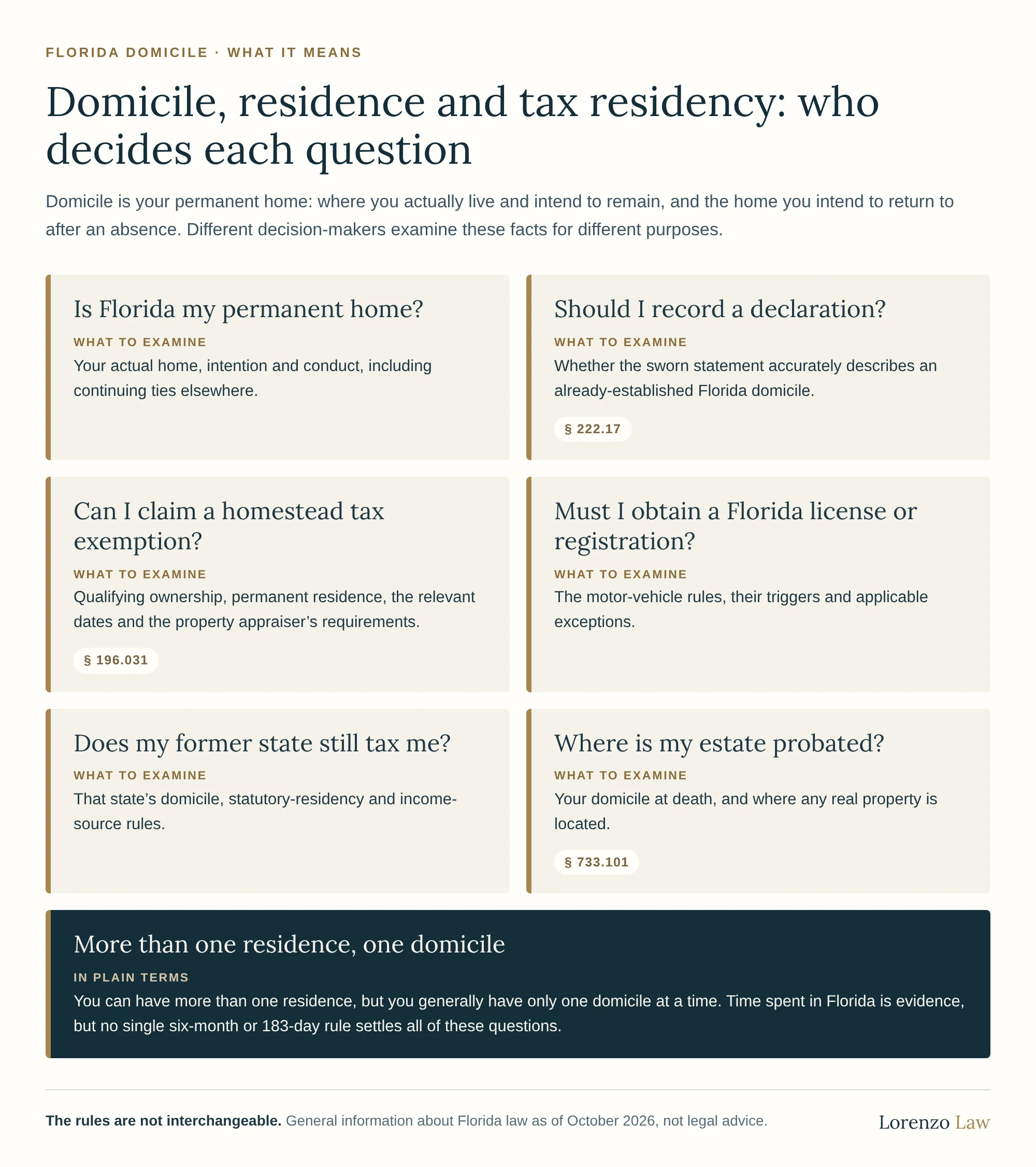
View the “Domicile, residence and tax residency: who decides each question” chart (zoom in to read; the details are also in the table above).
Domicile vs. residence: can you have dual residency in two states?
You can have homes, and even legal residency for some purposes, in more than one state. A state can treat you as a resident for its own income-tax rules, for example, because you kept a home there and spent enough days there, even though your domicile is elsewhere; that is what “resident but not domiciled” means. That is the practical difference between Florida residency and domicile, or resident vs. domicile: dual residency is possible for some purposes, but your legal domicile is narrower, because it identifies the one place that is your permanent home. That is why your records should point consistently to one permanent home, and why time spent in another state still needs to be tracked.
What Are the Requirements for Florida Domicile and Residency?
Florida domicile generally requires an actual home in Florida and the intention to make it your permanent home. No single factor decides the question: buying a house, recording a declaration or getting a Florida license does not prove domicile by itself, and the facts are weighed together.
The Florida Supreme Court describes domicile as the combination of an actual move, shown by overt acts, and the intention to remain, and says establishing it usually depends on a variety of acts and declarations that must all be weighed (Bloomfield v. City of St. Petersburg Beach, 82 So. 2d 364 (Fla. 1955)). Florida courts have more recently restated that a person may maintain several residences but can have only one domicile, judged on the totality of the circumstances (de Oliveira v. de Oliveira, 435 So. 3d 170 (Fla. Dist. Ct. App. 2026)).
When people ask about Florida residency requirements or Florida state residency requirements, they usually mean what it takes to make Florida their legal home. There is no single Florida residency law that applies to every purpose, but the core test for domicile is the same. The first part is objective: where you actually live, and whether you have a home here that you occupy. The second is about intention: whether you mean to remain in Florida as your permanent home rather than stay temporarily. Intention is shown by conduct and consistent records, not by a statement alone. Describing yourself as a Florida resident cannot substitute for actually establishing your home here.
Different decision-makers examine these facts for different purposes. A county property appraiser decides permanent residence for the homestead tax exemption; Florida’s motor-vehicle agency applies its own new-resident rules; a probate court looks at domicile when an estate is opened; and another state’s tax department applies its own law. A record that satisfies one of them does not automatically satisfy the others. That is why the evidence checklist below is organized by what each record shows, not by a single pass-or-fail test.
Is There a 6-Month or 183-Day Rule for Florida Residency?
Time spent in Florida is evidence, but there is no single six-month or 183-day rule that settles all these questions.
Searches for a Florida 183-day rule or Florida residency requirements of six months usually reflect another state’s income-tax rules or an agency’s own rules, not a Florida domicile test. Florida’s declaration statute does not require any minimum stay before a declaration is recorded. Florida’s motor-vehicle statutes do treat maintaining a principal home here for more than six consecutive months as one of several ways to become a resident for license and registration purposes (sections 322.01(36) and 320.01(34)); that is a licensing rule, not a domicile test.
Keep an accurate travel calendar, especially if you continue using a home in another state. Do not wait six months to check administrative deadlines that may arise much sooner.
New York illustrates the distinction: its published income-tax guidance includes a separate resident test involving a permanent place of abode for substantially all the tax year and 184 or more days in New York, even when the person is domiciled elsewhere. Definitions, exceptions and day-counting rules matter. This is a New York example, not a Florida domicile requirement or a nationwide rule (New York income-tax definitions).
Florida’s motor-vehicle agency also lists living in Florida for more than six consecutive months among the indicators it uses for its own new-resident purposes. That is an agency rule for licensing and registration, not a general domicile test.
You may also see a “six-month rule” for Florida divorce. That rule concerns how long a spouse must have resided in Florida before filing for dissolution of marriage; it is not a test of domicile for estate, homestead or tax purposes.
Are snowbirds considered Florida residents?
It depends on where their permanent home actually is. A seasonal visitor who keeps a principal home elsewhere and returns to it each year is generally domiciled there, however many months are spent in Florida. A person who has moved their permanent home to Florida can still travel or spend summers elsewhere. What matters is which home is the permanent one, shown by consistent conduct and records, not the number of months alone.
How long does it take to become a Florida resident, and what is the fastest way?
There is no general Florida waiting period for domicile itself. A change can take place once you are actually living in your Florida home with the present intention to remain; Florida courts look for an intention to make a home now, not at some point in the future. Proving the change is a separate matter: the evidence builds over time, and some benefits turn on fixed dates, such as status on January 1 for the homestead tax exemption. Agency clocks for licenses and vehicle registration start from their own triggering facts and can run much sooner. The fastest way to become a Florida resident is simply to make the move real: establish your home here, then promptly bring your license, vehicle registration, voter information (if eligible), any declaration and your financial and estate records into line with it.
How to Establish Florida Domicile: A Florida Residency Checklist
If you are making Florida your permanent home, the categories below can help you organize evidence of domicile. A particular residency application may require different documents or additional qualifications, so follow the rules for that application. Consistent records help explain your move, but no single set of documents proves eligibility for every purpose.
Use this Florida domicile checklist to prepare for advice and keep accurate records. It is not a scorecard, and completing every item does not guarantee a legal or tax result. Some items will not apply to you.
Home
- Keep the deed or lease for the Florida home you actually occupy, together with moving records, utilities and insurance information.
- Record when you moved and how you use each home. A rented home can be relevant evidence; buying Florida property is not the only way to establish a home here.
- Identify any retained home elsewhere, who uses it and when it remains available to you. Keep travel records rather than estimates prepared long after the fact.
- Discuss household circumstances, including where a spouse or dependent children live, work and attend school, when relevant.
Records
- Update your mailing address with financial institutions, insurers, creditors and government agencies as appropriate. A forwarding address alone does not establish domicile.
- Review applicable Florida driver’s-license, identification-card, vehicle-registration and insurance requirements.
- Register or update voter information only if eligible. Voting has its own citizenship and eligibility requirements; it is not a step every relocating person can take.
- Keep any recorded declaration, exemption application and agency correspondence. Address inconsistencies honestly rather than assuming one favorable document overrides them.
- Review where important papers and safe-deposit-box contents are kept and how an authorized person could obtain them when needed. Opening a local bank account or moving a box is not a universal legal requirement.
Intention and continuing ties
- Explain whether Florida is your permanent home or a temporary stay, and keep records consistent with that intention.
- Review employment, business, family and community connections in both places. Retaining a connection elsewhere does not answer the whole question, but it should not be concealed or ignored.
- Make sure statements in wills, trusts and other documents match the facts. Describing yourself as a Florida resident cannot substitute for actually establishing your home here.
Professional review
- Bring your existing will, trust and amendments, powers of attorney, health-care documents, deeds and beneficiary information to an estate-planning review.
- Ask a qualified tax adviser about the move year, future filing obligations, retained property or business income, and the records needed under the former state’s rules.
- Obtain appropriate cross-border tax or immigration advice if you have international connections. Florida domicile does not establish immigration status or resolve federal tax residency (IRS guidance on resident and nonresident aliens).
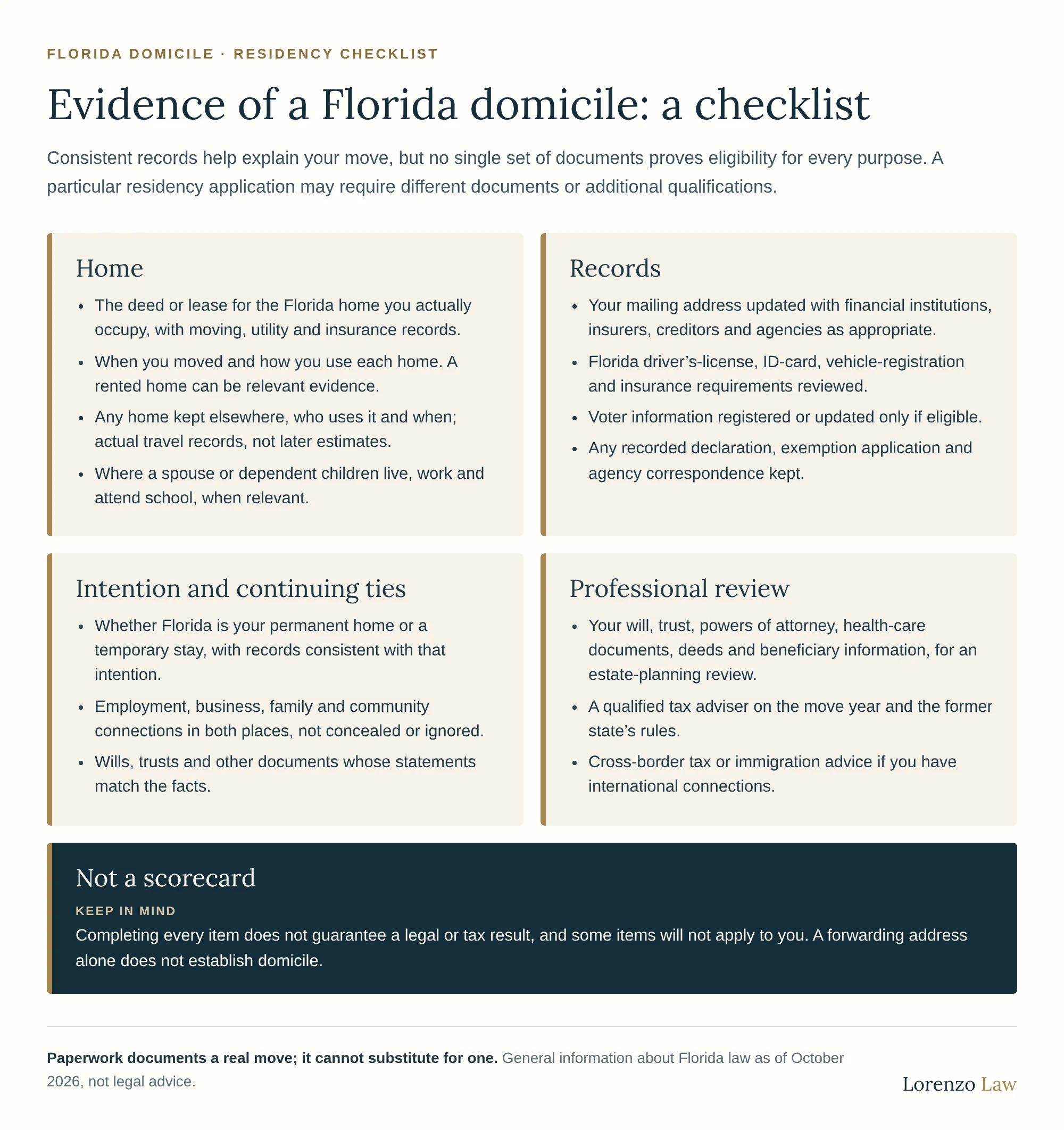
View the “Evidence of a Florida domicile: a checklist” chart (zoom in to read; the details are also in the text above).
Can a mail-forwarding service or virtual mailbox establish Florida domicile?
Not by itself. Domicile depends on an actual home and the intention to keep it. A mailing address, whether a post office box, a virtual mailbox or one of the Florida domicile services and mail-forwarding companies that full-time RV travelers and digital nomads use, shows where your mail goes, not where you live. Agencies, banks and insurers also apply their own address and documentation rules. If you do not have a fixed Florida home, get advice before relying on a mailing address to support domicile, a homestead application, a sworn declaration or an estate plan.
Can you keep a home in another state?
Yes. Owning or using a home elsewhere does not by itself prevent Florida domicile, and Florida’s declaration statute addresses people who keep another home outside Florida. A retained home is evidence that will be weighed, however: how often you use it, who lives there, and where your family, work and belongings are all matter. Keep an accurate travel calendar, and describe the retained home the same way in every document.
Can you become a Florida resident without living there?
Not for domicile purposes. People often search for how to become a Florida resident without living there, or online; paperwork can document a real move, but it cannot substitute for one. A declaration, a Florida address or a Florida license obtained without an actual home here invites challenges and can leave you with sworn statements that conflict with your other records.
Florida Declaration of Domicile (Section 222.17)
A Florida declaration of domicile, the formal way of declaring Florida residency, is a sworn statement, recorded with the clerk of the circuit court in the county where you live, describing your Florida home and your intention to maintain it. It is evidence of a domicile you have already established; it does not create one.
What a declaration of domicile does, and does not do
Florida law permits a person who has established domicile here to record a sworn declaration with the clerk of the circuit court in the county where the person resides. The declaration records facts about the Florida home and the intention to maintain it. The statute also addresses people who keep another home outside Florida (section 222.17).
The declaration is evidence; recording it does not create a permanent home that does not exist, decide another state’s tax claim or replace a homestead application. Other methods of proving domicile remain available under the statute.
Do you have to file a declaration of domicile in Florida?
No. The statute permits a declaration; it does not require one, and other ways of proving domicile remain available. Many people record one because it is a dated, sworn record of the change. Before signing, make sure every statement is true, including any other residence you are asked to disclose. The declaration is made under oath, and it can later be compared with your other records, including by a property appraiser, a probate court or another state. Courts treat a recorded declaration as evidence of intent to be weighed with everything else, not as conclusive proof of domicile.
What the declaration asks
County forms follow the statute. They generally ask for your name, your Florida residence address and county, a sworn statement that you are a bona fide Florida resident and intend to maintain your permanent home here, the city, county and state where you formerly lived, and any other place of abode you keep outside Florida (section 222.17(3)). Some counties publish a bilingual form; Osceola County’s, for example, is titled in English and Spanish. For an example of the information requested, see the Osceola County clerk’s declaration form. Lorenzo Law does not provide a copy, template or filled-in sample of the form. Florida does not issue a separate “certificate of domicile”; after recording, you can ask the clerk for a certified copy of the recorded declaration.
How to get and file a declaration of domicile in Florida, by county
Use your county clerk’s current form and recording instructions, sign under oath before an authorized official, disclose the requested residences accurately and keep the recorded copy. Record it in the county where you live. The table below links each clerk’s official page as published in October 2026; confirm your own county’s submission method and current charges before filing.
| County | Official page | How the office says to submit it | Published fee notes |
|---|---|---|---|
| Osceola (Kissimmee) | Clerk’s declaration form (English and Spanish); recording FAQ | The clerk’s recording FAQ lists in-person, mail and electronic recording for documents generally. The form provides for physical or online notarization. | See the clerk’s recording fees. |
| Orange | Comptroller Official Records FAQ | Have the form notarized before coming to Official Records, or take the oath there. | $10 if already notarized; $13.50 with the oath taken at Official Records. |
| Miami-Dade | Clerk’s declaration of domicile page | In person at the Miami-Dade Justice Center or by mail; must be notarized first. Follow the clerk’s current submission requirements. | $10 recording; $3 certified copy. |
| Broward | Records, Taxes and Treasury Division | Contact the county Recording Office for current declaration submission instructions. Broward recording is handled by this division. | Confirm current recording, copy and notarization charges with the Recording Office. |
| Palm Beach | Clerk’s declaration of domicile page | Bring or mail the form to a Clerk’s office location. | See the clerk’s fees page (recording fee plus a signature-verification fee if signed at the clerk). |
| Hillsborough | Clerk’s recording page | By mail or in person, as the page directs. | $10 recording. |
| Pinellas | Clerk’s recording services page | Consult the clerk’s current Recording Services instructions for the declaration form and accepted submission methods. | See the clerk’s fee schedule. |
| Duval | Clerk’s recording page | Ask the Recording Department to issue a “Notice of Domicile,” or record a form you have had notarized. | $15 total for a clerk-issued notice; $10 to record a notarized form. |
| Lee | Clerk’s instructions and form | Confirm the current declaration form, signing instructions and submission method with the Lee County Recording Office. | Confirm current recording and any notarization charges with the Recording Office. |
| Collier | Clerk’s recording forms | The form provides for physical or online notarization. | See the clerk’s fee schedule. |
| Sarasota | Clerk’s recording requirements | Electronically, in person or by mail; recordable only in the county where you reside. The clerk notes it is not a homestead exemption application. | Recording charges apply; an additional attestation fee applies if signed before a deputy clerk. See the clerk’s current fee schedule. |
| Brevard | Clerk’s recording forms | Form on the clerk’s recording-forms page. | See the clerk’s fee schedule. |
| Volusia | Clerk’s forms page (form CL-0575) | The form provides for physical or online notarization. | See the clerk’s fee schedule. |
In Polk, Manatee, Pasco, St. Johns, Leon, Monroe, Charlotte, Indian River and every other county, start with the clerk of the circuit court’s official recording page. A clerk can explain its recording requirements and fees, but it cannot give legal advice or tell you whether your facts support a Florida domicile.
How much does a declaration of domicile cost in Florida?
Florida sets recording and related service charges by statute (section 28.24); the county clerk collects those statutory amounts, and the clerk’s office can confirm the current total for your filing (section 222.17(5)). As published in October 2026, Miami-Dade and Hillsborough each list a $10 recording fee for a declaration, and some offices list separate charges for a certified copy or for signing before a deputy clerk. Check the clerk’s current instructions before paying.
Declaration of domicile vs. affidavit of domicile
They are different documents. A declaration of domicile is your own sworn statement about where you live, recorded under section 222.17. An affidavit of domicile is a form that brokerage firms and transfer agents commonly request when stock or other securities registered to someone who has died are transferred or re-registered. It typically states where the deceased owner was domiciled at death, and each institution sets its own form and signing requirements. It is the institution’s requirement, not a Florida statutory form. If you are a personal representative or beneficiary asked to sign one, the domicile you state should match the probate filings; see why domicile at death matters.
Florida Homestead: Three Different Rules
Owning a Florida home does not automatically qualify you for the homestead property-tax exemption. The general rule looks to qualifying title and permanent residence (yours or a dependent’s) on January 1, with an application normally due by March 1.
To file for the Florida homestead exemption, apply to your county property appraiser, not to the clerk recording your declaration; the Florida homestead exemption deadline is normally March 1. The homestead exemption requirements in Florida generally include holding legal or equitable title to the property on January 1 and, in good faith, making it your permanent residence — or the permanent residence of someone legally or naturally dependent on you (section 196.031(1)(a)). Special provisions and late-filing relief may apply; contact the property appraiser promptly about a missed deadline (sections 196.031 and 196.011).
The property appraiser considers evidence of permanent residence under section 196.015, including the declaration, identification, addresses, utilities and other relevant facts. That section also has specific provisions for military transfers and certain federal assignments outside Florida. A general moving checklist should not be used to decide those situations.
Homestead property-tax benefits, protection from certain creditors and restrictions on transfer at death are distinct subjects. Before changing a deed or deciding who will inherit the home, review the ownership and family circumstances.
| Homestead rule | Who decides | What to know |
|---|---|---|
| Property-tax exemption | The county property appraiser | Qualifying title and permanent residence (yours or a dependent’s) on January 1; application normally due March 1, with exceptions and late-filing relief. A declaration of domicile is evidence, not the application. |
| Protection from creditors | Courts, under the Florida Constitution | Can protect a qualifying homestead from forced sale by many creditors, subject to exceptions. It is a separate question from the tax exemption. |
| Restrictions on transfer at death | The probate court | Can limit how the homestead of a Florida resident passes when a spouse or minor child survives. See Florida homestead and probate. |
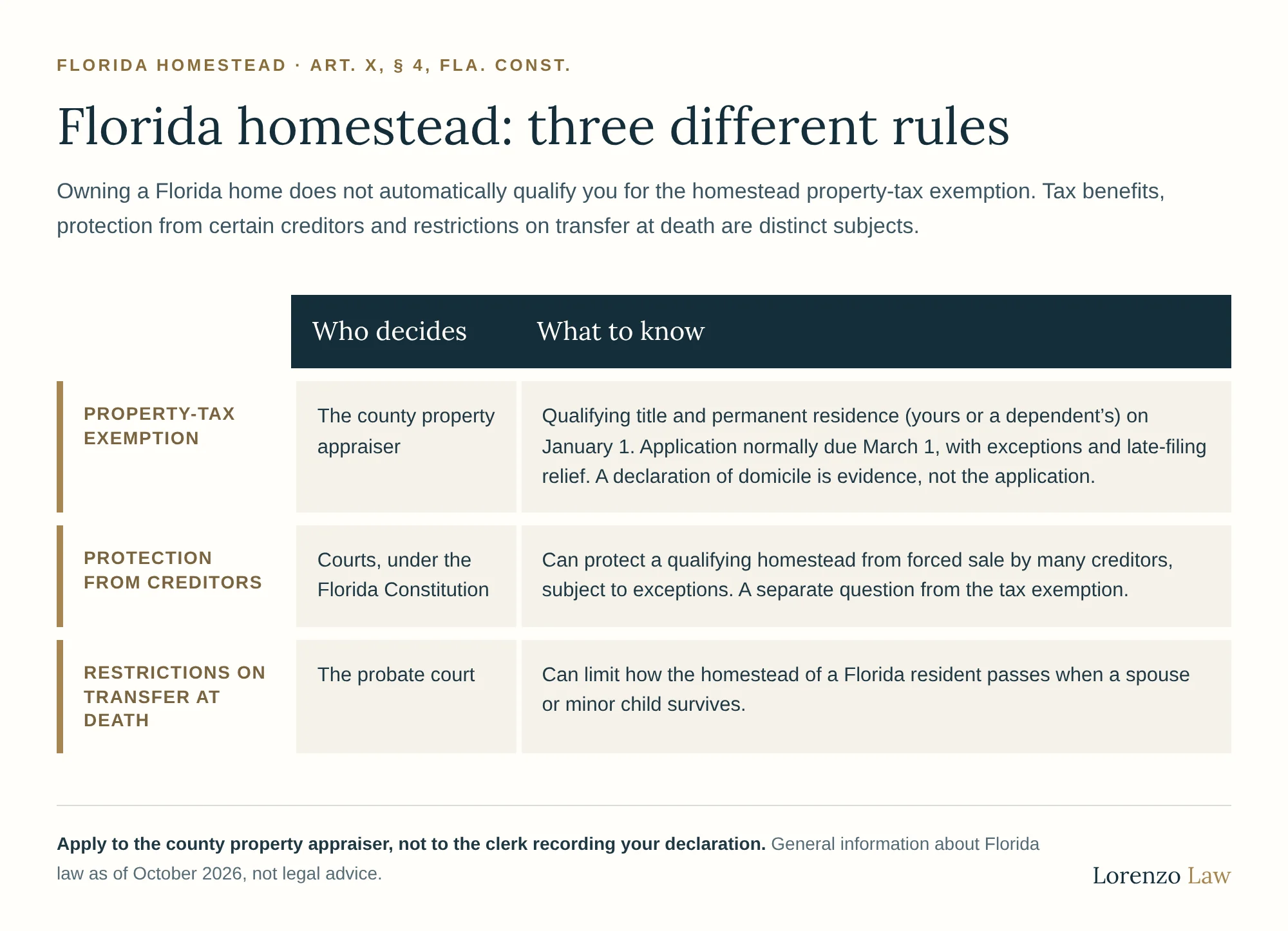
View the “Florida homestead: three different rules” chart (zoom in to read; the details are also in the table above).
Florida Driver License, Vehicle and Voter Steps for New Residents
Check license and vehicle deadlines promptly. They are administrative rules with their own triggers, not a test of domicile.
Florida requires a Florida driver license to drive on Florida highways (section 322.03). If you accept employment, engage in a trade or profession, or enroll your children in a Florida public school, you must obtain a Florida license within 30 days of that event, and you must register your vehicles within 10 days (section 322.031; section 320.38). These deadlines are tied to those specific events. A new resident who does not work or enroll children here — for example, a retiree — still needs a Florida license to drive and Florida registration for a vehicle operated here once he or she becomes a Florida resident, which happens by maintaining a principal home in Florida for more than six consecutive months, registering to vote, filing a declaration of domicile, or filing for the homestead exemption (sections 322.01(36) and 320.01(34)). Limited exceptions exist (for active-duty military, certain out-of-state commuters, and students), and the exceptions for licensing are not identical to those for vehicle registration (section 322.031(2)–(3); sections 320.37 and 320.38). Review FLHSMV’s current new-resident instructions for insurance, identification and vehicle documents.
Transferring your license to Florida and completing Florida vehicle registration as a new resident are separate steps from recording a declaration, although filing a declaration is itself one of the ways you become a Florida resident for license and registration purposes. These administrative rules are not a universal legal-domicile test. Check the rule for your situation rather than assuming that a seasonal stay or an out-of-state license automatically exempts you (sections 322.031, 320.37 and 320.38).
Register or update voter information only if you are eligible; see the Florida Division of Elections. When you register in Florida, Florida election officials notify the state where you were previously registered (section 97.073(2)), and you can also cancel the old registration directly under that state’s procedures, so your records do not show active registrations in two places. Florida voter registration is also one of the factors a property appraiser weighs in deciding permanent residence for homestead (section 196.015).
Review Your Estate Plan After Moving to Florida
Estate planning when moving to Florida starts with a review, not a rewrite. Moving to Florida does not automatically invalidate every document signed elsewhere or mean that every document must be replaced. Have the actual documents reviewed, including how and when they were signed and how your assets are owned.
- Wills: A will offered for probate in Florida must generally be signed by the testator at the end and witnessed by two attesting witnesses who sign in the presence of the testator and of each other. Florida also recognizes a will — other than a holographic or nuncupative will — that was executed while the person was a nonresident, if it was valid where it was executed; a will in the testator’s handwriting that was signed with two witnesses is not treated as holographic. A will executed while the person was a Florida resident must meet Florida’s signing-and-witnessing requirements wherever it is signed. A military testamentary instrument executed under federal law (10 U.S.C. § 1044d) by a person eligible for military legal assistance is also valid in Florida (section 732.502). Moving here is a reason to have your will reviewed, not a reason it automatically needs replacing.
- Trusts: Review the trust, amendments, funding and applicable law. Florida domicile at the time of execution can matter to the formalities for a revocable trust’s testamentary provisions. Changing an address does not automatically fund or relocate a trust (section 736.0403).
- Powers of attorney and health-care documents: Review whether the documents are valid and suitable for use here, whom they authorize and whether the authority still fits your wishes. Florida has a recognition provision for qualifying powers of attorney executed in another state (section 709.2106). See Florida durable powers of attorney and health care surrogates.
- Deeds and beneficiaries: Coordinate the Florida home, other property, account ownership and beneficiary designations with the plan. A will’s residence clause does not change a deed or an account beneficiary. Property in another state may require advice from counsel there. See beneficiary designations.
Can your out-of-state personal representative still serve?
Not always. Florida limits who may serve as the personal representative of an estate administered here when the person named does not live in Florida: a nonresident qualifies only if he or she is the decedent’s legally adopted child or adoptive parent; is related to the decedent by lineal consanguinity, such as a child, grandchild or parent; is the decedent’s spouse, brother, sister, uncle, aunt, nephew or niece, or a lineal relative of one of them; or is the spouse of a person who qualifies (section 733.304). A friend, adviser or other unrelated person named in a will signed elsewhere may not qualify once your estate is administered here. Review your nominations after the move; see serving as an out-of-state personal representative in Florida.
Should your trust be administered in Florida?
Moving to Florida does not by itself move a trust. Where a trust is administered generally depends on its terms, where the trustee is and where administration actually takes place. When a trustee transfers a trust’s principal place of administration, Florida’s statutory procedure calls for at least 60 days’ advance notice to the qualified beneficiaries where that procedure applies; the trust’s own terms can modify this default, and while a trust is revocable the trustee’s duties run to the settlor rather than to the beneficiaries (section 736.0108; section 736.0105; section 736.0603(1)). Review the trust’s governing-law and administration provisions, whether a trustee located elsewhere still makes sense, and how Florida banks and title companies will confirm the trustee’s authority. If you are considering a Florida living trust (a revocable living trust) for the first time, the same review applies. See living trusts in Florida.
Moving from a community-property state
If you and your spouse acquired property while living in a community-property state, such as California, Texas or Arizona, that property can keep its community-property character after you move. Florida’s Uniform Disposition of Community Property Rights at Death Act (sections 732.216–732.228) governs how such property is treated at death, which can affect what passes to the surviving spouse and how assets should be titled. Bring records of where and when assets were acquired to your estate-planning review.
Snowbirds with property in two states: avoiding a second probate
Owning, or inheriting, property in another state raises the question of where to probate a will for that property. Real property is generally administered where it is located. If you are domiciled in Florida and still own a home elsewhere, that home may need its own proceeding in the other state; if you are domiciled elsewhere and own a Florida home, Florida ancillary administration may be needed. A funded revocable trust, survivorship ownership or, for Florida real property, an enhanced life estate (Lady Bird) deed can avoid a second proceeding for that property, and each has trade-offs. See ancillary probate in Florida and Lady Bird deeds for out-of-state owners.
Why Your Domicile at Death Decides Your Probate
Your domicile when you die generally determines where your main probate, called domiciliary probate, is opened, which state’s rules govern your surviving spouse’s rights, and whether Florida’s homestead inheritance restrictions apply. Real property in another state may still need its own proceeding there.
Domicile can also affect where probate is opened, but it does not eliminate every proceeding concerning property elsewhere. Florida’s probate venue statute contains separate provisions for residents and nonresidents (section 733.101).
| Question at death | Why domicile matters | Read more |
|---|---|---|
| Where the main probate is opened | A Florida domiciliary’s estate is generally administered in the county where the decedent was domiciled; the venue statute has separate provisions for nonresidents (§ 733.101). | Probating a will in Florida |
| Florida property of a nonresident | When a person domiciled elsewhere leaves Florida property that needs probate, Florida ancillary administration is generally used (§ 734.102). | Ancillary probate; non-citizen estates |
| The surviving spouse’s elective share | Florida’s elective share is available to the surviving spouse of a person who dies domiciled in Florida (§ 732.201). For a nonresident, the spouse’s rights depend on the law of the decedent’s domicile. | Florida’s elective share |
| Homestead inheritance restrictions | The constitutional limits on devising a homestead when a spouse or minor child survives apply to the homestead of a Florida resident (Art. X, § 4(c), Fla. Const.; § 732.4015). | Homestead and probate |
| Exempt property and family allowance | Florida’s exempt-property and family-allowance protections are tied to a decedent domiciled in Florida (§§ 732.402, 732.403). | Surviving spouse rights; family allowance |
| Who inherits without a will | Personal property generally passes under the intestacy law of the decedent’s domicile; real property generally under the law of the state where it is located. | Florida estate planning guide |
| Who may serve as personal representative | Florida’s restrictions on nonresident personal representatives apply to estates administered here (§ 733.304). | Becoming a personal representative |
| State estate or inheritance tax | Florida does not impose its own estate or inheritance tax, but a former state that does may claim the decedent never changed domicile. | Florida estate and inheritance tax |
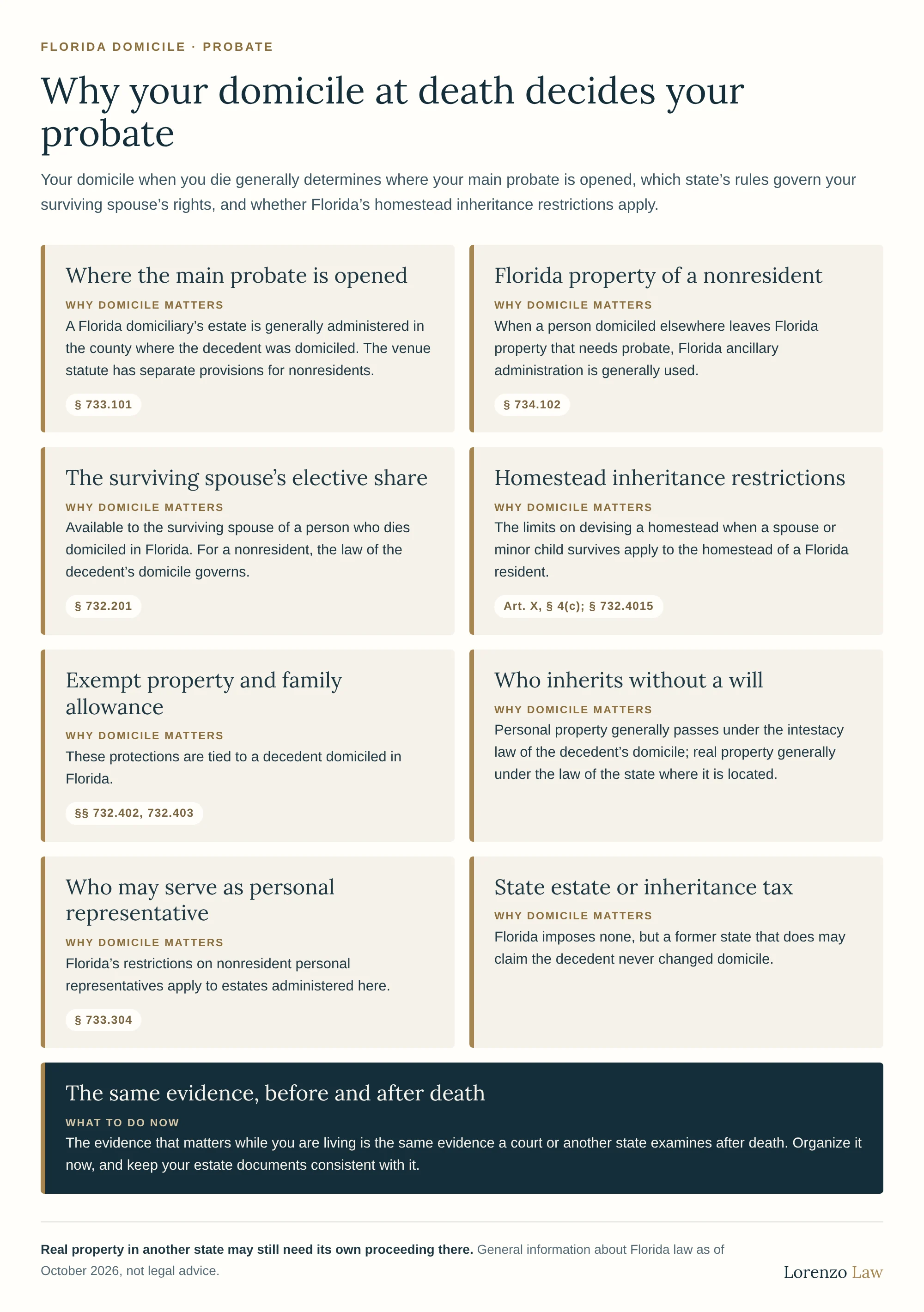
View the “Why your domicile at death decides your probate” chart (zoom in to read; the details are also in the table above).
The evidence that matters while you are living is the same evidence a court or another state examines after death. Organizing it now, and keeping your estate documents consistent with it, is the most practical way to spare your family a dispute over where you lived.
When Domicile Is Disputed After a Death
A contested domicile is a probate litigation issue. Domicile can be contested after a death when it changes who inherits, where probate belongs or which state can tax the estate. The question is decided on the evidence of where the person actually lived and intended to remain; a recorded declaration of domicile is one piece of that evidence, not the end of the inquiry.
Who raises domicile, and why
- A surviving spouse whose elective share, exempt property or homestead rights depend on whether the decedent was domiciled in Florida.
- Children or other heirs, when domicile affects whether the homestead restrictions apply, which intestacy law governs, or whether a will provision can be enforced.
- An interested person challenging venue or the appointment of a personal representative.
- A former home state’s tax authority claiming the decedent never changed domicile, for its estate or inheritance tax.
- Creditors, where domicile affects whether a home is protected homestead.
What evidence decides a domicile dispute?
Usually the same categories as the evidence checklist above: where the person lived and for how long, the homes kept in each place, family and community ties, licenses, registrations and voter records, tax filings, statements in wills and trusts, any recorded declaration, and travel records. Inconsistent records, such as a Florida declaration alongside resident tax returns filed in another state, are what these disputes are built on. A recorded declaration is admissible evidence of intent, but it is not conclusive, and courts weigh it with all the other facts. The person claiming that domicile changed generally bears the burden of proving it (Miller v. Nelson, 35 So. 2d 288 (Fla. 1948)).
Is there a deadline to raise domicile in a Florida probate case?
Yes. In a Florida estate, an objection to venue, which can turn on where the decedent was domiciled, generally must be filed within three months after service of the notice of administration (section 733.212(3); Pastor v. Pastor, 929 So. 2d 576 (Fla. Dist. Ct. App. 2006)). Anyone who may have a domicile objection should get advice as soon as the notice arrives.
What should a personal representative do?
Preserve the decedent’s records early, identify every state that may claim the estate, and get advice before conceding domicile in a filing, paying another state’s tax or opening proceedings in more than one place. The petition for administration must state the state and county of the decedent’s domicile (Fla. Prob. R. 5.200), so positions taken there, in tax filings and in any affidavit of domicile should be consistent.
Help with a Florida probate dispute
Lorenzo Law handles disputes over estates and trusts in Florida probate courts, including contested questions that turn on domicile. See Florida probate litigation, estate litigation, will contests and trust litigation. Another state’s tax audit or tax litigation requires a qualified adviser in that state.
Address Former-State and International Tax Questions Separately
If I move to Florida, will I still owe taxes to my old state?
Whether you are moving to Florida from New York, New Jersey, Illinois, California or another state, do not assume that your next return to the former state is necessarily your last. A move can require a part-year return, and income connected to that state may create later filing obligations. Florida has no personal income tax, so these are questions under your former state’s law and federal law, not Florida law. Have the relevant tax professional evaluate the facts and the rules for that state. New York’s filing and residency guidance is one example of why moving and ending all filing obligations are different questions.
Cross-border income, citizenship, immigration status, treaties and estate or gift taxes may involve additional rules. This guide does not determine those obligations or offer a comprehensive multistate or international tax plan. If a former state opens a residency audit, for example a New York residency audit, the audit is handled under that state’s law by a qualified adviser there.
Florida Domicile: Frequently Asked Questions
Short answers to common questions. Each answer is limited by the qualifications in the sections above.
Does a declaration of domicile get me the homestead exemption?
No. The homestead property-tax exemption requires its own application to the county property appraiser and its own qualifying facts, including title and permanent residence on January 1. A recorded declaration is one piece of evidence the property appraiser can consider.
Do I need a notary to sign a Florida declaration of domicile?
Yes, or another official authorized to take affidavits. The statute requires the declaration to be signed under oath before such an official (section 222.17(5)); in some counties a deputy clerk can administer the oath for an added fee. Florida law also allows the oath to be taken through a compliant online notarization (section 117.215), and some county forms provide for it. Follow your county clerk’s current instructions.
Can I file a declaration of domicile online?
It depends on the county. Some clerks say they accept recordings electronically, in person or by mail; others list only in-person and mail filing for this document. Check the clerk’s page in the county table above.
Is my out-of-state will valid in Florida?
Often, but the facts at signing matter. A will offered for probate in Florida must generally be signed by the testator at the end and witnessed by two attesting witnesses who sign in the presence of the testator and of each other. Florida also recognizes a will — other than a holographic or nuncupative will — that was executed while the person was a nonresident, if it was valid where it was executed; a will in the testator’s handwriting that was signed with two witnesses is not treated as holographic. A will executed while the person was a Florida resident must meet Florida’s signing-and-witnessing requirements wherever it is signed. A military testamentary instrument executed under federal law (10 U.S.C. § 1044d) by a person eligible for military legal assistance is also valid in Florida (section 732.502). Have the will reviewed for how it was signed and whether its provisions, such as the personal representative named, still work here.
Does Florida recognize my out-of-state power of attorney?
Florida has a recognition provision for qualifying powers of attorney executed in another state, but institutions may still question an unfamiliar document. Review whether yours is valid and practical to use here and whether the authority still fits your wishes.
Do I need new health-care documents after moving to Florida?
Not necessarily, but they should be reviewed. Florida treats an advance directive executed in another state as validly executed if it complied with that state’s law or Florida’s (section 765.112). Still, check whether the people you named remain the right choices and are reachable, and whether a Florida designation of health care surrogate would be easier for local providers to use.
Can one spouse be domiciled in Florida and the other in another state?
It is possible, but where a spouse and family live is evidence that will be weighed, and different domiciles can complicate taxes, homestead and estate planning. Married couples should review the facts together rather than assume one spouse’s move covers both.
Which state probates my will if I have homes in two states?
Generally, the main probate is opened in the state where you were domiciled at death, and real property located in another state may need a separate ancillary proceeding there. Planning tools such as a funded revocable trust can avoid the second proceeding for that property.
Does my domicile at death affect my spouse’s elective share?
Yes. Under the Florida elective share statute (section 732.201), the elective share is available to the surviving spouse of a person who dies domiciled in Florida. If the decedent was domiciled elsewhere, the spouse’s rights depend on that state’s law.
What is ancillary probate?
A secondary probate proceeding in a state where the decedent owned property but was not domiciled. It usually follows or runs alongside the main proceeding in the state of domicile and deals with the property located in the second state. In Florida, a shorter ancillary procedure may be available in limited cases for a nonresident who left a will and Florida property worth no more than $50,000 (section 734.1025).
Can my family challenge my Florida domicile after I die?
Yes, if domicile changes someone’s rights, such as a spouse’s elective share, homestead restrictions or which state can tax the estate. The dispute turns on the evidence of where you actually lived and intended to remain, which is why consistent records matter.
Does Florida have an estate or inheritance tax?
Florida does not impose its own state estate tax or inheritance tax. Federal estate tax rules can still apply to larger estates, and one of the states with an estate tax or inheritance tax may claim that a former resident remained domiciled there.
Can I establish Florida domicile if I rent?
Yes. Buying property is not the only way to establish a home here; a rented home you actually occupy can be relevant evidence of domicile. Renting does affect other benefits: the homestead property-tax exemption requires qualifying ownership (title) as well as permanent residence.
Can a non-U.S. citizen establish Florida domicile or claim the homestead exemption?
Domicile and immigration status are separate questions: Florida domicile does not establish immigration status, and immigration status does not by itself decide where someone’s permanent home is. For the homestead property-tax exemption, citizenship is not required. Eligibility turns on legal or beneficial title plus a good-faith permanent residence. A non-citizen’s immigration status matters only insofar as a temporary (nonimmigrant) visa is a legal impediment to forming the intent to reside here permanently; lawful permanent residents face no such impediment. An owner on a temporary visa may still qualify by maintaining the home as the permanent residence of a dependent, such as a U.S.-citizen child, who has no impediment (Garcia v. Andonie, 101 So. 3d 339 (Fla. 2012); Juarrero v. McNayr, 157 So. 2d 79 (Fla. 1963)). Confirm the application requirements with your county property appraiser. See non-citizen estates and ancillary administration.
Does a Florida domicile change my immigration status or federal tax residency?
No. Florida domicile does not establish immigration status or resolve federal tax residency. Obtain appropriate cross-border tax or immigration advice if you have international connections.
Does Florida residency affect Medicaid eligibility?
Florida Medicaid has its own residency requirement among many other conditions, applied under the Medicaid statute and the Department of Children and Families’ rules rather than the probate definition of domicile. Get advice before moving a parent who may need long-term care, and review powers of attorney and health-care documents at the same time.
Is Florida residency for college tuition the same as domicile?
No. Residency for in-state tuition is decided by the college or university under its own statute, which adds a 12-month test and its own documentation rules (section 1009.21). Meeting or failing that test does not decide domicile for estate, homestead or tax purposes.
Do I need a lawyer to establish Florida domicile?
Not to make the move. Many of the steps, such as getting a license, registering a vehicle or recording a declaration, are handled directly with the agency. Legal advice is most useful for reviewing your estate plan after the move, for homestead and deed questions, and when domicile may later be disputed.
Discuss Your Florida Estate Plan or a Domicile Question With Lorenzo Law
Lorenzo Law helps clients throughout Florida with estate planning, including wills, trusts, powers of attorney, health-care planning and appropriate deed and document review. If you are moving here, a useful starting point is to identify your current documents, property and family goals and discuss what needs attention under Florida law. See Florida estate-planning services.
If you are looking for a Florida domicile attorney or a Florida residency lawyer, the legal work usually lies in the estate plan and, later, the estate: domicile itself is established by how you live. If you are comparing Florida estate planning attorneys or probate attorneys in Florida, Lorenzo Law is a solo practice. You work directly with Jose M. Lorenzo, Jr. on your legal matter, with attorney consultations by appointment. When a family member has died and domicile affects the estate, such as where probate should be opened, a surviving spouse’s rights or property in another state, the same practice handles Florida probate administration and probate and trust disputes. Florida estate and probate attorney Jose M. Lorenzo, Jr. handles each matter himself, statewide and in English or Spanish.
Call (305) 224-6811 or request a free initial consultation with Jose Lorenzo. Consultations are available in English and Spanish, by phone and by appointment. Ask how to provide existing documents before sending sensitive records. The initial consultation does not promise a completed document review or a tax-residency determination; any legal work and fees depend on the agreed engagement.
Call (305) 224-6811 or Request a consultation
The principal office is in Kissimmee, Florida, with meetings by appointment in Coral Gables and Fort Lauderdale. For probate questions in the Kissimmee area, see Kissimmee probate lawyer. Former-state tax, international tax and immigration questions may require separate qualified advisers.
This article provides general information about Florida law. It is not legal advice and does not create an attorney-client relationship. Whether you have established Florida domicile depends on your own facts and records. It reflects Florida law and published agency information as of October 2026.
About the Author
Jose M. Lorenzo, Jr. was admitted to The Florida Bar on October 4, 2013, Bar number 107002. His pre-admission paralegal experience is described separately in his biography. Lorenzo Law’s principal office is in Kissimmee, with meetings by appointment in Coral Gables and Fort Lauderdale.
Authorities Cited on This Page
The statutes cited here are the 2026 Florida Statutes. Statutory text and agency instructions control over any summary on this page.