

LORENZO LAW · FLORIDA PROBATE
Florida Probate Lawyer
Florida probate attorney for estate administration and probate disputes, in English and Spanish
A Florida probate lawyer guides a family through the court process of settling an estate in Florida, from the first petition to the final discharge. Jose M. Lorenzo, Jr. is a Florida probate attorney who handles formal, summary and ancillary estate administration, and probate disputes, for clients throughout Florida, including families who live in another state or country.
When someone dies, the family's first questions are practical. Does this estate need probate? Who has authority to act? What must happen before property can be distributed? As the lawyer for estate settlement, Jose starts with your role, how the assets are owned, and whether a court case has already begun.
Lorenzo Law is a solo Florida law practice. Jose is the firm's only attorney, and he personally handles the matters the firm takes on. Consultations are available in English and Spanish, by phone or by appointment.
Request a free initial consultation Call (305) 224-6811
Only the consultation is free. Fees and costs for any representation are set separately, in a written agreement. Calls are answered 24 hours a day, and the firm follows up on inquiries within one to two business days.
What help do you need with the estate?
You do not need to know which probate procedure applies before contacting the firm. Explain what has happened and what you have been asked to do. Families usually arrive with one of these situations.
| Your situation | What to discuss |
|---|---|
| You are named as executor in a will (Florida's term is "personal representative"), or want to handle an estate without a will | Who is eligible to serve as personal representative, whether an appointment is needed, and the responsibilities involved. Being named in a will does not itself give you court-appointed authority. |
| A bank or title company has requested probate documents | The account ownership, deed, beneficiary designations and exact documents requested. These help determine whether probate is needed and which procedure fits. |
| The person lived outside Florida but owned Florida property | The Florida assets and any proceeding in the person's home state. Ancillary administration or another available Florida procedure may need to be considered. |
| You are an heir or beneficiary with questions about an existing estate | Your interest, notices received and the issue requiring advice. Representation must be evaluated for your particular role. |
| There is a contested will, disputed distribution or concern about a personal representative | Tell the firm about the disagreement and any deadline at the outset. Review the separate probate litigation service. If the dispute also involves a trust, a deed or transfers made before death, see Florida estate litigation. |
When an attorney represents the personal representative, that does not make the attorney counsel for every beneficiary. Identifying who the client will be is part of discussing representation. The Florida Bar explains this distinction.
If you are an heir looking for an inheritance attorney rather than counsel for the estate, say so when you contact the firm. Whether Jose can represent you depends on your role and a conflict review.
What a Florida probate attorney does for the estate
The work depends on the procedure, the estate and the agreed representation. An estate needing a summary-administration order involves different work from a formal administration with an appointed personal representative. Whether you call it a Florida probate administration attorney, a Florida probate administration lawyer or an estate administration attorney, Florida estate administration involves the same core work: getting legal authority, dealing with creditors, and transferring property correctly.
| Stage | Work to discuss with Jose |
|---|---|
| Assessing the estate | Reviewing the will, family information, ownership records, Florida venue and available probate procedures. |
| Opening the proceeding | Preparing the appropriate petition and supporting documents; seeking appointment and letters of administration when the procedure calls for them. |
| Administering a formal estate | Advising the personal representative about asset information, inventory, required notices, creditor issues and the records needed to carry out the administration. |
| Addressing property and distribution | Reviewing questions about estate property, homestead, beneficiaries and the authority needed for a proposed transfer or distribution. |
| Completing the matter | Preparing applicable closing documents and addressing the steps needed for distribution and discharge in a formal administration. |
This is a discussion of possible work, not a package in which every service is automatically included. Ask which tasks the engagement covers, which remain your responsibility, and how additional work will be addressed. Tax-return preparation, property-sale work and a separate lawsuit should each be discussed rather than assumed to be included.
Because Jose also handles probate litigation, a disagreement that develops during an administration can be assessed by the same attorney who already knows the estate. Whether one engagement can cover both depends on who the client is and on a conflict review. For a contested matter, see the Florida probate litigation attorney page.
For a fuller explanation of the stages, read the Florida probate process guide. The Florida probate guide collects the firm's educational resources and answers to common Florida probate questions.
How much does a probate lawyer cost in Florida?
How much should a probate lawyer cost in Florida, and how much should I expect to pay a probate lawyer? There is no single price for Florida probate. Florida probate attorney fees, and overall probate attorney cost, depend on the procedure, the assets, the creditors and whether anyone disagrees. Florida probate attorneys may charge:
- a flat fee
- an hourly rate
- a fee tied to the value of the probate estate
The arrangement should be agreed in writing before work begins. Florida law does not set a mandatory attorney fee for estate administration.
What Florida law does provide, in the Florida Statutes probate attorney fees section, is a schedule of fees presumed reasonable for an attorney's ordinary services to a personal representative (section 733.6171):
| Value of the probate estate (inventory value plus income earned during administration) | Presumed-reasonable fee |
|---|---|
| Up to $40,000 | $1,500 |
| $40,001 to $70,000 | $2,250 |
| $70,001 to $100,000 | $3,000 |
| Next $900,000 (to $1 million) | plus 3% |
| $1 million to $3 million | plus 2.5% |
| $3 million to $5 million | plus 2% |
| $5 million to $10 million | plus 1.5% |
| Over $10 million | plus 1% |
For example, under the schedule an estate with $300,000 in probate assets carries a presumed-reasonable fee of $9,000 for ordinary services: $3,000, plus 3% of $200,000.
Keep four points in mind:
- The schedule is not a price list. The fee is negotiable, it need not be based on the size of the estate, and the presumed-reasonable figure may not suit every administration.
- The value base counts probate assets only. Assets that actually pass outside probate, such as property that passes to a surviving joint owner, an account paid to a living named beneficiary, and trust assets, are not included.
- Extraordinary services can be billed separately. Examples include a property sale, litigation or tax work.
- You may choose your own attorney. The personal representative is not required to use the attorney who prepared the will.
The schedule is not a quote from Lorenzo Law.
Flat fees at Lorenzo Law. Lorenzo Law handles summary administrations and uncontested formal administrations for a Florida probate attorney flat fee. Each flat fee includes the costs of the procedure, such as court filing fees, so the fee agreed in writing is what you pay for the work it covers.
| Procedure | Flat fee, costs included |
|---|---|
| Summary administration | Starting at $3,975 |
| Uncontested formal administration | Starting at $7,975 |
The quote can be higher depending on the estate, for example the number of beneficiaries, the number and type of assets, real estate, creditor claims, or whether anyone disagrees. Jose reviews these factors with you and quotes the fee before the engagement begins. Once the fee is agreed in writing, no additional charges apply to the work the agreement describes. Work that falls outside the agreement's scope, such as defending a will contest, is quoted and agreed separately before it begins.
When comparing a Florida probate attorney flat fee from any firm, ask two things: exactly what the flat fee includes, and what would make the matter "contested" or outside the quote.
Summary administration: Florida cost. Summary administration generally involves less court work than formal administration, because no personal representative is appointed. The cost of summary administration in Florida still depends on:
- the number of beneficiaries who must join or be served
- the creditor search
- whether real estate is involved
Florida summary administration attorney fees are agreed like any other fee, in writing.
Cost of ancillary probate in Florida. A nonresident's Florida estate adds the cost of coordinating with the home-state proceeding, and of obtaining authenticated copies of it.
Cost to probate a will in Florida, beyond attorney fees, can include:
- court filing charges
- publication of the notice to creditors
- certified copies and appraisals
- a bond
The personal representative's fee. The personal representative is also entitled to reasonable compensation. Florida's statute presumes as reasonable 3% of the first $1 million, 2.5% up to $5 million, 2% up to $10 million, and 1.5% above that. So the executor fee in Florida and the Florida personal representative fee are separate from attorney fees for estate administration.
Affordable, low-cost and pro bono options. If the estate is small, ask whether summary administration or a small-estate procedure fits. That is often the most affordable probate path. Families who need an affordable probate attorney, a low cost probate attorney (Florida legal aid organizations can help qualifying families) or pro bono probate lawyers can also contact The Florida Bar Lawyer Referral Service.
Before hiring anyone, discuss:
- Who the firm will represent and the work the engagement covers.
- How attorney fees will be calculated, when payment is due, and how additional work is handled.
- Court charges and possible third-party expenses, such as publication of the notice to creditors, certified copies, appraisals or a bond.
- Who will pay each expense, and whether payment or reimbursement from estate funds is appropriate.
The initial consultation with Jose is free; fees and costs for representation are agreed separately, in writing. For more on average cost of probate in Florida and Florida probate fees, read how much probate costs in Florida.
Types of probate in Florida: formal, summary and ancillary administration
Estate administration in Florida takes one of three main forms.
| Formal administration | Summary administration | Ancillary administration | |
|---|---|---|---|
| Used when | The estate does not qualify for summary administration, or its circumstances call for an appointed personal representative | The estate qualifies under section 735.201 (see below) | A person who lived outside Florida left assets in Florida |
| Personal representative appointed? | Yes. The court issues letters of administration. | No personal representative is appointed; the court enters an order of summary administration. | Yes, and the person must be qualified to act in Florida |
| Creditor process | Notice to creditors is published and served | A diligent search for creditors is required | Notice to creditors, as in an original administration |
| How it ends | Distribution, and discharge of the personal representative | The court's order directs distribution | Florida assets are administered and the Florida case is closed |
Formal administration. Florida courts appoint a personal representative in a formal administration. Formal administration probate, Florida's standard procedure, may be needed when an estate does not qualify for summary administration, or when the estate's circumstances require the authority and work of a formal proceeding.
Summary administration in Florida is a different procedure for qualifying estates. Under section 735.201, one of two conditions must be met:
- the value of the estate subject to administration in Florida, after excluding property exempt from creditor claims, does not exceed $150,000; or
- the person has been dead for more than two years.
If there is a will, it must not direct administration under Chapter 733. The increased dollar threshold took effect July 1, 2026. Protected homestead is not counted toward the $150,000. That matters for Florida summary administration: homestead property is left out of the calculation. An estate made up of an $800,000 protected homestead and a $40,000 bank account can qualify for Florida summary administration probate.
Eligibility and suitability still require review of the actual estate. Section 735.201 · 2026 change, sections 7 and 14 · More on summary administration.
Ancillary probate. Florida's ancillary administration concerns a nonresident decedent's Florida assets. Ancillary administration, Florida's cross-state procedure, is not a third estate-value bracket. Bring information about any home-state proceeding so Jose can assess the Florida work needed. Read about ancillary probate in Florida.
Small estates: the small estate affidavit and other limited options
Families often ask whether a small estate affidavit, Florida-style, or an affidavit of heirship can replace probate. Florida's options are specific:
-
The closest thing to a State of Florida small estate affidavit is the intestate small-estate procedure. It applies when there is no will, more than a year has passed, no administration is pending in Florida, and the estate is personal property. Exempt property is not counted, and the nonexempt personal property must not exceed $20,000 plus preferred funeral expenses and reasonable and necessary medical and hospital expenses of the last 60 days of the last illness. A court must still act on the affidavit; it is not presented directly to the bank.
-
Disposition without administration can apply when the estate is personal property only. Any real property in the person's sole name, including a homestead, rules it out.
-
Florida bank payouts. Without a court case, a Florida financial institution may pay the funds in the person's qualified accounts to a family member, no earlier than six months after death. All of these conditions must be met:
- The accounts are deposit accounts or certificates of deposit in the person's sole name, with no pay-on-death or other survivor designation.
- The total in all such accounts at every institution the family member knows of is no more than $2,000.
- No personal representative has been appointed, and no probate or summary administration has been started.
- The family member knows of no will or other document or agreement about distributing the estate.
The family member gives the institution a certified death certificate and a sworn affidavit, and becomes personally liable to creditors and other rightful recipients for any amount beyond their proper share. Eligible family members, in order: the surviving spouse; if none, an adult child; if none, an adult descendant; if none, a parent.
-
Affidavit of heirship. Florida families often ask about one. Ask Jose whether an affidavit of heirship will satisfy a particular title company or institution. When it will not, a court order is the dependable route.
When probate is not necessary.
Some assets pass outside probate altogether. A will alone does not determine whether probate is necessary; the deed, account title, beneficiary designation and other governing documents matter. See which Florida assets are non-probate.
Florida probate requirements and the Florida probate timeline
Florida probate law is set out in the Florida Probate Code (chapters 731–735 of the Florida Statutes) and the Florida Probate Rules. The process of probate in Florida runs on deadlines. The Florida probate procedure below applies to a typical formal administration; a summary administration has fewer steps.
Probate timeline: Florida formal administration milestones
| Step | Deadline or timing | Source |
|---|---|---|
| Deposit the original will with the clerk | Within 10 days after the custodian learns of the death | Section 732.901 |
| Respond to a petition served by formal notice | Written defenses within 20 days after service | Florida Probate Rule 5.040 |
| File the Florida probate inventory | Within 60 days after letters of administration issue, unless extended | Florida Probate Rule 5.340 |
| Object to the will's validity, venue or jurisdiction | Within 3 months after service of the notice of administration | Section 733.212 |
| Creditor claims | The later of 3 months after first publication of the notice to creditors, or 30 days after service on a creditor who must receive notice | Section 733.702 |
| Petition to determine exempt property | The later of 4 months after service of the notice of administration, or 40 days after termination of any proceeding involving the construction, admission to probate or validity of the will, or any other matter affecting the estate's exempt property. Failure to file waives the right. | Section 732.402 |
| Outer limit on most creditor claims | 2 years after the date of death | Section 733.710 |
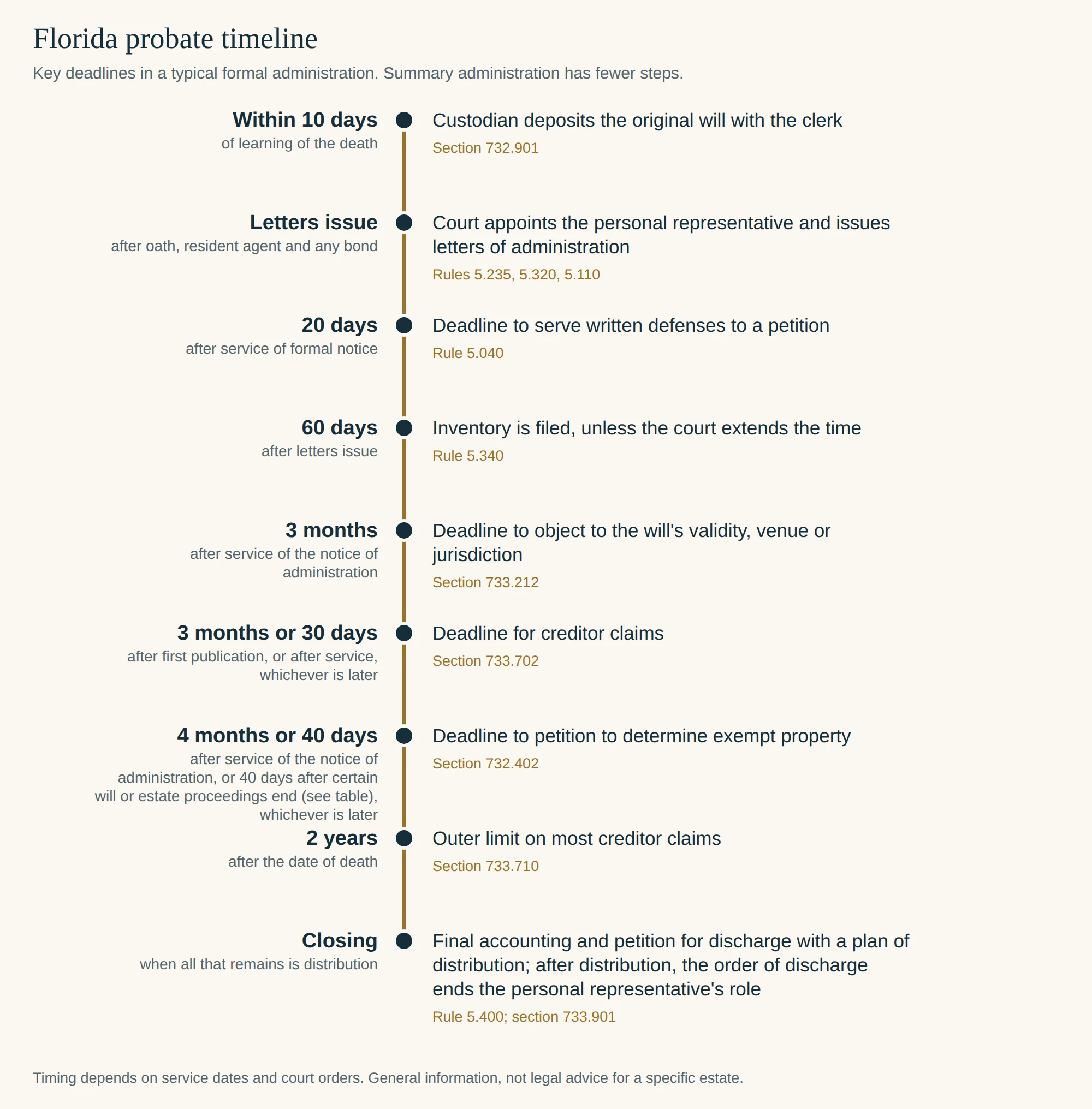 View timeline graphic
So how long does Florida probate take? The timeline depends on the procedure and on these deadlines. Many uncontested formal administrations take roughly six months to a year. Missing records, court scheduling, real estate sales and disputes extend the Florida probate timeline. How long probate takes in Florida · Florida probate rules and deadlines.
Probate court: Florida's circuit court probate division
Florida has no separate, stand-alone probate court. Probate court in Florida means the probate division of the circuit court in each county. This is the Florida state probate court system for estates, and it usually also hears guardianship. Filings go through the Florida Courts E-Filing Portal. The original paper will is the exception: it is deposited with the clerk.
Probate documents. Florida probate forms and filings include the petition for administration, the oath and letters of administration, the notice of administration, the notice to creditors, the inventory, and the closing papers.
Filing probate in Florida without an attorney. Because a personal representative generally must have a Florida attorney, most families do not file formal administration forms themselves. Summary administration and disposition without administration involve no personal representative. For that reason, some families attempt pro se probate. Florida summary administration and disposition petitions must still meet the rules, and errors in a petition, a creditor search or the treatment of homestead can be costly to fix.
Florida probate records. Probate files are generally public, and Florida probate court records can be searched through the clerk of the circuit court in the county where the case was filed. Estate inventories and accountings are confidential, and available only to interested persons or by court order.
The personal representative's role in Florida
Personal representative in Florida, or executor? Florida uses "personal representative" for the person who administers an estate, whether or not there is a will. Search for "executor of estate Florida" or "executor of will Florida" and you reach the same answer: in Florida, the executor is the personal representative. The court's grant of authority is a Florida letter of administration, formally called "letters of administration," in both situations.
Appointment of personal representative: Florida steps.
- The nominated person petitions the circuit court.
- The court admits any will and enters an order of appointment.
- The court sets bond, unless it is waived.
- The personal representative files an oath and a designation of resident agent (unless exempt); the Florida Probate Rules require both before letters issue.
- The court issues letters of administration. The personal representative of the estate in Florida has authority to act only once letters issue.
Duties of personal representative in Florida. Florida personal representative duties include:
- securing estate assets
- serving the notice of administration
- publishing and serving the notice to creditors
- filing the inventory
- paying valid claims and expenses
- handling any required tax filings
- distributing property correctly
- closing the estate
The personal representative is a fiduciary, held to the same duty as a trustee, and can be personally liable for losses caused by a breach of that duty. That is one reason the law generally requires counsel.
Florida personal representative qualifications. Who can be a personal representative of estate? Florida law sets who may serve, and nonresidents may serve only in listed family relationships (section 733.304). Read more about out-of-state executors in Florida.
Personal representative bond: Florida rules. A Florida probate bond is the default for a personal representative unless it is waived. The court can require a bond even when the will waives it.
Co-personal representatives: Florida allows more than one. More than one person can be appointed to serve together. When two or more co-personal representatives are appointed under a will signed on or after October 1, 1987 (or, with no will, when the person died on or after that date), a majority must agree on administration decisions; the will may provide a different rule. Discuss how decisions and signatures will work before petitioning.
Can an executor hire an attorney? Yes. In most formal administrations the personal representative must have one, and the personal representative chooses the attorney. An executor attorney, or executor of estate lawyer, represents the personal representative in that role.
Florida homestead: probate rules for the family home
A home is often the largest asset, and Florida homestead in probate follows its own rules:
- It is not treated as an ordinary estate asset. Protected homestead passes to the heirs or devisees at the moment of death, and it is not among the assets in the personal representative's hands. The personal representative may take possession of it only to preserve and protect it.
- Title companies still want a court order. Public records still show the person who died as the owner, and a deed from a decedent cannot be recorded. The court's order determining homestead status is the usual solution.
- That order often does not require a full administration. Some circuits, including Broward, require the homestead petition to be filed within an administration.
- It does not count toward the summary administration threshold.
If the home may be sold, the homestead question comes first. Selling a house during probate.
If there is no valid will, Florida's intestacy laws determine who inherits probate property. Homestead descent has its own rules, so do not assume every home is treated like an ordinary estate account.
Who will handle your probate matter?

Jose M. Lorenzo, Jr. is Lorenzo Law's only attorney. Clients work directly with him on matters he handles, whether the estate needs a straightforward administration or becomes a dispute. Your consultation is an opportunity to discuss the legal work you need, your responsibilities and how communication will work during the engagement.
Before his admission to The Florida Bar, Jose worked for roughly a decade as a paralegal on probate and litigation matters. As a third-year law student, before his admission to the Bar, he served as a judicial intern in the Probate Division of Florida's Eleventh Judicial Circuit in Miami-Dade County, working with the Honorable Maria M. Korvick.
Jose Lorenzo, attorney, was admitted to The Florida Bar on October 4, 2013. His Florida Bar number is 107002. Read his biography, or view his official Florida Bar profile, which shows his admission and current membership status.
Hiring a probate lawyer: Florida-specific questions to ask
When you compare probate lawyers in Florida, whether a large Florida probate law firm or a solo attorney, the questions that matter are practical ones:
- Who will do the work? At a multi-attorney firm, a file may move between lawyers. At Lorenzo Law, Jose handles the matters the firm takes on.
- Does the attorney handle both administration and disputes? Florida probate lawyers, and estate and probate lawyers generally, differ on this. Some handle only uncontested administration; others handle only litigation.
- How are fees set, and what do they include? Get the fee agreement in writing.
- Is the attorney familiar with the county's probate division practices? Local procedures differ between circuits.
- Can you work in your preferred language, and by phone if you live elsewhere?
- Is the attorney in good standing? Check the attorney's profile on The Florida Bar website. The Bar also certifies some lawyers in wills, trusts and estates, and lists them on its site.
There is no official ranking of the best probate lawyer in Florida. The best probate attorney in Florida for your family is the one whose experience, fees, availability and communication fit your estate and your role.
Probate help throughout Florida, in the correct county
Lorenzo Law represents clients in Florida probate matters throughout the state, including clients who live outside Florida. The firm's location and your current address do not determine where the estate belongs. For a Florida resident, probate in the State of Florida is generally filed in the county where the person was domiciled; different rules apply when the person lived elsewhere.
For a person domiciled in Florida, probate venue is generally the county of domicile. If the person had no Florida domicile, section 733.101 provides other rules, based on Florida property or, if there is no Florida property, the residence of a debtor. Tell Jose where the person lived, where the assets are located and whether a case is already open. Florida probate venue statute.
"Near me" searches. Searches like "probate attorney near me," "probate lawyers near me," "attorney probate near me," "probate law firms near me" and "estate attorney near me" return firms close to your address. What matters is familiarity with the court where the case belongs, so the correct county comes first.
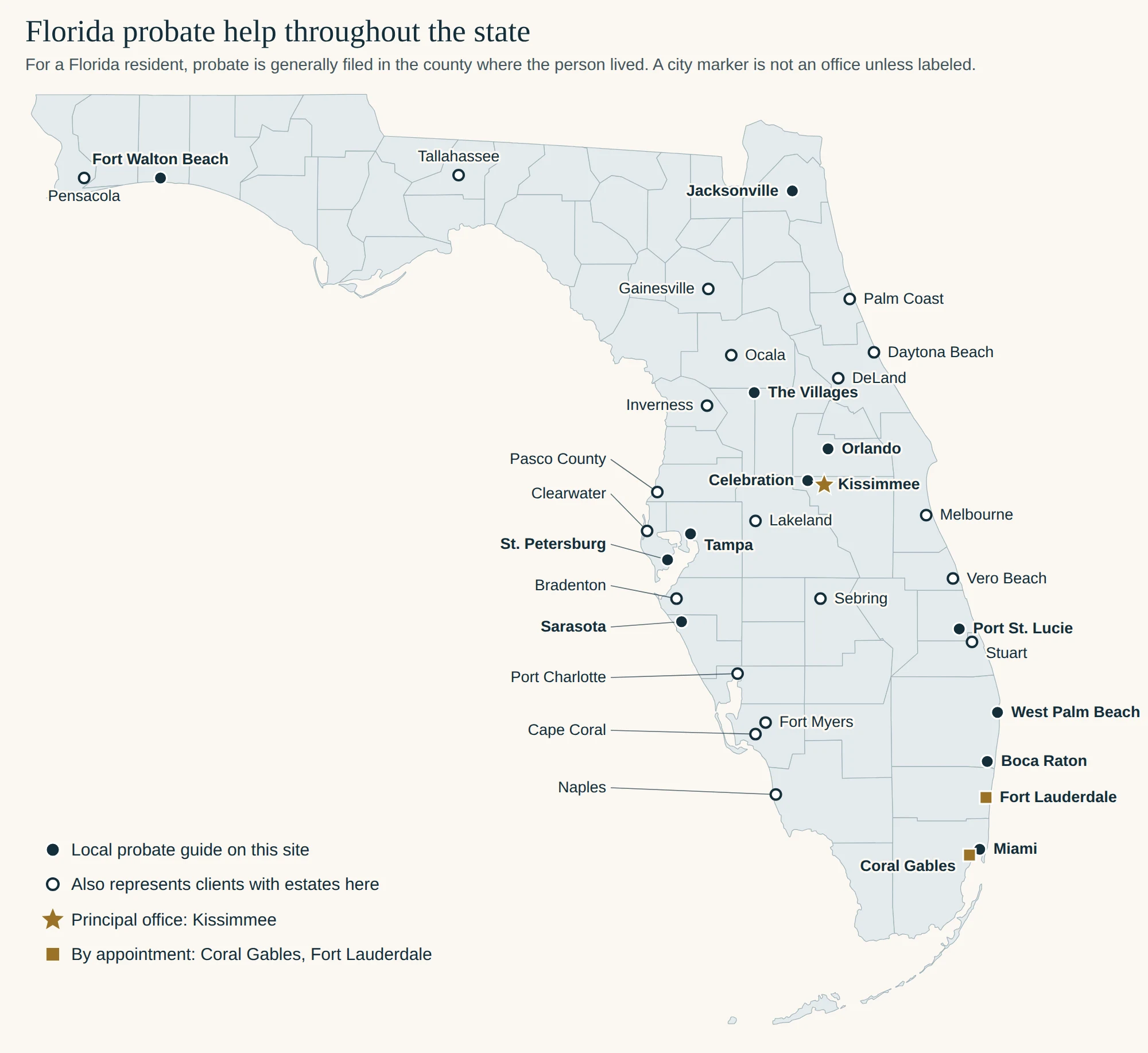
Map: Florida probate help throughout the state. Filled markers are local probate guides on this site; open markers are other cities where Jose represents clients with estates. The star is the principal office in Kissimmee; squares are the by-appointment locations in Coral Gables and Fort Lauderdale.
Local probate guides by region:
- Tampa Bay and Gulf Coast: Tampa · St. Petersburg · Sarasota
- Central Florida: Orlando · Kissimmee · Celebration · The Villages
- South Florida: South Florida probate attorney · Miami · Miami-Dade County · Fort Lauderdale · Broward County probate attorney · Palm Beach County · West Palm Beach · Boca Raton probate lawyer · Port St. Lucie
- North Florida: Jacksonville · Fort Walton Beach
Jose also represents clients with estates in these areas:
- Southwest Florida: Fort Myers and Cape Coral (Lee County), Naples (Collier County), Port Charlotte (Charlotte County)
- Central Florida: Lakeland (Polk County), Ocala (Marion County), Inverness (Citrus County), Sebring (Highlands County). A search for a probate attorney in Ocala or Inverness ("probate attorney Ocala," "probate attorney Inverness") leads to the Fifth Judicial Circuit, which includes Marion and Citrus Counties.
- Gulf Coast: Clearwater (Pinellas County), Bradenton (Manatee County), Pasco County
- East coast: Daytona Beach and DeLand (Volusia County), Melbourne (Brevard County), Palm Coast (Flagler County), Vero Beach (Indian River County), Stuart (Martin County)
- North Florida: Tallahassee (Leon County), Gainesville (Alachua County), Pensacola (Escambia County)
View all Florida probate service areas. A city guide describes local court practice; it does not mean the firm has an office in that city. The principal office is in Kissimmee, Florida. Jose also meets clients by appointment in Coral Gables and Fort Lauderdale.
What to do first when someone dies in Florida
- Find the original will, if there is one. Whoever has it must deposit it with the clerk within 10 days after learning of the death. If the will was signed in another state, bring the original. For a Florida probate out-of-state will, the rule is: a will signed by someone who was not a Florida resident is valid in Florida if it was validly executed under the law of the place where it was signed, but Florida will not admit a holographic (handwritten, unwitnessed) or nuncupative (oral) will, even if valid where signed.
- Order death certificates. Institutions often ask for certified copies.
- Secure property. Lock the home, keep the car insured and protect valuables. Do not sell, give away or retitle estate property before someone has legal authority.
- Collect the mail and notices, including bills, account statements and anything from a court or creditor.
- Generally, do not pay the person's debts from your own funds without advice. If you paid funeral expenses, you may file a Class 2 priority claim for reimbursement, up to $6,000, through the estate process.
- Contact a Florida probate attorney before a bank, title company or court deadline forces the issue.
Prepare for your initial consultation
Start with what you know. You do not need a complete inventory to request help.
- The person's name, date of death and last place of residence.
- Your relationship to the person, and whether you are named in a will or already appointed by a court.
- Any will or codicil, and who holds the original; a death certificate if available.
- A preliminary list of property, accounts and debts, including where assets are located and how they are titled.
- Names of the surviving spouse, children and other known heirs and beneficiaries.
- Whether the person received Medicaid or other public benefits.
- Any probate case number, court notices, creditor correspondence or documents requested by a bank or title company.
- Any disagreement, pending sale, hearing date or approaching deadline.
Mention an urgent deadline when you first contact the firm. Please avoid sending sensitive documents until the firm provides instructions for sharing them.
Florida probate questions: hiring a probate attorney in Florida
Do I need a lawyer for probate in Florida?
In most cases, yes, if there will be a personal representative. (Do I need a lawyer to go through probate in Florida if there is no personal representative? Not always; see the next question.) Florida Probate Rule 5.030 generally requires a personal representative to have a Florida attorney. Probate rules include two exceptions: a personal representative who remains the sole interested person, and a personal representative who is a Florida attorney representing themselves.
Being the only beneficiary does not automatically establish the sole-interested-person exception. The applicable procedure and your role matter. Florida Probate Rules, rule 5.030.
Do I need a probate attorney in Florida for summary administration?
Not always. Summary administration involves no personal representative, so rule 5.030's requirement does not apply in the same way. The petition, the creditor search and the homestead questions are where families most often need help.
What is the probate threshold in Florida for 2026?
Since July 1, 2026, an estate can use summary administration if the Florida estate subject to administration, after excluding creditor-exempt property such as protected homestead, is worth $150,000 or less. The earlier figure was $75,000. An estate also qualifies, at any value, if the person has been dead for more than two years. Other conditions apply, so have the actual estate reviewed.
What is the 10-day rule for probate in Florida?
It is the deadline for filing a will in Florida after death. The custodian of a will generally must deposit it with the clerk of the court having venue within 10 days after receiving information that the person has died. A consultation request does not extend that deadline. Section 732.901.
How long does probate take in Florida?
How long does a probate case take in Florida? It depends on the procedure. Summary administration involves no personal representative. Formal administration has the deadlines in the timeline table above. Many uncontested formal administrations take roughly six months to a year. Ask which steps are likely to control your case rather than relying on a promised completion date.
Creditor deadlines are not always simply three months. Section 733.702 generally uses the later of three months after first publication or, for a creditor required to receive notice, 30 days after service, subject to other limitations and exceptions. Bring the actual notices for review.
Is Florida a difficult probate state?
Florida probate is court-supervised, and it generally requires a personal representative to have a Florida attorney, which some states do not. The process is manageable when the deadlines, notices and homestead questions are handled correctly from the start.
What is the difference between an estate attorney and a probate attorney?
"Estate attorney" and "estate lawyer" are often used for both planning and administration. So what is a probate attorney? A probate attorney handles the court process after a death: opening the estate, advising the personal representative, and closing or defending the administration.
Titles overlap. An estate probate attorney, a probate estate lawyer and a probate law attorney generally describe the same work. Jose handles probate administration and probate disputes, and also prepares estate plans.
Is an executor the same as a personal representative in Florida?
Yes. Florida uses "personal representative" for the person who administers an estate, whether or not there is a will. Being named executor in a will is a nomination; the authority comes from the court's appointment.
What are letters of administration?
They are the court's written authority for the personal representative to act for the estate. Florida uses the term for every estate, with or without a will. Banks, title companies and others usually ask for a certified copy.
Does a will avoid probate in Florida?
No. A will directs how probate property passes, but it generally must be admitted to probate before it can be used to transfer title. Probate in Florida with a will follows the will's terms for probate property, and Florida will probate requirements include depositing the original with the clerk. Assets that pass by beneficiary designation, joint ownership with survivorship, or a funded trust may avoid probate, whether or not there is a will.
What happens if someone dies without a will in Florida?
Florida's intestacy statutes decide who inherits probate property. Someone may still need court authority to collect and transfer the assets, through formal or summary administration. In Florida probate, no will simply means the statute, rather than a will, determines the heirs. Probate in Florida without a will, known as Florida intestate probate, still follows the same procedures and deadlines. Homestead has its own rules. Probate process in Florida without a will.
What assets do not go through probate in Florida?
Common examples are:
- accounts and policies with a living named beneficiary
- property owned jointly with survivorship rights
- assets held in a funded trust
- protected homestead, which passes outside the personal representative's control
Assets in the person's sole name, with no beneficiary, usually need probate. Florida non-probate assets.
Is there a small estate process in Florida?
Yes, but it is narrow: the intestate small-estate procedure (no will, more than a year after death, no pending administration, and nonexempt personal property no greater than $20,000 plus preferred funeral and last-illness medical expenses), disposition without administration (personal property only), and the bank payout from sole-name accounts totaling no more than $2,000, subject to the conditions above. Estates that do not fit may still qualify for summary administration.
Can I serve as personal representative if I live outside Florida?
Sometimes. A nonresident can serve only if they fit one of the family relationships listed in section 733.304. If you would be an out-of-state executor, Florida's rules on who may serve come first; you may still be able to help in other ways. When you hire a probate attorney, Florida residency is not required of you. Ask whether the case will require any appearance, and what can be done by phone and mail.
Do I have to come to Florida for probate?
Not necessarily. Consultations are available by phone. Whether any court appearance is needed depends on the procedure and whether anything is contested. Ask about document signing and appearance requirements at the start.
Can the personal representative sell the house during probate?
It depends on whether the house is protected homestead, what the will says and what authority the court grants. Protected homestead is not treated as an ordinary estate asset in the personal representative's hands. Other real property may be sold with the necessary authority. Selling a house in probate: Florida guide.
Is a Florida probate case public?
Probate court files are generally public. Estate inventories and accountings, however, are confidential by statute and available only to interested persons or by court order.
How does a Florida estate close?
Once administration is complete except for distribution (claims, expenses and any taxes addressed), the personal representative files a final accounting and a petition for discharge that includes a plan of distribution. The property is then distributed. Once the estate is fully administered and properly distributed, the court's order of discharge ends the personal representative's role and releases any bond. Beneficiaries often search for "Florida probate final accounting" and "order of discharge probate Florida." Ask what to expect in your estate.
Can I choose a different attorney from the one who wrote the will?
Yes. The personal representative chooses the estate's attorney and is not required to use the attorney who prepared the will.
Is the first consultation free?
Yes. The initial consultation with Jose is free for probate matters, including the Florida probate attorney free consultation for families who live out of state. A probate attorney free consultation is a chance to describe the situation and learn the likely procedure. Whether you searched "probate attorney Orlando free consultation" or "probate lawyers free consultation," the terms are the same anywhere in Florida. Only the consultation is free; fees and costs for representation are set separately, in writing.
What if the estate involves a dispute?
Lorenzo Law also handles probate litigation. A contested will, a disputed accounting or allegations about a personal representative require a separate assessment of the issues and the representation needed. Do not assume an administration engagement automatically includes every dispute. If you need a probate litigation attorney, Florida disputes are handled on the probate litigation service page; for a trust dispute, see trust litigation.
Talk to a Florida probate lawyer
If you are thinking "I need a probate lawyer," start with a short conversation. To find a probate lawyer who fits the estate, tell Lorenzo Law:
- your role
- where the person lived
- what property is involved
- whether there is a deadline or an existing court case
Jose can discuss the representation you need and possible next steps. A probate lawyer consultation with Jose is free.
Request a free initial consultation Call (305) 224-6811
Only the consultation is free; fees and costs for representation are set separately, in a written agreement. Consultations are available in English and Spanish, by phone or by appointment. Calls are answered 24 hours a day, and the firm follows up on inquiries within one to two business days.
For information in Spanish, visit the firm's Spanish-language probate and inheritance page.
This page provides general information. Contacting the firm does not create an attorney-client relationship or confirm that the firm has agreed to represent you. Results are not guaranteed.