

Miami Probate Attorney
A Miami probate attorney guides families, personal representatives and beneficiaries through estate administration in the Probate Division of the Eleventh Judicial Circuit in and for Miami-Dade County. Firm founder Jose M. Lorenzo, Jr. clerked for the Honorable Maria M. Korvick in that same probate division and has been a member of The Florida Bar since 2013. Se habla español. We offer a free consultation to review the will, identify homestead and creditor exposure, and get the estate opened.
Call (305) 224-6811 · 2850 Douglas Road, Suite 303, Coral Gables, FL 33134 · Second office in Fort Lauderdale · Serving all of Miami-Dade County
Florida’s four probate tracks at a glance
| Track | Authority | Threshold | Personal representative? | Typical Miami-Dade time |
|---|---|---|---|---|
| Disposition of personal property without administration | Fla. Stat. § 735.301 | Personal property only: exempt property under § 732.402, plus constitutionally exempt personal property, plus non-exempt personal property not exceeding the sum of preferred funeral expenses and the reasonable and necessary medical and hospital expenses of the last 60 days of the last illness — no fixed dollar cap | No | 2–4 weeks |
| Summary administration | Fla. Stat. § 735.201, as amended by Ch. 2026-57, Laws of Fla. (CS/HB 1337) | Will must not direct formal administration; and estate subject to administration in Florida, less property exempt from creditors’ claims, does not exceed $150,000 — or the decedent has been dead more than 2 years (no dollar limit) | No — no letters issue | 4–8 weeks |
| Formal administration | Fla. Stat. Chs. 732–733; Fla. Prob. R. 5.235 | Everything else — larger estates, active debts, real property to convey, or where fiduciary authority is needed | Yes — Letters of Administration issue | 6–12 months uncontested |
| Ancillary administration | Fla. Stat. §§ 734.102, 734.1025 | A non-Florida resident who died owning Florida real property, timeshares, credits owed by Florida residents, or liens on Florida property | Yes (short-form available for testate estates ≤ $50,000) | 6–12 months |
What is probate, and when is it required in Florida?
Probate is the court-supervised process of identifying a decedent’s assets, paying valid creditor claims, and transferring what remains to the beneficiaries. It is governed by the Florida Probate Code, Chapters 731 through 735, Florida Statutes, and by the Florida Probate Rules.
Probate is required when a person dies owning assets titled solely in their individual name with no designated beneficiary, no survivorship designation, and no trust ownership. Where the estate is small enough, one of the two abbreviated tracks above may substitute for full administration.
Probate is not required for assets that transfer automatically:
- Pay-on-death (POD) accounts and transfer-on-death (TOD) securities
- Joint tenancy with right of survivorship and tenancy by the entirety marital property
- Property conveyed by an enhanced life estate deed (Lady Bird deed) or held in a revocable living trust
- Life insurance, IRAs, 401(k)s and other accounts with a valid named beneficiary
A common and costly mistake: a power of attorney does not survive the principal’s death. Whatever authority an agent held ends at the moment of death, and only a personal representative appointed by the court can act for the estate.
Where you file: venue is the county of the decedent’s domicile — Fla. Stat. § 733.101(1)(a) — not the county where the person happened to die. A Miami-Dade resident who dies in a Broward hospital, in New York, or abroad is still probated in Miami-Dade.
Summary administration: mechanics
An interested person or the person nominated as personal representative files a Petition for Summary Administration, verified and joined in or consented to by the surviving spouse if there is one (§ 735.203). The court enters an Order of Summary Administration transferring the assets directly to the beneficiaries. No personal representative is appointed and no Letters of Administration issue.
The petitioner must still conduct a diligent search and reasonable inquiry for known or reasonably ascertainable creditors and serve them (§ 735.206). Publication of a notice to creditors is permissive in a summary administration, not mandatory (§ 735.2063).
The two-year trap. Under Fla. Stat. § 735.206, when summary administration is filed before two years have elapsed since death, the people who receive property remain personally liable for a pro rata share of lawful claims, capped at the value of what they received. That exposure runs until two years after death. Summary administrations filed after the two-year mark carry no such exposure, because § 733.710 has already barred the claims.
Formal administration and Letters of Administration
Formal administration begins with a Petition for Administration. (On picking the right person for the job, see selecting an executor under Florida probate law.) The court admits the will, appoints the personal representative, and issues Letters of Administration — the fiduciary’s proof of authority to third parties. With letters in hand the personal representative can:
- Marshal, safeguard and appraise estate assets
- Open an estate bank account using a new Employer Identification Number (EIN)
- Obtain statutory access to the decedent’s safe deposit box (§ 733.6065)
- Deal with the IRS, banks, brokerages and title companies
Step by step
- Deposit the original will — 10 days. The custodian of a will must deposit it with the clerk of the court having venue within 10 days after learning of the death (§ 732.901). In Miami-Dade that is the Clerk’s Probate Court office.
- Open the estate. File the Petition for Administration, the original will with its self-proving affidavit (§ 732.503), the death certificate, and the oath and designation of resident agent.
- Serve the Notice of Administration. Served on the surviving spouse, beneficiaries, the trustee of a § 733.707(3) trust, and persons entitled to exempt property (§ 733.212; Fla. Prob. R. 5.240). This starts the 3-month window to object to the will’s validity, venue, or the court’s jurisdiction (§ 733.212(3)).
- Publish the Notice to Creditors. Once a week for two consecutive weeks in a Miami-Dade newspaper, plus direct service on every reasonably ascertainable creditor after a diligent search (§ 733.2121). If the decedent was 55 or older, the personal representative must also serve the notice and a copy of the death certificate on the Agency for Health Care Administration within 3 months after first publication (§ 733.2121(3)(d)).
- File the verified inventory — 60 days. Within 60 days after letters issue, listing every asset at date-of-death fair market value and identifying anything that appears to be protected homestead (Fla. Prob. R. 5.340).
- Handle creditor claims. Claims are due by 3 months after first publication; for a creditor who had to be served, the deadline is the later of that 3-month date or 30 days after service (§ 733.702(1)). The personal representative may object by the later of 4 months from first publication or 30 days from the timely filing or amendment of the claim (§ 733.705(2)); the claimant then has 30 days from service of the objection to file an independent action (§ 733.705(5)). Claims are paid in the eight-class priority order of § 733.707.
- Taxes. The decedent’s final Form 1040, the estate’s Form 1041 where required, and a federal Form 706 if the estate is large enough or portability is being elected.
- Final accounting, distribution and discharge. File the verified final accounting and petition for discharge within 12 months after letters issue — or, where a federal estate tax return is filed, within 12 months of the date that return is due — absent an extension (Fla. Prob. R. 5.400), obtain signed receipts, and secure the Order of Discharge (§ 733.901).
The creditor trap that catches personal representatives. Publishing is not enough. Under Jones v. Golden, 176 So. 3d 242 (Fla. 2015), a known or reasonably ascertainable creditor who is never served is not subject to the three-month bar. That creditor’s claim is timely if filed within two years of the date of death, the outer limit set by the statute of repose in § 733.710. A diligent search is not a formality.
Where probate is filed in Miami-Dade County
Probate Division, Eleventh Judicial Circuit in and for Miami-Dade County
Osvaldo N. Soto Miami-Dade Justice Center
20 N.W. 1st Avenue, Miami, FL 33128 — Clerk’s Probate Court office, Suite 6.223 (6th floor)
Monday–Friday, 9:00 a.m.–4:00 p.m. · 305-349-7492 or 305-349-7502 (the Clerk’s general probate line is 305-275-1155)
The Probate Division handles estates and trusts, guardianship, and mental health and substance abuse matters, and comprises six circuit judges and two general magistrates. Miami-Dade probate case numbers carry the suffix CP-02 (guardianship is GD-02; mental health is MH-02).
Note for anyone updating older material: many Miami firm pages still list the Dade County Courthouse at 73 West Flagler Street for probate. That building remains a circuit courthouse, but it is not where the Probate Division sits.
E-filing, hearings and the paper originals
- All pleadings are filed through the Florida Courts E-Filing Portal at myflcourtaccess.com, in PDF/A.
- Original wills, codicils, bonds, authenticated or exemplified copies, death certificates and birth certificates must still be delivered in paper to the Probate Court office at 20 NW 1st Avenue within two working days of electronically filing the case. They can be mailed — no one has to appear.
- Proposed orders and hearing submissions go through the circuit’s courtMAP system, generally ten days in advance unless the assigned judge’s directory page says otherwise.
- The Eleventh Circuit publishes probate checklists and smart forms that must be used for petitions and orders.
Miami-Dade probate filing fees
Amounts posted by the Miami-Dade Clerk of the Court; statutory base at Fla. Stat. § 28.2401. Confirm current figures with the Clerk before filing.
| Filing | Fee |
|---|---|
| Formal administration, ancillary administration, curatorship, conservatorship | $401 |
| Summary administration — estate value $1,000 or more | $346 |
| Summary administration — estate value under $1,000 | $236 |
| Disposition of personal property without administration | $232 |
| Caveat / notice of trust | $40 |
| Petition and order to admit a foreign will to record | $232 |
Newspaper publication of the notice to creditors is a separate third-party cost — approximately $125 in Miami-Dade at current rates.
Searching Miami-Dade probate records
Dockets are searchable free of charge through the Clerk’s Civil, Family and Probate Courts Online System by case number, party name or case type — probate cases end in CP-02. Certified copies can be ordered online, by mail, or in person. Attorneys of record and registered users can view the full electronic file. Guardianship and mental health files are confidential.
What probate costs in Florida: court fees and probate lawyer fees
Attorney fees are negotiable — and Florida requires us to tell you so
For a line-item breakdown of every cost in a Florida estate, see our guide to the cost of probate in Florida.
Under Fla. Stat. § 733.6171(2), the attorney must disclose in writing that attorney fees are not required to be based on the statutory schedule, that the schedule is not mandatory, that fees are negotiable, and that the personal representative selects counsel. An attorney who does not make those disclosures may not be paid for legal services without prior court approval or the written consent of all interested persons (§ 733.6171(2)(d)).
Any page telling you Florida probate fees are “set by statute at 3%” is wrong.
The § 733.6171(3) presumed-reasonable schedule
Compensation for ordinary services in a formal administration is presumed reasonable at:
| Compensable value of the estate | Presumed reasonable fee |
|---|---|
| $40,000 or less | $1,500 |
| Over $40,000 up to $70,000 | add $750 |
| Over $70,000 up to $100,000 | add $750 |
| Over $100,000 up to $1,000,000 | 3% of the value over $100,000 |
| Over $1,000,000 up to $3,000,000 | 2.5% |
| Over $3,000,000 up to $5,000,000 | 2% |
| Over $5,000,000 up to $10,000,000 | 1.5% |
| Over $10,000,000 | 1% |
Worked example. A $500,000 probate estate: $1,500 + $750 + $750 + 3% of $400,000 ($12,000) = $15,000 presumed-reasonable ordinary attorney fee.
Extraordinary services are compensated separately under § 733.6171(4) — will contests, elective share proceedings, tax audits and postmortem tax planning, sales of real property, running the decedent’s business, protected homestead matters, and ancillary administration among them. Effective 1 July 2026, Ch. 2026-57 added a new category: involvement in any proceeding to enforce the personal representative’s authority. The same session law created Fla. Stat. § 733.6125, under which a court shall award a prevailing personal representative taxable costs including attorney fees in such a proceeding.
Personal representative compensation — § 733.617
Presumed reasonable at 3% of the first $1,000,000 of compensable value, 2.5% above $1M to $5M, 2% above $5M to $10M, and 1.5% above $10M, computed on the inventory value plus income earned during administration. Extraordinary services are compensated additionally under § 733.617(3).
Who pays. Under Fla. Stat. § 733.707, administration expenses and attorney fees are a Class 1 priority paid from estate assets — ahead of general creditors and before anything is distributed to beneficiaries. In the ordinary case the family does not pay out of pocket.
Homestead, spousal rights and exempt property
Protected homestead
Under Art. X, § 4, Fla. Const., Florida homestead is exempt from forced sale by general creditors, and that exemption inures to the surviving spouse or heirs. The protection carries three carve-outs: taxes and assessments on the property, obligations contracted for its purchase, improvement or repair, and obligations for labor performed on the realty.
Because protected homestead is exempt from creditors’ claims, its value is subtracted from the § 735.201(2) computation — which is why a Miami family with a paid-off house and modest accounts often still qualifies for summary administration.
Confirming homestead status usually requires a Petition to Determine Homestead Status of Real Property (Fla. Prob. R. 5.405). In Miami-Dade condominium cases this is the single most common source of delay — build 3 to 6 weeks into the schedule for it.
The devise restriction
Under Art. X, § 4(c) and Fla. Stat. § 732.4015, homestead may not be devised if the owner is survived by a spouse or minor child, except that it may be devised to the spouse if there is no minor child. A revocable trust does not get around this — § 732.4015(2) defines “owner” and “devise” to reach trust dispositions of what would have been the grantor’s homestead.
The surviving spouse’s 6-month election — § 732.401
- Default (§ 732.401(1)): where the decedent is survived by a spouse and one or more descendants, the spouse takes a life estate in the homestead with a vested remainder to the descendants in being at death, per stirpes.
- The election (§ 732.401(2)): instead of the life estate, the spouse may take an undivided one-half interest as a tenant in common, with the other half vesting in the descendants.
- The deadline (§ 732.401(2)(b)): the election must be made within 6 months after the decedent’s death and during the surviving spouse’s lifetime, and it is made by filing a notice of election, containing the legal description of the homestead, for recording in the official record books of the county where the homestead is located — not merely in the probate file. The six months may be extended only by court order on a petition filed within that period.
This matters practically: the default life estate leaves the surviving spouse carrying taxes, insurance and maintenance while the remaindermen hold the appreciation. The 50% tenancy-in-common election is often the better outcome — and it is gone at six months.
Elective share, pretermitted heirs, exempt property and family allowance
- Elective share — §§ 732.201, 732.2035, 732.2065, 732.2135. A surviving spouse of a decedent domiciled in Florida may claim 30% of the elective estate. The elective estate is far broader than the probate estate: it reaches protected homestead, revocable trusts, POD/TOD and survivorship accounts, joint tenancy interests, the net cash surrender value of life insurance on the decedent’s life, retirement and deferred compensation plans, and certain transfers within one year of death. The election must be filed by the earlier of 6 months after service of the notice of administration on the spouse or 2 years after death (§ 732.2135(1)). The right can be waived by prenuptial or postnuptial agreement (§ 732.702).
- Pretermitted spouse — § 732.301. A spouse who married the testator after the will was executed takes an intestate share, unless provided for or waived by agreement, provided for in the will, or the will discloses an intent not to provide for the spouse.
- Pretermitted child — § 732.302. A child born or adopted after the will was executed and not provided for takes an intestate share, subject to two statutory exceptions.
- Exempt property — § 732.402. The surviving spouse, or the children if there is no spouse, take household furniture, furnishings and appliances in the decedent’s usual place of abode up to a net value of $20,000; two motor vehicles regularly used by the family, each under 15,000 lbs gross weight; § 529 qualified tuition programs; and certain § 112.1915 death benefits. The petition is due by the later of 4 months after service of the notice of administration or 40 days after the termination of proceedings affecting the property (§ 732.402(6)).
- Family allowance — § 732.403. Reasonable maintenance during administration for the surviving spouse and dependent lineal heirs, not to exceed a total of $18,000, payable in a lump sum or installments, and in addition to — not charged against — what they otherwise receive unless the will says otherwise.
If there is no will: Florida intestate succession
Under Fla. Stat. § 732.102, the surviving spouse’s share turns on whether either side has descendants from another relationship:
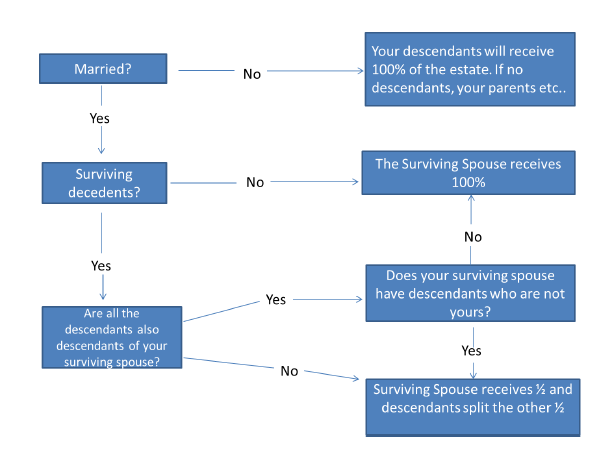
| Situation | Surviving spouse takes |
|---|---|
| No surviving descendant of the decedent | The entire intestate estate |
| All of the decedent’s descendants are also the spouse’s, and the spouse has no other descendants | The entire intestate estate |
| One or more of the decedent’s descendants are not descendants of the spouse | One-half |
| All of the decedent’s descendants are also the spouse’s, but the spouse has one or more descendants who are not the decedent’s | One-half |
The last row is the one people miss. A stepchild on either side cuts the spouse’s intestate share in half.
(Florida’s old “first $60,000 plus one-half” rule was repealed effective 1 October 2011. Any page still reciting it is out of date.)
Whatever does not pass to the spouse passes under § 732.103: to the decedent’s descendants per stirpes; then to the parents equally or the survivor; then to brothers and sisters and the descendants of deceased siblings; then one-half to paternal and one-half to maternal kindred in the statutory order, with the whole going to one side if there is no kindred on the other. Property escheats to the State under § 732.107 only when no heir exists anywhere.
Selling a home or condo during probate
This section summarises the essentials; our full guide to selling a house during probate in Florida walks through the contract, the court order and the closing.
- Will with a power of sale. The personal representative may contract for and sell non-homestead real property without prior court approval.
- No will, or no power of sale. The personal representative petitions for an Order Authorizing Sale of Real Property, confirming that the price and terms are commercially reasonable.
- Homestead. Protected homestead vests in the heirs at the moment of death and is not an estate asset the personal representative can convey. Every co-heir must sign the listing agreement and the deed. Where heirs cannot agree, a partition action under Fla. Stat. Ch. 64 is the remedy.
- Title. No closing happens without either Letters of Administration or an order determining homestead status. Build the timeline around that, not around the listing date.
- HOA and condominium assessments. Assessments keep accruing during administration and remain an obligation against the unit; unpaid amounts become an association lien. In a Miami condo estate this is frequently the largest avoidable cost of a slow probate.
When a Miami estate becomes contested
For a contested estate or trust in Miami-Dade, including a will contest, a trust dispute, or a claim against a personal representative or trustee, see the Miami probate litigation attorney page. The deadlines below are the ones to check first.
Deadlines
Objections to the validity of the will, venue, or the court’s jurisdiction must be filed within 3 months after service of a copy of the Notice of Administration (§ 733.212(3)), or they are forever barred. Separately, under § 733.2123, a person served with formal notice of the petition for administration before letters issue may not later challenge the will, testacy, venue or jurisdiction except in those pre-letters proceedings — and the response period for formal notice is 20 days under Fla. Prob. R. 5.040(a)(1).
An interested person who is worried an estate will be administered without their knowledge may file a caveat (§ 731.110), which entitles them to notice before letters issue.
Grounds
Our step-by-step guide to contesting a will in Florida covers evidence, cost and what a contest realistically requires to succeed.
- Lack of testamentary capacity — § 732.501. The testator must be of sound mind: able to understand the nature and extent of the property, the natural objects of the testator’s bounty, and the practical effect of the will, at the moment of execution.
- Undue influence, fraud, duress or mistake — § 732.5165. A will is void if its execution was procured by any of these. A revocation so procured is likewise void.
- Improper execution — § 732.502. The testator must sign at the end in the presence of two attesting witnesses, who must sign in the presence of the testator and of each other. A will executed by a nonresident is valid in Florida if valid where executed — except that a handwritten (holographic) will is not valid in Florida unless it meets the two-witness formality. Florida does not recognize oral wills.
- Revocation — by a later instrument or by physical act (§§ 732.505, 732.506).
What does not work as a ground: remarriage. Under § 732.507(1), neither subsequent marriage, birth, nor adoption of descendants revokes a prior Florida will. The post-will spouse’s remedies are the pretermitted spouse statute and the elective share. Dissolution of marriage is different — § 732.507(2) voids only those provisions of the will affecting the former spouse, and the will is read as if that spouse predeceased.
Undue influence and the Carpenter presumption
Under In re Estate of Carpenter, 253 So. 2d 697 (Fla. 1971), a rebuttable presumption of undue influence arises when a person who is (1) a substantial beneficiary under the will, (2) occupied a confidential or fiduciary relationship with the decedent, and (3) was active in procuring the will.
The seven nonexclusive Carpenter active-procurement factors are presence at the execution; presence when the testator expressed a desire to make a will; recommending the attorney who drew it; knowing its contents before execution; giving instructions to the drafting attorney; securing the witnesses; and keeping the will after execution. A contestant need not prove all seven.
Under Fla. Stat. § 733.107(2), that presumption shifts the burden of proof — not merely the burden of producing evidence — to the will’s proponent. Under § 733.107(1), the proponent first bears the burden of establishing prima facie formal execution and attestation.
Removing a personal representative; curators and ad litems
A personal representative may be removed under § 733.504 for, among other things, adjudication of incapacity, physical or mental incapacity, failure to comply with an order, failure to account, waste or mismanagement, self-dealing, conflict of interest, or holding a claim against the estate that will require adjudication.
If the estate becomes contested, learn how a probate litigation lawyer can help. If a trust is contested instead, see Lorenzo Law’s trust litigation attorney page. If a will is contested, see the Florida will contest attorney page. Where the estate needs protecting before letters issue — a contested petition, a will contest holding up appointment — or after a personal representative is removed, resigns or dies, the court appoints a curator under § 733.501, who may be authorized to perform any duty of a personal representative. Where the estate must be represented in a proceeding and there is no personal representative, or the personal representative’s interest is adverse to the estate, the court appoints an administrator ad litem; a guardian ad litem represents a minor, an incapacitated person, an unborn person, or a person whose identity or address is unknown (Fla. Prob. R. 5.120).
Out-of-state heirs, international estates and remote probate
Florida probate does not require an out-of-state or international personal representative to travel here. Documents are prepared and executed remotely, filed through the state e-filing portal, and hearings are conducted virtually through the Eleventh Circuit’s systems. One exception: the original will and certain other original documents must reach the Probate Court office in paper within two working days of e-filing — by mail is fine.
- Nonresident personal representatives — § 733.304. (See also our guide to serving as an out-of-state executor in Florida.) A person not domiciled in Florida may serve only if they are a legally adopted child or adoptive parent of the decedent; related by lineal consanguinity to the decedent; a spouse, brother, sister, uncle, aunt, nephew or niece of the decedent, or someone related by lineal consanguinity to any of those; or the spouse of a person otherwise qualified. A nonresident first cousin does not qualify, and neither does a stepchild who was never legally adopted. An in-law qualifies only if he or she is the spouse of a person who is otherwise qualified. Nonresident personal representatives must designate a Florida resident agent and are frequently required to post bond.
- Ancillary administration — § 734.102. The standard path where a New York, New Jersey, Canadian, Colombian, Venezuelan or other non-Florida decedent owned a Brickell condo, a Miami Beach unit, or a Florida brokerage account. A short-form procedure is available under § 734.1025 where the decedent died testate and the Florida property does not exceed $50,000, if filed within two years of death.
- Foreign heirs and assets. Apostilles, certified translations, tax treaty questions and FIRPTA withholding on the sale of Florida real property by a foreign seller are routine parts of a Miami estate. We handle these matters in Spanish.
Estate, inheritance and income taxes
- Florida charges neither. (More detail in our guide to Florida inheritance tax.) There has been no Florida estate tax for decedents dying on or after 1 January 2005, and Florida has never had an inheritance tax (Art. VII, § 5, Fla. Const.). To clear the Florida estate tax lien on Florida real property, the affidavit Form DR-312 is recorded where no federal return is required, and Form DR-313 where one is — filed with the clerk of the court in the county where the property is located, not with the Department of Revenue.
- Federal estate tax. The basic exclusion amount for decedents dying in 2026 is $15,000,000 per person — $30,000,000 for a married couple using portability — with a top rate of 40%. The One, Big, Beautiful Bill Act set that figure beginning in 2026, indexed it for inflation, and repealed the scheduled sunset that would have cut the exclusion roughly in half. (Any planning page still urging clients to “use it before it disappears in 2026” should be corrected.)
- Form 706 is due 9 months after death, with an automatic 6-month extension of time to file available on Form 4768. Extension of time to pay is separate and not automatic.
- Portability. The deceased spousal unused exclusion (DSUE) transfers to a surviving spouse only if a complete and timely Form 706 is filed electing it — even for an estate far below the filing threshold. This is the most common and most expensive omission in Florida estates. Rev. Proc. 2022-32 allows an estate not otherwise required to file to make the election up to the fifth anniversary of death.
- Step-up in basis — IRC § 1014. Assets acquired from a decedent take a basis equal to date-of-death fair market value, eliminating capital gain on lifetime appreciation. For long-held Miami real estate this is often worth more than any probate-avoidance planning. Note: income in respect of a decedent — IRAs, 401(k)s, annuities, unpaid deferred compensation — receives no step-up (IRC § 691). Florida is not a community property state, so only the decedent’s half of jointly held spousal property is stepped up unless the couple used a Florida Community Property Trust.
- EIN and Form 1041. The estate is a separate taxpayer and needs its own EIN to open the estate account. Form 1041 is required where the estate has gross income of $600 or more for the tax year, or has a nonresident alien beneficiary. An estate — unlike a trust — may elect a fiscal year, a useful deferral tool.
Small estates and reimbursement without a full probate
Besides summary administration, three provisions allow small transfers without administration. All three were raised effective 1 July 2026 by Ch. 2026-57:
| Provision | What it allows | Current limit |
|---|---|---|
| § 735.301 | Reimbursement to whoever paid preferred funeral expenses or last-60-days medical and hospital expenses, out of small non-exempt personal property. Real property can never pass this way. | Non-exempt personal property not exceeding those expenses |
| § 735.302 | Federal income tax overpayment refunded directly to a surviving spouse or designated child on verified application, where no administration has begun | $5,000 (raised by Ch. 2026-57, § 8) |
| § 735.303 | A financial institution may pay a successor without a court proceeding, on qualifying accounts in the aggregate | $2,000 |
| § 735.304 | Disposition of intestate personal property by an heir at law, where the decedent has been dead more than 1 year and no administration is pending — non-exempt personal property up to the stated sum plus funeral and last-illness medical expenses | $20,000 (raised by Ch. 2026-57) |
For the practical questions that come up first — what happens to a bank account when someone dies and how to transfer a car title after a death in Florida — see those guides.
Reasonable funeral expenses are a Class 2 priority claim under § 733.707(1)(b), capped at $6,000 for priority purposes. (Class 1 is the costs and expenses of administration, including attorney fees.)
Do you actually need a probate lawyer?
The honest answer is: it depends which track you are on.
Fla. Prob. R. 5.030(a) requires every personal representative to be represented by a Florida attorney unless the personal representative remains the sole interested person — and note that “sole interested person” is narrower than “sole beneficiary,” because creditors and other devisees are interested persons too. An attorney who is a member of The Florida Bar may represent themself.
Rule 5.030 speaks only to personal representatives and guardians. Because no personal representative is ever appointed in a summary administration or in a § 735.301 disposition, the rule simply has no application to those proceedings — there is no personal representative for it to require counsel for. A petitioner may file them without a lawyer.
Whether that is a good idea is a different question. The Eleventh Circuit requires its own probate checklists and smart forms, orders and hearing materials go through courtMAP, originals must reach the clerk in paper on a deadline, and a defective summary administration petition leaves the beneficiaries personally exposed to creditors for two years under § 735.206. Most people who file alone come back after the first rejection.
| Often manageable alone | Get counsel |
|---|---|
| Non-exempt assets under $150,000 | Non-exempt assets over $150,000 |
| Decedent deceased more than 2 years | Estate owes significant debts |
| A single financial account to claim | Disputed will, undue influence, or estranged heirs |
| No business to operate | Real property or a business to manage |
| All heirs agree and will sign | Letters of Administration needed to act |
Myth vs. reality
- Myth: the State takes your assets if you die without a will.
Reality: intestate assets pass to family under §§ 732.102 and 732.103. Escheat under § 732.107 happens only when no heir exists anywhere. - Myth: creditors can force the sale of the family home.
Reality: Art. X, § 4 protects homestead from general unsecured creditors and the protection inures to the surviving spouse and heirs — subject to property taxes, purchase-money and improvement obligations, and construction liens. - Myth: having a will avoids probate.
Reality: a will is the instruction manual for the probate court. It does not avoid probate; it directs it. - Myth: creditors have unlimited time.
Reality: claims are due by 3 months after first publication, or, for a creditor entitled to service, the later of that date or 30 days after service (§ 733.702(1)). All claims are barred 2 years after death under § 733.710 — but a known or reasonably ascertainable creditor who was never served is not bound by the 3-month period, and that creditor’s claim is timely if filed within 2 years of death (Jones v. Golden). - Myth: Florida probate takes two years.
Reality: the two-year figure is the § 733.710 statute of repose on creditor claims, not an administration timeline. A simple formal administration in Miami-Dade typically runs 6 to 12 months; summary administration usually 4 to 8 weeks. - Myth: Florida attorney fees are fixed by statute at 3%.
Reality: § 733.6171(3) creates a presumption of reasonableness, and § 733.6171(2) requires written disclosure that the schedule is not mandatory and fees are negotiable. - Myth: getting remarried cancels your old will.
Reality: § 732.507(1) — it does not. The new spouse’s protections are the pretermitted spouse statute and the elective share.
Frequently asked questions about Miami probate
Getting started
What is probate, and when is it required in Florida?
Probate is the court-supervised administration of a decedent’s estate under Chapters 731–735, Florida Statutes. It is required when someone dies owning assets titled solely in their individual name with no designated beneficiary, no survivorship designation, and no trust ownership. Assets that transfer automatically bypass probate entirely.
Is probate always required when someone dies in Florida?
No. Probate is unnecessary when every asset passes automatically — pay-on-death accounts, transfer-on-death securities, joint tenancy with right of survivorship, tenancy by the entirety, property conveyed by an enhanced life estate (Lady Bird) deed — a recorded Miami-Dade lady bird deed passes the home outside this division entirely — a funded revocable living trust, or accounts with a valid named beneficiary.
What assets go through probate in Florida, and what does not?
Probate assets are those titled solely in the decedent’s name: individual bank and brokerage accounts, real property held alone or as tenants in common, and personal property with no beneficiary designation. Non-probate assets include life insurance proceeds, retirement accounts with named beneficiaries, jointly held survivorship property, and trust property.
What is the first step to start probate in Miami-Dade County?
Locate the original will and order certified death certificates. The custodian of the will must deposit the original with the clerk of the court having venue within 10 days of learning of the death (Fla. Stat. § 732.901). Then determine which of Florida’s four administration tracks fits the estate.
What documents do I need to open a Florida probate case?
The original will with any codicils, a certified death certificate, statements for every account, deeds and vehicle titles, outstanding bills and creditor notices, and the full legal names, addresses and relationships of all beneficiaries and heirs. Miami-Dade requires the Eleventh Circuit’s own probate checklists and smart forms.
Where do I file probate in Miami-Dade County?
Cases are filed electronically through the Florida Courts E-Filing Portal with the Clerk of the Court for the Eleventh Judicial Circuit, Probate Division, at the Osvaldo N. Soto Miami-Dade Justice Center, 20 N.W. 1st Avenue, Miami, FL 33128. Original wills must still arrive in paper within two working days.
How long do you have to file probate after a death in Florida?
Florida sets no fixed deadline to open an administration, but the custodian of a will must deposit the original with the clerk within 10 days after learning of the death (Fla. Stat. § 732.901). Waiting is still costly: creditor claims are barred only two years after death.
What happens if you don’t deposit the will within 10 days?
Under Fla. Stat. § 732.901 the court may compel production of the will, and an interested person may petition for an order requiring the custodian to produce it. A custodian who withholds a will can be held responsible for the costs and damages that delay causes the estate.
The four administration tracks
What is the difference between summary and formal administration in Florida?
Summary administration is an expedited proceeding for smaller estates in which no personal representative is appointed and no Letters of Administration issue — the court simply orders assets transferred. Formal administration appoints a personal representative, issues letters, and runs a full creditor claims process under Chapter 733.
What is the summary administration limit in Florida in 2026?
Under Fla. Stat. § 735.201, as amended by Ch. 2026-57 (CS/HB 1337) effective 1 July 2026, the limit is $150,000 — the estate subject to administration in Florida, less property exempt from creditors’ claims. There is no dollar limit at all if the decedent has been dead more than two years.
What is disposition of personal property without administration?
Under Fla. Stat. § 735.301, a court may authorize direct payment where the decedent left only exempt personal property and non-exempt personal property not exceeding preferred funeral expenses plus the last 60 days of medical and hospital expenses. There is no fixed dollar cap, and real property can never pass this way.
What is ancillary probate, and when does Florida require it?
Under Fla. Stat. § 734.102, ancillary administration is required when a person who was not a Florida resident dies owning Florida real property, timeshares, credits owed by Florida residents, or liens on Florida property. A short-form procedure exists under § 734.1025 for testate estates of $50,000 or less.
Is Florida probate required if my parent lived in another state but owned a Miami condo?
Yes. Florida courts control the transfer of Florida real property regardless of where the owner lived. An ancillary administration is needed to convey marketable title to the heirs. The domiciliary personal representative from the home state often qualifies to serve as the Florida ancillary representative.
Cost
How much does probate cost in Florida?
Costs fall into three buckets: Miami-Dade clerk filing fees of $232 to $401 depending on the track, newspaper publication of the notice to creditors at roughly $125, and professional fees. Attorney fees are negotiable under Fla. Stat. § 733.6171(2); the statutory schedule is a presumption of reasonableness, not a mandate.
How much does a probate attorney cost in Florida?
Fla. Stat. § 733.6171(3) presumes reasonable fees for ordinary services beginning at $1,500 for estates of $40,000 or less, rising in steps, and reaching 3% of the compensable value between $100,000 and $1,000,000. A $500,000 estate works out to roughly $15,000. Flat fees are common alternatives.
Who pays probate attorney fees — the estate or the family?
The estate. Under Fla. Stat. § 733.707 the costs and expenses of administration, including attorney fees, are a Class 1 priority paid from estate assets ahead of general creditors and before anything is distributed to beneficiaries. In the ordinary case the family pays nothing out of pocket.
Are Florida probate attorney fees negotiable?
Yes. Fla. Stat. § 733.6171(2) requires the attorney to disclose in writing that the statutory schedule is not mandatory, that fees are negotiable, and that the personal representative selects counsel. An attorney who omits those disclosures cannot be paid without prior court approval or the written consent of all interested persons.
What are the Miami-Dade probate court filing fees?
As posted by the Clerk of the Court: $401 for formal or ancillary administration, curatorship and conservatorship; $346 for summary administration where the estate is $1,000 or more; $236 where it is under $1,000; $232 for disposition of personal property without administration; and $40 for a caveat or notice of trust.
How much is the personal representative paid in Florida?
Fla. Stat. § 733.617 presumes a reasonable commission of 3% of the first $1,000,000 of compensable value, 2.5% from $1M to $5M, 2% from $5M to $10M, and 1.5% above that — computed on inventory value plus income earned during administration. Extraordinary services are compensated separately.
Timeline
How long does probate take in Miami-Dade County?
Disposition of personal property without administration usually resolves in two to four weeks and summary administration in four to eight. An uncontested formal administration typically runs six to twelve months. Estates filing a federal estate tax return, or matters that become contested, run considerably longer.
How long does summary administration take?
In Miami-Dade an unopposed, complete petition — with the surviving spouse joined where there is one — typically produces an Order of Summary Administration in four to eight weeks. A separate petition to determine homestead status, common in condominium estates, usually adds three to six weeks.
Why does formal administration take at least five to six months?
The three-month creditor claims period cannot begin until the notice to creditors is first published, which cannot happen until Letters of Administration issue. The personal representative must then wait out that period and the objection window under Fla. Stat. § 733.705 before safely distributing.
How long does an executor have to distribute assets in Florida?
Fla. Prob. R. 5.400 requires the final accounting and petition for discharge within 12 months after Letters of Administration issue — or within 12 months of the due date of the federal estate tax return where one is filed — unless the court extends the deadline for cause.
How long do creditors have to file a claim against the estate?
Claims are due three months after first publication of the notice to creditors. A creditor entitled to be served has until the later of that date or 30 days after service (Fla. Stat. § 733.702(1)). All claims are barred two years after death under § 733.710.
Personal representative
What is a personal representative, and what do they do?
The personal representative — Florida’s term for an executor — is the fiduciary the court appoints to administer the estate. The role covers marshalling and appraising assets, opening an estate account, publishing and serving the notice to creditors, filing the inventory within 60 days, resolving claims and taxes, accounting, and distributing what remains.
Who can serve as personal representative in Florida?
Any Florida resident who is sui juris qualifies (Fla. Stat. § 733.302). Section 733.303(1) disqualifies anyone convicted of a felony, anyone convicted of abuse, neglect or exploitation of an elderly person or disabled adult, anyone mentally or physically unable to perform the duties, and anyone under 18.
Can someone who lives outside Florida serve as personal representative?
Only within Fla. Stat. § 733.304: an adopted child or adoptive parent; a person related by lineal consanguinity; a spouse, brother, sister, uncle, aunt, nephew or niece, or someone lineally related to one of those; or the spouse of a qualified person. A nonresident first cousin does not qualify.
Who serves as personal representative if there is no will?
Under Fla. Stat. § 733.301(1)(b) preference runs to the surviving spouse, then to the person selected by a majority in interest of the heirs, then to the heir nearest in degree. Where more than one heir of equal degree applies, the court may select whoever is best qualified.
Can a personal representative be removed?
Yes. Fla. Stat. § 733.504 permits removal for adjudication of incapacity, physical or mental incapacity, failure to comply with a court order, failure to account, waste or mismanagement, self-dealing, conflict of interest, or holding a claim against the estate that requires adjudication. Beneficiaries may petition for removal.
Heirs, spouses and property
Who inherits when someone dies without a will in Florida?
Under Fla. Stat. § 732.102 the surviving spouse takes everything if there are no descendants, or if all the decedent’s descendants are also the spouse’s and the spouse has no others. The spouse takes one-half if either the decedent or the spouse has a descendant from another relationship.
Can a spouse be cut out of a Florida will?
No. Under Fla. Stat. § 732.2065 a surviving spouse may claim an elective share of 30% of the elective estate, which reaches far beyond probate assets to homestead, revocable trusts, POD and TOD accounts, joint property, life insurance cash value and retirement plans. The right can be waived by written agreement.
Is homestead property exempt from probate in Florida?
Protected homestead under Art. X, § 4 of the Florida Constitution is exempt from the claims of general creditors, and that protection passes to the surviving spouse and heirs. Because it is creditor-exempt, its value is subtracted when testing eligibility for summary administration under Fla. Stat. § 735.201.
Can a house be sold while it is in probate, and do all heirs have to agree?
A personal representative may sell non-homestead real property under a power of sale in the will, or by court order authorizing the sale. Protected homestead is different: it vests in the heirs at death, so every co-heir must sign. Where heirs disagree, partition under Chapter 64 is the remedy.
Taxes and hiring counsel
Does Florida have an inheritance tax or an estate tax?
No to both. Florida has never imposed an inheritance tax, and no Florida estate tax is due for anyone who died on or after 1 January 2005. Form DR-312 or DR-313 is recorded with the clerk in the county where the property sits to clear the estate tax lien.
Do beneficiaries pay tax on what they inherit?
Generally no. An inheritance is not taxable income, and inherited assets take a basis equal to date-of-death fair market value under IRC § 1014, which eliminates capital gain on lifetime appreciation. Income in respect of a decedent — IRAs, 401(k)s, annuities — is the exception and receives no step-up.
Do I actually need a probate attorney in Florida?
Fla. Prob. R. 5.030(a) requires counsel for a personal representative unless the representative remains the sole interested person. No personal representative is appointed in a summary administration or a § 735.301 disposition, so the rule has no application there — though the court’s forms, filing rules and creditor exposure make self-filing difficult.
Areas we serve in Miami-Dade County
Coral Gables (33134, 33146) · Coconut Grove (33133) · Brickell and Downtown Miami (33130, 33131) · Little Havana (33125, 33135) · Flagami (33144) · Miami Beach (33139) · Bal Harbour and Surfside (33154) · Sunny Isles (33160) · North Miami Beach (33162) · South Miami (33143) · Pinecrest (33156, 33158) · Palmetto Bay (33157) · Coral Way and Coral Terrace (33155) · West Miami · Westchester · Kendall · Doral · Hialeah · Miami Springs and Medley (33166) · Miami Lakes · Miami Gardens · Liberty City (33127) · Overtown (33136) · Brownsville (33142) · West Little River (33147) · Aventura · Key Biscayne · Cutler Bay · Homestead · Sweetwater · Opa-locka
Our Miami-Dade office is at 2850 Douglas Road, Suite 303, Coral Gables, FL 33134 — minutes from the Probate Division at 20 N.W. 1st Avenue. Our Broward office is at 12 S.E. 7th Street, Suite 701, Fort Lauderdale, FL 33301.
Talk to a Miami probate lawyer today
Every estate is different. A short call will tell you which of the four tracks fits, what your deadlines are, and what it will cost — at no charge.
Call (305) 224-6811 · email jml@lorenzolaw.com · or send us a message
Lorenzo Law · 2850 Douglas Road, Suite 303, Coral Gables, FL 33134 · 12 S.E. 7th Street, Suite 701, Fort Lauderdale, FL 33301
Further reading
Most of our related guides are linked from the sections above, where they belong contextually. These three do not have a natural home in the body:
- Unclaimed property in Florida — for estates where assets have escheated to the state
- Florida right of survivorship
- Miami estate planning — for anyone who reached this page while planning rather than administering
Legal authority
Florida Statutes: §§ 28.2401 · 731.110 · 732.102 · 732.103 · 732.107 · 732.201 · 732.2035 · 732.2065 · 732.2135 · 732.301 · 732.302 · 732.401 · 732.4015 · 732.402 · 732.403 · 732.501 · 732.502 · 732.503 · 732.505 · 732.506 · 732.507 · 732.5165 · 732.702 · 732.901 · 733.101 · 733.107 · 733.202 · 733.212 · 733.2121 · 733.2123 · 733.301 · 733.302 · 733.303 · 733.304 · 733.305 · 733.501 · 733.504 · 733.6065 · 733.6125 · 733.617 · 733.6171 · 733.702 · 733.705 · 733.707 · 733.710 · 733.901 · 734.102 · 734.1025 · 735.201 · 735.203 · 735.206 · 735.2063 · 735.301 · 735.302 · 735.303 · 735.304
Session law: Ch. 2026-57, Laws of Florida (CS/HB 1337), effective 1 July 2026
Constitution: Art. X, § 4 and Art. VII, § 5, Fla. Const.
Florida Probate Rules: 5.030 · 5.040 · 5.110 · 5.120 · 5.200 · 5.235 · 5.240 · 5.260 · 5.340 · 5.360 · 5.400 · 5.405
Cases: In re Estate of Carpenter, 253 So. 2d 697 (Fla. 1971) · Jones v. Golden, 176 So. 3d 242 (Fla. 2015)
Federal: IRC §§ 691, 1014, 2010(c)(5)(A), 2001(c) · Rev. Proc. 2022-32 · IRS Forms 706, 1041, 4768, SS-4 · Fla. DOR Forms DR-312, DR-313