

LORENZO LAW · FORT LAUDERDALE AND BROWARD COUNTY PROBATE
Fort Lauderdale Probate Attorney
Probate lawyer for Broward County estates: administration, flat fees and probate disputes
When someone you love dies in Fort Lauderdale, the paperwork does not wait for the grief to settle. The bank freezes the account that was in Mom’s name alone. The condominium association on the Galt Ocean Mile writes to ask who will pay this month’s maintenance. A brother in New Jersey wants to know who is in charge, and the original will is still in a kitchen drawer in Victoria Park. That is usually the moment someone in the family says, “I need a probate lawyer,” and starts looking for a Fort Lauderdale probate attorney.
Jose M. Lorenzo, Jr. is a Fort Lauderdale probate lawyer who handles Broward County estate administration and probate disputes. He reviews the estate’s property, the will and your role to identify the appropriate procedure and court; for a Broward resident, that is usually the Broward County probate court in downtown Fort Lauderdale. As a Broward County probate attorney, he handles summary, formal and ancillary administration and evaluates disputed matters under a separately agreed scope. Consultations are available in English and Spanish.
Lorenzo Law is a solo practice. The lawyer you consult is the lawyer who handles your file, with no handoff to an associate after the first meeting. Jose meets clients by appointment in downtown Fort Lauderdale at 12 SE 7th Street, Suite 701, Fort Lauderdale, FL 33301. If you need a probate lawyer in Fort Lauderdale, Florida, but live in Coral Springs, Hollywood, Pompano Beach or another state, you can start with a phone call. If you are looking for an estate attorney, Fort Lauderdale appointments are available to discuss whether you need probate administration, help with a dispute or planning for your own estate.
The first consultation is free. After that, summary administration starts at $3,975 and uncontested formal administration starts at $7,975, with the costs of the procedure included, quoted and agreed in writing before work begins (see “How much does a Fort Lauderdale probate attorney cost?”). Jose aims to complete summary administrations within one to two months from retention. This is a goal, not a guaranteed completion date; documents, notice requirements, creditor issues and court review can affect timing.
Broward County probate at a glance
| Question | Short answer |
|---|---|
| Who handles the case? | Jose M. Lorenzo, Jr., Florida Bar No. 107002, personally handles the matters Lorenzo Law accepts, as your probate administration attorney. Litigation requires a separate assessment of conflicts, scope and engagement terms. Lorenzo Law is a solo practice. |
| Where is a Fort Lauderdale estate filed? | In the Fort Lauderdale probate court: the Probate and Guardianship Division of the Seventeenth Judicial Circuit, at the Broward County Central Courthouse, 201 SE 6th Street, Fort Lauderdale, when the person was domiciled in Broward. |
| Which probate routes exist? | Summary administration (Florida estate subject to administration, less exempt property, of $150,000 or less, or death more than two years ago, if any will does not direct formal administration), formal administration, and ancillary administration for nonresidents’ Florida property. |
| What does it cost? | Flat fees, costs included: summary from $3,975; uncontested formal from $7,975. Broward Clerk filing fees are $401 for formal or ancillary and $346 for summary (estate of $1,000 or more). |
| How long does it take? | Jose aims to complete summary administrations within one to two months from retention. This is a goal, not a guaranteed completion date; documents, notice requirements, creditor issues and court review can affect timing. Many uncontested formal administrations in his practice take roughly six months to a year. |
| Do I have to come to Fort Lauderdale? | Not necessarily. Consultations can be by phone, filings are electronic, and many uncontested matters are decided on the papers. Some matters need a hearing or original documents. |
| Languages | English and Spanish. |
| First step | A free consultation about who died, where they lived, what they owned and your role. |
What help do you need with a Broward County estate?
Start with your role and the property, not with the name of a procedure. The right next step depends on where the person was domiciled, how each asset is titled, whether there is a will, and whether a court case is already open. A Fort Lauderdale condominium, a bank account in the person’s name alone and a house held in a trust each call for different work. You do not need to know the correct probate procedure before asking for help.
| Your situation | What needs to be reviewed |
|---|---|
| You are named as executor (personal representative) in a will | The will, whether you qualify to serve, and whether formal administration is needed. A nomination does not by itself give you authority to act for the estate. |
| There is no will | Family relationships, how assets are titled, and who may seek appointment. Florida intestacy law then decides who inherits the probate property. |
| A bank will not release an account | The account title, any beneficiary designation, and the exact document the bank asked for. An order of summary administration and letters of administration do different jobs. |
| A Fort Lauderdale house or condominium must be transferred or sold | The deed, possible homestead status, the mortgage, association records and any title-company requirements. Mention a sale deadline at the first contact. |
| The person lived outside Florida but owned Broward property | The Florida property and any proceeding in the home state or country. Ancillary administration or another Florida procedure may fit. |
| You live outside Florida yourself | Whether you can serve as personal representative from where you live, and how the case can run without repeated travel. |
| You are the only beneficiary | Whether you are also the sole interested person, which is a different question, and which procedure fits. |
| You are a beneficiary worried about an existing case | The case number, notices, orders and your concern. Advice to a personal representative does not automatically include representing every beneficiary. |
| Someone disputes the will, an accounting or a distribution | The disagreement, the papers already served, and any hearing or response date. A dispute needs its own assessment of representation and scope. |
Three facts shape most first conversations: roughly what the property is worth (and whether a condominium is part of it), whether there is a will, and whether anyone besides you is entitled to share. Before accepting a matter, the firm must identify the client and check for conflicts. Family members can have different interests even when they begin by agreeing.
What does a Fort Lauderdale probate lawyer handle?
What does a probate attorney do? A probate lawyer opens the right court proceeding, advises the personal representative through each statutory step, and protects the estate’s property until it reaches the right people.
People use many names for this lawyer. Some families ask for an estate lawyer or a Fort Lauderdale estate attorney. Relatives abroad often ask for an inheritance lawyer or, in French- and Spanish-speaking families, a succession lawyer. Banks and title companies simply want to know who represents the personal representative. As a Broward County probate lawyer, Jose evaluates the probate work needed and identifies what the engagement will cover, from the first petition to the order of discharge.
| Work to discuss | Scope and limits |
|---|---|
| Initial estate assessment | The will, family information, asset titles, venue and the available procedure. A complete asset investigation is not part of the free consultation. |
| Opening the proceeding | Petitions and supporting papers, notice requirements, and the orders the estate needs. In formal administration that includes appointment and letters of administration. |
| Advising the personal representative | Inventory, creditor notices and claims, estate records, obligations and proposed distributions. The personal representative remains the fiduciary responsible for those duties. |
| Real estate and homestead | The probate steps needed to transfer or sell property, and the related court documents. A separate closing, title dispute or partition case is not automatically included. |
| Completing administration | Accounting (or waivers), distribution and discharge, as the proceeding requires. |
| Ancillary administration | Florida property of a person domiciled in another state or country, coordinated with the home proceeding. Quoted per matter. |
| Probate litigation | Will contests, fiduciary disputes, accountings and removal. Assessed and engaged separately (see “Probate litigation attorney in Fort Lauderdale”). |
Ask specifically about tax advice and returns, appraisals, property management, sale or closing services, proceedings outside Florida, and litigation. The written agreement controls what is included and how additional work is handled.
How much does a Fort Lauderdale probate attorney cost?
Lorenzo Law handles summary administrations and uncontested formal administrations for a flat fee that includes the costs of the procedure, such as court filing fees. A probate lawyer flat fee agreed in writing is what you pay for the work it covers. Broward County probate attorney costs vary widely between firms and billing methods. If you are looking for an affordable probate attorney, Fort Lauderdale quotes are only comparable when you know what each one includes.
| Procedure | Flat fee, costs included |
|---|---|
| Summary administration | Starting at $3,975 |
| Uncontested formal administration | Starting at $7,975 |
| Ancillary administration | Quoted per matter |
The quote can be higher depending on the estate, for example the number of beneficiaries, the number and type of assets, real estate, creditor claims, or whether anyone disagrees. Jose reviews these factors with you and quotes the fee before the engagement begins. Once the fee is agreed in writing, no additional charges apply to the work the agreement describes. Work that falls outside the agreement’s scope, such as defending a will contest, is quoted and agreed separately before it begins.
A flat fee probate attorney quotes the whole procedure before starting, which is different from hourly billing. When comparing a Florida probate attorney flat fee from any firm, ask two things: exactly what the flat fee includes (court costs? publication? certified copies?), and what would make the matter “contested” or otherwise outside the quote. Compare any estate administration attorney, Fort Lauderdale firm or online service on those same two questions.
How much should a probate lawyer cost in Florida?
It depends on the billing method, the estate and what the quote includes. How much do lawyers charge to handle probate? Florida lawyers generally use one of three methods: hourly billing, the statutory percentage schedule for formal administration, or a flat fee. Probate attorney fees (Florida firms may use any of the three) are negotiable. What is the average cost of a probate attorney? There is no official average. Any answer to “What is the average cost for a probate attorney in Florida?” mixes different estates and different billing methods.
How much does probate cost in Florida overall? Add the lawyer’s fee, the Clerk’s filing fee, newspaper publication of the notice to creditors, certified copies and, in some estates, an appraisal or a bond. Florida probate lawyer fees are only part of the total, which is why Lorenzo Law’s flat fees include the costs of the procedure. See the cost of probate in Florida for each item.
How much does a summary administration cost in Florida? At Lorenzo Law, summary administration starts at $3,975, costs included. Florida summary administration attorney fees are not set by the statutory schedule, because no personal representative is appointed.
How does a flat fee compare with Florida’s statutory fee schedule?
How much can an attorney charge for probate in Florida? The fee is what the client agrees to; the Florida probate attorney fees statute presumes a sliding-scale fee reasonable for ordinary services in a formal administration, but it is a presumption, not a mandatory charge or a cap. §733.6171 The schedule does not apply to summary administration, because no personal representative is appointed there. The schedule is not Lorenzo Law’s price list.
| Compensable estate value | Presumed-reasonable fee for ordinary services |
|---|---|
| $40,000 or less | $1,500 |
| Over $40,000 through $70,000 | Add $750 |
| Over $70,000 through $100,000 | Add another $750 |
| Over $100,000 through $1 million | Add 3% of the amount in this band |
| Over $1 million through $3 million | Add 2.5% of the amount in this band |
| Over $3 million through $5 million | Add 2% of the amount in this band |
| Over $5 million through $10 million | Add 1.5% of the amount in this band |
| Over $10 million | Add 1% of the amount above $10 million |
No Florida probate attorney fee calculator replaces a quote, but most calculators simply apply this table.
For a $500,000 compensable estate, the schedule produces $15,000 for ordinary services: $3,000 for the first $100,000 and $12,000 for the next $400,000. That illustrates the statute; it is not a quote. The calculation uses the inventory value of the probate estate plus income earned during administration, not a family’s total wealth or property that passes outside probate. Extraordinary services, such as litigation or selling real property, can support additional reasonable compensation.
What does the Broward Clerk charge to file probate?
If you searched for “letter of administration Florida cost,” distinguish the Clerk’s opening charge from the total cost of representation. In Broward, the Clerk’s schedule lists $401 to open a formal or ancillary administration, $346 for summary administration of an estate of $1,000 or more, $236 for summary administration under $1,000, and $232 for disposition of personal property without administration. These are court charges, not total probate costs or a Lorenzo Law quote. Under a flat fee, the costs of the procedure are included.
| Filing (Broward County Clerk) | Listed charge |
|---|---|
| Formal administration | $401 |
| Ancillary administration | $401 |
| Summary administration, estate $1,000 or more | $346 |
| Summary administration, estate under $1,000 | $236 |
| Disposition of personal property without administration | $232 |
Checked on the Clerk’s fee schedule, September 30, 2026. Other costs can include newspaper publication of the notice to creditors, certified copies, an appraisal, or a bond, depending on the estate.
Who pays probate attorney fees in Florida?
Attorney fees for estate administration, meaning reasonable fees for the personal representative’s lawyer, are generally an administration expense paid from estate assets, but that does not mean every lawyer or every dispute is paid by the estate. They are in the first-priority class of estate expenses. A beneficiary’s own lawyer is usually that beneficiary’s expense. In contested matters the court can allocate fees and costs among the shares of the estate, and it can do so without finding bad faith (§733.106).
Do you have to pay a probate attorney up front?
It depends on the engagement. A flat-fee agreement states when payment is due; ask any probate attorney (Fort Lauderdale, FL, or elsewhere) to put the payment schedule in writing. Whether estate funds are available at the start, who advances money, and whether reimbursement from the estate is appropriate should be settled in writing before anyone pays expenses personally. Administration expenses a person advances personally, such as filing or publication costs, can generally be reimbursed from the estate. A family member who paid funeral expenses can generally file a claim for reimbursement from the estate as a priority claim, up to $6,000 (§733.707).
What does the personal representative receive?
Personal representative fees (Florida law calls them compensation) are separate from attorney compensation (§733.617). A family member serving as personal representative can discuss whether to claim or waive it.
How are probate litigation fees handled?
Probate litigation is engaged separately from an administration, and probate litigation lawyers bill in different ways. If you searched for a contingency probate attorney near me, know that contingency fees fit disputes, such as recovering an inheritance, not routine administration. In appropriate litigation matters, a contingency or hybrid arrangement may be considered, and a flat fee may fit a discrete task such as a caveat, an objection or a single petition. Any contingency or hybrid agreement is in writing and signed, and costs may still be owed even if there is no recovery. In a hybrid arrangement, the fixed or hourly portion remains payable under the agreement even if there is no recovery.
Which probate route fits your Broward estate?
The State of Florida probate laws, the Florida Probate Code in chapters 731 to 735, set the routes, and the estate’s facts decide which one fits: the value of the Florida property that needs administration, how assets are titled, whether there is a will, and whether the person lived in Florida. A smaller estate does not eliminate creditor, notice, homestead or title questions. Eligibility for a shorter procedure does not mean it will accomplish everything the estate needs. Summary probate in Florida is formally called summary administration; formal administration (Florida Statutes, chapter 733) is the full, court-supervised route.
| Question | Summary administration | Formal administration |
|---|---|---|
| When it may fit | The Florida estate subject to administration, less property exempt from creditors’ claims, does not exceed $150,000, or the person has been dead for more than two years. If there is a will, it must not direct administration under chapter 733. | Estates that do not qualify for summary administration, or that need an appointed personal representative with authority to act. |
| Who acts | No personal representative is appointed. The petition is filed by beneficiaries or a person nominated in the will, and the court enters an order of summary administration directing distribution. | The court appoints a qualified personal representative and issues letters of administration. |
| Inventory | No separate inventory; the petition itself lists each asset and its estimated value. | Required. |
| What still needs attention | Accurate asset descriptions, beneficiaries’ joinder or formal notice, a diligent search for creditors and provision for claims, and any homestead determination. | Asset collection and inventory, notices, creditor claims, records, property issues, accounting, distribution and discharge. |
| Timing | Jose aims to complete summary administrations within one to two months from retention, depending on documents, beneficiaries’ participation, creditors and court review. | Many uncontested formal administrations in Jose’s practice take roughly six months to a year. |
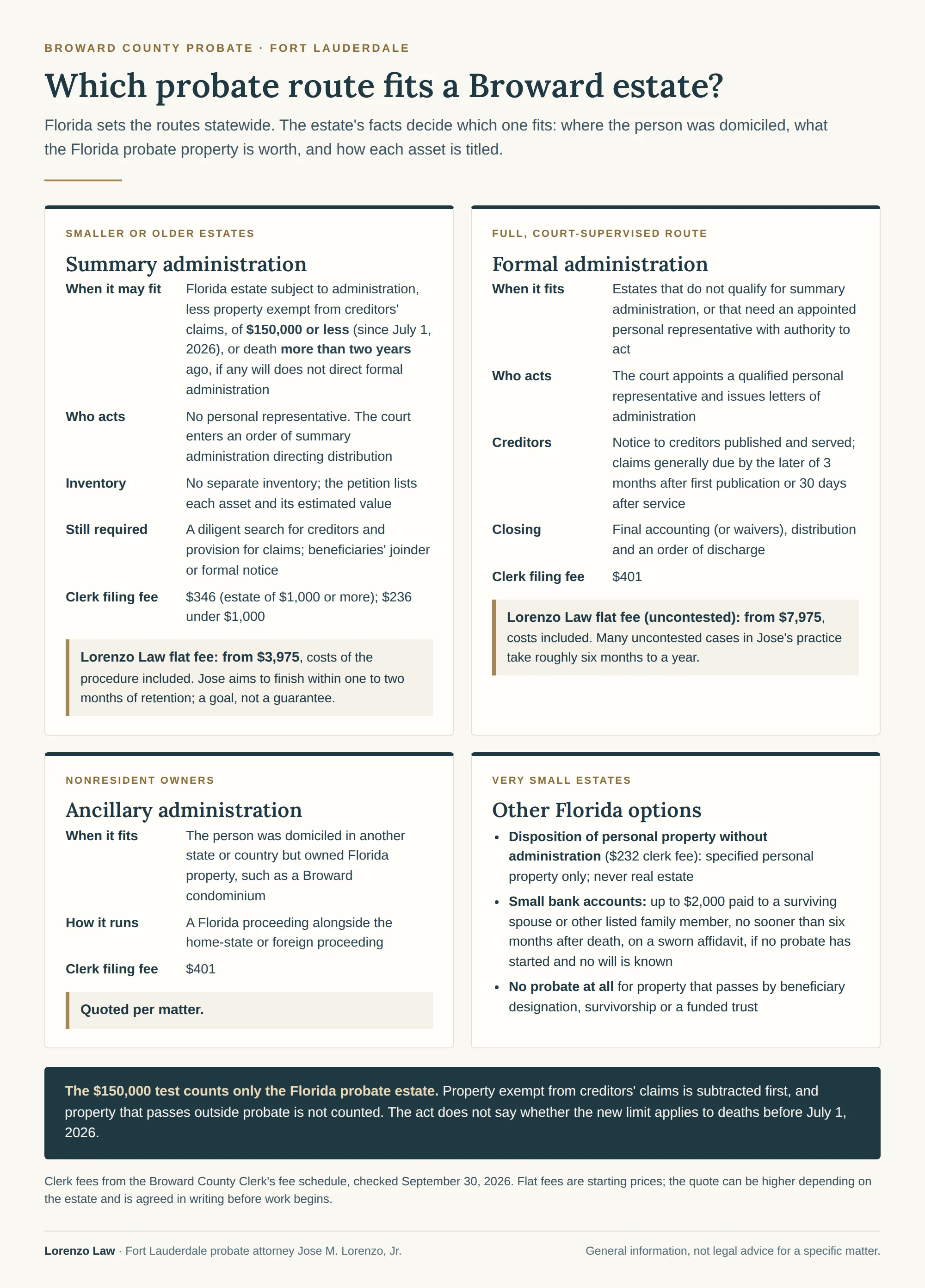
View the probate routes graphic
What qualifies for summary administration in Florida? The tests are in §735.201: value (the Florida estate subject to administration, less exempt property, of $150,000 or less) or time (death more than two years ago). Florida probate after 2 years is simpler in one respect: once the person has been dead more than two years, the Florida summary administration probate route is available regardless of value, as long as any will does not direct administration under chapter 733.
In summary administration, Broward County filings go to the same Probate Division as formal administration. The case starts with a petition for summary administration (Broward County checklist and Smart Forms apply where required). See summary administration in Florida for the full procedure. There is no single summary administration form that fits every estate: the petition must describe the assets, the beneficiaries and the provision for creditors. Beneficiaries often sign a Florida probate joinder, waiver and consent so the court can act without formal notice to them.
The $150,000 summary administration limit (effective July 1, 2026)
Chapter 2026-57, Laws of Florida, raised the summary administration limit from $75,000 to $150,000 effective July 1, 2026. Some published guidance, including the Clerk’s own explanatory page as of September 2026, still quotes $75,000.
A Fort Lauderdale example: a condominium worth $600,000 that qualifies as protected homestead, plus $120,000 in countable Florida probate assets, may satisfy the dollar test. That is because the test subtracts property exempt from creditors’ claims. The unit’s market value alone does not decide eligibility. The will, the creditor situation and the other conditions still matter. See Florida homestead in probate.
Does the $150,000 limit apply if the person died before July 1, 2026?
The act does not say. The act’s effective-date section reads in full: “Section 14. This act shall take effect July 1, 2026.” It contains no clause stating whether the new limit applies to people who died before that date. If an earlier assessment used the old limit, bring the date of death and the asset records for a fresh review. Do not assume the answer for an older or pending estate.
Other 2026 changes that affect Broward estates
The Florida new probate law most people have heard about is chapter 2026-57, effective July 1, 2026. The Florida Probate Rules 2026 amendments, including changes effective October 1, 2026, should be checked for any estate filed after that date.
- Small-estate thresholds rose. Ch. 2026-57 doubled the limits in several small-estate procedures (§§735.302–735.304).
- Safe-deposit boxes. A personal representative, or the personal representative’s attorney, can pay the accumulated charges and end the lease on a decedent’s safe-deposit box, so it stops billing the estate (§§655.933, 655.936).
- Enforcing authority. A personal representative who must go to court to enforce the authority the Probate Code gives them can recover costs and attorney fees if they prevail (§733.6125).
Is there a small estate affidavit in Florida?
Not a self-executing one for the whole estate, as many states have. The closest thing to a small estate affidavit: Florida allows a sworn affidavit for small bank balances, described below. The other small-estate routes still need a court order, so the options for probate in Florida for small estate values are narrow. A Florida probate small estate affidavit for real estate does not exist.
- Disposition of personal property without administration (sometimes shortened to disposition without administration, Florida Statutes §735.301) covers specified exempt personal property, and limited nonexempt personal property measured against qualifying funeral and last-illness expenses. It is not a way to transfer real estate.
- Intestate small estates. When there is no will, the person died more than one year ago, and no administration is pending in Florida, §735.304 can apply to nonexempt personal property worth no more than $20,000 plus preferred funeral expenses and reasonable medical and hospital expenses of the last 60 days of the final illness.
- Small bank accounts. A Florida financial institution may pay up to $2,000 in total, from sole-name accounts with no pay-on-death or survivor designation, to a surviving spouse (or, if none, an adult child, then an adult descendant, then a parent). Payment can be made no sooner than six months after death, on a sworn affidavit and a death certificate, and only when no probate has been started and no will is known (§735.303). The affiant takes on personal liability to creditors and others entitled to the funds.
Property that passes outside probate needs none of these: effective beneficiary designations, survivorship ownership, a funded trust, or a Lady Bird deed for Broward County property. See Florida non-probate assets and when probate is not necessary.
Ancillary administration: Florida property of a nonresident
Ancillary administration is the Florida proceeding for a person who was domiciled in another state or country but owned Florida property, such as a Broward condominium. Ancillary probate in Florida starts with a petition for ancillary administration. Florida courts then issue letters to a qualified personal representative. The cost of ancillary probate in Florida depends on the property and the home proceeding, so Lorenzo Law quotes it per matter. It is not a third value category. It runs alongside the home proceeding, and it often uses the home-state or foreign appointment papers. Bring the home probate documents, the will, and the Florida deed or account statements. See Florida ancillary probate and ancillary administration for non-citizens.
The Florida probate lawyer page explains these procedures statewide.
Where is probate filed for a Fort Lauderdale estate?
Florida probate venue is the county of domicile: for a person domiciled in Florida, probate belongs in the county where they lived. For a Broward resident, that is the Probate and Guardianship Division of the Seventeenth Judicial Circuit in Fort Lauderdale. Having an heir in Fort Lauderdale, choosing a local probate court lawyer, or owning one asset here does not by itself make Broward the proper county. If the person was not domiciled in Florida, §733.101 supplies other rules based on where property is located.
For example, a daughter who lives in Fort Lauderdale does not make Broward the proper county for her parent’s estate if the parent was domiciled in Palm Beach County. A nonresident’s Broward condominium raises a different venue and ancillary question. These are illustrations, not conclusions about a particular estate.
The Broward County probate court: what to know before filing
The Broward probate court, sometimes listed as the Broward County, FL probate court or simply the probate court Fort Lauderdale families use, takes filings electronically through the Florida Courts E-Filing Portal. The Seventeenth Judicial Circuit’s local procedures, mandatory checklists and Smart Forms govern many petitions. Every probate court (Florida has a probate division in each county’s circuit court) follows the same statewide probate law. Broward County adds its own local procedure. The same local rules apply whether a family files on its own or through a probate attorney. The Clerk also publishes its own filing fees, set out above.
| What you need | Where it is, or what applies |
|---|---|
| Official court name | Circuit Court for Broward County, Florida, Probate Division (the Probate and Guardianship Division of the Seventeenth Judicial Circuit) |
| Broward County probate division address | Broward County Central Courthouse (the Broward County courthouse), 201 SE 6th Street, Fort Lauderdale, FL 33301 |
| Broward County probate office and Broward County probate clerk | The Broward County Clerk of Court probate division, in the same courthouse |
| Phone, hours and email | Check the official Clerk page for the current Broward County Clerk of Court probate division phone number, the Broward County probate court phone number for the judges’ offices, the Broward County probate court hours, and any Broward County probate email address a division uses. Numbers change, so they are not reprinted here. |
| Filing | Florida Courts E-Filing Portal. The original will is deposited with the Clerk. |
| Broward County probate forms | The 17th Circuit publishes Broward County probate Smart Forms for many petitions. Broward probate forms and Broward County probate court forms are official court documents; Lorenzo Law does not supply forms. |
| Checklists | The Broward County probate checklist for opening an estate, the Broward County summary administration checklist, and the Broward County probate discharge checklist for closing are the 17th Circuit’s mandatory checklists. |
| Local affidavits | A Broward County probate affidavit of heirs and a Broward County probate affidavit of criminal history (an affidavit regarding criminal history) are required where the applicable checklist calls for them. |
| Broward County probate filing fees | $401 formal or ancillary; $346 or $236 summary; $232 disposition without administration (checked September 30, 2026). |
| Broward County probate judges | Assigned by division; the court guide lists the divisions. |
| Records | The Clerk’s online Broward County probate case search. The same Broward County probate search tools serve as the Broward County probate records search and show Broward County probate court records. |
| Uncontested matters | Qualifying uncontested matters can be submitted for orders without a hearing under Administrative Order 2021-49-PRC, Amendment 1, if the notice and supporting-document requirements are met. |
| Contested matters | A contested matter, one whose status is unknown, or one that otherwise requires a hearing is set as the assigned division directs. |
| Closing | The 17th Circuit’s closing requirements list a final accounting, or waivers of it signed by all beneficiaries, among the closing documents. |
Filing papers with the Clerk and submitting a proposed order to the judge are separate steps. Remote hearing arrangements depend on the assigned division and the court’s instructions. Do not assume every matter is entirely remote, or that every beneficiary must visit the courthouse. An original will may need to be delivered even when everything else is filed electronically.
For the Clerk’s room, phone numbers, hours, divisions and records search, see the Broward County probate court guide and the official Broward Clerk probate page, 17th Circuit Probate and Guardianship page and probate administrative orders.
How long does probate take in Broward County, Florida?
Jose aims to complete summary administrations within one to two months from retention. This is a goal, not a guaranteed completion date; documents, notice requirements, creditor issues and court review can affect timing. He starts the work as soon as he is retained. Many uncontested formal administrations in his practice take roughly six months to a year. Contested matters take longer, and no probate case carries a guaranteed completion date. The useful question is which unfinished step controls your estate.
How long does Florida probate take in general? The same statutes apply statewide, so the Florida probate timeline follows the same steps in every county; Broward adds its own checklists. How long does probate take in Florida without a will? No will does not by itself set a different timeline; finding and confirming every heir is what usually adds time. See how long probate takes in Florida.
When does probate start in Florida? When a petition is filed with the court, not automatically at the death. When is probate over in Florida? In formal administration, when the court enters the order of discharge; in summary administration, when the order is entered and the property is distributed.
What adds time in a Broward estate:
- a missing original will
- an heir who cannot be located or will not sign
- an unclear homestead status
- a condominium sale that needs association or title-company paperwork
- creditor claims that must be resolved
- a tax return
- a disagreement among family members
Court review times and other parties’ conduct are outside the firm’s control. Jose can discuss an estimated sequence after reviewing the records.
| Event | Timing to discuss |
|---|---|
| Depositing the original will | Whoever holds it must deposit it with the Clerk in the county where the person resided within 10 days after learning of the death. That is not the same as opening probate. §732.901 |
| Letters of administration | Florida courts issue them only after the petition is granted, and after the personal representative files an oath and a designation of resident agent (unless exempt) and posts any required bond. |
| Inventory (formal administration) | Generally due within 60 days after letters issue, subject to the rules and any extension. |
| Creditor claims | Generally the later of three months after first publication of the notice to creditors, or 30 days after service on a creditor who must be served. §733.702 |
| Two years after death | A separate limitation on claims, with statutory exceptions; not an absolute bar to every claim, lien or proceeding. §733.710 |
| Objections to the will | Generally three calendar months after service of the notice of administration. If formal notice was served before letters, written defenses are generally due within 20 days after service, and a later three-month window may not follow. A waiver or an earlier bar can change the analysis. |
| Exempt property petition | By the later of four months after service of the notice of administration, or 40 days after certain proceedings end. |
Tell the firm about any notice, waiver, objection, creditor letter or proposed sale right away. Requesting a consultation does not extend a deadline. See Florida probate rules and deadlines.
What is the 10-day rule for probate in Florida?
The “10-day rule” is the duty of whoever has the original will to deposit it with the Clerk within 10 days after learning of the death (§732.901). Where do I file a will in Broward County, Florida? The original goes to the Clerk’s probate division at the Central Courthouse. Depositing the will does not open probate or appoint anyone. A custodian who withholds it without good reason can be ordered to produce it and made to pay costs and fees.
What if the original will is lost, or there is only a copy?
A copy is not automatically enough, but a lost or destroyed will can still be proved in Florida. An interested person can ask the court to establish the will’s full terms. The content must generally be proved by two disinterested witnesses, or by one disinterested witness when a correct copy is available (§733.207). When the original was last in the person’s own possession and cannot be found, the law may presume the person destroyed it on purpose, and that presumption has to be overcome.
Before assuming the will is lost, check with the Clerk, the lawyer who drafted it, the person’s safe-deposit box and papers, and, for an electronic will, the qualified custodian. Bring the copy and anything showing where the original was kept. See probate of a will in Florida.
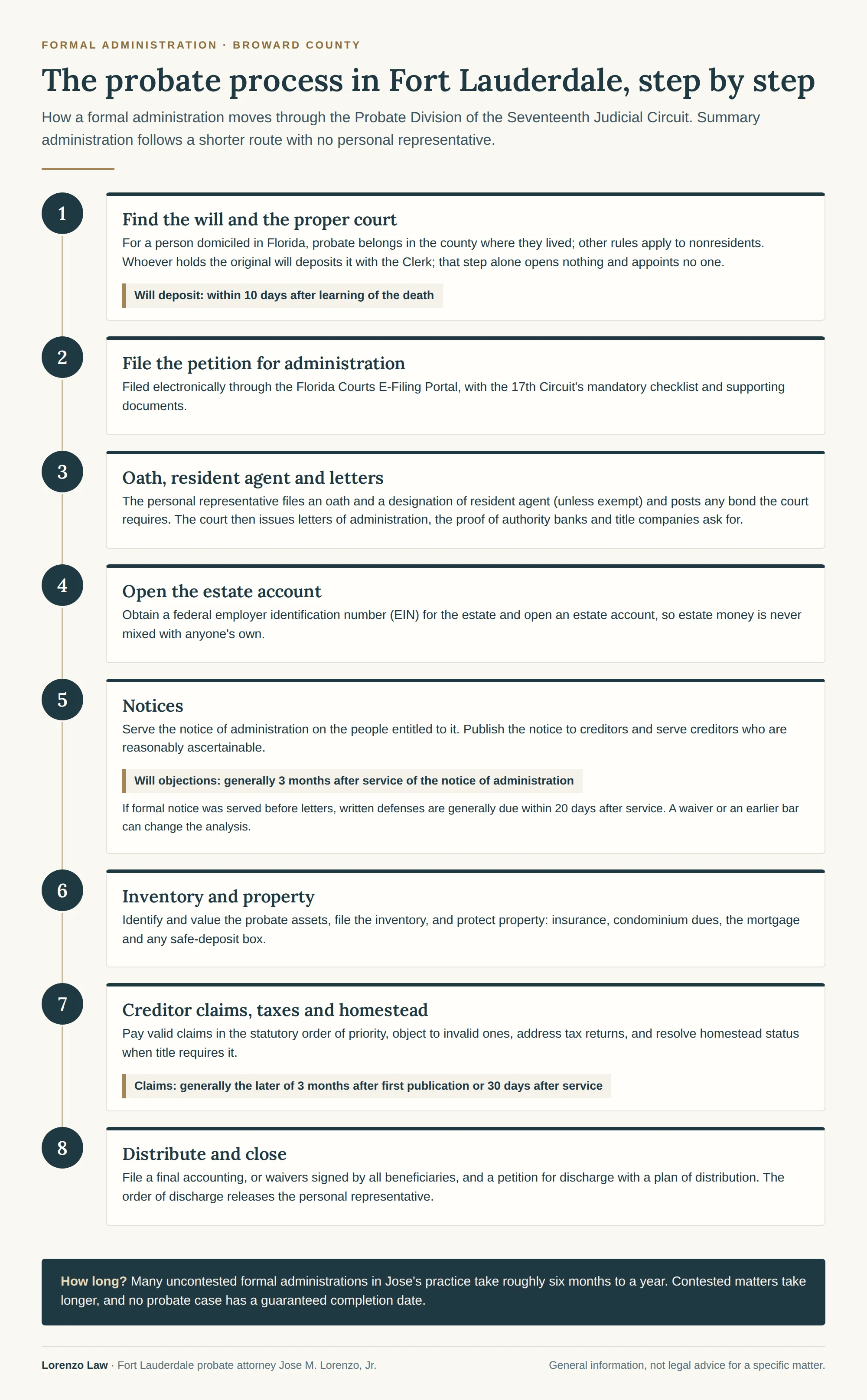
The probate process in Fort Lauderdale, step by step
Probating an estate: Fort Lauderdale formal administrations move through these steps; summary administration follows a shorter route without a personal representative. This is how to file probate in Broward County, Florida, and carry it to the end. The probate process (Florida statutes set it statewide) is explained generally in the Florida probate process.
- Identify the estate and the proper court. Review domicile, the will, family relationships and how each asset is titled. Deposit the original will where required; that step alone appoints no one.
- Prepare the petition for administration. Decide who seeks appointment and whether that person qualifies, and complete the 17th Circuit’s checklist and supporting documents. If there is a proceeding elsewhere, coordinate with it.
- Oath, resident agent and letters. The prospective personal representative files an oath and a designation of resident agent (unless exempt). When there is a will, the court enters an order admitting the will to probate. The court appoints the personal representative, sets any bond, and issues letters of administration, which banks and title companies ask to see. The Florida letter of administration, formally called letters of administration, is the personal representative’s proof of authority. Families from other states often ask for a letter of testamentary. Florida issues letters of administration instead; there is no separate Florida document by that name.
- Open the estate account. Obtain a federal employer identification number (EIN) for the estate and open an estate account, so estate money is never mixed with anyone’s own.
- Serve the notice of administration and handle creditors. Serve the notice of administration on the people entitled to it. Publish the notice to creditors. Florida requires publication and service on reasonably ascertainable creditors.
- Inventory and property. Identify and value the probate assets, file the inventory, and protect property: insurance, association dues, the mortgage and any safe-deposit box.
- Claims, taxes and homestead. Pay valid claims in the statutory order of priority, object to invalid ones, address tax returns, and file a petition to determine homestead status when title requires it.
- Distribute and close. File a final accounting (or the Florida probate waiver of accounting, signed by all beneficiaries) and a petition for discharge with a plan of distribution. The Florida probate order of discharge releases the personal representative.
Florida probate notice to AHCA. If the person was 55 or older at death, whether or not they ever received Medicaid, the personal representative must serve the state’s Medicaid agency with a copy of the notice to creditors and a copy of the death certificate within three months after the notice is first published, unless the agency has already filed a claim. This lets the agency decide whether it has a Florida Medicaid estate recovery claim. People often call this the notice to Agency for Healthcare Administration; the agency’s official name is the Agency for Health Care Administration (AHCA).
When there are co-personal representatives under a will signed on or after October 1, 1987, a majority must agree on administration decisions unless the will says otherwise. The personal representative is a fiduciary with the duties of a trustee. A personal representative who signs a contract for the estate without making clear they are acting for the estate, and identifying it, can be personally liable on that contract. For debts that come from owning or managing estate property, and for harm caused while handling the estate, a personal representative is personally liable only if personally at fault; either way, these obligations can also be pursued against the estate.
What does the personal representative do in Florida?
In other states the role is called executor of estate. Florida uses the term personal representative, and the court, not the will alone, makes the appointment.
- Who can serve, under Florida personal representative qualifications: a person is disqualified if under 18, mentally or physically unable to serve, convicted of a felony, or convicted anywhere of abuse, neglect or exploitation of an elderly person or disabled adult; a nonresident may serve only within the family relationships listed below. These rules apply with or without a will; they decide who can be the personal representative of estate. Florida courts check them before issuing letters.
- Appointment of personal representative (Florida procedure): the court appoints after the petition. Before letters, the Florida probate designation of resident agent and the oath are filed, and the court decides whether a Florida probate bond is required. When estate property needs protection, for example before a personal representative is appointed, the court can appoint a curator to preserve it.
- Duties of personal representative in Florida: collect and protect the probate assets, give the required notices, pay valid claims, account to the beneficiaries and distribute. The personal representative has the fiduciary duties of a trustee.
- Executor fees (Florida calls them personal representative compensation): separate from the lawyer’s fee; a family member may claim it or give it up.
Fort Lauderdale issues to address early
What happens to a condo during probate, and who pays the association?
A Fort Lauderdale condominium keeps generating obligations while the estate is open, and an heir who takes title can become responsible for assessments the estate left unpaid.
- Heir liability. Under §718.116(1)(a), a new owner is jointly and severally liable with the previous owner for assessments that came due before the transfer, with no exception for a unit received by will or inheritance. The heir has a right to recover from the estate, but the association can pursue the heir first. Florida’s First and Third District Courts of Appeal disagree about how far back that liability reaches: the First District reaches assessments left unpaid by earlier owners, while the Third limits it to the immediate prior owner’s period, and the Florida Supreme Court has not resolved the conflict. Broward appeals go to the Fourth District Court of Appeal, which has not decided the question, so the answer in Broward is unsettled. Have the association’s statement reviewed before accepting title.
- During administration. Assessments that come due while probate is open are generally owed by whoever holds title to the unit. If the unit is part of the probate estate (not protected homestead), the personal representative pays them from estate assets. If it is protected homestead, title passed to the surviving spouse or heirs at death, outside the estate. Either way, the association has a statutory lien and can foreclose, and the homestead protection does not block an assessment lien.
- Special assessments.
- Buildings three or more stories tall need milestone structural inspections: generally at 30 years after the certificate of occupancy, which a local agency may lower to 25 near salt water, then every 10 years (§553.899).
- Associations must fund structural integrity reserves for key building components (§718.112(2)(g)). For budgets adopted on or after December 31, 2024, unit owners generally can no longer vote to waive or underfund those reserves. There are two narrow exceptions: a pause while the building is officially uninhabitable after a natural emergency, and, for budgets adopted on or before December 31, 2028, a temporary pause or reduction of up to two budget years, with a majority vote of all unit owners, to pay for repairs after a recent milestone inspection.
- That is why an inherited unit in an older Galt Ocean Mile or Las Olas tower can arrive with a large special assessment.
- Transfers and sales. An association can require approval of a title transfer only if its declaration says so in those terms, and many declarations exempt transfers to family members. Request the association’s condo estoppel certificate early, not at the closing table.
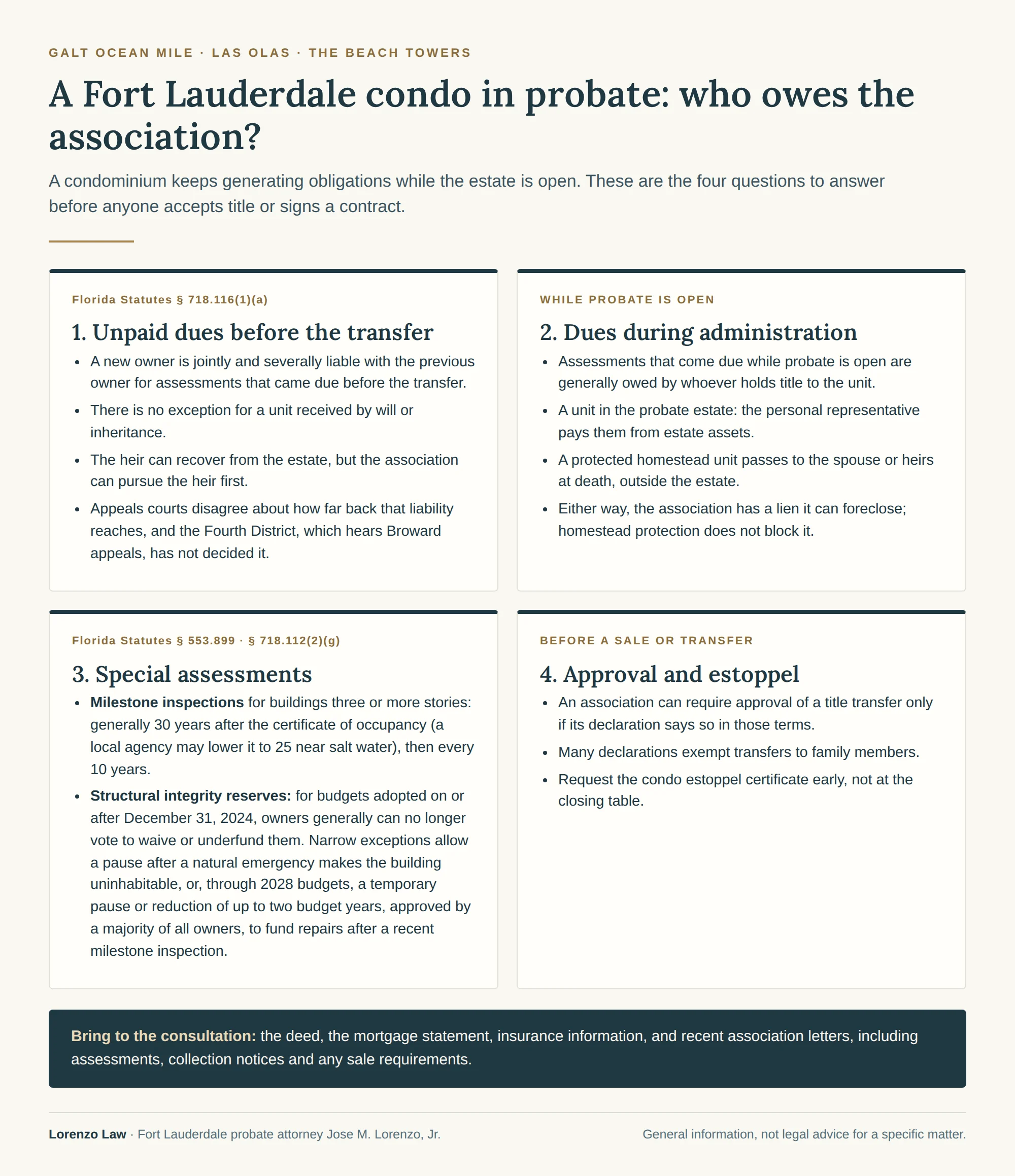
Gather the deed, mortgage statement, insurance information and recent association correspondence, including assessments, collection letters and any sale requirements. The probate case does not by itself resolve liens or stop ongoing charges. Share any contract or title-company request before committing to a closing date.
Can a house be sold while in probate in Florida?
Yes, with the right authority. Selling a house in probate: Florida law first asks who has the authority to sell. For estate property, a power of sale in the will, or court authorization or confirmation, allows the personal representative to sell (§733.613). Protected homestead, and property that already belongs to the heirs, raise different questions. One heir cannot sign for all owners. Do all heirs have to agree to sell a house in Florida? Not necessarily when the estate sells with proper authority; the deed, the will and the title company’s requirements decide it. When co-owners cannot agree, a separate partition action may be needed. This is the work people mean when they search for a real estate probate attorney or a probate real estate attorney: title, authority and association paperwork aligned before closing. Before listing any probate property (Fort Lauderdale houses and condos can be sold during administration with proper authority), confirm who signs the deed. See selling a house during probate.
Can I be personal representative if I live outside Florida?
Only if you fall within the relationships the law allows for a nonresident personal representative. Florida permits a person not domiciled in Florida to serve under §733.304 only if they are:
- related to the decedent by lineal consanguinity;
- a spouse, brother, sister, uncle, aunt, nephew or niece of the decedent, or someone related by lineal consanguinity to any of them;
- an adopted child or adoptive parent;
- the spouse of anyone otherwise qualified.
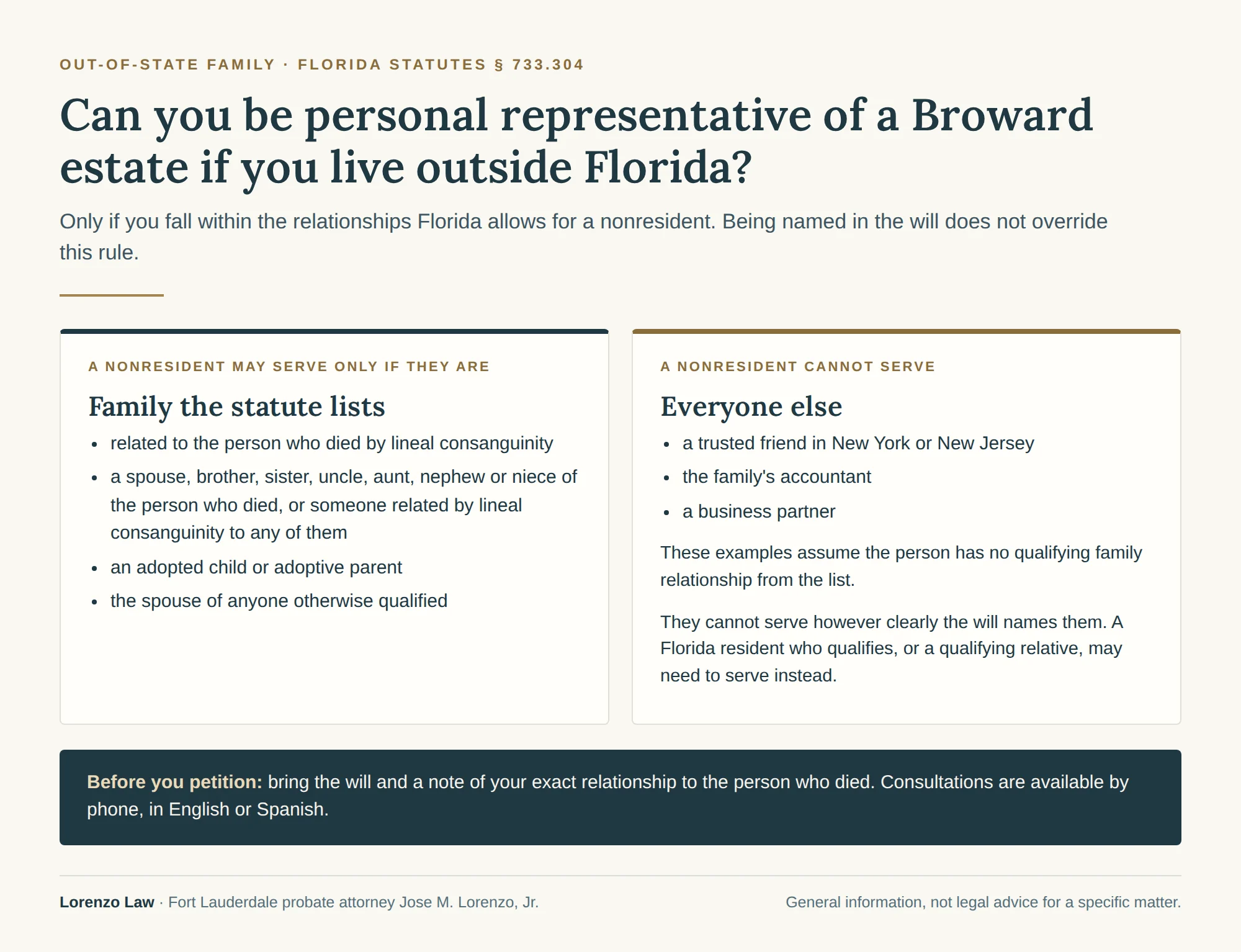
View the out-of-state personal representative graphic
This is the Florida probate non-resident rule. An out-of-state executor (Florida says nonresident personal representative) who is only a trusted friend, accountant or business partner in New York or New Jersey, with no qualifying family relationship, cannot serve, however clearly the will names them. Being named in the will does not override the qualification rules. Bring the exact relationship and the will for review. Read about serving as an out-of-state executor in Florida and how to become personal representative in Florida.
Can I handle a Broward probate from another state or country?
Often yes. You do not need to move here to hire an estate administration lawyer: Fort Lauderdale estates can often be handled for families who live elsewhere. Consultations can be by phone. Petitions are filed electronically. Many uncontested orders are entered on the papers. Jose offers remote signing through online notarization for documents that can lawfully be signed that way. Some matters still need a hearing, an original document or a particular signature. Confirm what your role and the assigned judge require before booking travel. A remote consultation does not guarantee that every later step can be completed remotely.
Canadian and other foreign snowbirds with Broward property
When a Canadian or other foreign owner of a Hollywood, Hallandale Beach or Fort Lauderdale condo dies, the Florida property usually needs its own Florida proceeding, often ancillary administration, even if the estate was settled at home. Families abroad often start by looking for an inheritance lawyer. Fort Lauderdale property titled in the owner’s name alone usually still needs its own Florida proceeding. Property held jointly with a right of survivorship, or in a funded trust, passes without one, and so can property conveyed by an enhanced life estate (Lady Bird) deed. Florida has no transfer-on-death deed for real estate; transfer-on-death designations work only for accounts and securities. Foreign wills, foreign appointment papers and translations need review. Florida will not admit a holographic (handwritten, unwitnessed) or oral will, even if it was valid where it was signed. French-speaking families from Quebec are welcome; consultations are in English or Spanish. Tax questions for non-U.S. owners should be raised with a tax professional early.
Beneficiary designations after divorce or death
Get the actual beneficiary records for life insurance, retirement accounts and payable-on-death accounts. They pass by their own terms, outside the will. A former spouse or a beneficiary who died first can change the result, depending on the plan’s terms and Florida law. Knowing how each asset is owned separates probate work from a separate benefit claim or dispute. See bank accounts when someone dies.
Guardianship before death, probate after
Broward has a large retiree population, and the two proceedings often arrive in sequence: an adult guardianship while a parent is alive, then probate after death. They are separate cases. A guardian’s authority, like an agent’s authority under a power of attorney, does not continue as authority to administer the estate. A guardianship ends at the ward’s death, but a guardian of the property still has work to do: file a final report within 45 days after being served with letters of administration, serve it on the personal representative, deliver the remaining assets, and ask the court for discharge. Bring the guardianship case number, orders and recent accounting. See guardianship in South Florida.
Does a beneficiary inherit the person’s debts?
Being an heir does not make you personally liable for the decedent’s debts. It is usually the first question heirs ask when they call an inheritance attorney, Fort Lauderdale or elsewhere. A debt you co-signed is your own. Valid claims are paid from the estate in the statutory order of priority. A beneficiary who received a distribution from an insolvent estate can be required to return it, up to the value received. Do not pay creditors or distribute assets before the claims picture is clear. See do you inherit debt in Florida and Florida probate creditors.
Probate litigation attorney in Fort Lauderdale
When a Broward estate is contested, the same lawyer who understands the administration can handle the dispute. Families looking for a probate litigation attorney: Fort Lauderdale disputes over a Broward estate are heard in the same Probate Division as the administration. Jose represents personal representatives, heirs and beneficiaries in probate litigation. Fort Lauderdale disputes he handles include:
- will contests and caveats;
- petitions to remove a personal representative;
- demands for an inventory or accounting;
- breach of fiduciary duty and surcharge claims;
- disputed homestead and heirship determinations;
- claims about transfers made before death.
Whether you call it a will contest or an estate dispute, and whether you are looking for a contested probate attorney or for probate litigation attorneys at a larger firm, the first step is the same: a review of the will, the notices already served and the deadlines.
Probate dispute resolution: Broward cases often go to mediation before any trial, and a contested probate lawyer, Broward County or elsewhere, should prepare for both. Probate issues are tried by the judge, not a jury.
Deadlines matter most, and they are the first thing a Fort Lauderdale probate litigation attorney checks. A will objection is generally due three calendar months after service of the notice of administration, and written defenses to a formal notice (probate, Florida Rule 5.040) served before letters are generally due within 20 days after service. A waiver, a consent or an order already entered can change the analysis. Florida does not enforce a no-contest clause in a will.
See Fort Lauderdale probate litigation, the Florida will contest attorney page, caveats in Florida probate, and trust litigation for disputes over a trust or trustee.
Do I need a lawyer for probate in Florida?
Do I need a lawyer to go through probate in Florida? In a formal administration, generally yes. Should you get a lawyer for probate in a smaller estate? Use the two lists below.
Does Florida require a lawyer for probate?
A personal representative in a formal administration must be represented by a Florida attorney unless the personal representative is the sole interested person or is a Florida attorney. Being the only beneficiary is not the same as being the sole interested person. A creditor, an omitted heir or a surviving spouse can also have a stake in the estate. No Florida court has held that one known creditor alone ends the exception, but proceeding without a lawyer is risky whenever anyone else has a financial interest.
Can I file for probate without a lawyer in Florida?
Do I need a lawyer for summary administration in Florida? Not always, because no personal representative is appointed. Filing probate in Florida without an attorney works best when the estate is small, the family agrees and there is no real estate. The petition, beneficiaries’ joinder or formal notice, a diligent creditor search and provision for claims still have to meet the requirements. Skipping the creditor search does not automatically void the order, but the people who received the property become personally liable to a creditor who was left out, up to what each received, and can owe that creditor’s attorney fees. A defective order is often discovered years later, when someone tries to sell or refinance the property. Pro se probate help from court self-help resources can explain forms. It cannot give legal advice about your estate.
You may not need a probate lawyer at all when:
- everything passed by beneficiary designation, survivorship or a funded trust, leaving nothing to administer;
- a small bank balance qualifies for the $2,000 family-member payment;
- the estate qualifies for disposition without administration.
Retain a Fort Lauderdale probate attorney when:
- there is real property, especially a condominium with an association;
- you live outside Florida and must confirm you can serve;
- anyone questions the will, the signature, capacity or a transfer made before death;
- creditors are calling, or a claim has been filed;
- a beneficiary is a minor or cannot be located;
- the person was not a U.S. citizen, or owned property in another state or country.
For more, see do I need a Florida probate attorney.
What are the common mistakes in probate in Broward County?
Each of these can delay an estate or cost the family money, whether or not the family hires a probate lawyer. Broward County’s checklists catch some of them; others surface months later.
- Keeping the original will instead of depositing it with the Clerk within 10 days.
- Assuming the will avoids probate. A will directs probate property; titles and designations decide what avoids it.
- Assuming the person named in the will can serve, without checking the nonresident rules.
- Paying creditors, or distributing to family, before the claims period ends.
- Letting condominium assessments lapse while the estate is open.
- Selling or clearing out the house without authority.
- Filing summary administration without a diligent creditor search.
- Relying on the $75,000 figure from an outdated page.
- Mixing estate money with personal money instead of opening an estate account.
- Waiting on a deadline while gathering “all the records.”
Myth vs. reality: what Fort Lauderdale families get wrong about probate
| Myth | Reality |
|---|---|
| “Florida will tax my inheritance.” | Florida has no estate tax and no inheritance tax. For U.S. citizens and residents, the federal estate tax reaches only estates above the federal exemption ($15 million per person in 2026, reduced by taxable lifetime gifts); owners who were not U.S. citizens or residents face different federal rules. Income-tax returns and property taxes are separate questions. |
| “The small-estate limit is $75,000.” | The summary administration limit has been $150,000 since July 1, 2026. |
| “Having a will means we avoid probate.” | A will directs probate property. Titles, beneficiary designations and funded trusts decide what avoids probate. |
| “The family inherits the debts.” | Heirs are not personally liable, but a distribution from an insolvent estate can be clawed back. |
| “The person named in the will automatically serves.” | The court appoints, and the nominee must qualify. |
| “Everyone has to go to court in Fort Lauderdale.” | Many uncontested Broward matters are decided on the papers; some need hearings. |
| “The estate always pays everyone’s lawyer.” | Reasonable fees of the personal representative’s lawyer are generally an estate expense; a beneficiary’s own lawyer usually is not. |
| “Probate fees are set at 3%.” | The statutory schedule is a presumption, not a mandate; fees are negotiable. Lorenzo Law quotes flat fees. |
How to hire a probate lawyer in Broward County
Hire a probate lawyer in Broward County by comparing who will actually do the work, what the fee covers, and how the lawyer will handle your estate’s specific risks. How to choose a probate attorney comes down to those three things. To find a probate lawyer who fits, talk to more than one.
Who are some good probate attorneys in Broward County, Florida?
How do I find a good probate attorney? Start with fit, not rankings. There is no official ranking of the best probate lawyer or the best probate attorney in Florida, and no directory can name the best probate attorney. Fort Lauderdale families should compare instead: the right lawyer for your family is the one whose experience, fees, availability and communication fit your estate and your role. Directories list many probate lawyers (Fort Lauderdale, Florida, and the rest of Broward). Check any Broward County probate attorneys you consider on The Florida Bar’s member profile, and ask the questions below.
Questions to ask a probate attorney
An experienced probate attorney should answer these directly:
- Who will handle my file from the first filing to the order of discharge?
- Which route fits this estate (summary, formal or ancillary), and why?
- What does the fee include, and what would put work outside the quote?
- What will you need from me, and when will I hear from you?
- How do you handle a Broward condominium, a nonresident personal representative, or a disagreement among heirs?
- If the estate becomes contested, will you act as the probate litigation lawyer, or refer the dispute elsewhere?
Comparing Fort Lauderdale probate lawyers and law firms
Probate attorneys in Fort Lauderdale, like other Broward County probate lawyers and estate lawyers (Fort Lauderdale has many), differ in staffing and availability. A Fort Lauderdale probate law firm with several attorneys may offer additional coverage; ask who will be responsible for your file. Lorenzo Law is a solo practice, and Jose personally handles the matters the firm accepts. Compare that structure with the communication, staffing and scope offered by any other firm you are considering. It is a difference in practice structure, not a claim about another lawyer’s ability.
Looking for a probate lawyer near you?
Searches for “probate lawyers near me,” “probate lawyer near me” or “probate attorney near me” can help you locate firms. Compare their scope, communication and fee terms as well as distance when you choose a probate lawyer. If you need a probate lawyer, Broward County has one courthouse for every estate: the Central Courthouse in Fort Lauderdale, regardless of where the lawyer’s office is. Jose meets clients by appointment in Fort Lauderdale and Coral Gables, and consultations are available by phone.
Searches for probate law firms near me, an inheritance lawyer near me, or an attorney probate near me return maps full of pins. Local probate attorneys and other probate lawyers in Broward County can meet you in person, but for a Broward estate the court is the same wherever the lawyer sits. See how to choose a Florida probate lawyer.
Probate across Broward County
Jose represents families with estates throughout Broward County, from Fort Lauderdale to Coral Springs, Hollywood and Hallandale Beach. A city guide describes local court practice; it does not mean the firm has an office in that city. The principal office is in Kissimmee, Florida. Jose also meets clients by appointment in Coral Gables and Fort Lauderdale. Families who need an estate lawyer (Fort Lauderdale, Florida, or any other Broward city) deal with the same Probate Division.
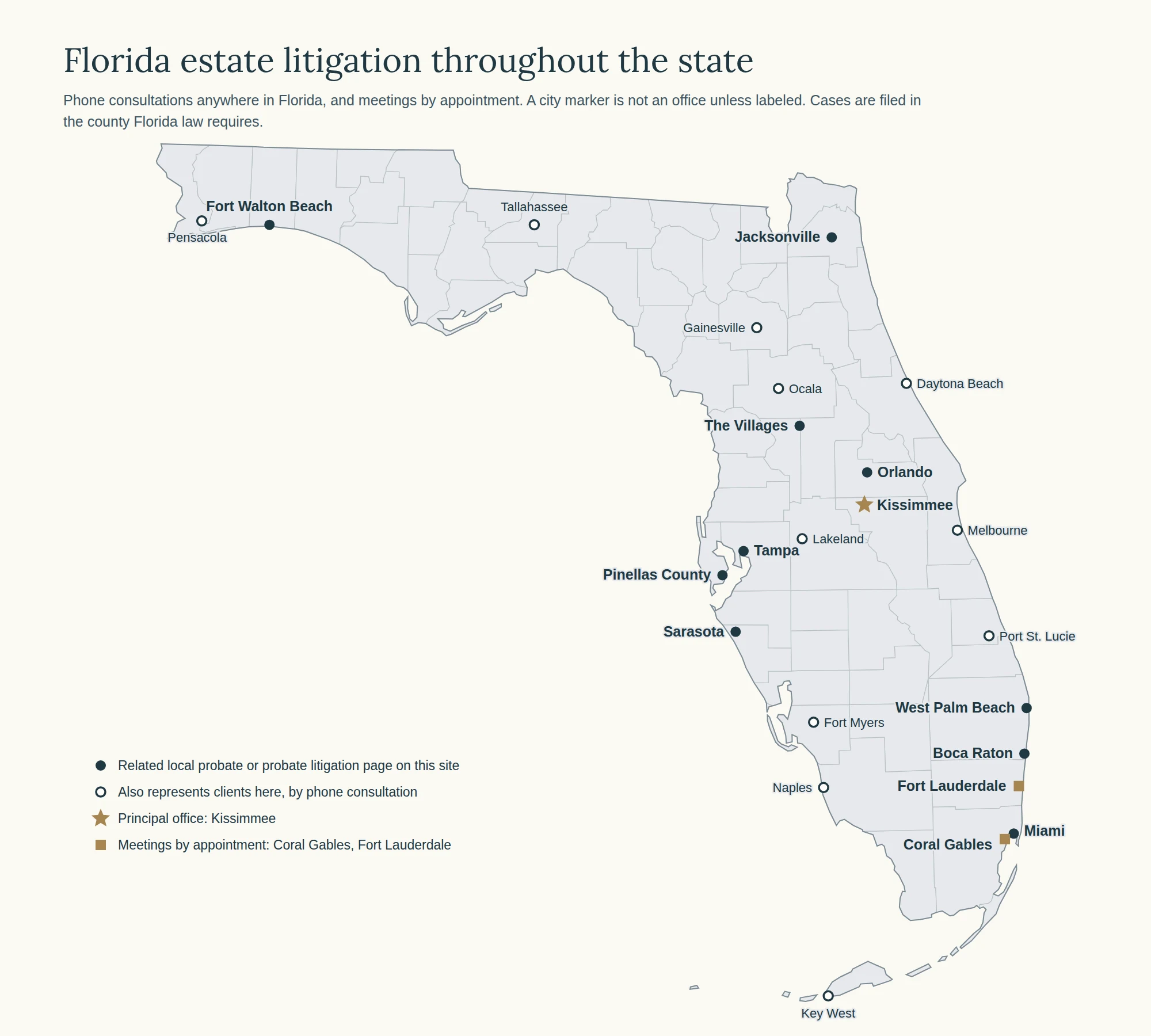
View the full-size Florida service-area map
| Area | City probate guides |
|---|---|
| North Broward | Pompano Beach · Lighthouse Point · Coconut Creek · Margate · Tamarac · North Lauderdale. Also Coral Springs, Parkland and Deerfield Beach. |
| Central Broward | Oakland Park · Wilton Manors · Lauderhill · Plantation · Sunrise. Also Lauderdale Lakes and Lauderdale-by-the-Sea. |
| South Broward | Dania Beach · Pembroke Park · Pembroke Pines. Also Hollywood, Hallandale Beach and Miramar. |
| West Broward | Davie · Cooper City · Weston · Southwest Ranches |
Every Broward estate is filed in the same Probate Division in Fort Lauderdale, whichever city the person lived in. See also the Broward County probate lawyer page and South Florida probate attorney. Looking for a probate lawyer? South Florida has a separate probate court in each county; for Miami-Dade or Palm Beach County estates, see Miami probate attorney and Palm Beach County probate lawyer.
Fort Lauderdale neighborhoods and nearby Broward communities
Property type and family circumstances can shape the questions to ask in Fort Lauderdale and nearby Broward communities, and a probate attorney (Broward County, Florida, or elsewhere) should ask about them early. These examples identify records and issues to discuss; they do not predict what every estate in an area involves.
| Neighborhood or community | Issues to discuss |
|---|---|
| Galt Ocean Mile, Las Olas, the beach towers | Condominium assessments, milestone-inspection and reserve assessments, estoppel certificates |
| Victoria Park, Rio Vista, Coral Ridge, Harbor Beach | Single-family and waterfront homes; homestead status and title before a sale |
| Hollywood and Hallandale Beach condominiums | Canadian and other foreign owners; ancillary administration |
| Coral Springs, Parkland, Weston, Plantation | Family homes; children who live out of state and want to serve |
Working with Jose M. Lorenzo, Jr.
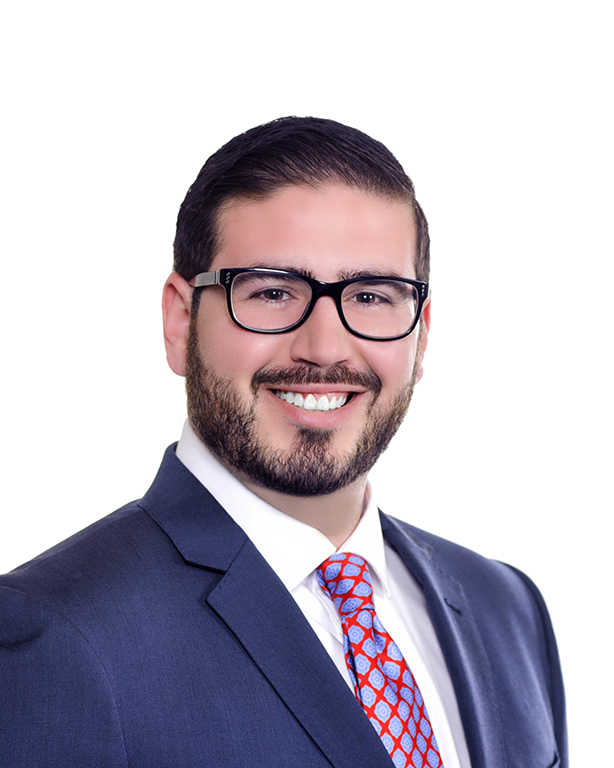
Jose M. Lorenzo, Jr. was admitted to The Florida Bar on October 4, 2013 (Florida Bar No. 107002).
- Before admission, he worked for roughly a decade as a paralegal on probate and litigation matters.
- As a third-year law student, he served as a judicial intern in the Probate Division of Florida’s Eleventh Judicial Circuit with the Honorable Maria M. Korvick.
- Education: a B.A. in Accounting and Finance from Florida International University, and a law degree from FIU College of Law.
Read Jose’s biography and his official Florida Bar profile.
How the practice works:
- A solo practice: one Broward probate attorney from the first review through the final order.
- Phones are answered 24 hours a day, and the firm aims to follow up on inquiries within one to two business days.
- Free initial consultation, by phone or by appointment, in English and Spanish.
- For clients who want to meet their probate attorney, Fort Lauderdale meetings are by appointment at 12 SE 7th Street, Suite 701. This is a meeting location, separate from the courthouse; it does not determine venue.
- The principal office is in Kissimmee, Florida, and appointments are also available in Coral Gables.
Consultations are available in Spanish. Spanish-language page: Fort Lauderdale wills and inheritance attorney (in Spanish).
Prepare for your free consultation
Lorenzo Law offers a probate lawyer consultation at no charge. Start with what you have. Missing documents should not stop you from raising an urgent problem.
- The person’s name, date of death and last permanent address.
- Your relationship, your role under any will, and whether a court has already appointed you.
- The will and any codicils, who holds the originals, and a death certificate if available.
- Names and contact information for the surviving spouse, children, and other heirs and beneficiaries.
- A preliminary asset list with account titles, beneficiary information and approximate values.
- For Broward real estate: the deed, property address, mortgage, insurance and association correspondence, and any contract or title-company request.
- Known debts, creditor letters, and receipts for funeral or other expenses someone has paid.
- Any existing probate or guardianship case number, letters, orders, notices, waivers, or papers from another state or country.
- Any disagreement, hearing, response date, proposed distribution or planned sale.
- Any letter about a Florida unclaimed estate or unclaimed property held by the state.
Describe the situation first and ask how to share sensitive records securely; do not put account or Social Security numbers in the contact form. The consultation can identify issues and next steps. Representation begins only if the firm accepts the matter under a written engagement.
More questions about probate in Fort Lauderdale
How much does a probate lawyer cost in Fort Lauderdale?
How much should I expect to pay a probate lawyer? At Lorenzo Law, summary administration starts at $3,975 and uncontested formal administration at $7,975, costs of the procedure included, quoted before the engagement begins. When comparing attorney probate fees, Florida firms may bill hourly, by the statutory schedule, or by flat fees that may or may not include costs. Compare what each quote covers.
Is the probate attorney free consultation really free?
Yes. At Lorenzo Law, the initial probate lawyer free consultation carries no charge, by phone or by appointment. Many firms advertise a Florida probate attorney free consultation; ask what it covers and when fees begin. Here, representation starts only under a written engagement.
What is the filing fee for probate in Broward County?
$401 for formal or ancillary administration and $346 for summary administration of an estate of $1,000 or more, on the Clerk’s schedule checked September 30, 2026.
How long does a summary probate take in Florida?
How long does summary administration take in Florida? Jose aims to complete summary administrations within one to two months, and he begins the filing work as soon as he is retained. Summary administration is usually faster than formal administration because no personal representative is appointed, there is no separate inventory, and there is no ongoing administration after the court enters its order. Timing still depends on complete documents, beneficiaries’ participation, the creditor search and the court’s review; the one-to-two-month aim is a goal, not a guarantee.
Do you have to go through probate when someone dies in Florida?
Not always. Does every death in Florida have to go through probate? No. Is probate required in Florida? Only for property that does not pass on its own at death: generally, property in the person’s name alone, the person’s share of property held as tenants in common, and assets payable to the estate, when no beneficiary designation, survivorship right or funded trust transfers them. When is probate not necessary in Florida? When everything passed by payable-on-death designation, joint ownership with survivorship, a funded trust or life insurance with a living beneficiary. See when probate is not necessary.
What assets are exempt from probate in Florida?
Assets that pass by their own terms are outside probate: accounts with a pay-on-death or transfer-on-death designation, property owned jointly with survivorship, trust assets, and life insurance or retirement accounts with a living beneficiary. Separately, Florida’s exempt-property rules can protect certain household items and motor vehicles for the surviving family, including what people call the Florida probate vehicle exemption, if a timely petition is filed. How to avoid probate in Florida for your own property is an estate-planning question; see Fort Lauderdale estate planning and what assets are exempt from probate.
Probate in Florida with a will or without a will: what changes?
Probate in Florida with a will follows the will’s instructions for the probate property (the people it names are called devisees or beneficiaries) and its choice of personal representative. Probate in Florida without a will follows the same court steps, but the intestacy statutes decide who inherits and who has priority to serve. The probate process in Florida without a will often needs more proof of family relationships.
Does having a will avoid probate?
No. A will directs the probate property and nominates a personal representative. Whether property needs probate depends on how it is titled. A trust that never received title to an asset does not keep that asset out of probate.
Is homestead exempt from probate?
The Florida probate homestead exemption gives protected homestead special inheritance and creditor protections, and it is excluded from the summary-administration value test as property exempt from creditors’ claims, but it can still require a court step. Whether the property qualifies, how it passes, surviving-family rights and existing liens all need review. In practice, title companies usually ask for a court order determining homestead status before they will insure a sale, and in Broward that petition is generally heard within a probate administration rather than as a stand-alone case.
Who inherits when there is no will in Florida?
Florida’s intestacy statutes decide, starting with the surviving spouse and descendants (§§732.102–732.103).
- Spouse, and the person left no descendants (children, grandchildren and so on): the spouse generally takes the entire intestate estate.
- Spouse, and every one of the person’s descendants is also the spouse’s descendant, and the spouse has no other descendants: the spouse generally takes the entire intestate estate.
- Spouse, and the person’s descendants, where either the person or the spouse has descendants from another relationship: the spouse generally takes half, and the person’s descendants share the other half, with the children of a child who died first taking that child’s place.
- No spouse: the descendants take everything; if there are none, the parents; then brothers and sisters and their descendants; then more distant relatives, in the order the statute sets.
When a spouse and descendants both survive, the home passes under its own rules instead of this list. Proving the family tree is usually the work in an intestate Broward estate: death and birth certificates, and sometimes an affidavit of heirs or a court determination of beneficiaries.
What does a surviving spouse get in Florida?
More than the will may show. Beyond any gift in the will or the intestate share above, Florida law gives a surviving spouse protections that a will cannot always override:
- Elective share: the right to elect 30% of the “elective estate,” which can include some property outside probate, within a strict deadline after notice of administration or death (§732.2065).
- Homestead: when the person is survived by a spouse or a minor child, the home generally cannot be left by will to anyone else; if there is a spouse but no minor child, it can be left to the spouse. When the home instead passes by law and the person also left descendants, the spouse generally takes a life estate, or may elect within six months after death to take a half interest instead; that election cannot be revoked.
- Exempt property and a family allowance: certain household items and vehicles, claimed by a timely petition; and a family allowance of up to $18,000 for the spouse and other lineal heirs the person was supporting, requested by a verified petition.
A written prenuptial or postnuptial agreement, signed before two witnesses, can waive these rights; one signed after the marriage also requires fair disclosure of each spouse’s estate. The deadlines are short, so a surviving spouse should ask about them at the first consultation, and a personal representative should account for them before distributing anything.
Who serves when there is no will?
Florida’s statute gives preference first to the surviving spouse, then to the person selected by a majority in interest of the heirs, then to the heir nearest in degree (§733.301). The court still decides, and the person must qualify. A convicted felon cannot serve.
Is Florida a difficult probate state?
The probate laws in Florida are detailed but predictable. The steps are set by Florida probate law. Fort Lauderdale estates add Broward’s own checklists. Missing documents, unclear titles, creditors, family disagreements and court scheduling can all affect timing. Ask which step is likely to control your estate.
Are probate records public in Florida?
Most probate filings are public court records. How do I find probate records in Broward County, Florida? Use the Clerk’s online case search. See the Broward County probate court guide for how to search.
Does Florida have an estate or inheritance tax?
No. There is no Florida estate tax and no inheritance tax. For U.S. citizens and people domiciled in the United States, the federal estate tax generally applies only to estates above the federal exemption, $15 million per person in 2026, and taxable gifts made during life use up part of that exemption. Different federal rules apply when the person was neither a U.S. citizen nor domiciled in the United States: an estate tax return can be required at a much lower level of U.S. assets, and a tax treaty, such as the one with Canada, can affect whether any tax is actually due. See ancillary administration for non-citizens. Final income-tax returns, estate income-tax returns and property taxes are separate obligations.
Must every family member come to Fort Lauderdale?
No universal rule requires it. Consultation, signing and court participation are separate questions, and a Broward probate lawyer can tell you which apply. Many matters move by electronic filing and orders on the papers; others need a hearing or original documents.
Talk to a Fort Lauderdale probate attorney
Before choosing a probate lawyer, Fort Lauderdale families can get answers in one free consultation. Tell Lorenzo Law who died, where the person lived, what property is involved, your role, and whether a case or deadline already exists. Jose can discuss the legal work needed, the fee, and the next steps for your Broward estate.
Request a free initial consultationCall (305) 224-6811
Fort Lauderdale meetings are by appointment at 12 SE 7th Street, Suite 701, Fort Lauderdale, FL 33301. Fort Lauderdale phone: (954) 371-0402. Consultations are available in English and Spanish, by phone or by appointment. Only the initial consultation is free; representation is agreed separately in writing.
Planning your own estate rather than settling someone else’s? Visit Fort Lauderdale estate planning.
This page provides general information about Florida probate law, not advice about a particular estate. Contacting the firm does not create an attorney-client relationship or confirm acceptance of your matter. Results are not guaranteed.
Reviewed by Jose M. Lorenzo, Jr., Florida Bar No. 107002. Legal information current as of September 2026.
Sources
the Florida Probate Code (chapters 731–735, Florida Statutes, 2026, as amended by ch. 2026-57); the Florida Probate Rules; §§ 553.899, 655.936 and 718.116, Florida Statutes; Seventeenth Judicial Circuit Administrative Order 2021-49-PRC, Amendment 1; the Broward County Clerk of Courts fee schedule.