

LORENZO LAW · FLORIDA PROBATE QUESTIONS AND ANSWERS
Florida Probate FAQ
Straight answers to the questions families ask about probate in Florida
This Florida probate FAQ covers whether probate is required, how much probate costs, how long it takes and when a lawyer is needed. Each answer starts with the practical point, explains important qualifications and links to a more detailed guide.
Lorenzo Law is the probate practice of Jose M. Lorenzo, Jr., a Florida probate attorney who handles summary, formal and ancillary administration and probate disputes statewide. The answers reflect Florida law as of September 2026, including the $150,000 summary administration limit that took effect July 1, 2026. Consultations are available in English and Spanish.
Start with your situation
| Your situation | Start with this question |
|---|---|
| A bank, title company or motor vehicle office wants court papers | Is probate required in Florida? and What are letters of administration? |
| You are named as executor in a will | What can an executor not do in Florida? |
| Someone died without a will | Who inherits when there is no will in Florida? |
| The estate is small | Is there a small estate affidavit in Florida? |
| You want to know the cost | How much does probate cost in Florida? |
| You received a notice, a creditor letter or court papers | How long do creditors have to file a claim in Florida? and How do I contest a will in Florida? |
| You hold the original will | What is the 10-day rule for probate in Florida? |
Does the estate need probate?
What is probate in Florida?
Probate is the court process that transfers a deceased person’s property when nothing else does. Florida probate validates any will, gives someone legal authority over the estate, deals with valid debts, and ends with property in the right people’s names. The Florida Probate Code (chapters 731 to 735 of the Florida Statutes) and the Florida Probate Rules set the steps, and each county’s circuit court has a probate division that applies them. Property that already passes by beneficiary designation, survivorship or a funded trust does not go through probate. See the Florida probate guide and what Florida probate court is.
Is probate required in Florida?
Only for property that does not pass on its own at death. Does every estate in Florida have to go through probate? No. Probate is generally needed for property titled in the person’s name alone, the person’s share of property held as tenants in common, and assets payable to the estate, when no beneficiary designation, survivorship right or funded trust transfers them. When everything passed by payable-on-death designation, joint ownership with survivorship, a funded trust, a Lady Bird deed or life insurance with a living beneficiary, there may be nothing to probate. Review each asset’s title and beneficiary records; the estate’s total value alone does not answer the question. See when probate is not necessary.
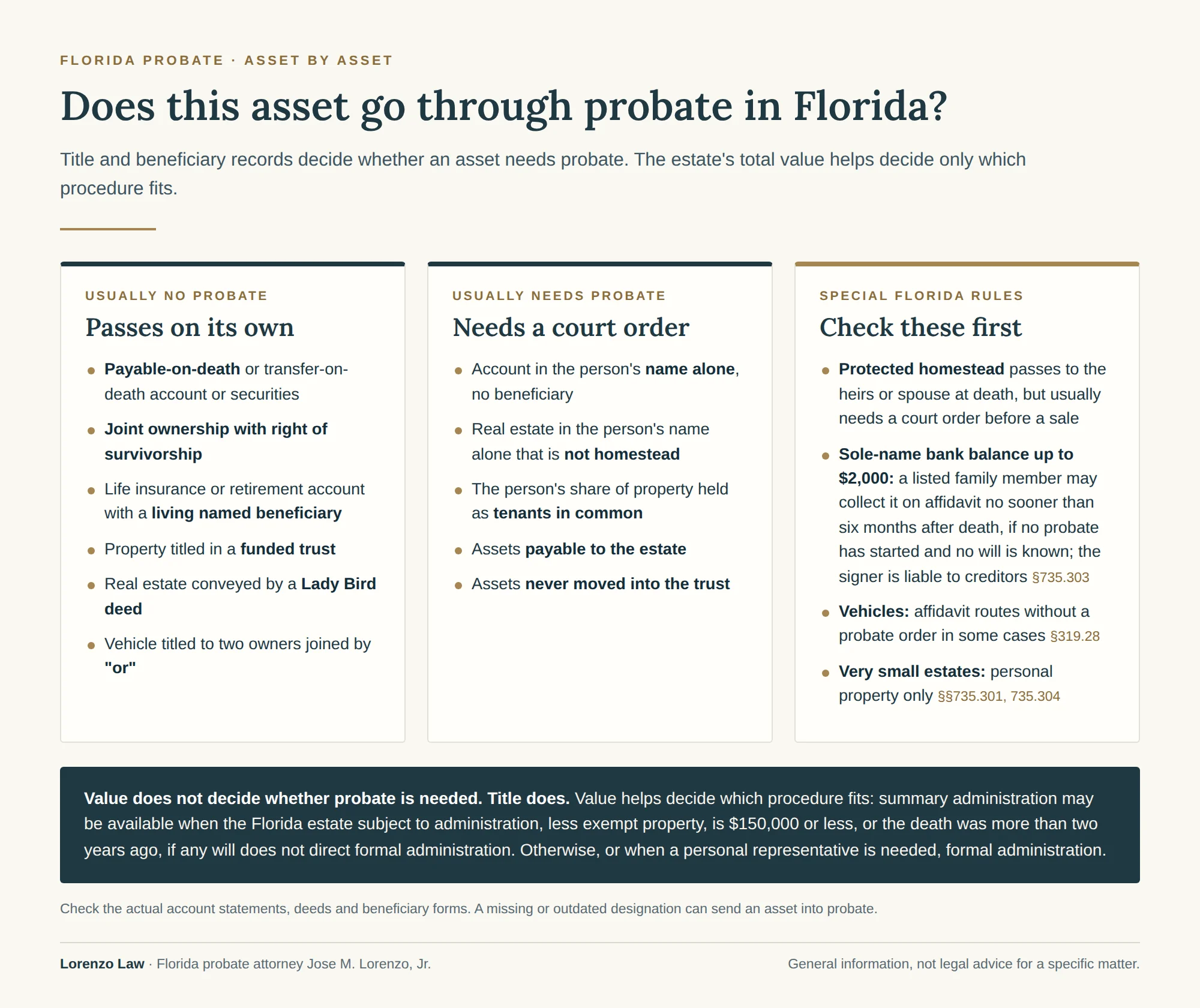
View the probate asset checklist
How much does an estate have to be worth to go to probate in Florida?
There is no minimum value. A $20,000 bank account in the person’s name alone can need a court proceeding, while a $2 million estate held in a funded trust may need none. Value decides which procedure fits, not whether probate is needed. The main dividing line is the summary administration test in §735.201: a Florida estate subject to administration, less property exempt from creditors’ claims, of $150,000 or less, or a death more than two years ago, if any will does not direct formal administration. Estates that do not qualify, or that need a personal representative, use formal administration. A few narrow routes cover very small amounts, described under Is there a small estate affidavit in Florida?
What assets are exempt from probate in Florida?
Assets that pass by their own terms skip probate: accounts with a pay-on-death or transfer-on-death designation, property owned jointly with a right of survivorship, assets held in a funded trust, life insurance and retirement accounts with a living named beneficiary, and real estate conveyed by an enhanced life estate (Lady Bird) deed. Florida has no transfer-on-death deed for real estate; transfer-on-death designations work for accounts and securities. Separately, Florida’s exempt-property rules can protect certain household items and vehicles for the surviving family if a timely petition is filed, and protected homestead passes outside the personal representative’s control. See what assets are exempt from probate and Florida non-probate assets.
Does a will avoid probate in Florida?
No. Do all wills go through probate in Florida? A will only works through probate: it tells the court who should receive the probate property and nominates a personal representative, but it does not transfer anything by itself or give anyone authority to act. If every asset already passed outside probate, the will may never need to be admitted, but whoever holds the original must still deposit it with the clerk (see the 10-day rule). A trust that never received title to an asset does not keep that asset out of probate either. See probate of a will in Florida.
Do bank accounts go through probate in Florida?
It depends on how the account is titled. A payable-on-death account goes to the named beneficiary, and a joint account with survivorship goes to the surviving owner, without probate. An account in the person’s name alone with no beneficiary usually needs a court order, with one narrow exception: under §735.303, a Florida bank may pay up to $2,000 in total from sole-name accounts to a surviving spouse (or, if none, an adult child, then an adult descendant, then a parent), no sooner than six months after death, on a sworn affidavit, when no probate has been started and no will is known. The person signing takes on personal liability to creditors and others entitled to the money. See bank accounts when someone dies.
Does a house have to go through probate in Florida?
Protected homestead passes outside the personal representative’s control, but it usually still needs a court order before it can be sold or insured. Title to protected homestead vests in the heirs or surviving spouse at death, and the home is not counted toward the $150,000 summary administration test. In practice, title companies ask for an order determining homestead status before they will insure a sale (see the homestead probate FAQ). A house that is not homestead, such as a rental or second home in the person’s name alone, generally goes through probate unless a Lady Bird deed, survivorship deed or trust moved it. When the person left a spouse or a minor child, special limits control who receives the home, whatever the will says. So is homestead property exempt from probate in Florida? It passes outside the estate, but the court step above is usually still needed. See Florida homestead in probate.
Do cars go through probate in Florida?
Often not. Florida’s title statute, §319.28, allows a vehicle to be retitled without a probate order in several situations. When there is no will and the estate owes no debts, the heirs can transfer the vehicle by affidavit and agreement among themselves. Other affidavit routes apply when there is a will, and a surviving spouse can sometimes assign the title directly. A vehicle titled to two owners joined by “or” passes to the surviving co-owner (§319.22). A car that is the estate’s only significant asset is a common reason families avoid probate altogether. See selling a deceased person’s car in Florida.
Is there a small estate affidavit in Florida?
Florida has no self-executing small estate affidavit of the kind used in California or Texas, where a successor’s affidavit goes straight to the asset holder. Florida’s options for small estates are narrower:
- Small bank accounts: the $2,000 bank payment under §735.303, described above, is the closest Florida comes to a self-executing affidavit.
- Disposition without administration (§735.301): for personal property only. It covers specified exempt personal property, and limited nonexempt personal property measured against preferred funeral expenses and reasonable and necessary medical and hospital expenses of the last 60 days of the final illness. Any real estate in the person’s sole name, including a homestead, rules it out.
- Intestate small estates (§735.304): no will, death more than one year ago, no pending administration, and an estate of personal property only, in which the nonexempt personal property is worth no more than $20,000 (raised from $10,000 on July 1, 2026) plus preferred funeral expenses and reasonable and necessary medical and hospital expenses of the last 60 days of the final illness; exempt personal property is handled separately. It still requires a court filing, a diligent creditor search and notice.
None of these transfers real estate. For a house or land, the choices are summary or formal administration, a homestead order, or a quiet title action.
Types of probate in Florida
What are the two types of probate in Florida?
Summary administration and formal administration. What is the difference between a summary and formal probate administration? Formal administration appoints a personal representative, who receives letters of administration and continuing authority to collect assets, pay claims and distribute the estate under court supervision. Summary administration appoints no one: the court enters an order of summary administration that directs who receives each listed asset. A third proceeding, ancillary administration, covers Florida property of a person who lived elsewhere. An estate can qualify for summary administration and still need formal administration to get its work done, for example to sell property or resolve claims. See summary administration in Florida.
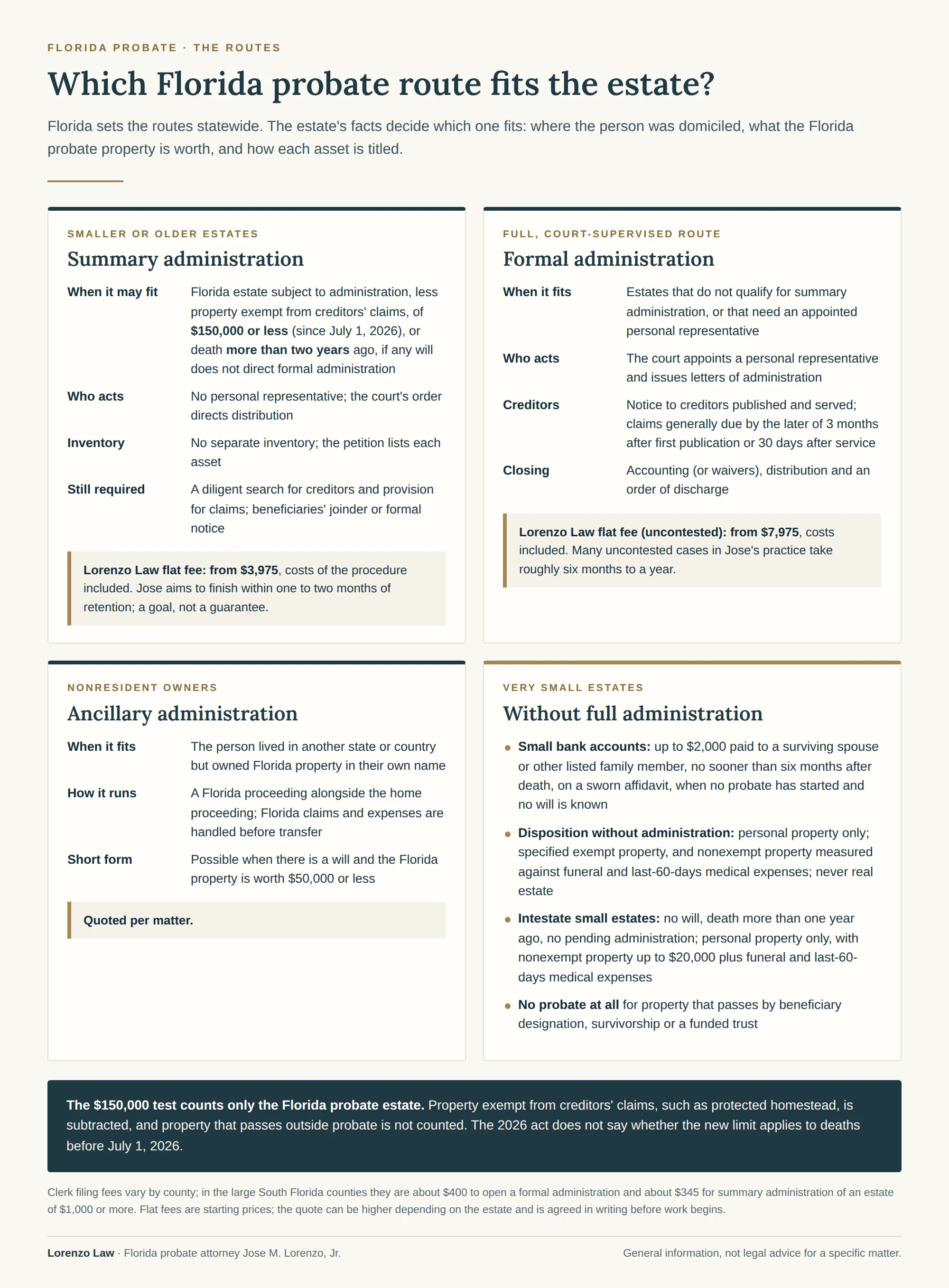
View the probate routes graphic
| Summary administration | Formal administration | |
|---|---|---|
| When it may fit | Florida estate subject to administration, less exempt property, of $150,000 or less, or death more than two years ago; any will must not direct administration under chapter 733 | Estates that do not qualify for summary administration, or that need an appointed personal representative |
| Who acts | No personal representative; the court orders distribution | The court appoints a personal representative and issues letters of administration |
| Inventory | No separate inventory; the petition lists each asset | Required, generally within 60 days after letters |
| Creditors | Diligent search for creditors and provision for claims | Notice to creditors is published and served; claims are generally due by the later of three months after first publication or 30 days after service on a creditor who must be served. Exceptions apply. |
| Typical time at Lorenzo Law | Jose aims to finish within one to two months from retention (a goal, not a guarantee) | Many uncontested matters in Jose’s practice take roughly six months to a year |
| Lorenzo Law flat fee | From $3,975, costs included | Uncontested, from $7,975, costs included |
What qualifies for summary administration in Florida?
Under §735.201, an estate qualifies if either test is met and any will does not direct administration under chapter 733: the Florida estate subject to administration, less property exempt from creditors’ claims, is $150,000 or less, or the person has been dead more than two years. The time test has no dollar limit. Because protected homestead is excluded from the calculation, an estate with an $800,000 homestead and a $40,000 bank account can qualify. Chapter 2026-57, Laws of Florida, raised the limit from $75,000 to $150,000 effective July 1, 2026. The act says only, “This act shall take effect July 1, 2026”; it does not say whether the new limit applies to people who died before that date, and no Florida court has decided the question. If someone told you an older estate needed formal administration, ask for a fresh review.
What is ancillary administration in Florida?
Ancillary administration is the Florida probate proceeding for a person who lived in another state or country but owned Florida property, such as a condominium or a vacation home in their name alone. It runs alongside the main probate where the person lived, and it often uses the home proceeding’s documents. Under §734.102, a personal representative is appointed for the Florida property, and Florida creditors and expenses are handled before anything is transferred. A shorter procedure under §734.1025 can apply when the person left a will and the Florida property is worth no more than $50,000. Lorenzo Law quotes ancillary matters individually. See Florida ancillary probate and ancillary administration for non-citizens.
Where do you file probate in Florida?
In the circuit court of the county where the person was domiciled (their permanent home) at death. An heir’s address, the lawyer’s office or the location of one asset does not decide the county for a Florida resident. For someone domiciled outside Florida, §733.101 looks to where the Florida property is located. Probate papers are filed electronically through the Florida Courts E-Filing Portal, and each county’s probate division follows the same statewide law, with its own local checklists and procedures. See what Florida probate court is.
What are letters of administration in Florida?
Letters of administration are the court document that proves a personal representative’s authority to deal with banks, title companies and others for the estate. Florida law says all letters are called letters of administration, with or without a will, so Florida does not issue “letters testamentary.” Before letters issue, the court enters an order appointing the personal representative (and, when there is a will, admitting it to probate); the personal representative files an oath and, unless exempt, a designation of resident agent, and posts any bond the court requires. An order of summary administration is a different document: it directs distribution of specific assets and gives no one continuing authority. See how to become personal representative in Florida.
Probate deadlines and timing
What is the 10-day rule for probate in Florida?
Whoever has the original will must deposit it with the clerk of the court in the county where the person lived within 10 days after learning of the death (§732.901). Depositing the will is not the same as opening probate, and it appoints no one. There is no deadline to open probate itself. A custodian who withholds a will without just or reasonable cause can be ordered to produce it and made to pay costs, damages and attorney fees; it is not a crime to be late, but destroying or concealing a will is a separate and serious matter. Do not wait to gather every financial record before depositing the original.
How long do you have to file probate after death in Florida?
Florida sets no deadline for opening probate after a death. Estates have been opened many years later. Waiting still has consequences: the original will must be deposited within 10 days, property stays frozen in the deceased person’s name, and records and witnesses get harder to find. Two years after death matters in two ways: creditor claims are generally barred under §733.710, subject to statutory exceptions, and once more than two years have passed the summary administration time test is met regardless of value, if any will does not direct formal administration. In an open probate, publishing a notice to creditors (and serving reasonably ascertainable creditors) is what starts the short claims period; without it, claims stay open until two years after death. See what to do when someone dies in Florida.
What happens if you don’t file probate in Florida?
Nothing happens automatically, and that is the problem. What happens if a will is not probated in Florida? Property in the person’s name alone stays in that name: a bank will not release a sole-name account above the small statutory limits, and a house cannot be sold or refinanced with insurable title. Real estate left in a deceased person’s name has three cures: a summary or formal administration with a court order or personal representative’s deed, an order determining protected homestead, or a quiet title action. Some assets may eventually be reported to the state as unclaimed property. The will-deposit duty applies whether or not anyone opens probate.
How long does probate take in Florida?
Jose aims to complete summary administrations within one to two months from retention. Many uncontested formal administrations in his practice take roughly six months to a year. These are goals and typical ranges, not guarantees. In formal administration, creditor claims are generally due by the later of three months after first publication of the notice to creditors or 30 days after service on a creditor who must be served, and the Florida Probate Rules call for the final accounting and petition for discharge within 12 months after letters issue (or 12 months after a federal estate tax return is due), unless the court extends the time. A missing original will, an heir who cannot be found or will not sign, an unclear homestead, real estate to sell, creditor claims, a tax return or a family disagreement each add time. How long does summary probate take in Florida? In Jose’s practice the aim is one to two months, as a goal rather than a guarantee. See how long probate takes in Florida.
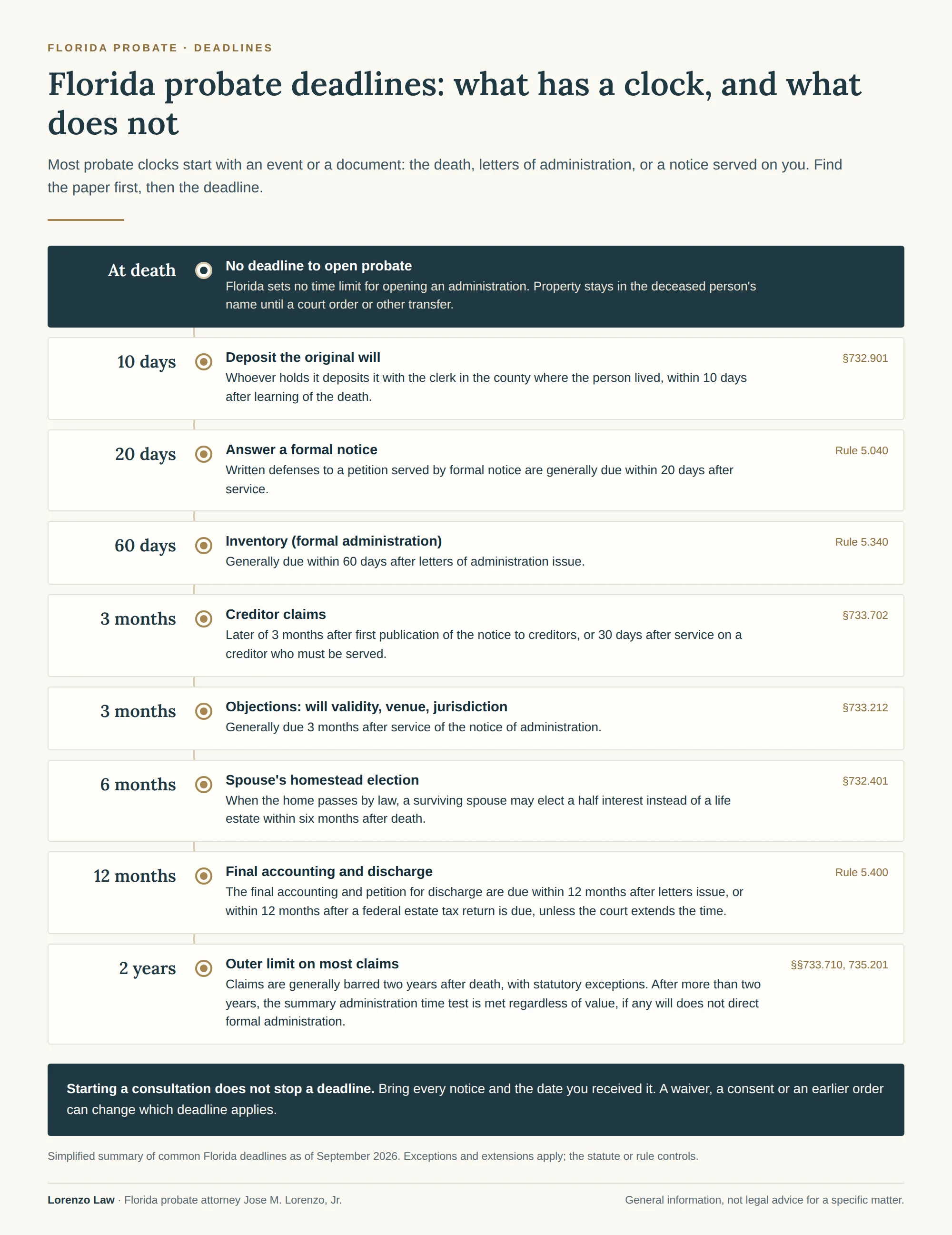
View the probate deadlines graphic
How long does an executor have to settle an estate in Florida?
Florida sets no fixed outer limit, but the Florida Probate Rules call for the final accounting and petition for discharge within 12 months after letters issue, unless the court extends the time. The personal representative must settle and distribute the estate as expeditiously and efficiently as is consistent with the estate’s best interests (§733.602). When a federal estate tax return is due, the 12 months run from that due date instead, and a personal representative who needs more time must petition the court, explaining the status of the estate. Distributions should generally wait until the creditor period has run and valid claims, expenses and taxes are provided for. Beneficiaries who believe an administration is stalled can ask the court to order the personal representative to file an accounting (Florida Probate Rule 5.150). See Florida probate rules and deadlines.
What probate costs in Florida
How much does probate cost in Florida?
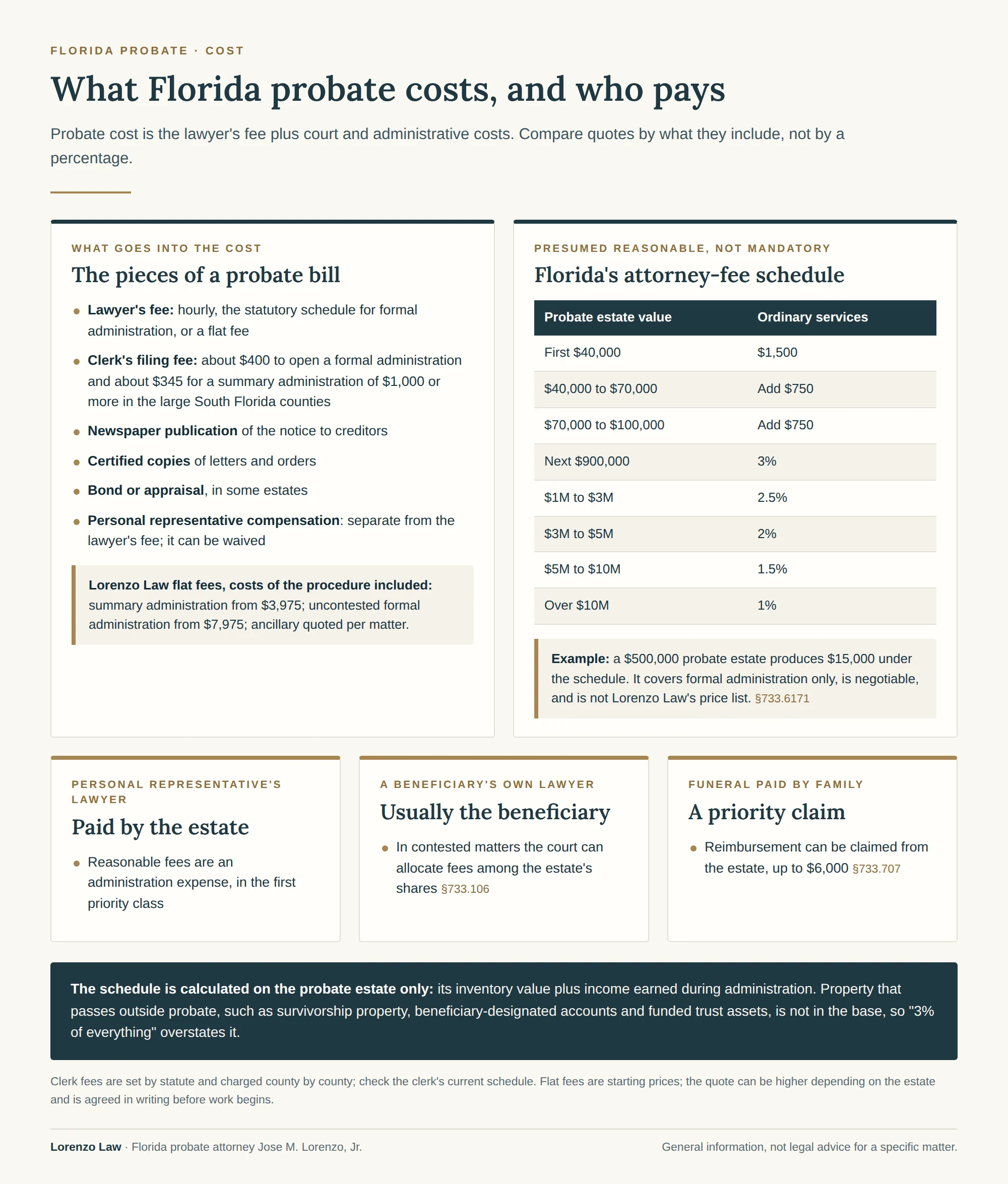
The total is the lawyer’s fee plus court and administrative costs, and it depends on the procedure. Court and administrative costs include the clerk’s filing fee (in Miami-Dade, Broward and Palm Beach counties, $401 to open a formal administration and $346 for summary administration of an estate of $1,000 or more, on the clerks’ schedules checked September 30, 2026), newspaper publication of the notice to creditors, certified copies and, in some estates, a bond or an appraisal. Lawyers bill hourly, by the presumed-reasonable statutory schedule for formal administration, or by flat fee. At Lorenzo Law, summary administration starts at $3,975 and uncontested formal administration starts at $7,975, with the costs of the procedure included. See the cost of probate in Florida for each item.
How much does a probate lawyer cost in Florida?
There is no official average, because billing methods and estates differ. Lorenzo Law’s summary administration flat fees start at $3,975 and uncontested formal administration flat fees start at $7,975, with the costs of the procedure included. These are starting fees, not a quote for every estate. The quote can be higher depending on the estate, for example the number of beneficiaries, the number and type of assets, real estate, creditor claims, or whether anyone disagrees. Jose reviews these factors with you and quotes the fee before the engagement begins. Once the fee is agreed in writing, no additional charges apply to the work the agreement describes. Work outside the agreement’s scope, such as defending a will contest, is quoted and agreed separately before it begins. Ancillary matters are quoted individually. That is also the honest answer to “What is the average cost for a probate attorney in Florida?”: compare what each quote includes. See Florida probate services and fees.
Who pays probate attorney fees in Florida?
Reasonable fees for the personal representative’s lawyer are generally an administration expense paid from estate assets, but that does not mean every lawyer is paid by the estate. Administration expenses are in the first-priority class of estate expenses. A beneficiary’s own lawyer is usually that beneficiary’s expense, and in contested matters the court can allocate fees and costs among the shares of the estate (§733.106). Settle in writing, before anyone pays, who is hiring the lawyer, when payment is due, and whether expenses someone advances personally will be reimbursed from the estate. A family member who paid funeral expenses can generally file a claim for reimbursement from the estate as a priority claim, up to $6,000 (§733.707).
What percentage of an estate does probate take in Florida?
No fixed percentage. Florida’s attorney-fee statute, §733.6171, sets a schedule that is presumed reasonable for ordinary services in a formal administration: $1,500 for the first $40,000, $750 more up to $70,000, $750 more up to $100,000, then 3% of the next $900,000, with lower percentages above $1 million. It is not a mandatory fee or a cap, fees are negotiable, and a lawyer who uses the schedule must say so in writing. The schedule is calculated on the inventory value of the probate estate plus income earned during administration, so property that passes outside probate, such as survivorship property, beneficiary-designated accounts and funded trust assets, is not in the base. For a $500,000 probate estate, the schedule produces $15,000. It does not apply to summary administration and is not Lorenzo Law’s price list.
What is a typical executor fee in Florida?
Florida calls it personal representative compensation, and the statute presumes 3% of the first $1 million of the probate estate reasonable, then 2.5% of the next $4 million, 2% of the next $5 million and 1.5% above $10 million (§733.617). It is separate from the lawyer’s fee and is calculated on the inventory value of the probate estate plus income earned during administration, not on property that passed outside probate, so “3% of everything the person owned” overstates it. A personal representative may waive it.
What happens if you can’t afford a probate lawyer?
Start by checking whether the estate needs a lawyer at all, and then who pays. If every asset passes outside probate, or a small bank balance qualifies for the $2,000 family payment, there may be nothing for a lawyer to do. When a personal representative must be appointed, the lawyer’s reasonable fee is an administration expense of the estate, so the estate’s own assets often fund it; ask how payment timing works before you sign. A written flat-fee quote identifies the fee, included costs and work covered. Court self-help centers can explain forms but cannot give legal advice. Local legal aid organizations sometimes help with small estates and homes in a family’s name. Lorenzo Law’s first consultation is free.
Lawyers and doing it yourself
Do I need a lawyer for probate in Florida?
In a formal administration, generally yes. Florida Probate Rule 5.030 requires a personal representative to be represented by a Florida attorney unless the personal representative is the sole interested person or is a Florida attorney. Being the only beneficiary is not the same as being the sole interested person: a creditor, an omitted heir or a surviving spouse can also have a stake in the estate. No Florida court has held that one known creditor alone ends the exception, but proceeding without a lawyer is risky whenever anyone else has a financial interest. Summary administration and the small-estate routes appoint no personal representative, so the rule’s representation requirement does not apply to them in the same way. See do I need a Florida probate attorney.
Can I file probate myself in Florida without an attorney?
Sometimes, for summary administration or a small-estate route, but the risk sits with the people who receive the property. Do I need a lawyer for summary administration in Florida? Not always, because no personal representative is appointed. The petition, the beneficiaries’ joinder or formal notice, a diligent creditor search and provision for claims still have to meet the requirements. If a creditor is left out, the people who received the property can become personally liable to that creditor, up to what each received, and can owe that creditor’s attorney fees. A defective order often surfaces years later, when someone tries to sell or refinance. Representing yourself is not unauthorized practice of law; providing legal services to someone else without a Florida license can be. Court self-help resources can explain forms but cannot give advice about your estate.
What does a probate attorney do?
A probate lawyer opens the right court proceeding, advises the personal representative through each statutory step, and protects the estate’s property until it reaches the right people. That includes choosing the procedure, preparing the petition and supporting papers, giving notices, handling creditor claims, addressing homestead and real estate, preparing the accounting or waivers, and closing the estate with an order of discharge. In a dispute, a probate litigation lawyer represents a personal representative, heir or beneficiary in will contests, accountings and removal proceedings. What is the difference between an estate lawyer and a probate lawyer? “Estate lawyer” often means planning someone’s own estate; a probate lawyer administers an estate after death. Many lawyers, including Jose, do both.
Does the personal representative’s lawyer represent the beneficiaries?
No. The lawyer retained by the personal representative represents the personal representative in the administration, not each beneficiary individually. Beneficiaries receive notices and information, but advice to the personal representative does not automatically include advice to every heir. A beneficiary with a conflict, or a question about their own rights, may need separate advice. Ask at the start who the client is and what the engagement covers. The Florida Bar’s probate explanation discusses these roles.
Executors, heirs and family
Who inherits when there is no will in Florida?
Florida’s intestacy statutes decide, starting with the surviving spouse and descendants (§§732.102–732.103).
- Spouse, and the person left no descendants: the spouse generally takes the entire intestate estate.
- Spouse, and all of the person’s descendants are also the spouse’s, and the spouse has no other descendants: the spouse generally takes everything.
- Spouse and descendants, where either the person or the spouse has descendants from another relationship: the spouse generally takes half, and the person’s descendants share the other half, with the children of a child who died first taking that child’s place.
- No spouse: the descendants take everything; if there are none, the parents; then brothers and sisters and their descendants; then more distant relatives in the order the statute sets.
When a spouse and descendants both survive, the home passes under its own homestead rules instead of this list. Proving the family tree, with death and birth certificates and sometimes a court determination of beneficiaries, is usually the main work in an estate without a will. See Florida inheritance lawyer.
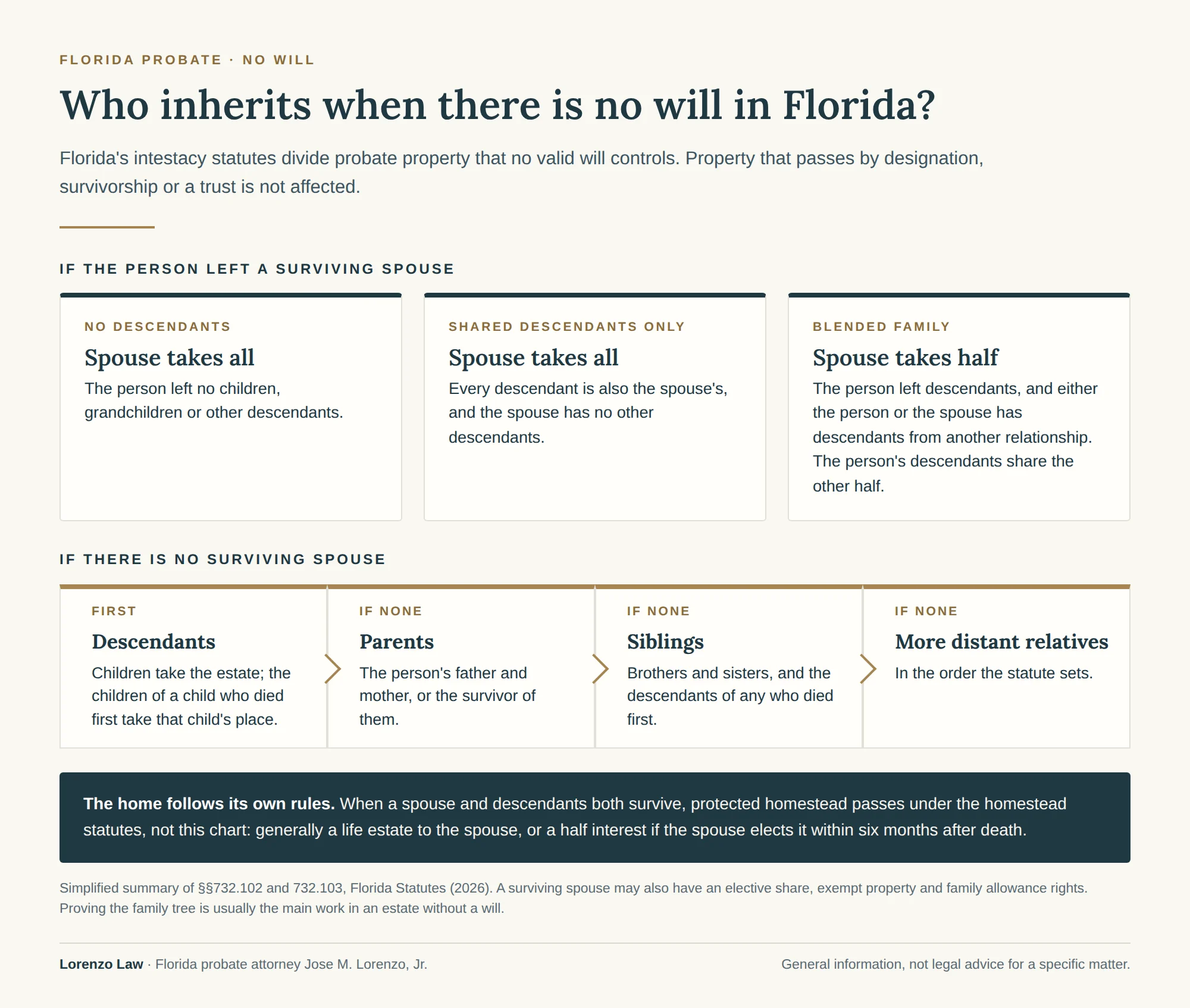
View the intestate succession chart
Does a surviving spouse automatically inherit everything in Florida?
Not always. Without a will, the spouse takes everything when the person left no descendants, or when all of the person’s descendants are also the spouse’s and the spouse has no other descendants. With or without a will, Florida gives a surviving spouse protections that a will cannot always override: the elective share of 30% of the elective estate, claimed within a strict deadline (§732.2065); homestead rights, including a life estate or an election to take a half interest instead, made within six months after death; and exempt property and a family allowance of up to $18,000, each requested by petition. A written prenuptial or postnuptial agreement signed before two witnesses can waive these rights. The deadlines are short, so a surviving spouse should ask about them early. See surviving spouse rights in Florida and the Florida elective share.
Who is the executor if there is no will in Florida?
The court appoints a personal representative, giving preference first to the surviving spouse, then to the person selected by a majority in interest of the heirs, then to the heir nearest in degree (§733.301). The person must still qualify. A person is disqualified if under 18, mentally or physically unable to serve, convicted of a felony, or found to have abused, neglected or exploited an elderly person or disabled adult, and a nonresident of Florida can serve only within the family relationships described below. Florida uses “personal representative” for both executor and administrator.
What can an executor not do in Florida?
A person named in a will has no authority to act for the estate until the court appoints them, and even then a personal representative is a fiduciary with the duties of a trustee. A personal representative should not:
- use estate money or sign for the estate before letters of administration issue (helpful acts taken before appointment can later be given effect, but that is not permission to act early);
- mix estate money with personal money instead of using an estate account;
- pay creditors out of priority, or distribute to family, before the claims picture is clear;
- sell protected homestead as if it were an estate asset; if the home is unoccupied, the personal representative may, but need not, take possession only to preserve, insure and protect it;
- ignore the will or the statutes, or favor one beneficiary;
- buy estate property or otherwise deal with the estate in a conflict of interest. Any interested person who did not consent after full disclosure can set that transaction aside, unless the will or a contract signed by the decedent expressly allowed it or the court approved it after notice (§733.610).
A personal representative who signs a contract for the estate without making clear they are acting for the estate, and identifying it, can be personally liable on that contract. For debts that come from owning or managing estate property, and for harm caused while handling the estate, a personal representative is personally liable only if personally at fault; either way, these obligations can also be pursued against the estate (§733.619). See how to become personal representative in Florida.
Can an out-of-state executor serve in Florida?
Only within the family relationships Florida allows. Under §733.304, a person not domiciled in Florida may serve only if they are related to the decedent by lineal consanguinity; a spouse, brother, sister, uncle, aunt, nephew or niece of the decedent, or someone related by lineal consanguinity to any of them; an adopted child or adoptive parent; or the spouse of anyone otherwise qualified. A trusted friend, accountant or business partner in another state cannot serve, however clearly the will names them. See serving as an out-of-state executor in Florida.
Does a power of attorney end at death in Florida?
Yes. The principal’s death terminates a Florida power of attorney (§709.2109). A former agent does not become the estate’s representative and should not keep using the person’s accounts. Authority after death comes from letters of administration, an order of summary administration, a beneficiary designation or a trust. Preserve the records from the agency period; a personal representative may ask for them. See does a power of attorney end at death in Florida.
Can an executor sell a house in Florida during probate?
Yes, with the right authority. For estate property, a power of sale in the will, or court authorization or confirmation, allows the personal representative to sell (§733.613). Protected homestead, and property that already belongs to the heirs, raise different questions: the heirs, not the personal representative, generally sign, after a homestead determination. One heir cannot sign for all owners. Confirm who signs the deed and what the title company will require before listing the property. So can a house be sold while in probate in Florida? Yes, once the right person has authority to sign. See selling a house during probate.
Do all heirs have to agree to sell inherited property in Florida?
Not necessarily when the estate sells with proper authority; the deed, the will and the title company’s requirements decide it. When a personal representative holds a power of sale or a court order, a sale of estate property can go forward over an heir’s objection, subject to the personal representative’s duties to the estate. When the heirs already own the property together, for example protected homestead or property already distributed to them, one heir cannot sign for all owners, and when co-owners cannot agree, a separate partition action may be needed. See when siblings disagree over selling the family home.
Debts, taxes and disputes
Do heirs have to pay the debts of the deceased in Florida?
Being an heir does not make you personally liable for the deceased person’s debts. Valid claims are paid from the estate in the statutory order of priority. A debt you co-signed is your own. A beneficiary who received a distribution from an insolvent estate can be required to return it, up to the value received, and recipients in a summary administration can be liable to an omitted creditor. Do not pay creditors from your own money or distribute estate assets before the claims picture is clear. See do you inherit debt in Florida.
How long do creditors have to file a claim in Florida?
In an open probate, generally the later of three months after first publication of the notice to creditors, or 30 days after a creditor who must be served is served (§733.702). The personal representative must serve reasonably ascertainable creditors; if the person was 55 or older, the state’s Medicaid agency must also be served. If no probate is ever opened, the three-month period never starts, and claims are generally barred two years after death under §733.710, subject to statutory exceptions such as certain liens. Publishing a notice never revives a claim already barred by that two-year limit. Have the actual claim and notices reviewed; there is no universal deadline for every debt. See Florida probate creditors.
Does Florida have an inheritance tax or estate tax?
No. Florida has no inheritance tax and no state estate tax. For U.S. citizens and people domiciled in the United States, the federal estate tax generally applies only to estates above the federal exemption, $15 million per person in 2026, reduced by taxable gifts made during life. Different federal rules apply when the person was neither a U.S. citizen nor domiciled in the United States: a federal estate tax return can be required at a much lower level of U.S. assets. Final income-tax returns, estate income-tax returns and property taxes are separate obligations. See inheritance tax in Florida.
How do I contest a will in Florida?
File an objection in the probate case, and watch the deadline. An objection to a will’s validity is generally due three calendar months after service of the notice of administration. If formal notice of a petition was served before letters issued, written defenses are generally due within 20 days after service, and a later three-month window may not follow. A waiver, a consent or an order already entered can change the analysis. Common grounds include lack of testamentary capacity, improper execution (§732.502), and fraud, duress, mistake or undue influence (§732.5165). Florida does not enforce no-contest clauses in wills. A will contest is different from a complaint about an inventory, accounting or the personal representative’s conduct. See contesting a will in Florida, the Florida will contest page and Florida probate litigation.
Are probate records public in Florida?
Most probate filings are public court records. How do you find out if probate has been filed in Florida? Search the online court records of the clerk of court in the county where the person lived, and in any other Florida county where they owned property. One exception is the estate inventory (and any accounting): it is confidential, and the clerk may disclose it only to the personal representative, the personal representative’s lawyer, an interested person, or someone with a court order (§733.604). An interested person can also file a caveat with the clerk so that a will is not admitted and a personal representative is not appointed without formal notice to them; a creditor may file one only after the death, and is then notified when letters of administration issue. See caveats in Florida probate.
Working with Lorenzo Law
How do I choose a probate attorney?
Start with fit, not rankings. Look for a Florida-licensed lawyer whose work matches the problem you actually have: administration, a beneficiary’s concern or a dispute. Ask:
- Who will handle my file from the first filing to the order of discharge?
- Which procedure fits this estate, and why?
- What does the fee include, and what would put work outside the quote?
- What will you need from me, and how will we communicate?
- If the estate becomes contested, will you handle the dispute?
A promised result or a claimed win rate is not a substitute for a clear explanation of your options. Check any lawyer’s Florida Bar member profile. Lorenzo Law is a solo practice: the lawyer you consult is the lawyer who handles your file. See how to choose a Florida probate lawyer and Jose’s biography.
What information does a probate lawyer need?
Bring what you have; missing documents should not stop you from raising an urgent problem.
- The person’s name, date of death and last permanent address.
- Your relationship and role, and whether a court has already appointed anyone.
- The will and any codicils, who holds the originals, and a death certificate if available.
- Names and contact information for the surviving spouse, children and other heirs or beneficiaries.
- A general asset list showing how each asset is titled, any beneficiary designations and approximate values, plus known debts.
- Any case number, court papers, notices, deadlines, or papers from another state or country.
Describe the situation first and ask how to share sensitive records securely; do not put account or Social Security numbers in the contact form. After you hire a lawyer, provide accurate information, disclose problems early, respond to document requests and keep your contact details current.
What should I expect when I hire Lorenzo Law?
You work directly with Jose M. Lorenzo, Jr. on the matter he agrees to handle. Lorenzo Law is a solo practice, and Jose is its only attorney. The written engagement identifies the client, the work covered and the fee. Phones are answered 24 hours a day, and the firm aims to follow up on inquiries within one to two business days. Consultations are available by phone or by appointment, in English and Spanish, and Jose offers remote signing through online notarization for documents that can lawfully be signed that way. The principal office is in Kissimmee, and Jose meets clients by appointment in Coral Gables and Fort Lauderdale. An estimate or strategy is not a guarantee of a court result or completion date.
Can I change probate attorneys during the case?
Yes. You may choose different counsel, but plan the transition. In a Florida probate case, a lawyer who has appeared generally needs the court’s approval to withdraw, while a properly limited appearance ends when the lawyer files a notice that the limited work is complete (Rule 5.030). Tell prospective counsel what has been filed, which deadlines are approaching, and who the current client is. Changing lawyers does not pause the case, extend a deadline or erase amounts properly owed under the existing fee agreement.
Is the consultation free, and when should I contact Lorenzo Law?
Yes, the initial consultation is free. Contact the firm when you need to know the next step: a bank asks for court authority, property cannot be transferred, you hold an original will, or you have received a notice or court papers. Mention any deadline in your first message. Contacting the firm does not create an attorney-client relationship or extend a deadline; representation begins only under a written engagement.
Talk to a Florida probate attorney
Tell Lorenzo Law who died, where the person lived, what property is involved, your role, and whether a case or deadline already exists. Jose can explain the procedure that fits, the fee, and the next step.
Request a free initial consultationCall (305) 224-6811
Lorenzo Law handles Florida probate matters statewide. The principal office is in Kissimmee, Florida; meetings in Coral Gables and Fort Lauderdale are by appointment. Consultations are available in English and Spanish, by phone or by appointment.
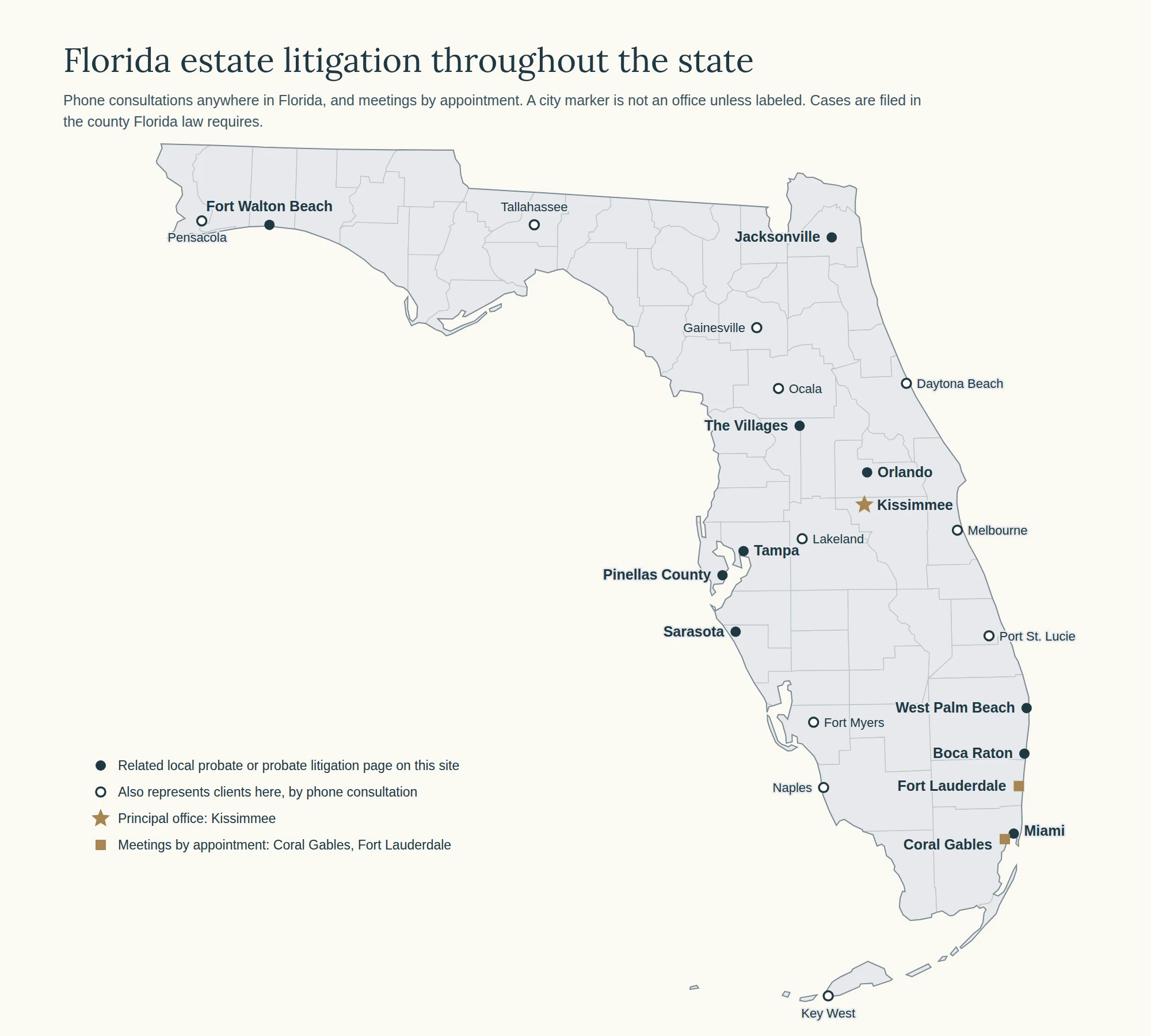
View the full-size Florida service-area map
This page provides general information about Florida probate law, not advice about a particular estate. Contacting the firm does not create an attorney-client relationship. Results are not guaranteed.
Sources
the Florida Probate Code (chapters 731–735, Florida Statutes, 2026, as amended by ch. 2026-57); the Florida Probate Rules, including amendments effective October 1, 2026; §§ 319.28, 709.2109 and 732.901, Florida Statutes.