
LORENZO LAW · CORAL GABLES ESTATE PLANNING
Coral Gables Estate Planning Attorney
As a Coral Gables estate planning attorney, I prepare the wills, revocable living trusts, durable powers of attorney and health care documents that decide who inherits what you own, who can act for you if you cannot act for yourself, and whether your family will need a court to finish the job. I coordinate those documents with your deed, your accounts and your beneficiary designations so the plan works the way you expect, and you work directly with me from the free consultation through drafting and signing, at a flat fee agreed before drafting begins.
Families usually call an estate planning lawyer in Coral Gables at a specific moment: buying a home, a new child or grandchild, a marriage or a second marriage, a move to Florida from another state or country, a diagnosis, or the realization that an old will no longer fits the family. Consultations are available in English and Spanish, by phone or video, or in person by appointment in Coral Gables. Bring your questions about your home, your family or an existing plan; you do not need to choose between a will and a trust, or assemble every financial record, before contacting me.
This page explains what a Florida estate plan contains, what each service costs at a published flat fee, how Florida’s homestead rules affect a Coral Gables home, how signing works in person or remotely, and how to compare estate planning lawyers in Coral Gables, including me.
Schedule your free consultationCall (305) 224-6811
Free consultation · Flat fees · English and Spanish · Meetings in Coral Gables by appointment
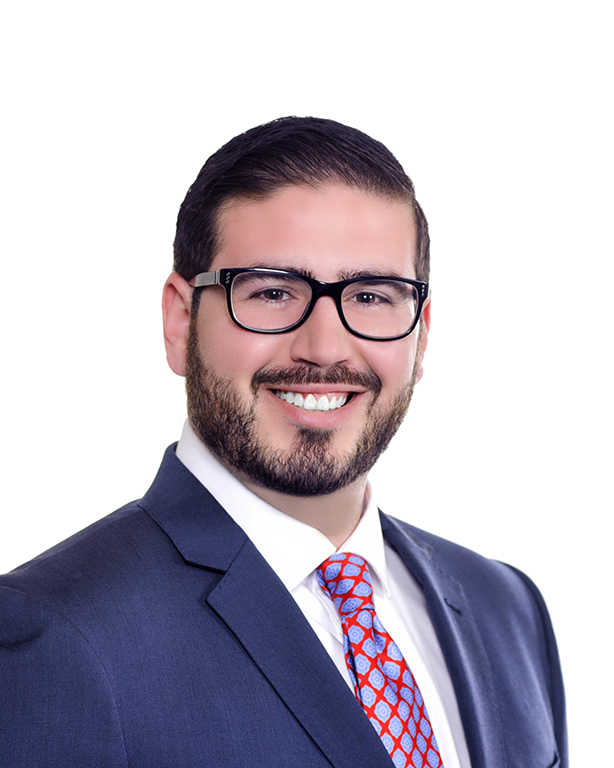
| Your attorney | Jose M. Lorenzo, Jr., Florida Bar No. 107002 |
| Practice structure | A solo practice: the same attorney handles your consultation, drafting, review and signing |
| Languages | English and Spanish |
| Consultation | Free, by phone or video, or in person by appointment |
| Coral Gables location | 2850 Douglas Rd, Suite 303, Coral Gables, FL 33134 — by appointment |
| Published flat fees | Will from $675 per person; durable power of attorney on its own $675; five-document core package $1,500 per person; revocable living trust plan from $2,500 |
| Property work | Florida deed into a trust $575 per deed; standard Lady Bird deed $675 as a separate engagement; scope and tax exceptions below |
| Signing | In person, or remotely where Florida law permits; electronic wills available |
| Where clients live | Coral Gables and communities across Miami-Dade County; phone and video consultations statewide |
In plain terms: Jose M. Lorenzo, Jr. is a solo Florida estate planning attorney who meets clients in Coral Gables by appointment, consults in English and Spanish, and charges published flat fees. A will starts at $675 per person, a durable power of attorney on its own is $675, the five-document core estate plan is $1,500 per person, and a revocable living trust plan starts at $2,500. A Florida deed that moves your home into your trust is $575 per deed. The first consultation is free.
Start with the decisions your plan needs to make
An estate plan should explain who can help while you are alive, how your property should pass at death, and what the people you name will need to do. The right documents depend on your family, your goals and how you own your assets.
For a Coral Gables homeowner, the first question may be what should happen to the home. For a parent, it may be who should care for a child and manage an inheritance. For someone who has recently moved to Florida, it may be whether an existing will, trust and financial power of attorney still fit. These are different starting points for one coordinated plan.
During our consultation, tell me what brought you here and what would make you feel prepared. We can identify the documents you need, the people you want to name and the work needed after signing.
| Your goal | Documents or decisions to consider | Follow-through that makes the plan useful |
|---|---|---|
| Decide who inherits estate property | Will; beneficiaries; personal representative and backup | Compare the will with account titles, beneficiary forms and the deed to your home |
| Arrange management during incapacity and after death | Revocable trust and successor trustee; appropriate asset transfers | Identify which assets belong in the trust and complete the required ownership changes |
| Give someone financial authority | Durable power of attorney; scope of authority and successor agents | Discuss powers carefully and make the document available to the appropriate institutions when needed |
| Record medical wishes | Health care surrogate designation and living will | Give copies to your surrogate and health care providers |
| Plan for children | Guardian nominations and a suitable way to manage an inheritance | Choose willing people and backups; distinguish caregiving from financial management |
| Address a Florida home | Current deed, homestead and family circumstances; trust or deed options | Complete and record any agreed deed; keep the recorded copy with the plan |
| Keep beneficiary transfers consistent | Primary and contingent beneficiaries for accounts, insurance and retirement assets | Submit the appropriate forms and confirm the institution recorded the intended choices |
Flat fees: what estate planning costs in Coral Gables
The consultation is free. Estate planning fees are flat, with the scope agreed before drafting. The engagement letter identifies your documents, implementation work and any separate costs.
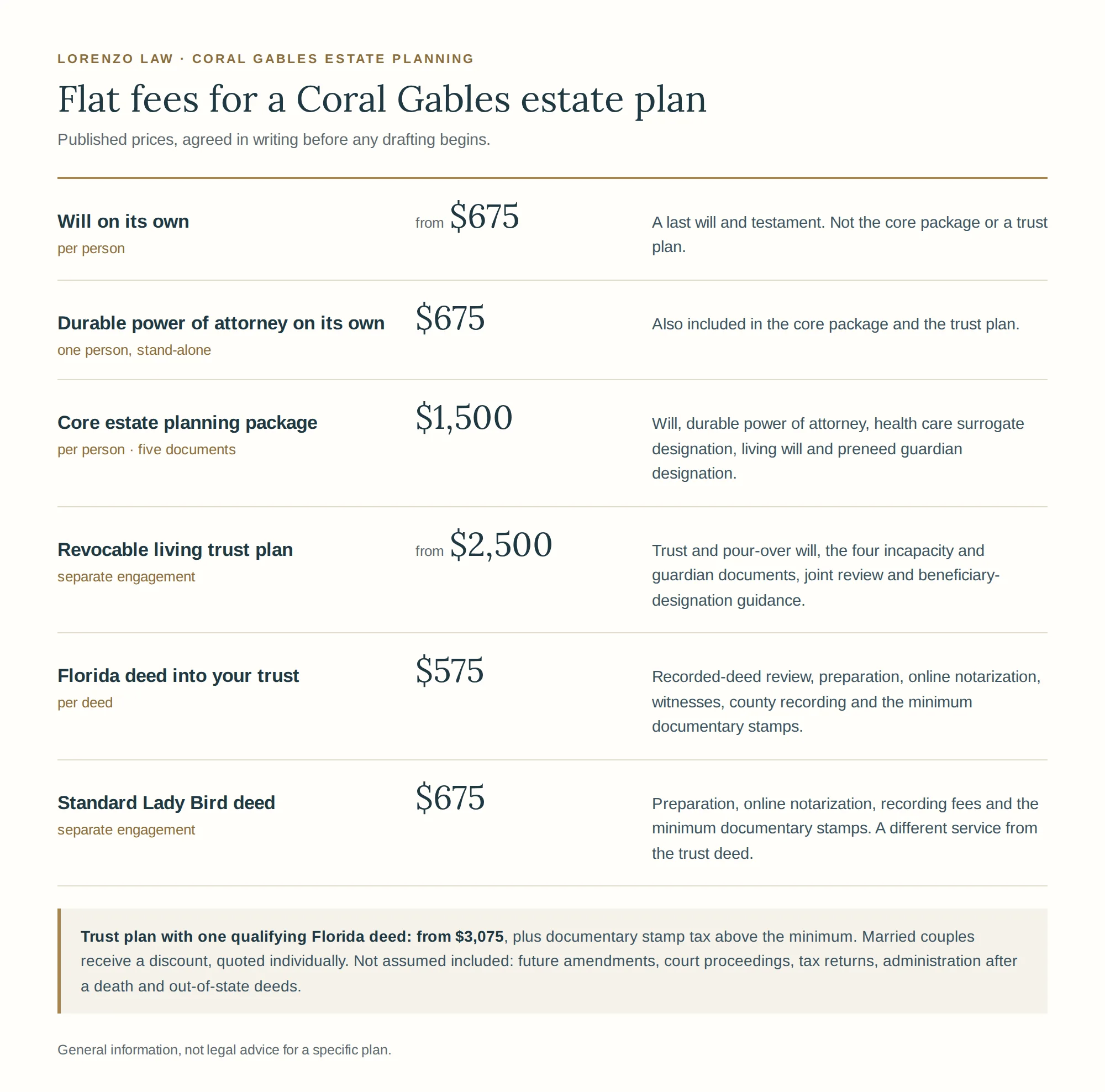
| Service | Flat fee | Included work and limits |
|---|---|---|
| Will on its own | From $675 per person | A last will and testament. This is not the core package or a trust plan. |
| Durable power of attorney on its own | $675 | A Florida durable power of attorney for one person, prepared as a stand-alone document. A durable power of attorney is already included in the core package and the trust plan. |
| Core estate planning package | $1,500 per person | Will, durable power of attorney, designation of health care surrogate, living will and preneed guardian designation. A revocable trust is not included. |
| Revocable living trust plan | From $2,500, separate engagement | Revocable living trust and pour-over will; durable power of attorney, health care surrogate designation, living will and preneed guardian designation; review of your estate plan and trust together; guidance on beneficiary designations. Florida deeds into the trust are separately priced. |
| Florida deed transferring property into your trust | $575 per deed | Review of the recorded deed, deed preparation, online notarization, witnesses, county recording fees and the minimum documentary stamp charge. Documentary stamp tax above the minimum is extra. |
| Standard Lady Bird deed | $675, separate engagement | Speaking directly with me, deed preparation, online notarization, recording fees and the minimum documentary stamp charge. Documentary stamp tax above the minimum is extra. I confirm whether the property and circumstances fit the standard service. |
Married couples receive a discount, quoted individually. Each spouse signs separate personal planning documents; the $1,500 price is for one person. A trust plan with one qualifying Florida deed starts at $3,075, plus documentary stamp tax above the minimum. The $575 trust-transfer deed and $675 Lady Bird deed are different services.
Separate costs and responsibilities
Do not assume the document package includes future amendments, court proceedings, tax-return preparation, administration after a death, out-of-state deeds or documentary stamp tax above the minimum. The quote identifies separately priced work. If your needs change, we agree on any new fee before added work begins.
For a trust plan, you retitle bank and brokerage accounts directly with the institution, using my guidance. Beneficiary-designation guidance does not mean I submit every institution’s forms or guarantee acceptance. Property outside Florida needs counsel in that state to prepare and record the deed; that work is outside the Florida deed fee.
How much does estate planning cost in Florida?
Fees vary from lawyer to lawyer, so the useful question is what a specific quote includes. My published fees are a will from $675 per person, a durable power of attorney on its own for $675, a five-document core estate plan for $1,500 per person, and a revocable living trust plan from $2,500. Those figures are flat, agreed before drafting, and listed with their inclusions and exclusions in the table above.
How much does a living trust cost in Florida?
A revocable living trust plan starts at $2,500. It includes the trust, a pour-over will, the four incapacity and guardian documents, a review of your estate plan and trust together, and guidance on beneficiary designations. Moving a Florida home into the trust is a separate deed at $575 per deed, so a trust plan with one qualifying Florida deed starts at $3,075, plus any documentary stamp tax above the minimum. Put another way, the will and trust cost starts at $2,500, because the trust plan already includes the pour-over will.
How much does a power of attorney cost in Florida?
A durable power of attorney on its own is a flat $675. It is also one of the five documents in the $1,500 core package, together with a will, a health care surrogate designation, a living will and a preneed guardian designation, so if you also want a will and health care documents, the package covers all five for $1,500 per person. If you need only a health care document on its own, ask for a quote for that scope before any drafting begins.
Are deed transfers, recording fees and documentary stamps included?
For the two published deed services, yes, within stated limits. The $575 trust-transfer deed and the $675 Lady Bird deed each include deed preparation, online notarization, county recording fees and the minimum documentary stamp charge. Documentary stamp tax above the minimum is extra. A deed is not part of the will, core package or trust-plan fee, and property outside Florida needs a lawyer in that state.
Why a flat fee instead of hourly billing?
A flat fee lets you know the cost of the agreed work before drafting starts, and lets you ask questions during the engagement without watching a clock. The trade-off is that the fee covers a defined scope. If your plan changes in a way that adds work, such as a second trust or an out-of-state property, we agree on the added fee before that work begins.
Wills and trusts: choosing a will or a revocable living trust
Most Coral Gables wills and trusts questions start the same way: which one do I need? Whether you came looking for a will lawyer, a wills and trusts attorney near me or a trust attorney near me, the honest answer to the living trust vs. will decision depends on what you own, how it is titled and what you want to happen if you become incapacitated.
A will gives instructions for property passing through your estate and names your preferred personal representative. It does not change an account’s beneficiary designation or, by itself, keep estate assets out of probate. A will can still be useful when some property passes by another arrangement.
A revocable living trust can provide for a successor trustee to manage trust assets during incapacity and distribute them after death. Its usefulness depends on the assets and transfer arrangements. Signing a trust does not automatically move your home or accounts into it. A pour-over will addresses probate property left outside the trust; that property may still require probate before it reaches the trust.
View the will vs. trust comparison chart
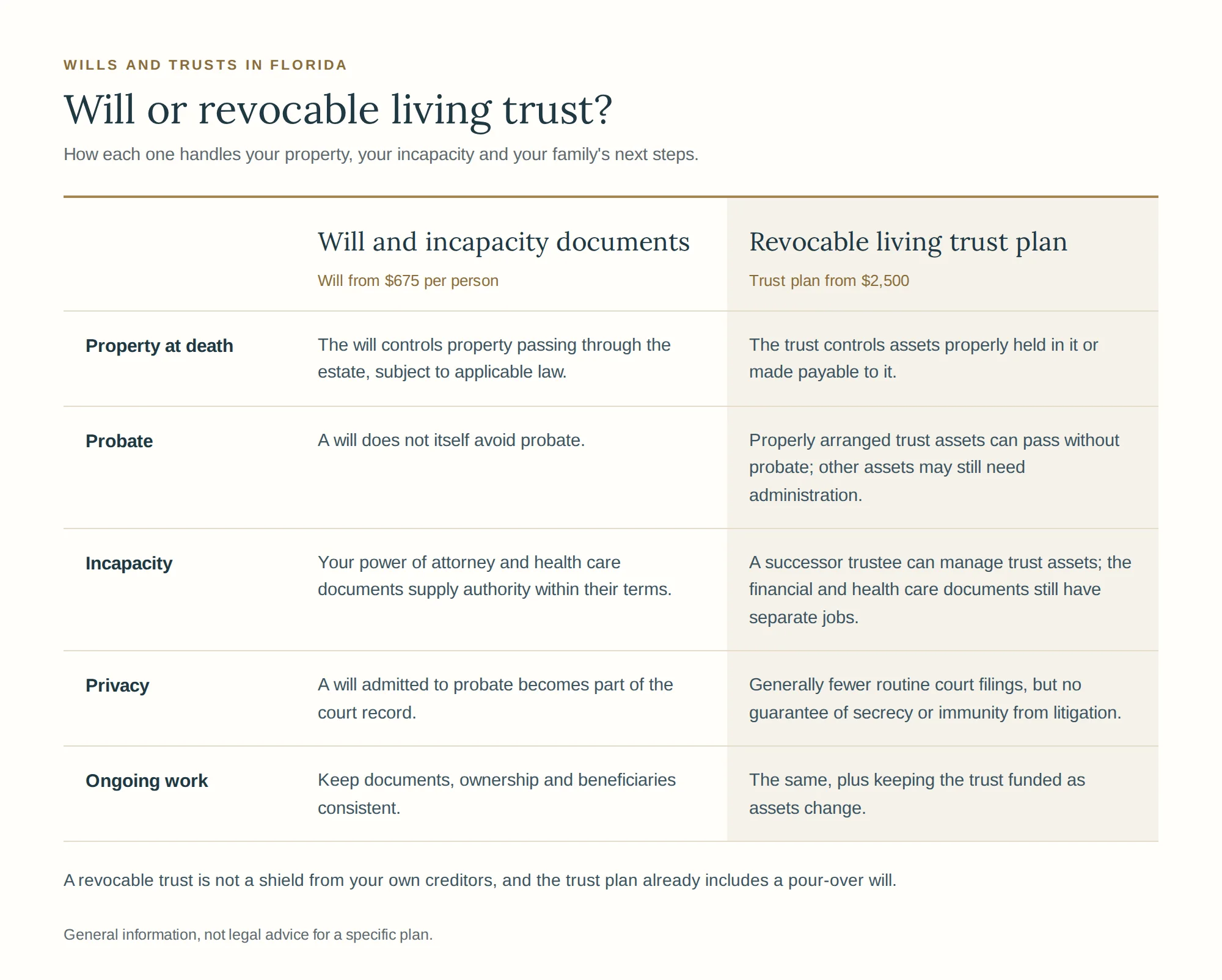
| Decision | Will and incapacity documents | Revocable living trust plan |
|---|---|---|
| Property at death | Will controls property passing through the estate, subject to applicable law | Trust controls assets properly held in or made payable to it; other assets need coordinated arrangements |
| Incapacity | Power of attorney and health care documents supply authority within their terms | Successor trustee can manage trust assets; financial and health care documents still have separate jobs |
| Probate | A will does not itself avoid probate | Properly arranged trust assets can pass without probate; other assets may still require administration |
| Privacy | A will admitted to probate becomes part of the court record | Trust administration generally involves fewer routine court filings, but a trust is not guaranteed secrecy or immunity from litigation |
| Continuing work | Keep documents, ownership and beneficiaries consistent | Do the same, and maintain appropriate trust funding as assets change |
A revocable trust is also not a general shield from your own creditors. Florida law makes revocable trust property available to the settlor’s creditors during life to the extent it would not otherwise be exempt if owned directly. See section 736.0505.
For more detail, read about living trusts in Florida and the Florida trusts guide. We can discuss whether the additional work of a trust fits your circumstances instead of choosing one solely because of your home’s value.
Is a trust better than a will in Florida?
Not for everyone. The benefits of a living trust are practical: a funded revocable trust can make management during incapacity smoother and can let properly arranged assets pass without probate. A simple will is less expensive to prepare, and it can be the right fit when most assets already pass by beneficiary designation or another arrangement. Many plans use both: a trust for management, and a pour-over will as a safety net.
What is the downside of a living trust in Florida?
A living trust costs more to set up than a will, and it only works for assets that are actually placed in it or made payable to it. It does not provide asset protection from your own creditors, it does not remove Florida’s homestead restrictions, and it needs attention when you buy, sell or refinance. An unfunded trust can leave your family with both a trust and a probate case.
Does a pour-over will avoid probate?
No. A pour-over will directs property that was left outside your trust into the trust after your death. That property may still have to go through probate to reach the trust. The pour-over will is a safety net, not a substitute for funding the trust.
Does a living trust need to be recorded or notarized in Florida?
A revocable trust is not recorded in the county’s official records the way a deed is. After the settlor’s death, the trustee files a notice of trust with the court under section 736.05055; that notice is a court filing, not a recorded copy of the trust. When a Florida resident’s trust contains provisions that take effect at death, Florida requires those provisions to be signed with the same formalities as a will under section 736.0403. A deed that moves your home into the trust is a separate document, and that deed is the one that gets recorded.
Funding a living trust: what usually goes in and what stays out
As your living trust attorney, my job does not end when the trust is signed. The trust controls only what it owns or what is made payable to it, so the plan includes a funding review. Each asset type has its own route.
| Asset | Usual approach | Who completes it |
|---|---|---|
| Florida home or other Florida real estate | A deed into the trust ($575 per deed), or a Lady Bird deed where that fits better | I prepare and record the agreed deed |
| Real estate outside Florida | A deed prepared under that state’s law | Counsel in that state |
| Home or accounts owned jointly by spouses (tenancy by the entirety) | Passes to the surviving spouse outside probate at the first death; we decide whether to keep it or move the asset into the trust | Reviewed during the funding review |
| Bank and brokerage accounts | Retitle in the trust’s name, or name the trust as payable-on-death or transfer-on-death beneficiary where the institution allows | You, with my guidance |
| IRAs and 401(k)s | Do not retitle retirement accounts into your living trust as ordinary trust assets. Moving IRA assets out of the IRA can trigger distribution and tax consequences; the taxable amount depends on account type and basis. Review beneficiary designations instead, including whether naming a trust fits the account’s tax and distribution rules | You submit the institution’s beneficiary form, with my guidance |
| Nonqualified annuities | A revocable trust can generally own one without losing tax deferral, but the contract’s ownership-change rules need review first | Reviewed case by case |
| Life insurance | Beneficiary designation reviewed against the plan | You submit the insurer’s form |
| Business interests | Transfer only as the operating or shareholder agreement allows | Reviewed case by case; separately scoped if substantial |
| Digital accounts | Provider tools and written directions coordinated with the plan | You, with my guidance |
The beneficiary designation guide explains why the forms on file with each institution matter as much as the trust document.
Your Coral Gables home: homestead, trusts and deeds
Start with the current recorded deed, your marital status and whether you have minor children. Florida homestead rules can restrict how a home passes at death. A trust does not automatically remove those restrictions. Under section 732.4015, homestead generally cannot be devised when the owner is survived by a spouse or minor child, except to the spouse when there is no minor child. Title, valid waivers and other circumstances require individual review.
Three different Florida homestead rules
“Homestead” means three different things in Florida, and an estate plan has to account for each one separately.
| Homestead rule | What it does | Where it comes from | Planning question |
|---|---|---|---|
| Restriction on who inherits | Limits leaving the home by will or trust when the owner is survived by a spouse or minor child | Florida Constitution, Article X, section 4(c); section 732.4015 | Who will own the home if you die first, and is a valid spousal waiver in place? |
| Property tax exemption and assessment cap | Reduces the taxable value of a permanent residence and limits yearly assessment increases | Exemption: Florida Constitution, Article VII, section 6, and section 196.031. Save Our Homes assessment limitation: Article VII, section 4(d), and section 193.155 | Will the exemption and the Save Our Homes cap continue after the home moves into a trust? |
| Protection from forced sale | Protects the homestead from most creditors, with constitutional exceptions such as taxes and assessments on the home; it does not erase a mortgage you signed | Florida Constitution, Article X, section 4(a) | Will a deed or ownership change affect that protection? |
The tax exemption is applied for through the Miami-Dade County Property Appraiser. A new owner or a new resident should confirm the application and its deadline with that office.
Can my home keep its homestead exemption in a revocable trust?
Generally, yes. Florida tax law treats a beneficial interest held under a revocable trust as qualifying for the homestead exemption, under section 196.041. The trust still needs Florida homestead trust language giving you a present right to use and live in the home and a beneficial interest for life. The deed must be recorded, and the Property Appraiser may ask for additional ownership documents, such as the trust or a certification of it, under section 196.031.
Does putting my home in a trust get around the homestead restrictions?
No. The restriction on leaving homestead applies to dispositions by trust as well as by will. Florida’s exception for certain lifetime transfers does not reach a revocable trust, because the owner keeps the power to revoke it. If you are married or have a minor child, the home’s destination at death must be planned within the homestead rules. A valid spousal waiver may address the spouse’s rights, but it does not remove the restriction arising from a surviving minor child. A Florida irrevocable homestead trust works differently, because the owner gives up the power to revoke it; whether that trade-off makes sense depends on your family, tax and creditor circumstances, and it is separately scoped.
Lady Bird deed or living trust for a Coral Gables home?
A Lady Bird deed may fit a plan for a particular Florida property. A deed into a revocable trust may fit a broader plan for ongoing management and distribution. Neither choice replaces health care documents, financial authority or beneficiary review for other assets. Florida does not have a statutory transfer-on-death deed for real estate; the Lady Bird deed is the tool Florida owners use for a similar result.
See the Lady Bird deed service, the Miami-Dade Lady Bird deed page and the comparison of a Lady Bird deed vs. a living trust for that separate engagement.
Consider two illustrative situations. A homeowner with adult beneficiaries may want to discuss whether a deed addresses the home’s transfer while a will and incapacity documents cover other needs. A homeowner with young children may also need a plan for who manages an inheritance and how funds can be used over time. Neither example determines the right deed or trust without reviewing the actual ownership and family facts.
Is it better to inherit a house or put it in a trust?
Your children inherit the home either way; the question is how it reaches them. If the home is left by will, it usually passes through probate before the title is in their names. If it is in a funded revocable trust, or covered by a Lady Bird deed, it can generally pass without probate. Property included in the owner’s estate and acquired at death generally receives a basis adjustment to its date-of-death value, subject to exceptions. That adjustment can be upward or downward; using a trust does not by itself guarantee a tax benefit. Retirement accounts are different: an inherited IRA or 401(k) does not receive that basis adjustment. Homestead restrictions apply in each case if you leave a spouse or minor child. The choice usually turns on whether you also want management during incapacity, how many properties you own and how the heirs will share the home.
Should I add my child to my deed?
Usually not without advice first. Adding a child as an owner is a present gift of part of the home. That share can be reached by the child’s own judgment creditors, you will need the child’s signature to sell or refinance, the change can affect the homestead tax exemption on the share you no longer own, the gift requires a federal gift tax return if the share is worth more than the annual exclusion ($19,000 per recipient in 2026), although tax is usually not owed because the gift is applied against your lifetime exemption, and the child generally receives your adjusted basis in the gifted share for calculating a later gain, with different rules potentially applying to a loss. This differs from the basis adjustment generally available to property acquired at death and can increase taxable gain on a later sale. A Lady Bird deed or a trust usually reaches the same goal without those costs.
Condominiums and homes in an association
If you own a condominium or a home governed by an association, bring the declaration and any rules about transfers. A condominium association can require approval of a title transfer only if its declaration says so, and many declarations exempt family transfers or require only notice. Homeowners’ associations are governed by a different statute, so their documents get their own review. I review those requirements before a deed is recorded.
If you also own property outside Florida, bring that deed too. I identify the separate legal work rather than assume a Florida document changes title everywhere. My Florida deed preparation page explains the deed work in more detail.
Incapacity documents and the people you name
Durable power of attorney
A durable power of attorney grants specified authority and can remain effective through incapacity, subject to Florida law. It generally becomes exercisable when signed, rather than waiting for incapacity, and terminates at death. Choosing an agent therefore involves trust, availability and the scope of the powers granted. The authority is not the same as being your personal representative after death. See sections 709.2108 and 709.2109.
Florida’s power of attorney statutes are in Part II of chapter 709, the Florida Power of Attorney Act. Under section 709.2108, a power of attorney is exercisable when signed. A springing power of attorney, one that takes effect only at a future date or event such as your incapacity, is ineffective under the current law, with narrow exceptions such as certain military deployment powers. A power of attorney signed before October 1, 2011 under the older statute, section 709.08, remains valid if it was signed in compliance with the law in effect at the time, but it should be reviewed, because institutions may hesitate to accept an older form and it may not grant the specific powers the current law requires to be listed.
If you were searching for a power of attorney lawyer in Coral Gables, this document is usually best prepared as part of the full plan, so the agent’s powers fit your trust, your accounts and your health care documents. The Florida power of attorney guide explains the document in more depth.
What are the “superpowers” in a Florida power of attorney?
Florida treats certain powers as too significant to pass under general language. They include creating or changing a trust, making gifts, changing survivorship rights or beneficiary designations, waiving certain retirement survivor benefits and disclaiming property. Under section 709.2202, each of these powers requires a separate signature or initials beside its specific grant. For a principal domiciled in Florida when the power of attorney is executed, both subscribing witnesses must be physically present to grant these powers; having one witness participate remotely is not enough. This witness restriction is separate from whether the notarization itself may be performed online.
Do you need a lawyer to get a power of attorney in Florida?
Florida law does not require a lawyer to prepare your power of attorney, but the document has to meet Florida’s signing requirements, and the superpowers above work only if they are specifically listed and separately signed or initialed. A power of attorney that is missing a required power, or that a bank or title company will not accept, often fails at the moment your family needs it. The $675 flat fee for a stand-alone durable power of attorney includes drafting it to fit your accounts, your home and your other documents.
What is the quickest way to get a power of attorney? A valid Florida durable power of attorney is signed before two witnesses and a notary, in person or, where Florida law permits, remotely. If a hospital stay, surgery or travel is coming up, say so when you first call, so timing can be discussed with you; no fixed turnaround is promised.
Does a Florida power of attorney need to be recorded? Generally, no. A power of attorney is usually kept by you or your agent and shown to institutions when needed. If your agent will sign a deed or other real estate document, the power of attorney is recorded in the county’s official records with that document, so that buyers and lenders have notice of it under section 695.01.
Is a Florida power of attorney valid in other states? Florida honors a power of attorney validly signed in another U.S. state, under section 709.2106. Whether another state will accept a Florida power of attorney is a question of that state’s rules, so if you own property or keep accounts in another state, we discuss whether a separate document for that state is advisable.
Does a power of attorney end at death?
Yes. A power of attorney terminates at the principal’s death. After death, authority comes from a probate appointment, a trust, the account title or a beneficiary designation, depending on how each asset is held. Read more about whether a power of attorney ends at death.
Health care decisions and treatment wishes
A health care surrogate designation names someone to make decisions or receive health information as authorized. A living will records wishes about life-prolonging procedures in the circumstances Florida law describes. They serve different purposes and should be reviewed together. The surrogate designation can also authorize your surrogate to receive your health information as defined under the federal HIPAA privacy rules, and you can make that access effective immediately, without a finding that you are incapacitated, under section 765.202. Give your surrogate and providers the appropriate copies. My health care surrogate resource and the guide to the Florida living will explain each document in more detail.
Guardian nominations and avoiding guardianship
A preneed guardian designation records a preferred person if a guardianship becomes necessary. It is a nomination subject to the court’s role, not a guarantee of appointment. Planning for a minor child raises separate questions about the person who would provide care and the person who would manage property. Tell me about children at the consultation so we can identify the appropriate documents and any additional scope.
Guardianship vs. power of attorney in Florida. A power of attorney is a document you sign while you have capacity, naming an agent you chose, and it works without a court case. A guardianship is a court proceeding started after a person can no longer manage his or her own affairs; the court decides who serves, and the guardian reports to the court. Under section 744.331, a court may not appoint a guardian if an alternative, such as a valid power of attorney, sufficiently addresses the person’s needs. That difference is the main reason to sign incapacity documents in advance.
What many states call a conservatorship is handled in Florida through a guardianship; Florida uses the word conservatorship only for a separate proceeding involving absent persons. A complete set of incapacity documents can also make a court-supervised guardianship unnecessary for many adults, because the people you trust already hold the authority they need. When a guardianship is unavoidable or disputed, see the Miami-Dade guardianship attorney page.
Choosing your personal representative, trustee and agents
The people you name matter as much as the documents. One person may serve in every role, or you may divide the jobs.
Personal representative or executor?
Florida uses the term “personal representative” for the person many other states call an executor. The personal representative administers property that passes through the estate under court supervision. A successor trustee manages trust property under the trust’s terms. Your agent under a power of attorney acts only while you are alive.
Can someone who lives outside Florida be my personal representative?
Only some people. Under section 733.304, a person who does not live in Florida can serve as personal representative only if he or she is related to the decedent by lineal consanguinity; is a spouse, brother, sister, uncle, aunt, nephew or niece of the decedent, or someone related by lineal consanguinity to any of them; is an adopted child or adoptive parent of the decedent; or is the spouse of anyone otherwise qualified. A trusted friend who lives abroad or in another state may not qualify. A successor trustee is not subject to the same residency rule, which is one reason families with relatives outside Florida often use a trust.
One person or several?
Consider availability, judgment with money, ability to work with family, and where the person lives. Name at least one backup for each role. The guide to selecting trustees and the explanation of contingent beneficiaries cover these choices in more depth.
Family circumstances that can change the plan
Parents of minor children
A young family’s plan needs a guardian nomination for the children, a backup, and a way to manage any inheritance until the children are old enough to handle it. The person best suited to raise a child is not necessarily the person best suited to manage an inheritance. See estate planning for parents for more on these choices.
Children and beneficiaries who need continuing help
An outright inheritance may not fit a beneficiary who needs ongoing management or whose public benefits could be affected. Discuss who should manage funds, permitted uses and when distributions should occur.
Raise disability-related and benefits-sensitive needs before settling on a standard package. My special needs trust resource explains why ordinary gifts and beneficiary designations may need a different approach. Specialized work requires its own scope discussion.
Second marriages and blended families
Tell me about children from earlier relationships, support obligations and any existing marital agreements. A plan should address what a surviving spouse may use or receive and what should ultimately pass to other beneficiaries, within the rights Florida law protects. A surviving spouse may have rights that a will cannot override, including the elective share under section 732.2065 and homestead rights, unless those rights were validly waived. Do not assume that naming different beneficiaries on a new will changes every account or overrides homestead restrictions.
Prenuptial and postnuptial agreements
I draft prenuptial and postnuptial agreements, and I also plan around agreements you already signed. A marital agreement can address what each spouse will receive at death, including whether a spouse waives the elective share or homestead rights, and it should be coordinated with your will, trust and beneficiary designations so the documents do not contradict each other. Under section 732.702, a waiver signed after the marriage requires fair disclosure, so both spouses should share financial information before signing. A marital agreement is a separately priced engagement, quoted before drafting begins.
Unmarried partners
Florida law does not treat an unmarried partner as an heir. Same-sex married couples have the same spousal rights as any other married couple; unmarried partners, of any gender, do not. If you want your partner to inherit, make decisions for you or have access to medical information, those choices have to be written into your documents and beneficiary designations. See estate planning for unmarried couples.
Surviving spouses
After the death of a spouse, the documents you signed together usually need to be reviewed: the successor trustee, the agent under your power of attorney, the health care surrogate and the beneficiaries on your accounts may all need to change. See estate planning for widows in Florida.
Business succession planning for business owners and professionals
If you own a business or a professional practice, bring the operating agreement, shareholder agreement or buy-sell agreement. Existing transfer restrictions and management arrangements can affect what your plan can accomplish. Identify who could run the business and who should benefit from its value; those may be different people. Business succession planning beyond coordinating your personal plan with existing agreements is separately scoped.
Charitable goals
If charitable giving matters to you, identify the intended organization and the assets you are considering. Complex tax, business-succession and charitable structures need a separate assessment of fit and scope. A standard planning package should not be read as a promise to establish every specialized trust, business agreement or tax strategy. The statewide estate planning page and the guide to irrevocable trusts in Florida provide broader planning context.
Other trusts and planning tools you may hear about
You may hear about other trusts and planning tools while researching. Each one solves a specific problem, and none is assumed to be part of a standard package.
| Term | What it means | Where to read more |
|---|---|---|
| Irrevocable trust | A trust you generally cannot change once signed, used for specific tax, benefits or protection goals | Irrevocable trusts in Florida |
| Spendthrift provision | A clause that limits a beneficiary’s ability to sign away a future distribution and limits creditors’ ability to reach it before it is paid; Florida’s spendthrift trust statute is section 736.0502 | Discussed when a beneficiary needs protection |
| Irrevocable life insurance trust (ILIT) | An irrevocable trust that owns a life insurance policy, often used to keep the proceeds outside the insured person’s taxable estate | Separately scoped tax planning |
| Spousal lifetime access trust (SLAT) | An irrevocable trust one spouse funds for the benefit of the other spouse, used in estate tax planning | Separately scoped tax planning |
| Dynasty trust | A long-term trust designed to hold assets for several generations | What is a dynasty trust |
| Pet trust | A trust that provides for the care of an animal | Discussed at the consultation |
| Charitable remainder trust | A trust that pays income to you or others for a period and then passes the remainder to charity | Separately scoped tax planning |
| Community property trust | A trust some married couples use for a possible income-tax basis benefit | Separately scoped tax planning |
| Family limited partnership | Not a trust: a partnership that holds family assets, sometimes used to centralize management and transfer interests to the next generation | Separately scoped; coordinated with business and tax advisers |
| Donor-advised fund | Not a trust you draft: a charitable giving account held by a sponsoring charity, which your plan can name or coordinate with | Discussed with your charitable goals |
| Land trust | A title-holding arrangement for real estate; not a substitute for a revocable living trust | Florida land trust |
One more point families often ask about: a clause that disinherits anyone who challenges the will or trust, often called a no-contest clause, is not enforceable in Florida under section 732.517 and section 736.1108. Clear drafting and a careful signing process do more to prevent a dispute.
Digital assets and cryptocurrency
Include important online accounts, digital property, cryptocurrency and any provider legacy-contact settings in your planning inventory. A provider’s qualifying online direction can take priority over conflicting instructions in a will or trust under section 740.003. Naming someone in a document does not guarantee unrestricted access to every account. Keep an appropriate access plan separate from a public-facing inquiry; do not send passwords or recovery phrases through the contact form.
Long-term care concerns
If you or a spouse may need long-term care, tell me at the consultation. I do not provide Medicaid or elder law planning. If qualifying for public benefits is a goal, that planning should be done by an elder law attorney, and I can coordinate with that attorney so that your power of attorney and other documents give your agent the authority that planning may require.
Moving to Coral Gables: updating an out-of-state estate plan
Moving to Florida does not automatically make every document signed elsewhere invalid. Bring your existing documents for review. The practical question is whether each document will work smoothly here, and whether your fiduciaries, property arrangements and instructions still fit your life in Florida.
| Document | How Florida treats it | What to review |
|---|---|---|
| Will | Florida recognizes certain out-of-state wills under section 732.502, with important exceptions | Whether your personal representative qualifies in Florida, and whether the will reflects Florida homestead and spousal rules |
| Revocable trust | Generally continues to operate; terms and trustee provisions should be reviewed | Successor trustees, funding of any new Florida home, and the law that governs the trust |
| Durable power of attorney | Florida recognizes a power of attorney validly executed under the law of another state, under section 709.2106 | Whether institutions will accept it in practice, and whether it grants the powers Florida requires to be listed specifically |
| Health care documents | Florida recognizes advance directives validly executed elsewhere, under section 765.112 | Whether your surrogate and providers can find and use them here |
| Deeds and accounts | Property in another state stays governed by that state’s law | Whether property left behind could require a second probate there |
Is my out-of-state will still valid in Florida?
Often, yes, but not always. A will executed validly under the law of the state where it was signed is generally recognized, but Florida does not accept every form of will that other places allow. Even a valid will may name a personal representative who cannot serve in Florida, or leave a Florida home in a way the homestead rules do not permit. A review answers both questions.
Do I need new documents after moving to Florida?
Not always, but many new residents update their documents so that banks, health care providers and the Florida courts receive familiar Florida forms. If you keep a home in another state or divide the year between states, we also discuss where you intend your permanent home to be. Florida provides a sworn declaration of domicile, filed with the clerk of the circuit court in your county under section 222.17, as one way to state that intent. Snowbirds and owners of second homes should bring documents for each property.
Planning for international and non-citizen families
I handle estate planning for non-citizen spouses and for foreign-owned Florida property as a separately priced engagement. If your spouse is not a U.S. citizen, if you or a family member who owns Florida property is not a U.S. citizen or resident, if you hold property or accounts outside the United States, or if your children or other heirs live abroad, tell me at the consultation. These facts can change which documents work, who can serve, and which tax rules apply, so the scope and flat fee for this work are quoted after we review the facts, rather than assumed to be part of a standard package.
- A spouse who is not a U.S. citizen. The unlimited federal marital deduction generally does not apply to property passing to a non-citizen spouse unless an exception applies, such as a qualified domestic trust, which defers the tax rather than eliminating it. Whether that matters depends on the size and structure of the estate.
- Owners who are not U.S. citizens or residents. For a decedent who was neither a U.S. citizen nor U.S.-domiciled for estate-tax purposes, U.S.-situated property may be subject to different estate-tax rules, credits and treaty provisions. Estate-tax domicile is not necessarily the same as immigration status or income-tax residence. See the explanation of non-citizen estate tax and ancillary administration.
- Heirs and fiduciaries abroad. A personal representative who lives outside Florida must qualify under section 733.304, and a beneficiary abroad may need documents that work in another country.
- Documents used in another country. Some documents may need translation or an apostille to be accepted abroad. We discuss where each document will be used.
- Powers of attorney signed abroad. A power of attorney signed in another country generally must meet Florida’s own signing requirements, including two witnesses, to be used for Florida property or accounts.
A Spanish-language guide to inheritance in Florida for foreign nationals is also available on this site.
Does Florida have an estate or inheritance tax?
No. Florida does not impose a state estate tax or an inheritance tax. Federal estate-tax exposure depends on estate value, prior taxable gifts, deductions and available credits, and different rules apply to nonresident noncitizens. For eligible estates, a timely federal estate-tax return can elect portability of a deceased spouse’s unused exclusion; portability is not automatic. For most families, the plan is therefore built around management, family and probate questions rather than estate tax. If your estate may approach the federal exemption, high-net-worth estate tax planning is a separately scoped discussion. Read more about inheritance tax in Florida.
Common estate planning mistakes
These are the problems that most often keep a plan from working the way the family expected.
- Signing a trust and never funding it. The trust controls only what it owns or what is made payable to it.
- Leaving old beneficiary designations in place. An account form can send money to a former spouse or a deceased beneficiary regardless of what the will says.
- Adding a child to the deed of the home. It is a present gift with creditor, tax and control consequences.
- Ignoring Florida homestead restrictions. A will or trust that leaves the home in a way the law does not permit will not work as written.
- Having no incapacity documents. Without a durable power of attorney and health care documents, a family may need a guardianship to act for you.
- Leaving property directly to a minor. Above $15,000, an inheritance left outright to a child generally requires a court-supervised guardianship of the property unless a trust or a custodian under Florida’s Transfers to Minors Act is used, and the child takes control as a young adult.
- Naming no backups. If the only person named cannot serve, the plan stalls.
- Assuming an out-of-state plan fits Florida. Personal representative eligibility, homestead and spousal rights are Florida-specific.
- Relying on online forms without review. Execution formalities, homestead and funding are where do-it-yourself plans fail.
- Never updating the plan. Marriage, divorce, a birth, a death, a move or a new property can each change what the documents should say.
Online forms vs. an attorney-drafted plan
Online services and free forms advertise wills and living trusts in Florida at a low price, and some people search for how to make a living trust without a lawyer. The risk is not the paper; it is what happens around it. A Florida will or trust must be signed with the required formalities, a home must be planned within the homestead rules, and a trust must be funded before it does anything. A form does not review your deed, ask who your heirs are under Florida law, or notice that your named personal representative lives in another country and may not qualify.
When a do-it-yourself plan fails, the cost usually arrives after death or incapacity, when the person who signed it can no longer fix it. An attorney-drafted plan at a published flat fee lets you compare that cost directly. If you already signed online documents, bring them; we can review what still works.
How your planning engagement works
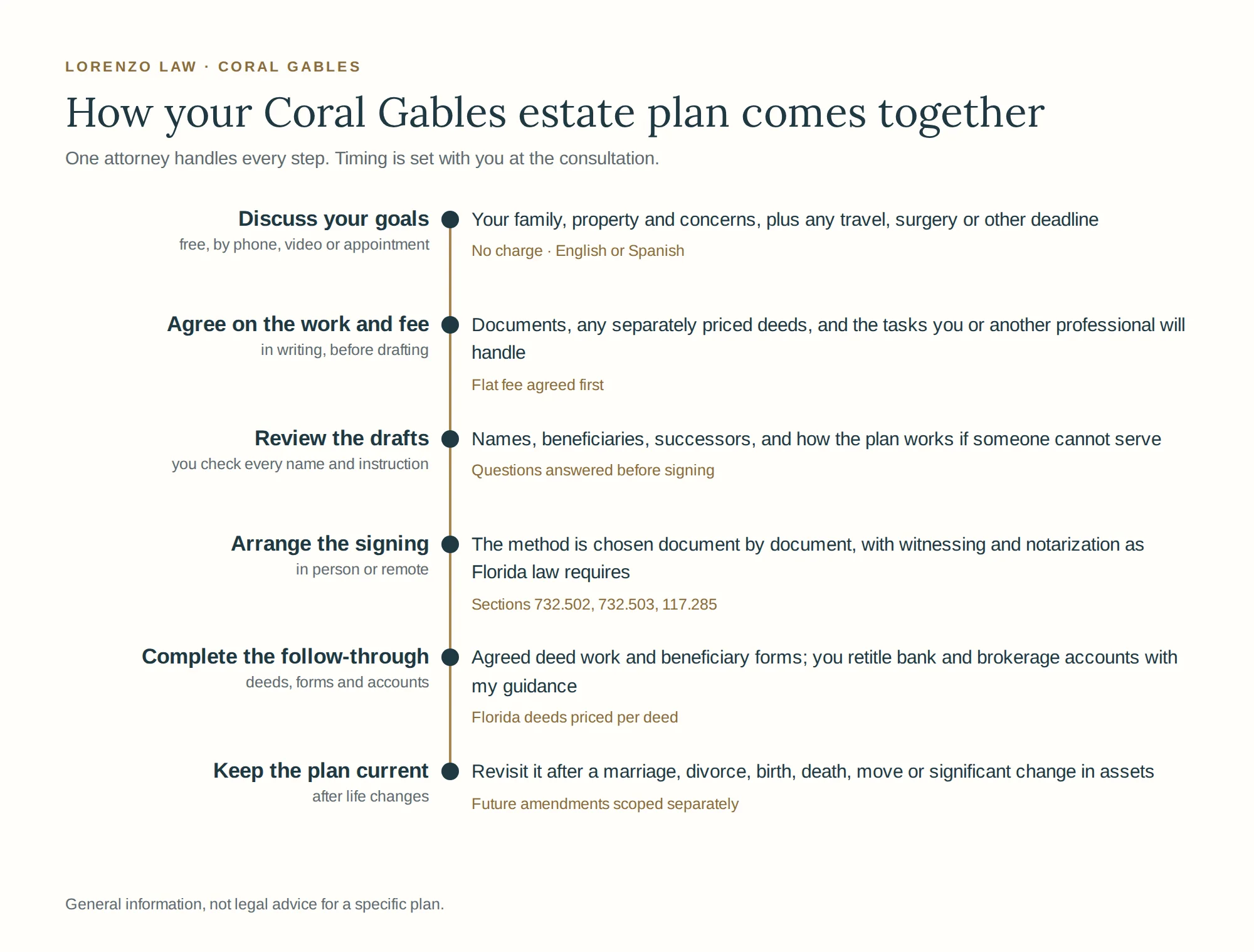
- Discuss your goals. We start with the family, property and concerns that brought you here. Tell me about upcoming travel, surgery or another deadline. Timing is discussed with you; no single turnaround fits every plan.
- Agree on the work and fee. We identify the documents, any separately priced deeds and the tasks you or another professional will handle. The flat fee is agreed before drafting.
- Review the draft documents. Check names, beneficiaries, successors and how the documents would work if someone cannot serve or circumstances change. Ask about anything you do not understand before signing.
- Arrange execution. We select the appropriate in-person or remote process for the documents and your circumstances. Witnessing, notarization and custody requirements are addressed as applicable.
- Complete the agreed follow-through. The plan identifies the deeds, account changes, beneficiary forms and document distribution still needed. You complete bank and brokerage retitling with my guidance; agreed Florida deed work is separately priced as described above.
- Keep the plan current. Revisit it after a marriage, divorce, birth, death, move, significant asset change or change in the people you named. Future amendments are separately scoped; the initial engagement is not an automatic annual-review subscription.
Signing in person or remotely
I offer in-person signing and remote signing where Florida law permits, including electronic wills. A video meeting alone does not establish that a document has been validly executed.
An ordinary Florida will must satisfy section 732.502: the required signature at the end, signing or acknowledgment before at least two attesting witnesses, and witnesses signing in the testator’s presence and each other’s presence. A self-proving affidavit can simplify later proof; it is not the same as the will’s execution requirements. Other proof routes remain available under section 733.201.
Remote witnessing has additional safeguards. Some documents and circumstances require physically present witnesses, including restrictions for vulnerable adults under section 117.285. We discuss the appropriate process before the signing appointment. For an electronic will, confirm the applicable custody and later deposit arrangements rather than assuming a saved PDF answers those questions.
Does a will need to be notarized in Florida?
An ordinary paper Florida will does not require notarization merely to satisfy the execution rules in section 732.502; it must meet the signature and witness requirements. A notarized self-proving affidavit under section 732.503 can simplify later proof, because the court can accept the will without locating the witnesses. An electronic will witnessed through audio-video technology has additional online-notarization and execution requirements under section 732.522.
Does a power of attorney need witnesses and a notary?
Yes. A Florida durable power of attorney must be signed by you before two witnesses and acknowledged before a notary, under section 709.2105. The “superpowers” described above must also be specifically listed and separately signed or initialed.
Can I sign my estate plan remotely?
Often, yes, using online notarization and remote witnessing where Florida law permits. Before a remote signing, Florida requires screening questions about the signer’s circumstances; certain answers, and vulnerable adults, require witnesses who are physically present. For a principal domiciled in Florida when signing a power of attorney that grants the superpowers, both subscribing witnesses must be physically present. We choose the signing method document by document. The online estate planning page explains the remote process.
What is an electronic will?
An electronic will is signed electronically under Florida’s electronic-will statutes. Its execution requirements are distinct from the additional requirements for self-proof. Under section 732.523, self-proof requires the specified acknowledgment and witness affidavits, designation of a qualified custodian, continuous qualified custody before the will is offered for probate, and the custodian’s certification; qualified custodians are governed by section 732.524. I confirm custody and later deposit arrangements before signing. Read more about online and electronic wills in Florida.
Your estate planning checklist: what to bring
You can make the first call before everything is gathered, and you do not need to fill out a long estate planning questionnaire first. Useful materials for the planning work include:
- Existing wills, trusts, powers of attorney and health care documents.
- The current deed for each property and information about mortgages and co-owners.
- A list of accounts, insurance and retirement assets, showing ownership and current beneficiaries.
- Names of the people you want to benefit and the people you would trust to act, with backups.
- Information about children, benefits-sensitive needs, prior marriages and family agreements.
- Business governing documents and any property or legal arrangements outside Florida.
- For a condominium or association home, the declaration and any transfer rules.
- Questions about timing, signing, fees and tasks you want help completing.
Use the initial contact form to describe the general planning need. We can discuss how to provide the records needed for your engagement. After signing, keep your original documents in a safe place and tell the people you named where to find them.
Reviewing or updating an existing estate plan
Some clients come to me with a plan signed years ago, or in another state, and want to know whether it still works. A review compares the documents with your current family, your current deed and the beneficiary forms on file, and identifies what to keep, amend or replace. Any amendment or replacement work is quoted for the agreed scope before it begins.
How often should I update my estate plan?
Review it after any major change: a marriage or divorce, a birth or death in the family, a move to or from Florida, the purchase or sale of a home, a change in the health or availability of the people you named, or a significant change in your assets. Without one of those events, a periodic look every few years helps catch outdated beneficiary designations and fiduciaries.
Where I meet Coral Gables clients
Coral Gables — by appointment 2850 Douglas Rd, Suite 303 Coral Gables, FL 33134
To meet with an estate planning attorney in Coral Gables, call (305) 224-6811 or use the consultation request page to arrange an appointment before coming to the location. Phone answering is available 24 hours; attorney consultations are by appointment. I aim to follow up within one to two business days.
The Coral Gables appointment location serves clients across Miami-Dade County, including Little Gables, Coral Way, Coral Terrace, the University of Miami area, South Miami, Coconut Grove, Westchester, Pinecrest, Kendall and Palmetto Bay, in ZIP codes such as 33134, 33143, 33146, 33155, 33156 and 33173. If you searched for an estate planning attorney near me from anywhere in that area, this is the location where we would meet. Consultations can also take place by phone or video anywhere in Florida. If you are looking for a bilingual, Spanish-speaking estate planning attorney, consultations can take place in Spanish. Tell me which language you prefer and whether you need to plan around travel or another deadline.
Lorenzo Law’s principal office is in Kissimmee, Florida; Coral Gables and Fort Lauderdale are by-appointment meeting locations. For planning across the wider county, see the Miami estate planning attorney page.
Miami-Dade offices your plan may involve
A Coral Gables estate plan often touches two county offices. The Miami-Dade County Property Appraiser administers the homestead tax exemption, so a deed into a trust or a new purchase may call for updated information there. The Miami-Dade Clerk of the Court and Comptroller records deeds in the county’s official records, which is where a trust-transfer deed or a Lady Bird deed is recorded. If a family later needs probate or a guardianship, those cases are handled in the Eleventh Judicial Circuit, which is a separate engagement.
How to compare estate planning lawyers in Coral Gables
If you are comparing estate planning attorneys in Coral Gables, or reading reviews of Coral Gables Florida estate planning lawyers, the most useful comparison is not a ranking. A search for an estate planning lawyer near me, or for lawyers for wills near me, returns a list of names; it does not tell you who will draft your documents or what is included in the fee. It is what each lawyer will actually do for you, who will do it and what it will cost.
Questions to ask any estate planning lawyer
- Who will meet with me, draft my documents and supervise the signing?
- Is the fee flat, and what exactly does it include and exclude?
- Will you prepare and record the deed for my home, and is that priced separately?
- Who handles funding the trust, and what will I need to do myself?
- Can the documents be signed remotely, and which ones cannot?
- Can we work in Spanish if I prefer?
- If you are not a U.S. citizen, or your spouse is not, do you handle that planning?
- How are future updates priced?
You can confirm any Florida lawyer’s admission and discipline history through the Florida Bar’s lawyer search.
How a solo practice compares to firms with more lawyers
Coral Gables estate planning lawyers work in estate planning law firms of every size, and a firm with more lawyers can offer more people on one matter. In a solo practice, you work with one attorney throughout. The person who hears your goals is the person who drafts the documents, answers your questions and oversees the signing, so nothing is lost in a handoff between a partner, an associate and a paralegal. That is a difference in structure, not a claim about any other lawyer’s ability. If your matter needs coordination with a tax adviser, a lawyer in another state or a financial institution, I coordinate with them directly.
Estate planning lawyer, estate attorney or “estate planner”: what the titles mean
“Estate planning lawyer,” “trusts and estates lawyer,” “estate attorney” and “estate lawyer” describe a licensed attorney who practices in this area. “Estate planner” is a broader label that can also be used by financial advisers and document preparers who are not lawyers. In Florida, only a licensed attorney may give legal advice about which documents you need or draft them for you. Ask for a Florida Bar number.
Questions about estate planning in Coral Gables
Who is an estate planning lawyer in Coral Gables who speaks Spanish and charges flat fees?
Jose M. Lorenzo, Jr. is a Florida estate planning attorney who meets clients in Coral Gables by appointment, works in English and Spanish, and publishes flat fees: wills from $675 per person, a durable power of attorney on its own for $675, a five-document core package for $1,500 per person and revocable living trust plans from $2,500. The first consultation is free.
Do I need a trust if I own a home in Coral Gables?
Not automatically. Start with the deed, your family circumstances and whether you need continuing asset management. A will, beneficiary arrangements, a Lady Bird deed or a funded trust may play different roles. Home ownership alone does not establish that everyone needs the same package.
What documents are in a basic Florida estate plan?
Most Florida plans start with five documents: a will, a durable power of attorney, a designation of health care surrogate, a living will and a preneed guardian designation. That is my $1,500 core package. If you ask which three are the most important legal documents in estate planning, the usual answer is the will, the durable power of attorney and the health care surrogate designation, because together they cover your property at death, your finances during incapacity and your medical decisions. A revocable living trust and a pour-over will are added when management or probate avoidance is a goal.
Are estate planners worth it, and are living trusts worth the expense?
An estate planning lawyer is worth the fee when the plan has to work without you: when there is a home, children, a second marriage, property in more than one state or people who may disagree. A living trust is worth the expense when you want a successor trustee to manage assets during incapacity or you want properly funded assets to pass without probate; it is less likely to be worth it when most assets already pass by beneficiary designation. With published flat fees, you can compare the cost before deciding.
Do I need a will if I have a trust?
Yes. A pour-over will catches property left outside the trust, and a will is also where parents of minor children can nominate a guardian. The trust plan includes a pour-over will for that reason.
Does a trust protect my property from every creditor?
No. A revocable trust is not general protection from your own creditors. Its planning functions include management and transfer of properly arranged assets. Asset protection beyond the exemptions Florida already provides, such as homestead, requires a separate analysis of the asset, applicable exemptions and your circumstances.
Will you move every account into my trust?
You handle bank and brokerage retitling with my guidance. We also review beneficiary choices. Each institution has its own forms and procedures, and a trust is not necessarily the correct owner or beneficiary of every asset. Separately agreed Florida deeds are handled under the deed service described above.
Can I keep my existing will and update the rest of my plan?
Possibly. Bring the existing documents so we can review what still works and what needs to change. Updating one document should not leave inconsistent beneficiaries, fiduciaries or ownership arrangements elsewhere. Any amendment or replacement work is quoted for the agreed scope.
At what age should I start estate planning?
Any adult can benefit from a durable power of attorney and health care documents, because incapacity can happen at any age. A will becomes more important once you own property, marry or have children, and a trust becomes worth discussing as your assets, your home or your family circumstances grow more complex.
What happens if I die without a will in Florida?
Florida’s intestacy statutes decide who inherits property that passes through your estate, and the court appoints a personal representative under its priority rules. The result may not match what you would have chosen, especially in blended families or for unmarried partners. A will or trust lets you make those choices yourself.
Can I meet locally and sign remotely?
We can arrange a Coral Gables appointment and discuss remote signing. Whether remote witnessing is appropriate depends on the documents and your circumstances. We confirm the process in advance rather than assuming every signature can be handled the same way.
What if my family needs help after someone has died?
That is a separate engagement. Visit the Florida probate lawyer page or the Miami-Dade probate attorney page for administration, or probate litigation for a dispute. Tell me about any notice or deadline when you contact the firm.
Arrange your free planning consultation
Tell me what you want your plan to accomplish, whether you already have documents and whether you prefer a phone, video or Coral Gables appointment. We can discuss the appropriate scope and flat fee before drafting begins.
Request your free consultation or call (305) 224-6811.
For further reading, use the estate planning resource guide or the detailed Florida estate planning explanation.