
Florida Probate vs. Non-Probate Assets
Florida probate vs. non-probate assets comes down to one question for each asset: who owned it at death, and what the deed, account agreement, beneficiary designation or trust says happens next. Non-probate assets are assets that pass at death under a valid arrangement outside the probate estate, such as survivorship ownership, a payable-on-death or transfer-on-death designation, a beneficiary designation, or ownership by a funded trust. A bank account, home or investment can follow different routes under different ownership arrangements.
The difference between probate and non-probate assets is how they transfer. Probate assets generally require estate administration to transfer the deceased person’s interest. Non-probate assets (also written “nonprobate”) pass under their own arrangement instead. Non-probate does not mean free of paperwork, creditor issues, taxes, surviving-spouse rights or possible court disputes. Exempt property and protected homestead are separate questions again: they describe family protections, not a way of passing outside probate.
If you are handling a death, gather the ownership documents before distributing property. If you are planning ahead, compare those documents with the people you intend to benefit. The same classification process helps in both situations, and this guide walks through it asset by asset.
Ask about your Florida assets — free initial consultationCall (305) 224-6811
Bank accounts · Real estate · Life insurance and retirement accounts · Trusts · Creditors and taxes · English and Spanish · Statewide
| What decides it | Ownership at death and the governing document: the deed, account agreement, beneficiary designation or trust. The type of asset alone does not decide whether it is a probate asset. |
|---|---|
| A will | A will directs probate property. It does not ordinarily redirect an asset that validly passes under its own beneficiary designation, POD or TOD registration, survivorship title or funded trust. |
| Not the same as protected | Passing outside probate does not settle creditor claims, a surviving spouse’s elective-share rights or estate-tax treatment. Each follows its own rules. |
| Exempt property and homestead | Separate questions about family protections and how a home passes. Neither is the same thing as a non-probate transfer. |
| Summary administration | Still a probate procedure. Under current section 735.201 it may be available when the Florida estate subject to administration, less creditor-exempt property, is $150,000 or less, or when the death occurred more than two years ago, if a will does not direct administration under chapter 733. Earlier deaths need review. |
| Attorney and consultation | Jose M. Lorenzo, Jr. is a solo Florida attorney. Lorenzo Law represents clients statewide and offers a free initial consultation. Consultations are available in English and Spanish. |
What Are Non-Probate Assets in Florida? Definition and Examples
Non-probate assets are assets that pass at death to a surviving owner, a named beneficiary or a trustee under a valid arrangement outside the probate estate. In Florida, common examples include accounts with a surviving payable-on-death beneficiary, securities registered in transfer-on-death form, real estate held with an express right of survivorship or by spouses as tenants by the entirety, life insurance payable to a named beneficiary, and property actually transferred to a funded trust.
List of non-probate assets in Florida
These are the assets that typically bypass probate in Florida, each with the condition that has to be true for it to do so:
- Payable-on-death (POD) bank accounts, when a beneficiary survives the account owner or owners (§ 655.82).
- Joint deposit accounts, which Florida law presumes pass to the surviving owner unless the account documents provide otherwise or the presumption is overcome (§ 655.79).
- Stocks, bonds and brokerage accounts registered in transfer-on-death (TOD) form, when a beneficiary survives all owners (§ 711.507).
- Real estate held with an express right of survivorship, or by spouses as tenants by the entirety (§ 689.15).
- Life insurance payable to a named beneficiary rather than to the insured’s estate (§ 222.13).
- Retirement accounts, IRAs, 401(k)s and annuities with a valid beneficiary arrangement under the plan or contract.
- Property titled in, or validly assigned to, a trust, meaning a trust that was actually funded.
- U.S. savings bonds registered with a co-owner or a payable-on-death beneficiary, which follow federal Treasury rules when that person survives (31 C.F.R. Parts 315 and 360).
- Real estate conveyed by an effective enhanced life estate (lady bird) deed, as to the remainder interest that passes at the owner’s death.
Each example assumes the arrangement was valid and effective and that the recipient survived. The list tells you where to look, not who receives a particular asset; the asset-by-asset chart below lists the documents and qualifications to check.
Examples of probate assets: what goes through probate in Florida
- A bank or brokerage account in the deceased person’s name alone with no effective POD or TOD designation.
- Real estate titled in the deceased person’s name alone, or the deceased person’s share held as a tenant in common, unless it passes another way or requires separate homestead analysis.
- Life insurance payable to the insured’s estate.
- A vehicle, business interest or personal property owned by the deceased person is a probate asset unless it passes under a qualifying non-probate arrangement, such as joint ownership with survivorship or a valid beneficiary designation. Some estate property, such as statutory exempt property under § 732.402, remains part of the probate estate but may be claimed by the surviving spouse or children free of most creditor claims: it is protected within probate, not a transfer that avoids probate.
- Property intended for a trust but never actually transferred into it.
Is exempt property the same as a non-probate asset?
No. Statutory exempt property under § 732.402 is a set of specified items, such as qualifying household property and vehicles, that a surviving spouse, or the decedent’s children if there is no surviving spouse, may claim, subject to eligibility conditions and a deadline. It is a family protection, not a way of passing outside probate. Protected homestead is a third, separate category. Both are explained in the homestead and exempt property section below and in the exempt-property guide.
Why the probate vs. non-probate distinction matters
Classification decides who has authority to transfer an asset and how. A probate asset generally moves through a court-supervised procedure, with a personal representative or court order, a creditor process and filings in the court record. A non-probate asset generally moves through the institution, trustee or title records under its own documents. That difference can affect who acts, what has to be filed and how long a transfer takes, but it does not guarantee a faster, cheaper or more private result in any particular case, and it does not by itself settle creditor, spouse or tax questions.
What Qualifies as a Non-Probate Asset? Start With Ownership and the Governing Documents
An asset is non-probate when the deceased person’s interest passes under an effective arrangement that does not depend on estate administration: survivorship title, a surviving POD, TOD or contract beneficiary, or completed ownership by a trust. Confirm the arrangement asset by asset before deciding how to transfer anything.
Work through each asset separately:
- Identify the owner at death. Look at the recorded deed, account registration, vehicle title, business ownership records or other evidence of ownership. A relative’s access to an account does not necessarily make that relative an owner.
- Read the transfer arrangement. Check for survivorship language, primary and contingent beneficiaries, trust ownership and any contract provisions that apply if a beneficiary cannot receive the asset.
- Confirm that the arrangement was effective. Review amendments, later deeds, accepted beneficiary forms, beneficiary survival and documents showing that property was actually transferred to a trust.
- Identify separate protections and claims. Homestead, statutory exempt property, spouse rights, liens and tax rules can affect the result without changing the basic transfer mechanism.
- Choose the transfer procedure. Only then determine whether an institutional claim, trustee action, title procedure, probate petition or disputed proceeding is needed.
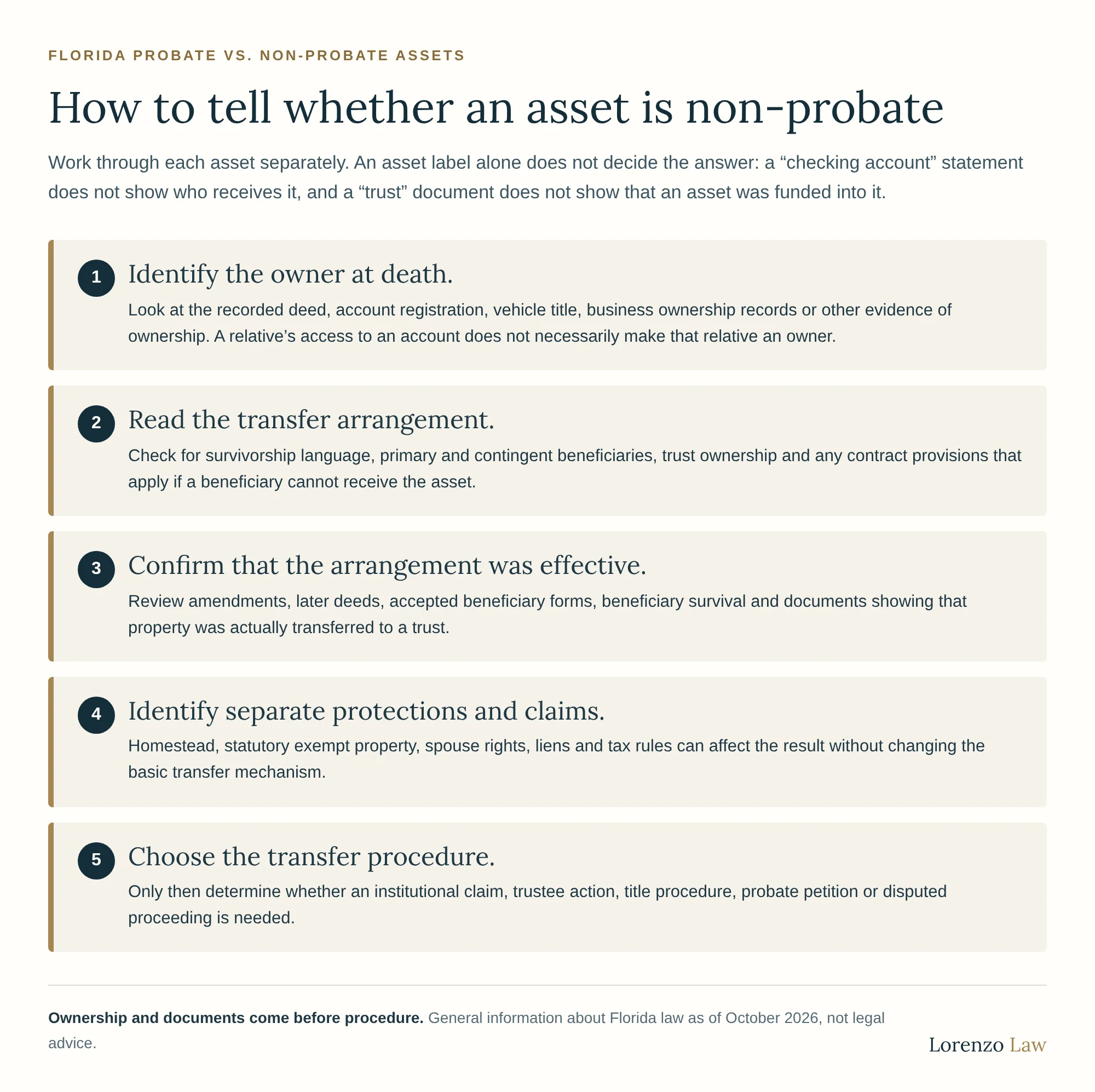
View the “How to tell whether an asset is non-probate” steps (zoom in to read; the details are also in the text above).
Do not classify all property from an asset label alone. A statement saying “checking account” does not establish who receives it; a document saying “trust” does not establish that every intended asset was funded into that trust.
Probate vs. Non-Probate Assets in Florida: Asset-by-Asset Chart
This chart is a starting point for document review, not a decision tree. It assumes valid documents and requires the qualifications in the last column to be checked before anyone transfers or distributes property.
| Asset | Ownership or designation to check | Documents to obtain | Possible route and qualifications |
|---|---|---|---|
| Individual bank account | Sole owner with or without an effective POD beneficiary | Deposit agreement, signature card, beneficiary record and death certificate | A qualifying surviving POD beneficiary may claim directly. Without an effective transfer arrangement, estate procedures may be needed; a narrow statutory payment route may apply in some cases. |
| Joint bank account | Actual co-ownership, survivorship terms or a convenience agent | Account contract, signature card and relevant change records | Florida deposit accounts have a statutory survivorship presumption, subject to the agreement and statutory grounds for challenge. Convenience authority alone does not confer inheritance. |
| Brokerage account or registered securities | Individual, survivorship, trust or TOD registration | Registration, beneficiary instructions and custodian requirements | Valid beneficiary registration can pass securities to surviving beneficiaries after all owners die. If none survives, § 711.507 directs the property to the estate of the sole or last owner. |
| Life insurance | Beneficiary entitled under the policy, or proceeds payable to the estate | Policy, current beneficiary form, assignments and claim requirements | Proceeds payable to a qualifying beneficiary generally follow the policy; proceeds payable to the insured’s estate are estate assets. Payment timing depends on the insurer’s claim requirements and any unresolved issues. |
| Retirement account or annuity | Beneficiary and default provisions, plan or contract requirements | Full beneficiary record, plan or contract, marital and relevant court documents | A valid beneficiary arrangement may permit a direct claim. Missing or failed designations require review of default provisions and applicable law; they do not justify one universal result. |
| Real estate held with another person | Survivorship, tenancy by the entirety, tenancy in common or trust ownership | Recorded deed and later conveyances, marriage or divorce records where relevant | Effective survivorship can pass the deceased owner’s interest to a survivor. A tenancy-in-common interest has no automatic survivorship; determine its estate or trust route and any homestead issues. |
| Home described as homestead | Ownership, actual qualification, family circumstances and permitted disposition | Deed, occupancy and domicile evidence, will or trust, family information | Analyze protected homestead separately. A court determination may be needed to document status or title even where the property is not an ordinary administered estate asset. |
| Property intended for a trust | Actual ownership or completed transfer to the trustee | Trust and amendments, deeds, assignments and account registrations | Properly funded property can be administered by the successor trustee. A trust document alone does not move an omitted asset into the trust. |
| Vehicle | Title wording, ownership, liens and any qualifying statutory procedure | Title, death certificate, lien information, will and required affidavits or orders | A qualifying title-transfer route may avoid administration. Sole title does not by itself establish that formal probate is mandatory; exempt-property status is a different inquiry. |
| Business interest or personal property | Decedent’s interest, valid assignment, trust ownership or governing agreement | Operating or shareholder agreement, ownership ledger, assignments and purchase records | Identify the interest that belonged to the decedent and any enforceable transfer or purchase arrangement. A company-owned asset is not automatically the owner’s personal estate asset. |
| Digital property | Ownership of the underlying value versus authority to access an account | Account terms, ownership records and disclosure directions | Access or disclosure authority does not itself transfer ownership of cryptocurrency, intellectual property or other underlying assets. |
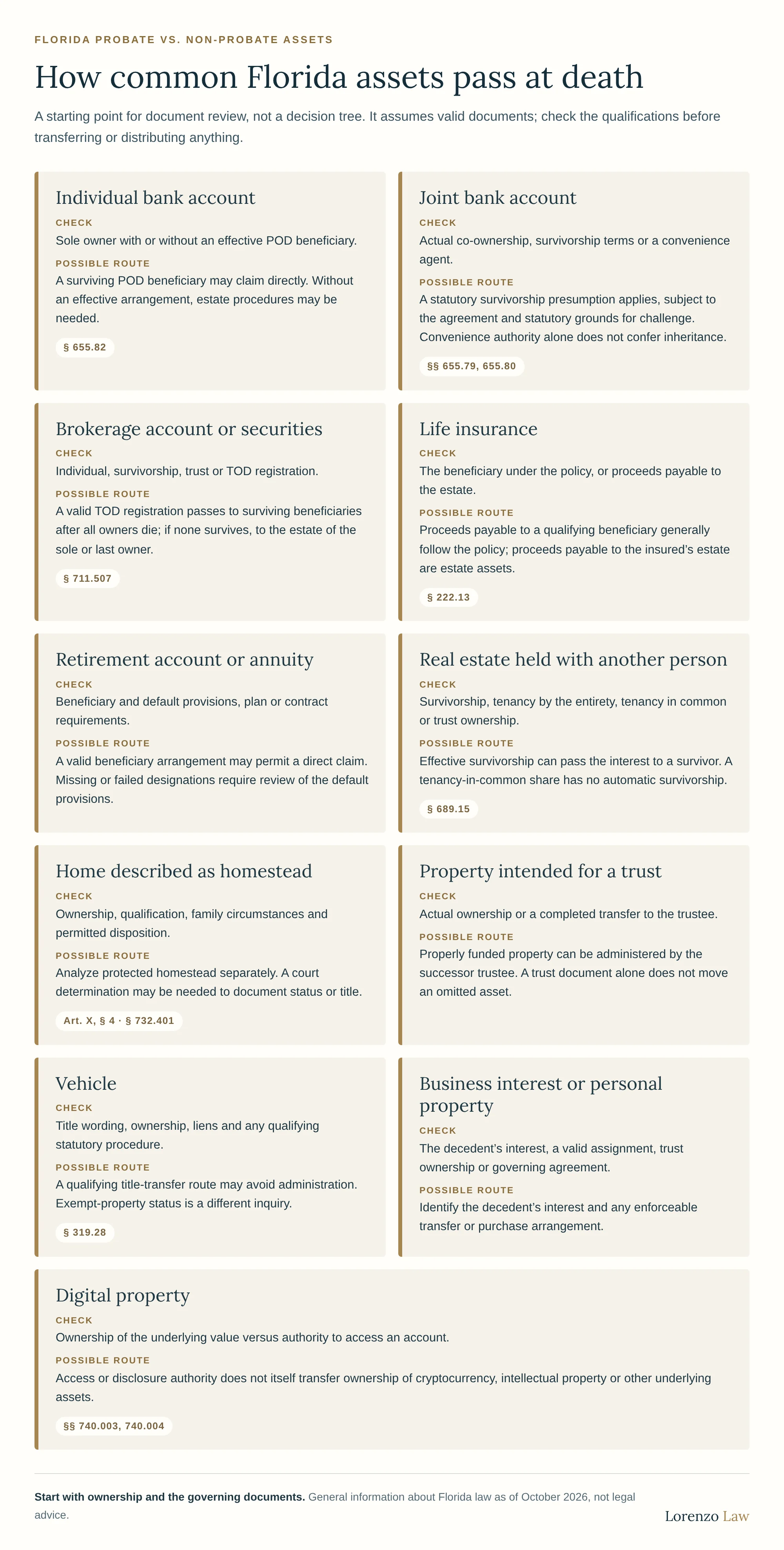
View the “How common Florida assets pass at death” chart (zoom in to read; the details are also in the text above).
The account rules differ: see joint deposits under § 655.79, POD accounts under § 655.82 and TOD securities under § 711.507. The bank accounts after death guide explains the institution-specific next steps. If the first question is whether an estate needs probate at all, and which Florida procedure fits, start with when probate is not necessary in Florida; this chart focuses on the documents that prove how each asset passes.
What Are Probate Assets, and Does a Will Avoid Probate?
A probate asset is property whose transfer requires estate administration because no effective outside-probate arrangement moves it at death. A will does not avoid probate: it directs the disposition of probate property, subject to applicable law.
A solely owned asset without an effective outside-probate transfer arrangement is a common probate asset. The deceased person’s tenancy-in-common interest can also require administration even though other people own shares of the same property. Insurance payable to the estate supplies another example.
Conversely, a gift in a will does not ordinarily redirect an asset that validly passes to someone else under its own governing arrangement. Coordinate both sets of documents.
For a fuller inventory discussion, see what counts as a probate asset and building a complete list of assets. The Florida probate guide covers the administration process after classification.
How the personal representative treats non-probate assets
Assets that pass outside probate are generally not administered by the personal representative as probate assets. They can still matter to the estate: the personal representative may need to know about them to confirm what is and is not part of the probate estate, to address a revocable trust’s statutory liability when the estate is insufficient, for a surviving spouse’s elective-share computation and for tax reporting. Distributing property before its classification is confirmed can lead to disputes about who was entitled to it. Classify first, then distribute.
Non-Probate Transfers Still Require Action
A beneficiary or surviving owner may need to provide a death certificate, identification and the institution’s required claim or registration documents. A trustee must establish authority and administer the trust. A real-estate transfer may require recorded evidence and title review. These steps are different from appointing a personal representative to administer that asset, but they are still work that must be completed.
Non-probate arrangements may reduce the need for probate administration. They do not guarantee a faster distribution, lower total expense, complete privacy or freedom from litigation. A disputed designation, missing record or unresolved trust obligation can delay a transfer.
Do POD and TOD Accounts Go Through Probate in Florida?
Generally not, when the designation is effective and a beneficiary survives. A payable-on-death bank account governed by § 655.82 and securities registered in transfer-on-death form under § 711.507 pass to the surviving beneficiary under their own terms. If no beneficiary survives, both statutes direct the property to the estate of the last surviving owner.
For a POD deposit account governed by § 655.82, a beneficiary has no right to the funds while an account party is alive. In a qualifying multiple-party arrangement, surviving parties take before POD beneficiaries; beneficiaries take after the sole or last surviving party dies. Check the contract and who survived.
TOD securities, often held in what brokerage firms call a TOD account, follow their registration and the requirements of chapter 711. Do not assume a securities registration rule authorizes the same arrangement for a Florida deed or vehicle title.
Do bank accounts go through probate in Florida?
It depends on the account’s ownership and designations. An account with a surviving joint owner or an effective POD beneficiary generally passes outside probate under the account terms. An account in the deceased person’s name alone with no such arrangement is generally a probate asset, although a narrow statutory payment route may apply in some cases. The bank account guide explains what institutions typically ask for. If a dormant account has already been reported to the state, it is claimed through Florida’s unclaimed property program instead; see unclaimed property after a death in Florida.
Can a bank release funds without probate in Florida?
Often, for accounts that pass by their own terms. A bank can pay a surviving joint owner or a surviving POD beneficiary on proof of death and its own claim requirements. For an account owned by the deceased person alone with no effective designation, the institution generally needs letters of administration, a court order or proof that a qualifying statutory procedure applies. Ask the institution for its written requirements and keep its response.
What happens if the POD or TOD beneficiary dies first?
For a POD deposit account, if no POD beneficiary survives, § 655.82 directs the balance to the estate of the last surviving party. For TOD securities, if no beneficiary survives all owners, § 711.507 provides that the security belongs to the estate of the sole owner or of the last of multiple owners to die. Retirement plans, insurance policies and annuities follow their own contingent-beneficiary and default provisions, which can differ from these account statutes. See contingent beneficiaries under Florida law.
Drawbacks of POD, TOD and joint accounts
POD, TOD and joint accounts are simple and inexpensive, which is why they are common. Their disadvantages show up when the facts change or the family is not treated the way the owner intended:
- No backup unless you name one. If the only named beneficiary dies first, the account generally falls back into the owner’s estate, which can mean probate after all. Naming a contingent beneficiary, where the institution allows it, closes that gap.
- A joint owner receives more than a beneficiary does. A POD beneficiary has no right to the money while the owner is alive. Adding someone as a joint owner usually lets that person withdraw funds during the owner’s life, and the account can be drawn into the joint owner’s own debts, divorce or disputes, depending on the facts.
- Unequal results among children. The account passes to whoever is named on it, not under the will. Adding one child to an account “to help with bills” can leave that child the entire balance at death, and the other children may have no simple way to recover a share.
- No help during incapacity. A POD or TOD designation does nothing while the owner is alive. Paying bills for an owner who can no longer manage money takes a durable power of attorney, a funded trust or a convenience arrangement.
- Designations drift out of date. They do not change when the will changes, and a will generally does not override them (see beneficiary designations vs. a will).
- No management for the recipient. The money passes outright, which can be a problem for a minor or for a beneficiary who receives public benefits or cannot manage money.
For questions about real-estate transfer tools, see the discussion of Florida transfer-on-death deeds below.
Does Life Insurance, an IRA, a 401(k) or an Annuity Go Through Probate?
Not when a valid beneficiary arrangement directs payment to a surviving beneficiary. Proceeds or benefits payable to the deceased person’s estate are estate assets. If a designation is missing or fails, the contract’s or plan’s contingent-beneficiary and default provisions, together with applicable law, decide who receives the money.
Read the actual contract or plan and its current beneficiary record. A named beneficiary may claim outside probate, while a payment directed to the estate follows an estate route. If a designation is missing or fails, investigate contingent beneficiaries and default provisions before deciding who receives the money. Retirement benefits can also involve federal plan and spousal rules.
Life insurance and the probate estate
Under § 222.13, insurance on the life of a Florida resident inures to the person designated in the policy, and the proceeds are exempt from the insured’s creditors unless the policy or a valid assignment provides otherwise. Insurance payable to the insured or the insured’s estate becomes part of the estate and is administered in probate. That asset-specific rule is not a general promise that all non-probate property is protected. Life insurance can also count for other purposes: the policy’s net cash surrender value immediately before death is included in the Florida elective estate, and death benefits can be part of the federal gross estate.
What happens if there is no beneficiary on a life insurance policy?
The policy controls. Check whether it names a contingent beneficiary and what its default provision says. If the result is that proceeds are payable to the insured or the insured’s estate, § 222.13 treats them as estate assets administered in probate. Review the policy, any assignment and the insurer’s claim requirements before assuming who receives the money.
Do IRAs, 401(k)s and annuities go through probate?
Generally not, when a valid beneficiary designation directs payment to a surviving beneficiary. A missing or failed designation requires review of the plan’s or contract’s default provisions and applicable law; it does not justify one universal result. Employer plans can involve federal plan and spousal-consent rules. The income-tax and distribution rules for inherited retirement accounts are separate questions for a tax adviser. See beneficiary designations for retirement plans.
Does a Beneficiary Designation Override a Will in Florida?
Generally yes, as to that asset. A will directs probate property; it does not ordinarily redirect an asset that validly passes under a beneficiary designation, a POD or TOD registration, or survivorship title. The designation, account agreement or deed controls that asset. Exceptions exist, so check the designation against current law and later family events such as a divorce.
That is why a will and the beneficiary records have to be coordinated. A will that says “divide everything equally among my children” does not reach a bank account that names one child as the POD beneficiary. Florida law can treat certain designations in favor of a former spouse as ineffective after a divorce (see § 732.703), and federal law governs many employer plans, so a designation that looks controlling on paper still needs review.
A will also cannot, by itself, change a POD designation or a joint account. A POD designation is changed through the institution’s procedures during the owner’s life. A joint account’s survivorship presumption under § 655.79 can be overcome only by proof of fraud or undue influence or clear and convincing proof of a contrary intent; whether particular evidence meets that standard is a fact-specific question. For how to review and update designations, see beneficiary designations in Florida estate planning.
Does a Living Trust Avoid Probate in Florida? Only for Funded Assets
A funded revocable living trust can keep the assets actually transferred to it out of probate. Property left outside the trust may still require probate, and the trust does not change creditor, spouse, homestead or tax rules.
A funded living trust can provide continuity of management and instructions for beneficiaries, including arrangements that require ongoing administration. Funding means completing the transfer appropriate for the asset, such as a deed, account retitling or valid assignment. Merely listing an asset as something you intend to transfer may be insufficient.
Property left outside the trust may still require probate. Trust planning for real estate in another state also requires attention to that state’s law and the completed title transfer; see ancillary probate for the reverse situation. See the Florida Bar’s revocable-trust explanation for the distinction between creating and funding a trust, and living trusts in Florida for planning considerations.
Pour-over wills and probate
A pour-over will directs property that was left outside the trust into the trust, but that property still has to pass through the applicable probate procedure first. It is a safety net for funding gaps, not a substitute for funding.
What should you not put in a living trust?
Assets that already pass by beneficiary designation, such as retirement accounts and many life insurance policies, are usually coordinated through the designation rather than retitled to the trust; changing the owner of a retirement account can have tax consequences. A homestead, vehicles and accounts held with a spouse also need individual review before retitling. Do not retitle a retirement account or home based only on a general checklist.
Should you put your house in a trust in Florida?
It depends on the goal, the family and how the home is owned now. A funded revocable trust can keep a Florida home out of probate and provide for management if the owner becomes incapacitated. It does not escape Florida’s homestead rules: if a spouse or minor child survives, the restrictions on leaving a homestead apply to a trust as they do to a will. Married owners also need to consider how the home is titled today, because a tenancy-by-the-entirety deed may already pass the home to the surviving spouse. Review the deed, the family situation and the homestead rules before signing a new deed.
Downsides of a revocable trust and of putting a house in a trust
The main disadvantages of a living trust in Florida are cost, follow-through and expectations:
- More up-front work and cost than a simple will. The trust must be drafted and then funded, asset by asset. Anything left outside the trust may still need probate.
- Limited protection from creditors. A revocable trust does not shield its assets from the owner’s creditors during life (§ 736.0505(1)(a)), except to the extent the property would be exempt anyway if the owner held it directly. After death, assets held in the trust can be reached to pay estate expenses and the deceased person’s debts, but only to the extent the probate estate itself is not enough to cover them, and certain assets, such as IRAs and qualified retirement plans, are excluded (§ 733.707(3); see creditors).
- Extra steps for a house. A deed into the trust has to be prepared and recorded correctly. A trust that gives the owner a beneficial interest for life supplies the ownership (equitable title) needed for the homestead property-tax exemption, but the owner must still separately meet the exemption’s other requirements: permanent Florida residence and a timely exemption application (§ 196.041(2); § 196.031). For a residential loan on property with fewer than five dwelling units, federal law generally bars a lender from enforcing a due-on-sale clause when the home is transferred into a living trust in which the borrower is and remains a beneficiary, so long as the transfer does not change who has the right to occupy the property (12 U.S.C. § 1701j-3(d)(8)). Title insurance and the homeowner’s insurance policy should still be checked before recording, and the trust does not escape Florida’s homestead restrictions when a spouse or minor child survives.
- Administration still happens. A trust avoids probate court, not the work. After death the trustee still has duties to notify beneficiaries, deal with creditors and taxes, keep records and account for the property.
- Less court oversight. No judge supervises the trustee unless someone files a case, which is an advantage when the family cooperates and a drawback when it does not.
Trust vs. will in Florida
A will directs probate property and takes effect only through a probate proceeding. A revocable trust can hold property during life and pass it outside probate at death, but only the property actually transferred to it. Many Florida plans use both: a funded trust for the main assets and a pour-over will as a safety net for anything left outside. Neither one changes creditor, spouse or homestead rules on its own.
Joint Ownership in Florida: Survivorship, Tenancy by the Entirety and Tenancy in Common
Two names on a title do not always mean the survivor receives everything. For Florida real estate, § 689.15 generally requires an express survivorship provision to avoid a tenancy in common, with a separate rule for spouses holding as tenants by the entirety. Joint deposit accounts follow their own statutory presumption under § 655.79.
Determine what the deed created and whether later events changed that ownership. See Florida survivorship rights for the detailed deed and account distinction and types of Florida deeds for the instruments.
Does a house go through probate in Florida?
It depends on how title was held at death and whether the home was protected homestead. A house held with an effective survivorship provision, or by spouses as tenants by the entirety, generally passes to the survivor outside probate. A tenant-in-common share passes under the owner’s will, trust or intestacy. A home in the deceased owner’s name alone needs separate homestead analysis, and a court determination may be needed to document title. A house left to someone in a will is not transferred by the will alone; a court proceeding, usually probate administration, is generally needed to carry out the gift and document ownership.
Homestead is different. Florida’s Constitution restricts leaving a homestead by will when the owner is survived by a spouse or a minor child (Art. X, § 4(c); § 732.4015(1)). The result depends on the family:
- Spouse and descendants survive: if the home is not validly devised, the spouse takes a life estate with a vested remainder to the owner’s descendants living at death, per stirpes. Within six months of death and during the spouse’s lifetime, the spouse may instead elect an undivided one-half interest as a tenant in common, with the descendants collectively taking the other half (§ 732.401).
- Spouse but no descendants: the homestead cannot be left away from the spouse and passes to the spouse.
- No spouse, but a minor child: the homestead cannot be devised and passes to the owner’s descendants.
- Spouse and no minor child: the owner may leave the homestead to the spouse outright by will.
- No spouse and no minor child: the owner may leave the homestead by will to anyone, including someone who is not an heir.
Where the homestead passes to a surviving spouse, descendants or other heirs, it generally passes at death outside probate and is protected from creditors. Where there is no spouse or minor child and the owner leaves it to someone who is not an heir, the homestead loses that protection and is administered as an estate asset. An order determining protected homestead status (Fla. Prob. R. 5.405) is often obtained either way to confirm the property’s status, identify who is entitled and clear title. See the Florida homestead probate guide.
Joint tenancy with right of survivorship
When the deed expressly creates survivorship and no later conveyance severed it, the deceased joint owner’s interest generally passes to the surviving joint owner outside probate. The survivor may still need recorded evidence of the death for title purposes.
Does tenancy by the entirety avoid probate in Florida?
Tenancy by the entirety is available only to married couples. When one spouse dies, the surviving spouse ordinarily owns the property by survivorship, outside probate. For deposit accounts, § 655.79 provides that an account in the names of two persons who are husband and wife is considered a tenancy by the entirety unless otherwise specified in writing. A divorce changes the result: under § 689.15, tenants by the entirety become tenants in common on dissolution of marriage. To clear title after the first spouse’s death, title companies commonly ask for a certified death certificate and may request an affidavit of continuous marriage; ask the title company for its written requirements.
Tenancy in common: no automatic survivorship
Each tenant in common owns a separate share. The deceased owner’s share passes under that owner’s will or trust, if the share was transferred to it, or by intestacy, subject to any homestead issues. The other owners keep their own shares but do not receive the deceased owner’s share merely because they are co-owners.
| Feature | Joint tenancy with right of survivorship | Tenancy by the entirety | Tenancy in common |
|---|---|---|---|
| Who can hold it | Any two or more owners | Spouses only | Any two or more owners |
| How it is created in Florida | The deed must expressly provide for survivorship (§ 689.15) | A conveyance to spouses; a separate rule applies to estates by the entirety (§ 689.15) | The default for two or more owners without express survivorship (§ 689.15) |
| At one owner’s death | The deceased owner’s interest generally passes to the survivor, outside probate | The surviving spouse ordinarily owns the property, outside probate | The deceased owner’s share passes by will, trust or intestacy |
| Effect of divorce | Depends on the deed and any later conveyance | The spouses become tenants in common (§ 689.15) | No automatic change |
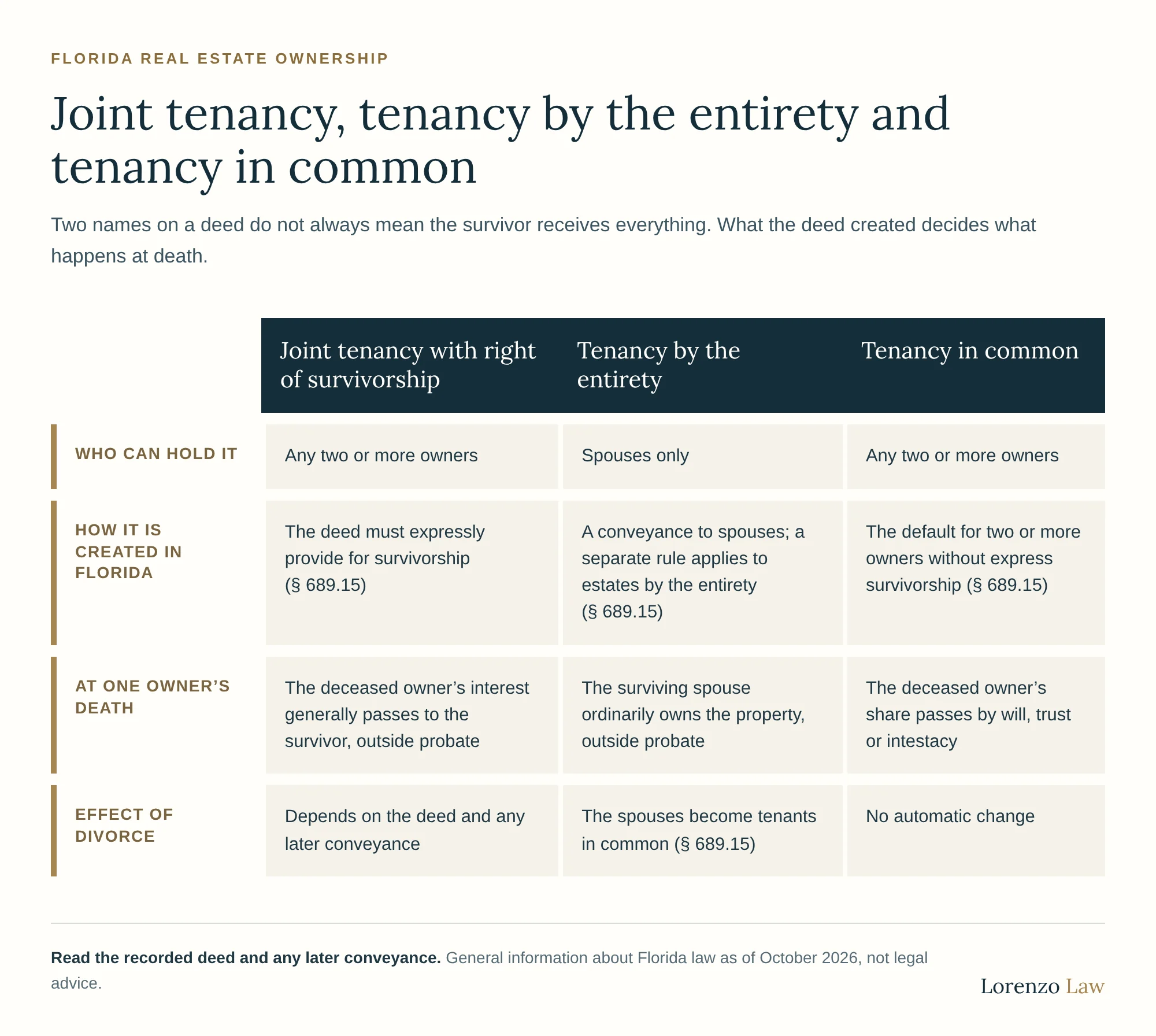
View the “Joint tenancy, tenancy by the entirety and tenancy in common” comparison (zoom in to read; the details are also in the text above).
What happens to a joint bank account when one owner dies in Florida?
Unless the account contract, agreement or signature card expressly provides otherwise, § 655.79 presumes that a deposit account in two or more names vests in the surviving owner or owners at death, less proper setoffs and charges in favor of the institution. The presumption can be overcome only by proof of fraud or undue influence or clear and convincing proof of a contrary intent. A bank’s ability to release funds and the ultimate ownership dispute are different questions; a surviving owner who receives the funds can still face a challenge.
Convenience accounts are not joint ownership
A statutory convenience account under § 655.80 lets an agent help with banking while ownership remains with the principal. The agent does not inherit the balance merely by being named. This is not a general probate-avoidance device and has nothing to do with creating survivorship in a deed.
Does Florida have a transfer-on-death deed?
No Florida statute authorizes a transfer-on-death deed for real estate. Florida owners who want real property to pass at death without probate commonly look at an enhanced life estate (lady bird) deed, which Florida recognizes through case law rather than a statute, a funded trust or survivorship title instead, and each has different consequences for control, creditors and homestead. Do not assume that TOD registration for securities under chapter 711 authorizes the same arrangement for a deed. See the Florida lady bird deed guide and the quitclaim deed guide, which address different tools and their limits.
Homestead and Statutory Exempt Property Are Separate Questions
Calling a home “homestead” does not resolve how title passes. Review ownership, Florida homestead requirements, the will or trust and the surviving family. Constitutional protection, restrictions on devise and descent rules must be considered together. A property-tax exemption alone is not a complete inheritance analysis. Trust ownership does not automatically eliminate homestead restrictions. See Article X, Section 4 of the Florida Constitution, § 732.401, § 732.4015 and the Florida homestead probate guide.
Statutory exempt property under § 732.402 is another distinct category. For a Florida-domiciled decedent, the surviving spouse, or the decedent’s children if there is no surviving spouse, may have rights to specified household property, qualifying vehicles, qualified tuition programs and specified benefits. The statute includes eligibility conditions, will-related exclusions, a petition deadline and an exception for perfected security interests. It does not make every household item or vehicle a non-probate asset.
Use the exempt-property guide for that claim. The legal right to an exemption and the documents needed to transfer title should both be checked.
Does a car go through probate in Florida?
Not necessarily. A qualifying vehicle may be claimed as exempt property under § 732.402, and § 319.28 provides a title-transfer route that may avoid administration in qualifying cases. Sole title does not by itself establish that formal probate is mandatory, and exempt-property status is a different inquiry from title procedure. The vehicle transfer guide explains the title steps.
Can Creditors Go After Non-Probate Assets in Florida?
Sometimes. Passing outside probate does not make an asset immune from claims. Florida law makes specified revocable-trust property liable for the deceased settlor’s estate expenses and obligations when the probate estate is insufficient, subject to statutory exclusions and payment rules. Other assets have their own, asset-specific protections, such as the rule for life insurance payable to a beneficiary. Fraud is not the only possible basis for a claim affecting property outside probate.
There is no single creditor rule for all non-probate assets. The clearest example is a revocable trust. Under § 733.707(3), any portion of a trust that the deceased settlor could revoke at death is liable for the expenses of administration and obligations of the estate to the extent the estate is insufficient to pay them. Under § 736.05053, the trustee pays the amounts the personal representative certifies in writing are required, following the statute’s payment rules. Specified retirement arrangements and certain other trusts are excluded from that rule, so not every trust asset is reachable.
Other arrangements need asset-specific analysis. Life insurance payable to a named beneficiary is generally exempt from the insured’s creditors under § 222.13 unless the policy or a valid assignment provides otherwise. For joint accounts, POD and TOD assets and other transfers, the answer depends on the asset, the creditor and the applicable law; do not assume either that they are protected or that they are reachable. If you received an asset outside probate and a creditor or personal representative asks for it, get advice before paying or refusing. See creditor claims in Florida probate and whether heirs inherit debt in Florida.
Can the IRS go after non-probate assets?
Federal tax collection follows federal law, not Florida’s probate rules. Unpaid federal taxes, including federal estate tax, can in some circumstances be collected from property that passed outside probate or from the people who received it (IRC § 6324(a)(2)). Whether that applies depends on the tax, the asset and the federal rules, so obtain tax advice promptly if the IRS contacts you about a deceased person’s taxes.
How long creditors have to collect after death in Florida
In a Florida probate, a creditor generally must file a claim within three months after the first publication of the notice to creditors or, for a creditor who must be served with a copy of the notice, within 30 days after service if that is later (§ 733.702). Separately, § 733.710 generally bars claims against the deceased person’s estate, the personal representative and the beneficiaries two years after the date of death, whether or not a probate was ever opened. Both rules have exceptions. The main exceptions to the two-year bar are a creditor who already filed a timely claim within the two years (§ 733.710(2)), certain secured creditors with a recorded mortgage, security interest or possessory lien (§ 733.710(3)), and some government claims governed by separate statutes.
Assets a person held in a revocable trust at death can be reached to pay estate expenses and the deceased person’s debts, but only to the extent the probate estate itself is not enough to cover them, and certain assets, such as IRAs and qualified retirement plans, are excluded (§ 733.707(3)). Those claims are usually established through the probate claim process. An estate with a funded trust may still need a probate proceeding to resolve creditor claims. See creditor claims in Florida probate.
Non-probate is not the same as protected
| Question | What decides it | Where to read more |
|---|---|---|
| Who receives it at death? | The deed, account terms, beneficiary designation or trust, and whether the recipient survived | Asset-by-asset chart |
| Can the deceased person’s creditors reach it? | Asset-specific rules, including revocable-trust liability (§§ 733.707(3), 736.05053) and the life insurance rule (§ 222.13) | Creditors |
| Does it count toward a surviving spouse’s elective share? | § 732.2035 includes specified survivorship, POD, TOD and revocable-transfer interests, subject to exclusions and valuation rules | Estate types; surviving spouse rights |
| Is it in the federal gross estate? | Federal estate-tax law, which reaches property that never passed through probate | IRS estate-tax overview |
| Is it statutory exempt property? | § 732.402: specified items, an eligible spouse or children, and a petition deadline | Exempt-property guide |
| Is it protected homestead? | Article X, Section 4 and §§ 732.401–732.4015: ownership, residence, family and permitted disposition | Homestead probate guide |
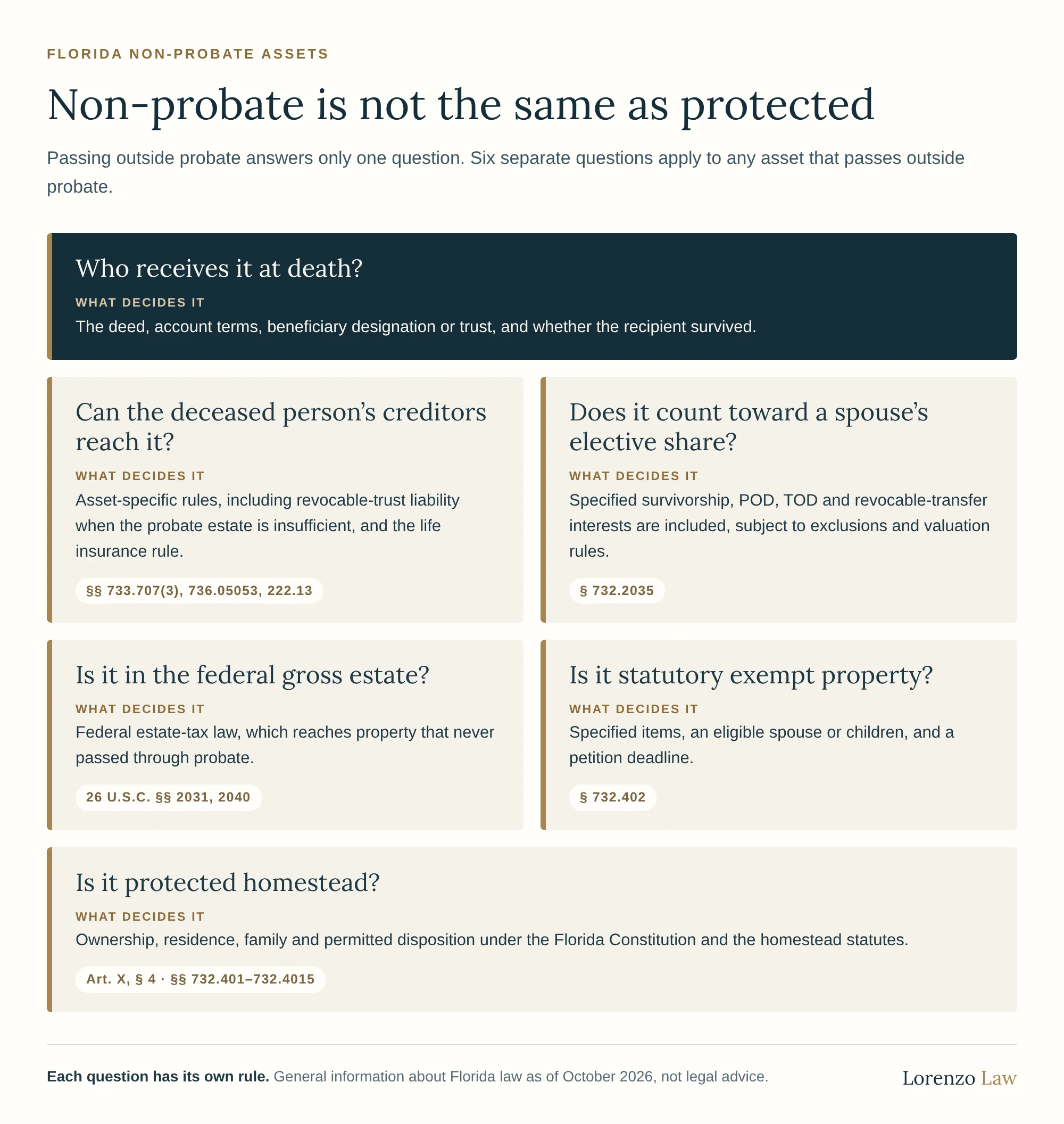
View the “Non-probate is not the same as protected” chart (zoom in to read; the details are also in the text above).
Are Non-Probate Assets Part of the Estate? Estate Assets vs. Non-Estate Assets
It depends on which “estate” is meant. Non-probate assets are not part of the probate estate, but some are included in the Florida elective estate used to compute a surviving spouse’s elective share, and many are included in the federal gross estate for estate-tax purposes.
The word “estate” can describe different things. The probate estate, the property considered for a spouse’s elective share and the federal gross estate are not interchangeable. Keep a complete working asset list, then identify the legally relevant categories. Do not omit an item from the review just because someone calls it non-probate.
| Estate | What it generally includes | Why it matters |
|---|---|---|
| Probate estate | Property the personal representative administers: generally property in the decedent’s name with no effective outside-probate arrangement, plus property payable to the estate | Creditor claims, distribution under the will or intestacy, and the probate procedure |
| Florida elective estate (§ 732.2035) | The probate estate plus specified interests, such as protected homestead, POD, TOD and survivorship accounts and securities, jointly held property, revocable transfers and the net cash surrender value of life insurance, subject to statutory exclusions and valuation rules | Computing a surviving spouse’s elective share |
| Federal gross estate | A broader federal measure that can include insurance, trust interests and other property that did not pass through probate | Whether a federal estate-tax return or payment is required |
Florida’s elective estate can include certain survivorship, POD, TOD and trust interests under § 732.2035. Inclusion, exclusions, valuation and satisfaction of a spouse’s rights require separate analysis; the spouse does not automatically receive every non-probate asset. Start with the surviving spouse rights guide and the Florida elective share page.
Are non-probate assets subject to estate tax?
They can be. Tax classification is separate: the federal gross estate can include insurance, trust interests and other property that did not pass through probate, and avoiding probate does not by itself answer whether a tax return or tax payment is required. The IRS estate-tax overview explains that broader accounting. Income tax is a separate question again. For federal income tax purposes, inherited property, including property received outside probate, often receives a basis adjustment to its value at the date of death, which can reduce capital gains if the recipient sells; the adjustment is not automatic in every case, so get tax advice before a sale. This page does not calculate tax or a beneficiary’s tax treatment; see Florida estate and inheritance tax for the questions heirs most often ask.
Taxes on a joint or POD account at death
Receiving a joint or POD bank account at death is not a taxable event under Florida law: Florida currently has no inheritance tax and no estate tax (ch. 198, Fla. Stat.). Federal estate tax applies only to estates above the federal exemption amount, which most estates do not reach, although the account still counts toward that calculation (IRC §§ 2031, 2040). Interest the account earns after the date of death is income to the new owner. Retirement accounts are different: distributions from an inherited traditional IRA or 401(k) are generally taxable income to the beneficiary when withdrawn (IRC § 691).
Can You Contest a Non-Probate Transfer?
In appropriate cases, yes. A beneficiary designation, POD account, survivorship deed or trust can be challenged on grounds such as lack of capacity, undue influence, fraud or forgery, and a joint account’s survivorship presumption can be overcome by proof of fraud or undue influence or clear and convincing proof of a contrary intent. A challenge does not automatically turn the asset into a probate asset; the applicable contract, statute, trust or court ruling determines the result.
These disputes often involve a designation, deed or account change made late in life, a caregiver or one child added to an account shortly before death, or records that conflict with each other. Evidence decides them: medical records around the date of the change, the institution’s change forms and who submitted them, the drafting attorney’s file where there is one, and the account history. Time limits apply and can be short. For example, a challenge to a trust that was revocable at death is barred on the earlier of (1) the general limitations period under chapter 95 or (2) six months after the trustee sends the person a copy of the trust instrument together with a notice of the trust’s existence, the trustee’s name and address, and the time allowed to bring a contest (§ 736.0604); and a person served with a notice of administration generally has three months to object to a will’s validity (§ 733.212). The deadline that applies depends on the asset and the notice given, and money that has already been distributed is harder to recover.
A trust dispute can require a court proceeding without turning every trust asset into a probate asset. Preserve the evidence and obtain advice before releasing or dividing disputed property. See challenging transfers made before death, contesting a deed in Florida and contesting a will in Florida.
Missing Documents and Failed Arrangements
Common reasons to investigate further include a deceased beneficiary, inconsistent account records, an unfunded trust, a later deed, uncertainty about the order of deaths or a dispute about capacity or undue influence. Do not assume every problem automatically converts the asset to probate property. The applicable contract, statute, trust or court ruling determines the result.
For example, a bank POD arrangement has statutory rules if no beneficiary survives. A retirement plan may have a different default beneficiary provision. Preserve the evidence and obtain advice before releasing or dividing disputed property.
Can you refuse a non-probate asset or an inheritance?
Sometimes. Florida’s disclaimer law, chapter 739, allows a person to refuse an interest in property, including interests that pass outside probate such as a beneficiary designation or jointly held property, if the disclaimer meets the statute’s form, delivery and timing requirements. A disclaimer generally does not let the person choose who receives the asset instead; the governing instrument or the statute decides that. Accepting the property can bar a later disclaimer, and federal tax rules have their own requirements for a disclaimer to be treated as qualified. Get advice before signing a claim form if you may want to disclaim.
How to disclaim an inheritance in Florida, in outline:
- Do not accept the asset first. Accepting the property or its benefits can bar a later disclaimer.
- Put it in writing. Under § 739.104, the disclaimer must be in writing, declare that it is a disclaimer, describe the interest being disclaimed and be signed by the person disclaiming, witnessed and acknowledged as a deed must be to be recorded in Florida. In practice, that means signing in front of two witnesses and having the signature notarized.
- Deliver or file it. Chapter 739 requires delivery to the person holding the property, such as the personal representative, trustee or account custodian, and recording when real estate is involved.
- Know where the asset goes. Under § 739.201, the disclaimed interest generally passes as if the person disclaiming had died immediately before the interest was created (for jointly held property, as if the person disclaiming had died before the other owner, § 739.202), so it follows the will, trust, designation or statute to the next taker.
- Check the federal tax deadline. Florida law lets a person disclaim at any time, so long as the person has not accepted the interest or otherwise become barred (§ 739.401); the nine-month clock is a separate federal tax requirement. For the disclaimer to be a qualified disclaimer under IRC § 2518, the signed written refusal must be received by the transferor (or the transferor’s representative or the holder of legal title) within nine months after the later of the transfer that created the interest or the disclaimant’s 21st birthday.
Digital access does not establish inheritance
An online disclosure tool can direct who may receive information under § 740.003. It does not by itself decide who owns the underlying asset. Section 740.004 preserves limits on the rights obtained through fiduciary or recipient access.
Separate access to a device or online account from ownership of cryptocurrency, business revenue, photographs or intellectual property. Keep recovery instructions secure; do not send passwords or private keys through a general website contact form. Review ownership, terms and appropriate transfer documents instead of assuming that a legacy contact becomes the owner.
Common Misunderstandings About Non-Probate Assets
| Misunderstanding | What actually decides it |
|---|---|
| “My will controls everything I own.” | A will directs probate property. An effective beneficiary designation, POD or TOD registration, survivorship title or funded trust controls its own asset. |
| “Two names on a deed means the survivor gets it.” | Only if the deed expressly creates survivorship, or the owners are spouses holding as tenants by the entirety. Otherwise the owners are generally tenants in common. |
| “The person who can sign on the account inherits it.” | A convenience agent under § 655.80 has authority to help with banking, not ownership. |
| “Non-probate assets are protected from creditors.” | Some are and some are not. Revocable-trust property can be liable when the estate is insufficient. |
| “Signing a trust avoids probate.” | Only for assets actually transferred to the trust. A pour-over will still requires probate for property left outside. |
| “A legacy contact owns my digital accounts.” | Disclosure authority under chapter 740 does not transfer ownership of the underlying assets. |
| “Summary administration means no probate.” | Summary administration is a probate procedure. |
| “The Florida probate limit is $75,000.” | The current § 735.201 amount is $150,000, effective July 1, 2026. Earlier deaths need review. |
| “Florida has transfer-on-death deeds.” | No Florida statute authorizes them for real estate. See the TOD deed section. |
| “If a beneficiary dies first, the asset always goes to probate.” | The account statute, plan or contract decides. If no designated beneficiary survives, POD and TOD assets default to the owner’s estate; a retirement plan or life-insurance policy may instead name a contingent or default beneficiary who takes in that situation. |
Florida Rules That Change the Answer
Generic national articles about non-probate assets miss several Florida-specific rules. Each one below can change how a particular asset passes or what claims can reach it:
- Express survivorship for deeds. A conveyance to two or more people creates a tenancy in common unless the instrument expressly provides for survivorship, except for spouses holding by the entirety (§ 689.15).
- Tenancy by the entirety, including the statutory treatment of a deposit account in the names of a husband and wife (§ 655.79(1)).
- The joint-deposit presumption and the limited grounds for overcoming it (§ 655.79(2)).
- Statutory convenience accounts that give banking authority without ownership (§ 655.80).
- POD accounts (§ 655.82) and TOD securities (chapter 711), each with its own default when no beneficiary survives.
- Protected homestead (Article X, Section 4; §§ 732.401–732.4015) and statutory exempt property (§ 732.402).
- Revocable-trust liability for estate expenses and obligations (§§ 733.707(3), 736.05053).
- The elective estate, which counts many non-probate interests (§ 732.2035).
- No transfer-on-death deed statute for real estate.
- The $150,000 summary administration threshold effective July 1, 2026 (§ 735.201; chapter 2026-57).
Choose the Procedure After Classifying the Assets
Some property can transfer outside probate, some matters qualify for a limited statutory transfer procedure, and some estates require summary or formal administration. Summary administration is a probate procedure; it is not the same thing as avoiding probate.
Under current § 735.201, summary administration may be available when the estate subject to administration in Florida, less property exempt from creditors’ claims, does not exceed $150,000, or when the decedent has been dead more than two years. If there is a will, it must not direct administration under chapter 733. The $150,000 threshold took effect July 1, 2026 under chapter 2026-57.
For an earlier death, applicability of the higher ceiling requires review. The act does not expressly limit the change to later deaths, and § 735.2055 supplies a filing-time qualification provision; that supports an interpretation, not a guaranteed ruling for every earlier death. Do not simply substitute $150,000 into an old case without reviewing its facts and procedural history. The completed summary administration guide explains this issue and the other requirements.
Do all estates have to go through probate in Florida?
No. An estate whose assets all pass by survivorship, designation or a funded trust may need no probate administration, and other estates may qualify for summary administration or a narrower statutory procedure. An estate can be settled without probate in Florida only to the extent its assets pass by those arrangements or qualify for a statutory procedure. Florida does not have a single, broad small estate affidavit of the kind some states use to collect most of a person’s assets. Smaller estates generally use summary administration or one of a few narrow procedures, including disposition without administration and limited affidavits for small bank accounts or small intestate estates. For bank accounts, for example, § 735.303 lets a bank pay a family member a combined total of up to $2,000 from the deceased person’s sole-name accounts on a sworn affidavit, no earlier than six months after death; the bank is permitted, not required, to pay. Florida has no single dollar amount that triggers probate. Whether probate is needed depends on whether property in the deceased person’s name alone, with no outside-probate arrangement, has to be transferred; the dollar figures in Florida law, such as the $150,000 summary administration ceiling, mainly decide which procedure is available. A few narrow statutory routes for specific or small assets, such as certain vehicles, can avoid a full administration. If no one opens probate, probate assets usually stay titled in the deceased person’s name and cannot be transferred until an estate is opened. But probate is not limited to the family: any interested person, including a creditor, can petition to administer the estate (§ 733.202). And deadlines keep running in the meantime: in general, two years after death, claims against the estate are barred whether or not probate was ever started (§ 733.710). The main exceptions are a creditor who already filed a timely claim within the two years, certain secured creditors and some government claims governed by separate statutes. See when probate is not necessary in Florida for the procedures and how to choose among them.
When a Florida administration is needed, it is generally filed in the circuit court for the county where the deceased person was domiciled (§ 733.101). Lorenzo Law’s county guides explain local practice in Miami-Dade, Broward, Palm Beach, Orange, Hillsborough, Pinellas, Duval, Lee and Collier, and Sarasota and Manatee counties.
Using Non-Probate Transfers in a Florida Estate Plan
Non-probate transfers are tools, not a plan by themselves. People looking for how to avoid probate in Florida usually need three things coordinated: how each asset is titled, who is named on each beneficiary designation, and, where it fits, a revocable trust that is actually funded. A will still matters for anything left outside those arrangements.
- Keep a house out of probate deliberately. In Florida that usually means a survivorship or tenancy-by-the-entirety deed, an enhanced life estate deed or a funded trust, each with different consequences for control, creditors and homestead.
- Coordinate the documents. Compare each deed, account registration and beneficiary record against the will or trust and the people you intend to benefit.
- Name contingent beneficiaries and confirm the institution accepted each change in writing.
- Review after life events: marriage, divorce, a death in the family, a move to or from Florida, a new account or a sale of real estate.
- Think about management, not only transfer. An outright designation to a minor or to someone who cannot manage money can create its own problems; a trust may be the better recipient.
- Weigh more than probate. Creditor exposure, a spouse’s rights, homestead rules, taxes, fairness among children and management during incapacity all matter as much as avoiding court.
For the planning tools themselves, see living trusts in Florida, the Florida trusts guide, Florida lady bird deeds, beneficiary designations, the Florida estate planning guide and Florida estate planning services.
Three Examples of Why the Records Matter
1. Same account type, different documents. Assume a Florida bank account is owned by one person, has an effective POD designation, and the beneficiary survives that owner. The beneficiary may claim under the POD arrangement. If instead the account has only a statutory convenience agent and no effective outside-probate transfer arrangement, the agent does not inherit it; review the applicable estate or statutory payment procedure. The label “checking account” cannot distinguish those outcomes.
2. Same rental property, different deeds. Assume two unmarried siblings own Florida rental property that is not homestead, no trust is involved, and no later deed changes their ownership. An effective survivorship deed can pass the first sibling’s interest to the survivor. A tenancy-in-common deed does not; the deceased sibling’s interest requires its own estate analysis.
3. One family, three routes. Assume a married Florida couple owns their home as tenants by the entirety, the husband has a bank account with an effective POD designation to his adult daughter, and he signed a revocable trust but never retitled his brokerage account into it. If he dies first and his wife and daughter survive, the home ordinarily passes to his wife by survivorship, the POD account passes to his daughter under the account terms, and the brokerage account, still in his own name with no TOD registration, needs an estate procedure before a pour-over will can send it to the trust. His wife’s elective-share rights may still count the POD account.
These examples illustrate document review under stated assumptions, not conclusions about a reader’s property. A different deed, designation or family fact changes the answer.
Documents That Prove How an Asset Passes
- Death certificate, date of death and the deceased person’s domicile.
- Recorded deeds and later conveyances; property location and relevant homestead facts.
- Account agreements, signature cards, registrations and statements near the date of death.
- Each beneficiary designation form, with primary and contingent beneficiaries, and the institution’s confirmation of accepted changes.
- Insurance policies, annuity contracts and retirement-plan documents.
- Will, codicils, trust and amendments, plus evidence of actual trust funding.
- Vehicle titles, business ownership records and governing agreements.
- Family information relevant to spouse, children and beneficiary survival; relevant marital agreements and court orders.
- Known liens, debts, pending disputes, existing probate filings and notices with service dates.
- A working list recording each asset, its owner, estimated value, proposed recipient and unanswered questions. Mark missing evidence as unknown rather than guessing.
Ask each institution what documentation it requires, and keep its written response. Bring urgent notices or disputes to counsel promptly rather than waiting to complete the list.
Glossary of Probate and Non-Probate Terms
- Probate asset
- Property whose transfer at death requires estate administration because no effective outside-probate arrangement moves it.
- Non-probate (nonprobate) asset
- Property that passes at death under a valid arrangement outside the probate estate, such as survivorship title, a POD or TOD designation, a beneficiary designation or ownership by a funded trust.
- Nonprobate transfer
- The transfer of a non-probate asset at death under its own arrangement rather than under a will or intestacy.
- Payable-on-death (POD) designation
- A pay-on-death bank-account designation under § 655.82. While every account party is alive, the named beneficiary has no rights to the funds; on the death of the last surviving party, the money passes to the beneficiary or beneficiaries who survive, and only if none survives does it fall into the estate.
- Transfer-on-death (TOD) registration
- Registration of securities in beneficiary form under chapter 711, so ownership passes to the surviving beneficiary after all owners die.
- Beneficiary designation
- A form filed with an insurer, plan administrator or financial institution naming who receives an asset at death.
- Primary and contingent beneficiary
- The difference between a primary and a contingent beneficiary is order: the primary beneficiary takes first, and the contingent beneficiary takes only if the primary beneficiary does not survive or cannot receive the asset.
- Joint tenancy with right of survivorship
- Co-ownership in which a deceased owner’s interest passes to the surviving owner, if the instrument expressly created survivorship and it was not severed.
- Tenancy by the entirety
- A form of ownership available only to spouses. When one spouse dies, the survivor ordinarily owns the property by survivorship.
- Tenancy in common
- Co-ownership in which each owner holds a separate share that passes by will, trust or intestacy rather than to the other owners.
- Convenience account
- A statutory account under § 655.80 in which an agent may transact banking for the principal without owning the funds.
- Funded trust
- A trust to which assets have actually been transferred by deed, retitling or valid assignment.
- Successor trustee
- The person who takes over management of a trust when the original trustee dies or can no longer serve.
- Pour-over will
- A will that directs property left outside a trust into the trust after the applicable probate procedure.
- Exempt property
- Specified items under § 732.402, such as household furniture, furnishings and appliances up to $20,000 in value and two qualifying motor vehicles, that the surviving spouse may claim or, if there is no surviving spouse, the deceased person’s children may claim. It is in addition to homestead and other benefits but must be claimed by petition within a statutory deadline, and it is lost if not timely claimed. It is not the same as a non-probate asset.
- Protected homestead
- A deceased owner’s qualifying Florida residence, governed by Article X, Section 4 and §§ 732.401–732.4015.
- Probate estate
- The property the personal representative administers under a will or intestacy.
- Elective estate
- The broader set of property interests under § 732.2035 used to compute a surviving spouse’s elective share.
- Gross estate
- The federal estate-tax measure of a decedent’s property, which can include assets that never passed through probate.
- Personal representative
- The person appointed by the probate court to administer the estate, often called the executor.
- Summary administration
- A shortened probate procedure under chapter 735. It is still probate, not a way of avoiding it.
Review Your Florida Assets With Lorenzo Law
Lorenzo Law assists with Florida probate and estate planning. Whether you are reviewing your own plan or handling a loved one’s affairs, bring the ownership and beneficiary documents so the available transfer routes and any unresolved issues can be evaluated. Jose M. Lorenzo, Jr., a Florida probate and estate planning attorney, handles each matter himself, statewide and in English or Spanish.
Call (305) 224-6811 or request a free initial consultation. Any representation and fees depend on the agreed scope; this guide does not promise a particular transfer result or completion date. Please use the public form for a brief overview rather than sensitive documents, account numbers or passwords.
Call (305) 224-6811 or Request a consultation
Principal office: Kissimmee, Florida; meetings in Coral Gables and Fort Lauderdale by appointment. For estates that need administration, see Florida probate representation.
This information is general and does not determine ownership or legal rights in a particular estate. It reflects Florida law as of October 2026. Reading it or contacting the firm does not create an attorney-client relationship.
Florida Probate and Non-Probate Assets FAQ
Short answers to common questions. Each answer is limited by the qualifications in the sections above.
Does having a will avoid probate in Florida?
No. A will generally directs probate property; it does not itself create a POD designation, survivorship interest or funded trust. Review each asset’s governing documents.
Are all jointly owned assets non-probate?
No. A tenancy-in-common interest does not pass automatically to the other owner. Deeds, joint deposits and convenience accounts have different rules; an effective survivorship arrangement and a surviving recipient must be established.
Can homestead pass without ordinary probate administration?
It can, but homestead qualification, ownership, family rights and the permitted disposition must be reviewed. A court order may still be needed to establish status or support a later title transaction. A tax exemption alone does not answer the question.
What is the fastest way to avoid probate in Florida?
There is no single fastest route for every family. Before death, coordinate effective beneficiary designations, ownership and appropriate trust funding. After death, identify the arrangement that actually existed and the evidence needed to use it. Do not assume a new form can retroactively repair the plan.
Does non-probate mean protected from creditors and taxes?
No. Creditor protection, spouse rights and tax inclusion follow their own rules. A revocable trust is an important example of a non-probate arrangement that can still have statutory obligations to the estate.
Is life insurance part of an estate in Florida?
It depends on which estate. Life insurance payable to a named beneficiary is generally not part of the probate estate, while insurance payable to the insured or the insured’s estate is administered in probate under § 222.13. The policy’s net cash surrender value immediately before death is included in the Florida elective estate, and death benefits can be part of the federal gross estate.
Does a POD account override a will?
As to that account, generally yes. When a POD beneficiary survives, the account terms and § 655.82, not the will, decide who receives an account governed by that statute. The owner changes a POD designation through the institution during life; a will does not change it.
Can a joint account holder withdraw money after the other owner dies?
Often the institution will pay the surviving owner under the account terms and § 655.78(1), which releases the bank when it pays a named owner, subject to its own requirements and any proper setoffs or charges. Payment by the bank does not prevent a later dispute about who was entitled to the money.
Can you contest a POD account in Florida?
In appropriate cases. A POD designation can be challenged on grounds such as lack of capacity, undue influence, fraud or forgery. Preserve the account records and obtain advice promptly, before the funds are distributed or spent.
Which types of property do not pass under a will?
Property that passes under its own arrangement: assets payable to a named beneficiary, such as life insurance and retirement accounts; POD and TOD accounts; jointly owned property with survivorship; and property in a funded trust. Each of these is a nonprobate transfer. A will governs only probate property, so a will that names someone else does not ordinarily change who receives these assets.
Are non-probate assets listed on the probate inventory?
Generally no; the inventory required by § 733.604 covers property of the probate estate. Protected homestead is treated separately: the personal representative does not take possession of it (§ 733.607), and real property that appears to be protected homestead must be listed on the inventory and designated as protected homestead rather than carried at an estimated value (Fla. Prob. R. 5.340(a)). Non-probate assets may still need to be identified for elective-share, trust-liability, creditor and tax questions.
What happened to the $75,000 probate limit in Florida?
Chapter 2026-57 raised the summary administration amount in § 735.201 to $150,000 effective July 1, 2026. A death more than two years ago is a separate route, and a will must not direct administration under chapter 733. For earlier deaths, applicability of the higher ceiling requires review.
About the Author
Jose M. Lorenzo, Jr. is the founder of Lorenzo Law and a Florida probate lawyer whose practice is concentrated in estate administration, probate and trust litigation, wrongful death claims brought by a personal representative, and guardianship. Before entering full-time practice he clerked for the Honorable Maria M. Korvick in the Probate Division of the Eleventh Judicial Circuit Court in Miami-Dade County, and spent nearly a decade as a paralegal at two Miami-area firms. He was admitted to The Florida Bar in 2013 (No. 107002) and is a graduate of Florida International University College of Law.
Authorities Cited on This Page
The statutes cited here are the 2026 Florida Statutes. Statutory text controls over any summary on this page.