
Coral Way Probate Lawyer
A Coral Way probate lawyer helps the family of someone who lived or owned property along Coral Way settle the estate in Miami-Dade: which documents to bring, where the case is filed, whether summary or formal administration fits, and who may sign for the house and the accounts before anything is distributed.
This guide is written for families looking for a Coral Way probate attorney for estate administration, whether the address is in the City of Miami’s Coral Way neighborhood, in Coral Gables or along the road’s western stretch in unincorporated Miami-Dade: personal representatives named in a will, heirs and beneficiaries with questions of their own, and relatives who live in another state or abroad. It covers the records to gather, the 10-day rule for the original will, the Miami-Dade Probate Division at the Osvaldo N. Soto Miami-Dade Justice Center, the $150,000 summary-administration limit, formal and ancillary administration, whom the lawyer represents, published flat fees, timing and disputes.
Request a free initial consultation. Only the initial consultation is free; representation fees and costs are agreed separately in writing.
Request a free initial consultationCall (305) 224-6811
Consultations by phone or video in English or Spanish; meetings by appointment in Coral Gables, at 2850 Douglas Road, Suite 303, or in Fort Lauderdale. Lorenzo Law’s principal office is in Kissimmee. There is no Lorenzo Law office on Coral Way.
Go straight to: Documents to start probate · The 10-day rule · Where it is filed · Which route fits · Fees · Disputes · More questions
By role: if you were named personal representative, start with whom the lawyer represents; if you are an heir or beneficiary with questions of your own, with a beneficiary’s own lawyer; if you live outside Florida, with handling the estate from another state; if the family disagrees, with disputes; if you are planning for yourself or a living parent, with planning ahead.
The Coral Way neighborhood: Shenandoah, Silver Bluff, Coral Gate and the Roads · Coral Gables and western Miami-Dade · Miami-Dade Probate Division · Published flat fees · English and Spanish
All guide sections(23)
Coral Way probate at a glance
Short answer. Coral Way has no probate court of its own. It is a neighborhood of the City of Miami and a road that continues through Coral Gables into unincorporated Miami-Dade, and all of it is in Miami-Dade County, so the estate of a person domiciled along Coral Way is generally opened in the Probate Division of the Eleventh Judicial Circuit. Before choosing a route, the family needs the original will if there is one, the death certificate, the recorded deed, the account records and the names of the surviving family; those facts decide whether a probate case is needed, which procedure fits and who may sign.
| Where it is filed | For a person domiciled along Coral Way, Miami-Dade County (Eleventh Judicial Circuit, Probate Division), whether the address is in the City of Miami, Coral Gables or unincorporated Miami-Dade. The heirs’ addresses do not decide the county. Where it is filed |
|---|---|
| Documents to start | The original will and any codicils, a certified death certificate, the list of assets and debts, the heirs’ and beneficiaries’ contact information, deeds and vehicle titles, and account records, plus any court or creditor notice. Documents |
| The original will | Whoever has it must deposit it with the Miami-Dade Clerk within 10 days after learning of the death; depositing it does not open an estate or appoint anyone. The 10-day rule |
| Which route | Summary administration is available if the Florida assets subject to administration, less exempt property, are worth no more than $150,000, or the owner died more than two years ago, and any will does not direct formal administration. Otherwise formal administration, or ancillary administration when the owner was domiciled outside Florida. The $150,000 limit took effect July 1, 2026; for earlier deaths, confirm which limit applies. Which route fits |
| Whom the lawyer represents | The personal representative’s lawyer represents the personal representative in that role, not each heir or beneficiary individually; a beneficiary can hire a lawyer of his or her own. Personal representative |
| Flat fees | Summary administration from $3,975; uncontested formal administration from $7,975; ancillary administration quoted per matter. Fees |
| How long | In summary administration, Jose aims to finish within one to two months from retention, as a goal and not a guarantee; many uncontested formal administrations take roughly six months to a year. Timing |
| Who handles it | Jose M. Lorenzo, Jr., a solo attorney: the attorney you speak with at the first call is the attorney who handles any matter the firm accepts, in English or Spanish. Who handles your case |
What does a Coral Way probate lawyer handle?
A Coral Way probate attorney, also called a Coral Way estate attorney or an estate administration attorney, represents the person who has to settle the estate, usually the personal representative named in the will or the relative who will ask to be appointed, and handles the Florida court case: choosing the right procedure, preparing and filing the petition, obtaining the order or the letters of administration that give authority, handling notices and creditor claims, and closing the estate.
Along Coral Way the work often starts with a house that has been in the family for decades, a few bank accounts and a will kept in a drawer, or with no will at all. The lawyer reviews how the house was titled and whether an earlier owner who died is still in the chain of title, whether it was protected homestead, who can sign for it and whether a sale needs the court’s authorization; the lawyer also identifies what is outside the case, such as accounts with a named beneficiary, property that passed to a surviving joint owner and assets held in a funded trust.
The first conversation identifies who would be the client and what the work would be. Representing the personal representative is not the same as representing every heir. A beneficiary who wants advice about his or her own rights, an accounting or a release can hire a probate attorney for beneficiaries for that, as a separate engagement. If the family disagrees about the will, the personal representative or the house, the dispute is priced and agreed separately, but a lawyer already in the case stays the lawyer of record unless the court allows otherwise. Lorenzo Law also represents creditors and claimants in filing, enforcing or settling a claim against a Florida estate; fees and costs for that work depend on the issue and are discussed in advance. When a death gives rise to a wrongful-death claim, Florida law has the personal representative bring it (section 768.20), so the estate side of that claim, including the appointment, is part of the probate work; the damages case itself goes to a personal-injury lawyer, by referral or as co-counsel, and other personal-injury matters are not handled. More on this: Florida wrongful death and the estate.
Administration or dispute
Start with your role and what you need authority to do. A personal representative named in a will who needs to open the estate has a different need from a beneficiary who questions how the estate is being run, and both differ from a family member who suspects the will is invalid. An uncontested administration is handled under one engagement; a will contest, a claim against the personal representative or a fight over the house is priced under a separate agreement, though the court’s rules on the lawyer’s appearance still apply. If someone has already filed papers or served you with a notice, say so at the first contact: some deadlines are short, and an inquiry does not stop them. Contacting Lorenzo Law does not make the firm the lawyer for everyone in the family or mean that it has accepted the matter.
Matters a Coral Way estate can involve
| Your situation | Work to discuss | Record or fact that changes the answer | Scope boundary |
|---|---|---|---|
| You were named personal representative, or will ask to be appointed | Qualification, venue, the probate assets and the right petition | Will, domicile, date of death, family information, the deed and the asset list | Being named in a will is not court appointment; confirm authority before acting |
| You are a beneficiary and want information or advice | Review of your own rights, the notices you received and the accounting | Case number, will, inventory or accounting received, dates of service | The estate’s lawyer does not represent you individually; a separate paid engagement |
| The family agrees about the inherited house | Ownership, homestead and who has authority to transfer or sell | Recorded deed, earlier owners’ deaths, spouse or minor children, occupancy and mortgage records | Probate work establishes authority; it does not include the real estate closing or title insurance |
| Siblings disagree about a sale, occupancy or money spent on the house | Who owns what, and whether an agreement, relief in the probate case or partition fits | Ownership shares, written agreements, expense records and existing court orders | A dispute is not part of an uncontested administration fee |
| The person who died owed you money | Filing, enforcing or settling a claim against the estate | The notice to creditors and its publication date, any notice served on you, the loan or invoice records | Creditor deadlines run from the notice to creditors, generally 3 months after it is first published or 30 days after a copy is served on you, whichever is later; a late claim is barred unless the court extends the time, and a consultation does not stop the deadline |
| You suspect the will is invalid or a fiduciary has misused estate money | Legal grounds, standing, deadlines and evidence | Earlier and current wills, notices, account and transaction records, witnesses | Suspicion alone does not establish wrongdoing; litigation is priced under its own written agreement |
| The owner was domiciled in another state or country | Florida administration for the Coral Way property, including ancillary administration where it applies | Florida deed, domicile, the other state’s or country’s probate papers, the will | A relative living out of state does not by itself make a case ancillary; Lorenzo Law handles the Florida side only |
| You want to plan for your own Coral Way home | A separate estate-planning engagement: will, trust, deed or beneficiary designations | Current title, existing documents, family and domicile | Planning for the living cannot change how a deceased owner’s house passes |
| A bank, brokerage firm or insurer says it needs letters of administration or a court order | Whether the account passes by its title or beneficiary designation, or needs a probate case, and which procedure fits | The institution’s written request, the account title and the beneficiary information | Do not send full account numbers through the public contact form; Jose explains how to send records after the first conversation |
| The death may give rise to a wrongful-death claim | Appointment of the personal representative who brings the claim, and the estate side of it | The date and circumstances of the death, the surviving family, any personal-injury lawyer already involved | The damages case goes to a personal-injury lawyer, by referral or as co-counsel |
The table is a guide for the first conversation, not a promise that every matter in it can be accepted or a conclusion about any property. Before the first call, it helps to know your role, the date of death, where the person lived, how the house and the main accounts were titled, whether the family agrees, and whether anyone has already filed papers or sent you a court notice. Missing records are not a reason to wait; identifying the gap is part of the first review. More on how the lawyer’s work fits the Florida procedure: do you need a Florida probate attorney?
How a matter usually starts
- Describe the situation. Give the date of death, the county and state where the person was domiciled, your relationship and role, the general types of assets and any case number or deadline. Name the other people involved so a conflict check can be run.
- Clarify the client and the route. Decide whether the request concerns opening and running the estate, a beneficiary’s own interest, a dispute or another service. Representation depends on acceptance and the conflict rules.
- Gather the records. Use the checklist below, say which originals are missing, and wait for instructions before sending sensitive documents.
- Agree the work in writing. The written engagement names the client, the proceeding, the fee, the costs included and the work handled separately. An uncontested administration quote does not include litigation, which is priced and agreed separately.
- Proceed under the agreed scope and the court’s requirements. Court authority, notices, documents and hearings vary with the route. Neither an inquiry nor a consultation extends a deadline.
What documents do you need to start probate in Miami-Dade?
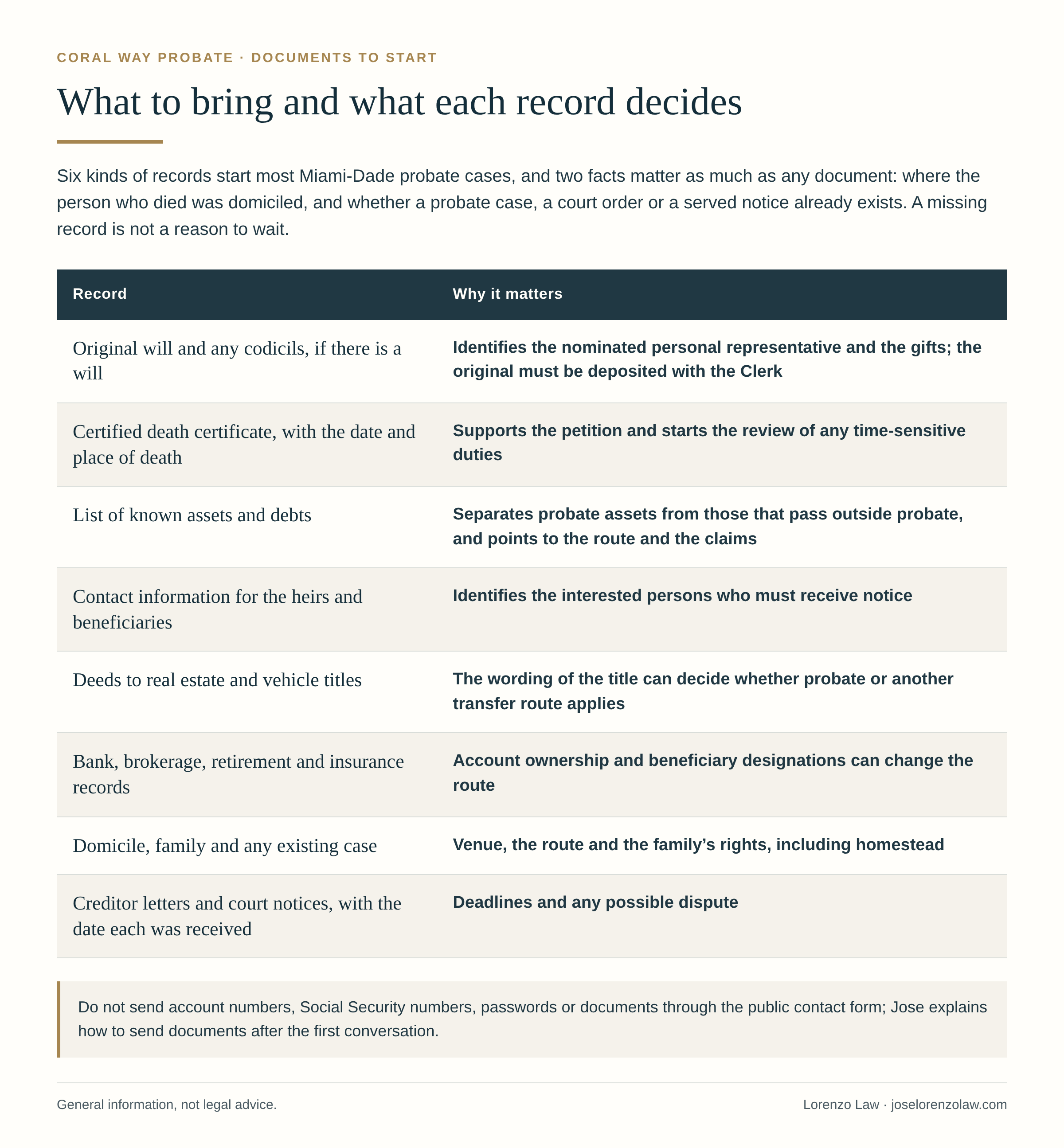
Six kinds of records start most Miami-Dade probate cases: the original will and any codicils, a certified death certificate, a list of the known assets and debts, the names and contact information of the heirs and beneficiaries, the deeds to real estate and the vehicle titles, and the bank and other financial-account records. A missing record is not a reason to wait; identifying the gap is part of the first review.
Two facts matter as much as any document: where the person who died was domiciled, and whether a probate case, a court order or a served notice already exists. Bring the case number and the date you received any notice. The Eleventh Circuit publishes a checklist for each type of petition, such as summary administration, formal administration and homestead; a checklist lists what must be filed for that petition, but it does not decide which route fits the estate or who should be the petitioner.
What each record decides
| Gather | Why it matters | How to prepare |
|---|---|---|
| Original last will and testament and any codicils, if there is a will | Identifies the nominated personal representative and the gifts; the original must be deposited with the Clerk | Say who has the original and whether it has already been deposited. A scanned or e-mailed copy does not satisfy the deposit requirement |
| Certified death certificate, with the date and place of death | Supports the petition and starts the review of any time-sensitive duties | Say which copies you have; the lawyer identifies the form needed for each task |
| List of known assets and debts | Separates probate assets from those that pass outside probate, and points to the route and the claims | List categories, approximate values, institutions and known bills; note what you are unsure about |
| Contact information for the heirs and beneficiaries | Identifies the interested persons who must receive notice | Include relationships, a surviving spouse, minor children and anyone whose address is unknown |
| Deeds to real estate and vehicle titles | The wording of the title can decide whether probate or another transfer route applies | Gather the recorded deed or the title itself, not only a tax bill or the family’s understanding; for an older title, each earlier owner’s date of death and any probate case number |
| Bank, brokerage, retirement and insurance records | Account ownership and beneficiary designations can change the route | Note the account type and what the institution asked for; send complete records only in the way Jose arranges after intake |
| Domicile, family and any existing case | Venue, the route and the family’s rights, including homestead | The county and state of domicile, the surviving spouse and children, any case number, order or served notice, and any other lawyer already involved |
| Funeral bill, final medical bills and proof of who paid them | Funeral expenses and the medical expenses of the last illness have their own place in the order in which the estate pays its debts, and a relative who paid them may ask the estate for reimbursement | Keep the invoices and the receipts or bank records that show who paid |
| Mortgage, tax, insurance and any association statements; who lives in the house; any lease | Carrying costs, occupancy and any deadline | The lender, the Tax Collector, the insurer, the family |
| Creditor letters and court notices, with the date each was received | Deadlines and any possible dispute | Keep the envelope or the e-mail that shows the date |
| Where the proposed personal representative and the heirs live; language needs | Qualification, signatures, notices and translation | The family |
| Trust documents, recent tax returns, powers of attorney and advance directives | Useful background: a funded trust can hold assets outside probate, and a power of attorney shows who handled the person’s affairs before the death | Bring what exists; none of these is required in every probate, and a power of attorney gives no authority after the death |
At the first call, tell the lawyer everything relevant, including facts that seem unfavorable, such as a family disagreement, a relative living in the house, a later will or a transfer the owner made shortly before death; surprises later cost time and money. Florida’s ethics rules generally protect information a prospective client shares with a lawyer in a consultation, even if no engagement follows (Rule Regulating The Florida Bar 4-1.18). In the public contact form, give only a short description: your role, the date of death, the county or state of domicile, the types of assets and any deadline. Do not send account numbers, Social Security numbers, passwords or documents through the form; Jose explains how to send documents after the first conversation. If a court notice or hearing is pending, say so when you ask for the consultation. Sending an inquiry does not by itself create an attorney-client relationship, stop a deadline or mean the firm can accept the matter.
Chart: what to bring and what each record decides
Do you need the original will to start probate?
Usually, yes. A Florida probate case is ordinarily opened with the original will, which is deposited with the Clerk and offered for admission to probate; a photocopy or a scan is not automatically enough. If the original may be in the deceased person’s safe-deposit box, Florida law lets the spouse, a parent, an adult descendant or the person named as personal representative in a copy of the will open the box in the presence of a bank officer to look for it, and the bank delivers any will found to the court (section 655.935). An electronic will is deposited by its qualified custodian under its own rules. If there is no will at all, the estate can still be opened; Florida’s intestacy statutes then decide who inherits.
What if the original will cannot be found?
Search first: the person’s papers, the safe-deposit box, the lawyer who drafted the will and the Clerk’s wills-on-deposit records. If the original still cannot be found, a copy is not automatically enough: a lost or destroyed will must be established in court, generally by two disinterested witnesses, or one if a correct copy is available (section 733.207). When the person is known to have kept the original and it cannot be found after the death, Florida law generally presumes that the person destroyed it intending to revoke it, and the family member who wants the copy admitted has to overcome that presumption with evidence. That is a contested question, separate from an uncontested administration. Bring every copy, the name of the drafting lawyer and anyone who saw the original.
How many death certificates do you need, and which kind?
Order several certified copies at the start: the Clerk, banks, brokerage firms, insurers, the mortgage servicer and a title company may each ask for one, and some keep the copy they receive. A Florida death certificate that shows the cause of death is confidential under section 382.025 and is issued only to eligible people, such as close relatives and those who can document an interest in the estate; the version without the cause of death is easier to obtain. For the probate case, the Eleventh Circuit’s current instructions call for the original certified death certificate to be delivered to the Clerk’s probate office after the petition is filed electronically and the case is assigned; check the instructions for the type of case before mailing it.
Can a power of attorney be used after the death?
No. A power of attorney ends when the principal dies (section 709.2109), so the agent cannot use it afterward to pay bills, close accounts, write checks or sign for the house. Authority after a death comes from letters of administration, a court order, a trust or the terms of the account or the deed. Bring the power of attorney anyway: it shows who handled the person’s affairs before the death and which records that person holds.
What is the 10-day rule for a will in Florida?
Whoever has the original will of a person who died must deposit it with the clerk of the court in the county with venue within 10 days after learning of the death (section 732.901). The 10 days run from learning of the death, not necessarily from the death itself, and depositing the will does not open an estate or give anyone authority to act.
For a person domiciled along Coral Way, whether in the City of Miami, Coral Gables or unincorporated Miami-Dade, that is the Miami-Dade Clerk’s probate office. The Clerk lists the wills-on-deposit service on its probate page; check the current instructions before mailing or delivering an original, and keep a copy of what was delivered and when. Do not send an original will through a web form or by e-mail. An electronic will is deposited by its qualified custodian under its own rules. If the original may be in the deceased person’s safe-deposit box, the bank must, on proof of death, let the spouse, a parent, an adult descendant or the person named as personal representative in a copy of the will open the box in the presence of a bank officer, and it delivers any will found to the probate court (section 655.935). If the original cannot be found, a copy is not automatically enough: a lost or destroyed will must be established in court, generally by two disinterested witnesses, or one if a correct copy is available (section 733.207).
A will made in another state is not automatically invalid in Florida. A will signed by someone who was not a Florida resident is generally valid in Florida if it was valid where it was signed, but a handwritten will that was not witnessed as Florida requires, or an oral will, is not recognized here (section 732.502(2)). A self-proving affidavit can avoid the need to locate the witnesses. Admitting a will to probate is routine when no one objects; the court does not hold a trial on the testator’s capacity in every case, and a challenge to the will is a separate contest with its own deadlines. Bring the original, every codicil and any earlier will you find, even one you believe was revoked.
Coral Way: a neighborhood and a road
Coral Way is two things: a neighborhood of the City of Miami, and a road of about 16 miles that runs from Brickell Avenue west through Coral Gables and into unincorporated Miami-Dade County. Every part of it is in Miami-Dade, so for a person domiciled along Coral Way the probate court is the same: the Probate Division of the Eleventh Judicial Circuit.
The neighborhood takes its name from the road George Merrick laid out in the 1920s to connect Coral Gables with Miami. Inside the City of Miami, Coral Way runs mainly along SW 22nd Street and then follows short stretches of SW 3rd Avenue and SW 13th Street to Brickell Avenue; the area around it includes Shenandoah, Silver Bluff, Coral Gate, Golden Pines and The Roads, and ZIP codes there include 33145 and 33135. Shenandoah, one of the city’s oldest neighborhoods, lies north of Coral Way between SW 12th and SW 27th Avenues; Silver Bluff lies south of it; and Coral Gate, at the western edge beside Coral Gables, is one of the City of Miami’s neighborhood conservation districts (NCD-1).
At Douglas Road (SW 37th Avenue) the road enters Coral Gables, where the half mile between Douglas Road and LeJeune Road is Miracle Mile; west of Red Road (SW 57th Avenue) it continues through unincorporated Miami-Dade, including Coral Terrace and Westchester, where some addresses use ZIP code 33155, as SW 24th Street and then SW 26th Street, out to SW 157th Avenue. A Coral Way mailing address can therefore be in the City of Miami, in Coral Gables or in unincorporated Miami-Dade, and the Miami-Dade Property Appraiser’s record for the folio shows which.
The municipality matters for some questions about the house and not for others. It decides which city’s permits and code rules, and in Coral Gate the conservation-district requirements, apply to a renovation, a demolition or a buyer’s plans, and it appears on the tax bill. It does not change the probate court, the probate route, who inherits or who may sign for the estate; those follow the domicile, the title, and the will or the intestacy statutes. Shenandoah and Silver Bluff have many houses built in the 1920s and 1930s that have stayed in the same family for generations, which is why the recorded deed and any earlier owner’s estate deserve attention early. This is information only: Lorenzo Law does not provide land-use, zoning or permitting services.
Is Coral Way in the City of Miami or Coral Gables?
Both, depending on the address. The Coral Way neighborhood, east of Douglas Road (SW 37th Avenue), is part of the City of Miami; the road itself continues west through Coral Gables, including Miracle Mile, and then through unincorporated Miami-Dade County. For probate the difference does not change the court: the estate of a person domiciled anywhere along Coral Way is generally opened in Miami-Dade County, in the Probate Division of the Eleventh Judicial Circuit. Lorenzo Law has no office on Coral Way; meetings are by appointment in Coral Gables, at 2850 Douglas Road, Suite 303.
Where is a Coral Way estate filed?
In Miami-Dade County, in the Probate Division of the Eleventh Judicial Circuit, when the person who died was domiciled along Coral Way; that one case also covers property the person owned in other Florida counties. Where the heirs live, where the lawyer’s office is and which hospital the person died in do not decide the county.
Florida’s venue statute starts with the county where the person was domiciled. When the person who died was not domiciled in Florida, the estate may be opened in a county where the person owned property; if there was neither a Florida domicile nor Florida property, the statute points to the county where a debtor of the person lives (section 733.101). A beneficiary’s residence is not part of that test. A Coral Way house can therefore bring a nonresident’s estate to Miami-Dade, but a daughter who lives on Coral Way does not bring her father’s estate there if he was domiciled in another Florida county. A case filed in the wrong county is not automatically void: the court may transfer it, and actions taken before the transfer stand (section 733.101(3)). An interested person who is served with a notice of administration generally has three months after service to object to venue (section 733.212(3)).
Two hypothetical examples
The daughter lives on Coral Way. A father domiciled in Broward County died owning a house in Hollywood in his own name; his daughter lives in Shenandoah. Her Miami address does not move his estate to Miami-Dade: it is opened in Broward, the county of his domicile, and that case would also administer any property he owned in Miami-Dade (section 733.101). The daughter can still hire a lawyer in Miami-Dade, and the work can be done by phone, video and electronic filing.
The house was a second home. A man domiciled in Georgia owned a condominium on Coral Way in his own name and used it in the winter. His main estate is opened in Georgia, and a Florida case for the condominium, generally an ancillary administration, can be opened in Miami-Dade, where the property is (sections 733.101(1)(b) and 734.102). If he had been domiciled in another Florida county, that county’s case would administer the condominium too. These examples assume the stated facts; they are not client results or title opinions.
When domicile is unclear
When the person lived part of the year along Coral Way and part elsewhere, the first question is domicile. Spending winters in a Coral Way apartment does not by itself make someone a Florida domiciliary, and having a home in another state or country does not by itself rule it out: domicile is decided from all the facts, such as where the person usually lived, where the family, documents and daily life were, and what intention the person showed, not from a single document. A Florida declaration of domicile is one of those facts, not the deciding one. The answer decides whether the main estate is opened in Miami-Dade or elsewhere. More on this: establishing a Florida domicile.
Coral Way and nearby neighborhoods
The same Miami-Dade rules apply to an estate along Coral Way and in nearby Coral Gables, Coconut Grove, Brickell, Downtown Miami and South Miami. The neighborhood does not change the court; the domicile and the title do. Families with property elsewhere in Miami-Dade can read the guides for Coconut Grove estates, Brickell condominium estates, South Miami and Cutler Bay, or the Miami probate attorney page for the city as a whole and the Miami-Dade County probate page for the county.
Where is the Miami-Dade probate court?
Probate cases for people domiciled along Coral Way are handled by the Probate Division of the Eleventh Judicial Circuit of Florida. Filings are made electronically, and the Clerk’s probate office at the Osvaldo N. Soto Miami-Dade Justice Center receives the originals that must be delivered on paper. Hearings and proposed orders follow the assigned section’s instructions, and the court publishes mandatory probate checklists by type of case.
Whichever probate lawyer in Miami-Dade the family hires, a Coral Way estate goes to the same Probate Division; the lawyer’s office location does not change the court. Three different offices are easy to confuse. The Clerk of the Court and Comptroller keeps the court file, receives wills on deposit, issues certified copies and maintains the official records where deeds and recorded orders appear. The judges of the Probate Division decide the petitions and set any hearings. The Property Appraiser keeps the property-tax roll, including the owner of record and any homestead exemption. Each answers a different question, and none of them gives legal advice for a particular estate.
The Eleventh Circuit’s current instructions send the required originals to the Clerk’s probate office at the Osvaldo N. Soto Miami-Dade Justice Center, 20 NW 1st Avenue, 6th Floor, Room 223, Miami, FL 33128. Check the address and the document required before you travel or ship anything. Some older web pages give 73 West Flagler Street for probate; follow the Clerk’s current listing instead. The instruction to deliver original death and birth certificates within two business days after electronic filing and case assignment concerns those certificates; it does not replace the statutory deadline for depositing a will. Other Miami-Dade courthouses, such as the North Dade Justice Center, do not list probate filings among their services, so do not take an original will to the nearest courthouse just because it is convenient. A meeting with Jose in Coral Gables is a meeting at a law office, not a visit to the court.
How do you search Miami-Dade probate records?
Start with the Clerk’s online case search, reached from the Miami-Dade Clerk’s probate page. A search by the name of the person who died, or by case number, shows whether an estate has been opened, who petitioned and which papers have been filed, which is how a family learns early whether a relative has already filed or deposited a will. The documents in a probate file are generally not displayed online; the will and other papers are consulted or copied through the Clerk. The docket is public, but some filings are not: the inventory and the accountings filed in an estate are generally confidential, subject to the access the statute allows (section 733.604). Certified copies and wills on deposit are requested through the Clerk. A docket entry shows what was filed, not whether it was correct; ask the lawyer to read the file before acting on it.
Will you have to appear in court?
Usually not, in an uncontested Miami-Dade estate. Florida probate is handled in writing and filed electronically, the petition and joinders can be signed under penalty of perjury, and most uncontested matters are decided without a hearing (Florida Probate Rule 5.020; section 92.525). Hiring a lawyer does not remove the court’s requirements: if a hearing is needed, the assigned judge’s instructions decide whether it is held in person or remotely, and an original document, testimony or an appearance may still be required. A phone or video consultation with the lawyer is not permission to appear remotely in court.
Official Miami-Dade probate resources
| Resource | What it is for | Keep in mind |
|---|---|---|
| Eleventh Judicial Circuit, Probate Division | The division’s current location, procedures, administrative orders and links to each section’s instructions | The assigned section’s instructions and the actual hearing notice control hearings and proposed orders |
| Probate checklists | Required items for each type of petition, such as summary administration, formal administration, homestead and discharge | A checklist lists what to file; it is not a decision about which route fits an estate |
| Miami-Dade Clerk, probate | Probate records, case search and dockets, wills on deposit, certified copies and filing information | The Clerk’s legal summaries can lag behind changes in the law; the statutes control |
| Clerk’s office at the Soto Justice Center | The current address and location of the Clerk’s probate services | Confirm the task and the location before traveling or mailing originals; court hours are not Lorenzo Law’s hours |
| courtMAP | The court’s system for scheduling hearings and submitting proposed orders | Separate from the statewide e-filing portal, where pleadings are filed |
| Miami-Dade Property Appraiser | Owner of record, folio number and homestead exemption for the house | Helps find the deed; the recorded deed in the official records shows title |
The Circuit also publishes probate Smart Forms and local requirements, and in some cases the court orders estate or guardianship property placed with a designated financial institution, for example instead of a large bond (section 69.031). Court forms are written for the court’s process, not for a particular family’s situation; the risk of filing a form without legal review is choosing the wrong route, missing a required notice or signing something the estate cannot undo. The Miami-Dade probate court guide covers the Clerk’s services in more detail: Miami-Dade probate court.
Does every asset go through probate?
No. Start with titles and transfer instructions, then choose the procedure. A house owned with a right of survivorship, owned by spouses as tenants by the entirety, titled in a living trust or covered by a recorded Lady Bird deed usually passes without a probate case for that house, and an account with a named beneficiary is paid to that beneficiary; a house or account in the owner’s sole name with no beneficiary usually needs a probate case.
Start with the recorded deed, not with the tax bill. A tax bill, the Property Appraiser’s owner line, the utility account or a set of keys can help identify the house, but none of them shows the full chain of title or who may convey it. A family member’s payment of the taxes or the insurance does not make that person the owner or appoint him or her to act for the estate.
A will does not by itself keep the house out of probate: it takes effect through the probate case. A trust avoids probate only for property actually titled in the trust, so signing a trust does not prove the house was deeded to it. A revocable trust can still answer for the estate’s expenses and debts when the probate assets are not enough (section 733.707(3)). Bank and brokerage accounts, retirement accounts and life insurance follow their own designations: a payable-on-death or transfer-on-death account, or a policy with a living beneficiary, is paid to that beneficiary without probate, while one payable to the estate, or with no surviving beneficiary, usually becomes a probate asset. A car is different again: Florida’s motor-vehicle title statute provides routes for transferring a vehicle after the owner’s death, including certain transfers to heirs without administration when the statute’s conditions are met (section 319.28). When the house was owned by a company, such as a limited liability company, the house stays with the company; what passes through the estate is the owner’s interest in the company, and the company’s own documents decide who can sign for it.
How the house was titled
| Title on the deed | What usually happens to the house | What to check |
|---|---|---|
| The owner’s name alone | Probate: summary, formal or ancillary administration | The will, homestead status, the value of the Florida assets |
| A parent or grandparent who died years ago | The earlier owner’s estate may still need its own case before the house can pass on | Each owner’s date of death, will and any earlier probate case number |
| Joint owners with a right of survivorship | Passes to the surviving owner, when the title carries the right of survivorship | The exact wording of the deed; the death certificate to record |
| Spouses as tenants by the entirety | Passes to the surviving spouse | That the owners were married when they took title |
| Tenants in common | The deceased owner’s share goes through that owner’s estate | Each owner’s share; the co-owners’ plans for the house |
| A living (revocable) trust | The successor trustee administers it under the trust | The recorded deed into the trust and the trust document |
| A Lady Bird deed (enhanced life estate) | Passes to the named remainder beneficiaries under the deed’s terms | The recorded deed, any later deed or sale, and the title company’s requirements |
| A company, such as an LLC | The house stays with the company; the owner’s interest in the company passes | The operating agreement and who can sign for the company |
When the house is titled in a revocable trust, the successor trustee named in the trust administers it without a probate case for that house: the trustee takes control of the trust’s assets, pays the house’s expenses from the trust and follows the trust’s instructions to keep, sell or distribute it. The trustee also has notice duties under Florida’s Trust Code, including notice to the qualified beneficiaries within 60 days after learning that the trust, once revocable, has become irrevocable (section 736.0813). Lorenzo Law also handles trust administration for successor trustees.
Even when the house passes outside probate, other assets may still need a case, such as an account in the owner’s sole name with no beneficiary. More on each kind of asset: Florida non-probate assets, when probate is not necessary in Florida and assets exempt from probate.
Which probate route fits a Coral Way estate?
The three Florida probate routes are summary administration, formal administration and ancillary administration. Summary administration fits when the assets subject to administration in Florida, less property exempt from creditors, are worth no more than $150,000, or the person died more than two years ago, and any will does not direct formal administration. Formal administration appoints a personal representative with letters of administration. Ancillary administration is the Florida case for a person who was domiciled in another state or country.
That $150,000 figure is the Florida threshold for summary administration (section 735.201); the older $75,000 figure still repeated on some websites and in some AI answers is out of date. The $150,000 figure took effect on July 1, 2026. Neither the amended statute nor the amended court rule says which limit applies when the death occurred before that date, so confirm the applicable limit before filing. The $150,000 test is not the size of the whole estate. It counts only what must pass through the Florida court: a house already held in joint tenancy with right of survivorship, an account with a payable-on-death beneficiary or a house deeded into a funded trust usually does not count. Property exempt from creditors is subtracted (section 735.201). The second condition matters for long-held Coral Way houses: when the owner died more than two years ago, summary administration can be available whatever the value. In a summary administration there is no personal representative; the court orders distribution to the people entitled. Before the petition is filed, the petitioner must make a diligent search for creditors, and the order does not end the claims of creditors who are owed and not paid; those who receive property can remain liable for two years after death (section 735.206). Debts do not by themselves rule out summary administration, and being eligible for it does not make it the right choice for every estate. More on the shorter route: Florida summary administration attorney and summary administration in Florida.
A Coral Way formal administration is used when summary administration is not available or not appropriate, and it is not limited to estates above a dollar figure: for example, when someone has to sell the house and the will gives no usable power, collect assets, deal with creditors through the claims process or bring or defend a lawsuit, or when the will requires it. The court appoints a personal representative and issues letters of administration, which banks, insurers and buyers rely on as proof of authority. When a minor child is a beneficiary, the amount matters: a parent acting as natural guardian can generally receive up to $15,000 for the child without a guardianship (section 744.301(2)), while a larger share usually needs a guardianship of property or another arrangement the law allows. An adult beneficiary who cannot manage his or her own property may likewise need a guardian of the property, or another arrangement the law allows, before the share can be distributed to that beneficiary; more on this: Florida adult guardianship.
Very small estates can sometimes be handled without a full case. Disposition without administration covers only personal property on narrow facts, such as when the only assets are exempt property and personal property worth no more than the funeral expenses and certain final-illness medical expenses (section 735.301). Separately, when someone dies without a will leaving only personal property, the heirs can ask the court to release it without a full probate case if the property that creditors could reach is worth no more than $20,000 plus funeral costs and the last 60 days of medical expenses, the death was more than a year ago, and no estate is open (section 735.304). Neither procedure nor an heir’s affidavit can transfer a Coral Way house. Florida has no general small-estate affidavit that does.
Summary, formal and ancillary administration compared
| Point | Summary administration | Formal administration | Ancillary administration |
|---|---|---|---|
| When it fits | Florida assets subject to administration, less exempt property, worth no more than $150,000, or death more than two years ago; the will, if any, does not direct formal administration | Summary is not available or not appropriate, or authority is needed to act for the estate | The owner was domiciled outside Florida and left Florida property needing administration |
| Personal representative | None; the court orders who receives the property | Appointed, with letters of administration | Appointed in Florida; a representative the will names for the Florida property, or otherwise the domiciliary representative, has priority if qualified |
| Creditors | Diligent search before filing; distributees may remain liable for two years after death | Notice to creditors published, and served on known or reasonably ascertainable creditors; claims period | Notice to creditors in Florida, as in a formal case |
| Typical records | Death certificate, original will if any, asset values, family information | Same, plus records for each asset, the house and any debts | Authenticated copies of the will and of the other state’s probate papers, the Florida deed |
| Flat fee (see fees) | From $3,975 | From $7,975, if uncontested | Quoted per matter |
More on the court steps: the Florida probate process. If there is no will, Florida’s intestacy rules decide who inherits the probate assets, subject to the homestead rules; they do not redirect assets that pass by beneficiary designation, survivorship or trust (probate without a will in Florida).
What happens if there is no will?
Florida’s intestacy statutes decide. A surviving spouse generally takes the whole estate if the deceased person left no descendants, or if the deceased person left descendants who are all also the spouse’s and the spouse has no other descendants. If the deceased person left descendants and either at least one of them is not the spouse’s, or all of them are the spouse’s but the spouse also has descendants who are not the deceased person’s, the spouse generally takes half and the deceased person’s descendants share the other half (sections 732.102 and 732.103). With no spouse, the estate goes to the descendants, then the parents, then brothers and sisters and their descendants, and so on (section 732.103). A Coral Way house that was the Florida resident’s homestead follows the separate homestead rules described below. More on this: Florida probate without a will.
What if the owner lived outside Florida but owned property here?
If the person who died was domiciled in another state or country and owned a Coral Way house or condominium in his or her own name, a Florida case is usually needed for that property. It is generally an ancillary administration opened in Miami-Dade, where the house is, while the main estate stays in the state of domicile. An heir who lives outside Florida does not, by itself, make a case ancillary, and most of the work can be done from where the family lives.
An ancillary administration recognizes the out-of-state estate in Florida and gives a Florida personal representative authority over the Florida property (section 734.102). The court generally gives preference to a representative the will names for the Florida property and, otherwise, to the representative already appointed in the state of domicile, if qualified to serve in Florida (section 734.102). Filing ordinarily needs authenticated copies of the will and of the other state’s probate papers; an ordinary photocopy is not enough. Owning property in two Florida counties does not make a Florida resident’s estate ancillary: the estate of a Florida domiciliary is a single Florida case in the county of domicile. An appointment in another state does not by itself give authority over a Coral Way house.
Two shorter routes exist for nonresidents. Summary administration is available to the estate of a nonresident if the Florida estate meets the summary conditions described above (section 735.201). Short-form ancillary administration may be available when a nonresident died with a will, the Florida property subject to administration had a gross value of no more than $50,000, and the foreign personal representative files within two years after death (section 734.1025). Whether a house falls under either route depends on its value and on how it was titled; a house owned with a surviving joint tenant may not need any Florida case. The cost of an ancillary case depends on those facts, which is why Lorenzo Law quotes it per matter rather than publishing a single figure. More on this: Florida ancillary probate.
Can you handle a Coral Way estate from another state?
In most cases, yes. Florida probate is filed electronically, Jose works with families by phone and video, and many signatures can be given remotely: the petition and joinders can be signed under penalty of perjury, and when a notarized document is needed it can be signed online with a Florida online notary, or abroad before a U.S. consular officer or a local notary (Florida Probate Rule 5.020; sections 92.525, 117.215 and 92.50(3)). Living elsewhere does not prevent anyone from inheriting or from taking part in the case. Being named in the will is not the same as being appointed, however: a person not domiciled in Florida can serve as personal representative only if he or she is a close relative the statute lists, such as a child, grandchild, parent, spouse, brother, sister, uncle, aunt, nephew or niece, or the spouse of such a relative (section 733.304), and before letters issue a nonresident personal representative designates a resident agent (section 733.402). A nominated friend who lives in another state may not qualify. Travel may still be needed for a hearing set in person or to clear out the house, and an original will or an authenticated document may have to travel on paper by courier. Foreign documents usually need authentication, often by apostille, and a translation if they are not in English. More on serving from another state: serving as an out-of-state executor in Florida.
Who does the lawyer represent, and what does the engagement cover?
The personal representative is the person the court appoints to run the estate, often called the executor; the will usually nominates one, and if there is no will the statute sets the order of preference. The personal representative’s lawyer represents the personal representative in that role, not each heir or beneficiary individually.
When there is no will, the order of preference starts with the surviving spouse and then the person chosen by a majority in interest of the heirs (section 733.301). Florida’s probate rules generally require a personal representative to be represented by a Florida lawyer, with limited exceptions, such as when the personal representative is the sole interested person, or is a Florida lawyer (Florida Probate Rule 5.030). Being the only beneficiary named in the will does not by itself make someone the sole interested person. Two or more people, such as siblings, can be appointed together as co-personal representatives; unless the will provides otherwise, most acts then need the agreement of a majority of them, which for two means both (section 733.615), so siblings who already disagree should think carefully before asking to serve jointly. Being nominated in the will does not give authority to act until the court appoints the person and letters of administration issue. A personal representative owes duties to the estate and to the interested persons, keeps estate money separate, files an inventory and accounts for what was received and paid. The personal representative may also be entitled to reasonable compensation, which is separate from the lawyer’s fee (section 733.617). More on the role: how to become a personal representative in Florida and executor fees and duties.
The lawyer prepares the court papers, but the personal representative signs the documents the rules require, such as the oath (Florida Probate Rule 5.320), and the inventory, accountings, petitions to sell and the petition for discharge (Florida Probate Rule 5.330). Attorney continuity does not replace the personal representative’s own responsibilities; it means the same lawyer who heard the facts at the first call is the one who prepares and files what the personal representative signs. Beneficiaries and heirs receive the notices the law requires and can ask questions, but if they want advice about their own rights, an accounting or a proposed release, they can hire their own lawyer; Lorenzo Law accepts those beneficiary engagements as separate paid matters when there is no conflict.
Do you need a probate lawyer if you are the executor or the only beneficiary?
Usually, if you are the personal representative. Florida Probate Rule 5.030 generally requires a personal representative to be represented by a Florida lawyer, unless the personal representative is the sole interested person or is a Florida lawyer. Being the only beneficiary named in the will does not by itself make someone the sole interested person, because creditors and others can also be interested persons. A beneficiary or heir is not required to hire a lawyer to receive notices or an inheritance, although he or she may hire one for advice about his or her own rights. Summary administration appoints no personal representative, so a beneficiary who is an individual may file it without a lawyer. More on this: do you need a Florida probate attorney?.
Can one lawyer represent the executor and all the heirs?
Not as a matter of course. The personal representative’s lawyer represents the personal representative in that role; the heirs and beneficiaries do not become clients because the lawyer handles the estate. A lawyer can represent more than one person in the same matter only if their interests do not conflict or, when they do, if the lawyer reasonably believes each can be represented well, the law does not prohibit it, they will not take opposing positions in the same court case, and each client gives informed consent confirmed in writing or clearly stated on the record at a court hearing (Rule Regulating The Florida Bar 4-1.7(a)–(b)). When family members disagree about the will, the house or an accounting, each side usually needs its own lawyer.
Can a beneficiary hire a separate probate lawyer?
Yes. A beneficiary or heir may hire a lawyer of his or her own to review the notices received, the inventory or accountings the beneficiary is entitled to see, a proposed release or receipt, or the beneficiary’s rights in a disagreement with the personal representative. Lorenzo Law accepts those beneficiary engagements as separate paid matters when there is no conflict, with the fee agreed in writing in advance. Creditors and other claimants can likewise retain Lorenzo Law to file, enforce or settle a claim against a Florida estate; fees and costs for that work depend on the issue and are discussed in advance.
What does an executor do in Florida, and can the executor also be a beneficiary?
In Florida the executor is called the personal representative. Once the court appoints that person and letters of administration issue, the personal representative collects and protects the probate assets, gives the notices the law requires, reviews creditors’ claims, pays valid debts and expenses, files an inventory and any accountings, and distributes what is left as the will or the intestacy statutes direct, under the court’s supervision. Letters give authority over the probate assets only, not over property that passes outside probate, and a sale of the house still needs a power of sale in the will or the court’s authorization. The personal representative can also be a beneficiary, and often is: a son or daughter named in a parent’s will commonly serves and inherits, but must treat the other beneficiaries impartially and account to them. When there is no will, the person the court appoints has the same title, personal representative, although other states may call that person an administrator. A lawyer can serve as personal representative if qualified, and a personal representative who is a Florida lawyer may act as his or her own attorney in the estate (sections 733.302–733.304; Florida Probate Rule 5.030(a)). An agent under the deceased person’s power of attorney has no authority from that document after the death, but may be appointed personal representative like anyone else who qualifies (sections 709.2109(1)(a) and (2)(c), and 733.302–733.304). More on the role: executor fees and duties.
What the written engagement covers
| Work to discuss | Administration work within the agreed scope | Separate or conditional work | Record that sets the boundary |
|---|---|---|---|
| Opening the estate | Review of the route and the venue, and preparation of the petition and the orders requested | A lost-will proceeding, competing petitions for appointment or another contested issue | The will, the domicile, family information and any existing filings |
| Assets and ownership | Identifying probate and nonprobate assets, and advice on the inventory and on authority | Appraisals, title insurance, real estate closings and foreign-law work are not included by hiring probate counsel | Deeds, titles, account records and the asset list |
| Creditors | The notices the route requires, and claims as agreed | A contested claim or a separate lawsuit is priced and agreed separately | Bills, claims filed, and notice and service records |
| The house and distribution | Advice on authority, the probate filings a sale or a transfer needs, and lawful distribution and closing | A partition action, litigation, the closing itself or other tax work | Orders, title documents, the proposed transaction and the family facts |
| Disputes | Identifying the dispute and discussing representation options | A will contest, a claim against a fiduciary or trust litigation is not part of an uncontested fee | Pleadings, evidence, notices and deadlines |
| Other professionals and other places | Coordination can be agreed separately | No appraisal, tax-return preparation or foreign-law service is provided in-house, and outside professionals’ fees are excluded unless the written engagement says otherwise | The engagement says who contracts for, performs and pays for each task |
The table describes questions to settle in the written engagement, not a fixed package. A fee agreement does not control the court’s rules: under Florida Probate Rule 5.030, a lawyer who appears for someone in an estate is that person’s lawyer of record for later proceedings in the same estate, including a dispute, unless the lawyer filed a notice limiting the appearance when first appearing or the court later allows the lawyer to withdraw or limit it. Legal guidance helps a personal representative understand the duties, document decisions and raise questions before acting; it does not remove the personal representative’s fiduciary responsibilities or guarantee protection from claims. More on the role: how to become a personal representative in Florida and executor fees and duties.
What happens after the engagement begins?
A Coral Way probate administration usually moves through six stages: review of the facts and the route, the petition, the order or letters that give authority, inventory and notices, claims and expenses, and distribution and closing. The stages can overlap, the work in each depends on the route, and the written engagement says which stages Lorenzo Law handles.
1. Review: client, route and assets
Identify the client and any conflict, the date of death, the domicile, the surviving family and how each asset was titled. Separate the probate assets from those that pass by beneficiary designation, survivorship or trust, and note any deadline already running, such as a notice someone received or a sale contract.
2. The will and the petition
Deposit the original will with the Clerk if no one has done so, then prepare the petition for the route that fits: summary, formal or ancillary administration. Depositing the will is not opening probate, and nominating a personal representative is not appointing one. The personal representative or the petitioner signs what the rules require; the lawyer prepares and files it.
3. Authority: the order or the letters
In formal or ancillary administration, the court appoints the personal representative, who takes the oath, designates a resident agent when required and, if the court requires one, posts a bond; the Clerk then issues letters of administration. In summary administration, no personal representative is appointed; the court’s order of summary administration names who receives each asset.
4. Inventory, notices and the house
The personal representative serves a notice of administration on the interested persons, publishes a notice to creditors and serves it on known or reasonably ascertainable creditors, and files an inventory, ordinarily within 60 days after letters issue (Florida Probate Rule 5.340). The notice of administration and the notice to creditors are different notices with different purposes. The inventory and accountings filed in the estate are generally confidential, subject to the access the statute allows (section 733.604). Meanwhile the house is secured, insured and kept current on its bills, and any homestead question is presented to the court.
5. Claims, expenses and taxes
Creditors generally have until the later of three months after the first publication of the notice to creditors or, for a creditor who had to be served, 30 days after service (section 733.702). Other limits and exceptions apply, and claims not filed within two years after death are generally barred, with exceptions such as recorded mortgages and liens (section 733.710). There is no fixed 90-day wait. The personal representative reviews each claim, objects to improper ones, pays valid claims in the order the law sets and arranges the final tax returns with the family’s tax professional. Bring any notice you received, with the date you received it, rather than calculating a deadline yourself.
If the person who died received Medicaid benefits at 55 or older, the State may have a claim against the estate for those benefits. In any probate case for a person who died at 55 or older, the personal representative must serve the notice to creditors and a copy of the death certificate on the Agency for Health Care Administration within three months after first publication (section 733.2121(3)(d); section 409.9101). The State’s claim is not enforced if the person who died is survived by a spouse, a child under 21 or a child who is blind or permanently disabled, and it cannot be enforced against property exempt from creditors, such as protected homestead (section 409.9101). This is information about the estate side only: Lorenzo Law does not provide Medicaid planning.
6. Distribution and closing
Once claims, expenses and taxes are provided for, the personal representative distributes the assets as the will or the law directs, including by deed for the house or by sale and distribution of the proceeds, obtains receipts or the waivers the rules allow, and asks the court for discharge. Partial distributions can sometimes be made before the end when the estate can safely do so; discharge comes after the final distribution, not before it. More detail: the Florida probate process, Florida probate creditor claims and closing an estate in Florida.
Summary administration is shorter. No personal representative is appointed and no letters issue; before filing, the petitioner makes a diligent search for creditors, and Lorenzo Law does not publish the optional notice to creditors in a summary administration. The court’s order names who receives each asset, and the recipients present certified copies of the order to the banks, the title company or anyone else who holds the property.
The first weeks after a death along Coral Way
Secure the house and its contents, find the original will and the deed, order certified death certificates, tell the insurer in writing, and keep paying or documenting the house’s bills. Do not sell, give away or move assets until someone has legal authority.
- Keep the house secure by knowing who has keys, alarm codes and garage remotes, and change them only for a vacant house, or with the agreement of anyone who lives there or co-owns it; ask the lawyer first if someone objects.
- Check the Miami-Dade Clerk’s probate records to see whether someone has already opened an estate or deposited a will; a relative may have filed without telling the rest of the family.
- Look for the original will, codicils and any trust; if someone has the original, it must be deposited with the Clerk within 10 days after that person learns of the death.
- Get the recorded deed, the latest tax bill, the mortgage statement and the insurance policy for the house.
- Tell the insurer about the death in writing, and ask what the policy requires if the house stays vacant.
- Keep receipts for anything a relative pays for the house; reimbursement is not automatic.
- Do not use a power of attorney after the death: the agent’s authority ended when the principal died (section 709.2109).
- Do not sign a listing agreement or a sale contract for the house until the right person has authority to sign it.
- Write down any court notice, creditor letter or tax notice you receive, and the date it arrived.
If something cannot wait for an appointment
Sometimes the house or other property needs protection before anyone has been appointed: a vacant house with a lapsing insurance policy, a tenant whose lease is ending, or a sale contract the owner signed before death. Florida allows the court to appoint a curator to take charge of the estate’s property when that is necessary, until a personal representative is appointed (section 733.501). Whether a curator, a prompt petition for administration or a simpler step fits depends on the facts, so raise the urgency at the first call. Removing furniture, jewelry or art before anyone has authority can cause conflict between heirs.
How much does a Coral Way probate lawyer cost?
Lorenzo Law charges flat fees for probate administration. Summary administration starts at $3,975 and includes the filing fee and one certified copy of the order, with additional certified copies at the Clerk’s rate; Lorenzo Law does not publish the optional notice to creditors in summary administration, so there is no publication cost. Uncontested formal administration starts at $7,975 and includes the filing fee, creditor-notice publication and certified copies. Ancillary administration is quoted per matter. These fees are honored at least until February 18, 2027.
The same flat fees apply to any Miami-Dade estate, whether the person lived on Coral Way, elsewhere in Miami or in another part of the county. Whether probate is expensive depends less on the size of the estate than on its facts: a flat fee does not grow with the value of the assets, while a fee figured under the schedule in section 733.6171 does; a dispute, a sale of the house, a missing will or an out-of-state personal representative adds work.
For either procedure, homestead determinations, more complex estates and contested matters are quoted separately, and other expenses may apply, such as recording fees or the decedent’s debts, and in formal administration a personal representative’s bond if the court requires one and the personal representative’s compensation; any increase is discussed before work begins. Full fee terms: the cost of probate in Florida.
Flat fees for Coral Way probate administration
| Route | Flat fee | Included | Outside this administration fee |
|---|---|---|---|
| Summary administration | From $3,975 | Filing fee, one certified copy of the order (no notice publication) | Disputes, a real estate closing, title insurance, tax returns |
| Uncontested formal administration | From $7,975 | Filing fee, creditor-notice publication, certified copies | Contested matters, a real estate closing, title insurance, tax returns |
| Ancillary administration | Quoted per matter | Set out in the written quote | Work under another state’s or country’s law |
| Homestead determination | Quoted separately | Set out in the written quote | A dispute over the homestead or the house |
What the fee does not cover
- The house’s own costs: the mortgage, insurance, utilities, repairs and property tax. These are the estate’s or the owner’s obligations, not lawyer’s fees.
- Other professionals’ fees, such as an appraiser, a tax preparer, a closing agent or a title company, unless the written engagement says otherwise; coordination with them is available under a separately agreed scope.
- A dispute, a will contest, an objection to a claim that becomes contested, or a partition action among heirs; fees for any dispute require their own agreement.
- An earlier owner’s estate, when the house is still titled to a parent or grandparent who died before; that estate is quoted on its own facts.
The figure that applies to a particular estate can rise with its facts, such as the number of assets, an out-of-state personal representative or a sale, and any change is discussed before the work begins. The written engagement names the client, the work, the fee and any cost not included. The flat fee is generally paid near the close of the matter; whether the client advances any cost is discussed in advance, and when the estate has no cash, for example when the house is the only asset, the client pays the flat fee. People who prefer to handle part of the work themselves can retain Jose by the hour for review or advice.
When is the flat fee paid?
Near the close of the matter. Lorenzo Law’s probate flat fees are generally paid near the close; whether the client advances any cost, such as the filing fee, is discussed in advance, and when the estate has no cash, for example when the house is the only asset, the client pays the flat fee. People who prefer to handle part of the work themselves can retain Jose by the hour for review or advice; the written engagement states the terms.
Does Florida law set a percentage fee for probate lawyers?
No. Florida law does not require a percentage fee for a probate lawyer. Section 733.6171 sets a schedule presumed reasonable for the personal representative’s lawyer, but there is no mandatory fee: the lawyer, the personal representative and those bearing the cost can agree to a different fee, such as a flat fee, and a lawyer who uses the schedule must make written disclosures. The personal representative’s own compensation is a separate question (section 733.617). Probate litigation is priced differently, depending on the facts, under its own written agreement; trust litigation is not offered on a flat fee. Full fee terms: the cost of probate in Florida.
How long does probate take for a Coral Way estate?
In summary administration, Jose aims to finish within one to two months from retention, and starts as soon as he is retained; that is a goal, not a guarantee. Many uncontested formal administrations take roughly six months to a year. Missing documents, unclear title, creditor claims, taxes, a sale of the house or a dispute can make any estate take longer.
Some parts of the timing are set by law. In a formal administration, the creditor period runs three months from first publication of the notice to creditors, which is why most formal estates cannot close in a few weeks (section 733.702). Claims not filed within two years after death are generally barred, whether or not an estate was opened (section 733.710). Florida’s court rules set 12 months from the issuance of letters to discharge as a presumptive time standard for uncontested estates that do not file a federal estate-tax return, but that is a time standard for completing cases, not a promise of distribution by that date (Fla. R. Gen. Prac. & Jud. Admin. 2.250(a)).
Florida generally sets no deadline to open a probate case, but waiting has costs. A will does not transfer the house until it is admitted to probate, and two years after the death a general bar extinguishes most claims against the person who died, with exceptions (section 733.710). That time limit does not affect the lien of a recorded mortgage or security interest. A house with no living owner of record keeps accruing property taxes, insurance and maintenance costs; it cannot be sold or refinanced in the ordinary way; and if an heir dies in the meantime, that heir’s share may need another estate. When the earlier owner died more than two years ago, summary administration may be available for that estate whatever the value of the house (section 735.201).
The person named as executor in the will is not required to open the estate, and a nominated personal representative who will not act does not block it. Any interested person, such as a beneficiary or an heir, can petition for administration, and if the person named in the will does not seek appointment or is not qualified, the court appoints someone else in the order of preference set by law (sections 733.202, 733.301(1) and (3), and 733.303(2)). Whoever holds the original will still has to deposit it with the Clerk within 10 days after learning of the death (section 732.901).
What usually decides the timing of a Coral Way estate
- Whether the original will is available and the family agrees on who should serve.
- Whether the title to the house is current, or an earlier owner’s estate has to be handled first.
- How quickly the personal representative signs and returns the court papers and the bank forms, especially from another state or country.
- Whether the house is protected homestead and needs a court determination before it can be sold.
- Whether someone lives in the house, and whether the heirs agree to keep, buy out or sell it.
- Whether creditors file claims that have to be objected to, or the family disagrees.
- For a nonresident owner, how quickly the other state’s or country’s court issues authenticated papers.
No one can promise when a beneficiary will receive money; the price of the house, a relative’s travel plans or a buyer’s closing date does not set the court’s schedule. More detail: how long probate takes in Florida.
What changes if the family disagrees?
A disagreement about the will, the personal representative, an accounting, a claim or what to do with the house is priced and agreed separately from an uncontested administration, though a lawyer already in the case remains the lawyer of record. Identify it at the first call and bring any papers you have been served, because some deadlines are short and a consultation does not stop them.
Common Coral Way disputes include heirs who cannot agree whether to keep, rent or sell the house; a relative living in the house who will not leave or pay; questions about a will or a deed signed late in life; a personal representative who does not communicate, account for money or rent, or distribute; an heir who will not respond or sign anything, sometimes after years of estrangement; and creditor claims the estate disputes. Some are resolved inside the probate case, by objection, petition or mediation; others need a separate lawsuit. Suspicion alone does not establish wrongdoing: the records, the notices and the timeline usually matter more than a family’s impressions. Lack of capacity and undue influence are different grounds for challenging a will, each with its own facts and evidence. Families often ask how to remove or sue an executor; in Florida that is usually a petition in the probate case to remove the personal representative, to compel an accounting or to hold the representative liable for losses caused by a breach of duty, each with its own grounds and proof (sections 733.504 and 733.609).
What if the personal representative is not acting?
Ask first, in writing, for the information you are entitled to, such as the inventory, an accounting or a timetable, and keep the notices you received with their dates. If the personal representative still does not communicate, account for money or rent, or distribute, an interested person can petition the probate court to compel an accounting, to remove the personal representative or to hold the representative liable for losses caused by a breach of duty, each with its own grounds and proof (sections 733.504 and 733.609). Suspicion alone does not establish wrongdoing: the records, the notices and the timeline usually matter more than a family’s impressions. A beneficiary who takes this step usually hires a lawyer of his or her own, because the personal representative’s lawyer represents the personal representative.
Deadlines in a dispute
Timing matters. An interested person who is served with a copy of the notice of administration generally has three months after service to object to the validity of the will, the venue or the jurisdiction of the court (section 733.212(3)). A person who expects to have an interest in an estate can file a caveat with the Clerk so that he or she receives notice before the will is admitted or a personal representative is appointed (section 731.110). Other rights run on their own deadlines: an exempt-property claim, the spouse’s elective share, an objection to a claim or to an accounting, and a petition to remove a personal representative each follow their own rules. Missing the three-month period can bar an objection to the will even when the objection had merit.
Coral Way probate litigation, estate litigation and trust and estate litigation are handled under a separate engagement, with the same attorney. When the dispute concerns a trust that held the house, such as a trustee who will not account or distribute, it is a trust case under Florida’s Trust Code, separate from the estate’s probate case. More on disputes: Florida will contests, trust litigation, Florida probate litigation and Florida partition actions.
What if the estate includes a house, a trust or a wrongful-death claim?
Each needs its own records and its own authority. For a house, ownership, homestead status and who may sign are separate questions; for a trust, the trust document and how each asset was actually titled decide what the trustee handles and what needs the probate case; for a wrongful-death claim, the personal representative brings the claim, so an appointment may be needed even when there is little else to probate.
For a house, gather the recorded deed, the mortgage, tax and insurance statements, who lives there and any proposed listing or sale contract. Do not sign for the estate because the will names you: being nominated gives no authority until the court appoints you and letters issue. More on title records: which record answers which question.
Can the house be sold during probate?
Being an heir does not by itself give the power to sell. While the house is part of the estate, only a person with authority can sell, rent or hand it over. In formal administration, the personal representative can sell without a court order if the will gives a power of sale; otherwise, the sale needs the court’s authorization or confirmation (section 733.613). In summary administration no personal representative is appointed: the court’s order determines who receives the house, and its new owners can then sell it themselves. A personal representative may lease estate real property, which does not include protected homestead, without a court order, for a term within or extending beyond the period of administration, but must act reasonably for the benefit of the interested persons and is bound by any limits in the will or a court order (section 733.612(7)). Once the heirs are co-owners, each may sell an undivided share, but none can sell the whole house without the others. A relative who has the keys, pays the bills or is named in the will does not yet have authority to sign a sale.
Lorenzo Law’s probate work establishes the authority to sell within the agreed engagement. The firm does not provide real estate closings or title insurance. Coordination with the closing agent, the title company, an appraiser or the family’s tax adviser is available under a separately agreed scope, and the engagement says who does, contracts for and pays for each task. More on sales during probate: selling a house during probate.
Is the house protected homestead?
It may be. A house can be protected homestead if the person who died was a Florida resident and the house was the permanent residence of that person or his or her family. Protected homestead is generally exempt from most creditor claims and, if the owner was survived by a spouse or a minor child, cannot be left by will except as Florida’s Constitution allows; it then passes under the homestead statutes rather than as the will directs (article X, section 4, Florida Constitution; sections 732.401 and 732.4015).
When there is a surviving spouse and descendants, the spouse generally receives a life estate in the homestead with the remainder to the descendants, or may elect within six months after death to take an undivided one-half interest as a tenant in common (section 732.401). When the surviving spouse who held that life estate later dies, the life estate ends and the descendants who held the remainder generally own the house without a probate case for it, unless the spouse chose a one-half share instead or a descendant has since died; a title company will usually ask for the spouse’s death certificate and proof of how the remainder passed, such as the earlier order determining homestead. When the owner was survived by no spouse and no minor child, the house can generally be left by will to anyone, and if it passes to an heir it keeps its creditor protection. The family usually asks the court for an order determining homestead, which a title company relies on when the house is later sold. Protected homestead is generally not an asset the personal representative administers for creditors (section 733.607), although the representative may need to take possession to protect it (section 733.608(2)).
The homestead exemption shown on the Miami-Dade Property Appraiser’s records is a property-tax benefit, not a probate determination. The exemption and the Save Our Homes assessment limit generally end with a change of ownership at death, and the property is reassessed at just value as of the next January 1, except for certain transfers to a surviving spouse, a minor child or a dependent who lives there (sections 193.155 and 196.011). For a house the family has owned for decades, that reassessment can raise the tax bill sharply, which is worth knowing before the heirs decide whether to keep it. An heir who makes the house his or her own permanent residence must apply for a new exemption by March 1 of the year it should apply. Families should tell the Property Appraiser about the death rather than let an exemption continue that no longer applies. More on this: Florida homestead in probate.
Who pays the mortgage, taxes and insurance meanwhile?
As a general rule, the person with authority pays the house’s expenses from estate funds: in formal administration, the personal representative once appointed; in summary administration there is no personal representative, and the assets are applied as the court’s order directs. The owner’s death does not suspend the mortgage, property tax, insurance or the cost of keeping the house safe.
If the house was protected homestead, it is not an estate asset the personal representative administers, and its expenses are not always paid from the estate. If no one with an interest is living in it, the personal representative may take possession only to preserve, insure and protect it until the court determines its status (section 733.608(2)). No relative has to pay the deceased person’s debts from personal funds just because of the family relationship; a relative who advances payments to protect the house does not take on those debts by doing so and may ask the estate for reimbursement, although reimbursement is not automatic. Keep the receipts. More on the other debts: Florida probate creditor claims and whether heirs inherit debt in Florida.
Condominiums and townhouses along Coral Way
Coral Way also has condominium buildings and townhouses, especially near Brickell, in Silver Bluff and along the road’s commercial stretches. For a condominium unit, the declaration of condominium and the association’s other documents decide whether the association must approve a buyer, a tenant or an occupant, and an estoppel certificate states what the association says is owed as of a date (section 718.116(8)); association approval and the signer’s legal authority are two separate requirements. Older condominium buildings three or more habitable stories tall are subject to milestone inspections and structural integrity reserve studies on statutory schedules, which can lead to special assessments (sections 553.899 and 718.112(2)(g)). Check the windstorm and flood coverage before hurricane season and before a sale. The Brickell condominium estates guide covers associations, estoppel certificates and inspections in more detail.
Trusts
A trust and a probate estate are administered differently. The trust document and how each asset was actually titled show which responsibilities belong to the trustee and which need the authority of a personal representative; a trust signed but never funded does not keep the house out of probate. Trust administration is not automatically part of a probate engagement, and Lorenzo Law handles it for successor trustees under its own scope. A trust is not supervised by a court unless the court orders it; court involvement usually arises only when a trustee or beneficiary asks the court to resolve a dispute, give instructions, or decide another trust matter (section 736.0201(2)–(4)).
Does a wrongful-death claim need a probate case?
Usually, for the estate side. Only the personal representative can bring a Florida wrongful-death action (section 768.20), and summary administration appoints none, so a formal administration is needed to create a personal representative who can bring the claim, even when the person left few other assets. The appointment and the estate side of the claim are probate work; the damages case itself goes to a personal-injury lawyer, by referral or as co-counsel, and Lorenzo Law does not handle other personal-injury matters. Mention any possible claim at the first call so that the appointment is planned with the litigation in mind. More on this: Florida wrongful death and the estate.
Common mistakes before authority and scope are clear
Early mistakes can come from acting before anyone has legal authority, or from assuming that a document does more than it does. Depositing a will, being named in it, holding the keys or paying the bills does not authorize anyone to sell, close accounts or distribute.
- Treating the deposit of the will as opening the estate. The deposit satisfies the 10-day rule; it does not appoint anyone or authorize transfers.
- Acting on a nomination in the will before the court appoints the personal representative and letters issue.
- Using the deceased person’s power of attorney, debit card or online banking after the death.
- Assuming that every account goes through probate, or that none does: the title and the beneficiary designation decide.
- Signing a listing agreement or a sale contract for the house before the right person has authority to sign it.
- Paying the estate’s debts from personal funds, or paying creditors before the claims are reviewed and in the order the law sets. No relative has to pay the deceased person’s debts from personal funds just because of the family relationship.
- Ignoring a notice of administration or a notice to creditors while the family talks: the periods to object or to file a claim run from service or publication, not from when the family is ready.
- Moving or dividing furniture, jewelry, art or cars before anyone has authority; it can cause conflict between heirs.
- Filing a court form without checking that it fits the estate; the risk is choosing the wrong route or missing a required notice.
- Assuming that the estate’s lawyer represents every heir, or that a beneficiary cannot have a lawyer of his or her own.
- Sending Social Security numbers, account numbers or original documents through a website form or by ordinary e-mail.
More on avoiding the most common problems: Florida probate creditor claims and closing an estate in Florida.
Who will handle your Coral Way estate?
Jose M. Lorenzo, Jr. handles each matter himself. Lorenzo Law is a solo practice: the attorney you speak with at the first call is the attorney who handles any matter the firm accepts, within the scope of the written engagement.
Jose is a Florida attorney (Florida Bar No. 107002), admitted in 2013. Before his admission to The Florida Bar, he worked for about a decade as a probate and litigation paralegal, and during law school he was a judicial intern in the Probate Division of the Eleventh Judicial Circuit, the division that hears Miami-Dade probate cases. Jose also takes over probate matters from another lawyer partway through a case; whether that can be done, and how, depends on where the case stands, and it is discussed at the first call. He takes first calls personally and works in English and Spanish, so families can speak with a bilingual probate attorney directly; documents are prepared in English and explained in Spanish when a client prefers.
Lorenzo Law has no office on Coral Way. The principal office is in Kissimmee; meetings in Coral Gables, at 2850 Douglas Road, Suite 303, and in Fort Lauderdale are by appointment, and consultations are available statewide by phone or video. Families looking for a probate attorney in Coral Gables can meet Jose there by appointment. That arrangement suits Coral Way families whose members live in different states or countries, because most of the work is done in writing, by phone and by video. Whether a particular matter needs original documents, travel or a court appearance depends on the case and the court’s requirements.
In practice, families usually work this way: a first call or video meeting to identify the client and the route; documents sent in the way Jose arranges after intake, not through the public contact form; signatures given where the family lives; and updates by phone, video, e-mail or WhatsApp. Lorenzo Law aims to follow up within one to two business days. More about Jose: the firm.
Comparing probate attorneys for a Coral Way estate
Ask every lawyer you speak with the same questions: who exactly the lawyer would represent, which route fits and why, what the fee includes and excludes in writing, who will do the work, how the lawyer will handle the house and its title, and how the family will sign from wherever it lives.
- Will you represent the personal representative, a beneficiary or the family as a whole, and what happens if family members disagree?
- Does this estate need summary, formal or ancillary administration, and does the house need probate at all?
- If the house is still in a parent’s or grandparent’s name, how many estates have to be handled, and in which order?
- Is the fee a flat fee or a percentage, and what exactly is included: filing fee, publication, certified copies, a homestead determination?
- Who will I speak with, and who will prepare and file the papers?
- Who will sign the sale of the house, and does the sale need a court order?
- How will documents be signed by family members who live in another state or country?
Lawyers can be checked through the Florida Bar’s lawyer directory, including Jose’s listing. More on choosing a lawyer: how to choose a Florida probate lawyer.
Planning ahead, or a parent who is still living
Probate is for someone who has died. If you are planning for your own future, or for a Coral Way home you want to pass to your family, see Lorenzo Law’s Coral Gables estate planning services. If a parent is alive but can no longer manage his or her affairs, the question is usually guardianship or an alternative to it; see Miami guardianship. Each is a separate engagement from administering an estate.
More questions from Coral Way families
Does Lorenzo Law have an office on Coral Way?
No. Lorenzo Law has no office on Coral Way. The principal office is in Kissimmee; meetings in Coral Gables, at 2850 Douglas Road, Suite 303, and in Fort Lauderdale are by appointment, and consultations are available statewide by phone or video. Jose M. Lorenzo, Jr. handles Miami-Dade probate matters for families along Coral Way through those channels, and the probate case itself is filed electronically with the Miami-Dade Probate Division.
Does Lorenzo Law offer consultations in Spanish?
Yes. Jose M. Lorenzo, Jr. speaks English and Spanish and takes first calls personally, so families can discuss the estate in either language with the attorney who would handle it. Court documents are prepared in English and explained in Spanish when a client prefers; a client who needs a full translation or an interpreter for someone else hires one separately.
Is the initial consultation with Lorenzo Law free?
Yes. Only the initial consultation is free; representation fees and costs are agreed separately in writing. The first conversation identifies the client, the route and whether Lorenzo Law can accept the matter; it is not legal advice for the estate, and it does not create an attorney-client relationship or stop any deadline. Probate administration is then handled on a flat fee: summary administration from $3,975 and uncontested formal administration from $7,975, with ancillary administration quoted per matter.
Does Florida have an inheritance tax?
No. Florida does not currently collect an estate tax or an inheritance tax. For a U.S. citizen or resident, a federal estate tax return is required when the gross estate, together with certain lifetime gifts, exceeds the federal basic exclusion amount, which is $15 million for deaths in 2026; for an owner who was neither a U.S. citizen nor domiciled in the United States, the threshold for the U.S. part of the estate is $60,000. An inheritance is generally not taxable income to the heir for federal income tax purposes, although income it earns after the death, such as rent or interest, is taxable, and Florida has no personal income tax. An heir who sells an inherited house generally measures gain from its value at the date of death, a federal income tax rule the family’s tax professional should apply. Lorenzo Law does not prepare tax returns or give tax opinions. More on this: Florida inheritance tax.
Is the Florida probate threshold still $75,000?
Since July 1, 2026, the summary-administration limit has been $150,000. Summary administration is available if the Florida assets subject to administration, less property exempt from creditors, are worth no more than $150,000, or the person died more than two years ago, and any will does not direct formal administration (section 735.201). Pages that still give $75,000 reflect the earlier limit. If the death occurred before July 1, 2026, confirm which limit applies before filing.
Talk with a Coral Way probate lawyer
To discuss an estate involving property along Coral Way, call (305) 224-6811 or use the contact page. Mention your role, the date of death, the person’s county and state of domicile, the general types of assets, which documents you have and which are missing, and any probate case, court notice, hearing or other deadline. Wait for instructions before sending sensitive records. Jose M. Lorenzo, Jr. takes first calls personally and handles each matter himself.
Consultations are by phone or video statewide, in English or Spanish. Lorenzo Law’s principal office is in Kissimmee; meetings in Coral Gables and Fort Lauderdale are by appointment. There is no office on Coral Way. For probate elsewhere in Florida, see Florida probate lawyer, the Florida probate guide and probate service areas.
Request a free initial consultation. Only the initial consultation is free; representation fees and costs are agreed separately in writing.
Request a free initial consultationCall (305) 224-6811
This page gives general information about Florida probate law and Miami-Dade procedure as of the date shown at the top. It is not legal advice for any estate. Reading it or contacting Lorenzo Law does not create an attorney-client relationship; representation begins only with a signed written engagement.