
Florida Wrongful Death Lawyer — Estate, Probate & Settlement Counsel
If you are looking for a Florida wrongful death lawyer, the first question is who will handle the claim and who will handle the estate. Lorenzo Law handles the estate side. In Florida the family does not file the lawsuit. The personal representative of the estate does. That means a probate case has to be opened and a representative appointed for the claim to be brought in the right name, and the two-year deadline keeps running while that happens.
Lorenzo Law handles the wrongful death probate side of these cases statewide. That work covers opening the estate, getting the personal representative appointed, allocating the settlement between the survivors and the estate, obtaining court approval where it is required, protecting a minor’s share, coordinating creditor and lien issues, and closing the estate. The liability claim itself, meaning the work a wrongful death attorney does to prove fault against the person or company responsible, may be referred to, or handled together with, another lawyer or law firm. If a trial lawyer is already handling the claim, ask about probate support. If no lawyer is involved yet, call to talk through the circumstances and the right next step. If you are looking for a probate attorney for wrongful death matters, that is this office’s role.
Talk to a Florida wrongful death attorney about the estate side of the claim. (305) 224-6811, or contact Lorenzo Law. The initial consultation is free. Fees and costs for any representation are agreed separately, in writing. Consultations are available in English or Spanish.
Request a free initial consultationCall (305) 224-6811
Families · Referring lawyers · Personal representatives · Settlement allocation · Minors’ shares · Free Kill law · English and Spanish · Statewide
| Who files | Only the personal representative brings a Florida wrongful death action, for the benefit of the survivors and the estate (§768.20). |
|---|---|
| Deadline | The wrongful death statute of limitations Florida applies is generally two years from the date of death (§95.11(5)(e)), and opening probate does not extend it. |
| Two kinds of damages | Survivors and the estate recover different damages. Only the estate’s share is exposed to the decedent’s creditors (§768.21(7)). |
| Court approval | Settlements involving a minor, an incompetent survivor, or a survivor who objects need court approval while the action is pending (§768.25). |
| Free Kill law | Florida’s “Free Kill” law, §768.21(8), still bars certain non-economic damages in medical negligence deaths as of 2026. |
How Lorenzo Law helps families and referring lawyers
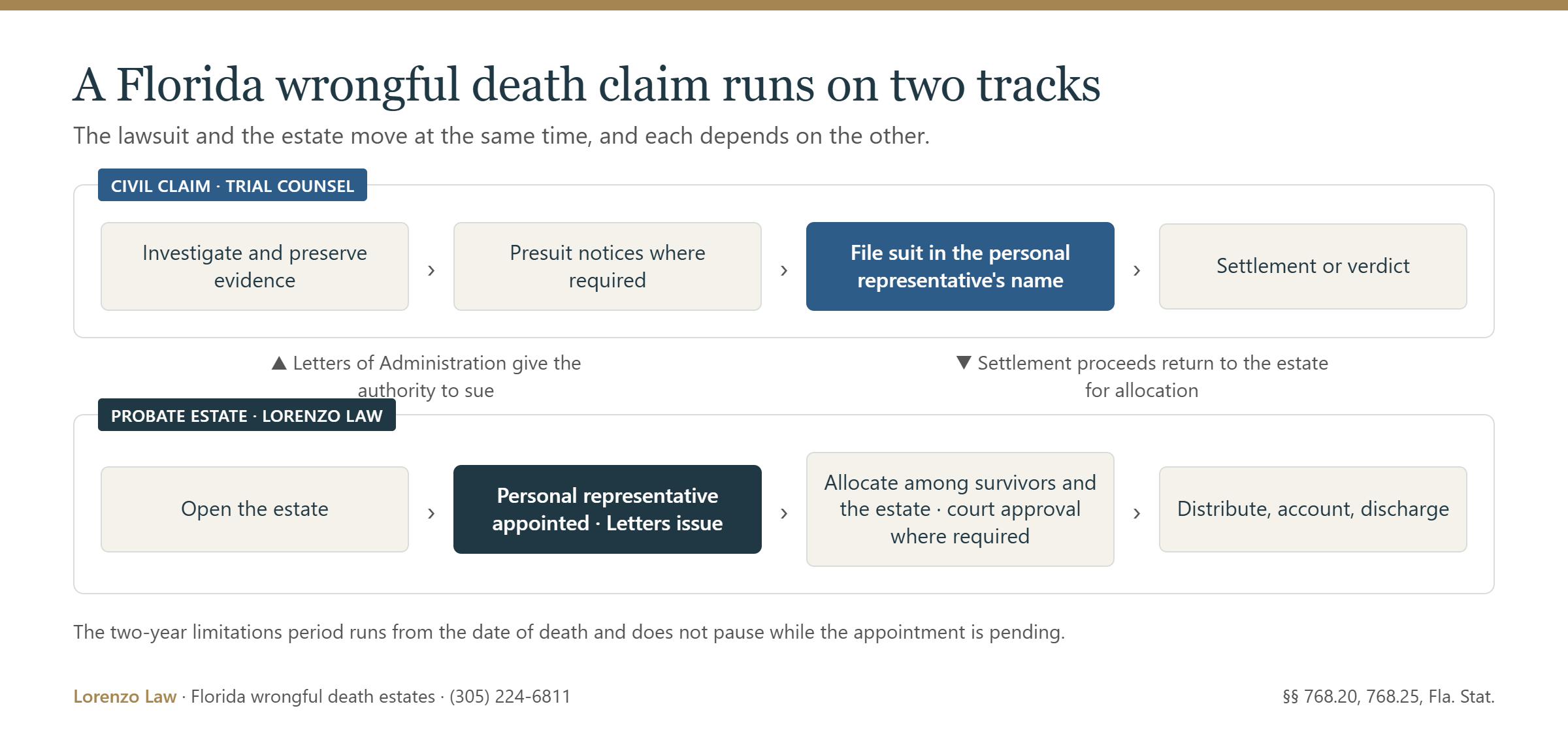
View the “A Florida wrongful death claim runs on two tracks” chart (zoom in to read; the details are also in the text above).
Families usually need to know three things first: who can act for the estate, whether an estate is already open, and how to coordinate with the lawyer investigating the death. Referring lawyers usually need someone appointed quickly, help with an estate that is already open, or probate work tied to a proposed settlement. Personal injury and wrongful death firms on the liability side often need the estate handled by someone else.
| Your situation | What to discuss | Useful information to have ready |
|---|---|---|
| A death may have been caused by someone else’s conduct and no lawyer is involved | The circumstances, time limits, and whether the matter should be referred or handled together with another firm | Dates of injury and death, location, people or businesses involved, and any notices received |
| A trial lawyer is handling the claim but no personal representative is appointed | The estate proceeding, the proposed personal representative, and coordination between counsel | Trial lawyer’s name, the will, death certificate, family relationships and known deadlines |
| An estate is already open | The existing appointment, its authority and any restrictions, and the work still needed | Case number, Letters of Administration and relevant orders |
| A settlement is being discussed | Allocation, required approvals, estate claims, minors, and who is responsible for disbursement | Proposed settlement and release, survivor information, expenses and known reimbursement demands |
| Family members disagree | Whether there is an appointment, allocation or fiduciary dispute, and whether separate counsel is needed | Relevant pleadings, notices, proposed distributions and each person’s position |
What this office does on the estate side
Lorenzo Law carries the estate side:
- Opening the estate in the county of the decedent’s domicile and getting a qualified personal representative appointed.
- Letters of Administration issued so the personal representative can act, sign the fee agreement with trial counsel and bring the claim.
- Allocation (apportionment) of a settlement between each survivor and the estate.
- Court approval where a minor, an incompetent survivor or an objection makes it necessary, and §733.708 authorization where the personal representative wants that protection.
- Minor’s shares: guardianship of the property and guardian ad litem issues.
- Creditor and lien coordination on the estate side, so nothing is disbursed before demands are resolved and documented.
- Distribution, final accounting and discharge.
Lorenzo Law is a solo practice. The same attorney, Jose M. Lorenzo, Jr., handles the matter from the first call to the discharge of the personal representative. That is the wrongful death estate attorney role, start to finish.
What is referred out or handled with trial counsel
Wrongful death matters may be referred to, or handled together with, another lawyer or law firm. The probate role does not automatically include investigating liability, filing or trying the civil claim, negotiating every lien, representing each survivor individually, or giving tax or public-benefits advice. Those responsibilities are assigned expressly in the engagement agreements. A referral or an initial conversation does not by itself create representation or transfer responsibility for a deadline. The wrongful death attorney fee for the liability claim is set in that lawyer’s own written agreement.
The role of a wrongful death attorney, and which lawyer does what
What does a wrongful death attorney do? A wrongful death attorney on the liability side investigates the death, preserves evidence, identifies every responsible party and insurance policy, serves any required presuit notices, files the civil case, and negotiates or tries it. A probate lawyer on the estate side gets the personal representative appointed and handles allocation, court approvals, minors’ shares, creditors and distribution. Some firms do both. Many wrongful death law firms that are strong on liability send the estate work to probate counsel.
If you are comparing wrongful death lawyers in Florida or searching for a wrongful death attorney near me, ask each firm three questions:
- Who will open the estate?
- Who owns each deadline?
- Who will handle allocation and court approval if a minor is involved?
The answers tell you more than a ranking does.
For personal-injury attorneys: Florida probate counsel for your wrongful death case
If you represent a family on the liability side, the estate has to be in place before the claim can move in the right name and before any settlement can be allocated, approved and distributed. Lorenzo Law works as probate co-counsel on these cases, including for firms based outside Florida whose client needs a Florida estate opened. Only members of The Florida Bar may practice law in Florida; a lawyer licensed elsewhere can appear in a Florida case only by pro hac vice admission under Rule 2.510, associated with Florida counsel of record. Wrongful death co-counsel arrangements are set out in writing, and the goal is simple: have the Letters of Administration wrongful death claims depend on in hand before they are needed.
- To get started: the decedent’s name, date of death and domicile; the death certificate; any will; the family tree with ages, so the under-25 rule can be applied; the proposed personal representative; the date of injury; and the date you are treating as the limitations deadline.
- Division of work: you carry liability, experts, the civil pleadings and negotiation. The estate side carries appointment, notices, allocation, approvals, minors’ shares and distribution. Each deadline is assigned to one owner in writing.
- Fees: any division of fees between firms is documented in advance and disclosed to the client in writing (Rule Regulating The Florida Bar 4-1.5(g)). The estate engagement is quoted separately, in writing.
- Communication: one point of contact on the probate side, and copies of every order you will need for the release and disbursement.
Referring an estate matter connected to a wrongful death claim? Call Jose M. Lorenzo, Jr. at (305) 224-6811 to discuss the probate work, the division of responsibilities and the communication the matter needs.
Who can file a wrongful death lawsuit in Florida?
Only the personal representative of the decedent’s estate. Not the spouse, not the children, not the parents, no matter how directly the loss falls on them. So if you are asking who can sue for wrongful death in Florida, the answer is the personal representative, in that capacity, whoever the court appoints to serve.
For wrongful death, Florida statute section 768.20 controls who files. §768.20 is explicit: the action is brought by “the decedent’s personal representative, who shall recover for the benefit of the decedent’s survivors and estate all damages.”
One person files the claim, and everyone else recovers through that filing. This is why a probate estate has to be opened for the civil case, whether or not the decedent left a will and whether or not there is anything else in the estate to administer. That is the complete answer to who can bring a wrongful death claim in Florida.
If no one has yet been appointed, that is the first task. See how to become personal representative in Florida.
Can you sue for wrongful death in Florida?
Yes, when the death was caused by conduct that would have let the person sue had they lived. §768.19 covers a death caused by a “wrongful act, negligence, default, or breach of contract or warranty.” The suit is brought in the personal representative’s name, and the recovery is divided among the statutory survivors and the estate. That test is what qualifies as wrongful death in Florida.
Can anyone file a wrongful death lawsuit? No. Family members recover through the claim, but only the personal representative files it.
Is a personal representative the same as an executor?
Yes. Florida just uses a different word. Other states say “executor” for someone named in a will and “administrator” where there is no will. Florida calls both a personal representative, and that is the term the statutes, the court file and the Letters of Administration will use. If you are searching for a Florida wrongful death executor, this is the role you mean.
Being named in a will is not the same as being appointed. The court decides who qualifies and issues Letters of Administration as proof of authority. The court-appointed wrongful death personal representative is the person who signs, sues and settles.
Can a family member file a wrongful death claim without opening probate in Florida?
No. §768.20 gives the right of action to the personal representative, and only the probate court can appoint one. An estate may be needed even when the decedent left few assets apart from the claim. Summary administration does not help here: it appoints no personal representative and issues no Letters, it simply assigns property to the people entitled to it (§735.206). Formal administration is the route that produces a personal representative with standing to sue. When the decedent lived in another state, the appointment may come from that state’s court instead, as explained below, but an appointment is still required. There is no shortcut around the personal representative wrongful death law requires.
Appointment should be handled promptly, alongside the civil claim. Do not assume a claim is lost just because Letters were not issued before something was filed. Under §733.601, a personal representative’s powers relate back to give beneficial acts taken before appointment the same effect as acts taken after it, and the Florida Supreme Court has held that a wrongful death suit filed before Letters issue is not a nullity. Griffin v. Workman, 73 So. 2d 844 (Fla. 1954). People sometimes ask about filing a “placeholder” wrongful death suit before Letters issue. Relation back helps only a personal representative who is actually appointed in time: if the case is dismissed before the appointment, a later appointment cannot reinstate it. A placeholder filing is not a shortcut around getting appointed.
Does the surviving spouse have to be the personal representative?
No, but the spouse often has priority. Under §733.301, in a testate estate preference goes first to the person named in the will, then a person selected by a majority in interest of those entitled to the estate, then a beneficiary under the will. In an intestate estate it goes to the surviving spouse, then a person selected by a majority in interest of the heirs, then the nearest heir. A person with priority can decline, and the court still has to find the nominee qualified. The personal representative serves everyone, so the right choice is often whoever can work with all the survivors and has no conflicting claim. Choosing the personal representative Florida courts will appoint is often the first decision a family has to make together.
Who are considered survivors under the Florida Wrongful Death Act?
“Survivors” is a defined term, and the definition is narrower than most families expect. The Florida wrongful death statutory survivors are defined in §768.18(1):
the decedent’s spouse, children, parents, and, when partly or wholly dependent on the decedent for support or services, any blood relatives and adoptive brothers and sisters.
Three consequences people do not anticipate:
- A sibling is not automatically a survivor. A brother or sister recovers only on proof of actual dependency. The same is true of any other blood relative.
- Stepchildren are not survivors unless legally adopted.
- “Minor children” means children under 25. §768.18(2) defines the term as “children under 25 years of age, notwithstanding the age of majority.” A 22-year-old is a minor child for this statute; a 26-year-old is not. That one line decides which damages are available and, in medical negligence cases, whether the non-economic damages are available at all.
Read in context, the under-25 definition is a damages rule: it decides who can recover which damages “notwithstanding the age of majority.” It does not make a survivor aged 18 through 24 a legal minor, so it does not by itself call for a guardianship for that survivor’s share. Guardianship turns on actual legal minority.
The Florida Wrongful Death Act, part of Florida Statutes chapter 768, runs from §768.16 through §768.26. Its stated purpose, in §768.17, is to shift the losses that result from the death from the survivors to the wrongdoer. Who are the beneficiaries covered by the Florida wrongful death statute? The survivors on this list plus the estate itself. Together they are the Florida wrongful death beneficiaries.
Can a sibling or grandparent sue for wrongful death in Florida?
Only the personal representative files. Whether a sibling or other blood relative recovers depends on dependency: §768.18(1) includes blood relatives and adoptive siblings only where they were partly or wholly dependent on the decedent for support or services. Grandparents are not listed as survivors in their own right. A grandparent who was dependent on the decedent should raise it early, with proof of that dependency. Among wrongful death survivors, Florida law treats siblings and grandparents very differently from spouses, children and parents.
So, can a sibling sue for wrongful death in Florida? Only through the personal representative’s claim, and only with proof of dependency.
Can a fiancé or unmarried partner sue for wrongful death in Florida?
Generally, no. “Spouse” in the survivor definition means a legal spouse. A fiancé, girlfriend, boyfriend, long-term partner or close friend is not listed, however close the relationship and however much the loss. A partner also cannot come in as a dependent “blood relative,” because that category requires an actual blood relationship. Children the couple had together are survivors in their own right, and their claims are brought by the personal representative. In wrongful death, Florida “who can sue” questions have two answers: the personal representative sues, and only the listed survivors recover.
Stepchildren, adopted children and children born out of wedlock
Legally adopted children are children for these purposes. A stepchild is not included just because of the step-relationship, and neither is a child who was raised as the decedent’s own but never legally adopted. For a child born out of wedlock, §768.18(1) draws a line between the parents: survivors include “the child born out of wedlock of a mother, but not the child born out of wedlock of the father unless the father has recognized a responsibility for the child’s support.” A formal paternity judgment is not required; proof of paternity plus the father’s recognition of that support responsibility is enough. Greenfield v. Daniels, 51 So. 3d 421 (Fla. 2010). Bring whatever you have on legal parentage, adoption, support and dependency, because these questions decide who is in the case.
When a child dies: claims for a minor or adult child
In the wrongful death of a child, including the wrongful death of a minor, the parents are usually the central survivors. What they can recover depends on the child’s age under the Act’s definitions: Can a parent sue for wrongful death? Not in their own name. The personal representative brings the claim, and the parents recover through it.
- A child under 25, with no spouse or children of their own. Each parent may recover for their own mental pain and suffering from the date of injury (§768.21(4)). A parent who paid medical or funeral expenses may recover them (§768.21(5)). Both parents are survivors whether or not they are married to each other and whatever the custody arrangement was.
- An adult child (25 or over). The parents’ pain-and-suffering claim exists only if there are no other survivors. In a medical negligence death it is barred by the free kill law.
- The estate’s claims for a young child are often small, because the conditions for net accumulations are narrow.
Who serves as personal representative is often the hard part, especially when the parents are divorced or do not get along. With no will, an unmarried child with no children of their own leaves the estate to the father and mother equally (§732.103), with no exception for divorced parents, so both have the same priority to serve. The court can appoint them as co-personal representatives, but with two co-representatives most acts require both to agree (§733.615). Their disagreement can delay the appointment that the case depends on. Raise it at the first call.
Can you bring a wrongful death claim for an unborn child (fetal death) in Florida?
Not as a wrongful death claim. The Wrongful Death Act covers the death of a “person,” and the Florida Supreme Court has held that a right of action for wrongful death “can arise only after the live birth and subsequent death of the child.” A fetus, even a viable one, is not a “person” under the Act. Stern v. Miller, 348 So. 2d 303 (Fla. 1977); Tanner v. Hartog, 696 So. 2d 705 (Fla. 1997).
Florida does recognize a separate claim for negligent stillbirth, which belongs to both parents. Damages are limited to the parents’ mental pain and anguish and the medical expenses of the pregnancy. Tanner v. Hartog, above. A 2026 bill that would have added the parents of an unborn child to the survivor definition, SB 164, died in the Senate Rules Committee on March 13, 2026, so the live-birth rule still governs.
Heirs vs. survivors: why the will does not decide who gets wrongful death money
Being a survivor under the Act is not the same as being one of the wrongful death heirs people sometimes have in mind. Someone can inherit under the will and recover nothing in the claim, and someone can recover in the claim and inherit nothing. The two lists come from different statutes and often do not match. The will controls the estate’s own assets. It does not decide each survivor’s award. Florida’s Wrongful Death Act, not the will, decides who shares in the recovery.
The probate side, step by step: opening the estate and getting Letters
How does probate affect a wrongful death claim? It decides who can bring the claim, how fast it can move, and how the money is allocated and distributed. The civil claim and the estate run on two parallel tracks. Here is how the estate usually moves, with typical timing. This is what handling a wrongful death in probate court actually involves.
| Step | What happens | Typical timing |
|---|---|---|
| 1. Intake and conflict check | Family tree, will, death certificate, proposed personal representative, limitations date | At the first consultation. Bring the documents listed under what to bring and this step is usually complete the same day. |
| 2. Petition for Administration filed | Filed in the county of the decedent’s domicile, with oaths, designation of resident agent, and any waivers or consents from family | Once the signed petition, oaths and any family consents or waivers are in hand. Gathering signatures from several relatives is usually what takes the time. |
| 3. Order appointing personal representative and Letters of Administration | The court reviews the petition. Letters issue as proof of authority. | Set by the court, and varies by county. Uncontested petitions with complete paperwork are often weeks; a contested appointment or a missing will can take months. |
| 4. Notice to creditors | Published and served; starts the probate claims period that decides what the estate’s share is exposed to | Claims are barred unless filed by the later of 3 months after first publication of the notice, or 30 days after service on a known creditor (§733.702; §733.2121) |
| 5. Civil case | Trial counsel investigates, files, conducts discovery and mediation | Months to years, depending on the case |
| 6. Allocation and approvals | Settlement allocated among survivors and the estate; court approval where required; minors’ shares protected | After settlement terms are reached. Adult-only allocations with no objection move fastest; a minor’s share adds the petition, any guardian ad litem report and a hearing. |
| 7. Distribution, accounting and discharge | Liens and fees resolved, proceeds distributed, final accounting, personal representative discharged | After every lien and creditor issue is documented. The creditor period above sets the earliest point at which the estate’s share can safely be distributed. |
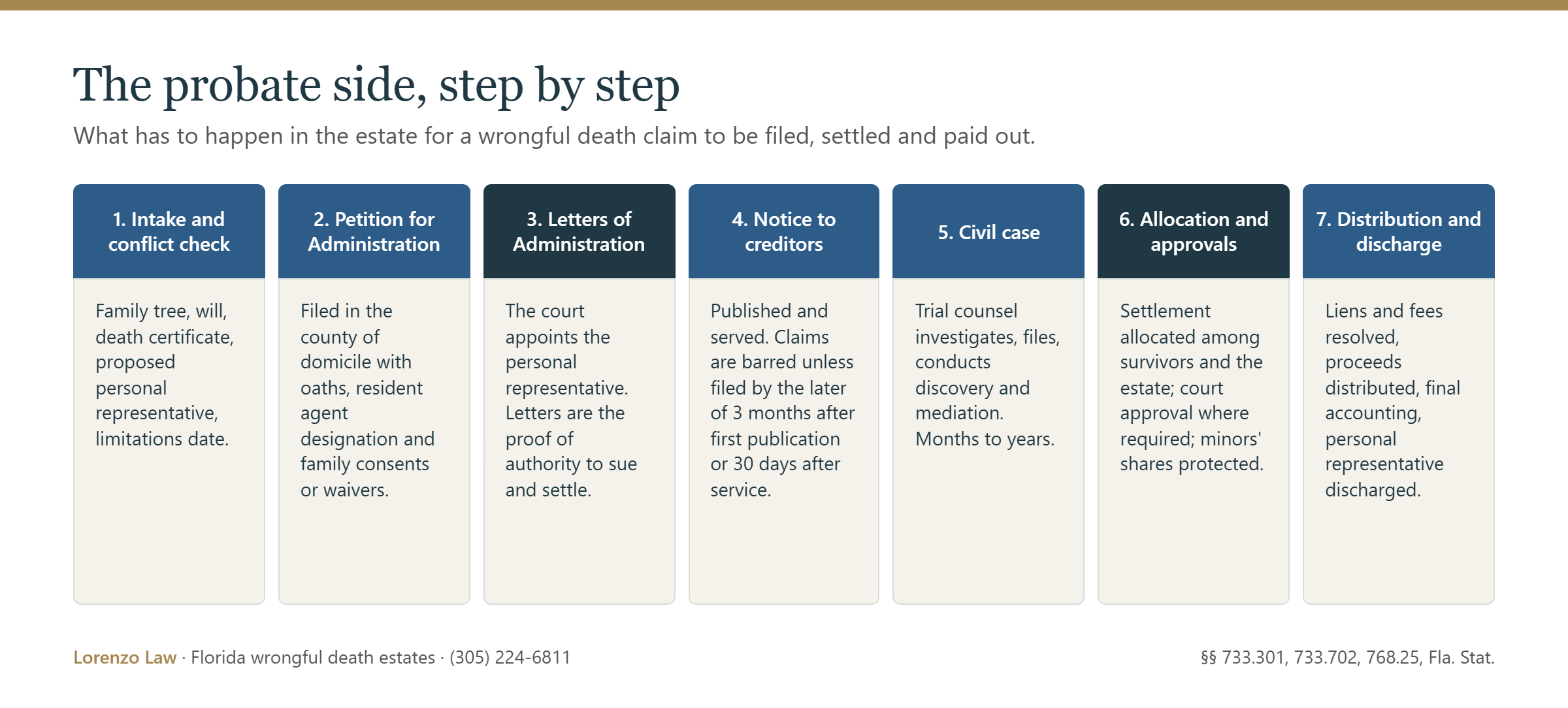
View the “The probate side of a Florida wrongful death claim, step by step” chart (zoom in to read; the details are also in the text above).
What is a wrongful death estate? It is an ordinary probate estate, opened at least in part so the claim can be brought, and it may hold little else. People also ask: how long does an executor have to settle an estate in Florida? The overall estate timeline is a separate question from the claim. See how long probate takes in Florida. There is no fixed appointment timetable that applies to every county or every contested estate. A dispute over who should serve, a missing will, or a family member who will not sign a waiver can all add time.
How long does it take to get Letters of Administration?
Where the appointment is uncontested and the paperwork is complete, Letters often issue within a few weeks of filing, though the court’s calendar varies by county. A contested appointment can take months, and the two-year limitations period does not pause while it runs. That is why appointment should be started at the same time the claim is investigated, not after.
When there is no will, or the named personal representative cannot serve
With no will, the preference order in §733.301 runs to the surviving spouse, then a person selected by a majority in interest of the heirs, then the nearest heir. If a will names someone who has died, declines or is not qualified, the next tier applies. Qualification is a separate test. The court looks at the statutory requirements in §733.302 and §733.303, and a nonresident must fit one of the relationships in §733.304. Under §733.303, a person is not qualified if they have been convicted of a felony or of abuse, neglect or exploitation of an elderly or disabled adult, are mentally or physically unable to perform the duties, or are under 18.
What if the family cannot agree who serves as personal representative?
Two problems arrive at once: the claim cannot move in the right name, and the two-year clock keeps running.
Contests usually turn on the majority-in-interest calculation under §733.301, on qualification, or on a conflict of interest where the proposed representative is also a defendant or a competing survivor.
While that is unresolved, the estate is not without a caretaker. Under §733.501 the court may appoint a curator, a temporary fiduciary who takes charge of and preserves assets until letters of administration issue. A curator ordinarily does not pursue the wrongful death claim, but under the version of §733.501 in effect since July 1, 2026, the court may specifically authorize a curator to perform the functions of a personal representative. Where an appointment fight is running against a limitations deadline, the deadline is the argument to make to the court, whether for a prompt appointment or for a curator with that authority. If the dispute is genuinely contested, it becomes probate litigation and should be treated that way immediately. An appointment dispute never justifies leaving the civil deadline unattended.
When a personal representative is already appointed
Sometimes an estate was opened for other reasons before anyone realized a claim existed. The existing personal representative usually brings the claim. Check three things first: whether the Letters carry restrictions, whether the estate is near closing or already closed, and whether the current representative has a conflict with any survivor. An appointed personal representative can prosecute a claim for the protection of the estate without a further court order (§733.612). If the estate has already been closed, final discharge does not prevent further administration, so it can be reopened for a claim discovered later (§733.903). Bring the case number, the Letters and every order entered so far.
When the personal representative has a conflict of interest
A conflict arises when the personal representative is a defendant (for example, the driver in a family crash), or is a survivor whose interest in the allocation runs against the others. The court can address it in different ways, including a different appointment or an administrator ad litem for the specific matter. Under Florida Probate Rule 5.120(a), where the personal representative is also a survivor with a stake in the allocation, the court can appoint a disinterested administrator ad litem to represent the estate and survivors on the claim without removing the personal representative, and the administrator ad litem can bring the wrongful death action itself. Raise it at the outset; it affects who should petition and who signs the fee agreement.
When the decedent lived outside Florida, or a Floridian died in another state
For a Florida domiciliary, probate venue generally lies in the county of domicile at death, wherever the death occurred. For a person who was not domiciled in Florida, §733.101 places venue in any county where the decedent had property. When the decedent lived in another U.S. state, the Florida suit can be brought through an ancillary administration, whose personal representative has the same powers as any other Florida personal representative (§734.102), or by the home-state personal representative acting as a foreign personal representative on authenticated Letters (§734.101). That second route is limited to appointments made in a U.S. state or territory, not in another country. The civil claim has its own jurisdiction and venue analysis.
Families who live out of state or overseas
Usually it is not an obstacle. Much of a probate administration runs on filings, and family members can sign many documents from wherever they live. Most steps in an uncontested administration need no hearing at all. Where a hearing is required, many Florida probate divisions hold it by video or telephone at the judge’s discretion, and documents can be signed and notarized remotely. Travel to Florida is rarely necessary for the estate side.
§733.304 limits who may serve as personal representative when they are not a Florida resident: a nonresident qualifies only through a listed family relationship to the decedent. Living outside Florida is not an automatic disqualification. See out-of-state executor in Florida. Living abroad does not change who can file a wrongful death suit in Florida: only the personal representative.
The 10-day rule for probate in Florida
What is the 10 day rule for probate in Florida? People searching for a “10-day rule” in Florida probate are usually asking about the original will. §732.901 provides: “The custodian of a will must deposit the will with the clerk of the court having venue of the estate of the decedent within 10 days after receiving information that the testator is dead.” Here that matters early, because the will is part of deciding who has priority to serve as personal representative.
What is the statute of limitations for wrongful death in Florida?
Generally two years from the date of death, under §95.11(5)(e). How long do I have to file a wrongful death lawsuit in Florida? In the ordinary case, that is the answer. The clock runs from the death, not from the appointment of a personal representative. Opening probate does not extend it. The Florida wrongful death statute of limitations is the deadline every other step is measured against.
Several other clocks can shorten or lengthen it.
| Clock | Period | Authority |
|---|---|---|
| Wrongful death action | 2 years from death | §95.11(5)(e) |
| Medical negligence: limitations | 2 years from the incident or from discovery | §95.11(5)(c) |
| Medical negligence: absolute repose | 4 years from the incident (7 on fraud or concealment). The repose period does not bar a claim brought on behalf of a child who was injured by the malpractice, up to that child’s 8th birthday. That protects only the injured child-patient; it does not extend a wrongful death deadline because a surviving child is under 8, and it does not extend the 2-year limitations period. | §95.11(5)(c) |
| Notice of claim against a government entity | 2 years for wrongful death (3 for other claims) | §768.28(6)(a)2 |
| Government agency’s non-response becomes a denial | 90 days in wrongful death and medical malpractice; the limitations period is tolled during the review | §768.28(6)(d) |
| Chapter 766 presuit investigation, medical cases | Adds a presuit investigation and notice period before suit may be filed | §§766.106, 766.203 |
| Wrongful death against the person who committed an intentional tort resulting in death (acts described in the murder and manslaughter statutes, §§782.04 and 782.07) | No time limit. The action “may be commenced at any time.” No arrest, charge or conviction is required. | §95.11(11) |
Appointment takes time, so raise the appointment and the claim deadline together. If time has passed and the family still disagrees about who should serve, tell counsel about both at once. When you call, give both the injury and death dates, any existing case number, and every notice or deadline you have received. If a deadline may be close, call; don’t wait on a website message. Does wrongful death have a statute of limitations even while a criminal case is pending? Yes, and it keeps running. A criminal case does not toll it; only the murder-and-manslaughter exception in the table removes the deadline.
Medical malpractice deaths: limitations, repose and presuit
A death caused by medical care adds a presuit investigation under chapter 766, special notice requirements, and the repose period in the table above, along with the damages restriction discussed under Florida’s Free Kill law. The medical-negligence claim needs counsel who handles that kind of case. A personal representative does not have to be appointed before the presuit notice of intent is served: Florida courts have held that a notice served by family members before appointment is not a nullity, because the representative’s powers relate back once the appointment issues. The appointment still has to follow promptly, because only the personal representative can file suit. For the medical malpractice wrongful death statute of limitations, Florida presuit rules run alongside the deadline, so both have to be tracked.
When the injured person dies while their lawsuit is pending
If the person was already suing over the injury and then died of that injury, the injury case does not continue. The Florida Statutes’ wrongful death provisions say so in §768.20:
When a personal injury to the decedent results in death, no action for the personal injury shall survive, and any such action pending at the time of death shall abate.
The pending case abates. It is replaced by a wrongful death action brought by the personal representative: a different claim, with different beneficiaries and different damages.
But “abate” does not mean the file is thrown out. In Capone v. Philip Morris USA, Inc., 116 So. 3d 363 (Fla. 2013), the Florida Supreme Court held that the personal representative must be added as a party and given a reasonable opportunity to amend the complaint to plead wrongful death. Where the parties dispute whether the injury actually caused the death, the representative may plead survival damages and wrongful death in the alternative.
Substitution under Fla. R. Civ. P. 1.260 is part of that process, and the rule carries its own deadline. The motion to substitute must be made within 90 days after a statement noting the death is filed and served, or the action is dismissed as to the person who died. The pleadings, the cause of death and the procedural deadlines all have to be reviewed together. A pending file should not be dismissed and restarted automatically.
Wrongful death vs. survival action in Florida
Many states allow two separate lawsuits after a death: a wrongful death claim for the family’s losses and a survival action for the decedent’s own claim. Florida handles it differently when the injury causes the death. Read from the start of the Florida wrongful death statute 768.16 onward, the Act creates one action, not two. That is the practical difference between wrongful death and survival action claims here.
Does Florida have a survival action?
Not for the injury that caused the death. Florida folds what other states call a survival claim into the Wrongful Death Act itself. The decedent’s own losses, such as lost earnings from injury to death and medical and funeral expenses charged to the estate, are recovered by the personal representative for the estate under §768.21(6), inside the same action. Survival action damages, as other states know them, are mostly folded into this one claim. In the wrongful death vs survival action Florida comparison, the separate survival claim largely disappears when the injury caused the death.
Florida’s general survival statute, §46.021, says no cause of action dies with the person. §768.20 is the specific exception that controls where the injury caused the death: Florida substitutes a statutory wrongful death action for the personal injury action that would otherwise have survived. Niemi v. Brown & Williamson Tobacco Corp., 862 So. 2d 31 (Fla. 2d DCA 2003), quoted in Salfi v. Columbia/JFK Medical Center Ltd. Partnership, 942 So. 2d 417 (Fla. 4th DCA 2006). The 1972 Act merged the two into a single lawsuit, and the Florida Supreme Court upheld that consolidation in Martin v. United Security Services, Inc., 314 So. 2d 765 (Fla. 1975).
The distinction matters because it decides which damages belong to the survivors and which belong to the estate. Only the estate’s share is exposed to creditors.
Wrongful death is a civil case, not a criminal one
Is wrongful death civil or criminal? Civil. Is wrongful death a tort? Yes. The lawsuit is a civil claim for money, a statutory tort claim brought by the personal representative. It is separate from any criminal prosecution for the same death, such as vehicular homicide, DUI manslaughter or murder. The two proceed independently: a civil claim does not depend on a conviction, and a criminal case does not resolve the civil one. The civil standard of proof is the greater weight of the evidence, lower than the criminal standard. A conviction can still help the civil case: under §775.089(8) a convicted defendant cannot deny the essential allegations of the crime in a later civil action, and restitution paid is credited against the civil recovery. Families sometimes wait for a criminal case to finish before calling a lawyer. The civil deadline keeps running while they wait.
Can you go to jail for wrongful death? Not as a result of the civil lawsuit. Jail is possible only through a separate criminal prosecution brought by the State.
Wrongful death vs. medical malpractice, negligence, manslaughter and accidental death
Use this table to compare wrongful death vs negligence, wrongful death vs manslaughter and wrongful death vs accidental death, and to see how each relates to a Florida claim:
| Term | What it is | How it relates to a wrongful death claim |
|---|---|---|
| Wrongful death | A civil (tort) claim created by the Wrongful Death Act, brought by the personal representative | The claim itself |
| Survival action | The decedent’s own claim continuing after death | When the injury caused the death, Florida folds it into the action |
| Negligence | A legal theory: failure to use reasonable care | The most common basis for a wrongful death claim |
| Medical malpractice | Negligence by a health care provider | A wrongful death claim based on medical negligence, with presuit rules and the free kill restriction |
| Manslaughter, vehicular homicide, murder | Criminal charges brought by the State | Separate case, with a higher standard of proof. The civil claim does not depend on a conviction. |
| Accidental death / life insurance | A contract benefit paid under a policy | Separate from the claim. It is paid under the policy, whether or not anyone was at fault, and it does not reduce the wrongful death award. |
What damages can you recover in a Florida wrongful death case?
Section 768.21, Florida Statutes, assigns each category of damages to a specific claimant. The available categories depend on who is recovering. Florida wrongful death damages are personal to each recipient.
Lawyers group these into economic (pecuniary) damages, such as lost support and services, lost earnings, net accumulations, and medical and funeral bills, and non-economic damages, such as companionship, guidance, protection, and mental pain and suffering. That split is how the damages are calculated in practice. Economic losses are projected with records and often an economist, and future losses are reduced to present value. Non-economic losses have no formula and are left to the jury’s judgment. The collateral source statute, §768.76, applies to wrongful death awards: the court reduces the award by amounts paid from collateral sources such as health insurance, except where the source has a subrogation or reimbursement right. Life insurance proceeds are expressly excluded and do not reduce the award. Records of support, services and earnings are what document the pecuniary loss wrongful death survivors claim.
What are the damages awarded in Florida for wrongful death? The table answers it claimant by claimant:
| Who recovers | What | Subsection |
|---|---|---|
| Each survivor | Lost support and services, from the date of injury to death with interest, and future loss reduced to present value | (1) |
| Surviving spouse | Loss of companionship and protection, and mental pain and suffering from the date of injury | (2) |
| Children under 25, and all children if there is no surviving spouse | Lost parental companionship, instruction and guidance, and mental pain and suffering. Not available to adult children in a medical negligence death (§768.21(8)). | (3) |
| Each parent of a child under 25 | Mental pain and suffering from the date of injury | (4) |
| Each parent of an adult child | Mental pain and suffering, only if there are no other survivors, and not in a medical negligence death (§768.21(8)) | (4) |
| Whichever survivor paid them | Medical and funeral expenses | (5) |
| The estate | Lost earnings from injury to death; lost prospective net accumulations; medical and funeral expenses charged to the estate | (6) |
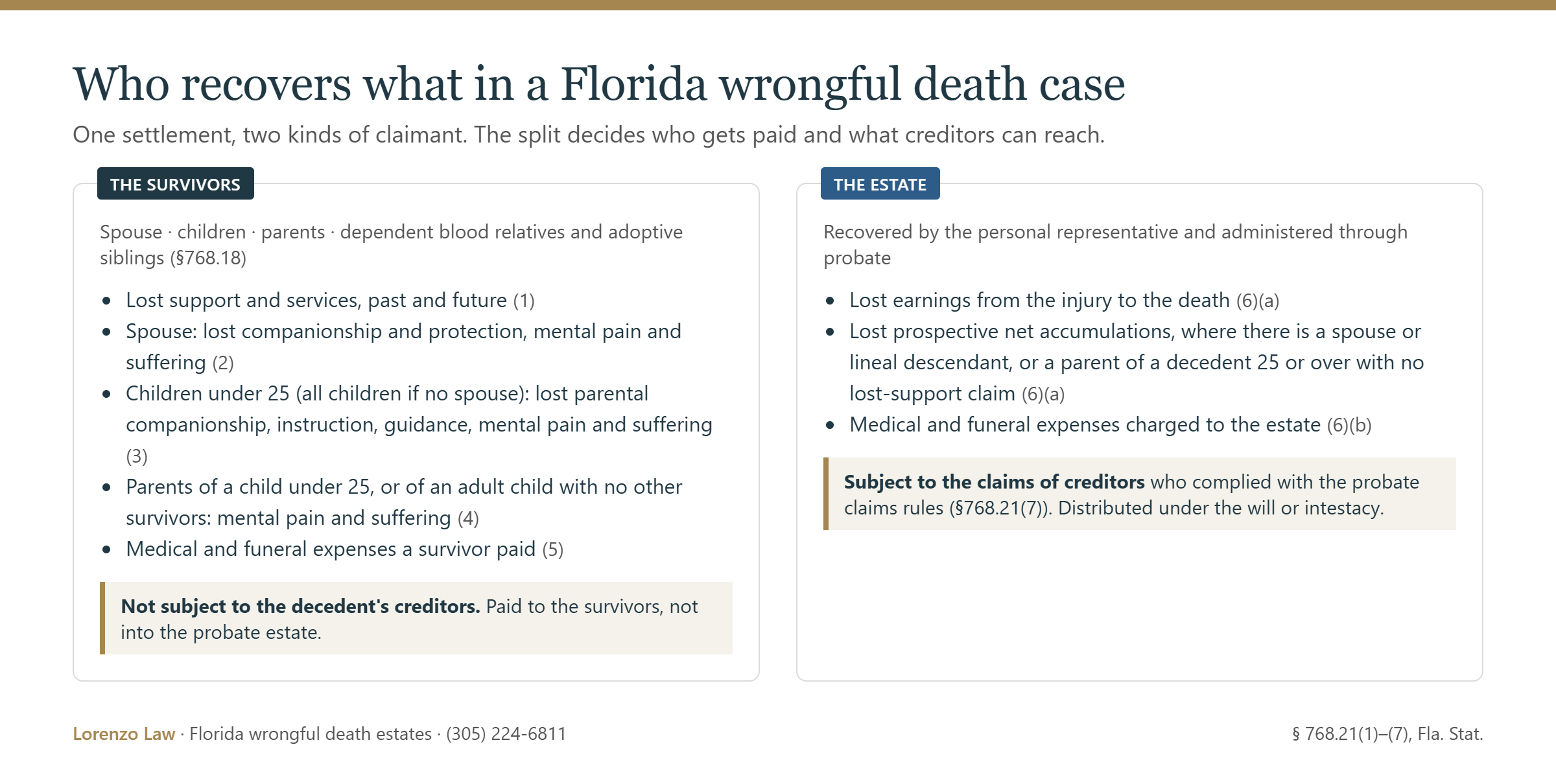
View the “Survivors and the estate recover different damages under §768” chart (zoom in to read; the details are also in the text above).
Four details that change wrongful death compensation:
- The complaint must name everyone. In a wrongful death lawsuit, Florida law (§768.21) requires that all potential beneficiaries, including the estate, be identified in the complaint and their relationships alleged.
- Lost net accumulations are conditional. They are recoverable only where there is a surviving spouse or lineal descendants, or, where the decedent was 25 or over and no one has a lost-support claim, where a parent survives. §768.21(6)(a).
- Evidence of a surviving spouse’s remarriage is admissible. The statute says so expressly, but remarriage may not be used to reduce the damages.
- Simultaneous deaths. If both spouses die within 30 days of one another from the same wrongful act or incident, each is treated as having been predeceased by the other. That moves the children’s claim into the “no surviving spouse” category. §768.21(3).
Does Florida pay for pain and suffering?
Yes, for the survivors’ own pain and suffering. The surviving spouse, children under 25 (and all children where there is no spouse), and parents in the circumstances shown above can recover for their own mental pain and suffering from the date of injury. Those awards are measured by the survivor’s loss. If the injury caused the death, the person who died cannot recover for their own pain and suffering; the law instead compensates the survivors for their own loss. A claim for the decedent’s pain and suffering survives only on the alternative theory that the injury did not cause the death, the pleading option described under the abatement rule above. Wrongful death pain and suffering awards have no formula. Of all Florida Wrongful Death Act damages, they are the hardest to value.
Lost net accumulations: what the estate recovers
“Net accumulations” is the part of the decedent’s expected future earnings, after taxes and after the support the decedent would have given the survivors, that the decedent would probably have saved and left at death (defined in §768.18(5)). The estate recovers it under §768.21(6)(a) when the conditions above are met. It is often the largest estate-side item. It is also the item most exposed to the decedent’s creditors, which is why its size matters in allocation. For net accumulations, wrongful death Florida claims value what the decedent would have saved, not simply what they would have earned.
Is there a cap on wrongful death damages in Florida?
No general cap applies to wrongful death damages against a private defendant. The statutory caps on non-economic damages in medical negligence cases (§766.118) were held unconstitutional as to wrongful death in Estate of McCall v. United States (Fla. 2014) and as to personal injury in North Broward Hospital District v. Kalitan, 219 So. 3d 49 (Fla. 2017), and they are not enforced. Claims against government entities are limited by §768.28, discussed below. Punitive damages have their own cap under §768.73: generally the greater of three times the compensatory damages or $500,000, with no cap where the defendant had a specific intent to harm.
People search for this as the Florida wrongful death cap or the wrongful death cap Florida applies. The answer depends on who the defendant is.
Remarriage of a surviving spouse
A surviving spouse who remarries keeps the claim. The Act makes evidence of remarriage admissible, but remarriage is not a ground for reducing the damages. A spouse who married the decedent after the injury, but before the death, is still a surviving spouse. Ripple v. CBS Corp., 385 So. 3d 1021 (Fla. 2024).
Can you recover for loss of consortium after a death in Florida?
Not under that name. The married-couple loss of consortium claim exists in Florida personal injury law, but it does not survive a death caused by the injury, because §768.20 abates it. What replaces it is the surviving spouse’s own statutory claim under §768.21(2) for loss of the decedent’s companionship and protection and for mental pain and suffering from the date of injury. Children have a parallel claim under §768.21(3) for lost parental companionship, instruction and guidance. That is how wrongful death and loss of consortium fit together in Florida.
Can adult children recover for a parent’s death in Florida?
Can a child sue for wrongful death of a parent? The child recovers through the personal representative’s claim, and what the child can recover depends on age and cause of death. For most causes of death, yes. All children recover under §768.21(3) where there is no surviving spouse. In medical negligence cases, no: §768.21(8) bars adult children from those damages, and bars the parents of a decedent aged 25 or over. “Adult” here means 25 or over, because §768.18(2) defines minor children as those under 25. The provision has been upheld against constitutional challenge, most recently in Santiago v. Rodriguez, 281 So. 3d 603 (Fla. 2d DCA 2019).
How is a Florida wrongful death settlement divided among survivors?
Not equally, and not by the will. Florida wrongful death settlement distribution follows the Act. Each survivor and the estate receives an amount based on their own statutory damages. Allocation (apportionment) decides what each person actually receives, and it is negotiated, not calculated. Two rules frame it. §768.22 requires that the amounts awarded to each survivor and to the estate be stated separately in the verdict, so there is no single undivided sum. And §768.21 gives each survivor a different menu of damages, so a surviving spouse, a 19-year-old child and a 30-year-old child are not in the same position even within one family.
How does a wrongful death settlement work in Florida? Through allocation: one recovery, divided by statute among separate claimants.
In a settlement the same allocation has to be agreed instead of found by a jury, and it drives four outcomes at once:
- What each survivor nets.
- What the decedent’s creditors can reach: only the estate’s share, under §768.21(7).
- What liens and reimbursement demands can reach.
- What attorneys’ fees and costs are measured against, since §768.26 deducts them in proportion to each award.
Who gets paid in a wrongful death lawsuit is decided at this stage. The allocation has to be supportable on the facts and the law. It should not be treated as a device for avoiding valid creditor or reimbursement rights.
Any survivor may object. Under §768.25 an objection to the amount or the apportionment makes court approval a precondition to an effective settlement while the action is pending. The right belongs to every survivor defined by §768.18(1), including one with no damage claim of their own. Brunson v. McKay, 905 So. 2d 1058 (Fla. 2d DCA 2005). Discuss the proposed allocation with every survivor before anyone signs; an allocation agreed among some survivors and sprung on the rest invites an objection. Personal representative’s counsel does not automatically represent every survivor individually. When interests conflict, separate advice may be needed.
A worked example of Florida wrongful death settlement distribution
A hypothetical, for illustration only. Real allocations depend on evidence and must be supportable. Say a 52-year-old dies in a crash, a typical wrongful death car accident claim, leaving a spouse, a 20-year-old daughter and a 28-year-old son, and the case settles for a single gross figure. The allocation has to answer, separately:
- How much reflects the spouse’s lost support and services, companionship and protection, and mental pain and suffering.
- How much reflects the 20-year-old’s claims. She is a “minor child” under the Act, so she has parental-companionship and pain-and-suffering claims.
- Whether the 28-year-old has any claim beyond lost support and services. With a surviving spouse, an adult child generally does not recover the subsection (3) damages.
- How much belongs to the estate for lost earnings to death, net accumulations, and medical and funeral bills the estate paid.
How are wrongful death settlements calculated in practice? Like this. Fees and costs come off each share in proportion under §768.26. Creditors reach only the estate’s line. Any lien is tested against the share it actually attaches to. The 28-year-old may have little or no individual award, and still has the right to object to the allocation.
When the insurance is not enough, or there is more than one defendant
Many fatal-crash claims settle for the at-fault driver’s policy limits, which can be far less than the family’s losses. The settlement still has to be allocated among each survivor and the estate based on their claims. It is not split by headcount, and it is not paid to whoever is closest to the claim. When there are several defendants, the personal representative may settle with one and keep suing another. The release has to be drafted so it releases only what is intended and covers every survivor’s claim. A release of one defendant does not release the others, and the amount paid is set off against any later judgment against them (§768.041; §46.015). Minors’ shares still need court approval. Truck accident wrongful death cases often involve larger commercial policies, but the same allocation rules apply.
Does a wrongful death settlement have to go through probate?
The estate has to be open, but not every dollar becomes an estate asset. The personal representative receives the recovery in a representative capacity. The survivors’ shares pass to the survivors and are not part of the probate estate. The estate’s share is administered through probate, alongside creditor claims. Court approval is a separate question, covered below. The wrongful death estate claim is the only part administered as an estate asset.
Are wrongful death settlements part of the estate?
Only the estate’s share. Damages awarded to survivors under §768.21(1)–(5) belong to those survivors. Damages awarded to the estate under §768.21(6) are estate assets and are distributed under the will or intestacy after valid claims. That split is why one settlement can be partly protected from creditors and partly exposed to them. Questions about wrongful death estate tax treatment belong with a tax adviser, and should be asked before the allocation is final. What assets are exempt from probate in Florida after death is a broader question; see assets exempt from probate. The survivors’ shares are not probate assets at all.
How are wrongful death settlements paid out, and how long does it take to get paid?
Settlement money is usually paid by the defendant or its insurer to the trust account of the lawyer handling the claim, after the release is signed and any required court orders are entered. It is then disbursed under the approved allocation, after fees, costs and resolved liens. A minor’s share goes to the guardianship or other protected arrangement the court approves.
How long does it take to get paid after a wrongful death settlement? Timing depends on the release, required approvals, lien resolution and the insurer’s payment process. Ask for an estimate once the release terms and every lien demand are known; before that, any date is a guess. No one should receive a distribution before the documents that protect the personal representative are in place.
Privacy: when wrongful death settlement amounts become public record
Are wrongful death settlements public record? Sometimes. Families often ask whether a settlement becomes public. A private settlement with no court involvement may stay confidential, subject to any confidentiality terms in the release. Once a settlement needs court approval, for a minor, an incompetent survivor or an objection, or once it runs through the probate file, it becomes part of a court file. Court files are generally open to the public, but Florida Rule of General Practice and Judicial Administration 2.420 makes some records confidential, including estate inventories and accountings and documents relating to the settlement of a minor’s or ward’s claim. Sealing anything else requires a specific showing to the court. Confidentiality clauses have limits too: under Florida’s Sunshine in Litigation Act, §69.081, a settlement term that conceals a public hazard is void. Ask about privacy before the petitions are drafted.
Who pays the money in a wrongful death lawsuit?
Who pays for wrongful death damages? Usually the at-fault party’s liability insurer, up to the policy limits, and sometimes the defendant directly. Other sources can include an employer that is responsible for an employee’s conduct, a business’s commercial or umbrella coverage, and in vehicle deaths the decedent’s own uninsured/underinsured motorist coverage. When the person responsible has also died, the claim may have to be pursued against that person’s estate. That claim is subject to the other estate’s creditor deadlines and to the two-year bar after death in §733.710, but a claim limited to the person’s liability insurance coverage can proceed under an exception in §733.702(4)(b). Identifying every source early affects both the value of the case and how it is allocated. For a wrongful death lawsuit against estate representatives of the person at fault, those probate deadlines are the first thing to identify.
What happens after the claim is settled
The estate side does not end with the settlement check. The personal representative then completes the estate administration: estate creditors are resolved, the estate’s share is distributed, a final accounting is prepared unless it is waived, and the personal representative petitions for discharge. Discharge under §733.901 releases the personal representative and the surety and bars later actions against them. A personal representative who distributes the estate’s share before creditor claims are resolved, or who skips the accounting and discharge, can be personally exposed.
If the personal representative distributes the money to the wrong people
An improper or unlawful distribution can be a breach of fiduciary duty. §733.609 makes a personal representative who breaches a fiduciary duty liable to interested persons for the resulting damage. Removal under §733.504 is a separate remedy. The right response depends on the specific conduct, and it is probate litigation territory.
Creditors, liens and taxes on the recovery
Can creditors take a Florida wrongful death settlement?
Some of it, and the line is drawn precisely. Damages awarded to survivors under §768.21(1)–(5) are not estate assets, and the decedent’s creditors do not reach them. Damages awarded to the estate under §768.21(6) are a different matter. §768.21(7):
All awards for the decedent’s estate are subject to the claims of creditors who have complied with the requirements of probate law concerning claims.
So the survivors’ share is protected from the decedent’s creditors, and the estate’s share is exposed to creditors who complied with the probate claims rules. That does not make the survivors’ money immune from everything. A survivor’s own debts, and any lien or reimbursement right that attaches to the recovery, need separate review. Under §733.702, a creditor claim filed late is barred unless the court extends the time for fraud, estoppel or insufficient notice, and no extension reaches past the two-year outer limit in §733.710, apart from that section’s narrow exceptions. See Florida probate creditors and whether you inherit debt in Florida.
Have a question about the estate side after a death? Contact Lorenzo Law for a free initial consultation about your circumstances and the scope of help available.
Call (305) 224-6811 or Request a free initial consultation
Will Medicare, Medicaid or a hospital lien take part of the settlement?
Often, and a wrongful death lien is not the same as a creditor claim. An estate creditor has to file in the probate proceeding. A lien or reimbursement right attaches to the recovery under its own body of law and runs on its own timetable, so closing the creditor period does not resolve it:
- Medicare lien (conditional payments). Where Medicare paid for treatment related to the injury, it has a recovery right when a settlement is paid. CMS describes the recovery process, which runs through the Benefits Coordination & Recovery Center. For a Medicare lien, wrongful death counsel reviews the conditional-payment correspondence before anything is disbursed.
- Medicaid lien. Florida’s Agency for Health Care Administration (AHCA) asserts reimbursement rights under §409.910. Under the statutory formula, AHCA is repaid out of one-half of what remains after subtracting attorney’s fees (counted as 25% of the recovery) and taxable costs, and never more than the total Medicaid actually paid. With no taxable costs that works out to 37.5% of the gross; taxable costs reduce the agency’s share below that. After Gallardo v. Marstiller, 596 U.S. 420 (2022), the lien can reach only the part of a recovery that pays for medical care, past or future, so the allocation between the estate’s medical damages and the survivors’ non-medical damages limits what the lien can take. The formula amount can be challenged before the Division of Administrative Hearings, but only by clear and convincing evidence. For a Medicaid lien, wrongful death counsel reviews AHCA’s reimbursement demand.
- Hospital and provider liens created by county ordinance or by contract.
- ERISA and private health plan reimbursement. A self-funded plan’s right is governed by the plan document and federal law.
- Letters of protection signed with treating providers during the injury period.
Before anything is distributed, someone has to reconcile the allocation, the applicable orders, fees, costs and every open demand. Do not assume that an allocation or a probate order binds every lienholder or eliminates every obligation. On matters where Lorenzo Law handles the estate side, who investigates, negotiates and documents each demand is set out in the engagement. Nothing is disbursed until each resolution is documented. A personal representative who pays out over an unresolved lien can be left personally exposed.
Is a wrongful death settlement taxable?
Do I have to report settlement money to the IRS? That depends on the documents. Federal tax treatment depends on what the payment compensates. The IRS explains that qualifying compensatory damages for physical injury can be excluded from income, while punitive damages generally are treated differently. Interest needs its own review. Under IRC §104(a)(2), compensatory damages received on account of a physical injury or death are excluded from federal income; punitive damages are generally taxable, with one narrow exception in §104(c). Florida has no personal income tax and no state estate or inheritance tax. Whether a wrongful death settlement is considered income, and whether settlement money has to be reported to the IRS, depends on what each payment in the settlement documents compensates. Have a tax adviser review the specific numbers rather than treating the whole recovery as automatically tax-free. Are wrongful death damages taxable when part of them is paid to the estate? The same question applies to each payment. Calling wrongful death proceeds taxable or tax-free across the board misses the point: the settlement documents should say what every dollar is for.
Is a wrongful death settlement taxable to the IRS? If you searched “is wrongful death settlement taxable,” the short answer is: usually not for compensatory damages for a death caused by physical injury, but the details belong with a tax adviser.
Community property, divorce and public benefits: survivor-side questions
- Community property. Is a wrongful death settlement community property? Florida is not a community-property state. In a later divorce, a survivor’s wrongful death recovery is not automatically separate property. Florida courts classify it by what each portion compensates: amounts for the survivor’s own pain and suffering and for losses after the marriage ends are generally that survivor’s nonmarital property, while amounts for losses accruing during the marriage, and funds paid to the estate or paid jointly without allocation, are generally marital (§61.075; Childers v. Childers, 640 So. 2d 108 (Fla. 4th DCA 1994); Weisfeld v. Weisfeld, 545 So. 2d 1341 (Fla. 1989)). Funds that cannot be allocated, or that are commingled without tracing, may be treated as marital, so how the recovery is documented and held matters.
- Public benefits. A survivor who receives needs-based benefits, such as SSI or Medicaid, can lose eligibility by taking a lump sum. That survivor should get advice before the allocation and distribution are finalized. Lorenzo Law does not provide Medicaid planning. For how a recovery can be placed in a special needs trust, see funding and managing a Florida special needs trust.
- A survivor’s own creditors. These are a separate question from the decedent’s creditors, discussed above.
Do you have to pay taxes on money received from a death? The Florida Constitution (Art. VII, §5) prohibits a state inheritance or estate tax beyond the federal credit, so Florida has no inheritance tax, and the federal income-tax treatment depends on what the money compensates. See Florida inheritance tax.
Does a Florida wrongful death settlement need court approval?
Not always. The rule is narrower than “the probate court must approve every settlement,” and the governing section is §768.25:
While an action under this act is pending, no settlement as to amount or apportionment among the beneficiaries which is objected to by any survivor or which affects a survivor who is a minor or an incompetent shall be effective unless approved by the court.
Approval under §768.25 is triggered when a survivor objects, or when a survivor is a minor or incompetent. An uncontested settlement among adult survivors, with no minor share, does not require approval under this section. The Second District so held in Guadalupe v. Peterson, 779 So. 2d 494 (Fla. 2d DCA 2000), where no survivor objected while the action was pending. Other authority, such as guardianship rules or an order the personal representative wants for protection, may still matter.
Who may object is broader than people assume. The right belongs to any survivor as §768.18(1) defines the term, including an adult child with no individual damage claim of their own. Brunson v. McKay, above.
(§768.24 is a different rule. It governs what happens when a survivor dies before final judgment.)
Which court approves it: probate or civil
§768.25 says only “the court.” The petition is often filed in the probate division, which supervises the personal representative, and an approval order entered there is a final, appealable order. Brunson v. McKay, above. Where the action is pending in the civil division, that court also has authority under the section, and both divisions are sometimes involved in the same matter. Thompson v. Hodson, 825 So. 2d 941 (Fla. 1st DCA 2002). For a minor’s claim, Florida Probate Rule 5.636 and its committee notes address settlement procedure and distinguish a pending civil action from other situations. Counsel has to decide which proceeding needs each petition and order.
Settling without a court order: §733.612 and §733.708
What is a wrongful death compromise? It is the settlement of the claim, and it can happen with or without a court order. Under §733.612 a personal representative may, without court order, prosecute claims for the protection of the estate and settle claims. Against that, §733.708 lets the court authorize a compromise, such as a court-approved compromise, where it is in the best interest of the interested persons. An order entered under that section protects the personal representative for the compromise it authorizes. It does not make later administration or distribution immune from challenge. A representative who settles on their own authority and is later second-guessed by a survivor has no order to stand behind, which is why many ask for one.
Minor children: settlement approval, guardianship and guardian ad litem
Does Florida require court approval for a minor’s settlement?
Yes, in a pending action under the Act. §768.25 makes a settlement affecting a minor survivor ineffective without court approval, and §768.23 requires the court to protect a minor’s award under the Florida Guardianship Law. Those two statutes are the starting point for Florida minor settlement approval in a case. Separately, guardianship rules decide who may receive and manage the minor’s money. The thresholds are specific, and “a guardian ad litem is always required” is not the rule. Every minor wrongful death settlement starts with that approval.
| Question | Rule | Authority |
|---|---|---|
| Can a natural guardian settle and collect a smaller claim? | Specified smaller settlements and collections (aggregate $15,000 or less) can be handled by a natural guardian without a guardianship. That does not remove an otherwise applicable court-approval requirement. | §744.301(2); §744.387(2) |
| When is a guardian of the property required? | When the minor’s net settlement exceeds $15,000 | §744.387(2), (3)(b) |
| When may a guardian ad litem be appointed? | When the relevant gross settlement exceeds $15,000 and the court considers it necessary (discretionary) | §744.3025(1)(a) |
| When must a guardian ad litem be appointed? | At $50,000 or more gross, where there is no court-appointed guardian, the guardian may have an adverse interest, or representation is otherwise inadequate. The gross is the total paid to all parties to the claim, not just the minor’s share, and it is not reduced for present value, fees or costs. | §744.3025(1)(b); Fla. Prob. R. 5.636(d), (e) |
| A guardian is already appointed and has no adverse interest | Generally no guardian ad litem is required, but the court may still appoint one if it finds the minor’s interests would otherwise be inadequately represented | §744.3025(1)(e); Fla. Prob. R. 5.636(d)(3) |
| An action has been commenced for the minor | No settlement is effective without approval by the court with jurisdiction of the action | §744.387(3)(a) |
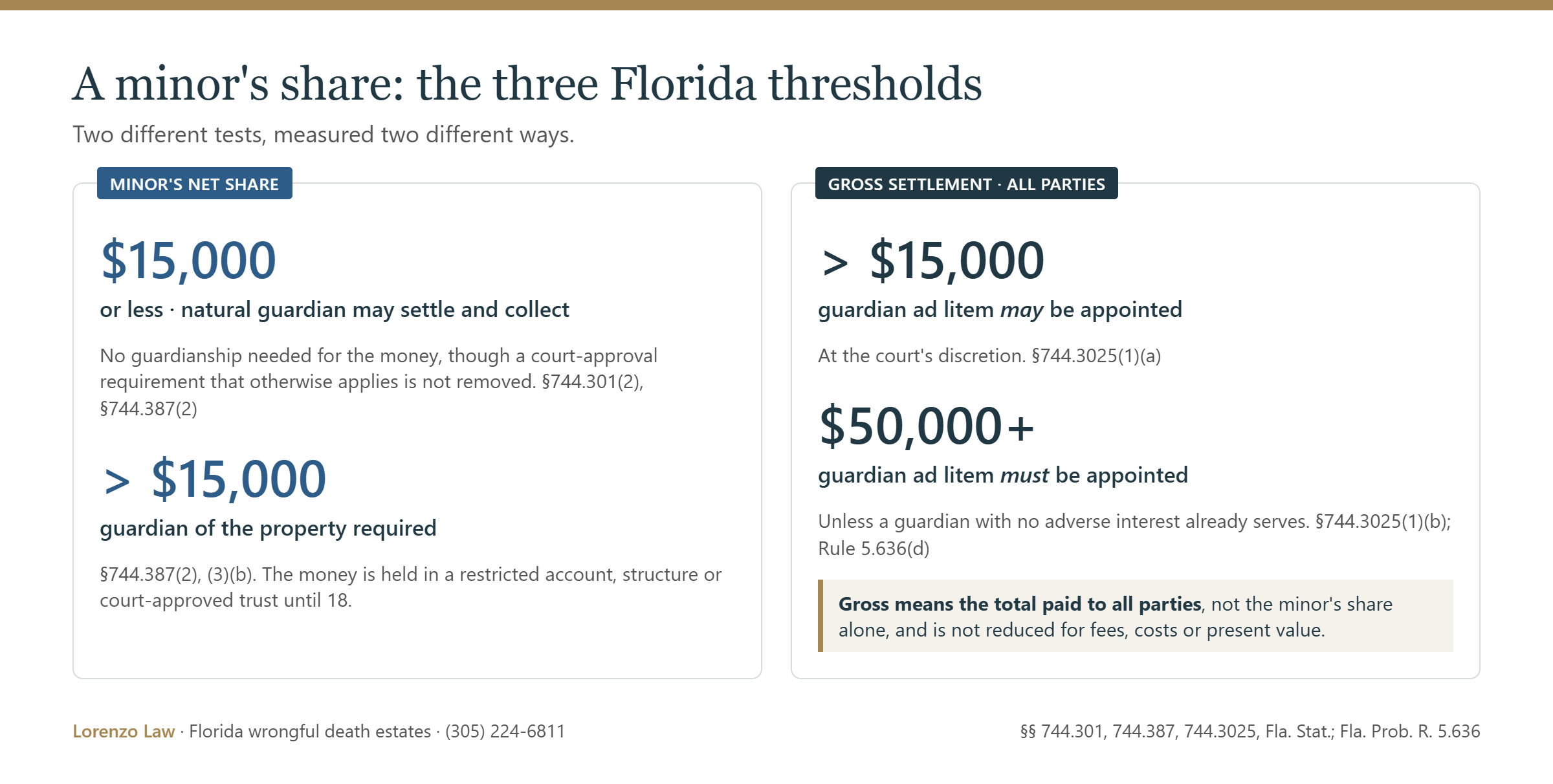
View the “The two Florida minor-settlement tests are measured differently: guardianship on the minor's net share, the guardian ad litem on the gross settlement paid to all parties” chart (zoom in to read; the details are also in the text above).
These are separate tests, measured differently: guardianship turns on the minor’s net figure, the guardian ad litem on the gross. A small individual share does not answer whether settlement approval or a guardian ad litem is needed. A $60,000 gross settlement that nets a minor $34,000 crosses both lines. So does a $60,000 settlement split $30,000 to the minor and $30,000 to another party: the committee note to Rule 5.636 counts the full $60,000 toward the $50,000 line. The Florida minor settlement threshold that comes up most often is the $15,000 net figure.
Ask which protections the child’s share actually requires before setting up a guardianship or distributing anything. Disbursing a large minor’s share without the required protection produces a settlement that can be undone. See the Florida guardianship guide and guardianship for a minor’s share. Review the Florida minor settlement rules before deciding how the funds will be held.
How a minor settlement is approved in Florida: petition, hearing and order
Approval generally runs through a petition to approve minor settlement, filed for the minor’s claim. It sets out the claim, the gross settlement, fees, costs, liens, and the minor’s net share, along with the proposed arrangement for holding the money. Notice goes to the required parties, including the minor if 14 or older. Where a guardian ad litem is appointed, they review the settlement and file a report at least 5 days before the hearing. The court then holds a hearing and enters an order approving the minor settlement, which says how and where the money is to be held. In a pending action this is coordinated with the §768.25 approval.
Families sometimes look for a sample petition or motion to approve a minor settlement. The risk in doing it from a template is real. A petition that misstates the gross figure, omits a lien or proposes the wrong account can be denied, delay payment for months, or produce an order that does not protect the personal representative. In a pending civil case the request is sometimes styled as a motion to approve minor settlement. The risks are the same.
What happens when a minor gets a settlement
A minor’s approved share is usually held in a restricted (blocked) account under a guardianship, in a structured settlement, or in a court-approved trust. Withdrawals before 18 generally require a court order. When the child turns 18, the guardianship ends and the remaining funds are released to them unless a structure or trust provides otherwise. A survivor aged 18 to 24 who is a competent adult receives their own share directly. When a Florida minor settlement guardian ad litem has been appointed, their report shapes how the money is held.
Guardian of the property vs. guardian ad litem
A guardian of the property manages a minor’s money under court supervision until the child turns 18. A guardian ad litem is appointed to evaluate and protect the minor’s interests in the proposed settlement itself. One appointment does not automatically replace the other. An 18- to 24-year-old survivor is a “minor child” for damages but an adult for guardianship, and, if a competent adult, receives their own share directly. For a guardian ad litem, wrongful death settlement work means answering to the court, not to the family.
What is a structured settlement for a minor?
A structured settlement pays some or all of a minor’s share over time, usually through an annuity purchased at settlement, instead of in one lump sum. It can fund needs during childhood and deliver larger payments at set ages after 18. Whether a structure, a guardianship account or a settlement-protection trust is the right vehicle is part of what the court reviews when it approves a minor’s settlement.
Florida’s Free Kill law: what it is and whether it still applies in 2026
What is the free kill law in Florida?
“Free Kill” is the nickname for §768.21(8), which bars certain survivors from recovering non-economic damages when the death was caused by medical negligence. The text:
The damages specified in subsection (3) shall not be recoverable by adult children and the damages specified in subsection (4) shall not be recoverable by parents of an adult child with respect to claims for medical negligence as defined by s. 766.106(1).
Here is the Florida free kill law meaning, explained in plain terms: in a medical negligence death, a child aged 25 or over cannot recover the subsection (3) damages for lost companionship, instruction and guidance and mental pain and suffering, and the parents of a decedent aged 25 or over cannot recover the subsection (4) damages for mental pain and suffering. The nickname, and the free kill law meaning most people take from it, comes from cases where an unmarried adult with no spouse and no minor children dies from a medical error and no one is left with a claim for those losses.
The provision does not say that every claim disappears. It reaches only the subsection (3) damages of adult children and the subsection (4) damages of parents of an adult child. Economic damages and the other categories are set out separately and remain recoverable when their own conditions are met. It also does not make those same losses automatically recoverable in every non-medical case, because the other conditions in each subsection still apply.
Who the free kill law affects: because the Florida free kill law medical malpractice restriction applies only to medical negligence, it reaches adult children (25 and over) of a parent who died from medical negligence; parents of an adult child (25 and over) who died from medical negligence; and families where the decedent left no spouse and no children under 25. A surviving spouse and children under 25 are not barred by §768.21(8). It is the one place in the Florida wrongful death statute medical malpractice cases are treated differently.
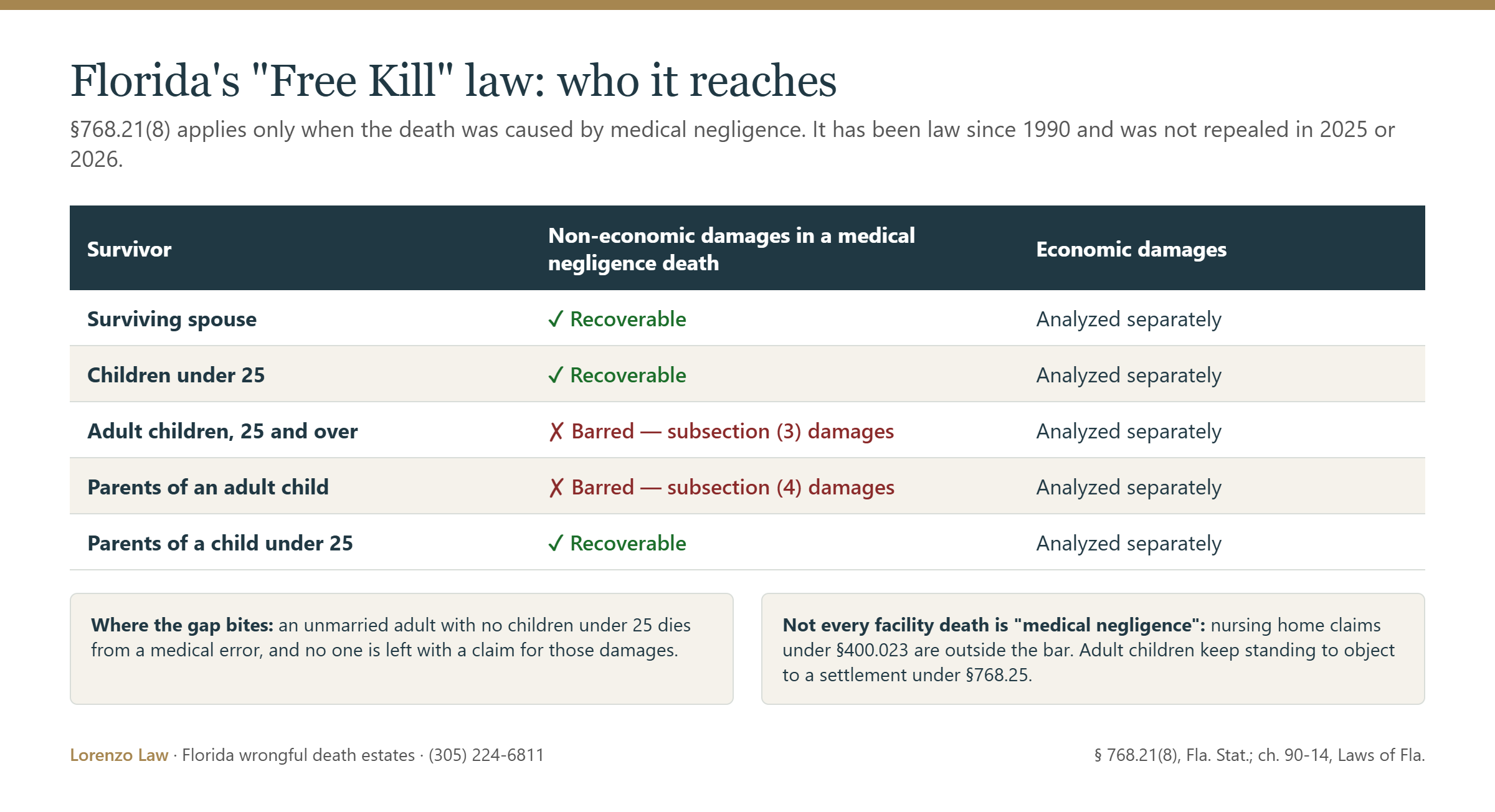
View the “Florida's "Free Kill" law, §768” chart (zoom in to read; the details are also in the text above).
It has been challenged and upheld. The Florida Supreme Court rejected an equal protection challenge in Mizrahi v. North Miami Medical Center, Ltd., 761 So. 2d 1040 (Fla. 2000), on the reasoning adopted in Stewart v. Price, 718 So. 2d 205 (Fla. 1st DCA 1998). The Second District followed Mizrahi in Santiago v. Rodriguez, 281 So. 3d 603 (Fla. 2d DCA 2019), but certified a question about whether the Supreme Court’s later decisions striking down the medical-negligence damages caps undermine it. Mizrahi remains good law.
It cannot be routed around by pleading a survival claim instead. §768.20 abates the personal injury action and §768.21(8) bars those damages, leaving an adult child with neither. The Fourth District said so directly, while noting it was bound to that result. Salfi v. Columbia/JFK Medical Center Ltd. Partnership, 942 So. 2d 417 (Fla. 4th DCA 2006).
What an adult child does keep is standing to object to the amount or allocation of a settlement under §768.25, even with no damage claim of their own. Brunson v. McKay, 905 So. 2d 1058 (Fla. 2d DCA 2005).
When was the free kill law passed in Florida?
The restriction has been in the Act since 1990, when the Legislature added it as part of medical-malpractice reform (Laws of Fla. ch. 90-14, §2). Its substance has not changed since. Under the free kill law, Florida has treated these families the same way for more than three decades.
Is Florida’s free kill law still in effect in 2026?
Yes. It has not been repealed. As of October 2026 it remains the law: no change to §768.21(8) was enacted in the 2026 regular session or the special sessions that followed. The 2025 repeal was vetoed and the 2026 repeal died in the Senate. That is the Florida free kill law 2026 status.
- 2025, HB 6017. Passed the House 104–6 on 26 March 2025 and the Senate 33–4 on 1 May 2025. Vetoed by Governor DeSantis on 29 May 2025; the Florida free kill law veto cited the absence of “safeguards like caps on damages and attorney’s fees.”
- 2026, HB 6003. Passed the House 88–17 on 15 January 2026. It died in Senate Rules on 13 March 2026. The identical Senate bill, SB 1700, never received a committee hearing and died in the Senate Judiciary Committee the same day.
The phrase “free kill law repealed” does not describe what happened in 2025: the bill passed, but it was vetoed. Florida free kill law repeal remains a live political issue, so check the current status before relying on any summary, including this one. If a case involves a medical death and an adult decedent or adult child, this is the first thing to check.
Nursing homes, hospitals and hospice under the free kill law
The restriction applies only to claims for “medical negligence as defined by s. 766.106(1).” Whether a particular nursing home, assisted living, hospice or hospital death falls inside that definition depends on who provided the care and the theory of the claim. Nursing home claims brought under the resident-rights statute, §400.023, are not medical malpractice claims; that statute says expressly that §768.21(8) does not apply to them, and the chapter 766 presuit rules do not apply either. An assisted living, hospice or hospital death that fits the §766.106(1) definition of medical care or services remains subject to the bar. This is decided on the facts and the pleadings. Do not assume a family is barred just because the death happened in a health care facility. The same analysis applies to a wrongful death lawsuit against hospice providers or assisted living facilities.
What kinds of death qualify for a wrongful death claim in Florida?
What is considered wrongful death in Florida? Any death caused by a “wrongful act, negligence, default, or breach of contract or warranty” under §768.19. The test is whether the person could have sued had they lived. A death alone does not establish liability. The table below lists issues to raise with the lawyer handling the liability claim. It is not a promise that Lorenzo Law will handle the underlying litigation in every category.
| How the death happened | Who may be responsible | What complicates it |
|---|---|---|
| Fatal car, truck, motorcycle and pedestrian crashes | The at-fault driver; an employer or trucking company; sometimes a vehicle or parts manufacturer | Policy limits, uninsured/underinsured motorist coverage, and comparative fault |
| Nursing home neglect and abuse | The facility, its management company, sometimes individual staff | An arbitration agreement signed at admission |
| Medical negligence: surgical error, misdiagnosis, medication error, maternal and birth-related death | Physician, hospital, practice group | Chapter 766 presuit investigation and the §768.21(8) restriction |
| Workplace and industrial accidents | A third party such as a contractor, equipment maker or property owner | Workers’ compensation benefits and employer immunity; possible third-party claims |
| Premises liability and drownings | Property owner, occupier, pool or apartment operator | Notice of the dangerous condition |
| Defective products | Manufacturer, distributor, retailer | Identifying the chain of distribution before the deadline |
| Deaths involving alcohol service | Florida’s dram shop statute, §768.125, is narrow | A seller is liable only for willfully and unlawfully serving someone under the legal drinking age, or knowingly serving a person habitually addicted to alcohol |
| Hit-and-run deaths | An unknown or uninsured driver. A wrongful death hit and run case often turns on insurance. | The decedent’s own uninsured motorist coverage may be the main source. Report to police and notify insurers promptly. |
| Deaths involving police or law enforcement | The agency. An individual officer is personally liable only for acting in bad faith, with malicious purpose, or with wanton and willful disregard (§768.28(9)(a)). A wrongful death lawsuit against police agencies starts with notice. | §768.28 notice and immunity rules. Possible federal civil-rights claims under 42 U.S.C. §1983, which run under separate rules and are referred to counsel who handle them. |
| Death involving a public entity | City, county, school district, public hospital | Notice requirements, immunity and recovery limits |
Wrongful death punitive damages are available in Florida where the facts justify them, but they are not automatic. Under Florida statute 768.72 (§768.72), the claim may be pleaded only after a court finds a reasonable evidentiary basis for it, and the right to pursue punitive damages belongs to the personal representative. There is one punitive recovery per death, not a separate claim for each survivor.
Medical malpractice and hospital deaths
A medical malpractice wrongful death claim, including a suit against a hospital, adds the chapter 766 presuit process, expert testimony and the free kill restriction. Families asking whether they can sue a hospital for wrongful death need a medical malpractice wrongful death attorney for the liability side, and an estate opened promptly alongside the presuit process. A hospital wrongful death claim and a wrongful death lawsuit against hospital-employed physicians can involve different defendants and insurers, which is why searches like “suing hospital for wrongful death” rarely have a one-line answer.
Nursing home deaths
Nursing home wrongful death cases, from whether a nursing home death lawsuit goes to court or to arbitration to how a nursing home wrongful death settlement is allocated and approved, often turn first on paperwork: who signed the admission documents, whether there is an arbitration clause, and what authority the signer had. Keep every admission and discharge document. Before suing a nursing home for wrongful death, a nursing home wrongful death attorney will want those documents.
Fatal car, truck, motorcycle and pedestrian crashes
Families who start out searching for an accidental death lawyer or a fatal accident attorney usually need two things: a lawyer for the liability claim (the accidental death lawsuit itself) and an estate for the claim to run through. In a fatal crash the first questions are about insurance: the at-fault driver’s bodily injury limits, any employer or commercial policy, and the decedent’s own uninsured/underinsured motorist coverage. Under §627.4137, a liability insurer must answer a written request within 30 days with a sworn statement of the coverage: the insurer, the insureds, the limits, any coverage defenses, and a copy of the policy. Uninsured/underinsured motorist coverage extends to death claims, and Florida PIP coverage includes a $5,000 death benefit per person (§627.736). Policy limits often decide whether the case resolves quickly, so identify every policy early.
How to file a wrongful death lawsuit in Florida: the civil steps
How does a wrongful death lawsuit work in Florida? In six steps:
- Get the personal representative appointed (above), so the claim is brought by the right party.
- Investigate and preserve evidence, and identify every defendant and insurance policy.
- Serve any required presuit notices: chapter 766 in medical cases, §768.28 for public entities.
- File the Florida wrongful death complaint, identifying every potential beneficiary and their relationship to the decedent, as §768.21 requires.
- Discovery, experts and mediation.
- Trial if necessary. The jury is instructed under the Florida Standard Jury Instructions. The Florida wrongful death verdict form must state each survivor’s and the estate’s damages separately under §768.22.
A sample wrongful death complaint Florida families find online is a poor starting point. A complaint that names the wrong plaintiff or is filed before the required presuit steps can cost the family the claim. One that leaves out a survivor puts that survivor’s interest at risk, because the personal representative brings a single action for everyone.
How do you prove a wrongful death claim in Florida?
What are the elements of a wrongful death claim? The wrongful death elements Florida courts apply are the familiar ones. The liability claim generally has to show that the defendant owed the decedent a duty, breached it, and caused the death, and that the survivors and estate suffered the damages the Act allows. The statutory test in §768.19 is whether the decedent could have recovered had they lived. Proof usually depends on the accident or medical records, witnesses and experts, gathered by the lawyer handling liability. Preserve everything you have: photos, messages, records, receipts and names.
How hard is it to prove wrongful death? It depends heavily on the evidence preserved in the first weeks. An evidence-preservation checklist for families:
- Photos and video of the scene, vehicles or premises, and any doorbell, dashcam or business camera footage (it is often overwritten within days).
- The crash or incident report, witness names and contact details.
- Phone records and messages around the time of the incident.
- Medical, hospital, nursing-home and pharmacy records, and every bill.
- Admission paperwork, contracts and insurance policies.
- Pay stubs, tax returns and benefit records, which support the economic damages.
Knowing how to prove wrongful death usually means knowing which experts the case needs. Expert witnesses (accident reconstructionists, physicians, economists) are usually needed to prove liability, causation and future economic loss. Once appointed, the personal representative can get the decedent’s medical records: federal HIPAA rules require providers to treat a deceased patient’s personal representative as the patient for records purposes, and Florida law requires hospitals (§395.3025) and practitioners (§456.057) to furnish them.
Can you sue a city, county or public hospital for wrongful death in Florida?
Yes, but Florida statute 768.28 sovereign immunity rules change the process. §768.28 includes notice requirements, immunity provisions and recovery limits of $200,000 per person and $300,000 per incident, and the entity’s legal status matters. Amounts above those limits can generally be paid only through a claim bill passed by the Legislature, except that a government defendant may settle above the limits without a claim bill to the extent it carries liability insurance covering the excess. For a wrongful death claim, written notice must be presented to the agency within two years, and for most state entities also to the Florida Department of Financial Services; claims against a municipality, a county or the Florida Space Authority do not require the Department of Financial Services notice. Suit generally cannot be filed until the agency has had the statutory review period, and the agency’s failure to act within 90 days is treated as a denial. Missing the notice can end an otherwise strong claim.
Nursing home arbitration agreements
The arbitration agreement is the first document to find after a nursing home death. Many Florida facilities include an arbitration agreement in the admission packet. If it is enforceable, the case may go to a private arbitrator instead of a jury. Before anyone accepts that, check:
- Who signed it. A relative who was not the resident’s authorized agent may have had no power to bind them. A health care surrogate cannot agree to arbitration for the resident, because agreeing to arbitrate is not a health care decision. A general durable power of attorney can, depending on its terms.
- Whether signing was a condition of admission.
- Whether the resident signed it with capacity. A valid agreement signed by a resident with capacity binds the estate and the survivors in a later wrongful death case, because they stand in the resident’s shoes for this purpose. Laizure v. Avante at Leesburg, Inc., 109 So. 3d 752 (Fla. 2013).
- Whether its terms are enforceable.
Bring the admission paperwork to the first conversation. In a wrongful death suit, Florida courts decide enforceability on the actual agreement and the signer’s authority.
What is the 51% rule in Florida?
Florida’s “51% rule” is the modified comparative negligence bar in §768.81(6). Since CS/CS/HB 837 took effect on March 24, 2023, in negligence actions the rule covers, a claimant found more than 50% at fault for their own harm recovers nothing. At 50% or below, the award is reduced in proportion to the share of fault. Here, the question is the decedent’s own share of fault. Florida statute 768.81 also governs how fault is divided among multiple defendants.
The subsection expressly excludes medical-negligence actions under chapter 766, so it is not a universal rule for every death claim. Florida was a pure comparative fault state for decades. Now, pushing the decedent’s fault past fifty percent can end a case instead of just reducing it. One caveat on timing: a Broward County circuit court has held that the 51% bar cannot be applied retroactively to a claim that accrued before the 2023 tort-reform law took effect, because doing so would impair a vested right. Rosenstein v. McPherson, No. CACE23014709 (Fla. 17th Cir. Ct. Apr. 7, 2026). That is a single trial-court order addressing only retroactive application; it does not strike down the statute and does not bind other courts.
What are the odds of winning a wrongful death lawsuit?
No general win-rate statistic predicts the outcome of an individual case. The outcome depends on the liability evidence, the defenses (especially comparative fault and, in medical cases, the standard of care), the available insurance, and the survivors’ recoverable damages. How many wrongful death cases go to trial? Ask the lawyer handling liability how settlement and trial would each be approached in your case; a strong case is prepared as though it will be tried. Florida Bar rules prohibit lawyers from promising results.
What happens if you lose a wrongful death lawsuit? The family recovers nothing on the claim. Depending on the fee agreement, the costs advanced may or may not be owed. In some cases the losing side can be exposed to the other side’s costs, or to fees under Florida’s proposal-for-settlement statute, §768.79, which runs against the personal representative as the plaintiff. Ask how costs are handled before the case is filed.
How long do wrongful death lawsuits usually take?
How long do wrongful death cases take to settle? It depends on the claim. A clear-liability crash with adequate insurance may resolve within months of the estate being opened. A medical negligence case adds presuit time before suit can even be filed. Contested liability, multiple defendants or a trial can take years. The estate side adds its own steps after settlement: allocation, required approvals, lien resolution, distribution and discharge.
How much does a Florida wrongful death lawyer cost?
How much does a wrongful death lawyer cost? The initial consultation is free. Fees and costs for any representation are agreed separately, in writing. One statute, §768.26, governs how fees and litigation expenses come out of the recovery:
Who pays for a wrongful death lawsuit? Under §768.26, fees and litigation expenses come out of the recovery in proportion to each award. Whether anything is owed up front depends on the written fee agreement.
Attorneys’ fees and other expenses of litigation shall be paid by the personal representative and deducted from the awards to the survivors and the estate in proportion to the amounts awarded to them, but expenses incurred for the benefit of a particular survivor or the estate shall be paid from their awards.
Fees come off proportionally, and costs incurred for one person’s benefit come out of that person’s share. Read with §768.21(7), this means the allocation decision drives three things at once: what each survivor nets, what the fee is measured against, and what a creditor can reach. §768.26 does not set any firm’s price, and it does not promise that nothing will be owed without a recovery.
Ask what the engagement includes, which lawyer or firm will do each part of the work, what expenses may be payable, and whether probate, guardianship, dispute or appellate work needs a separate agreement.
Contingency fees and how the work is billed
The lawyer handling the liability claim is usually paid on a contingency contract that must meet the requirements of Rule 4-1.5(f) of the Rules Regulating The Florida Bar, including the statement of client’s rights. The estate work is quoted separately, in writing, and is not part of that contract. Ask for both agreements before signing either.
How much does a wrongful death lawsuit cost overall? Fees, costs and the estate work are separate lines:
| Work | How it is billed | What governs it |
|---|---|---|
| The liability claim: proving fault and damages | Under the written agreement with the lawyer or firm handling liability. Wrongful death contingency contracts have specific requirements. | Rule Regulating The Florida Bar 4-1.5(f)(4) |
| Opening and administering the estate: appointment, allocation, approvals, closing | Quoted separately, in writing, before work begins | §733.6171 sets the framework for probate attorney compensation |
| Court costs: filing fee, publication of the notice to creditors, certified copies | Costs, not fees; discussed up front | Set by the clerk of the circuit court |
| Referral or joint handling with a trial firm | Any division of fees between firms is documented in advance and disclosed in writing | Rule 4-1.5(g) |
The fee arrangement for the liability claim should not be assumed to cover estate administration or every related proceeding. For the probate component on its own, see what probate costs in Florida.
How much is a Florida wrongful death case worth?
How much is a wrongful death case worth, and how much money can you expect to get in a wrongful death lawsuit? There is no reliable value to quote without reviewing liability, available damages, evidence, defenses, insurance and collection. That is why no wrongful death settlement calculator and no published average wrongful death settlement Florida families find online can tell a family what its case is worth. The factors that drive the number:
- the survivors’ ages and relationships, and which damages each one has;
- the decedent’s earnings, age and life expectancy;
- available insurance, and whether an excess or umbrella carrier is involved;
- whether punitive damages are in play under §768.72;
- whether a public entity is a defendant, under §768.28;
- whether §768.21(8) removes non-economic claims in a medical case;
- the decedent’s own share of fault.
What is the average settlement for wrongful death lawsuits in Florida? No single average reliably values an individual case. Headlines about the highest settlement or verdict, and online averages of wrongful death settlement amounts, say nothing reliable about one family’s case. Neither do “wrongful death lawsuit payout” estimates. The amount paid, the allocation among recipients, and each person’s net after fees, costs and valid obligations are three separate questions.
Do you need one lawyer or two for a wrongful death and probate case?
When hiring a wrongful death lawyer, Florida families are really choosing across two distinct bodies of law: liability and damages on one side, estate administration and distribution on the other. There are three workable structures.
| Structure | Suitable when | Watch for |
|---|---|---|
| One firm handles both | Uncontested appointment, straightforward estate, survivors in agreement | Whether the firm actually practices probate |
| Trial firm plus probate co-counsel | Serious liability case; contested or complex estate; minors among the survivors | Fee division documented in advance under Rule 4-1.5(g); every deadline assigned to one owner |
| Separate, independent counsel | Survivors are in conflict; the proposed representative is adverse to some beneficiaries | Genuine conflicts sometimes require it. Two firms with no protocol can miss deadlines. |
Lorenzo Law works in the second row, as probate counsel alongside the lawyer handling liability. Who is responsible for each part of the matter, and the scope of representation, are set out in the engagement agreements.
Wrongful death estates by county
Lorenzo Law handles Florida probate matters statewide, from South Florida and Central Florida to the Gulf Coast and the Panhandle. The principal office is in Kissimmee, and meetings in Coral Gables and Fort Lauderdale are by appointment. The probate estate is opened in the circuit court for the county where the decedent was domiciled. The civil action has its own venue rules and is often filed somewhere else. The two frequently run at once. Families looking for a South Florida wrongful death attorney for the estate side are served from the same practice. That split between the two courts shapes most wrongful death cases in Florida.
Miami wrongful death lawyer for the estate: Miami-Dade County
Estates for Miami-Dade residents are opened in the probate division of the Eleventh Judicial Circuit. Families looking for a Miami wrongful death lawyer for the estate side come from across the county: Miami, Brickell, Coconut Grove, Coral Gables, Hialeah, Doral, Kendall, Kendale Lakes, The Hammocks, Aventura, North Miami, Miami Gardens, Opa-locka, Liberty City, Miami Beach, Homestead and Cutler Bay. Coral Gables meetings are by appointment. See the Miami-Dade probate court guide and Miami probate attorney.
Fort Lauderdale wrongful death attorney for the estate: Broward County
Broward estates are opened in the Seventeenth Judicial Circuit. That covers Fort Lauderdale, Hollywood, Hallandale Beach, Pembroke Pines, Plantation, Weston, Davie, Cooper City, Tamarac, Coral Springs, Pompano Beach, Wilton Manors, Dania Beach and Oakland Park. Fort Lauderdale meetings are by appointment. See the Broward County probate court guide and Fort Lauderdale probate lawyers.
Orlando and Kissimmee wrongful death attorney for the estate: Orange and Osceola
Orange and Osceola estates are opened in the Ninth Judicial Circuit. Families searching for an Orlando wrongful death lawyer or a Kissimmee wrongful death attorney for the estate side come from Orlando, Kissimmee, St. Cloud, Celebration and the surrounding Central Florida communities. The principal office is in Kissimmee. See the Orange County probate court guide, Kissimmee probate lawyer and Orlando probate lawyer.
Palm Beach, Tampa Bay and Jacksonville
Families looking for a Tampa wrongful death attorney, a Boca Raton or West Palm Beach wrongful death lawyer, or a Jacksonville wrongful death attorney for the estate side are handled the same way as anywhere else in the state, from the county of domicile. Palm Beach County estates (Boca Raton, West Palm Beach, Delray Beach, Boynton Beach) are opened in the Fifteenth Circuit; see Boca Raton and West Palm Beach. Hillsborough (Tampa) estates are opened in the Thirteenth Circuit, Pinellas (St. Petersburg, Clearwater) in the Sixth, and Duval (Jacksonville) in the Fourth; see Tampa, St. Petersburg and Jacksonville. County guides: Palm Beach · Hillsborough · Pinellas · Duval.
Southwest Florida, the Treasure Coast, North Florida and the Panhandle
For a wrongful death claim, Florida has 20 judicial circuits. Lorenzo Law handles Florida probate matters in all 67 counties. Estates elsewhere in the state are opened in the circuit for the decedent’s county of domicile:
- Southwest Florida: Sarasota and Bradenton (Twelfth Circuit), Fort Myers and Naples (Twentieth Circuit). See Sarasota probate attorney, the Sarasota and Manatee probate court guide and the Lee and Collier probate court guide.
- Treasure Coast: Port St. Lucie, Fort Pierce, Stuart and Vero Beach (Nineteenth Circuit). See Port St. Lucie probate attorney.
- Central and North Florida: Daytona Beach and Deltona (Seventh Circuit), Ocala and Lake County (Fifth), Lakeland (Tenth), Gainesville (Eighth), and Tallahassee (Second).
- Panhandle: Pensacola and Fort Walton Beach (First Circuit) and Panama City (Fourteenth). See Fort Walton Beach probate lawyer.
Full list: Florida probate service areas.
What do you need for a free consultation?
Start with a short description of the matter and your role: a family member, an appointed representative, or a lawyer looking for probate support. Gather what you already have:
- Dates of injury and death, the decedent’s domicile, and where the incident occurred.
- A certified copy of the death certificate; the original will and any codicils, if they exist.
- Names, relationships and ages of everyone who might be a survivor (ages matter because of the under-25 rule), with any adoption, parentage or dependency information.
- Existing probate, guardianship or civil case numbers, Letters and orders.
- Names of current lawyers and a list of known deadlines, notices and hearing dates.
- Whether a government entity may be involved, and any nursing-home admission paperwork.
- Proposed settlement, allocation and release documents, if negotiations have reached that stage.
- Known estate assets, bills, expenses, and lien or reimbursement letters.
- Any concern about family disagreement, a minor, incapacity, or public benefits that a recovery could affect.
Use the first website message for a brief summary only. Do not send Social Security numbers, account numbers, detailed medical records or confidential litigation materials through a general inquiry form. Ask how to provide documents after the office has reviewed your inquiry. If the death was recent and nothing has been started on the estate, begin with what to do when someone dies in Florida.
Florida wrongful death and probate: frequently asked questions
Who gets the money from the case?
The Florida wrongful death statute names them. The survivors defined by §768.18 (spouse, children, parents, and dependent blood relatives or adoptive siblings), each recovering the specific categories §768.21 assigns to them. The estate separately recovers the decedent’s own lost earnings, net accumulations, and medical and funeral expenses it paid. The two groups are governed by different rules.
What is the difference between a wrongful death claim and an estate claim in Florida?
What is a wrongful death claim? It is a claim for the survivors’ own losses, and it travels with the estate’s claim under the FL wrongful death statute. Both are recovered in the same lawsuit. The survivors’ damages under §768.21(1)–(5) compensate the family for their own losses. The estate’s damages under §768.21(6) compensate for the decedent’s lost earnings to death, net accumulations, and medical and funeral bills charged to the estate. Both are brought by the personal representative, but only the estate’s share is exposed to the decedent’s creditors.
Do I need a wrongful death lawyer near me?
A local wrongful death attorney near you can make sense for the liability claim, especially if it may go to trial. The estate is a different matter. It is filed in the county where the person was domiciled, and much of the probate work is done by filing. Lorenzo Law handles Florida probate matters statewide, with the principal office in Kissimmee and meetings in Coral Gables and Fort Lauderdale by appointment. Consultations are available in English or Spanish. Where a case calls for local trial counsel on liability, Lorenzo Law can work as probate co-counsel alongside them.
Is it too early to call before anyone has been appointed personal representative?
No. Getting the right person appointed is usually the first task, and it takes time while the limitations period runs. Call as soon as the family is ready to talk. You do not need Letters, a lawyer or a decision about who should serve before the first conversation.
Which wrongful death firm handles the probate coordination?
Ask who will handle the probate coordination before choosing a firm. On cases where Lorenzo Law is engaged for the estate side, it handles appointment, allocation, approvals, minors’ shares and distribution, and coordinates with the lawyer handling liability under a written division of responsibilities.
Talk with Lorenzo Law About the Estate Side of a Wrongful Death Claim
Talk to Jose M. Lorenzo, Jr. about the estate side of a wrongful death claim: (305) 224-6811. Whether you are a family member or a lawyer looking for probate support, include your role, the relevant dates, whether an estate is open, and whether a lawyer is already handling the claim. You can also write from the contact page. The initial consultation is free. Fees and costs for any representation are agreed separately, in writing.
Only the initial consultation is free; the scope and fee for legal work are confirmed separately. Whether a wrongful death matter is handled with, or referred to, another lawyer or firm is settled in writing at the outset.
Request a free initial consultation or Call (305) 224-6811
Lorenzo Law’s offices are in Coral Gables (Miami-Dade County) and Fort Lauderdale (Broward County), and the firm handles the estate side of wrongful death claims statewide.
Related: Florida probate guide · Florida probate lawyer · the Florida probate process · Florida probate litigation · surviving spouse rights · how long probate takes in Florida · assets exempt from probate · Florida probate rules and deadlines.
This page offers general information about Florida law and is not legal advice for a specific case. Reading it or sending an inquiry does not create an attorney-client relationship. Every case turns on its own facts, and the law changes. Prior results do not guarantee future outcomes. It reflects the law as of October 2026.
About the Author
- Jose M. Lorenzo, Jr. is the firm’s sole attorney. He was admitted to The Florida Bar on October 4, 2013, Florida Bar No. 107002. His earlier probate and litigation paralegal experience came before his admission and is not years of licensed attorney practice. You can check his Florida Bar profile. He is a wrongful death attorney Florida families and trial lawyers can reach directly for the estate side.
- His practice focuses on probate, estate administration, guardianship and probate litigation, including the probate side of Florida wrongful death claims. That includes Florida wrongful death law as it applies to estates, survivors and settlements.
- Clients work directly with Jose on the matters he handles. Wrongful death matters may be referred to, or handled together with, another lawyer or law firm.
- Consultations in English and Spanish. Principal office in Kissimmee; Coral Gables and Fort Lauderdale by appointment.
Authorities Cited on This Page
The Florida statutes cited here are the 2026 Florida Statutes, and the court rules are cited from the compilations in effect on October 1, 2026. Statutory and rule text controls over any summary on this page. Legal propositions on this page were verified in October 2026.