
Boca Raton Probate Lawyer
A Boca Raton probate lawyer helps a family settle the estate of someone who lived or owned property in Boca Raton: where the case is filed, which court route fits, who may sign for the house or condominium and what has to be done before anything is distributed.
This guide is written for families looking for a Boca Raton probate attorney for estate administration, including families whose parent spent winters in Boca Raton and summers in New York, New Jersey or another state. It covers where a Boca Raton estate is filed, the Palm Beach County courthouses and probate checklists, summary, formal and ancillary administration, the house or condominium, homeowners’ and condominium associations, homestead, out-of-state personal representatives, timing and published flat fees.
Request a free initial consultation. Only the initial consultation is free; representation fees and costs are agreed separately in writing.
Request a free initial consultationCall (305) 224-6811
Consultations by phone or video in English or Spanish; meetings by appointment in Coral Gables or Fort Lauderdale. Lorenzo Law’s principal office is in Kissimmee. There is no Lorenzo Law office in Boca Raton.
Go straight to: Where the estate is filed · Courthouse and division · Seasonal residents · Out-of-state owners · The house or condo · Fees · More questions
By role: if a parent just died, start with the first weeks; if you were named personal representative and live outside Florida, with serving from out of state; if you are a beneficiary with questions, with who the lawyer represents; if the family disagrees, with disputes; if you are planning for your own home, with planning ahead.
Boca Raton and southern Palm Beach County · Seasonal and out-of-state owners · Houses, condominiums and HOA communities · Published flat fees · English and Spanish
All guide sections(30)
Boca Raton probate at a glance
Short answer. If the person who died was domiciled in Boca Raton, the estate is generally opened in Palm Beach County, in the probate division of the Fifteenth Judicial Circuit; Boca Raton has no probate court of its own. If the owner was domiciled in another state or country, a Boca Raton home or condominium can bring a separate Florida case to Palm Beach County. Before choosing a route, the family needs to know how the property and each account were titled, where the owner was domiciled and who survived.
| Where it is filed | For a Boca Raton domiciliary, Palm Beach County (Fifteenth Judicial Circuit, probate division). A beneficiary’s Boca Raton address does not by itself make Palm Beach County the place to file. Where the estate is filed |
|---|---|
| Which courthouse | Palm Beach County has a Main Courthouse in West Palm Beach and branch courthouses, including the South County Courthouse in Delray Beach. According to the Clerk, the courthouse a probate case is assigned to follows the ZIP code of the petitioner’s attorney’s office, or the decedent’s last known address when there is no attorney. Courthouse and division |
| Which route | Summary administration is available if the Florida assets subject to administration, less exempt property, are worth no more than $150,000, or the owner died more than two years ago, and any will does not direct formal administration; this route is open to residents and nonresidents alike. Otherwise, formal administration, or ancillary administration when the owner was domiciled outside Florida. Which route fits |
| Seasonal owner | Domicile, not the months spent in Boca Raton, decides whether the main estate is in Palm Beach County or in another state. A Florida declaration of domicile is one fact among many. Seasonal residents |
| The house or condo | Title decides whether the property needs probate at all. If it does, only a person with authority can sell or rent it, and the association’s documents decide whether a buyer needs approval. The house or condo |
| Flat fees | Flat fees for summary and uncontested formal administration; ancillary administration is quoted per matter. Fees |
| How long | In summary administration, Jose aims to finish within one to two months from retention, as a goal and not a guarantee; many uncontested formal administrations take roughly six months to a year. Timing |
| Who handles it | Jose M. Lorenzo, Jr., a solo attorney: the attorney you speak with at the first call is the attorney who handles any matter the firm accepts. Who handles your case |
What does a Boca Raton probate attorney do?
A Boca Raton probate attorney, or probate administration lawyer, first sorts out who needs representation and which assets need a court case at all, then files the case in the right county, guides the personal representative through notices, creditors, the property and distribution, and keeps the family’s roles separate. The work depends on your role: a nominated personal representative, a beneficiary, a trustee and an heir who questions a transaction need different advice.
This page is about probate administration, sometimes called estate administration: opening the estate, obtaining authority, dealing with creditors and the property, and distributing what is left. Families sometimes search for an inheritance lawyer or for probate services in Boca Raton; in Florida, that work is probate administration, trust administration and, when there is a disagreement, probate litigation. Being part of the same family does not mean everyone has the same legal interests or the same lawyer. When Lorenzo Law represents the personal representative, it does not automatically represent each beneficiary; a beneficiary who questions an accounting or a proposed distribution may need separate advice.
Case-fit checklist
- Your relationship to the person who died, and whether you are seeking appointment, expecting an inheritance, acting as trustee or questioning someone’s actions.
- The date of death, the person’s permanent home (domicile) and where the Florida assets are. Say so if another estate case is already open, in Florida or in another state.
- How the house or condominium and each account were titled. A will, a trust and beneficiary designations are read together with the ownership records.
- Whether there is a surviving spouse, a minor child, a missing will, an earlier owner still on the deed or an asset whose owner is unclear.
- Any court notice, creditor claim, association collection letter, proposed sale or distribution deadline, with the actual document and the date you received it.
- Whether the family agrees about the will, who should serve and what should happen to the property. Agreement helps, but it does not replace the court authority the law requires.
Scope by situation
| Your situation | Route to discuss | Record or fact that changes the answer | Scope boundary |
|---|---|---|---|
| You have been nominated to handle an estate | Formal administration and appointment | Will, domicile, family information, assets and any existing case filings | Nomination is not court appointment; confirm authority before acting |
| The estate may qualify for a shorter proceeding | Summary administration | Value subject to Florida administration after creditor-exempt property, time since death and any will direction for formal administration | Still a court proceeding; qualifying does not guarantee a prompt order or erase creditor issues |
| The owner lived outside Florida and owned a Boca Raton home or condo | Florida administration, including ancillary administration where appropriate | Recorded deed, domicile, the other state’s probate papers and the type of ownership | A second home is not automatically a probate asset; Lorenzo Law handles the Florida side, not another state’s law |
| You are an heir or beneficiary seeking information | Review of your own rights and documents | Notices, will, case number, accountings and the dates you received them | The personal representative’s lawyer does not automatically represent you |
| You suspect misconduct or want to challenge a will or a distribution | Separate dispute review | The document challenged, service dates and supporting records | Litigation is not included because administration was retained; see Boca Raton probate litigation |
| You want to avoid a future probate for your own property | Separate estate-planning consultation | Current ownership and planning goals | Planning for the future does not change the title of an owner who has already died |
A sale of the house or condominium may also need a separately retained closing agent or title company: Lorenzo Law does not provide real estate closings or title insurance. Tax returns, appraisals, translations and work under another state’s law may need other professionals; who hires them, does the work and pays for it is set in each engagement. The written engagement names the client, the accepted work and the fee.
Where is a Boca Raton estate filed?
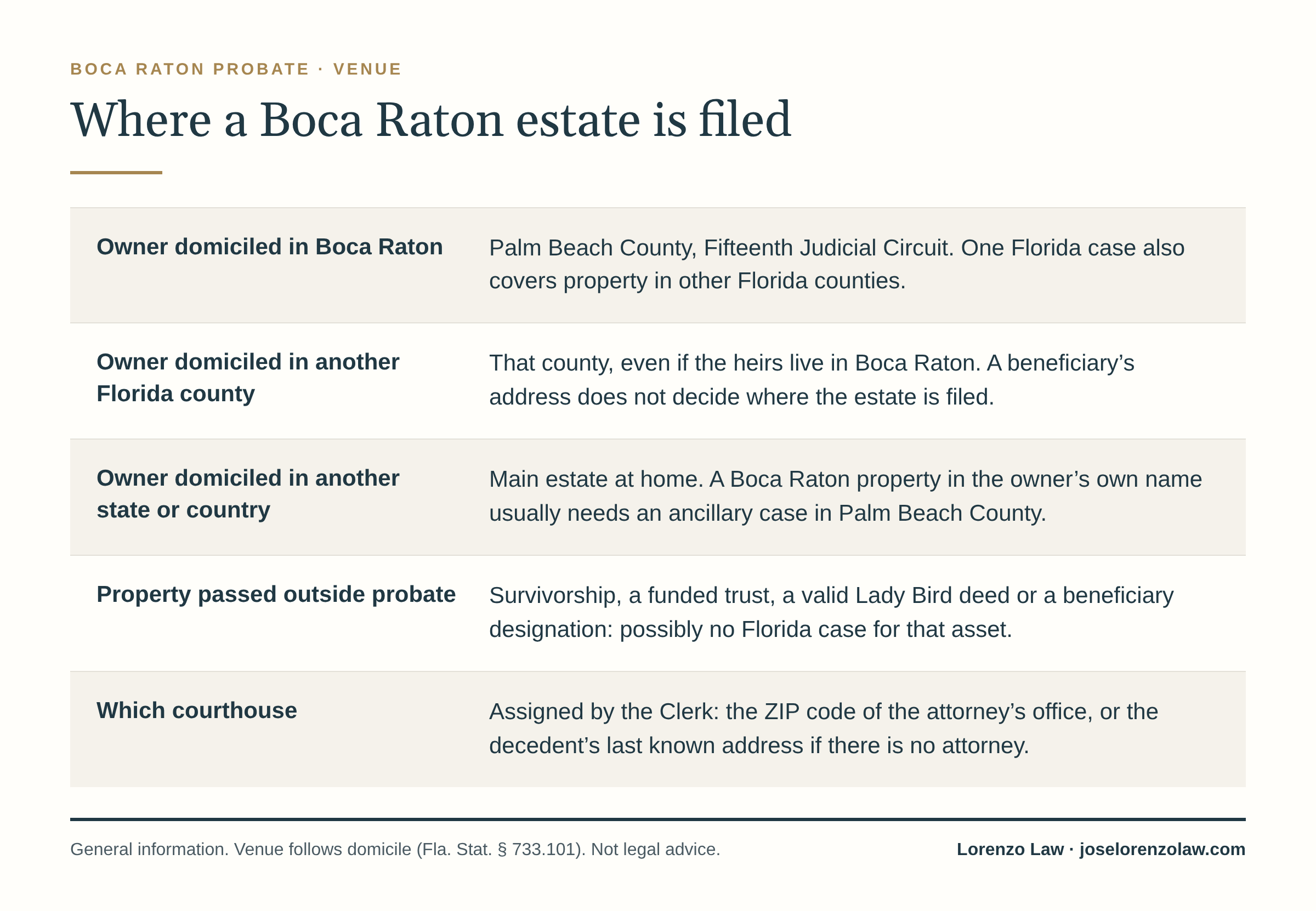
If the person who died was domiciled in Boca Raton, the estate generally belongs in Palm Beach County, in the probate division of the Fifteenth Judicial Circuit, and that case also covers property the person owned in other Florida counties. It is not decided by where the heirs live, where the lawyer’s office is or where the person died.
Florida’s venue statute starts with the county where the person was domiciled. When the person who died was not domiciled in Florida, the estate may be opened in any county where the person owned property; if there was neither a Florida domicile nor Florida property, the statute points to the county where a debtor of the person lives (section 733.101). A beneficiary’s residence is not part of that test. A Boca Raton home can therefore bring a nonresident’s estate to Palm Beach County, but a daughter who lives in Boca Raton does not bring her father’s estate there if he was domiciled in another Florida county. A case filed in the wrong county is not automatically void: the court may transfer it within Florida, and actions taken before the transfer stand (section 733.101(3)).
Boca Raton is a city in southern Palm Beach County. Many homes west of the city limits, often called West Boca, carry a Boca Raton mailing address but lie in unincorporated Palm Beach County; either way, the county is Palm Beach. Highland Beach and Delray Beach to the north are also in Palm Beach County, while Deerfield Beach and Parkland, just across the county line to the south, are in Broward County. A mailing address that says “Boca Raton” is not a substitute for checking where the person was domiciled and where each property is.
Two hypothetical examples
The beneficiary lives in Boca Raton. A daughter lives in Boca Raton, but her father was domiciled in Orange County, Florida, when he died. Her address does not make Palm Beach County the place for his estate; ordinarily it is opened in Orange County, where he was domiciled. The family should gather the father’s domicile records and check whether an estate case was already opened.
The owner lived in another state. A widow domiciled in New York owned a Boca Raton condominium in her own name. A Florida case is usually needed for the condominium, and it can be opened in Palm Beach County, where the unit is (sections 733.101(1)(b) and 734.102). If the unit had passed under a valid survivorship arrangement or was held in a funded trust, the route could be different. Obtain the recorded deed and any New York estate papers before deciding. These examples assume the stated facts; they are not client results or title opinions.
Chart: where a Boca Raton estate is filed
Which Palm Beach County courthouse handles a Boca Raton probate case?
Probate for Boca Raton estates is handled by the Fifteenth Judicial Circuit in and for Palm Beach County. There is no separate probate court or probate courthouse in Boca Raton. The Clerk of the Circuit Court and Comptroller, Palm Beach County, says that a probate case is assigned to a courthouse by the ZIP code of the petitioner’s attorney’s office location, or by the decedent’s last known address when there is no attorney, under the Circuit’s Administrative Order 6.101.
Palm Beach County’s courthouses include the Main Courthouse in West Palm Beach, the North County Courthouse in Palm Beach Gardens and the South County Courthouse in Delray Beach. Because the assignment follows the attorney’s office ZIP code when there is an attorney, a Boca Raton estate handled by a lawyer whose office is outside Palm Beach County is not automatically assigned to the South County Courthouse. Families should not assume which courthouse or division will have the case until it is filed; the case number and the assigned division appear on the court papers.
The Fifteenth Circuit publishes division instructions for its probate divisions. Its instructions for Division IA (Main Courthouse) and Division IZ (South County Courthouse) say that checklists are required for probate filings, that waivers, consents, renunciations and receipts must be notarized, and that most matters proceed on proposed orders submitted through the court’s online system rather than at a hearing. Division IZ’s instructions say that parties who live outside Palm Beach County or outside Florida may appear by Zoom without a court order; evidentiary hearings and trials are generally in person. Those are court instructions that the court can change; the instructions for the assigned division at the time of filing are the ones that apply.
Do you have to go to the courthouse?
Often, no. According to the Palm Beach County Clerk, most uncontested probate cases need no hearing, and papers can be filed by mail or electronically through the Florida Courts E-Filing Portal. A phone or video consultation with Jose is not permission to appear remotely before the court; remote appearance at a hearing is governed by the assigned division’s instructions or by order of the judge. A family member who will sign a notarized waiver or consent from another state can usually sign before a notary where they live.
Public probate records in Palm Beach County
Most Palm Beach County probate court files are public records that can be searched through the Clerk, including the petition, the will once it is filed and the orders. Some documents are not: estate inventories and accountings are confidential and available only to the personal representative, the personal representative’s lawyer, interested persons and others the court allows for good cause (section 733.604), and Social Security and bank account numbers are kept confidential in the court file (section 119.0714). Families who want privacy for a home or an investment account usually get it through planning, such as a funded trust, rather than through the probate file.
Palm Beach County probate resources
| Resource | What it is used for | What to keep in mind |
|---|---|---|
| Clerk of the Circuit Court and Comptroller, Palm Beach County | Deposit of an original will, case filings, the court file and certified copies | The Clerk’s staff cannot give legal advice or say which route an estate should use |
| Fifteenth Judicial Circuit probate division instructions and checklists | Filing requirements for formal, summary and ancillary cases, homestead petitions, sales of real property and discharge | Each division publishes its own instructions; check the version current at filing |
| Palm Beach County official records | Recorded deeds, mortgages, liens and recorded probate orders affecting real property | A recorded document shows the record, not the legal effect; a deed’s wording decides whether it needs probate |
| Palm Beach County Property Appraiser | Parcel details, the owner of record, assessed value and exemptions such as homestead | The appraiser’s homestead exemption is a property-tax status; it does not decide probate homestead |
| Florida Courts E-Filing Portal | Electronic filing in Florida courts | With limited exceptions, every Florida personal representative must be represented by a lawyer admitted in Florida (Florida Probate Rule 5.030). |
Palm Beach County probate checklists
The Fifteenth Circuit’s probate page publishes checklists for the filings families most often need: formal administration with or without a will, summary administration with or without a will, formal and summary ancillary administration, petitions to determine homestead (with a formal or summary petition, or on their own), petitions to sell real property and discharge. According to the division instructions, a petition to determine homestead can be accepted without opening a summary administration when that is the only relief needed. A checklist lists what the court expects to see; it does not decide which route applies, and filing the wrong route still leaves the family with the wrong order.
What happens to the original will after a death in Boca Raton?
Florida’s 10-day rule requires a person who has custody of a will to deposit it with the clerk of the court that has jurisdiction within 10 days after receiving information that the person who made it has died (section 732.901). For a Boca Raton domiciliary, that is ordinarily the Palm Beach County Clerk. Depositing the will does not open an estate or appoint anyone.
According to the Palm Beach County Clerk, an original will may be filed in person at any courthouse location or mailed to the Clerk’s probate division at P.O. Box 4667, West Palm Beach, FL 33402, together with a certified death certificate or other proof of the date of death. Keep a copy of the will and of the cover letter before sending the original, and use a trackable method. If the will is in a bank safe-deposit box, Florida law allows limited access to look for a will and to deliver it to the court (sections 655.935 and 733.6065). An electronic will held by a qualified custodian is deposited by the custodian under the electronic-will statutes rather than mailed as paper. If the original cannot be found, a copy is not automatically enough: establishing a lost or destroyed will is a separate court proceeding with its own proof requirements.
A will made in another state is not automatically invalid in Florida. A will signed by someone who was not a Florida resident is generally valid in Florida if it was valid where it was signed, but a handwritten will that was not witnessed as Florida requires, or an oral will, is not recognized here (section 732.502(2)). A self-proving affidavit can avoid the need to locate the witnesses. Bring the original, every codicil and any earlier will you find, even one you believe was revoked.
Which probate route fits a Boca Raton estate?
The three Florida probate routes are summary administration, formal administration and ancillary administration. Summary administration fits when the assets subject to administration in Florida, less property exempt from creditors, are worth no more than $150,000, or the person died more than two years ago, and any will does not direct formal administration. Formal administration appoints a personal representative with letters of administration. Ancillary administration is the Florida case for a person who was domiciled in another state or country.
That $150,000 figure is the Florida threshold for summary administration (section 735.201). The $150,000 test is not the size of the whole estate. It counts only what must pass through the Florida court: a condominium already held in joint tenancy with right of survivorship, an account with a payable-on-death beneficiary or a house deeded into a funded trust usually does not count. Property exempt from creditors, such as certain household furniture and vehicles up to statutory limits, is subtracted (section 735.201). In a summary administration there is no personal representative; the court orders distribution to the people entitled. Before the petition is filed, the petitioner must make a diligent search for creditors, and the order does not end the claims of creditors who are owed and not paid; those who receive property can remain liable for two years after death (section 735.206).
Formal administration is used when summary administration is not available or not appropriate: for example, when the estate is larger, when someone has to sell the home, collect assets, deal with creditors through the claims process or bring or defend a lawsuit, or when the will requires it. The court appoints a personal representative and issues letters of administration, which banks, the association and buyers rely on as proof of authority. When a minor child is a beneficiary, the amount matters: a parent acting as natural guardian can generally receive up to $15,000 for the child without a guardianship (section 744.301(2)), while a larger share usually needs a guardianship of property or another arrangement the law allows, and the court may direct that funds be placed in a designated financial institution (section 69.031).
Very small estates can sometimes be handled without a full case. If the only assets are exempt personal property and other personal property worth no more than the funeral expenses and the medical and hospital expenses of the last 60 days of the final illness, the court may authorize a disposition without administration (section 735.301). Florida’s small-estate shortcuts are narrow. Disposition without administration covers only personal property on narrow facts (section 735.301), and an heir’s affidavit is available only for an intestate estate of personal property, when the person died more than one year ago, with nonexempt property of no more than $20,000 plus certain expenses (section 735.304). Neither can transfer a Boca Raton house or condominium. More on the shorter route: summary administration in Florida.
Summary, formal and ancillary administration compared
| Point | Summary administration | Formal administration | Ancillary administration |
|---|---|---|---|
| When it fits | Florida assets subject to administration, less exempt property, worth no more than $150,000, or death more than two years ago; the will, if any, does not direct formal administration | Summary is not available or not appropriate, or authority is needed to act for the estate | The owner was domiciled outside Florida and left Florida property needing administration |
| Personal representative | None; the court orders who receives the property | Appointed, with letters of administration | Appointed in Florida; a representative the will names for the Florida property, or otherwise the domiciliary representative, has priority if qualified |
| Creditors | Diligent search before filing; distributees may remain liable for two years after death | Notice to creditors published, and served on known or reasonably ascertainable creditors; claims period | Notice to creditors in Florida, as in a formal case |
| Typical records | Death certificate, original will if any, asset values, family information | Same, plus records for each asset, the property and any debts | Authenticated copies of the will and of the other state’s probate papers, the Florida deed |
| Flat fee (see fees) | Flat fee | Flat fee, if uncontested | Quoted per matter |
Which Boca Raton assets may not need probate?
An asset with a living joint owner who has a right of survivorship, a named beneficiary, a payable-on-death or transfer-on-death designation, or title in a funded trust usually passes outside probate. An asset titled only in the name of the person who died usually needs probate, unless it is protected homestead that can be handled through a homestead determination or another exception applies.
The deed or account record decides this, not what the family was told or what the will says. A will does not control an account with a beneficiary designation. A condominium deeded to a husband and wife usually passes to the survivor as tenants by the entirety; a condominium deeded to two siblings without survivorship words usually leaves the deceased sibling’s half to be administered. An enhanced life estate deed, often called a Lady Bird deed, can pass the home to the named remainder beneficiaries without probate if it was properly signed and recorded. A trust avoids probate only for what was actually transferred into it.
How common titles affect a Boca Raton estate
| How the asset was held | Usual result at death | What to check |
|---|---|---|
| Spouses as tenants by the entirety | Passes to the surviving spouse outside probate | The recorded deed and the death certificate |
| Joint tenants with right of survivorship | Passes to the surviving joint owner | The exact survivorship wording on the deed or account |
| Tenants in common, or co-owners with no survivorship words | The deceased owner’s share is administered in the estate | The deed, and the share each owner holds |
| Enhanced life estate (Lady Bird) deed | Passes to the named remainder beneficiaries, if valid | The deed’s wording, recording, and any lien or homestead issue |
| Funded revocable trust | The successor trustee administers it under the trust | Whether the deed or account is actually in the trust’s name |
| Account with a named beneficiary or POD/TOD designation | Paid to the beneficiary on a claim to the institution | The institution’s current designation record |
| Sole name, with no designation | Usually needs probate, subject to homestead and other exceptions | Value, homestead status and the family |
A trust is not a free pass from obligations. A successor trustee has notice and information duties to the qualified beneficiaries (section 736.0813); when the settlor dies, the trustee of a revocable trust must file a notice of trust with the court of the county of the settlor’s domicile and the court with jurisdiction of the estate (section 736.05055); and revocable-trust property can be reached for estate expenses and claims if the probate estate is not enough (section 733.707(3)). Trust administration is separate from probate; Lorenzo Law can review it as a separate matter. More on this: Florida non-probate assets, assets exempt from probate and when probate is not necessary.
What if the owner of a Boca Raton home lived in another state?
If the person who died was domiciled in another state or country and owned Florida property in his or her own name, a Florida case is usually needed for that property. It is generally an ancillary administration opened in the county where the property is, so a Boca Raton house or condominium brings the Florida case to Palm Beach County. The main estate stays in the state of domicile.
An ancillary administration recognizes the out-of-state estate in Florida and gives a Florida personal representative authority over the Florida property (section 734.102). The court generally gives preference to a representative the will names for the Florida property and, otherwise, to the representative already appointed in the state of domicile, if qualified to serve in Florida (section 734.102). Filing ordinarily needs authenticated copies of the will and of the other state’s probate papers; an ordinary photocopy is not enough. Owning property in two Florida counties does not make a Florida resident’s estate ancillary: the estate of a Florida domiciliary is a single Florida case in the county of domicile.
A personal representative who lives in another state can usually handle a Boca Raton estate without moving to Florida: papers are signed where he or she lives. Florida lets the petition and joinders be signed under penalty of perjury, so a notary is usually not needed; when a notarized document is needed, it can be signed online with a Florida online notary, or abroad before a U.S. consular officer or a local notary (Florida Probate Rule 5.020; sections 92.525, 117.215 and 92.50(3)). In Palm Beach County, the division instructions still require waivers, consents, renunciations and receipts to be notarized. The lawyer files the papers, and most uncontested matters are decided without a hearing. Travel may still be needed for a hearing the court sets in person, or to clear out and secure the property. More on this: Florida ancillary probate.
Two shorter routes exist for nonresidents. Summary administration is available to the estate of a nonresident if the Florida estate meets the summary conditions described above (section 735.201). Short-form ancillary administration may be available when a nonresident died with a will, the Florida property subject to administration had a gross value of no more than $50,000, and the foreign personal representative files within 2 years after death (section 734.1025). Whether a property falls under either route depends on its value and on how it was titled; a condominium owned with a surviving joint tenant may not need any Florida case.
Can an out-of-state relative serve as personal representative?
Being named in the will is not the same as being appointed. Florida allows a person who is not a Florida resident to serve as personal representative only if he or she is related to the person who died in the ways the statute lists, such as a child, parent, spouse, brother, sister, uncle, aunt, nephew or niece, or the spouse of a person in those categories (section 733.304). A nominated friend who lives in New Jersey, for example, may not qualify, even if the will names him. Before letters issue, a personal representative, unless a Florida corporate fiduciary or a Florida-resident lawyer, must designate a resident agent, and a bond is required unless the will or the court waives it (section 733.402 and Florida Probate Rules 5.110 and 5.235).
Records for an out-of-state owner’s Florida case
| Record | Why it matters | Where it usually comes from |
|---|---|---|
| Recorded deed for the Boca Raton property | Shows whether the property needs a Florida case at all | Palm Beach County official records or the closing file |
| Authenticated copy of the will and the other state’s probate order or letters | Supports an ancillary petition and the domiciliary representative’s priority | The probate court of the state of domicile |
| Certified death certificate | Proof of death for the court, the association and the title company | The state where the death occurred |
| Association, mortgage and tax statements | Debts that attach to the property and continue while the case is open | The association, the lender and the Palm Beach County Tax Collector |
| Names and addresses of the beneficiaries and heirs | Florida notices must reach the interested persons | The family and the domiciliary estate papers |
If the owner lived outside the United States
Families of owners who lived in Canada, Latin America or Europe may face extra steps with foreign documents, and the Florida court decides how a foreign will or foreign court papers are treated. Separate federal tax rules can apply. A sale of U.S. real property by the estate of an owner who was neither a U.S. citizen nor a U.S. resident can trigger federal income-tax withholding, and an estate-tax return is required if that owner’s U.S. gross estate exceeded $60,000. This is general information; Lorenzo Law does not prepare tax returns, and the family’s tax adviser, in the United States and abroad, should review these points.
Where is probate filed for a seasonal Boca Raton resident?
For a snowbird or other seasonal resident who split the year between Boca Raton and another state, the main estate is filed in the state of domicile, which is the place the person intended as a permanent home, not simply where he or she spent the most time. If the person was domiciled in Boca Raton, the estate is opened in Palm Beach County; if the person was domiciled in another Florida county, it is opened in that county; and if another state was the domicile, Florida may need only an ancillary case for the Boca Raton property (sections 733.101 and 734.102).
Domicile is a question of intent shown by facts. Courts look at where the person had a homestead exemption, filed a declaration of domicile, voted, held a driver’s license and registered vehicles, filed income-tax returns, kept doctors, bank accounts and memberships, and described his or her home in legal documents. A Florida declaration of domicile filed with the Clerk (section 222.17) is evidence, but it is one fact among many and does not control on its own. When the facts point both ways, two states may each claim the estate, and the other state’s taxes may depend on the answer; Lorenzo Law advises on the Florida side and does not give advice on another state’s law.
Facts that usually show where a seasonal resident was domiciled
- A homestead exemption on the Boca Raton home, recorded with the Palm Beach County Property Appraiser, or a residence exemption in the other state.
- The address on the driver’s license, voter registration, vehicle registration and federal income-tax returns.
- A recorded Florida declaration of domicile, and any statement of domicile in the will or trust.
- Where the person kept doctors, banks, a place of worship, clubs and personal belongings of sentimental value.
- The number of months spent in each place, read together with the facts above rather than on its own.
If the family is unsure, it should gather these records before any petition is filed in either state, and say so at the first call. Filing the main case in the wrong state can mean repeating the work. More on this subject: establishing a Florida domicile and serving as an out-of-state executor in Florida.
Who can sell or manage a Boca Raton house or condo during probate?
If the house or condominium is a probate asset, only a person with authority can sell it: a personal representative appointed by the court, acting under a power of sale in the will or with a court order, or the people who received it by court order in a summary administration. A relative who has a key, pays the dues or is named in the will does not yet have authority to sign a sale.
A personal representative may sell real property if the will gives a power of sale or the court authorizes the sale (sections 733.612 and 733.613). Even with authority, the family should check whether the property is protected homestead, which usually passes directly to the heirs and is handled differently, and whether all beneficiaries need to join or consent. In a summary administration, the court’s order names who receives the property, and those people sign any later sale themselves. When the heirs own the property in shares, each owns an undivided interest, and a sale normally needs all of them or a court proceeding.
How a probate order affects the property records
Title to Palm Beach County real property is shown by the Palm Beach County official records maintained by the Clerk. A certified copy of the order of summary administration, the order determining homestead or the personal representative’s deed is usually recorded there so that a buyer’s title company can rely on it. The Property Appraiser updates the owner of record from what is recorded. Recording does not cure a defect in the order; it gives public notice of it.
Condominium and HOA approval for a buyer or tenant
Many Boca Raton condominiums and some homeowners’ associations require approval of a buyer or tenant. Whether approval applies, and to whom, depends on the association’s declaration, bylaws and rules, not on the probate court. For condominiums, Florida allows a transfer or lease approval fee only if the association must approve the transfer and its declaration, articles or bylaws provide for the fee; the fee is capped per applicant, with spouses or a parent and dependent children treated as one applicant, and the cap is adjusted for inflation every five years (section 718.112(2)(k)). Whether heirs who inherit a unit, as opposed to buyers or tenants, need approval also depends on the association’s documents. Ask the association in writing for its transfer requirements and the time it takes to decide before signing a contract. More on sales: selling a house during probate.
How long can a Boca Raton property stay in the name of a person who died?
There is no rule that forces a family to retitle within a set number of months, but leaving property in a deceased owner’s name causes practical problems: it cannot be sold or refinanced, insurance may lapse, dues and taxes still accrue and liens can grow. After two years from death, creditor claims are generally barred against the estate (section 733.710), but that time limit does not affect a recorded mortgage or the right to foreclose it, and taxes and assessments on the property are not cut off by homestead protection. Families should open the needed case once the facts are known rather than wait.
What happens to condo or HOA dues, the mortgage and insurance after a death?
Association dues, property taxes, mortgage payments and insurance premiums keep coming due after the owner dies. Unpaid condominium and HOA assessments generally stay with the unit or parcel, and a new owner is generally liable, together with the previous owner, for assessments that came due before the transfer (sections 718.116(1)(a) and 720.3085). Paying them from the right source matters.
Before a sale or a transfer, the title company usually orders an estoppel certificate, which states what the association says is owed. A condominium estoppel certificate is generally effective for 30 days if delivered electronically or by hand and 35 days if mailed (section 718.116(8)(b)); homeowners’ associations follow a similar statute (section 720.30851). An association can record a lien and, in some cases, foreclose on unpaid assessments, so a collection letter addressed to the estate should not be ignored. Whoever pays the dues out of pocket should keep receipts; reimbursement from the estate depends on the facts and the order of priority for expenses and claims.
Mortgage, reverse mortgage and insurance
A mortgage does not disappear at death. Federal law generally prevents a lender from calling a residential loan due only because the home passed to a relative at the borrower’s death, but payments still need to be made. A reverse mortgage usually becomes due when the last borrower dies, unless an eligible non-borrowing spouse may stay; the servicer’s letter sets the timelines, and heirs of a federally insured reverse mortgage can generally pay the balance or sell the home for an amount set by HUD that does not exceed 95 percent of the appraised value. Homeowner’s and condominium unit policies often limit coverage for a vacant home, so the insurer should be told about the death promptly and the policy kept in force.
Medicaid and other government claims
If the person who died was 55 or older, the personal representative must serve the notice to creditors and a copy of the death certificate on the Agency for Health Care Administration within three months after first publication (section 733.2121(3)(d)); if the person received Medicaid after age 55, the agency may file a claim for benefits paid (section 409.9101). Whether a claim can reach a particular asset, such as protected homestead, depends on the facts. This page gives information about the estate side only.
How does Florida homestead affect a Boca Raton home in probate?
If the person who died was a Florida resident and owned the Boca Raton home as his or her residence, the home may be protected homestead. Protected homestead is generally exempt from most creditor claims and, if the owner was survived by a spouse or a minor child, cannot be left by will except as Florida’s Constitution allows; it then passes under the homestead statutes rather than as the will directs (article X, section 4, Florida Constitution; sections 732.401 and 732.4015).
When there is a surviving spouse and descendants, the spouse generally receives a life estate in the homestead with the remainder to the descendants, or may elect within six months after death to take an undivided one-half interest as a tenant in common (section 732.401). When the owner was survived by no spouse and no minor child, the home can generally be left by will to anyone, and if it passes to an heir it keeps its creditor protection. The family usually asks the court for an order determining homestead, which a title company relies on when the home is later sold. Protected homestead is generally not an asset the personal representative administers for creditors (section 733.607), although the representative may need to take possession to protect it.
A Boca Raton home that was not the permanent residence of the owner or the owner’s family, such as a nonresident’s seasonal condominium, is generally not protected homestead (article X, section 4, Florida Constitution). A Boca Raton condominium owned by a New York resident is therefore administered like any other Florida asset. A surviving spouse may also have an elective share of 30 percent of the elective estate, which must generally be claimed by the earlier of six months after service of the notice of administration or two years after death, unless the spouse waived it in a valid agreement (sections 732.201, 732.2065, 732.2135 and 732.702).
Homestead property-tax exemption is a different question
The homestead exemption shown on the Palm Beach County Property Appraiser’s records is a property-tax benefit, not a probate determination. The exemption and the Save Our Homes assessment limit generally end with a change of ownership at death, and the property is reassessed at just value as of the next January 1, except for certain transfers to a surviving spouse, a minor child or a dependent who lives there (sections 193.155 and 196.011). An heir who makes the home his or her own permanent residence must apply for a new exemption by March 1 of the year it should apply (section 196.011). Families should tell the Property Appraiser about the death rather than let an exemption continue that no longer applies. More on this: Florida homestead in probate.
Who serves as personal representative, and whom does the lawyer represent?
The court appoints the personal representative, usually the person named in the will if he or she is qualified, and, when there is no will, a person chosen in the order the statute sets, starting with the surviving spouse and then the person chosen by a majority in interest of the heirs. When Lorenzo Law represents the personal representative, the client is the personal representative in that role, not each beneficiary.
The statutory order of preference for intestate estates is in section 733.301. A person cannot serve if he or she has been convicted of a felony or of abuse, neglect or exploitation of an elderly person or disabled adult, is under 18, or is mentally or physically unable to perform the duties (section 733.303), and a nonresident must fit the relationship rule described above (section 733.304). The personal representative is a fiduciary: he or she must administer the estate for the benefit of the interested persons, keep estate money separate, give the required notices and account for what was done. Florida allows reasonable compensation for the personal representative, with a commission schedule presumed reasonable that the court can adjust (section 733.617).
Because the personal representative’s lawyer represents the personal representative, a beneficiary who wants advice about his or her own rights, an accounting or a proposed distribution may need a separate lawyer. Beneficiaries still receive the notices and information the law requires. More on this role: how to become a personal representative in Florida and who can serve as executor.
What are the steps of probate administration for a Boca Raton estate?
In a formal administration, the main steps are: deposit the will and gather the records, file the petition in Palm Beach County, obtain the order and letters of administration, give notice of administration and publish and serve notice to creditors, collect and inventory the assets, resolve claims and expenses, deal with the property and any taxes, and then distribute and ask the court for discharge. Summary administration replaces most of those steps with a single court order.
Review and authority
The first work is to confirm the facts that decide the route: domicile, the original will, the family, how each asset was titled and whether any case already exists. The petition, the oath of the personal representative, the designation of a resident agent when needed and the proof of the will are filed with the Palm Beach County checklist for that route. Once the court signs the order admitting the will and appointing the personal representative, the Clerk issues letters of administration.
Estate records and notices
The personal representative serves a notice of administration on the surviving spouse, the beneficiaries and the other people the law requires, publishes a notice to creditors in a qualifying newspaper and serves it on known or reasonably ascertainable creditors (sections 733.212 and 733.2121). A personal representative must keep estate money separate from his or her own funds, so it is usually held in an estate bank account opened in the estate’s name (State v. Lahurd, 632 So. 2d 1101). An inventory is filed within 60 days after letters are issued (Florida Probate Rule 5.340). The personal representative keeps records of every receipt and payment from the beginning.
Claims, taxes and property
Creditors generally have three months from the first publication of the notice to creditors, or 30 days after being served if later, to file claims (section 733.702). The personal representative reviews each claim, pays valid ones in the order the law sets (section 733.707) and objects to the others; probate assets pay administration expenses and valid claims before the beneficiaries receive anything. More on this: Florida probate creditors. In the same period the property is protected and insured, a homestead determination is requested if it applies, and a sale is handled if the estate needs one. Tax questions are identified early and referred to the family’s tax adviser.
Distribution and closing
When claims and expenses are resolved, the personal representative distributes what remains as the will or the intestacy statutes provide, usually with receipts and, often, waivers from the beneficiaries. A final accounting is served unless waived, and the personal representative petitions for discharge. The court’s discharge order closes the estate and ends the representative’s role, subject to later matters the law allows.
Lorenzo Law’s role is legal representation. The client provides accurate family, asset and creditor information and makes the decisions a personal representative must make; Jose explains the options, prepares and files the papers and guides each step. Communication arrangements are discussed when the engagement is agreed. More detail: the Florida probate process.
What should a family do in the first weeks after a death in Boca Raton?
In the first weeks, secure the home and its contents, order certified death certificates, find the original will and deposit it with the Clerk, keep paying insurance and essential bills from a safe source, collect the mail, and do not sell, give away or move estate property until someone has authority. A power of attorney ends at death and cannot be used afterwards.
- Order several certified copies of the death certificate through the funeral home or the Florida Department of Health, Bureau of Vital Statistics. Certified copies with the cause of death are restricted to certain relatives and people with a legal interest (section 382.025).
- Locate the original will, any codicils and any trust. Whoever has the original will must deposit it with the clerk of the court where the estate belongs, which for a person domiciled in Boca Raton is ordinarily the Palm Beach County Clerk, within 10 days after learning of the death (section 732.901).
- Lock and insure the house or condominium, tell the association and the insurer about the death and arrange for someone to check the unit, especially during hurricane season or if the owner was a winter resident.
- Do not write checks or make withdrawals on the deceased person’s accounts. A power of attorney terminates on the principal’s death (section 709.2109), and a joint account holder should get advice before using funds for anything other than ordinary bills.
- Collect and keep all mail, statements, bills and court notices, with the envelopes and dates received; forward the mail if no one lives at the property.
- List the assets and how each one was titled, without moving them, and identify the family members who would inherit if there were no will.
- Note any deadline you already know about: a mortgage notice, an association collection letter, a lease, a sale contract or a court paper.
What should you gather before calling a Boca Raton probate lawyer?
You do not need every document to make a first call. Start with your role, the date of death, the person’s state and county of domicile, the main assets and any upcoming deadline. Ask how to send sensitive documents after the call; do not send account numbers or unredacted financial statements through a general website form.
Records that move a Boca Raton estate forward
| Record | Why it matters | Usual source | If it is missing |
|---|---|---|---|
| Death certificate | Proof of death and the date that starts several deadlines | Funeral home or Bureau of Vital Statistics | Order certified copies; tell the lawyer what is known meanwhile |
| Domicile facts, not only the place of death | Decide the county and whether the Florida case is ancillary | Licenses, tax returns, exemption and voter records | Flag more than one home or conflicting records |
| Original will and codicils, or electronic-will information | Deposit, validity and the nominated personal representative | The person who kept it, a prior lawyer or a qualified custodian | Identify the last known holder; never call a copy the original |
| Recorded deed for the Boca Raton property | Probate interest, survivorship, trust title and homestead | Palm Beach County official records | Give the property address; the address alone is not a title answer |
| Account type and current owner or beneficiary designation | Probate versus transfer outside probate | Statements or the financial institution | List the institution and account type; leave out full account numbers |
| Family tree: spouse, children, grandchildren of a child who died | Notice, appointment, homestead and intestate shares | The family | Flag unknown heirs or estrangements |
| Creditor notices and bills, with dates received | Claim review and deadline triage | Mail and email | Keep envelopes; do not assume every debt is valid |
| Association documents, estoppel letters and the mortgage statement | Debts tied to the property and any approval for a buyer or tenant | The association, the management company and the lender | Ask for them in writing |
| Any existing case number, letters or orders | Current authority, assigned division and stage | The court file or a prior lawyer | Give the county and approximate filing date |
| Out-of-state probate papers | Ancillary administration and coordination | The domiciliary representative or that state’s court | Name the state and say whether a case is pending |
| Sale contract or listing agreement | Timing and whether authority will be in place | The broker or the family | Flag the proposed closing date; it is not a promise it can be met |
How long does probate take in Boca Raton?
In summary administration, Jose aims to finish within one to two months from retention, and starts as soon as he is retained; that is a goal, not a guarantee. Many uncontested formal administrations take roughly six months to a year. Missing documents, unclear title, creditor claims, taxes, a sale or a dispute can make any estate take longer.
Some parts of the timing are set by law. In a formal administration, the creditor period runs three months from first publication of the notice to creditors, which is why most formal estates cannot close in a few weeks (section 733.702). Claims not filed within two years after death are generally barred, whether or not an estate was opened (section 733.710). Florida’s court rules set 12 months from the issuance of letters to discharge as a presumptive time standard for uncontested estates that do not file a federal estate-tax return, but that is a time standard for completing cases, not a promise of distribution by that date (Fla. R. Gen. Prac. & Jud. Admin. 2.250).
What usually decides the timing of a Boca Raton estate
- Whether the original will is available and the family agrees on who should serve.
- How quickly the personal representative signs and returns the court papers and the bank and association forms.
- Whether the home is protected homestead and needs a court determination before it can be sold.
- Whether an association approval, a buyer’s financing or a title issue affects a sale.
- Whether creditors file claims that have to be objected to, or the family disagrees.
- For a nonresident owner, how quickly the other state’s court issues authenticated papers.
More detail: how long probate takes in Florida.
How much does a Boca Raton probate lawyer cost?
Lorenzo Law charges flat fees for probate administration. Summary administration starts at $3,975 and includes the filing fee and one certified copy of the order, with additional copies at the Clerk’s rate; Lorenzo Law does not publish the optional notice to creditors in summary administration, so there is no publication cost. Uncontested formal administration starts at $7,975 and includes the filing fee, creditor-notice publication and certified copies. For either procedure, homestead determinations, more complex estates and contested matters are quoted separately, and other expenses may apply, such as recording fees or the decedent’s debts, and in formal administration a personal representative’s bond if the court requires one and the personal representative’s compensation; any increase is discussed before work begins. Full fee terms: summary and formal administration fees. Ancillary administration is quoted per matter. These fees are honored at least until February 16, 2027.
Flat fees for Boca Raton probate administration
| Route | Flat fee | Included | Outside this administration fee |
|---|---|---|---|
| Summary administration | From $3,975 | Filing fee and one certified copy of the order included (additional copies at the Clerk’s rate); no publication cost (Lorenzo Law does not publish the optional notice to creditors) | Disputes, a real estate closing, title insurance, tax returns |
| Uncontested formal administration | From $7,975 | Filing fee, creditor-notice publication, certified copies | Contested matters, a real estate closing, title insurance, tax returns |
| Ancillary administration | Quoted per matter | Set out in the written quote | Work under another state’s law |
For either procedure, homestead determinations, more complex estates and contested matters are quoted separately, and other expenses may apply, such as recording fees or the decedent’s debts, and in formal administration a personal representative’s bond if the court requires one and the personal representative’s compensation; any increase is discussed before work begins. Full fee terms: summary and formal administration fees.
Lorenzo Law does not provide real estate closings, title insurance or tax-return preparation. Any separate dispute representation requires its own agreement. The figure that applies to a particular estate can rise with its facts, such as the number of assets, an out-of-state personal representative or a sale, and any change is discussed before the work begins. A homestead determination is quoted separately as a flat fee. The written engagement names the client, the work, the fee and any cost not included. The flat fee is generally paid near the close of the matter; whether the client advances any cost is discussed in advance, and when the estate has no cash, for example when the home is the only asset, the client pays the flat fee. People who prefer to handle part of the work themselves can retain Jose by the hour for review or advice.
Florida law does not require a percentage fee for a probate lawyer. Section 733.6171 sets a schedule presumed reasonable for the personal representative’s lawyer, but there is no mandatory fee: the lawyer, the personal representative and those bearing the cost can agree to a different fee, such as a flat fee, and a lawyer who uses the schedule must make written disclosures. The personal representative’s own compensation is a separate question (section 733.617). Probate litigation is priced differently: on contingency or a hybrid basis where appropriate, or with a flat fee for a discrete task, depending on the facts. More on this: the cost of probate in Florida.
Are there estate or inheritance taxes on a Boca Raton estate?
Florida has no inheritance tax, and its estate tax does not apply to people who died after December 31, 2004 (article VII, section 5, Florida Constitution; chapter 198). Federal estate tax applies only to larger estates: for a U.S. citizen or resident who dies in 2026, the basic exclusion amount is $15 million, reduced by adjusted taxable gifts. An estate-tax return may still be worth filing for a smaller estate to preserve the unused exclusion for a surviving spouse, called portability.
Probate value and federal estate-tax value are not the same: the federal gross estate includes assets that pass outside probate, such as life insurance over which the person who died held incidents of ownership, retirement accounts and property in a revocable trust. A married couple does not automatically have twice one person’s exclusion; portability generally requires a timely estate-tax return. Separate income-tax returns may be due for the person’s final year and for the estate itself. Another state where the person was domiciled or owned property may have its own estate or inheritance tax. Lorenzo Law does not prepare tax returns; the engagement identifies any tax question and which professional will handle it. More on this: Florida inheritance tax.
Do you need a lawyer for probate in Palm Beach County?
Usually, yes, for the personal representative. Florida Probate Rule 5.030 generally requires a personal representative to be represented by an attorney admitted to practice in Florida, unless the personal representative is the sole interested person or is a Florida attorney. That does not mean every beneficiary must hire a lawyer, and it does not decide which procedure applies.
In a summary administration there is no personal representative, but the petition is still a court filing with legal requirements, and the Clerk’s office cannot give legal advice. Families who try to file on their own with generic probate forms often find the court returns papers that do not match the checklist, or that the order does not cover an asset a buyer’s title company needs. A lawyer for the personal representative also helps keep the fiduciary within the duties the law imposes. More on this: do you need a Florida probate attorney?
What if the family disagrees about a Boca Raton estate?
A will contest, a disputed accounting, suspected misuse of estate property or a disagreement over who should serve or what should happen to the home may require a separate litigation engagement. Keep the notice or pleading, write down when and how you received it, and mention any hearing or deadline at the first call; asking for a consultation does not pause a court deadline.
Some disputes have short deadlines. A person served with a notice of administration generally has three months from service to object to the validity of the will, the venue or the jurisdiction of the court (section 733.212). A person who expects to have an interest in an estate can file a caveat with the Clerk so that he or she receives notice before the will is admitted or a personal representative is appointed (section 731.110). When heirs own a Boca Raton property together and cannot agree, a partition action may be available, and Florida’s heirs’ property statutes add steps to protect co-owners who inherited (sections 64.202, 64.206 and 64.207). Probate litigation in Palm Beach County is covered on a separate page: Boca Raton probate litigation, and the grounds for a will contest are explained in Florida will contests.
What Lorenzo Law handles in a Boca Raton estate
Lorenzo Law handles Florida probate administration, formal, summary and ancillary, trust administration, homestead determinations, probate-related sales of real property, and probate, trust and guardianship litigation, by phone or video statewide in English and Spanish. It also represents beneficiaries in their own matters and creditors with claims against a Florida estate, and can take over a probate case from another lawyer when the facts and stage of the case allow.
- Opening the estate in Palm Beach County and obtaining the personal representative’s appointment, or obtaining an order of summary administration.
- Ancillary administration for an owner who was domiciled in another state or country.
- Petitions to determine homestead, and petitions to sell real property when the estate needs a court order.
- Notices to creditors and beneficiaries, claim review and objections, inventories, accountings and discharge.
- Review of an accounting, release or proposed distribution for a beneficiary, as a separate paid engagement.
- Hourly review or advice for people handling part of the work themselves.
- Guardianship for an adult or a minor, as a separate matter, when an heir cannot manage an inheritance; see Florida adult guardianship.
Lorenzo Law does not provide real estate closings, title insurance, tax-return preparation, Medicaid or benefits planning, or advice on another state’s or country’s law. Those are handled by the professionals the family chooses, and the written engagement says who does what.
Who handles your Boca Raton probate case?
Jose M. Lorenzo, Jr. handles each matter himself. Lorenzo Law is a solo practice: Jose takes every first call personally, and the attorney you speak with at the first call is the attorney who handles any matter the firm accepts, from the petition to the discharge.
Jose is a Florida attorney (Florida Bar No. 107002). During his third year of law school he served as a judicial intern in the Probate Division of the Eleventh Judicial Circuit in Miami-Dade County. Lorenzo Law’s principal office is in Kissimmee, with meetings by appointment in Coral Gables and Fort Lauderdale. There is no Lorenzo Law office in Boca Raton; Boca Raton families work with Jose by phone, video, email and mail, and most uncontested Palm Beach County probate matters do not need a court appearance. Consultations are available in English and Spanish.
Comparing probate attorneys in Boca Raton?
When comparing Boca Raton probate attorneys, estate attorneys or Palm Beach County probate law firms, ask who will actually handle the estate, how the fee is set and what it includes, whether the lawyer represents the personal representative or the beneficiaries, and how the lawyer will deal with the specific issue in your estate, such as a nonresident owner, a condominium sale or a homestead question.
Questions to ask any probate lawyer
- Who will handle the estate day to day, and who will you speak with when you call?
- Is the fee flat, hourly or a percentage, and which costs are included?
- Which route do you expect, summary, formal or ancillary, and why?
- Whom will you represent, and what happens if a beneficiary disagrees?
- What will you need from me, and what is the next court step once the engagement is signed?
- Does the work include a sale of the home, a homestead determination or tax returns, or are those separate?
More on this: how to choose a Florida probate lawyer.
Which county handles probate near Boca Raton?
Boca Raton, unincorporated West Boca, Highland Beach, Delray Beach and Boynton Beach are in Palm Beach County, so an estate domiciled in any of them is handled by the Fifteenth Judicial Circuit. Deerfield Beach, Parkland, Coconut Creek and other cities just south of the county line are in Broward County, where the Seventeenth Judicial Circuit handles probate.
Nearby communities and their probate county
| Community | County | Probate court |
|---|---|---|
| Boca Raton (city) | Palm Beach | Fifteenth Judicial Circuit |
| West Boca (unincorporated, Boca Raton mailing address) | Palm Beach | Fifteenth Judicial Circuit |
| Highland Beach | Palm Beach | Fifteenth Judicial Circuit |
| Delray Beach | Palm Beach | Fifteenth Judicial Circuit |
| Boynton Beach | Palm Beach | Fifteenth Judicial Circuit |
| Deerfield Beach, Parkland, Coconut Creek | Broward | Seventeenth Judicial Circuit |
The county follows the domicile of the person who died, not the family’s mailing address, and an out-of-state owner’s Florida case follows the county where the property is. For a broader view of the county, see Palm Beach County probate, the Palm Beach County probate court and West Palm Beach probate.
Can a Boca Raton homeowner avoid probate for the family later?
Often, yes, for many assets: a funded revocable trust, an enhanced life estate (Lady Bird) deed for the home, joint ownership with survivorship and beneficiary designations on accounts can each pass property outside probate if they are set up and kept up correctly. Planning only works while the owner is alive and able to sign; it cannot change the title of an owner who has already died.
For a seasonal resident, planning can also reduce the chance of two probate cases: an owner domiciled in another state who holds a Boca Raton condominium in a funded trust or under a valid Lady Bird deed may avoid an ancillary administration in Florida. A Lady Bird deed or a trust has to account for Florida homestead rules if the owner has a spouse or minor child, and a will alone does not avoid probate.
Lorenzo Law also prepares wills, revocable trusts, Lady Bird deeds and deeds into a trust for flat fees; the fees and what each one includes are on the Palm Beach County estate planning page. Planning is a separate consultation from probate administration. More on this: Palm Beach County estate planning, Lady Bird deeds in Palm Beach County and Lady Bird deeds for out-of-state owners.
Example: a New York owner’s Boca Raton condominium
A widow domiciled in New York owned a Boca Raton condominium in her own name and left a will naming her son, who lives in New Jersey, as executor. Her estate is opened in New York. In Florida, a Palm Beach County ancillary administration is usually needed for the condominium, and her son can generally serve as the Florida personal representative because he is her child.
The son gathers the recorded deed, an authenticated copy of the will and of the New York letters, the death certificate and the association’s statements. A Florida petition for ancillary administration is filed in Palm Beach County with the son’s designation of a resident agent. Because the condominium was not her or her family’s permanent residence, the condominium is not protected homestead and is administered like any other Florida asset; a notice to creditors is published in Palm Beach County. To sell, the son needs letters of administration and a power of sale in the will or a court order, the association’s approval of the buyer if its documents require it, and an estoppel certificate for the dues. Because she left a will and was not a Florida resident, if the Florida property’s gross value was no more than $50,000, a short-form ancillary administration filed within 2 years after death might fit instead (section 734.1025). This is a hypothetical with stated assumptions, not a client result or a prediction for any estate.
More Boca Raton probate questions
Is there a probate court in Boca Raton?
No. Boca Raton has no probate court of its own. Estates of Boca Raton residents are handled by the probate division of the Fifteenth Judicial Circuit in and for Palm Beach County, and filings go to the Palm Beach County Clerk of the Circuit Court and Comptroller. According to the Clerk, a probate case is assigned to a courthouse by the ZIP code of the petitioner’s attorney’s office, or by the decedent’s last known address when there is no attorney. Palm Beach County’s courthouses include the Main Courthouse in West Palm Beach and the South County Courthouse in Delray Beach, so a Boca Raton estate may be assigned to either, or to another branch, depending on that rule.
Does Lorenzo Law have a Boca Raton office?
No. Lorenzo Law has no office in Boca Raton. Its principal office is in Kissimmee, and meetings are available by appointment in Coral Gables and Fort Lauderdale. Jose M. Lorenzo, Jr. works with Boca Raton and Palm Beach County families by phone, video, email and mail, in English or Spanish, and most uncontested Palm Beach County probate matters do not need a court appearance. Call (305) 224-6811 or use the contact page to request a free initial consultation; only the initial consultation is free, and representation fees and costs are agreed separately in writing.
Does depositing the will give me authority over the accounts?
No. Depositing an original will with the clerk of the court where the estate belongs, ordinarily the Palm Beach County Clerk for a person domiciled in Boca Raton, which Florida requires the custodian to do within 10 days after learning of the death (section 732.901), only places the will in the court’s custody. It does not admit the will to probate, appoint a personal representative or give anyone access to the deceased person’s accounts. Authority comes from letters of administration in a formal administration, or from an order of summary administration that names who receives each asset. Accounts with a named beneficiary or a surviving joint owner are claimed directly from the institution.
Is summary administration the same as avoiding probate?
No. Summary administration is a shorter Florida probate proceeding, but it is still a court case: a petition is filed, the court reviews it and signs an order that says who receives the assets. It is available when the Florida assets subject to administration, less property exempt from creditors, are worth no more than $150,000, or the person died more than two years ago, and any will does not direct formal administration. Avoiding probate means the asset passes without any court case, for example through a surviving joint owner, a beneficiary designation, a funded trust or a valid Lady Bird deed.
What if there is no will?
An estate without a will still usually needs probate for assets in the deceased person’s sole name, and Florida’s intestacy statutes decide who inherits. A surviving spouse generally takes the whole estate if the deceased person left no descendants, or if the deceased person left descendants who are all also the spouse’s and the spouse has no other descendants. If the deceased person left descendants and either at least one of them is not the spouse’s, or all of them are the spouse’s but the spouse also has descendants who are not the deceased person’s, the spouse generally takes half and the deceased person’s descendants share the other half (sections 732.102 and 732.103). With no spouse, the estate goes to the descendants, then the parents, then brothers and sisters and their descendants, and so on (section 732.103). A Boca Raton home that was the Florida resident’s homestead follows the separate homestead rules. More on this: Florida probate without a will.
Can the family sell the Boca Raton house before probate is opened?
Usually not. If the house or condominium was in the deceased person’s sole name, no one can sign a deed until someone has authority: a personal representative with letters and a power of sale or court order, or the people who received it under an order of summary administration or an order determining homestead. A family can talk to a broker and prepare the property, but a contract should not be signed without making it subject to that authority and any association approval. If the home passed outside probate, the surviving owner or the named beneficiaries may be able to sell once the title company is satisfied.
How does the family get money out of the deceased person’s bank account?
It depends on how the account was titled. An account with a payable-on-death beneficiary or a surviving joint owner with survivorship rights is paid to that person on a claim to the bank. An account in the deceased person’s sole name with no beneficiary generally needs letters of administration or an order of summary administration before the bank will release it. A personal representative then deposits the funds into an estate account. A power of attorney ends at death, so an agent can no longer use it for the account. Some assets may not need a court case at all: a car can sometimes be retitled by affidavit without probate (section 319.28), and a Florida bank may pay up to $2,000 in total from the person’s sole-name accounts with no named beneficiary to the surviving spouse or, if none, the nearest adult child, descendant or parent, no earlier than six months after the death and on a sworn affidavit (section 735.303).
Can a condominium or homeowners’ association foreclose during probate?
Yes, it can. An association can record a lien for unpaid assessments and, in many cases, foreclose it, even while an estate is open, and the lien generally follows the unit or parcel. Florida homestead protection does not generally stop an association from enforcing a lien for assessments under its recorded declaration. A personal representative or heir who receives a collection letter or foreclosure papers should keep them, note the date received and get advice promptly, and should ask the association for a written payoff or estoppel figure.
What if I already received a court notice?
Keep the notice and the envelope, and write down the date and how you received it, because several Florida probate deadlines run from service. For example, a person served with a notice of administration generally has three months to object to the will, the venue or the court’s jurisdiction, and a creditor served with a notice to creditors generally has the later of three months from first publication or 30 days from service to file a claim. Asking for a consultation does not pause a deadline, so mention the notice and its date at the first call.
What is the difference between an executor and a personal representative?
In Florida they are the same role. Florida law uses the term personal representative for the person the court appoints to administer an estate, whether or not there is a will; executor is the term many other states, and many wills, use. A person named as executor in a will is nominated, not appointed: he or she becomes the personal representative only when the court signs the order and the Clerk issues letters of administration, and only if he or she is qualified to serve in Florida, including under the rules for nonresidents.
Who pays the probate lawyer in Florida?
The fee of the personal representative’s lawyer is generally an expense of administration paid from the estate, not from the personal representative’s own pocket, and it is paid before distributions to the beneficiaries. A beneficiary who hires his or her own lawyer generally pays that lawyer. With Lorenzo Law, the probate flat fee is generally paid near the close of the matter, whether the client advances any cost is discussed in advance, and when the estate has no cash, for example when the home is the only asset, the client pays the flat fee. What each flat fee includes is set out under “How much does a Boca Raton probate lawyer cost?”
What happens to the car, furniture and personal belongings?
If the person who died was domiciled in Florida, certain items are set aside as exempt property for a surviving spouse, or for the children if there is no spouse: household furniture, furnishings and appliances in the home up to a net value of $20,000, and up to two vehicles in the deceased person’s name that were regularly used by that person or the immediate family (section 732.402). Exempt property must be claimed within the time the statute allows and is protected from most creditor claims. A family allowance of up to $18,000 may also be available for the spouse and dependents during administration (section 732.403). Other belongings pass under the will or the intestacy statutes.
Can Lorenzo Law take over a Boca Raton probate case from another lawyer?
Often, yes. Lorenzo Law takes over probate matters from other lawyers partway through a case. Whether that is possible in a particular estate depends on the facts and the stage of the case, and it is discussed with the client before anything is filed. A change of lawyers in an open Palm Beach County case is made through the court file, and the new lawyer reviews the docket, the letters and the orders already entered. Bring the case number and any papers you have to the first call with Jose M. Lorenzo, Jr. at (305) 224-6811.
Talk with a Boca Raton probate lawyer
To discuss a Boca Raton probate matter, call (305) 224-6811 or use the contact page. Mention your role, the date of death, the person’s state and county of domicile, the main assets and any upcoming hearing or deadline. Jose M. Lorenzo, Jr. takes first calls personally and handles each matter himself.
Consultations are by phone or video statewide, in English or Spanish. Lorenzo Law’s principal office is in Kissimmee; meetings in Coral Gables and Fort Lauderdale are by appointment. There is no office in Boca Raton. For probate elsewhere in Florida, see Florida probate lawyer and the Florida probate guide.
Request a free initial consultation. Only the initial consultation is free; representation fees and costs are agreed separately in writing.
Request a free initial consultationCall (305) 224-6811
This page gives general information about Florida probate law and Palm Beach County procedure as of the date shown at the top. It is not legal advice for any estate. Reading it or contacting Lorenzo Law does not create an attorney-client relationship; representation begins only with a signed written engagement.