
Contesting a Will in Florida

Contesting a will in Florida means asking the probate court to reject all or part of a will because of a legal defect, such as lack of capacity, undue influence, fraud, duress, forgery or improper signing. Learn how to contest a will in Florida: who can challenge a will, deadlines, evidence, costs and what to gather first.
Request a free initial consultation. Only the initial consultation is free; representation fees and costs are agreed separately in writing. Consultations are available in English or Spanish, by phone or video.
Request a free initial consultationCall (305) 224-6811
Go straight to: Deadlines · Who can contest · Grounds and evidence · Success rate · Cost · What to gather
Standing · Deadlines · Undue influence · Capacity · Evidence · Costs · All 67 Florida counties
All guide sections 22 sections
| The deadline that usually controls | Generally 3 months after you are served with a notice of administration. Formal notice before letters are issued, a signed waiver or the personal representative’s final discharge can mean an earlier bar. Never count from the date of death. Deadlines |
|---|---|
| Who can contest | An interested person: someone the outcome may reasonably be expected to affect, such as an heir who would inherit if the will fails or a beneficiary under an earlier will. Being related, or being unhappy with the will, is not enough by itself. Standing |
| What to do first | Keep every notice, envelope, waiver and court order you received and have them reviewed promptly. Gathering records, talking to relatives or writing a letter does not pause any deadline. Checklist |
| What you must prove | A recognized legal ground, backed by evidence: lack of testamentary capacity, undue influence, fraud, duress, improper execution, forgery, or revocation by a later document. Unfairness is not a ground. Grounds |
| Burden of proof | Once the will’s proper signing is shown, the person challenging it generally has to prove the ground. In an undue influence case, a presumption can shift that burden to the beneficiary who procured the will. |
| Does probate stop? | No. The estate continues to be administered, but distributions may not defeat the rights of the people who would inherit if the will were revoked. Details |
| No-contest clauses | Unenforceable in Florida, in wills and in trusts. Details |
| Before death | Not allowed. Florida bars an action contesting a will while the person who made it is alive. |
| Cost and odds | No fixed price and no reliable published success rate. Both depend on the evidence near the signing, the timing, experts, whether the case settles and what you would receive if the will failed. Cost · Odds |
An unequal inheritance or a broken relationship does not by itself make a will invalid. Three questions decide a challenge: whether you have a legal interest, whether a recognized ground is supported by evidence, and whether it can still be filed in time. Jose M. Lorenzo, Jr. handles will contests and probate disputes throughout Florida, for people challenging a will and for those defending one.
This guide explains how Florida will contests work. For representation to challenge or defend a will, see the Florida will contest attorney page.
How long do you have to contest a will in Florida?
Generally, you have 3 months after you are served with a notice of administration to file a pleading objecting to the will’s validity (§ 733.212(3)). That time can be much shorter if you received formal notice of the petition before letters of administration were issued or signed a waiver, and objections are in any event barred at the earlier of the personal representative’s final discharge or one year after service.
The clock runs from service on you, not from the date of death or the day you first saw the will. What people usually call the statute of limitations to contest a will in Florida is this notice-based deadline, not a general statute of limitations.
How long after someone dies can a will be contested? There is no fixed period counted from the death: the clock runs from service of the notice of administration, so the time left can be months or can already be gone, depending on what was served and when. The two-year period some readers have in mind (§ 733.710) is a bar on creditors’ claims, not a will contest deadline. Have the papers you received, how they were served, anything you signed and any order entered reviewed together.
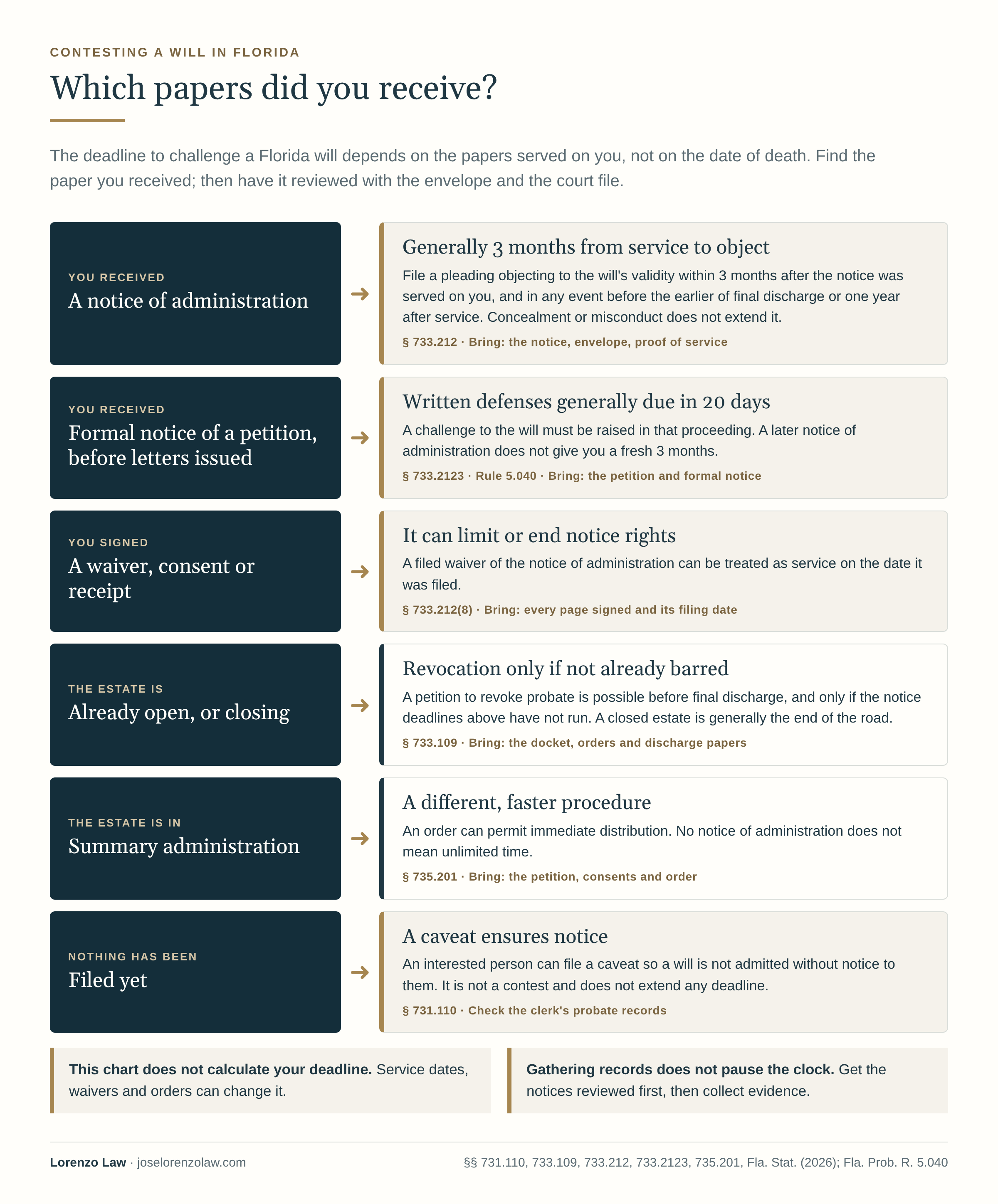
See the chart “Which papers did you receive?” (opens the full-size image; the details are also in the text).
| Document or event | Why it matters | What to bring |
|---|---|---|
| Notice of administration | Generally starts a 3-month period, counted from service, to object to the will’s validity (§ 733.212); earlier bars and outer limits still apply | The complete notice, attachments, envelope or delivery record, and the proof of service on the docket |
| Formal notice of a petition before letters issue | Written defenses are due within 20 days after service, and a challenge to the will must be raised in that proceeding (§ 733.2123) | The petition, the formal notice, service records, any response, the order admitting the will and the letters |
| A waiver you signed | Its scope and filing date can affect notice rights and when time began to run | Every signed page and the docket entry showing when it was filed |
| Will already admitted to probate | Revocation is available only before final discharge and only if not already barred (§ 733.109) | The admission order, the current docket and any discharge papers |
| Summary administration | Do not assume the formal-administration timetable applies | The summary petition, notices, consents, the order and records of distributions |
| A judgment or other order already entered | A rehearing, relief-from-judgment or appeal deadline may be running | The signed order and its filing and service information |
The notice of administration and the three-month rule
Under § 733.212(3), an interested person served with a notice of administration must file a petition or other pleading requesting relief, objecting to the validity of the will, venue or jurisdiction, within 3 months after the date of service, or those objections are barred. The statute uses months, not a flat 90 days. It allows an extension only for estoppel based on a personal representative’s misstatement about the objection period; concealment, failure to disclose information or other misconduct does not extend it. Unless barred sooner, objections must in any event be filed no later than the earlier of the personal representative’s final discharge or one year after service of the notice of administration.
What to check on the notice you received. Under § 733.212(2), a notice of administration states, among other things, the decedent’s name, the case number and the court; whether there is a will and, if so, its date and the dates of any codicils; the names and addresses of the personal representative and the personal representative’s lawyer; a statement that the fiduciary lawyer-client privilege applies to the personal representative and that lawyer; the deadline warning for objections to the will; the time limits for claiming exempt property and for a surviving spouse’s elective share; and a warning that failing to contest the will may waive the right to contest a trust or other writing incorporated into it. Keep the envelope and note when and how you received it.
Formal notice before letters: the 20-day response and the earlier bar
Formal notice of a petition for administration is not the same as a notice of administration. Under Florida Probate Rule 5.040(a), a person served with formal notice must serve written defenses within 20 days after service, not counting the day of service. If none is served, the court may consider the petition ex parte as to that person unless it orders otherwise, and the relief requested can be granted without further notice. Under § 733.2123, a person served with formal notice of the petition before letters are issued, or who waived notice, may raise objections to the will only in that proceeding and is barred from a later challenge. Do not assume a later notice of administration gives you a fresh three months.
If you signed a waiver
A waiver of notice, a consent to the petition or a receipt can affect your rights and the timing. Under § 733.212(8), filing a waiver of service of the notice of administration is treated as service for the referenced deadlines, as of the date the waiver is filed. Bring every page you signed.
Can you contest a will after probate in Florida?
A will can sometimes be contested after it is admitted to probate, but only within narrow limits. After a will is admitted to probate, an interested person may petition to revoke the probate before the personal representative’s final discharge, but only if the challenge is not already barred by the notice deadlines in §§ 733.212 or 733.2123 (§ 733.109). An open estate does not mean you are still on time, and you cannot contest a will years later simply because you just learned of it. Can a will be overturned after probate? Yes, but only by a timely petition before discharge, not as a matter of course.
Can a will be contested after distribution? It depends on whether the estate is closed: a distribution made while the administration is still open does not end your rights, because a petition to revoke probate may be filed any time before the personal representative’s final discharge unless the notice deadlines in §§ 733.212 or 733.2123 have already run (§ 733.109(1)). Once the estate is closed and the personal representative discharged, the ordinary will contest route is generally over. A later-discovered will cannot be offered once the estate is completely administered and the personal representative discharged, and the discharge order cannot be revoked on that basis (§§ 733.208, 733.903). A person who was never served may still have a route, such as relief from an order entered without required notice, so have the record reviewed immediately.
Summary administration
Under current § 735.201, the shortened procedure is available when the estate subject to administration, excluding exempt property, does not exceed $150,000, or when the decedent has been dead for more than two years, subject to the statute’s conditions. Those are eligibility rules, not will-contest deadlines. Summary administration has no personal representative and no notice of administration; it proceeds by petition and an order that can permit immediate distribution, so the lack of a notice is no assurance of unlimited time. A beneficiary who did not join the petition must be served with formal notice of it (§ 735.203), and the prudent course is to raise any challenge to the will in that proceeding, before the order is entered. See the Florida summary administration guide.
If you think time has already run out
Late discovery of suspicious conduct does not, by itself, revive a contest. A separate lawsuit for tortious interference with an inheritance is not a routine workaround. In DeWitt v. Duce, 408 So. 2d 216 (Fla. 1981), the Florida Supreme Court barred a later interference claim where an adequate probate remedy had been available and the plaintiff had a fair opportunity to use it. Whether a different case presents an inadequate probate remedy needs its own analysis.
Will contest or contested probate: identify what is actually disputed
A will contest challenges whether a will, or part of it, is valid. A contested probate is broader: the dispute may be about an accounting, a sale, a personal representative’s conduct or who receives property, even though the will itself is valid. The two use different pleadings and deadlines. Contesting, disputing or protesting a will, or fighting a will in court, means formally challenging its validity in the probate case.
| Your concern | Issue to investigate | Documents to identify first |
|---|---|---|
| A caregiver arranged a new will that leaves the caregiver most of the estate | Possible undue influence: the person’s independence and how the will was made | Earlier and later wills, messages, appointment history, the signing witnesses |
| The person could not understand the estate plan when signing | Possible lack of testamentary capacity | The signing date, medical and medication records, observations close to that date |
| The signature or the witnessing looks wrong | Authenticity or improper execution | The complete will, the self-proving affidavit, where the original is, witness and notary information |
| The personal representative is withholding information or mishandling property | An administration or fiduciary dispute; the will may still be valid | Inventory, accountings, orders, requests for information, transaction records |
| A spouse or child was left out | A possible contest, but also separate statutory inheritance rights | Marriage and adoption dates, a family tree, all wills, any waivers, property records |
| The money passed by trust, deed or account designation | A different instrument that may need its own challenge | The trust and amendments, the recorded deed, account ownership and beneficiary forms |
| There was no will at all | Not a will contest: a dispute about heirs, who serves as administrator or how the estate is run | A family tree, the petition for administration, any later-found will |
Misconduct by the person running the estate is covered on the breach of fiduciary duty page, and the full range of estate disputes on the probate litigation page and in the Florida estate disputes guide. When siblings disagree about a house rather than the will, see siblings who disagree about selling the family home.
If there was no will
When a person dies without a valid will, there is no will to contest: Florida’s intestacy statutes decide who inherits, and any dispute is about who the heirs are, who serves as administrator and how the estate is handled. If a will is later found, an interested person may petition to probate it, after which its validity may be contested under the rules in this guide; no will may be offered once the estate is completely administered and the personal representative discharged (§ 733.208). See the probate process without a will.
Key terms in brief
- Testator
- The person who made the will. After death, court papers usually call that person the decedent.
- Interested person
- Anyone who may reasonably be expected to be affected by the outcome of the particular proceeding. Only an interested person can contest a will (see who can contest).
- Proponent
- The person who offers the will to the court and asks that it be admitted to probate, usually the personal representative named in it.
- Contestant
- The person challenging the will.
- Personal representative
- Florida’s term for an executor or administrator: the person the court appoints to gather the assets, pay valid debts and distribute the estate.
- Letters of administration
- The court document that gives the personal representative authority to act for the estate. “Before letters are issued” means before that authority is granted, which matters for the deadline (see formal notice).
- Caveator
- A person who has filed a caveat with the clerk so that a will is not admitted, or a personal representative appointed, without notice to them (see caveats).
- Adversary proceeding
- A contested probate matter, such as a will contest, that the Florida Probate Rules handle much like a civil lawsuit, with formal service, discovery and a hearing or trial.
Who can contest a will in Florida?
Only an interested person can contest a will in Florida: someone who may reasonably be expected to be affected by the outcome of the proceeding. In practice, that usually means an heir who would inherit more if the will failed, or a beneficiary under an earlier will that would control instead. A family label alone is not the test, and the interest can vary with the stage of the proceeding (§ 731.201(23)).
Compare what the challenged will gives you with what an earlier will, or intestacy, would give you. Do not reduce standing to a rule that you must end up with a larger dollar share. Section 733.109 expressly includes a beneficiary under a prior will among the interested persons who may seek revocation of probate.
| Person | Usually affected by the outcome? | What decides it |
|---|---|---|
| Child or grandchild who would inherit if the will failed | Often yes | Whether an earlier will or intestacy gives that person more |
| Beneficiary under an earlier will | Often yes | Whether the earlier will would control if the later one fails |
| Surviving spouse | Often yes | The will, any prenuptial or postnuptial agreement, and separate spousal rights |
| Sibling, half sibling, niece or nephew | Sometimes | Whether closer relatives survive; an earlier will naming the person |
| Parents of an adult child who died without spouse or children | Sometimes | Whether they would inherit under intestacy or an earlier will |
| Beneficiary named in the challenged will | Depends | How the requested ruling would change that person’s share |
| Stepchild or step sibling never adopted | Usually not as an heir | Only if an earlier will or another instrument names the person |
| Friend, caregiver or other non-relative | Usually not | Only if named in an earlier will |
| Creditor of the estate | Usually not for validity | A creditor files a claim; that does not by itself give a right to challenge the will |
A starting point, not a ruling on any person’s standing. The legal interest depends on the family, the documents and the relief requested.
If you are not named in the will
An heir who would inherit under intestacy, or a person named in an earlier will, can have standing even though the challenged will leaves them nothing. A person with no family tie and no earlier will usually cannot, however close the relationship was.
Children, including a disinherited child
A disinherited adult child may have standing, because that child would often inherit if the will failed. A child born or adopted after the will was signed may have a separate omitted-child claim under § 732.302, which has statutory exceptions. Florida does not require a parent to leave anything to an adult child.
Siblings, half siblings, nieces and nephews
A sibling’s standing depends on who else survives. Under § 732.103, descendants and parents come before siblings in the intestate order for the part of the estate not passing to a surviving spouse, so a sibling of someone who left children usually would not inherit even if the will failed, unless an earlier will names the sibling. Half siblings inherit as heirs, but a relative of the half blood generally takes half as much as a relative of the whole blood (§ 732.105). Nieces and nephews generally take their deceased parent’s place in the sibling line.
Grandchildren whose parent has died
A grandchild whose parent died before the grandparent usually steps into that parent’s share under intestacy (by representation, or per stirpes), so the grandchild may have standing if the will cut out that branch of the family. If that parent is alive, the parent is usually the heir, and the grandchild needs an earlier will naming them.
Stepchildren and step siblings
A stepchild who was never adopted does not inherit as a child under Florida intestacy, and a step sibling is not an heir. Either can still have standing if an earlier will left them something that the challenged will took away. When contesting a will of a stepparent, a stepchild’s standing usually comes from an earlier will, not from the family relationship.
Spouses and former spouses
A surviving spouse usually has standing, but often does not need to overturn the will: the elective share, the pretermitted-spouse share and homestead rights can apply even to a valid will (see other inheritance rights). Under § 732.507(2), provisions in favor of a former spouse generally become void when the marriage is dissolved, unless the will expressly provides otherwise; the rest of the will is not revoked.
Beneficiaries, personal representatives and creditors
A beneficiary named in the challenged will has standing only if the requested ruling would affect them. A personal representative’s duties and personal interest can differ when one person holds both roles. A creditor’s right to assert a debt does not, by itself, give a right to challenge the will’s validity. When a charity is the main beneficiary, the charity is an interested person and usually defends its gift alongside the personal representative.
Minors, out-of-state heirs and contesting on someone else’s behalf
A minor heir acts through a guardian or a court-appointed guardian ad litem. An heir who is incapacitated acts through a guardian, and an agent under a power of attorney acts only as far as the document and the law allow. If an heir dies while a challenge is possible, the heir’s own personal representative may pursue it. Living outside Florida does not end an heir’s interest in a Florida estate.
Disinherited or left out of a will in Florida: what you can and can’t do
Being disinherited, excluded from a will or left out of a will is not, by itself, a reason the court will set the will aside. Florida lets a person leave property to anyone, subject to protections for a surviving spouse, homestead and some omitted family members. Being cut out of a will matters legally only with a recognized ground, such as undue influence or lack of capacity, or a separate statutory right.
Three routes when you were left out
- A validity ground. Pressure, confusion, deception or a defective signing may support a contest, especially when a long-standing plan was replaced shortly before death while someone else controlled access to the person.
- A separate statutory right. A surviving spouse may have the elective share, a pretermitted-spouse share or homestead rights; a child born or adopted after the will may have an omitted-child share. These can apply even when the will is valid (see other inheritance rights).
- Neither. If the person knowingly chose to leave you out and had the capacity to do so, an unfair will is not invalid for that reason alone.
If your concern is “my brother changed Mom’s will” or “a sibling changed my parents’ will,” the questions to investigate are who arranged the new will, who instructed the lawyer, and whether the parent acted independently (see undue influence).
Estranged children and everything left to charity
Contesting a will as an estranged child is harder in practice, because a long estrangement often explains the disinheritance. A challenge still needs evidence from the circumstances of the will, not the estrangement. Likewise, a will leaving everything to a charity is not suspect because family members were left out; the charity usually defends it.
What a disinheritance clause does
A disinheritance clause, such as “I intentionally make no provision for my son,” shows that leaving someone out was deliberate. That makes an argument that the person was forgotten much harder, and it can defeat an omitted-child claim for a child the will mentions. It does not stop a challenge based on capacity, undue influence, fraud or improper execution, because those grounds attack the whole document, including the clause.
Prefer to read in Spanish? See impugnar un testamento en Florida.
Grounds for contesting a will in Florida and the evidence each needs
The grounds for contesting a will in Florida are lack of testamentary capacity, undue influence, fraud, duress, mistake in limited situations, an insane delusion, improper execution, forgery, and revocation by a later will or act. Each needs evidence tied to the will’s signing or contents.
| Ground | What the evidence must address | Useful records or witnesses | Not enough by itself |
|---|---|---|---|
| Lack of testamentary capacity | The person’s understanding when the will was signed | Medical and medication records near the signing, drafting notes, the witnesses’ observations | Age, a diagnosis, or confusion at an unrelated time |
| Undue influence | Whether someone overcame the person’s free choice; procurement and the relationship | Appointment messages, drafts, instructions, restricted access, earlier estate plans | A large gift, caregiving or a close relationship |
| Fraud | Deception that produced the will or a provision | What was said, by whom, why it was false, and the change it caused | A relative’s general reputation for dishonesty |
| Duress | Threats or coercion that overcame free choice | Messages, reports made at the time, witnesses, evidence of dependence | Ordinary argument or persuasion |
| Improper execution | Compliance with the signing and witness requirements | The complete will, the self-proving affidavit, witness testimony, how the signing happened | A relative’s unfamiliarity with the document |
| Forgery or alteration | Whether the signatures and pages are genuine | The original, genuine signature samples, custody history, a document examiner | A signature that merely looks unusual |
| Mistake | Whether the issue is invalid procurement or terms that need reformation | Drafts, instructions, correspondence, evidence of actual intent | An outcome a beneficiary considers a mistake |
| Revocation or a competing will | Which document and which revoking act legally controls | Every will and codicil, the originals, signing and custody history | An assumption that the older, preferred will comes back automatically |
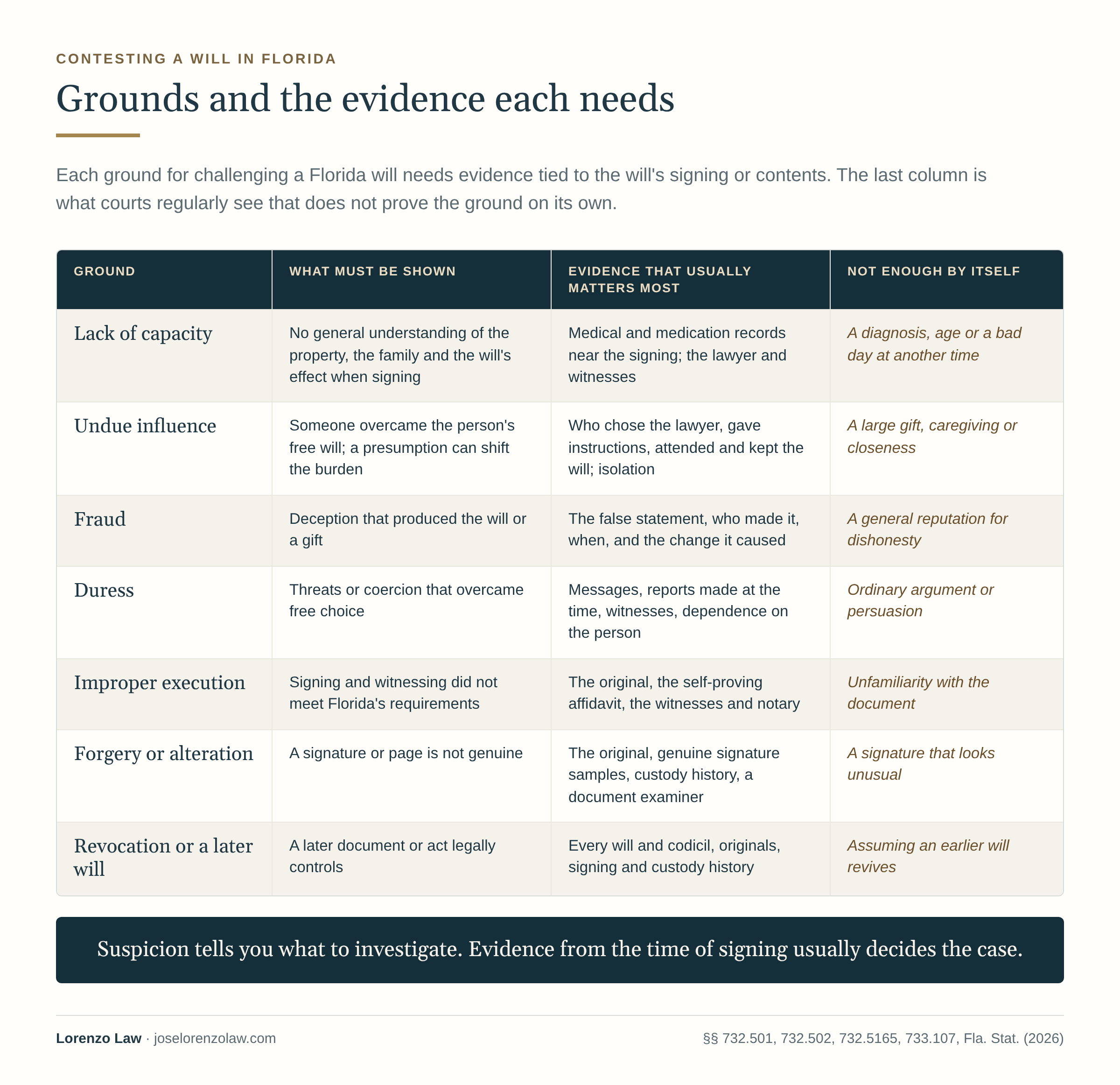
See the chart “Grounds and the evidence each needs” (opens the full-size image; the details are also in the text).
What makes a Florida will invalid
A Florida will is invalid if the person lacked testamentary capacity when signing, if it was procured by undue influence, fraud or duress, if it was not signed and witnessed as the law requires, if it is forged, or if it was later revoked. What voids a will in Florida, in other words, is a defect in how it was made or a later act undoing it, not the fairness of what it says.
Two common beliefs are wrong. Getting married after signing a will does not revoke it in Florida; instead, a spouse the person married after signing may be entitled to a pretermitted-spouse share unless an exception applies (§ 732.301). And divorce does not revoke the whole will; it generally voids only the provisions for the former spouse (§ 732.507(2)).
Testamentary capacity, dementia and lucid intervals
Florida requires a person making a will to be of sound mind (§ 732.501). Florida courts use a testamentary capacity definition to describe the required understanding, sometimes called the mental capacity to make a will. It is a general understanding, at the moment of signing, of the nature and extent of the property, the people who are the natural objects of the person’s bounty, and the practical effect of the will. It is a lower standard than the capacity needed to manage complex finances.
A dementia or Alzheimer’s diagnosis does not automatically invalidate a will. Medical evidence needs a reasoned connection to the day of signing. A will signed during a lucid interval, a period when the person understood those things despite a broader illness, can be valid. In Reeves v. Gross, 403 So. 3d 362 (Fla. 3d DCA 2025), the court affirmed summary judgment on that record, holding that the mere possibility of incapacity does not overcome the presumption of capacity. It did not hold that every person with dementia has capacity.
Who determines testamentary capacity? The probate judge decides, based on the whole record: the drafting lawyer, the attesting witnesses, medical records, people who saw the person around the signing date, and sometimes a retrospective opinion from a physician or geriatric psychiatrist. If there was a guardianship or incapacity proceeding, bring the actual orders and evaluations; they are important evidence, but their effect has to be measured against the signing date. A guardianship does not by itself take away the right to make a will, because a person found incapacitated keeps every right the court did not specifically remove; a prior adjudication of incapacity does, however, shift the burden of coming forward with evidence of capacity to those supporting the will, when the will was signed after that adjudication. See contested guardianship for disputes about a living person’s capacity.
Undue influence: the presumption and the Carpenter factors
Undue influence is pressure that overcomes the person’s free will so that the will reflects someone else’s wishes. The Florida undue influence statute for wills is § 732.5165, which makes a will or a provision procured by undue influence void; the presumption and burden rules come from case law and § 733.107, and the trust counterpart is § 736.0406. Persuasion, affection or a request is not enough. Under In re Estate of Carpenter, 253 So. 2d 697 (Fla. 1971), a presumption of undue influence arises when three elements are shown: the person was a substantial beneficiary, had a confidential relationship with the person making the will, and was active in procuring it.
The Carpenter factors for active procurement include whether the beneficiary was present when the will was discussed or signed, recommended the lawyer, knew the contents before signing, gave instructions on what to put in the will, secured the witnesses, or kept the will afterward. In Swiss v. Flanagan, 329 So. 3d 199 (Fla. 3d DCA 2021), the court treated the factors as non-exclusive and considered planning involvement, communications and dependence together.
When the presumption applies, current § 733.107(2) and Florida Probate Rule 5.275 make it a presumption that shifts the burden of proof to the beneficiary, who must then show the will was not the product of undue influence. That statute replaced Carpenter’s older rule, which required only a reasonable explanation from the beneficiary. The presumption is rebuttable. Undue influence claims have no separate time limit of their own in a will contest; the notice deadlines in the deadline section govern. For representation focused on these claims, see the undue influence lawyer page.
Fraud, duress and mistake
A will, or any part of one, is void if its execution was procured by fraud, duress, mistake or undue influence, and a revocation procured the same way is also ineffective (§ 732.5165). A fraudulent will can arise in two ways. Fraud in the execution is deception about what was being signed; fraud in the inducement is a lie that caused a particular gift or exclusion, such as telling a parent that a child had stolen from them.
Duress means threats or coercion that overcame free choice, such as a threat to withhold necessary care. A drafting error is different again: it may call for reformation rather than invalidation. Under § 732.615, a court may reform a will, even if unambiguous, on clear and convincing proof of the person’s intent and of a mistake of fact or law.
Insane delusion
An insane delusion is a false belief, held against all evidence and reason, that caused a gift or exclusion the person otherwise would not have made. It is not a label for resentment or an opinion the family thinks is unreasonable. In Levin v. Levin, 60 So. 3d 1116 (Fla. 4th DCA 2011), the trial court was required to address an alleged delusion even though other grounds failed.
Signing, witnesses and self-proving affidavits
A conventional Florida will must be signed at the end by the person making it, or by someone else in that person’s presence and at that person’s direction, and the person must sign, or acknowledge the signature, in the presence of at least two attesting witnesses, who must sign in the presence of the person and of each other (§ 732.502). Acknowledgment matters: an earlier signature acknowledged in front of the witnesses is not, by itself, a defect.
Can a beneficiary witness a will in Florida? Yes. Any person competent to be a witness may act as one, and a will is not invalid because an interested person witnessed it (§ 732.504). An interested witness can still matter as evidence in an undue influence case.
A self-proving affidavit, signed by the person and the witnesses before a notary, usually at the signing, lets the will be admitted without witness testimony and establishes the initial showing of proper execution. It does not make the will immune from challenge or prove capacity and freedom from influence. A notary does not replace a missing witness just by notarizing the affidavit. What if the witnesses to the will can’t be found? For a self-proved will, their testimony is generally not needed to admit it; for a will that is not self-proved, Florida law provides other ways to prove it when the witnesses are unavailable (§ 733.201).
A handwritten will is not invalid because it is handwritten; it is valid only if it meets the same signing and witness requirements. Florida does not recognize an unwitnessed holographic will, even one valid where it was written. A will signed in another state is generally valid in Florida if it was valid where signed, except holographic and oral wills (§ 732.502(2)).
Forged or altered wills
To prove a will was forged, you need the original where it exists, known genuine signatures from around the same time, the custody history of the document and, usually, a forensic document examiner as an expert witness. Forging a will or knowingly offering a forged will is also a crime in Florida, but a criminal case is separate from the probate contest and does not decide it.
Electronic and remotely witnessed wills
Florida recognizes electronic wills under § 732.522. Remote witnessing has statutory conditions, including extra protections for vulnerable adults, and an ordinary video call does not qualify. Identify the original electronic record, the online notarization session, the witnesses, the custodian and any audit trail. Do not print the file and discard the electronic source. See Florida online wills.
Last-minute changes: deathbed wills, powers of attorney and executors
A will changed shortly before death is not invalid for that reason alone, but the timing is worth investigating. Only the person making the will can make a new will or codicil, signing it (or directing someone to sign for them in their presence) with capacity and the required formalities; an agent under a power of attorney cannot, and an executor cannot change one after death.
Can a power of attorney change a will?
No. Florida’s power of attorney statute does not allow an agent to make, amend or revoke the principal’s will, however broad the document (§ 709.2201). An agent may, if the power of attorney specifically grants it with the principal’s separate signature or initials, change things that pass outside the will, such as beneficiary designations or survivorship rights, and may create a trust on the same condition. An agent may amend or revoke the principal’s trust only if the power of attorney specifically grants that authority and the trust itself allows amendment or revocation by the settlor’s agent (§ 709.2202). That is why a will that looks unchanged can still be emptied by changes made under a power of attorney before death. Those transfers are challenged separately; see challenging transfers made before death. A power of attorney also ends when the principal dies; see whether a power of attorney ends at death and Florida powers of attorney.
An executor cannot rewrite the will
The personal representative (Florida’s term for an executor) carries out the will as written and has no power to change it. After death, a will cannot be changed by anyone. The beneficiaries can, however, agree among themselves to a different division in a written settlement, or a beneficiary can disclaim a gift, subject to the statutes and, where minors are involved, court approval. A personal representative who ignores the will raises an administration problem; see removing a fiduciary and breach of fiduciary duty.
Deathbed wills and sudden changes
A deathbed will is not invalid because it was signed in a hospital or hospice. Like any will, it stands if the person had testamentary capacity, it was signed and witnessed properly, and it was not procured by fraud, duress or undue influence. The questions are factual: medications, who called the lawyer, who was in the room, and whether the new will broke from a long-standing plan. A late change does not prove undue influence; an independent lawyer, disinterested witnesses and a record of the person’s own reasons make it much harder to challenge.
What is the success rate of contesting a will in Florida?
No Florida court, clerk or state agency publishes a success rate for will contests, so there is no reliable percentage for contesting a will in Florida. A figure of about 1% circulates online, but it is not tied to any published study or court data. Many contests settle, and each is decided on its own record, so a single rate would not describe your case anyway.
Do people who contest wills usually win? Many contests do not end in a court ruling at all, and no reliable figures exist for the ones that do. What can be said is what moves your chances of winning a will contest. The evidence from around the signing date matters most, then timing, the undue influence presumption, any earlier will, and whether winning would improve your position after costs.
How hard is it to contest a will in Florida?
Is it easy to contest a will? No. A Florida court will not set aside a will because someone finds it unfair; a successful challenge needs standing, a timely filing, a recognized ground and evidence. A case with merit can still fail on the calendar.
What makes a will contest stronger or weaker
| Tends to strengthen a contest | Tends to weaken a contest |
|---|---|
| The will changed shortly before death, away from a plan held for years | The new will matches what the person said or wrote over many years |
| Medical records near the signing date document confusion or cognitive decline | Disinterested people found the person clear and consistent at the time |
| The main beneficiary chose the lawyer, made the appointment, attended or kept the original | An independent lawyer the person chose met with them alone |
| The beneficiary controlled the person’s care, money or contact with family | The will was properly witnessed and self-proved |
| Witnesses saw fear, pressure, confusion or isolation | The complaint is mainly that the result is unfair |
| Accounts, deeds or beneficiary forms changed in the same period | Invalidating the will would not improve the challenger’s share |
| The challenge was filed early, with time for discovery | The challenge is late, or the challenger lacks standing |
Who most often contests a will
Who is most likely to contest a will? In practice, challenges most often come from adult children who received less than a sibling, especially when the favored sibling or a new caregiver was closely involved with the parent near the end; from children of a first marriage when a later spouse receives most of the estate; and from relatives displaced by a will signed during an illness. None of those facts is a legal ground, but each is a setting where the circumstances of the signing deserve a careful look.
What happens if the will is thrown out, or upheld
Overturning a will does not simply hand the property to the person who challenged it. Depending on what remains valid, an unaffected part of the will may stand, an earlier will may control, or the estate may pass under Florida’s intestacy statutes as if there were no will. If the will is upheld, it is carried out as written, and the challenger may bear their own fees and, in some cases, part of the estate’s.
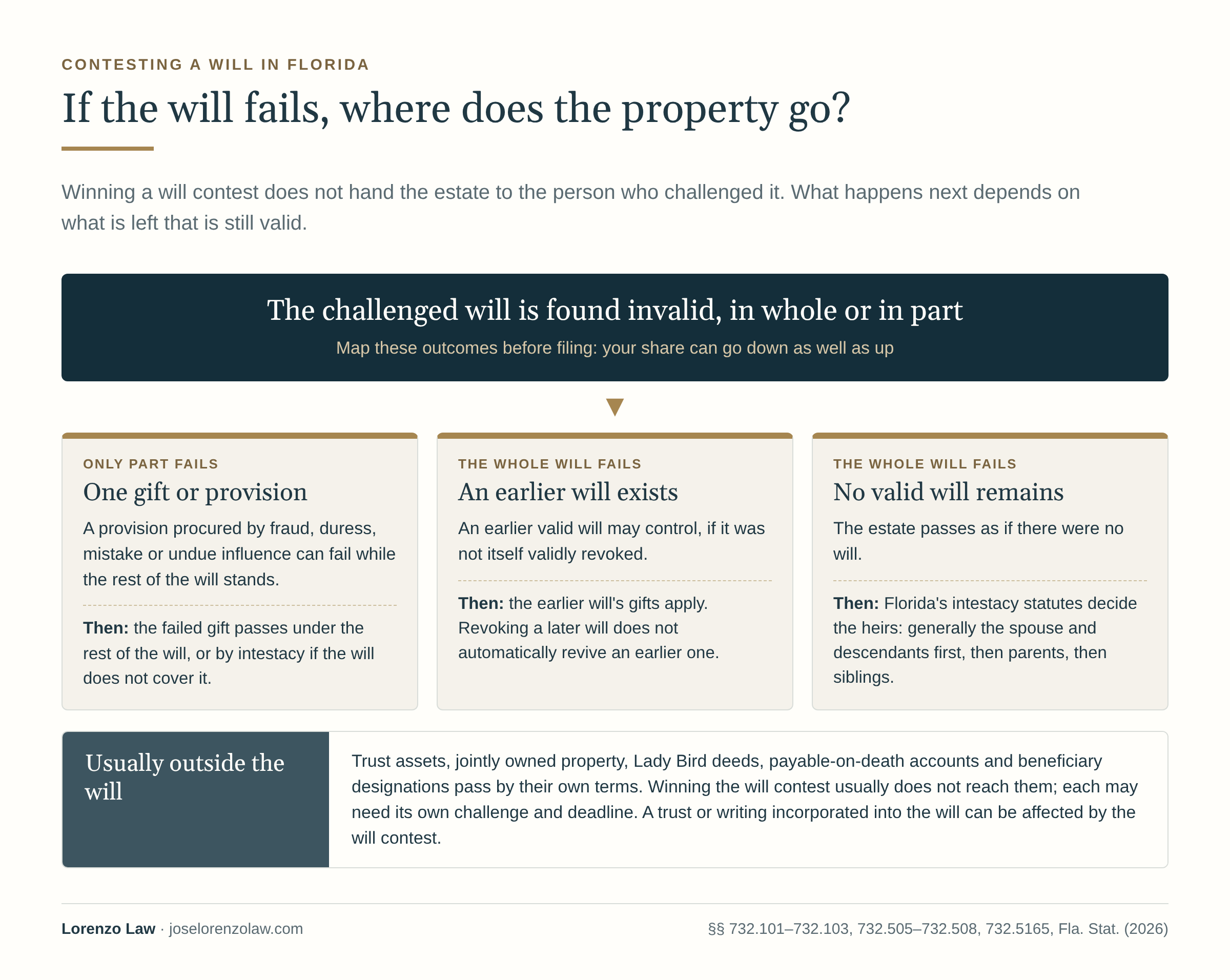
See the chart “If the will fails, where does the property go?” (opens the full-size image; the details are also in the text).
Part of a will
A challenge can target a single gift. If only one provision was procured by fraud, duress, mistake or undue influence, that provision can fail while the rest of the will remains effective (§ 732.5165). A partially invalid will is common in undue influence cases, where one late gift is the real target. A narrower challenge is not automatically cheaper or easier to prove.
Revocation and revival
Read the revocation clause along with the gifts. Florida separately addresses revocation by a later writing, revocation by act such as burning or tearing, and revival. Revoking a later will that revoked an earlier one does not automatically bring the earlier will back. If the later will fails as a whole because of undue influence or incapacity, its revocation clause can fail with it, which is often how an earlier will comes to control. A claim that a revocation was itself improperly procured needs its own analysis. When multiple wills are discovered during probate, each one’s signing, revocation clause and custody history has to be compared before anyone can say which controls.
If the original will is missing
A missing original is not simply replaced by whichever copy a relative prefers. Florida has a proceeding to establish a lost or destroyed will (§ 733.207); its specific content generally must be proved by two disinterested witnesses, or by one if a correct copy is provided. When an original last in the person’s possession cannot be found, the law presumes it was revoked, and the person offering it must rebut that presumption with competent evidence that it was not; the custody history matters. Record who last held the original, where, when it was last seen and who had access.
If you contest the will and lose
What happens if you contest a will and lose? The will is carried out as written, and you keep whatever it gave you, because Florida does not enforce no-contest clauses (see no-contest clauses). The cost is the risk: you generally pay your own lawyer, and the court may order part of the estate’s legal fees charged against your share (who pays). A claim that is not supported by the facts or the law can also lead to sanctions: under Florida’s frivolous-claim statute, the court can order the person who filed it, and their lawyer, to pay the other side’s attorney’s fees.
What evidence you need and how to get it lawfully
The evidence needed to contest a will depends on the ground, but the most persuasive evidence is almost always from the time the will was signed: medical and medication records, the drafting lawyer’s file, the testimony of the witnesses and notary, messages about the appointment and the gifts, and earlier wills that show the person’s long-standing plan. Start by securing the notices and the will itself; most of the rest is obtained through the court once a case is filed.
How to find out whether a will was filed and get a copy
A will deposited with the court or filed in a probate case becomes part of the court file, so the first step is the clerk in the county where the person lived. Search the clerk’s probate records by name, or call the probate division, and request a copy (see the county table). Under § 732.901, anyone holding an original will must deposit it with the clerk within 10 days after learning of the person’s death, and the court can compel production. That 10-day rule is the custodian’s duty, not your deadline. Is a will public record in Florida? Once it is deposited with the clerk or filed in a probate case, it is generally part of the court file that can be viewed or copied, subject to the clerk’s rules.
Can you contest a will without seeing it? Get the will first. Its terms, dates and witnesses usually decide which grounds are worth investigating. If no probate case exists yet and you expect a dispute, a caveat ensures you receive notice (see caveats).
Notice and court document checklist
- The person’s full name, date of death and last residence; the Florida county and case number if known.
- The complete notice of administration and all attachments.
- Any formal notice, petition for administration, petition for summary administration or hearing notice.
- Envelopes, certified-mail receipts, delivery confirmations, emails and the proof of service on the docket.
- Every waiver, consent, receipt, release or settlement you signed, with its filing date if available.
- Orders admitting a will, appointing a personal representative, issuing letters, authorizing distributions or discharging the representative.
- The challenged will, codicils, earlier wills and related trust documents, noting where each original is.
Keep receipt, service, signature and filing dates separate; they often differ.
Evidence checklist
- Names and contact details of the drafting lawyer, the witnesses, the notary, caregivers and people who saw the person near the signing.
- Medical providers, facilities, treatment dates and medication changes, and records already lawfully available to you.
- Messages about the lawyer appointment, the gifts, isolation, threats, document changes or who kept the will.
- Earlier estate plans and communications showing whether the change fit long-standing wishes.
- Financial and property records showing related transfers, account changes or deeds.
- A family tree and a short explanation of the interest you believe the outcome affects.
- Any imminent sale, distribution or threatened destruction of records.
Organize what you know
| Date or period | What happened | How you know | Record or witness | Still uncertain |
|---|---|---|---|---|
| Week of signing | A beneficiary arranged the lawyer’s appointment | A text you received directly | The original message and sender | Who gave the lawyer the instructions |
| Signing day | The person seemed confused during a visit | Your own observation | Dated notes; another visitor | Whether this was before or after the signing |
| After death | A later will appeared | A copy received by email | The full email and attachment | Who holds the original |
Separate what you saw from what you were told, and include evidence that cuts against your suspicion.
Medical records, the drafting lawyer’s file and expert witnesses
Keep original messages, attachments and devices; screenshots help, but preserve the surrounding context and the underlying records too. Do not edit messages, access someone else’s accounts without authority, or request records by posing as the person who died.
Access to medical records after death depends on legal authority; being a relative is not automatic permission. HHS guidance on personal representatives explains the role of a person authorized under applicable law, and in a contested case the records are usually obtained by subpoena or court order.
The drafting attorney’s file often holds the best evidence: the intake notes, who attended, who paid and what instructions were given. It is not automatically open in full, but Florida’s lawyer-client privilege has an exception for communications relevant to an issue between parties who claim through the same deceased client (§ 90.502(4)(b)). In a will contest, the file is typically obtained by subpoena for documents and by deposing the lawyer, and other protections and relevance still apply. Communications between the personal representative and the estate’s own lawyer are separately protected by the fiduciary lawyer-client privilege (§ 90.5021).
Many contests turn on an expert witness: a physician or geriatric psychiatrist who reviews the records and gives a retrospective opinion on capacity, or a forensic document examiner on a disputed signature. Expert evidence is persuasive only when it is tied to the signing date and the actual records.
How to contest a will in Florida, step by step
To contest a will in Florida, confirm your standing and which deadline applies, then file the proper pleading in the probate case: an objection or answer to the petition before the will is admitted, or a petition for revocation of probate after it is admitted. A contested will is handled as an adversary proceeding, with service, discovery, mediation and, if it does not settle, a hearing or trial before the probate judge. A letter to relatives or the personal representative does not preserve your rights.
Here is how to challenge a will in Florida, step by step. After the will is admitted, the filing is a petition to revoke probate. Florida has no single will contest statute: the rules come from the Florida Probate Code (chapters 731 through 735 of the Florida Statutes) and the Florida Probate Rules, which is why the deadline, the grounds, the burden of proof and the procedure each cite a different provision on this page.
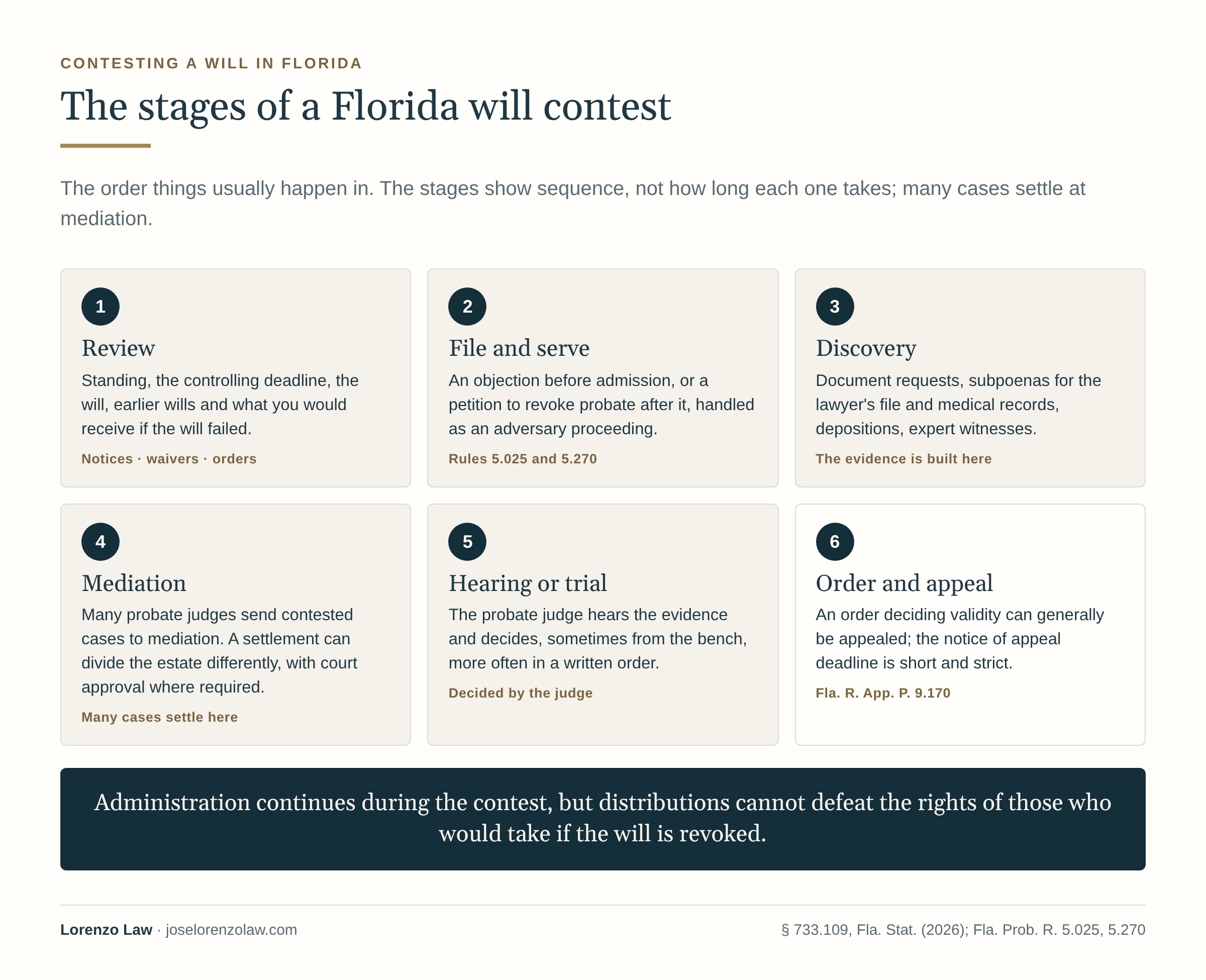
See the chart “The stages of a Florida will contest” (opens the full-size image; the details are also in the text).
- Review standing, timing and the documents together. Identify your legal interest, every notice, waiver and order, the provisions you dispute, and what you would receive under an earlier will or intestacy.
- Protect what is at risk. Tell counsel about imminent distributions, sales or records that could disappear. Court protection needs a legal basis and an order.
- File and serve the proper pleading. It states your interest, the facts, the grounds and the relief requested under the Florida Probate Rules, which treat a will contest as an adversary proceeding (Rule 5.025) and govern revocation of probate (Rule 5.270).
- Develop admissible evidence. Document requests, subpoenas, depositions of the drafting lawyer and witnesses, and expert analysis. The judge does not investigate the family dispute for the parties.
- Resolve it. Mediation, a settlement, a dispositive motion or a trial may resolve some or all issues. A settlement should cover the affected documents, parties, fees, distributions and any required court approval.
Does contesting a will stop probate?
No. Under § 733.109, the personal representative continues administering the estate while a revocation proceeding is pending, but may not make distributions that would defeat the rights of the people who would take if the will were revoked. A contest does not automatically freeze accounts, stop a sale or remove the personal representative. If more protection is needed, ask about a specific order, a bond, a curator, or removal for misconduct; a personal representative who is also the main beneficiary is not removed for that overlap alone. Does contesting a will delay probate? In practice it often does, because distributions to the disputed beneficiaries usually wait for the result.
Filing a caveat before probate opens
If you expect a dispute and no probate case has been filed, an interested person who is not a creditor can file a caveat with the clerk so that the court does not admit a will or appoint a personal representative without notice to them (§ 731.110). A caveat filed before the person’s death expires two years after it is filed. A caveat is not a will contest, does not freeze property and does not extend any response deadline; if formal notice follows, you must still act. See caveats in Florida probate.
Mediation and settlement
Many probate judges send contested cases to mediation, and many will contests settle there. A settlement can divide the estate differently from the will, provided everyone affected signs and the court approves where the law requires it, for example when a minor’s interest is involved.
Who decides, and how long a will contest takes
A Florida will contest is decided by the probate judge, not a jury; a related civil claim, such as tortious interference with an inheritance, is a separate lawsuit and is not the will contest. After an evidentiary hearing or trial, a judge sometimes rules from the bench, but more often takes the matter under advisement and issues a written order later. How long a will contest takes depends on the issues, the experts, the court’s calendar, settlement and any appeal; a narrow case can end within months, a discovery-heavy one much later.
Appealing a will contest ruling
An order that finally decides a will’s validity, such as an order revoking probate or denying revocation, can generally be appealed to the district court of appeal (Fla. R. App. P. 9.170). The notice of appeal is generally due within 30 days after the order is rendered, and that deadline is strict. A timely motion for rehearing, which in a probate case must be served within 15 days after the order is filed, postpones rendition and so the start of the 30 days. An appeal is not a new trial, so the evidence must be in the record first.
How much does it cost to contest a will in Florida?
There is no single price for contesting a will in Florida. The cost depends mainly on how much discovery and expert work the ground requires, how many parties are involved, and whether the case settles early or goes to trial. Before agreeing to representation, ask for a written explanation of the fee arrangement, which stages it covers, and who pays costs such as filing fees, depositions and experts.
| Cost component | What to clarify before agreeing to representation |
|---|---|
| Attorney’s fees | The fee arrangement, the stages covered, and what happens if the scope changes |
| Court and service charges | Which filing is needed, what has already been paid and the court’s current charges |
| Records and testimony | Record retrieval, subpoenas, depositions, transcripts and out-of-state witnesses |
| Experts | Whether a medical or document expert is needed, the scope, and when it will be authorized |
| Mediation, trial and appeal | Which stages are included and which need a separate estimate or agreement |
| Fee awards | Whether a statute permits payment from the estate, a charge against a share, or another award |
Routine estate-opening fees do not measure the cost of litigating a will’s validity, and a consultation is not a full investigation. What drives the number is the evidence: a contest that turns on a narrow execution question usually costs less than one that needs medical experts, several depositions and a trial.
Who pays the legal fees in a Florida will contest
Each side generally pays its own lawyer at the start, but do not assume either that the estate pays every bill or that the loser automatically pays. Under § 733.106, the person nominated as personal representative, or another proponent if the nominee does not act within a reasonable time, who is justified in good faith in offering the will in due form for probate receives fees and costs from the estate even if probate is denied or revoked. A challenger who succeeds, and whose work benefits the estate by establishing the person’s true will, may recover fees from the estate for services that benefited it; an unsuccessful challenger generally cannot. Who pays probate attorney fees in Florida in other situations? The personal representative’s own lawyer is generally paid from the estate, and Florida’s fee statute allows additional compensation for extraordinary services, which can include defending a will contest (§ 733.6171).
When estate payment is authorized, the court may direct which part of the estate bears it, including charging fees against the share of a person whose position caused them, with no required finding of bad faith; in some situations this can reach that person’s share of a related trust. Sanctions or personal liability need their own legal basis.
Contingency and hybrid arrangements
Lorenzo Law may consider contingency or hybrid arrangements in appropriate matters; availability depends on the case and written terms. Fees and litigation costs are different things: costs may remain payable, and a hybrid’s fixed or hourly portion may be due regardless of the outcome. The will contest attorney page explains engagement terms.
Deciding whether a contest is worth it
Is it worth contesting a will? Compare your position now with each realistic outcome: an earlier will controlling, only one provision failing, or intestacy. Then weigh the recoverable assets, the expenses, the time, the fee-allocation risk and the evidence still needed. The gross value of the estate is not your recovery.
Where a Florida will contest is filed
A will contest is filed in the probate division of the circuit court in the county where the estate is being administered, usually the county where the person was domiciled at death, or, for a nonresident, a county where Florida property is located (§ 733.101). Florida has 67 counties grouped into 20 judicial circuits, and each county’s clerk keeps the probate records. Your own residence, or where the lawyer meets you, does not decide where the case belongs.
If the person lived in another state but owned Florida real estate, the Florida case may be an ancillary administration, which raises its own procedural questions for a contest. Jose handles will contests in every Florida county. The principal office is in Kissimmee, with meetings in Coral Gables and Fort Lauderdale by appointment. Consultations are available statewide by phone or video.
| County | Judicial circuit | Communities | Clerk’s probate page | Lorenzo Law page |
|---|---|---|---|---|
| Miami-Dade | 11th | Miami, Coral Gables, Hialeah, Homestead, Miami Beach | Miami-Dade Clerk of the Court and Comptroller: Probate | Miami probate litigation |
| Broward | 17th | Fort Lauderdale, Hollywood, Pembroke Pines, Coral Springs | Broward Clerk: Probate and Guardianship | Fort Lauderdale probate litigation |
| Palm Beach | 15th | West Palm Beach, Boca Raton, Delray Beach, Jupiter | Palm Beach Clerk: Probate of estates | West Palm Beach · Boca Raton |
| Orange | 9th | Orlando, Winter Park, Apopka | Orange County Clerk: Probate | Orlando probate litigation |
| Osceola | 9th | Kissimmee, St. Cloud, Celebration | Osceola Clerk: Probate | |
| Hillsborough | 13th | Tampa, Brandon, Plant City | Hillsborough Clerk: Probate, guardianship and trust | Tampa probate litigation |
| Pinellas | 6th | St. Petersburg, Clearwater, Largo | Pinellas Clerk: Probate | Pinellas County probate litigation |
| Pasco | 6th | New Port Richey, Dade City, Wesley Chapel | Pasco Clerk: Probate and estates | |
| Duval | 4th | Jacksonville, Jacksonville Beach | Duval Clerk: Probate | Jacksonville probate litigation |
| Lee | 20th | Fort Myers, Cape Coral, Bonita Springs | Lee Clerk: Probate | Statewide practice |
| Monroe | 16th | Key West, Marathon, Islamorada, Tavernier, Key Largo | Monroe Clerk: Probate and guardianship (probate judges sit in Key West and at the Plantation Key courthouse in Tavernier) | Statewide practice |
| Okaloosa | 1st | Destin, Fort Walton Beach, Crestview, Niceville | Okaloosa Clerk: Probate | Statewide practice |
| Walton | 1st | Miramar Beach, Santa Rosa Beach, DeFuniak Springs | Walton Clerk: Wills, probate and guardianships | Statewide practice |
Circuits and clerk pages were checked on official court and clerk websites in October 2026. Courthouse locations and procedures change; confirm with the clerk before filing.
Other inheritance rights that may work better than a will contest
Some of the strongest claims do not challenge the will at all. A surviving spouse, an omitted family member or someone whose inheritance moved outside the will may have a statutory right or a separate claim that is easier to prove than incapacity or undue influence, and that runs on a different deadline.
- Spousal rights. The elective share, the pretermitted-spouse share for a spouse married after the will was signed (§ 732.301), homestead, exempt property and the family allowance each have their own conditions and timing, and a spouse need not overturn the will to claim them. See surviving spouse rights in Florida and the Florida elective share.
- A child born or adopted after the will. Section 732.302 may give an omitted-child share, subject to its exceptions. It does not mean every adult child must receive an equal share.
- Protected homestead. Florida restricts devising a homestead when a spouse or minor child survives (§ 732.4015); whether a property qualifies needs separate review. See the Florida homestead probate FAQ.
- Trusts. Can you contest a trust in Florida? Yes, on similar grounds such as incapacity, undue influence or fraud, but through a separate action under the trust code, not the will contest. Get the trust and every amendment. A will contest does not automatically decide a trust’s validity, and trust challenges have their own deadlines: a challenge to a revocable trust is generally barred unless brought within the earlier of the chapter 95 limitations period or six months after the trustee sends a copy of the trust and the required notice (§ 736.0604). See Florida trust litigation and the Florida trusts guide.
- Deeds, joint accounts and beneficiary designations. A Lady Bird deed, a survivorship account, a payable-on-death account or a beneficiary form moves property outside the will, and the parties and remedy can differ. See how to set aside a deed and whether a Lady Bird deed can be contested.
- Estate administration. Missing accountings, unauthorized transactions and removal of a fiduciary concern how the estate is run. They are not proof that the will is invalid. For disputes over an inheritance itself, see the inheritance dispute lawyer page.
Failing to contest a will can, in some circumstances, also affect the right to challenge a trust or other document the will incorporates. Bring the entire estate plan for review; neither “only the will matters” nor “the will can never affect the trust” is a safe assumption.
Are no-contest clauses enforceable in Florida?
No. A no-contest clause, also called an in terrorem clause, says a beneficiary who challenges the will loses their gift. Florida makes such a provision in a will unenforceable (§ 732.517), and makes the same kind of provision in a trust unenforceable (§ 736.1108). A beneficiary who contests and loses keeps what the document gave them.
That does not remove the filing requirements, the cost of litigating or the possibility that fees are charged against a share. A will or trust that says another state’s law governs, or that controls property in another state, needs specific review rather than an assumption about which law applies.
If you are defending the will
If someone is contesting a will you are named in or responsible for, preserve the same records a challenger would need and get your own lawyer early. The personal representative usually defends the will, and a personal representative who defends it in good faith is generally entitled to fees from the estate; beneficiaries who want their own voice in the case need their own counsel.
Keep the complete will and self-proving affidavit, earlier plans, the witnesses’ details, the drafting lawyer’s communications, service records and court papers. Identify evidence of independent instructions and capacity without coaching witnesses or reconstructing documents.
Who can help executors with will challenges? A personal representative needs counsel for the estate’s fiduciary interests, and should say if they also have a personal stake, because personal interests and fiduciary duties may need separate counsel. Defending the will does not allow withholding required information or distributing property in disregard of the pending proceeding. For defense representation, see the will contest lawyer page.
Common mistakes in a Florida will contest
Contests that fail for reasons other than the evidence usually fail on timing or a misunderstanding of what the court can do.
- Waiting. Nothing informal pauses the three months.
- Confusing formal notice with a notice of administration.
- Signing a waiver or consent without understanding its effect on notice and timing.
- Sending a letter instead of filing a pleading.
- Filing on unfairness alone, without a recognized ground, which invites fee and sanction exposure.
- Never checking what happens if you win. Invalidating the will sometimes leaves you with less than the will gave you.
- Letting records, phones and witnesses disappear.
- Ignoring trusts, deeds and joint accounts, which need their own claims and deadlines.
- Overlooking a spouse’s statutory rights, which can be easier to establish than a contest and run on a separate clock.
- Editing or overreaching for evidence, such as altering messages or accessing someone else’s accounts.
Planning to reduce future disputes
How can a will not be contested? No plan can guarantee that nobody will sue. But if you want to prevent your family from contesting your will, a will is much harder to challenge when the person chose their own lawyer, met with that lawyer alone, signed with full formalities and a self-proving affidavit, and left a record of their reasons. Florida does not allow anyone to contest a will while the person who made it is alive (§ 732.518).
- Use an independent lawyer the person selects; beneficiaries should not book, attend or pay for the meeting.
- Sign with two disinterested witnesses and a self-proving affidavit.
- Where capacity could be questioned, document it at the time, for example with a physician’s note from around the signing date.
- Explain unequal treatment in the document or a letter written at the same time. Unequal is lawful; unexplained and sudden invites a fight.
- Do not rely on a no-contest clause, which Florida does not enforce.
- Consider whether a funded revocable trust fits the plan; it changes the procedure and deadlines but does not make a challenge impossible.
Concerns about a living person’s exploitation or incapacity are not a pre-death will contest; they call for protective remedies such as guardianship. For planning, see Florida estate planning.
What kind of lawyer handles a Florida will contest?
A will contest is probate litigation, so the right lawyer is a probate litigation attorney who tries contested cases in probate court, not only a lawyer who drafts wills. An estate litigation attorney handles the same kind of dispute. Look for someone who regularly handles adversary proceedings, discovery, mediation and evidentiary hearings in the county where the estate is open.
What does a probate litigation attorney do in a will contest? The lawyer confirms standing and the controlling deadline from the actual notices, files and serves the objection or petition, subpoenas the drafting lawyer’s file and medical records, takes depositions, retains experts, negotiates at mediation and tries the case if it does not settle.
When looking for a lawyer who handles contested probate cases, ask how many will contests the lawyer has handled, who will do the work, how fees and costs are structured, and whether the lawyer can appear in the county where the estate is open. After reviewing the notices and the will, a contested will attorney should be able to explain which deadline governs and what evidence the case will need.
Lorenzo Law is a one-attorney firm: Jose M. Lorenzo, Jr. handles every will contest himself, from the first call to the final order, in English or Spanish. Looking for a lawyer for contesting a will or for defending one? The Florida will contest attorney page explains how he takes on these cases.
Questions about contesting a will in Florida
Can you contest a will in Florida?
Yes, if you are an interested person, you have a recognized legal ground supported by evidence, and you file in time. The usual deadline is 3 months after you are served with a notice of administration, and it can be earlier. Unfairness alone is not a ground.
What are the odds of winning a contested will in Florida?
No reliable figure exists. Florida courts and agencies do not publish will contest outcomes, and many cases settle. Your odds depend on the evidence from around the signing, whether the undue influence presumption applies, timing, and whether winning would actually improve your share.
Is an unfair inheritance enough to contest a will?
No. Unequal treatment or disappointment does not establish that a will is invalid. You need a recognized ground, evidence, standing and a timely filing. A spouse or omitted child may still have separate statutory rights.
Can you contest a will if you are not named in it?
Yes, if you would inherit under an earlier will or under Florida’s intestacy statutes if the challenged will failed. A person with no family tie and no earlier will usually has no standing to contest.
Can a disinherited child contest a will in Florida?
Often yes, because a disinherited child would usually inherit if the will failed. But disinheritance is not itself a ground. The child needs evidence of incapacity, undue influence, fraud, duress, improper execution or forgery, and must file in time.
Can a sibling contest a will in Florida?
Only if the sibling would inherit if the will failed, or was named in an earlier will. When the person left children or a surviving parent, a sibling usually is not next in line under Florida intestacy and so usually lacks standing.
Can a grandchild contest a will if their parent is deceased?
Often yes. A grandchild whose parent died before the grandparent generally steps into that parent’s share under intestacy, which can give standing. If the parent is alive, the grandchild usually needs an earlier will naming them.
Can a stepchild contest a will in Florida?
Usually not as an heir, because a stepchild who was never adopted does not inherit under Florida intestacy. A stepchild named in an earlier will that the challenged will replaced can have standing.
Can a beneficiary or the executor contest a will?
A beneficiary can, if the requested ruling would affect their interest, for example when an earlier will gave them more. A personal representative’s duty is generally to carry out and defend the will, so a personal representative who wants to challenge it in a personal capacity should get advice about the conflict first.
Is there a time limit to contest a will in Florida?
Yes. Generally 3 months after service of a notice of administration, with earlier bars for a person who received formal notice before letters issued or who signed a waiver, and an outer limit tied to the personal representative’s discharge. See deadlines.
Can a will be contested before the person dies?
No. Florida bars an action contesting a will before the death of the person who made it. A living person who has capacity can change or revoke a will at any time, following the required formalities. Concerns about exploitation or incapacity call for protective remedies, such as guardianship.
Does dementia automatically invalidate a will?
No. Capacity is measured at the moment of signing. A diagnosis and medical records can be strong evidence, but they must be connected to the signing date and weighed with the other evidence, including the possibility of a lucid interval.
Who determines testamentary capacity?
The probate judge, based on the whole record: the drafting lawyer and the witnesses, medical and medication records, people who saw the person near the signing, and sometimes a retrospective expert opinion. No single doctor’s statement decides it.
What are the elements of undue influence in Florida?
A presumption of undue influence arises when a substantial beneficiary had a confidential relationship with the person and was active in procuring the will. If the presumption arises, the burden of proof shifts to that beneficiary. Without it, the challenger must prove the influence overcame the person’s free will.
Can an executor change a will after death?
No. No one can change a will after death. The personal representative must carry out the will as written. Beneficiaries can agree in writing to a different division, subject to the statutes and any required court approval, and a beneficiary can disclaim a gift.
Can the personal representative be removed while a will contest is pending?
Not just because a contest was filed. The court can remove a personal representative for the causes the statute lists, such as mismanaging the estate, failing to account or a conflicting interest that interferes with administration. It can also require a bond, or appoint a curator to protect the estate while the dispute is pending.
How do you prove a will was forged?
With the original document, known genuine signatures from around the same time, the document’s custody history, and usually a forensic document examiner. A signature that simply looks different is a reason to investigate, not proof.
What happens if the original will can’t be found?
Florida has a proceeding to establish a lost or destroyed will, which generally requires two disinterested witnesses, or one with a correct copy. A missing original last held by the person who made it is presumed revoked unless that presumption is rebutted, so its custody history matters.
How do I find out if a will was filed in Florida and get a copy?
Search the probate records of the clerk of court in the county where the person lived, or call the probate division, and request a copy. A person holding an original will must deposit it with the clerk within 10 days after learning of the death.
Can only part of a will be challenged?
Yes. If one provision was procured by fraud, duress, mistake or undue influence, that part can fail while the rest stands. Check first what happens to the failed gift and to your own interest.
Does a no-contest clause in a trust work in Florida?
No. Florida makes a trust provision penalizing a contest or other proceeding relating to the trust unenforceable, just as it does for wills. The trust’s validity and its own deadlines are separate questions.
Who pays the legal fees when a will is contested?
Each side generally starts by paying its own lawyer. A personal representative who defends the will in good faith is generally entitled to fees from the estate, and the court may charge estate-paid fees against a particular person’s share. See who pays.
What happens if you contest a will and lose?
The will is carried out as written and you keep what it gave you, because Florida does not enforce no-contest clauses. You generally bear your own fees, part of the estate’s fees may be charged against your share, and a claim filed without basis can bring sanctions.
How long does a Florida will contest take?
It depends on the issues, the records, the number of witnesses and experts, the court’s calendar, settlement and any appeal. A case resolved on a narrow issue can end within months; a discovery-heavy dispute can take much longer.
Can I challenge a will if I live outside Florida?
Yes. Living outside Florida does not end your interest in a Florida estate. Standing, venue and service work the same way, and much of the case can be handled by phone, video and electronic filing, though some hearings may require attendance.
Should I wait until all the records arrive?
No. Send the notices, orders, case information and documents you already have for prompt review, and list what is missing. Gathering evidence does not pause a deadline or undo an order already entered.
Can you contest probate if there is no will?
There is no will to contest, but you can dispute who the heirs are, who serves as administrator and how the estate is run. Florida’s intestacy statutes decide who inherits. If a will is later found, an interested person may petition to probate it, changing who inherits, but no will may be offered once the estate is completely administered and the personal representative discharged (§ 733.208).
Can you contest a will without a lawyer in Florida?
Yes. You can represent yourself in many probate matters, including contesting a will on your own behalf. But a will contest involves formal pleadings, service, strict deadlines, and discovery and evidence rules, and a personal representative generally must be represented by a Florida lawyer, unless the personal representative is a lawyer or is the only person receiving estate assets. Get advice about your position promptly; a generic objection form does not preserve every claim.
Does divorce invalidate a will in Florida?
Not the whole will. When a marriage is dissolved, provisions in the will for the former spouse generally become void, as if the former spouse had died first, unless the will expressly says otherwise. The rest of the will stays in effect.
Talk to a Florida will contest lawyer
Share the county and case number, any notice or hearing date, the names of the people involved and the notice packet you have. Ask how to send sensitive records before sending them.
Lorenzo Law is a one-attorney firm. Jose M. Lorenzo, Jr. reviews every will contest himself and stays with the case from the first call to the final order. Consultations are available in English and Spanish, by phone or video, anywhere in Florida. The principal office is in Kissimmee, with meetings in Coral Gables and Fort Lauderdale by appointment.
Request a free initial consultation. Only the initial consultation is free; representation fees and costs are agreed separately in writing.
Request a free initial consultationCall (305) 224-6811
For representation details, see the Florida will contest attorney page. ¿Prefiere español? Lea cómo impugnar un testamento en Florida.
This guide provides general information about Florida law as of October 2026. It is not legal advice about a particular estate. Sending an inquiry does not create an attorney-client relationship, preserve a deadline or guarantee representation.
About the author
- Jose M. Lorenzo, Jr. is the firm’s only attorney. He was admitted to The Florida Bar on October 4, 2013 (Florida Bar No. 107002). See his Florida Bar profile.
- His practice focuses on probate litigation and will contests, probate, estate planning, guardianship, homestead law, and deeds and property transfers.
- He consults in English and Spanish. Principal office in Kissimmee; Coral Gables and Fort Lauderdale by appointment.
Sources and authorities cited
Statutes cited are the 2026 Florida Statutes. The text of the law controls over any summary on this page.

