
How to Choose a Florida Probate Lawyer
How to Choose a Florida Probate Lawyer
How to choose a Florida probate lawyer comes down to four checks: match the lawyer to your role and to the work the estate needs, confirm the lawyer’s license with The Florida Bar, compare what each fee actually covers, and find out who will handle the matter from the first call to the end.
Go straight to: Questions to ask · Check a lawyer’s license · Compare fees · Who the lawyer represents · Out of state · Fit check
Choosing a probate attorney in Florida starts with one question: who would the lawyer represent? A personal representative who needs to run the estate, a beneficiary who wants an independent review, and a family member who disagrees with a decision each need a different engagement. This guide gives the questions to ask, what a clear answer includes, how to check a lawyer’s record, how to compare fee quotes on the same basis, and the red flags to watch for. With Lorenzo Law, summary administration costs from $3,975 and uncontested formal administration from $7,975, as flat fees. The summary administration fee includes the court filing fee and one certified copy of the order, with additional certified copies charged at the Clerk’s rate; the formal administration fee includes the court filing fee, publication of the notice to creditors and the certified copies the matter needs. Jose does not publish the optional notice to creditors in summary administration, so his fee there includes no publication cost. For either procedure, homestead determinations, more complex estates and contested matters are quoted separately, and other expenses may apply, such as recording fees or the decedent’s debts, and in formal administration a personal representative’s bond if the court requires one and the personal representative’s compensation; any increase is discussed before work begins. Full fee terms: summary and formal administration fees.
Request a free initial consultation. Only the initial consultation is free; representation fees and costs are agreed separately in writing.
Request a free initial consultationCall (305) 224-6811
Consultations by phone or video in English or Spanish, for estates in any Florida county; meetings by appointment in Coral Gables or Fort Lauderdale. Lorenzo Law’s principal office is in Kissimmee.
By role: if you were named personal representative, start with which kind of lawyer; if you are a beneficiary or heir, with who the lawyer represents; if the person lived in another state or you do, with local or remote; if the family disagrees, with when you need a litigator; if you already have a lawyer, with changing lawyers.
Statewide · Personal representatives and beneficiaries · Questions to ask · Fee comparison · Published flat fees · English and Spanish
All guide sections 18 sections
Choosing a probate lawyer in Florida at a glance
Short answer. Decide first whose lawyer you need: the personal representative’s, your own as a beneficiary or heir, or a litigator for a dispute. Then verify each candidate’s license, ask the same questions of each one, compare the written scope and what the fee includes, and choose the lawyer who explains the route, the costs and who does the work in terms you can check later.
| Start with your role | The personal representative’s lawyer represents the personal representative, not each beneficiary. A beneficiary who wants advice about his or her own share hires separate counsel. Your role |
|---|---|
| Match the kind of lawyer | Running an estate, reviewing it as a beneficiary, a will or fiduciary dispute, and trust administration are different kinds of work; ask which ones the lawyer handles. Which kind |
| Check the license | Look the lawyer up in The Florida Bar’s member directory: eligibility to practice, admission date and any public discipline. Board certification is optional. Check the license |
| Ask the same questions | Experience with similar matters, the likely route, what is included, what is not, how the fee works and who does the work. Questions to ask |
| Compare scope, not only price | A lower quote can cover less work or leave out court costs. Ask whether filing fees, publication and certified copies are included. Compare fees |
| Office location | The case is filed in the county with venue, not where the lawyer’s office is; many estates are handled by phone, video, mail and electronic filing. Local or remote |
| Get it in writing | The engagement letter should name the client, the scope, the exclusions, the fee and the costs. Engagement letter |
| Lorenzo Law’s flat fees | Flat fees for summary and uncontested formal administration. Fee details |
How do you choose a probate lawyer in Florida?
To choose a probate lawyer in Florida, compare candidates on the same seven factors: relevant experience, fit with your role and the estate’s route, venue and logistics, the written scope, the fee and the costs it includes, communication, and who will actually handle the matter. Bring the same facts to each consultation so the answers can be compared, and treat any promise of a result or a date as a reason to keep looking.
What to look for in a probate lawyer is fit: experience and a proposed engagement that match your role and the work the estate needs. There is no official list of the top probate lawyers in Florida; directories, paid badges and search-ad positions are not the same as a lawyer’s record with The Florida Bar or a clear answer to your questions. Comparing probate attorneys works well when you ask each one the same questions and write the answers down.
Seven factors to compare
| Factor | Question to ask | What a clear answer includes |
|---|---|---|
| Relevant experience | Have you handled matters with the issues in this estate, for a client in my role? | Similar administrations or disputes, what the lawyer does personally, and anything the lawyer would refer elsewhere. No client names or promised results are needed. |
| Case fit | Which route or proceeding seems to fit, and what still needs to be checked? | Formal administration, summary administration, a beneficiary’s review or a dispute, the facts that decide it, and what is still unknown. |
| Venue and logistics | Which county should the case be in, and what can be done remotely? | The county with venue and why, how original documents are handled, and whether any hearing is expected. |
| Scope | What work is included, and where does it end? | The stages covered, the exclusions (a dispute, a sale, tax work) and what would need a new agreement. |
| Fees and costs | How is the fee calculated, and which costs are included? | The method (flat, hourly or the statutory schedule), the filing fee, publication and copies, any advance, and when payment is due. |
| Communication | How will I hear about progress, and how do I reach you about a deadline? | The channels, the milestones you will hear about, and what you are expected to provide. |
| Who handles the work | Who gives the legal advice, prepares the filings and appears if there is a hearing? | The responsible lawyer by name, what staff do if any, and who covers when that lawyer is unavailable. |
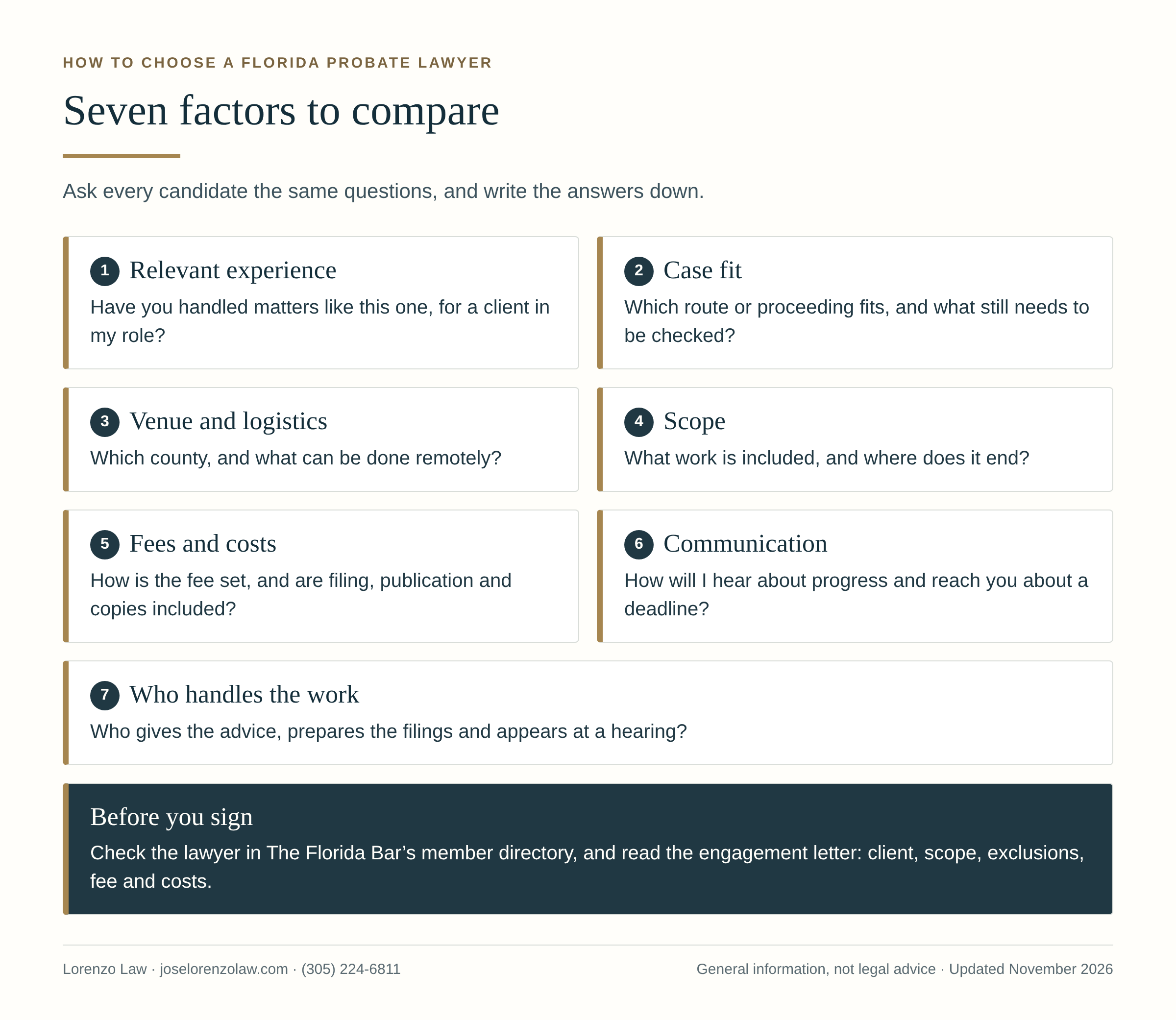
See the chart “Seven factors to compare” (opens the full-size image)
A lower estimate may cover fewer tasks, and a higher one may assume a different route or a dispute. Ask what explains the difference before deciding. The full question list below adds the questions for beneficiaries, disputes and out-of-state families.
Do you need a probate lawyer at all?
Florida Probate Rule 5.030(a) provides that every guardian and every personal representative, unless the personal representative remains the sole interested person, must be represented by an attorney admitted to practice in Florida. A guardian or personal representative who is an attorney admitted to practice in Florida may represent himself or herself as guardian or personal representative. Florida does not require a lawyer for summary administration, and no personal representative is appointed in it.
A beneficiary is never required to hire a lawyer. For the role-by-role answer, including the “sole interested person” exception and when a beneficiary needs independent advice, see do I need a probate attorney in Florida.
Summary administration is available when the value of the entire estate subject to administration in Florida, less the value of property exempt from creditors’ claims, does not exceed $150,000, or when the person has been dead for more than two years, and the will, if there is one, does not direct formal administration. The limit was $75,000 before July 1, 2026, and many websites and AI answers still give the old figure. Florida law allows a summary administration petition to be filed if the estate qualifies at the time of filing (§ 735.2055), but it does not expressly say whether the $150,000 limit or the former $75,000 limit applies when the death occurred before July 1, 2026. In that situation, confirm the applicable limit before filing.
Start with your role: who would the lawyer represent?
A probate lawyer represents a client in a capacity: the personal representative in that role, a beneficiary about his or her own share, a surviving spouse about the spouse’s rights, or a creditor about a claim. Before comparing lawyers, decide which of these you are, because the same family can need more than one lawyer when their interests differ.
Who the lawyer represents, by role
| Your role | The lawyer you are choosing | Ask about | Read next |
|---|---|---|---|
| Named or likely personal representative (executor) | Your lawyer as personal representative (an attorney for the executor, sometimes called an estate administration attorney); in a formal administration the lawyer files for you and advises you on your duties | The route, notices, creditor claims, the inventory, the house, the accounting and closing | Becoming a personal representative |
| Beneficiary or heir | Your own lawyer, if you want advice about your share; the personal representative’s lawyer is not your lawyer | Notices you received, the inventory, the accounting, a waiver or release you were asked to sign, a delay | When a beneficiary hires a lawyer |
| Surviving spouse | Your own lawyer about the spouse’s rights, which can differ from the will | Homestead, the elective share, exempt property, the family allowance and any deadlines | Surviving spouse rights |
| Family member in a dispute | A lawyer who handles contested probate for your side of the dispute | Evidence, deadlines, hearings, mediation and whether the engagement covers trial | Probate litigation |
| Trustee or someone with several roles | A lawyer who identifies each capacity and whether more than one engagement is needed | Which assets are in the trust and which need probate, and any conflict between your roles | Trust or probate |
| Creditor of the estate | Your lawyer to file, enforce or settle a claim | The notice to creditors, the claim deadline and any objection | Florida probate creditor claims |
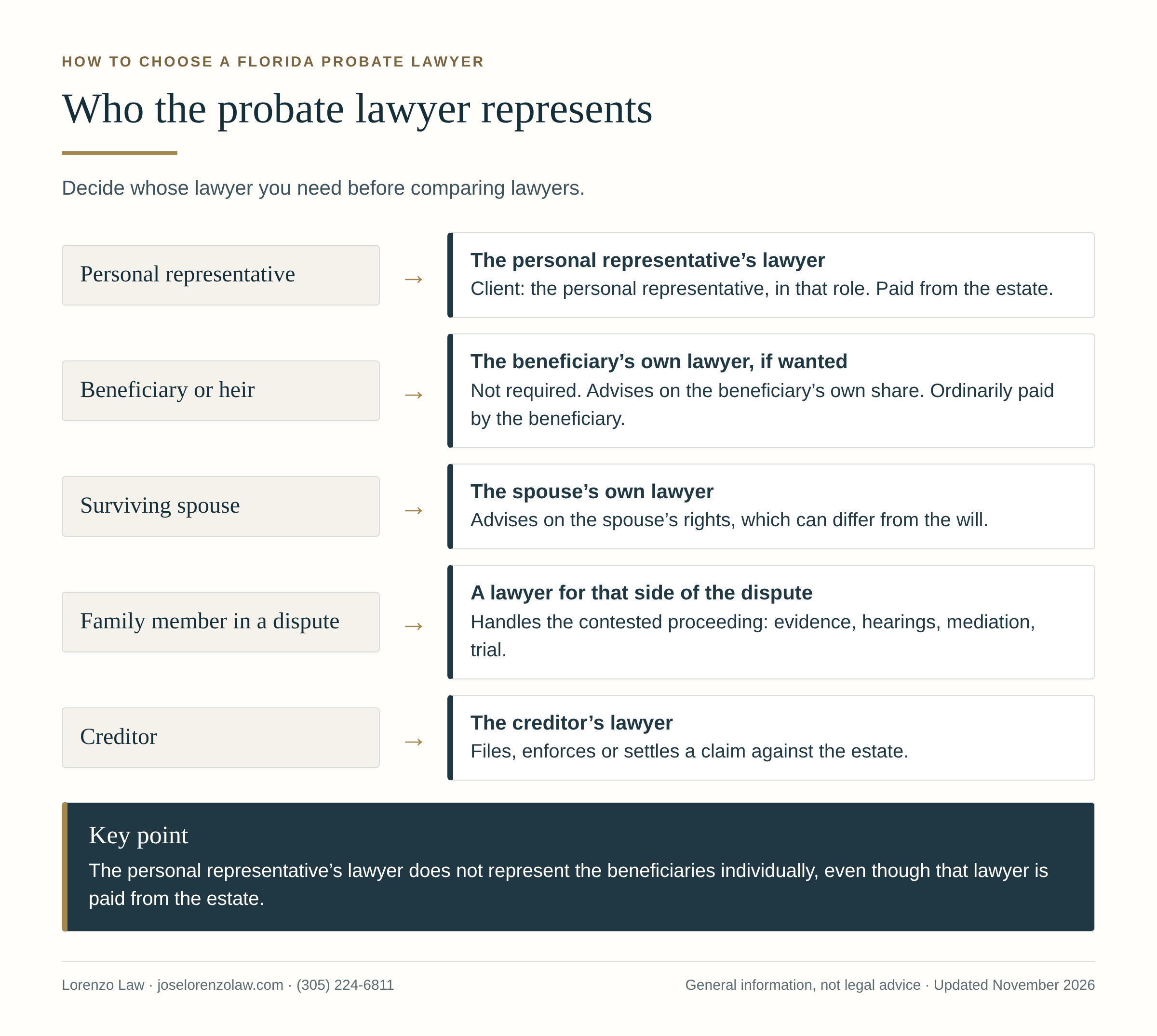
See the chart “Who the probate lawyer represents” (opens the full-size image)
Does the personal representative’s lawyer represent the beneficiaries?
No. In a formal administration, the probate lawyer’s client is the personal representative, not the beneficiaries individually, even though the lawyer’s fee is paid from the estate (In re Estate of Gory, 570 So. 2d 1381 (Fla. 4th DCA 1990)). The lawyer still owes the beneficiaries certain fiduciary duties, but they are not the lawyer’s clients. Sending notices to beneficiaries, answering their questions or sharing documents does not make them clients.
Communications between the personal representative and the estate’s lawyer are protected by the lawyer-client privilege under section 90.5021, as they would be for any other client; a beneficiary does not gain access to them because the lawyer’s fee is paid from the estate.
That is why the first question to ask any probate lawyer is “Who would be your client?” A personal representative choosing a lawyer is choosing counsel for the role; a beneficiary who wants someone on his or her side needs a separate engagement.
When should a beneficiary hire a separate lawyer?
A beneficiary or heir is never required to hire a lawyer, and many never do. Independent advice is worth considering when you are asked to sign a waiver, receipt or release; when the inventory or accounting does not match what you know; when the personal representative’s compensation or the lawyer’s fees seem high; when distributions are delayed without an explanation; when an asset seems to be missing; or when you think the personal representative is favoring someone. Lorenzo Law accepts a beneficiary’s individual matter, such as reviewing an accounting or a release, as a paid engagement, subject to a conflict check.
A lawyer who advises a beneficiary on his or her own share is sometimes called a beneficiary attorney or an inheritance lawyer. The label matters less than the engagement: the lawyer should confirm in writing that you are the client and what the review covers.
Can one lawyer represent the whole family?
Sometimes, but only with care. When family members agree on everything, one lawyer may represent more than one of them after a conflict check, an explanation of the risks and each person’s informed consent confirmed in writing. When their interests differ, as when one sibling serves as personal representative and another questions a distribution, each may need his or her own lawyer. Ask the lawyer who the client is, what happens if a disagreement develops, and whether you would need new counsel then.
For example, two siblings may both want the estate finished quickly, while one of them, as personal representative, plans to sell the house and the other wants to keep it. They share a goal but not an interest in that decision, and the lawyer advising the personal representative is not the other sibling’s independent adviser.
Trustees and people with more than one role
The same person can be personal representative, trustee and beneficiary at once. Each role carries different duties, and a lawyer should say which capacity the engagement covers. If the person who died had a revocable trust, some assets may pass under the trust while others still need probate; ask whether the lawyer handles both and whether one engagement or two is proposed.
Which kind of probate lawyer does the estate need?
Probate work divides into estate administration (opening the estate, giving notices, handling claims, distributing and closing), a beneficiary’s or spouse’s individual review, and contested matters such as will contests, objections to accountings and removal of a personal representative. Trust administration and estate planning are related but separate. Ask which of these the lawyer handles regularly and which the engagement covers.
What does a probate lawyer do?
A probate lawyer for a personal representative advises on the duties of the role and prepares and files the court papers. “Probate lawyer” and “probate attorney” mean the same thing; both describe a lawyer who handles estate administration and the disputes that can arise in it. The table shows the usual tasks by stage; the full sequence is in the Florida probate process guide.
Tasks a probate lawyer usually handles, stage by stage
| Stage | Typical lawyer tasks | What you provide |
|---|---|---|
| Opening the estate | Confirm the route and the county, prepare the petition, oath, address designation and, unless an exception applies, designation of resident agent, and file them | Death certificate or date of death, the original will if any, family and asset information |
| Authority | Obtain the order and letters of administration for the personal representative | Signatures; bond information if one is required |
| Notices and claims | Prepare the notice of administration and notice to creditors, track the claim period, review claims and file objections | Bills, creditor letters and the names of anyone owed money |
| Inventory and property | Prepare the inventory, advise on the house, accounts and other property, and on any sale | Statements, deeds, titles and values |
| Closing | Prepare the accounting or waivers, the petition for discharge and plan of distribution, and the discharge papers | Records of every payment and distribution |
What is the difference between a probate lawyer and an estate planning lawyer?
An estate planning lawyer prepares documents for someone who is alive: a will, a trust, powers of attorney and deeds. A probate lawyer works after a death, guiding the estate through court. Many lawyers do both, and experience drafting wills helps in reading one, but drafting is not the same work as running an estate or arguing a contested hearing. Ask about the work this estate needs. Planning your own estate is a separate service; see Florida estate planning.
When do you need a probate litigation lawyer?
When someone challenges the will, the personal representative’s conduct, an accounting, a claim or a distribution, the matter can become an adversary proceeding with pleadings, evidence and hearings. A disagreement does not by itself prove a claim or guarantee removal of a personal representative, and each kind of challenge has its own deadline, some of which start when papers are served. If your concern is contested, say so at the start of the consultation and ask whether the lawyer handles contested probate, whether the engagement covers hearings and trial, and how mediation fits.
When a personal representative does not act, for example by not filing the inventory, not answering beneficiaries or letting deadlines pass, an interested person can ask the court to order the personal representative to act or, in some cases, to remove the personal representative. Both steps usually need a lawyer who handles contested probate.
Related guides: probate litigation, will contests, breach of fiduciary duty, undue influence and the Florida estate disputes guide. If you want notice before a will is admitted, see the Florida probate caveat.
Is trust administration the same as probate?
No. A funded revocable trust is administered by the trustee under the trust instrument, generally without opening a court case, while probate covers assets in the deceased person’s own name with no other way to pass. Many families need both: a trust for most assets and a probate for one account or a car left outside it. Ask whether the lawyer handles both and what each costs; disputes over a trust are handled as trust litigation.
How do you check a Florida lawyer’s license and record?
Search the lawyer’s name in The Florida Bar’s member directory. The profile shows whether the lawyer is eligible to practice law in Florida, the date of admission, the address on record and any public discipline, and it lists board certification if the lawyer holds it. A lawyer who is not eligible to practice in Florida cannot represent a personal representative in a Florida probate.
The Florida Bar member search is free and public. A few points make it more useful:
- Search by full name and confirm the Bar number. Several lawyers can share a name; the Bar number on the lawyer’s website or engagement letter should match the profile.
- Read the eligibility status. A lawyer must be eligible to practice to take on your matter.
- Note the admission date. It shows how long the lawyer has been licensed in Florida, not how much probate work the lawyer has done; ask about that separately.
- Look for public discipline. The directory notes public disciplinary history; ask the lawyer about anything you find.
- Check certification only if it is claimed. If a lawyer advertises board certification, the profile should show the area.
You can check Lorenzo Law the same way: Jose M. Lorenzo, Jr., Florida Bar No. 107002, admitted October 4, 2013, in The Florida Bar member directory.
Is board certification required for a probate lawyer?
No. Board certification by The Florida Bar in wills, trusts and estates is an optional credential that requires a minimum period of practice, substantial involvement in the area, peer review and an examination. Many lawyers who handle probate every day are not board certified, and certification does not promise a result. Florida’s advertising rules limit when a lawyer may claim to be a specialist or expert: the lawyer must be board certified or able to objectively verify the claim. Board certification by The Florida Bar appears in the Bar’s directory. Ask any lawyer you consider about the work your estate actually needs.
How should you read reviews, ratings and directory badges?
Recommendations from family, friends, a financial advisor or another lawyer are a reasonable place to start, but they tell you how the lawyer treated someone else, not whether the lawyer fits your estate. Check any recommended lawyer in the Bar directory and ask the same questions you would ask anyone else.
Online reviews describe one client’s experience and often say more about communication than about the law. Directory listings and “top lawyer” badges are frequently paid or self-reported, and search ads appear because a firm bought them. None of these replaces the Bar directory or your own questions. Use reviews to decide whom to call, then compare the lawyers on the answers they give.
What questions should you ask a probate lawyer before hiring one?
Ask every candidate the same questions in six groups: experience and fit, who the lawyer represents, the route and the court, scope and exclusions, fees and costs, and communication and who does the work. Write the answers down; a clear answer names a person, a route, a price basis or a document, and an unclear one is a reason to ask again.
Question bank: what to ask and what a clear answer includes
| Topic | Question | Why it matters |
|---|---|---|
| Experience | How often do you handle Florida probate matters like this one? | A lawyer who files these regularly knows what the clerk and the court expect. |
| Experience | Have you handled an estate with this issue (a house, a business, an out-of-state owner, a missing will, a creditor dispute)? | The issue, not the label “probate,” decides the work. |
| Experience | Do you also handle contested matters, or would a dispute go to another lawyer? | You learn now whether a disagreement means a second lawyer. |
| Client | Who would be your client, and in what capacity? | The personal representative’s lawyer does not represent the beneficiaries. |
| Client | If my siblings or I disagree later, who would you continue to represent? | Conflicts can force a change of counsel mid-case. |
| Route | Which type of administration do you expect, and why? | Summary and formal administration differ in steps, time and cost. |
| Route | Which assets will need probate, and which pass outside it? | Assets with an effective beneficiary designation, or held jointly with a right of survivorship, usually skip probate. |
| Route | Which county will the case be filed in, and will any hearing be needed? | Venue follows the decedent’s Florida domicile, or for a nonresident, where Florida property is, not the lawyer’s office. |
| Route | How will the house be handled, and is it homestead? | Homestead often passes outside the administration and changes who signs. |
| Scope | What exactly does your fee cover, from which step to which step? | Quotes are only comparable when the scope matches. |
| Scope | What is excluded: a contest, a property sale, tax returns, a second petition? | Exclusions are where costs grow. |
| Scope | What would require a new agreement, and how would you tell me? | Changes should be agreed before the work, not billed after. |
| Fees | Is your fee flat, hourly or based on the statutory schedule? | Each method moves differently when the estate gets complicated. |
| Fees | Are the filing fee, the creditor-notice publication and certified copies included? | These costs are often quoted separately. |
| Fees | When is the fee paid, and is any advance required? | Timing matters when the estate has little cash. |
| Fees | Who pays your fee: the estate or me personally? | The personal representative’s lawyer is usually paid from the estate; your own lawyer, by you. |
| Handling | Who will I speak with, and who prepares and signs the filings? | The person at the first call may not be the person doing the work. |
| Handling | How will you update me, and how do I reach you about a deadline? | Communication gaps are a common source of frustration in probate. |
| Timing | What has to happen before the court appoints someone, and before anyone is paid? | An honest answer explains the steps instead of promising a date. |
| Timing | Is there anything I should do, or not do, right now? | Paying bills or distributing too early can create personal liability. |
| Remote | What can be signed and handled remotely, and what needs an original or my presence? | Out-of-state families plan travel and mail around this. |
| Disputes | If a sibling objects, what changes in the work and the fee? | A dispute usually moves the matter out of a flat fee. |
| Beneficiary | I was asked to sign a waiver or release. What does it give up? | Waivers can end your right to an accounting or to object. |
| Language | Can the consultation be in Spanish, and are documents explained in Spanish? | You should understand every document you sign, whatever language it is written in. |
A good answer to “How long will it take?” describes the steps and what could change them, not a guaranteed date. For the time each route usually takes, see how long probate takes in Florida.
What the lawyer will ask you
Expect questions about the date of death, where the person lived, whether there is a will and where the original is, the family (spouse, children, any child of a prior relationship), the assets and how each was titled, debts and creditor letters, anything already filed, and any disagreement. The lawyer will also ask the names of everyone involved to run a conflict check before giving advice. Answer as completely as you can; gaps in the facts are the most common reason an early estimate later changes.
What should you bring to the first meeting with a probate lawyer?
Bring what you have, not a perfect file: the death certificate or the date of death, the will and any codicil or trust (a copy is fine for the meeting), a list of assets with how each was titled, recent statements, deeds, any court papers or notices you received with their envelopes, creditor letters, and the names and addresses of the family members and beneficiaries. If a notice or hearing date is involved, mention it when you call.
Documents to bring, and why
| Bring | Why the lawyer needs it |
|---|---|
| Death certificate or the date of death | Starts several deadlines and is filed in the case |
| The will, codicils and any trust | Shows who serves, who inherits and whether a trust holds assets; the original will must reach the clerk |
| List of assets with titles and approximate values | Decides which assets need probate and which route fits |
| Deeds, statements and beneficiary forms | Shows how each asset passes |
| Bills, creditor letters, mortgage statements | Affects the notice to creditors and the order of payment |
| Court papers, notices, waivers you were asked to sign | Some deadlines run from the date of service |
| Names and addresses of the family and beneficiaries | Needed for the conflict check and the notices |
What should you not tell or send a lawyer before you hire one?
Be complete and candid with the lawyer you consult; holding back facts only makes the advice less useful. Florida’s lawyer-client privilege generally protects what you tell a lawyer you consult about legal services, even before you hire one (section 90.502). What you should avoid is sending sensitive documents the wrong way: do not put full account numbers, Social Security numbers or original documents into a website form or an email to a firm you have not hired. Ask how the lawyer wants documents delivered, and keep originals until you are told where they go. Sending an inquiry does not make a lawyer your lawyer, and it does not protect a deadline.
How do you compare probate lawyer fees?
Compare what each quote covers before comparing the numbers: the route, the steps included, which court costs are included, what is excluded, and when payment is due. A flat fee covers an agreed scope; an hourly fee depends on the work; Florida’s statutory schedule only presumes a fee reasonable for ordinary services in a formal administration, and it is not a required price. For the full cost picture, see how much probate costs in Florida.
Flat fee, hourly or the statutory schedule
The personal representative’s lawyer is paid from the estate as an expense of administration, before beneficiaries receive their shares. A beneficiary who hires his or her own lawyer ordinarily pays that lawyer. Section 733.6171 sets a schedule that the law presumes reasonable in formal administration, but it is not a required fee, the base is the estate’s compensable value (the inventory value plus income earned during administration), not every asset the decedent owned, and a lawyer who charges by the schedule must first make written disclosures to the personal representative.
Florida does not set a universal 3% probate fee or a 3% maximum. A flat fee covers an agreed scope and stays the same if the work inside that scope takes longer; an hourly fee follows the time spent; extraordinary work, such as litigation or selling property, can be paid in addition to ordinary services under the statute, unless the fee agreement provides otherwise. Whatever the method, the fee arrangement should be in writing.
Are court costs included in a flat fee?
Not always. Many quotes list the clerk’s filing fee, publication of the notice to creditors and certified copies as extra costs passed through at cost. Ask each lawyer for the total with those costs, so that a quote that leaves them out does not look lower than one that includes them. Lorenzo Law’s flat fees include them.
Comparing two quotes on the same basis
| Check | Quote A | Quote B |
|---|---|---|
| Route the quote assumes | Write it here | Write it here |
| Steps included (opening to discharge?) | Ask | Ask |
| Filing fee, publication and certified copies included? | Yes or no | Yes or no |
| Exclusions (dispute, sale, tax returns) | List them | List them |
| When payment is due; any advance | Ask | Ask |
| Who does the work | Name | Name |
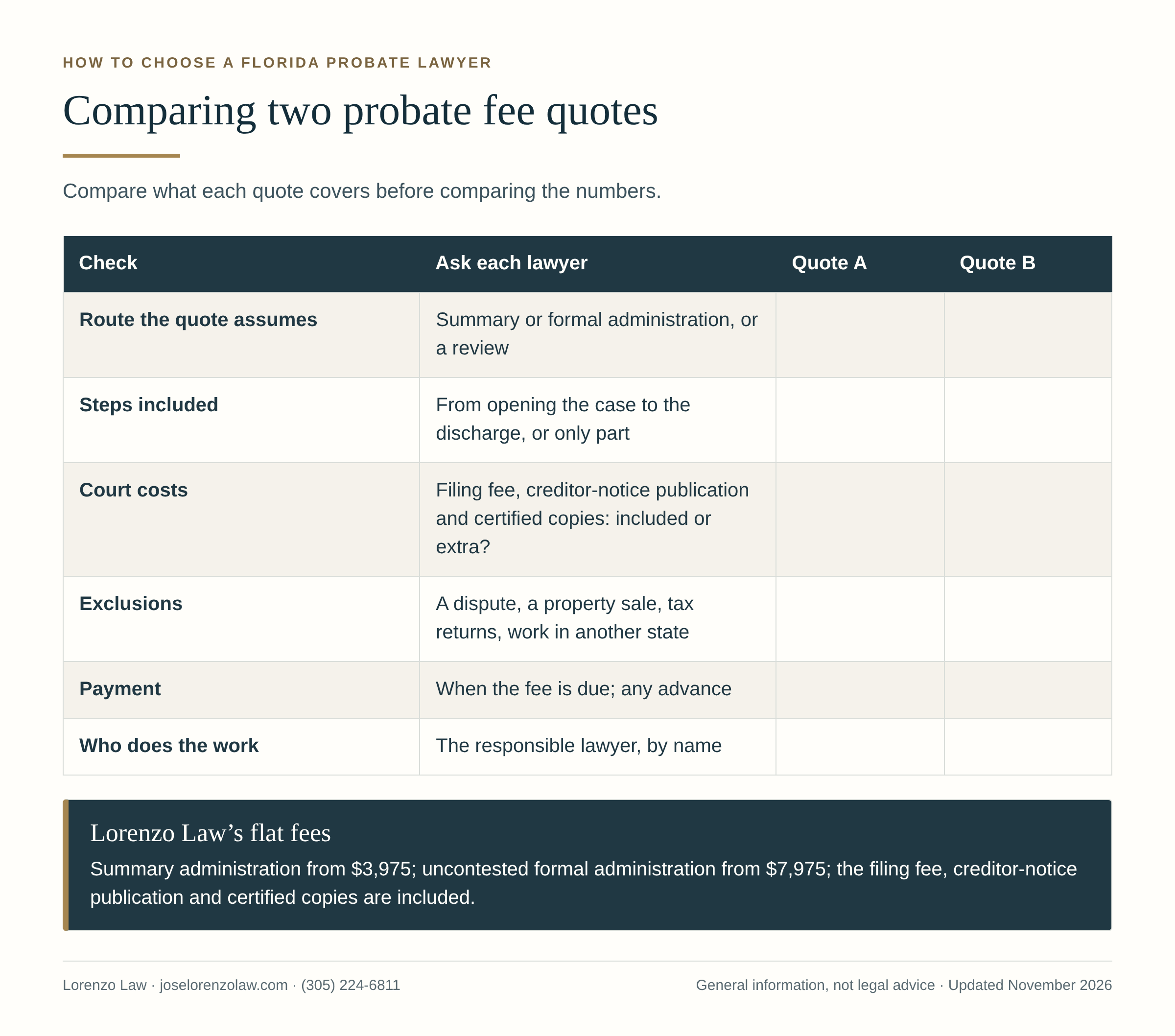
See the chart “Comparing two probate fee quotes” (opens the full-size image)
Use it on paper or in your notes while you call; nothing on this page is downloaded or stored.
Why are two probate quotes so different?
Usually because they assume different things: one assumes summary administration and the other formal; one includes court costs and the other adds them; one covers the whole case and the other only opening it; one expects a dispute. A quote far below the others may also leave out work that will be billed later. Ask each lawyer to state the assumptions in writing.
Do probate lawyers take a retainer, work on contingency or charge upfront?
It depends on the lawyer and the matter. Some ask for an advance before starting; others are paid near the end of the case from estate funds. Contingency or hybrid fees are more common in litigation than in an ordinary administration. Ask when payment is due and what happens if the estate has no cash, for example when the house is the only asset. With Lorenzo Law, the probate flat fee is paid near the close of the matter; any advance for costs is discussed with you, and when the estate has no cash, the client pays the flat fee.
Lorenzo Law’s fees by engagement
| Service | Fee basis | What is included |
|---|---|---|
| Summary administration | From $3,975 | Court filing fee and one certified copy of the order (additional copies at the Clerk’s rate); no publication cost (Lorenzo Law does not publish the optional notice to creditors) |
| Uncontested formal administration | From $7,975 | Court filing fee, creditor-notice publication and certified copies |
| Ancillary administration | Quoted per matter | Set out in the written agreement |
| Hourly review and advice, for example for someone filing a petition without a lawyer | Hourly; rate agreed in writing | The review or advice you request |
| A beneficiary’s individual matter, such as reviewing an accounting or a release | Paid engagement; fee agreed in writing | The review you request, subject to a conflict check |
| Creditor claims (filing, enforcing or settling a claim) | Depends on the issue; agreed in writing | Subject to a conflict check |
| Probate, trust and estate litigation | Agreed in writing for the matter | Contingency or hybrid where appropriate; flat fees for some discrete tasks; trust litigation is never a flat fee |
For either procedure, homestead determinations, more complex estates and contested matters are quoted separately, and other expenses may apply, such as recording fees or the decedent’s debts, and in formal administration a personal representative’s bond if the court requires one and the personal representative’s compensation; any increase is discussed before work begins. Full fee terms: summary and formal administration fees.
The quote can rise with factors in the estate, such as a dispute, additional property or a sale, and any change is discussed before the work begins. These fees are honored for at least 90 days from the date this page was updated, through at least February 15, 2027.
Probate lawyer fit check: what kind of help do you need?
Answer five questions to see which kind of probate lawyer fits your situation, the questions to ask first, and whether Lorenzo Law handles that kind of matter. It uses general information only; it does not decide your case.
The tool works in your browser and stores nothing. It makes your selected role and type of need available to site analytics; the event does not include your other answers. This is general information, not legal advice, and does not create an attorney-client relationship.
Does your probate lawyer need to be local?
No rule requires the lawyer’s office to be in the county where the case is filed. What matters is that the lawyer is admitted in Florida, files in the correct county and knows how that court handles probate. Many Florida estates are handled by phone, video, mail and electronic filing; a hearing, when one is needed, is the exception, and some courts hold hearings remotely.
A Florida estate is opened in the county where the decedent was domiciled; if the decedent was not domiciled in Florida, in any county where the decedent’s property is located; and if there is no Florida property, in the county where a debtor of the decedent lives (section 733.101).
So the circuit court that hears the case is set by where the person was domiciled, or for a nonresident, where Florida property is, not by where the lawyer works. A lawyer’s familiarity with a court’s procedures helps the filings go smoothly; it does not mean preferential treatment or a faster ruling. For how a particular court works, see the court guides below and the Florida probate service areas page.
The same checks apply whether the case will be filed in Miami-Dade, Broward, Palm Beach, Orange, Hillsborough or any other Florida county. How to choose a probate lawyer does not change with the county; what changes is the court’s local procedure, which a lawyer who files there regularly will know. For one local example, see comparing probate attorneys for a Coral Way estate. Another is comparing probate attorneys for a Cutler Bay estate.
County probate court guides
- Miami-Dade County probate court
- Broward County probate court
- Palm Beach County probate court
- Orange County probate court
- Hillsborough County probate court
- Duval County probate court
- Pinellas County probate court
- Sarasota and Manatee County probate courts
- Lee and Collier County probate courts
Can you hire a probate lawyer in Florida if you live in another state?
Yes, and usually without traveling. A Florida probate can generally be handled by phone, video, mail and electronic filing, and many estates never need an in-person hearing. Ask about signing and original-document requirements for the particular matter; the original will must be deposited with the clerk.
Living outside Florida does not decide whether you can serve as personal representative. A person domiciled in Florida can serve if otherwise qualified; a nonresident can serve only if related to the decedent in one of the ways the statute lists (section 733.304). If the person who died lived in another state but owned Florida property, the Florida case is usually an ancillary administration. See the guides to the out-of-state executor in Florida and Florida ancillary probate.
Is a Spanish-speaking probate lawyer available?
Consultations with Lorenzo Law are available in Spanish. The court papers Jose M. Lorenzo, Jr. prepares are in English; he explains them in Spanish but does not translate them word for word, so a client who needs a full written translation or an interpreter for a hearing arranges one.
Who will handle your matter, and how will you hear about it?
Ask who gives the legal advice, who prepares and signs the filings, who appears if there is a hearing, and who covers when that person is away. Then agree on how you will hear about progress: which channel, which milestones (appointment, notices, the end of the creditor period, the inventory, the closing papers) and what you need to send.
Larger firms often divide work among lawyers, paralegals and assistants, and that can work well when the responsible lawyer is clear and reachable; a solo lawyer does more of the work personally. Neither model is right for every estate. What matters is that you know, before you sign, who is responsible for your matter and how to reach that person about a deadline.
Questions that make communication concrete:
- Will I speak with the lawyer, or with staff, when I call?
- How will you tell me when the court appoints the personal representative, when the creditor period ends and when the closing papers are filed?
- What do you need from me, and by when?
- How do I send documents securely?
- If I disagree with a recommendation, how is that decided?
What if your probate lawyer isn’t responding?
Send a short written request that names the question and a reasonable date for an answer, and keep a copy. Ask for a status summary: what has been filed, what is pending and what is the next step. You can also look at the court docket through the clerk’s online case search, which shows what has been filed and when. If the silence continues, a consultation with another lawyer can tell you where the case stands and whether a change of counsel makes sense; see changing probate lawyers.
What should the engagement letter say?
Before you sign, the engagement letter should name the client and the capacity (for example, “you, as personal representative”), describe the work included and the work excluded, state the fee method and amount, say which costs are included or billed separately, explain when payment is due, and say how a change in scope will be agreed. Read it before signing and keep a copy.
Use the letter to check what you heard in the consultation:
- Client and capacity. Is it you personally, you as personal representative, or you as a beneficiary?
- Scope. Does it run from opening the case to the order of discharge, or only to one step?
- Exclusions. A will contest, an objection, a property sale, tax returns, work in another state.
- Fees and costs. The amount or rate, the filing fee, publication and copies, any advance.
- Changes. What triggers a new agreement, and how you will be told before extra work starts.
- Ending the engagement. What event completes the work, and what happens to your file.
Can a lawyer handle only part of the probate?
Sometimes. Some lawyers offer a limited engagement, such as reviewing a petition you prepared or advising on one step, and Lorenzo Law offers hourly review and advice for people handling part of the process themselves. In a formal administration, however, the personal representative generally must be represented by a Florida lawyer unless an exception applies, and a lawyer appearing for a limited purpose must file a notice limiting the appearance when first appearing. Ask exactly which steps the engagement covers and who will be responsible for the rest.
Red flags when choosing a probate lawyer
Be cautious about a lawyer who guarantees a result or a date, who cannot say who the client would be, who quotes a price without asking about the assets, who will not put the fee and scope in writing, or who presses you to sign before you understand the engagement.
- Guarantees. No lawyer can promise how a court will rule, how long a case will take or that a dispute will be won.
- An unclear client. If the lawyer cannot say whether he or she represents you, the personal representative or “the family,” ask again before sharing more.
- A price with no questions. A quote given before the lawyer knows the route, the assets or the family may not cover what the estate needs.
- Nothing in writing. The fee, the scope and the costs should be in a signed agreement.
- Pressure. A real deadline is a reason to act promptly, not a reason to skip reading the agreement.
- Credentials you cannot check. Look up the lawyer in The Florida Bar’s directory; a claimed certification should appear there.
- Advice to ignore a notice. Notices and service dates start deadlines; a lawyer should ask when you received them.
Common mistakes when hiring a probate lawyer
- Choosing on price alone. A low quote that leaves out court costs, the homestead petition or a property sale can end up costing more.
- Not asking who the client is. Beneficiaries sometimes assume the estate’s lawyer is looking after their interests.
- Acting before getting advice. Paying the decedent’s bills or distributing property before the estate is opened and the claims are known can create problems for the personal representative.
- Signing before reading. A waiver, receipt or release can give up the right to an accounting or to object.
- Waiting for a deadline. Notices start deadlines; a lawyer hired the week a deadline runs has fewer options.
- Hiring the wrong kind of lawyer. A dispute needs a lawyer who handles contested matters; a real estate closing or a tax return may need someone else.
Can you change probate lawyers in the middle of the case?
Yes. A client can end the engagement and hire another lawyer at any stage. In a court case, the court approves a substitution of counsel with the client’s written consent, or the former lawyer moves for leave to withdraw, so someone is always responsible for the filings; the former lawyer then turns over the client’s papers, subject to any right to keep them that the law allows.
Before you change, ask the current lawyer for a written status: what has been filed, what is pending and what deadlines are running. Ask about fees already paid or owed under the engagement letter. A personal representative in a formal administration should line up the new lawyer before the old one withdraws, because the personal representative generally cannot proceed without counsel unless an exception applies.
Lorenzo Law does take over probate matters from other lawyers and reviews open cases for a second opinion, as an hourly review. Whether it can take over a particular case depends on the facts and where the case stands; that is discussed at the initial consultation, subject to a conflict check.
Do you have to use the lawyer who wrote the will?
No. The personal representative may choose the lawyer for the estate, even when the will names a lawyer or the lawyer who drafted the will offers to handle the probate. Compare that lawyer with others on the same questions.
Can the lawyer also serve as personal representative?
A Florida lawyer can be named as personal representative and, under Rule 5.030, may represent himself or herself in that role. When a lawyer serves as personal representative and also acts as the estate’s lawyer, the compensation for each role is reviewed separately, and the family should understand both before agreeing. A lawyer who drafted a Florida resident’s will signed on or after October 1, 2020 that names him or her as personal representative is paid for serving only if certain disclosures were made first, unless related to the testator.
When should you hire a probate lawyer?
Talk to a lawyer before you act for the estate, not after: before paying the decedent’s bills or distributing anything, before signing a waiver or release, as soon as you receive a notice of administration or a hearing notice, when a creditor or family member disputes something, and when a house needs to be sold. If you are the person named as personal representative and the estate has probate assets, the lawyer is part of opening the case.
The deadline for depositing the original will is that the custodian of a will must deposit it with the clerk of the court having venue of the estate within 10 days after receiving information that the testator is dead (section 732.901). Depositing the will does not open probate and does not require a lawyer.
Other timing points to raise in the first call:
- Notices received. A notice of administration or a notice to creditors starts deadlines measured from service or publication.
- Money or property at risk. A vacant house, a vehicle, a business or accounts others can reach.
- A disagreement. Each kind of challenge has its own deadline.
- Two years after death. Most creditor claims not filed by then are barred, and summary administration may become available whatever the value.
Hiring a lawyer does not by itself make probate faster; the court’s schedule and the legal waiting periods still apply. For the full sequence, see the Florida probate process.
How Lorenzo Law fits
Lorenzo Law is the solo practice of Jose M. Lorenzo, Jr. The attorney you speak with at the first call is the attorney who personally handles the work covered by any engagement the firm accepts. The practice takes Florida probate administration, beneficiaries’ and spouses’ individual matters, creditor claims and probate litigation statewide, by phone or video in English or Spanish.
- One lawyer, start to finish. Jose takes the first call himself and handles each accepted matter himself.
- Published flat fees. Summary and uncontested formal administration, with what each includes set out in the fee table. Fee details
- Statewide. Estates in any Florida county; principal office in Kissimmee; meetings by appointment in Coral Gables and Fort Lauderdale.
- Background. Admitted to The Florida Bar in 2013, after about a decade as a probate and litigation paralegal; judicial intern with the Hon. Maria M. Korvick in the Probate Division of the Eleventh Judicial Circuit.
- Both sides of the estate. Personal representatives, beneficiaries reviewing an accounting or release, surviving spouses and creditors, subject to a conflict check.
For the probate service itself, see the Florida probate lawyer page; for disputes, Florida probate litigation.
When another lawyer may fit better
Choosing well also means knowing what a practice does not do. Lorenzo Law does not handle:
- Medicaid, SSI or other public-benefits planning;
- preparation of tax returns or tax opinions; Lorenzo Law coordinates with the family’s tax professional;
- real estate closings or title insurance;
- challenges to a tax-deed sale or tax-deed surplus claims;
- personal injury cases; for a wrongful-death claim, Lorenzo Law handles only the estate side, and the damages case goes to a personal-injury lawyer by referral or co-counsel;
- criminal or family matters;
- probate in Puerto Rico or under another country’s law; Lorenzo Law explains the Florida side only.
If your matter is mainly one of these, look for a lawyer who handles it regularly, and keep the Florida probate questions on this page for the part of the matter that is probate.
More questions about choosing a probate lawyer
How do I find a probate lawyer in Florida?
Ask people you trust who have been through a Florida probate, look at the guides lawyers publish to see how they explain the process, and search for lawyers who handle probate in the county where the person lived or statewide. Shortlist two or three, check each one in The Florida Bar’s member directory, and ask each the same questions before deciding.
Are probate lawyers free?
No. Some lawyers offer a free consultation, but the representation itself is paid. With Lorenzo Law, only the initial consultation is free; representation fees and costs are agreed separately in writing.
Is the cheapest probate lawyer a good choice?
Price is one factor among seven. An affordable probate lawyer is one whose total, with the costs, covers the work the estate actually needs. A low quote can be a good value when it covers the same work, includes the court costs and comes with a clear scope. It is a poor value when it leaves out costs or steps that will be billed later, or when it assumes a simpler route than the estate needs. Compare quotes on the same basis using the fee comparison above.
Will hiring a lawyer make probate faster?
Not by itself. The creditor period and the court’s schedule apply whoever files. A lawyer helps avoid the returned filings, missed notices and early distributions that slow an estate down, and can tell you which steps are waiting on the court and which are waiting on information.
Does a probate lawyer have to go to court?
Often not in person. Many uncontested Florida probates are decided on the filed papers, without a hearing. Hearings are more likely when someone objects, a will’s validity is disputed or the court wants to hear from the petitioner, and some are held remotely. Ask the lawyer whether a hearing is expected and who will attend.
Why would a probate attorney contact me?
Usually because you are named in a will, are an heir, or are a creditor or another interested person in an estate the lawyer is handling for the personal representative. The letter may include a notice of administration, a waiver or a request for information. That lawyer represents the personal representative, not you, so read what you receive closely: a notice of administration starts deadlines, and a waiver or receipt can affect your rights. You may ask the lawyer questions, and you may hire your own lawyer before signing anything. If a letter offers to buy your share or asks for a fee to help you collect an inheritance, check who sent it before you respond.
What happens after I hire a probate lawyer?
For a personal representative, the lawyer confirms the route and the county, prepares the opening papers for signature and files them; after the court appoints the personal representative, the notices go out and the administration runs through claims, the inventory, distribution and closing. For a beneficiary, the lawyer reviews the documents you received and advises on your options. The step-by-step guide is the Florida probate process.
Talk with Lorenzo Law about your Florida probate matter
Tell Lorenzo Law your role (named personal representative, beneficiary, heir, surviving spouse or creditor), the date of death, the county where the person lived, the kinds of assets and how they were titled, and whether there is a notice, a hearing date or a disagreement. Jose M. Lorenzo, Jr. handles each matter himself. The initial consultation identifies the route and the information needed to quote a fee; it does not guarantee that a matter will be accepted, a result or a date from the court.
Ask how to send documents securely before sending account numbers or originals. An inquiry does not create an attorney-client relationship.
Request a free initial consultation. Only the initial consultation is free; representation fees and costs are agreed separately in writing.
Request a free initial consultationCall (305) 224-6811
Related guides: do I need a probate attorney in Florida, probate costs, selecting a personal representative, homestead in probate, a bank account after a death, probate questions people are embarrassed to ask.
General information about Florida law; it does not replace a review of your documents and circumstances. Reading this page does not create an attorney-client relationship.
Sources and authorities
Statutes cited are the 2026 Florida Statutes; the rules are the Florida Probate Rules compilation of October 15, 2026, and the Rules Regulating The Florida Bar.

