
Change or Revoke a Florida Lady Bird Deed
Quick answer: how do you change a Lady Bird deed in Florida? While you are alive, sign a new deed in front of two witnesses and a notary, deliver it, and record it in the county where the property sits.
It works only if your original deed reserved the power you want to use and you understand what you are signing. On homestead, a married owner's spouse usually must sign too. If you have a minor child, homestead rules may limit what any deed can do.
Request a free initial consultation. Only the initial consultation is free; representation fees and costs are agreed separately in writing. Consultations are available statewide in English and Spanish, by phone or video.
Request a free initial consultationCall (305) 224-6811
Go straight to: Can it be changed? · What it costs · How to change a Lady Bird deed · Signing and recording · Changing vs. challenging
All guide sections 12 sections
A Lady Bird deed, formally an enhanced life estate deed, lets you keep control of your Florida home during your life and name who receives it at your death. Here, “you” are the owner, and the people named to receive the property are your beneficiaries. This page is for living owners. If the owner has died, see what to do after the owner dies; for the basics, see my Florida Lady Bird deed guide.
| Is a Lady Bird deed revocable? | Yes, during your lifetime, if your deed reserved the power to make the change. |
|---|---|
| Can a Lady Bird deed be revoked after the owner dies? | No. The reserved powers end at death. |
| Does a Lady Bird deed override a will? | Yes. A will can’t change who receives property under a recorded Lady Bird deed. |
| Can a power of attorney change or revoke it? | Only with the specific authority the law requires. |
| Does a divorce remove my ex-spouse? | No, not automatically. It takes a new deed. |
| What does it cost to change a Lady Bird deed? | $675 flat for one property and one deed. Any documentary stamp tax above the minimum, and anything outside a standard change, is identified during the free initial consultation, before you hire me. |
Can a Lady Bird Deed Be Changed or Revoked in Florida?
Usually yes, if three things are true:
- You are alive. The reserved powers are lifetime powers that end at your death, and a new deed must be delivered while you are alive. Afterward, no personal representative, heir or agent can use them, and the beneficiaries in your last valid deed take the property.
- Your deed reserved the matching power. You can act alone only to the extent your deed reserved the power you want to use. A reserved power to sell lets you sell; a reserved power to change beneficiaries lets you add, remove or replace them. One doesn’t automatically include the other, and Florida courts won’t imply a power the deed doesn’t contain.
- You understand what you are signing, and anyone else who must sign does. On homestead, that usually means your spouse.
If you can no longer make decisions, an agent may be able to act, but only with the right authority (see “An agent under a power of attorney”).
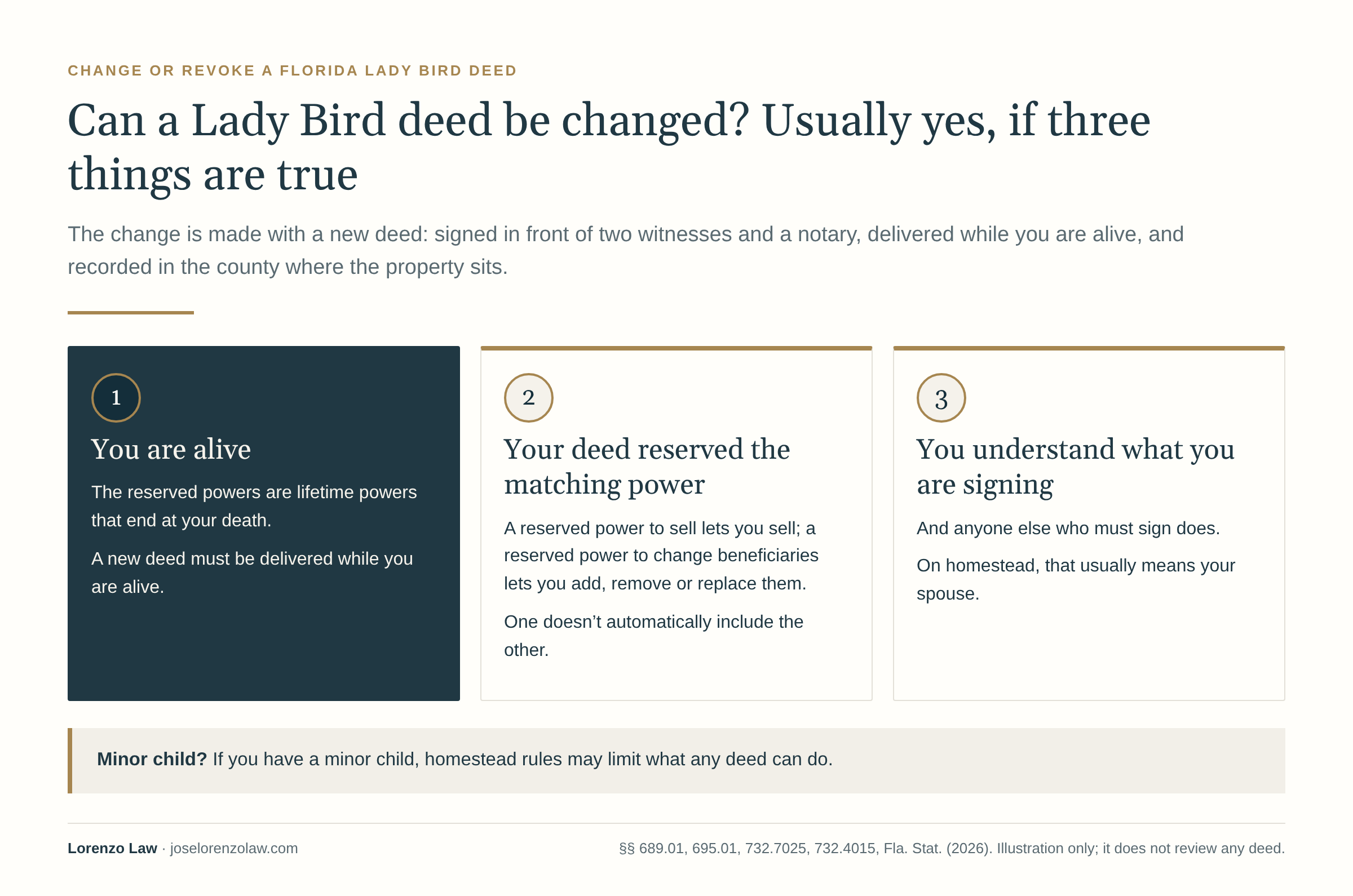
See the chart “Can a Lady Bird deed be changed? The three conditions” (opens the full-size image; the details are also in the text).
Lady Bird Deed vs. Life Estate Deed
A Lady Bird deed is considered a life estate deed, a special kind with reserved powers added. With it, you can sell, mortgage or change the beneficiaries without them, to the extent the deed reserves those powers. An ordinary life estate deed fixes the beneficiaries’ interest, so you generally can’t revoke or change a life estate deed of that kind on your own.
Florida has no statutory transfer-on-death deed for real estate (in some other states called a beneficiary deed); the Lady Bird deed fills much of that role. A quitclaim deed to someone else ordinarily passes your present interest and keeps no lifetime control for you. See Lady Bird deed vs. quitclaim deed.
Why I Review the Recorded Deed First
The recorded deed, not anyone’s memory of it, decides what you can change. I look at the powers it reserves, how the property is owned today, the beneficiaries and alternates (and wording such as “per stirpes”), later deeds or mortgages, any spousal joinder or homestead waiver, the legal description, and the property appraiser’s information for the home.
Looking at your recorded deed costs you nothing; paid work begins only when you hire me to prepare the new deed. The review isn’t a title search, title insurance or an evaluation of a lawsuit. If it shows a problem that needs title or court work, I tell you first.
Can I change a Lady Bird deed someone else prepared, including online?
Yes. I review deeds prepared by other lawyers and online services. If I see a larger issue, such as missing reserved powers or a missing spousal signature on homestead, I explain it before you hire me, including how the scope and fee may differ from my standard fee.
Hypothetical: An owner used an online service for what she believed was a Lady Bird deed. The recorded deed reserves the power to sell but not the power to change beneficiaries, so naming a new beneficiary is a different job from a standard replacement.
What I Need, How the Process Works, and What It Costs
To start, send me your recorded Lady Bird deed, with its book and page or instrument number if you have it. These also help:
- ☐ the deed that put the property in your name, and any later deeds, mortgages or refinances
- ☐ whether you are married, whether you have a minor child, and whether the property is your homestead
- ☐ what you want to change, and why
- ☐ your current will or trust, if any
- ☐ any power of attorney, if an agent will sign
How it works:
- Review. I read the deed and documents and tell you whether a new deed can do what you want and what it costs.
- Engagement. If you go ahead, you hire me to prepare the new deed. That is when paid work begins.
- Preparation. Once the review shows which deed fits what you want, a new Lady Bird deed or a deed back to yourself, I prepare it, with spousal joinder or waiver language where homestead rules call for it.
- Signing. You sign with two witnesses and a notary, in person or online.
- Recording. I record the deed in the county where the property sits. After recording, I send you a copy of the recorded deed. Keep it with your estate papers and make sure your will or trust agrees with it.
I am personally involved in every matter, and my staff assists with the process. Sending me your deed doesn’t by itself make me your lawyer; I confirm the scope and fee before you hire me.
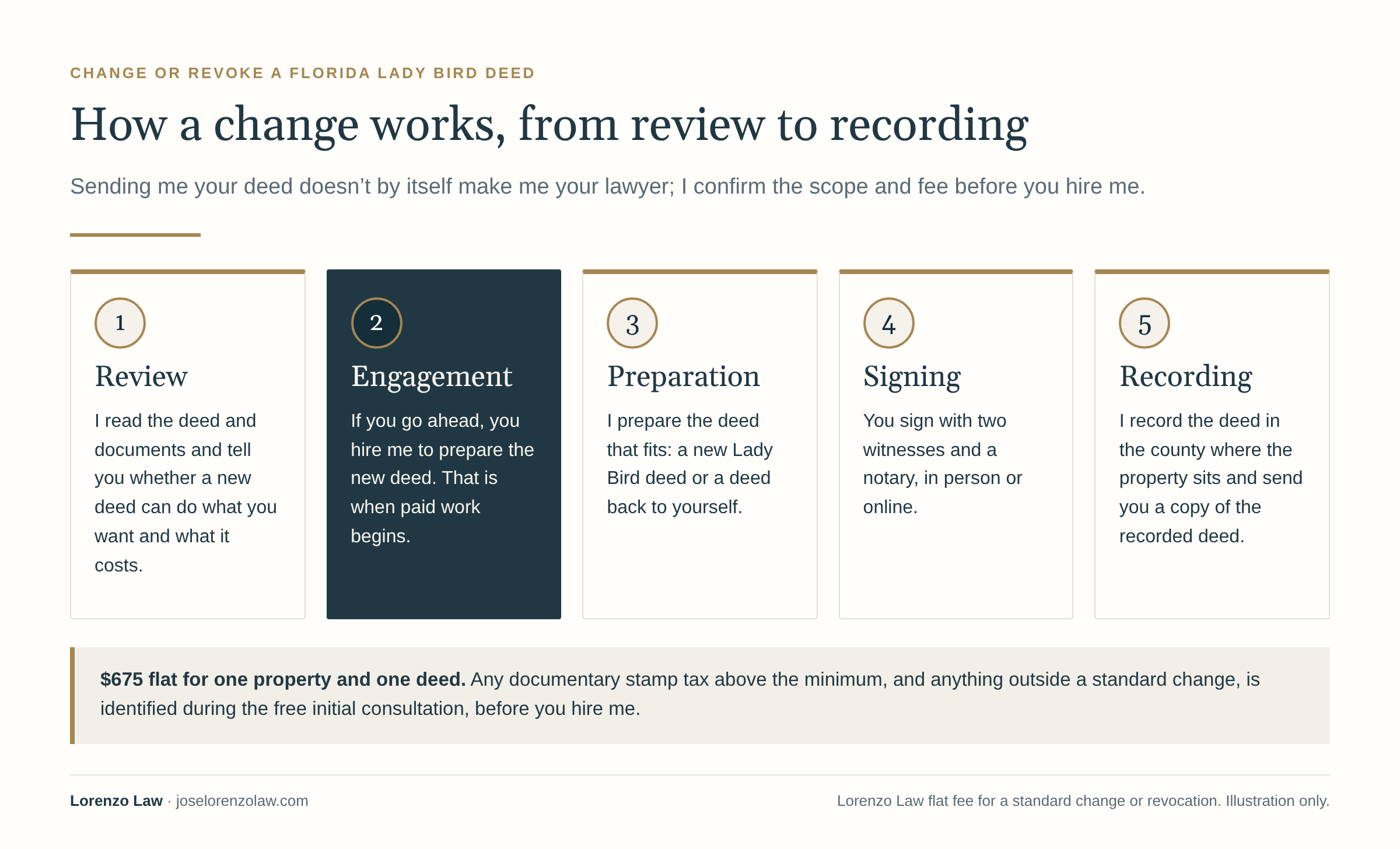
See the chart “How a change works, from review to recording” (opens the full-size image; the details are also in the text).
What it costs to change a Lady Bird deed
How much does a lawyer charge to change a Lady Bird deed? My fee for a standard matter, one property and one deed, is flat.
| Standard change or revocation | Quoted separately, before you hire me | |
|---|---|---|
| Fee | $675 flat | Depends on the issue |
| Covers | The deed you request: a new Lady Bird deed or a deed back to yourself | — |
| Included | Speaking with me directly, deed review, homestead and spousal-signature analysis, documentary stamp analysis, drafting, signing with witnesses (including online notarization), recording fees, and the minimum documentary stamp charge | — |
| Not included | Documentary stamp tax above the minimum, identified during the free initial consultation, before you hire me | Correcting a defective deed, title searches, disputes, after-death matters, more than one property or deed, and wills or trusts |
How long does it take to change a Lady Bird deed? Mostly as long as gathering documents and scheduling the signing takes, plus the county’s recording time. I don’t promise a turnaround time, but I tell you what to expect once I have your documents.
Your Options for Changing or Revoking the Deed
Revoking a Lady Bird deed and changing one both use a new deed, signed and delivered while you are alive, then recorded.
| Option | What it is meant to do | What I check first |
|---|---|---|
| A new Lady Bird deed | Keep your lifetime control and change who receives the property | That you reserved the power to change beneficiaries; homestead; any mortgage |
| A deed back to yourself in fee simple | End the arrangement so you own the property outright | No Florida appellate court has approved this method or addressed whether merger affects it, so I use it cautiously |
| Selling the property | If your deed reserved the power to sell, you can sell the property; the proceeds are yours and the beneficiaries receive nothing from it | That you reserved the power to sell; closing and title requirements |
| Giving the property away | Takes a reserved power to convey, give or dispose of the property; a bare power to sell isn’t enough | That your deed reserved that power; gift-tax and Medicaid effects |
| Moving the property into a trust (a Lady Bird deed to trust) | Deed the property to the trustee now, or name the trust as the beneficiary at your death | Which fits your plan; homestead restrictions, which can apply to trusts. See Lady Bird deed vs. living trust |
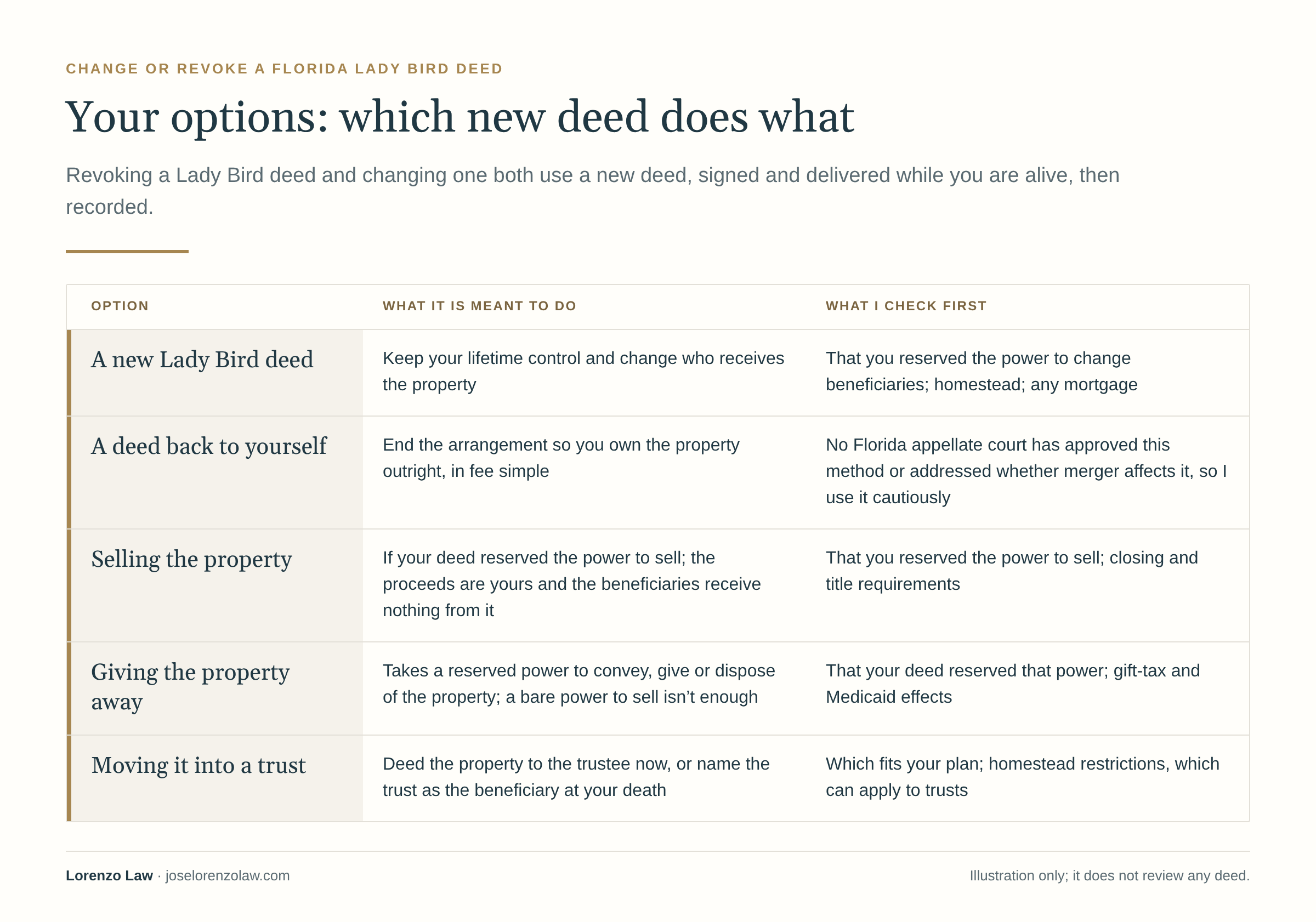
See the chart “Your options: which new deed does what” (opens the full-size image; the details are also in the text).
Change, add or remove a beneficiary
A new Lady Bird deed can add a beneficiary, remove a beneficiary, change shares, name alternates or name a trust. You can remove one child and keep the others if your deed reserved the power to change beneficiaries. Who has the power to remove a beneficiary? Only you, or an agent with the right authority; a beneficiary can’t remove another.
How many beneficiaries can you have on a Lady Bird deed? Florida law sets no fixed number, and shares can be equal or unequal. Several beneficiaries take as tenants in common unless the deed gives them a right of survivorship. (§ 689.15) Florida has no statute that defines “per stirpes” for a deed. Courts give the phrase its ordinary legal meaning — if a named beneficiary dies before you, that person’s share passes down to his or her own descendants by right of representation — but because no Florida statute or appellate decision settles the term for deeds specifically, the safest course is to spell out in the deed exactly what you intend.
An alternate, or contingent beneficiary, is the person named to take a share if the first beneficiary dies before you. Naming one matters: Florida’s anti-lapse statutes apply to wills and trusts, not deeds, and Florida law hasn’t settled what happens to a predeceased beneficiary’s share.
Hypothetical: An owner named her two sons, with no alternates. One son dies before her, leaving children. Whether his share goes to his children or his brother is unsettled; a new deed naming alternates addresses the question while she can still decide it.
A beneficiary who is a minor, receives disability benefits or has creditors can raise guardianship, benefits or title concerns, which I flag before you choose.
Can I change my Lady Bird deed without telling my beneficiaries?
In most cases, yes, and that includes removing someone without their knowledge. When your deed reserves the power to change beneficiaries, Florida law doesn’t require them to sign, consent or be notified. No Florida appellate decision rules on that exact point; it follows from the reserved-power cases and long-standing title practice. A beneficiary can’t block an authorized change but can go to court to argue the power didn’t exist or wasn’t properly used.
Lady Bird Deed vs. Will: Wills, Trusts and Handwritten Changes
For property under a recorded Lady Bird deed, the deed takes precedence over a will: a will can’t override a Lady Bird deed. The property passes outside probate, and a will, including a codicil, controls only probate property. The deed works like a beneficiary designation on a bank account or life insurance policy. A trust controls the property only if the deed names the trust, or you deed the property to the trustee.
Once a deed has been delivered, writing on it or crossing out a name doesn’t change title; a change takes a new deed. A handwritten note works only if it is itself a properly signed and witnessed deed, and tearing up your copy doesn’t undo a delivered deed. (§ 689.01)
What form do I use to cancel a Lady Bird deed?
There is no Lady Bird deed revocation form I would point you to, and I don’t publish a fill-in replacement deed, because whether an instrument works depends on your deed’s wording, your family and homestead situation, any mortgage and documentary stamps. Before using any form, read what to know before using a Florida Lady Bird deed form.
Issues I check before preparing the new deed: whether it keeps the reserved powers you may want later; whether it clearly uses the power reserved in the earlier deed, so the two deeds don’t conflict; whether the legal description matches the property you own now; and whether your will or trust still agrees with your plan.
When Should an Existing Deed Be Reviewed?
These events are reasons for a review, not automatic reasons for a new deed.
- Divorce. Changing a Lady Bird deed after divorce takes a new deed: a divorce doesn’t automatically remove a former spouse named as beneficiary. Florida’s statute revoking designations to a former spouse covers listed assets such as life insurance, retirement and payable-on-death accounts, not deeds, and no Florida appellate court has squarely decided the deed question. If you still co-own with your former spouse, divorce changes how you co-own, not who the deed names. (§ 732.703, § 689.15) Hypothetical: An owner named her husband in 2019 and divorced in 2025; her deed still names him until she records a change.
- Remarriage or a minor child. Both can affect who must sign and what the deed can do. See “Your spouse and minor children.”
- A beneficiary died, or a child or grandchild was born. The deed itself doesn’t change and nobody is added automatically, and what happens to a share left to a beneficiary who died first is unsettled.
- A family falling-out. With a reserved power, you can remove a beneficiary without that person’s agreement.
- A sale, refinance or home-equity loan. The mortgage stays, and the beneficiaries take subject to it. After a partial sale, a new deed must describe what you still own.
- A beneficiary’s disability, benefits, creditors or divorce, or a new plan such as a trust.
If you do nothing, the deed stays as it is: at your death, the beneficiaries named in your last valid deed take the property, subject to any homestead or other limits, and a will can’t change that afterward.
Who Can Sign, and How Is the New Deed Signed and Recorded?
Your capacity when you sign
You must understand the nature and effect of the deed when you sign. A deed is presumed valid, and a later decline doesn’t undo it. A claim that you lacked capacity or were unduly influenced is a court matter; see can a Lady Bird deed be contested.
An agent under a power of attorney
Can a power of attorney change or revoke a Lady Bird deed? For one signed in Florida on or after October 1, 2011, only if it separately lists the needed authority (such as changing survivorship rights, beneficiary designations or making gifts) and you signed or initialed next to each listing. General real-estate authority isn’t enough. A power of attorney signed earlier, or validly signed in another state, follows different rules. Either way, an agent who would benefit faces added limits, must act in your interest, and loses authority at your death. See can a power of attorney sign a Lady Bird deed. (§ 709.2202, § 709.2106, § 709.2114, § 709.2109)
Hypothetical question: “Can I change my mother’s Lady Bird deed using the power of attorney she gave me?” Only if that power of attorney gives you the authority those rules require.
More than one owner
Tenants by the entireties must both sign. A tenant in common can sell or deal with only his or her own share. If co-owners can’t agree whether to keep or sell the property, a court case called a partition action is one way to resolve it. (§ 64.031)
Your spouse and minor children, if the property is homestead
Your spouse. A married owner can’t convey homestead to someone else without the spouse joining, unless the spouse has validly waived that right, for example in a prenuptial or postnuptial agreement. Without that signature or waiver, a deed naming someone else as beneficiary is void as to that gift; your life estate stands, and you keep the remainder. The reliable fix is a new deed your spouse joins. A waiver your spouse signed inside an earlier deed covers only that deed and only the right to be left the home. A prenuptial or postnuptial agreement can be broader: an “all rights” homestead waiver can also remove the need for your spouse to join a later deed, so I review any such agreement. (§ 732.7025, § 732.702)
Minor children. If you are survived by a minor child, Florida law doesn’t let you leave your homestead by will to anyone, and a Lady Bird deed naming someone else may be treated the same way. No Florida appellate court has decided that question for Lady Bird deeds, and a spouse’s waiver can’t fix it. If you have a minor child, tell me when you first contact me. (§ 732.4015, § 732.4017)
Signing and recording checklist
| Requirement | What it means |
|---|---|
| Written and signed by you | Plus your spouse on homestead if you are married, unless a valid prenuptial or postnuptial agreement waived it, or both spouses for tenants by the entireties |
| Two witnesses | They watch you sign, in the room or live by audio-video (§ 689.01, § 117.285) |
| Notary | Acknowledges your signature so the clerk will record the deed; a Florida online notary can do this by audio-video, and I offer online signing (§ 695.03, § 117.209) |
| Legal description | Matches the property you own today |
| Earlier deed | I review it so the new deed clearly replaces it |
| Delivery | The deed takes effect when delivered during your life |
| Recording | In the Official Records of the clerk for the county where the property sits (§ 695.01) |
Does a Lady Bird deed have to be recorded in Florida?
Delivery, not recording, creates the transfer, and a deed you delivered during life stays valid even if recorded after your death. But recording in the county where the property sits protects you against later buyers and creditors, and title companies rely on it, so I record every new deed promptly. For the counties and cities I serve, see my Florida Lady Bird deed attorney page.
Could the Change Affect Homestead, Taxes, Medicaid, or Title?
As part of the review, I flag these issues. If one needs more than a flag, such as detailed tax or Medicaid planning, I tell you before going further.
- Documentary stamp tax. With no mortgage and no exchange of value, a new Lady Bird deed, a deed back to yourself or a deed giving up your powers generally carries at most the minimum tax. With a mortgage, a deed back to yourself isn’t taxable, a deed giving up your powers is taxable to the extent of the mortgage, and a new Lady Bird deed that only changes beneficiaries is unsettled. A Department of Revenue advisement finding an unencumbered enhanced life estate deed not taxable binds the Department only for the taxpayer who asked. (§ 201.02, § 213.22)
- Homestead exemption and Save Our Homes. A new deed in which you keep your life estate and keep living there doesn’t end the exemption or reset your Save Our Homes cap. Because Florida law requires refiling if ownership changes in any manner, I review the property appraiser’s information as part of the change. (§ 196.041, § 196.011, § 193.155)
- Gift, estate and income tax. While you keep the power to revoke or change beneficiaries, there is no completed gift; giving up the powers completes it. The home stays in your taxable estate while you keep those powers, and your beneficiaries receive a new cost basis equal to its value at your death. If you give up the powers within three years of death, section 2035 of the Internal Revenue Code pulls the value back into the estate. This assumes you keep your life estate in the home until death. See tax effects of a Lady Bird deed.
- Medicaid. Keeping your powers generally means no completed transfer. Giving them up without fair value can be treated as a transfer within the five-year look-back. Florida’s estate recovery statute works through a claim against the probate estate, and Lady Bird deed property passes outside probate. (§ 409.9101)
- Mortgage. You can change a Lady Bird deed on mortgaged property if your deed reserved the powers. The mortgage stays, the beneficiaries take subject to it, and the lender doesn’t sign. Federal law generally protects a transfer like this from a due-on-sale clause when you keep living in the home; because a Lady Bird deed isn’t listed word for word, I review the loan terms.
Changing a Deed Versus Challenging Its Validity
“Can a Lady Bird deed be reversed?” and “Can a Lady Bird deed be voided?” are different questions.
- Changing or revoking (by you). How to revoke a Lady Bird deed, or how to get out of a Lady Bird deed you signed, comes down to a new deed made with the powers your deed reserved. No court is involved.
- Voiding (by a court). As for how to void a Lady Bird deed: you can’t do it yourself. Family members or heirs can sue to set a deed aside, before or after the owner’s death. Lack of capacity or undue influence can make a deed voidable; a forgery makes it void, and so does a missing spousal joinder on homestead, as to the gift it affects. See contesting a Lady Bird deed in Florida.
- Correcting a mistake. A single scrivener’s error of the kind Florida’s curative statute covers can often be fixed by recording a curative notice or a corrective deed, without going to court. The statute doesn’t cover quitclaim deeds, deeds with more than one error, or property described only by metes and bounds. Other errors may need a court action to reform the deed or quiet title, and a court generally can’t reform a deed given as a gift, which most Lady Bird deeds are. (§ 689.041)
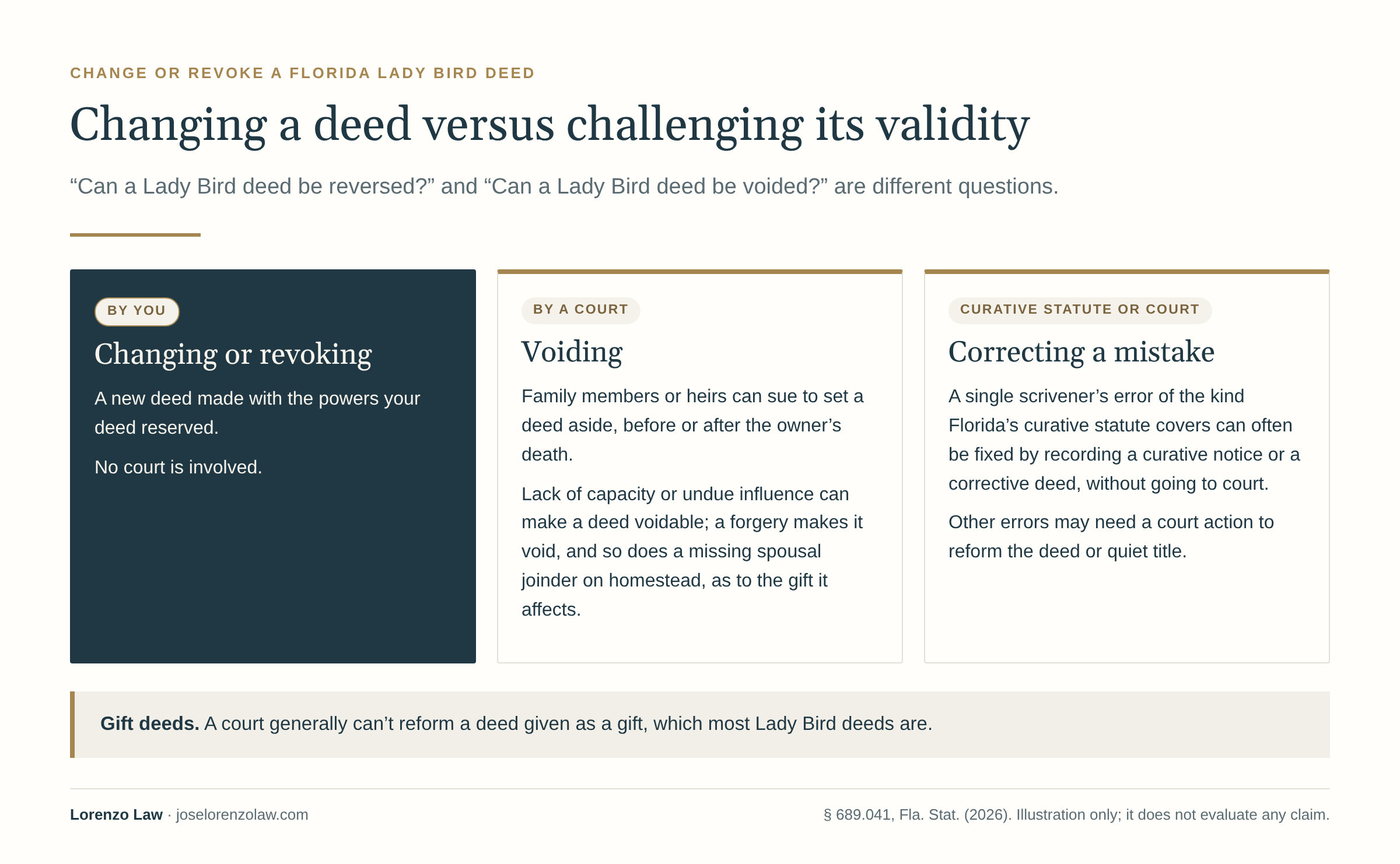
See the chart “Changing a deed versus challenging its validity” (opens the full-size image; the details are also in the text).
Frequently Asked Questions
Can I change my Lady Bird deed without a lawyer?
Do you need a lawyer to change a Lady Bird deed? No law requires one when you change your own deed. But the change works only if your deed reserved the right powers and the new deed is properly signed, witnessed and notarized, with any required spousal signature, and delivered while you are alive. Recording it promptly then protects it against later buyers and creditors. Generally, someone who isn’t a lawyer may not prepare a deed for another person.
Can I change my Florida Lady Bird deed if I live in another state?
Usually, yes. A deed signed outside Florida is valid here if it meets Florida’s requirements: a written deed, two witnesses and a notary acknowledgment. An out-of-state notary’s acknowledgment can qualify for recording, and online signing is another option. See changing a Florida deed from another state.
What happens if two Lady Bird deeds are recorded?
If the later deed was made under a power reserved in the earlier one, the later deed controls who receives the property, and a mortgage recorded in between keeps its priority. A later deed that doesn’t clearly use that power, or isn’t properly signed, can leave a cloud on title.
Will a title company accept my new deed?
Title companies and their underwriters decide what they will insure before treating title as marketable, and their requirements can go beyond the law. For a later sale or refinance, they may ask for proof of identity and marital status, or payoff of a judgment against a named beneficiary.
How do I remove a deceased person from my deed?
If a beneficiary named in your Lady Bird deed died, you can sign a new deed naming new beneficiaries or alternates. If a co-owner died, that is after-death title work, quoted separately. See what to do after the owner dies.
Talk to a Florida Lady Bird deed lawyer
To start, send me a copy of your recorded Lady Bird deed. I’ll tell you what a change involves, whether there is a larger issue, and what it costs before you hire me. Call (305) 224-6811 or contact form. I can’t promise a particular result, but I can tell you clearly what your deed allows and what a change requires.
About the author. Jose M. Lorenzo, Jr., Esq., Florida Bar No. 107002, is the attorney at Lorenzo Law. His principal office is in Kissimmee, and meetings in Coral Gables and Fort Lauderdale are by appointment. His practice covers Florida probate, estate planning, guardianship and homestead matters, including the preparation and review of Lady Bird deeds statewide.
Request a free initial consultation. Only the initial consultation is free; representation fees and costs are agreed separately in writing. Consultations are available statewide in English and Spanish, by phone or video.
Request a free initial consultationCall (305) 224-6811
This page provides general information about Florida law, not advice about a particular deed or situation. Reading it or requesting a consultation does not create an attorney-client relationship.
Sources and authorities cited
Florida statutes cited are the 2026 Florida Statutes, linked to the Florida Senate; section 2035 of the Internal Revenue Code is federal law and is listed without a link. The text of the law controls over any summary on this page.