
LORENZO LAW · FLORIDA ESTATE LITIGATION
Florida Estate Litigation Attorney
A Florida estate litigation attorney represents people in disputes over an inheritance. That includes a will or trust being challenged or defended, a personal representative or trustee accused of mishandling property, a deed that moved a home outside the estate, and heirs who cannot agree about what they inherited. Some disputes are resolved by negotiation or mediation. Others need a court decision.
Lorenzo Law is a solo Florida practice. Attorney Jose M. Lorenzo, Jr. represents beneficiaries, heirs, surviving spouses, personal representatives and trustees in estate, trust, will and deed disputes throughout Florida, in English and Spanish. Clients work directly with him on the matters he handles, from the first consultation onward. Whether you are looking for an estate litigation lawyer, an estate dispute lawyer or an inheritance dispute lawyer, the initial consultation is free.
Request a free initial consultationCall (305) 224-6811
Free initial consultation · English and Spanish · Matters throughout Florida · Fees agreed in writing
Received a court notice, a trust accounting or disclosure, or a proposed final accounting? When you contact the firm, say what you received, and when and how you received it. Different claims have different deadlines, and some run from service or receipt. Do not wait until you have gathered every document.
| Who Jose represents | Beneficiaries, heirs, surviving spouses, personal representatives and trustees, including family members who live outside Florida |
|---|---|
| Disputes | Wills and trusts, executor and trustee conduct, deeds and inherited real estate, transfers made before death, heirship and creditor claims |
| Your attorney | Jose M. Lorenzo, Jr., Florida Bar No. 107002, Lorenzo Law’s only attorney. Clients work directly with him on the matters he handles. |
| Fees | Free initial consultation. Representation fees and costs are agreed in writing. In appropriate cases, Lorenzo Law may consider a contingency or hybrid arrangement. Costs and expenses may remain payable even without a recovery; a hybrid arrangement’s hourly or fixed portion remains payable regardless of the outcome. |
| Where | Matters throughout Florida. Principal office in Kissimmee; meetings by appointment in Coral Gables and Fort Lauderdale; consultations by phone. |
| Contact | (305) 224-6811; calls are answered 24 hours a day, and inquiries receive follow-up within one to two business days. |
| Languages | English and Spanish |
Before his admission to The Florida Bar, Jose worked for roughly a decade as a paralegal on probate and litigation matters and served as a judicial intern in the Probate Division of the Eleventh Judicial Circuit.
What does a Florida estate litigation attorney do?
An estate litigation attorney evaluates whether a legal claim or defense exists, protects the applicable deadlines, gathers the records that show what happened, and then negotiates, mediates or asks the court to decide. Estate litigators go by other names too: an inheritance lawyer, an inheritance attorney or an inheritance litigation attorney. The work can include:
- challenging or defending a will or trust
- requiring an executor or trustee to account
- seeking removal of a fiduciary, or repayment for a proven breach
- recovering property
- resolving who owns inherited real estate
A contested estate is generally one in which people with a legal interest disagree about the documents, the property or the person in charge of it. Estate litigation covers those disputes, and disputes over the ownership, control or transfer of property connected with an inheritance. The dispute may involve:
- a probate estate
- a trust
- a deed
- a beneficiary designation
- a fiduciary’s conduct
Whether you believe you were denied your rightful inheritance or you are defending a document, the starting point is the same: identify the property, the document or duty in question, your legal interest, and the result you want. Feeling that an inheritance is unfair does not, by itself, establish a legal claim.
Litigator or attorney? Every litigator is an attorney. “Litigator” describes the part of the work that happens when a dispute may go to court. A lawyer for estate disputes does both: advising before anything is filed, and representing the client in court if needed.
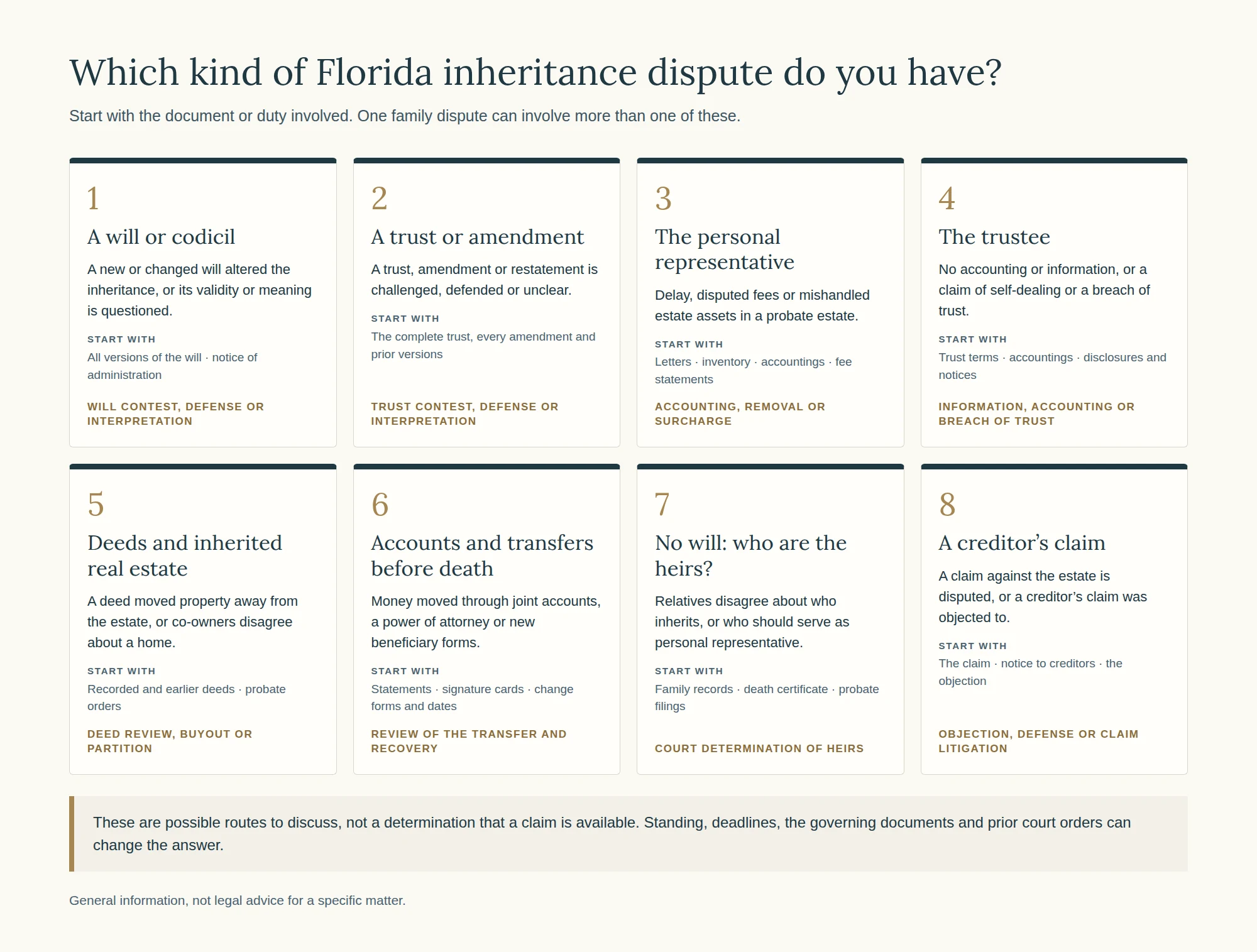
Which kind of dispute do you have?
Start by matching your concern to the document or duty involved. The table shows common starting points.
| Your concern | Documents that help identify the issue | Possible direction to discuss |
|---|---|---|
| A will or codicil changed the inheritance | All available versions, signing information, the notice of administration and probate filings | A will contest, a defense of the will, or interpretation of its terms |
| A trust or amendment is questioned | The complete trust and all amendments, prior versions, notices and relevant signing records | A challenge to validity, a defense, or interpretation of the trust |
| A personal representative is delaying, charging disputed fees or mishandling assets | Letters of administration, inventory, accountings, fee statements, orders and correspondence | Accounting or fee review, distribution issues, removal, or liability for a proven breach |
| A trustee will not account or is accused of self-dealing | Trust terms, accountings, disclosure documents, limitation notices and transaction records | Information or accounting relief, review of administration, removal, or a breach-of-trust claim |
| Money or property moved before death through joint accounts, a power of attorney or changed beneficiary designations | Account statements, signature cards, the power of attorney, beneficiary-change forms and dates | Review of the transfer’s validity and authority, and whether it can be recovered |
| There is no will, and people disagree about who the heirs are | Family records, the death certificate, any probate filings and known relatives | A court determination of who is entitled to inherit |
| The wording of a will or trust is unclear, or the document no longer works as intended | The document, related instruments and evidence of what was intended | Construction (interpretation), and in some cases reformation or modification |
| A deed transferred property away from the expected inheritance | The recorded deed, earlier deeds, title records, any power of attorney and signing information | Review of the deed’s validity, authority and effect on ownership |
| Co-owners disagree about inherited real estate | The current deed, probate orders, ownership shares, agreements and expense records | A negotiated buyout or sale, or a partition proceeding where available |
| A creditor’s claim against the estate is disputed | The claim, the notice to creditors, the objection and supporting records | Objection to, defense of, or litigation of the claim |
These are possible routes, not a determination that a claim is available. Standing, deadlines, governing documents and prior court orders can change the answer.
View the dispute-types graphic
Common scenarios (hypothetical examples)
Hypothetical examples: these are illustrations only, not actual client matters, and they do not describe or predict any result.
- The caregiver sibling. A mother signs a last-minute change to a will three months before her death, leaving the house to the son who lived with her. His sisters learn of it only when the notice of administration arrives. The first questions: when the notice was served, who arranged the signing, and what the medical records show for that week.
- The silent trustee. A brother serving as trustee has not sent an accounting in a year, and the executor won’t communicate either. The beneficiaries’ first step is usually a written request for information, then a court petition if it is ignored.
- The shared house. Three siblings inherit a condo. One lives in it rent-free, one wants to sell, and one lives out of state. The options range from a buyout to partition. Out-of-state heirs can begin with a phone consultation and discuss whether any part of the matter will require an in-person appearance.
Estate litigation, probate litigation, trust litigation and will contests
Estate litigation is the broad term; the others are branches of it. In general terms, probate administration carries out the estate, while litigation begins when people with a legal interest disagree and ask a court to resolve it. Probate disputes are governed mainly by the Florida Probate Code (chapters 731–735 of the Florida Statutes) and the Florida Probate Rules; trust disputes by the Florida Trust Code (chapter 736). This page identifies the overall dispute and how its parts connect. The focused pages explain each route:
- Florida probate litigation attorney: representation in contested probate proceedings involving an estate, its beneficiaries or its personal representative, including bringing or defending objections and resolving disputes within the probate case. A contested probate attorney (also called a contested probate lawyer, a probate dispute attorney or a litigation probate attorney) does this work in the probate court. For a probate litigation attorney, Florida’s venue rules decide which county’s court hears the case.
- Florida trust litigation attorney: disputes about a trust’s validity, meaning or administration, including trustee conduct.
- Will contest attorney: challenges to a will’s validity, and the evidence and procedure involved. People also search for a contested will attorney, a will dispute attorney, an attorney for will dispute cases or a lawyer for will disputes.
A single family dispute often involves more than one route. Many Florida plans pair a short “pour-over” will with a revocable trust that holds most of the property. A challenge aimed only at the will may leave the trust, a later amendment, a deed or a beneficiary designation untouched, which is why many matters are trust and estate litigation at the same time. When the will, the trust and the deeds are all in play, the matter is trust & estate litigation, and Jose handles each branch himself as a trust and estate litigation attorney. Some people search for an estate and trust litigation lawyer; it is the same work.
If you need help administering an estate where there is no dispute, see Florida probate administration. For a reading list of dispute topics, see the Florida estate disputes guide.
Your role changes the representation you need
Your role in the dispute determines what you can ask for and what you must bring.
- An heir or beneficiary may want information, a distribution, recovery of property, or review of a document.
- A personal representative or trustee may need advice about responding to allegations, defending a document or accounting, or obtaining court direction.
- A surviving spouse may have rights that do not depend on proving that a will is invalid.
- A co-owner may need to resolve ownership or the sale of real estate.
- A person involved in a related guardianship may need guardianship litigation advice as well.
- When a death was caused by someone’s wrongful conduct, the estate’s personal representative is the only party with standing to bring the wrongful death claim, for the benefit of the survivors and the estate. §768.20. Wrongful death matters may be referred to, or handled together with, another lawyer or law firm.
Tell Jose whose interests you want represented and whether another lawyer already represents you. Representing a fiduciary does not automatically mean representing every beneficiary. Conflicts and the scope of any engagement must be addressed before representation begins.
If you are responding to a claim, bring the petition or complaint, the service papers, hearing notices and relevant orders. The fact that someone filed an accusation does not establish that misconduct occurred.
Defending a will, a trust or your administration
Being accused is not the same as having done something wrong, and defending a will, a trust or your own administration is legitimate work. Defending a will contest, an accounting objection or a removal petition calls for the same organized records as bringing one. Bring:
- the petition or complaint, the service papers, any hearing notice and relevant orders
- your letters of administration or the trust
- your inventory and accountings
- your correspondence with beneficiaries
Early review can identify what must be answered and by when, and whether court instructions or a corrected accounting could narrow the dispute.
Defenses in will and trust disputes often focus on three things:
- proof that the document was properly signed and witnessed
- evidence of the maker’s capacity and independent decision-making when it was signed
- whether the challenge was brought in time
A personal representative has executor rights to act within the authority the document and the law provide, and a trustee may have trustee rights against beneficiaries who interfere with proper administration.
Contesting a will or trust in Florida
How to contest a will in Florida starts with two questions: is there a recognized legal ground, and do you have standing? A will or trust can be challenged only on recognized legal grounds, and only by a person with standing. To contest a will, you generally need an interest that the result would affect, for example as a beneficiary under the current will or an earlier one, or as an heir. Challenging a will is sometimes called protesting a will or fighting a will, and most families simply call it a will dispute; the legal question is the same. Contesting a living will is different: in Florida, a living will is an advance directive about medical treatment, not a document that leaves property, so a disagreement over it is not an inheritance dispute. If someone challenges how a health care surrogate is carrying out a living will, that challenge can be filed in the circuit court’s probate division under an expedited procedure, but it concerns medical decisions, not inheritance. §765.101, §765.105. The will-contest page discusses standing, grounds and procedure in more detail.
Grounds to contest a will or trust in Florida
Grounds for challenging a will include lack of testamentary capacity, failure to meet the execution requirements, and procurement through fraud, duress, mistake or undue influence. A forged signature, or a document the maker never actually signed, is also a basis to challenge a will. Florida law also addresses a trust, amendment or restatement procured through fraud, duress, mistake or undue influence. Grounds for contesting a trust therefore overlap with grounds for disputing a will, but the requirements and consequences depend on the instrument and the particular defect. §732.501, §732.502, §732.5165, §736.0406.
Can you contest a trust in Florida?
Often, yes. You can contest a trust in Florida on similar grounds, but its timing rules differ from a will’s. A trust that is still revocable generally is not the subject of a contest while the settlor is alive and can change it. §736.0207. After the settlor’s death, a challenge to the validity of a trust that was revocable at death is generally subject to a four-year period, shortened to six months if the trustee sends the person a copy of the trust instrument and the required notice. §736.0604. A will contest and a trust contest must each be brought separately, within their own deadlines. A trust contest attorney or trust contest lawyer should look at the trust’s history as closely as its text. See Trust litigation attorney, Florida.
Unfairly left out of a will?
Being left out, or receiving less than a sibling, is not by itself a ground to contest a will. It may become a legal issue when the evidence points to one of the recognized grounds. It also matters if an earlier will, a trust or a statutory right, such as a spouse’s elective share, gives you an interest. Compare the current document with every earlier version you can find.
Contesting a will due to dementia, mental capacity or hospice care
A will can be challenged on capacity grounds, but a dementia diagnosis or hospice care does not by itself make a will invalid. Contesting a will due to mental capacity turns on the signing date, because capacity is judged at the time the document was signed. Florida’s test asks whether, when signing, the person understood in a general way the nature and extent of the property, the people who would naturally expect to benefit, and the practical effect of the will. Even a person with dementia may have signed during a lucid interval. §732.501. A person with a progressive illness may have had better and worse periods, so the evidence focuses on the signing date:
- medical and hospice records
- medication
- who was present
- what the drafting lawyer observed
- how the new document compared with earlier ones
The same capacity standard applies to a trust amendment signed near the end of life.
Proving undue influence in will and trust contests
Undue influence is shown through evidence about the relationship and the circumstances of the signing, not merely by the fact that the result was unequal. Relevant evidence can include:
- communications
- witness accounts
- drafting and signing circumstances
- medical information around the relevant date
- financial transactions
Illness, age or an unequal distribution is not a substitute for proving undue influence. Florida’s will-contest statute allocates the burden of proof between the proponent and the challenger. It also recognizes a burden-shifting presumption, often called presumed undue influence, when the presumption applies. The presumption arises only when a substantial beneficiary who had a confidential or fiduciary relationship with the testator was also actively involved in procuring the will; a family relationship, caregiving or a confidential relationship alone is not enough. Where it applies, it shifts the burden of proof. §733.107.
Signs that often lead families to ask about undue influence (what searches call “confidential relationship undue influence”):
- A beneficiary chose or contacted the drafting lawyer.
- A beneficiary attended the signing.
- A beneficiary knew the terms in advance.
- A beneficiary kept the document afterward.
- The parent was isolated from other relatives.
- The new document departed sharply from earlier ones.
None of these proves undue influence on its own. For more depth, see undue influence claims in Florida, on what an undue influence lawyer looks for.
Preserve records already lawfully available to you. Access to medical records, another person’s accounts or a drafting attorney’s file may require authorization or legal process.
Inheritance disputes between siblings
Many Florida inheritance disputes are between family members, and the facts that raise questions are often innocent on their own. A familiar pattern:
- One child lived nearby and cared for a parent.
- That child was added to accounts or given a power of attorney “for convenience.”
- A new will or trust amendment appeared in the last year or two.
- After the death, the same child is the personal representative or trustee and the largest beneficiary.
None of those facts alone proves sibling undue influence. The child who stayed often genuinely did more and was genuinely trusted. A sibling contesting will provisions that favor a caregiver has to rely on evidence, not on the relationship alone.
For siblings contesting a will, useful questions include:
- Who gave the instructions?
- Who selected and contacted the drafter?
- Who attended the signing?
- Could the parent communicate independently?
- What did the accounts do in the final months?
- What changed from earlier documents?
For example, a hypothetical dispute may involve both a late trust amendment and a deed signed earlier. Even if the amendment is successfully challenged, ownership under the deed may still need separate analysis. Start with a chronology and copies of both instruments. Some siblings fighting over an inheritance resolve it by negotiation once the records are on the table.
Disputes over heirlooms and personal property
Jewelry, vehicles, collections, furniture and family photographs cause some of the hardest sibling disputes, often out of proportion to their dollar value. A will may refer to a separate written list of personal items, signed by the maker and describing the items and recipients with reasonable certainty; the personal representative generally distributes items according to the will, the list and the law. §732.515. When heirs cannot agree, options include negotiated division, rotating selection, sale and division of the proceeds, or a court decision. Items removed from the home before or after the death should be documented. See specific bequests of tangible property and inherited collections in Florida probate.
What a will contest may not reach: accounts, designations and lifetime transfers
A will generally controls only property that passes through the probate estate. The following may pass outside the will:
- joint accounts with survivorship
- payable-on-death and transfer-on-death accounts
- life insurance
- retirement-account beneficiary designations
- trust property
- real estate already deeded during life
If money moved before death through a power of attorney, a new joint account or a changed beneficiary form, that transfer may need its own analysis. See challenging transfers made before death and whether a beneficiary designation overrides a will. If a parent was financially exploited while alive, the estate may have claims to recover what was taken. Florida probate litigation discusses those claims.
Claims for tortious interference with inheritance (Florida recognizes them in limited circumstances) are brought against a person who wrongfully interfered with an inheritance someone expected to receive. The claim is limited: it is generally barred if the person had an adequate remedy in probate and a fair opportunity to pursue it, the interfering conduct must be independently wrongful rather than mere persuasion, and the claim generally cannot be brought until after the testator’s death.
Contesting an intestate estate, when there is no will
When there is no will, the dispute is usually about who the heirs are, or who should serve, rather than about a document. Contesting an intestate estate can involve disputed relationships (for example, paternity or adoption), missing relatives, or which qualified person should be appointed personal representative. §733.301. Contesting intestacy can also mean arguing that a will exists after all. Families who want to contest probate (no will was found, or the wrong heirs were named) can ask the court to determine who is entitled to inherit.
Disputes about what a will or trust means
Not every dispute is about validity. Some are about interpretation. When the wording of a will or trust is unclear, conflicts with another document, or no longer works as intended, the court may be asked to construe it. In some circumstances, a trust may be reformed to correct a proven mistake (which requires clear and convincing evidence), or modified by the court or, after the settlor’s death, by agreement of the trustee and all qualified beneficiaries. §736.0415, §736.0412.
What if the original will cannot be found?
A missing original will is a common starting point for a dispute. Florida has a procedure to establish and probate a lost or destroyed will, but it requires specific proof: the will’s terms must be proved by two disinterested witnesses, or by one if a correct copy is available. An original last known to be in the maker’s possession that cannot be found may be presumed revoked. §733.207. If you have a copy, keep it and note where it came from. If someone is holding the original, the 10-day deposit duty (below) applies.
What happens if a will is declared invalid?
An earlier valid will may govern if the circumstances support it; if there is no earlier valid will, the estate passes under Florida’s intestacy rules. In some cases, only the part of a will or trust directly affected by the defect is void, leaving the rest in effect. Before filing, confirm what the result would actually be for you.
Does a no-contest clause stop a challenge?
Generally not, when Florida law governs. Florida statutes make specified penalty clauses in wills and trusts unenforceable. A no contest will clause does not establish standing, extend a deadline or eliminate possible fee exposure. If another state’s law may govern the document, the clause requires additional analysis. §732.517, §736.1108.
Executor and trustee misconduct: what relief may be available?
Florida generally uses the term personal representative for the person administering a probate estate; most people call this role the executor. A trustee administers a trust. Their authority, their duties and the procedure for challenging their conduct are related but distinct.
What can an executor not do?
An executor (personal representative) must administer the estate under the governing law, the will and the court’s orders, and cannot treat the inheritance as theirs to reallocate. Concerns commonly raised include:
- ignoring or rewriting the will’s terms
- waste or mismanagement of estate property
- failing to account when an accounting is required
- disregarding court orders
- self-dealing or improper conflicts of interest, such as buying estate property without proper authority
- unreasonable compensation
- distributing to themselves ahead of others without authority
Being both a beneficiary and the personal representative does not, by itself, establish wrongdoing. A personal representative may have legitimate reasons for delay, may be entitled to reasonable compensation, and may sell assets when authorized.
The response should match the problem.
- A request for information, an accounting dispute or a fee review may address a narrower issue.
- Removal concerns who should serve.
- A claim for loss caused by a breach, sometimes called surcharge, concerns liability and repayment.
Depending on the facts, possible requests include a petition to compel an accounting, a petition for partial distribution (sometimes called an interim distribution), a petition for removal, or a claim for repayment (surcharge) for a proven breach. §733.802. These remedies have different requirements. §733.602, §733.504, §733.609, §733.6175.
Executor breach of fiduciary duty
A personal representative owes duties to the estate and its beneficiaries, and a proven breach can lead to removal, repayment, or both. Executor breach of fiduciary duty claims commonly involve self-dealing, commingling estate money with personal funds, unexplained transfers, or failure to protect estate property. See breach of fiduciary duty in Florida.
Executor not distributing assets, or taking too long
Delay is a reason to ask questions, not proof of misconduct. An executor taking too long is one of the most common complaints, especially when the executor won’t communicate. An unsold house, creditor issues, tax work, a pending dispute or a family business that must be valued, run or sold can explain a delay. The timing rules are explained below. If the explanations stop, or the records do not match them, the possible requests listed above may apply.
What is typical compensation for an executor in Florida, and who decides?
A personal representative is entitled to reasonable compensation, and Florida law provides a compensation schedule that is presumed reasonable; the will, an agreement or the court can change the result. If a fee looks excessive, interested persons can ask the court to review it. The personal representative, and anyone the personal representative employed, bear the burden of showing that the employment was proper and the compensation reasonable, and a person who received excessive compensation can be ordered to refund it. §733.617, §733.6175. For how probate fees work, see the cost of probate in Florida.
Warning signs worth a consultation
- Months without an inventory, accounting or explanation after repeated requests
- Estate or trust property used, rented or occupied by the fiduciary personally
- Assets sold to the fiduciary, a relative or a business associate
- Funds moved into personal or joint accounts
- Unexplained fees or compensation
- A hearing, a discharge petition or a final distribution scheduled before your questions are answered
None of these proves misconduct. Each is a reason to ask what the records show.
Tracing missing assets
When money or property seems to be missing, the first job is to reconstruct what existed and where it went. That usually means comparing:
- the inventory, the accountings and the account statements
- the dates of transfers, against the dates of powers of attorney and new documents
Formal discovery and subpoenas can reach records that are not otherwise available. Where property was wrongfully taken, a court may in some cases impose a constructive trust on it or on what it was converted into, so it can be recovered for the estate or trust. Jose’s undergraduate degree is in accounting and finance, and reading the numbers is part of the work in these cases.
What if a trustee will not account or has moved trust property?
A beneficiary with the necessary status may be able to request information from the trustee and, if needed, ask the court to enforce the trustee’s duties (§736.0201). Information and accounting rights depend on your status, the trust and applicable law, including whether the trust remains revocable. In a qualifying breach-of-trust case, possible court remedies include:
- requiring an accounting
- enforcing duties
- restoring money or property
- limiting compensation
- suspending or removing the trustee
- other appropriate relief
Recovery and removal are not automatic. §736.0813, §736.1001, §736.0706.
A trust accounting (Florida’s Trust Code sets standards for it) should let a beneficiary follow the money: what came in, what went out and what remains. §736.08135.
Trustee breach of fiduciary duty. The Trust Code also addresses a trustee’s conflicts of interest. A transaction affected by a conflict may be voidable by a beneficiary unless an exception applies, including authorization in the trust, court approval, the beneficiary’s consent, ratification or release, expiration of the limitations period, a contract that predated the trusteeship, or the settlor’s written consent while the trust was revocable. §736.0802.
If a sale, transfer or distribution is approaching, identify the asset, the scheduled date and the supporting notice promptly. Jose can assess whether the facts support protective relief and what would be required to request it.
Can an executor or trustee be removed?
Yes, a court can remove a personal representative or trustee on grounds the law recognizes, but removal is not automatic and requires proof. Removal concerns who should serve going forward. It is separate from whether the fiduciary must repay a loss. Contesting the executor of a will can also happen earlier, by objecting to the person’s appointment. To remove a personal representative, an interested person petitions the probate court; to remove a trustee, the settlor, a cotrustee or a beneficiary petitions the court. In both cases, evidence of the grounds is required. §733.506, §736.0706. See removing a trustee in Florida and §733.504.
Can a beneficiary sue the executor, the trustee or the estate?
A beneficiary may be able to bring a claim, but “suing the executor,” “suing the trustee” and “suing the estate” are different actions with different requirements.
- A claim about a fiduciary’s administration differs from a creditor’s claim against the decedent’s estate.
- Trustee liability is a separate route again.
- What an executor can be sued for depends on the duty involved and the harm caused.
Being a beneficiary does not make every claim yours to bring, and naming the wrong party can create procedural problems. Review the injury, your legal interest and the requested relief together.
How to sue an executor of an estate: can you sue the executor of an estate directly? In practice, you begin by identifying the duty breached, the loss, and the estate proceeding where the claim belongs. When suing an executor for breach of fiduciary duty, the claim is usually raised within the probate case, not as a separate lawsuit. The same steps apply to suing an administrator of an estate; Florida calls both roles the personal representative. Creditor claims have their own notice and limitation rules under §733.702 and §733.710.
Creditor disputes
If you are owed money by someone who died, or you are a personal representative facing a disputed claim, the dispute follows the creditor-claim process. Claims generally must be filed within the later of three months after first publication of the notice to creditors or 30 days after service on the creditor, and every claim is subject to a two-year outer limit from the date of death. The personal representative may object, and a claimant whose claim is objected to must bring a separate action or proceeding to establish it. §733.702, §733.705, §733.710. See Florida probate creditors.
Your rights as a Florida beneficiary or heir
Beneficiaries and heirs generally have the right to be informed of certain proceedings, to ask for information about the administration, to object, and to ask the court to review a fiduciary’s conduct. The specific rights depend on your status and the document involved.
- Rights of the beneficiary of a will, or under intestacy: as an interested person in a probate estate, you may receive notice of administration and of certain filings, and may be able to object or petition within the applicable time limits. If you are asking “as a beneficiary of a will, what are my rights?”, start with the notice of administration and the will itself.
- Trust beneficiary rights: the legal rights of a trust beneficiary, including trust beneficiaries’ rights to information, depend on your status (for example, whether you are a qualified beneficiary), the trust’s terms, applicable law and whether the trust is still revocable. §736.0813. The legal rights of trust beneficiaries also change when a trust becomes irrevocable (next point). Family trust beneficiary rights likewise depend on the terms of the family trust, so read the document first.
- Revocable vs. irrevocable trust beneficiary rights: living trust beneficiary rights and revocable trust beneficiary rights are generally limited while the settlor can still change the trust. Once the trust becomes irrevocable, often at the settlor’s death, beneficiaries’ rights to information and accountings become more significant.
- Surviving spouse: rights such as the elective share (elective share Florida law sets as a statutory spousal share) and homestead protections may apply without proving that a will is invalid.
- Residuary beneficiary rights: a residuary beneficiary receives what remains after debts, expenses and specific gifts are paid, so delays, fees and asset sales often affect a residuary beneficiary most directly. When an estate cannot pay everything, Florida law uses the residue before general or specific gifts; Florida’s statutory term is “residuary devise”. §733.805.
- Contingent beneficiary rights, remainder beneficiary rights and secondary beneficiary rights: your interest may carry rights even though you receive nothing yet. This includes the rights of a remainderman under a life estate. Identify exactly what the document gives you. See contingent beneficiaries under Florida law.
- Heir rights: Florida’s intestacy statutes decide heirs’ rights when there is no will. When there is a will, an heir who is not named may still have standing if an earlier will or intestacy would benefit them.
Whichever term you search for, wills and beneficiaries’ rights or inheritance beneficiary rights, knowing which of these describes you is usually the first thing a consultation settles.
How long does the executor have to pay beneficiaries or settle the estate?
Florida sets no single date by which every beneficiary must be paid. Section 733.801 generally does not require delivery of a devise or distributive share during the first five months after letters are granted. That is not a promise of payment at five months. Debts, expenses, disputed rights and the condition of the estate also matter. §733.801.
For formal administration, Probate Rule 5.400(c) generally requires the final accounting and the petition for discharge to be filed and served within 12 months after letters are issued if no federal estate tax return is filed, or within 12 months after the return’s due date if one is filed. The court may extend that period for cause after notice. This is a filing requirement, not a guarantee that a contested estate will close within a year. Florida Probate Rules, Rule 5.400.
If distribution seems delayed, ask what remains unresolved, which documents explain the delay, and whether the court has granted an extension. The passage of time alone proves neither proper administration nor misconduct.
Which deadlines need immediate review?
Bring the actual notice and the envelope, email or service record, because a deadline may run from service or receipt, not only from the date of death. A deadline may also depend on what the document disclosed, a court order or an earlier proceeding. The examples below are not a complete deadline chart, and none of them calculates your deadline.
| Document or event | Why it matters |
|---|---|
| Notice of administration | For a served interested person, §733.212 generally provides three months to object to the will’s validity, venue or jurisdiction, subject to its strict provisions. Earlier formal notice or adjudication can also matter. |
| Will already admitted to probate | §733.109 permits a qualifying revocation proceeding before final discharge only if the person is not already barred under §733.212 or §733.2123. It is not permission to wait until discharge. |
| Trust accounting, report or limitation notice | The breach-of-trust rule below depends on adequate disclosure and notice requirements. |
| Copy of a revocable trust and notice after the settlor’s death | §736.0604 addresses a separate validity-contest limitation. Do not confuse it with a trustee-accounting claim. |
| Trustee’s final report with a 60-day objection notice | When a trust ends, or a trustee resigns or is removed, the trustee may send a report and plan of distribution with a notice that claims may be barred unless a written objection is received within 60 days. If no timely objection arrives, the trustee may be discharged, once distributions are completed, from liability for adequately disclosed matters, with the effect of a court order. §736.10081 (effective April 29, 2026). |
| Surviving spouse’s elective share | The election must be filed by the earlier of six months after the notice of administration is served on the spouse (or the spouse’s attorney-in-fact or guardian of property) or two years after the date of death. The court may extend the six-month period for good cause if a petition is filed before it expires, but never beyond two years after death. §732.2135. |
| Before a will is admitted | An interested person may be able to file a caveat to receive formal notice before a will is admitted or a personal representative appointed. A caveat filed before the death expires two years after filing, and a caveat filed after those steps have occurred does not undo them. §731.110. |
| Final accounting, petition for discharge or hearing notice | Objection procedures and discharge can affect your rights. Get prompt review rather than assuming an unresolved concern preserves a claim. |
Sources: §733.212, §733.2123, §733.109, §736.0604, §733.901.
Is there a statute of limitations to contest a will in Florida?
There is no single time limit for every will contest. The time depends on whether and how you were served with notice, and on what has already happened in the probate case. The first two rows of the table above are the starting points. Because the answer turns on service records, bring them.
Can a will be contested after probate?
Once a will is probated, can it be contested? Sometimes, but only before final discharge and only if you are not already barred. To dispute a will after probate, see the §733.109 row in the table above. Contesting a will after probate has been granted is therefore possible in some cases and foreclosed in others. §733.109.
Does receiving a trust accounting start a six-month deadline?
Not necessarily. Receiving an accounting alone does not establish everyone’s deadline. Under §736.1008(2), a beneficiary’s breach-of-trust claim about an adequately disclosed matter may be barred six months after receipt of the disclosure document or an applicable limitation notice, whichever is later, unless it is barred sooner. The limitation notice does not have to be a separate letter: if a trustee’s written report or accounting itself includes the required warning that a breach-of-trust claim may be barred unless filed within six months, that single document starts the six-month period on the day the beneficiary receives it. If a report adequately discloses a matter but no limitation notice applies to it, the longer chapter 95 period generally applies instead. For matters not adequately disclosed, the general four-year limitations period under chapter 95 generally applies, running from when the beneficiary has actual knowledge of the facts supporting the claim. The statute defines adequate disclosure and specifies when a limitation notice applies. Have counsel review the complete disclosure and notice history. §736.1008.
Received a trustee’s notice with a 60-day deadline?
Treat it as urgent. Since April 29, 2026, Florida has allowed a departing trustee to seek discharge without going to court, and the deadline to object is 60 days, much shorter than the six-month rule above. The procedure is available when a trust terminates, or a trustee resigns or is removed, at least six months after the trustee accepted the trust, and only if the trustee has substantially complied with the duty to inform and account. The trustee must send the report to all qualified beneficiaries, any cotrustee, the successor trustee if the trust is not terminating, and anyone else the trustee reasonably believes would be affected. The report must identify the trustee and include a plan of distribution, any required accounting, a statement that the trust terminated or the trustee resigned or was removed, and the statutory notice in at least 12-point type.
If no written objection is timely received, the trustee is discharged, once the planned distributions are completed, from liability for matters adequately disclosed in the report, with the same effect as a court order. An objection does not have to give reasons or follow a particular form; it only has to be in writing. The required notice counts the 60 days from your receipt, while another part of the statute counts them from when the trustee sent the document, so do not wait: make sure the trustee receives your written objection well within 60 days of the date on the notice. The same report can also start the six-month period under §736.1008(2), and matters that were not adequately disclosed are not covered by the discharge. If you receive this kind of notice, review the accounting and the distribution plan promptly, and have a lawyer look at it before the 60 days run. §736.10081.
How a Florida estate litigation case proceeds
Contested estate and trust matters commonly move through similar stages: evaluation, a demand or records request, a filed petition or complaint, discovery, mediation, and, if the dispute does not settle, a hearing or trial before a judge.
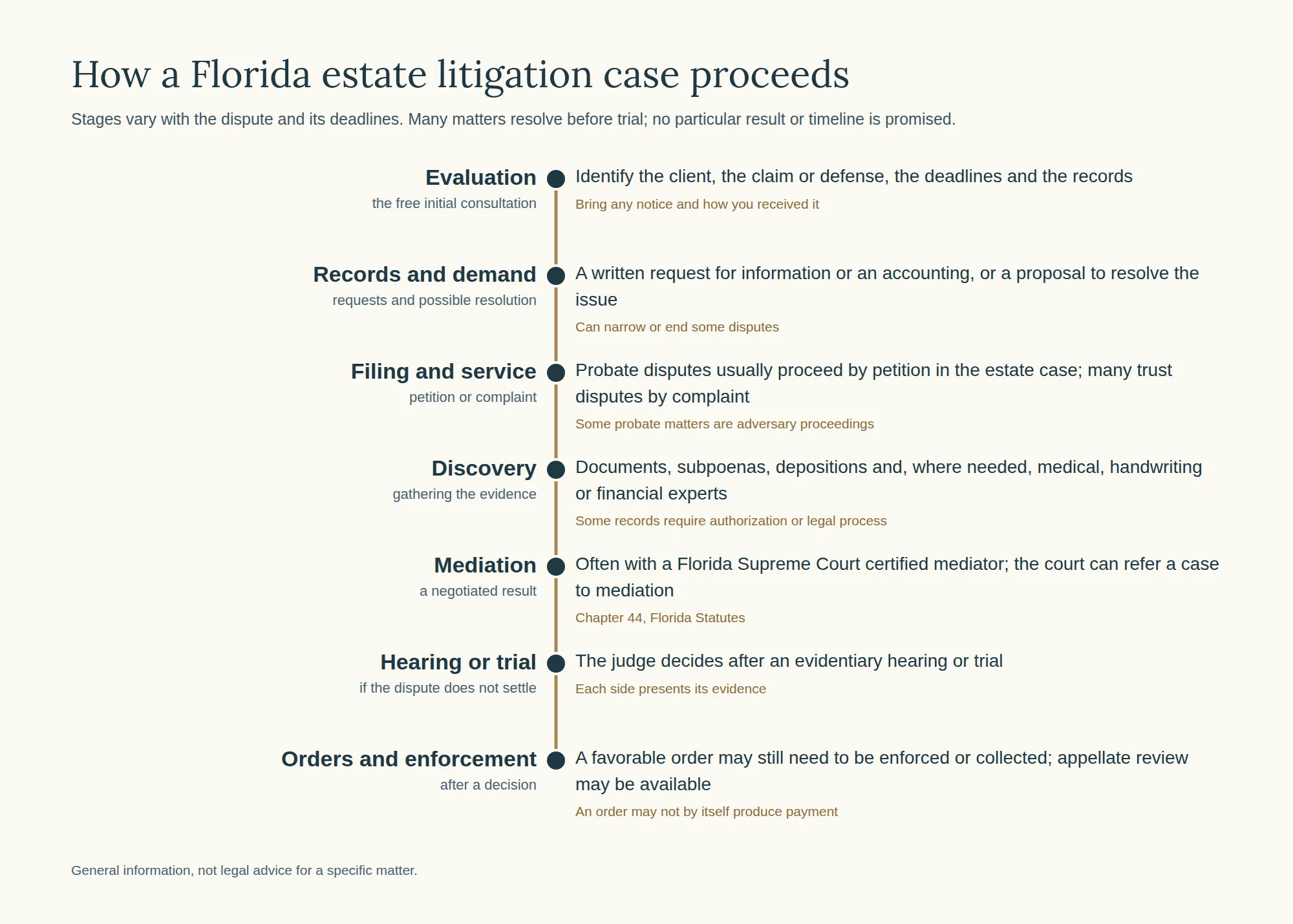
- Evaluation. Identify the client, the claim or defense, the deadlines and the records.
- Records and demand. A written request for information or an accounting, or a proposal to resolve the issue, can narrow or end some disputes.
- Filing and service. Probate disputes usually proceed by petition within the estate case; certain contested matters are conducted as an adversary proceeding under the Probate Rules. Many trust disputes proceed by complaint. The other interested persons are served and respond. §736.0201.
- Discovery. Documents, subpoenas, depositions and, where needed, medical, handwriting or financial experts.
- Mediation. Many contested matters are mediated, often with a Florida Supreme Court certified mediator, and the court can refer a case to mediation under chapter 44 of the Florida Statutes. Mediation allows a negotiated result, including a buyout or a revised distribution.
- Hearing or trial. If the dispute does not resolve, the judge decides after an evidentiary hearing or trial.
- Orders and enforcement. A favorable order may still need to be enforced or collected, and review by an appellate court may be available.
If a will or trust is contested, how long does it take?
Some disputes resolve in a few months; complex litigation can take a year or more. Timing depends on:
- the number of documents and transactions
- the number of parties
- the court’s calendar
- discovery
- whether the case settles
No particular timeline is promised.
Will the dispute become public?
Probate court files are generally public records, although Florida keeps certain filings, such as estate inventories and accountings, confidential. The petition for administration, which is public, often contains an estimate of the estate’s value and the beneficiaries’ names. Mediation and a negotiated agreement may keep more of a family’s disagreement out of the court file. §733.604.
Deeds, life estates and inherited real estate
A deed dispute asks who owns the property and whether a transfer or retained interest is legally effective, and a will contest does not automatically undo a deed. To contest a deed, Florida law looks at the instrument itself: signing, capacity, authority and delivery. Bring the recorded instrument, earlier title documents, any relevant power of attorney, and information about signing and delivery. See Florida deed challenges.
Can a life estate be contested?
It can be, in two different senses, and they should be kept apart.
- One is a challenge to the document that created the interest.
- The other is a dispute about how the property is being used or maintained, which is where remainderman rights come in.
A traditional life estate and a Lady Bird deed can reserve different powers. The deed’s wording, the ownership interests and the facts must be reviewed before deciding whether a transfer or other conduct can be challenged. To contest a Lady Bird deed, start with its exact wording. For the focused explanation, see contesting a Lady Bird deed in Florida.
Can siblings force the sale of inherited property?
A qualifying beneficiary or co-owner may be able to seek partition, but filing does not guarantee a forced sale. Section 733.814 provides a partition route before an estate closes when beneficiaries are entitled to undivided interests. Other co-ownership disputes proceed under Chapter 64, and qualifying heirs property has additional procedures, including possible buyout rights. Because a house often cannot be divided physically, partition of a home commonly ends in a sale or a buyout. To partition inherited property, Florida co-owners should first review title, homestead rights, agreements and the available alternatives. §733.814, §64.202, §64.207, §64.208.
For more, read about:
- Florida partition actions
- when siblings disagree about selling the family home
- Florida homestead in probate, if the property was the decedent’s homestead
Homestead disputes
Florida homestead rules can control who inherits a residence, and who may live in it, regardless of what the will says. Disputes commonly involve whether the property was the decedent’s protected homestead, whether a devise was valid when a spouse or minor child survived, and occupancy and expenses among the people who inherit. The court can be asked to determine homestead status. Florida Constitution, Art. X, §4; §732.401, §732.4015. See Florida homestead in probate and the homestead probate FAQ.
What does estate litigation cost, and who pays?
The initial consultation is free. Fees and costs for any representation are set separately, in a written agreement. Estate-planning prices do not set the price of litigation.
The work may depend on:
- the number of disputed instruments and transactions
- the parties and witnesses
- the records available
- expert needs
- discovery and motion practice
- whether the case settles or goes to trial
Discuss the proposed scope, billing arrangement, any required retainer and anticipated expenses before proceeding.
Do estate litigation attorneys only get paid if the case is won?
Not necessarily. Lawyers use different fee arrangements, and the arrangement for your matter is agreed in writing before the work begins. Depending on the lawyer and the case, arrangements may be hourly, a fixed fee for a defined task, contingent on recovery, or a combination. In appropriate cases, Lorenzo Law may consider a contingency or hybrid arrangement; whether one is available depends on the nature of the claim and is confirmed in a written agreement. No particular rate or arrangement is promised here.
How the arrangements differ:
- Contingency fee: the lawyer’s fee is a share of what is recovered. No attorney fee is owed if there is no recovery, but you may remain responsible for costs and expenses regardless of the outcome.
- Hybrid arrangement: combines a reduced hourly or fixed fee with a contingent portion. The hourly or fixed portion is owed whatever the outcome.
- Costs: filing fees, court reporters, depositions and expert witnesses are separate from the lawyer’s fee. The written agreement says who advances them and who is responsible for them if there is no recovery.
A contingency or hybrid agreement must be in writing and signed by you and the lawyer, and you receive a copy. It states how the fee is determined and how costs are handled. Lorenzo Law puts that agreement in place at the start of the representation. At the free consultation, ask about the arrangement, the expected costs and who advances them.
How much does it cost to contest a will, or to sue an estate?
There is no single price for every will contest or estate lawsuit. The cost of contesting a will depends on the work, not only on the estate’s size. A signing dispute and a case involving years of transactions can require very different work. The amount at stake matters to the economic decision, but it does not alone determine the work or fee. For a fuller discussion, see what a Florida will contest costs.
Who pays the legal fees? Can the estate pay mine if I win?
Do not assume the estate, the trust or the opposing party will pay your legal bill. Fee allocation depends on the claim and the governing law. In probate proceedings, the court may award costs and attorney fees and assess them against one or more parties’ shares of the estate, considering factors such as the effect on each share, the strength of the claims and each party’s participation, without a finding of bad faith (section 733.106, as amended July 1, 2026). In actions for breach of fiduciary duty, the court must award taxable costs including attorney fees, and may charge them against a party’s interest in the estate or trust. Whether a successful challenger recovers fees therefore depends on the proceeding and the result. Discuss both potential recovery and exposure. §733.106, §733.609, §736.1004, §736.1005.
Is it worth contesting a will?
It can be, when there is a recognized ground, admissible evidence, a timely claim and a realistic recovery that justifies the cost. Evaluate:
- your legal interest
- the available grounds and the evidence
- the deadlines
- the likely practical benefit and the potential recovery
- the costs and the alternatives
A strong concern may still require substantial investigation. A favorable court order may not produce payment if the property or funds cannot be recovered.
A surviving spouse may have a separate elective-share route. The statutory amount is 30% of the elective estate, subject to eligibility, waiver, calculation and election requirements. It is not simply 30% of every asset, and it does not depend on invalidating a will. §732.2065, §732.2135.
Comparing estate litigation lawyers?
When comparing estate litigation lawyers, probate litigation lawyers, probate litigators, probate dispute lawyers or trust litigation lawyers, compare how each will actually handle your matter. Choosing a lawyer for inheritance dispute resolution is a practical decision. The same questions apply whether you are comparing a Florida estate litigation lawyer, an estate trust litigation lawyer or a probate litigation attorney. Searches for the “best lawyer to contest a will” or “successful will contests” are understandable. Florida’s lawyer-advertising rules, though, prohibit comparative claims about a lawyer’s skills, experience, reputation or record unless objectively verifiable, and any statement that could be read as predicting or guaranteeing a result. Past results do not predict yours. Questions worth asking any lawyers for inheritance disputes you are considering:
- Who will do the work? At Lorenzo Law, Jose handles the matters he takes on himself.
- What is the plan for the deadlines that apply to you?
- How will fees and costs be set, and will that be in writing?
- How will you communicate, and in which language?
- Are there conflicts? Does the lawyer already represent anyone else involved?
You can confirm any Florida lawyer’s status through The Florida Bar’s member directory.
Preparing for your consultation
If something is scheduled soon, act first on these three steps:
- Write down the date and time of any hearing, sale or distribution.
- Keep the notice and its envelope, email or service record.
- Call and say what is scheduled.
Then bring what you already have, and note what is missing:
- Your role and the people involved: the decedent or settlor, the fiduciaries, the beneficiaries, other parties and any known lawyers.
- The disputed documents: wills, codicils, trusts, amendments, deeds, powers of attorney, beneficiary forms and relevant prior versions.
- Notices and dates: court papers, trust disclosures, limitation notices, envelopes, emails, service records and hearing dates.
- Financial and property records: inventories, accountings, fee statements and transaction records lawfully available to you.
- A short chronology: what changed, when you learned of it, who witnessed it, and what you want to accomplish.
Keep original records and complete messages. Do not access accounts or obtain records without authority. Explain any imminent sale, distribution or hearing at first contact. Ask the firm how to share sensitive material before sending it.
The consultation should establish the client and scope, identify urgent procedural issues, assess the available evidence and consider the appropriate response. Depending on the matter, next steps may involve a records request, negotiation, mediation or court proceedings. No particular remedy, timing or result is guaranteed.
Estate litigation throughout Florida
Lorenzo Law represents clients in estate, trust, will and deed disputes in matters throughout Florida, including for family members who live outside the state. Searches such as “estate litigation attorney Florida,” “estate litigation Miami” or “estate litigation attorney Orlando” describe where a dispute is; for estate litigation, Florida’s venue rules decide where a case is filed. Identify the county of any pending case and the location of any real estate when you contact the firm.
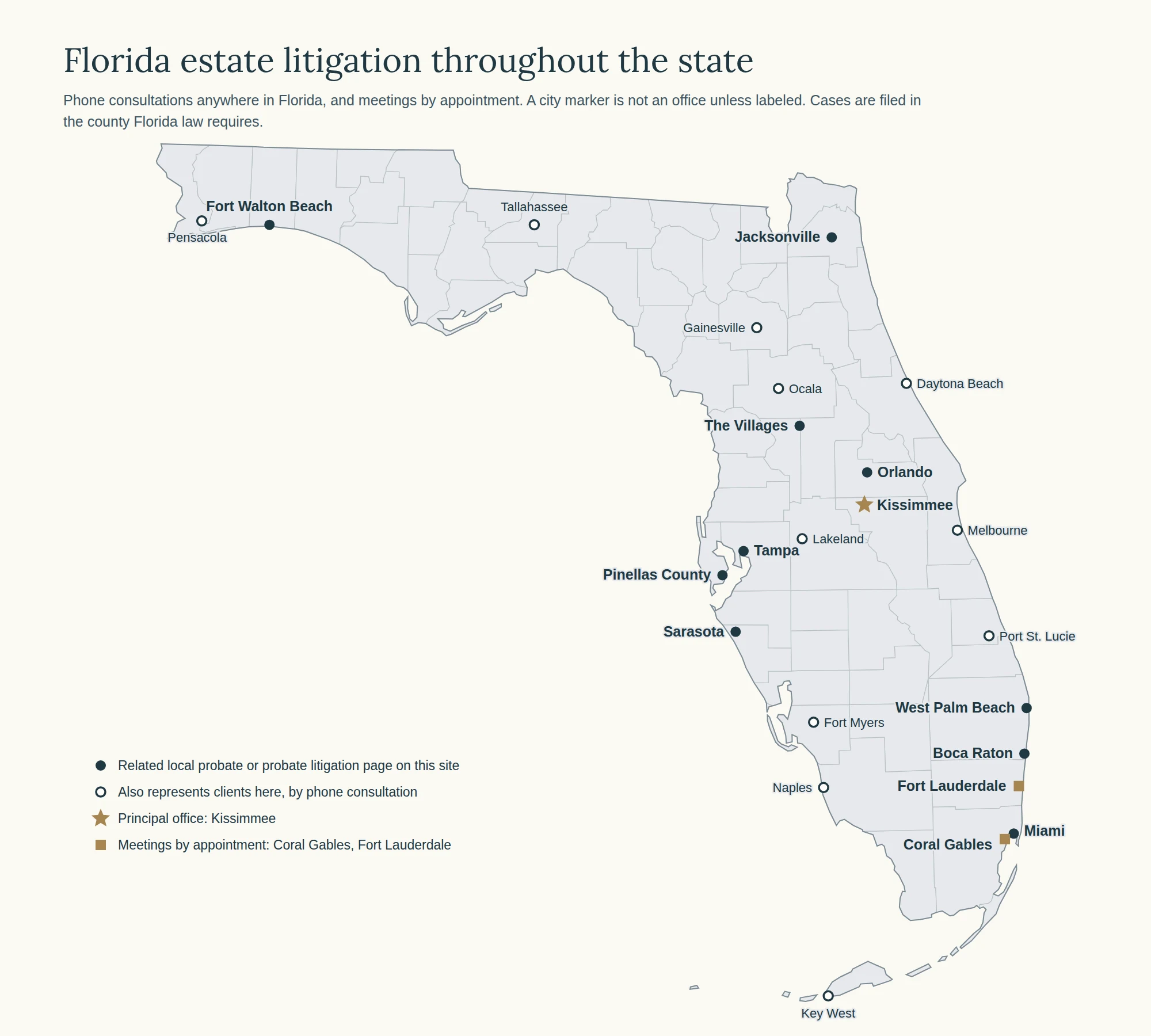
View the full-size Florida service-area map
| Region | Counties in the region | Related pages |
|---|---|---|
| South Florida | Miami-Dade, Broward, Palm Beach, Monroe (Florida Keys) | Probate litigation attorney, Miami · Probate litigation attorney, Fort Lauderdale · West Palm Beach probate litigation · Boca Raton probate litigation |
| Central Florida | Orange, Osceola, Seminole, Lake, Volusia, Brevard | Probate litigation attorney, Orlando · Kissimmee probate |
| Tampa Bay | Hillsborough, Pinellas, Pasco | Tampa probate litigation · Pinellas County probate litigation |
| Southwest Florida and the Gulf Coast | Sarasota, Manatee, Charlotte, Lee, Collier | Sarasota probate |
| North Florida | Duval and neighboring counties | Jacksonville probate litigation |
| Northwest Florida | Okaloosa and neighboring counties | Fort Walton Beach probate |
| The Villages corridor | Sumter, Lake, Marion | The Villages probate |
Jose’s principal office is in Kissimmee, and he meets clients by appointment in Coral Gables (Miami-Dade County) and Fort Lauderdale (Broward County). Consultations are also available by phone, which is how many clients in other regions begin.
Looking for an estate litigation attorney near you?
Start with the Florida county involved, the disputed documents and any approaching deadline. If you searched for an estate litigation attorney near me or an estate dispute attorney near me, what matters most is where the case belongs, not the lawyer’s street address: Florida’s venue rules decide that, and a lawyer’s meeting location does not (see the venue answer below). Jose handles matters throughout Florida, with phone consultations and meetings by appointment in Coral Gables and Fort Lauderdale. If you are comparing estate litigators near me, estate litigation lawyers near me, probate litigation attorneys near me or trust dispute lawyers near me, ask each one which county’s court the case belongs in and who will actually handle it.
Where is estate litigation filed in Florida?
It depends on the proceeding.
- Probate venue follows §733.101, which has separate provisions for a decedent who was not domiciled in Florida.
- Trust venue has its own rules under §736.0204.
- Partition generally follows the property’s location under §64.022.
Your residence, or a law firm’s meeting location, does not by itself determine venue. When the decedent lived part of the year in Florida and part elsewhere, where the decedent was domiciled can itself be disputed, and it can affect where the estate is administered and which state’s rules and taxes apply. See establishing a Florida domicile. Probate venue, trust venue, partition venue.
What if I live outside Florida?
You can pursue or defend a Florida estate or trust dispute without living in Florida; out-of-state heirs and beneficiaries often do. Consultations are available by phone. Include your city and state or country in your inquiry, along with the Florida county involved. If a family member outside Florida is serving, or wants to serve, as personal representative, see out-of-state personal representatives in Florida.
Who will handle my matter?

Jose M. Lorenzo, Jr. is Lorenzo Law’s only attorney, and clients work directly with him on the matters he handles. Jose (Florida Bar No. 107002) practices as an estate litigation attorney alongside his probate and estate planning work.
Before his admission to The Florida Bar, Jose worked for roughly a decade as a paralegal on probate and litigation matters. As a third-year law student, before his admission to the Bar, he served as a judicial intern in the Probate Division of Florida’s Eleventh Judicial Circuit in Miami-Dade County, working with the Honorable Maria M. Korvick. He earned a Bachelor of Arts in Accounting and Finance from Florida International University in 2009 and graduated from Florida International University College of Law in 2013. He was admitted to The Florida Bar on October 4, 2013.
Because Lorenzo Law also handles uncontested probate and estate planning, a client whose administration turns into a dispute often does not need to change lawyers, subject to conflicts and the scope of the engagement.
Read his biography or view his Florida Bar profile, number 107002.
Key terms in Florida estate litigation
- Personal representative
- the person the court appoints to administer a probate estate; the Florida term that includes an executor.
- Letters of administration
- the court-issued document granting the personal representative authority to act on behalf of the estate.
- Notice of administration
- the notice that tells interested persons about the estate and starts certain objection periods.
- Interested person
- someone whose rights may be affected by a proceeding.
- Qualified beneficiary
- a trust beneficiary with rights to certain information under the Trust Code.
- Caveat
- a filing that asks for notice before the court takes certain steps.
- Petition for revocation of probate
- a request to set aside a will that has already been admitted.
- Surcharge
- a court order requiring a fiduciary to repay a loss caused by a breach.
- Elective share
- a surviving spouse’s statutory share of the elective estate.
- Protected homestead
- a residence that passes under special constitutional and statutory rules.
- Pour-over will
- a will that sends probate property into a trust.
- Partition
- a proceeding that divides, or sells and divides, co-owned property.
- No-contest (in terrorem) clause
- a clause that tries to penalize a challenge; specified clauses are unenforceable under Florida statutes.
- Mediation
- a confidential, facilitated negotiation with a neutral mediator.
- Adversary proceeding
- a contested probate matter conducted under the Probate Rules’ procedures for lawsuits between parties.
- Constructive trust
- a court-imposed remedy treating wrongfully held property as held for the person entitled to it.
- Petition to compel an accounting
- a request that the court order a fiduciary to account.
More questions about Florida estate litigation
Could taxes explain a delayed distribution?
Possibly. Florida does not impose an estate tax for deaths on or after January 1, 2005. Federal estate-tax work, income taxes and another state’s taxes may still need review. An inheritance itself is generally excluded from federal income, while income generated by inherited property can be taxable. Ask which specific obligation is delaying the administration, rather than treating every tax explanation as misconduct. Florida Department of Revenue, IRS guidance.
Can the family agree to divide an inheritance differently?
Yes, often. Interested persons may resolve a dispute by a written agreement that changes how the estate or trust is divided, and court approval is not always required. Court approval may be sought to protect the personal representative, and it is required when minors or incapacitated persons are involved. Creditor rights and tax obligations cannot be changed by private agreement. §733.815, §733.708, §736.0111.
How hard is it to win a will contest?
It depends on the evidence and the timing, not on how unfair the result feels. Contests built on documented execution problems or strong evidence about the signing differ from contests based only on an unequal division. No lawyer can ethically promise an outcome. A consultation can identify the evidence that would matter in your case.
Can an inheritance be contested?
Sometimes, when a person with standing has a recognized legal ground and a timely claim. The ground may concern the will, the trust, a deed, a beneficiary designation or the fiduciary’s conduct, as described above. Unfairness alone is not enough.
Can an executor screw over a beneficiary?
An executor can cause real harm by delaying, hiding information or mismanaging property, but cannot lawfully rewrite the will or take a beneficiary’s share. The protections are the ones described above: accountings, objections, removal and repayment for a proven breach. See what an executor cannot do.
What voids a will in Florida?
A will can be void, or can be set aside, for improper execution, lack of testamentary capacity, forgery, or procurement by fraud, duress, mistake or undue influence; a will can also be revoked by a later will or a qualifying act of revocation. See the grounds section above.
Can you dispute a probate case in Florida?
Yes. An interested person can object, petition or defend within a Florida probate case, but only within the applicable deadlines. The deadline table above is the starting point.
How long is too long to contest a will?
It can be too late once the applicable objection period has run after proper service, or once the estate is closed and the personal representative is discharged; the exact point depends on your notice and the case history. For a person served with a notice of administration, objections to the will’s validity generally must be filed within three months after service. That period can be extended only if the personal representative misstated the deadline, and in all events objections must be filed before the earlier of the personal representative’s final discharge or one year after service. §733.212. Do not wait for a better time. Bring your notice and service records to a consultation.
What is the 7-year rule in Florida?
Florida has no “7-year rule” for wills, trusts, probate or inheritance disputes. The question may reflect rules from other states or unrelated time limits. In Florida probate, the deadlines that usually matter are the objection period after service of a notice of administration and the bar that follows the personal representative’s final discharge; see the deadline table above.
What is the 10-day rule for probate in Florida?
It refers to the duty of a person holding a deceased person’s original will to deposit it with the clerk of court within 10 days after learning of the death. A custodian who fails to do so without just cause can be ordered to pay the petitioner’s costs, damages and attorney fees. There is no criminal penalty for mere failure to deposit, but stealing or concealing a will is a separate criminal offense. §732.901. See Florida probate administration.
How much do lawyers charge to settle an estate in Florida?
Settling an uncontested estate is probate administration, which is priced differently from litigation. See the cost of probate in Florida and Florida probate administration. Litigation fees are discussed above.
Talk to a Florida estate litigation attorney about your inheritance dispute
Tell Lorenzo Law:
- your role
- what is disputed
- whether you have received a notice or face a scheduled hearing, transfer or distribution
You do not need to know the legal name of your claim before requesting a consultation.
Request a free initial consultationCall (305) 224-6811
Consultations are available in English and Spanish, by phone or by appointment. Calls are answered 24 hours a day, and inquiries receive follow-up within one to two business days. The initial consultation is free; fees and costs for representation are agreed separately in writing. Principal office: Kissimmee, Florida. Jose also meets clients by appointment in Coral Gables and Fort Lauderdale.
This page provides general information, not advice about your particular circumstances. Contacting Lorenzo Law does not establish an attorney-client relationship or confirm that the firm has agreed to represent you.
Sources
Florida Statutes (2026), also linked in context above: §§ 64.022, 64.202, 64.207, 64.208, 732.2065, 732.2135, 732.501, 732.502, 732.5165, 732.517, 733.101, 733.107, 733.109, 733.212, 733.2123, 733.504, 733.602, 733.609, 733.6175, 733.702, 733.710, 733.801, 733.814, 733.901, 736.0201, 736.0204, 736.0207, 736.0406, 736.0604, 736.0706, 736.0802, 736.0813, 736.08135, 736.1001, 736.1004, 736.1008, 736.10081, 736.1108. Also: §§ 731.201, 732.401, 732.4015, 732.505, 732.506, 732.515, 733.207, 733.617, 733.802, 733.805, 765.101, 765.105, 731.110, 732.901, 733.106, 733.301, 733.506, 733.604, 733.705, 733.708, 733.815, 736.0111, 736.0412, 736.0415, 736.1005, 768.20; Florida Constitution Art. X, §4; Florida Probate Rules 5.025 and 5.510.
Also: