

LORENZO LAW · FLORIDA WILL CONTESTS
Florida Will Contest Attorney
A Florida will contest attorney represents people who challenge a will in probate court, and people who defend one. Jose M. Lorenzo, Jr. is a Florida will contest lawyer who handles contested wills and contested probate in all 67 Florida counties. He represents heirs, beneficiaries, surviving spouses and personal representatives, whether the question is undue influence, dementia and capacity, a forged or improperly signed will, or a notice deadline that has already started to run.
Lorenzo Law is a solo practice: clients work directly with Jose on the matters he handles, from the first review of the court file through hearings and trial. Representation is subject to a conflict check and an agreed scope of work. Consultations are available in English and Spanish, by phone or by appointment.
Request a free initial consultationCall (305) 224-6811
The first meeting is a free consultation. Only the initial consultation is free. Fees and costs for representation are agreed separately in writing. In appropriate cases, a contingency or hybrid arrangement may be considered.
People look for this help under many names: a will contest lawyer in Florida, a contested will attorney or contested will lawyer, a contested probate attorney or contested probate lawyer, a will dispute attorney or will dispute lawyer, an attorney for a will dispute or a lawyer for will disputes, an undue influence attorney, or simply a lawyer to contest a will or an attorney to contest a will. Others search for a “contest a will lawyer,” a “contesting a will lawyer” or a “contesting a will attorney.” Whatever the label, the legal work is the same; when the will is being attacked, Jose acts as a will contest defense attorney.
An inheritance that feels unfair is not, by itself, a reason to invalidate a will. A supportable will contest needs three things:
- a recognized legal ground
- a person entitled to raise it
- timely action in the right proceeding
If you received a notice or petition, have the complete document reviewed promptly. Do not assume every will contest has the same deadline.
Were you served with a probate notice? Keep the whole document: its attachments, and the envelope or proof of delivery.
- A notice of administration generally gives an interested person three months after service to object to the validity of the will, venue or jurisdiction. That is three calendar months (3 months, not 90 days).
- A formal notice of a petition served before letters of administration issue generally calls for written defenses within 20 days after service. A later three-month window may not follow.
- A waiver, a consent, or an order already entered can change the analysis.
A phone call, a consultation request or a family negotiation does not file a challenge or stop a deadline.
Florida will contests at a glance
| Question | Short answer |
|---|---|
| Who can contest a will? | An “interested person”: someone who may reasonably be expected to be affected by the outcome, often an heir or a beneficiary under an earlier will. |
| What is the deadline? | Usually three calendar months after service of the notice of administration. Formal notice served before letters generally calls for written defenses within 20 days. There is no single date for every case. |
| What are the grounds? | Improper execution, lack of capacity, undue influence, fraud, duress or mistake, forgery, insane delusion, or a later revocation. Unfairness alone is not a ground. |
| Who has the burden? | The person offering the will proves proper execution; the challenger then proves the ground, unless the undue-influence presumption shifts the burden. |
| Does a no-contest clause stop you? | Not in a Florida will. It is unenforceable. |
| Is there a jury? | Generally no. The probate judge decides. |
| Who pays? | Each side’s fees depend on its engagement. The court can award costs and allocate fees among shares of the estate under §733.106. |
| Where is it filed? | In the probate division of the circuit court where the estate is administered. |
What does a Florida will contest attorney do?
A will contest asks the probate court to decide whether all or part of a will is legally valid. A will contest attorney identifies the right proceeding and deadline, builds or answers the evidence, and presents the case to the judge. Contesting a will, challenging a will, disputing a will and protesting a will all describe the same thing, and “contest of wills” is another name for the same dispute. A contested will is one someone has formally objected to, and contested probate in Florida is the estate administration once that happens.
What is a will contest? What does it mean to contest a will? It means asking the court to refuse, or revoke, probate of all or part of a will (a last will and testament) on a recognized legal ground. Can a will be contested? Can you challenge a will? Can you contest a will in Florida? Yes, by an interested person, on a recognized ground, within the deadline that applies. Can a will be overturned? Proving that ground is how to overturn a will; otherwise the will stands.
A will contest is not a separate lawsuit filed somewhere else. It happens inside the probate case, before the judge already supervising the estate. Before a will is admitted, the dispute may be whether it should be admitted at all. After admission, the procedure is usually a petition to revoke probate. §733.109. The court file and the notice history decide which pleading fits. A notice of administration is not a prerequisite to every challenge.
Will contests and revocation proceedings are adversary proceedings under Florida Probate Rule 5.025 unless the court orders otherwise. They run much like a civil lawsuit, with formal service, pleadings, discovery and evidentiary hearings.
Challenging a will or defending one
The work depends on your position:
| Your position | What the initial review should address |
|---|---|
| You believe a will or codicil is invalid | Your interest under the disputed will, earlier wills or intestacy; the specific grounds; the notices received and the filing requirements |
| You were left out of a will, or left less than expected | Whether you would benefit under an earlier will or the intestacy statutes, whether a recognized ground exists, and whether a challenge is still timely |
| Your inheritance under the will is being challenged | The allegations, the response deadline, the signing evidence, and whether you need your own counsel |
| You are the personal representative (executor) | Your duties to the estate, the defense of the will, possible conflicts, and the scope of your current lawyer’s engagement |
| You are an heir, but there may be no valid will at all | Whether the dispute is really about who the heirs are, or who should serve |
| The dispute involves a will and a trust, a deed or a lifetime transfer | Which assets each document controls, and whether separate claims, parties and deadlines apply |
Depending on the engagement, the work may include:
- objections or revocation petitions
- defenses
- preserving evidence
- discovery
- hearings
- settlement discussions and mediation
- trial preparation
Being accused of undue influence does not establish that it occurred, and being disappointed by a will does not establish that it is invalid.
Will contest, probate litigation, estate litigation or trust litigation?
It depends on where the disputed property sits and who controls it.
| If the dispute is about… | It is usually… | Where to read more |
|---|---|---|
| Whether a will or codicil is valid | A will contest | This page |
| The personal representative’s conduct, an estate accounting, heirship, or the meaning of a will | Probate litigation inside the estate case | Florida probate litigation attorney |
| Transfers made during life, joint or payable-on-death accounts, beneficiary designations, or several asset types at once | Estate litigation, the work of an estate litigation attorney or inheritance dispute attorney | Florida estate litigation attorney |
| A trust, a trust amendment, or a trustee | Trust litigation, with its own notices and deadlines | Florida trust litigation |
A will contest does not automatically reach property that passed outside probate, such as joint accounts, life insurance, trust assets or real estate deeded during life. An inheritance dispute lawyer looks at all of those at once; a will contest looks at the will. For a longer educational explanation, see the guide to contesting a will in Florida.
How to contest a will in Florida: the legal process
What is the legal process for contesting a will in Florida?
How do you contest a will? To contest a will in Florida, an interested person files a timely objection or petition in the probate case, serves the other parties, and proves a recognized ground through evidence. The case is resolved by settlement or by the judge. The order of the steps depends on the notice you received and the stage of the estate.
What are the steps to contest a will? The same steps apply to how to challenge a will, how to dispute a will or how to contest a probate case. What happens when you contest a will is that the dispute becomes an adversary case inside the estate, and it moves through these stages:
- Find the deadline first. Collect every notice, petition and order, and the date each was served on you. Note anything you signed. The deadline depends on which document you received (see “How long do you have to contest a will in Florida?”).
- Get the court file. The petition for administration, the will as filed, the order admitting it, the letters of administration and the docket show what has already happened.
- Choose the right filing. Depending on the stage, that may be written defenses to a formal notice, an objection, or a petition to revoke probate. This is how to file an objection or a petition to contest a will: a written pleading, filed and served in the estate case. A revocation petition must state the petitioner’s interest and the facts supporting revocation (Probate Rule 5.270). A letter to the family or the personal representative complaining about the will is not a substitute.
- Serve the parties. Will contests are adversary proceedings, so the affected parties must be formally served.
- Preserve and gather evidence. That means medical and pharmacy records, the drafting lawyer’s file where it can be reached, the signing-day logistics, financial records and earlier wills. Records can be lost to retention schedules.
- Will contest discovery. Document requests, will contest interrogatories (written questions answered under oath), subpoenas, and depositions of the drafting lawyer, witnesses, caregivers and the personal representative.
- Mediation and settlement discussions.
- Evidentiary hearing or trial before the probate judge, then the order and any appeal. This is what fighting a will in court looks like, and how to contest a will in court in 2026: a hearing on evidence before the probate judge, generally not a jury trial. Orders that finally determine a right or obligation of an interested person can be appealed.
How does contesting a will work, and how do you win one?
The process of contesting a will is the eight steps above; how contesting a will works in practice depends on the evidence. There is no formula for how to win a will contest. Successful will contests are usually built on records made at the time of the signing, a ground the evidence actually supports, and a filing made within the deadline. This page does not predict results.
Do I need a lawyer to contest a will? Can you contest a will without a lawyer?
A person may represent themself, but it is risky. Learning how to contest a will without a lawyer means learning the procedure, and that is the hard part. A will contest is an adversary proceeding, and after formal notice it runs like a civil lawsuit under the Florida Rules of Civil Procedure (Probate Rule 5.025). Missing a formal-notice response or a service requirement can end the case before the evidence is heard.
What kind of attorney do you need to contest a will?
What kind of attorney to contest a will? A probate litigation lawyer: a probate lawyer to contest a will who handles hearings, discovery and trial, not only uncontested estates. “Probate litigator” is not a separate license or a Florida Bar certification. An attorney for contesting a will should explain which deadline applies to your notice at the first meeting.
Who can contest a will in Florida?
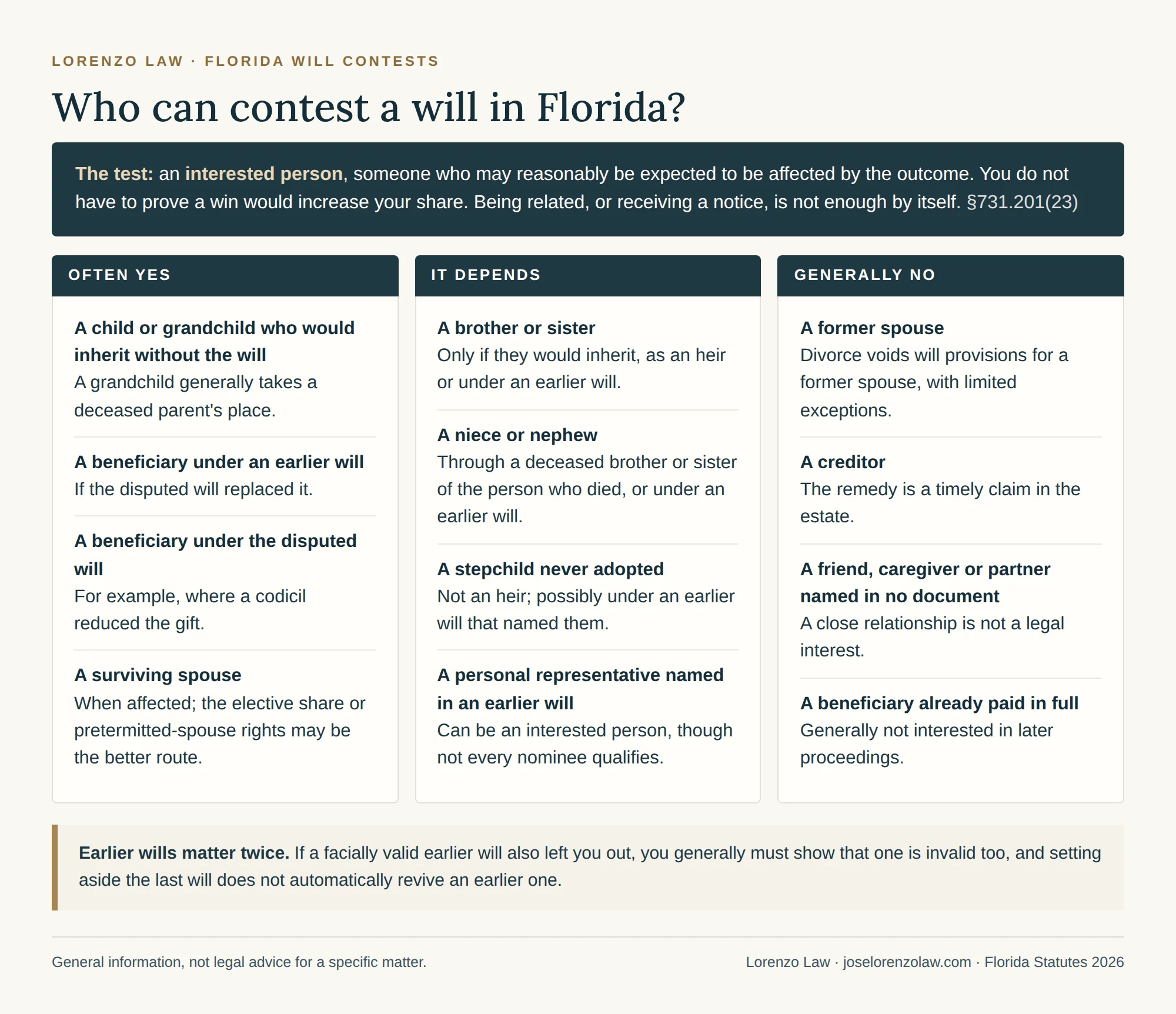
Who can contest a will? Generally, an interested person: someone who may reasonably be expected to be affected by the outcome of the particular proceeding. The same test answers who has standing to contest a will, who has standing to challenge a will, who has the right to contest a will, who can challenge a will and who can dispute a will. Family membership, or receiving a notice, does not by itself establish standing. §731.201(23).
An heir at law (someone who inherits under the intestacy statutes when there is no valid will) and a devisee (a person who receives property under a will) are the usual contestants. A person who would inherit under an earlier will, or under the intestacy statutes if the challenged will failed, commonly has that interest even though the current will leaves them nothing. A contestant does not have to prove that a win would increase their share, only that they may reasonably be expected to be affected by the outcome (Frank v. Conlan, 434 So. 3d 452 (Fla. 4th DCA 2026)).
Can anyone contest a will? No. Can someone contest a will just because they are related, or were close to the person? Not without an interest the outcome affects. Can someone not named in a will contest it? Yes, if they would inherit without it, for example as an heir or under an earlier will. Can you contest a will if you’re not in it? Can you contest a will if you are not in it? Can a non-beneficiary contest a will? Yes, on that basis.
| Who you are | Can you contest the will? |
|---|---|
| A child or grandchild who would inherit if there were no will | Often yes. A grandchild generally takes a deceased parent’s place among the heirs. |
| A beneficiary under an earlier will that the disputed will replaced | Often yes, but see the earlier-will problem below. |
| A beneficiary under the disputed will | Yes, if they may reasonably be expected to be affected by the outcome, for example where a codicil reduced their gift (§731.201(23)). |
| A brother or sister | Only if they would inherit: as an intestate heir when there are no descendants and no surviving parent, or under an earlier will. |
| A surviving spouse | Yes, when affected. But the elective share or pretermitted-spouse rights may be the better route. |
| A former spouse | Usually not as a beneficiary. Divorce generally voids will provisions for a former spouse, unless the will was signed after the divorce, the will expressly says otherwise, or the divorce judgment provides otherwise (§732.507). |
| A stepchild who was never adopted | Not as an intestate heir, but possibly under an earlier will that named them. |
| A niece or nephew | If they would inherit under intestacy (for example, through a deceased sibling of the testator) or under an earlier will. |
| The personal representative | The personal representative serving under the disputed will usually defends it. A personal representative named in an earlier will can be an interested person with standing to contest a later will (Engelberg v. Birnbaum, 580 So. 2d 828 (Fla. 4th DCA 1991)), though not every nominated personal representative qualifies (Wheeler v. Powers, 972 So. 2d 285 (Fla. 5th DCA 2008)). |
| A creditor | Generally no. A creditor’s remedy is a timely claim in the estate (§§733.702–733.705), and a creditor may file a caveat only after the death (§731.110). |
| A friend, caregiver or partner named in no document | Generally no. A close relationship is not a legal interest. |
| A beneficiary who has already received complete distribution | Generally not an interested person for later proceedings. |
Can a sibling contest a will in Florida?
Sometimes. A brother or sister is an intestate heir only when the person left no surviving descendants and no surviving parent. A sibling named in an earlier will can have standing on that basis instead. Siblings contesting a parent’s will are usually children of the testator, not siblings of the testator, so their standing comes from being heirs or earlier beneficiaries. When it is siblings contesting a will, the usual claim is sibling undue influence: one brother or sister arranged the new will. Can a sibling contest a will if left out? Can siblings challenge a will? Yes, when they are heirs or earlier beneficiaries and have a recognized ground; being left out alone is not a ground.
Can a grandchild contest a will in Florida?
Can a grandchild contest a will if their parent is deceased? Often yes. A grandchild whose parent died before the grandparent generally takes that parent’s place among the heirs under the intestacy statutes (§732.103, §732.104), and may also be named in an earlier will.
Can a stepchild contest a will in Florida?
A stepchild who was never adopted is not an intestate heir of the stepparent, so standing usually depends on an earlier will.
Can a spouse contest a will?
A surviving spouse may have standing, and may also have rights that do not require invalidating the will: the elective share, a pretermitted spouse’s share for a will signed before the marriage, and homestead protections.
Can a family member contest a will? Quick answers by relationship
Can family members contest a will? When can a family member contest a will? When the outcome affects them, a recognized ground exists, and the challenge is timely. Relationship alone is never enough.
- Can a daughter contest a will? Can a son contest a will? Yes, if they would inherit without the will or under an earlier will. Can I contest my father’s will, or can I contest my dad’s will? The same test applies; contesting a parent’s will turns on how the will was made, not on the size of the share.
- Can an estranged son contest a will? Can my estranged son contest my will? Estrangement does not remove standing, and it does not create a ground. An adult child can generally be left out.
- Can a granddaughter contest a will? Can a grandson contest a will? Yes, when their parent died first and they take that parent’s place, or under an earlier will.
- Can a brother contest a will? Can a half sibling contest a will? Only as an heir or under an earlier will. Brothers and sisters inherit by intestacy only when there are no descendants and no parents, and then only the part not passing to a surviving spouse; a surviving spouse with no descendants takes the entire intestate estate (§732.102; §732.103). Among brothers, sisters and other collateral relatives, those of the half blood inherit half as much as those of the whole blood, unless all are of the half blood (§732.105).
- Can nieces and nephews contest a will? Can a niece contest a will? Can a nephew contest a will? If they would inherit through a deceased brother or sister of the person who died, or under an earlier will.
- Can a step daughter contest a will? Can a stepson contest a will? Can stepchildren challenge a will? A stepdaughter or stepson is not an heir unless adopted, but may have standing under an earlier will that named them.
- Can a daughter-in-law contest a will? Generally not in her own right, because she is not an heir. She may have standing if an earlier will named her, or if she is a beneficiary whose gift a later codicil reduced.
- Can a wife contest a will? Can a wife contest a husband’s will? Yes, when affected, and she may also have elective-share, pretermitted-spouse and homestead rights.
- Can a separated spouse contest a will? Can an estranged wife contest a will? Yes. A spouse who is separated but not divorced at the death is still a surviving spouse. Florida has no legal separation that ends spousal rights; only a final judgment dissolving the marriage does.
- Can an ex-wife contest a will? Can an ex-spouse contest a will? Usually not as a beneficiary; divorce voids will provisions for a former spouse, unless the will was signed after the divorce, the will expressly says otherwise, or the divorce judgment provides otherwise.
- Can a common-law spouse contest a will? Can a common-law wife contest a will? Florida does not recognize common-law marriages entered into in Florida after January 1, 1968, so standing usually depends on another interest (§741.211). A common-law marriage validly formed in a state that recognizes it may be recognized in Florida.
- Can a beneficiary contest a will? Can you contest a will if you are in it? Yes, if they may reasonably be expected to be affected by the outcome. A beneficiary whose gift a later codicil reduced is the usual example.
- Can a power of attorney contest a will? Not as agent after death. A power of attorney, even a durable one, ends when the principal dies (§709.2109), so a former agent can contest the will only in their own right as an interested person. An agent also can never sign or revoke a will for the principal (§709.2201). Whether an agent can bring a will contest for a living, incapacitated beneficiary is unsettled; it would need specific authority in the document, and a guardian of the property is the clearer route. See guardianship litigation.
- Can an executor contest a will? Can a trustee contest a will? A personal representative or trustee named under an earlier will, or a trustee of a trust that would receive more under an earlier will, may have an interest; roles and conflicts need review.
- Can an heir contest a will? Can next of kin contest a will? An heir under the intestacy statutes commonly can. “Next of kin” is not the legal test; being an heir or an earlier beneficiary is.
- Can a non-family member contest a will? Only with a legal interest, such as a gift under an earlier will. A friend or caregiver named in no document generally cannot.
What if you were left out of a will?
Being left out, or being left less than a sibling, is not by itself a ground to contest a will in Florida. A person may generally leave property to whomever they choose, subject to rules such as protected homestead and a surviving spouse’s statutory rights. An adult child can generally be left out.
The real question is how the will came to say what it says. A will signed in good health five years before death raises different questions than a will changed in the final months of life that favors the person who managed the medications, drove to the lawyer’s office and controlled the phone, even if the shares are identical.
Earlier wills: the prior-will problem
Earlier wills matter twice. They may establish your interest, and they may decide what happens if the disputed will fails. Setting aside the last will does not automatically revive the earlier will you prefer (§732.508). In limited cases, the doctrine of dependent relative revocation lets an earlier will stand when the testator revoked it only on the assumption that the new will was valid and the two wills are not materially different. If a facially valid earlier will also left you out, you generally must show that the earlier will is invalid too; otherwise setting aside the later will would not help you, and you may lack standing (Newman v. Newman, 766 So. 2d 1091 (Fla. 5th DCA 2000); Wehrheim v. Golden Pond Assisted Living Facility, 905 So. 2d 1002 (Fla. 5th DCA 2005)). Bring every version you can find, and tell counsel about wills you know of but do not have.
How long do you have to contest a will in Florida?
Usually three calendar months after you were served with the notice of administration, not 90 days. If you were served with formal notice before letters of administration issued, written defenses are generally due within 20 days, and a later three-month window may not follow. There is no single deadline that covers every case.
Under §733.212(3), an interested person served with a notice of administration must raise objections to the validity of the will, venue or jurisdiction within three months after service.
- The period runs from service on that person. It does not run from the date of death, the funeral, or the day you learned about the will.
- It can be extended only for estoppel based on a misstatement by the personal representative about the time period. It does not provide a general extension for misconduct, nondisclosure or later-discovered evidence.
- Unless barred sooner, it ends no later than the earlier of the personal representative’s final discharge or one year after service. That outer limit does not give everyone a year.
- It bars challenges to the validity of the will, including a claim that a single gift was procured by undue influence or fraud: that claim seeks to void part of the will, so the three-month deadline applies (§732.5165).
- It does not bar a proceeding that accepts the will as validly executed and asks the court to construe a provision, such as whether a power of appointment was effectively exercised or what a condition in a testamentary trust means (Tendler v. Johnson, 332 So. 3d 521 (Fla. 4th DCA 2021); Gundlach v. Gundlach, 339 So. 3d 997 (Fla. 4th DCA 2022)). Those are construction or declaration-of-rights proceedings, not validity challenges. A proceeding to revoke the probate of the whole will must begin before the personal representative’s final discharge (§733.109); no equivalent statutory cutoff applies to construction or trust declaration-of-rights proceedings.
| Document or stage | Why it matters | Bring for review |
|---|---|---|
| Notice of administration | Generally three months after service to object to will validity, venue or jurisdiction. Extensions are narrow. | The complete notice, attachments, envelope, delivery records and proof of service |
| Formal notice of the petition for administration, before letters issue | Written defenses are generally due 20 days after service. A challenge to will validity, testacy, venue or jurisdiction may have to be raised in that proceeding (§733.2123; Rule 5.040). | The petition, the formal notice, service records, waivers, orders and letters |
| A will already admitted to probate | A revocation proceeding must begin before final discharge, and only if you are not already barred under §733.212 or §733.2123. “Before discharge” does not extend an expired deadline (§733.109). | The admission order, the docket, all notices, any discharge papers |
| A waiver or consent you signed | A waiver can affect your notice and procedural rights. When service of the notice of administration is waived, the waiver’s filing date is treated as service for the referenced deadlines (§733.212(8)). | Everything you signed, and the date it was filed, not only the date you signed |
| Summary administration, or an estate where you received no notice | Do not assume the notice-of-administration timetable controls, or that the absence of that notice leaves unlimited time (§735.206). | The summary petition and order, notices, consents, distribution information and the docket |
| A caveat on file | A caveat affects notice before a will is admitted; it is not itself a contest and does not extend a deadline (§731.110). | The caveat and its filing date |
| Holding the original will | The custodian must deposit it with the clerk within 10 days after learning of the death (§732.901). That is not the contestant’s deadline. | Who has the original and when they learned of the death |
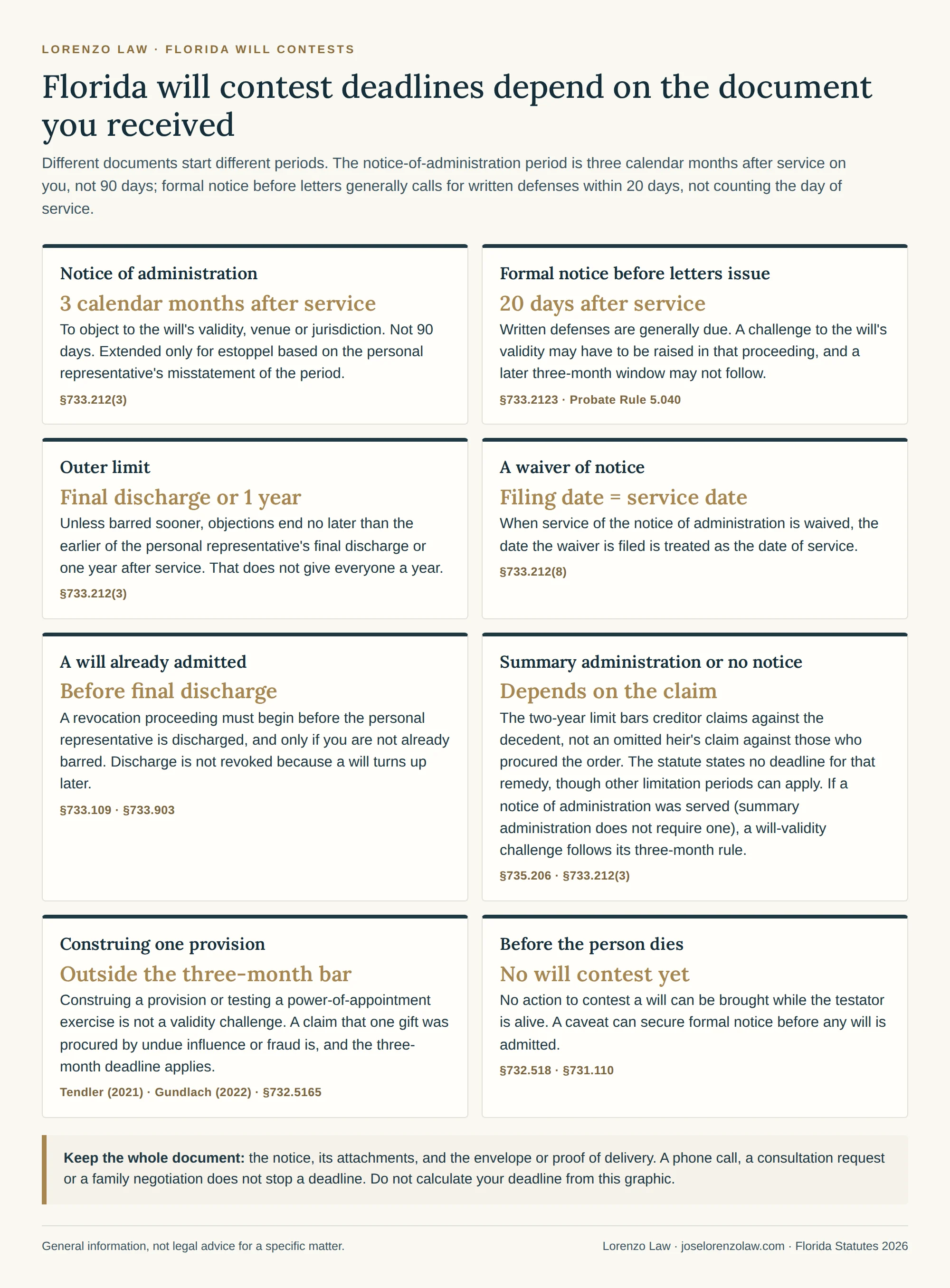
These examples explain why the document matters. They do not calculate your deadline.
Is it three months or 90 days?
Three calendar months. The statute measures the period in months after service. A 90-day count can land on the wrong day. Count from the date of service on you, and confirm it against the court’s proof of service.
Time limits to contest a will in Florida: quick answers
Is there a time limit to contest a will? Yes. The time limit to contest a will in Florida, sometimes called the statute of limitations to contest a will in Florida, is tied to notice, not to the date of death. The time to contest a will runs from these events:
- The Florida will contest statute most people mean is §733.212(3). For a will contest, Florida statute §733.212(3) sets the period at three months after service of the notice of administration. That is the Florida will contest period, and the most common answer to how long to contest a will in Florida.
- How long do you have to contest a will? How long can you contest a will? How long do I have to contest a will? Usually three calendar months from service on you; 20 days for defenses to a formal notice served before letters.
- How long does a beneficiary have to contest a will? How long does an heir have to contest a will? The same periods apply to beneficiaries and heirs; they run from service on each person.
- Deadline for contesting a will when no notice came? No universal safe harbor applies (see summary administration below).
- Statute of limitations on contesting a will, as people use the phrase: Florida’s will-contest time limits are procedural bars in the probate case, with narrow extensions only. Contesting a will? Time limits do not restart when new evidence turns up.
- When can you contest a will? Only after the testator’s death, once there is a will offered or admitted and a proceeding in which to raise it.
What is the 20-day rule for formal notice?
If you were served with formal notice of a petition before letters of administration issued, you may have had to raise your challenge in that proceeding. §733.2123 and Probate Rule 5.040 give 20 days after service to serve written defenses to a formal notice. Do not assume a fresh three-month window will follow. Under Rule 5.040, the defenses are served within that period and filed before or immediately after service.
Can a will be contested after probate?
Can you contest a will after probate? Sometimes. An interested person who is not already barred may petition to revoke the probate of a will before the personal representative is finally discharged. §733.109.
- Administration generally continues while the petition is pending.
- A good-faith purchaser who bought property from the personal representative before an order of revocation is protected.
After discharge, or once the three-month objection period has run following proper service, a challenge may be too late.
- Once a will is probated, can it be contested? Only through a timely petition for revocation of probate in Florida, filed before discharge by a person not already barred.
- How long after probate can a will be contested? How long after probate can you contest a will? Until the applicable bar runs (three months after service of the notice of administration, or the formal-notice response), and in any event before final discharge (the court’s order of discharge); the one-year outer limit also applies.
- Can you contest a will after probate has been granted? Can you contest a will after distribution? After probate has been granted, only by a timely revocation petition before discharge; distribution does not create a new window. If you were properly served and the period ran, a challenge after distribution is generally barred.
- Want to contest a will after probate in Florida when you were never served? Tell counsel at once; the service record decides the analysis.
- Can a will be contested after the estate is closed? Generally no. A revocation proceeding must begin before the personal representative’s final discharge (§733.109), no will can be offered once the estate is fully administered and the personal representative discharged (§733.208), and a discharge cannot be revoked just because a will turns up later (§733.903). Courts have allowed a closed estate to be reopened only for fraud, bad faith or procedural irregularity, such as a personal representative who hid a known later will (Dean v. Bentley, 848 So. 2d 487 (Fla. 5th DCA 2003)) or an alleged forgery (Liechty v. Hall, 687 So. 2d 64 (Fla. 5th DCA 1997)). In 2026, a petition filed nine days after discharge was held too late where the petitioner knew of the probate case (Gilbert v. Riley, 431 So. 3d 588 (Fla. 3d DCA 2026)).
- Can a will be contested if it was never probated? There is nothing to contest until someone offers the will for probate. Whoever holds an original will must deposit it with the clerk within 10 days after learning of the death, and the court can compel production and charge costs and fees against a custodian with no good reason for withholding it (§732.901). A will can still be offered while an administration is open, even after an intestate case has begun, but not after the estate is fully administered and the personal representative discharged (§733.208).
How long after someone dies can their will be contested?
How long after death can you contest a will? How long after someone dies can you contest a will? There is no single period measured from the date of death. Can a will be contested after death? Yes, only after death, and on the notice-based timetable above. The clock for most will challenges is tied to service of a notice. A later-discovered will can be offered for probate until administration is complete and the personal representative is discharged (§733.208). If no probate has been opened, no notice has been served, and no notice deadline has started.
What if there was a summary administration, or you never received a notice?
Summary administration generally involves no notice of administration, so the usual three-month objection period may not apply in the same way. That does not mean timing can be ignored. An heir or beneficiary who was entitled to share but was left out of the order can enforce their rights against those who procured it, and can recover reasonable attorney’s fees if successful. That remedy runs against those people, not against the estate, and the statute states no deadline for it, although other limitation periods can apply depending on the claim. The statute’s two-year limit, measured from the date of death, bars creditors’ claims against the decedent; it does not apply to an omitted heir’s or beneficiary’s inheritance claim (Wallace v. Watkins, 253 So. 3d 1204 (Fla. 5th DCA 2018)). A challenge to the validity of the will itself follows the three-month rule above if a notice of administration was served, which summary administration does not require. A beneficiary who did not join the petition must be served with formal notice of it (§735.203). Counsel must examine the petition, service, orders and available relief (§735.206).
If you believe you were never properly served, raise it promptly. Not being served one document does not mean no other bar applies.
Is it too late to contest a will in Florida?
When is it too late to contest a will? How long is too long to contest a will? It depends on the actual papers and procedural history, so do not decide that on your own. Can you contest a will after 5 years, or can you contest a will 10 years later? If you were properly served and the estate was administered, generally not. Can you contest a will years later without ever having been served? That depends on what was filed, and it needs review. If a period has run, prompt review can determine which notices, waivers, orders and bars actually apply.
Florida recognizes a claim for tortious interference with an expected inheritance, but it is not an automatic way around a missed probate deadline. If adequate relief was available in the probate proceeding, and the claimant had a fair opportunity to pursue it, the tort claim is generally barred (DeWitt v. Duce, 408 So. 2d 216 (Fla. 1981)). Courts have allowed the claim where the defendant’s fraud kept the claimant from pursuing the probate remedy at all, for example by concealing the death until the probate period expired (Schilling v. Herrera, 952 So. 2d 1231 (Fla. 3d DCA 2007)); that exception needs its own analysis. It is not an exception to the will-contest deadline itself, which cannot be extended for concealment or misconduct. Unlike a will contest, a tortious-interference claim can carry a right to a jury trial. Whether you need a will contest lawyer or a tortious interference attorney depends on which forum was open to you, and that question is answered first.
Can you contest a will before the person dies? The caveat
Can a will be contested before death? No. No will contest can be brought while the testator is alive (§732.518). The tool before death, or before a will is admitted, is a caveat.
For a caveator who is not a creditor, §731.110 restricts admission of a will or appointment of a personal representative until formal notice has been served and the caveator has had the opportunity to participate as the rules provide.
- Creditors have different caveat rights.
- A caveat filed before the person’s death expires after two years.
- A caveat does not invalidate a will, replace a response to a later petition, or undo steps already taken.
- A Florida probate caveat is filed with the court in the county where the estate would be administered (§731.110; Probate Rule 5.260).
- A caveator who does not live in Florida must designate an agent who lives in the county where the caveat is filed, unless a Florida attorney signs it.
If a living person is being exploited, a will contest cannot help, because there is no estate yet. Protective proceedings, including an injunction against exploitation of a vulnerable adult, may apply. See guardianship litigation and caveats in Florida probate.
Grounds to contest a will in Florida
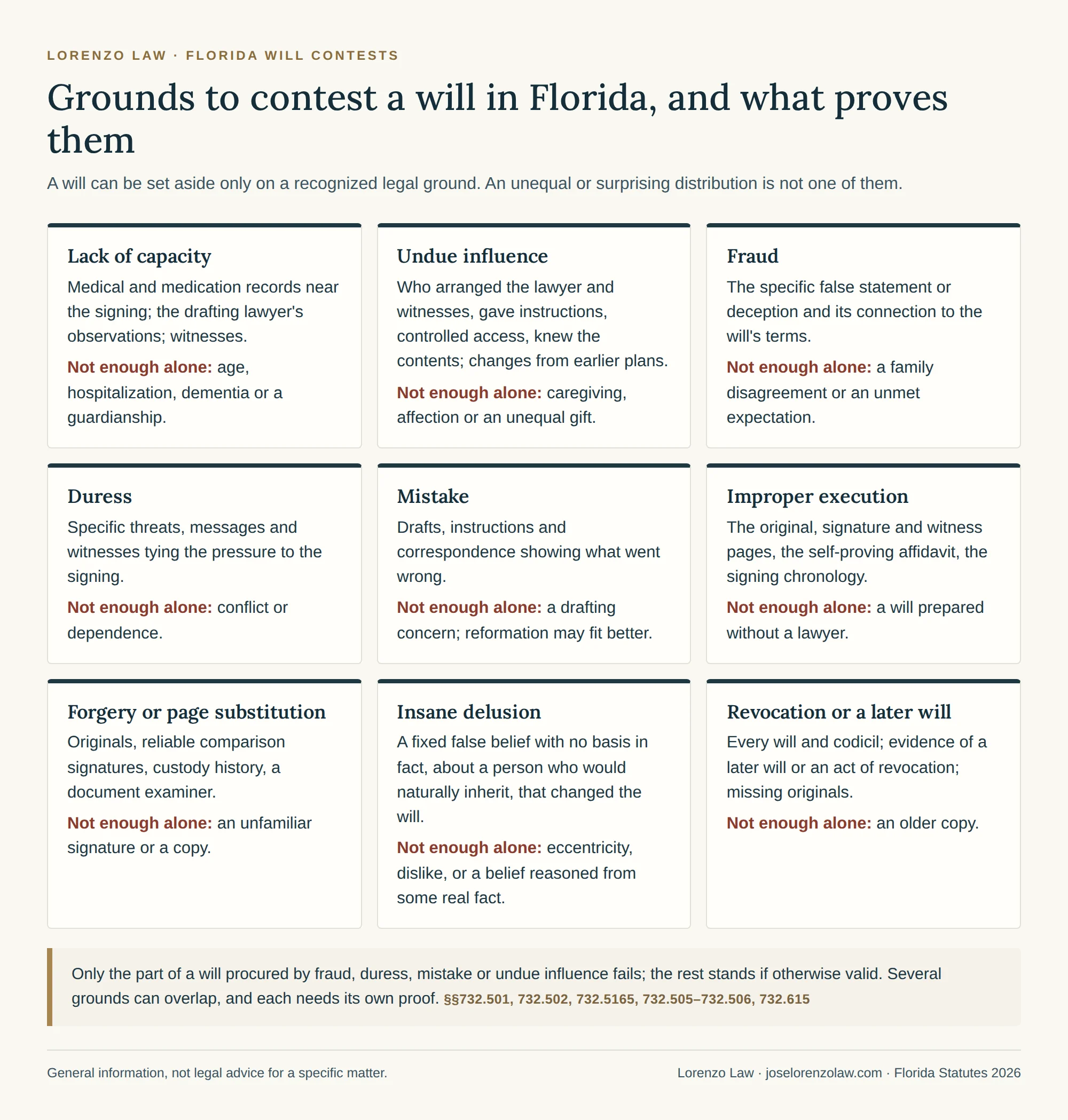
A Florida will can be set aside only on a recognized legal ground: improper execution, lack of testamentary capacity, undue influence, fraud, duress, mistake, forgery, insane delusion, or a later revocation. An unequal or surprising distribution is not one of them. The question is whether evidence supports a recognized ground, not whether the circumstances seem suspicious. Several grounds can overlap, and each needs its own proof.
These are the grounds for a will contest in Florida. Whether you search for the grounds for contesting a will in Florida, the grounds for challenging a will, or the grounds for disputing a will, the list is the same. They are the valid reasons to contest a will, the legal reasons to contest a will, and the only basis for contesting a will or challenging the validity of a will. Other reasons to contest a will, such as unfairness, do not qualify on their own. People also search for the “grounds for contest a will in Florida”; the answer is this same list.
Why would someone contest a will? Because they believe it was not the person’s own free and valid decision, or was never validly signed. Should I contest a will? Should I contest my father’s will? That depends on the evidence, the deadline and the numbers; see “Is it worthwhile to contest a will?” below.
| Ground | Evidence that may help evaluate it | What the evidence does not establish by itself | Where it comes from |
|---|---|---|---|
| Lack of testamentary capacity | Medical and medication records near signing, the drafting lawyer’s observations, witnesses, and the person’s understanding of the will | Age, hospitalization, dementia or guardianship alone does not decide capacity at signing | §732.501 |
| Undue influence | Who arranged the lawyer and witnesses, gave instructions, attended meetings, controlled access, knew the contents and kept the original; changes from earlier plans | Caregiving, affection, persuasion or an unequal gift alone does not prove undue influence | §732.5165; §733.107 |
| Fraud | The particular false statement or deception, communications, reliance, and its connection to the will’s terms | A family disagreement or an unmet expectation does not prove fraud | §732.5165 |
| Duress | Specific threats, messages, witnesses, and evidence tying the pressure to the signing | Conflict or dependence alone does not show free choice was overcome | §732.5165 |
| Mistake | Drafts, instructions, correspondence, and evidence of what went wrong | Not every drafting concern invalidates a will; interpretation or reformation may fit better | §732.5165; §732.615 |
| Improper execution | The original will, signature and witness pages, self-proving affidavit, signing chronology, witness testimony | A homemade will is not invalid just because a lawyer did not prepare it | §732.502 |
| Forgery or page substitution | Originals, reliable comparison signatures, custody history, a document examiner’s analysis | An unfamiliar-looking signature or a copy alone does not establish forgery | §§732.502, 732.5165 |
| Insane delusion | Evidence of the specific false belief, its lack of factual basis, and its effect on the will | Eccentricity, dislike or a belief reasoned from some real fact does not meet this distinct doctrine | Miami Rescue Mission, Inc. v. Roberts, 943 So. 2d 274 (Fla. 3d DCA 2006) |
| Revocation or a different controlling will | All wills and codicils, evidence of a later will or an act of revocation, the history of missing originals | An older copy alone does not establish that it controls | §§732.505–732.506 |
Common situations behind a Florida will contest
These facts do not prove anything by themselves, but they are the situations that most often lead families to ask whether a will can be challenged, and the ground each one points to:
- A new will signed weeks before death that replaced a long-standing plan: capacity and undue influence.
- A caregiver or sibling took them to the lawyer, sat in on the meeting, or kept the original: undue influence and the Carpenter factors.
- The will left everything to one child after earlier wills divided the estate equally: undue influence, capacity, or a later revocation.
- A second marriage, with a new spouse who handled appointments and finances: undue influence, and the spouse’s own statutory rights.
- The person was isolated from family in the final months: undue influence.
- “I was left out” after being named in every earlier will: standing through the earlier will, and the grounds above.
- A will signed in the hospital or in hospice: capacity at the moment of signing, and execution formalities.
- The family has a copy but no original: lost-will proof and the presumption of revocation.
What makes a will valid or invalid in Florida?
A Florida will is valid when a person of sound mind who is 18 or older, or an emancipated minor, signs a written will at the end (or acknowledges the signature) before at least two witnesses, who sign in the testator’s presence and in each other’s (§732.501; §732.502). What makes a valid will in Florida, what are the valid will requirements, and does a will have to be notarized? Notarization is not required for validity; a notary matters only for the optional self-proving affidavit (§732.503). A will is not invalid just because a witness also inherits under it (§732.504). What makes a will invalid in Florida is the reverse: a failure of these requirements, lack of capacity, procurement by fraud, duress, mistake or undue influence (§732.5165), or a later revocation by writing or by act (§§732.505–732.506).
What voids a will in Florida?
Defective execution, lack of capacity, forgery, or procurement by fraud, duress, mistake or undue influence can each void a will in whole or in part. A later will or a qualifying act of revocation can also revoke it. Where only part of a will was procured by fraud, duress, mistake or undue influence, only that part fails; the rest remains valid if otherwise valid.
Contesting a will due to dementia, mental capacity or hospice care
Testamentary capacity definition: the mental ability, at the moment of signing, to understand what a will does, what you own, and who would naturally inherit.
Testamentary capacity in Florida is judged at the moment the will was signed, and lack of testamentary capacity is proved with evidence about that moment. A dementia diagnosis, heavy medication or hospice care is evidence, not proof. Contesting a will due to mental capacity follows the same rule.
The testamentary capacity requirements in Florida are that the testator must have understood three things:
- the nature and extent of their property
- their relationship to the people who would naturally inherit
- the practical effect of the will
A will signed during a lucid interval can be valid even if the person lacked capacity at other times. An apparently normal conversation does not resolve every capacity question either.
A testamentary capacity example: a parent with moderate dementia who, at the signing, could name her children, describe her house and accounts, and explain that the will divides them may have had capacity that day, even if she was confused the week before. A parent who could not identify her children or her property at the signing likely did not. The evidence about that day decides the question.
The law presumes capacity, and the burden of proving incapacity is heavy. In Florida’s Third District, a 2025 decision rejected expert testimony about dementia because it did not address the testator’s lucid periods (Reeves v. Gross, 403 So. 3d 362 (Fla. 3d DCA 2025)). A prior court adjudication of incapacity can create a rebuttable presumption the other way (In re Estate of Supplee, 247 So. 2d 488 (Fla. 2d DCA 1971)). A guardianship is evidence to weigh, not an automatic answer: a guardianship order about capacity entered a month before a codicil did not decide capacity on the signing day (Scott v. Young, 395 So. 3d 239 (Fla. 5th DCA 2024)).
The records that matter most are contemporaneous: office notes, dated cognitive-screening scores, hospital discharge summaries, and medication changes close to the signing date. Where a diminished testator was also dependent on the person who arranged the new will, the case often becomes an undue-influence case too, and that ground carries a presumption that capacity does not.
Undue influence in Florida: the statute, the elements, the factors and the burden shift
Undue influence is proved through the relationship and the circumstances of the signing, not by an unequal result. Florida has a presumption that can shift the burden of proof to the favored beneficiary.
Undue influence: Florida law, in brief
- The Florida undue influence statute that voids a will is §732.5165: a will, or any part of it, procured by undue influence is void.
- The Florida undue influence elements for the presumption are a substantial beneficiary, a confidential relationship, and active procurement of the will.
- The Florida undue influence factors for active procurement are the Carpenter factors listed below.
- In search terms, the undue influence Florida elements are those three presumption elements, and the undue influence Florida factors are the seven Carpenter factors.
- Florida undue influence statute of limitations: there is no separate clock for an undue influence will contest. The claim follows the will-contest deadlines above.
How the burden moves:
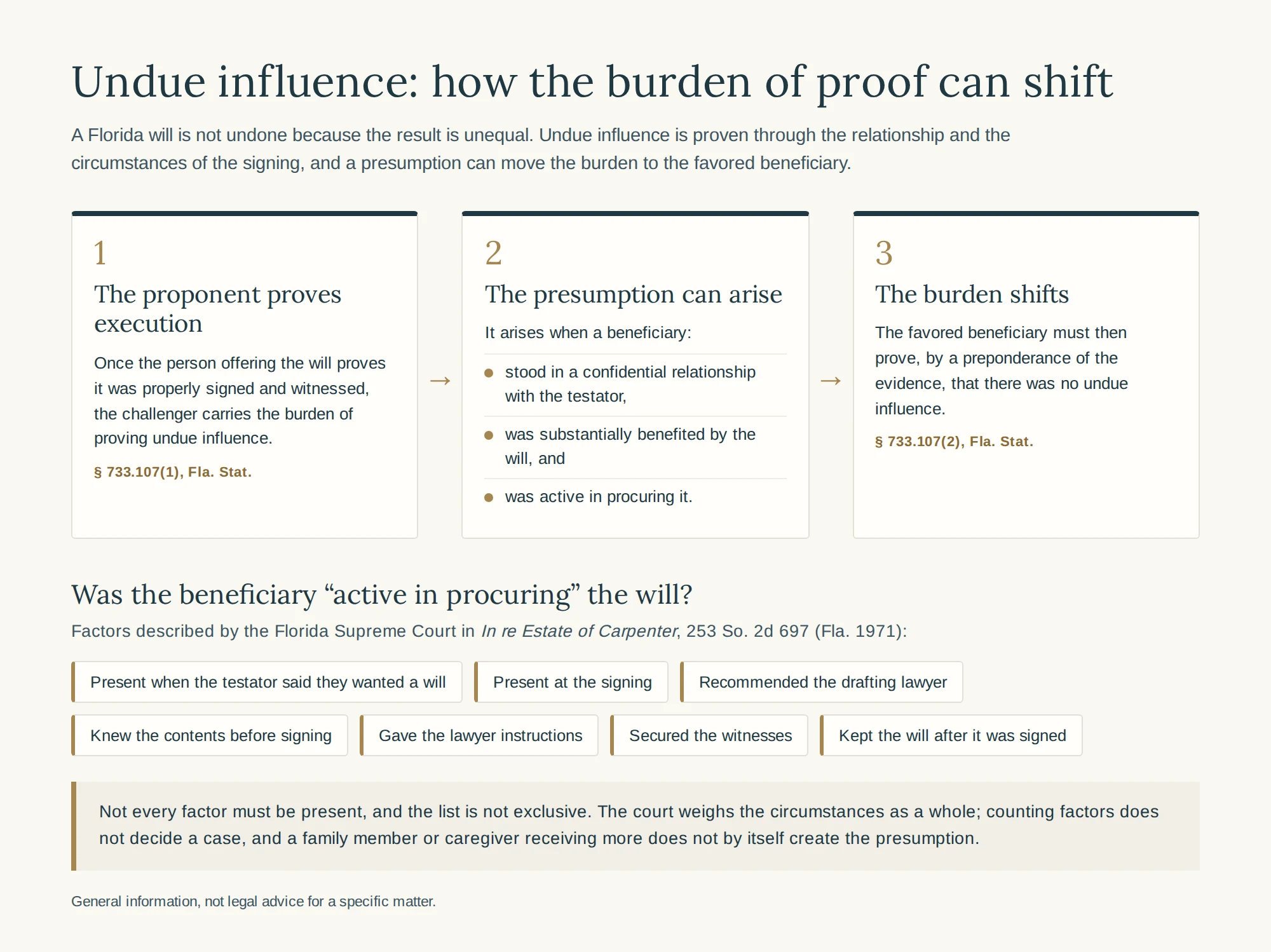
- The proponent proves execution. Once the person offering the will proves it was properly executed and attested, the burden of establishing undue influence is on the challenger (§733.107(1)).
- The presumption can arise. It arises when a beneficiary who (a) stood in a confidential relationship with the testator and (b) was substantially benefited by the will (c) was also active in procuring it.
- The burden shifts. When the presumption applies, it shifts the burden of proof, not merely the burden of producing some evidence. The beneficiary must then prove, by a preponderance of the evidence, that there was no undue influence (§733.107(2)). Probate Rule 5.275 is to the same effect. The leading appellate decision on the 2002 amendment is Hack v. Janes, 878 So. 2d 440 (Fla. 5th DCA 2004).
To decide whether a beneficiary was “active in procuring” a will, Florida courts look to the factors described by the Florida Supreme Court in In re Estate of Carpenter, 253 So. 2d 697 (Fla. 1971):
- presence when the testator said they wanted a will
- presence at the signing
- recommending the lawyer who drafted it
- knowing the contents before signing
- giving the lawyer instructions for preparing it
- securing the witnesses
- keeping the will after it was signed
Not every factor must be present, and the list is not exclusive. The court weighs the circumstances as a whole. The presumption is not established just because the person who received more was a family member or caregiver. Courts also weigh isolation, control over the testator’s affairs, and abrupt departures from a long-standing plan (isolation and control: Swiss v. Flanagan, 329 So. 3d 199 (Fla. 3d DCA 2021)). Once the presumption is raised, the issue generally cannot be decided on summary judgment (RBC Ministries v. Tompkins, 974 So. 2d 569 (Fla. 2d DCA 2008); Leitner v. Leitner, 391 So. 3d 1023 (Fla. 5th DCA 2024)). The same framework applies to lifetime transfers such as joint accounts and deeds.
View the undue influence graphic
The presumption does not guarantee a trial result or make a case inexpensive. It changes who must prove what.
How do I contest a will in Florida if I suspect undue influence?
Contesting a will in Florida for undue influence starts with the deadline, then with the signing. The statute of limitations for undue influence in Florida, when undue influence is raised in a will contest, is the same notice-based deadline that applies to every will-contest ground (see the deadline section above). Identify the notice you received and its date of service. Then write down what you saw yourself about how the will came to be signed, and keep every message. The signs of undue influence families most often notice are about access and control:
- the favored beneficiary chose the lawyer, attended the signing, knew the terms in advance or kept the document
- the person was isolated from other relatives or friends
- the new will departs sharply from earlier plans
- a caregiver, new partner or one sibling took over finances, medications and communication
Examples of undue influence in families often look ordinary from the outside: a child who moved in “to help,” a new spouse who handled every appointment, a caregiver who became the only visitor. Signs are a reason to investigate, not proof. More on proof: undue influence claims, which an undue influence lawyer handles as part of the will contest.
What evidence is needed to prove undue influence?
How to prove undue influence when contesting a will: show the confidential relationship, the substantial benefit, and the beneficiary’s active role in procuring the will, with records rather than impressions. The evidence usually includes the drafting lawyer’s file and testimony, who scheduled and attended the appointments, medical records showing dependence, communications, and earlier wills showing the change. In cases of undue influence, those details decide the issue: successful undue influence cases turn on how the will was procured, not on who received more.
How hard is it to win an undue influence case?
It depends on whether the presumption applies. If it does, the favored beneficiary must prove there was no undue influence; if it does not, the challenger carries the burden throughout. This page does not give odds (see “How hard is it to win a will contest?”).
Is undue influence a crime? Is undue influence legal? Undue influence is not a lawful way to obtain a gift: a will, or the part of a will, procured by it is void (§732.5165). Procuring a will by undue influence is a civil ground for invalidating it, not itself a criminal charge. Related conduct, such as exploiting an elderly or disabled adult, can be a crime (§825.103).
What is the penalty for undue influence? In a will contest the consequence is civil: the will, or the part procured by undue influence, is void (§732.5165), and the court can charge fees and costs against the share of the person responsible (§733.106). Undue influence is not itself a crime. Exploiting an elderly person or disabled adult is a felony whose degree depends on the value involved (§825.103). A person convicted of abuse, neglect or exploitation of an elderly or disabled decedent, or found by the greater weight of the evidence to have caused or contributed to the death through that conduct, is generally treated as having died first and takes nothing under the will, subject to a narrow exception where the victim later confirmed the gift in a sworn, witnessed writing (§732.8031).
Fraud, duress and mistake
Section 732.5165 voids a will, or any part of it, whose execution was procured by fraud, duress, mistake or undue influence; the unaffected remainder stays valid.
- Fraud can be fraud in the execution (the person did not know the document was a will, or what it said) or fraud in the inducement (a lie that caused the person to make or change the will).
- Duress requires pressure that overcame free choice, tied to the signing.
- Mistake in the terms may call for reformation rather than invalidity. Florida allows a court to reform a will, even an unambiguous one, when clear and convincing evidence proves both the testator’s intent and the mistake (§732.615).
The same statute voids a revocation that was procured the same way, which can restore a will someone believed was cancelled.
Improper execution: signatures, witnesses and the self-proving affidavit
For a conventional Florida will, the testator signs at the end, or acknowledges an earlier signature, before at least two attesting witnesses, who sign in the testator’s presence and in each other’s. §732.502. Another person may sign the testator’s name in the testator’s presence and at the testator’s direction. Florida requires strict compliance: a will signed with only a first name, where the testator did not intend that as his signature, was held not validly executed, and the order admitting it to probate was reversed (Bitetzakis v. Bitetzakis, 264 So. 3d 297 (Fla. 2d DCA 2019)).
A properly executed self-proving affidavit generally lets the will be admitted without live witness testimony and usually meets the proponent’s initial burden of proof. It does not make the will immune from challenge, and it cannot cure a signature that was never validly made. If the affidavit itself is defective, for example through faulty notarization, the will is not self-proved and the proponent must prove execution another way (Camacho v. Camacho, 434 So. 3d 521 (Fla. 3d DCA 2026)). Can a notarized will be contested? Yes. Notarization adds nothing to validity, and a self-proving affidavit is only prima facie evidence of formal execution (§733.107). The will can still be contested for lack of capacity, undue influence, fraud or defective execution; in Blits v. Blits, 468 So. 2d 320 (Fla. 3d DCA 1985), an undue influence claim survived even though the will was self-proved.
Is an unsigned or handwritten will valid in Florida? An unsigned will is not valid. A handwritten will is valid only if it was signed and witnessed like any other will. Florida does not recognize unwitnessed handwritten (holographic) wills or oral wills executed here.
Forged wills and probate fraud in Florida
A forged will is invalid, and a forged signature on a will means the document is not the testator’s will at all. A forged will in Florida, and probate fraud in Florida generally, are proved with originals and records. Fraudulent wills and forged wills are different from a will that was only signed improperly. Will forgery cases usually turn on a questioned-document examiner, not on family testimony.
The examiner compares the questioned signature with known signatures from the same period, so access to the original and to comparison records matters early. A photocopy limits what an examiner can do. Probate fraud can also mean a substituted page, a backdated codicil, or a false petition. Each is proved with originals, custody history and records. Taking or hiding someone’s will is a separate crime from failing to deposit it.
Insane delusion
An insane delusion is a distinct ground: a fixed false belief, with no basis in fact, that the testator held against all evidence and reason, about a person who would naturally inherit, and without which the will would not have been made as it was. Challenging an insane delusion will turns on proof that the belief had no basis in fact and that it changed who received what. A belief reached by reasoning from some known fact, however flawed the reasoning, is not an insane delusion (Hooper v. Stokes, 145 So. 855 (Fla. 1933)). The leading modern decision is Miami Rescue Mission, Inc. v. Roberts, 943 So. 2d 274 (Fla. 3d DCA 2006). A parent who wrongly insisted a child had stolen from them, with no factual basis, and cut that child out because of it, is the classic pattern. Dislike, eccentricity or a mistaken opinion that had some basis is not enough.
Revocation, later wills and lost wills
A will can be revoked by a later will or writing, or by a qualifying act such as burning, tearing or cancelling it with the intent to revoke. §§732.505–732.506. A dispute may be about which of several wills controls, not whether any will is valid.
What if the original will is lost? A lost will in Florida does not always end the case. Under §733.207, an interested person may establish the full and precise terms of a lost or destroyed will. The contents must be proved by two disinterested witnesses, or by one disinterested witness if a correct copy is provided. When the original was last known to be in the testator’s possession and cannot be found after death, Florida presumes the testator destroyed it intending to revoke it. The person offering the will must overcome that presumption. Access by someone with an adverse interest is relevant but does not by itself overcome it.
Electronic wills, remote signings and wills signed in another state
An electronic will in Florida is valid only under specific statutory conditions, including rules for remote witnessing and additional safeguards for vulnerable adults (§732.522). Remote (audio-video) witnessing is not effective for a testator who was a vulnerable adult, and the person challenging the will must prove that status (§117.285). If the recording of the online notarization cannot be produced, the electronic will is treated as a lost or destroyed will (§733.207). A contest over an electronic will turns on the statutory records: the audio-video recording, the online notary’s records, and the qualified custodian’s custody history. Jose prepares electronic wills and serves as qualified custodian of the electronic wills he prepares.
A will signed by a nonresident in another state is valid in Florida if it was valid where it was signed, except a handwritten unwitnessed (holographic) or oral will. Military testamentary instruments have their own rules (§732.502). Identify where the person lived, where and how the signing happened, and whether remote witnessing or an electronic custodian was involved. Do not judge validity solely from an unfamiliar format.
What is not enough to contest a will, and what if a contest succeeds?
An unequal division, a late change of mind, a homemade will, greater generosity to a caregiver, an illness, or a promise the will does not keep does not by itself make a will invalid. Neither does the fact that a relative kept you uninformed or did not send you a copy. Some of these facts may support a different claim, but each must be connected to a recognized ground.
Florida law protects a person’s right to make an unfair will. What it does not protect is a will that was not the person’s own decision, or that was never validly signed.
What happens if a will is successfully contested?
A successful contest does not always invalidate every provision or produce intestacy.
- Only the part procured by fraud, duress, mistake or undue influence fails; the unaffected remainder remains effective if otherwise valid. This partial invalidity rule means a contest can target one gift or one clause.
- If the whole will fails, an earlier valid will may govern. If there is none, the estate may pass under the intestacy statutes.
What you would receive depends on the surviving provisions, other wills, how property was titled, and Florida inheritance law. Challenging the one clause that changed can be the stronger case.
Evidence needed to contest a will in Florida
What evidence decides a Florida will contest? Records made at the time usually outweigh recollections made later. The documents and people that usually matter:
- Medical and pharmacy records for the period around the signing, for both capacity and dependence. The right time range depends on the disputed events; there is no universal one-year or two-year rule.
- The logistics of the signing: who made the appointment, who drove, who was in the room, who paid.
- Financial records: new joint accounts, new signature cards, new powers of attorney, large transfers.
- The drafting lawyer’s file and testimony, where they can be obtained (below).
- Signs of isolation: changed locks, blocked calls, visitors turned away.
- Earlier wills, showing what changed and when.
- Witnesses without a stake: neighbors, doctors, clergy, long-time friends.
Preserve originals and complete messages with their dates and attachments. Do not alter files, access another person’s accounts without authority, or coach witnesses. Tell counsel where records are held, so they can be requested properly or subpoenaed.
Can you get the drafting attorney’s file?
Often, in part. In a dispute between parties who all claim through the same deceased client, Florida’s evidence code removes the attorney-client privilege for communications relevant to that dispute (§90.502(4)(b)). This is the usual route to the drafter’s notes, earlier drafts and testimony about the signing.
Limits:
- The exception reaches relevant communications. It does not open every file automatically.
- Courts may review material privately before ordering it produced.
- It does not reach the personal representative’s own lawyer. Communications between a fiduciary and the fiduciary’s lawyer are privileged under §90.5021.
Medical and financial records also require proper authority or legal process, such as a subpoena. Ask early: files are archived and purged, and lawyers retire.
Which experts are used in will contests?
It depends on the disputed facts.
- Capacity: a geriatric psychiatrist or neuropsychologist reviewing records to give an opinion on cognition at or near the signing.
- Signatures and pages: a questioned-document examiner.
- Money: a forensic accountant, when lifetime transfers or an accounting are in play.
The need for an expert, and the cost, should be weighed against the actual issues. No particular expert is necessary in every case. A capacity opinion that does not address the testator’s condition at the signing, including any lucid periods, may carry little weight (Reeves v. Gross).
Who must deposit the original will?
Whoever holds the original must deposit it with the clerk in the county where the decedent resided within 10 days after learning of the death. A custodian who fails to do so without just or reasonable cause can be liable for costs, damages and fees (§732.901), and the court can compel production. If the original is being withheld, tell counsel right away.
Defending a will contest in Florida
If you are the personal representative, an executor being sued over the will, or a beneficiary under the will being challenged, the early steps matter as much as they do for a challenger. A defense evaluates the actual allegations and evidence, the signing, and the testator’s independent decisions, as well as procedural defenses such as timeliness and standing. Defending a will does not require agreeing that every allegation is false; it requires answering them with evidence.
First steps for the defense:
- Respond to formal notice and to any objection or petition on time.
- Keep the original will secure.
- Identify the drafting lawyer, the witnesses and the notary.
- Collect the testator’s own statements about the plan, and the earlier wills.
- Keep the estate’s records and accountings current.
How to defend a will contest: what the proponent proves, and common defenses
How to defend against a will contest: prove proper execution, answer each alleged ground with records, and raise timeliness and standing where they apply. A will contest defense attorney starts with the signing file. The person offering the will must first prove it was properly executed and attested. The challenger then carries the burden unless the undue-influence presumption applies. A self-proving affidavit usually meets the proponent’s initial burden (§733.107).
Defenses often rest on:
- independent advice from a lawyer the beneficiary did not choose
- a new will that follows a consistent earlier plan
- the testator’s own stated reasons
- medical evidence of capacity near the signing
- the beneficiary’s lack of opportunity or involvement
For example, a Florida appeals court affirmed a finding of no undue influence where the testator had her own personal and financial reasons to favor one child (Hannibal v. Navarro, 317 So. 3d 1179 (Fla. 3d DCA 2021)). Rebutting the presumption does not end the case; the facts that raised it stay in evidence, and the judge weighs everything.
The personal representative and an individual beneficiary may have different interests. Representation and conflicts need to be addressed at the outset.
Who pays to defend a contested will?
A personal representative who defends a will in good faith, or who offers a will for probate in good faith, may be entitled to costs and fees from the estate even if probate is denied or revoked. §733.106(2). An individual beneficiary defending their own gift generally pays their own lawyer. The court can also assess fees and costs against a person’s share, and it can do so without finding bad faith, wrongdoing or frivolousness (§733.106(4)).
How can a will not be contested, or at least be harder to contest? How to keep someone from contesting a will
No will can be made uncontestable, and there is no way to stop a contest in advance, but careful execution, a clear record of capacity, and independent advice make a will harder to challenge. Families often ask how to stop a contest before it starts; the answer is the planning below, not a clause. Planning steps can include:
- a self-proving affidavit
- signing without the main beneficiary in the room
- a lawyer the beneficiary did not choose
- contemporaneous notes of the person’s reasons
In Florida, a no-contest clause will not stop a contest (see below). See Florida estate planning.
What happens to the estate during a will contest?
Can probate go forward while a will is contested? Generally yes. Administration generally continues, but no distribution may be made that would defeat the rights of the people who would inherit if the will were revoked. §733.109. A revocation petition does not freeze everything, so counsel should assess whether more protection is needed.
A curator is a temporary fiduciary the court can appoint to take charge of and preserve estate property. Florida amended the curator statute, §733.501, effective July 1, 2026. Under the current text, the court may appoint a curator:
- at any time, with the notice to other interested persons that the court finds appropriate
- without notice, if property is in significant danger of being wasted, destroyed or removed from the court’s jurisdiction and giving notice would delay the appointment
- in any other proper case, when needed to protect the estate or the heirs
Where a personal representative already holds letters, a court appointing a curator must first suspend or revoke the representative’s authority, at least temporarily (Gordin v. Estate of Maisel, 179 So. 3d 518 (Fla. 4th DCA 2015)). A curator is a specific remedy, not an automatic replacement for an acting personal representative.
If a sale, a transfer or the loss of an asset is imminent, tell counsel immediately. Contacting a lawyer does not by itself freeze an account or stop a sale.
Mediation, settlement and trial
Do Florida will contests go to mediation?
Frequently. Florida courts can refer contested probate matters to a mediator under chapter 44 of the Florida Statutes. Mediation is confidential, subject to limited statutory exceptions. It can resolve some or all issues. Can a contested will be settled out of court? Yes. A will contest can be resolved at mediation or by a written family settlement agreement (below), without a ruling from the judge. Mediation is an option to evaluate, not a guaranteed outcome, and it does not replace preparing the case.
Family settlement agreements
Interested persons can agree in writing to change their shares (§733.815).
- The agreement must be signed by everyone affected.
- The personal representative must honor it, subject to obligations to creditors and to administering the estate.
- Court approval is required where minors or incapacitated persons are involved.
- Creditor and tax obligations cannot be changed by agreement.
Is there a jury in a Florida will contest?
Generally no. Probate issues, including will contests, are tried by the judge.
- Goggin v. Shanley, 81 So. 2d 728 (Fla. 1955): “Probate issues are tried by the court without a jury.”
- In re Estate of Howard, 542 So. 2d 395 (Fla. 1st DCA 1989): no constitutional right to a jury trial in a probate adversary proceeding.
A judge may use an advisory jury in the court’s discretion, but the judge remains the decision-maker and may accept or reject its verdict (In re Estate of Fanelli, 336 So. 2d 631 (Fla. 2d DCA 1976)). A separate tort claim for interference with an inheritance may carry a jury right. Because a judge decides, a clean chronology of medical and financial records often does more than a sympathetic witness.
How long does contesting a will take in Florida?
There is no standard timeline. Questions such as “How long does a will contest take?”, “How long does it take to contest a will?”, “How much time does it take to contest a will in Florida?” and “How long does a contested will take to settle?” all depend on the case. Timing depends on:
- the issues and the volume of records
- the number of parties
- expert work
- the court’s calendar
- emergency motions
- whether the case settles
The type of allegation alone does not answer the question. A consultation can identify the factors in your matter; it cannot promise a trial or resolution date.
What it costs to contest a will in Florida, and who pays
How are will contest attorney fees structured?
Do you have to pay to contest a will? Yes: court costs, and your own lawyer’s fees under whatever arrangement you agree. Fees and costs for representation are agreed in writing. Lorenzo Law may consider a contingency or hybrid arrangement in appropriate cases; no particular arrangement or rate is promised. Florida does not prohibit contingency fees in probate litigation.
| Arrangement | When it tends to fit | How it works |
|---|---|---|
| Hourly | Defending a will or a fiduciary; disputes with no identifiable fund to recover | The rate depends on the complexity of the matter and is agreed in writing. |
| Contingency | Recovering an inheritance: undue influence, forgery, a later or earlier will | The fee is a percentage of any recovery, set in the written agreement. You may still owe costs and expenses even if there is no recovery. |
| Hybrid | Strong facts with uncertain collectability | A reduced hourly or fixed fee plus a smaller contingent percentage. The hourly or fixed portion is owed regardless of the result. |
| Flat fee | A discrete task, such as a caveat, an objection or a single petition | Whether a flat fee fits is discussed with the client, depending on the facts and the matter, and agreed in writing. |
A contingency or hybrid agreement must be in writing and signed by you and the lawyer, and you receive a copy. It states how the fee is determined and how costs are handled. So-called “no win, no fee” arrangements are contingency arrangements, and costs may still be owed. Searches for “no win no fee will contesting” or “contest a will no win no fee” describe that kind of contingency arrangement. If you are looking for a contingency lawyer for a probate dispute in Florida, ask how a will contest contingency fee treats costs, and what happens if the case settles early.
Costs are separate from fees
Filing fees, service, records, court reporters, deposition transcripts and expert fees are costs. They exist under every arrangement. Who advances them, and who bears them if there is no recovery, is set in the written agreement at the start.
How much does it cost to contest a will in Florida?
How much money does it cost to contest a will? How much does it usually cost to contest a will? Questions like how much to contest a will, and how much does an attorney cost to contest a will, have no fixed answer before the facts are reviewed. No fixed figure can be quoted responsibly before the facts are reviewed; the cost depends on the actual work, not on the size of the estate alone. The drivers:
- the volume of medical and financial records
- the grounds (capacity, undue influence, execution, forgery), and whether experts are needed
- the number of parties, and how many are represented
- whether a guardianship, power of attorney or lifetime transfers ran alongside the will
- Florida real estate, a family business or out-of-state assets
- whether the personal representative is also the favored beneficiary
- whether the case resolves before trial
A signing dispute is not automatically the cheapest case, and an undue-influence presumption does not guarantee a shorter one. Estate-planning prices do not set litigation fees.
If you contest a will, who pays the costs along the way? Usually you do, or as your written agreement provides, unless the court later shifts them. Is it expensive to contest a will? It can be. The cost of contesting a will (or the cost of challenging a will) rises with records, experts, parties and trial time. The cost of contesting a will in Florida is best estimated after the first review of the file, when those drivers are known.
Who pays to contest a will in Florida?
Who pays to contest a will? Who pays to challenge a will? Who pays legal costs when contesting a will, and who pays legal fees when contesting a will? Each side first pays under its own engagement; the court can then award costs and allocate fees. The same rule governs who pays attorney fees in a will contest, and who pays probate attorney fees in Florida when an estate is contested. Your engagement obligations and a possible court award are separate questions. Florida probate law gives the court several tools under §733.106:
- Costs may be awarded as in chancery actions.
- A personal representative or nominee who, in good faith, offers or defends a will may be paid from the estate even if probate is denied or revoked.
- An attorney who rendered services to an estate may be awarded reasonable compensation from it.
- The court may direct which part of the estate bears the fees and costs, including assessing them against one person’s share.
The statute lists the factors the court may weigh in allocating fees and costs among shares, including each person’s participation, the relative merits of their positions, prevailing-party status, and whether anyone unjustly increased the costs. No finding of bad faith is needed. In the specified pour-over situation, an insufficient estate share may lead to payment from that person’s trust share.
What happens if you contest a will and lose?
If you contest a will and lose, who pays? Do you have to pay the other side’s fees? Not automatically, but you can lose more than your own fees. Your own inheritance under the will can be charged with fees your contest caused, through the court’s allocation power. Separately, a court can award fees against a party and that party’s lawyer for a claim they knew or should have known lacked factual or legal support, after a 21-day safe-harbor notice and specific findings (§57.105). Under §733.106(4), the court has discretion over which part of the estate bears fees and costs; by contrast, a person nominated as personal representative, or any proponent of a will if the person so nominated does not act within a reasonable time, who was in good faith justified in offering the will in due form for probate, shall receive costs and attorney fees from the estate even though probate is denied or revoked (§733.106(2)). The statute does not make an unsuccessful contestant personally liable beyond their share (Anderson v. McDonough, 189 So. 3d 266 (Fla. 2d DCA 2016)); in the pour-over situation described above, the court can also reach that person’s trust share.
Does a no-contest clause stop you from challenging a will in Florida?
No. A no contest clause in Florida wills is unenforceable. Is a no contest clause in a will in Florida enforceable against a beneficiary who sues? No. A no contest clause in a will, also called a no contest provision or an in terrorem clause (sometimes written as a terrorem clause), threatens to take away a gift from anyone who contests. A typical example of a no contest clause in a will says that a beneficiary who contests the will forfeits their gift.
For illustration only (this is not a sample to copy or a form to use): “If any beneficiary contests this will, that beneficiary’s gift lapses.” That sentence is a no contest clause in a will example, and it is also an in terrorem clause example. People looking for a no contest clause in a will sample or an in terrorem clause sample will find language like it in wills signed in many states. However it is worded, a clause in a will to not contest is treated the same way in Florida. Under §732.517, a will provision that penalizes an interested person for contesting the will, or for starting another proceeding about the estate, is unenforceable. Florida has no “probable cause” exception. A clause that offers an alternative benefit is not necessarily a penalty clause. Trusts have a parallel rule for trusts created on or after October 1, 1993 (§736.1108).
A disinheritance clause is different. A disinheritance clause example, again for illustration only: “I intentionally make no provision for my son.” A disinheritance clause in a will that simply leaves someone out is generally effective, subject to a surviving spouse’s rights and homestead rules; it is not a contest clause in a will and does not penalize anyone for suing.
A no-contest clause’s unenforceability does not remove standing, proof, deadlines or fee exposure. If the will was signed in another state that enforces such clauses, no Florida appellate court has decided whether §732.517 still applies. The reasoning of In re Estate of Swanson, 397 So. 2d 465 (Fla. 2d DCA 1981), supports applying Florida law, but the question is open, so have counsel evaluate it rather than assume the answer.
How hard is it to win a will contest? Is it worth it?
How hard is it to contest a will in Florida? Is it hard to contest a will? How hard is it to win a contested will? How difficult is it to contest a will? Each depends on the evidence and the burden of proof. What is the success rate of contesting a will in Florida? What percentage of will contests are successful, and what are the odds of contesting a will? What are the chances of successfully contesting a will? The success rate of contesting a will is not something this page states. This page does not give odds. Florida’s lawyer-advertising rules prohibit statements that a prospective client can reasonably interpret as a prediction or guaranty of success or specific results; your own evidence can be assessed privately in a consultation. There is no reliable published success rate for Florida will contests, and some settle before a judge rules. What can be explained is how the law allocates the burden:
- The law presumes the testator had capacity.
- The person offering the will must prove proper execution.
- The challenger then carries the burden, unless the undue-influence presumption applies and shifts it.
Unfairness alone is not a ground; the evidence has to concern how the will was made and signed.
Is it worthwhile to contest a will? Only a review of the evidence and the numbers can answer that. The practical assessment includes:
- the strength of the procurement and capacity evidence
- the amount realistically at stake, net of what the dispute will cost
- whether the assets are still there to recover
- how fees may be allocated under §733.106
- the number of parties
- what the dispute will do to family relationships
An estate’s gross value alone does not tell you whether a particular claim is economical.
When a will contest is the wrong tool
Sometimes the strongest claim is not a will contest. Match the remedy to the actual problem.
| The actual problem | What to review alongside or instead of a will contest |
|---|---|
| A surviving spouse received little, or the marriage came after the will | The elective share Florida law gives a surviving spouse, or pretermitted-spouse rights, each with its own conditions and separate deadlines. A pretermitted spouse will contest lawyer checks those conditions before any contest is filed. See Florida elective share. |
| A child was born or adopted after the will | Whether the rule for a pretermitted child in Florida applies |
| The home is the main asset | Homestead restrictions and descent; invalidating a will may not resolve ownership. See homestead in Florida probate. |
| The personal representative is mishandling an otherwise valid estate (executor misconduct) | Accounting, surcharge or removal: contesting an executor of a will, or challenging the executor of an estate, is probate litigation, not a will contest. See Florida probate litigation. |
| A trust or trust amendment redirected the property | A trust contest, with separate notices and deadlines. See Florida trust litigation. |
| A deed, Lady Bird deed or life estate moved the house | A deed challenge. See deed challenges and contesting a Lady Bird deed. |
| A joint or payable-on-death account, or a beneficiary designation, redirected money | A claim aimed at that transfer. See beneficiary designations. |
| A power of attorney was used to move money before death | A claim about those lifetime transactions. See challenging transfers before death. |
| There is no will, and the fight is over who the heirs are | A determination of beneficiaries (§733.105) |
| The original will is missing | Lost-will proof, custody history and the presumption of revocation |
Can a trust, deed, power of attorney or beneficiary designation be contested?
Yes, but not through a will contest. A will contest does not automatically reach property that passed outside probate. Each of these is challenged on its own terms:
- Can a trust be contested? Can you contest a trust? Yes, on recognized grounds, under the Florida Trust Code’s own notices and deadlines. How to contest a trust starts with identifying the trust, its trustee and any notice already served. Can a revocable trust be contested, can an irrevocable trust be contested, and can a living trust be contested? Each can be, on the grounds and timing that fit that trust. How much does it cost to contest a trust? The same cost drivers apply as for a will. See Florida trust litigation for any trust contest.
- Can a deed be contested? Yes, as a deed challenge. The same is true when people ask: can a life estate deed be contested, can a survivorship deed be contested, can a beneficiary deed be contested, or can a transfer on death deed be contested. Can a Lady Bird deed be contested? Yes; see contesting a Lady Bird deed and deed challenges.
- Can you contest a beneficiary designation? Can you contest a 401k beneficiary? Can you contest a POD account, and can a POD account be contested? Those transfers are challenged directly, not through the will. See beneficiary designations.
- Can a power of attorney be contested, or can a power of attorney be challenged? Transactions an agent made during life are reviewed through separate claims, and the agent’s authority ends at death. See challenging transfers before death.
A pour-over will and a trust should be reviewed together, because failing to contest a will can, in some circumstances, affect a later challenge to a trust it incorporates; the notice of administration must warn of this (§733.212(2)(f)). Bring both documents and every related notice. The Florida estate litigation page explains how these claims connect.
Mistakes that cost people their will contest
Watch for these procedural and practical mistakes:
- Counting 90 days instead of three months, or counting from the date of death. The period generally runs three calendar months from service.
- Ignoring a formal notice. Written defenses are generally due 20 days after service.
- Assuming no notice means no deadline. Other bars can apply.
- Waiting until “all the records are in” before asking about a deadline.
- Signing a waiver, consent, receipt or release without advice.
- Challenging only the last will when a facially valid earlier will also leaves you out.
- Assuming a will contest reaches everything. Joint accounts, beneficiary designations and trust assets usually need separate claims.
- Treating the personal representative’s lawyer as your lawyer.
- Removing property from the house, or holding onto the original will, instead of letting the proper process work.
- Going to the tort claim first when a probate remedy was available.
Preparing for your consultation
Start with what you already have and can lawfully access. Make a list of missing records and who may hold them. Do not wait for a complete file before raising an approaching deadline.
- Court papers: case number, county, petition, admission order, letters, notices, objections, hearing notices and any discharge papers. Include the full docket if available.
- Delivery and waiver records: envelopes, tracking information, signed receipts, emails and service affidavits, plus every consent, waiver or release, with the dates signed and filed.
- Estate documents: the disputed will, codicils, earlier versions, any trust and amendments, and who holds the originals.
- Signing history: when and where the signing happened, who contacted the lawyer, who attended, witness names, and any invoices or correspondence you already have.
- Capacity and relationship evidence: dated observations, treating-provider names, care records, communications, and a chronology of changes that separates what you saw from what you were told.
- Property and your goal: a rough asset list, how assets were titled, your interest under the different documents, and what resolution you want.
Describe the issue briefly in your first inquiry. Include the names of the other people involved, for a conflict check. Do not put full account numbers, Social Security numbers or sensitive documents in the public contact form; wait for instructions on how to share them.
Will contests throughout Florida
Jose handles will contests and contested probate in all 67 Florida counties, for clients who live in Florida and for families elsewhere. A will contest is heard in the probate division of the circuit court for the county where the estate is administered. Local procedures differ by circuit.
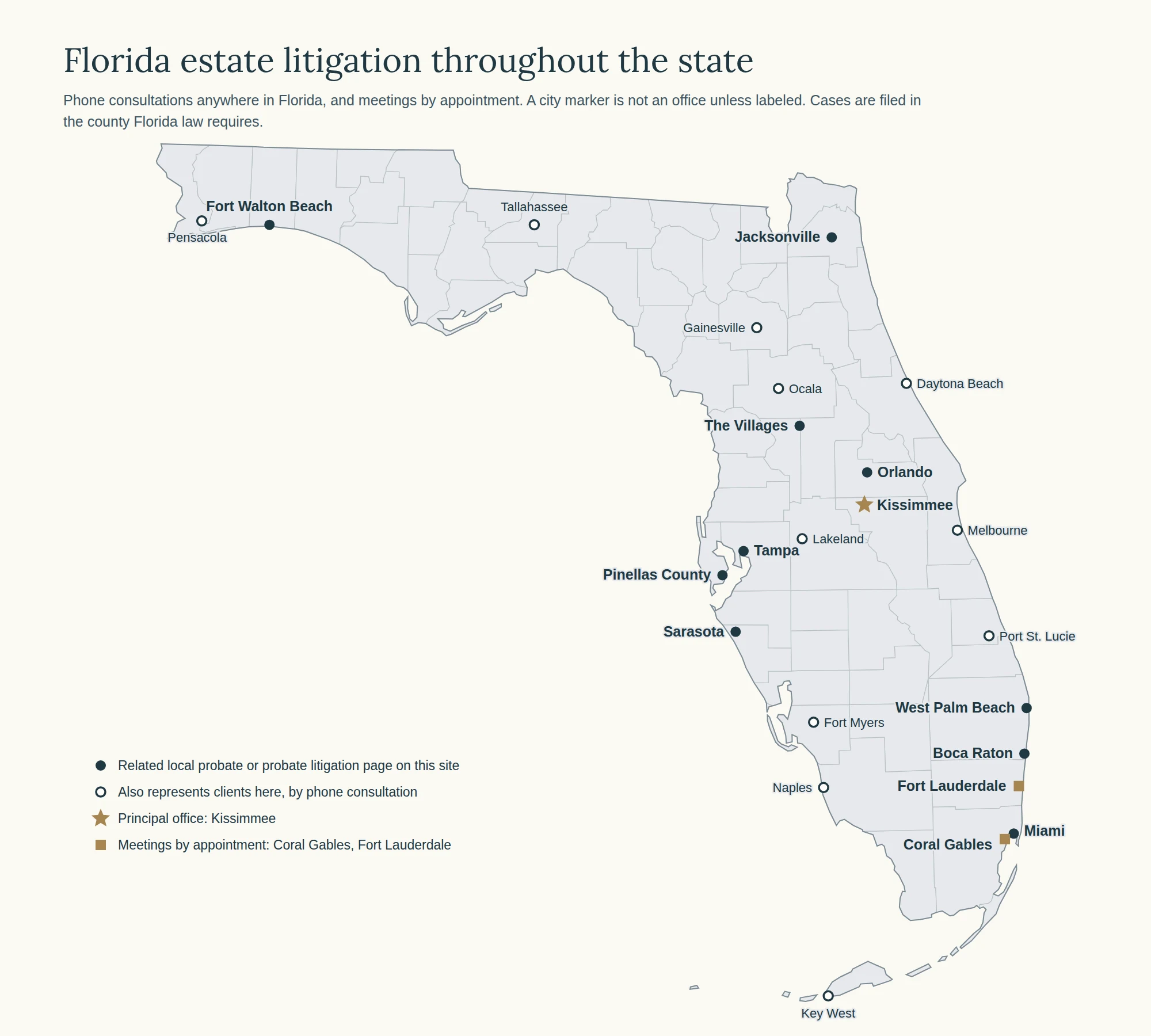
View the full-size Florida service-area map
| Region | Counties and communities | Local pages |
|---|---|---|
| South Florida and the Keys | Miami-Dade, Broward, Palm Beach, and Monroe (Key West, Marathon, Islamorada, Tavernier) | Miami · Fort Lauderdale · West Palm Beach · Boca Raton |
| Central Florida | Orange, Osceola (Kissimmee, Celebration), Seminole, Lake, Sumter (The Villages), Polk, Volusia, Brevard | Orlando · Kissimmee probate · The Villages probate |
| Tampa Bay and the Nature Coast | Hillsborough (Tampa, Brandon), Pinellas, Pasco (New Port Richey), Hernando (Spring Hill), Manatee, Sarasota | Tampa · Pinellas County |
| Treasure Coast and Southwest Florida | St. Lucie, Indian River (Vero Beach), Martin, Lee (Fort Myers), Collier (Naples), Charlotte | Port St. Lucie probate |
| North Florida and the Panhandle | Duval (Jacksonville), St. Johns, Alachua, Marion, Leon, Escambia, Okaloosa (Fort Walton Beach, Destin, Crestview), Walton (Miramar Beach) | Jacksonville |
The Kissimmee, The Villages and Port St. Lucie pages cover probate administration. The local pages describe representation in those areas; they do not identify additional firm offices.
Local will contests: which county court hears the case
A will contest is usually heard in the county where the person who died was domiciled, whatever city name you searched.
| If you need… | The case is usually heard in… |
|---|---|
| A will contest attorney in Miami, a will contest lawyer in Miami, or help to contest a will in Miami (a will contest in Miami-Dade) | Miami-Dade County |
| A will contest attorney in Fort Lauderdale | Broward County |
| A will contest attorney in Boca Raton, or a will contest attorney in West Palm Beach | Palm Beach County |
| Help with a will dispute in Islamorada, FL, a will dispute in Tavernier, FL, or elsewhere in the Keys | Monroe County |
| A will contest attorney in Orlando, an Orlando contested will attorney, or help to contest a will in Orlando | Orange County (see the Orlando contested will attorney page) |
| A will contest attorney in Kissimmee or Celebration | Osceola County |
| A will contest attorney in Tampa, help to contest a will in Tampa, a will contest in Hillsborough, will contests in Brandon, or Tampa contested probate matters | Hillsborough County |
| A will contest attorney in St. Petersburg or Clearwater | Pinellas County |
| Help if you are asking: can you contest a will in Spring Hill? | Hernando County |
| Help if you are asking: can you contest a will in New Port Richey? | Pasco County |
| A will contest attorney in Sarasota | Sarasota County |
| A will contest attorney in Naples | Collier County |
| Help contesting a will in Vero Beach | Indian River County |
| A will contest attorney in Jacksonville | Duval County |
| A Fort Walton Beach will contest, a Destin will contest, a Crestview will contest, any Okaloosa County will contest, or a Fort Walton Beach undue influence claim | Okaloosa County |
| A Miramar Beach will contest, any Walton County will contest, or a Walton County undue influence claim | Walton County |
Jose handles these matters wherever the estate is administered; the table does not describe additional offices.
Where do you contest a will in Florida?
Where is a will contest filed? Generally in the county where the decedent was domiciled, with statutory alternatives when the decedent was not domiciled in Florida (§733.101). Where an heir lives, or where you meet with a lawyer, does not by itself decide the court. A dispute over venue, for example for a decedent who split the year between Florida and another state, belongs early in the case.
Can you contest a Florida will if you live out of state or abroad?
Yes. Many contested Florida estates involve family members who live elsewhere. Consultations are available by phone, in English and Spanish. Whether a particular hearing can be attended remotely depends on the court and the proceeding, and travel may sometimes be required. Living outside Florida does not by itself decide venue.
Looking for a will contest attorney near me?
If you searched for a will contest near me, a will contest attorney near me, will contest lawyers near me, or a lawyer to contest a will near me, consider where the case is pending and how you will work with the lawyer. Lorenzo Law’s principal office is in Kissimmee. Jose also meets clients by appointment in Coral Gables and Fort Lauderdale, and consultations are available by phone. A will contest is filed where the estate is administered, not where the lawyer’s office is.
Working with Jose M. Lorenzo, Jr.

Jose M. Lorenzo, Jr. was admitted to The Florida Bar on October 4, 2013 (Florida Bar No. 107002).
- Before admission, he worked for roughly a decade as a paralegal on probate and litigation matters. That work is separate from his years as an attorney.
- As a third-year law student, he served as a judicial intern in the Probate Division of Florida’s Eleventh Judicial Circuit with the Honorable Maria M. Korvick.
- Education: a B.A. in Accounting and Finance from Florida International University, and a law degree from FIU College of Law.
Read Jose’s biography and his official Florida Bar profile.
How the practice works:
- Solo practice: the same lawyer from the first review through hearings and trial.
- Phones are answered 24 hours a day, and the firm aims to follow up on inquiries within one to two business days.
- Free initial consultation, by phone or by appointment, in English and Spanish (fee terms above).
Comparing will contest attorneys?
Whether you are choosing a will contest law firm, comparing contested wills and probate lawyers, or looking for the best lawyer to contest a will, ask each lawyer:
- Who will actually handle my case, from the first filing to trial?
- Which deadline applies to the notice I received, and when does it run out?
- How will the fee and the costs work if there is no recovery?
- What evidence is missing from my file, not only what helps?
No one can objectively name the best attorney to contest a will for your facts, and Jose does not claim that title. What you will not read here is a success rate or a promise about an outcome; that is a choice this firm makes. Florida’s advertising rules allow past results only when they are objectively verifiable and not misleading. They prohibit statements a prospective client can reasonably interpret as a prediction or guaranty of results, and characterizations of a lawyer’s skills, experience, reputation or record that are not objectively verifiable.
More questions about Florida will contests
What are the most common grounds for contesting a will?
Undue influence and lack of capacity are often raised together; improper execution and forgery are the other common grounds. Which ground fits depends on the evidence about the signing, not on which sounds strongest.
What is the best way to contest a will?
File the right pleading within the deadline, and build the case on the signing-day facts and contemporaneous records. In practice that means securing the notice history, the drafting lawyer’s file and the medical records early, and choosing the ground the evidence actually supports.
What is the 7 year rule in Florida?
There isn’t one. Florida has no “7-year rule” for wills, probate or inheritance disputes. The deadlines that matter are tied to the notice you received.
Can an executor screw over a beneficiary?
An executor can cause real harm through delay, secrecy or mismanagement, but a personal representative cannot lawfully rewrite the will, remove a beneficiary or take a beneficiary’s share. Misconduct is addressed through accountings, removal and surcharge. See Florida probate litigation.
Can you contest probate with no will?
There is no will to contest, but the estate can still be disputed. Contesting an intestate estate, or contesting an estate at all when there is no will, usually means disputing who the heirs are, their shares, or who should serve as personal representative. Can you contest intestate succession itself? Not the statutory order, but you can contest who qualifies as an heir and in what share. The court can determine beneficiaries in an adversary proceeding. If a will surfaces later, it can be offered for probate until the personal representative is discharged.
Can a codicil be contested?
Yes. A codicil amends a will, must be signed with the same formalities, and can be challenged on the same grounds. Often the codicil is the stronger target, because it shows exactly what changed and when.
Can a living will be contested?
Not as a will contest. A living will is a health-care advance directive about end-of-life treatment. It does not leave property to anyone, and disputes about it are not will contests.
Can a holographic will be contested? Can a mirror will be contested?
A handwritten (holographic) will signed in Florida without two witnesses is not valid; one that was properly signed and witnessed can be contested like any other will. Mirror wills that spouses sign together are two separate wills; each can be contested on the same grounds, and the surviving spouse can generally change their own unless bound by a written contract not to revoke. Signing mirror wills does not by itself create that contract (§732.701).
How to revoke a will in Florida
How do you revoke your own will in Florida? By a later will or writing executed with the same formalities, or by burning, tearing, cancelling, defacing, obliterating or destroying it with the intent to revoke, by you or by another person in your presence and at your direction. A new will is the clearest method. See Florida estate planning.
Can I contest a will and still inherit under it?
Contesting a Florida will does not forfeit what the will already gives you, because a no-contest clause is unenforceable. But your share can bear fees the court allocates to you.
Do I need every document before calling?
No. Tell the firm which notices or court papers you received and the dates on them. Identify missing documents and who may hold them. Ask for instructions before sending sensitive records.
Is a Florida trust contested the same way as a will?
No. Trust contests have separate notice and limitation rules. Do not apply the will deadlines on this page to a trust. See Florida trust litigation.
Discuss the will you want to challenge or defend
Tell Lorenzo Law:
- whether you want to challenge or defend the will
- the Florida county and case number, if known
- any notice or hearing date
- the names of the other people involved, for a conflict check
- your preferred language, and whether you live outside Florida
Request a free initial consultation or call (305) 224-6811. Only the initial consultation is free; representation fees and costs are agreed separately in writing.
Sending an inquiry does not create an attorney-client relationship, preserve a deadline or guarantee representation. This page provides general information about Florida law, not advice about a particular estate.
Reviewed by Jose M. Lorenzo, Jr., Florida Bar No. 107002. Legal information current as of September 2026.
Sources
the Florida Probate Code (chapters 731–735, Florida Statutes, 2026); the Florida Probate Rules, including 2026 amendments; chapter 44 and §§ 90.502, 90.5021 and 825.103, Florida Statutes; and the Florida cases cited above.