
Florida Partition Action: Co-Owner Rights, Forced Sale and Buyout
A Florida partition action asks a court to end shared ownership of real property by dividing it or, when the legal requirements are met, ordering it sold. An eligible co-owner can seek partition without every other owner’s permission, but filing does not guarantee an immediate sale, a particular price or a particular share of the proceeds. This guide, from a Florida probate attorney who handles partition actions statewide, explains who can file, how heirs-property buyouts and partition during probate work, who pays, how long it takes, and how to defend a case.
Request a free initial consultation. Only the initial consultation is free; representation fees and costs are agreed separately in writing. Consultations are available statewide in English and Spanish, by phone or video.
Request a free initial consultationCall (305) 224-6811
Go straight to: Who pays · How long · Heirs property · During probate · Defenses
By role: a co-owner who wants to sell should start with the options and the steps; one who wants to keep the property, with the buyout and alternatives; an heir in an open estate, with partition during probate; an owner who has been sued, with defenses.
All guide sections 24 sections
Short answer. What is a Florida partition action? It is a lawsuit under Chapter 64 of the Florida Statutes that ends shared ownership of real property by dividing the land or, when the legal requirements are met, ordering it sold, which is how an heir can force the sale of inherited property in Florida when the other owners will not agree. An eligible co-owner can file without every other owner’s permission, but filing does not guarantee an immediate sale, a particular price or a particular share of the net proceeds. When the property qualifies as heirs property, Florida adds a court valuation and a buyout opportunity before any sale.
| Who can file | One or more joint tenants, tenants in common or coparceners, against the other cotenants and others interested in the land (§ 64.031). A small fractional interest is still an interest, but it has to be proved. Who can file |
|---|---|
| Where it is filed | In the circuit court of the county where the land, or part of it, lies (§ 64.022). Florida has 67 counties in 20 judicial circuits. Counties and circuits |
| The two outcomes | Partition in kind (dividing the land into separately titled parcels) or partition by sale. Ordinary partition allows a public sale and, when its conditions are met, a private sale (§§ 64.061, 64.071). Remedies |
| Heirs property | If a cotenant acquired title from a relative and the statutory test is met, the court determines value and a cotenant who did not ask for a sale may elect to buy out those who did (§§ 64.202–64.207). Heirs property |
| Who pays | Costs and attorney fees for services that benefit the partition are allocated on equitable principles in proportion to each party’s interest, and can be paid from sale proceeds (§ 64.081). It is not a loser-pays rule. Cost and who pays |
| Credits and rent | Taxes, mortgage payments, insurance, necessary repairs and value-adding improvements can be credited in an equitable accounting; rent from a co-owner living in the home follows separate rules. Accounting |
| Probate | While an estate is open, the personal representative or any beneficiary may ask the probate court to partition property before the estate closes (§ 733.814). Partition during probate |
| How long | From a few months for a negotiated sale or buyout to well over a year for a contested case; heirs-property steps, missing owners and title problems add time. How long it takes |
| Consultation | Statewide by phone or video, in English and Spanish. Principal office in Kissimmee; Coral Gables and Fort Lauderdale by appointment. Only the initial consultation is free. |
Quick answers about partition in Florida
- Can a co-owner of a house force a sale in Florida?
- An eligible co-owner can ask a circuit court for partition without the others’ consent, but a court can force the sale of co-owned property only if it finds the owner entitled to partition, physical division is not ordered, and any heirs-property buyout does not resolve the case. Who can file for partition
- Who pays for a partition action in Florida?
- Under section 64.081, the court allocates costs and attorney fees for services that benefited the partition among all parties in proportion to their interests, usually from the sale proceeds. Each owner’s own representation fees are agreed with that owner’s lawyer. Costs and who pays
- How long does a partition lawsuit take in Florida?
- A negotiated sale or buyout often resolves in about three to six months; an uncontested case commonly takes about four to eight months; a contested case commonly takes about nine to eighteen months, and longer with heirs-property steps, missing owners, title problems or an appeal. Partition timelines
- Can a partition action be stopped?
- Rarely by objection alone. A case can end through settlement, a funded buyout, a binding agreement not to partition, a title or standing problem, or the heirs-property procedure. Defenses and alternatives
- Does homestead protection stop partition between co-owners?
- Not by itself. Florida’s homestead protection is aimed at forced sale for creditors’ claims; courts have allowed partition between co-owners of homestead property, subject to the owners’ actual interests and any possession order. Homestead and partition
- Can partition happen while probate is open?
- Yes. Section 733.814 lets the personal representative or any beneficiary petition the probate court to partition property before the estate closes. Partition during probate
- What kind of lawyer handles a partition action?
- A Florida lawyer who litigates real-property cases in circuit court. When the property came through an estate, it helps if that lawyer also handles probate, homestead and probate litigation. Choosing a partition lawyer
Jose M. Lorenzo, Jr. is a Florida probate attorney who handles partition actions statewide: for co-owners who want to sell, for co-owners who want to keep the property through a buyout, and for owners responding to a case already filed. For a plain-language starting point on family disagreements, see when one sibling won’t sell the inherited house. This page explains the formal partition remedy and the decisions that shape a case.
Start with ownership and the result you want
Being a relative, beneficiary, occupant or the person paying the bills does not by itself establish a present ownership interest that can be partitioned. The deed, governing documents, court orders and inheritance law have to be read together, and the result you want (sell, keep, divide or defend) decides which route fits.
| Your situation | What needs to be established | Useful next step |
|---|---|---|
| Several people own present undivided interests | Ownership form, percentages, liens, and any agreement governing partition | Compare an agreed sale, a buyout, continued ownership and partition |
| A deceased owner’s estate is still open | Whether the property is subject to administration and who is entitled to distribution | Review the probate file and the possible distribution procedure under section 733.814 |
| The home may be protected homestead | Who inherited it, any spouse’s life estate or election, and any minor child’s interest | Review the homestead determination and ownership interests before choosing a remedy |
| A trust or company holds title | Who owns the real estate and who has authority to act for the titleholder | Review the trust or entity documents; an interest in an entity is not automatically a direct interest in its land |
| A deed, will or ownership percentage is disputed | The asserted source of each person’s title and the relief needed | Decide whether title, probate or other claims must be resolved with or before partition |
A deed’s name does not answer every ownership question. The Florida deed guide explains the difference between a deed’s warranties and the form of ownership it creates, and right of survivorship in Florida explains why joint ownership with survivorship can end with one surviving owner instead of a co-ownership dispute.
Compare a sale, buyout, probate distribution and partition
The right option depends on authority to act, cooperation, financing and the cost of continuing to hold the property. The comparison below is a planning aid, not a prediction of any case’s outcome.
| Option | Consent or authority | How value is addressed | Timing and potential costs | Documents that change the next step |
|---|---|---|---|---|
| Agreed sale of the whole property | The required owners or legally authorized representatives must participate | Owners agree on a broker, asking price and acceptable terms | Depends on title, the market, inspections, financing and closing; broker, title, legal and carrying costs may apply | Deed, liens, listing terms, occupancy and a written agreement on the proceeds |
| Negotiated co-owner buyout | The selling and buying owners agree; other consents may be needed | An agreed appraisal or valuation method, debt treatment and expense adjustments | Depends on available funds and lender and title requirements; appraisal, financing, recording, closing and legal costs | Ownership percentages, payoff statements, proof of financing and proposed releases |
| Continued shared ownership | Owners agree on practical terms for use, management and expenses | Value may be set now for a later exit or buyout | Ongoing taxes, insurance, repairs and management; future disputes remain possible | A written use or rental agreement, budget, access rules and exit terms |
| Partition for distribution in an open estate | A petition by the personal representative or a beneficiary under section 733.814; the probate court decides the relief | Valuation and an equitable distribution or sale must be addressed | Depends on the estate and the issues in dispute; administration, valuation and litigation costs may apply | Will, probate orders, inventory, distribution rights and homestead status |
| Chapter 64 partition action | An eligible owner may seek relief without unanimous consent; the court decides entitlement and remedy | Evidence and the statutory procedure; heirs property has its own valuation and buyout rules | Service, title disputes, accounting, hearings, sale conditions and appeals affect duration and expense | Title records, agreements, family acquisition history, appraisals, expense records and court notices |
An agreed sale leaves more control with the owners, but it cannot cure missing authority to convey. A buyout can keep property in the family, but an election or a promise to buy is not funding. Continued ownership needs workable written rules, not just an agreement to postpone a difficult conversation.
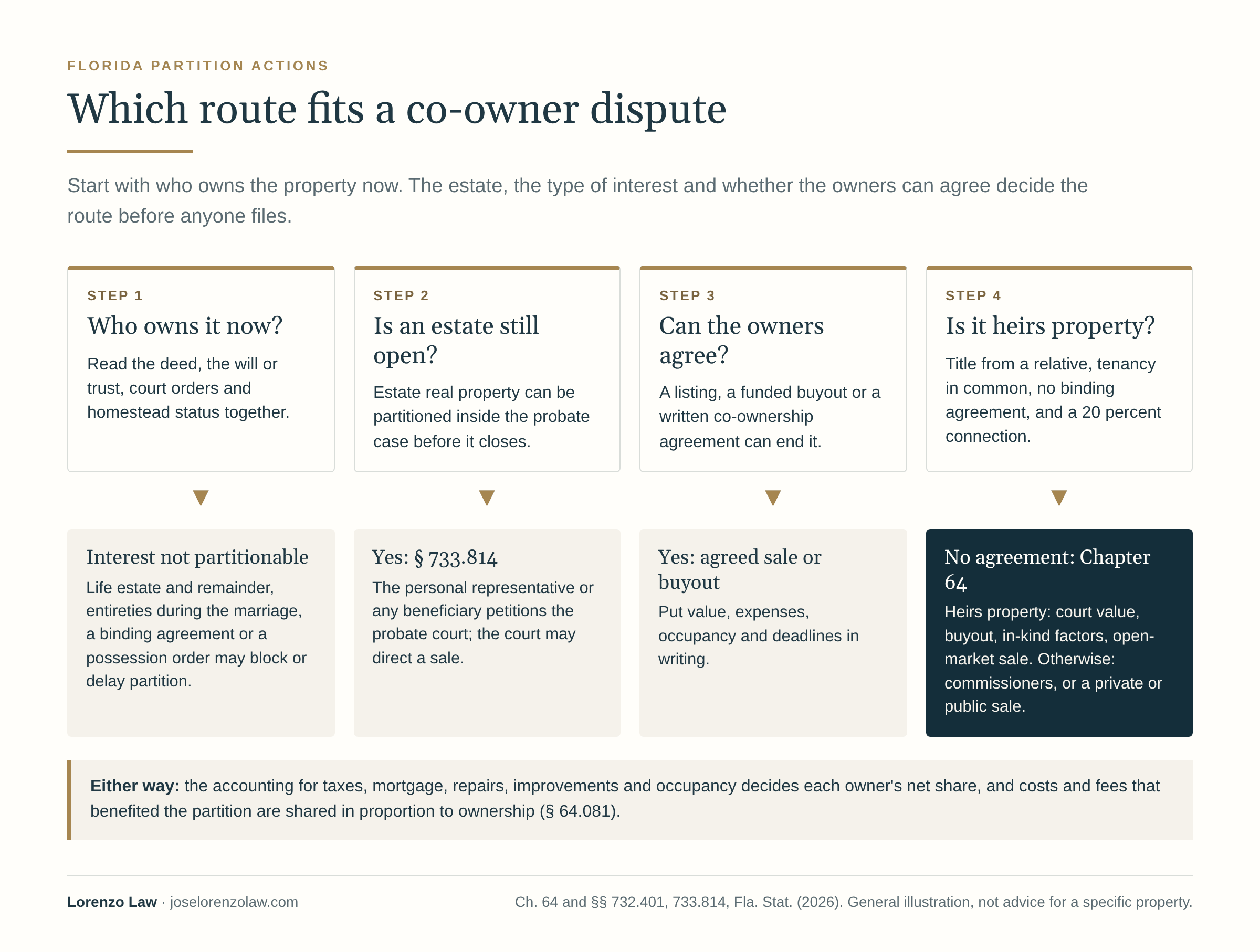
See the chart “Which route fits a co-owner dispute” (opens the full-size image; the details are also in the text).
What is a partition action in Florida?
A partition action in Florida, also called a partition lawsuit, partition suit or civil suit for partition, is an equitable proceeding in circuit court, under section 64.011 and the rest of Chapter 64, that determines each co-owner’s interest and ends the co-ownership by physical division or by sale. Partition proceedings are in equity, and the trial court has discretion in shaping the relief.
In short, if you had to define partition action in one sentence, it is a court case that ends co-ownership of real property; the partition action definition and the partition lawsuit definition are the same. The partition sale definition is just as short: a court-supervised sale whose net proceeds are divided among the owners. Florida partition laws are collected in Chapter 64, the Florida partition statute: Part I governs every action for partition of real property, and Part II adds the heirs-property rules. Partition of property held by an estate can also be requested inside the probate case. A partition lawsuit in Florida is filed in the county where the property lies.
Each eligible co-owner holds a right of partition. Real estate owned with others can be divided or sold even if the other owners object, unless a binding agreement, a court order or the type of interest stands in the way. The result is a termination of co-ownership by partition, and the most familiar example is a partition of property among family members after a parent’s death.
Most people would define partition in kind as splitting the land itself; legally, partition in kind divides land into separately titled parcels. Whether that is workable depends on access, zoning, parcel configuration, improvements and the effect of division on value. A larger tract or farmland may allow a division that a single house or condominium unit does not, which is why a condo partition usually ends in a sale or a buyout. When parcels cannot be made exactly equal in value, a court dividing in kind may adjust the allotments so the division is fair; a cash “owelty” payment is expressly authorized in heirs-property cases (section 64.208(3)), while its availability in an ordinary Chapter 64 partition is unsettled (Schroeder v. Lawhon, 922 So. 2d 285 (Fla. 2d DCA 2006)).
Partition by sale, sometimes called a sale in lieu of partition, converts the property into sale proceeds allocated among the owners, after liens, expenses, court-ordered fees and accounting adjustments. In practice, a partition sale of real estate turns shared ownership into shared money. Under ordinary partition, sections 64.061 and 64.071 provide different sale procedures, including a possible private sale under section 64.061(4). An auction is not the only possible result. Heirs property follows additional rules, including a court appraisal that searchers often call “partition by appraisal.”
In a partition action, forced sale comes only after the court has decided entitlement and remedy. A house that cannot practically be split may ultimately be sold, but the presence of a house does not skip the inquiry into title, agreements, applicable law or a statutory buyout, and no court order guarantees the amount an owner will receive.
Forms of co-ownership that matter in a partition
For joint ownership of property, Florida recognizes several forms, and each is treated differently in a partition. The difference between joint tenancy and tenancy in common is survivorship: joint tenants’ shares pass to the surviving owners, while each tenant in common’s share passes through that owner’s estate. Comparing tenants in common vs tenants by the entirety in Florida, entireties ownership is available only to a married couple and treats the spouses as one owner, so it is not ordinary co-ownership that one spouse can partition.
| Ownership form | What it means | How partition applies |
|---|---|---|
| Tenants in common | Each owner holds an undivided fractional share, which can be unequal and passes by will or inheritance at death | The usual partition case; inherited real property commonly ends up held this way |
| Joint tenants with right of survivorship | In a joint tenancy, owners hold equal undivided interests, and a deceased owner’s interest passes to the survivors | Joint tenants are among the owners section 64.031 allows to seek partition; see right of survivorship |
| Tenancy by the entirety | A married couple’s joint ownership as a unit (tenants by the entireties) | Spouses generally cannot partition entireties property between themselves during the marriage; divorce changes the analysis under section 689.15 |
| Coparceners | A historical term for heirs who inherited together | Named in section 64.031 alongside joint tenants and tenants in common |
| Life estate and remainder | One person holds the property for life; others take after that death | Successive, not concurrent, interests; a life tenant and remaindermen are not cotenants who can partition against each other |
| Enhanced life estate (Lady Bird) deed | The owner keeps control for life; named beneficiaries take at death | After the owner dies, beneficiaries who take together are co-owners who may later disagree; see Lady Bird deed after death |
| Heirs property | A statutory label for certain tenancy-in-common property connected to family transfers | Adds valuation, buyout and sale protections under sections 64.201–64.214 |
Rights and responsibilities of tenants in common in Florida
Most partition cases involve tenants in common, so their legal rights and responsibilities frame the dispute. For tenants in common, Florida law comes mostly from court decisions. Among the statutes that govern tenants in common, Florida Statutes section 689.15 (a conveyance to two or more people creates a tenancy in common unless it expressly provides for survivorship) and section 64.031 (the right to seek partition) matter most.
- Right to occupy. Each tenant in common may use and occupy the whole property, and possession by one is treated as possession for all; no owner may shut the others out.
- Carrying costs. Each owner is expected to bear a proportionate share of taxes, insurance, mortgage interest and necessary repairs; an owner who pays more can seek credit in the accounting.
- Rents from third parties. Net rent collected from outside tenants belongs to the owners according to their shares.
- Selling or mortgaging a share. An owner can usually sell or encumber an undivided share, but not the whole property, without the others.
- At death. What happens to a tenant in common in Florida after someone dies? The deceased owner’s share passes through that owner’s estate to heirs or devisees, not to the surviving co-owners, and those heirs step into the co-ownership.
- Ending the co-ownership. Any tenant in common can seek partition under section 64.031, whatever the size of their share in the co-owned property. Forced sale is one possible result; physical division and a buyout are others.
What is the downside of tenants in common? The drawbacks follow from the same rules: no one can sell the whole property without everyone, financing and insurance get harder as the number of owners grows, a share can pass to people the others never chose, and disagreements about occupancy and expenses tend to end in an accounting or a lawsuit.
What kind of attorney do I need for a partition action?
A Florida partition action is real-property litigation in circuit court, so it calls for a lawyer who litigates there: a partition lawsuit attorney or real estate partition attorney. That is also who handles property partition disputes among heirs. Many partition cases also involve an estate, a homestead determination, a life estate or a disputed deed, and those turn on Florida probate law. A Florida partition lawyer who also handles probate and probate litigation can address title, the estate and the partition together.
Jose M. Lorenzo, Jr. handles Florida probate, probate litigation and estate planning, and represents co-owners in partition matters statewide. Lorenzo Law is a solo practice: the attorney you speak with at the first call is the attorney who handles any matter the firm accepts. Consultations are available in English and Spanish, by phone or video anywhere in Florida; the principal office is in Kissimmee, and meetings in Coral Gables and Fort Lauderdale are by appointment.
How partition representation is billed. The initial consultation is free. Partition matters vary too much (the property, the number of owners, whether anyone is contesting, and the result the client wants) for a single published price, so the appropriate fee structure is determined at the consultation and agreed separately in writing before any work begins.
Comparing partition attorneys, or Florida partition lawsuit attorneys? Questions worth asking any lawyer include who will actually handle the file, whether the lawyer handles probate and homestead issues as well as the partition, how heirs-property valuation and buyouts would be approached, how the accounting for taxes, mortgage and occupancy would be documented, and how fees and costs are structured. Representation depends on a conflict review, acceptance and an engagement agreement.
Can I file a partition lawsuit without a lawyer? Florida allows individuals to represent themselves, and the questions below explain what a self-represented owner would have to handle: naming and serving every interested party, proving title and shares, any heirs-property procedure, and the accounting.
Common situations: inherited homes, couples, partners and investors
Inherited property disputes in Florida are a frequent reason for partition, but partition is a remedy for any concurrent co-ownership of Florida real property, not only inheritances. The facts that matter most are how title was acquired, whether an agreement governs a sale, and whether anyone is living in or paying for the property.
- Siblings or other heirs who inherited a house. A frequent case, whether it is a brother and sister or a dozen cousins. Once the estate is closed, the way to force the sale of inherited property without everyone’s agreement is a partition action. Whether the estate is still open, whether the home was protected homestead and whether the heirs-property rules apply usually decide the route. See partition during probate and when one sibling won’t sell the inherited house.
- Inherited land, farmland, agricultural land or vacant land. Larger or undeveloped tracts, including generational family land, are where physical division is most often realistic, and where family history and use carry weight in an heirs-property case. Where property is zoned for agriculture, land-use and minimum-parcel rules can make land impractical to divide, which bears on whether a court will order division in kind — in heirs-property cases through the statutory factors (including practicability and any other relevant factor), rather than as a separate named bar.
- Unmarried couples who bought together. Unmarried couples’ property rights in Florida come from the deed and any written agreement between them, not from the relationship itself. When the relationship ends, title form, down payments and who paid the mortgage drive the accounting; the heirs-property rules generally do not apply to unrelated buyers who purchased from an unrelated seller.
- Former spouses still holding title together. Former spouses who remain tenants in common after divorce can generally seek partition like any other co-owners, but the divorce judgment and any marital settlement agreement may already govern the property; read them before choosing a partition remedy.
- Friends, business partners and investors on title. Partition applies to individuals who hold title together, including to commercial or rental property. Property owned by an LLC, a partnership or a trust is different: the remedy usually runs through the entity or trust documents, or a proceeding such as judicial dissolution, instead.
- An investor who bought a relative’s share. A purchaser of one heir’s fractional interest becomes a co-owner and may seek partition. See when an investor buys a relative’s share.
- Co-owners who live outside Florida or abroad. The case is still filed in the Florida county where the land lies, and each owner must be properly served. Foreign heirs can start with Inheritance in Florida for foreign heirs (Spanish).
Who can file a partition action, and where is it filed?
Section 64.031 lets one or more joint tenants, tenants in common or coparceners bring a partition action against their cotenants or others interested in the land. A majority vote is not required, and a small fractional interest is still an interest, but the person filing has to establish the ownership and entitlement claimed.
Under section 64.022, the action belongs in the circuit court of the county where the land, or part of it, lies. The owner’s residence and the lawyer’s office do not decide venue. Florida’s 67 counties are grouped into 20 judicial circuits; the county and circuit table lists them.
The complaint must identify the property and the owners, their residences and interests, and other necessary matters under section 64.041, which also addresses information the plaintiff does not know. Unknown heirs or uncertain percentages call for investigation and proper pleading, not guessed figures. Every owner and other person interested in the land, including lienholders whose interests the judgment should bind, has to be joined and served.
Ownership interests that need a different analysis
A life estate and a remainder are successive interests, not ordinary concurrent ownership of the same present estate. Florida courts have held that interests which are merely successive, and not concurrent, are not partitionable (Barden v. Pappas, 532 So. 2d 707 (Fla. 5th DCA 1988)), and that one remainderman cannot sue another for partition while a third person holds an outstanding life estate (Weed v. Knox, 27 So. 2d 419 (Fla. 1946)). A spouse’s homestead life estate therefore should not be treated as though the spouse already owns a one-half tenancy-in-common interest. A valid election under section 732.401 can change that structure; eligibility, deadlines and formalities need separate review.
Property held by spouses as tenants by the entirety also requires a different analysis from ordinary tenancy in common. Divorce orders, agreements and awards of exclusive possession can matter; for the effect of dissolution on an estate by the entirety, see section 689.15.
If a trust or company owns the property, a beneficiary or member should not assume they can personally partition it as a direct co-owner. The relevant authority and remedies depend on title and the governing documents.
When partition may not be available
What properties cannot be partitioned in Florida? The answer turns on the kind of interest and any binding agreement or order, not on whether the other owners object. The situations below need review before anyone files or relies on a partition remedy.
| Situation | Why it matters | Authority |
|---|---|---|
| Successive interests (life estate followed by remainder) | Partition reaches concurrent interests; a life tenant and remaindermen are not cotenants of the same present estate | Barden v. Pappas; Weed v. Knox |
| Tenancy by the entirety during the marriage | Spouses own as a unit; dissolution changes the analysis | Section 689.15 |
| A binding agreement not to partition, or a prescribed method of division | Owners can waive the right to partition by express or implied agreement, and a deed-prescribed method of division may have to be used first. A will clause forbidding partition for the heirs’ lifetimes is different: Florida treats it as an unlawful restraint on alienation, so the property remains partitionable | Haddad v. Hester, 964 So. 2d 707 (Fla. 3d DCA 2007); Robinson v. Speer, 185 So. 2d 730 (Fla. 1st DCA 1966); Vinson v. Johnson, 931 So. 2d 245 (Fla. 1st DCA 2006) |
| Homestead with an award of exclusive possession | A court order giving a spouse or children exclusive possession can bar partition while it lasts | Hoskin v. Hoskin, 329 So. 2d 19 (Fla. 3d DCA 1976), distinguished in Tullis v. Tullis |
| Estate real property still under administration | A separate circuit-court partition can be stayed while administration is pending; section 733.814 provides the route inside the estate | Section 733.814; for an example of a trial-court stay, Chin v. Estate of Chin, 15 So. 3d 894 (Fla. 3d DCA 2009) |
| Title held by an LLC, partnership or trust | Members, partners and beneficiaries do not hold the land directly; partition does not lie for property owned solely by a partnership, and the same reasoning applies where an LLC or trustee holds title | Shephard v. Ouellete, 854 So. 2d 251 (Fla. 5th DCA 2003) (partnership); entity and trust documents |
Is it possible to waive a right to partition? Yes, by an express or implied agreement (Haddad v. Hester), although a written waiver is the cleanest form. But an agreement governing partition is not necessarily the same as an enforceable promise never to partition. Whether it bars the remedy, delays it or only affects heirs-property eligibility depends on its terms and legal effect.
Can partition happen while probate is open?
Yes, inside the estate. Under section 733.814, when two or more beneficiaries are entitled to distribution of undivided interests in any property, the personal representative or any beneficiary may petition the court before the estate is closed to partition the property in the same manner as civil partition actions. The court may direct the personal representative to sell property that cannot be partitioned without prejudice and cannot be allotted equitably and conveniently.
Section 733.814 has been part of the Florida Probate Code since 1974; the only reported Florida appellate decision located construing it is In re Estate of VanLandingham, 380 So. 2d 1178 (Fla. 4th DCA 1980), which applied the 1979 text. Before 1974, a circuit court could not partition estate real property in a personal representative’s hands while administration was pending (Leonard v. Browne, 134 So. 2d 872 (Fla. 1st DCA 1961), decided under the former county-judge probate system). Today the practical effect is a sequencing rule. Can you file a partition action if the property is still in probate, as a separate circuit-court case? It can be filed, but a separate Chapter 64 case filed while the estate is open can be stayed, as the trial court did in Chin v. Estate of Chin, and section 733.814 lets the dispute be resolved inside the estate through a petition for partition of real estate, or other property, before distribution.
| Question | Partition for distribution (section 733.814) | Chapter 64 partition action |
|---|---|---|
| When it fits | The estate is open and beneficiaries are entitled to undivided interests | The co-owners already hold title, for example after distribution or for property outside administration |
| Who files | The personal representative or any beneficiary | A joint tenant, tenant in common or coparcener |
| Which court | The probate court administering the estate; Florida Probate Rule 5.025 lists partition for distribution as an adversary proceeding | The circuit court of the county where the land lies |
| Sale | The court may direct the personal representative to sell property that cannot be divided without prejudice | Commissioners, a special magistrate or clerk sale under Part I, or the Part II procedures for heirs property |
| Homestead | Protected homestead passes outside ordinary administration; review it separately | Partition between co-owners of homestead is available, subject to their actual interests and any possession order |
Non-homestead real property vests in the devisee or heir at death, subject to administration, and a personal representative does not hold title to estate real property (Hi-Land Properties, LLC v. Gantt, 429 So. 3d 1014 (Fla. 4th DCA 2026)). That is different from saying every beneficiary already holds a readily transferable interest or that every inherited home can be sold by the personal representative. Review the estate’s status, distribution rights, the will, existing orders, the stage of estate administration and the personal representative’s authority. Section 733.608 treats protected homestead differently from ordinary estate property, and for anyone asking whether they can sell a house while it’s in probate in Florida, selling a house during probate explains when a personal representative can sell without every heir’s signature.
Where a partition-for-distribution petition concerns qualifying heirs property, the relationship between section 733.814 and Chapter 64 Part II has to be addressed in the actual proceeding. Do not assume that filing in probate either removes the heirs-property protections or guarantees every Part II procedure without an applicability analysis.
For administration questions, see Florida probate representation. A dispute about the will, fiduciary conduct or administration may require probate litigation in addition to resolving the property’s future.
Does homestead prevent partition?
No, not between co-owners. Florida’s constitutional homestead protection is aimed at forced sale for creditors’ claims. The Florida Supreme Court long ago recognized that a judicial sale necessary for partition among the beneficiaries of a homestead is not within the exemption from forced sale (Spitzer v. Branning, 135 Fla. 49, 184 So. 770 (1938), quoting Donly v. Metropolitan Realty), permitted partition between co-owners in Tullis v. Tullis, 360 So. 2d 375 (Fla. 1978), and the Fourth District, in an equitable-lien case, said the prohibition does not apply where a sale is necessary to protect an ownership interest (Hieke v. Hieke, 782 So. 2d 443 (Fla. 4th DCA 2001)). An existing award of exclusive possession is different (Hoskin). Under Florida homestead law, heir consent is not a condition of partition either: an eligible co-owner of inherited homestead can file without the other heirs’ agreement.
Protected homestead passes outside ordinary administration. A surviving spouse’s life estate, a valid election to take an undivided interest, minors’ rights and restrictions on devise all have to be evaluated before choosing a proceeding. A minor’s remainder is not the same as a minor’s present tenancy-in-common interest. Review representation and required court approvals rather than assuming either that a parent can sign for everyone or that all property involving a minor is immune from partition. The property-tax homestead exemption is a separate benefit claimed with the county property appraiser; heirs do not inherit it automatically, and an heir who makes the home a permanent residence applies in their own name. Under the Florida homestead exemption, a tenant in common who makes the home a permanent residence receives the exemption only on their own share; a co-owner who lives elsewhere receives none, and co-owners who share the home split a single exemption in proportion to their interests. See Florida homestead in probate and the homestead probate FAQ.
The surviving spouse’s life estate and the six-month election
When a Florida homeowner dies leaving a spouse and descendants, and the home passes as protected homestead outside a valid devise, the default under section 732.401 is a life estate for the spouse with the remainder to the descendants. Because those interests are successive, the default arrangement is not a co-ownership that the children or the spouse can partition. The spouse may instead elect to take an undivided one-half interest as a tenant in common, and that election has a statutory deadline that excusable neglect cannot extend (Samad v. Pla, 267 So. 3d 476 (Fla. 2d DCA 2019)). Whether the resulting tenancy in common can then be partitioned is the better reading of section 64.031 and the homestead cases, but no Florida appellate decision squarely holds it. A life tenant who does not elect bears ordinary carrying costs such as taxes, insurance, association fees and general repairs (Aronson v. Aronson, 81 So. 3d 515 (Fla. 3d DCA 2012), quoting Schneberger v. Schneberger, 979 So. 2d 981 (Fla. 4th DCA 2008)). The surviving spouse rights page covers the election in detail.
Florida heirs property law: the Uniform Partition of Heirs Property Act (Fla. Stat. §§ 64.201–64.214)
Florida’s Uniform Partition of Heirs Property Act, Part II of Chapter 64, adds protections when co-owned property is “heirs property”: a court determination of value, a chance for cotenants who did not ask for a sale to buy out those who did, a preference for physical division in defined circumstances, and an open-market sale instead of an auction as the default when a sale is ordered. Before any forced sale, inherited property that qualifies gets a court valuation and a buyout opportunity.
Heir property laws in Florida sit in Part II of Chapter 64, inside the partition statute rather than the Probate Code. Section 64.203 applies Part II to actions filed on or after July 1, 2020, and requires the court to determine heirs-property status whenever partition is otherwise available under Part I. If the property qualifies, Part II governs unless all cotenants otherwise agree in a record, and it displaces inconsistent Part I provisions. No reported Florida appellate decision construing Part II was located as of October 2026.
Does the property qualify as heirs property?
Florida law does define heir property, and narrowly. Heirs property (also written heir property or heirs’ property, and sometimes called heirship property) is a statutory term, and the statute, not family usage, decides what qualifies. The label is narrower than “a house somebody inherited,” and broader than many summaries suggest: it is not limited to property inherited without a will, and it can include a transfer from a living relative. Under section 64.202(6), the property must be held in tenancy in common and meet all of these conditions when the action is filed:
- No agreement in a record binding all cotenants governs partition.
- At least one cotenant acquired title from a relative, living or deceased.
- At least one statutory 20-percent test is satisfied: 20 percent or more of the interests are held by cotenants who are relatives; 20 percent or more of the interests are held by an individual who acquired title from a relative; or 20 percent or more of the cotenants are relatives.
Two contrasting examples: siblings who inherited tenancy-in-common interests, by will or without one, and have no binding partition agreement may satisfy the test. Unrelated friends who bought a home together from an unrelated seller do not qualify merely because they are co-owners. Review the full acquisition history; a later transfer does not answer the statutory test on its own. “In a record” does not mean recorded in the county’s official records: the statute defines a record broadly to include electronic and other retrievable information.
Valuation comes before the statutory buyout
Under section 64.206, the court determines fair market value. It adopts a value or valuation method agreed to by all cotenants. Otherwise, an appraisal by a disinterested Florida-licensed real estate appraiser is ordinarily required, valuing the property as if it were owned by one person in fee simple. If the evidentiary benefit is outweighed by the cost of an appraisal, the court instead determines value after an evidentiary hearing. Who pays for the appraisal is set by the court’s orders; costs of the partition are generally shared among the owners in proportion to their interests under section 64.081.
When an appraisal is filed, the statute ties notice, objections and the valuation hearing to specific events, and the hearing is required even without an objection. At a cotenant’s request, the court must also determine an equitable accounting and adjust the monetary relief under Part II. A fractional-value calculation is therefore a starting point, not an assurance of the final amount payable.
Who can elect a buyout?
The statutory opportunity under section 64.207 arises if any cotenant requests partition by sale. After valuation, the court sends notice. A cotenant who did not request partition by sale may elect to buy all the interests of the cotenants who did. Eligibility turns on the requested remedy, not on who filed first or who is a family member.
The initial election is due no later than 45 days after the court sends that notice; it is not a requirement to complete the purchase within 45 days. If more than one cotenant elects, the court allocates the right to buy among them in proportion to their existing interests.
The statutory starting price for a selling cotenant’s interest is the court-determined whole-property value multiplied by that cotenant’s fractional ownership. For example, assuming a $400,000 determination of value and a one-quarter sale-requesting interest, the starting figure is $100,000. This illustration assumes no accounting adjustment and does not account for liens, financing, fees or closing obligations; the court’s accounting and payment orders decide what must actually be paid.
After the election period, the court sends the applicable allocation notice and sets a payment date no sooner than 60 days after that notice was sent. Buyers pay their apportioned amounts into court. If some buyers fail to pay, the statute gives paying buyers a further opportunity to acquire the remaining interests. If no purchase is completed as required, the case returns to the statutory partition alternatives.
Buying out the sale-requesting owners does not necessarily end every dispute: a remaining request for partition in kind can still require resolution under section 64.208. Interests of properly served defendants who did not appear have a separate request, hearing and due-process procedure under section 64.207(7)–(8); they are not automatically forfeited.
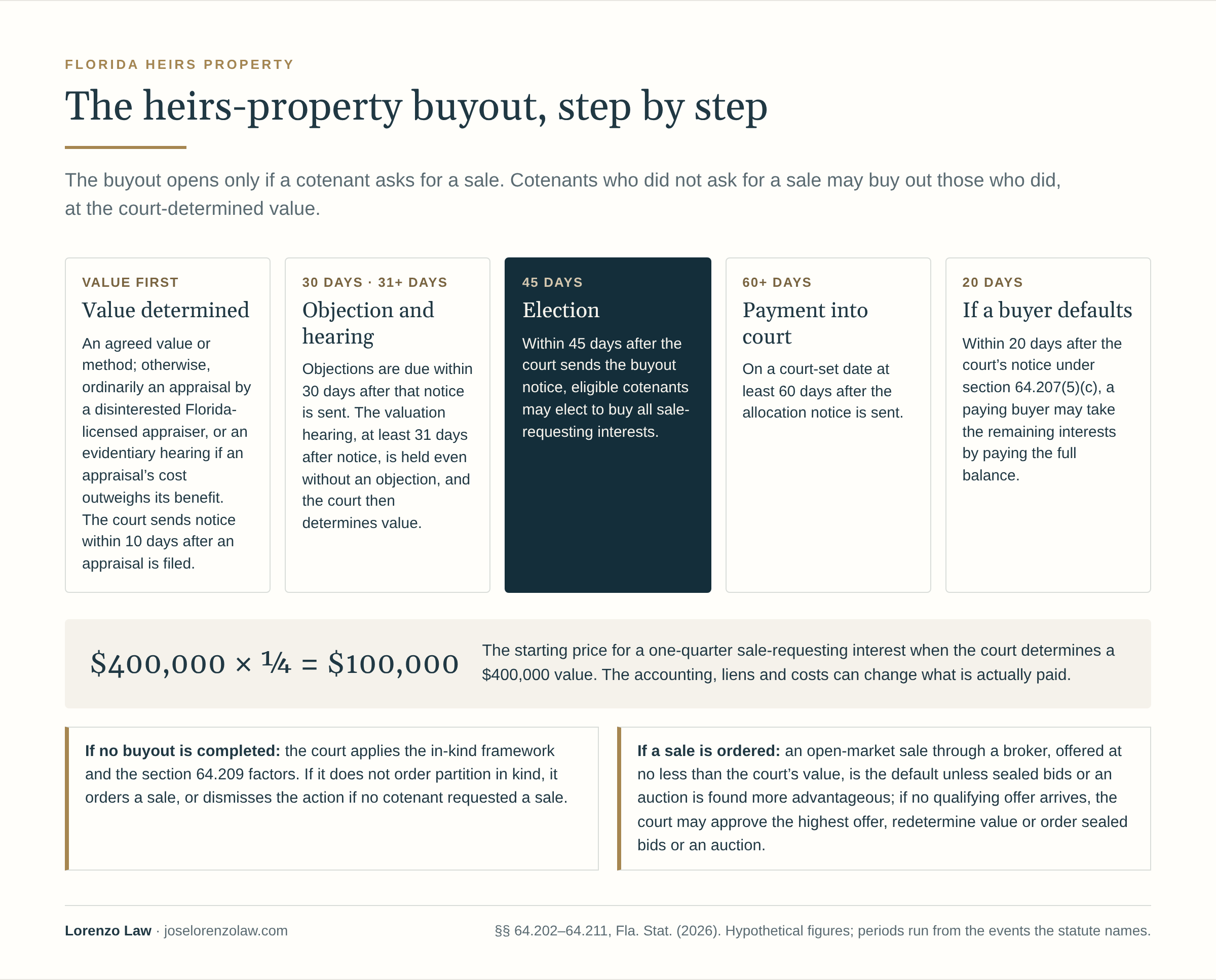
See the chart “The heirs-property buyout, step by step” (opens the full-size image; the details are also in the text).
Heirs-property notices and time periods
These periods govern particular steps, not the total length of a case. Have counsel review the actual notices, orders, service requirements and time-computation rules promptly.
| Event | Statutory period and trigger |
|---|---|
| Notice of a filed court appraisal | The court sends notice to each party with a known address no later than 10 days after the appraisal is filed; section 64.206(5) |
| Objection to the appraisal | Filed no later than 30 days after that notice is sent, stating the grounds; section 64.206(5)(c) |
| Valuation hearing | No sooner than 31 days after a copy of the appraisal notice is sent to each party; section 64.206(6) |
| Initial buyout election | Notify the court no later than 45 days after the section 64.207(1) buyout notice is sent |
| Initial buyout payment | A court-set date no sooner than 60 days after the later section 64.207(4)(a) or (b) notice is sent; payment goes into court |
| Purchase after some electing buyers default | A paying cotenant may elect by paying the entire remaining price no later than 20 days after the section 64.207(5)(c) notice |
| Request concerning served cotenants who did not appear | No later than 45 days after the initial section 64.207(1) notice; additional judicial protections apply |
Physical division and sale after the buyout stage
Section 64.208 does not make a sale automatic whenever nobody requests physical division. Its in-kind framework also applies where not all the sale-requesting interests were purchased, and where an in-kind request remains after a buyout. Before rejecting in-kind relief under that framework, the court must be satisfied that the commissioners considered the section 64.209 factors and found prejudice to the cotenants as a group.
Those factors include practical divisibility, the relative value of the divided parcels and the whole property, family ownership history, sentimental or ancestral attachment, lawful use, and contributions toward taxes, insurance, maintenance and improvements. The total circumstances matter, and no single factor is automatically decisive. Requests to aggregate interests and equalizing payments can also affect a physical division.
If the court does not order partition in kind, it orders a sale under section 64.210, or dismisses the action if no cotenant requested a sale. That is why the relief each owner requests matters from the outset.
Under section 64.210, an open-market sale is the default once a sale is ordered, unless the court finds sealed bids or an auction more economically advantageous and in the cotenants’ collective best interest. The broker offers the property at no less than the court’s determination of value. If no qualifying offer arrives within a reasonable time, the court may, after a hearing, approve the highest outstanding offer, redetermine value and continue marketing, or order sealed bids or an auction. The statute does not guarantee the eventual selling price.
The parties have 10 days after entry of an open-market-sale order to agree on a Florida-licensed broker; otherwise the court selects a disinterested broker. Under section 64.211, the broker must report a qualifying offer no later than seven days after receiving it, unless Part I requires a shorter period.
How a Florida partition action works, step by step
The partition action process in Florida follows the ordinary civil-litigation path in circuit court, with partition-specific steps: title investigation, a complaint naming every interested party, service, the defendants’ answers, a determination of each party’s interest, an heirs-property determination, then either division or sale, an accounting and distribution.
- Title and parties. Search title, identify every owner and lienholder, and confirm whether an estate, homestead, life estate, trust or entity is involved.
- Demand and negotiation. Many disputes start with a written proposal or demand letter; an agreed sale or buyout can avoid the case entirely.
- Complaint and lis pendens. The complaint for partition (some people call it a petition for partition) is filed in the county where the property lies. Counsel also evaluates whether a notice of lis pendens is appropriate; that notice concerns pending litigation affecting the property and is not a judgment establishing ownership.
- Service of process. Each defendant must be served; missing heirs and other missing owners call for a diligent search and, where allowed, service by publication.
- Answer, defenses and counterclaims. Defendants typically respond within 20 days after service and may contest title, shares, the remedy or the accounting. In a contested case, discovery, including document requests and depositions, follows.
- Determining the parties’ rights. The court determines the parties’ rights and interests under section 64.051, often by summary judgment when title is not disputed, and determines heirs-property status under section 64.203.
- Heirs-property valuation and buyout, when Part II applies.
- Division or sale. For physical partition, section 64.061 provides for three commissioners; the parties may agree on their selection, and objections to the commissioners’ report are due within 10 days after the report is served. Section 64.061(4) permits a special magistrate or the clerk to conduct a private sale, or a sale under section 64.071, when its prerequisites are met; section 64.071 addresses a public sale, such as a public auction, with payment and confirmation requirements.
- Accounting and distribution. Credits, offsets, liens, costs and allowed fees are resolved, and the court directs distribution of the proceeds.
- Final judgment and appeal period. Title passes only after the court approves the sale and orders the conveyance.
The heirs-property valuation and buyout procedure belongs to qualifying heirs-property cases; it is not a step every ordinary partition must follow. Owners can still negotiate an agreed buyout in an ordinary case.
Does a partition case go to trial?
Many do not, and a partition case can be settled without trial at any stage. When title and shares are undisputed, the right to partition is often decided on motion, and owners frequently settle the sale terms or a buyout, sometimes through mediation that a court order or local practice may require. Disputed title, valuation, occupancy rent or accounting credits can require an evidentiary hearing or trial before the judge; partition is an equitable proceeding, so there is no jury.
Can the court protect the property while the case is pending?
The court can. A Florida appellate court affirmed the part of an order barring co-owners from renting or advertising jointly inherited property, or engaging a broker, without court approval while the partition action was pending; it reversed a separate restriction in the same order on due-process grounds (Hefley v. Colombo, 420 So. 3d 589 (Fla. 3d DCA 2025)). Filing a partition action does not, by itself, oust an occupying co-owner or stop deterioration, foreclosure or a tax sale; those risks need their own attention.
What if a co-owner cannot be found?
Missing owners require diligent investigation and legally sufficient service. Publication is not an automatic substitute for personal service whenever contact is inconvenient. If the plaintiff seeks publication and the court determines the property is heirs property, section 64.204 requires the plaintiff to post the clerk-issued notice of action on the property no later than 10 days after receiving it. That posting requirement does not replace the service rules or erase the missing owner’s rights, and Part II gives served owners who do not appear their own protections.
How long does a partition action take in Florida?
In Jose M. Lorenzo, Jr.’s experience, a Florida partition dispute that resolves through a negotiated sale or buyout often closes in about three to six months; an uncontested court case, where every owner is served and no one opposes partition, commonly takes about four to eight months; and a contested case commonly takes about nine to eighteen months. Heirs-property valuation and buyout steps, missing or unknown owners, title or probate problems, and appeals can push a case past two years. These are general ranges, not a prediction for any particular case.
| Path | Typical range | What usually decides where a case falls |
|---|---|---|
| Negotiated sale or buyout, no lawsuit | About 3 to 6 months | Agreement on value, title clearance, financing for a buyout, the listing and the closing |
| Uncontested partition case | About 4 to 8 months | How quickly every owner and lienholder is served, the court’s calendar, and the sale or closing |
| Contested partition case | About 9 to 18 months | Title or share disputes, the accounting for credits and rent, valuation evidence, hearings and trial scheduling |
| Heirs property, missing owners, open estate or appeal | About 12 to 24 months or more | Court appraisal and buyout periods, diligent search and publication, probate sequencing, and appellate review |
General ranges from Jose M. Lorenzo, Jr.’s practice. Every case depends on its facts, the county and the court’s calendar.
How long does it take to file a partition action? Usually a few weeks once the deed, a title search and the owners’ information are in hand, because the complaint has to name and describe every interested party; the court-case ranges above run from the filing. The statutory heirs-property periods alone add months once an appraisal is filed: notice within 10 days, a 30-day objection period, a valuation hearing at least 31 days after notice, a 45-day buyout election, and a payment date at least 60 days after the allocation notice. Those periods cannot simply be added together to predict a closing date, but they explain why heirs-property cases rarely finish quickly. A useful estimate for a specific property begins with the current deed, any court papers, the owners’ positions and available records.
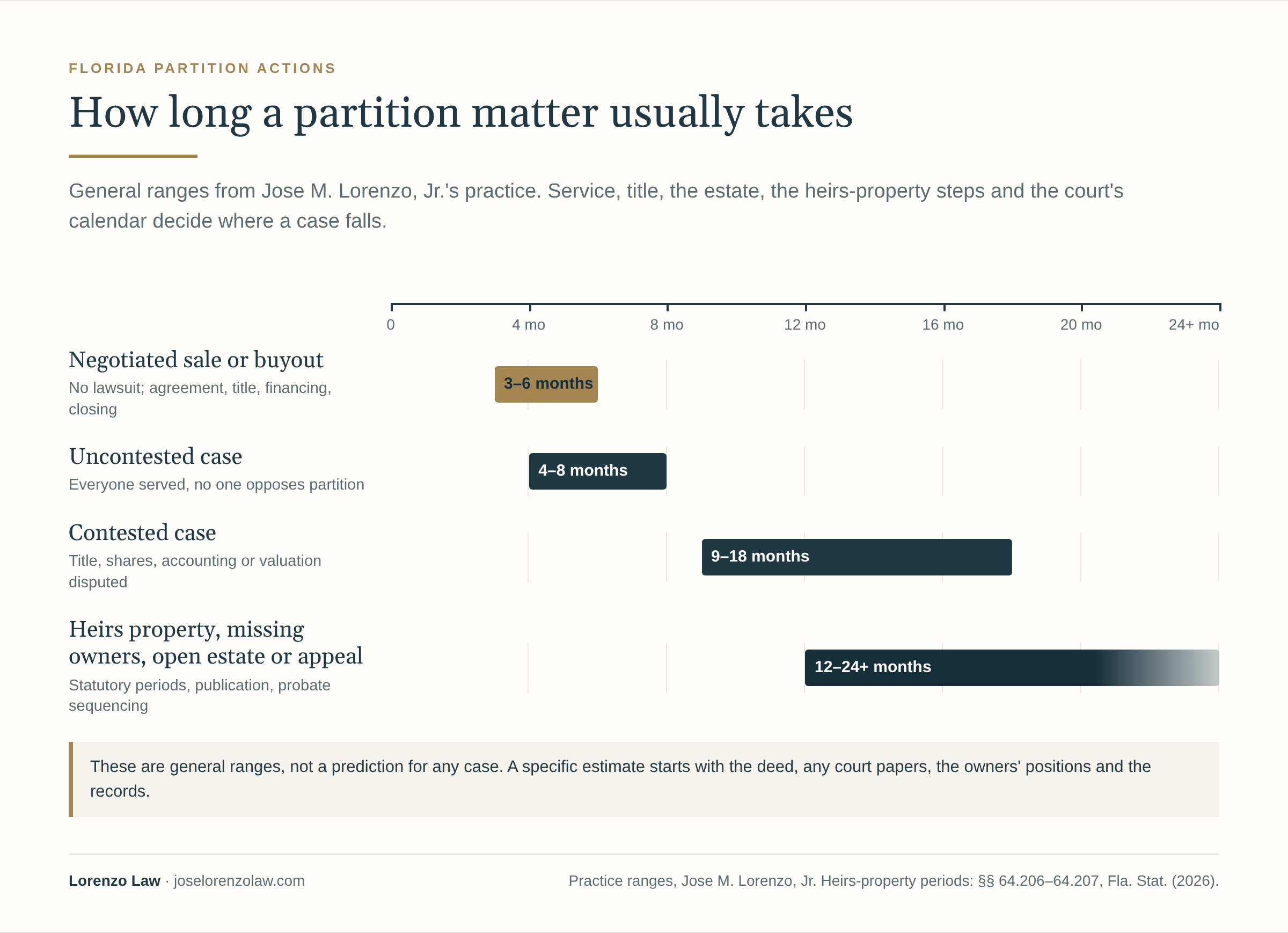
See the chart “How long a partition matter usually takes” (opens the full-size image; the details are also in the text).
What does a partition action cost, and who pays?
Under section 64.081, Florida Statutes, the court allocates the costs of the partition and reasonable attorney fees for services that benefited the partition among all the parties, on equitable principles and in proportion to each party’s interest, and can order them paid from the sale proceeds. So who pays for a partition action in Florida turns on ownership shares, not on who wins: it is a proportional-sharing rule, not a prevailing-party rule. How much does a partition action cost in Florida overall? That depends mostly on the number of owners and whether anyone contests the case.
Florida appellate courts have described Florida Statute 64.081 as giving each party a right to have the others share in fees for services that benefited the partition, and a corresponding responsibility to share in theirs (Casiano v. Casiano, 370 So. 3d 991 (Fla. 5th DCA 2023)). A trial court has discretion to find that an attorney’s services benefited the partition, but it cannot assign all of those fees to one party instead of apportioning them by interest (Wolland v. Wolland, 433 So. 3d 1276 (Fla. 3d DCA 2026)). Fees are generally not available under section 64.081 when partition is not granted (Harmon v. Harmon, 453 So. 2d 77 (Fla. 3d DCA 1984)), and the heirs-property part of Chapter 64 does not change the fee rule.
This is not a promise that a difficult co-owner pays the whole bill, that all legal work qualifies, or that nothing is owed until a sale. A successful defense does not automatically make the other side pay. If a fee claim is pending when sale proceeds are disbursed, ask the court to reserve funds before disbursement; one appellate court held a trial court was not required to hold proceeds back on its own (Cauble v. Kaczmarski, 389 So. 3d 687 (Fla. 3d DCA 2024)).
| Cost category | What can be involved |
|---|---|
| Court and service costs | Filing fees, summonses, process servers, publication when allowed, recording, and other authorized charges |
| Attorney fees | Partition suit lawyer fees cover investigation, negotiation, pleadings, hearings, evidence, trial and implementation, depending on the engagement |
| Valuation and division | A partition suit appraisal, a survey, commissioners, expert testimony, and a special magistrate where applicable |
| Ownership and sale | Taxes, insurance, mortgage payments, necessary maintenance, broker commission, title work and closing costs |
Section 28.241(1)(a)2. lists graduated filing fees for covered real-property actions: $395 where the claim value is $50,000 or less, $900 where it exceeds $50,000 but is below $250,000, and $1,900 where it is at least $250,000. A small per-defendant charge applies above five defendants, and the statute adds a $4 fee and addresses other charges, including summons issuance. Confirm the claim valuation, the type of proceeding and the clerk’s current total; a property’s asking price alone is not a complete filing-fee analysis.
Representation fees. The initial consultation is free. For a partition matter, it takes a consultation to determine the appropriate fee structure, because the property, the number of owners, whether the case is contested and the outcome sought all change the work involved. Representation fees and costs are then agreed separately in writing.
Accounting: taxes, mortgage, repairs, improvements and rent
Ownership percentages are the starting point, not the final distribution. Apart from the heirs-property direction in section 64.206 to determine an equitable accounting at a cotenant’s request, Chapter 64 has no separate accounting statute: credits between co-owners come from equitable principles developed in Florida cases. Can you recover mortgage payments you made alone, or get back what you paid into the house? Often, as a credit in the accounting, if the payments are documented and no agreement says otherwise. Keep an itemized record of payments, rental receipts, reimbursements, occupancy and agreements.
| Item | Evidence to collect | Issue for the accounting |
|---|---|---|
| Taxes, insurance and mortgage payments | Bills, statements, proof of payment and payment dates | Who bore more than the proper share, which obligations are covered, and whether an agreement or offset changes the result |
| Necessary preservation and repairs | Invoices, photographs, scope of work and proof of payment | Necessity, reasonableness and allocation; payment alone does not prove every claimed credit |
| Improvements | Before-and-after evidence, permits, invoices and valuation evidence | Credited by the increase in value, not by what was spent |
| Payments before the co-ownership began, and the down payment | Closing statements and how title was taken | May not be creditable at all, because joint title can be presumed a gift |
| Third-party rentals | Leases, booking records, deposits, income and expenses | Net receipts and amounts properly attributable to each owner; a tenant’s lease does not prevent partition (Leonard v. Browne), but the lease, rent and deposits must be addressed in any sale or division |
| An owner’s personal occupancy | Occupancy dates, access communications, agreements and rental-value evidence | Independent rent liability, exclusion, and any offset against a contribution claim are different questions |
Example: assume two equal owners, no different expense agreement, and $12,000 of property taxes paid entirely by one owner. Before other adjustments, the contribution sought from the other owner would be that owner’s $6,000 share, not reimbursement of the entire $12,000. An agreement, reimbursement already received or a valid offset could change the final accounting.
Florida courts have recognized credits for payments of principal and interest on a mortgage, taxes, insurance and essential improvements (Hernandez v. Hernandez, 645 So. 2d 171 (Fla. 3d DCA 1994)), and have held that cost is not the measure for improvements; the measure is the enhancement in value (Hernandez; Schroeder v. Lawhon, 922 So. 2d 285 (Fla. 2d DCA 2006)). Payments that exceed an owner’s share create a credit, not a larger ownership share (Biondo v. Powers, 743 So. 2d 161 (Fla. 4th DCA 1999)), and payments made before the co-ownership began, including a down payment, may not be creditable (Fernandez v. Marrero, 282 So. 3d 928 (Fla. 3d DCA 2019)).
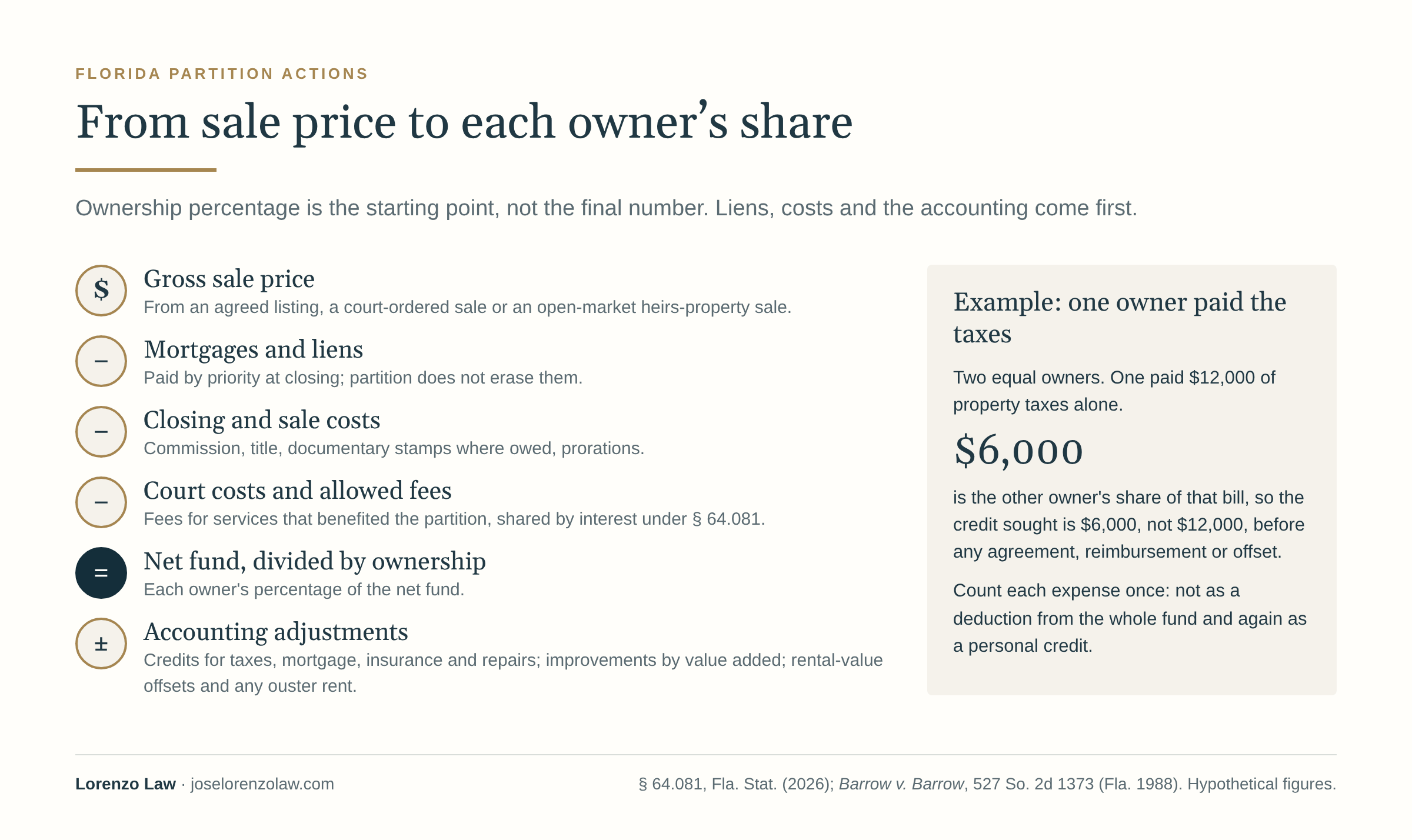
See the chart “From sale price to each owner's share” (opens the full-size image; the details are also in the text).
Does a co-owner living in the house owe rent?
Not simply for living there, even rent-free while others pay the bills. Possession by one co-owner is treated as possession for all until an adverse claim is communicated, and a co-owner in sole possession is not liable for rent to the others unless there has been an ouster (Barrow v. Barrow, 527 So. 2d 1373 (Fla. 1988)). Ouster requires acts inconsistent with, and exclusive of, the other owners’ rights, plus communicated knowledge of the exclusive claim (Coggan v. Coggan, 239 So. 2d 17 (Fla. 1970)). In 2025 an appellate court reversed a back-rent credit awarded for sole occupancy alone, and held the earliest any rent claim could run was the date the co-ownership began, not the date of death (Seaborn v. Seaborn, 413 So. 3d 989 (Fla. 2d DCA 2025)).
What is the 7 year property law in Florida? Owners usually mean adverse possession. Because possession by one co-owner counts as possession for all, years of living in the property do not by themselves let one heir take the others’ shares by adverse possession. Tenants in common must first show an ouster.
Changing the locks on a co-owner can be an ouster (Moraitis v. Galluzzo, 511 So. 2d 427 (Fla. 4th DCA 1987)). When ouster is proved, the measure is the ousted owner’s share of the property’s reasonable rental value (its fair rental value), not the cost of substitute housing (Artis v. Stephens, 435 So. 3d 1079 (Fla. 4th DCA 2026)).
There is also a separate offset rule. When the occupying owner asks for contribution toward preservation or improvements, the other owners can offset that claim with the reasonable rental value of the occupant’s use, to the extent it exceeded the occupant’s share, even without an ouster (Barrow). The offset is limited by the contribution claim; it is not a separate rent judgment. This changes whether a proposed expense credit actually increases an owner’s net recovery, so preserve records on both sides of the accounting rather than assuming either “no ouster means no offset” or “living there means rent is owed.”
A sibling who cared for a parent before death may have a claim for that care, but a claim against the parent arising before death is generally a creditor’s claim that must be timely filed in the estate; filing a lawsuit is not a substitute for the statement of claim (Spohr v. Berryman, 589 So. 2d 225 (Fla. 1991)), and recasting it as a partition credit is uncertain.
Can a co-owner be evicted?
Not through an ordinary landlord-tenant eviction. A co-owner is not a tenant under a lease, so Chapter 83 eviction does not fit. The possessory remedy against a co-owner is ejectment in circuit court under section 66.021, and it requires an ouster. Filing a partition action does not oust the occupant by itself (Diedricks v. Reinhardt, 466 So. 2d 375 (Fla. 3d DCA 1985)), and a co-owner’s possession can continue until the court confirms a partition sale and orders possession delivered. Changing the locks or demanding rent does not resolve ownership; partition, negotiated occupancy terms or ejectment may fit, depending on the facts.
What happens if there is a tenant living in the property? A third-party tenant under a lease is in a different position from a co-owner: the lease does not prevent partition, but the lease, rent and deposits have to be addressed in any sale or division, as the accounting table above notes.
Protecting the property: waste, taxes, title and mortgages
Co-owner disputes can damage the property itself: unpaid taxes, lapsed insurance, code violations, association liens, vacancy and foreclosure. Filing a partition action does not by itself prevent deterioration, stop a foreclosure or supply emergency relief, so document the condition and the deadlines promptly.
- Property taxes. Taxes keep coming due while a partition case is pending. Unpaid Florida real estate taxes can lead to a tax certificate on the property and, eventually, a tax deed application. Payments made to protect the property are a common accounting credit.
- Insurance. A vacant or disputed home can lose coverage. Confirm the policy, the named insureds and any vacancy clause.
- Code enforcement and homeowners’ association (HOA) liens. Fines and assessments can attach to the property and reduce everyone’s net proceeds.
- Mortgages and liens. Partition does not erase a mortgage or other lien. Priority, payoff, the sale order and closing requirements must be addressed. Personal liability on a note is a separate question from ownership of encumbered property, and a buyout deed alone does not release a borrower from the loan; any assumption, refinance or lender release needs its own review.
- Title defects. A disagreement about who owns the property may require probate, deed-related or other title relief. The right sequence depends on the defect and the parties; there is no universal requirement that a separate quiet title action come before every partition, and section 64.051 itself provides for adjudicating the parties’ rights and interests.
Accounting or other relief for waste depends on the facts and the claims made. If foreclosure, a tax sale, an insurance lapse or a code hearing is close, raise it at the first consultation.
When an investor buys a relative’s share
Any co-owner can usually sell an undivided fractional interest without the others’ consent. When one heir sells a share to an investor, the investor becomes a co-owner and may seek partition, which can change the dynamics of a family dispute and lead to a forced sale of real estate the family wanted to keep.
Florida’s heirs-property rules were written with that situation in mind. If the property otherwise qualifies, the court-determined value, the buyout opportunity for cotenants who did not ask for a sale, the in-kind factors that consider family history, and the open-market sale default all apply, even though the investor is not a relative. Whether the transfer to the investor keeps the property within the statutory test depends on the full acquisition history and the 20-percent tests.
For an owner thinking of selling a share to an outside buyer, price, restrictions, tax consequences and the effect of introducing a new co-owner deserve review. Do not assume a fractional-interest offer equals the same fraction of an unrestricted whole-property sale price. For an owner who receives a letter from a fractional-interest buyer or a new co-owner, the response deadlines in any summons and the heirs-property protections are the first things to check.
Alternatives to filing: buyouts, financing, mediation and agreements
Can co-owners sell the property themselves without going to court? Yes, if everyone with authority signs. Most co-owner disputes are cheaper to resolve by agreement than by litigation, and a written proposal is often the first step. An agreed valuation method, a funded buyout, a listing agreement or a written co-ownership agreement can each end the disagreement without a court-ordered sale.
Agree on how value will be set. Owners might choose a neutral appraiser, decide in advance what happens if an appraisal is disputed, or agree on broker selection and a listing process. A negotiated arrangement should address debt, expenses, occupancy and net proceeds as well as the headline price.
Buy out a sibling’s share of the house fairly. A fair buyout of siblings’ shares of an inherited house starts from an agreed value, credits each owner for documented contributions, deals with the mortgage and closing costs, and ends in a written buyout agreement. The same steps apply when buying out a tenant in common who is not family.
Fund the buyout before committing to it. A buyout needs evidence of funds or realistic financing. Loan approval depends on the borrower, title, the property, equity and lender requirements, and an inherited or co-owned home may need title and estate issues resolved before a lender will close. Do not let a court payment date pass while assuming financing will be available. The deed, title work, lender requirements, releases and closing documents should fit the transaction; a quitclaim deed is not the automatic answer for every family buyout. See the Florida quitclaim deed guide and adding or removing a name on a Florida deed.
Put the interim terms in writing. A settlement can specify who pays expenses while the property is held, access for inspections and showings, the treatment of past payments, move-out arrangements, deadlines, and remedies if a party does not perform. Mediation may help the owners reach those terms, and a court order or local practice may require it, but no particular completion time or settlement rate can be promised.
Keep the property together on workable terms. If the owners want to keep the property, a written agreement should cover use, rent, management, repairs, expenses, access and future exit rights. Continued co-ownership works only if the arrangement can actually be carried out.
Plan ahead to prevent the next dispute. Much partition litigation begins with an estate plan that left a house to several people without saying who may live there, who pays, or how one can buy out the others. Florida estate planning can address those questions before they become a lawsuit.
Defenses: can a partition action be stopped?
Defenses to a partition action in Florida start from a hard fact: a co-owner’s right to seek partition is strong, and disliking a sale is not a defense. Can someone force me to sell my house? If they co-own it with you, they can ask a court to order a sale, but a partition action can still be defeated, delayed, narrowed or resolved on different terms, depending on title, agreements, possession orders, the estate and the heirs-property rules. No defense or election is a guaranteed way to stop a case.
What are some common affirmative defenses used in Florida partition cases? Two that come up are a waiver of the right to partition, express or implied, and a binding agreement governing partition, and like all affirmative defenses to a partition action in Florida they must be raised in the answer; other responses challenge title, standing or the remedy. If you are asking how to fight or how to stop a partition action, start by taking the complaint, summons, court notices and orders to counsel promptly. A 45-day heirs-property buyout period is not a substitute for the response deadline in a summons or another court order. Defensive positions and responses that can apply include:
- Title and standing. The plaintiff must prove a present concurrent interest; disputed deeds, percentages or estate rights can defeat or reshape the claim.
- Successive interests or entireties. A life estate and remainder, or entireties property during the marriage, is not ordinary co-ownership.
- Waiver or an agreement governing partition. A waiver by express or implied agreement, or a deed-prescribed method of division, may control; its validity and scope need review.
- A possession order. An award of exclusive possession must be read for what it covers and how long it lasts.
- An open estate. Partition of estate real property can be stayed while administration is pending, with section 733.814 available inside the estate.
- Heirs-property status. If Part II applies, the court must determine value, offer the buyout to eligible cotenants, and apply the in-kind framework before ordering a sale.
- A request for partition in kind. For land that can be divided, physical division may be the appropriate remedy.
- The accounting. Credits, offsets and the occupancy rules often matter more to the final numbers than the decision to partition.
- Settlement. A negotiated buyout, sale terms or a schedule can end the case on the owners’ terms.
Can a partition suit be dismissed? It can, for example for lack of standing or a defective claim, by voluntary dismissal after settlement, or, in an heirs-property case, when no cotenant requested a sale and the court does not order partition in kind. Asking how to win a partition action usually means deciding first what winning looks like: keeping the property, a fair sale price, or a correct accounting. A completed statutory buyout may remove a sale-requesting owner’s interest while other issues still need orders, and settlement, dismissal, physical division and sale each have different consequences.
Myths and facts about Florida partition actions
| Myth | What actually happens |
|---|---|
| Only a majority owner can force a sale | A small fractional interest is still an interest; any eligible co-owner can seek partition, subject to proof of title and share |
| Any co-owner can force an immediate sale | An eligible co-owner can ask for partition; the court decides entitlement and remedy, and heirs-property cases add valuation and a buyout first |
| All heirs have to agree before anything can happen | A voluntary sale needs the owners’ signatures, but a partition action does not need unanimous consent |
| Homestead can never be partitioned | Homestead protection is aimed at creditors; partition between co-owners has been allowed, subject to their interests and any possession order |
| The sibling living in the house automatically owes rent | Sole occupancy alone does not create rent liability without an ouster, although a rental-value offset can reduce the occupant’s own expense claims |
| A forced sale is always a courthouse auction | Ordinary partition allows a private sale when its conditions are met, and heirs property defaults to an open-market sale through a broker |
| Whoever files pays all the fees | Section 64.081 apportions costs and fees that benefited the partition among all owners in proportion to their interests |
| Heirs-property rules apply only when there was no will | The test turns on acquiring title from a relative, living or deceased, plus the statutory conditions, not on intestacy |
| A partition case always takes years | Negotiated and uncontested matters often resolve within months; contested and heirs-property cases take longer |
Taxes and distribution of partition proceeds
A partition sale or buyout can have tax consequences, and the amount received at closing is not necessarily taxable gain. Basis, sale expenses, improvements, rental use and the particular transfer all matter, so have a tax professional review them before relying on a projected net amount.
Inherited property’s federal income-tax basis is generally tied to its fair market value at the date of death, often called a step-up in basis, subject to alternate valuation and other rules; basis can move down as well as up, and later adjustments matter. A lifetime gift can carry different basis treatment, which is why a co-owner who received a share by deed during a parent’s life may face more capital gains tax than a sibling who inherited. The guide to assets that pass outside probate explains how property moves at death, and the IRS explains the basic distinction in its guidance on gifts and inheritances.
Florida documentary stamp tax under section 201.02 also needs transaction-specific review. Do not assume every partition-related deed is exempt or that every family buyout is tax-free.
Distribution must account for the ownership interests and the applicable orders, liens, closing expenses, fees and accounting adjustments. Avoid counting the same expense twice, once as a deduction from the whole fund and again as an individual credit. Request an understandable proposed closing and distribution statement before relying on a projected net amount.
Florida counties and circuits where partition actions are filed
A Florida partition action is filed in the circuit court of the county where the land lies. Jose M. Lorenzo, Jr. handles partition matters in all 67 Florida counties, with consultations by phone or video statewide. The table follows the 20 judicial circuits defined in section 26.021.
The case is filed in the county where the property lies, not where the owners live: a home in Miami goes to the Eleventh Judicial Circuit in Miami-Dade County, a home in Fort Lauderdale to the Seventeenth Judicial Circuit in Broward County, and a home in Orlando or Kissimmee to the Ninth Judicial Circuit in Orange County or Osceola County. The same rule applies to property in West Palm Beach (Palm Beach County), Tampa (Hillsborough County), St. Petersburg (Pinellas County), Jacksonville (Duval County), Naples (Collier County), Fort Myers (Lee County), Pensacola (Escambia County), Tallahassee (Leon County) and The Villages (Sumter, Lake and Marion counties).
| Circuit | Counties | Related Lorenzo Law pages |
|---|---|---|
| First | Escambia, Okaloosa, Santa Rosa, Walton | Florida probate service areas |
| Second | Franklin, Gadsden, Jefferson, Leon, Liberty, Wakulla | Florida probate service areas |
| Third | Columbia, Dixie, Hamilton, Lafayette, Madison, Suwannee, Taylor | Florida probate service areas |
| Fourth | Clay, Duval, Nassau | Jacksonville probate |
| Fifth | Citrus, Hernando, Lake, Marion, Sumter | The Villages probate |
| Sixth | Pasco, Pinellas | Florida probate service areas; Pinellas inherited-property disputes |
| Seventh | Flagler, Putnam, St. Johns, Volusia | Florida probate service areas |
| Eighth | Alachua, Baker, Bradford, Gilchrist, Levy, Union | Florida probate service areas |
| Ninth | Orange, Osceola | Orlando probate; Kissimmee probate; Celebration probate; Orlando inherited-house disputes |
| Tenth | Hardee, Highlands, Polk | Florida probate service areas |
| Eleventh | Miami-Dade | Miami probate |
| Twelfth | DeSoto, Manatee, Sarasota | Florida probate service areas |
| Thirteenth | Hillsborough | Tampa probate |
| Fourteenth | Bay, Calhoun, Gulf, Holmes, Jackson, Washington | Florida probate service areas |
| Fifteenth | Palm Beach | Palm Beach County probate; Boca Raton probate litigation |
| Sixteenth | Monroe | Florida probate service areas |
| Seventeenth | Broward | Fort Lauderdale probate |
| Eighteenth | Brevard, Seminole | Florida probate service areas |
| Nineteenth | Indian River, Martin, Okeechobee, St. Lucie | Port St. Lucie probate |
| Twentieth | Charlotte, Collier, Glades, Hendry, Lee | Florida probate service areas |
Local practice differs from circuit to circuit, including how hearings are set, whether mediation is ordered and how sales are conducted, and each county clerk sets its own filing procedures within the statute. When the estate and the land are in different counties, the probate case and a Chapter 64 case may proceed in different courts; that is one reason to review the estate’s status before filing.
Documents to gather before a consultation
- The current recorded deed, prior relevant deeds, legal description, parcel identification number, and any title policy or title report.
- The will or trust, death certificate, probate case number, letters of administration, homestead determination and distribution orders, as applicable.
- Co-ownership, buyout, occupancy, rental or non-partition agreements, and any divorce judgment or possession order.
- Names and contact information for known owners, claimed percentages, family relationships, acquisition dates, and how each interest was acquired.
- Mortgage statements, payoff information, liens, tax bills, insurance, association statements, repair receipts, and proof of payments or reimbursements.
- Leases, rental income and expense records, occupancy dates, and communications about access or exclusion.
- Appraisals, surveys, offers, listing documents, proposed buyout terms and available financing information.
- Any complaint, summons, service record, notice, hearing date, election or court order, including when it was sent, received or served.
Be ready to explain what you want: to sell, to keep the property through a buyout, to divide the land, to resolve expenses, or to defend a pending case. Flag foreclosure, insurance, tax and court deadlines at the start. Ask how to send documents securely; do not put sensitive records into an initial general inquiry.
Questions co-owners ask about Florida partition actions
Do all heirs have to agree to sell property in Florida?
When heirs cannot agree, the property is not frozen forever. To sell the whole property voluntarily, every owner or an authorized representative has to sign. To ask a court for partition, no: an eligible co-owner can file a partition action without unanimous consent, and estate property may involve the personal representative’s separate authority. A court-ordered sale still requires the legal findings and procedure described above. The family side of this question is covered in when one sibling won’t sell the inherited house.
How do you force the sale of jointly owned property in Florida?
Short of an agreement, the way to force the sale of jointly owned property in Florida is a partition action in the circuit court of the county where the property lies. Can a jointly owned property be sold by one owner in Florida? Not as a whole: one owner can sell only their own share. Forcing a sale of a jointly owned property starts with the court determining each owner’s interest and whether the property is heirs property, and a court order to sell jointly owned property comes only if physical division is not ordered and any heirs-property buyout does not resolve the case. Expect the accounting for taxes, mortgage and occupancy to be decided along the way.
Can a tenant in common or joint tenant force a sale?
Either can ask the court for partition under section 64.031 without the other owners’ consent, and the case can end in a court-ordered sale. So a co-owner of a house can ask the court to order a sale, and a tenant in common can end up having to sell through partition, but any heirs-property buyout and the court’s choice between division and sale come first. Forcing the sale of a jointly owned house this way is not available between spouses who own as tenants by the entirety during the marriage.
Can I force the sale of the house after a divorce?
Forcing a sale of a house after a divorce depends on the divorce papers. If the judgment or marital settlement agreement already decides what happens to the house, the usual route is to enforce or seek relief under that order in the family case. If former spouses simply continue to hold title as tenants in common, either can generally seek partition like any other co-owner. An ex-spouse who refuses to sell the former marital home is a common reason to review both options.
Can a pending partition action survive the death of a co-owner?
It depends on how title was held. A deceased tenant in common’s share passes through the estate, and the personal representative or the heirs can be substituted as parties. Can a pending partition action survive the death of a joint tenant with right of survivorship? Generally no: a pending partition does not sever the joint tenancy, so unless a final judgment of partition was entered before the death, the action abates and the surviving owner takes full title (Mercurio v. Headrick, 983 So. 2d 773 (Fla. 1st DCA 2008)).
Can one sibling force the sale of an inherited house in Florida?
A brother or sister with a present ownership interest may file a partition lawsuit to force the sale of a house they inherited together. Ownership, agreements, an open estate, homestead status, whether the land can be divided, and any heirs-property buyout rights all affect the result, and no one is forced to sell the house just because a case is filed.
What happens if a co-owner refuses to sell?
The owner who wants out can propose a sale or buyout, sell their own undivided share, or file a partition action; the owner who wants to stay can offer a funded buyout, ask for physical division where the land allows it, or, if the property is heirs property, elect the statutory buyout of the owners who requested a sale. The same answer covers what happens if one co-owner wants to sell the property and the other doesn’t, and when a joint owner wants to sell: if, between joint tenants, one wants to sell and the other refuses, either can seek partition. Can I force a co-owner to sell? Not directly, but a court can order a sale through partition when the legal requirements are met.
What is the difference between a partition in kind and a partition by sale?
Partition in kind divides the land into separately titled parcels, one for each owner or group of owners. Partition by sale sells the property and divides the net proceeds after liens, costs, allowed fees and accounting adjustments. A single-family house usually cannot be divided fairly, so sale is more common for homes; land is more often divisible. In short, partition by sale vs partition in kind comes down to whether the owners end up with separate land or a share of the money.
Do Florida courts prefer partition in kind or sale?
The court looks at whether the property can be divided without prejudice to the owners. Under the probate partition statute, a sale may be directed for property that cannot be partitioned without prejudice and cannot be allotted equitably and conveniently; under the heirs-property rules, the court must consider statutory factors and find prejudice to the cotenants as a group before rejecting partition in kind. So is partition by sale the preferred remedy? Not as a starting point; it follows when division is not workable.
What is partition by appraisal in Florida?
It is an informal name for the court valuation used in heirs-property cases. Under section 64.206, the court adopts a value or method all cotenants agree on, or ordinarily orders an appraisal by a disinterested Florida-licensed appraiser, and that value sets the starting price for any statutory buyout.
How are attorney fees distributed in a partition action in Florida?
Attorney’s fees and costs are distributed under section 64.081, which lets the court allocate reasonable fees for services that benefited the partition, together with costs, among all parties in proportion to their interests, usually from the sale proceeds. Fees for work that served only one owner, or fees in a case where partition is not granted, are treated differently. Can I recover legal fees if I’m sued in a partition action? Fees for services that benefited the partition are shared among all owners by interest, but winning a defense does not automatically shift your own fees to the other side.
How much does a partition lawsuit cost in Florida?
The cost depends on the number of owners, service problems, title disputes, valuation, the accounting and whether the case is contested. Is a partition lawsuit expensive? It can be when several of those are in play. Court costs to force a house sale through partition include graduated filing fees under section 28.241; appraisal, survey, commissioner, broker and closing costs may follow. The initial consultation is free, and the appropriate fee structure for a partition matter is determined at that consultation and agreed in writing.
Does a forced partition sale get full market value?
Not necessarily. A forced sale of property in Florida through partition can take different forms: a negotiated listing, or an heirs-property open-market sale first offered at no less than the court-determined value, is designed to approach market value, although the court can later approve a lower offer, redetermine value or change the method; an auction can produce less. No statute guarantees the final selling price, which is one reason owners often negotiate the sale terms.
What happens to the mortgage in a partition sale?
Partition does not erase a mortgage or other lien. Lienholders are generally joined, and liens are paid according to priority at closing before the net proceeds are divided. Who made the payments, and whether one owner is personally liable on the note, are separate accounting and liability questions.
Will I receive my ownership percentage of the sale price?
Your percentage is the starting point, but gross price is not net proceeds. Liens, closing costs, court-ordered fees and accounting credits or offsets can change each owner’s distribution. Ask for an itemized calculation based on the actual transaction and orders.
What if two of four siblings want to keep the home?
Start with their actual interests and whether a funded buyout is possible. If the property qualifies as heirs property and a cotenant requests a sale, eligible cotenants who did not request a sale may elect the statutory purchase. If the purchase is not completed, the court applies the remaining partition alternatives; it does not skip straight to a sale just because no one completed a buyout.
Is a statutory buyout the same as a right of first refusal?
No. Section 64.207 provides a court-supervised election to buy the sale-requesting cotenants’ interests at the court-determined value, subject to eligibility, notice and payment-into-court requirements. It is not a general right to match whatever a third party offers.
Can I borrow money to buy out the other owners?
Possibly. Financing depends on lender approval, income, credit, title, equity and the proposed transaction, and an election does not guarantee a loan or extend a court payment date. Confirm funding and any required releases before committing to terms.
Can I sell my half or my share instead of the whole property?
Usually, yes: a co-owner can generally convey an undivided fractional interest. Can I sell my half of a jointly owned property at a fair price, though? The buyer becomes a co-owner, and the price for a fractional interest is typically well below the same fraction of a whole-property sale. Review restrictions, tax consequences and the heirs-property implications first.
Does every inherited house qualify as heirs property?
No. Section 64.202 requires tenancy in common, no agreement in a record binding all cotenants that governs partition, acquisition of title from a relative, and at least one 20-percent connection. It does not depend on whether there was a will, and “in a record” does not mean recorded in the county’s official records.
Can an executor sell inherited property without every heir agreeing?
Sometimes. A personal representative’s power to sell depends on the will, the type of property and any court order; protected homestead is treated differently. Can an executor sell property without the consent of the heirs in a particular estate? Selling a house during probate in Florida explains when court approval or heir consent is needed. Can one heir sell property without all beneficiaries approving? Only their own share, not the whole property. If the executor refuses to sell when the will or the estate requires it, the beneficiaries can raise that with the probate court.
Can a life tenant force a sale of the property?
Not through partition against the remaindermen, because a life estate and a remainder are successive interests rather than co-ownership of the same present estate. The answer can change if the life tenant also owns part of the remainder, if the deed or will grants a power of sale, or if a surviving spouse validly elects an undivided interest in a homestead.
Can tenancy by the entirety property be partitioned?
Not by one spouse against the other during the marriage. Divorce changes the ownership analysis under section 689.15, and the divorce judgment or marital settlement agreement may already decide what happens to the property.
Does Florida require mediation before a partition sale?
Not by Chapter 64 itself, but many Florida courts order mediation in civil cases, and owners often choose it to settle the sale terms, a buyout or the accounting. A mediated agreement should cover price, occupancy, expenses and deadlines.
Do I need a lawyer for a partition action?
No lawyer is legally required, because individuals may represent themselves. But can I file a partition action without a lawyer and handle it safely? A partition case requires naming and serving every interested party, proving title and shares, following the heirs-property procedure when it applies, and presenting an accounting. Mistakes in service, valuation or the accounting can be expensive, and an owner responding to a summons has a short deadline.
Discuss a Florida partition matter with Jose M. Lorenzo, Jr.
A useful review starts with the deed and title, the estate’s status, any homestead or life-estate issue, the owners’ positions, the expense and occupancy records, and what you want to happen to the property. From there the matter may call for a negotiated sale or buyout, relief inside an estate, a Chapter 64 partition action, or a defense to a case already filed. Jose M. Lorenzo, Jr. is Lorenzo Law’s sole attorney (Florida Bar No. 107002) and handles Florida estate planning, probate and probate litigation, including partition actions, with consultations in English and Spanish. If you are looking for a Florida partition lawyer or Florida partition attorney, a partition action attorney for an inherited home, or counsel for a co-owner dispute anywhere in Florida, Lorenzo Law is a solo practice: the attorney you speak with at the first call is the attorney who handles any matter the firm accepts. The principal office is in Kissimmee; meetings in Coral Gables and Fort Lauderdale are by appointment. If you are searching for a partition attorney near me, consultations are available statewide by phone and video.
Request a free initial consultation. Only the initial consultation is free; representation fees and costs are agreed separately in writing. For a partition matter, the appropriate fee structure is determined at the consultation. Representation requires a conflict review, acceptance and an engagement agreement.
Request a free initial consultationCall (305) 224-6811
Explore estate planning for preventing co-ownership disputes, probate administration for handling an estate after death, and probate litigation or the estate disputes guide for a contested matter. Related guides: Florida inheritance lawyer and Florida estate litigation.
This page provides general information about Florida law, not advice about a particular property or estate. Time ranges are general and are not a prediction for any case. Reading this page or requesting a consultation does not create an attorney-client relationship.
Sources and authorities cited
Statutes cited are Florida Statutes (2026). The text of the law controls over any summary on this page.