
LORENZO LAW · FLORIDA ESTATE PLANNING
Florida Estate Planning Attorney
I’m Jose M. Lorenzo, Jr., a Florida estate planning attorney who prepares wills, revocable living trusts, powers of attorney and health care documents for individuals and families throughout Florida. When you hire me, you work with one estate planning lawyer from the free consultation to the signing, at a flat fee agreed before any drafting begins, in English or Spanish.
Lorenzo Law is a solo Florida estate planning practice. I serve clients in all 67 counties. We can meet by phone or video, or in person by appointment in Coral Gables or Fort Lauderdale. You can sign in person or remotely through online notarization where Florida law allows it. You don’t need to decide between a will, a trust and a deed before you call. Start with what you want for yourself and your family, and a Florida estate planning lawyer can help you choose the tools that fit.
Schedule your free consultationCall (305) 224-6811
Free consultation · Flat fees · English and Spanish · Remote or in-person signing
| Who I help | Individuals and married couples anywhere in Florida, including new and seasonal residents |
| Your attorney | Jose M. Lorenzo, Jr., Florida Bar No. 107002. The same attorney handles your matter from the first call to the signing. |
| Flat fees | Will from $675 per person · Core estate planning package $1,500 per person · Revocable living trust plan from $2,500 · $575 per Florida deed into the trust · Standard Lady Bird deed $675 |
| Signing | In person by appointment in Coral Gables or Fort Lauderdale, or remotely by online notarization where the law allows. Electronic wills available. |
| Timing | Set with you at the consultation. I accommodate your schedule, travel and deadlines. |
| Contact | (305) 224-6811; calls are answered 24 hours. I aim to follow up within one to two business days. Consultations by phone or video, or in person by appointment in Coral Gables or Fort Lauderdale. |
| Languages | English and Spanish |
Before joining The Florida Bar, Jose worked for about a decade as a paralegal on probate and litigation matters and completed a judicial internship in the Probate Division of the Eleventh Judicial Circuit.
What a Florida estate planning attorney does for you
Estate planning is a set of decisions about your property, your care and the people you want to provide for. The documents come afterward. My estate planning services cover wills, trusts, powers of attorney, health care documents and Florida deeds. As your estate planning attorney, my job is to help you make those decisions and turn them into documents that work under Florida law. I then make sure the steps that happen after signing, such as deeds, account titles and beneficiary forms, are either done or clearly assigned.
Perhaps you want your children to understand your wishes. You may want someone you trust to handle financial decisions, or a plan for your Florida home. You may be starting from nothing, or wondering whether documents signed years ago still fit.
A useful plan accounts for family relationships, how each asset is owned, and who can carry out your instructions. Tell me if you have minor children, a blended family, an unmarried partner, property in another state, a business interest or a beneficiary with particular needs. Those facts can change the planning choices. They don’t mean everyone needs the same trust or the same package.
My work also includes estates after a death and disputes over wills and trusts. That shapes how I draft. I think about what the documents will require the people you name to do, and what could create uncertainty for them later.
One attorney from consultation to signing
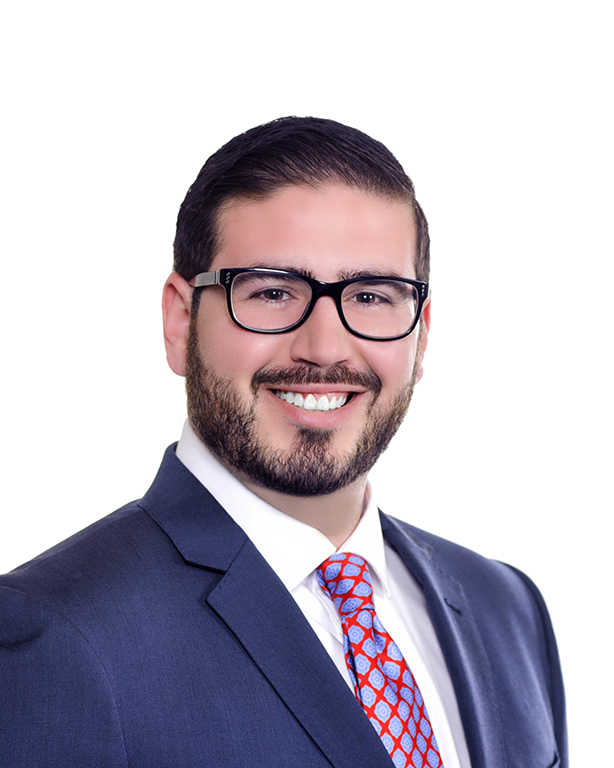
Lorenzo Law is a solo practice, and as your attorney for wills and estates I handle each step of your plan myself. The estate attorney you talk to at the consultation is the one who reviews your facts, drafts your documents, answers your questions and supervises your signing. If you call with a question after signing, you reach the same attorney.
Estate attorney, estate lawyer, estate planner: what’s the difference?
“Estate attorney,” “estate lawyer,” “wills and trusts attorney” and “trust and estate attorney” are informal names for the same kind of legal work. They describe a Florida lawyer who prepares wills, trusts and incapacity documents, and who may also handle estates after death. The label matters less than the license and the scope of the work.
“Estate planner” is different. If you search for an estate planner near me, some results will be financial advisors or document-preparation services rather than lawyers, and an estate planner who is not a lawyer cannot give you legal advice about your documents. If you are hiring an estate lawyer Florida has licensed, ask for the lawyer’s Florida Bar number and confirm it on The Florida Bar’s website.
When you need a different kind of help
This page is about planning while you are alive. If someone has already died, a family may be looking for an inheritance attorney to handle estate administration, or a successor trustee may need a trust administration attorney. Start with my Florida probate lawyer page. If there is a disagreement over a will, trust or estate, see probate litigation. Mention any notice or deadline when you contact me.
Flat fees for Florida estate planning
As a Florida estate planning attorney, I publish my prices. The consultation is free. Every estate planning engagement has a flat fee, and we agree on it before I begin drafting. These fees apply to clients throughout Florida; the estate planning package cost for one person is $1,500. Because estate planning fees here are flat, the estate planning attorney cost is known before any drafting. The engagement letter lists the documents, the implementation work and any separate costs for your circumstances.
| Service | Flat fee | What is included | Important limits |
|---|---|---|---|
| Will on its own | From $675 per person | A last will and testament | Not the core package or a trust plan |
| Core estate planning package | $1,500 per person | Will, durable power of attorney, designation of health care surrogate, living will and preneed guardian designation | A revocable trust is not included |
| Revocable living trust plan | From $2,500 (separate engagement) | Revocable living trust and pour-over will; durable power of attorney, health care surrogate designation, living will and preneed guardian designation; my review of your estate plan and trust together; guidance on your beneficiary designations | Florida deeds into the trust are priced separately (see the deed service) |
| Florida deed transferring property into your trust | $575 per deed | Review of the recorded deed, deed preparation, online notarization, witnesses, county recording fees and the minimum documentary stamp charge | Documentary stamp tax above the minimum is extra |
| Standard Lady Bird deed | $675 (separate engagement) | Speaking directly with me, deed preparation, online notarization, recording fees and the minimum documentary stamp charge | Documentary stamp tax above the minimum is extra. I confirm whether the property and circumstances fit the standard service. |
Married couples receive a discount, quoted individually. Each spouse signs his or her own documents, so do not read the $1,500 individual package price as a couple’s price.
How much does a will cost in Florida?
A will on its own starts at $675 per person. Most people also need someone who can act for them during incapacity, so the more common choice is the core estate planning package. At $1,500 per person, it includes the will plus a durable power of attorney, a designation of health care surrogate, a living will and a preneed guardian designation. For basic estate planning in Florida, the core package is where most people start. A simple will Florida residents sign with two witnesses can be the right starting point when your wishes are straightforward and your assets already pass the way you want. Both options are available wherever you live in Florida, and many clients who first looked for a will lawyer near me find that a phone or video consultation serves them just as well. Because the fee is flat, the will attorney cost doesn’t grow with your questions about the agreed documents during the engagement.
If you only need one document, the cost of power of attorney in Florida on its own, like a living will on its own, is quoted at the consultation. Most clients choose the $1,500 core package, which includes both.
How much does a trust cost in Florida?
The cost to set up a revocable living trust with me starts at $2,500, as a separate engagement. That living trust price includes the trust, a pour-over will and the full set of incapacity documents, and the trust attorney cost is fixed once we agree on the scope. As a trust attorney in Florida, I quote it once I understand what the trust needs to hold and do. Each Florida deed that moves real estate into the trust is $575. A trust plan with one qualifying Florida deed therefore starts at $3,075, plus any documentary stamp tax above the minimum. Additional Florida deeds are $575 each. Much of a trust plan, including the Florida deed, can often be handled remotely, so a search for a trust attorney near me doesn’t have to limit your choices. Some documents or powers require witnesses who are physically present; the signing section below explains when.
What does it cost to put my house in a trust?
The deed that moves a Florida home into your revocable trust is $575. That covers reading your current recorded deed, preparing the new one, online notarization, witnesses, county recording and the minimum documentary stamp charge. It is a different transaction from a Lady Bird deed, and the two fees should not be used interchangeably.
| If your goal is… | The service is… | Flat fee |
|---|---|---|
| Moving Florida real estate into your revocable living trust | Deed into the trust (part of a trust plan) | $575 per deed |
| Passing one Florida property at death while keeping control during life, without a trust | Standard Lady Bird deed | $675 |
| A full plan for all your assets, incapacity and health care | Core package or trust plan | $1,500 per person / from $2,500 |
Property outside Florida needs counsel in that state to prepare and record the deed. That work is not part of the Florida deed fee.
Married couples: does each spouse need an estate plan?
When you’re married, each spouse needs an estate plan of his or her own. Each spouse signs a separate will, power of attorney, health care surrogate designation, living will and preneed guardian designation, even when the plans mirror each other. A couple’s estate plan cost is quoted individually, with a discount.
What the flat fee does not include
When comparing the cost of estate planning package offers, check what each one leaves out. The quote identifies anything separately priced. Do not assume a document package includes:
- future amendments
- court proceedings
- tax-return preparation
- administration after a death
- deeds for property outside Florida
- documentary stamp tax above the minimum
For a trust plan, you retitle bank and brokerage accounts directly with the institution, using my guidance. Beneficiary-designation guidance does not mean I submit every institution’s forms or can guarantee an institution’s acceptance.
What affects the price of a plan
Florida estate planning cost depends on the documents and decisions involved, not the size of your estate. People comparing estate planning attorney fees often find hourly billing hard to predict. With a flat fee, your estate planning lawyer cost is known before work begins. The quote changes with:
- whether you need a trust
- how many Florida properties move into it
- property in other states
- a beneficiary who needs continuing management or benefits-sensitive planning
- the number of decisions involved, such as blended-family provisions
If your needs change after we agree on a fee, we agree on any new fee before the added work begins.
How long does estate planning take?
Timing is something we set together at the consultation. I plan around your schedule: an upcoming surgery, travel, a closing or a family visit. Tell me about any deadline when you first call.
Are flat-fee estate planning attorneys worth it?
Compared with hourly estate planning lawyer fees, a flat fee tells you the cost before you commit, and questions about the agreed documents during the engagement don’t add to the fee. Its limit is that it covers a defined scope: later amendments and new work are quoted separately. That is why the engagement spells out what is included, what is excluded and who handles each follow-up step. When you compare attorneys that do wills, ask whether each quote is flat or hourly and what it covers.
Florida estate planning documents
Estate planning Florida families can rely on starts with the right documents. The right combination depends on your circumstances. Each document should have a clear purpose, and the plan should say what still needs to happen after signing.
| Your goal | Planning choice and follow-through |
|---|---|
| Leave instructions for property passing through your estate | A will names your beneficiaries and a personal representative. Review ownership and beneficiary designations too: a will does not control every asset and does not itself avoid court administration. |
| Arrange management of selected assets during incapacity and after death | A revocable trust can give instructions to a successor trustee. Identify the right assets, complete the transfers and coordinate beneficiary designations. |
| Choose someone to exercise financial and legal authority | A durable power of attorney grants specified powers. Consider the person, successor choices and scope carefully; it generally takes effect when signed. |
| Document medical wishes and who should help | A health care surrogate designation and a living will serve different purposes. Give copies to your surrogate and health care providers. |
| State a preference if a guardian is needed | A preneed guardian designation records a nomination. It does not guarantee appointment or replace the court’s role. |
| Address a particular Florida property | Review the current deed and family circumstances before choosing a Lady Bird deed, a trust transfer or another approach. |
| Make account transfers consistent with the plan | Review account ownership and primary and contingent beneficiaries. Complete each institution’s forms and keep the confirmations. |
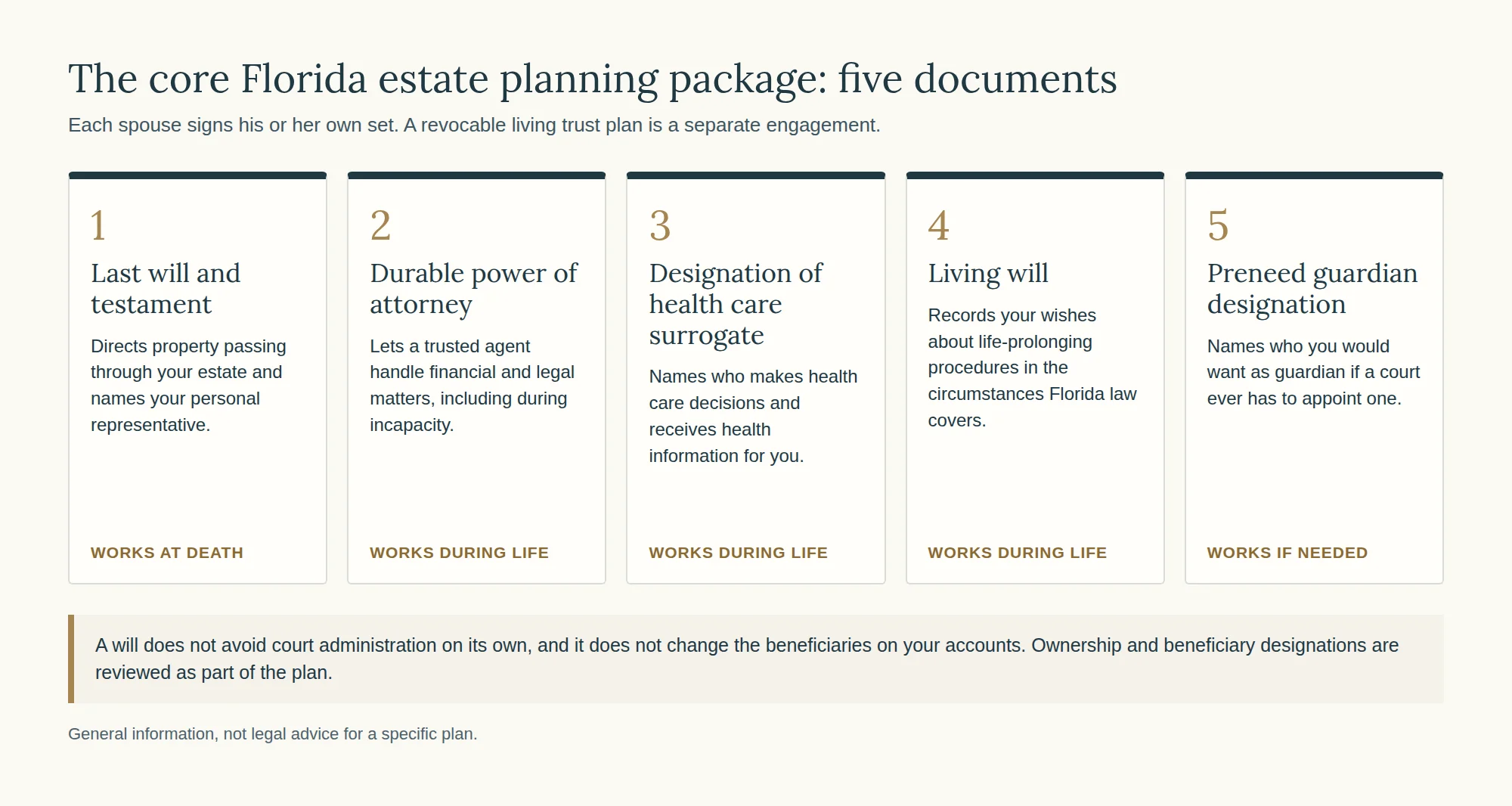
View the five-document graphic
Last will and testament
A will states your instructions for property passing through your estate. It names a personal representative, which is Florida’s term for what many people call an executor. It can also nominate a guardian for minor children, subject to the court’s appointment process.
Signing a will does not, by itself, avoid court administration. It also does not replace a power of attorney or health care documents for use while you are alive. As your last will attorney, I also review how your assets are titled, because the will controls only what passes through your estate.
Revocable living trust
A revocable living trust, often called a Florida living trust, gives instructions for managing trust assets during your life and distributing them afterward. In a typical revocable living trust Florida clients serve as their own trustee, and a successor trustee takes over at incapacity or death.
Avoiding court administration depends on the assets actually transferred to the trust, not simply on having a signed trust. A pour-over will catches assets left outside the trust, but those assets may still need court administration before they reach it.
As your living trust attorney, I draft the trust and pour-over will, prepare the Florida deeds and give you written funding guidance. A Florida trust attorney should also explain who your successor trustee will be and what that person will have to do. Read more about living trusts in Florida.
Durable power of attorney
A durable power of attorney lets a trusted person, your agent, exercise the financial and legal powers the document grants. Many people call it a financial power of attorney. The durable power of attorney Florida law recognizes today generally takes effect when executed. Durability lets it continue through incapacity, subject to applicable law. It ends at death. See when a power of attorney takes effect and termination and suspension rules.
With Florida powers of attorney, choosing an agent is a present decision about authority, not only a future emergency plan. Tell me about existing powers of attorney and any concern about who should act. A durable power of attorney lawyer can also explain the specific powers Florida treats differently, such as creating or changing a trust or changing beneficiary designations. Some of those powers carry signing requirements of their own (see the signing section below). Ask any of the power of attorney lawyers you consult how those powers will be handled at signing. If you have seen the document called a “power of lawyer,” a common translation of poder, the Florida document is the durable power of attorney. My Florida power of attorney resource explains more.
Health care surrogate and living will
In other states, people often call the health care document a medical power of attorney. If you’re looking for a medical power of attorney Florida residents can sign, the Florida document is a designation of health care surrogate. It names someone to make health care decisions or receive health information as you authorize, and it can address when that authority begins.
A Florida living will is a separate advance directive. It records your wishes about life-prolonging procedures in the circumstances Florida law covers. As your living will attorney, I make sure the two reflect your preferences and work together. Give your health care surrogate Florida designation and living will to your doctors, and keep copies where your surrogate can find them.
Despite the similar names, a living will and a living trust are unrelated. The living will concerns medical care; the living trust concerns property.
See my health care surrogate resource and Florida’s surrogate and living will statutes.
Preneed guardian designation
A preneed guardian designation names the person you would want to serve if a guardianship ever becomes necessary. The declaration is signed in front of two witnesses and can be filed with the clerk of court. If a guardianship proceeding is ever filed, it creates a rebuttable presumption that the person you named is entitled to serve. The court can still decline to appoint someone who is unqualified, or whose appointment would be contrary to your best interests (§ 744.312). Planning for a minor child’s guardian raises a separate nomination question. See adult preneed guardians and preneed guardians for minors.
Some summaries of Florida estate planning list four core documents. My core package includes this fifth one because guardianship is part of my practice, and I have seen how much a written nomination matters when a family has to go to court.
Beneficiary designations, payable-on-death accounts and joint ownership
Account titles and beneficiary designations work alongside your documents. Retirement accounts, life insurance and payable-on-death (POD) or transfer-on-death (TOD) accounts pass to the named beneficiary. Signing a new will does not change a bank’s or insurer’s records. Bring the actual designations if you can.
Florida has no transfer-on-death deed for real estate; the Lady Bird deed fills that role. Florida also has no transfer-on-death titling for cars or boats. My beneficiary designation resource explains why this coordination matters.
Other trusts: irrevocable, special needs and dynasty trusts
Some goals call for a different kind of trust, and each is scoped and quoted on its own. For an overview of every kind of trust, see the Florida trusts guide.
- An irrevocable trust generally cannot be changed as freely as a revocable trust. It is used for particular tax, asset-protection or benefits goals, so talk with an irrevocable trust attorney about your goals before assuming you need one.
- A special needs trust attorney plans around a beneficiary’s means-tested benefits. A special needs trust Florida families set up for a child or relative is its own engagement. See the special needs trust resource.
- A trust for a child or other beneficiary can include a spendthrift provision. In a Florida spendthrift trust, the beneficiary’s creditors generally cannot reach the trust money before it is distributed (§ 736.0502). Florida makes exceptions, including support claims by the beneficiary’s child, spouse or former spouse, and certain claims of the state or federal government (§ 736.0503). This protection works for the people you leave money to; it does not work for your own revocable trust.
- For multigenerational planning, a dynasty trust Florida law permits can last for many generations; see dynasty trusts.
Will vs. trust in Florida: how to decide
Most will vs trust Florida questions come down to a few facts about your family and property. Estate planning and trusts are often discussed as if they were the same thing, but a trust is one tool among several. Start with what the plan needs to accomplish; a wills & trusts lawyer should walk you through both options before recommending either. Consider how your assets are held, whether a beneficiary needs continuing management, how someone would act during incapacity, and what work you are prepared to complete after signing.
When weighing a will versus trust in Florida, remember that a will-based plan may fit. A trust may be useful where continuing management or coordinated transfers would serve your goals. Real estate in more than one state, a blended family, or a beneficiary who should not receive an immediate outright distribution each warrant a closer conversation. None of those facts decides the answer by itself.
| Question | Will and trust considerations |
|---|---|
| What happens during incapacity? | A will gives no lifetime financial authority. A trust can provide management of trust assets under its terms; a power of attorney covers other granted powers. |
| What avoids court administration? | A will alone does not. Properly arranged trust ownership and other valid nonprobate transfers can keep particular assets out of the estate. |
| Can distributions continue over time? | Trust provisions can set management and distribution terms. Discuss who would serve and what that person would have to do. |
| What about privacy? | Trust administration can be more private than court administration, but a trust is not a guarantee of secrecy or freedom from litigation. |
| What happens after signing? | Both require attention to ownership and beneficiaries. A trust also requires the planned funding steps; drafting alone is not completion. |
| What does it cost? | Core package with a will: $1,500 per person. Trust plan: from $2,500, plus $575 per Florida deed. |
How much should a will and trust cost in Florida? Here, you know both numbers before you choose, because the fees are flat and published.
Who needs a trust instead of a will in Florida?
A trust deserves a serious look if you:
- own real estate in more than one state
- want a child’s inheritance held until an age you choose
- have a blended family
- have a beneficiary who receives benefits or shouldn’t receive money outright
- want a successor to step in without a court if you become incapacitated
A revocable living trust lawyer should explain what the trust will and won’t do for your particular assets before you pay for one. When comparing revocable living trust attorneys in Florida, ask who prepares the deeds and who completes each funding step.
What are the downsides of a living trust in Florida?
How much does a living trust cost in Florida? With me, from $2,500, which is more than a will-based plan. It only works for assets you actually transfer into it. It needs updating when you buy, sell or refinance. A revocable trust also does not protect your assets from your own creditors while you are alive, because you keep control of it. Estate planning asset protection is a separate subject with its own tools, and an irrevocable trust lawyer can explain whether any of them fit your situation. None of these is a reason to avoid a trust. They are reasons to choose one deliberately.
Should my house go into a living trust?
Often, but first review your deed, your mortgage, your homestead status and your family (see the next section). For some owners, a Lady Bird deed reaches the same result for the home at a lower cost. When the house does go into the trust, the $575 deed fee covers the transfer, on top of the living trust lawyer cost for the plan itself.
Which assets usually stay outside the trust?
What assets should not go in a living trust? Retirement accounts, in most plans: they are usually coordinated through their beneficiary designations rather than retitled. Do not transfer a retirement account into a trust without advice about that account and its tax consequences. Life insurance and POD accounts also pass by designation, which may name the trust or a person, depending on the plan.
Your Florida home: homestead, trust deeds and Lady Bird deeds
Start with your current recorded deed and what you want to happen to the property. Tell me about co-owners, your spouse or minor children, mortgages, existing trusts and the people you want to name.
Florida’s homestead rules can limit how the family home is left at death. The general rule restricts devise when the owner is survived by a spouse or a minor child; the spouse exception applies when there is no minor child. See Florida Statutes § 732.4015.
A common misunderstanding is that moving the home into a revocable living trust gets around this rule. It does not. A revocable trust is still subject to the homestead devise restriction, so the trust terms must be drafted with it in mind. Ownership, any applicable waivers and the proposed transaction need individual analysis.
The property tax side works differently. Moving your Florida home into your revocable trust does not, by itself, cost you the homestead property tax exemption, as long as the trust gives you the beneficial interest for life that Florida’s exemption statute recognizes (§ 196.041). The trust has to be drafted with that in mind. Protecting the Florida homestead exemption revocable trust owners rely on means reviewing the trust and the deed together before anything is signed.
A spouse who does not own the home can sign a deed containing the waiver language Florida law provides (§ 732.7025). A qualifying deed waiver can waive the spouse’s homestead devise-restriction rights. It does not waive a minor child’s protection or eliminate other applicable homestead requirements (§ 732.4015). It also does not remove the home’s protection from creditors, and it does not end the requirement that both spouses sign to sell or mortgage the home.
Suppose a homestead owner dies survived by a spouse and descendants, and the home was not validly left to anyone. Then the spouse receives a life estate, and the descendants receive the remainder. Within six months after the death, the spouse can instead elect an undivided one-half interest, shared with the descendants. That election is made by recording a notice, and it cannot be undone (§ 732.401). The six-month deadline cannot be extended except in one situation: if the spouse’s agent under a power of attorney or guardian of the property petitions the court for approval within the six months, the deadline runs until at least 30 days after the court’s order. A pending dispute over homestead status or the will does not pause the clock.
Married owners may hold the home as tenants by the entirety. That generally passes the property to the surviving spouse by survivorship, and Florida gives it particular protection from the creditors of only one spouse. A plan should account for how the home is titled today before changing it.
Florida has no transfer-on-death deed. The Lady Bird deed, an enhanced life estate deed, lets you keep control of your home during life and name who receives it at death. It may fit a plan for a particular Florida property, but it doesn’t replace decisions about other assets, financial authority or medical care. The Lady Bird deed service explains its scope, and my comparison of a Lady Bird deed and a living trust can help you choose. You can also read what happens with a Lady Bird deed after the owner’s death.
Adding a child to your deed “so the house avoids probate” is a different transaction. It generally gives the child an ownership interest now. It can affect ownership, creditor exposure, property-tax treatment and income-tax basis. The result depends on the deed, retained rights and each owner’s circumstances. The homestead property-tax exemption shows why the form matters. If you add a child who doesn’t live there as a joint tenant with right of survivorship, you keep the full exemption; as tenants in common, your exemption is limited to your share (§ 196.031). If you keep a life estate and give the child the remainder, you keep the full exemption as the resident life tenant (§ 196.041). Talk it through before signing anything.
Who I work with
Wills and estate planning look different for every household. Every plan starts from the same questions, but the answers change with your family and your assets. These are the situations I see most often, and each one a Florida estate planning attorney should ask you about.
Married couples
Each spouse signs his or her own documents, and the plans should work together. Florida gives a surviving spouse rights that a plan has to account for, including an elective share of 30% of the elective estate. Florida law also lets married couples hold property in a community property trust. Florida’s statute is written so the trust is treated as community property for the federal rule that can give both halves a new income-tax basis at the first spouse’s death (§ 736.1511). Federal confirmation of that result for Florida trusts is not yet settled, so it is analyzed individually before I recommend one. See surviving spouse rights in Florida.
Parents of minor children
Estate planning for young families starts with who would raise your children. A will lets you nominate a guardian for your children, and a preneed designation records your choice of guardian for a minor. Money is a separate question. Without a court appointment, a parent can collect and manage settlement proceeds, estate or trust distributions, and insurance or benefit-plan proceeds for a minor child only up to $15,000 in total (§ 744.301). Larger amounts can require a court-supervised guardianship of the property. A custodian under Florida’s Uniform Transfers to Minors Act can manage property without court oversight. A custodianship created by will or gift generally ends at 21, although the transferor may select 25. For an irrevocable lifetime gift or an irrevocable lifetime exercise of a general power of appointment, the beneficiary still has a right to demand the entire property at 21, subject to the statute’s notice and exercise-period rules (§ 710.123). Money a child holds outright is the child’s to control at 18 (§ 743.07). A trust for your children lets you choose who manages the money and until what age.
Blended families and second marriages
In a second marriage, most people want to protect a spouse and their own children at the same time. Florida’s intestacy rules and class gifts treat a stepchild differently from a child unless the stepchild is adopted, so a stepchild you raised can be left out without clear drafting. Homestead and the elective share also shape what a blended-family plan can do. This is where a trust is most often worth its cost.
Marrying after you sign a will does not cancel it. But a spouse the will does not provide for may be protected by Florida’s pretermitted-spouse statute. It does not apply if a premarital or postnuptial agreement provides for or waives the spouse’s share, if the will provides for the spouse, or if the will shows an intent not to provide for the spouse. If the pretermitted-spouse statute applies, the spouse may receive the share provided by Florida’s intestacy rules. That share depends on the surviving descendants and family relationships; it is not always one-half. With no surviving descendants, it is the entire intestate estate (§ 732.301; § 732.102).
Florida law gives second-marriage planning specific tools:
- An elective share trust. A trust can give your spouse the income or use of property for life, with the remainder to your children. If it meets Florida’s requirements, it counts toward your spouse’s elective share (§ 732.2025).
- A written waiver of spousal rights, signed before or during the marriage (see the next section).
- A deed waiver for the home. A qualifying deed waiver can waive the spouse’s homestead devise-restriction rights. It does not waive a minor child’s protection or eliminate other applicable homestead requirements (§ 732.7025; § 732.4015).
Prenuptial agreements and spousal waivers
A Florida spouse can waive the rights the law would otherwise give at death:
- the elective share
- the intestate share and the pretermitted share
- homestead rights
- exempt property and the family allowance
- the preference to serve as personal representative
Under § 732.702, the waiver can be signed before or after the wedding, and it must be in writing and signed in front of two witnesses. A waiver signed after the marriage requires each spouse to make a fair disclosure of his or her estate to the other. The disclosure rules in § 732.702 are specific to that Probate Code waiver; a premarital agreement is also judged under the family-law statute below, which has its own disclosure and knowledge requirements.
A premarital agreement can also decide what happens to property at death, and it must be in writing and signed by both of you (§ 61.079). Enforceability depends on the applicable statute, voluntariness, fraud or coercion issues, and the statutory financial-disclosure and knowledge requirements. Death-related spousal waivers must also be assessed under § 732.702.
Any waiver of death-related spousal rights inside a premarital agreement should also meet the two-witness rule above. If a premarital agreement is being negotiated, coordinate it with your will, trust and beneficiary designations so they all point the same way.
Unmarried partners and LGBTQ+ couples
An unmarried partner does not inherit through Florida’s intestacy rules merely because of the relationship. Joint ownership, beneficiary designations and other arrangements can change what passes outside the intestate estate. If no health care surrogate has been designated, Florida’s list of people who may make medical decisions puts a guardian, spouse, adult children, parents, adult siblings and qualifying relatives first. A partner may qualify as a “close friend” who signs an affidavit, but that tier comes after those people (§ 765.401). Explicit appointment is more reliable: a will or trust, a health care surrogate designation and a durable power of attorney let you choose. If you are looking for an LGBT estate planning attorney, you will be treated with respect here, and your plan will be drafted around your family as it is.
Estate planning for gay couples who are married follows the same Florida rules as for any married couple. Unmarried couples, of any kind, need their documents even more.
The documents are the same ones every family needs. Estate planning for LGBTQ+ families simply has to name the right people, because the law’s default list may not.
New to Florida, and seasonal residents
Florida estate planning laws differ from other states on homestead, witnessing and powers of attorney. Moving to Florida is a good reason to review your plan, but not automatic proof that the old plan is invalid. Will and estate lawyers in your former state drafted for that state’s rules, so a Florida review is worth doing. Florida recognizes qualifying wills executed by nonresidents under the law of the place of execution, with statutory exceptions. Your powers of attorney, health care documents, homestead status and the people you named all deserve a look. Seasonal residents with homes in two states should ask how each property is titled.
Property in more than one state
Real estate in another state can require a separate court proceeding there after death. See Florida ancillary probate for how that works in the other direction. A trust holding both properties can avoid that. The deed for property outside Florida must be prepared and recorded by counsel in that state.
Business owners
A business interest needs a succession plan. That means who runs it if you can’t, who owns it after you, and how that fits the company’s own agreements. Bring your operating agreement or shareholder agreement to the consultation so the estate plan and the business documents point the same way.
A beneficiary with special needs
Estate planning for special needs Florida beneficiaries starts early. If a beneficiary receives means-tested benefits or has disability-related needs, raise it at the beginning. An ordinary outright gift or standard trust may not fit. A special needs trust is a specialized engagement with its own scope discussion, and a special needs trust lawyer should explain how it fits the beneficiary’s benefits.
Aging parents, capacity and elder law
Families often call about a parent’s plan. The parent is the client, and capacity to sign is judged at the time of signing. If your question involves elder law and estate planning together, such as nursing-home costs or Medicaid, raise it at the start: long-term-care benefit planning needs its own scope discussion. Estate planning for incapacitated adults has a hard limit: a person who no longer has the capacity to sign cannot make a new will or power of attorney. If a parent can no longer sign, a guardianship may be the remaining path; see the Florida guardianship guide.
International families
If you or your spouse is not a U.S. citizen, or you own assets abroad, tell me at the start. As a general federal estate-tax rule, property passing at death to a surviving spouse who is not a U.S. citizen qualifies for the marital deduction only through a qualified domestic trust (QDOT) (IRC § 2056(d)). There are statutory exceptions: for example, no QDOT is needed if the spouse becomes a U.S. citizen before the estate tax return is filed and was a U.S. resident at all times after the death. Lifetime gifts to a noncitizen spouse follow a separate rule: a larger annual exclusion instead of the unlimited marital deduction (IRC § 2523(i)). Not every family with a noncitizen spouse needs a QDOT. Nonresident noncitizen estates follow different federal rules. I prepare the Florida side of the plan and flag where counsel in another country or an estate tax lawyer is needed. Consultations are available in English and Spanish, so Spanish-speaking relatives can take part.
Leaving money to charity
You can leave a charity a set amount, a percentage of what remains, or a specific account. A retirement account can be an efficient gift to a qualified charity, because the charity does not pay income tax on it. It should be arranged so it doesn’t affect your other beneficiaries. Name the charity exactly, and plan for what happens if it later merges or closes. See leaving money to charity in Florida.
Widows and widowers
Losing a spouse changes almost every document in a plan: beneficiaries, agents, the surrogate and the home. A surviving spouse who holds title and keeps the home as a permanent residence can hold the homestead property tax exemption in his or her own right. Florida also has a separate $5,000 property tax exemption for a widow or widower who is a Florida resident (§ 196.202). See estate planning for widows in Florida.
How the engagement works
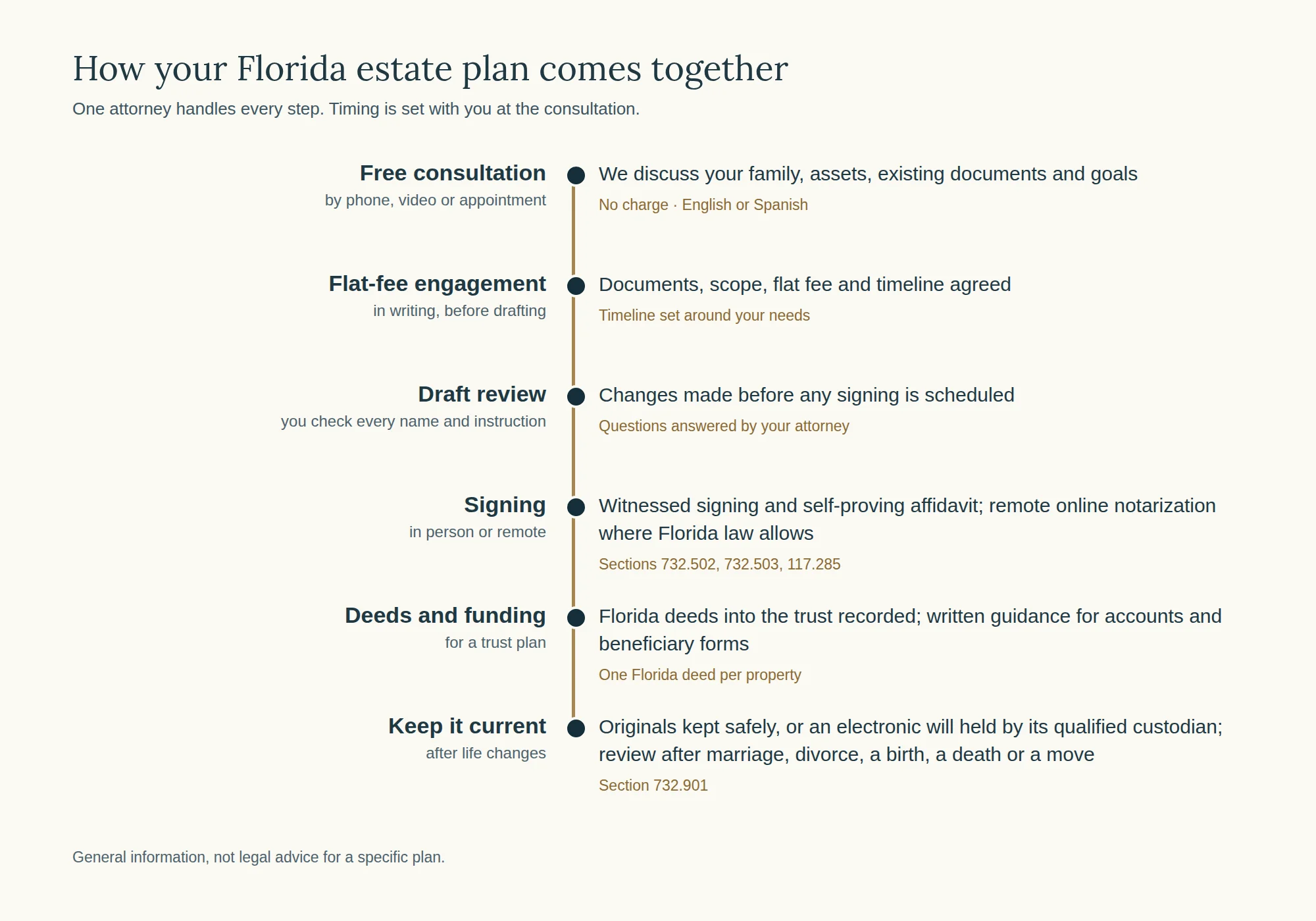
1. Free consultation
We talk through your family, your assets, your existing documents and the decisions you want help with. Tell me about a health concern, upcoming travel or another timing issue. The consultation is free, by phone, by video or in person by appointment in Coral Gables or Fort Lauderdale. If you were looking for a will and trust attorney near me, this first conversation is where we decide how to meet.
Estate planning documents checklist: what to bring
Use this estate planning checklist before the consultation. Have these available if you can:
- existing wills, trusts, powers of attorney and health care documents
- a general list of your assets and how each is owned, including property outside Florida
- current recorded deeds for Florida real estate
- beneficiary records for retirement accounts, life insurance and other accounts
- the people you want to provide for, and the people you would appoint, with alternates
- questions about children, a blended family, a beneficiary’s needs or a recent life change
- any timing concern that may affect review or signing
There is no Florida estate planning questionnaire to fill out first; this list is enough, and you do not need a complete inventory to schedule a consultation. Don’t send account passwords or sensitive records in a first general message; ask how I would like documents provided.
2. Flat-fee engagement
You receive the proposed documents, the scope and the flat fee in writing. We identify:
- whether Florida property transfers are needed
- what the beneficiary guidance will cover
- which tasks you will complete with financial institutions
We also set a timeline that works for you.
3. Draft review
Check the names, appointments, beneficiaries and instructions. Ask how the documents work together, when each person’s authority begins, and what happens if the first person you name cannot serve. Raise changes before signing is scheduled.
4. Signing
Signing is in person by appointment in Coral Gables or Fort Lauderdale, or remote by online notarization, depending on the documents, the people involved and the legal requirements (see the next section). I explain the arrangements before execution.
5. Follow-through
Deeds are recorded. You receive written guidance for each account and beneficiary step. We confirm where the originals are kept and who knows how to find them.
Signing your documents: in person or remotely
For an ordinary paper will, Florida requires the testator to sign at the end. Alternatively, another person may subscribe the testator’s name there, in the testator’s presence and at the testator’s direction. The testator must sign or acknowledge the signature in the presence of at least two attesting witnesses, and the witnesses sign in the presence of the testator and each other. See Florida Statutes § 732.502. These state of Florida will requirements are where homemade wills most often go wrong.
How many witnesses does a Florida will need?
Two. Both attesting witnesses must be present when you sign or acknowledge your signature, and they sign in your presence and in each other’s. Those Florida will witness requirements, together with the signature rule, are the execution formalities. Validity also depends on the testator’s capacity and on the will’s content and circumstances, so proper signing is only part of the question.
Does a Florida will need to be notarized?
An ordinary paper will does not need notarization merely to satisfy § 732.502’s execution formalities. Notarization is used for the self-proving affidavit described below, which I include with every will I prepare. Remotely witnessed electronic wills have additional requirements (§ 732.522).
In short, Florida will notary requirements apply to the self-proving affidavit and to remotely witnessed electronic wills, not to an ordinary paper will’s execution. In Florida estate planning, a notary takes acknowledgments and oaths, such as the self-proving affidavit and the acknowledgment on a power of attorney or deed. An estate planning notary is not a substitute for legal advice about what the documents say.
Handwritten and online wills
Handwriting does not replace the required formalities. Florida’s recognition rule for wills executed by nonresidents excludes holographic and nuncupative wills. It does recognize a handwritten will properly executed under the statute. A will from an online form is judged by the same Florida will signing requirements. Its source doesn’t make it valid or invalid; how it was signed matters, along with capacity and what the document says. Many last will and testament lawyers, including me, will review a will you prepared from an online form.
The self-proving affidavit
A self-proving affidavit can make a will easier to prove later. The testator’s acknowledgment and the witnesses’ affidavits are made before an authorized officer under § 732.503. A qualifying self-proved will may be admitted without further proof under § 733.201. Without it, someone may have to locate your witnesses years later. A will signed in 2010 may need a witness found in 2036. Self-proof is not a guarantee against a contest, and a will without it is not automatically invalid: the statute provides other ways to establish it.
Remote signing by online notarization: yes, I offer it
You don’t have to travel to sign. For documents Florida allows to be executed remotely, I supervise signing by remote online notarization, with the witnesses and notary appearing by live audio-video under § 117.285. The session is recorded, which creates a lasting record of the signing. See how the online estate planning process works from start to finish.
Florida sets limits I apply at every remote signing. The first two apply to the instruments listed in § 117.285(5): wills, revocable trusts with testamentary aspects, health care advance directives, agreements concerning succession and waivers of spousal rights, and powers of attorney authorizing the transactions listed in § 709.2208:
- Screening questions. Before a remotely witnessed signing of a covered instrument, the signer is asked whether they are under the influence of any drug or alcohol that impairs their ability to make decisions, have a physical or mental condition or long-term disability that impairs the normal activities of daily living, or require assistance with daily care. Any “yes” means that instrument can be validly witnessed only by people physically present.
- Vulnerable adults. Remote witnessing is not effective for a covered instrument signed by a vulnerable adult.
- Special powers of attorney. A power of attorney whose witnesses were not physically present with the principal cannot grant the special powers Florida treats separately. These include creating, amending or revoking a trust, making gifts, and changing beneficiary designations. Those are often the powers a family needs most in a long-term-care crisis.
When a plan needs those powers, part of the signing happens in person.
Electronic wills
Florida allows electronic wills, and I prepare them for clients who choose one. When the witnesses appear remotely, the will is signed in an online notarization session supervised by a notary, and the § 117.285 requirements, including the screening questions, apply (§ 732.522). A qualified custodian is not required for an electronic will to be valid. Self-proof requires compliance with § 732.523, including the acknowledgment and witness affidavits, designation and continuous custody of a qualified custodian, and the required custodian certification. Where a qualified custodian holds the will, the custodian deposits it with the clerk of court after a death (§ 732.524). I explain at the consultation whether an electronic will or a paper original fits your plan, and we confirm the custody and deposit arrangements for your electronic will.
Trust signing formalities
A revocable trust Florida residents sign has its own formalities. For a Florida domiciliary, the testamentary aspects of a revocable trust must also satisfy Florida’s will-execution formalities, subject to the statutory provisions. See § 736.0403. Each document’s signing is planned on its own terms; one method doesn’t fit all of them.
When signing in person is the better choice
Remote signing is convenient, but in-person signing is sometimes stronger. Examples: a signer whose capacity may later be questioned, a family where someone may claim pressure, or a plan that needs the special powers of attorney above. In those cases I’ll recommend meeting in person, by appointment in Coral Gables or Fort Lauderdale.
After signing: funding your trust and keeping your plan current
A trust plan is complete when the assets are where the plan says they should be. The table shows who handles each step. If you are comparing trust lawyers near me, ask each one who handles the steps in this table.
| Asset | What usually happens | Who does it |
|---|---|---|
| Florida real estate | Deed into the trust, recorded | Me ($575 per deed) |
| Real estate in another state | Deed prepared and recorded under that state’s law | Counsel in that state |
| Bank and brokerage accounts | Retitled to the trust, or given a POD/TOD designation that fits the plan | You, with my written guidance |
| Retirement accounts | Beneficiary designations coordinated; not retitled without advice | You, with my guidance |
| Life insurance | Beneficiary designation reviewed | You, with my guidance |
| Vehicles and boats | Handled under the plan; Florida has no TOD title for them | Discussed case by case |
| Business interests | Coordinated with the company’s agreements | Discussed at the engagement |
| Digital assets and accounts | Florida’s digital asset law (ch. 740) governs access; authority can be addressed in the plan | Discussed at the engagement |
Where your original documents are kept
Confirm who holds each original and how your chosen representatives will find it. A paper will’s original matters; a scan is not a substitute. For an electronic will, confirm the custody and deposit arrangements; self-proof requires continuous custody by a qualified custodian (§ 732.523). During your lifetime, a Florida will is not recorded or filed anywhere. After a death, whoever holds the original must deposit it with the clerk of court within 10 days of learning of the death (§ 732.901).
When to update your estate plan
Review your plan after:
- a marriage, divorce, birth or death
- a significant change in assets
- a move to or within Florida
- a change in the people you trust to act
Also review it before assuming newly acquired property is already covered. New property may need a deed or a beneficiary form.
Divorce changes some documents automatically, but not all of them. When a Florida marriage is dissolved, provisions for the former spouse are voided in:
- a will (§ 732.507)
- a revocable trust (§ 736.1105)
- beneficiary designations on covered assets such as life insurance, IRAs and payable-on-death accounts (§ 732.703)
There are exceptions, including assets where federal law controls, such as many employer retirement plans. Review every designation after a divorce, and sign new documents rather than relying on the automatic rules.
Florida estate planning mistakes to avoid
- An unfunded trust. A signed trust with the house still in your own name leaves the house outside the trust.
- A will signed without both witnesses present. The witnesses must sign in the presence of the testator and each other.
- Ignoring homestead. A will or trust that leaves the home in a way the homestead rules don’t allow does not do what it says.
- Stale beneficiary designations. An ex-spouse or a deceased parent still named on a retirement account or life policy. Florida’s automatic revocation on divorce does not reach assets where federal law controls.
- Believing a power of attorney works after death. It ends at death.
- Relying on a no-contest clause. Florida does not enforce no-contest clauses in wills or trusts (§ 732.517; § 736.1108), so a plan has to prevent disputes some other way.
- Adding a child to the deed instead of planning (see “Your Florida home”).
- No successor named. Every personal representative, trustee, agent and surrogate needs a backup.
- Leaving money outright to a minor. Above $15,000 in total, a parent generally cannot manage a child’s money without a court-supervised guardianship of the property (§ 744.301). A trust or custodianship lets you choose who manages the money.
- Using a form without advice. Can I write my own will without a lawyer? You can, but a form cannot tell you whether it fits your homestead, your family or your accounts.
What happens if you do nothing?
Do you need a will in Florida? No law requires one, but without it, Florida decides for you. For property subject to intestate succession, Florida law supplies the inheritance rules when a valid will does not dispose of it. Those rules may not match your wishes. Joint ownership and beneficiary arrangements can still govern other property; having no will does not mean every asset goes through the court. See § 732.101.
Planning also covers decisions while you are alive. Without a durable power of attorney and a health care surrogate designation, the people you want to help may need a court guardianship to act for you. Guardianship is part of my practice, and much of it is avoidable. A living will lawyer can also record your wishes about life-prolonging procedures, so your family isn’t left guessing. Make these decisions while you can take part, even if your estate is modest. Estate planning is about who decides and how, not how much you own.
Estate and gift taxes for Florida residents
There is no Florida estate tax and no Florida state inheritance tax on beneficiaries. Federal rules are separate. The so-called death tax Florida residents sometimes ask about doesn’t exist at the state level. For 2026, the federal basic exclusion is $15 million per U.S. citizen or resident, but taxable gifts and other circumstances matter.
- Portability is not automatic. It requires a timely estate tax return (IRS Form 706) after the first spouse’s death, so marriage alone does not create a $30 million exclusion.
- Gifts. The annual gift exclusion is $19,000 per recipient.
- Non-citizen spouse. As a general rule, property passing at death to a non-citizen spouse qualifies for the estate-tax marital deduction only through a qualified domestic trust, subject to statutory exceptions (IRC § 2056(d)). Lifetime gifts to a non-citizen spouse get a larger annual exclusion rather than the unlimited marital deduction (IRC § 2523(i)).
- Nonresident noncitizens. Their estates follow different rules. If you own Florida property but live abroad, the estate tax Florida non-resident owners may face comes from federal law.
See the Florida Department of Revenue, the IRS Form 706 instructions and my page on Florida inheritance tax.
For most families, tax is not the planning problem; incapacity, beneficiaries and transfers are. If you have significant lifetime gifts, a non-U.S. connection or an estate near the federal figure, have the plan reviewed by an estate tax attorney or a CPA. Raise it at the consultation; I coordinate the Florida documents with your tax advisers and flag when one should be involved.
Estate planning throughout Florida
I serve individuals and families in all 67 Florida counties. Most clients never need to travel: whether you searched for an estate attorney near me or a Florida-wide practice, consultations are by phone or video, and many documents can be signed remotely. For in-person meetings, I meet clients by appointment in Coral Gables and Fort Lauderdale; those are the only in-person appointment locations. My principal office is in Kissimmee. “Served remotely” in the table means phone or video consultations and remote signing where Florida law allows it.
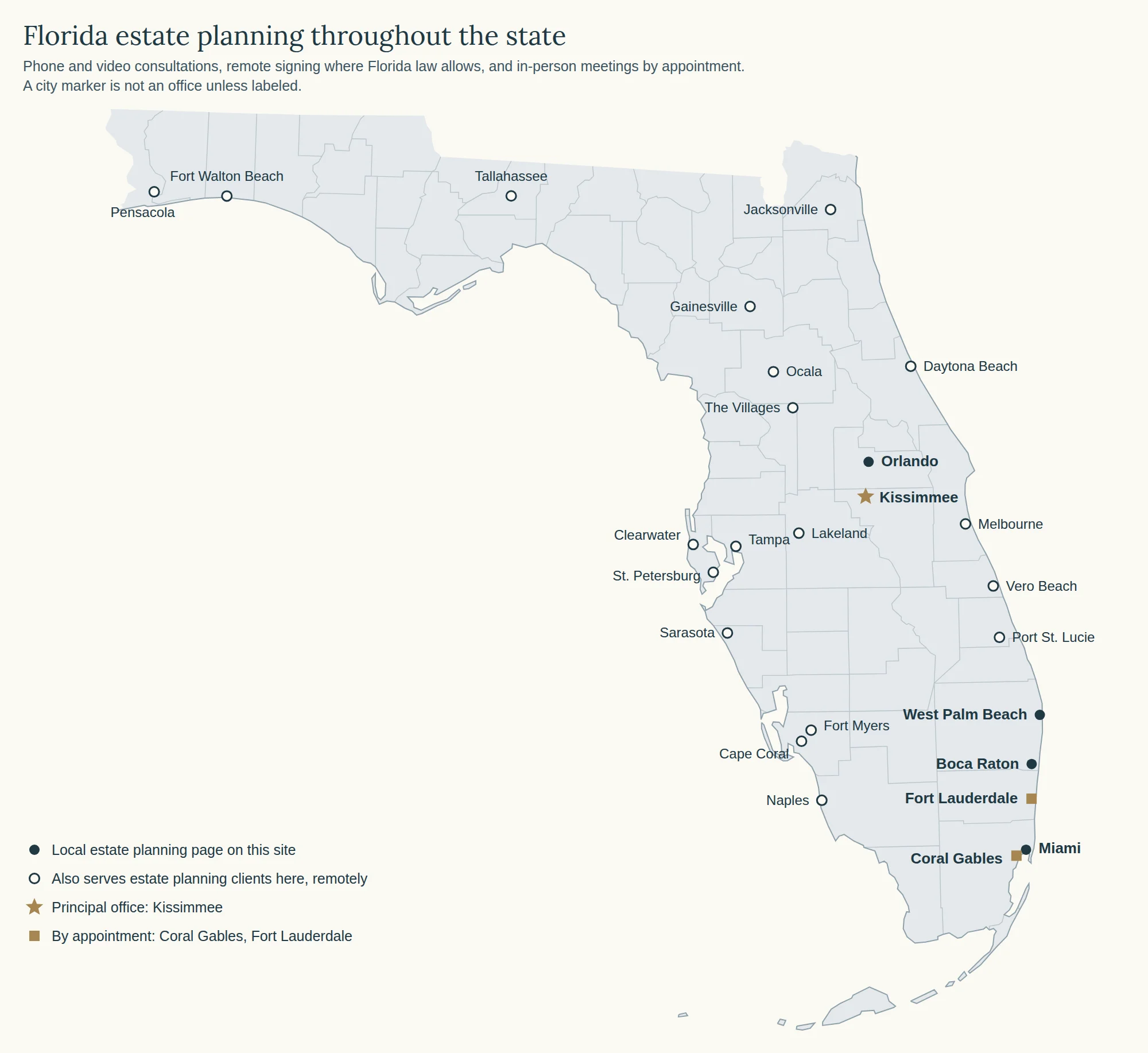
| Region | Communities I serve | Local page |
|---|---|---|
| South Florida | Miami, Coral Gables, Miami Beach, Kendall, Fort Lauderdale, Hollywood, Pembroke Pines, Weston, Boca Raton, West Palm Beach, Delray Beach | Miami estate planning · Coral Gables estate planning · Fort Lauderdale estate planning attorney · Palm Beach County estate planning |
| Central Florida | Orlando, Winter Park, Kissimmee, Celebration, Osceola County, Lakeland, Daytona Beach, Ocala, The Villages | Orlando estate planning |
| Tampa Bay and Sarasota | Tampa, St. Petersburg, Clearwater, Sarasota | Served remotely |
| Southwest Florida | Naples, Fort Myers, Cape Coral | Served remotely |
| North Florida and the Panhandle | Jacksonville, Gainesville, Tallahassee, Pensacola, Fort Walton Beach | Served remotely |
| Space and Treasure Coasts | Melbourne, Port St. Lucie, Vero Beach | Served remotely |
If you want an estate planning attorney South Florida clients can meet in person, the Coral Gables and Fort Lauderdale appointment locations are nearby. Clients looking for an estate attorney Florida-wide get the same flat fees and the same attorney. From Pensacola to Key West, a search for “lawyer wills and trusts near me” leads to the same service.
Looking for an estate planning attorney near me?
Most people who look for an estate planning attorney near me want a lawyer they can actually reach. What matters is access to the lawyer, not the mileage. If you are comparing estate planning lawyers near me or estate law firms near me, ask each one who will draft your documents and who will be at your signing.
If you would rather work with a local estate planning attorney you can visit, and you live in the Miami or Fort Lauderdale area, I am also a South Florida estate planning attorney who meets clients by appointment in Coral Gables and Fort Lauderdale. Florida law is the same in every county, and I work with clients wherever they live in the state: by phone, by video and with remote signing. If being near your lawyer matters most to you, tell me where you are and we’ll plan around it.
Choosing an estate planning attorney in Florida
You have many choices. Florida estate planning lawyers range from solo practitioners to firms with dozens of attorneys. The practical question is who will know your file, answer your questions and supervise your signing.
How to find a good estate planning lawyer
What type of lawyer do I need for estate planning? A lawyer licensed in Florida who prepares wills, trusts and incapacity documents. If you are wondering how to find a good attorney for estate planning, look for four things:
- a Florida Bar number you can verify
- a clear explanation of what is included and what it costs, before you commit
- someone who asks about your family and assets before recommending documents
- an answer to who will handle your plan after the first meeting
Every estate planning attorney Florida licenses has a Bar number you can check. When comparing estate planning law firms, remember that law firms’ estate planning quotes are only comparable if they cover the same documents, deeds and follow-up steps.
A solo practice compared with firms that have more lawyers
Firms with several lawyers can offer depth on a bench of lawyers, and they may divide the work among attorneys and staff. That is a fair trade-off to weigh.
What my solo practice offers is continuity: an estate planning lawyer Florida families can reach directly. I hear your goals, draft your plan, explain it and supervise your signing. When you compare Florida estate lawyers, ask each one who will actually do the work, what the flat fee includes and who signs off on the final documents.
Nobody can honestly promise to be the best estate planning attorney for every family. What you can compare is published prices, direct access to the lawyer, and whether that lawyer has seen what happens to plans after death.
Questions to ask before you hire
Whether you are comparing estate plan attorneys near me or across the state, ask these questions before you hire any lawyer, including me:
- Who drafts my documents and who supervises the signing?
- Is the fee flat, and what exactly does it include?
- Who prepares and records the deed into my trust, and who retitles my accounts?
- Can I sign remotely, and which documents need to be signed in person?
- How will I reach you if I have a question after signing?
Online forms and do-it-yourself documents
If you are deciding between a form and one of the lawyers that do wills near me, consider what can go wrong. A form can be signed incorrectly. It can conflict with Florida’s homestead rules, leave a beneficiary designation pointing the wrong way, or leave no backup for the person you named. None of those problems shows until the document is needed. I do not offer forms or templates. If you already have a document you prepared yourself, bring it; it may not need to be thrown out.
Frequently asked questions
What is the average cost for estate planning in Florida?
The average cost of an estate plan depends on the documents, and the average cost of estate planning quoted by lawyers for wills and trusts varies with what is included. At Lorenzo Law, the flat fees are:
- a will from $675 per person
- the core package (will, durable power of attorney, health care surrogate designation, living will and preneed guardian designation) at $1,500 per person
- a revocable living trust plan from $2,500, plus $575 per Florida deed into the trust
Married couples receive an individually quoted discount.
Do I need a will in Florida?
If you want to choose who receives the property passing through your estate and who administers it, yes. People often ask, “What happens if I die without a will in Florida?” Florida’s intestacy rules decide for that property. Assets with beneficiary designations or joint ownership pass on their own terms either way.
Do I need a trust in Florida?
Not always. The cost of a revocable living trust in Florida with me starts at $2,500, and many people are well served by the core package with a will, plus up-to-date beneficiary designations. A trust earns its cost in the situations described under “Who needs a trust instead of a will in Florida?” above.
Is it better to have a will or a trust in Florida?
Is a trust better than a will in Florida? Neither is better in every case. A will-based plan is often enough when assets already pass by beneficiary designation or joint ownership. A trust is worth considering for real estate in more than one state, children’s inheritances held over time, blended families, or management during incapacity without a court. The comparison table above sets out the differences.
What documents do I need for estate planning in Florida?
Most adults need five: a will, a durable power of attorney, a designation of health care surrogate, a living will and a preneed guardian designation. Those five are the core package, and the surrogate designation is the healthcare power of attorney Florida residents sign under a different name. Some people also need a revocable living trust and a pour-over will, plus deeds and beneficiary updates to fund it.
Do I need a lawyer to make a will in Florida?
Florida doesn’t require one, but a will must meet the statute’s signing requirements, and it has to work with homestead rules and your beneficiary designations. A Florida estate planning attorney checks both, and the self-proving affidavit I include makes the will easier to prove later. The will lawyer cost here starts at $675 per person, and you don’t need a will attorney near me to get it: the consultation and signing can be remote.
Does a will need to be notarized in Florida?
An ordinary paper will does not need notarization merely to satisfy § 732.502’s execution formalities; it needs two witnesses who sign in your presence and each other’s. Notarization is used for the self-proving affidavit. Remotely witnessed electronic wills have additional requirements.
Is a handwritten will valid in Florida?
Is a handwritten will legal in Florida? It must be signed and witnessed like any other will; handwriting alone does not satisfy Florida’s requirements. What makes a will valid in Florida is proper execution together with the testator’s capacity, not the handwriting. Florida does not give a will special status because it is handwritten.
Do I need a power of attorney if I have a trust?
Usually, yes. A successor trustee manages only the assets held in the trust. A durable power of attorney covers everything else, such as retirement accounts, tax matters and assets never transferred. The core package and the trust plan both include one.
How much does a living will cost in Florida?
A living will and a durable power of attorney are both included in the $1,500 core package, along with a will, a health care surrogate designation and a preneed guardian designation. If you want only one of them, that fee is quoted at the consultation. When comparing attorneys for power of attorney documents, check whether the fee covers the special powers Florida treats separately.
Does a power of attorney work after death?
No. The authority under a power of attorney ends at the principal’s death. What authority is needed afterward depends on the asset and the estate, trust or beneficiary arrangement. See § 709.2109 and does a power of attorney end at death in Florida.
What happens if I become incapacitated without a power of attorney?
Without a durable power of attorney, the people you want to help may need a court guardianship to act for you, and a person who no longer has the capacity to sign cannot make one. For medical decisions, the medical POA Florida law recognizes is the health care surrogate designation; without one, Florida’s statutory list of decision-makers applies (§ 765.401). Both documents are in the core package.
Does a trust keep every asset out of probate?
No. Assets properly held in a trust pass under its terms, and assets left outside it may still need court administration. A beneficiary designation that names a trust is a different mechanism from transferring ownership during life. The Florida Bar’s revocable trust overview explains why funding matters.
Does every will in Florida have to go through probate?
A will does not, by itself, avoid court administration. Property that passes under a will generally needs court administration before it reaches your beneficiaries. Assets with a payable-on-death or transfer-on-death beneficiary, accounts owned jointly with right of survivorship, and assets held in a funded trust pass outside it. Here is what court administration involves after a death.
Does Florida have an estate tax or inheritance tax?
No. Florida has no separate estate tax or inheritance tax. Federal estate tax depends on the estate and applicable rules. For 2026, the federal basic exclusion is $15 million for a U.S. citizen or resident, and taxable gifts and other circumstances matter; nonresident noncitizens follow different rules. Inherited assets can have separate income-tax consequences.
I moved to Florida. Is my old will still valid?
Often, yes. Florida recognizes qualifying wills executed by nonresidents under the law of the place of execution, with statutory exceptions. Review it anyway: homestead, the people you named and your powers of attorney may not fit Florida. A move is a reason for review, not automatic proof the old plan is invalid.
Can I do my estate plan remotely?
Yes. Consultations are by phone or video. Many documents can be signed by remote online notarization. Some documents or circumstances require witnesses who are physically present, and I tell you which before signing.
Can I have an electronic will in Florida?
Yes. Florida allows electronic wills. Self-proof requires compliance with § 732.523, including the acknowledgment and witness affidavits, designation and continuous custody of a qualified custodian, and the required custodian certification. Confirm the custody and deposit arrangements for your electronic will.
How long does it take to complete an estate plan?
We set the timeline together at the consultation, around your schedule and any deadline you have.
Can I start with just a Lady Bird deed?
Yes. The standard Lady Bird deed is a separate $675 engagement. I’ll review whether it fits the property and your goals and explain what it leaves open, such as incapacity and your other assets. Its fee is not the price of a complete estate plan.
When a husband dies, what is the wife entitled to in Florida?
It depends on the will, how assets are titled and the homestead rules. Florida also gives a surviving spouse an elective share of 30% of the elective estate. See surviving spouse rights in Florida.
Does a will need to be recorded in Florida?
Do wills have to be filed with the court in Florida? Not while you’re alive. A Florida will is not recorded with the county or filed with any court or registry. After a death, whoever holds the original must deposit it with the clerk of court within 10 days of learning of the death (§ 732.901).
Which bank accounts avoid probate?
Accounts with a payable-on-death (POD) or transfer-on-death (TOD) beneficiary, accounts owned jointly with right of survivorship, and accounts titled in your revocable trust generally pass outside court administration. An account in your sole name with no beneficiary does not.
How much can you inherit in Florida without paying taxes?
There is no inheritance tax Florida heirs pay to the state, so the state sets no limit. Federal estate tax depends on the estate and applicable rules: for 2026, the federal basic exclusion is $15 million for a U.S. citizen or resident, and taxable gifts and other circumstances matter. Nonresident noncitizens follow different rules. Inherited assets can have separate income-tax consequences; for example, withdrawals from an inherited retirement account can be taxable income.
Can a surviving spouse in Florida qualify for the homestead exemption?
Yes. A surviving spouse who holds title and keeps the home as his or her permanent residence qualifies for the homestead property tax exemption in his or her own right (§ 196.031). A Florida-resident widow or widower may also claim a separate $5,000 exemption (§ 196.202).
What is the 5 by 5 rule in estate planning?
A “5 by 5 power” lets a trust beneficiary withdraw, each year, up to the greater of $5,000 or 5% of the trust. The trust sets the window for using it; if the window closes unused, the right lapses. Under federal tax law (Internal Revenue Code §§ 2514(e) and 2041(b)(2)), a lapse within that limit is not treated as a release, or taxable transfer, by the beneficiary. Separately, Florida’s trust code uses the same limit, or the annual gift exclusion (doubled if the donor was married) if larger, to decide whether the lapsed amount can be reached by the beneficiary’s creditors (§ 736.0505).
What is the 7 year rule in Florida?
Florida does not have a general seven-year gift exemption from inheritance tax. If you have heard of a seven-year rule, identify the jurisdiction and transaction before relying on it. Cross-border tax questions require separate advice. Florida’s estate-related deadlines are different; for example, most claims against an estate are barred two years after the death (§ 733.710).
How often should I update my estate plan?
After marriage, divorce, a birth or death, a significant asset change, a move, or a change in the people you trust to act. Also review it when you buy property that may need a deed or beneficiary form.
Does marriage or divorce revoke a will in Florida?
Marriage does not revoke a will. But a new spouse the will does not provide for may receive a share under Florida’s pretermitted-spouse statute, unless an agreement provides for or waives it, the will provides for the spouse, or the will shows an intent not to. That share follows the intestacy rules and is not always one-half (§ 732.301; § 732.102). Divorce voids the will’s provisions for the former spouse unless the will or the divorce judgment says otherwise (§ 732.507). Update your plan after either one.
Can a stepchild inherit in Florida?
Not under the intestacy rules unless the stepchild was adopted. If you want a stepchild included, your will or trust must say so.
Do I have to come to an office?
No. You can meet by phone or video and often sign remotely. In-person appointments are available in Coral Gables and Fort Lauderdale.
Talk to a Florida estate planning attorney
Tell me whether you are starting a plan, reviewing existing documents or addressing a particular Florida property. The consultation is free, the fee is flat and agreed before work begins, and you can talk with me in English or Spanish. Whether you think of me as a trust & estate attorney or an estate planning lawyer, you work with one person.
Schedule your free consultationCall (305) 224-6811
For a topic index, visit the Florida estate planning resource guide. For a longer educational explanation, read estate planning in Florida. To learn more about the attorney you would work with, meet Jose Lorenzo.