
Coconut Creek Probate Lawyer
A Coconut Creek probate lawyer helps the family of someone who was domiciled in Coconut Creek, or who was domiciled outside Florida and owned property here, work out whether the estate needs a court case, where it is filed, which procedure fits and who may act for the estate.
This page is for people looking for a Coconut Creek probate attorney for estate administration: a named personal representative, a son or daughter who lives in another state, a beneficiary with questions about an open case, or a family deciding what to do with a condominium or house. It covers where a Coconut Creek estate is filed, the Broward County court, summary, formal and ancillary administration, condominiums in 55-and-older communities, homestead, what to gather, timing and published flat fees.
Request a free initial consultation. Only the initial consultation is free; representation fees and costs are agreed separately in writing.
Request a free initial consultationCall (305) 224-6811
Consultations by phone or video in English or Spanish; meetings by appointment in Fort Lauderdale or Coral Gables. Lorenzo Law’s principal office is in Kissimmee. There is no Lorenzo Law office in Coconut Creek.
Go straight to: What help you need · Where it is filed · Which route · Condos and 55+ communities · What to gather · Fees · More questions
By role: if you were named personal representative, start with who serves and whom the lawyer represents; if you live outside Florida, with handling a Coconut Creek estate from another state; if you are a beneficiary in an open case, with what help you need; if the family disagrees, with disputes; if the person is still living, with planning and guardianship.
Coconut Creek and northern Broward County · Seventeenth Judicial Circuit · Condominiums and 55-and-older communities · Published flat fees · English and Spanish
All guide sections(28)
Coconut Creek probate at a glance
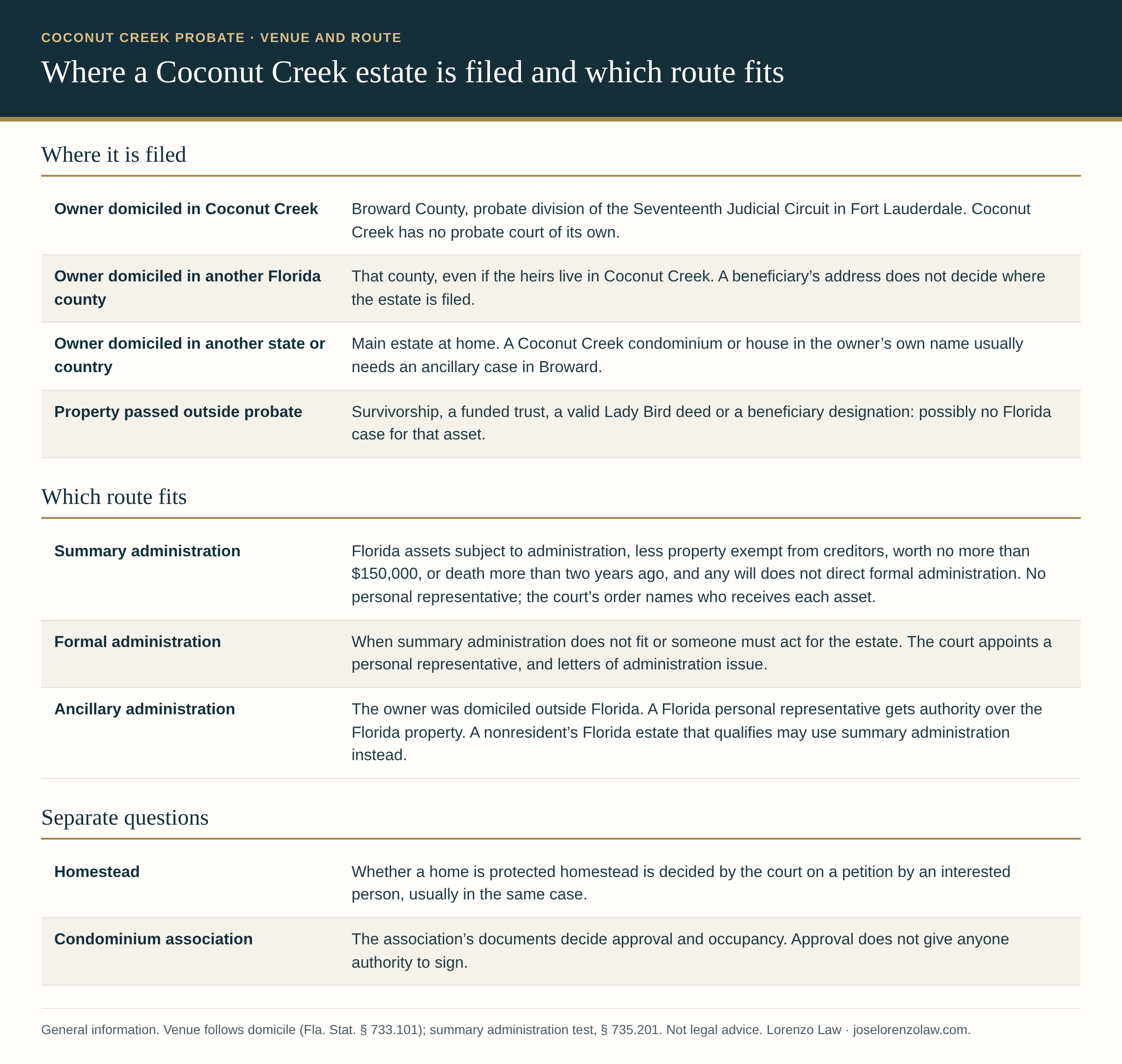
Short answer. Coconut Creek is a city in northern Broward County, and it has no probate court of its own. If the person who died was domiciled in Coconut Creek, the estate is generally opened in Broward County, in the probate division of the Seventeenth Judicial Circuit in Fort Lauderdale. Before anyone chooses a procedure, the family needs to know where the person was domiciled, how each asset was titled, whether there is a will and who survived.
| Where it is filed | For a person domiciled in Coconut Creek, Broward County, in the probate division of the Seventeenth Judicial Circuit in Fort Lauderdale. The heirs’ addresses do not decide the county. Where the estate is filed |
|---|---|
| Does it need probate? | It depends on how each asset was owned. Property in the person’s sole name with no beneficiary usually needs a probate case; survivorship property, accounts with a living beneficiary and property already in a funded trust usually do not. Does every estate need probate? |
| Which route | Summary administration is available if the Florida assets subject to administration, less property exempt from creditors, are worth no more than $150,000, or the person died more than two years ago, and any will does not direct formal administration. Otherwise formal administration, or ancillary administration when the person was domiciled outside Florida. Which route fits |
| Who can act | In formal administration, the personal representative the court appoints, once letters of administration issue; in summary administration, no one is appointed and the court’s order says who receives each asset. Personal representative |
| Condos and 55+ communities | Association approval and occupancy rules are separate from legal authority to sell, rent or transfer the unit; meeting one does not satisfy the other. Condos and 55+ communities |
| Timing | Summary administration: Jose aims to finish within one to two months from retention, a goal, not a guarantee. Many uncontested formal administrations take roughly six months to a year. Timing |
| Fees | Flat fees: summary administration from $3,975; uncontested formal administration from $7,975; ancillary administration quoted per matter. Fees |
| Who handles it | Jose M. Lorenzo, Jr. handles each matter himself, by phone and video statewide, in English or Spanish, with meetings in Fort Lauderdale or Coral Gables by appointment. How Lorenzo Law works |
What help do you need with a Coconut Creek estate?
Your role and the documents decide the next step. A bank’s request, a will that names you, a condominium that must be sold, an owner who lived out of state, a disagreement and planning for someone still living are different inquiries, and only some of them are estate administration.
A Coconut Creek probate attorney first identifies who is asking for help and what that person needs, then whether the estate needs a court case at all, which county and route apply, and who may act. Within an accepted administration, the lawyer prepares and files the court papers and guides the personal representative through notices, creditor claims, the inventory, the property and distribution. In a disagreement, the same lawyer can assess the dispute under a separate engagement.
You do not need to choose a probate procedure before you hire a probate lawyer in Broward County; sorting that out is part of the first conversation. The personal representative remains the person who signs and carries the duties of the role; the lawyer prepares, files and advises.
Families sometimes search for an estate administration attorney, an executor lawyer or an inheritance lawyer in Coconut Creek. In Florida, the work after a death is probate administration, trust administration for property held in a trust and, when the family disagrees, probate litigation. Being part of the same family does not mean everyone has the same legal interests or the same lawyer.
Whether you search for an estate administration lawyer, a probate administration attorney or an estate settlement lawyer, the kind of lawyer a Florida estate needs is a Florida lawyer who handles probate, because the personal representative generally must be represented in the probate case (Florida Probate Rule 5.030). The right time to hire one is before anyone signs, sells, pays the decedent’s debts or hands out property, and as soon as a court paper, a creditor letter or an association demand arrives with a deadline.
If the death was caused by someone else’s negligence, a Florida wrongful death claim is brought by the personal representative for the benefit of the survivors and the estate (section 768.20), so the probate case and the claim are connected; the claim and any settlement are a separate matter from the administration. Lorenzo Law handles the estate side, opening the estate and the personal representative’s appointment; the damages case goes to a personal-injury lawyer by referral or as co-counsel, and the fee for a wrongful-death estate is set at the consultation. More on this: Florida wrongful death claims and the estate.
Case-fit and scope guide
| Your situation | Work to discuss | Record or fact that changes the route | Scope boundary |
|---|---|---|---|
| You are named as executor or proposed personal representative | Whether appointment is needed and what administration work fits | The will, the person’s domicile, how the assets were titled, the date of death and any letters already issued | Being named in a will is not the same as being appointed by the court; the written engagement names the client |
| A bank or another institution will not release an account or transfer property | Whether the asset needs probate, and whether the institution needs a summary-administration order or a personal representative’s letters | Account registration, beneficiary designation, deed, values and creditor information | A death certificate, a family agreement or a former power of attorney does not by itself give the required authority |
| You are a beneficiary and an estate case is already open | Review of your own questions as a separate paid engagement, after a conflicts check | Case number, orders entered, notices you received and any proposed distribution or release | The personal representative’s lawyer does not represent each beneficiary |
| There is a dispute about the will, an accounting or the personal representative’s conduct | A separate probate-dispute assessment | Papers served on you, service dates, the transactions in question and the parties | Litigation is not included in an uncontested administration fee |
| The owner was domiciled outside Florida and owned a Coconut Creek condominium or house | Whether ancillary administration or another Florida procedure fits | Domicile evidence, the Florida deed, any proceeding in the home state or country and the appointment papers there | A Florida engagement does not include representation under another state’s or country’s law |
| The family wants to sell the home | The authority needed to sign, any homestead question and the association’s approval process | The deed, the will, the association documents, the proposed contract and any closing date | Lorenzo Law does not provide real estate closings or title insurance |
| The person is still living | Estate planning, or guardianship if the person can no longer manage his or her affairs | Existing documents, assets, capacity and the actual goal | Planning and guardianship are separate engagements, not estate administration |
Before accepting any matter, Lorenzo Law identifies the client and checks for conflicts. Representing a personal representative does not automatically include representing every beneficiary, and a will dispute or a concern about a personal representative’s conduct needs its own assessment of conflicts, scope and representation.
Does every Coconut Creek estate have to go through probate?
No. Whether an asset needs probate depends on how it was owned. Property in the person’s sole name with no beneficiary usually needs a probate case; property owned with a right of survivorship, owned by spouses as tenants by the entirety, titled in a funded living trust, covered by a recorded Lady Bird deed or paid to a living beneficiary usually passes without one.
Start with the documents, not with who has been paying the bills. A recorded deed shows how real property was titled; a bank or brokerage statement and the institution’s records show whether an account has a payable-on-death or transfer-on-death beneficiary; a beneficiary designation controls a life insurance policy or a retirement account. A relative who paid the condominium dues or the property tax does not become the owner, and a will does not by itself keep anything out of probate: it takes effect through the probate case.
A trust avoids probate only for property actually titled in the trust, so signing a trust does not prove the house or the condominium was deeded to it. A revocable trust can still answer for the estate’s expenses and debts when the probate assets are not enough (section 733.707(3)). When the property is titled in a revocable trust, the successor trustee administers it without a probate case for that property, and Lorenzo Law also handles trust administration for successor trustees.
Joint ownership is not always survivorship. Two people named on a deed or an account may own it as tenants in common, in which case the deceased owner’s share goes through that owner’s estate. Read the exact wording on the deed or the account before assuming the surviving owner already has it.
How common titles affect a Coconut Creek estate
| Title | What usually happens | What to check |
|---|---|---|
| The owner’s name alone, no beneficiary | Probate: summary, formal or ancillary administration | The will, homestead status and the value of the Florida assets |
| Joint owners with a right of survivorship | Passes to the surviving owner when the title carries the right of survivorship | The exact wording of the deed or account; the death certificate to record or present |
| Spouses as tenants by the entirety | Passes to the surviving spouse | That the owners were married when they took title |
| Tenants in common | The deceased owner’s share goes through that owner’s estate | Each owner’s share and the co-owners’ plans |
| A living (revocable) trust | The successor trustee administers it under the trust | The recorded deed or account title in the trust’s name and the trust document |
| A Lady Bird deed (enhanced life estate) | Passes to the named remainder beneficiaries under the deed’s terms | The recorded deed, any later deed or sale, and the title company’s requirements |
| An account with a payable-on-death or transfer-on-death beneficiary | Paid to the beneficiary who survived the owner | Whether the beneficiary is living and the institution’s claim form |
Even when the main asset passes outside probate, another asset may still need a case, such as an account in the owner’s sole name with no beneficiary or a car titled only to the owner. More on bank accounts: a deceased person’s bank account in Florida. More on each kind of title: Florida non-probate assets and when probate is not necessary in Florida.
Where is a Coconut Creek estate filed?
If the person who died was domiciled in Coconut Creek, the estate generally belongs in Broward County, in the probate division of the Seventeenth Judicial Circuit, and that one case also covers property the person owned in other Florida counties. It is not decided by where the heirs live, where the lawyer’s office is or which hospital the person died in.
Florida’s venue statute starts with the county where the person was domiciled. When the person who died was not domiciled in Florida, the estate may be opened in a county where the person owned property; if there was neither a Florida domicile nor Florida property, the statute points to the county where a debtor of the person lives (section 733.101). A beneficiary’s residence is not part of that test.
A Coconut Creek condominium can therefore bring a nonresident’s Florida case to Broward, but a son who lives in Coconut Creek does not bring his mother’s estate here if she was domiciled in another Florida county. A case filed in the wrong county is not automatically void: the court may transfer it, and actions taken before the transfer stand (section 733.101(3)). An interested person who is served with a notice of administration generally has three months after service to object to venue (section 733.212(3)).
Coconut Creek lies in northern Broward County, next to Parkland, Coral Springs, Margate, Pompano Beach and Deerfield Beach, all of them also in Broward. North of the city is unincorporated Palm Beach County, where estates are filed in Palm Beach County instead. A mailing address is not a substitute for checking where the person was domiciled and where each property is.
Two hypothetical examples
The beneficiary lives in Coconut Creek. A daughter lives in Coconut Creek; her father was domiciled in Orange County, Florida, and owned his home there. His estate is ordinarily opened in Orange County, not in Broward, because her address does not move it (section 733.101). Conversely, a person domiciled in Coconut Creek can have children living in other states without changing the county where the estate belongs.
The owner lived in New Jersey. A widower domiciled in New Jersey owned a Coconut Creek condominium in his own name. The main estate belongs in New Jersey; a Florida case for the condominium can be opened in Broward, where the unit is (sections 733.101(1)(b) and 734.102 and Florida Probate Rule 5.470). These examples assume the stated facts; they are not client results or title opinions.
Part-year residents and domicile
For a part-year resident, the first question is domicile. Spending winters in a Coconut Creek condominium does not by itself make someone a Florida domiciliary, and keeping a home in another state does not by itself rule it out: domicile is decided from all the facts, such as where the person usually lived, where the family, documents and daily life were, and what intention the person showed, not from a single document. A Florida declaration of domicile is one of those facts, not the deciding one. The answer decides whether the main estate is opened in Broward or elsewhere. More on this: establishing a Florida domicile.
For countywide guidance across all of Broward’s cities, see the Broward County probate lawyer guide.
Chart: where a Coconut Creek estate is filed and which route fits
Which court handles a Coconut Creek probate case?
Coconut Creek estates are handled by the Seventeenth (17th) Judicial Circuit of Florida, whose probate and guardianship division sits at the Broward County Courthouse in downtown Fort Lauderdale. The Broward County Clerk of Courts keeps the probate records and receives filings and deposited wills.
Attorneys file probate papers electronically through the Florida Courts E-Filing Portal. Filing a petition is not the same as getting an order: under the circuit’s administrative orders, proposed orders and requests for hearings go through the circuit’s Court Management System (CMS) and other court procedures, and some uncontested matters can be considered without a hearing. That does not mean every case, or every appearance, will be handled without a hearing or remotely.
Each case is assigned to one of the circuit’s probate divisions, and the assigned division’s current instructions and the notices in the case control. Which city the person lived in does not decide the judge. The circuit also publishes probate Smart Forms and certified checklists that certain filings must follow, and those requirements can change. A family’s consultation checklist is not the court’s certified filing checklist.
Clerk staff can explain the Clerk’s services but cannot give legal advice, such as which kind of administration fits or whether a will is valid.
Official Broward probate resources
| Official resource | What it is for | Practical limit |
|---|---|---|
| Broward County Clerk of Courts, probate and guardianship division | Deposited wills, probate records, the Clerk’s filing fees and case search | The Clerk lists the division at the Central Courthouse, West Building, 201 SE 6th Street, Fort Lauderdale, third floor, Room 03150, phone (954) 831-7154, weekdays 8:00 a.m. to 3:30 p.m. except holidays (checked November 19, 2026). Confirm current access before traveling; this is the Clerk, not Lorenzo Law’s office |
| Seventeenth Judicial Circuit, probate and guardianship pages | Division procedures, administrative orders, Smart Forms and certified checklists | The assigned division’s instructions and the notices in a case control |
| Florida Courts E-Filing Portal | Electronic filing of probate papers | Filing a petition is different from submitting a proposed order; original documents and hearings can have their own requirements |
| Broward County official records | Recorded deeds and recorded probate orders affecting Coconut Creek real estate | Recording a document is a separate step from obtaining it |
For courthouse location, filing-fee and counter details, see the Broward County probate court guide. For current official resources, use the Broward Clerk’s probate and guardianship division, the circuit’s probate administrative orders and the Florida Courts E-Filing Portal.
What happens to the original will after a death in Coconut Creek?
Whoever has the original will of a person who died must deposit it with the clerk of the court in the county with venue within 10 days after learning of the death (section 732.901). For a person domiciled in Coconut Creek, that is the Broward County Clerk of Courts. Depositing the will does not open an estate or give anyone authority to act.
The 10 days run from learning of the death, not necessarily from the death itself. Check the Clerk’s current instructions for depositing an original will before mailing or delivering it, and keep a copy of what was delivered and when. An electronic will is deposited by its qualified custodian under its own rules.
This deposit deadline is what people usually mean by Florida’s “10-day rule” for probate. It applies to whoever holds the original will; it is not a deadline for opening the estate.
If the original may be in the deceased person’s safe-deposit box, the bank must, on proof of death, let the spouse, a parent, an adult descendant or the person named as personal representative in a copy of the will open the box in the presence of a bank officer, and it delivers any will found to the probate court (section 655.935).
What if the original will cannot be found?
If the original cannot be found, a copy is not automatically enough: a lost or destroyed will must be established in court, generally by two disinterested witnesses, or one if a correct copy is available (section 733.207). A will made in another state is not automatically invalid in Florida. A will signed by someone who was not a Florida resident is generally valid in Florida if it was valid where it was signed, but a handwritten will that was not witnessed as Florida requires, or an oral will, is not recognized here (section 732.502(2)).
Bring the original, every codicil and any earlier will you find, even one you believe was revoked. If only a copy turns up, bring it and say where the original was last seen; a missing original is a fact to review, not a reason to stop.
Which probate route fits a Coconut Creek estate?
The three Florida probate routes are summary administration, formal administration and ancillary administration. Summary administration fits when the assets subject to administration in Florida, less property exempt from creditors, are worth no more than $150,000, or the person died more than two years ago, and any will does not direct formal administration. Formal administration appoints a personal representative with letters of administration. Ancillary administration is the Florida case for a person who was domiciled in another state or country.
That $150,000 figure is the Florida threshold for summary administration (section 735.201); the older $75,000 figure still repeated on some websites, including some official summaries, is out of date. The $150,000 test is not the size of the whole estate. It counts only what must pass through the Florida court: a home held with right of survivorship, an account with a payable-on-death beneficiary or property deeded into a funded trust usually does not count. Property exempt from creditors is subtracted (section 735.201), and protected homestead that passes to the heirs is generally not part of the estate subject to administration, so a Broward home that qualifies does not by itself push an estate over the limit.
In a summary administration there is no personal representative; the court orders distribution to the people entitled. Before the petition is filed, the petitioner must make a diligent search for creditors, and the order does not end the claims of creditors who are owed and not paid; those who receive property can remain liable for two years after death (section 735.206). Debts do not by themselves rule out summary administration, and being eligible for it does not make it the right choice for every estate. More on the shorter route: Florida summary administration attorney and summary administration in Florida.
The petition for summary administration is generally signed and verified by the surviving spouse, if any, and the beneficiaries. A beneficiary who will receive a full distributive share does not have to sign but must be served with formal notice (section 735.203). A son or daughter who lives in another state signs where he or she lives.
Formal administration is used when summary administration is not available or not appropriate, and it is not limited to estates above a dollar figure: for example, when someone has to sell property and the will gives no usable power, collect assets, deal with creditors through the claims process or bring or defend a lawsuit, or when the will requires it. The court appoints a personal representative and issues letters of administration, which banks, associations and buyers rely on as proof of authority. A summary-administration order and letters of administration serve different purposes, so an institution’s written request should be reviewed before the route is chosen.
Very small estates can sometimes be handled without a full case. Disposition without administration covers only personal property on narrow facts, such as when the only assets are exempt property and personal property worth no more than the funeral expenses and certain final-illness medical expenses (section 735.301). Neither that procedure nor an affidavit of heirs can transfer a Broward house or condominium. Florida has no general small-estate affidavit that does.
Summary, formal and ancillary administration compared
| Point | Summary administration | Formal administration | Ancillary administration |
|---|---|---|---|
| When it fits | Florida assets subject to administration, less exempt property, worth no more than $150,000, or death more than two years ago; the will, if any, does not direct formal administration | Summary is not available or not appropriate, or a personal representative’s authority is needed to act for the estate | The person was domiciled outside Florida and left Florida property needing administration; a nonresident’s Florida estate that qualifies may use summary administration instead |
| Personal representative | None; the court orders who receives the property | Appointed, with letters of administration | Appointed in Florida; a representative the will names for the Florida property, or otherwise the domiciliary representative, has priority if qualified |
| Creditors | Diligent search before filing; distributees may remain liable for two years after death | Notice to creditors published, and served on known or reasonably ascertainable creditors; claims period | In formal ancillary administration, notice to creditors in Florida, as in a formal case |
| Typical records | Death certificate, original will if any, asset values, family information | Same, plus records for each asset, any real property and any debts | Authenticated copies of the will and of the other state’s probate papers, the Florida deed |
| Timing | Documents, creditor questions and the court’s review affect timing | Required notices, the claims period, any sale and the court’s review affect timing | The other state’s papers and the Florida steps both affect timing |
| Flat fee | From $3,975 | From $7,975, if uncontested | Quoted per matter |
If there is no will, Florida’s intestacy rules decide who inherits the probate assets, subject to the homestead rules; they do not redirect assets that pass by beneficiary designation, survivorship or trust (probate without a will in Florida).
Who serves as personal representative, and whom does the lawyer represent?
The personal representative is the person the court appoints to run the estate, often called the executor; the will usually nominates one, and if there is no will the statute sets the order of preference. The personal representative’s lawyer represents the personal representative in that role, not each heir or beneficiary individually.
Florida’s probate rules generally require a personal representative to be represented by a Florida lawyer, with limited exceptions, such as when the personal representative is the sole interested person, or is a Florida lawyer (Florida Probate Rule 5.030). Being nominated in the will does not give authority to act until the court appoints the person and letters of administration issue. A personal representative owes duties to the estate and to the interested persons, keeps estate money separate, files an inventory and accounts for what was received and paid. More on the role: how to become a personal representative in Florida and who can serve as executor.
A will can name two or more people to serve together as co-personal representatives. Unless the will provides otherwise, acts connected with administering and distributing the estate generally need the agreement of a majority of them (all of them if the will was signed before October 1, 1987), which means both when there are two, with limited exceptions such as emergency action to preserve the estate; a family that splits the role between a local relative and one who lives out of state should plan how each will sign (section 733.615).
Beneficiaries and heirs receive the notices the law requires and can ask questions, but if they want advice about their own rights, an accounting or a proposed release, they can hire their own lawyer; Lorenzo Law accepts those beneficiary engagements as separate paid matters when there is no conflict.
Can a relative who lives outside Florida serve?
Being named in the will is not the same as being appointed. Florida allows a person who is not domiciled in Florida to serve as personal representative only if he or she is an adopted child or adoptive parent of the person who died, a lineal relative such as a child, grandchild or parent, a spouse, brother, sister, uncle, aunt, nephew or niece, or a lineal relative of one of them, or the spouse of anyone in those categories (section 733.304). A nominated friend who lives in another state may not qualify, even if the will names him.
Before letters issue, a personal representative, unless a corporate fiduciary with a Florida office or a Florida lawyer who lives and has an office in Florida, must designate a resident agent, and a bond is required unless the will or the court waives it, subject to the court’s power to require one (section 733.402 and Florida Probate Rules 5.110 and 5.235). More on serving from another state: serving as an out-of-state executor in Florida.
What can an estate administration engagement cover?
An administration engagement usually moves through four stages: settling the route and the authority, identifying the assets, handling notices and claims, and distributing and closing. The written engagement says which of those stages are included for a particular estate and who the client is.
1. The route and the authority
The lawyer reviews the person’s domicile, the will, the assets and the requester’s role, then prepares the petition and the supporting papers the court and the Clerk require. In formal administration, the court admits the will, if there is one, appoints the personal representative, and letters of administration issue; in summary administration, the court enters an order naming who receives each asset. Filing a petition does not by itself give anyone authority to act.
2. The assets
The assets are identified from ownership records, valued and, in formal administration, listed on the inventory. A home, a business interest or an account can each need a different authority analysis. An appraisal or other outside professional work is arranged under a separately agreed scope when it is needed.
3. Notices, claims and expenses
In formal administration, the personal representative serves the notice of administration on the interested persons, and publishes and serves the notice to creditors, which starts the claims period (sections 733.212, 733.2121 and 733.702). They are two different notices: the first goes to the interested persons and starts certain deadlines to object; the second is published and served on creditors. The ordinary claims deadline is generally the later of three months after the first publication of the notice to creditors or, for a creditor who must be served, thirty days after service of the notice, subject to the statute’s qualifications and exceptions (section 733.702). Creditor deadlines are not a promise of when an inheritance will be distributed.
4. Distribution and closing
Valid claims are paid in the order the law sets, the personal representative accounts to the beneficiaries, distributes the remaining assets and asks the court for discharge, which ends the personal representative’s role. A homestead determination, a sale, a creditor dispute or an objection can add a petition or a hearing, so not every estate follows the same sequence. For the full sequence, see the Florida probate process guide.
What if the Coconut Creek home is a condominium in a 55-and-older community?
Then two separate sets of rules apply. Probate law decides who owns the unit and who has authority to sign for it; the condominium documents decide whether the association must approve a buyer, a tenant or an occupant and who may live in the unit. Meeting one set of rules does not satisfy the other.
Coconut Creek includes condominium and homeowners’ association communities, including age-restricted condominium communities such as Wynmoor. If a parent owned a unit in one of these communities and the family lives elsewhere, gather the association documents along with the estate records. For a single-family home in a Broward homeowners’ association, see the Cooper City probate lawyer guide.
The declaration and the association’s other documents decide whether the association must approve a buyer, a tenant or an occupant, or has a right of first refusal; in some buildings they do, in others they do not, and a transfer to heirs through probate may be treated differently from a sale. In a 55-and-older community, the documents may also limit who can live in the unit, which can affect whether an heir can move in or rent it. Ask management in writing for the current documents and the time the association takes to decide before signing a contract or promising a closing date. Association approval and the signer’s legal authority are two separate requirements; meeting one does not satisfy the other.
The association’s estoppel certificate states, as of a date, what the association says is owed on the unit; it does not appoint anyone, decide who inherits or give anyone authority to sign. A unit with no living owner of record keeps accruing dues, assessments and interest, and the association’s lien rights are governed by the Condominium Act (section 718.116). Tell the association about the death and the estate early, and keep the unit insured.
Can an heir move into or rent the unit?
Only if two things line up: the heir or the personal representative has the legal authority to give possession or sign a lease, and the association’s documents allow that person to live there or the unit to be rented. An heir who does not meet a community’s age rules may be unable to move in even after inheriting the unit; the documents and the association’s written answer decide that, not the probate case.
A community that operates as housing for older persons under federal fair-housing law must generally have at least one person 55 or older in at least 80 percent of its occupied units (42 U.S.C. § 3607(b)(2)(C)). Within that limit, the community’s own rules decide whether a younger heir, a surviving spouse under 55 or a tenant may occupy the unit, so ask the association for its written occupancy policy before anyone moves in.
A personal representative may lease estate real property, which does not include protected homestead, without a court order, for a term within or extending beyond the period of administration, but must act reasonably for the benefit of the interested persons and is bound by any limits in the will or a court order (section 733.612(7)). A lease still has to follow the association’s rules on minimum terms, the number of leases a year and approval, and any local short-term rental rules.
Assessments, inspections and reserves
Building safety rules affect what an inherited condominium costs to keep. Florida law requires residential condominium buildings three or more habitable stories tall to undergo milestone inspections and structural integrity reserve studies on statutory schedules (sections 553.899 and 718.112(2)(g)), and repairs and reserves can become special assessments that the estate or the new owner must pay. Check the notice the building received rather than assuming a date, and ask management for the inspection reports, the reserve study, the current budget and any notice of a proposed or adopted assessment. Engineering review and disputes with the association over repairs are not part of an estate administration; if they arise, they are a separate matter.
A beneficiary who does not want an inherited unit can, in some circumstances, disclaim the inheritance; a disclaimer has strict form requirements, is barred once the beneficiary accepts the property, and has tax effects, so it should be reviewed before anyone accepts the unit or its rents (chapter 739).
How does Florida homestead affect a Coconut Creek home?
A house or a condominium can be protected homestead if the person who died was a Florida resident and the property was the permanent residence of that person or his or her family. Protected homestead is generally exempt from most creditor claims and, if the owner was survived by a spouse or a minor child, cannot be left by will except as Florida’s Constitution allows; it then passes under the homestead statutes rather than as the will directs (article X, section 4, Florida Constitution; sections 732.401 and 732.4015).
When there is a surviving spouse and descendants, the spouse generally receives a life estate in the homestead with the remainder to the descendants, or may elect within six months after death to take an undivided one-half interest as a tenant in common (section 732.401). When the owner was survived by no spouse and no minor child, the home can generally be left by will to anyone, and if it passes to an heir it keeps its creditor protection.
The family usually asks the court for an order determining homestead, which a title company relies on when the property is later sold; whether a home is protected homestead is decided by the court on a petition by an interested person, usually in the same case (Florida Probate Rule 5.405). Not every home needs the same order, and a home is not protected homestead just because it is a house. Protected homestead is generally not an asset the personal representative administers for creditors (section 733.607), although the representative may need to take possession to protect it (section 733.608(2)). A Coconut Creek property that was not the permanent residence of the owner or the owner’s family, such as a rental unit or a seasonal condominium owned by someone domiciled in another state, is generally not protected homestead.
A surviving spouse may also have an elective share of 30 percent of the elective estate, which must generally be claimed by the earlier of six months after service of the notice of administration or two years after death, unless the spouse waived it in a valid agreement (sections 732.201, 732.2065, 732.2135 and 732.702). More on these rights: Florida homestead in probate and surviving spouse rights in Florida.
The homestead tax exemption is a different question
The homestead exemption shown on the Broward County Property Appraiser’s records is a property-tax benefit, not a probate determination. The exemption and the Save Our Homes assessment limit generally end with a change of ownership at death, and the property is reassessed at just value as of the next January 1, except for certain transfers to a surviving spouse, a minor child or a dependent who lives there (sections 193.155 and 196.011). An heir who makes the property his or her own permanent residence must apply for a new exemption by March 1 of the year it should apply. The property tax itself keeps coming due during probate; Lorenzo Law does not handle tax-deed proceedings.
Who can sell a Coconut Creek house or condo during probate?
Being an heir does not by itself give that power. While the property is part of the estate, only a person with authority can sell, rent or hand it over. In formal administration, the personal representative sells under a power of sale in the will or with the court’s authorization; in summary administration, the people who received the property by the court’s order act as its owners.
A relative who has the keys, pays the dues or is named in the will does not yet have authority to sign a sale. In formal administration, the personal representative can sell without a court order if the will gives a power of sale; otherwise, the sale needs the court’s authorization or confirmation (section 733.613). If the property was protected homestead, different rules apply: it usually passes directly to the heirs, the court is usually asked to determine its status, and the personal representative does not sell it as an ordinary estate asset.
When one heir wants to keep the property and the others want its value, there are three usual paths: the other heirs agree to sell their shares to that heir for an agreed price; in a formal administration, the personal representative may distribute the property to that heir and balance the shares with other estate assets, because Florida allows non-pro-rata distribution subject to the representative’s duty of impartiality (section 733.810); or, if no agreement is possible, a co-owner asks the court for partition, which can end in a division or, if the property cannot be divided without prejudice, a court-ordered sale (chapter 64, including section 64.071). More on this: Florida partition actions and selling a house in probate in Florida.
If the Coconut Creek home or condominium has a reverse mortgage, bring the servicer’s correspondence to the consultation. A reverse mortgage usually becomes due when the last borrower dies, unless an eligible non-borrowing spouse may stay; the servicer’s letter sets the timelines, and heirs of a federally insured reverse mortgage can generally pay the balance or sell the home for an amount set by HUD that does not exceed 95 percent of the appraised value (24 C.F.R. §§ 206.27 and 206.125).
How the transfer shows up in the public record
The public record catches up with ownership only when the right document is recorded in the Broward County official records: in formal administration, the personal representative’s recorded release (distribution to beneficiaries) or deed (sale to a buyer); in summary administration, a certified copy of the order; for a protected homestead, the court’s order determining homestead status (Florida Probate Rule 5.405), which confirms rights that already passed at death; and for a survivorship or trust title, the documents the title company requires, usually including a death certificate. Lorenzo Law’s probate work establishes the authority to sell within the agreed engagement. The firm does not provide real estate closings or title insurance; coordination with the closing agent, the title company or an appraiser is available under a separately agreed scope.
Can a family handle a Coconut Creek estate from another state?
Usually, for most of the work, and often without traveling to Florida. Florida probate is handled in writing and filed electronically, Jose works with families by phone and video, and many signatures can be given remotely. What cannot always be done remotely is delivering an original, such as the original will or certain authenticated documents, and attending a hearing the court sets in person.
A personal representative who lives in another state can usually handle a Broward estate without moving to Florida: papers are signed where he or she lives. Florida lets the petition and joinders be signed under penalty of perjury, so a notary is usually not needed; when a notarized document is needed, it can be signed online with a Florida online notary, or abroad before a U.S. consular officer or a local notary (Florida Probate Rule 5.020; sections 92.525, 117.215 and 92.50(3)).
If a hearing is needed, the assigned judge’s instructions decide whether it is held in person or remotely, so no one should assume every hearing will be remote. Travel may still be needed for a hearing set in person, or to clear out and secure the property. An original will, certain authenticated documents or a document to be recorded may have to travel on paper by courier; that is a shipment, not necessarily a trip. A scanned will or an e-mailed signature is not a substitute where the law requires an original.
If the owner lived in another state or country
If the person who died was domiciled in another state or country and owned Florida property in his or her own name, a Florida case is usually needed for that property. It is generally an ancillary administration opened in the county where the property is, so a Coconut Creek condominium brings the Florida case to Broward. The main estate stays in the state of domicile. An heir who lives outside Florida does not, by itself, make a case ancillary.
A nonresident’s Florida estate that qualifies may use summary administration instead of a full ancillary administration, sometimes called ancillary summary administration. Whether it fits depends on the estate’s Florida assets, any will and the papers from the home state or country.
An ancillary administration recognizes the out-of-state estate in Florida and gives a Florida personal representative authority over the Florida property (section 734.102). Filing ordinarily needs authenticated copies of the will and of the other state’s probate papers; an ordinary photocopy is not enough. An appointment in another state does not by itself give authority over a Broward property. Summary administration is available to the estate of a nonresident if the Florida estate meets the summary conditions described above (section 735.201). More on this: Florida ancillary probate.
What should the family do in the first weeks after a death in Coconut Creek?
Secure the home and its contents, find the original will and the deed, order certified death certificates, tell any association and the insurer in writing, and keep paying or documenting the property’s bills. Do not sell, give away or move assets until someone has legal authority.
- Control keys, gate or access devices and any association authorization list; note who has access.
- Look for the original will, codicils and any trust; if someone has the original, it must be deposited with the Clerk within 10 days after that person learns of the death.
- Get the recorded deed, the latest association statements, the mortgage statement and the insurance policy.
- Tell the association manager and the insurer about the death in writing, and ask the insurer what the policy requires if the home stays vacant. Keep receipts for anything a relative pays; reimbursement is not automatic.
- Do not use a power of attorney after the death: the agent’s authority ended when the principal died (section 709.2109). Do not sign a listing agreement or a sale contract until the right person has authority to sign it.
- Write down any court notice, creditor letter or association collection notice you receive, and the date it arrived.
If something cannot wait for an appointment
Sometimes property needs protection before anyone has been appointed: a vacant home with a lapsing insurance policy, a tenant whose lease is ending, or a sale contract the owner signed before death. Florida allows the court to appoint a curator to take charge of the estate’s property when that is necessary, until a personal representative is appointed (section 733.501). Whether a curator, a prompt petition for administration or a simpler step fits depends on the facts, so raise the urgency at the first call.
What should you gather before the consultation?
Gather the records you have: the death certificate, the will, the recorded deed, recent statements for the main accounts, any association statements and any court or creditor notice. A missing record is a reason to identify the gap at the first call, not a reason to wait; you can request an initial consultation before every record is found.
Broward County probate checklist for a Coconut Creek estate
| Record or fact | Why it matters | Likely source | If missing or uncertain |
|---|---|---|---|
| Date of death and death certificate | Supports the filings and starts several time periods | The family or the funeral home | Give the date and say which certificate copies you have |
| The person’s domicile and any other residence | Decides the county and whether the case is a Florida estate or an ancillary one | The family and the person’s records | Describe each address and how the time was split, rather than choosing a county from an heir’s address |
| Original will, codicils and any trust | Admission to probate, the nominated personal representative, powers of sale and possible nonprobate ownership | The family, the drafting lawyer or the trustee | Say whether there is only a copy, a missing original or a will already deposited |
| Recorded deed, account ownership and beneficiary details | Separates probate assets from property that passed another way | Broward County official records; the banks and brokerage firms | Bring partial records; do not guess ownership from who paid the bills |
| Approximate values and known debts | Help assess the route, creditor questions and the scope of the engagement | Statements, bills, valuations | Separate estimated values from known ones, and disputed bills from undisputed ones |
| Heirs and beneficiaries, and your relationship | Notices, appointment questions and who the client is | The will and family information | Identify unknown addresses or any disagreement |
| Any existing case number, letters, orders and notices | Prevents a duplicate case and shows what is already pending | The Clerk’s records and documents you were served | Mention a known case even if you do not have copies |
| Association documents, statements and any approval forms | Carrying costs, occupancy limits and the approval process for a buyer or tenant | The association or its manager | Ask management for the current documents in writing |
| A hearing, claim, sale or distribution deadline | Flags timing for review | The notice, order or contract itself | Provide the document and the date you received it; contacting a lawyer does not extend a deadline |
In the public contact form, give only a short description: your role, the date of death, the county or state of domicile, the types of assets and any deadline. Do not send account numbers, Social Security numbers, passwords or documents through the form; Jose explains how to send documents after the first conversation. Florida’s ethics rules generally protect information a prospective client shares with a lawyer in a consultation, even if no engagement follows (Rule Regulating The Florida Bar 4-1.18).
What to tell the lawyer at the first consultation
Tell the lawyer the facts that make the estate harder, not only the easy ones: a second marriage, a child left out of the will, a relative living in the unit, money the decedent lent or gave, a missing original will, an unpaid association balance or a family disagreement. Information a prospective client shares in a consultation is generally kept confidential even if no engagement follows (Rule 4-1.18, Rules Regulating The Florida Bar). A problem left out of the first conversation does not go away; it only means the route and the fee were chosen without it.
How long does probate take for a Coconut Creek estate?
In summary administration, Jose aims to finish within one to two months from retention, and starts as soon as he is retained; that is a goal, not a guarantee. Many uncontested formal administrations take roughly six months to a year. Missing documents, unclear title, creditor claims, taxes, a sale or a dispute can make any estate take longer.
Creditor deadlines are not a promise of when an inheritance will be distributed. That is why most formal estates cannot close in a few weeks. Claims not filed within two years after death are generally barred, whether or not an estate was opened (section 733.710).
What usually decides the timing
- Whether the original will is available and the family agrees on who should serve.
- How quickly the personal representative signs and returns the court papers and the bank and association forms, especially from another state.
- Whether the home is protected homestead and needs a court determination before it can be sold.
- Whether association approval, a buyer’s financing, a special assessment or a title issue affects a sale.
- Whether creditors file claims that have to be objected to, or the family disagrees.
- The court’s review of the filings, and any hearing the assigned division sets.
How long a home stays in probate depends on the estate as a whole. A Coconut Creek house or condominium that is a probate asset belongs to the heirs or beneficiaries from the date of death, but subject to the estate’s administration, so it generally follows the same timeline as the estate. In formal administration, the personal representative controls it for paying estate expenses and debts until it is distributed (usually shown by the personal representative’s recorded release) or sold (by the personal representative’s deed). In summary administration there is no personal representative; the court’s order assigns the property to the people entitled to it. Protected homestead passes at death outside probate, but in my experience the title company will usually want a court order on its homestead status before a sale.
No one can promise when a beneficiary will receive money. More detail: how long probate takes in Florida.
How much does a Coconut Creek probate attorney cost?
Lorenzo Law charges flat fees for probate administration. Summary administration starts at $3,975 and includes the filing fee and one certified copy of the order; additional certified copies are at the Clerk’s rate. Uncontested formal administration starts at $7,975 and includes the filing fee, creditor-notice publication and the certified copies the matter needs. Ancillary administration is quoted per matter. These fees are honored at least until February 28, 2027.
Lorenzo Law does not publish the optional notice to creditors in summary administration, so there is no publication cost in that fee. For either procedure, homestead determinations, more complex estates and contested matters are quoted separately, and other expenses may apply, such as recording fees or the decedent’s debts, and in formal administration a personal representative’s bond if the court requires one and the personal representative’s compensation; any increase is discussed before work begins.
Flat fees for Coconut Creek probate administration
| Route | Flat fee | Included | Outside this administration fee |
|---|---|---|---|
| Summary administration | From $3,975 | Filing fee and one certified copy of the order; additional certified copies at the Clerk’s rate; no notice publication | Homestead determination, disputes, a real estate closing, title insurance, tax returns |
| Uncontested formal administration | From $7,975 | Filing fee, creditor-notice publication and the certified copies the matter needs | Homestead determination, contested matters, a real estate closing, title insurance, tax returns |
| Ancillary administration | Quoted per matter | Set out in the written quote | Work under another state’s or country’s law |
The Broward Clerk’s probate filing fee, which these flat fees include, is currently $401 for formal or ancillary administration and $346 for summary administration of an estate of $1,000 or more ($236 below $1,000) (checked November 19, 2026); the Clerk receives that fee, and it is not charged a second time. The figure that applies to a particular estate can rise with its facts, such as the number of assets, an out-of-state personal representative or a sale, and any change is discussed before the work begins. The written engagement names the client, the work, the fee and any cost not included.
The flat fee is generally paid near the close of the matter; whether the client advances any cost is discussed in advance, and when the estate has no cash, for example when the home is the only asset, the client pays the flat fee. People who prefer to handle part of the work themselves can retain Jose by the hour for review or advice. Full fee terms: summary and formal administration fees.
Florida’s statutory fee schedule
Florida law does not require a percentage fee for a probate lawyer. Section 733.6171 sets a schedule presumed reasonable for the personal representative’s lawyer, but there is no mandatory fee: the lawyer, the personal representative and those bearing the cost can agree to a different fee, such as a flat fee, and a lawyer who uses the schedule must make written disclosures. The personal representative’s own compensation is a separate question (section 733.617).
The schedule is computed on the inventory value of the probate estate plus income earned during administration, for ordinary services in a formal administration: $1,500 for an estate up to $40,000; $750 more for the part from $40,000 to $70,000; $750 more from $70,000 to $100,000; 3% of the next $900,000; 2.5% from $1 million to $3 million; 2% from $3 million to $5 million; 1.5% from $5 million to $10 million; and 1% above $10 million. Extraordinary services can be compensated separately. The schedule does not set Lorenzo Law’s fees, which are the flat fees above.
Personal representative (executor) compensation in Florida
The personal representative’s compensation is separate from the lawyer’s fee. In a formal administration, Florida presumes reasonable a commission based on the value of the probate estate: 3 percent of the first $1 million, 2.5 percent of the next $4 million, 2 percent of the next $5 million and 1.5 percent of anything above $10 million, with additional compensation possible for extraordinary services (section 733.617). A will can set different compensation, and any personal representative may renounce it in whole or in part. In summary administration no personal representative is appointed, so there is no commission.
Probate litigation is priced differently: on contingency or a hybrid basis where appropriate, or with a flat fee for a discrete task, depending on the facts. More on this: the cost of probate in Florida.
What happens to the debts of a person who died in Coconut Creek?
Debts are paid from the estate, in the order Florida law sets, before beneficiaries receive their shares. Heirs generally do not become personally liable for the decedent’s debts just because they inherit, but property that passes through the estate, and in some cases a revocable trust, can be used to pay valid claims.
In formal administration, the personal representative publishes a notice to creditors and serves it on creditors who are known or reasonably ascertainable; creditors then file claims in the probate case, and the personal representative reviews each claim and may object to one that is not valid. In summary administration there is no claims period like the one in a formal administration, although a notice to creditors may be published after the order; the petitioner makes a diligent search for creditors before filing, serves the petition on those creditors, and those who receive property can remain liable for valid unpaid claims (sections 735.206 and 735.2063). A recorded mortgage stays with the property, and the association’s rights against a condominium unit follow the Condominium Act. Protected homestead passing to heirs is generally not available to pay ordinary creditors.
Reasonable funeral, burial and grave-marker expenses, up to $6,000 in total, come early in the order of payment, right after the costs and expenses of administering the estate, and a family member who paid the funeral home can file a timely claim in the probate case to be reimbursed from the estate (sections 733.702 and 733.707). More on this: Florida probate creditor claims and do you inherit debt in Florida.
Two other family protections apply when the person who died was domiciled in Florida: exempt property, such as household furnishings in the usual home up to a net value of $20,000 and up to two motor vehicles held in the decedent’s name and regularly used by the decedent or the family, which must generally be claimed within four months after service of the notice of administration (section 732.402), and a family allowance of up to $18,000 for the spouse and the dependent lineal heirs the decedent was supporting (section 732.403).
Lorenzo Law also represents creditors and claimants filing, enforcing or settling a claim against a Florida estate; the fee for that work depends on the issue and is agreed with the client in writing.
Taxes after a death
Florida does not currently collect an estate tax or an inheritance tax. Federal estate tax applies only to estates above the federal filing threshold, and the person who died may still owe a final income-tax return. Property tax on a Coconut Creek home keeps coming due during probate. Lorenzo Law does not prepare tax returns or give tax opinions; it explains the Florida side of the estate and coordinates with the family’s accountant or tax professional. More on this: Florida inheritance tax.
What if the family disagrees about a Coconut Creek estate?
A disagreement about the will, the personal representative, an accounting, a claim or what to do with the home is a separate matter from an uncontested administration. Identify it at the first call and bring any papers you have been served, because some deadlines are short and a consultation does not stop them.
Common inheritance disputes include heirs who cannot agree whether to keep, rent or sell a home or condominium; a relative living in the property who will not leave or pay; questions about a will signed late in life, such as claims of undue influence or lack of capacity; a personal representative who does not account for money or rent; and creditor claims the estate disputes. Some are resolved inside the probate case, by objection, petition or mediation; a probate dispute can also end in a negotiated settlement or court-ordered mediation rather than a trial; others need a separate lawsuit. The client, the conflicts review, the legal issues and the fee differ from an uncontested administration, and the written engagement for a dispute is separate.
Timing matters. An interested person who is served with a copy of the notice of administration generally has three months after service to object to the validity of the will, the venue or the jurisdiction of the court (section 733.212(3)). An interested person who expects a dispute before a case is opened can file a caveat with the Broward County Clerk, which generally entitles the caveator to formal notice before a will is admitted to probate or a personal representative is appointed (section 731.110); more on this: Florida probate caveats.
More on disputes: Fort Lauderdale probate litigation, Florida probate litigation and Florida will contests.
If the person is still living: planning or guardianship
When the person is still living, the question is not a probate administration. Help for a living person who can no longer manage his or her affairs is a guardianship or planning question, and planning for your own property is estate planning; each is a separate inquiry and a separate engagement.
If a parent or spouse can no longer make decisions and has no usable power of attorney or health care surrogate, a guardianship may be needed; guardianship is not simply the first stage of a later probate. More on this: Florida adult guardianship.
If you are planning ahead for a Coconut Creek home, a deed such as a Lady Bird deed or a revocable trust can avoid probate for that home, subject to Florida’s homestead restrictions when there is a spouse or minor child; that planning is different from administering property after a death and cannot fix property already in a deceased person’s sole name. More on this: Broward County Lady Bird deeds and Florida estate planning.
How Lorenzo Law works with Coconut Creek families
Jose M. Lorenzo, Jr. handles each matter himself. Lorenzo Law is a solo practice: the attorney you speak with at the first call is the attorney who handles any matter the firm accepts, from the first review to discharge.
Jose is a Florida attorney (Florida Bar No. 107002), admitted in 2013. Before law school he worked for about a decade as a probate and litigation paralegal, and during law school he was a judicial intern in the Probate Division of the Eleventh Judicial Circuit. He takes first calls personally and works in English and Spanish; documents are prepared in English and explained in Spanish when a client prefers.
Consultations are available statewide by phone or video. Lorenzo Law’s principal office is in Kissimmee; meetings in Fort Lauderdale and Coral Gables are by appointment, and there is no office in Coconut Creek. Lorenzo Law aims to follow up within one to two business days. A phone or video consultation does not mean every document, court appearance or property task can be completed remotely; the court’s requirements and the practical steps for each estate are discussed before anyone relies on a remote arrangement. For appointment logistics in Broward, see the Fort Lauderdale probate lawyer page.
Do probate lawyers go to court? In an uncontested Coconut Creek estate, many steps are decided on the papers filed electronically with the Broward court. When the assigned judge sets a hearing, or a matter is contested, Jose appears for the client, and the division’s instructions say whether the hearing is in person or remote.
What Lorenzo Law handles, and what it does not
| Topic | Within a probate engagement | Outside it, or a separate engagement |
|---|---|---|
| The home or condominium | Whether it is a probate asset, who has authority, the court order or letters, the personal representative’s deed | The closing itself, title insurance, listing and management of the property |
| The association | Reviewing the estoppel certificate and the documents that affect the estate | Association litigation or disputes with the board |
| Taxes | Explaining the Florida side and coordinating with the family’s tax professional | Preparing tax returns or giving tax opinions |
| Other professionals | Coordination under a separately agreed scope | Their fees, unless the engagement says otherwise |
| Disputes | A separate written engagement | An uncontested administration fee |
| A case another lawyer started | Taking over the representation when the facts and the position of the case allow, discussed with the client first | Responsibility for work done before the change |
The initial consultation is not a complete review of every asset or a title search. The written engagement says who the client is, what work is included, the fee and the costs, and which later proceedings would need their own agreement.
Comparing probate attorneys in Coconut Creek?
Before hiring a probate attorney in Coconut Creek or anywhere else for a Coconut Creek estate, ask each lawyer the same questions: who exactly the lawyer would represent, which route fits and why, what the fee includes and excludes in writing, who will do the work, how a condominium or house will be handled, and how the family will sign from wherever it lives.
Questions to ask any probate lawyer
- Will you represent the personal representative, a beneficiary or the family as a whole, and what happens if family members disagree?
- Does this estate need summary, formal or ancillary administration, and does the home need probate at all?
- Is the fee a flat fee or a percentage, and what exactly is included: filing fee, publication, certified copies, a homestead determination?
- Who will I speak with, and who will prepare and file the papers?
- Who will sign a sale of the property, and does the sale need a court order or the association’s approval?
- How will documents be signed by family members who live in another state?
These questions and a check of each lawyer’s listing in the Florida Bar’s lawyer directory, including Jose’s, will tell you more than any ranking. More on choosing a lawyer: how to choose a Florida probate lawyer.
Which county handles probate near Coconut Creek?
Every city around Coconut Creek is in Broward County except the unincorporated area to the north, which is in Palm Beach County. The county still follows the domicile of the person who died, not the city named on a mailing address or the address of the family.
Nearby communities and their probate county
| Community | County | Local guide |
|---|---|---|
| Coconut Creek | Broward (Seventeenth Judicial Circuit) | This page |
| Margate | Broward | Margate probate lawyer |
| Pompano Beach | Broward | Pompano Beach probate lawyer |
| Lighthouse Point | Broward | Lighthouse Point probate lawyer |
| North Lauderdale | Broward | North Lauderdale probate lawyer |
| Tamarac | Broward | Tamarac probate lawyer |
| Coral Springs, Parkland and Deerfield Beach | Broward | Broward County probate lawyer |
| Boca Raton and unincorporated Palm Beach County to the north | Palm Beach (Fifteenth Judicial Circuit) | Boca Raton probate lawyer |
The city links show local information; they do not mean there is an office in each city or decide where a case is filed. For all 67 Florida counties, see the Florida probate service areas, and for the wider region the South Florida probate attorney page.
Example: a New Jersey daughter and her father’s Coconut Creek condominium
The facts below are hypothetical and simplified. They show how the questions on this page fit together; they are not a client result or a prediction for any estate.
A widower lived for twelve years in a condominium he owned in his own name in a 55-and-older community in Coconut Creek, voted and filed his taxes in Florida, and died there with a will leaving everything to his only daughter, who lives in New Jersey. He also had a checking account in his own name with no beneficiary, and an individual retirement account naming his daughter.
- Where. He was domiciled in Coconut Creek, so the estate belongs in Broward County; his daughter’s New Jersey address does not change that.
- What needs probate. The retirement account goes to the daughter as the named beneficiary. The checking account needs a court order or a personal representative. The condominium was his permanent residence, and he left no spouse or minor child, so it is likely protected homestead that he could leave by will; the court is usually asked to determine its status.
- Which route. If the will does not require formal administration and the checking account and any other nonexempt probate assets are worth no more than $150,000 (or he has been dead more than two years), summary administration may fit; the condominium, as likely protected homestead left to his daughter, is not a probate asset, so selling it is not itself a reason for formal administration. Formal administration may fit better if the will requires it or if someone must manage or collect estate assets while the case is open (sections 735.201 and 735.206).
- Who can serve. If formal administration is used, she can serve as personal representative even though she lives in New Jersey, because a nonresident child of the person who died is among the relatives Florida allows (section 733.304), provided she is otherwise qualified; she signs the court papers where she lives.
- The unit. Before listing it, she asks management in writing for the current documents, the approval process for a buyer and the time the association takes to decide; approval and her authority to sign are separate questions.
Coconut Creek probate terms
- Decedent
- The person who died.
- Domicile
- The place a person treated as his or her permanent home; it decides where the main estate is opened.
- Personal representative
- The person the court appoints to administer the estate, often called the executor.
- Letters of administration
- The court document showing the personal representative’s authority; it is not a deed.
- Order of summary administration
- The court order in a summary case naming who receives each asset; no personal representative is appointed.
- Ancillary administration
- The Florida case for the Florida property of a person domiciled in another state or country.
- Testate and intestate
- A person who dies with a valid will dies testate; a person who dies without one dies intestate, and Florida’s intestacy statutes then decide who inherits the probate assets.
- Beneficiary
- A person entitled to receive property from the estate under the will or, if there is no will, as an heir under the law.
- Protected homestead
- The Florida residence of the owner or the owner’s family that the Constitution and statutes protect from most creditors and, when there is a spouse or minor child, from being left by will except as the law allows; it is not the same as the property-tax homestead exemption.
- Notice of administration and notice to creditors
- Two different notices: the first goes to the interested persons and starts certain deadlines to object; the second is published and served on creditors and starts the claims period.
- Estoppel certificate
- The association’s statement, as of a date, of what is owed on a unit; it does not decide ownership or authority.
- Probate litigation
- A court dispute connected with an estate, such as a challenge to a will for undue influence or lack of capacity, or a claim that a personal representative breached a duty.
- Seventeenth Judicial Circuit
- The Florida trial court circuit for Broward County, also written 17th Judicial Circuit, whose probate and guardianship division hears Coconut Creek probate cases.
More Coconut Creek probate questions
Is there a probate court in Coconut Creek?
No. Coconut Creek has no probate court of its own. Estates of people domiciled in Coconut Creek are handled by the probate division of the Seventeenth Judicial Circuit for Broward County, and the Broward County Clerk of Courts lists its probate and guardianship division at the Central Courthouse in downtown Fort Lauderdale. Probate papers are filed electronically, and the assigned division’s instructions decide whether and how any hearing is held.
Does Lorenzo Law have a Coconut Creek office?
No. Lorenzo Law has no office in Coconut Creek. Its principal office is in Kissimmee, and meetings are available by appointment in Fort Lauderdale and Coral Gables. Jose M. Lorenzo, Jr. works with Coconut Creek families by phone, video, email and mail, in English or Spanish. Call (305) 224-6811 or use the contact page to request a free initial consultation; only the initial consultation is free, and representation fees and costs are agreed separately in writing.
Is the Florida probate threshold still $75,000?
No. The summary-administration threshold is $150,000: summary administration is available if the Florida assets subject to administration, less property exempt from creditors, are worth no more than $150,000, or the person died more than two years ago, and any will does not direct formal administration (section 735.201). Pages and summaries that still say $75,000 are out of date.
Does depositing the will give me authority over the accounts?
No. Depositing the original will with the Broward County Clerk, which Florida requires the custodian to do within 10 days after learning of the death (section 732.901), places the will with the court; it does not open an estate or appoint anyone. Authority over accounts in the person’s sole name comes from the court: letters of administration for a personal representative, or the order in a summary administration.
Does the bank need letters of administration or a summary-administration order?
It depends on the account and on what the institution asks for in writing. An account with a living payable-on-death beneficiary is paid to that beneficiary without probate. An account in the person’s sole name with no beneficiary usually needs a court order: in summary administration, the order names who receives it; in formal administration, the personal representative collects it under letters of administration. Review the institution’s written request before choosing the route.
What is the 10-day rule for probate in Florida?
It is the deadline for the original will, not for opening probate. Whoever has the original will of a person who died must deposit it with the clerk of the court in the county with venue within 10 days after learning of the death (section 732.901); for a person domiciled in Coconut Creek, that is the Broward County Clerk of Courts. Depositing the will does not open an estate or give anyone authority to act.
Is there a deadline to open probate in Florida?
Florida sets no single deadline for opening an estate, but waiting has consequences. Creditors’ claims are generally barred two years after the death, whether or not an estate was opened (section 733.710), and once two years have passed summary administration can be available whatever the estate’s value, if any will does not direct formal administration (section 735.201). Meanwhile a Coconut Creek condominium keeps accruing dues and assessments, a vacant home may need its insurance reviewed, and no one can sign for property in the deceased person’s sole name until the court acts.
Does probate representation include selling the home?
The probate engagement covers the legal authority to sell: who may sign, whether a court order or a homestead determination is needed, and the personal representative’s deed when one is used. It does not include the real estate closing or title insurance, which are handled by a closing agent and a title company; coordination with them is available under a separately agreed scope. A disagreement among heirs about the sale is a separate matter.
Does the personal representative’s lawyer represent the beneficiaries?
No. The personal representative’s lawyer represents the personal representative in that role, not each heir or beneficiary individually. A beneficiary who wants advice about his or her own rights, an accounting or a proposed release can hire a separate lawyer; Lorenzo Law accepts those beneficiary engagements as separate paid matters when there is no conflict.
Can I file probate in Broward County without a lawyer?
Usually not as a personal representative. Florida’s probate rules generally require a personal representative to be represented by a Florida lawyer, with limited exceptions, such as when the personal representative is the sole interested person or is a Florida lawyer (Florida Probate Rule 5.030). Self-filers who fit an exception can retain Jose by the hour to review a petition or advise at one step.
Is there a small estate affidavit for a Coconut Creek house?
Not for a house. Florida’s small-estate affidavit route (section 735.304; Fla. Prob. R. 5.425) applies only when a person died without a will more than a year ago, no probate is pending, and the estate consists only of exempt personal property plus up to $20,000 of nonexempt personal property (the limit since July 1, 2026) and qualifying funeral and final-illness expenses; it does not transfer real property. For a small estate that includes a house, the usual route is summary administration. An affidavit of heirs can help a title company identify the family members of a person who died, but it does not transfer title or give anyone authority to sell. A house in the deceased owner’s sole name generally needs a probate order, letters of administration or another route the law recognizes, such as an order determining homestead.
What is the difference between an executor and a personal representative?
In Florida, they are the same role. “Executor” is the term many people and other states use; Florida law and Florida courts use “personal representative” for the person the court appoints to administer the estate. Being named executor in a will is a nomination; the authority comes when the court appoints the person and letters of administration issue.
What happens if there is no will?
Florida’s intestate succession statutes decide who inherits the probate assets, generally the surviving spouse and the descendants, or other relatives when there are none, subject to the homestead rules. The court appoints a personal representative following the statutory order of preference. Assets with a living beneficiary or a survivorship title are not redirected. More on this: probate without a will in Florida.
Are Broward County probate records public?
Mostly. Probate court files are court records that can generally be searched through the Broward Clerk’s case search, but some filings, such as the estate inventory and accountings, are available only to the people the law allows (section 733.604). The original will becomes part of the court file once it is deposited. To find probate records in Broward County, search the decedent’s name in the Clerk’s online case search.
How are probate lawyers paid, and is the fee due up front?
Probate lawyers in Florida charge in different ways: a flat fee, an hourly rate, or a fee for a formal administration measured by the schedule that section 733.6171 presumes reasonable. Lorenzo Law’s probate flat fee is generally paid near the close of the matter. The written engagement sets the payment terms, including any costs the client must advance and how payment will work when the estate has no cash. Other lawyers may bill differently, so ask when a fee is due before signing any engagement.
Can you change probate lawyers in the middle of a case?
Usually, yes. A personal representative or other client can change lawyers during a probate case; whether Lorenzo Law can take over depends on the facts and the position of the case, and it is discussed with the client first. Bring the case number, the orders entered, the papers filed so far and every notice you have received, with the date each arrived, because some deadlines run from service and a consultation does not stop them.
Are consultations available in Spanish?
Yes. Jose consults in English and Spanish. Court papers are prepared in English and explained in Spanish when a client prefers; Lorenzo Law does not translate documents word for word, so a client who needs a full translation or an interpreter arranges one.
Talk with a Coconut Creek probate lawyer
To discuss a Coconut Creek estate, call (305) 224-6811 or use the contact page. Share the date of death, the person’s domicile, the kinds of assets involved, your role and whether a case is already open, and mention any notice, hearing or proposed sale. Jose M. Lorenzo, Jr. takes first calls personally and handles each matter himself.
Hiring a probate lawyer in Coconut Creek does not require a local office visit: consultations are by phone or video statewide, in English or Spanish. Lorenzo Law’s principal office is in Kissimmee; meetings in Fort Lauderdale and Coral Gables are by appointment. There is no office in Coconut Creek. For probate elsewhere in Florida, see Florida probate lawyer and the Florida probate guide.
Request a free initial consultation. Only the initial consultation is free; representation fees and costs are agreed separately in writing.
Request a free initial consultationCall (305) 224-6811
This page gives general information about Florida probate law and Broward County procedure as of the date shown at the top. It is not legal advice for any estate. Reading it or contacting Lorenzo Law does not create an attorney-client relationship; representation begins only with a signed written engagement.