
What If a Lady Bird Deed Beneficiary Dies Before the Owner?
Quick answer: A beneficiary’s death doesn’t change the recorded deed, and nobody is added to it automatically. If the deed doesn’t say what happens when a beneficiary dies before the owner, Florida law hasn’t squarely settled the answer.
The answer is different for a traditional life estate deed, so first check which kind of deed you have.
Ask about your deedCall (305) 224-6811
Find your situation: The owner is still alive · The owner has also died · Another owner or life tenant is still living · Not sure who died first · Not sure it’s a Lady Bird deed
All guide sections 9 sections
“Lady Bird deed,” “ladybird deed” and “enhanced life estate deed” are the same document; my main guide explains how it works.
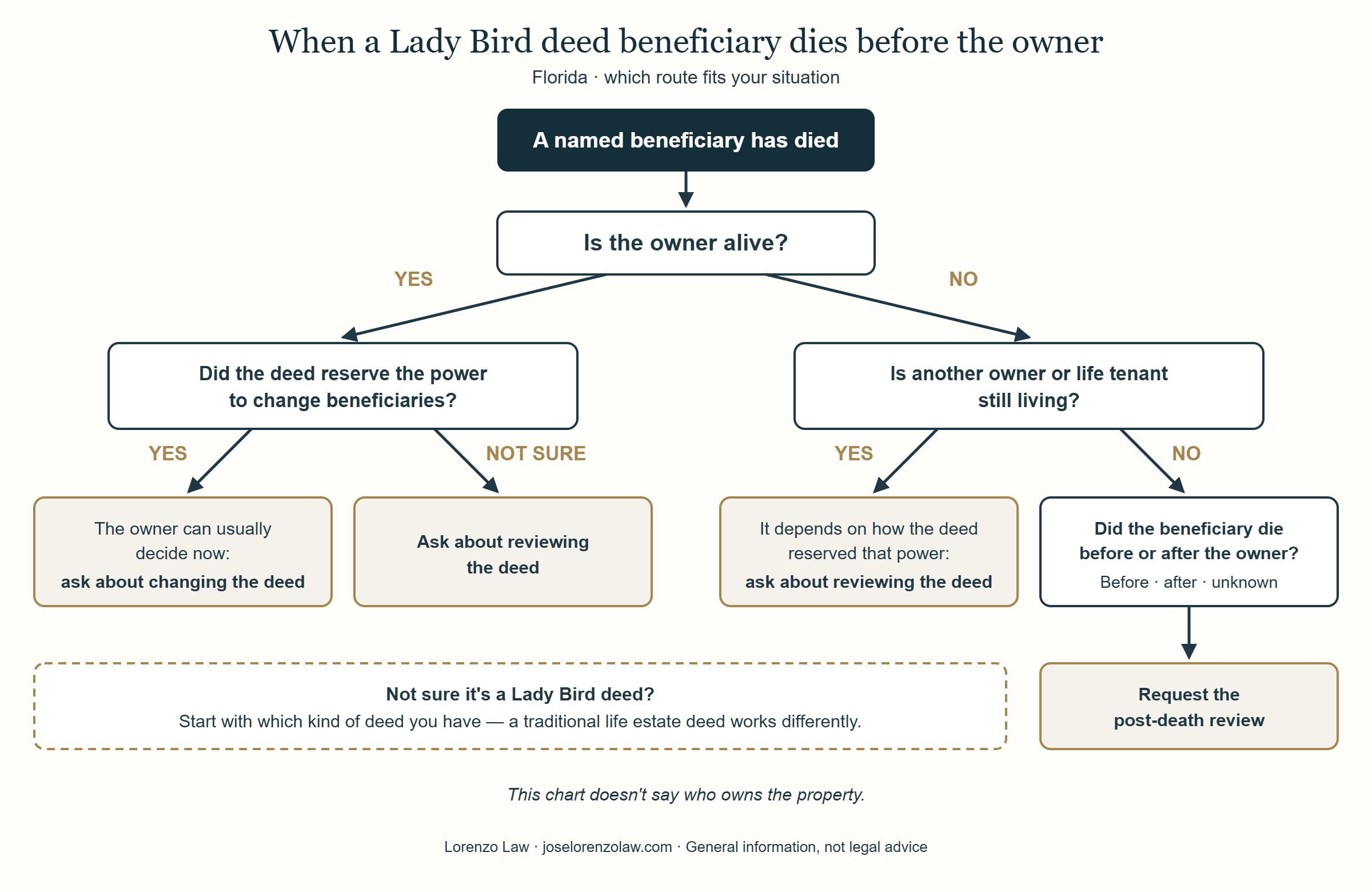
The chart in words:
- A named beneficiary has died. Is the owner alive?
- Yes: did the deed reserve the power to change beneficiaries? If yes, the owner can usually decide now; ask about changing the deed. If you’re not sure, ask about reviewing the deed.
- No: is another owner or life tenant still living? If yes, the answer depends on how the deed reserved that power; ask about reviewing the deed. If no, find out whether the beneficiary died before or after the owner, or mark it unknown, and request the post-death review.
- Not sure it’s a Lady Bird deed? Start with which kind of deed you have.
The chart doesn’t say who owns the property.
What happens to the share when a beneficiary dies first?
If the deed doesn’t say what happens when a beneficiary dies before the owner, Florida law hasn’t squarely settled the answer. Because the owner keeps the power to change or undo the deed while alive, the better view is that a beneficiary who dies first leaves nothing to pass to that beneficiary’s own family — but no Florida appellate court has decided this for a Lady Bird deed. A deed that spells out the owner’s wishes avoids the question.
Florida’s anti-lapse statutes apply to wills and trusts, not deeds, and Florida law hasn’t settled what happens to a predeceased beneficiary’s share. The will statute is section 732.603; the trust statute is section 736.1106.
If the deed is a traditional life estate deed — one where the owner can’t sell, mortgage, or change it without the remainder beneficiary’s signature — the beneficiary’s interest is generally vested once the deed is signed and delivered, so if that beneficiary dies first the share generally passes through his or her own estate and may require probate (unless the deed expressly required the beneficiary to survive the owner, which makes the share fail instead). That is the opposite of the better view for a Lady Bird deed, which is why the first question is which kind of deed you have.
What the deed’s wording decides
If the deed clearly says whether the share goes to the surviving beneficiaries or to a beneficiary’s descendants, that wording generally controls — provided it is definite and, for homestead, consistent with Florida’s homestead rules.
Some deeds also name an alternate, often called a contingent beneficiary.
Does “per stirpes” in the deed send a share to the grandchildren?
Under Florida law, “per stirpes” in a deed isn’t defined, and the word alone may not make the owner’s intent clear. A deed should say expressly who takes a share if a beneficiary dies first. “Per capita” isn’t defined for deeds under Florida law either, and it can be read more than one way, so the word alone may not show whether a share goes to the surviving beneficiaries or to a beneficiary’s descendants. A deed should say that expressly.
Deeds that say “my children” or name a trust
Whether the deed names each beneficiary or describes a group, such as “my children,” can change who takes when one of them dies first, and Florida law hasn’t settled how a group description in a Lady Bird deed works — including whether it reaches a child born, adopted or added by marriage after the deed was signed. A deed should name the people it means.
If the deed names a trust as the beneficiary, the trust’s own terms (and Florida’s trust rules) decide what happens when a beneficiary of that trust dies first; but if the trust no longer exists or the deed names or describes it incorrectly, the gift may fail or require a court to construe or correct the deed.
When the deed is silent
Hypothetical. If the owner named three children, one died before the owner, and the deed is silent, Florida law has not settled where that one-third share goes: it does not automatically go to the surviving children, and while the better view is that it does not pass through the deceased child’s own estate, that remains possible — the share may instead fall back into the owner’s estate — so sorting it out can require probate.
What if the only beneficiary, or every beneficiary, dies before the owner?
If every beneficiary named in the deed dies before the owner and the deed names no alternate, the property generally falls back into the owner’s estate and passes under the owner’s will or by intestacy — usually through probate — though if the home is homestead and the owner leaves a spouse or minor child, Florida’s homestead rules, not the will, control where it goes.
If the home is homestead and the owner is survived by a spouse or a minor child, Florida law limits how it can pass: a share that would otherwise fall into the owner’s estate goes under the homestead descent rules, not the will. Adult children alone do not trigger this limit. If a share ends up in the owner’s estate, it may have to go through probate.
What if the owner is still alive?
While you are alive, you can usually decide who takes the share instead by signing, delivering and recording a new deed, if your deed reserved the power to change beneficiaries. If you do nothing, the share goes wherever the deed and Florida law send it, as explained above.
Choosing who takes the share now
You can give the share to the surviving beneficiaries, to the deceased beneficiary’s children, to a named alternate or to a trust. A change works when your deed reserved the matching power, you understand what you are signing, and the new deed is delivered while you are alive. If the property is your homestead and you are married, your spouse usually must sign the new deed. A deed that expects a minor to take should name a custodian or a trust.
Do I need the deceased beneficiary’s family’s permission to sign a new deed?
If your Lady Bird deed reserved the power to change beneficiaries, you don’t need a signature or consent from a deceased beneficiary’s estate or family to sign a new deed, just as you wouldn’t need one from a living beneficiary. (A traditional life estate deed works differently; see before the house can be sold.)
The steps are on my page about how to change or revoke a Lady Bird deed; if an agent would sign for you, see whether a power of attorney can sign one.
The new-deed service
Looking at your recorded deed costs you nothing; paid work begins only when you hire me to prepare the new deed. My fee for a standard matter, one property and one deed, is flat.
| Standard change or revocation | Quoted separately, before you hire me | |
|---|---|---|
| Fee | $675 flat | Depends on the issue |
| Covers | The deed you request: a new Lady Bird deed or a deed back to yourself | — |
| Included | Speaking with me directly, deed review, homestead and spousal-signature analysis, documentary stamp analysis, drafting, signing with witnesses (including online notarization), recording fees, and the minimum documentary stamp charge | — |
| Not included | Documentary stamp tax above the minimum, identified during the free initial consultation, before you hire me | Correcting a defective deed, title searches, disputes, after-death matters, more than one property or deed, and wills or trusts |
Any documentary stamp tax above the minimum, and anything outside a standard change, is identified during the free initial consultation, before you hire me.
I review deeds prepared by other lawyers and online services. If I see a larger issue, such as missing reserved powers or a missing spousal signature on homestead, I explain it before you hire me, including how the scope and fee may differ from my standard fee. After recording, I send you a copy of the recorded deed.
What if the owner has also died?
Once the owner has died, no one can use the powers the owner reserved in the deed to change it. A court can sometimes correct a drafting mistake or set the deed aside for fraud, undue influence, or incapacity — but a deed the owner gave purely as a gift, with no real payment, usually cannot be rewritten after the owner’s death to cut out the owner’s other heirs, so the wording left behind generally stands. Whether the beneficiary died before or after the owner can change the answer. That is why the deed gets read, and the date of each death confirmed, before anyone records, signs or sells anything.
When the order of deaths matters
The better view is that a beneficiary who survived the owner — even briefly — took the share at the owner’s death, so it then passes through that beneficiary’s own estate; but the deed can require a beneficiary to outlive the owner by a set period, and if it does, a beneficiary who dies within that period is treated as not having survived and takes nothing.
Florida law sets no minimum time a beneficiary must outlive the owner, though the deed can require survival for a stated period. If it cannot be determined who died first, Florida’s simultaneous-death law doesn’t establish an order — it directs that the property be handled as if each person survived the other — and no Florida case has yet applied that rule to a Lady Bird deed.
When two people held the life estate
When a deed gives a life estate to two people, the remainder beneficiary generally must survive the last of the two to die, not the first — and the life estate continues in the survivor only if the two hold with survivorship, which is presumed for a married couple (their shared interest is presumed a tenancy by the entireties) but, for anyone else, must be stated in the deed.
Whether the surviving life tenant can change the beneficiary alone depends on how the deed reserved that power — to them jointly, to each separately, or to the survivor; without such wording, a surviving life tenant can deal only with his or her own life interest, not the whole property. If one of them is still living, the living-owner section may fit better than this one.
Whose will counts
A beneficiary’s own will generally can’t control a share that beneficiary never received. The owner’s will can’t change the deed, but it can govern a share that falls back into the owner’s estate — unless the home was homestead and the owner left a spouse or minor child, in which case Florida’s homestead rules control that share instead.
What a share in the owner’s estate is exposed to
If a share lands in the owner’s estate, the owner’s unpaid debts and any Medicaid estate-recovery claim can be paid out of it through probate. But a home that qualifies as protected homestead and passes to the owner’s spouse or heirs is beyond both ordinary creditors and Medicaid recovery — though it still carries any mortgage, tax lien, or other lien the owner agreed to, and the protection may be lost if the home was left to someone who is not an heir.
Before the house can be sold
If a share may have fallen back into the owner’s estate, someone usually needs court authority — typically through probate of the owner’s estate, and for homestead a court determination — before that share can be sold; if the beneficiary outlived the owner and then died, that beneficiary’s own estate may have to be probated instead. Which proceeding fits, including whether a shorter summary administration is available, depends on the facts.
If a share passes to someone under 18, the child can own it, but generally can’t manage or sell it; unless the deed left the share to a custodian or a trust for the child, a court-appointed guardian of the property is usually needed, and a sale may require court approval.
Under a traditional life estate deed, the deceased beneficiary’s share usually belongs to his or her estate, so the personal representative or heirs would generally have to sign before the whole property can be sold — unless the deed required the beneficiary to survive the owner, in which case the share fails and the beneficiary’s estate has nothing to sign for. Where the failed share then goes depends on the deed’s wording — to the surviving remainder beneficiaries if the deed so provides, otherwise back to the owner or the owner’s estate; without clear wording, Florida law hasn’t settled it.
The list below is what I need to review the deed.
The post-death deed review
The post-death deed review is $475, flat. That covers my review of the existing recorded deed you supply, and a 30-minute consultation with me — Jose Lorenzo, not a paralegal. In it I read the deed and tell you what it actually did, we discuss how the death you have reported affects the ownership situation, and I identify the next steps that fit your facts.
What that fee is not. It is not a title search, and it is not a comprehensive review of the whole estate. Preparing or recording further documents, administering a probate, and representing you in a dispute are separate engagements — each with its own agreed scope and fee, quoted before any of it starts.
Making that initial inquiry costs nothing, and it is not itself the paid review — I will confirm the scope, and give you instructions for delivering the documents, before you send anything sensitive.
For the wider steps after a death, see what to do with a Lady Bird deed after death.
Documents and dates to gather
Start with the complete recorded deed, any later deeds, and the date of every death. You can usually pull the recorded deed from the clerk’s official records; a full records search is separate work.
| Event | Date (or “unknown”) | Document that shows it | Have it? |
|---|---|---|---|
| Deed signed | Deed (signature page) | ||
| Deed recorded | Recorded deed (book and page, or instrument number) | ||
| When or how the deed was handed over, if you know (for my review) | What you know | ||
| Any later deed, sale or mortgage | Recorded instrument | ||
| Each beneficiary’s death | Death certificate | ||
| Owner’s death, if any | Death certificate | ||
| A will or probate case for the owner or the beneficiary | Will or court file |
Family facts.
- If the owner is living: current marital status, and whether there is a minor child.
- If the owner has died: marital status, and any minor child, at the date of death.
If you don’t know a date, mark it unknown — it doesn’t stop you from getting in touch. Tell me whether anything is pending — a sale, a lender, a disagreement, a deadline — and send documents only through the instructions I give you, never through a public web form.
Mistakes to avoid before the deed is read
Don’t assume that the grandchildren step in, that the survivors split the share, or that it passes through the beneficiary’s estate; as explained above, that depends on the deed. Don’t record anything or sign a “clean-up” deed. Writing on the recorded deed or crossing out a name doesn’t change title.
A review isn’t representation in a disagreement. If someone is challenging the deed, see can a Lady Bird deed be contested; if co-owners can’t agree, see partition actions.
Questions about reviewing your deed
Can you tell me who owns the property from a short message?
No. To review it I need the recorded deed, the date of each death and the family facts above. A review explains what the deed did and where Florida law is unsettled; it doesn’t bind anyone who disagrees.
Does the $475 review cover a lawsuit or fixing title?
No. It identifies what the deed did and the next steps; corrective documents, probate and disputes are separate engagements, quoted first.
Does the $475 post-death review include preparing a new deed?
No. Preparing or recording any document is a separate engagement, quoted before it starts.
Ask about your deed
Owner living: ask about changing the deedOwner has died: request the post-death deed review
Describe the situation first; I’ll confirm the scope and how to send documents. Sending me your deed so I can review it does not by itself make me your lawyer. Call (305) 224-6811 or use the contact form.
About the author. Jose M. Lorenzo, Jr., Esq., Florida Bar No. 107002, is the attorney at Lorenzo Law. His principal office is in Kissimmee, and meetings in Coral Gables and Fort Lauderdale are by appointment. His practice covers Florida probate, estate planning, guardianship and homestead matters, including the preparation and review of Lady Bird deeds statewide.
This page provides general information about Florida law, not advice about a particular deed or situation. Reading it or requesting a consultation does not create an attorney-client relationship.
Sources and authorities cited
Florida statutes cited are the 2026 Florida Statutes, linked to the Florida Senate. The text of the law controls over any summary on this page.