Palm Beach County Estate Planning Attorney: Wills, Trusts and Tax-Aware Planning from Boca Raton to Jupiter
As a Palm Beach County estate planning attorney, I prepare wills, durable powers of attorney, health care surrogate designations, living wills and revocable living trusts, at published flat fees: a will from $675, a $1,500 core package and a trust plan from $2,500.
I work with individuals and couples in Boca Raton, West Palm Beach, Delray Beach, Boynton Beach, Palm Beach Gardens, Jupiter and Wellington, including new residents from New York and New Jersey and families planning for estate tax, charitable gifts or a relative with special needs. The whole engagement can be handled without a trip to an office, and when witnesses need to be in the room, the signing comes to you.
Request a free initial consultation. Only the initial consultation is free; representation fees and costs are agreed separately in writing. Consultations are available statewide in English and Spanish, by phone or video.
Request a free initial consultationCall (305) 224-6811
Go straight to: Cost · Moving to Florida · Estate tax · Signing · Questions
By role: someone with no plan yet should start with choosing a will, a package or a trust; a new resident, with moving your domicile; a married couple, with joint wills, mirror wills and joint trusts; a larger estate, with estate and gift tax; an adult child helping a parent, with the questions readers ask.
All guide sections 21 sections
Short answer. What does a Palm Beach County estate planning attorney do, and what does it cost? I prepare the documents that decide who inherits from you and who acts for you if you cannot: a will, a durable power of attorney, a designation of health care surrogate, a living will, a preneed guardian designation and, when it fits, a revocable living trust. For larger estates I also plan for federal estate and gift tax, irrevocable and charitable trusts, special needs trusts and marital agreements. A will starts at $675; the core estate planning package is $1,500 for one person; a revocable living trust plan starts at $2,500, plus $575 per Florida deed into the trust, plus any documentary stamp tax above the minimum. Clients from Boca Raton to Jupiter work with me by phone or video, and when witnesses need to be in the room, the signing comes to you.
| Who is it for? | Individuals and married couples anywhere in Palm Beach County, from Boca Raton, Delray Beach and Boynton Beach to West Palm Beach, Palm Beach Gardens, Jupiter and Wellington, who want a will, incapacity documents or a trust, including people who have just moved to Florida. Your situation |
|---|---|
| What does it cost? | A will on its own starts at $675. The core estate planning package is $1,500 for one person. A revocable living trust plan is a separate engagement, starting at $2,500, plus $575 per deed, recording included, when Florida real estate is moved into the trust, plus any documentary stamp tax above the minimum. Married couples receive a discount, quoted individually. Fees and what they include |
| Which documents does a plan need? | For most Florida adults, five core documents: a will, a durable power of attorney, a designation of health care surrogate, a living will and a preneed guardian designation. Together they are the $1,500 core package. What each one does |
| Moving from New York or New Jersey? | Your documents may still be valid, but they were written for another state’s rules. The move itself, including the declaration of domicile, which I prepare and record, is covered in its own section. Moving your domicile to Palm Beach County |
| A larger estate, or estate tax? | Florida has no estate tax of its own; the federal estate and gift tax applies only to larger estates. Tax planning, irrevocable and life insurance trusts, spousal lifetime access trusts, dynasty trusts and charitable trusts are each quoted individually. Estate and gift tax |
| What does the will fee include? | Advice, drafting, supervised signing, both witnesses, the notary and the self-proving affidavit, at the same price for every lawful signing method. What every fee includes |
| Is there a Palm Beach County office? | No. Kissimmee, Florida is the principal office; meetings in Coral Gables and Fort Lauderdale are by appointment. Palm Beach County clients work with me by phone, Zoom or WhatsApp. Where I work |
| Do I have to come to an office? | No. I explain on the first call which documents can be signed remotely in your situation; when a document should be signed with witnesses in the room, I prefer a mobile signing that comes to you. How signing works |
| How long does it take? | It runs on your timeline. Tell me when you need the documents signed, and the work is scheduled around that date. Timing |
| Is there a free consultation? | Yes: a short phone call with me, with no obligation. Only the initial consultation is free; representation fees and costs are agreed separately in writing. |
| Languages | English and Spanish. The documents are in English; I explain them in Spanish. Spanish-speaking families |
I am Jose M. Lorenzo, Jr., Florida Bar No. 107002, and the only attorney in my practice. Lorenzo Law is a solo practice: the attorney you speak with at the first call is the attorney who handles any matter the firm accepts. Most people who call have one of three reasons: they have never made a plan, they moved to Palm Beach County with documents written for another state, or they have a plan and are no longer sure it still works. Please do not put Social Security numbers, account numbers or medical details in the web form.
Estate planning with attorney Jose Lorenzo for Palm Beach County
An estate plan answers two separate questions. What happens to what you own when you die, and who makes decisions for you if you are alive but cannot make them yourself. The second question comes up far more often than the first, and it is the one a plan made in a hurry usually leaves out. Everything I prepare is built to answer both.
Palm Beach County is not one kind of household. It runs from Jupiter and Tequesta in the north through West Palm Beach and Wellington to Boynton Beach, Delray Beach and Boca Raton in the south, and west to Belle Glade and the Glades. People usually call a Palm Beach County estate planning lawyer at a specific moment: a move from the Northeast, a closing on a home or condominium, a diagnosis, a new grandchild, a second marriage, the sale of a business, or a bank refusing a parent’s power of attorney. Whether you are retiring, raising children, in a second marriage, running a business or newly arrived from another state, the law is the same. What differs is the first question, and this page is organized around those first questions.
Personal attorney guidance, not a rotating file
I am one attorney. There are no associates and no rotating file assignments. You explain your family once, to the person who writes the documents, and if you need a change later, you can contact me directly about a new engagement. That is what an estate planning attorney Palm Beach County clients can reach directly should mean: the person who answers the phone is the person who drafts the plan. The practical difference between that and a larger firm is set out in the comparison section below.
Individual and couple planning
Most of the plans I prepare are for one of two households: a single person, often widowed, divorced or never married, or a married couple whose two plans need to agree with each other and with how they own their home and accounts. Estate planning for couples is not one set of documents with two names on it. Each spouse signs his or her own will and his or her own incapacity documents, drafted so that the two plans fit together. Couples have their own section.
Many single clients want a will and health care documents and nothing more. For a lot of people that is a complete plan, and it is the core package described below.
Do I need an estate planning attorney near me in Palm Beach County?
Not in the sense of an office down the street. When choosing among wills and trusts attorneys in Palm Beach County, or comparing an estate attorney in Boca Raton with an estate lawyer in West Palm Beach, ask how the lawyer handles Florida’s rules on homestead, spouses and signing, and how you can reach the lawyer with questions. For a search framed as “estate planning attorney near me,” an office address does not tell you who will draft your documents or how you will communicate with that person.
If you are comparing an estate planning attorney in Boca Raton or an estate planning attorney in West Palm Beach with me, the first thing to know about me is where I am. Kissimmee, Florida is the principal office; meetings in Coral Gables and Fort Lauderdale are by appointment. I do not have a Palm Beach County office, and I would rather tell you that now than have you discover it later. Palm Beach County clients work with me by phone, Zoom or WhatsApp, and by email; when a document should be signed with witnesses physically present, I prefer a mobile signing, so the signing comes to you.
When to hire an estate planning lawyer is easier to answer than whom. The right time is before a change rather than after it: a move to Florida, a marriage or divorce, a new child, a home or business purchase, or a diagnosis, and in any case before a hospital stay makes the documents urgent. If you already have a plan, the list of reasons to update is the same test.
What does estate planning cost in Palm Beach County?
Short answer. Estate planning in Palm Beach County with me starts at $675 for a will on its own, costs $1,500 for the core estate planning package for one person, and starts at $2,500 for a revocable living trust plan, plus $575 for each Florida deed that moves real estate into the trust. Every figure is agreed in writing before drafting begins. Married couples receive a discount, quoted individually. Irrevocable, tax, charitable and special needs trusts and marital agreements are quoted individually.
I publish my estate planning fees, so the answer to how much a will costs is on this page. Here is how the fees work, and what each one includes.
| Service | Fee | What the fee includes | Quoted or paid separately |
|---|---|---|---|
| Will on its own | Starts at $675 per person | Advice, drafting, supervised signing, both witnesses, the notary and the self-proving affidavit, at the same price for every lawful signing method | Reviewing documents you already have; anything beyond the will |
| Core estate planning package | $1,500 for one person | Will, durable power of attorney, designation of health care surrogate, living will and preneed guardian designation. For parents of minor children, also a preneed guardian declaration for the children, filed with the clerk, and a designation of health care surrogate for the children | A trust; business succession planning |
| Revocable living trust plan | Separate engagement, starting at $2,500 | Revocable living trust, pour-over will and the incapacity documents; my review of your estate plan and your trust so that they work together; advice on what is necessary for your beneficiary designations and how to get it done efficiently | Each Florida deed into the trust |
| Deed into the trust | $575 per Florida deed | Reading your recorded deed, deed preparation, online notarization, witnesses, county recording fees and the minimum documentary stamp charge | Documentary stamp tax above the minimum; a property outside Florida, which counsel in that state should handle |
| Married couples | A discount, quoted individually | Each spouse signs his or her own documents, so the couple’s plan is quoted individually rather than doubling the single price | The same separate items as above |
| Irrevocable, life insurance, spousal lifetime access, dynasty, charitable and special needs trusts; marital agreements; estate and gift tax planning; declaration of domicile | Quoted individually | A written quote before the work starts, based on what the document or plan needs to do | Any filing or recording fee charged by a public office |
A trust plan with the deed for your home starts at $3,075, plus any documentary stamp tax above the minimum. The $575 applies only when Florida real estate is moved into the trust, and it is per deed, so each additional Florida property is another $575. If a property is outside Florida, I advise you to have counsel in that state prepare and record the deed. My Palm Beach County lady bird deed service is also $675, but it is a separate service that passes one property; it is not a will.
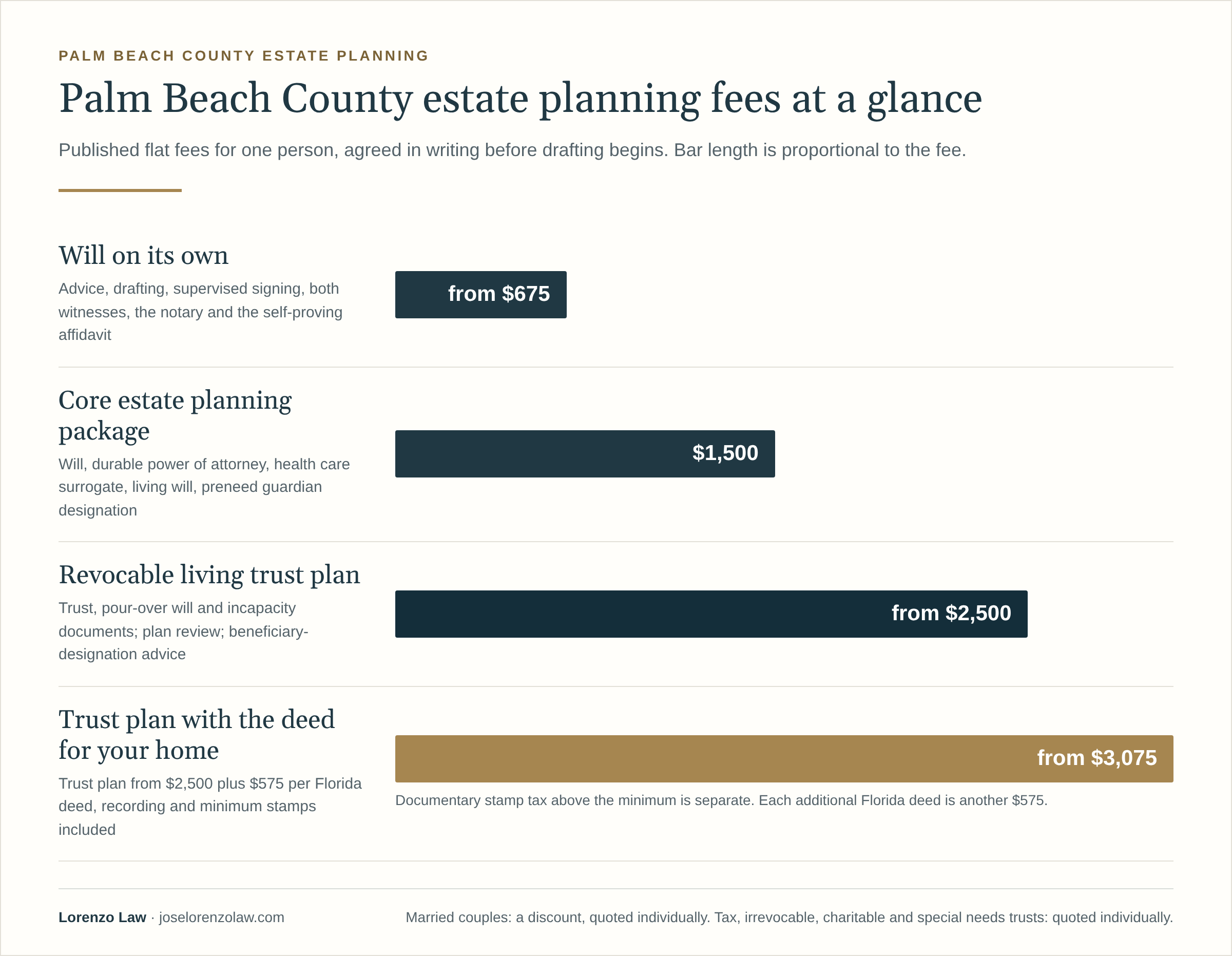
See the chart “Palm Beach County estate planning fees at a glance” (opens the full-size image; the details are also in the text).
Every figure is agreed before drafting begins, so an estate planning flat fee here, for an individual or a couple, means you know the number before I write a word. The quote changes if the plan needs more than the documents listed, for example a business succession arrangement, a second property in another state, or a trust. I tell you the figure before that work starts. For a complete estate plan package in Palm Beach County, compare what each package lists: the documents, the signing, the witnesses and notary, and, for a trust, what the quote covers on funding.
How much does a living trust cost in Florida?
With me, a revocable living trust plan for one person starts at $2,500, and each Florida deed that moves real estate into the trust is $575, recording included, so a trust plan with the deed for your home starts at $3,075, plus any documentary stamp tax above the minimum. The trust plan figure depends on what the trust needs to hold and do, and I quote it once I understand that. Whoever prepares your trust, ask what the quote covers on funding.
What is the average cost of estate planning in Florida?
How much estate planning costs in Florida depends on what the plan contains, and estate planning attorney cost varies widely because published averages mix wills, packages and trusts together, and hourly and flat fees. The useful comparison is not an average but what each quote includes. For a trust in particular, ask what the quote covers on funding, because a trust that is never funded does nothing. Retitling your bank and brokerage accounts is done by you, with the steps I give you. Reviewing documents you already have, including a plan signed in another state, is separate work, quoted before it starts. My own figures are in the table above.
Is the fee different in Boca Raton or Jupiter?
No. My fees are set by what the plan includes, not by the city you live in. A will-and-incapacity package for a client in Boca Raton is the same $1,500 as for a client in Jupiter, Wellington or Belle Glade, and the $575 deed fee includes the county’s recording fees wherever the property is in Florida.
Is the first consultation free?
The first conversation is free: a short phone call with me, so you can tell me what you have in mind, ask how the process works and decide whether you want to go ahead. There is no charge and no obligation. It is a free consultation with the estate planning attorney who would draft your documents, not with an intake coordinator. Only the initial consultation is free; representation fees and costs are agreed separately in writing.
Choose between a will, a document package and a trust plan
Most people need one of three things: a will, a will with the documents that work during life, or a revocable trust plan. Some need only a fourth: a deed for one property. The table shows what each is for and what it contains. On the first call I ask what you own, how it is held and who is in your family, and I tell you which of these fits. Sometimes the answer is less than you expected.
| Service | What it is for | Documents | Trust? | Fee |
|---|---|---|---|---|
| Will on its own | Who inherits, who administers the estate, and the guardian you nominate for minor children | Last will and testament | No | Starts at $675 |
| Core estate planning package | A will plus the documents that work while you are alive | Will, durable power of attorney, designation of health care surrogate, living will, preneed guardian designation | No | $1,500 for one person |
| Revocable living trust plan | Keeping assets out of probate and handling incapacity through a successor trustee | Revocable living trust, pour-over will, and the incapacity documents | Yes | Separate engagement, starting at $2,500, plus $575 per deed when Florida real estate is moved into the trust, plus any documentary stamp tax above the minimum |
| Lady bird deed only | Passing one Florida property at death without probate, while you keep full control | Enhanced life estate deed | No | $675, a separate service (below) |
Married couples: each spouse signs his or her own documents, and the couple receives a discount, quoted individually. Business owners: business succession planning is an additional service, quoted before that work starts.
The will-and-incapacity package
The core estate planning package is $1,500 for one person: a will, a durable power of attorney, a designation of health care surrogate, a living will and a preneed guardian designation. Each one does a different job, and together they are the essential estate planning documents most Florida adults need. If you are calling a will attorney in Boca Raton for “just a will,” consider what a will cannot do: it covers only what happens after death, and the other four documents cover the years before it. For most people, a basic estate plan is exactly this package.
As a last will and testament attorney for Palm Beach County, I start with the will and consider which other documents your plan needs. If you need help writing a last will and testament in Palm Beach County, the first decision is whether you need a will alone or the wider package.
Your last will and testament, sometimes called your final will and testament, follows the same Florida rules for a written will whether you write a will and testament yourself or have a lawyer create it. Writing your last will and testament and creating a will and testament with a lawyer involve more than filling in names. The key components of estate planning are the five documents below; the “three” or “four” estate planning documents some lists name are usually the will, the power of attorney and the health care documents, with the preneed guardian designation left off. Together, the five make up the complete estate plan package for one person, whether you live in West Palm Beach, Boca Raton or elsewhere in Palm Beach County. Dying with no last will and testament is covered in the questions below: Florida’s intestacy statutes then decide who inherits.
- Last will and testament. Names who inherits, who administers the estate and the guardian you nominate for your minor children. It operates only after death, and only through the court. Even what people call a simple will: Florida requires it to be signed at the end with two witnesses, and a simple document can still give a result nobody intended.
- Durable power of attorney. Lets a person you choose handle your financial and legal affairs; it is the financial power of attorney, and the document most people mean when they look for a power of attorney lawyer. A Florida power of attorney generally takes effect when you sign it, and because it is durable it keeps working if you become unable to act. It ends at death.
- Designation of health care surrogate. Lets a person you choose make medical decisions and receive your records. What other states call a medical power of attorney or a health care proxy, Florida calls a designation of health care surrogate.
- Living will. States your own wishes about end-of-life care, so no one has to guess. A living will is a medical document. It does not leave property to anyone, and it is not the same thing as a living trust. The difference between a living will and a last will is the difference between a hospital and a probate court. Many people first ask about a living will in Boca Raton after a hospital stay; it is far easier to sign one before.
The health care surrogate designation and the living will are both advance directives under Florida law (§ 765.101).
Living will vs. last will. What’s a living will, and how is it different from a last will? Families in West Palm Beach, Boca Raton and across Palm Beach County often confuse the two because the names sound similar, but the documents do different jobs. A living will speaks while you are alive, about medical treatment at the end of life; a last will speaks after death, about property and guardians. A living will has no executor: the person who carries out your health care wishes is the health care surrogate you name, while the executor, called a personal representative in Florida, is named in your last will and acts only after death. Most plans include both, and both are in the $1,500 core package.
A preneed guardian designation, which names the person you want appointed if a court ever decides a guardian is needed, is included in the package. You will also see it written pre need guardian. Florida law gives the person you name a statutory presumption if a guardianship is ever opened. If planning came too late and a guardianship is contested, see removing a guardian.
Some people ask for a “health and wealth power of attorney,” meaning one document for money and medicine. Florida separates them. I prepare the durable power of attorney for financial and legal matters and the designation of health care surrogate for medical decisions, so each document does one job.
Health care surrogate for Palm Beach County families
The designation of health care surrogate, often searched as a healthcare surrogate, is the document a hospital in Boca Raton, Delray Beach or West Palm Beach asks for first, usually on the worst day a family has had in years. It names the person who speaks for you on medical decisions and, if you choose, gives that person access to your records straight away rather than only once you are incapacitated. I prepare the surrogate designation as its own document rather than folding health care into the durable power of attorney: the financial document falls under chapter 709, Florida’s power of attorney statute, and the health care document under chapter 765, Florida’s law on health care advance directives, and keeping them separate means each is read for the job it does. My pages on the Florida health care surrogate and the Florida power of attorney explain each document in detail.
What rights does a health care surrogate have in Florida? Once the surrogate is acting, he or she can talk with your doctors, review your medical records, consent to or refuse treatment, and apply for benefits for your care, all in line with what you would have wanted, and can make those decisions only within what your designation and Florida law allow. A surrogate decides about care; paying your bills from your own money is the job of the agent under your durable power of attorney.
For a snowbird, the surrogate you name should be someone who can be reached, and ideally be present, during the months you are in Palm Beach County. Many families name one person who lives nearby and a second who lives where the family spends the rest of the year.
Types of durable power of attorney in Palm Beach County, and the language that matters
The types of power of attorney are named for what the document covers and when it works. A general power of attorney gives broad authority over your financial affairs; a limited or special power of attorney covers one task or one asset, such as selling a single property. A durable power of attorney keeps working if you become incapacitated, while a non-durable one ends when you lose capacity, which is exactly when most families need it. A springing power, which waits for a finding of incapacity, cannot be created in Florida for documents signed on or after October 1, 2011. All of them are governed by Florida’s power of attorney statute, chapter 709, Part II, which sets the signing rules but does not prescribe one mandatory statutory form, so a “statutory durable power of attorney” in Florida means one signed under that statute, not a fill-in form. The power of attorney in the core package is a durable general power of attorney, with the specially listed powers you choose. It is revocable: you can revoke it at any time while you have capacity. A power described as irrevocable is usually one coupled with an interest in a business or lending transaction, which the Florida statute treats separately.
For clients in Boca Raton, West Palm Beach and the rest of Palm Beach County, the durable power of attorney language that matters most is the list of specially enumerated powers: gifts, trusts, beneficiary designations and survivorship rights are not granted by general wording, and each must be listed with your signature or initials beside it. A “financial and property power of attorney” or a “legal financial power of attorney” is the durable power of attorney; what some people call a “health and wealth” power of attorney, or a durable power of attorney for health and financial decisions, is, in Florida, two documents, the durable power of attorney and the designation of health care surrogate. Changing a durable power of attorney means signing a new one and revoking the old one in writing, with notice to the former agent and to any bank that has a copy (updating a plan). A “medical power of attorney,” or a durable power of attorney for medical care or medical decisions, is the designation of health care surrogate. For a senior parent, the durable power of attorney is the document that most often decides whether a family can pay the bills without going to court.
Legal guardian vs. power of attorney. A power of attorney is chosen by you, signed while you have capacity and used without a court. A guardian of the property is appointed by a court after a finding of incapacity, files reports and acts under court supervision. A durable power of attorney, with a health care surrogate designation and a preneed guardian designation, is how most families avoid needing a guardian at all, and the preneed designation names your choice if a guardianship is ever opened.
A separate revocable living trust plan
A revocable living trust plan is a separate engagement, starting at $2,500. I quote it once I understand what the trust needs to hold and do. The trust plan includes my review of your estate plan and your trust, so that they work together. For your beneficiary designations, I advise you on what is necessary and how to get it done efficiently. Moving your home into the trust takes a new deed, at $575 per Florida deed plus any documentary stamp tax above the minimum; what that fee includes is set out in the fee section.
When comparing Boca Raton trust attorneys or a trust attorney in West Palm Beach, consider three goals: keeping a house or accounts out of probate, letting someone step in without a court if they become incapacitated, or holding a child’s inheritance until an age they choose. A revocable trust in Boca Raton works the same way as one anywhere else in Florida: it controls only what is titled in it.
A living trust attorney helps with two parts of a plan: drafting and funding. The first is drafting: the trust itself, a pour-over will that catches anything never moved into the trust and nominates guardians for minor children, and the incapacity documents. The second is funding, and it is the part that decides whether the trust works. Real estate is funded by recording a new deed into the trust; in Palm Beach County, deeds are recorded with the Clerk of the Circuit Court & Comptroller (county offices). Bank and brokerage accounts are retitled at the institution. You handle that step yourself, and I give you the steps to follow, because it is faster and less expensive for you to do it directly with your bank or brokerage than to pay counsel to do it. Retirement accounts and life insurance are usually handled by changing the beneficiary designation. An unfunded trust is an expensive folder.
Setting up a living trust in Florida with me follows five steps:
- Consultation and quote. Drafting starts only after I understand what the trust needs to hold and do, and you have the fee in writing.
- Drafting. The trust, the pour-over will and the incapacity documents, reviewed with you before anything is signed.
- Signing. The trust is signed with the same formalities as a will, in the room or remotely (how signing works).
- Funding. A new deed for each Florida property, retitling at your bank and brokerage, and beneficiary designations matched to the plan.
- Later changes. A revocable living trust is changed by a signed amendment, or restated in full, without moving the assets out and back in.
For a married couple, a revocable trust plan may use one trust or two, with a pour-over will for each spouse. Which one fits depends on how you own your home and accounts now, and I quote the couple’s trust plan individually.
A Florida resident’s revocable trust that disposes of property at death must be signed with the same formalities as a will. That matters if you want your plan handled remotely, and it is covered in the signing section below. My Florida living trust page goes further into how a revocable living trust in Florida works.
Will vs. living trust in Florida
Is a trust better than a will in Florida? Not always. A will speaks only after you die and only through a court. A trust speaks as soon as it is funded, and keeps speaking through incapacity and death without one. That is why the choice is rarely a will instead of a trust. Most people who use a trust also sign a pour-over will, and the two are drafted as a pair.
For estate planning in Palm Beach County, the will vs. trust question usually turns on real estate, family structure and incapacity, not on the document’s name. On cost, the will package versus a living trust plan is $1,500 against a trust plan starting at $2,500. Each deed that moves Florida real estate into the trust is a separate $575, with recording included.
| Question | Last will and testament | Revocable living trust |
|---|---|---|
| Does it work if I become incapacitated? | No; it has no effect until death | Yes; the successor trustee takes over |
| Does it avoid a court proceeding? | No | Only for assets actually titled in it |
| Does it name guardians for minor children? | Yes | No — the pour-over will does |
| Does it protect assets from my own creditors while I am alive? | No | No |
| Does it override the homestead restrictions? | No | No |
| Work after signing | Very little | Funding is essential |
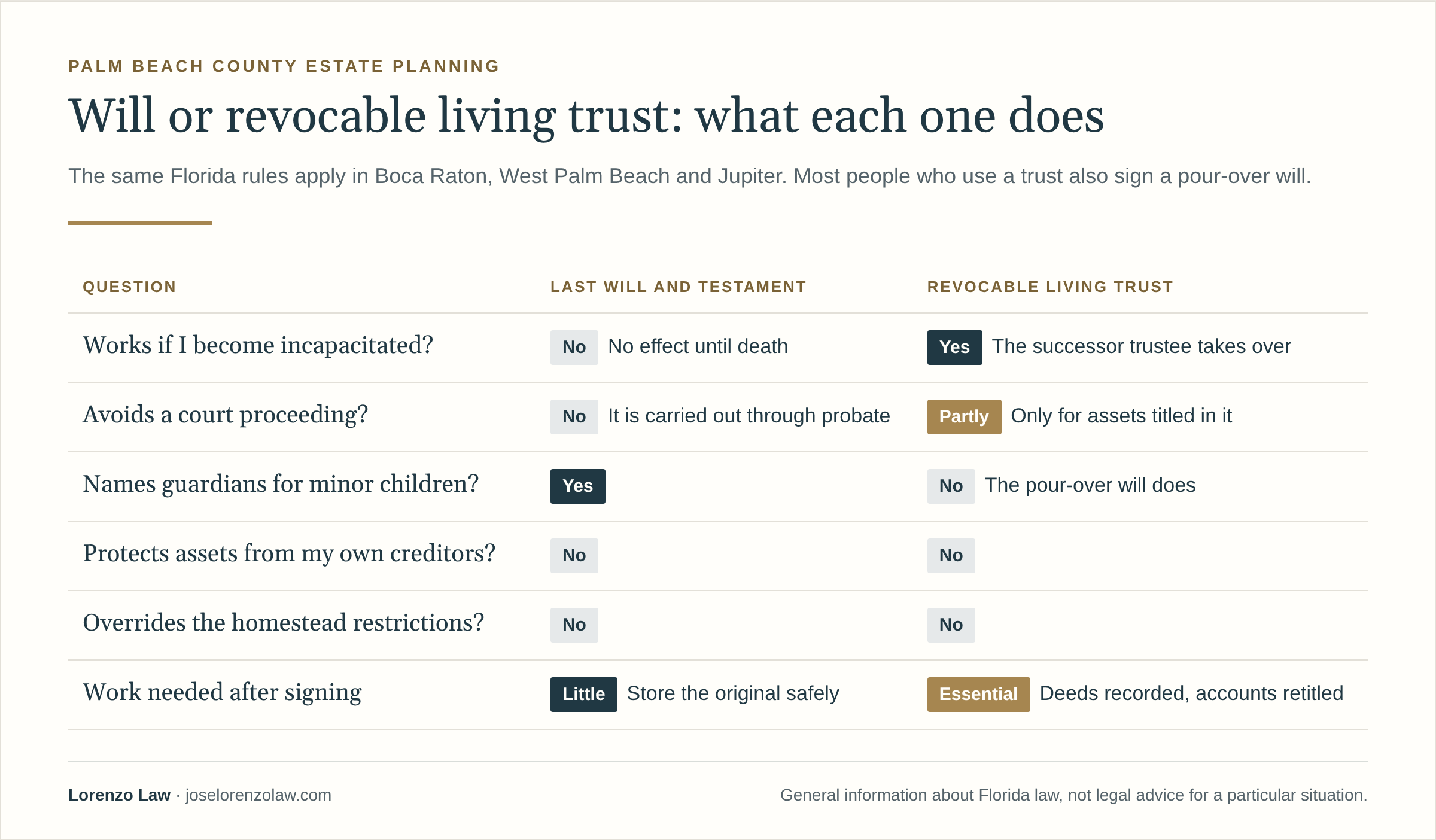
See the chart “Will or revocable living trust: what each one does” (opens the full-size image; the details are also in the text).
A revocable trust is not an asset protection tool. As the fourth row shows, it does not protect your assets from your own creditors while you are alive, so if you were looking for an asset protection attorney in Boca Raton, that question is answered in the irrevocable trust section.
What are the pros and cons of a living trust in Florida?
The advantages are concrete. A successor trustee can step in at once if you become incapacitated, without a court proceeding. The terms stay private rather than filed publicly. Real estate in another state can pass without a separate proceeding there, which matters to the many Palm Beach County families who still own a home in New York, New Jersey or elsewhere. And a child’s inheritance can be held until an age you choose instead of arriving as a lump sum at eighteen.
The disadvantages are just as real. A trust costs more to set up than a will. It has to be funded: deeds recorded, accounts retitled, beneficiary designations coordinated. And it does not remove your home from Florida’s homestead restrictions. Put side by side, the living trust in Florida pros and cons usually favor a trust when there is real estate, a blended family or a young beneficiary, and a will-based plan when the estate is simple. That is the conversation to have with any revocable living trust attorney before you sign.
Who needs a trust instead of a will in Florida?
Not everyone. A trust tends to earn its cost when you own real estate you want to pass without probate, own property in another state, have a blended family, want a child’s inheritance held until a later age, or want a successor trustee ready to manage your assets if you become incapacitated. If most of what you own already passes by beneficiary designation or joint ownership, and your family situation is simple, a will-based plan with the incapacity documents may be enough. Do I need a trust in Florida, then? Only if one of those reasons fits your family. For one Palm Beach County home, a lady bird deed can sometimes do the job a trust would do for that property. And do you need a will in Florida if you have a trust? Yes: the pour-over will catches what’s left outside the trust and names your children’s guardian; a preneed declaration adds weight.
Is it better to leave a house in a will or a trust in Florida?
Usually a trust, or a lady bird deed, rather than a will alone. A house left by will goes through probate. A house held in a funded revocable trust, or covered by a recorded lady bird deed, passes without it. Whichever document you use, homestead still limits who can receive the house if you are survived by a spouse or a minor child, as explained below.
What should not go into a living trust?
Some assets are usually left outside a revocable trust and coordinated by beneficiary designation instead. Retirement accounts such as IRAs and 401(k)s are the main example: ownership of the account generally cannot be moved into a trust during your life without being treated as a withdrawal, so the plan works through the beneficiary form. Life insurance and payable-on-death accounts are often handled the same way, and everyday items such as a car may be handled outside the trust depending on the plan. Which assets belong in your trust, and which pass by designation, is part of the funding advice in a trust plan.
Trust names that describe the same thing. Clients in West Palm Beach, Boca Raton and across Palm Beach County often compare an “individual trust vs. family trust,” a “lifetime trust vs. revocable trust,” a “last will vs. living trust” or a “will in trust vs. living trust.” A living trust, a lifetime trust and a family trust are usually names for the same revocable trust, created during your life; an individual trust has one settlor, while a joint or family trust is one trust created by a married couple. A “will in trust” or a “last will and testament trust” usually means a testamentary trust, which is written into a will and starts only at death, through probate. Whether the trust is revocable or irrevocable matters far more than its name, and that difference is set out in the irrevocable trust section. A revocable trust also does not replace your power of attorney: the trustee manages only what is in the trust, and the agent under your durable power of attorney handles everything else, including moving assets into the trust if you cannot.
Does a will or a living trust have to be recorded in Florida?
No. A Florida will is not recorded or filed while you are alive. After death, whoever has the original must deposit it with the clerk of the circuit court in the county where the decedent lived, within ten days after learning of the death (§ 732.901). A revocable trust is not recorded either; what is recorded is the deed that moves Florida real estate into it. Keep the original will where it can be found.
Irrevocable trusts, spendthrift trusts and asset protection
Irrevocable means the person who creates the trust, the grantor (Florida law says settlor), generally cannot change or revoke it once it is signed and funded, and that is what lets an irrevocable trust do things a revocable living trust cannot. A spendthrift provision protects a beneficiary’s share from that beneficiary’s creditors. Neither one protects your own assets from your own creditors while you can still benefit from the trust: Florida does not allow that kind of self-settled asset protection trust. For most families, the right tool is a revocable trust with spendthrift terms for their children; an irrevocable trust earns its place when there is a tax, insurance or long-term family goal.
Revocable or irrevocable trust in Florida
A revocable living trust is yours to amend or revoke at any time, and for that reason Florida treats its property as yours: it avoids probate, but your creditors can reach it during your life (section 736.0505, Florida Statutes). An irrevocable trust works the other way. You transfer assets to a trustee, usually someone other than yourself, under terms you generally cannot take back. That loss of control is what produces any creditor protection or tax result, not the word “irrevocable” on the cover page.
When does a revocable trust become irrevocable in Florida? Upon the death of the grantor. After that, the successor trustee settles the trust under its terms: pays the expenses, files any tax returns, and distributes the assets or holds them in continuing trusts for the beneficiaries. The same is true when an irrevocable trust’s grantor dies; the trustee then closes the trust or keeps managing it as its terms direct.
Can an irrevocable trust be changed, terminated or decanted in Florida? More often than the name suggests, though not by the grantor alone. Florida law allows modifying or ending an irrevocable trust in some circumstances: by unanimous agreement of the trustee and beneficiaries after the settlor’s death (section 736.0412), by a court (section 736.04113), or by decanting, where a trustee with discretion over principal moves the assets into a new trust with updated terms for the same beneficiaries (section 736.04117). Each route has conditions, and breaking an irrevocable trust in Florida is never a substitute for drafting it carefully the first time. If a trust modification is already disputed among family members, that is a litigation question: see contested estates in Palm Beach County.
The common types of irrevocable trusts in a family plan are an irrevocable life insurance trust, a spousal lifetime access trust and a dynasty trust, each described below; an irrevocable trust fund for children or grandchildren, often funded with gifts; and charitable remainder and charitable lead trusts, covered in the charitable planning section. A testamentary trust in your will is also irrevocable once you die, though you can change the will freely until then.
Setting up or establishing an irrevocable trust in Florida follows the same broad steps as setting up a living trust, with two differences that matter: the trustee is usually not you, and transferring assets to the irrevocable trust is a gift you cannot take back. Florida does not require an irrevocable trust to be signed with the formalities of a will, as it does a revocable trust, but it is usually signed before two witnesses and a notary anyway, and any deed that funds it must be. A home moved into an irrevocable trust can keep the homestead property tax exemption only if the trust gives you the right to live there for life (section 196.041); that is a drafting decision, not an automatic result.
How much does an irrevocable trust cost in Florida? Irrevocable trusts, including life insurance trusts, are quoted individually and in writing before the work starts. An irrevocable trust attorney in Palm Beach County should be able to tell you, before you sign, what the trust will and will not do for you. My Florida irrevocable trust page covers the statewide rules in more detail.
Spendthrift trust attorney for Palm Beach County families
A spendthrift provision is a clause in a trust that stops a beneficiary from selling, pledging or giving away future distributions, and stops the beneficiary’s creditors from reaching them before they are paid out (section 736.0502). That is how a spendthrift trust works. It is not a separate kind of trust, but a trust with that clause, and the spendthrift trust language is usually a short paragraph. It can go in a revocable living trust, where it takes effect for the beneficiaries after your death, in an irrevocable trust, or in a testamentary trust written into your will. A trust that also gives the trustee discretion over whether and when to pay adds another layer, because there is nothing fixed for a creditor to claim. A share held this way protects an inheritance from a beneficiary’s creditors, lawsuits, a failed business, addiction or poor judgment, and it is easier to keep separate if the beneficiary divorces. That is what people usually want from an inheritance protection trust for a child or grandchild.
Can a spendthrift trust be broken? In limited ways. Florida lets certain claims reach a beneficiary’s interest despite the clause, including claims for child support and alimony (section 736.0503), and money already paid out to the beneficiary is no longer protected by it. A spendthrift provision protects the beneficiary, not you: it does nothing for the grantor who created the trust and can still benefit from it. Its disadvantage is the same as its purpose. The beneficiary cannot borrow against the share or sell it, and the trustee decides when money is paid out, so choosing that trustee is the real decision. A beneficiary can serve as his or her own trustee, but the protection is stronger when distributions are in someone else’s hands. A spendthrift trust has no separate cost: in a trust plan, the provision is part of the drafting, not a separate document.
Asset protection in Florida: what a trust can and cannot do
For asset preservation planning, an asset protection attorney in Boca Raton or anywhere in Palm Beach County should first explain what Florida law already protects. Some states allow a domestic asset protection trust (DAPT), a self-settled trust that shields your own assets from your own creditors. Florida does not: if you can benefit from your trust, your creditors can reach whatever the trustee could pay to you (section 736.0505). A Florida resident who sets up an asset protection trust in another state cannot count on a Florida court honoring it. A revocable living trust gives no creditor protection at all, and a Florida land trust is a privacy tool rather than an asset protection trust.
What assets are protected in Florida? Much of the protection comes from other law, not from a trust:
- Your homestead, protected from most creditors by Article X, section 4 of the Florida Constitution.
- Retirement accounts such as IRAs and 401(k)s (section 222.21).
- The cash value of life insurance and annuity contracts (section 222.14).
- Property a married couple owns as tenants by the entireties, which a creditor of only one spouse generally cannot reach.
Shielding assets from creditors is a question of timing as much as structure. A transfer made to hinder, delay or defraud a creditor can be undone under Florida’s fraudulent transfer law (chapter 726), so asset protection planning is done before a claim exists, not after a lawsuit is filed. Protecting your assets with a trust works for what you leave to others, through spendthrift and discretionary terms; for your own assets during your life, it depends on what you own, how it is already held, and whether you are willing to give up the benefit. When you speak with an asset protection attorney in West Palm Beach or anywhere else, ask how those factors affect your plan. The disadvantages of an asset protection trust follow from how it works: you give up control and the benefit of what you transfer, the protection depends on timing and on what you already own, and a trust that Florida treats as self-settled protects nothing. A marital agreement can also matter here: see prenuptial and postnuptial agreements.
Irrevocable life insurance trusts
An irrevocable life insurance trust, often called an ILIT, is a trust that owns a life insurance policy on your life, or a second-to-die policy on a married couple, and receives the death benefit. When is one used? Mainly to keep the proceeds out of your taxable estate for federal estate tax, which matters only for larger estates because Florida has no estate tax of its own, and to control how the money reaches your family rather than paying it to a young beneficiary outright. How an ILIT works: the trustee, not you, owns the policy, so it becomes trust-owned life insurance, and makes the premium payments, usually from gifts you make to the trust. Those gifts are often paired with a short window in which the beneficiaries could withdraw them, called Crummey powers, so they qualify for the annual gift tax exclusion. An existing policy transferred into the trust is generally still counted in your estate if you die within three years of the transfer, which is why the trustee often buys a new policy directly. Like any irrevocable trust, an ILIT is hard to change once it is signed, so the beneficiaries and the trustee are chosen with care, and it is quoted individually.
For most families, putting or placing life insurance in a trust does not require an ILIT. Making a trust the beneficiary of life insurance, either your revocable living trust or a testamentary trust for your children, gives the same control over how the money is used, without the estate-tax planning.
Spousal lifetime access trusts and dynasty trusts
A spousal lifetime access trust, or SLAT, is an irrevocable trust one spouse creates for the other spouse, and often for their descendants, using part of the creating spouse’s federal gift tax exemption. The assets, and their future growth, are generally removed from both spouses’ taxable estates, while the beneficiary spouse can still receive distributions, which gives the couple indirect access to the money. The trade-offs are real: the gift cannot be taken back, the creating spouse’s indirect access ends if the beneficiary spouse dies or the marriage ends, and two spouses who create matching trusts for each other risk having them disregarded for tax purposes. A SLAT is worth considering only when the couple’s combined estate is large enough for the federal estate tax to matter, which is the subject of the next section.
A dynasty trust is a long-term trust designed to hold assets for children, grandchildren and later generations instead of distributing them outright, so each generation receives the benefit without the assets passing through its own taxable estate or its own creditors and divorces. Florida lets a trust created today last up to 1,000 years, far longer than the traditional rule against perpetuities would allow (section 689.225), and a dynasty trust is usually paired with the federal generation-skipping transfer tax exemption. My post on the dynasty trust explains the structure. Both trusts are quoted individually.
Estate and gift tax for Palm Beach County families
Short answer. Florida has no estate tax, no inheritance tax and no gift tax of its own. The federal estate and gift tax applies only when what you leave, together with the taxable gifts you made during life, exceeds the federal exemption, which for 2026 is $15,000,000 per person. Most Palm Beach County families will owe no estate tax at all; for those who could, the plan is built around that number, the annual gift exclusion and the married couple’s ability to use both spouses’ exemptions.
High-net-worth estate planning in Palm Beach County still starts with the basics: the will, the trust, the incapacity documents and the beneficiary designations come first. What changes for a larger estate is the order of decisions. How much to give during life, which trusts to fund, how life insurance is owned and how a business or a second home is held all depend on whether the federal estate tax could apply.
| Tax | Florida | Federal |
|---|---|---|
| Estate tax | None | Applies only above the federal exemption: $15,000,000 per person for deaths in 2026 |
| Inheritance tax (paid by the person who inherits) | None | None |
| Gift tax | None | Gifts above the annual exclusion, $19,000 per recipient in 2026, use part of the same lifetime exemption; tax is owed only once that exemption is used up |
| Generation-skipping transfer tax | None | A separate exemption, equal to the estate tax exemption, for gifts and bequests to grandchildren and later generations |
Federal figures for 2026, as published by the Internal Revenue Service; they are adjusted for inflation in later years.
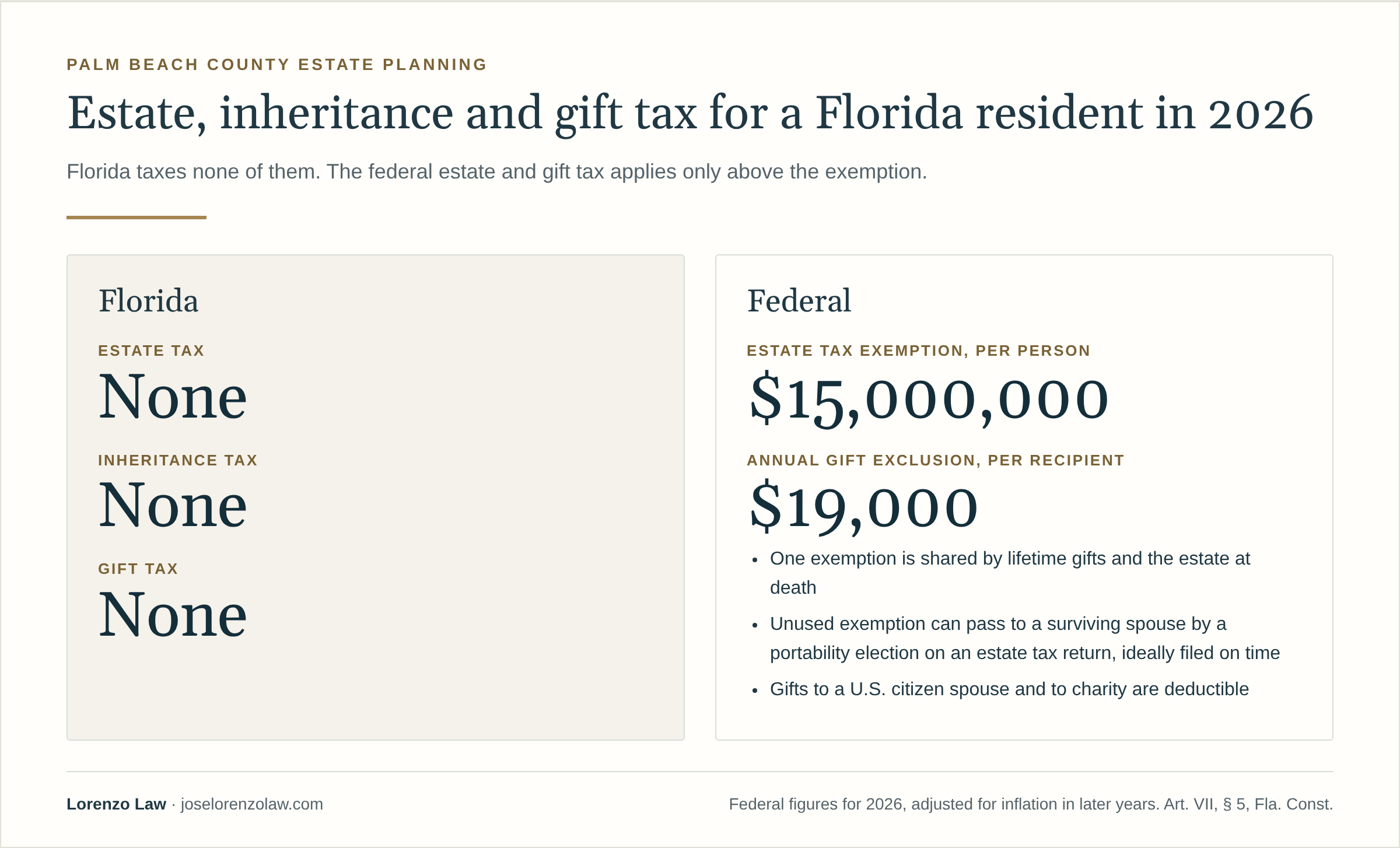
See the chart “Estate, inheritance and gift tax for a Florida resident in 2026” (opens the full-size image; the details are also in the text).
Does Florida have an estate tax or an inheritance tax?
No. Florida does not impose an estate tax, an inheritance tax or a gift tax. The Florida Constitution limits any state estate tax to the credit allowed against the federal estate tax for state death taxes (Article VII, section 5), and because that federal credit no longer exists, no Florida estate tax is owed and no Florida estate tax return is filed for deaths after 2004. Where Florida real estate is involved, the personal representative may still record an affidavit on the Florida Department of Revenue’s form DR-312, stating that no Florida estate tax is due, so that title is clear. A child who inherits from a Florida parent pays no Florida tax on the inheritance. What can still apply is the federal estate tax on a large estate, and, for property you still own in another state, that state’s own estate or inheritance tax.
That last point matters to many Palm Beach County families. A New York apartment, a New Jersey house or a vacation home in another state can be subject to that state’s estate or inheritance tax even after you become a Florida resident. Moving the property into a revocable trust avoids a separate probate there, but it does not by itself change that state’s tax rules; that is a question for counsel in that state.
What is the federal estate tax exemption in 2026?
For people who die in 2026, the federal estate tax exemption, formally the basic exclusion amount, is $15,000,000 per person, and it is adjusted for inflation in later years. The same exemption is shared between taxable lifetime gifts and the estate at death, so a gift that uses part of it during life reduces what is left at death. An estate that exceeds the exemption, after deductions, pays federal estate tax on the excess at rates up to 40 percent, and a federal estate tax return is due nine months after death unless extended.
Two deductions keep most married couples’ estates from paying tax at the first death: property left to a surviving spouse who is a United States citizen passes free of estate tax under the unlimited marital deduction, and property left to charity passes free of estate tax under the charitable deduction. If your spouse is not a United States citizen, the marital deduction is available only through a qualified domestic trust, and the plan has to be drafted for that from the start.
Portability for married couples
When the first spouse dies, any part of his or her federal exemption that was not used can be transferred to the surviving spouse, an election known as portability. The election is made on a federal estate tax return (Form 706) filed for the first spouse’s estate, even when no tax is owed. If that return was never filed, an estate that was not otherwise required to file may still be able to make a late portability election up to five years after the death under a simplified IRS procedure, but it is far easier to file on time. A couple whose combined estate approaches twice the exemption should decide, while both are living, whether to rely on portability or to use a trust at the first death, because the two approaches treat growth after the first death, creditors and a remarriage differently.
Annual exclusion gifts and lifetime gifts
Each person can give up to $19,000 in 2026 to as many recipients as he or she chooses without using any lifetime exemption and without filing a gift tax return; a married couple who elect to split gifts can give $38,000 per recipient. Payments made directly to a school for tuition, or directly to a medical provider for someone’s care, are excluded from gift tax without limit. Gifts above the annual exclusion are reported on a federal gift tax return and use part of the lifetime exemption.
A lifetime gift has a cost that a bequest at death does not: property received as a gift keeps the giver’s income tax basis, while property inherited at death generally receives a new basis equal to its value at death, often called a step-up in basis. For appreciated Palm Beach County real estate or long-held stock, that difference can outweigh the estate tax saved, so the choice of which assets to give, and which to keep, is part of the plan.
When tax planning changes the plan
For most families, the tax answer is simply that no estate tax will be owed, and the plan focuses on who receives what and how. Tax planning changes the documents when the combined estate, including life insurance, retirement accounts, a business and real estate in every state, could exceed the exemption, or when a large lifetime gift, a sale of a business or a move between states is coming. The usual estate planning tax strategies are the ones on this page: an irrevocable life insurance trust, a spousal lifetime access trust or dynasty trust, a charitable trust, and annual exclusion gifts. If you are comparing an estate tax attorney in Boca Raton or West Palm Beach, ask how the attorney coordinates with your accountant: I prepare the legal documents and work alongside the CPA or financial adviser who handles your returns and investments. Estate and gift tax planning is quoted individually.
Charitable planning: bequests, charitable remainder trusts and lead trusts
A gift to charity can be as simple as one sentence in your will or trust, or as structured as a trust that pays you income for life and leaves the rest to charity. Charitable gifts pass free of federal estate tax, and some lifetime charitable trusts also produce an income tax deduction and let appreciated assets be sold without immediate capital gains tax inside the trust. Each charitable trust is quoted individually.
A charitable gift in your will or trust
The simplest charitable plan is a charitable bequest: a gift to charity in your will or revocable trust, of a fixed amount, a percentage, a specific asset or what is left after other gifts. Naming a charity as beneficiary of a retirement account is often more efficient than leaving it cash, because a charity pays no income tax on the account, while a family member who inherits it generally does. Whatever form the gift takes, the charity’s exact legal name and identification should be in the document, so the gift reaches the organization you intend.
How does a charitable remainder trust work?
A charitable remainder trust is an irrevocable trust that pays you, or you and your spouse, an annual amount for life or for a term of up to 20 years, and then leaves what remains to one or more charities. A charitable remainder annuity trust pays a fixed dollar amount each year; a charitable remainder unitrust pays a fixed percentage of the trust’s value, revalued each year, so the payment rises and falls with the investments. The payout rate must be at least 5 percent and no more than 50 percent, and the value of the charity’s remainder, measured when the trust is created, must be at least 10 percent of what you put in.
The trust itself is generally exempt from income tax, so stock or real estate that has grown in value can be sold inside the trust and reinvested without the capital gains tax being paid up front; the payments you receive carry out the trust’s income and gains to you over time. You also receive an income tax charitable deduction, in the year the trust is funded, for the present value of the remainder that will pass to charity. A charitable remainder trust is a fit for someone who holds an appreciated asset, wants income from it and intends to benefit charity anyway; it is not a fit for someone who will need the principal back.
Charitable lead trusts
A charitable lead trust reverses the order: it pays a charity first, for a term of years or for someone’s life, and then passes what remains to your children or other family members. Its main use is to move future growth to the family at a reduced gift or estate tax value, because the value of the charity’s payments is deducted when the trust is created. It works well when the trust’s investments are expected to outperform the interest rate the federal tax rules assume.
Donor-advised funds and private foundations
Not every charitable goal needs a trust. A donor-advised fund, held by a public charity or a community foundation, lets you make a deductible gift now and recommend grants over time, with very little administration. A private foundation gives a family more control over grant-making, but it comes with annual returns, minimum distribution rules and restrictions on dealings with family members. Either can be named in your will or trust, and the choice between them is usually made with your financial adviser.
What your estate plan should address
A plan should match your goals, not a standard list. The matrix below connects what people usually want to the document that does it.
| If you want to… | The document that does it |
|---|---|
| Choose who handles your money if you cannot | Durable power of attorney |
| Choose who makes medical decisions for you | Designation of health care surrogate |
| Record your own end-of-life wishes | Living will |
| Say who inherits and who administers your estate | Last will and testament, or a trust with a pour-over will |
| Name a guardian for your minor children | Last will and testament (and a preneed guardian declaration) |
| Keep assets out of probate | A funded revocable trust, beneficiary designations, or a lady bird deed for one property |
| Hold a child’s inheritance until an age you choose | A trust |
| Provide for a family member with a disability without disrupting benefits | A third-party special needs trust |
| Reduce a federal estate tax that would otherwise be owed | Annual exclusion gifts, an irrevocable life insurance trust, a spousal lifetime access trust or a charitable trust |
| Leave part of your estate to charity | A gift in your will or trust, a beneficiary designation, or a charitable remainder or lead trust |
| Settle in advance what a spouse receives | A prenuptial or postnuptial agreement |
| Let someone manage your online accounts | Digital-asset authority in the power of attorney, will or trust |
| Make your business plan and your estate plan agree | Your company’s documents read together with your will or trust |
Decision-making during life
If I could get every household to fix one document, it would be the durable power of attorney. Without one, the alternative when someone loses capacity is a court guardianship, heard in the Fifteenth Judicial Circuit for Palm Beach County residents: slower, public, supervised and expensive. Florida’s power of attorney law was rewritten effective October 1, 2011. A power of attorney signed today takes effect when you sign it; the “springing” power that waits for a finding of incapacity no longer works for documents signed on or after that date. Certain powers, including making gifts, creating or amending a trust and changing beneficiary designations, are not granted by general language. They must be listed in the document, with your signature or initials next to each one. The financial power of attorney a Palm Beach County bank is most likely to question is a form downloaded from a website, and it usually fails at exactly that point. My Florida power of attorney page covers the document in full.
Property and family goals after death
Most of what you own passes by how it is titled, not by what your will says. Retirement accounts, life insurance, annuities and payable-on-death bank accounts pass by beneficiary designation. A carefully drafted will controls none of them. Part of any estate plan is making sure the beneficiary designations already on file match the plan the documents describe, and I advise you on what is necessary to get that done efficiently. Probate is avoided the same way, by titling, not by writing “avoid probate” in a document. A will does the opposite: it is the instrument that sends an estate to court. Florida has no inheritance tax and no state estate tax, so the question for most families is not tax but who receives what, and how quickly.
A lady bird deed or a full plan
A lady bird deed, formally an enhanced life estate deed, passes the one property it describes at your death without probate, while you keep the right to sell, mortgage or change your mind. Florida has no transfer on death deed for real estate; the lady bird deed is the Florida equivalent. It does nothing if you become incapacitated. It does not name a guardian for your children or cover your accounts, and it does not appoint anyone to act for you. A full plan does those things; a deed does one.
If your only goal is keeping one Palm Beach County home out of probate, my Palm Beach County lady bird deed service may be all you need. It is a separate $675 service; a will starts at $675. The two can be coordinated: a deed for the house and a will-and-incapacity package for everything else, drafted so that the deed and the will agree. Whichever document you use, homestead still limits who can receive the house if you are survived by a spouse or a minor child. If you are weighing the two, my comparison of the lady bird deed vs. living trust sets out the trade-offs.
Digital accounts and online assets in estate planning
Email, cloud storage, social media and online financial accounts sit behind passwords and service terms. Florida’s Fiduciary Access to Digital Assets Act (chapter 740) lets you give your agent, personal representative or trustee authority over your digital assets, and lets you decide whether that person may also see the content of your electronic communications. A setting you chose in a provider’s own online tool can control that account over what your documents say. Your documents can address digital-asset authority; a current list of accounts, kept outside the documents, makes it usable.
Moving your domicile to Palm Beach County
Short answer. Moving to Palm Beach County from New York, New Jersey or another state raises two separate questions: whether your existing documents still work in Florida, and whether Florida, rather than your former state, is now your legal home. A declaration of domicile, recorded with the Palm Beach County Clerk, is evidence of that home, not proof of it; your driver license, voter registration, homestead exemption and where you actually spend your time carry the weight. I prepare and record the declaration of domicile as part of a new-resident plan, quoted individually.
Estate planning for new Florida residents, and estate planning after moving to Florida from New York or New Jersey in particular, starts with four documents and one decision. Your documents came with you. Some travel well and some do not.
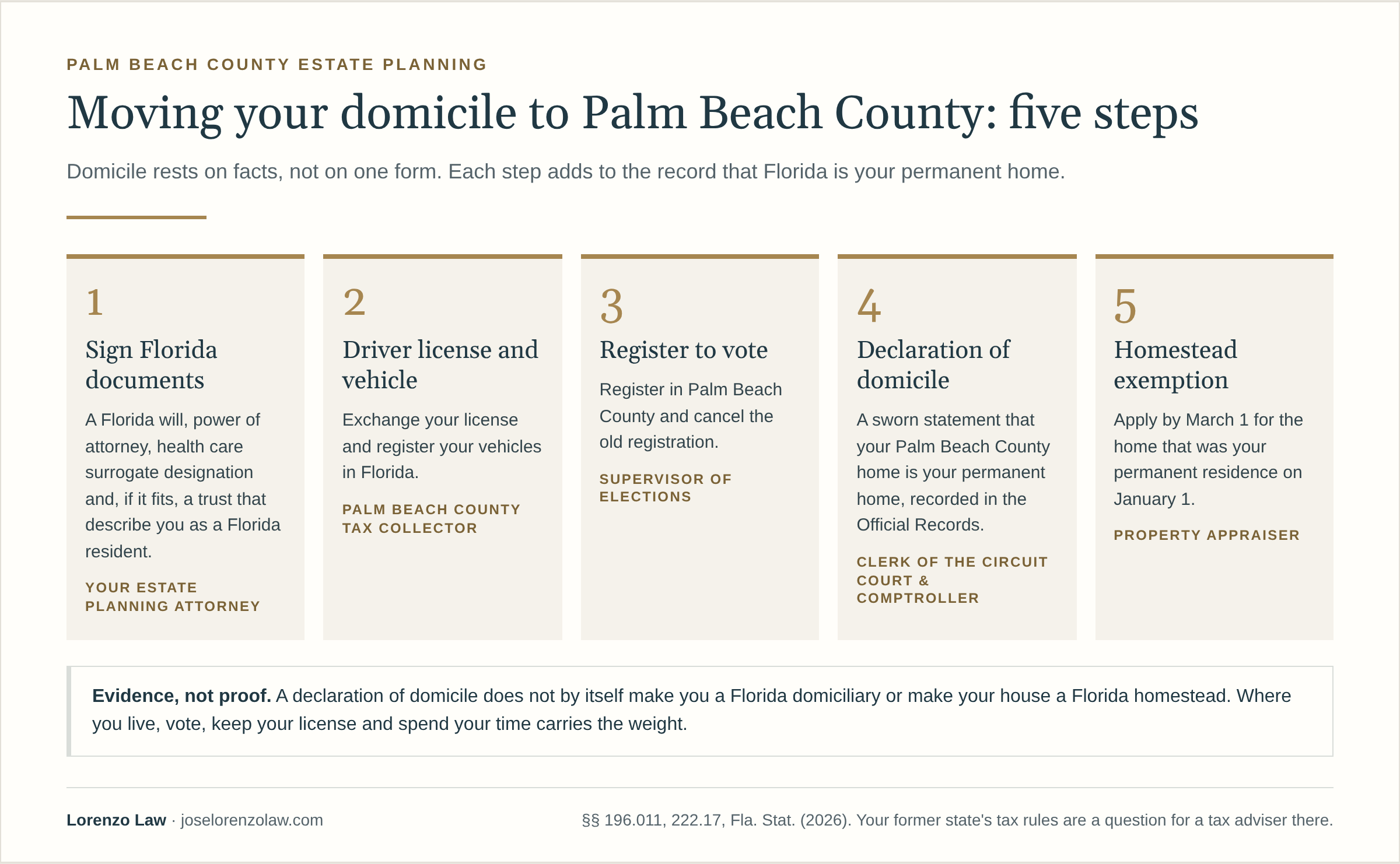
See the chart “Moving your domicile to Palm Beach County: five steps” (opens the full-size image; the details are also in the text).
Your documents from New York, New Jersey or another state
- The will. Under section 732.502(2), Florida Statutes, a will signed by someone who was not a Florida resident at the time is valid here if it was validly signed under the law of the place where it was signed, unless it is a holographic will. A handwritten, unwitnessed will is not valid in Florida even if the state where it was written would honor it. The Fourth District Court of Appeal applied that rule in Caveglia v. Heinen, 359 So. 3d 745 (Fla. 4th DCA 2023).
- The person you named to settle your estate. Under section 733.304, Florida Statutes, a person who does not live in Florida can serve as personal representative only if he or she is within the family relationships the statute lists. A trusted friend in another state may be exactly the right person and still be ineligible.
- The power of attorney. A power of attorney signed in New York or New Jersey is valid in Florida if it was properly signed under that state’s law when you signed it. A Florida bank or other institution asked to rely on it may request a lawyer’s opinion that it was validly signed, at your expense, and may refuse the document if the opinion is not provided. That is why I generally recommend signing a Florida power of attorney after you move.
- The health care documents. A health care proxy, living will or other advance directive signed in another state is valid in Florida if it was signed in compliance with that state’s law or Florida’s. You are not required to sign it again here, though you may want to update it, for example to name a surrogate who lives nearby.
- Your home. Florida’s limit on who can receive your home by will does not wait for the homestead tax exemption. Once you actually live in your Palm Beach County home intending it to be your permanent residence, that limit generally applies: if you leave a spouse or a minor child, the home cannot pass by will to anyone else, except that it may go entirely to your spouse when there is no minor child. A will written in another state was not drafted around that rule. The homestead section below explains it.
Validity is not the same as workability. A will can be valid here and still produce a result you did not intend, because it was written for another state’s rules on spouses and real estate. A review after a move shows which of your documents still work as written and which should be updated.
Hypothetical: a couple who moved to Boca Raton from New York. They bring New York wills naming their closest friend, who lives in Connecticut, as executor, a New York power of attorney and New York health care proxies. The wills were properly witnessed, so they are likely still valid here, but their friend is not a relative, so Florida would not let him serve as personal representative from out of state. A Florida bank may ask for a lawyer’s opinion before it relies on the New York power of attorney. The decision they face is not whether to start over, but what to change now: a Florida personal representative or an eligible relative, a Florida power of attorney, surrogates who can reach them in Boca Raton, and a declaration of domicile filed with the rest of the move.
How do I file a declaration of domicile in Palm Beach County?
A declaration of domicile is a sworn statement, filed with the Clerk of the Circuit Court in Palm Beach County, that your home here is your permanent home (§ 222.17). The Palm Beach County Clerk of the Circuit Court & Comptroller publishes the form and records the signed declaration in the Official Records, in person at any Clerk location or by mail, for the recording fee on the Clerk’s published fee schedule; the declaration is signed under oath before a notary or a deputy clerk. When I prepare a new-resident plan, I prepare the declaration with the rest of the documents, have it signed with them and send it for recording, so you receive the recorded copy.
Do I have to file a declaration of domicile? No. Florida does not require one, and filing it does not by itself make you a Florida domiciliary. It is one piece of evidence of where your permanent home is, and it is most useful when your former state may later claim you never left. Whether you change your domicile from New York to Florida or from New Jersey, a Florida domicile rests on facts, not on one form. Florida treats the declaration as evidence of where you are domiciled, not as proof: if you still vote, keep your driver license or spend most of the year in New York or New Jersey, the declaration alone will not make you a Florida domiciliary. Filing it also does not, by itself, make your house a Florida homestead.
How long does it take to establish domicile in Florida? There is no waiting period for domicile itself: it begins when you live in Florida intending to make it your permanent home, and the declaration, the driver license, the voter registration and the homestead exemption are evidence of that intent rather than steps that must age. Particular benefits can carry their own residence requirements, such as being a permanent resident on January 1 for the homestead exemption.
What else shows a Florida domicile
Domicile is your one permanent home, the place you intend to return to; you can own several residences but have only one domicile. The facts that usually show where it is are the ones a former state looks at first:
- a Florida driver license and vehicle registration, issued in Palm Beach County through the Tax Collector’s office;
- voter registration in Palm Beach County, through the Supervisor of Elections, and cancellation of the old registration;
- the homestead exemption on your Palm Beach County home, with the Property Appraiser;
- where you spend your time, where your doctors, accountant, bank and safe deposit box are, and where your family, clubs, places of worship and pets are;
- a Florida will, trust and power of attorney that describe you as a Florida resident, and a declaration of domicile on record.
When is the Palm Beach County homestead exemption due?
The Palm Beach County Property Appraiser accepts homestead exemption applications for the current tax year through March 1 — and, by the office’s practice, through the next business day when March 1 falls on a weekend or holiday — and the home must be your permanent residence on January 1 of that same year (§ 196.011). The Palm Beach County homestead exemption for property taxes is a separate application: you apply for the Palm Beach County Property Appraiser homestead exemption with that office, and it is not part of an estate plan. When a home moves into a revocable trust, the deed and the trust are drafted so the exemption can continue, and the appraiser may ask to see them. The exemption and the homestead rules that limit who can inherit the house are two different things, and the second applies whether or not you have claimed the first.
If your former state questions your residency
Florida has no state income tax, which is one reason a former state may continue to treat you as its resident for its own income tax after you move, particularly if you keep a home there and spend a significant part of the year in it. Whether New York, New Jersey or another state can do so, including in a New York domicile audit, is governed by that state’s law, and it is a question for your tax adviser there. What I can do, as a Florida attorney, is make sure the Florida side of the record is complete and consistent: the declaration of domicile, the documents that describe you as a Florida resident, and a plan for property you still own in the other state.
Snowbirds, second homes and condominiums
Estate planning for snowbirds who keep their domicile in another state looks different. A Florida home owned by someone domiciled elsewhere is generally handled through a separate ancillary proceeding in Florida after death, which is one reason a lady bird deed or a funded trust matters for a seasonal home. The reverse is true for a Florida resident who still owns a home in another state: that property can need its own proceeding there unless it is held in a funded trust or passes by another non-probate route, and the deed for it should be prepared by counsel in that state.
Many Palm Beach County homes are condominium units or homes in communities with an association. Some associations’ documents require notice or approval before a unit is deeded to someone else, including to a trust, so the documents are read before the deed into the trust or the lady bird deed is drafted.
Start with your situation: a Palm Beach County planning selector
The documents are the same across Florida, but the families who need them differ. Start with the row that describes you. Each one points to the part of this page, or the separate page, that answers your first question.
| If this is you… | Your first question is usually… | Start here |
|---|---|---|
| You moved to Palm Beach County with a will or power of attorney from another state | Do my documents still work here, and is Florida now my legal home? | Moving your domicile |
| You have a Florida plan and are not sure it is current | What should change, and what can stay? | Updating documents you already have |
| You are married, remarried or have children | Who inherits, and who raises the children? | Married couples and blended families |
| You are about to marry, or remarry | Should I sign an agreement before the wedding? | Prenuptial and postnuptial agreements |
| A child or grandchild has a disability | How do I leave money without disrupting benefits? | Special needs trusts |
| Your estate may be large enough for federal estate tax | Will my estate owe tax, and what can I do now? | Estate and gift tax |
| You want to leave part of your estate to charity | What is the most efficient way to give? | Charitable planning |
| You own a business | What happens to the company? | Business owners |
| Your only goal is keeping one home out of probate | Is a deed enough? | A deed or a full plan |
| Someone has already died | How is the estate handled? | That is probate: see my Palm Beach County probate lawyer page |
Married couples
Estate planning for married couples in Florida has to account for rights a spouse holds whatever the documents say. The elective share entitles a surviving spouse to elect thirty percent of the elective estate (section 732.2065, Florida Statutes). The elective estate reaches well beyond the will, drawing in revocable trust property, payable-on-death and transfer-on-death accounts, and joint accounts, among others. These rights can be addressed, but through a properly signed marital agreement or spousal waiver, not by drafting around them. My page on the Florida elective share explains the calculation.
Joint will, mirror wills or a joint trust: what should a married couple sign?
Couples often ask whether their wills in Boca Raton or West Palm Beach should be one joint document. Each spouse signs his or her own will. Under Florida law, signing a joint will, or two matching wills, does not by itself create a promise that neither of you will change your will later. If a couple wants that kind of promise to be binding, Florida requires it to be a written agreement signed in front of two attesting witnesses (section 732.701).
What most couples sign instead are mirror wills: two separate wills with matching terms, each usually leaving everything to the other spouse and then to the same children or beneficiaries. Without that written agreement, each spouse remains free to change his or her own will, including after the first spouse dies. Couples who use a trust choose between one joint revocable trust and two separate trusts; which fits depends on how the home and accounts are titled, and I quote a couple’s trust plan individually. Caution: a home or accounts you own with your spouse as tenants by the entireties generally lose that creditor protection once retitled into a revocable trust; keeping title in both names directly preserves it.
Blended families and second marriages
Estate planning for blended families is where Florida’s default rules most often produce an outcome nobody chose. Without a will, section 732.102 gives a surviving spouse only one half of the estate when the deceased spouse leaves descendants and either spouse has a descendant from another relationship. In a second marriage, a will leaving the house to children from a first marriage, over a surviving second spouse, does not do what it says, because of the homestead rule below. The questions are always the same: what the surviving spouse should receive, what the children should receive, and when. The answers are different in every family, and they have to be written down to count.
In a blended family, the planning work is making sure a surviving spouse is provided for while the children from an earlier relationship still receive what you intend. The usual tools are a trust that provides for the spouse during his or her lifetime and then passes to your children, beneficiary designations that match the plan, and a marital agreement where both spouses want one. As an estate planning attorney for blended families, I draft each spouse’s plan so the two fit together, and I tell you where the homestead and elective-share rules limit what a document alone can do.
Prenuptial and postnuptial agreements
A marital agreement is the one document that can settle, in advance, what each spouse will receive at the other’s death, and, for a premarital agreement, what happens in a divorce. Many Palm Beach County couples who marry later in life, or who marry with children, a business or significant assets from before the marriage, sign one so that each spouse’s estate plan can leave property to his or her own children without the elective share, homestead or other spousal rights overriding it. An entrepreneur or business owner often asks a prenuptial lawyer to keep a company, or its growth, separate; that wealth protection and asset protection side of a marriage agreement, including provisions for real estate, investment accounts and other assets each spouse brings, is drafted together with the estate plan, so the two agree.
- A prenuptial agreement, signed before the marriage, is governed in Florida by the Uniform Premarital Agreement Act (section 61.079). It must be in writing and signed by both parties, and it takes effect on marriage.
- A postnuptial agreement (sometimes called a post-marriage agreement), signed during the marriage, can waive the same rights at death. A waiver of spousal rights signed after the marriage requires fair disclosure of each spouse’s assets to the other; one signed before the marriage does not (section 732.702).
- Signing. A waiver of spousal rights at death must be signed by the waiving spouse in the presence of two subscribing witnesses (section 732.702), and if it is signed with remote witnesses it falls within the screening rule below.
Each spouse should have his or her own lawyer for a marital agreement, and I represent only one of you. If you are comparing a prenuptial agreement attorney in Boca Raton or West Palm Beach for estate planning purposes, ask how the agreement and the two estate plans will be drafted to agree. Marital agreements are quoted individually.
Married homeowners and the homestead rule
Your house is the asset most likely to defeat a plan, and Florida homestead is the reason. Under section 732.4015, Florida Statutes, homestead is not subject to devise if the owner is survived by a spouse or minor child, except that it may be left to the spouse if there is no minor child. Moving the house into a revocable living trust does not get around this. Section 732.4017 treats a lifetime transfer in trust as outside the devise rules only where the owner keeps no power to revoke, and a revocable trust is revocable by definition. A spouse’s homestead rights can be given up only by a valid waiver in the form Florida law requires. The property tax exemption is a separate question, handled by the Palm Beach County Property Appraiser.
Parents of minor children
Parents usually start with the same question: who would raise the children? Estate planning for new parents starts there. The will records the guardian you want, and a separate preneed guardian declaration filed with the clerk gives that choice more weight. Estate planning for parents also has to decide who manages money left to a child. Property left outright to a minor may require an adult to receive and manage it on the child’s behalf. A parent acting as natural guardian can manage up to $15,000 in total without a court (section 744.301(2), Florida Statutes). If more than that is left to a child outright, with no trust or other arrangement named to hold it, a court-appointed guardian of the property is generally required, and when that guardianship ends at eighteen, the child receives the whole balance. A trust avoids both: you choose the ages, the purposes and the trustee, with no court file.
The trust can be a separate revocable trust or a trust written into the will itself, called a testamentary trust. A testamentary trust costs less to set up because it is part of the will, but it comes into existence only when the will goes through probate. A separate revocable trust costs more and has to be funded during your life, but a child’s share held in it is managed without a probate proceeding. Life insurance and retirement accounts can go into either kind of trust by beneficiary designation, though a trust named for a retirement account needs careful drafting to avoid accelerated tax. Either kind of trust can include a spendthrift provision. My page on planning for parents of minor children covers guardians, trusts for children, life insurance and what happens if the other parent is still living.
Special needs trusts for a child or adult with a disability
Leaving money outright to a family member who receives, or may one day need, needs-based public benefits such as Supplemental Security Income or Medicaid can disqualify that person until the money is spent. A special needs trust, also called a supplemental needs trust, holds the inheritance instead, and the trustee uses it for the beneficiary’s extra needs, such as therapies, education, travel, equipment and quality of life, while the public benefits continue to cover the basics.
- A third-party special needs trust is funded with a parent’s, grandparent’s or other relative’s money, never the beneficiary’s own. It can be a separate trust or a trust written into your will or revocable trust, and whatever remains at the beneficiary’s death can pass to your other family members, with no repayment to Medicaid. This is the trust most parents and grandparents use.
- A first-party special needs trust holds the beneficiary’s own money, such as an inheritance already received or a settlement. Federal law allows it only on specific conditions, including that the beneficiary is under 65 when it is established and that Medicaid is repaid from what remains at the beneficiary’s death.
- A pooled trust or an ABLE account can fit when a first-party trust does not. A pooled trust, managed by a nonprofit association, has no under-65 limit, so it suits a beneficiary over 65 or a modest amount; an ABLE account holds smaller sums for qualified disability expenses. If the beneficiary is 65 or older and funds the pooled-trust account with his or her own money, that transfer can still create a Medicaid or SSI penalty period, so the timing should be reviewed first.
In a special needs trust, the special needs trust beneficiary is the person with the disability; the trustee for the special needs trust is the person or institution you choose to manage the money and decide on distributions. Families in West Palm Beach, Boca Raton and across Palm Beach County often ask about a “supplemental trust account” or “trust accounts for disabled adults”: those terms refer here to this trust, which holds an inheritance or gift for a disabled adult or child so that it supplements, rather than replaces, the benefits. A special needs trust can pay medical costs that Medicaid does not cover, such as therapies, equipment or a private room, as well as education, travel and quality-of-life expenses. One caution: when the trust pays for the beneficiary’s shelter, such as rent, SSI counts it as in-kind support and can reduce the monthly payment; since a 2024 federal rule change, food paid for by the trust is no longer counted. A disability trust attorney drafts the distribution terms with those benefit rules in mind.
What is the downside of a special needs trust? The beneficiary cannot demand distributions or control the money, the trustee must understand the benefit rules and keep records, and a first-party trust must repay Medicaid from what remains. The common special needs trust mistakes are avoidable: leaving the inheritance outright, or by a beneficiary designation, to the person with the disability; leaving it to a sibling “to look after” informally, where it is exposed to that sibling’s creditors and divorce; mixing the beneficiary’s own money into a third-party trust, which can trigger a Medicaid payback; and naming no successor trustee. Can you set up a special needs trust without a lawyer? No law requires one, but the trust has to be drafted for the benefit rules that apply, and a form rarely is.
Beneficiary designations matter as much as the trust: a retirement account or life insurance policy that names the beneficiary directly defeats the plan, so the designation names the trust instead. My pages on the Florida special needs trust, the third-party special needs trust, funding and managing a special needs trust and distributions to a family member with special needs go further. Special needs trusts are quoted individually.
Retirees and planning for long-term care
For many Palm Beach County retirees, the documents that matter most are the ones that work during life: the durable power of attorney, the health care surrogate designation, the living will and the preneed guardian designation. They decide who pays the bills, who speaks to the doctors and who would be appointed if a court ever became involved, and they are far easier to sign before a hospital stay than after one. If paying for long-term care, or eligibility for Medicaid or veterans’ benefits, is a concern, raise it on the first call, because some planning choices, such as an irrevocable trust or a large gift, have effects on that eligibility that should be understood before anything is signed.
Business owners and business succession
If you own a business, your estate plan and your company’s documents have to agree, and often they do not. An operating agreement that restricts transfers can override what your will says. A buy-sell agreement can require your estate to sell on terms your family never negotiated. An LLC interest with no succession provision can leave a spouse holding a minority stake in a company she has no role in. Business succession planning, as part of estate planning for business owners, covers who takes over operations, who takes the economic interest, how the interest is valued, whether a buy-sell agreement is funded with life insurance, and whether the interest is better held in a trust. It is work done alongside your accountant and your company’s lawyer, and it is quoted before that work starts.
Updating documents you already have
You do not have to start over to fix a plan. Tell me on the first call what you have and where it was signed. If you already have a trust you are happy with, the right answer may be to keep it and update the documents around it. Reviewing existing documents is separate work, and I quote it before it starts. Being told nothing needs to change is a legitimate outcome.
Spanish-speaking families
I speak Spanish, and Spanish-speaking clients in Palm Beach County, from Lake Worth Beach and Greenacres to Boca Raton and West Palm Beach, can have the whole conversation in Spanish. The documents themselves are in English: I explain them in Spanish, but I do not translate them word for word, and a client who needs a full written translation or an interpreter arranges one. If you are looking for a Spanish-speaking estate planning attorney in Palm Beach County, an abogado de planificación patrimonial, the first call can be in Spanish from the start. Readers looking for an abogado de testamentos can start with my page on the testamento en Florida; for a probate matter after a death, my Spanish page on the abogado de herencias y testamentos en West Palm Beach explains the process in Spanish.
County offices that touch a Palm Beach County estate plan
An estate plan is signed in private, but several public offices touch it: the Clerk of the Circuit Court & Comptroller, which records deeds and a declaration of domicile; the Property Appraiser, which handles the homestead property tax exemption; the Tax Collector and the Supervisor of Elections, whose records show where you live; and the Fifteenth Judicial Circuit, which would hear a guardianship or a probate. In Palm Beach County, all of them are countywide offices.
| Office | What it does for a plan | Where |
|---|---|---|
| Clerk of the Circuit Court & Comptroller, Palm Beach County | Records deeds into a trust and lady bird deeds in the Official Records; records a declaration of domicile; receives a preneed guardian declaration for filing; receives the original will after a death | Main Courthouse, 205 N. Dixie Hwy., West Palm Beach; North County Courthouse, 3188 PGA Blvd., Palm Beach Gardens; South County Courthouse, 200 W. Atlantic Ave., Delray Beach; West County Courthouse, 2950 State Road 15, Belle Glade; Royal Palm Beach Branch, 200 Civic Center Way, Suite 400 |
| Palm Beach County Property Appraiser | Homestead property tax exemption, applied for by March 1; may ask to see the deed and trust when a home is moved into a trust | Countywide; applications online or at its service centers |
| Palm Beach County Tax Collector | Florida driver license and vehicle registration, two of the facts that show a Florida domicile | Countywide service centers |
| Palm Beach County Supervisor of Elections | Voter registration in Palm Beach County, another fact that shows where you live | Countywide |
| Fifteenth Judicial Circuit | Hears a guardianship if one is ever needed, and the probate of a will after death | Palm Beach County; the assigned division and hearing notice identify the courthouse or remote appearance details. |
Office names and locations as each office publishes them (October 2026). Circuit assignment: § 26.021.
Two practical points follow. A deed into a trust is recorded in the county where the property is located, not where you live, and the $575 deed fee includes that county’s recording fees. And the homestead property tax exemption is a separate matter with the Property Appraiser: when a home moves into a revocable trust, the deed and the trust are drafted so the exemption can continue. For a plan, the Fifteenth Judicial Circuit matters mostly as the reason to have one: without a durable power of attorney, the alternative when someone loses capacity is a court guardianship. My Palm Beach County probate court guide covers the courthouses and divisions.
Estate planning across Palm Beach County, from Boca Raton to Jupiter
The documents do not change by city: a power of attorney in Boca Raton is the same Florida document as one signed in Jupiter or Belle Glade. Where you live matters in only a few practical places: which Clerk location is nearest if you want to record something yourself, which homes are condominiums with association rules, and where a mobile signing comes to you. The fee is the same everywhere.
| Area | Communities | Clerk location to consider | How signing works |
|---|---|---|---|
| South county | Boca Raton, Highland Beach, Delray Beach, Boynton Beach, Gulf Stream, Ocean Ridge | South County Courthouse, Delray Beach | Remote where Florida law allows it; otherwise a mobile signing comes to you |
| Central county | West Palm Beach, Palm Beach, Lake Worth Beach, Lantana, Greenacres, Palm Springs, Riviera Beach | Main Courthouse, West Palm Beach | The same |
| North county | Palm Beach Gardens, Jupiter, Juno Beach, Tequesta, North Palm Beach, Palm Beach Shores, Singer Island | North County Courthouse, Palm Beach Gardens | The same |
| Western communities | Wellington, Royal Palm Beach, Loxahatchee, Westlake | Royal Palm Beach Branch | The same |
| The Glades | Belle Glade, Pahokee, South Bay | West County Courthouse, Belle Glade | The same |
Boca Raton, Delray Beach and Boynton Beach
If you are weighing a Boca Raton estate planning attorney or a Boca Raton estate planning lawyer with a local office against working with me remotely, compare who drafts the documents, what the fee includes and whether the lawyer raises homestead on the first call. The same questions apply to any estate planning attorney in Delray Beach or Boynton Beach, FL, and if you are comparing estate planning lawyers in Boynton Beach, ask each one the hiring questions below. South county is home to many condominium owners, couples in second marriages and families who moved from New York and New Jersey, which is why the domicile, blended-family and condominium sections of this page are long. The Clerk of the Circuit Court & Comptroller has a South County Courthouse at 200 W. Atlantic Avenue in Delray Beach, but when a deed is part of your plan, I handle the recording and send you the recorded copy.
West Palm Beach, Palm Beach Gardens, Jupiter and Wellington
If you are comparing West Palm Beach estate planning lawyers, the questions in the hiring checklist below apply to them and to me alike. North and west county work the same way, whether you would otherwise look for an estate planning attorney in Jupiter or North Palm Beach, in Palm Beach Gardens, or an estate planning attorney in Wellington, FL. The county’s main courthouse is at 205 N. Dixie Highway in West Palm Beach, and the Clerk has branches in Palm Beach Gardens, Royal Palm Beach and Belle Glade. Guardianship and probate matters for Palm Beach County residents are heard in the Fifteenth Judicial Circuit.
Virtual estate planning provides complete, full-service estate planning with your lawyer: the consultation, the drafting, your review and the signing, by phone, Zoom or WhatsApp, with a mobile signing when witnesses need to be in the room.
If you live in Broward County, my page for an estate planning attorney in Fort Lauderdale covers the same work for that county.
How do consultation, drafting and signing work?
Working with a virtual estate planning attorney does not mean working with a less involved one. You call, I answer your questions about the process and fees, and you decide whether to go ahead. Then there is a questionnaire, the drafting, your review and the signing, and none of it requires a trip to an office.
- A free first call. A short phone call with me about what you have in mind and how the process works.
- Engagement and questionnaire. The fee and scope are agreed in writing, and I email you an intake questionnaire.
- Drafting. I draft the documents myself.
- Your review. You read the drafts with my explanation in plain language, and I change what needs changing.
- Signing. Remotely where Florida law allows it for your documents; otherwise a mobile signing with the witnesses in the room.
- After signing. The originals, copies for the people you named and, for a trust, the funding steps; for a new resident, any separately quoted declaration of domicile sent for recording.
Prepare for the conversation
If you decide to go ahead, I email you an intake questionnaire. It covers your family, the people you want to name and a general picture of what you own. You don’t need every answer before the work begins; anything you are unsure about, I work through with you. I then draft the documents myself and send them to you to read, with the reasoning explained in plain language, and I change what needs changing before anything is signed.
Which documents can be signed remotely in Florida?
Florida permits remote online notarization, and a Florida will can be signed electronically with an online notary and witnesses on the same audio-video session. Remote signing is not unlimited: the limits catch people who assume it is. The table below sets out what changes by document. I tell you which documents can be signed remotely in your situation before anything is scheduled.
| Document | Can it be signed remotely? | What to know |
|---|---|---|
| Last will and testament | Yes, electronically, with an online notary and witnesses on the same session | The same Florida formalities apply: a signature at the end and two witnesses who sign in your presence and in each other’s |
| Revocable living trust | Yes, on the same basis as a will | A Florida resident’s revocable trust that disposes of property at death must be signed with the formalities of a will |
| Durable power of attorney | Yes, for general authority | Under section 709.2202(6), a power of attorney signed by someone domiciled in Florida at the time of signing, whose witnesses were not physically present, cannot grant the specially listed powers: creating, amending or revoking a trust, making gifts, creating or changing survivorship rights, changing beneficiary designations, waiving a joint and survivor annuity or retirement survivor benefit, and disclaiming property. If you need those powers, the witnesses must be in the room |
| Designation of health care surrogate and living will | Discussed with you | These documents have their own witness rules, and I confirm the arrangement for your situation |
| A will, a revocable trust that disposes of property at death, a health care advance directive, an agreement or waiver of spousal rights under sections 732.701 or 732.702, or a power of attorney authorizing the transactions listed in section 709.2208, when signed with remote witnesses | Only if the screening allows it | Under section 117.285(5), when fewer than two witnesses are physically present, you must be asked whether you are under the influence of a drug or alcohol that impairs your decision-making, whether a physical or mental condition or long-term disability impairs your daily activities, and whether you need help with daily care. A “yes” to any of them means the document can be witnessed only by people physically present. A vulnerable adult cannot have these documents witnessed remotely at all |
My online estate planning page covers remote signing in more depth.
When I still recommend signing with witnesses in the room
Not every document, and not every client. Where capacity may later be questioned, where a family member has been applying pressure, or where the plan is complex enough that I want the signing handled with the witnesses physically present, I will tell you plainly. Remote signing is a genuine option, not a default, and knowing which situation calls for which is part of what you are hiring.
When a document needs witnesses physically present, I prefer a mobile signing: the signing comes to you, and it is arranged as part of the engagement at no extra charge. It is included in every fee on this page.
How long does it take?
I work on your timeline. Tell me when you need the documents signed, whether that is before a surgery, a closing, the start of the season up north or a trip, or simply by a date you choose, and the questionnaire, drafting, review and signing are scheduled around it.
Who keeps the signed documents?
For documents signed on paper, you keep all of the signed originals, and I keep a copy on file. For an electronic will, I serve as the qualified custodian of the electronic record. Give copies of the power of attorney and the health care surrogate designation to the people named in them, and keep your living will where your family can find it: a hospital cannot follow wishes nobody can produce.
When should you update your estate plan?
Review your estate plan whenever your family, your property or your state changes, and otherwise every few years. A plan that was right when it was signed can stop working without anyone noticing, because the people and the assets around it change.
- You moved to Florida, or you are planning to move away. See moving your domicile.
- You married, divorced or separated. Florida law can treat provisions for a former spouse differently after a divorce, but the documents and beneficiary forms should still be updated.
- A child or grandchild was born or adopted, or a child reached adulthood.
- A person you named as personal representative, trustee, agent, health care surrogate or guardian died, moved away or is no longer the right choice.
- You bought or sold real estate, especially in another state, or bought into or sold a business.
- You opened or changed retirement accounts, life insurance or payable-on-death accounts.
- Your estate grew to the point where federal estate tax could apply. See estate and gift tax.
- Your health changed, or the health of someone who depends on you did.
A change to a will is made by a codicil or a new will, signed with the same formalities as the original.
A revocable trust is changed by a signed amendment, or by a restatement that replaces its terms in full while keeping the same trust, so assets already titled in it stay where they are. A power of attorney or health care surrogate designation is usually replaced by signing a new document and revoking the old one in writing. A health care surrogate designation can also be revoked orally or by destroying it. Give notice to the former agent or surrogate and to anyone, such as a bank or doctor, who has a copy.
Can you review documents I already have? Yes; reviewing existing documents is separate work, quoted before it starts, and updating documents you already have explains how I approach it.
What are the most common estate planning mistakes?
Most plans that fail, fail for one of a handful of reasons, and almost all of them can be caught on a review before they matter. The ones I see most often in Florida plans, including the estate planning mistakes West Palm Beach and Boca Raton families make after a move, are not exotic.
- A trust that was never funded. The deed was never recorded or the accounts were never retitled, so the trust controls nothing. See funding.
- Beneficiary designations that contradict the plan. An old form on an IRA or life insurance policy pays whoever it names, whatever the will says. See titling and designations.
- A house left to the wrong person. A will leaving the homestead to children over a surviving spouse or a minor child does not do what it says. See the homestead rule.
- A personal representative who cannot serve. A friend in another state may be ineligible. See documents from another state.
- A power of attorney a Florida bank will not accept. A downloaded form, an old springing power, or one without the specially listed powers. See decision-making during life.
- A plan written in another state and never reviewed after the move, and no declaration of domicile or other record of the move. See moving your domicile.
- A young child, or a family member with a disability, named directly on a life insurance policy or retirement account. See special needs trusts.
- A do-it-yourself will with signing or proof problems. Missing required witnesses can affect validity; a missing self-proving affidavit can make proof harder later. See notarization.
- No portability election after the first spouse’s death, when the couple’s combined estate is large enough for it to matter. See portability.
- No health care documents. Without a health care surrogate designation and a living will, nobody can produce your wishes at the hospital.
- No preneed guardian designation. If a guardian is ever needed, the choice is left to a court without your nomination.
- Nobody knows where the originals are. See who keeps the signed documents.
Estate planning checklist: what should you gather before starting?
Less than you might think. What documents you need for estate planning is my job to work out; yours is to be ready to say who you trust and what worries you. You do not need to make every final choice before the first call, and you do not need any of this perfectly organized.
| Item | Why it matters |
|---|---|
| The people you want to name, with a backup for each: personal representative, agent under the power of attorney, health care surrogate, guardian for minor children, trustee, and the person you would nominate as your preneed guardian | These are the most important decisions in the plan, and the ones only you can make |
| Any existing will, trust or power of attorney, including documents signed in New York, New Jersey or another state | Shows what still works in Florida and what does not |
| A rough list of what you own: your home, any other property, including property in another state, bank and brokerage accounts, retirement accounts, life insurance, a business | Decides whether a will, a package or a trust fits, and whether estate tax could apply |
| How each item is held: your name alone, joint, or with a beneficiary named | Most assets pass by titling or beneficiary designation, not by the will |
| A marital agreement, if you have one | Affects a spouse’s rights under Florida law |
| Your company’s governing documents, if you own a business | They may control what happens to the business whatever your will says |
| Your condominium or homeowners’ association documents, if you own a unit | Some require notice or approval before a deed into a trust |
| A list of your online accounts | Lets the people you name find and manage them |
Keep sensitive details for the questionnaire, not the public web form. The problems with do-it-yourself documents are usually not in the blanks but in what the form never asked: your homestead, your spouse’s rights, and whether the person you named can serve.
Comparing estate planning lawyers in Palm Beach County
Search for an estate planning lawyer in Boca Raton, an estate lawyer in West Palm Beach or a trust attorney in Palm Beach and you will find directories, large firms with Palm Beach offices, small local firms and non-lawyer services side by side. Here is how I would compare them, including me.
What is the difference between an estate planner and an estate attorney?
An estate attorney and an estate lawyer are describing the same work; no Florida licensing distinction sits behind these labels, whether the search is for a Palm Beach County estate attorney or a trust and estate attorney in Boca Raton. “Estate planner” is different: it does not necessarily mean a lawyer at all. Financial advisors, insurance agents and document preparation services all use it. A document preparer who drafts your will or trust is practicing law without a license, and cannot advise you on homestead, the elective share or whether the person you named can serve. Ask one question and the ambiguity disappears: are you a member of The Florida Bar, and what is your bar number? Mine is 107002.
For a trust, the type of lawyer you want is a Florida estate planning attorney who both drafts and funds trusts, and who can tell you how the trust fits your homestead, your spouse’s rights and your beneficiary designations.
Doing your own estate planning, and when to start
Can you do your own estate planning? No law requires a lawyer. You can write your own, but a handwritten will is valid only if it is signed and witnessed exactly as section 732.502 requires, and an unwitnessed handwritten will is not valid in Florida. The same is true of a do-it-yourself living trust: a Florida resident’s trust that disposes of property at death must be signed with the formalities of a will, and a form will not fund it. The larger risk in a do-it-yourself will is what the form never asks: whether your homestead can go where you are leaving it, what your spouse is entitled to, and whether the person you named can serve. Those last will risks are among the issues a document review addresses.
At what age should you do estate planning? Any adult can sign a will and incapacity documents, and the documents that work during life matter at every age: an 18-year-old leaving for college needs a health care surrogate designation and a durable power of attorney as much as a retiree does. The usual trigger is a change, such as a marriage, a child, a home, a business or a move to Florida, but the right time is before you need the documents.
How a solo practice compares to firms with more lawyers
Here the same attorney handles every stage of your plan: you explain your family once, to the person who writes the documents, and if you need a change later, you can contact me directly about a new engagement. That is a difference in structure, not a claim about talent. When comparing firms, ask who will take the first meeting, draft the documents, assemble the signing packet and attend the signing.
To be fair about the trade-off: larger Palm Beach County firms offer bench depth, colleagues in other practice areas down the hall and coverage when someone is away, and for a very large estate with a complex federal tax structure that depth is worth having. I also handle estate litigation, including will and trust contests, so the documents I draft are written by someone who has seen documents tested in court; see contested estates in Palm Beach County.
How do you find a good estate planning lawyer?
Whether you are interviewing a will lawyer in Boca Raton or an estate planning lawyer in West Palm Beach, ask these questions of any lawyer you are comparing, including me.
- Who actually drafts the documents, and how much time will I have with that person?
- Will you advise me on my beneficiary designations and how my home is held, or only draft documents?
- Is the fee quoted before the work starts, and what does it include?
- For a trust: how will it be funded, and who does each step? Ask this of any living trust attorney in Boca Raton or elsewhere.
- What is your answer on homestead? If a Florida lawyer does not raise it when you own a home, keep looking.
- If I moved from another state: what should I change, and will you prepare the declaration of domicile?
- Which of my documents can be signed remotely, and which should not be?
- Are you a member of The Florida Bar, and what is your bar number?
Questions readers ask about estate planning in Palm Beach County
Do you have an office in Palm Beach County?
No. Kissimmee, Florida is the principal office; meetings in Coral Gables and Fort Lauderdale are by appointment, and there is no Palm Beach County office. Palm Beach County clients work with me by phone, Zoom or WhatsApp, and by email, with an emailed intake questionnaire; when a document should be signed with witnesses in the room, I prefer a mobile signing, so the signing comes to you.
What is included in a Palm Beach County estate planning package?
The core estate planning package is $1,500 for one person: a will, a durable power of attorney, a designation of health care surrogate, a living will and a preneed guardian designation. For parents of minor children, it also includes a preneed guardian declaration for the children, filed with the clerk, and a designation of health care surrogate for the children. A revocable trust is not included: a revocable living trust plan is a separate engagement, starting at $2,500, plus $575 per deed when Florida real estate is moved into the trust, plus any documentary stamp tax above the minimum. Married couples do not share one set of documents; each spouse signs his or her own, and the couple’s plan is quoted individually with a discount.
How much does a will cost in Florida?
Wills start at $675 per person, all-inclusive for the agreed will service: advice, drafting, supervised signing, both witnesses, the notary and the self-proving affidavit, at the same price for every lawful signing method. A will together with the documents that work during your life is the $1,500 core estate planning package. Prices elsewhere vary with what is included, so compare what each quote covers rather than the headline number.
Is my New York or New Jersey will still valid in Florida?
Usually. Under section 732.502(2), Florida Statutes, an out-of-state will is valid in Florida if you signed it before you moved, it was validly signed under the law of the state where it was signed, and it is not a handwritten, unwitnessed will. Valid is not the same as workable, as the moving section explains.
Do I need a new power of attorney after moving to Florida?
A power of attorney signed in New York or New Jersey is valid in Florida if it was properly signed under that state’s law when you signed it. Even so, I generally recommend signing a Florida power of attorney after you move, for the reason given in the moving section: a Florida bank may ask for a lawyer’s opinion first, at your expense.
Can you coordinate my plan with a lady bird deed?
Yes. A lady bird deed passes one property at death without probate; a will and incapacity documents cover everything else and the years before death. The deed is a separate $675 service. The package is $1,500 for one person. I draft them so that they agree.
Does a living trust avoid probate in Florida?
For the assets it actually holds, yes: property titled in a funded revocable trust passes under the trust without a probate proceeding. Anything left in your own name with no beneficiary designation or joint owner can still require probate, which is why a trust is paired with a pour-over will and why funding matters. A revocable trust also does not override Florida’s homestead restrictions.
What happens if I die without a will in Florida?
Florida’s intestacy statutes decide who inherits, in a fixed order that starts with your spouse and descendants; the court appoints the personal representative; and, if you have neither a will nor a preneed guardian declaration, you will not have nominated a guardian for your minor children. In a blended family, a surviving spouse may receive only half of the estate (§ 732.102), which is rarely what anyone intended.
How much can you inherit in Florida without paying taxes?
Florida has no inheritance tax, so the person who inherits pays no Florida tax on what he or she receives, whatever the amount. Any federal estate tax is paid by the estate, not by the heir, and only when the estate — together with the large taxable gifts the person made during life — exceeds the federal exemption, $15,000,000 per person for deaths in 2026. Income tax is a separate question: an inherited traditional IRA or 401(k) is taxed as income when the money is withdrawn.
Does a Florida health care surrogate designation need to be notarized?
No. A designation of health care surrogate must be in writing and signed in the presence of two adult witnesses, at least one of whom is neither your spouse nor a blood relative, and the person you name as surrogate cannot act as a witness (§ 765.202). A notary is not required.
Can I leave money to a family member with a disability without affecting benefits?
Yes, if the inheritance goes into a third-party special needs trust instead of to the person directly. The trustee uses the trust for the beneficiary’s supplemental needs while needs-based benefits such as Supplemental Security Income and Medicaid continue, and what remains at the beneficiary’s death can pass to your other family members. Life insurance and retirement accounts should name the trust, not the beneficiary, and the special needs section explains the difference between a third-party and a first-party trust. The trustee has to follow the benefit rules, because some payments — for example, the beneficiary’s rent or other shelter — can still reduce the monthly SSI benefit.
Does a Florida will need to be notarized?
An ordinary paper will does not need to be notarized to be valid: it needs your signature at the end and two witnesses who sign in your presence and in each other’s. A will signed electronically in a remote ceremony is different, because the witnessing is supervised by an online notary (§ 732.522). A self-proving affidavit, which is sworn before a notary, lets the will be admitted to probate without tracking down the witnesses later; it can be signed with the will or at a later date (§ 732.503), and every will I prepare includes one.
Can my adult child help set this up for me?
Your son or daughter can help: make the call, gather documents and arrange the signing. You are the client. I confirm your wishes with you directly, and you decide who may be on the calls and who receives information.
How long does probate take in Palm Beach County?
That depends on the estate and the kind of administration, and it is a probate question rather than a planning one. My Palm Beach County probate lawyer page covers it. A plan built around a funded trust, beneficiary designations or a lady bird deed can keep much of an estate out of probate altogether.
Talk to a Palm Beach County estate planning attorney
Call (305) 224-6811 or use the contact form to reach an estate planning attorney serving Boca Raton, West Palm Beach, Delray Beach, Boynton Beach, Palm Beach Gardens, Jupiter, Wellington and the rest of Palm Beach County. A useful first conversation covers who is in your family, what you own and how it is held, any documents you already have, including documents from another state, and when you need the plan signed. Jose M. Lorenzo, Jr. is Lorenzo Law’s sole attorney (Florida Bar No. 107002) and handles Florida estate planning, probate and probate litigation, with consultations in English and Spanish. Lorenzo Law is a solo practice: the attorney you speak with at the first call is the attorney who handles any matter the firm accepts. Kissimmee, Florida is the principal office; meetings in Coral Gables and Fort Lauderdale are by appointment, and consultations are available statewide by phone and video.
If you searched for “estate planning attorney free consultation,” the first call is with the attorney who would draft your documents. Please do not put Social Security numbers, account numbers or medical details in the web form. If you only need a deed for one property, start with the Palm Beach County lady bird deed service instead.
Request a free initial consultation. Only the initial consultation is free; representation fees and costs are agreed separately in writing. Representation requires a conflict review, acceptance and an engagement agreement.
Request a free initial consultationCall (305) 224-6811
¿Prefiere español? Jose M. Lorenzo, Jr. atiende consultas en español sobre testamentos, poderes notariales, designaciones de sustituto para decisiones de salud, fideicomisos en vida y planificación patrimonial para familias de Boca Raton, West Palm Beach, Lake Worth Beach y todo el condado de Palm Beach. Lea también sobre el abogado de testamentos en Florida y el fideicomiso en vida en Florida.
Explore my Florida estate planning attorney page for the statewide picture, Palm Beach County probate for handling an estate after death, and West Palm Beach probate litigation for a contested matter.
Last updated: October 29, 2026. Written and reviewed by Jose M. Lorenzo, Jr., attorney, Florida Bar No. 107002. This page is general information about Florida law and does not constitute legal advice for any particular situation. Reading it or requesting a consultation does not create an attorney-client relationship.
Sources and authorities cited
Statutes cited are Florida Statutes (2026). The text of the law controls over any summary on this page.