
How to Fund a Special Needs Trust in Florida, Including When a Guardian Needs Court Approval
Funding a special needs trust in Florida means moving money or property into the trust in a way that matches whose money it is, who has legal authority to sign, which court orders apply, and how each benefit program will review the transfer. A parent using personal savings, a guardian handling a ward’s settlement, and a trustee receiving an inheritance do not all follow the same procedure.
Before money moves, identify whose money it is, which trust is proposed, who has authority to act, and which benefits the beneficiary receives. This guide covers the funding sources, the assets that can go into a trust, who can sign, when a Florida guardian needs court approval, settlements and inheritances, age and trust type, and the step-by-step transfer. For the broader planning framework, see the Florida special needs trust guide.
If you have a pending settlement, inheritance or court deadline, Lorenzo Law offers a free initial consultation about the guardianship or trust-administration issue, in English or Spanish. Explain the deadline and your role before sending documents. Only the initial consultation is free; the scope and fee for legal work are confirmed separately.
Request a free initial consultationCall (305) 224-6811
Guardians · Parents · Trustees · Settlements · Inheritances · Court approval · SSI and Medicaid · English and Spanish · Statewide
| Whose money | The funding source decides the route. The beneficiary’s own money, such as a settlement, savings or an inheritance received outright, belongs in a first-party or pooled arrangement. A relative’s own money can fund a third-party trust. |
|---|---|
| Authority | A guardian of the property needs court approval to create a trust with the ward’s property and should confirm that the orders cover each transfer. A parent, agent or trustee has only the authority that the law and the documents give. |
| Court and agency | A court order authorizes a transaction. It does not, by itself, decide SSI or Medicaid treatment of the trust or the transfer. |
| Age 65 | To qualify for the federal exception, an individual first-party special needs trust must be established before the beneficiary turns 65, and additions after that birthday are reviewed separately. |
| Transfer route | Use the transfer route that fits the asset, its owner, the trust and any court order. Planned gifts from relatives should name the trust directly. Assets the beneficiary already owns may need to go to a qualifying first-party or pooled arrangement; direct payment alone does not change ownership or benefits treatment. |
| Records | Keep the orders, the executed trust, transfer confirmations and the trustee’s receipt showing what moved, when and from whose funds. |
Can a Guardian Fund a Special Needs Trust in Florida?
Yes. A Florida guardian of the property can ask the court for authority to create and fund a special needs trust with the ward’s assets. The guardian must act within the powers granted by law and the court, and obtain the approval required for the proposed transaction. Creating a trust under section 744.441(19) requires court approval. A court order does not, by itself, establish that the trust or transfer qualifies under SSI or Medicaid rules.
The guardian’s request is a transaction-specific petition, not a formality. The sections below explain when court approval is needed, what the petition must show, how settlement proceeds change the process, and how the ward’s age and trust type affect the options. Sources: Florida Statutes §§ 744.361, 744.441; SSA trust exceptions.
Whose Money Will Fund the Trust?
Ownership is the starting point. Money does not become a family member’s money because that person manages it. A guardian who controls a ward’s bank account holds the money in a fiduciary role; the guardian cannot treat it as a personal gift to the trust.
First-party funding involves the beneficiary’s own assets. Examples include the beneficiary’s personal injury recovery, savings, or an inheritance left outright to the beneficiary. A parent signing paperwork or a settlement check being sent directly to a trustee does not, by itself, turn those assets into third-party funds.
Third-party funding generally involves another person’s assets, such as a parent’s own savings or an inheritance directed by the deceased person’s estate plan into a trust for the beneficiary. Spousal funding and mixed-source trusts require separate analysis; “someone else wrote the check” is not a reliable classification test. SSA distinguishes the beneficiary’s and spouse’s assets from other contributions and examines mixed funding. POMS SI 01120.201.
For an inheritance, read the will, trust or beneficiary designation before deciding where the property belongs. A personal representative’s authority to distribute an estate and a guardian’s authority to receive or transfer a ward’s property are different. Florida law permits qualifying devises to trustees, but that does not give a personal representative unrestricted power to redirect an outright inheritance. Florida Statutes §733.808.
Why first-party and third-party money should be kept apart
Keep the beneficiary’s own money and other people’s money in the arrangements designed for each. Adding the beneficiary’s own assets to a third-party trust can cause that trust to be reviewed as the beneficiary’s resource or as a first-party trust, with reimbursement requirements that the third-party trust was written to avoid. Adding a relative’s money to a first-party trust can expose that gift to the trust’s Medicaid reimbursement provision. If one arrangement will receive both kinds of money, obtain advice before funding it.
Special needs trusts are also called supplemental needs trusts. A trust funded with the beneficiary’s own assets is often called a first-party, self-settled or self-funded special needs trust, or a “d4A” trust after 42 U.S.C. § 1396p(d)(4)(A).
The Florida special needs trust guide explains the broader planning framework, including the downsides of a special needs trust. For a relative leaving their own assets in trust, see the third-party special needs trust guide.
What Assets Can Fund a Special Needs Trust?
Most kinds of property can fund a special needs trust if they are properly transferred to the trustee or made payable to the trust: cash, investment accounts, settlement proceeds, life insurance, retirement benefits and real estate are common. The questions are whose asset it is, how it reaches the trust, and what tax or benefits consequences follow.
Common assets at a glance
| Asset | How it usually reaches the trust | First question to ask |
|---|---|---|
| Cash and bank accounts | Transfer from the owner’s account to an account titled in the trust’s name | Whose money is it, and does a guardian or agent need an order or specific authority to move it? |
| Brokerage and investment accounts | Retitling, or transfer in kind to a trust account | Whose account is it, and will selling or transferring the holdings create taxable gain? |
| Settlement lump sum | Payment to the trustee under the settlement documents and any required order | Have the settlement, the trust and the transfer each been authorized, and have liens and other claims been addressed? |
| Structured settlement payments | Future payments directed to the trustee under the settlement and annuity documents | When were the payment rights assigned to the trust, particularly in relation to the beneficiary’s 65th birthday? |
| Life insurance | A relative names the trust, not the person with a disability, as beneficiary of the relative’s policy | Does the designation name the correct trust, and is that trust a third-party trust? |
| IRAs and other retirement accounts | A beneficiary designation naming the trust, or a transfer after a distribution | Who owns the account, and what income-tax and distribution-timing rules apply to the trust as beneficiary? |
| Real estate | A deed to the trustee, or a purchase by the trust | What are the title, homestead, mortgage, insurance and tax consequences, and who will pay the carrying costs? |
| Vehicle | Title transferred to the trustee, or a purchase by the trust | Who will own, insure, maintain and use it? |
| Retroactive SSI or SSDI payments | A deposit of the beneficiary’s own funds to a first-party or pooled arrangement, where the payee rules allow it | These are the beneficiary’s own money. For SSI, the unspent portion is generally excluded from resources for the 9 calendar months after the month of receipt. A child’s past-due SSI held in a required dedicated account follows separate rules. Check those rules and any representative-payee limits first. |
| Inheritance | Outright to the beneficiary, or through a will, trust or designation naming a trustee | Did the deceased person’s plan leave it outright or in trust? See inheritances. |
For retirement accounts and life insurance, the beneficiary designation controls who receives the proceeds, so the trust must be named correctly. See naming a trust as a retirement-account beneficiary.
Which Funding Route Fits the Situation?
It depends on whose money it is and who is acting. A guardian of the property needs authority to create the trust and carry out the transfer, and a guardian advocate can act only if the court’s order delegated rights over property. A parent funding a third-party trust acts as owner of the parent’s own money, an adult with capacity can act for themselves, and a child’s settlement or inheritance follows the minor-property and settlement rules. Every route also needs a separate benefits review.
Funding routes compared
The following comparison identifies questions to resolve before transferring property. It does not authorize a transaction or predict an agency’s decision.
| Funds and proposed trust | Person acting and authority | Court approval to address | Separate benefits review |
|---|---|---|---|
| Ward’s settlement or savings; individual first-party SNT | Guardian of the property, within delegated powers | Authority to create the trust and carry out the transfer; settlement approval if applicable; inspect existing orders | Disability, under-65 establishment rule, funding dates, sole benefit, payback, resource and transfer rules |
| Ward’s assets; pooled trust subaccount | Guardian with authority to execute the joinder and transfer assets | Identify the approval required for this transaction; do not assume joining an existing master trust eliminates guardianship restrictions | Nonprofit structure, individual account, sole benefit, retention/payback terms and age-related transfer penalties |
| Assets of a person with a developmental disability; first-party SNT or pooled subaccount | Guardian advocate, only if the court’s order delegated rights over property | Confirm that the order covers property and identify the approval required for the transaction | Same review as for a ward’s first-party or pooled funding |
| Parent’s own assets; third-party SNT for an adult child | Parent acts as owner of the contributed property | The child’s guardianship does not alone make the parent’s contribution a transfer of the ward’s property; other applicable restrictions still matter | Beneficiary’s access and control, trust terms and actual funding history |
| Adult beneficiary’s own assets; individual first-party SNT | Beneficiary with legal capacity, or a properly authorized agent | No universal guardianship petition solely because the adult has a disability; review any existing guardianship or other restrictions | Federal exception, state-law validity and agency review still apply |
| Child’s settlement or inheritance | Natural guardian, appointed property guardian or other authorized fiduciary, depending on the facts | Minor-property and settlement rules; appointment, settlement and trust authority are distinct questions | Child’s ownership, disability, program eligibility and timing; a parent’s signature is not enough by itself |
| Inheritance directed to an existing third-party SNT | Personal representative or distributing trustee, then receiving trustee | Follow the estate/trust documents and applicable orders; review any needed probate or trust relief | Confirm the beneficiary was not entitled to an outright distribution and evaluate the receiving trust |
The guardianship routes arise under Chapter 744. Trust resource exceptions and transfer rules are separate parts of 42 U.S.C. §1396p.
Who Can Set Up and Fund a Special Needs Trust?
It depends on whose money is used. A relative can fund a third-party trust with the relative’s own assets. For a first-party trust holding the beneficiary’s own assets, federal law lists who may establish it: the individual, a parent, a grandparent, a legal guardian or a court. Each person must also have authority under Florida law to sign and to move the beneficiary’s property. A family relationship or a trustee appointment does not, by itself, supply that authority.
A guardian of the property must check the appointment and orders
A guardian of an incapacitated person may exercise only the rights removed from the ward and delegated to the guardian. A limited guardian must work within that limited grant. A guardian of the person does not obtain financial authority merely by making health or living-arrangement decisions. Review the letters, appointment order, incapacity order, guardianship plan and later orders together. Florida Statutes §744.361. For the appointment process, see Florida adult guardianship.
Can a guardian advocate fund a special needs trust?
Only if the court gave the guardian advocate authority over property. A guardian advocate may be appointed under section 393.12 for a person with a developmental disability. The person keeps every right not specifically granted to the guardian advocate, and for the rights the court does delegate, the guardian advocate has the same powers, duties and responsibilities as a guardian under Chapter 744. If the order includes property rights, that means any required court approval before funding a trust. If the order covers only health care, residential or similar personal decisions, it does not authorize moving the person’s property into a trust.
A parent’s authority depends on the child’s age and the property
Parenthood alone does not confer control over an adult child’s property. For a minor, natural-guardian authority is defined and limited by statute. The type and amount of property, pending litigation and existing orders matter. Do not carry the rules for a parent contributing personal funds into a transaction involving the child’s own assets. Florida Statutes §744.301.
An agent must have the needed power of attorney authority
A power of attorney requires its own review. Florida imposes specific authorization requirements for creating an inter vivos trust and certain other acts. Read the instrument, its execution date, applicable law and any court restrictions; a general reference to handling finances is not a complete answer. Florida Statutes §709.2202. See also Florida durable powers of attorney.
Can you set up a special needs trust for yourself?
Yes, if the beneficiary is an adult with the legal capacity to sign. For first-party trusts established on or after December 13, 2016, federal law allows the individual to establish the trust. The beneficiary must still be under 65 at establishment and meet the disability standard, and a person whose relevant rights were removed in a guardianship cannot sign in place of the guardian and the court. CMS guidance on the 2016 change.
A trustee manages trust property under the trust
The receiving trustee’s willingness to accept funds does not establish the transferor’s authority. After acceptance, the trustee administers the trust under its terms and Florida law. If one person serves as both guardian and trustee, the person must still distinguish the two roles, records and approval requirements. Florida Statutes §736.0801.
Can a representative payee move SSI money into a trust?
Being a Social Security representative payee does not necessarily authorize establishing a trust or transferring other assets. SSA expressly separates payee status from legal authority over property. POMS SI 01120.203, C.2.
When Does the Guardian Need Court Approval?
Section 744.441 identifies powers a guardian of the property may exercise after court approval. Subsection (19) addresses creating or amending revocable trusts and creating irrevocable trusts with property of the ward’s estate for the specified planning purposes. It also provides for continuing court oversight of assets transferred to a trust unless the court orders otherwise. Florida Statutes §744.441(19).
Subsection (19) speaks of creating and amending trusts; it does not separately list funding an existing trust or signing a pooled-trust joinder. Because each power in section 744.441 is exercised only after court approval, treat each of those acts as one that needs its own approval, whether in a separate order or in an order that expressly covers it.
The petition and proposed order should identify the actual acts: establishing a new trust, executing a pooled-trust joinder, transferring specified assets, or taking other related steps. An appointment order is not a substitute for every transaction-specific approval. Conversely, an existing order may already address particular acts; read its scope before assuming a second identical order is needed.
The proposed trustee, fees, retained funds for care, remainder provisions and continuing reporting duties deserve attention. A plan that changes who may receive the property after the ward’s death can raise issues beyond the bank transfer itself.
Do not move the money on the assumption that the court will approve it later. If a transfer already occurred, obtain advice promptly about the actual transaction and possible corrective steps. A later order should not be assumed to cure state-law authority, federal trust-establishment or benefits problems retroactively.
Should the court establish the trust or approve one already signed?
If relying on establishment by a court, SSA distinguishes an order establishing or requiring establishment of a trust from later approval of an already-created trust. The timing and wording of the order matter. Do not execute and fund a document first while assuming a later approval will satisfy that route. POMS SI 01120.203, B.7 and C.3.
When a court order is part of the funding plan, draft the petition and proposed order with that distinction in mind, before the trust is signed and funded, so the order describes the trust it authorizes or establishes.
Does the guardianship court keep supervising the trust?
Often, yes. Section 744.441(19) provides that the court retains oversight of assets transferred to a trust unless the court orders otherwise, so the order should state what continuing reports, accountings or approvals the court requires. A transfer to a trust does not by itself terminate the guardianship or eliminate the guardian’s continuing recordkeeping and reporting duties.
For a disagreement about a guardian’s proposed action, see the Florida guardianship guide and the guardianship litigation page.
What Belongs in a Petition for Authority to Act?
Florida’s petition statute and Probate Rule 5.630 require facts supporting the requested act, rather than simply a statement that a special needs trust would be useful. The verified petition must address the need for the action, the property involved, relevant transaction terms, the ward’s adjudicated rights, conformity with the guardianship plan and the basis for relief. Florida Statutes §744.447; Florida Probate Rule 5.630.
For a proposed trust, supporting materials may include the trust instrument or joinder, the source and amount of funds, the trustee’s acceptance and fees, a care budget, the benefits analysis and the proposed transfer instructions. Which exhibits and testimony are needed depends on the requested relief and local practice. This is a preparation checklist, not a substitute for a case-specific pleading.
Notice must be addressed under the statute and rules, including the applicable recipients and exceptions. The proposed order should describe what the guardian may do, which assets may move, and any continuing supervision or reporting terms. Required notices and local hearing procedures should be checked before scheduling the matter.
Does every petition require the same evidentiary hearing?
The court needs an adequate record to decide the requested relief. Whether particular testimony, an evidentiary hearing or additional procedures are required depends on the facts, disputed issues, applicable law and court directions.
In Rainey v. Guardianship of Mackey, 773 So. 2d 118 (Fla. 4th DCA 2000), the court reversed the denial of a proposed Medicaid gifting plan after the trial court declined to receive evidence. The unresolved facts included possible ineligibility and the funds available for care. The case concerned gifts to the ward’s daughter; it should not be described as a decision approving a special needs trust or imposing one identical hearing procedure on every trust petition. Rainey opinion.
How does substituted judgment fit into the analysis?
Substituted judgment considers what the particular ward would have chosen if able to decide. Rainey applied that standard to the proposed gifting plan, drawing on In re Guardianship of Bohac, 380 So. 2d 550 (Fla. 2d DCA 1980), an estate and tax-planning gift case. Relevant considerations included the ward’s donative intent, condition, resources and needs, and the proposed recipients’ circumstances and relationship to the ward. Bohac opinion.
These decisions do not justify telling every guardian to disregard the ward’s best interests. Section 744.361(4) prohibits a guardian from acting contrary to the ward’s best interests. Section 744.441(2) imposes a best-interest condition on a guardian’s court-approved exercise of powers the ward could lawfully have exercised if not incapacitated, and section 736.0602(6) routes a guardian’s power to revoke or amend a revocable trust through section 744.441. In Rene v. Sykes-Kennedy, 156 So. 3d 518 (Fla. 5th DCA 2015), the Fifth District applied section 744.441(2)’s best-interest standard to approve a guardian’s amendment substituting the trustee; its footnote 2 expressly left open whether a court may authorize a guardian to amend a trust’s beneficiary provisions. Identify the controlling authority and standard for the particular relief requested. Courts have used both best-interest and substituted-judgment reasoning and keep discretion. A trust for the ward’s own benefit and a gift to family members are not interchangeable transactions. Present the ward’s known wishes, care needs and relevant estate-planning history without assuming approval follows automatically.
How Do Settlement Proceeds Change the Process?
A settlement can require several related decisions: whether the settlement may be accepted, who may receive the proceeds, and who may establish and fund the proposed trust. Counsel should coordinate those issues before disbursement.
Under section 744.387(3)(a), a settlement after an action has begun by or on behalf of a ward is ineffective without approval by the court having jurisdiction of that action. The statute also addresses pre-suit settlements and appointment of a property guardian. It requires a legal guardianship when the net settlement to the ward exceeds $15,000; subsection (3)(b) separately addresses net settlements or judgments exceeding $15,000 when no guardian has been appointed. These provisions are not a rule requiring every competent adult settlement recipient to enter guardianship. Florida Statutes §744.387.
For a minor’s settlement, also review guardian ad litem requirements. A guardian ad litem evaluates the minor’s interests in the proceeding and is distinct from a guardian managing the minor’s property. The gross-settlement threshold and exceptions for that appointment differ from the net-settlement rule. Florida Statutes §744.3025; Florida Probate Rule 5.636.
Settlement approval and trust-funding authority may need coordination between proceedings. Do not assume every case requires two judges, two separately timed orders or a fixed appointment–settlement–trust sequence. The orders must cover the necessary relief before the acts they authorize are taken.
Before funds are released, review liens, fees, costs, structured payments and the amount actually available. Direct payment to a trust can be part of an authorized arrangement, but it does not erase the beneficiary’s ownership or automatically resolve income, resource or transfer rules.
Florida minor settlements: thresholds at a glance
| Situation | What Florida law requires | Source |
|---|---|---|
| Settlement after a lawsuit is filed by or for a minor or ward | Not effective unless approved by the court that has jurisdiction over the action | § 744.387(3)(a) |
| Net settlement to a minor or ward over $15,000 | A legal guardianship of the property is required to receive and manage the proceeds | § 744.387(2)–(3) |
| Pre-suit claim of a minor, with amounts received not exceeding $15,000 in the aggregate | A natural guardian may settle without appointment of a guardian of the property | § 744.301(2) |
| Gross settlement over $15,000 for a minor | The court may appoint a guardian ad litem to represent the minor’s interest | § 744.3025 |
| Gross settlement of $50,000 or more involving a minor | The court must appoint a guardian ad litem unless a previously appointed guardian has no potential adverse interest. The amount is the gross amount payable, without reduction for present value or fees and costs | § 744.3025 ($50,000 trigger); Fla. Prob. R. 5.636(e) (gross measure) |
| Parent’s use of a child’s settlement | A natural guardian may not, without a court order, use the child’s property for the guardian’s own benefit or to satisfy the guardian’s support obligation | § 744.301(4) |
These thresholds decide who must manage the money and which court must act. They do not decide whether the money belongs in a special needs trust; that turns on the child’s disability, benefits and the trust and benefit rules described on this page. Some circuits also publish their own procedures for minor settlements, so check the local administrative orders before filing.
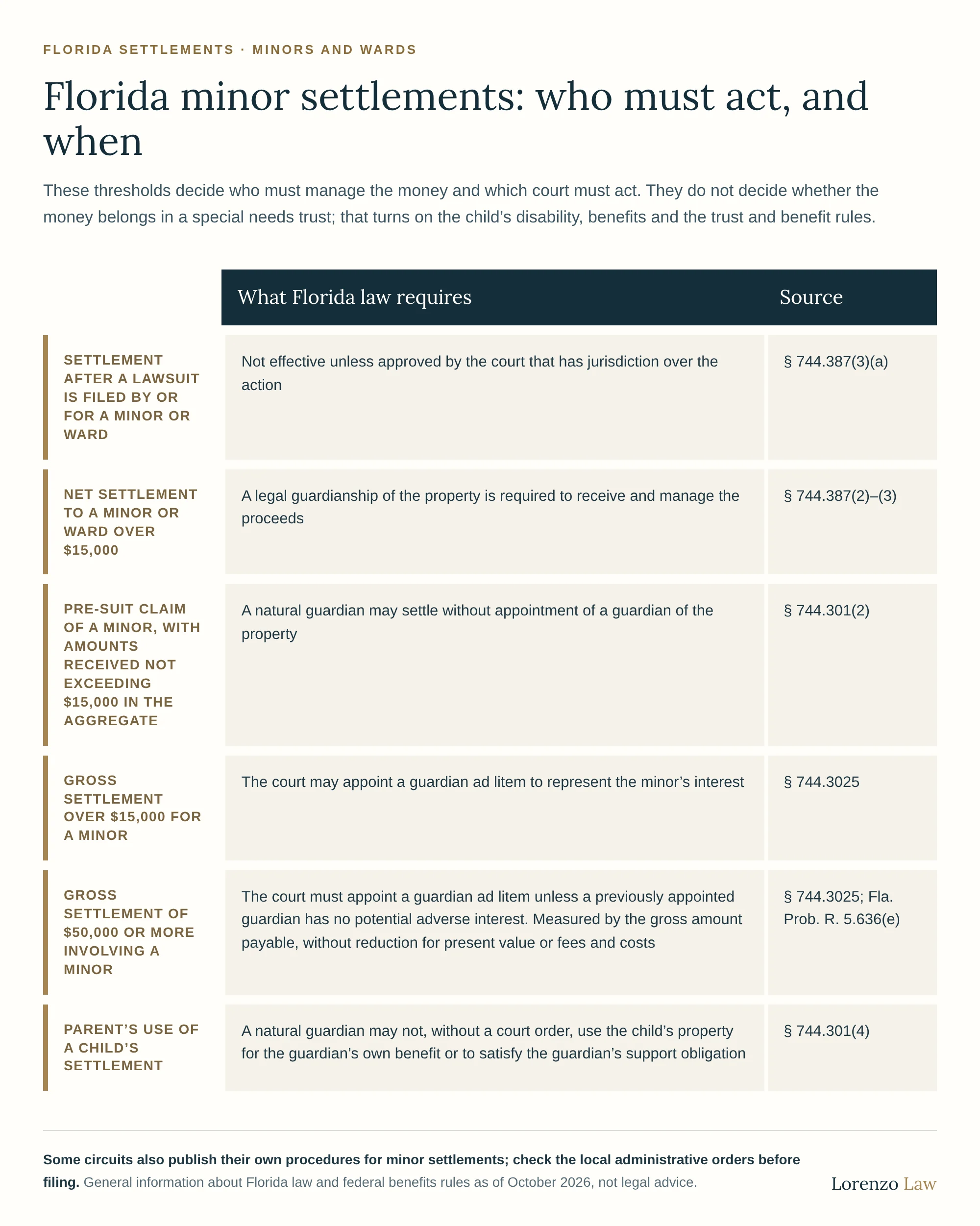
View the “Florida minor settlements: who must act, and when” chart (zoom in to read; the details are also in the table above).
Medicaid liens and Medicare set-asides before funding
Before settlement money reaches a trust, identify the claims against it. Florida’s Medicaid program can recover from a third-party recovery for medical assistance it paid (§ 409.910), and Medicare may seek repayment of conditional payments. Settlement planning sometimes also considers a Medicare set-aside for future Medicare-covered care. A Medicare set-aside is a separate arrangement for Medicare-covered expenses; it is not a special needs trust, although both can arise in the same settlement.
Structured settlement payments and the trust
A settlement may pay part of the recovery over time. When future payments are intended for a first-party trust, the settlement and annuity documents should direct them to the trustee, and the assignment date matters: when the right to annuity, support or Survivor Benefit Plan payments is irrevocably assigned to the trust before the beneficiary turns 65, SSA treats the later payments as if made before 65, while other additions after 65 do not qualify for the exception. Review the annuity contract, the assignment and the trust together. POMS SI 01120.203, B.3.
What If a Person on SSI or Medicaid Inherits Money?
An inheritance left outright to a person who receives SSI or Medicaid is generally that person’s own money. For SSI, an outright cash inheritance generally counts as unearned income in the month received and as a resource in the following month if retained, subject to applicable exclusions, and it must be reported. Noncash inheritances require separate review of availability, valuation and exclusions; they do not all receive the same treatment (POMS SI 00830.550). Later spending or a transfer to a qualifying trust can affect resource counting in later months, but it does not undo income counted in the month of receipt. Medicaid applies its own eligibility and transfer rules. An inheritance left to the trustee of a properly drafted third-party special needs trust is handled under that trust’s terms instead.
Start with the documents: the will, the trust or the beneficiary designation decides whether the person inherited outright or through a trustee. If the inheritance arrived outright, the options depend on age, the amount and the programs involved:
- Under 65: an individual first-party special needs trust or a pooled-trust subaccount may be considered, using the beneficiary’s own money and meeting the requirements described below. A transfer to such a trust for a disabled person under 65 is excepted from the SSI and Medicaid transfer penalties.
- 65 or older: a newly established individual first-party trust cannot qualify for the under-65 special needs trust exception for a beneficiary who is already 65 or older. A qualifying trust established before 65 can continue, but adding the inheritance to it after 65 does not receive the same exception, and a pooled-trust transfer raises the transfer-penalty questions discussed in age and trust type.
- Other options: a spend-down on items the programs exclude, or an ABLE account if the beneficiary is eligible. See alternatives.
Who can sign depends on the beneficiary’s capacity and any guardianship or power of attorney, as explained in who can set up and fund the trust. SSI recipients must report changes, including receipt of an inheritance, no later than 10 days after the end of the month in which the change occurs; Florida Medicaid applies its own reporting rules.
Disclaiming an inheritance is not automatically safe. For Medicaid, refusing an inheritance is treated as a transfer of assets. For SSI, it is treated as giving away a resource for less than fair value, which can cause a period of ineligibility. Obtain advice before signing a disclaimer.
Relatives can avoid the problem by leaving the gift to a third-party special needs trust rather than outright, as part of their own planning with a Florida estate planning attorney. See the third-party special needs trust guide, and for estate questions, Florida inheritance.
How Do Age and Trust Type Affect the Options?
An individual first-party special needs trust under section 1396p(d)(4)(A) must satisfy requirements for a disabled beneficiary under age 65, permitted establishment and Medicaid reimbursement. For trusts established on or after December 13, 2016, the permitted establishers include the individual, parent, grandparent, legal guardian or court. Being on that federal list does not itself give someone state-law authority to use the beneficiary’s property. Federal statute; CMS guidance on the 2016 change.
A qualifying trust established before 65 can continue after that birthday. Later additions generally do not receive the same exception, subject to specific rules such as certain payment rights irrevocably assigned before 65. Review the establishment date, funding dates and any structured-payment arrangement separately. POMS SI 01120.203, B.2–3 and C.
For SSI, the beneficiary must satisfy the applicable disability standard, and SSA applies a sole-benefit requirement with specific permitted expenses. The trust needs compliant reimbursement language for the state or states that provided Medicaid assistance, up to the applicable assistance amount; a generic “payback trust” label is insufficient. These requirements must be addressed in the instrument and administration, not just the petition’s description.
A pooled trust under section 1396p(d)(4)(C) is established and managed by a nonprofit association, with separate beneficiary accounts pooled for investment and management. Its exception has no age limit, but transfers at 65 or older can still create a benefits transfer penalty. Its retention and Medicaid-reimbursement provisions also differ from an individual first-party trust. It is not an automatic solution for every older beneficiary. See Florida pooled special needs trusts.
A third-party trust funded with other people’s assets is a different planning route. The first-party under-65 establishment rule does not govern a genuine third-party trust in the same way, and it is not subject to the first-party statutory payback requirement merely because its beneficiary receives Medicaid. The trust’s terms, beneficiary control and funding history still matter. Avoid mixing the beneficiary’s own money into that trust without analyzing the consequences.
First-party, pooled and third-party arrangements compared
| Arrangement | Whose money | Age rule | At the beneficiary’s death |
|---|---|---|---|
| Individual first-party trust, § 1396p(d)(4)(A) | The beneficiary’s own assets | Established before age 65; later additions reviewed separately | Reimburses each state that provided Medicaid, up to the assistance paid, before remaining funds pass to others |
| Pooled trust subaccount, § 1396p(d)(4)(C) | The beneficiary’s own assets, held by a nonprofit in a separate account | No age limit for the exception, but transfers at 65 or older can create a transfer penalty | The nonprofit may retain amounts under its terms; amounts not retained go toward Medicaid reimbursement |
| Third-party trust | Someone else’s assets | No first-party age rule | Passes under the trust’s terms; no first-party statutory payback requirement |
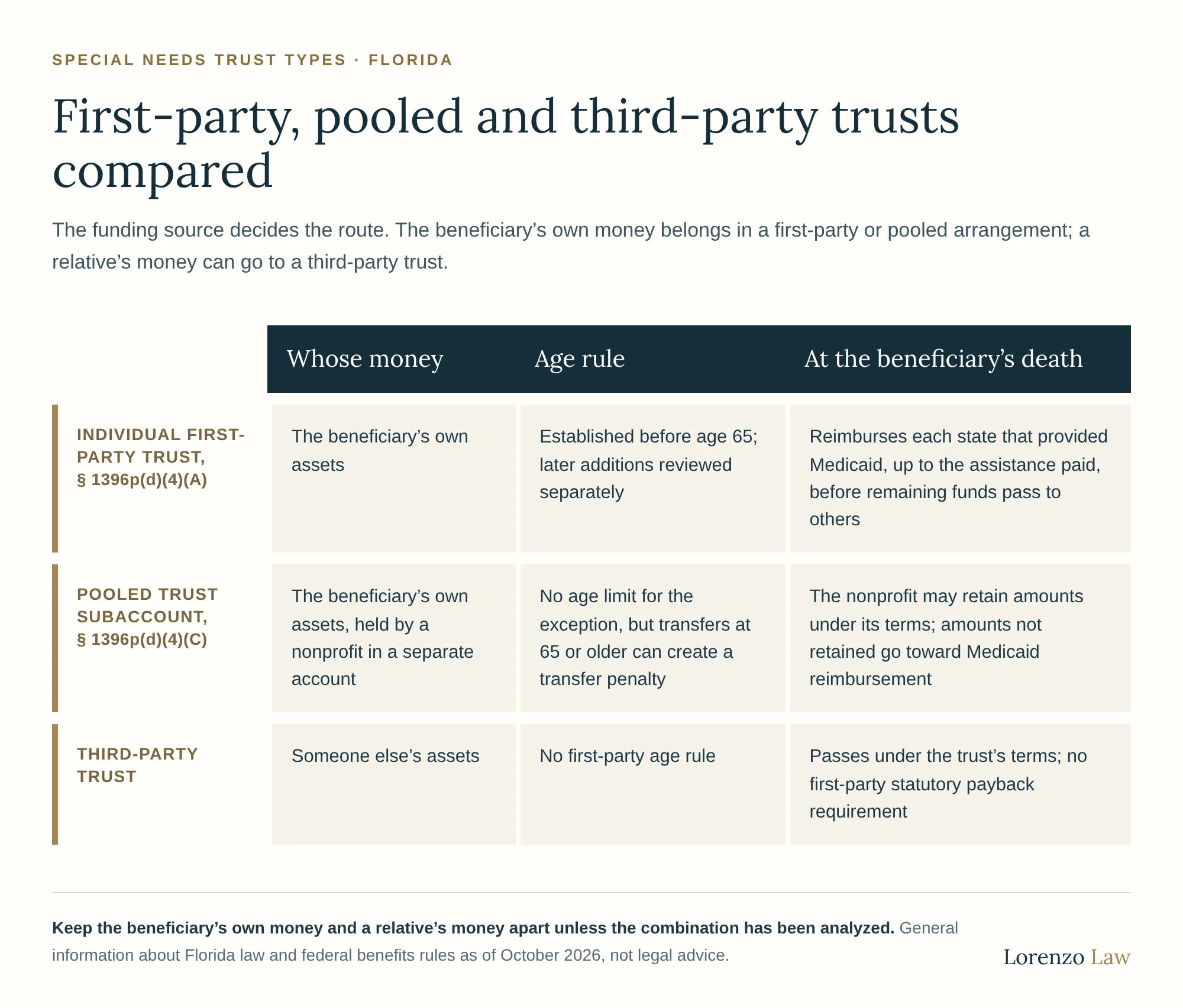
View the “First-party, pooled and third-party trusts compared” chart (zoom in to read; the details are also in the table above).
Are There Alternatives to Funding a Special Needs Trust?
Yes. Depending on the amount, the beneficiary’s age and the programs involved, alternatives include a spend-down on items the programs do not count, an ABLE account, a pooled-trust subaccount, or accepting a period without benefits. None is automatically better; each has different rules on eligibility, control and what happens at death.
- Spend-down on excluded items. A spend-down that pays fair value for items excluded by the applicable program, for the beneficiary’s own benefit, can reduce countable resources. Giving money away is different: for Medicaid, it can be a transfer of assets.
- ABLE account. Beginning January 1, 2026, ABLE eligibility requires disability onset before age 46. Florida’s program is ABLE United. Annual contribution limits apply, and ABLE funds follow their own SSI and Medicaid rules; see the special needs trust distributions guide for how ABLE accounts are used alongside a trust.
- Pooled trust. A nonprofit’s pooled trust can be practical for modest amounts or when no individual trustee is available. See Florida pooled special needs trusts.
- Accepting temporary ineligibility. For some amounts and programs, accepting a short loss of benefits may be considered, but the effect on Medicaid coverage must be reviewed first.
Does Court Approval Protect SSI and Medicaid Automatically?
No. Court authority to act, trust validity, resource treatment, income treatment and transfer penalties are separate questions. Each relevant benefit program applies its own rules.
SSA reviews the trust and related documents, including who funded it and whether the beneficiary can revoke it or obtain its assets. Even a trust meeting the federal special needs trust exception must still be evaluated under the regular SSI resource rules. POMS SI 01120.202; POMS SI 01120.200.
Florida DCF’s SSI-related Medicaid assets manual separately addresses qualified disabled and pooled trusts and agency legal review. Its qualified-trust treatment is conditional and program-specific. A guardianship order is not a replacement for that eligibility review. Keep the trust, amendments, orders and transfer records available for the agency process. DCF assets manual, §§1640.0576.08–.11.
Identify the actual programs from benefit notices. Do not assume all disability payments are SSI or all health coverage is Medicaid. Reporting and any response deadlines must be handled for each program; signing a trust does not complete those obligations.
How Do You Fund a Special Needs Trust, Step by Step?
Confirm the authority first, then move each asset into the trust’s name by the authorized route and keep proof of every step. The order below is typical; a court order or settlement agreement may require a different sequence.
- Confirm ownership and authority. Identify whose money it is, who can sign, and whether a court order is needed. Have any required order entered before the transfer.
- Sign or establish the trust as the plan or order requires, and obtain the trustee’s written acceptance.
- Obtain a taxpayer identification number (an employer identification number, or EIN, issued by the IRS) for the trust if it needs its own. The trust’s income-tax classification determines which number and returns apply.
- Open an account titled in the trust’s name. A bank may accept a certification of trust instead of the full trust instrument (§ 736.1017).
- Transfer the approved assets into the trust account by the authorized route. Direct payment from the source may suit a settlement or a planned contribution from a relative. Savings the beneficiary already holds may instead be transferred from the beneficiary’s account by someone with authority. Social Security and SSI payments themselves generally cannot be assigned or direct-deposited to a trust (POMS SI 01120.201, J.1.c).
- Retitle other assets: deeds to the trustee, brokerage accounts in the trust’s name, and beneficiary designations naming the trust where a relative funds a third-party trust.
- Keep proof of the order, the executed trust, the trustee’s receipt, transfer confirmations and any difference between approved and deposited amounts.
- Report to the programs involved under each program’s rules, and provide the trust and funding records when requested.
- Report the transfer in the guardian’s annual accounting when a guardian made it. The accounting covers all of the ward’s property under the guardian’s control and must disclose significant transactions (§ 744.3678; Fla. Prob. R. 5.696).
Documenting the transfer
After the necessary authority and approvals are in place, implement the approved transaction and preserve proof of each step. Match account titles and transfer instructions to the executed trust and order. Retain the trustee’s receipt, opening statements, source-of-funds records and an explanation of any difference between the approved and deposited amounts.
Cash, investments, real estate, insurance proceeds and retirement benefits require different handling. A signed trust schedule alone does not establish that every asset has been transferred. A proposed deed needs title and property review; a beneficiary designation needs confirmation from the relevant institution; retirement benefits require tax analysis before withdrawal or redirection. Do not treat retirement-account ownership as interchangeable with directing future proceeds. See beneficiary designations.
Trustees must keep clear records, keep trust property separate from their own, and identify it appropriately. Guardians also have continuing recordkeeping and reporting duties. A transfer to a trust does not by itself terminate the guardianship or eliminate retained court oversight. Florida Statutes §736.0810; §744.361.
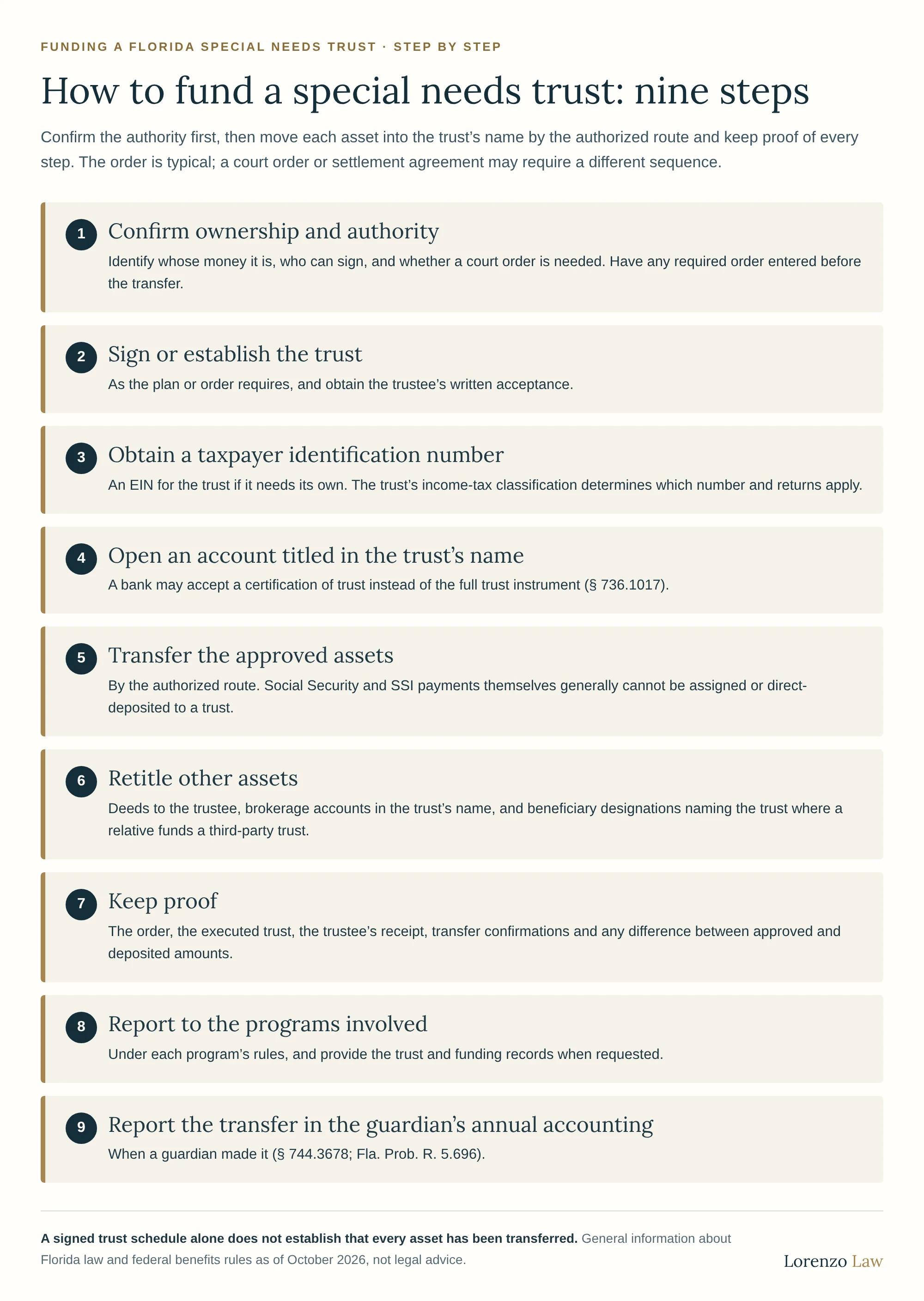
View the “How to fund a special needs trust: nine steps” chart (zoom in to read; the details are also in the list above).
Managing a Special Needs Trust After It Is Funded
Special needs trust administration continues for as long as the trust holds property. Florida requires the trustee to administer the trust in good faith under its terms and purposes, to keep clear, distinct and accurate records with trust property kept separate from the trustee’s own, and, for an irrevocable trust, to give qualified beneficiaries the information and accountings required by section 736.0813, subject to its applicable exceptions and written-waiver rules (§§ 736.0105(2)(r)–(t); 736.0813(1)(d), (2)). When a guardian funded the trust, the guardianship court may also retain oversight of the transferred assets.
Managing a special needs trust well starts with the funding file described above and continues with a record for every distribution. Once the trust is funded, see special needs trust distribution rules for how the trustee decides what to pay, and special needs trust accounting and records for the records in detail. Sources: § 736.0801, § 736.0810, § 736.0813.
Who should serve as trustee when a guardian funds the trust?
The court can be asked to approve the trustee along with the trust. A guardian can also serve as trustee; in Rene v. Sykes-Kennedy, the court appointed the guardian as successor trustee on a best-interest finding. The two roles still carry separate duties, records and court requirements, and the plan should address conflicts, any bond or other safeguards the court may require, and a successor trustee. A professional or nonprofit trustee may be considered when the amount, complexity or family situation calls for it. See choosing a trustee under Florida law and the letter of intent for the trustee.
Can a special needs trust own a house or other property?
A special needs trust can buy and own a house in Florida if the trust allows it, but ownership alone does not settle the benefits question.
Review the trust’s authority, ownership arrangement, available cash for expenses and effects on benefits before acquiring or transferring real estate. Taxes, insurance, maintenance, occupancy and a later sale all need a workable plan. Trust ownership alone does not establish that every housing payment leaves benefits unchanged.
Who decides how the funded trust spends money?
The trustee acts under the trust and applicable law, including duties governing discretionary decisions. A guardian’s request does not automatically require a payment. For cash, housing, vendor payments and other expense-specific questions, see what a special needs trust can pay for. Florida Statutes §736.0814.
What about taxes and later changes?
Tax treatment requires its own review. A contribution’s benefits treatment does not establish its gift-tax treatment, and a gift to a trust does not automatically qualify for the annual exclusion. Income-tax reporting also depends on the trust and transaction. Obtain tax advice before transferring retirement proceeds or other assets with material tax consequences. IRS gift-tax guidance; Form 709 instructions on the annual exclusion.
If the trust needs changes, review the instrument, available legal authority, any court order and the benefits consequences before acting. Do not assume an amendment, trustee change or closing distribution is permitted simply because it seems helpful. First-party payback and pooled-trust retention/reimbursement terms must be addressed before distributing a remainder after death; genuine third-party trusts follow their terms and applicable law. To change or remove a trustee, see trustee removal in Florida.
What happens to the trust when the beneficiary dies?
It depends on the type. An individual first-party trust must reimburse each state that provided Medicaid, up to the assistance paid, before remaining funds pass to remainder beneficiaries. Before that reimbursement, the trust may pay only taxes due from the trust to state or federal government because of the beneficiary’s death and reasonable fees for administering and winding up the trust; funeral expenses, debts owed to others and payments to remainder beneficiaries must wait (POMS SI 01120.203, E). Because funeral costs cannot be paid ahead of the state, a prepaid funeral arranged during the beneficiary’s lifetime is often considered. A pooled trust may retain amounts under its terms, with amounts not retained applied toward reimbursement. A genuine third-party trust passes under its own terms, for example to other family members or a charity the trust names.
What Documents Should You Gather Before a Funding Review?
Have available the records that explain ownership, authority and timing. The main ones are guardianship letters and orders, the trust documents, settlement papers, wills and beneficiary designations, account statements and deeds, benefit notices, a care budget, the trustee’s acceptance and any power of attorney. You do not need every item to request an initial consultation.
Records checklist
| Records | What they help establish |
|---|---|
| Letters of guardianship, appointment and incapacity orders, current plan and later orders | The rights delegated, existing restrictions and approvals already entered |
| Trust instrument, amendments, schedules and any pooled-trust master agreement and joinder | Proposed trust type, establishment history, trustee powers and remainder/payback terms |
| Settlement agreement, proposed or signed orders, distribution statement and structured-payment documents | Who owns the recovery, gross and net amounts, liens, costs and payment dates |
| Will, estate orders, existing trust and beneficiary designations | Whether an inheritance goes outright to the person or to a trustee |
| Bank and investment statements, deeds and ownership records | Source, title, value and location of assets; whether funds have already moved |
| Birth-date and disability documentation, current benefit notices and agency correspondence | Age-sensitive requirements, programs involved and pending deadlines |
| Current care budget, income and expected expenses | How needs will be met during the process and any period without benefits |
| Trustee acceptance, fee information and proposed account details | Administration feasibility, costs and the intended destination of funds |
| Relevant power of attorney and prior estate-planning or gifting records | Authority of an agent and evidence relevant to the proposed relief |
Use a secure method arranged with the firm for sensitive records. An initial contact-form message should identify the issue, your role, the Florida county and any deadline, without account numbers or medical documents.
Common Funding Mistakes to Avoid
- Treating the guardian’s appointment as authority for every trust transaction.
- Calling the beneficiary’s settlement or outright inheritance a third-party contribution.
- Assuming a parent, agent, payee and trustee have the same powers.
- Obtaining settlement approval without checking whether the trust and transfer are authorized.
- Missing the age-65 funding issue or assuming a pooled trust eliminates transfer penalties.
- Assuming a court order guarantees agency eligibility or retroactively fixes an earlier transfer.
- Omitting care funding, fees, continuing supervision or proof of the completed transfer.
- Making distributions before checking the trust and applicable benefits rules.
- Moving settlement or inheritance money before confirming ownership, benefits treatment, signing authority and any required court approval.
- Combining the beneficiary’s own money and a relative’s money in one trust without analysis.
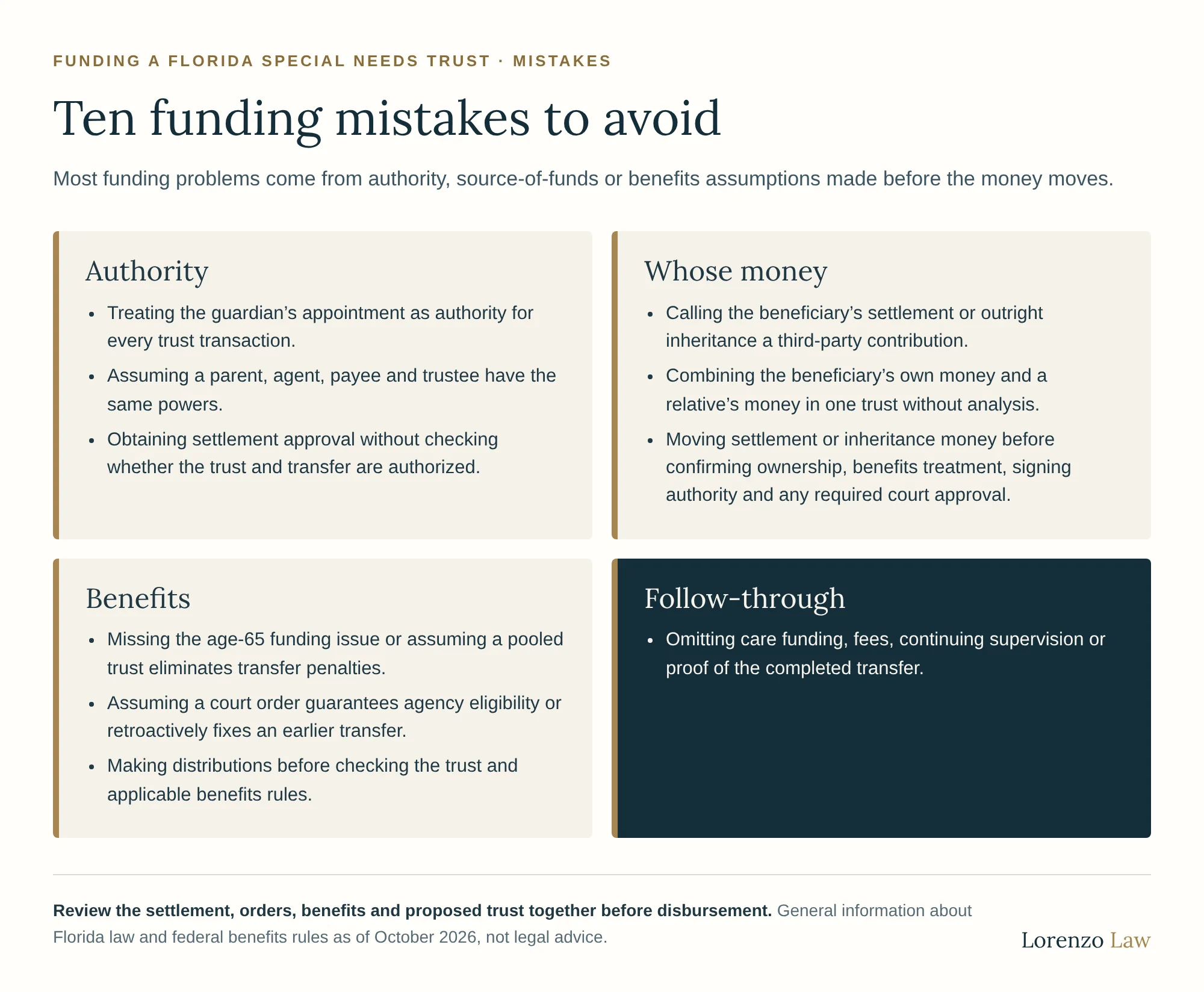
View the “Ten funding mistakes to avoid” chart (zoom in to read; the details are also in the list above).
Hypothetical example: A court-appointed property guardian receives notice of a settlement for a 40-year-old ward who receives SSI and Medicaid. The useful next step is to review the settlement, orders, benefits and proposed trust together before disbursement. The guardian’s adult sibling offering personal savings presents a separate source-of-funds question; those savings should not simply be combined with the ward’s recovery without reviewing the intended trust arrangement.
Funding a Special Needs Trust: Frequently Asked Questions
Short answers to common questions. Each answer is limited by the fuller explanation in the sections above.
Who can set up or fund a special needs trust in Florida?
A relative can fund a third-party trust with the relative’s own money. A first-party trust for the beneficiary’s own money may be established by the individual, a parent, a grandparent, a legal guardian or a court, but each must also have authority under Florida law to sign and move the property. A guardian needs court approval.
Can you add money to a special needs trust later?
Usually, if the trust permits additions. Relatives can add their own money to a third-party trust under its terms. Additions of the beneficiary’s own money to a first-party trust after the beneficiary turns 65 generally do not receive the same exception, and every addition should be documented by source.
When should a special needs trust be funded?
Planning should ideally start before the money is paid. Settlement planning should start before the agreement is final, and relatives should name the trust in their wills, trusts and beneficiary designations. If money has already reached the beneficiary, it can still be moved to a qualifying first-party or pooled arrangement by someone with authority; act promptly, because SSI evaluates resources month by month.
Can an IRA or life insurance fund a special needs trust?
Yes, when a relative names the trust, rather than the person with a disability, as beneficiary. Retirement accounts also carry income-tax and distribution-timing rules for the trust as beneficiary, so review the trust’s terms and the account’s rules with a tax adviser.
Can retroactive SSI or SSDI back pay go into a special needs trust?
Back pay belongs to the beneficiary, so if it goes into a trust at all, it belongs in a first-party or pooled arrangement, not a third-party trust. For SSI resource counting, the unspent portion of retroactive SSI and Social Security benefits is generally excluded for the 9 calendar months after the month of receipt. Some children’s past-due SSI must be held in a dedicated account, which has its own resource exclusion and spending limits (POMS SI 01130.600, B.1 and B.3; SI 01130.601; GN 00602.140). Confirm those rules and any representative-payee restrictions before deciding whether money can be transferred to a qualifying first-party or pooled trust.
Will I lose SSI or Medicaid if I inherit money?
It can. For SSI, an outright cash inheritance generally counts as unearned income in the month received and as a resource in later months if kept, subject to any exclusion. A transfer to a qualifying first-party or pooled trust, or appropriate spending, can affect later resource counting but does not automatically erase income counted in the month of receipt. Medicaid has its own eligibility and transfer rules. Report the inheritance and get advice before moving it.
Does Florida require court approval for a minor’s settlement?
Yes, once a lawsuit has been filed, the court with jurisdiction over the action must approve it. A guardianship of the property is required when the net settlement exceeds $15,000. A natural guardian may settle a pre-suit claim when the amounts received do not exceed $15,000 in the aggregate. The court may appoint a guardian ad litem when the gross settlement exceeds $15,000 and generally must when it is $50,000 or more.
Is a Medicare set-aside the same as a special needs trust?
No. A Medicare set-aside reserves settlement money for future Medicare-covered care. A special needs trust holds assets for a beneficiary’s supplemental needs while preserving eligibility for needs-based benefits. Both can arise in the same settlement.
Does guardianship override an existing trust?
No. An existing trust is governed by its own terms and its trustee. A guardian of the property may exercise a ward’s powers over the ward’s own revocable trust only as Florida law allows, which generally requires court approval under section 744.441.
Is a special needs trust revocable or irrevocable?
A first-party special needs trust must be irrevocable to work as intended. A third-party trust is usually irrevocable once it holds assets for the beneficiary, although a parent’s plan may use a revocable trust that becomes irrevocable at the parent’s death. Review the terms and the benefits treatment together.
Does a special needs trust need its own bank account and EIN?
The trust’s money should be held in an account titled in the trust’s name, separate from the trustee’s and the beneficiary’s own funds. Whether the trust needs its own taxpayer identification number depends on its income-tax classification.
What if a guardian already transferred money without an order?
Obtain advice promptly about the actual transaction and possible corrective steps. A later order should not be assumed to cure state-law authority, federal trust-establishment or benefits problems retroactively.
Is there a Florida special needs trust statute?
Florida does not have one comprehensive special needs trust statute. A Florida special needs trust is governed by its own terms, the Florida Trust Code in Chapter 736 of the Florida Statutes, and the federal and state benefits rules that apply to the beneficiary. A guardian’s authority to create and fund one comes from Chapter 744, discussed above.
Can I set up a special needs trust without a lawyer?
An adult with capacity can sign documents without a lawyer, but a first-party trust must meet federal requirements, and a trust funded with a ward’s property requires a court order. Errors can affect eligibility. The Florida special needs trust guide explains the planning framework.
Talk with Lorenzo Law About a Guardianship or Trust-Administration Question
Request a free initial consultation with Jose Lorenzo about your Florida guardianship or trust-administration question. Consultations are available in English and Spanish, and one lawyer, Jose M. Lorenzo, Jr., handles each matter himself. Explain whether you are the guardian, trustee, beneficiary or family member, who owns the funds, and whether a settlement, inheritance or deadline is involved.
Ask how to provide the relevant records and what work would be included in any engagement. Do not send Social Security numbers, account numbers or private medical records through the public contact form.
The scope and fee for legal work are confirmed separately. This consultation offer concerns guardianship and trust administration; it does not include a promise to handle Medicaid or SSI applications, reporting or appeals. Benefits, tax and other specialized questions may require separate professional advice.
Request a free initial consultation or Call (305) 224-6811
Lorenzo Law’s principal office is in Kissimmee, with meetings by appointment in Coral Gables (Miami-Dade County) and Fort Lauderdale (Broward County), and the firm works with guardians, trustees and families statewide. For related context, see Florida adult guardianship. If there is a disagreement about a guardian’s conduct or proposed action, the guardianship litigation page addresses that separate issue.
This information is general and is not legal advice. Contacting the firm does not create an attorney-client relationship. The appropriate trust, court procedure and benefits treatment depend on the documents and circumstances. It reflects the law and agency guidance as of October 2026.
About the Author
Jose M. Lorenzo, Jr. was admitted to The Florida Bar on October 4, 2013, Bar number 107002. His pre-admission paralegal experience is described separately in his biography. Lorenzo Law’s principal office is in Kissimmee, with meetings by appointment in Coral Gables (Miami-Dade County) and Fort Lauderdale (Broward County).
Authorities Cited on This Page
The Florida statutes cited here are the 2026 Florida Statutes, and the probate rules are cited from The Florida Bar’s compilation published October 1, 2026. Statutory, regulatory, rule and agency text controls over any summary on this page.