

Jacksonville Probate Litigation Attorney
A Jacksonville probate litigation attorney represents people on either side of a contested estate or trust in Duval County: a will contest, a trust challenge, a claim against a personal representative or trustee, a dispute over an inherited house, or a surviving spouse’s claim. Jose M. Lorenzo, Jr. is a Florida probate litigation lawyer who handles these disputes for beneficiaries, heirs, spouses and fiduciaries in matters before the Fourth Judicial Circuit, and every review starts with your role, the documents and any deadline a notice may already have started.
Request a free initial consultation. Only the initial consultation is free; representation fees and costs are agreed separately in writing. Consultations are available statewide in English and Spanish, by phone or video.
Request a free initial consultationCall (305) 224-6811
Go straight to: Your role and dispute · Notices and deadlines · Duval court · What to bring
By role: a beneficiary or heir should start with the notices; a surviving spouse, with spousal rights; a personal representative or trustee, with defending a claim. No dispute, just an estate to settle? See Jacksonville probate administration.
All guide sections 25 sections
At a glance: contested estates and trusts in Jacksonville and Duval County
Short answer. What does probate litigation mean? Probate litigation, or a contested probate case, is any estate or trust dispute that a judge has to decide: a will contest, a trust challenge, a claim that a personal representative or trustee breached a duty, a request to remove one, an objection to fees or an accounting, or a surviving spouse’s claim. Probate litigation in Jacksonville is heard in the probate division of the Circuit Court for the Fourth Judicial Circuit, in and for Duval County, and appeals go to the Fifth District Court of Appeal. The first task is always the same: identify your role, the document or conduct in dispute, and any notice that may already have started a deadline.
| Where cases are heard | The probate division of the Fourth Judicial Circuit in Duval County, with two divisions, PR-A and PR-B. Duval County Courthouse probate filings go through the Clerk’s Probate Department, 501 West Adams Street, Jacksonville. Duval court and Clerk |
|---|---|
| Where appeals go | The Fifth District Court of Appeal, which has heard appeals from the Fourth Judicial Circuit since January 1, 2023. Circuit and appeals |
| Common disputes | Will contests, trust contests, undue influence, lack of capacity, breach of fiduciary duty, refused accountings, removal of a personal representative or trustee, fee objections, spousal rights, disputes over an inherited house, and transfers made outside the will. Find your dispute |
| The first thing to check | Any notice of administration, formal notice, trust notice, accounting or limitation notice you received, and how and when it reached you. Different notices can start different clocks. Notices and deadlines |
| Who Jose represents | Beneficiaries, heirs, surviving spouses, personal representatives and trustees, on either side of a dispute, after a conflict review. Your role |
| Cost | Only the initial consultation is free; representation fees and costs are agreed separately in writing. Arrangements that may be considered: hourly; a flat fee for a discrete task; and, in appropriate litigation matters, contingency or hybrid terms. Cost and who pays |
| Languages and meetings | Consultations in English and Spanish, statewide by phone or video. There is no Jacksonville office: the principal office is in Kissimmee, with meetings in Coral Gables and Fort Lauderdale by appointment. Contact |
| Routine estate, no dispute? | Opening, administering and closing an uncontested estate is a different job. Jacksonville probate administration |
A dispute and an administration are different jobs. Probate is the court-supervised process of collecting a decedent’s assets, paying valid debts and expenses, and distributing what remains; litigation begins when someone asks the judge to decide a contested question in or alongside that process. That is the difference between probate and litigation. When an estate is in litigation, administration usually continues, but while a will or trust contest is pending, distributions that would conflict with the rights of those who could win the contest are restricted (§ 733.109; § 736.08165). If the family agrees and the estate simply needs to be opened, administered and closed, start with Jacksonville probate administration; for a plan of your own, see Florida estate planning. This page is about the matters that become contested.
What does a Jacksonville probate litigation attorney do?
Short answer. A Jacksonville probate litigation attorney brings or defends court proceedings over a Duval County estate or trust: challenging or defending a will or trust, compelling an accounting, seeking or resisting the removal of a personal representative or trustee, objecting to fees, recovering property that was taken or mismanaged, and asserting or answering a surviving spouse’s claim. The work runs from reviewing the documents and deadlines through filing, discovery, mediation and, when a dispute does not settle, an evidentiary hearing or trial.
You may see this work called a probate litigation lawyer, a probate litigator, an estate litigation attorney or estate litigation lawyer, a trust litigation attorney or trust litigation lawyer, a contested probate attorney, a litigation probate attorney, an estate trial attorney, an estate dispute lawyer or an inheritance dispute attorney. The label matters less than the proceeding. What does a probate litigator do, and what does an estate litigator do? The same work from different starting points: one begins with a probate case, the other with any dispute over an estate, a trust or a lifetime transfer, and an estate trial lawyer is simply one who takes those disputes to an evidentiary hearing or trial. Probate litigators, whatever the title, spend most of their time on the same questions: Is this document valid? Is the person in charge doing the job lawfully? Is the estate being charged fairly? What does a surviving spouse receive? And what happened to property that moved outside the will?
A Jacksonville probate litigation lawyer also works on the defense side. A personal representative accused of delay, a trustee accused of self-dealing, or a child whose gift under a new will is under attack needs a response that is just as carefully built as the claim. Lorenzo Law takes matters on either side, but never both sides of the same dispute. It is a solo probate litigation law firm, not a multi-lawyer estate litigation law firm, so the attorney you speak with at the first call handles the matter. A probate litigation attorney (Jacksonville, FL, or anywhere else in Florida) has to start with the same three things: the documents, the docket and the deadline. Probate litigation, Jacksonville or elsewhere, does not begin with a lawsuit; it begins with that review.
Estate, probate and trust litigation compared
Probate litigation is a dispute inside an estate proceeding, such as a will contest, a petition to remove a personal representative or an objection to an accounting. Estate litigation is the broader term: it also covers trusts, deeds, joint accounts with survivorship rights, beneficiary designations and other transfers that never pass through probate. Will litigation is the narrowest, concerned with the will itself. “Probate and estate litigation” is the umbrella phrase many people search for, and it fits: most contested Jacksonville estates involve more than one of these at once. Together they make up estate, trust and fiduciary litigation, sometimes shortened to trust and probate litigation.
The categories overlap in the evidence they use, often the same medical records, bank statements and witnesses, but they do not all follow the same code, notice rules or filing procedure. A claim about a revocable trust, for example, is generally commenced by filing a complaint governed by the Florida Rules of Civil Procedure (§ 736.0201(1)). Treating an estate contest, a trust contest and a deed challenge as one filing is a costly mistake. The Florida estate litigation attorney page and the Florida estate disputes guide explain how these claims connect statewide.
Not every will dispute is a contest. A construction proceeding, such as a petition for construction of will or trust terms, asks the court to resolve an ambiguity and say what the document means, and a determination of beneficiaries asks who is entitled to take; both are probate litigation even when no one claims the document is invalid. Declaratory relief is also available to settle questions about the construction of a will or other writing (§ 86.041). Fiduciary litigation is the part of the field aimed at the person in charge, the personal representative of an estate or the trustee of a trust. Those claims concern conduct, not the validity of the document, and they use different evidence.
Other titles describe different work. The difference between an estate attorney and a probate attorney is usually one of timing: an estate attorney helps clients plan with wills, trusts and powers of attorney, while a probate attorney guides the court process after a death. The difference between an estate attorney and a trust attorney is one of focus, since a trust attorney drafts trusts or advises trustees and beneficiaries. One lawyer may do all three, and none of those titles says whether the lawyer handles contested cases. What is the difference between an estate lawyer and a trust lawyer, then? Mostly focus, as described above. What type of lawyer do I need to contest a will? One who litigates these proceedings, whatever the title; the same is true for a trust.
Which role are you in, and what is the dispute?
Short answer. An heir, a beneficiary, a surviving spouse, a personal representative and a trustee can have different rights and opposing interests in the same estate. Before anything else, identify who is involved, who already has a lawyer, the capacity in which you need help, and what you actually want: information, a distribution, a transaction stopped, recovery of a loss, or a defense. A lawyer for the personal representative does not represent the beneficiaries. Lorenzo Law identifies the proposed client and checks for conflicts before accepting any matter.
The personal representative administers the estate; the trustee administers the trust. The same person may hold both positions, but the duties, records and proceedings remain distinct. In Duval County probate litigation, sorting out who holds which role is usually the first step. If you serve as a fiduciary and are also a beneficiary, say so at the outset, because the two roles can pull in different directions.
| Your situation | What needs to be established | Helpful starting documents |
|---|---|---|
| Beneficiary or heir disputing a will | How the result affects your interest; the ground for the challenge; whether a deadline or prior order bars it | Current and earlier wills, codicils, notices and the probate docket. See grounds |
| Beneficiary questioning administration | What information or action is missing, which fiduciary owes the duty, and any loss or risk | Inventory, accountings, your written requests, statements and orders. See fiduciary conduct |
| Trust beneficiary shut out of information or distributions | Your status under the trust, the trust terms, and whether the trust is still revocable | The complete trust with every amendment, notices, accountings and correspondence. See trust disputes |
| Personal representative or trustee responding to a claim | The capacity in which you are sued, the authority for the decision, and any individual exposure | Appointment papers, the governing document, the claim, transaction records and legal correspondence. See defending a claim |
| Surviving spouse concerned about inheritance | Which rights apply, whether a waiver affects them, and the election or petition requirements | Marriage and waiver documents, the will and trust, asset information and notices. See surviving spouse |
| Heir or co-owner of a disputed house | Current title, how the property was transferred, and whether the dispute concerns ownership or division | Recorded deeds, title documents, transfer records and estate orders. See the inherited house |
| Creditor whose claim was objected to, or an heir objecting to a claim | Whether the claim was timely and properly presented, and what happens after an objection | The claim as filed, the notice to creditors, any objection and its service date. See notices |
| Family member living outside Florida, including military families | Where the decedent was domiciled, the case number if one exists, and every notice you were sent | The same documents; consultations are by phone or video. See out-of-state families |
Matching the dispute to the right route
Whether you are looking for an inheritance dispute lawyer to bring a claim or defending one, once your role is clear, put the dispute in the right category. The remedy should address the actual problem. Challenging a will does not automatically undo a deed, and removing a fiduciary does not automatically restore missing funds. Several related issues may need coordinated but separate proceedings.
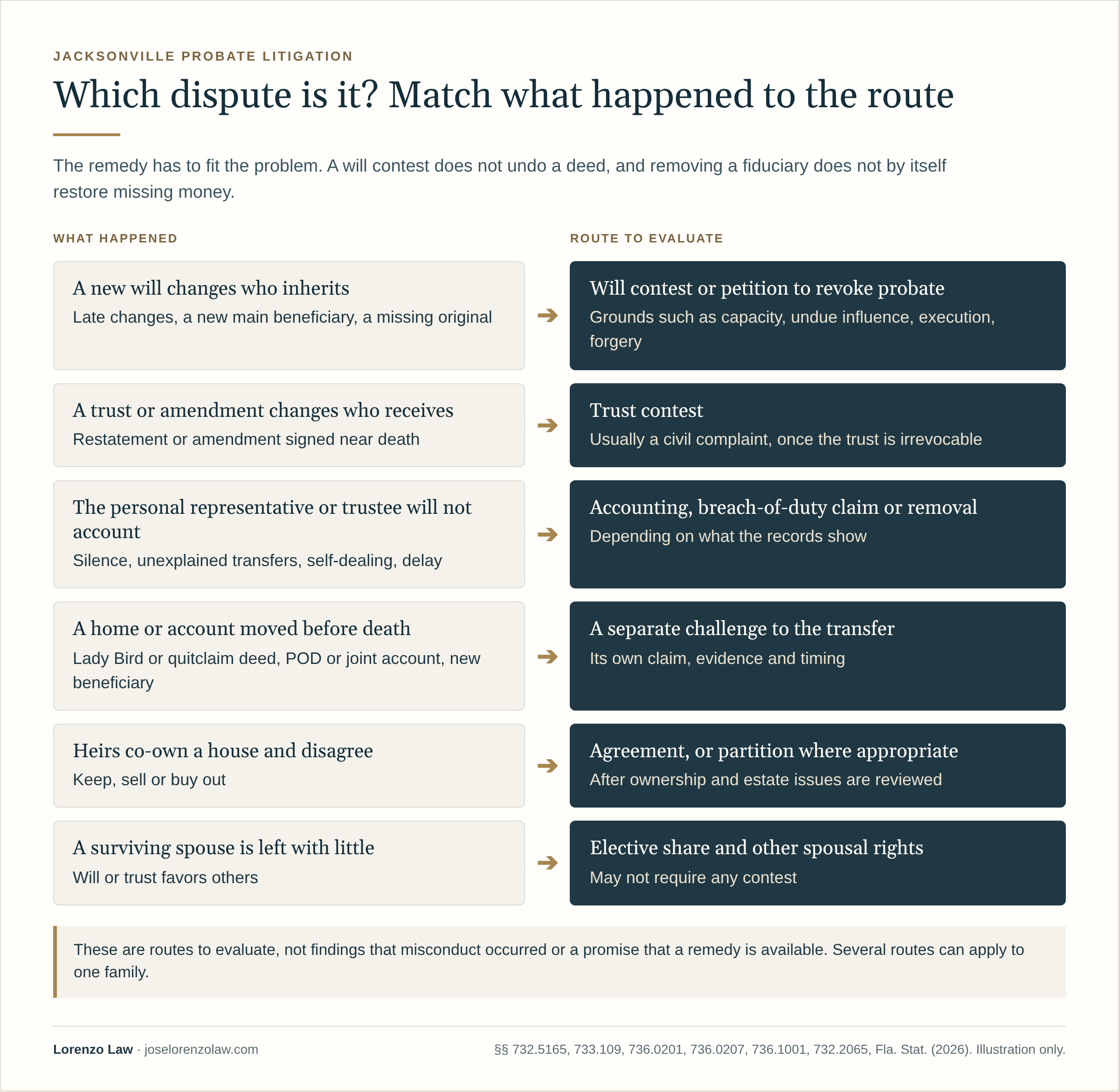
See the chart “Which dispute is it? Match what happened to the route” (opens the full-size image; the details are also in the text).
| What concerns you | Possible route to evaluate | Evidence that can change the analysis |
|---|---|---|
| A new will or codicil unexpectedly changes who inherits | Will contest, defense of the will, or a proceeding about its meaning | Earlier documents, signing circumstances, witnesses, communications and records bearing on capacity |
| Estate money is unaccounted for, transactions are unexplained, or orders are ignored | Requests for information or an accounting; objections; removal or a claim for loss where supported | Inventory, bank statements, sale proceeds, invoices, accountings and court orders |
| A trust amendment is disputed or a trustee’s conduct is questioned | Trust contest, construction, accounting relief, or a breach-of-trust claim | The complete trust and amendments, notices, disclosure documents, requests and transaction records |
| A deed transferred a home before death | A separate challenge to the deed, the transfer authority and the parties who must be joined | The recorded instrument, prior title, signing evidence, any power of attorney and any consideration paid |
| Heirs who share a house disagree about keeping or selling it | Agreement or, where appropriate, partition after ownership and estate issues are reviewed | Deeds, ownership shares, estate orders, mortgage and expense records |
| A spouse believes the plan leaves out protected rights | A separate analysis of the elective share and other spousal rights | Notices and service records, waiver agreements, asset ownership and beneficiary designations |
These are routes to evaluate, not findings that misconduct occurred or a promise that a remedy is available.
Who can contest a will or trust in Florida?
Who can contest a will in Florida is a question of standing. Generally, it is an interested person: someone who may reasonably be expected to be affected by the outcome of the particular proceeding. Florida’s definition turns on that proceeding, and it excludes a beneficiary who has already received a complete distribution (§ 731.201). The practical test is whether you would receive more, or lose less, if the challenged document or action failed.
Being a non-beneficiary under the current will does not, by itself, end the question. A person who would inherit under an earlier will, or as an heir if there were no will, may have standing to challenge the new one, and being cut out is often part of the evidence. Being related to the decedent, receiving a notice, or disagreeing with a distribution does not by itself establish the right to bring every claim, because standing is measured proceeding by proceeding. A creditor, for example, is interested in its claim, not in who inherits. A stepchild who was never adopted is usually not an heir, so a stepchild’s standing generally depends on being named in a prior will.
Can a grandchild contest a will? Usually only if a prior will names the grandchild, or if the grandchild would inherit as an heir, which generally requires that the grandchild’s parent died before the decedent. Brothers and sisters come next in line after parents: a sibling generally inherits as an heir only when the decedent left no descendants and no surviving parent, and a surviving spouse takes first (everything, if there are no descendants), so whether siblings can contest a will usually depends on that order or on a prior will that names them. Can nieces and nephews contest a will? They are in a similar position: unless a prior will names them, they generally inherit as heirs only when the decedent left no descendants and no surviving parent, and only if their own parent (the decedent’s brother or sister) has died, taking that parent’s share (§ 732.102; § 732.103; § 732.104). In each case the question is the same: what would you receive if the challenged will failed?
Can the executor contest the will? The person named as personal representative is normally the one who offers the will for probate, and a nominated personal representative who was in good faith justified in offering the will in due form for probate is entitled to costs and attorney’s fees from the estate even if probate is denied or revoked (§ 733.106(2)). A person named as personal representative in an earlier will, or who would inherit under it, may be an interested person entitled to challenge a later will, but anyone who holds a fiduciary role and also wants to attack the document should get advice about that conflict before acting. Can you contest a will if you’re not in it? Yes, if you would receive something under an earlier will or as an heir if the challenged will failed; that is the standing test above. Contesting a parent’s will turns on the same test, and so does a grandchild contesting a will, a sibling contesting a will or a niece or nephew.
For a trust, the question is whether you are a beneficiary or would become one if the challenged trust or amendment failed. A qualified beneficiary also has information rights while the trust is administered. Both are covered under trust disputes.
Which notice did you receive, and which deadline might it start?
Short answer. There is no single deadline for an inheritance dispute. Four things matter: the document you were served, your status, the type of claim, and what has already happened in the Duval court file. Keep the entire notice and anything showing how and when it reached you, and have it reviewed well before the shortest deadline that might apply. A family conversation, a records request or an email to the personal representative does not extend a deadline.
Keep every notice, attachment, envelope, delivery record and waiver. The title of the document, what it contains, how it was served or sent, and the date of a filed waiver can change the analysis. A docket entry on the Clerk’s system is not a substitute for the complete notice or the evidence of service.
Each notice, and the clock it can start
What is a notice of administration? Florida probate law requires the personal representative to serve it promptly on interested persons after letters issue; it identifies the estate, the court and the personal representative and starts the objection period described below. People sometimes call it a “formal notice of administration” because it is served in the manner provided for formal notice; formal notice of a petition is a different document with its own response period. The table summarizes the Florida probate deadlines that come up most in contested estates.
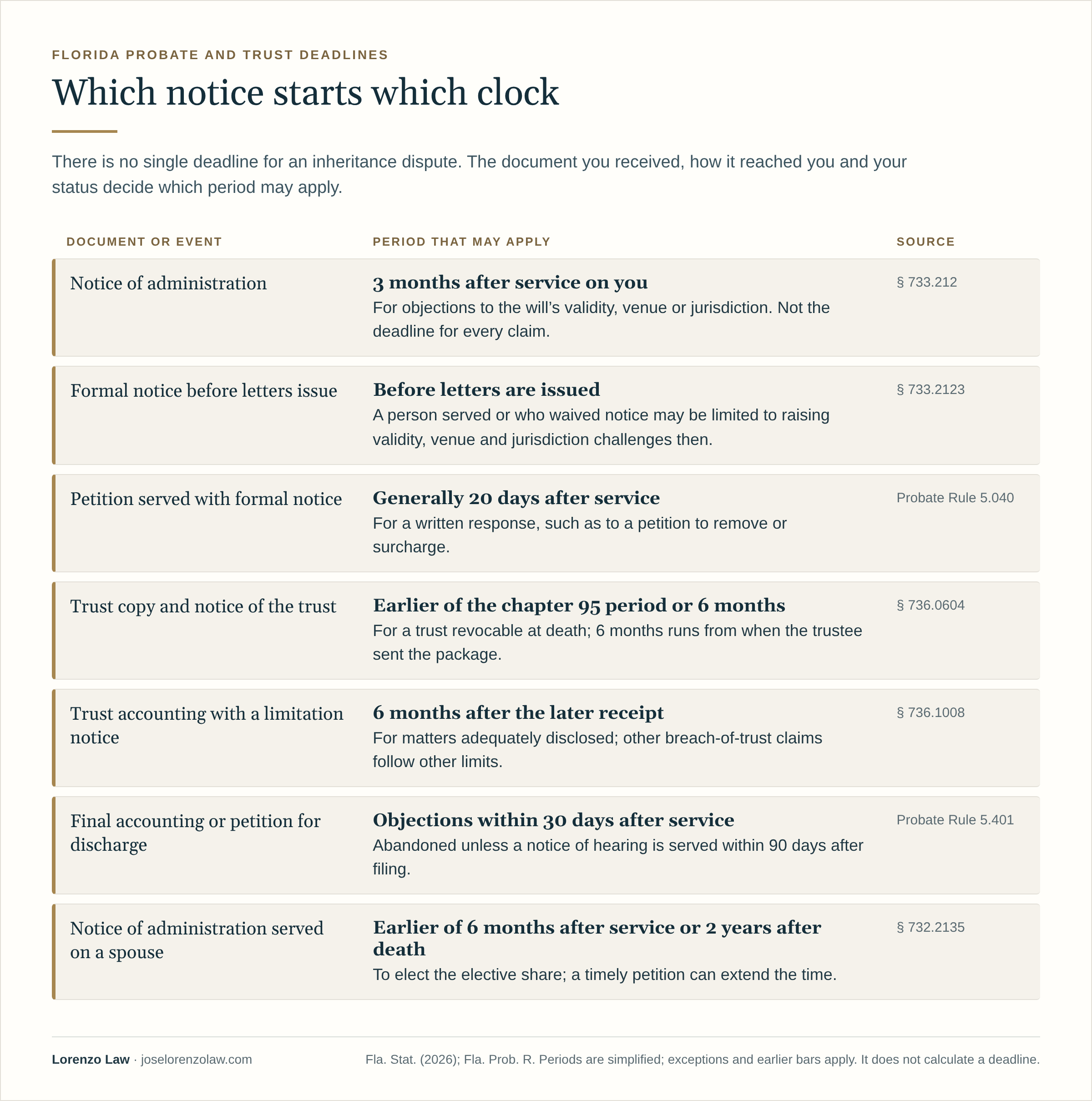
See the chart “Which notice starts which clock” (opens the full-size image; the details are also in the text).
| Document or event | Why prompt review matters | What to keep |
|---|---|---|
| Notice of administration | Objections to the will’s validity, venue or the court’s jurisdiction generally must be filed within 3 months after service on you (§ 733.212). This is not the deadline for every probate claim. | The complete notice, proof of service or delivery, any waiver you signed, the docket |
| Formal notice of a petition for administration, before letters issue | A person served this way, or who waived notice, may be limited to raising will-validity, testacy, venue and jurisdiction challenges in the proceedings before letters are issued (§ 733.2123). | The petition, the formal notice, any response, the order appointing the personal representative |
| A petition served with formal notice, such as a petition to remove, surcharge or determine beneficiaries | Formal notice generally calls for a written response within 20 days after service (Florida Probate Rule 5.040), and many of these petitions are adversary proceedings. | The petition, the notice, the service date and the hearing notice if one exists |
| Copy of a trust instrument with a notice of the trust’s existence | For a trust that was revocable at death, a validity contest must be brought within the earlier of the applicable chapter 95 limitations period — generally four years for an undue-influence or fraud-based contest, and potentially five years if the contest is framed as an action on the written trust instrument — or six months after the trustee sent the person a copy of the trust instrument and the required notice of the trust’s existence, the trustee’s name and address, and the time allowed to sue (§ 736.0604). | Every page and attachment, the envelope or email, and the notice wording |
| Trust accounting or other disclosure document with a limitation notice | For matters adequately disclosed, a breach-of-trust claim can be barred unless filed within 6 months after the later receipt of the disclosure document or the applicable limitation notice (§ 736.1008). | The full report, the limitation notice, earlier reports and the dates each arrived |
| Final accounting or petition for discharge in the estate | Objections generally must be filed and served within 30 days after service and stated with particularity, and they are deemed abandoned unless a notice of hearing is served within 90 days after they are filed (Florida Probate Rule 5.401). | The accounting, the petition, the service date and every receipt or release you were asked to sign |
| Notice of administration served on a surviving spouse | The elective share must be elected by the earlier of 6 months after service of this notice or 2 years after the date of death (the court may extend the time for good cause on a timely petition), and the homestead election must be made within 6 months after the date of death; a will contest does not substitute for either (§ 732.2135; § 732.401). | The notice, marriage agreements or waivers, and the date of death |
| Notice to creditors, if the decedent owed you money | A claim generally must be filed within the later of 3 months after first publication of the notice to creditors or 30 days after service on a creditor who must be served, or it is barred unless the court extends the time on limited statutory grounds (§ 733.702); claims are generally barred 2 years after death in any event (§ 733.710). After an objection to a filed claim, the creditor generally has 30 days to bring an independent action (§ 733.705). | The published notice, any copy served on you, the claim as filed and any objection |
| Hearing notice, proposed order, sale or distribution | A scheduled sale or distribution may need attention before the larger dispute is decided. In Duval, exhibits for a hearing in Division PR-B are due well before the hearing date. | The complete filing, the hearing date, the case number and the assigned division (PR-A or PR-B) |
The table summarizes common triggers under the 2026 Florida Statutes and the Florida Probate Rules, 2026 compilation. It does not calculate a deadline for a particular estate or trust.
How long do you have to contest a will in Florida?
The time limit, or time to contest a will, is usually three months after you are served with the notice of administration, for objections to the will’s validity, the venue or the court’s jurisdiction (§ 733.212(3)). It is three months, not 90 days, and it runs from service on you, not from the date of death, so beneficiaries served on different days can have different deadlines. People often call this the Florida will contest statute of limitations, the Florida will contest statute, or the deadline for an objection to probate; strictly, it is a statutory objection period with its own exceptions.
The statute allows only one extension: estoppel based on a personal representative’s misrepresentation about the time to object. It also sets an outer limit of the earlier of the order of final discharge or one year after service of the notice, unless the objection is already barred. When service of the notice is waived, the waiver’s filing date is treated as the date of service. If you were served with formal notice before letters were issued, the earlier bar in § 733.2123 may apply instead. If you were served, do not treat the outer limit as extra time to file. Read carefully before you sign a waiver of notice of administration. Florida treats the filed waiver as service on its filing date.
Once a will is probated, can it be contested? A will that has already been admitted to probate can be attacked by a petition to revoke probate, which an interested person, including a beneficiary under an earlier will, may bring before the personal representative’s final discharge unless barred under § 733.212 or § 733.2123 (§ 733.109). Administration generally continues while that petition is pending, but no distribution may be made that would contravene the rights of those who would take if the will failed. Never assume that not being served means unlimited time: the docket may show service, a waiver or an approaching discharge, and it is the first thing a will contest lawyer checks. In Jacksonville, a Duval County probate case search on the Clerk’s online records system shows non-confidential probate filings to registered users; see the Duval court table.
How long do you have to contest a trust in Florida?
It depends on two different rules. First, timing to start: a challenge to the validity of all or part of a revocable trust generally cannot be brought until the trust becomes irrevocable, usually at the settlor’s death, and a challenge to revocation of the entire trust must wait until after death, with an exception for a guardian of the property of an incapacitated settlor (§ 736.0207). That rule restricts when a case may begin; it is not the deadline that ends one.
Second, the limitation period, often called the statute of limitations for a Florida trust contest: for a trust that was revocable at death, a validity contest must be commenced within the earlier of the applicable chapter 95 limitations period — generally four years for an undue-influence or fraud-based contest (§ 95.11(3)), and potentially five years if the action is framed as one on the written trust instrument (§ 95.11(2)(b)) — or six months after the trustee sent the person a copy of the trust instrument and a notice of the trust’s existence, the trustee’s name and address, and the time allowed to sue (§ 736.0604). The six-month period runs from when the trustee sent the package, so the envelope, email or delivery record matters. Claims about how a trustee administers a valid trust are separate breach-of-trust claims with their own limitations in § 736.1008. So how long does a beneficiary have to contest a trust in Florida? The earlier of those two periods, which is the first thing a trust contest attorney checks. Can a trust be contested after death in Florida? Yes; for a revocable trust, death is usually when a contest can first be brought. Some families call the trustee’s package a notice of trust administration. Florida law calls it notice of the trust’s existence, and what matters is when it was sent.
The six-month sent-package rule in § 736.0604 is not the same as the adequate-disclosure and later-receipt rule in § 736.1008. Settlement discussions or requests for records should not be assumed to stop a deadline.
Contesting a will in Jacksonville: what are the grounds?
Short answer. To challenge a will in Florida you need a legal ground; an unequal or unfair division is not one. A Florida will can be challenged for lack of testamentary capacity, improper execution, forgery, revocation, an insane delusion that caused the gift, or because it was procured by fraud, duress, mistake or undue influence. When fraud, duress, mistake or undue influence procured only part of a will, only that part is void, so a successful challenge may strike one gift and leave the rest in place (§ 732.5165).
A Jacksonville will contest attorney is usually called after one of a few events: a parent signs a new will during a final illness, a caregiver or one child suddenly becomes the main beneficiary, the original will cannot be found, or the family learns of a will only when the notice of administration arrives. Each of those is a reason to look at the records, not proof of a ground. A Jacksonville will contest lawyer represents either side: the person challenging the will, or the personal representative or beneficiary defending it. A contested will attorney defending the document needs the same records as the challenger. Challenging a will in Florida, sometimes called protesting a will, means challenging the validity of a will on a recognized ground. The grounds for contesting a will in Florida are in the table below, with the evidence that usually matters for each.
| Ground | What it means | Evidence that usually matters |
|---|---|---|
| Lack of testamentary capacity | At the moment of signing, the testator could not understand in a general way the nature and extent of the property, the testator’s relation to those who would naturally claim a benefit from the will, and the practical effect of the will (§ 732.501; In re Estate of Wilmott, 66 So. 2d 465 (Fla. 1953)). | Medical and pharmacy records near the signing date, the drafting lawyer’s notes, witnesses to the signing |
| Undue influence | Pressure amounting to over-persuasion, duress or coercion destroyed the testator’s free agency (§ 732.5165); a presumption arises when a substantial beneficiary who had a confidential relationship with the testator was active in procuring the will (§ 733.107(2)). | Who arranged the lawyer, attended meetings, gave instructions and kept the original. See undue influence |
| Fraud | A false statement or concealment induced the will or a gift in it. | Messages, letters and witnesses showing what the testator was told |
| Duress | Threats or coercion produced the will. | Witness accounts, police or adult-protective records, communications |
| Mistake | The will, or part of it, was procured by a mistake (§ 732.5165). | Drafts, instructions to the drafter, earlier plans |
| Improper execution | The will was not signed at the end by the testator and attested by two witnesses signing in the presence of the testator and each other (§ 732.502). A beneficiary can witness a will in Florida: the will is not invalid because a witness is interested (§ 732.504). | The original will, the witnesses, any self-proving affidavit, signing-ceremony records. A handwritten (holographic) will is valid in Florida only if it was signed and witnessed like any other will |
| Forgery | The signature is not the testator’s. | Handwriting comparison samples, the original document, chain of custody |
| Insane delusion | A false belief about a natural object of the testator’s bounty, held against all evidence, caused a will the testator would not otherwise have made (discussed in Levin v. Levin, 60 So. 3d 1116 (Fla. 4th DCA 2011)). | Proof that the belief was false, and evidence linking it to the change in the will |
| Revocation | The offered will was revoked by a later will or codicil or by a physical act (§ 732.505; § 732.506). | Later documents, the location and condition of the original, statements by the testator |
Can a will be contested because one child received more than another? Not on that basis alone. Whether you call it a will contest or a will dispute, or describe it as fighting a will or overturning a will, any attempt to dispute a will has to connect specific evidence to a specific document and ground. An illness, a caregiving relationship or a late change in the plan is not, by itself, proof of anything; each is a reason to gather records. A reason to contest a will has to be one of the grounds for challenging a will in the table; disappointment is not one.
Preserving evidence for a will contest
Preserve the versions you have, the names of witnesses and the drafting lawyer, relevant messages, and a dated account of what you personally observed. Tell counsel where potentially relevant medical or financial records are held; access to those records must follow the applicable authorization and legal process. Do not alter an original or annotate it with your theory of the case. For focused will-contest representation statewide, see Florida will contest attorney, and for the full framework, the guide to contesting a will in Florida.
Can a will be challenged for dementia or lack of capacity?
Yes, but a diagnosis is evidence, not the answer. Florida asks whether, when the will was signed, the testator could understand in a general way the nature and extent of the property, the relation to those who would naturally claim a benefit, and the practical effect of the will (In re Estate of Wilmott, 66 So. 2d 465 (Fla. 1953)). Capacity is presumed, and the challenger’s burden is a heavy one (Reeves v. Gross, 403 So. 3d 362 (Fla. 3d DCA 2025)).
Because dementia often fluctuates, a will signed during a lucid interval can be valid even if the testator was confused on other days. A recent appellate decision rejected an expert’s dementia opinion that did not address periods of lucidity (Reeves v. Gross, 403 So. 3d 362 (Fla. 3d DCA 2025)). The useful records are the ones closest to the signing date: physician and nursing notes, medication changes, hospital discharge summaries, the drafting lawyer’s file and the testimony of the witnesses who were in the room. Contesting a will due to mental capacity, including dementia, is therefore a records case first and a medical-opinion case second. For Jacksonville families, those records often sit with a hospital system, a memory-care facility or a hospice provider, and the earlier they are requested through proper channels, the more complete they tend to be.
What if the original will is lost or there are several versions?
Florida allows an interested person to establish the full and precise terms of a lost or destroyed will and offer it for probate. The content must generally be proved by two disinterested witnesses, or by one if a correct copy is provided (§ 733.207). A lost will is common when the original was kept at home or in a safe deposit box. When the original was last in the testator’s possession and cannot be found, Florida law can presume that the testator revoked it, and that presumption must be overcome with evidence. For a lost will, Florida law therefore leaves the burden of overcoming that presumption on the person offering it.
Several versions raise a different question: which document is the last valid will, and whether a later one revoked a prior will. A copy is not an original. Ask the Duval Clerk’s Probate Department whether an original has been deposited for the decedent, and gather every draft, copy and codicil you can lawfully obtain. Anyone holding an original will must deposit it with the Clerk within 10 days after learning of the death (§ 732.901); see the 10-day rule.
How do you prove undue influence in Florida?
Short answer. The person contesting the will bears the burden, but Florida recognizes a presumption of undue influence when a substantial beneficiary had a confidential relationship with the testator and was active in procuring the will. When the presumption arises, it shifts the burden of proof to the will’s proponent to show, by a preponderance of the evidence, that the will was not the product of undue influence (§ 733.107(2); Hack v. Janes, 878 So. 2d 440 (Fla. 5th DCA 2004)).
Undue influence means more than persuasion or a close relationship. It must amount to over-persuasion, duress, coercion or artful contrivance to the point of destroying the testator’s free agency. The presumption has three elements: the beneficiary received a substantial benefit, was in a confidential relationship with the testator, and was active in procuring the will (In re Estate of Carpenter, 253 So. 2d 697 (Fla. 1971)). The proponent first proves formal execution and attestation; the contestant then carries the burden on the grounds of invalidity, subject to that presumption (§ 733.107). Hack v. Janes is a decision of the Fifth District Court of Appeal, the court that now hears appeals from Duval County.
The presumption of undue influence Florida courts apply comes from § 733.107(2) and Carpenter. On active procurement, courts weigh what are often called the Florida undue influence Carpenter factors, such as whether the beneficiary:
- was present when the will was signed, or when the testator expressed a wish to make one;
- recommended or hired the lawyer who drafted it;
- knew what the will said before it was signed;
- gave the lawyer instructions on what to include;
- found the witnesses; or
- kept the original afterward.
Not every factor must be present, and their presence is not automatic proof. In Levin v. Levin, a Fourth District appeal from Palm Beach County, the beneficiary conceded the first two elements, the case turned on active procurement, and the appellate court upheld the trial judge’s finding that active procurement had not been shown, while sending a separate insane-delusion question back for findings (60 So. 3d 1116 (Fla. 4th DCA 2011)). The case shows why suspicion and proof must be kept apart.
Proving undue influence in Florida is a records exercise. An undue influence lawyer builds the case from records that usually already exist:
- medical records for the months around the signing, including medication changes and hospital stays;
- who booked the lawyer, drove the testator, sat in the meetings and paid the bill;
- bank and brokerage records showing new joint accounts, signature cards, beneficiary changes or a new power of attorney;
- the drafting lawyer’s file and the witnesses’ recollections;
- evidence that the testator was isolated from other family; and
- the timing of the change against illness, a move or a new caregiving arrangement.
A sibling who lived with a parent, a caregiver or a second spouse is not presumed to have done anything wrong. The question a Jacksonville estate litigation attorney asks is what the records show about how the document came to exist. The same analysis applies to trusts and trust amendments (§ 736.0406), and the Florida undue influence attorney page covers those claims statewide.
How long do you have to raise undue influence? Florida has no single undue influence statute of limitations; the time limit follows the document. For a will, it is the objection period after service of the notice of administration (§ 733.212) and the limits on revoking probate (§ 733.109). For a trust that was revocable at death, it is the period in § 736.0604, which for an undue-influence contest is generally the earlier of the four-year chapter 95 period or six months after the trustee sent the required notice. For a deed, an account or another lifetime transfer, it is the limitations period for the claim brought to set that transfer aside, generally the four-year period in § 95.11(3). For a lifetime transfer challenged as undue influence, Florida courts treat the claim as a species of fraud, and the limitations period may run from discovery rather than from the transfer (§ 95.031(2)(a)). An undue influence will contest therefore starts with the notice you received and the docket, not with the theory. The undue influence Florida statute for wills is § 732.5165, with the burden rules in § 733.107; for trusts it is § 736.0406. See which notice starts which clock.
How do you contest a trust in Florida?
Short answer. First decide which claim you have. A trust contest challenges the trust, an amendment or a restatement as invalid, usually for undue influence, fraud, duress or mistake or, for a revocable trust, lack of the capacity required to make a will. A breach-of-trust claim accepts the trust but challenges how the trustee is running it. Trust proceedings are generally commenced by a complaint under the Florida Rules of Civil Procedure, with statutory exceptions (§ 736.0201), and a revocable trust generally cannot be contested until it becomes irrevocable (§ 736.0207).
Can you contest a trust in Florida? Yes. How to contest a trust in Florida depends first on which of those claims you have. Trust litigation (Jacksonville trusts included) follows the trust code. Contesting a trust in Florida starts with the full set of documents, not just the latest page. If the creation, amendment or restatement of a trust is procured by fraud, duress, mistake or undue influence, the trust or the part so procured is void (§ 736.0406). That rule covers irrevocable trusts as well as revocable ones. The grounds for contesting a trust therefore largely mirror those for a will: undue influence, fraud, duress, or mistake (§ 736.0406), and—for a revocable trust—lack of the capacity required to make a will (§ 736.0601). In trust litigation in Jacksonville, the challenged document is often not a trust signed decades ago but an amendment or restatement signed weeks or months before death that moved a house in Mandarin or an account to one person. Because the restriction in § 736.0207 delays the lawsuit until the trust becomes irrevocable, the evidence often has to be preserved before a case can be filed.
The chances of successfully contesting a trust in Florida cannot honestly be stated as a percentage, and Florida Bar rules prohibit promises about results. What can be assessed early is whether there is evidence of a recognized ground at the time the trust or amendment was signed, whether a presumption of undue influence may shift the burden, and whether the claim is still timely.
Many Florida estate plans pair a short pour-over will with a revocable trust, often called a living trust, that holds the real assets. A will contest alone may therefore reach very little, while the trust that actually controls the property needs its own claim, so anyone who wants to contest an estate plan in Jacksonville usually needs both documents reviewed. The fact that the Duval probate division handles trust matters does not mean every trust claim belongs in an existing estate file. Specified proceedings, such as construction of a testamentary trust or the homestead status of trust-owned property, may proceed in the probate case under the exceptions in § 736.0201(5) and (7). Venue for a trust case also follows its own statute, which can point to the trust’s principal place of administration or to where a beneficiary suing or being sued resides (§ 736.0204). That is the first venue question a trust litigation attorney, Duval County or elsewhere, will ask, and a Jacksonville Beach trust litigation lawyer review starts with the same complete trust and every accounting.
Petitions for modification or reformation can also be contested. Reformation of a will or trust to correct a mistake requires clear and convincing evidence of both the intent and the mistake (§ 732.615; § 736.0415), and judicial modification of an irrevocable trust is available on the grounds the trust code lists, such as purposes that have been fulfilled or become impracticable or circumstances the settlor did not anticipate (§ 736.04113), or when following the terms is not in the beneficiaries’ best interests (§ 736.04115). Decanting, a trustee’s exercise of a power to distribute principal into a second trust with different terms, is another source of disputes, because it can change how and when beneficiaries receive property and the statute requires advance written notice to the qualified beneficiaries (§ 736.04117).
What can a trust beneficiary demand from the trustee?
Trust beneficiary rights in Florida start with the information and accounting rights that qualified beneficiaries have under § 736.0813, subject to its conditions, written waivers and exceptions. The trustee must keep them reasonably informed, give notice of the trust and of the trustee’s acceptance within the statutory periods, provide a complete copy of the trust instrument on reasonable request, and, for an irrevocable trust, provide a trust accounting at least annually, on termination and on a change of trustee. While the trust is still revocable, those duties run to the settlor, not to the beneficiaries. (§ 736.0813.)
A Florida trust accounting, like any fiduciary accounting, should show what the trust held, what came in, what went out and what remains. A trustee who will not confirm that a trust exists, refuses a reasonable request for the instrument or stops sending accountings is creating a record that can matter later. Put each request in writing and keep the response. Beneficiary rights in Florida probate estates come from the probate code instead: an interested person may obtain the inventory and accountings, which are otherwise confidential, and may object to a final accounting (§ 733.604; Florida Probate Rule 5.401). Bring the complete trust and amendments, not just the page showing your name. Start with the complete instrument when consulting a Jacksonville trust litigation attorney for a trust administered in Duval, or another trust litigation lawyer. Jacksonville beneficiaries of an out-of-county trust have the same rights, and the review starts with the complete instrument; for the statewide service, see Florida trust litigation attorney. The beneficiary laws in Florida that matter most here are the trust code’s duty to inform and account and the probate code’s rules on inventories and accountings.
What if the trustee or personal representative will not provide an accounting?
If the trustee will not provide accounting records after a written request, ask in writing, then use the court. For a trust, the beneficiary can bring a proceeding to compel the trustee to account, and the court has broad remedial power in breach-of-trust cases, including ordering an accounting (§ 736.1001). For an estate, the personal representative files the accounting of the estate with the court, and an interested person can object to a final accounting or petition for discharge; under Florida Probate Rule 5.401, objections must be served on time, state their grounds with particularity, and are deemed abandoned if a notice of hearing is not served within 90 days after they are filed.
Are probate records public in Florida? Generally, a probate case file is a public court record, but in Duval the Clerk’s online portal, CORE, shows probate records only to registered users, and some documents are confidential or available only at the Clerk’s office. Estate inventories and accountings are confidential court records that may be disclosed to an interested person (§ 733.604). A trust administered without a court case is different: the trust instrument itself is not filed with the court, although after the settlor of a revocable trust dies, the trustee must file a notice of trust that contains only basic identifying information (§ 736.05055). If you are a beneficiary and have never seen the inventory, ask for it. Gaps between the inventory, the bank records and the accounting are often where a breach-of-fiduciary-duty claim begins.
What counts as a breach of fiduciary duty by a personal representative or trustee?
Short answer. A personal representative is a fiduciary held to the standards of care that apply to trustees (§ 733.602), and a trustee must administer the trust solely in the interests of the beneficiaries (§ 736.0802). Self-dealing, unexplained transfers, commingling, failing to account, ignoring court orders and letting property deteriorate can each be a breach of fiduciary duty. Florida law does not treat delay alone as a breach, because creditor periods, tax issues and property sales can lawfully take time.
Searches for a Jacksonville trustee malfeasance lawyer usually describe the same conduct this table covers: a trustee or personal representative who takes money, favors one relative, sells to a friend, or simply stops answering. “Trustee malfeasance” is not a separate claim under Florida law; it is an everyday name for a breach of trust, which the Florida Trust Code defines as a violation by a trustee of a duty the trustee owes to a beneficiary (§ 736.1001(1)). Examples of trustee misconduct include a trustee not following the trust’s distribution terms, selling a trust house to a relative below value, paying personal bills from trust money, or refusing to account. What can a trustee not do? Put personal interests ahead of the beneficiaries, ignore the trust’s terms, mix trust money with personal money, or withhold information the statute requires.
| Conduct | Evidence to gather | Possible relief |
|---|---|---|
| Selling estate or trust property to themselves, a relative or a related business | The deed or contract, the price, any appraisal, who the buyer is | Setting the sale aside where the conflict rules allow, or recovering the loss |
| Withdrawals or payments that are not explained | Bank statements, checks, the inventory and every accounting | An accounting, repayment (surcharge) and, in serious cases, removal |
| Mixing estate or trust money with personal money | Account titles, deposit records, transfers between accounts | An accounting and restoration of the funds |
| No inventory, no accounting, no answers | Your written requests, the docket, any deadline in a court order | An order to account and, if ignored, further relief |
| Letting a house lapse on insurance, taxes or homeowners’ association dues | Insurance notices, the tax bill, association statements | Orders protecting the property; liability for resulting loss |
| Paying themselves or their lawyers excessive fees | Fee agreements, invoices, disclosures and fee orders | Court review of compensation and refunds. See estate fees |
| Favoring one beneficiary in distributions | The will or trust terms, distribution records | An order enforcing the terms or redressing the breach |
A personal representative who breaches a fiduciary duty can be personally liable to interested persons for the resulting damage or loss (§ 733.609), and a court in a breach-of-trust case can compel performance, order an accounting, appoint a special fiduciary, suspend or remove the trustee, reduce or deny compensation, and, subject to protection for people who dealt with the trustee in good faith and for value (§ 736.1016), void an act, impose a lien or constructive trust, and trace property that was wrongfully disposed of (§ 736.1001). A trustee can likewise be held personally liable for a breach of trust, through a surcharge for the greater of the amount needed to restore the trust property and distributions to what they would have been without the breach, including lost income, capital gain or appreciation, or the profit the trustee made from the breach (§ 736.1002). Winning a judgment and collecting it are different problems, so the available assets and the cost of getting relief are part of the plan from the start. A removal order alone is not a recovery. Statewide detail is on the Florida breach of fiduciary duty attorney page.
What if the executor is not distributing the estate or will not communicate?
An executor not doing their job, or a personal representative not performing duties the will and the court assigned, is one of the most frequent reasons families call a probate dispute lawyer. Jacksonville families describe the same pattern: months pass, the personal representative stops answering, and no one knows where the money is. If the executor will not distribute estate property after the creditor period and the accounting are done, or you suspect an executor stealing from estate accounts or a sibling stealing inheritance money, the records come first. In Florida an executor is called a personal representative. What an executor cannot do in Florida is disinherit a beneficiary, shrink a share or decide that someone no longer deserves a gift. What a personal representative can lawfully do is pay valid expenses and claims first, take reasonable time for creditor periods, tax matters and sales, and in some cases ask the court to construe an ambiguous will.
On timing, the probate rules require a personal representative in a formal administration to file a final accounting and petition for discharge within 12 months after letters issue for an estate not filing a federal estate tax return, otherwise within 12 months from the date the return is due, unless the court extends the time for cause shown after notice to interested persons (Florida Probate Rule 5.400(c)); that is the practical answer to how long an executor has to settle an estate in Florida. When an executor refuses to act or lets that time pass without an extension, an interested person can ask the court to compel the filings or, on a statutory ground, to remove the personal representative. A trust has no comparable fixed period: how long a trustee has to close a trust depends on its terms, and once a trust terminates the trustee must proceed expeditiously to distribute the property, subject to the trustee’s right to retain a reasonable reserve for the payment of debts, expenses, and taxes (§ 736.0817).
Florida sets no fixed schedule for distributions, so an executor who has not yet distributed estate assets is not automatically in breach; the duty is to administer the estate as expeditiously as is consistent with the best interests of the estate (§ 733.602). Contesting estate distribution, such as a proposed division or a disputed share, is done by objection in the probate case. Removal requires a statutory ground and supporting facts, and an apparent shortfall or slow distribution can reflect valid expenses, creditor claims, tax issues or a disputed interpretation. A probate dispute attorney will usually start with a written request for information and a review of the governing documents and accountings, and then consider an accounting proceeding, another remedy or a removal petition, depending on what the records show. Can you sue a personal representative of an estate? A personal representative who breaches a fiduciary duty can be personally liable to interested persons for the resulting damage or loss (§ 733.609), and a personal representative who acts as though the inheritance is his or hers to reallocate may be supplying a ground for removal (§ 733.504).
Trustee sales of the family home
A trustee may have power under the trust and the Florida Trust Code to sell property without each beneficiary’s consent (§ 736.0816). The limits come from the trust terms and the rest of the Trust Code, especially the duty of loyalty. A sale for the trustee’s own account, or one otherwise affected by a conflict between the trustee’s fiduciary and personal interests, is voidable by a beneficiary affected by it unless an exception applies, such as authorization in the trust terms, court approval, the beneficiary’s consent, ratification or release, the beneficiary’s failure to sue within the time allowed, a contract or claim the trustee had before becoming or contemplating becoming trustee, or the settlor’s written consent while the trust was revocable (§ 736.0802).
A conflict is presumed when the buyer is the trustee’s spouse, descendant, sibling or parent, or the spouse of one of them, or certain agents and affiliated entities. So a trustee who sells the family house to a brother is in a different position from one who lists it with a broker and sells to a stranger at market value. Before consulting a Jacksonville trust litigation lawyer, beneficiaries who question a sale should gather the deed, the sale price and the trust’s terms; trust litigation lawyers on either side of a sale dispute start with those same documents. The exception for the beneficiary’s failure to sue in time is a reason to read every trust accounting promptly: the time to object can run from what the trustee disclosed.
How do you remove a personal representative or trustee in Florida?
Short answer. By a petition for a personal representative, or a complaint for a trustee (§ 736.0201(1)), on a ground the statute recognizes, proved with evidence. A personal representative must be removed if he or she was not qualified when appointed, and may be removed for causes listed in § 733.504. A trustee may be removed on the grounds in § 736.0706, several of which also require the court to find that removal best serves the beneficiaries’ interests. Removal is not automatic, and the court decides it after notice and a hearing.
Can a personal representative be removed? Yes, on a statutory ground, and contesting an executor of a will usually means asking the court to compel, surcharge or remove the personal representative. How to remove a personal representative in Florida, or how to remove an executor in Florida, follows the rules below. In Florida an executor is called a personal representative, so executor removal, or removal of an executor of a will, follows these rules. Removal of a personal representative can be sought by any interested person, and the court can act on its own. The causes for removing a personal representative in § 733.504 include:
- failing to comply with a court order, unless the order has been superseded on appeal;
- failing to account for the sale of property, or to produce and exhibit estate assets, when required;
- wasting or maladministering the estate;
- failing to give bond or security;
- conviction of a felony, or incapacity to perform the duties;
- holding or acquiring conflicting or adverse interests against the estate that will or may interfere with administering the estate as a whole (this cause does not apply to a surviving spouse because of a claim to the elective share, family allowance or exemptions); and
- removal of Florida domicile, where domicile was required for the appointment.
Being both a beneficiary and the personal representative is not by itself a ground; the conflicting interest must be one that will or may interfere with administering the estate as a whole.
Executor bond and trustee removal
Bond is on that list for a reason. Unless the will waives it or the court decides otherwise, a personal representative generally must post a bond before letters issue, in an amount the court sets after considering the value of the estate and other factors (§ 733.402; § 733.403), and failing to give bond or security when required is itself a cause for removal. An executor bond question in Jacksonville is usually answered by the will and the order appointing the personal representative. An interested person concerned about a growing estate or missing money can ask the court to review whether bond, or a larger bond, should be required.
A trustee may be removed for a serious breach of trust; for lack of cooperation among co-trustees that substantially impairs administration; because of unfitness, unwillingness or persistent failure to administer the trust effectively, when the court determines that removal best serves the beneficiaries’ interests; or for a substantial change of circumstances or a request by all qualified beneficiaries, with the further findings the statute requires (§ 736.0706); that is how to remove a trustee from a trust in Florida. Persistent failure to administer effectively does not require proof of dishonesty. A request to remove a trustee can come from the settlor, a co-trustee or a beneficiary, and the court can also act on its own. A successor trustee then takes over as the trust terms provide; for a noncharitable trust that does not name one, the qualified beneficiaries can appoint a successor by unanimous agreement, or the court appoints one (§ 736.0704).
How difficult is it to remove a trustee? It takes a statutory ground and evidence; a court generally will not remove a trustee simply because beneficiaries dislike decisions the trust allows. The same grounds apply to a co-trustee and to a successor trustee who has taken over. Friction or tension between a trustee and the beneficiaries is not, by itself, a ground for removal; a complaint to remove the trustee still needs one of the statutory grounds. Missed or incomplete accountings, unexplained transactions and written requests that went unanswered are the records that usually matter.
Florida appellate decisions show how removal petitions are tested. Removal is reviewed for abuse of discretion, and a court may decline to appoint even a statutorily preferred person who is not specifically disqualified (Boyles v. Jimenez, 330 So. 3d 953 (Fla. 4th DCA 2021)); and a personal representative is entitled to the notice and hearing the removal rule requires before letters are revoked (Blechman v. Dely, 138 So. 3d 1110 (Fla. 4th DCA 2014); Florida Probate Rule 5.440). While removal is pending, the court in a trust case may suspend the trustee or appoint a special fiduciary to protect the property (§ 736.1001). Removal of trustee cases follow the trust code and start with a complaint, petitions for removal of personal representative follow the probate code and Florida Probate Rule 5.440, and the Florida trustee removal attorney page covers trustee removal statewide.
Resignation, successor trustees and changing a trust
Can beneficiaries override a trustee? Not by vote or demand, unless the trust itself gives them that power, for example a clause letting a trust protector or a majority of beneficiaries remove and replace the trustee without going to court. Otherwise a trustee answers to the trust terms, the Florida Trust Code and the court, so beneficiaries who disagree with a decision ask the court to compel or restrain the trustee, construe the terms, or remove the trustee on a statutory ground. Even a removal request by all qualified beneficiaries still requires the findings in § 736.0706. Some irrevocable trusts can be changed after the settlor’s death by unanimous agreement of the trustee and all qualified beneficiaries, subject to the statute’s conditions and exclusions, or by court order, which is a modification question rather than a removal question (§ 736.0412; § 736.04113; § 736.04115). Sorting out which question you have is the first job of a trust dispute attorney.
Can a personal representative step down? Yes, but not by walking away. A personal representative may petition to resign. After notice to all interested persons, the court may accept the resignation and revoke the letters if the estate’s interests are not jeopardized, and the resigning personal representative must still surrender the estate’s assets and records and file a final accounting before being discharged (§ 733.502; § 733.5035; § 733.5036). A trustee may likewise resign, either with court approval or on at least 30 days’ notice to the qualified beneficiaries, the settlor if living, and any co-trustees, and resigning does not end liability for earlier acts or omissions (§ 736.0705).
Removing a trustee from a revocable trust while the settlor is alive is a different question. While a trust is revocable, the trustee’s duties are owed to the settlor and the settlor’s powers control (§ 736.0603), so a settlor with capacity can usually replace the trustee under the trust terms, and the beneficiaries generally have no right to force a change. If the settlor has lost capacity, the settlor’s powers can be exercised only by someone the law and the trust terms authorize, such as a guardian acting with court approval (§ 744.441) or an agent whose power of attorney and the trust both expressly allow it (§ 709.2202(1)(b)), and the dispute may belong in a guardianship or power-of-attorney proceeding rather than a removal action.
Can transfers outside the will be challenged?
Short answer. Yes, but not by contesting the will. A Lady Bird deed, a quitclaim deed, a joint account with right of survivorship or a payable-on-death (POD) account, a life insurance or retirement beneficiary designation, or a gift made under a power of attorney passes outside probate. Each needs its own claim, usually that the transfer was procured by undue influence or fraud, made without capacity, or made beyond an agent’s authority, and each has its own evidence and timing.
This is where many inheritance disputes actually sit. A parent’s will may divide everything equally, while the Jacksonville Beach condominium passed by a deed signed months earlier and the brokerage account had a single payable-on-death beneficiary. Winning the will contest would change nothing about those assets. A Jacksonville estate litigation lawyer therefore lists every asset and how it was titled at death before deciding which claims to bring. A will contest does not automatically bring a previously transferred home into the estate.
| Asset or transfer | Typical dispute | Where to read more |
|---|---|---|
| Lady Bird deed (enhanced life estate deed) or quitclaim deed signed before death | Capacity, undue influence, fraud or forgery in signing the deed; a separate action to set the deed aside | Can a Lady Bird deed be contested · Florida deed challenges |
| Joint account with right of survivorship, or a payable-on-death or transfer-on-death account | Whether the survivorship or beneficiary designation was intended and validly made | Challenging transfers before death |
| Life insurance, IRA, 401(k) or annuity beneficiary designation | A late change of beneficiary made under influence or without capacity | Beneficiary designations in Florida |
| Gifts or transfers by an agent under a power of attorney | Whether the agent had authority and acted for the principal’s benefit | Challenging transfers before death |
| Protected homestead | Who receives the home and whether the devise was valid; a spouse or minor child changes the analysis | Florida homestead in probate |
Other routes sometimes apply. Tortious interference with an expected inheritance, often shortened to interference with inheritance, is a civil claim, but the Florida Supreme Court has held that a person with an adequate remedy in probate generally must pursue it there rather than skip to that claim (DeWitt v. Duce, 408 So. 2d 216 (Fla. 1981)). Depending on the facts, equitable claims such as unjust enrichment, or a request for a constructive trust, may also be pleaded to recover property that someone received and should not in fairness keep. And when a vulnerable adult was abused, neglected or financially exploited, the situation often called elder abuse, Florida provides a civil action against the perpetrator under § 415.1111 that is separate from a probate proceeding; the vulnerable adult, a guardian or, after death, the personal representative of the estate may bring it. A report to the Florida Abuse Hotline is also separate: the Adult Protective Services program works to prevent further harm to vulnerable adults, but a report does not recover property or decide who inherits. (§ 415.1111.) When a claim seeks to set aside a deed to Duval County real estate, a notice of lis pendens may be recorded to give notice of the case to anyone dealing with the property. Which vehicle fits depends on the facts, the deadline and what relief is realistic.
Power of attorney misuse while the parent is alive
When the parent is still alive and a sibling is abusing a power of attorney, the dispute is not yet a probate case. An agent under a Florida power of attorney must act in good faith and only within the authority granted, may not act contrary to the principal’s reasonable expectations actually known to the agent or contrary to the principal’s best interest, and must keep a record of all receipts, disbursements and transactions (§ 709.2114(1)). The principal, a guardian or other fiduciary acting for the principal, and any other interested person who satisfies the court that he or she is interested in the principal’s welfare and believes in good faith that the court’s intervention is necessary, among others, can ask the court to construe the power of attorney or review the agent’s conduct and grant appropriate relief (§ 709.2116(2)). If the parent can no longer manage his or her affairs, a guardianship may be the proceeding that stops the misuse. Because a sibling-agent is a family member, a guardianship petition alone does not suspend the power of attorney; a verified motion under § 744.3203 is required to suspend it before the incapacity determination (§ 709.2109). Transactions made under the power of attorney during life can later become claims for the estate, so keep the bank statements now; see contested guardianship.
The guide to the types of deeds in Florida explains how each deed affects what passes at death, and the Jacksonville Lady Bird deed page covers how those deeds are prepared in Duval County.
What happens when heirs disagree about an inherited Jacksonville house?
Short answer. Start with ownership, not with the argument. Identify how the property was owned before choosing a claim. A deed, trust, survivorship arrangement, or probate order can affect the analysis. If the house is a probate asset, the personal representative’s authority and the court file control what happens next; if it passed by deed or through a trust, a different set of rules applies; and if the heirs already own it together and simply disagree, the dispute may be about division rather than inheritance.
The house is a frequent source of inheritance disputes between siblings in Jacksonville estates, and lawyers for inheritance disputes over a house usually start with the deed. One sibling lives in it and will not leave; another wants to sell the house; a third wants to be bought out; meanwhile insurance, property taxes and association dues keep coming due. Those facts lead to different proceedings:
- The house is in the probate estate. Except for protected homestead, the personal representative takes possession of estate real property during administration (§ 733.607(1)), and a sale needs a power of sale in the will or a court order (§ 733.613). Disputes about whether, when and to whom to sell belong in the probate case. The posts on selling a house during probate and on siblings who disagree over selling the family home explain the practical steps.
- The house passed outside probate. A Lady Bird deed, a survivorship deed or a trust may have moved it at death. Challenging that transfer is its own claim; see transfers outside the will.
- The heirs already co-own it. Inherited co-owners who disagree about keeping or selling property may resolve it by agreement or, where appropriate, by partition after ownership and estate issues are reviewed. The Florida partition action guide explains that proceeding.
- The house was homestead. A surviving spouse or minor child changes who can receive it; see Florida homestead in probate.
The route should not be selected simply because family members disagree about a home. If you own out-of-state inherited property, Jacksonville or elsewhere in Duval, and cannot easily visit it, gather the deed, the tax bill, the insurance declarations and any probate order first; those four documents usually show which of these situations applies.
What if you are the surviving spouse?
Short answer. You may have rights that do not require invalidating anything. A surviving spouse of a person domiciled in Florida may be entitled to elect 30 percent of the elective estate, which reaches many trusts and accounts outside probate (§ 732.2065). The election generally must be filed by the earlier of six months after service of the notice of administration or two years after death (§ 732.2135). Eligibility, any marital agreement or waiver, and what the spouse already receives all need review first.
A petition to extend the time to elect has its own filing limit, and a timely petition tolls the time to elect; the limit on filing that petition should not be confused with a rule that an allowed election can never be filed later. The Florida elective share guide explains who can elect, what counts, how the 30 percent is calculated and how the extension works. Do not assume that contesting the will preserves every spousal claim.
Other spousal rights can matter as much. If the home was the decedent’s protected homestead, Florida restricts how it can be devised when there is a surviving spouse, and a spouse who takes a life estate may instead elect a one-half interest as a tenant in common within six months after death (§ 732.401). A spouse who married the decedent after the will was signed may be entitled to a share as a pretermitted spouse unless an exception applies (§ 732.301). Exempt property and the family allowance are also separate rights. A prenuptial or postnuptial agreement can waive some or all of these rights (§ 732.702).
Second marriages often shape estate disputes, and the children of a first marriage and a second spouse often read the same documents very differently. A surviving spouse can also contest a will on the same grounds as anyone else with standing, but these statutory rights may protect the spouse without proving that any document is invalid. A former spouse is in a different position. Once the marriage is dissolved, will provisions in favor of the ex-wife or ex-husband are generally void unless the will was signed after the divorce, the will shows a specific contrary intention, or the divorce judgment provides otherwise (§ 732.507(2)). Many beneficiary designations naming a former spouse, such as life insurance, IRAs and POD or TOD accounts, are likewise treated as void, subject to exceptions, including where federal law controls, as it does for many employer plans, where the decedent named the former spouse again after the divorce, and where the divorce judgment required the designation to be kept (§ 732.703). Whether a contest, an election or a negotiated resolution makes sense is a question to answer with the actual assets, documents and dates in hand.
Can there be a probate dispute when there is no will?
Short answer. Yes. A dispute may concern who the heirs are, who should serve as personal representative, or whether estate property was properly handled. The absence of a will changes the inheritance framework; it does not eliminate the need to establish your interest and identify the claim.
A surviving spouse takes first (everything, if there are no descendants); a sibling generally inherits as an heir only when the decedent left no descendants and no surviving parent (§ 732.102; § 732.103). Disputes over who the heirs are, whether a person was a child of the decedent, or whether someone predeceased are usually decided in the probate case through a determination of beneficiaries (Florida Probate Rule 5.385; § 733.105), sometimes called a determination of heirs or heirship proceeding; if no estate has been administered, § 733.105(3) allows a separate action.
An inheritance litigation attorney handling an estate with no will starts with the family tree and the docket. Contesting an intestate estate, sometimes called contesting intestacy, usually means disputing who the heirs are or who serves, because there is no will to attack.
Who serves is the other common fight. The Florida out-of-state executor rule is narrow. Generally, an adult who is mentally and physically able to serve and has not been convicted of a felony, or of abuse, neglect or exploitation of an elderly person or disabled adult, can serve (§ 733.303). A Florida resident can qualify, but an out-of-state executor qualifies only if related to the decedent in a way the statute lists, such as a child, parent, spouse, sibling, niece or nephew, or the spouse of such a relative (§ 733.304). When more than one person wants the job, the statute sets an order of preference: in a testate estate, the person named in the will comes first; in an intestate estate, which answers who becomes executor if there is no will, the surviving spouse comes first, then a person selected by a majority in interest of the heirs, then the heir nearest in degree (§ 733.301). Preference is not automatic in every case. An interested person can object to the petition for administration. In an intestate estate, the court may decline to appoint even a preferred person if the record shows that person is not suited to serve; in a testate estate, the court generally must appoint the person named in the will unless that person is disqualified by statute, and may refuse only in exceptional circumstances. A dispute between siblings who each want to serve is decided in that proceeding, ideally before letters issue.
Bring family information, the death certificate, any appointment papers and the court file. If no one disputes anything and the estate simply needs to be opened, routine formal or summary administration belongs with Jacksonville probate administration; the out-of-state executor guide covers relatives who live elsewhere.
Can you challenge the fees charged to the estate?
Short answer. Yes. On petition, a Florida court can review whether the personal representative’s employment of an attorney, accountant or other agent was proper and whether the compensation paid to that person, or to the personal representative, was reasonable, and it can order excessive compensation refunded. The burden of proving propriety and reasonableness is on the personal representative and the person employed (§ 733.6175).
How much should a probate lawyer cost in Florida, and how much do probate attorneys charge in Florida? For ordinary administration, the statutory schedule below is the starting point; there is no official figure for what is the average cost for a probate attorney in Florida. Probate attorney fees in Florida for a formal administration start from a statutory schedule, which is a presumption of reasonable compensation for ordinary services, not a fixed price and not a quote for litigation. Its base, the compensable value, is the inventory value of the probate assets plus income earned during administration; jointly held property, beneficiary-designated accounts and trust assets are not part of it (§ 733.6171). Extraordinary services, such as litigation, sales of property or tax matters, may be compensated in addition, and on petition of any interested person the court may increase or decrease the ordinary-services fee or award compensation for extraordinary services.
| Compensable value | Presumed reasonable fee for ordinary services |
|---|---|
| $40,000 or less | $1,500 |
| More than $40,000, up to $70,000 | $2,250 |
| More than $70,000, up to $100,000 | $3,000 |
| More than $100,000, up to $1 million | $3,000, plus 3% of the value above $100,000 |
| More than $1 million, up to $3 million | $30,000, plus 2.5% of the value above $1 million |
| More than $3 million, up to $5 million | $80,000, plus 2% of the value above $3 million |
| More than $5 million, up to $10 million | $120,000, plus 1.5% of the value above $5 million |
| More than $10 million | $195,000, plus 1% of the value above $10 million |
The schedule in § 733.6171(3) covers the personal representative’s attorney’s ordinary services only. It is not Lorenzo Law’s fee for litigation or for any other service. Are probate attorneys expensive? Ordinary-service fees on the schedule are presumed reasonable, and litigation is billed separately under its own agreement.
An attorney who intends to charge a fee based on the schedule must give the personal representative the statutory written disclosures and must obtain the personal representative’s timely signature acknowledging them. If the attorney does not make the required disclosures, the attorney may not be paid for legal services without prior court approval of the fees or the written consent of all interested parties (§ 733.6171(2)). Personal representative fees in Florida, the personal representative’s own compensation, have a separate schedule and their own rules for extraordinary services (§ 733.617).
The burden rule in § 733.6175 helps a beneficiary, but it does not make a fee objection free or automatic: the objection still has to identify the charges in question, and the proceeding itself has costs. Bring the engagement agreement, the disclosures, the invoices, every accounting showing payments, and any prior fee order. An estate that is being consumed by fees is a contested estate even if no one has called it one yet. The cost guide to the cost of probate in Florida explains the ordinary charges an estate should expect.
What are reasonable trustee fees in Florida? There is no statutory percentage schedule for trustees like the one for personal representatives. If the trust does not set the trustee’s compensation, the trustee is entitled to compensation that is reasonable under the circumstances, and even when the terms do set it, the court may allow more or less in the circumstances the statute describes (§ 736.0708). A court in a breach-of-trust case can also reduce or deny a trustee’s compensation (§ 736.1001). Bring the trust, every accounting and the fee entries when trustee compensation is the question.
Suing the estate’s probate attorney
Can you sue the estate’s probate attorney? The attorney hired by the personal representative represents the personal representative, not the beneficiaries. A beneficiary who believes the estate is paying too much uses the fee review in § 733.6175, and a beneficiary harmed by the personal representative’s conduct generally pursues the personal representative. Whether a beneficiary has a separate claim against the attorney depends on the facts, and Florida courts allow such claims only in limited circumstances.
Does a no-contest clause stop you from challenging a will or trust?
Short answer. Not in Florida. A provision in a will that purports to penalize an interested person for contesting the will or bringing other proceedings about the estate is unenforceable (§ 732.517), and the Florida Trust Code applies the same rule to trusts (§ 736.1108). Unlike many states, Florida does not ask whether the challenger had probable cause; the clause simply cannot be enforced.
So, are no-contest clauses enforceable? A no-contest clause in Florida cannot be enforced against a will contest, and if a will you are named in has a no-contest clause, Florida law will not let it penalize a challenge; the same is true of a Florida no-contest clause in a trust. The trust rule applies to trusts created on or after October 1, 1993, and a revocable trust is treated as created when the right of revocation ends. Many Florida residents signed wills or trusts in other states before moving to Florida, and those documents often contain an in terrorem (no-contest) clause that appears to penalize a challenge. No Florida appellate court has squarely decided whether Florida’s rule overrides a no-contest clause in a will signed in a state that enforces such clauses when the will is probated in Florida, though the reasoning of existing Florida cases points toward Florida’s rule applying. Either way, an out-of-state plan needs its own review by a Florida inheritance attorney. That matters for families who moved to Jacksonville, including military families, with plans signed in another state.
Two cautions. A provision that offers an alternative benefit instead of imposing a penalty may not be treated as an in terrorem clause at all (Dinkins v. Dinkins, 120 So. 3d 601, 603 (Fla. 5th DCA 2013)). And an unenforceable clause does not create standing, extend a deadline, prove the claim or remove the risk of costs and fees in the litigation itself. See who pays.
If you are planning your own estate and wondering how to prevent your family from contesting your will, a no-contest clause will not do it in Florida, and a so-called no-contest will, one carrying a Florida will no-contest clause, does not stop a challenge here. Steps that can reduce the risk of a successful challenge include signing with the required formalities and a self-proving affidavit, meeting with your own lawyer without beneficiaries in the room, keeping your will, trust and beneficiary designations consistent, and updating them while your capacity is clear; no plan can promise that no one will sue. That is planning work rather than litigation; see Florida estate planning.
Defending a will contest or a claim against a personal representative or trustee
Short answer. If you are the personal representative, the trustee or the beneficiary whose gift is under attack, the first steps are to calendar any response deadline, preserve the records of each decision, and confirm the capacity in which you are being sued. A fiduciary can be sued in a representative capacity, individually, or both, and the answer affects who pays for the defense.
A will’s proponent first proves formal execution and attestation, and the contestant then carries the burden on the grounds of invalidity, subject to any presumption of undue influence (§ 733.107). A person nominated as personal representative, or any proponent of a will if the person nominated does not act within a reasonable time, who was in good faith justified in offering the will in due form for probate is entitled to costs and attorney’s fees from the estate even though probate is denied or revoked (§ 733.106(2)). A fiduciary litigation attorney defending a claim of misconduct looks first at the documents: what the will or trust authorized, what was disclosed and when, whether a beneficiary consented or released the claim, whether a court approved the action, and whether the limitation period has run.
Florida law sets rules for when a trustee or personal representative may use trust or estate funds to pay for a defense, including notice requirements in some breach-of-trust cases, so that question should be answered before invoices are paid. Since July 1, 2026, a personal representative whose authority is being obstructed can also bring a proceeding to enforce that authority, and a prevailing personal representative is to be awarded taxable costs, including attorney’s fees, which the court may direct to be paid by the person whose action or inaction made the proceeding necessary (§ 733.6125; § 733.612(28)).
If you are defending your conduct, preserve the records explaining both the authority for the decision and what actually happened. A difficult family relationship is not proof that a fiduciary acted improperly. Jose represents personal representatives and trustees as well as beneficiaries, which is why every inquiry includes a conflict review: the firm cannot represent both sides of the same dispute.
Contested guardianship in Duval County
Short answer. Guardianship disputes, such as a challenge to a petition to determine incapacity, a fight over who should serve as guardian, or objections to how a guardian handles an incapacitated person’s money, are governed by Florida’s guardianship code, chapter 744, not by the will-contest rules. In Duval County they are heard in the same probate and guardianship divisions, PR-A and PR-B.
Jacksonville guardianship litigation often runs alongside an estate dispute: a parent’s capacity is questioned while a new will, deed or power of attorney is signed, and the same records later matter in probate. If a guardianship is pending or a power of attorney is being used, raise it at the first conversation; a Jacksonville guardianship litigation lawyer will want the incapacity petition, any examining committee reports and the power of attorney. The Florida guardianship litigation attorney page explains contested guardianship representation statewide.
Does the case belong in Duval County?
Short answer. Where to file depends on venue rules, not on where the heirs or their lawyers live: probate venue generally follows the decedent’s Florida domicile (§ 733.101), and trust cases follow their own venue statute (§ 736.0204). A Jacksonville connection does not automatically make Duval County the proper venue.
For probate of a will and issuance of letters, Florida generally looks first to the county where the deceased person was domiciled. If the person had no Florida domicile, the statute turns to Florida property and, if there is no Florida property, the residence of a debtor of the deceased person. A beneficiary’s Jacksonville address, a hospital death in Jacksonville, or the location of a lawyer’s office does not alone establish probate venue. Bring information about the decedent’s domicile, property, and any case already opened. An existing proceeding and the relief sought must be reviewed before another filing is made. In an open estate, an interested person served with the notice of administration must object to venue within three months after service, or the objection is forever barred (§ 733.212(3)).
Trust venue has separate alternatives under § 736.0204: any county where venue is proper under chapter 47, any county where the beneficiary suing or being sued resides or has its principal place of business, or the county where the trust has its principal place of administration. A partition action has its own land-location rule under § 64.022. A connected family dispute may therefore require more than one venue analysis.
The Duval County probate court guide explains how an estate is opened in Jacksonville. Geography matters for neighboring counties too. The Fourth Judicial Circuit serves Duval, Clay and Nassau Counties, so a decedent who lived in Orange Park, Fleming Island or Green Cove Springs is usually a Clay County case, and one who lived in Fernandina Beach, Amelia Island or Yulee a Nassau County case, each with its own Clerk and filings. A family that needs a trust litigation lawyer, Orange Park included, should check where the trust is administered, not just where the family lives. St. Johns County, including St. Augustine and much of Ponte Vedra, is in the Seventh Judicial Circuit. Northeast Florida service coverage is not a reason to file every matter in Jacksonville.
Hypothetical example. An heir lives in Jacksonville, the decedent was domiciled in St. Johns County, and a disputed deed concerns a Nassau County property. The heir’s address does not move the estate to Duval. Counsel must separately evaluate the estate proceeding, the deed claim, the relevant parties, and each claim’s venue. An action to set aside a deed to land is a local action brought where the land lies (§ 47.011), so the Nassau County deed claim belongs in Nassau County. This is an illustration, not a firm case result.
Which court hears a Jacksonville probate dispute?
Short answer. The circuit court for Duval County, part of the Fourth Judicial Circuit, through its probate and guardianship divisions, PR-A and PR-B. Appeals go to the Fifth District Court of Appeal. The Duval County Clerk of Courts keeps the probate file and receives original wills and creditors’ statements of claim.
What court handles probate in Florida? The circuit court in each county, through its probate division. Whether you call it the Jacksonville probate court or the Jacksonville, FL probate court, it is the same circuit court, part of the Fourth Judicial Circuit. Do you need a lawyer for probate court in Florida? A personal representative generally does (Florida Probate Rule 5.030). Each case runs on the assigned division’s procedures, so the case number and division letter matter from the start. A contested probate lawyer will ask first for the death certificate, the decedent’s last address and the docket.
| Item | Detail | Source to check before acting |
|---|---|---|
| Court | Probate court (Jacksonville, FL): the circuit court of the Fourth Judicial Circuit, which serves Duval, Clay and Nassau Counties; probate and guardianship divisions PR-A and PR-B in Duval | Fourth Judicial Circuit, About the Courts |
| Division procedures | Each division publishes its own ex parte and hearing procedures. Division PR-B’s procedures (as of July 22, 2026) say all hearings are held by Zoom, hearing requests go to the division’s judicial assistant (email preferred), most proposed orders are submitted through the Florida Courts E-Filing Portal once the supporting pleading is already on the docket, and hearing exhibits are due at least three business days before the hearing. Division PR-A’s procedures were last updated in August 2024 | Duval judges and procedures |
| Clerk’s Probate Department | Mailing address: Duval County Clerk of Courts, Attn: Probate Department, 501 West Adams Street, Room 1260, Jacksonville, FL 32202; (904) 255-1990; Monday to Friday, 8:00 a.m. to 5:00 p.m., excluding holidays | Duval Clerk, Probate |
| Online records | For records and a probate case search, the Clerk’s portal, CORE, shows probate cases only to registered users; basic public access excludes cases under the Florida Probate Rules, and confidential documents are not available online | Duval Clerk, Court Records |
| Original wills | The custodian must deposit the original with the clerk within 10 days after receiving information that the testator has died (§ 732.901); the Clerk does not accept a will before the maker has died | Duval Clerk, Probate |
| Creditors’ claims | A statement of claim can be e-filed, mailed or hand-delivered to the Probate Department | Duval Clerk, Probate |
| Caveat | An interested person or creditor can file a caveat so that a will is not admitted, or administration opened, without notice (§ 731.110). See the guide to the Florida probate caveat | Duval Clerk, Probate |
| Appeals | Fifth District Court of Appeal, which has heard appeals from the Fourth, Fifth, Seventh and Eighteenth Judicial Circuits since January 1, 2023 | Fifth District Court of Appeal |
The Clerk’s address is a court service location, not Lorenzo Law’s office and not a statement of which judge is assigned to a case. Clerk and court details checked October 13, 2026.
Because PR-B hears matters by Zoom, a family member in another state can often follow a Jacksonville hearing without traveling, but whether a particular event goes forward remotely depends on the division and the hearing notice. An approaching sale, transfer or distribution should be raised immediately: explain what is scheduled, when, and which document shows it. The court, not the label on a filing, decides whether emergency relief is justified. Marking a request urgent does not guarantee a hearing, an injunction or a freeze on assets.
How does a contested estate or trust case proceed?
Short answer. Most Duval County estate litigation moves through the same stages: intake and conflict review; a deadline and records review; an attempt to resolve the dispute; a petition or complaint served on the right parties; discovery; mediation or settlement talks; and, if the dispute remains, an evidentiary hearing or trial, followed by an order that may be appealed. Not every case uses every stage, and settlement can happen at any point.
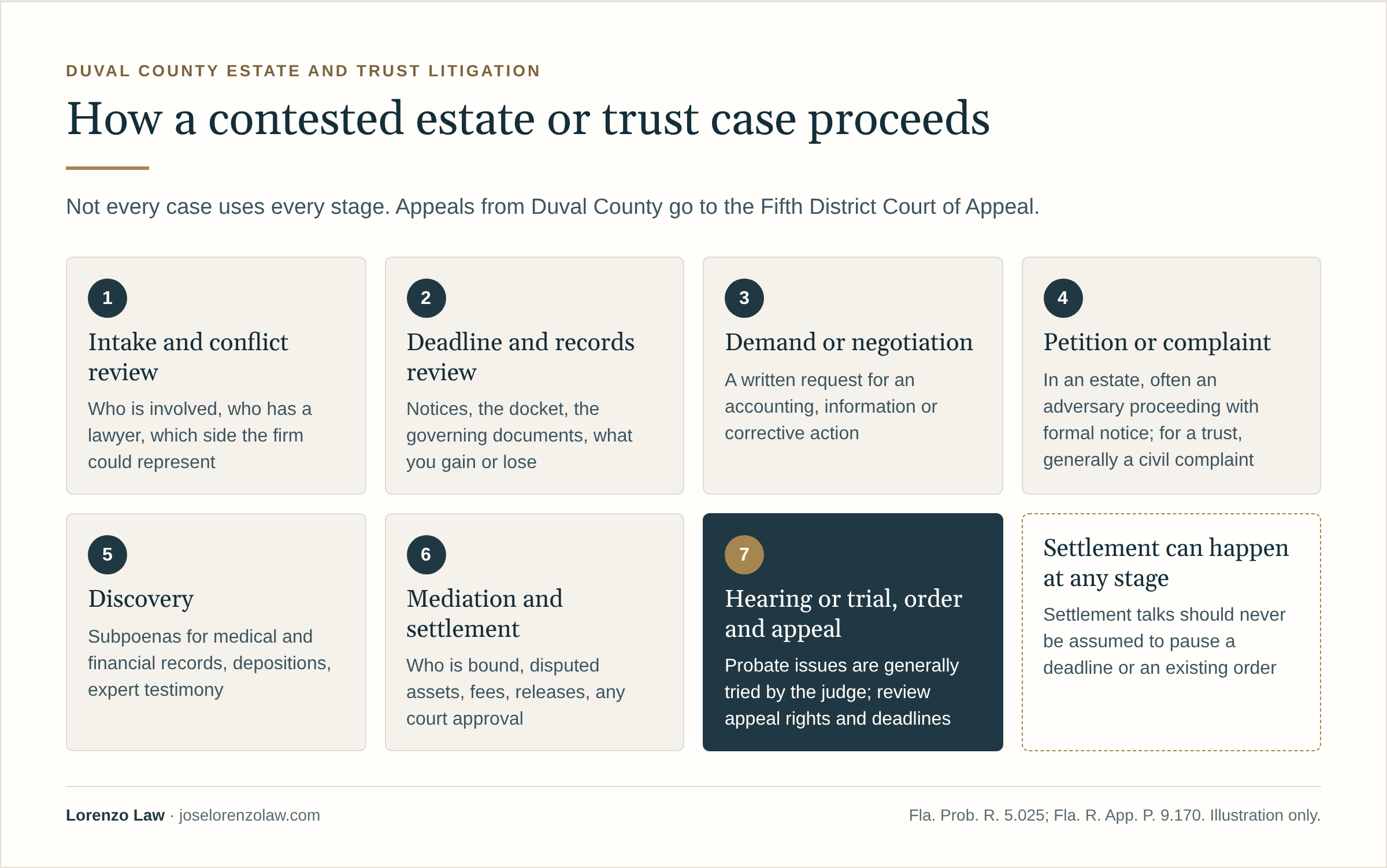
See the chart “How a contested estate or trust case proceeds” (opens the full-size image; the details are also in the text).
- Intake and conflict review. Who is involved, who already has a lawyer, and which side the firm could represent.
- Deadline and records review. The notices, the docket, the governing documents, and what you would gain or lose if the challenged document or act failed.
- Demand or negotiation. A written request for an accounting, information or corrective action can resolve some disputes or narrow them.
- Petition or complaint. Contesting a will in probate court follows the same steps to contest a will as other contested matters. In an estate, many contested matters are adversary proceedings under Florida Probate Rule 5.025, such as removing or surcharging a personal representative, revoking probate, construing a will or determining beneficiaries; they require formal notice, and the civil rules apply as the rule specifies (Florida Probate Rule 5.025). A separate trust claim is generally a civil complaint.
- Discovery. Subpoenas for medical, bank and brokerage records, the drafting lawyer’s file, depositions of witnesses, and expert testimony where capacity, handwriting or tracing is in issue.
- Mediation and settlement. A settlement should address who is bound, what happens to disputed assets, fees, releases and any required court approval.
- Hearing or trial, order and appeal. Contested issues are decided after motions, an evidentiary hearing or a trial. Many probate orders that finally determine a right can be appealed while the estate is still open, and the time to appeal is short (Florida Rule of Appellate Procedure 9.170). From Duval, that appeal goes to the Fifth District Court of Appeal. People sometimes call this appealing a will; what is appealed is the court’s order.
If you are asking how to contest a will in Florida, this is the process to contest a will, applied to your document and deadline. Settlement discussions should never be assumed to pause a deadline or an existing order. And an ordinary administration, a will contest and a trust complaint are not interchangeable filings, even when they involve the same family and the same assets. How do I contest a will without a lawyer, and do I need a lawyer to go to probate court at all? You can contest a will without a lawyer if you are acting only for your own individual interest, and the deadlines, evidence rules and procedure are the same either way. A personal representative, however, must be represented by a Florida lawyer unless the personal representative is the sole interested person or is a member of The Florida Bar (Florida Probate Rule 5.030). Contesting a will without an attorney is possible, but the procedure is unforgiving. Estate litigation lawyers on both sides follow the same rules. A letter expressing disagreement is not automatically the required pleading. Before hiring an estate litigation attorney, Jacksonville families can ask how each step applies to their case.
Is there a jury in a Florida will contest?
Generally, no. Probate issues are tried by the judge without a jury (Goggin v. Shanley, 81 So. 2d 728 (Fla. 1955)), so the evidence in a will contest is presented to the probate judge. A claim for tortious interference with an expected inheritance is different: it is a civil action that can carry a right to a jury (Mulvey v. Stephens, 250 So. 3d 106 (Fla. 4th DCA 2018)), subject to the rule that an adequate probate remedy generally must be used first. Which vehicle to use is a strategic choice that depends on the facts and the deadlines.
What does probate litigation cost, and who pays?
Short answer. It depends on the scope, from a single objection to multi-party litigation over several documents and transfers. Lorenzo Law publishes no litigation price, because a responsible estimate needs the documents and the court history. Hourly, flat-fee, contingency or hybrid arrangements may be considered depending on the facts and the matter, and every arrangement is set out in a written agreement. Who pays at the end is a separate question that the court can affect.
The cost of probate litigation is driven by scope. A flat fee may fit a discrete task; it is not a promise to handle an entire dispute for an administration price. Contingency or hybrid terms are considered only in appropriate litigation matters. Costs may remain payable without a recovery, and the noncontingent component of a hybrid arrangement is owed as agreed regardless of outcome. Hourly rates vary with the complexity of the case, and every arrangement is discussed in detail before it is signed. The written agreement defines the scope, the fees, any retainer or cost deposit, and the treatment of costs. Court filing fees, service, depositions, experts, and document work may add costs. The ordinary administration compensation provisions in § 733.6171 do not establish Lorenzo Law’s litigation price.
How much does probate litigation cost, and how much does a probate litigation attorney cost? How much does it cost to sue an estate, or to defend one? What usually drives the cost:
- how many medical and financial records must be obtained and reviewed;
- whether the dispute involves the will, a trust, lifetime transfers, or all three;
- whether fees, an accounting or a spouse’s election are also in dispute;
- how many parties must be served, and how many live outside Florida;
- whether the estate holds a house with association arrears, rental property or a closely held business, and whether the valuation of an asset is disputed;
- whether a forensic accountant, a handwriting examiner or a medical expert is needed; and
- whether the personal representative or trustee is also a beneficiary, which can fuse two disputes into one.
How much does it cost to contest a will in Florida? The cost of contesting a will in Florida, the cost of challenging a will and estate litigation cost in general follow the same drivers. How much does it normally cost to contest a will, and how expensive is it to contest a trust? People often ask how much it normally costs to contest a will, or how expensive trust litigation is. No single figure would be honest, because these drivers can make two disputes over similar estates cost very different amounts; in the initial consultation, Jose can discuss the likely scope, and any fee arrangement is put in writing before work begins. Whether it is worth contesting a will in Florida comes down to the same comparison: what you would receive if the challenge succeeded, against the cost, the time and the risk of paying fees.
Do you have to pay to contest a will? Yes: court costs and your own lawyer’s fees under the written agreement, unless a court later shifts fees. How much should I expect to pay a probate lawyer for a contested matter? The administration schedule does not set the price of contested work; fees and costs are set in a separate written agreement. Before hiring a probate litigation lawyer, Jacksonville families should ask two separate questions: who pays attorneys’ fees and costs along the way, and whether a court may later shift fees, which is often called fee-shifting. Who pays probate attorney fees in Florida? Whether the estate pays depends on whose lawyer is being paid and what the work accomplished: the personal representative’s attorney is entitled to reasonable compensation payable from the estate (§ 733.6171); a person nominated as personal representative, or any proponent of the will if the nominee does not act within a reasonable time, who was in good faith justified in offering the will in due form for probate receives costs and attorney’s fees from the estate even though probate is denied or revoked (§ 733.106(2)); and an attorney who has rendered services to the estate may be awarded reasonable compensation from it (§ 733.106(3)). Otherwise, each side generally pays its own lawyer unless the court shifts fees.
- In an estate, the court can award costs and fees and direct from which part of the estate they are paid, including assessing them against a party’s share in appropriate cases, even without a finding of bad faith (§ 733.106).
- In trust breach and trustee-power cases, costs including attorney’s fees are awarded as in chancery actions and may be directed against a party’s interest in the trust (§ 736.1004).
- A court can sanction claims or defenses that are not supported by the facts or the law, often called frivolous claims (§ 57.105).
Do not assume that the estate, the trust or the other side will pay your bill, or that winning makes the dispute economical.
How long does probate litigation take?
There is no honest one-number answer. A discrete objection to an accounting or a fee can be resolved much faster than a contest over a will, two trust amendments and a deed. What moves the timeline is the number of parties and records, whether a presumption or a statutory deadline narrows the issues, the assigned division’s hearing calendar, whether the parties mediate, and whether anyone appeals. After reviewing the documents and the docket, Jose can explain which of those factors apply, without predicting an outcome. So if a will is contested, how long does it take? As long as those factors require. No fixed completion period or expedited hearing is promised.
What should you bring to a consultation?
Short answer. You do not need a complete file to ask for help. Start with the papers that may require action, then organize the records you lawfully possess. Bring a one-paragraph summary: your relationship to the decedent or the trust, the act or document you dispute, what you want to protect or change, and any date you know about. Do not wait to collect everything before calling a contested probate attorney about an approaching deadline. If a case is already open in the Duval County, Florida probate court, bring the case number and any Duval County probate records you already have.
| Gather what you already have | Examples | Why it helps |
|---|---|---|
| People and roles | The decedent or settlor, the personal representative, the trustee, the beneficiaries, opposing parties and any lawyers already involved | Lets the firm check conflicts and identify the capacity in which you need advice |
| Case and notices | County, case number, division (PR-A or PR-B), docket, letters of administration, orders, every paper served on you, envelopes, delivery confirmations and filed waivers | Identifies the proceeding and possible deadlines; an envelope alone does not establish every legal service date |
| Governing documents | Complete wills, codicils, trusts, amendments and restatements, marital agreements, deeds and powers of attorney, including every earlier version | Shows the disputed change, the governing terms and what you would receive if a document failed |
| Money and property | Inventories, accountings, bank and brokerage statements (including any digital assets or cryptocurrency accounts), sale documents, invoices, distributions and property records | Locates disputed transactions, gaps and claimed losses |
| Timeline and witnesses | Dates of signing, changes, death, requests for information and responses; the names of caregivers, doctors and the drafting lawyer | Separates what you saw from what you assume, and connects events to the signing or the administration |
| Your objective and prior agreements | The information or result you want, any immediate risk, and any settlement, release, consent or payment you have already accepted | Shows what relief to pursue and what may already have been given up |
Preserve original documents and complete messages, including attachments. Gather only records you lawfully have or can obtain through authorized means, and do not access another person’s accounts without authority. Ask the firm how to transmit sensitive records after the initial conflict check; avoid putting full account numbers, medical records, or a complete estate file into a general contact form. Use this checklist as a starting point before you meet any lawyer for estate disputes or any probate litigation attorney. Jacksonville matters also need the case number and the division letter, if you know them. If you live outside Florida, include your city and state or country and the times you can talk. The contact form is not a substitute for filing a response with the court.
Common questions about Jacksonville probate and trust disputes
How hard is it to contest a will in Florida?
It depends on the evidence, not the unfairness of the result. The proponent first has to make a prima facie showing that the will was properly signed and witnessed; the person contesting it then has to prove a ground such as lack of capacity or undue influence. Capacity is presumed, unless the testator had already been adjudicated incapacitated, in which case the proponent must show the will was signed during a lucid interval. Otherwise, the burden of proof shifts only when the facts raise the presumption of undue influence. No one can responsibly predict the outcome before reviewing the documents, the medical records and the witnesses, and Florida Bar rules prohibit promises about results. What can be assessed early is whether there is a recognized ground, whether you have standing, and whether a deadline has already run. How hard is it to win a contested will? Successful will contests are built on records made close to the signing date, not on family testimony alone.
Can you contest a will after probate is opened or closed?
After a will is admitted, an interested person may petition to revoke probate before the personal representative’s final discharge, unless the challenge is already barred by the three-month objection period after service of the notice of administration or by formal notice served before letters issued (§ 733.109; § 733.212; § 733.2123). Once the personal representative has been discharged, which usually happens when the estate is closed, that route is no longer available under § 733.109, and any remaining option depends on the specific facts. So, can a will be overturned after probate? Overturning a will after probate has been opened remains possible on a proved ground and within those limits; after discharge, the statutory route is gone, so act quickly when you learn that a will you question has been admitted. After a will is probated, can it be contested? Yes, within those limits; contesting a will after probate is usually done by a petition to revoke probate in the same case. After probate, can a will be contested once the estate is closed? Generally not by that route, so challenging a will after probate has ended depends on narrow facts, and contesting probate early matters. A closed estate can be reopened for limited purposes, such as administering property discovered later, but reopening is not a substitute for a timely will contest (§ 733.903).
What if I was left out of my parent’s will?
Being disinherited or unfairly left out of a will is not itself a ground to set it aside, but it is often the first sign that something needs a closer look. Check whether you would inherit under an earlier will or as an heir if the new will failed, because that is what gives you standing; whether the will you were cut out of has been admitted and when you were served; and whether the assets actually pass under the will or through a trust, deed or beneficiary designation. A child born or adopted after the will was signed may have a separate claim as a pretermitted child (§ 732.302). Bring every version of the documents you can lawfully obtain when you first consult a lawyer for inheritance dispute matters. Can you contest an inheritance? Not the inheritance itself; you contest the will, trust, deed or designation that created it.
Comparing Jacksonville probate litigation attorneys? What should you ask?
Whether you are comparing Jacksonville probate litigation lawyers, estate litigators, estate dispute lawyers, probate dispute lawyers or trust litigation attorneys in Duval County, how to find a good estate litigation lawyer comes down to asking who will actually handle the matter, how fees and costs will be set and put in writing, whether the lawyer represents only one side and how conflicts are checked, how often you will hear about the case, and what the lawyer needs to see before giving an assessment. If you are asking, “Can you recommend a probate litigation attorney in Jacksonville?”, start by confirming any Florida lawyer’s admission and status in The Florida Bar’s member directory. Lorenzo Law is a solo practice: the attorney you speak with at the first call is the attorney who handles any matter the firm accepts. Lorenzo Law does not have a Jacksonville office; ask any lawyer you consider where meetings and hearings will actually happen.
Can a beneficiary sue a trustee in Florida?
Yes. A beneficiary can bring a breach-of-trust action against a trustee who fails to administer the trust according to its terms and the Florida Trust Code, for example by self-dealing, failing to account, refusing proper distributions or mismanaging property. So can a trustee be sued for mismanagement? Yes, mismanagement is one of the breaches a beneficiary can sue over. The court’s remedies include compelling performance, ordering an accounting, surcharging the trustee for losses, suspending or removing the trustee and tracing property (§ 736.1001). Watch the limitation rules in § 736.1008: a claim about a matter that was adequately disclosed in a trust accounting with a limitation notice can be barred if not brought within six months after the later receipt of the accounting or the limitation notice. Other breach-of-trust claims generally fall under chapter 95 and the further limits in § 736.1008, so how long do you have to sue a trustee? It depends on what was disclosed and when. Is it hard to sue a trust? The hard parts are usually evidence and timing, not the form of the claim. A trust is not usually sued as if it were a person; the claim is brought against the trustee, often in the trustee’s fiduciary capacity and sometimes individually as well. Bring the trust, every accounting and your written requests to your first meeting with a trust litigation attorney. Jacksonville beneficiaries can meet Jose by phone or video.
What is the 10-day rule for a will in Florida?
The rule, sometimes called the 10-day rule for probate, is the custodian’s duty to deposit the original will with the clerk of the court having venue of the estate (for a Florida resident, generally the county where the decedent was domiciled) within 10 days after receiving information that the testator has died (§ 732.901). It is not a deadline to contest the will. A custodian who fails without just or reasonable cause can be ordered to pay costs, damages and a reasonable attorney’s fee, and the court can compel production. Depositing the original will does not by itself request administration or file a will contest. The Duval County Clerk of Court probate page describes deposit within ten days after death; the statute measures the ten days from when the custodian receives information of the death. Tell counsel who holds the original and what has already been deposited or filed. So what is the 10-day rule for probate in Florida? A deposit duty, not a contest deadline.
Which judicial circuit covers Jacksonville, and where do appeals go?
Jacksonville and the rest of Duval County are in the Fourth Judicial Circuit. Florida divides its trial courts into 20 judicial circuits, and the Fourth (often written 4th Judicial Circuit) also serves Clay and Nassau Counties. Probate and guardianship matters in Duval are assigned to the PR-A and PR-B divisions. Since January 1, 2023, appeals from the Fourth Judicial Circuit go to the Fifth District Court of Appeal, which also hears appeals from St. Johns County’s Seventh Judicial Circuit. Before that date, Duval appeals went to the First District Court of Appeal, so older Jacksonville probate decisions carry a First District citation. A Jacksonville probate litigation lawyer therefore works with the Duval divisions’ procedures and with Florida appellate decisions, including the Fifth District’s.
Does a probate litigation attorney work on contingency?
Sometimes. A probate litigation attorney contingency fee is never automatic. At Lorenzo Law, hourly, flat-fee, contingency or hybrid arrangements may be considered depending on the facts and the matter; contingency or hybrid terms are considered only in appropriate litigation matters, costs may remain payable without a recovery, and the noncontingent part of a hybrid arrangement is owed as agreed regardless of outcome. Every arrangement is discussed in detail and set out in a written agreement. Probate litigation contingency terms, when offered, also say how costs are handled.
Can a probate dispute be settled in mediation?
Yes. Mediation, a negotiation led by a neutral mediator, is a common form of probate dispute resolution. Duval County probate disputes can be mediated, and the court can refer a contested matter to mediation on its own motion or at a party’s request. A useful settlement should say who is bound, what happens to each disputed asset, who pays fees and costs, what releases are given and whether court approval is needed. Taking part in mediation should never be assumed to pause a deadline or an existing order.
What happens if you win a will contest?
If a will is set aside, the estate may pass under an earlier will if that will remains effective, or otherwise under Florida’s intestacy rules, and a personal representative appointed under the invalid will may be replaced (§ 733.504(10)). When only part of a will was procured by fraud, duress, mistake or undue influence, only that part is void, so the rest of the will can still control. Winning does not automatically recover property already transferred by deed, trust or beneficiary designation, does not by itself make the other side pay your fees, and does not mean a disputed asset can be collected. That is why the review looks at every asset and how it passed before a contest is filed.
Do you need to live in Florida to bring or defend a claim?
No. Many people involved in Jacksonville estates live out of state or abroad, including military families who were stationed in Northeast Florida and later moved, and need a Florida inheritance lawyer they can consult by phone or video. Lorenzo Law represents clients in Florida matters, and consultations are available by phone or video, in English and Spanish. Whether a hearing or other event can be attended remotely depends on the court, the event and the current division instructions. Where you live can also affect personal jurisdiction: a claim that seeks to hold someone personally liable, such as a surcharge against a personal representative or trustee, requires proper service on that person individually, by formal notice in an adversary proceeding or by service of process, before the court can enter relief against him or her personally. Include your city and state or country, the case number if there is one, and any notice you received when you first make contact.
Talk to a Jacksonville probate litigation attorney
Short answer. Briefly explain your role, the county and case number if known, the disputed document or conduct, and any notice or hearing date that needs attention. As a trust and estate litigation attorney, Jose M. Lorenzo, Jr. represents beneficiaries, heirs, surviving spouses, personal representatives and trustees in contested Florida estates and trusts, including Duval County matters.
Jose M. Lorenzo, Jr. is Lorenzo Law’s sole attorney (Florida Bar No. 107002), admitted to The Florida Bar in 2013, and before his admission he worked for roughly a decade as a paralegal on probate and litigation matters. His practice covers estate planning, probate and trust administration, guardianship, and disputes over estates, trusts, guardianships and deeds. Lorenzo Law is a solo practice: the attorney you speak with at the first call is the attorney who handles any matter the firm accepts. As a Florida probate attorney, Jose also handles uncontested administration.
The principal office is in Kissimmee. Meetings in Coral Gables and Fort Lauderdale are by appointment, and consultations are available statewide by phone or video, in English and Spanish. Lorenzo Law has no Jacksonville office; Jose represents clients in Florida matters, including estates of people who lived in Jacksonville neighborhoods such as Riverside, San Marco, Mandarin, Arlington and the Southside, in Jacksonville Beach, Atlantic Beach and Neptune Beach, and elsewhere in Duval County, and their relatives who live elsewhere. Where someone lives does not decide venue; see whether the case belongs in Duval County. The initial conversation can identify the issue and possible next steps; a full investigation, acceptance of the matter, and representation are separate.
Request a free initial consultation. Only the initial consultation is free; representation fees and costs are agreed separately in writing. Representation requires a conflict review, acceptance and an engagement agreement.
Request a free initial consultationCall (305) 224-6811
Planning, administration and litigation each serve a different need; if what you need is help settling an uncontested estate, the kind of work many people mean by a Jacksonville estate issues lawyer, start with administration. For related services, explore Jacksonville probate administration, Florida estate planning, Florida probate litigation attorney and contested guardianship representation.
This page provides general information about Florida law, not legal advice about a particular estate or trust. Reading it or requesting a consultation does not create an attorney-client relationship, and contacting the firm does not file a response or pause a deadline, so identify any urgent date in your first message or call.
Sources and authorities cited
Statutes cited are the 2026 Florida Statutes; rules are from the Florida probate rules 2026 compilation, effective October 1, 2026. The text of the law controls over any summary on this page.