
Types of Deeds in Florida: Warranty, Quitclaim, Lady Bird and More
The main types of deeds in Florida differ in three ways: how much the seller promises about the title, the purpose of the transfer, and who is signing. A general warranty deed promises the most, a special warranty deed promises less, and a quitclaim deed promises nothing about the title. Life estate and Lady Bird deeds plan for death, and personal representative’s, trustee’s and guardian’s deeds are signed by someone acting for an estate, a trust or a ward.
This guide compares the Florida deed types you are most likely to meet: what each promises, who signs it, its effect on homestead, the mortgage and doc stamps, how to read the deed you have, and which deed fits your situation. Jose M. Lorenzo, Jr. prepares Florida deeds and reviews deed problems statewide.
Free initial consultation, in English or Spanish, by phone or video. Please do not send full account numbers, identification or confidential documents through the public form.
Request a free initial consultationCall (305) 224-6811
Go straight to: Which deed do I need? (2-question chooser) · Deed types at a glance · Homestead · Cost
Warranty deeds · Quitclaim deeds · Lady Bird deeds · Personal representative’s deeds · Homestead · Doc stamps · All 67 Florida counties
| Three warranty levels | General warranty deed (Florida’s statutory form is a general warranty deed): the seller guarantees the title against everyone. Special warranty deed: the seller guarantees only against title claims arising through the seller, not defects from earlier owners. Quitclaim deed: no guarantee at all; it transfers whatever interest the signer has, if any. |
|---|---|
| Deeds named for their purpose | A life estate deed gives someone the property for life, with a remainder to others. An enhanced life estate (Lady Bird) deed lets the owner keep full control during life and pass the property at death without probate for that property. |
| Deeds named for the signer | Personal representative’s, trustee’s and guardian’s deeds are signed by someone acting for an estate, a trust or a ward. The name tells you who signed and in what role, not how much the deed promises. |
| Conveyances from a court or the county | A certificate of title after a foreclosure sale and a tax deed after a tax-deed sale are issued through a court or county process rather than signed by the owner. |
| What a deed does not do | Changing the deed does not change who owes the mortgage, does not by itself avoid probate, and does not prove the title is clean. Homestead, a spouse’s signature, documentary stamp tax and Save Our Homes need their own review. |
| Cost with Lorenzo Law | Standard quitclaim deed $575; standard Lady Bird deed $675; signing, recording and the minimum documentary stamp included in both. The free initial consultation confirms which deed fits and the scope of the work. |
What type of deed do I need? Match the ownership change to the deed
Start with who owns the property now and who should own it afterward. Then review the current deed, the mortgage, homestead status and the authority of everyone who must sign. In short: selling to a buyer usually calls for a warranty deed; an agreed transfer within a family often uses a quitclaim or warranty deed after review; planning for death points to a Lady Bird deed, survivorship ownership or a trust; and when an owner has died, the estate’s authority comes before any deed.
Florida deed chooser: explore deeds for your situation
Two questions · general information
Choose the situation closest to yours. Each result links to the explanation on this page and lists what to review before signing or at a consultation.
General information about Florida deeds, not legal advice for your property. The right deed depends on the recorded title, the mortgage, homestead and who has authority to sign. No personal information is collected; the site may record an anonymous count of which result is shown. Using this tool does not create an attorney-client relationship.
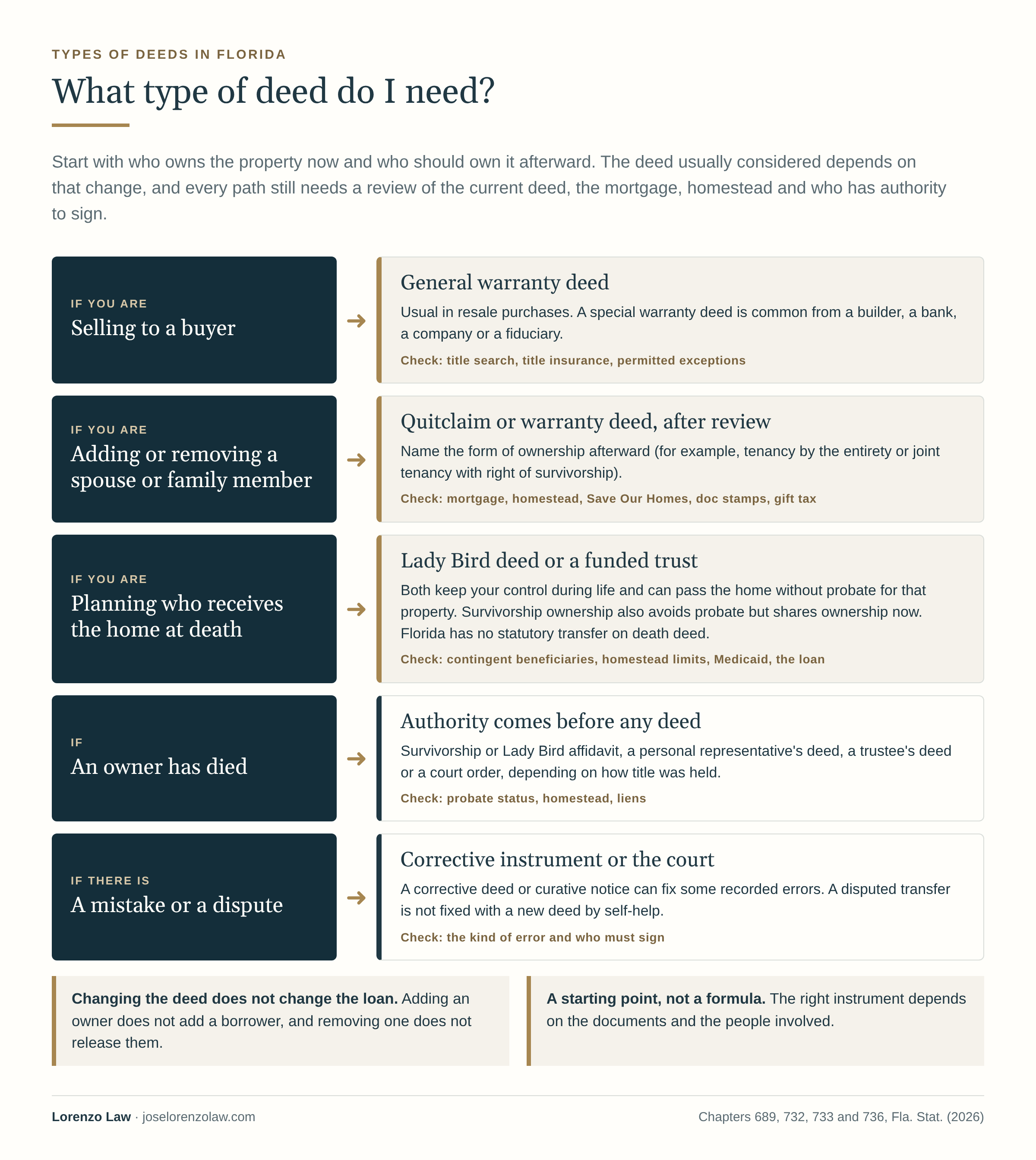
See the chart “What type of deed do I need?” (open to enlarge; the details are also in the text).
| Ownership now → afterward | Deed usually considered | Review needed | Separate debt question | Next step |
|---|---|---|---|---|
| One owner → that owner plus a spouse or adult child | Quitclaim or warranty deed naming both, with the intended form of ownership | Consent, shares, survivorship, homestead, Save Our Homes, gift tax and future control | Adding an owner does not add or release a borrower | Current-deed review for an agreed transfer |
| Two owners → one owner (for example, after a divorce) | Quitclaim from the departing owner | The interest conveyed, required signatures, the settlement or judgment | The departing owner may stay liable on the note | Coordinate the deed with a lender release or refinance |
| Parent owns alone → child owns now | Quitclaim or warranty deed as a gift | Gift versus inheritance, retained rights, basis, Medicaid, homestead | The mortgage and due-on-sale rules still matter | Compare a present gift with a Lady Bird deed or trust |
| Owner keeps control now → beneficiaries receive at death | Lady Bird (enhanced life estate) deed | Deed language, contingent beneficiaries, homestead, alternatives | Liens remain; loan terms and tax treatment need review | Estate-planning and deed-suitability review |
| Owner holds title individually → trustee of the owner’s revocable trust | Warranty or quitclaim deed to the trustee, identifying the trust | Trust identification, trustee powers, homestead exemption | A qualifying trust transfer may have federal due-on-sale protection; loan liability stays | Review the deed and the trust together |
| Owner → the owner’s LLC | Warranty or quitclaim deed to the company | Doc stamps, homestead exemption, title insurance, the company’s authority | The lender’s consent may be needed | Tax and loan review before signing |
| Recorded owner has died → heirs or a buyer | Depends: survivorship affidavit, Lady Bird beneficiaries’ recording, PR’s deed, trustee’s deed or court order | Existing survivorship or remainder, homestead, the estate’s authority | Debts and liens do not disappear because an owner died | Probate or other succession review before any deed |
| Estate or trust owns → a purchaser | PR’s deed or trustee’s deed, often with a special warranty | Fiduciary authority, approvals, warranties | Payoff and release of liens at closing | Coordinate fiduciary, title and closing review |
| An owner disputes a recorded transfer | No new deed by self-help | Forgery, capacity, consent, competing claims and remedies | Loan enforcement may continue during the dispute | Deed-dispute review |
| The recorded deed has an error | Corrective deed or curative notice, depending on the error | Type of error, original intent, affected parties | A correction does not discharge debt | Title or corrective-document review |
This table is a starting point for review, not a deed-selection formula. The right instrument depends on the documents and the people involved.
There is no single best deed to have in Florida. The best deed for a house you are buying is usually a general warranty deed. The best deed for a seller, who would rather promise less, is a special warranty deed, but the contract and the buyer’s lender usually decide that. The best deed to pass a home at death while keeping control is often a Lady Bird deed.
A standard deed-preparation engagement fits a straightforward, agreed transfer between living people with a clean chain of title. It does not automatically include a title search, title insurance, probate, curative litigation or the resolution of an ownership dispute. Those needs should be identified before the engagement is defined. For adding or removing a name step by step, see how to add or remove a name on a Florida deed.
Adding someone to a deed: what it does, what it costs and the disadvantages
Before you add your wife or husband, a daughter or son, or anyone else to your house deed, decide when ownership should change. What does adding someone to a deed do? It gives that person ownership now. What happens when you add someone to a deed after that depends on the wording: as tenants in common, the new owner’s share passes through his or her own estate; with right of survivorship, the survivor takes the whole property. The best way to add someone to a deed depends on the goal: if it is to pass the home at death, a Lady Bird deed or a trust usually does that without giving anything away today.
The disadvantages of adding someone to a deed:
- You need the new owner’s signature to sell or mortgage the whole property later.
- The new owner’s creditors can reach his or her share, and at the new owner’s death the share passes through his or her estate unless the deed gives survivorship.
- Adding a child is a gift, which may require a federal gift-tax return.
- The child generally takes your tax basis in the gifted share instead of a stepped-up basis at your death.
- Medicaid eligibility can be affected.
How much does it cost to add someone to a deed in Florida? With Lorenzo Law, a standard quitclaim deed adding a spouse or family member is $575, including signing, recording and the minimum documentary stamp; documentary stamp tax above the minimum, such as on a mortgage balance, is separate. Those, with the gift-tax and basis points above, are the tax implications of adding someone to a deed in Florida.
Does adding someone to a deed affect homestead? The owner who lives there generally keeps the exemption, and the Save Our Homes cap can continue (see Save Our Homes), but the homestead signing rules still apply. Adding someone to a deed with a mortgage does not add that person to the loan. For the step-by-step process, see how to add or remove a name on a Florida deed.
The same applies to transferring ownership of a house to a family member outright, such as parents transferring home ownership to a son or daughter: it is a present gift, usually by quitclaim deed, with doc stamps if there is a mortgage. If the real goal is for the child to inherit, compare a Lady Bird deed first.
Removing someone from a deed
Is it hard to remove someone from a deed, or to take someone off a deed after a divorce? Not if that person agrees: he or she signs a quitclaim deed (and if the home is homestead and either owner is married, the spouse joins too), after the mortgage, homestead and tax effects are reviewed. Without that person’s signature, a co-owner cannot be removed by a new deed. The answer then is a buyout agreement, a divorce judgment that orders the transfer, or a partition action. After a co-owner’s death, survivorship ownership is cleared with a death certificate and an affidavit, as explained below.
Removing a name does not change the loan. With a VA loan, the veteran’s quitclaim does not end his or her liability or restore VA entitlement while the loan remains; that generally takes a payoff, a lender-approved assumption by a qualified buyer that releases the veteran (38 U.S.C. § 3714), or a substitution of entitlement by a qualifying veteran who assumes the loan. A quitclaim may also conflict with a home equity line’s transfer terms, and in a refinance the lender decides who must be on title, so coordinate the deed with the refinance. A quitclaim deed signed under a divorce decree should match the decree exactly; where the final judgment itself transfers the property, recording a certified copy may make a separate deed unnecessary.
Transferring property to a living trust or an LLC
Transferring a house into a trust, or any real estate into a living trust, uses a warranty or quitclaim deed to the trustee that identifies the trust by name and date. The owner usually keeps the homestead exemption, and federal law protects many such transfers from a lender’s due-on-sale clause. Transferring property to an LLC is different. The company becomes the owner, the homestead exemption generally ends, doc stamps can be due on any mortgage balance, and the lender’s consent and title insurance coverage need review first. See the living trust in Florida guide. With Lorenzo Law, a deed into your revocable trust is $575 per Florida deed, including signing, recording and the minimum documentary stamp.
Changing a deed after an owner dies
What happens to a deed when someone dies? The recorded deed stays where it is; what changes is who owns the property, and that depends on how the house was titled. So whether you are removing a deceased spouse from a deed, changing deeds on a house after a death, or transferring a parent’s house title after death, start with how the recorded deeds titled the property. A surviving joint tenant or spouse holding by the entireties usually records a death certificate with an affidavit, and Lady Bird beneficiaries do the same. A house in the deceased owner’s name alone needs probate or another court process before anyone can sign a deed, unless it was the owner’s protected homestead, which passes at death to the heirs, who can sign themselves (a title company usually wants an order determining homestead before a sale); a trustee signs for a house deeded to a trust. A power of attorney ends at death. See Florida right of survivorship and homestead property in probate.
If the owner died without a will and the house was in his or her name alone, the transfer of property after death follows Florida’s intestacy rules, which decide who inherits. If the house was not homestead, probate, or summary administration when the estate qualifies, comes before the heirs can sell it. If it was the owner’s homestead, title passed to the heirs at death, and they generally need only a court order determining homestead (Fla. Prob. R. 5.405) to give a buyer insurable title. That is how to transfer property in Florida after someone dies without a will; see Florida probate representation.
Once someone has authority, transferring ownership of inherited property is done with the instrument that matches it: a personal representative’s deed, a court order, or the beneficiaries’ own deed after a survivorship or Lady Bird affidavit is recorded. Before that, an heir’s quitclaim conveys only whatever interest the heir has, which a buyer or title insurer will rarely accept.
Types of deeds in Florida at a glance
Florida deeds sort on three levels: what the signer promises (a full, limited or no warranty), what the deed is for (a sale, a gift, a transfer at death or a correction) and who is signing (the owner, or a personal representative, trustee or guardian). One deed can fit more than one category; a trustee, for example, can sign a special warranty deed.
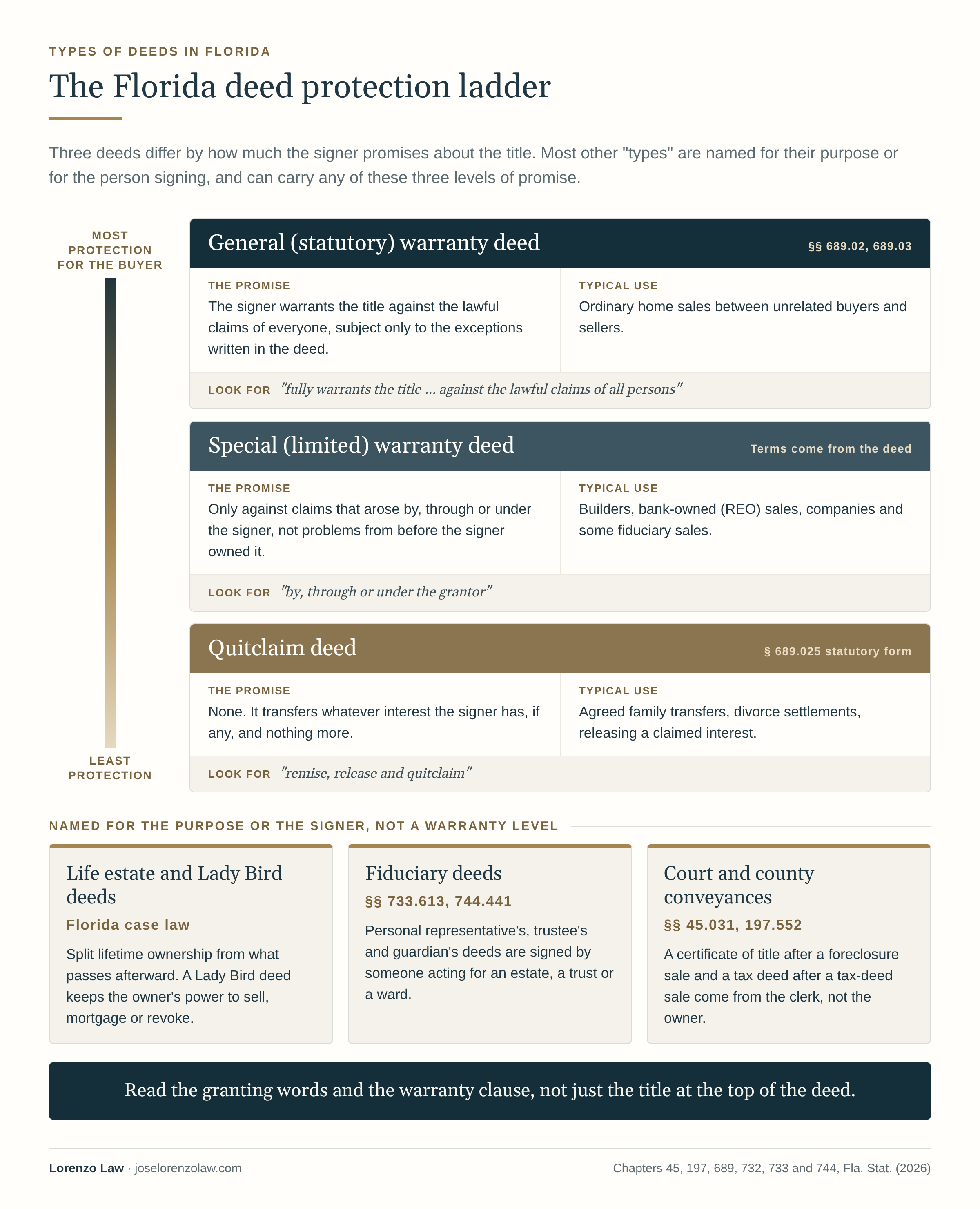
See the chart “The Florida deed protection ladder” (open to enlarge; the details are also in the text).
| Deed | What the signer promises | Typical use | Who signs | What still needs review |
|---|---|---|---|---|
| General (statutory) warranty deed | Full covenants of title against all lawful claims, subject to the exceptions written in the deed | Ordinary home sales between unrelated parties | The owner (and a spouse when homestead requires it) | Title search, permitted exceptions, the sale contract and the owner’s title insurance policy |
| Special (limited) warranty deed | Covenants only against claims arising by, through or under the signer | Builder, bank-owned (REO), commercial and some fiduciary sales | The owner, a company or a fiduciary | Defects from before the signer’s ownership; the exact warranty wording |
| Quitclaim deed | No warranty; transfers whatever interest the signer has, if any | Agreed family transfers, divorce settlements, releasing a claimed interest | The person giving up the interest | Who actually owns what, the mortgage, homestead, doc stamps |
| “Fee simple deed” (caption) | Depends on the wording inside; the caption alone settles nothing | A conveyance that uses that heading | The owner | The granting words and any warranty actually included |
| Traditional life estate deed | Any warranty level; splits a lifetime interest from the remainder | Lifetime use for one person, ownership afterward for another | The owner | Who must join a later sale or mortgage of the whole property |
| Enhanced life estate (Lady Bird) deed | Usually limited or none; reserves powers to sell, mortgage or revoke | Passing a home at death without probate for that property | The owner (and a spouse where homestead rules require it) | The retained powers, beneficiaries, homestead, the loan and tax treatment |
| Personal representative’s deed | Whatever the deed states; often limited to the representative’s own acts | Selling or distributing a house from a probate estate | The court-appointed personal representative | Letters of administration, power of sale or court order, homestead status |
| Trustee’s deed | Whatever the deed states | Selling or distributing trust property | The current trustee | The trust terms, the trustee’s appointment and powers, a certification of trust |
| Guardian’s deed | Whatever the deed states | Selling a ward’s property | The court-appointed guardian | The guardianship court’s approval of the sale |
| Corrective deed or curative notice | Follows the instrument being corrected | Fixing an error in a recorded deed | The original parties, or as the statute allows | The kind of error and whether the chosen remedy is available |
| Certificate of title | None; issued by the clerk after a judicial sale | Foreclosure sales | The clerk of court | The court file, objections and interests that survive the sale |
| Tax deed | None; issued after the county tax-deed sale | Delinquent property taxes | The clerk of court | Surviving interests and restrictions, possession, insurability |
| Deed in lieu of foreclosure | Whatever the parties negotiate | Handing the property to the lender | The borrower-owner | Whether the debt is released, any deficiency, other liens |
This table compares the instruments Florida owners most often meet. It is not an exhaustive legal classification, and the actual wording of a deed controls over its caption.
How many types of deeds are there in Florida?
If you count by warranty, there are three: general warranty, special warranty and quitclaim. Many guides describe four basic types of deeds in Florida, or five, by adding a “fee simple deed,” a life estate deed or a Lady Bird deed. Others list a dozen or more by adding the fiduciary deeds and court conveyances. Each count is a way of sorting, not a legal rule. What matters is what your deed says, who signed it and what it was meant to do.
Florida’s statutes supply forms for two of these: the statutory warranty deed (§ 689.02) and, since July 1, 2023, a statutory quitclaim deed (§ 689.025). The special warranty deed has no statutory form; its terms come from the deed itself and Florida case law.
Deed terms in brief: strongest, weakest and court-ordered deeds
Real estate courses, closing documents and county indexes use shorthand. In plain English:
- What distinguishes one type of deed from another
- Three things: what the signer promises about the title, what the deed is for, and who is signing.
- The strongest deed
- The general warranty deed, the deed that offers the most protection: it provides the covenant of quiet enjoyment and promises to defend the title against everyone.
- The weakest form of deed
- The quitclaim deed: the type of deed that contains no warranties, so it gives the grantee the least protection. A “deed without warranty” also makes no promise.
- The deed that warrants only the grantor’s own acts
- The special warranty deed, which covers only claims arising by, through or under the seller.
- The deed used after a foreclosure sale
- In Florida, a certificate of title issued by the clerk after the judicial sale, not a deed signed by the owner (see certificate of title).
- Court-ordered deeds
- Conveyances that exist because of a court process: a certificate of title after a foreclosure sale, a sheriff’s deed after an execution sale, a guardian’s deed signed with court approval, and a personal representative’s deed when the will gives no power of sale and the court authorizes or confirms the sale.
- WD, SWD, QCD
- Common index codes for a warranty deed, a special warranty deed and a quitclaim deed; each county keeps its own list.
- What a Florida deed is taxed on
- In Florida, the deed of the property is taxed based upon the consideration for the transfer, which can include a mortgage balance, not the assessed value (see documentary stamp tax).
- What does not have to be in a deed
- The grantee’s signature and the actual sale price. Most deeds recite only nominal consideration, such as “$10 and other good and valuable consideration,” and the doc stamp notation reflects the tax paid.
Deed vs title in Florida: who holds the deed to your house
A deed is the signed document that transfers an interest in real property from the grantor (the person transferring) to the grantee (the person receiving); title is the ownership itself. Florida does not issue a certificate of title for a house the way it does for a car. Ownership is shown by the chain of deeds recorded in the Official Records of the county where the property is located.
Who holds the deed? You do. After recording, the original goes to the person on the “return to” line, often the buyer, the closing agent or the lawyer who prepared it; the lender does not keep it. A certified copy from the county Official Records works for almost every purpose (see where to find a copy of your deed).
The latest recorded deed is the starting point, not a guarantee against mortgages, liens, competing claims or older defects, and the property appraiser’s owner listing is not a title search.
Can someone be on the title but not the deed? In everyday use, being “on the title” means being named as an owner in the recorded deed. A spouse who is not named is not a record owner, but may still have homestead rights that require his or her signature on a later deed and, in a divorce, a marital interest in the home that the court can divide (§ 61.075) (see a spouse’s signature).
So are a deed and title the same thing? No. In real estate, deed vs title is document vs ownership. Is a deed more important than a title? Neither outranks the other. A recorded deed, even a warranty deed, is strong evidence that ownership passed (Florida law presumes a recorded deed was delivered), but it does not prove ownership of a clean title by itself; a title search and an owner’s title insurance policy answer that.
Florida uses mortgages, not deeds of trust
Florida treats a mortgage as a lien on the property, not as a transfer of title to the lender (§ 697.02). You keep title; the lender records a mortgage against it and, when the loan is paid, records a satisfaction. That is why Florida transactions use mortgages rather than the “deed of trust” common in states such as California and Texas. Paying off the mortgage concerns the lien; changing the deed concerns ownership.
Deed names you may see from other states
A grant deed, bargain and sale deed, deed of trust or beneficiary deed form written for another state does not become a Florida deed because its caption sounds familiar. The words “granted, bargained and sold” appear inside Florida’s own statutory warranty form, but an out-of-state form can omit Florida’s witness and homestead requirements. Other instruments that turn up in searches belong to other states as well: a “deed to secure debt” is Georgia’s security instrument, and a “warranty deed with vendor’s lien” is a Texas form. Have the Florida conveyance prepared for Florida land.
Some names describe a purpose rather than a separate kind of deed. Florida has no special “gift deed” or “interspousal transfer deed”; a gift or a transfer between spouses uses an ordinary warranty or quitclaim deed. An agreement for deed is not a deed at all: it is an installment contract, and the buyer receives a deed only after paying in full. Florida treats it as a mortgage, so if the buyer defaults, the seller must foreclose in court and cannot simply declare a forfeiture and retake the property (§ 697.01).
What is a warranty deed in Florida?
A warranty deed transfers the property and adds promises about the title. In Florida, the standard is the statutory warranty deed, a short form set out in § 689.02. Under § 689.03, a deed in substantially that form carries the full common-law covenants of title, even though they are not written out. It is the deed most Florida home buyers receive.
A warranty deed transfers real estate and promises that the title is good; that is the warranty deed definition in one line. Why would someone use a warranty deed? A buyer paying full value wants that promise, which is why a warranty deed in real estate sales is the norm and the standard Florida purchase contract generally calls for one. A warranty deed on a house can also be a gift: a general warranty gift deed from a parent to a child is valid, though most gifts use a quitclaim deed.
General warranty deed and the covenants of title
A general warranty deed promises, in substance, that the seller:
- owns the property (covenant of seisin);
- has the right to convey it;
- conveys it free of encumbrances other than those the deed lists as exceptions;
- will protect the buyer’s quiet enjoyment against a superior claim; and
- will warrant and defend the title against the lawful claims of all persons.
Many textbooks list six covenants of a general warranty deed by adding a sixth, the covenant of further assurances: a promise to sign any further documents needed to perfect the title. Florida courts list five; further assurances is not among them.
Read the exceptions. A warranty deed subject to a mortgage, for example, lists that mortgage as an exception, so the promise does not cover it. A deed is usually given “subject to” taxes for the current year, recorded easements, restrictions and similar matters. Anything listed there is outside the warranty. A warranty against “all persons” is the broadest promise a Florida deed can make, which is why buyers in ordinary sales expect it.
Statutory warranty deed vs general warranty deed
Statutory warranty deed meaning: in Florida, a statutory warranty deed and a general warranty deed usually give the same protection. The statutory version is the short form in § 689.02, with the words “has granted, bargained and sold” and “does hereby fully warrant the title,” and § 689.03 reads the full general-warranty covenants into it. A longer general warranty deed simply writes them out. The difference is drafting length, not the strength of the promise, unless the longer deed adds or removes something. Section 689.02(2) requires the form to include a blank space for the parcel identification number (the folio number in Miami-Dade), filled in if available before recording; leaving it out or entering a wrong number does not affect validity or recordability, and it cannot substitute for the legal description.
Special (limited) warranty deed
Special warranty deed meaning: a special warranty deed, also called a limited warranty deed, limits the seller’s promise to claims arising by, through or under the seller. In effect: “I did nothing to cloud this title while I owned it,” with no promise about earlier owners. It does not necessarily convey less ownership than a general warranty deed; the difference is in the promise.
Special warranty deeds are common when the seller never lived in or used the property: a builder, a bank selling a foreclosed home, a company or, sometimes, a fiduciary selling for an estate or trust. Because no statute prescribes a form, the wording varies, and the actual language controls. A company usually signs through an authorized officer, often on a form captioned “corporate warranty deed,” which can carry either a general or a special warranty.
Is a special warranty deed a red flag?
Not by itself. It is normal in bank-owned, new-construction and commercial sales. In a resale between individuals it is less usual, and a buyer may fairly ask why the seller will not give a general warranty. Either way, the practical protection comes from the title search and the owner’s title insurance policy.
The disadvantages of a special warranty deed fall on the buyer. If a defect arose before the seller owned the property, such as an unreleased mortgage two owners back, the buyer has no warranty claim against the seller, unless the deed separately promises more; the practical protection is an owner’s title insurance policy, apart from any claim for fraud or under the purchase contract. After a foreclosure, the bank or investor almost always resells by special warranty deed, so special warranty title insurance coverage (the owner’s policy issued with that deed) matters most in a foreclosure purchase.
A warranty is not title insurance
A warranty is a promise by the seller. Enforcing it means suing the seller, and it is only as good as the seller’s ability to pay. The time limit is generally five years, because a deed is a written instrument (§ 95.11(2)(b)). The promises about the title as it stands at closing are broken, if at all, when the deed is delivered; the promise to defend the title is broken later, when a superior claim actually disturbs the buyer. An owner’s title insurance policy is a contract with an insurer, with its own terms, exclusions and exceptions, which is why Florida buyers rely on it even with a warranty deed. The lender’s policy issued at a financed closing protects only the lender. Do not infer insurability, coverage or marketable title from the name on a deed.
Warranty deed vs quitclaim deed in Florida
A warranty deed transfers the property and guarantees the title. A quitclaim deed transfers only whatever interest the signer has, if any, and guarantees nothing. Neither one removes anyone from a mortgage, and neither one, by its name alone, decides whether the property will go through probate.
Is a warranty deed better than a quitclaim deed? For a buyer, yes. Is a quitclaim deed the same as a warranty deed? No: both are ways of conveying real estate, but only the warranty deed adds promises. A quitclaim and a “deed without warranty” are both non-warranty deeds, and either can be used for a deed without consideration, such as a gift.
| Question | Warranty deed | Quitclaim deed |
|---|---|---|
| What it promises | That the signer owns the property and will defend the title (general) or will defend it against the signer’s own acts (special) | Nothing; it releases whatever interest the signer has |
| Typical use | Sales to buyers, including most residential closings | Agreed transfers among people who already know the title: spouses, family members, divorce settlements, releasing a claimed interest |
| If the signer owns nothing | The buyer may have a claim against the signer under the covenants | Nothing passes, and there is no warranty claim |
| Florida form | Statutory short form, § 689.02 | Statutory form since 2023, § 689.025 |
| Mortgage, homestead, taxes | Same rules apply | Same rules apply |
Quitclaim deeds in brief
A quitclaim deed transfers whatever interest the signer has within the deed’s terms. If the signer owns the whole property, the whole interest passes; if the signer owns a share, only that share passes; if the signer owns nothing, nothing passes. A quitclaim cannot transfer someone else’s share. A quitclaim also does not pass title the signer acquires later. Lack of a warranty does not erase claims based on fraud, a contract or other wrongdoing.
Florida’s statutory quitclaim form (§ 689.025) calls for a legal description and a space for the parcel identification number, which does not replace the description; the statute addresses the effect of leaving the number out. A quitclaim is not automatically right for every trust transfer, inheritance or name change, and it does not remove anyone from a loan. The Florida quitclaim deed guide covers requirements, cost and filing, and the Lady Bird deed vs quitclaim deed comparison explains when each fits a family.
Common questions about a quitclaim deed in Florida:
- How long is a quitclaim deed good for?
- It does not expire. It takes effect when it is delivered to and accepted by the grantee, and recording protects it against later buyers and creditors.
- Is a quitclaim deed reversible?
- Not by the person who signed it. Once it is delivered, getting the property back takes a new deed from the grantee, or a court order: one declaring a forged deed void, or one setting the deed aside for fraud, undue influence or lack of capacity.
- Is a quitclaim deed a public record?
- Yes, once it is recorded. Anyone can look it up in the county Official Records.
- Is a quitclaim deed legally binding?
- Yes, if it is properly signed before two witnesses and delivered. It binds the signer even though it promises nothing about the title.
- Is a quitclaim deed proof of ownership?
- Only that the signer gave up whatever interest he or she had. It does not prove the signer owned anything.
- Is a quitclaim deed a good idea? Is it safe?
- For the person signing, a quitclaim is safe only if he or she means to give up the interest and has checked the mortgage, homestead and tax effects. For the person receiving it, a quitclaim is safe only between people who already know the state of the title, because it comes with no promise.
- Is a quitclaim deed considered a gift?
- When nothing is paid, generally yes for federal gift tax purposes (see gift tax and basis).
- Does a quitclaim deed override a will?
- Property deeded away during life is no longer part of what the will controls, so the will cannot take it back. A deed that was signed but never delivered is a different question (see unrecorded deeds).
“Fee simple deed”: a type of deed, or a type of ownership
“Fee simple” describes what is owned, not what is promised. Fee simple is the most complete form of ownership: it lasts indefinitely and can be sold, mortgaged or left to heirs. A document captioned “fee simple deed” may convey fee simple ownership with or without warranties. To know what it promises, read the granting words and any warranty clause inside it.
Under § 689.10, a Florida conveyance without words of limitation generally passes the whole estate the grantor could dispose of unless the deed shows otherwise, and a grantor who owns less cannot transfer more by calling the document “fee simple.” A warranty, special warranty or quitclaim deed can each convey fee simple ownership; they differ in what the signer promises about it.
Fee simple definition and its limits. Fee simple, often called fee simple absolute, is ownership with no end date. A deed can instead create a fee that ends if a stated condition occurs, which is no longer fee simple absolute. A life estate ends at the life tenant’s death, so fee simple absolute vs life estate is a question of duration and control. A deed can also reserve rights or impose conditions, and a leasehold is a right under a lease, not fee simple ownership. The disadvantages and limitations of fee simple ownership are those of any property: property taxes, zoning and building rules, deed restrictions and association covenants, easements, mortgages and liens, eminent domain, and Florida’s homestead limits on conveyance and inheritance.
Life estate and Lady Bird deeds
Does Florida have a life estate deed? Yes, two kinds. A traditional life estate deed gives one person the property for life and names the people who own it afterward (the remaindermen). An enhanced life estate deed, called a Lady Bird deed, goes further: the owner keeps the power to sell, mortgage or revoke without the remaindermen’s consent. If the owner never uses that power, the property passes to the named beneficiaries at death without probate for that property.
Traditional life estate deed
How does a life estate deed work? The owner signs a deed reserving a life estate (a “life estate reserved” to the grantor) and naming the remaindermen; a “remainderman deed” is the same deed seen from their side. From then on, the remaindermen own a present interest in the future. The life tenant can sell or mortgage only his or her own interest, and selling or mortgaging the whole property generally takes the remaindermen’s signatures. That loss of flexibility is why most Florida owners who want a home to pass at death now use the enhanced version.
The life estate ends at the life tenant’s death, when the remaindermen record a certified death certificate, usually with an affidavit. Terminating a life estate earlier takes a deed, such as a release of life estate to the remaindermen, or a sale that everyone joins. The reservation of life estate language in the original deed controls what the life tenant kept, so read it first.
The disadvantages of a life estate deed follow from that gift. The remaindermen cannot be changed without their signatures; a sale, refinance or reverse mortgage of the whole property needs them to join; and a remainderman’s creditors or death, and potentially a divorce, can affect the remainder. As to meaning and requirements, it is an ordinary Florida deed, signed before two witnesses and acknowledged, with no separate life estate deed statute. Life estate deed tax implications include a possible gift-tax return for the remainder, the owner’s continued homestead exemption and, often, a basis adjustment at the owner’s death because the property is included in the owner’s estate.
Enhanced life estate (Lady Bird) deed
A properly drafted Lady Bird deed reserves to the owner, during life, the power to sell, mortgage, lease or revoke without the remainder beneficiaries’ joinder. If the owner dies without having exercised those powers, the property passes to the beneficiaries named in the deed, and that property does not need probate. Other assets may still require it.
Florida has no enhanced life estate deed statute prescribing the form; the deed rests on Florida case law and practice, and how § 732.4017 applies to it on homestead is unsettled. Lady Bird deed requirements are those of any Florida deed: two witnesses, a notary’s acknowledgment, the full legal description and, for homestead, a spouse’s joinder where the law requires it. It can be written as an enhanced life estate warranty deed or in quitclaim form. With Lorenzo Law, a standard Lady Bird deed costs $675, including signing, recording and the minimum documentary stamp.
The wording matters more than the label. In Hirschenson v. Compu-Link Corp. of MI, 389 So. 3d 574 (Fla. 3d DCA 2023), inconsistent wording in an enhanced life estate deed led to litigation over the owner’s power to mortgage. The court described the enhanced life estate as giving the holder the exclusive power to mortgage the property without the joinder of the remainder person.
Homestead adds rules many families miss. Whether a Lady Bird deed’s retained powers bring the homestead within Florida’s restrictions on devising homestead (§ 732.4017) is unsettled, so the deed should not be assumed to resolve a spouse’s or minor child’s homestead rights. If the owner is married, the spouse must join in the deed for any remainder that goes to someone other than the spouse; joinder is not needed when the spouse alone takes the remainder, and a homestead waiver under § 732.7025 does not replace that joinder. If the owner leaves a minor child, the deed may not carry the homestead to the named beneficiaries (§ 732.4015); no Florida appellate court has decided the question for a Lady Bird deed. A Lady Bird deed also does not remove an existing mortgage or guarantee a particular tax or Medicaid result.
The name is not from a statute. It is generally credited to Florida elder-law attorney Jerome Ira Solkoff, who used Lady Bird Johnson in an early example in the 1980s. For the full picture, see the Lady Bird deed in Florida guide, the Lady Bird deed vs living trust comparison, the Lady Bird deed tax consequences and what the family does after the owner dies.
Selling a house with a Lady Bird deed. During life, the owner sells alone, because the deed reserved that power; the title insurer will read the reserved-powers language before closing. After the owner’s death, the beneficiaries record the death certificate and an affidavit, then sign the deed to the buyer themselves. A Lady Bird deed on mortgaged property leaves the mortgage in place; federal law limits enforcement of due-on-sale clauses for specified transfers of homes with fewer than five units, including a transfer to a relative at the borrower’s death, with occupancy conditions for some, but the loan must still be paid. Whether recording a Lady Bird deed during life fits one of those exemptions is not settled, so check the loan documents before signing. Only a handful of states recognize enhanced life estate deeds, so out-of-state forms often get Florida’s version wrong.
Lady Bird deed pros and cons. The advantages: the owner keeps full control, the home passes without probate for that property, the homestead exemption and Save Our Homes cap generally continue, the beneficiaries usually take a stepped-up tax basis, and recording the deed is not a completed gift, so no gift-tax return is due. The downside of a Lady Bird deed in Florida: it covers only the property described, it does not help on its own if the owner becomes incapacitated (an agent can use the reserved powers only if a durable power of attorney specifically grants that authority, with the spouse joining for homestead, and gifts or beneficiary changes need the separately signed or initialed powers of § 709.2202), it must be redone when a beneficiary dies first or family circumstances change, homestead rules can defeat it when there is a spouse or minor child, and some lenders and title insurers ask for extra documents when the owner later sells or refinances.
From Jose’s practice. A father who knew he was terminally ill asked for a Lady Bird deed so that his children would not have to go through probate for the house. The deed let him keep full control of his home for the time he had left, with the house set to pass to his children at his death without probate for that property. A deed like this must be signed while the owner has the mental capacity to make it, which is judged at the moment of signing.
A Lady Bird deed is not a trust
There is no such thing as a “Lady Bird trust.” A Lady Bird deed is a deed that reserves a life estate with powers; it does not create a trust, appoint a trustee or hold any other asset. A revocable living trust is a separate document that can hold many assets, including the house, if the house is actually deeded to the trustee.
Does Florida have a transfer on death deed?
No. Florida has no statute authorizing a transfer on death (TOD) or “beneficiary” deed for real estate like those used in many other states. Florida’s transfer-on-death law covers securities and brokerage accounts (chapter 711), and payable-on-death designations apply to deposit accounts, not land, so there is no “POD deed” either. For a house, Florida owners get the same result with a Lady Bird deed, survivorship ownership or a funded revocable trust.
| Tool | How the house passes at death | Control during life | Watch for |
|---|---|---|---|
| Lady Bird (enhanced life estate) deed | To the beneficiaries named in the deed, without probate for the house | Owner keeps full control: can sell, mortgage or revoke | Homestead rules when there is a spouse or minor child; drafting and recording |
| Joint tenancy with right of survivorship or tenancy by the entireties | To the surviving co-owner | Shared now: the co-owner already owns part of the house | The co-owner’s creditors, consent to sell, gift and basis issues |
| Revocable living trust | The successor trustee distributes or holds it under the trust | Owner, as trustee, keeps control | The house must actually be deeded to the trustee; homestead limits still apply |
| Will | Through probate, under the will’s instructions | Full | Does not avoid probate; homestead devise limits |
Which states do not allow transfer on death deeds? Florida is one, so a “transfer upon death” deed or a Florida deed “upon death” does not exist here. Many other states authorize them, and the list changes, so never record another state’s beneficiary-deed form for Florida land. Where TOD deeds exist, the disadvantages of a transfer on death deed resemble a Lady Bird deed’s: it covers one property, it must be kept current as beneficiaries’ lives change, and it does not help if the owner becomes incapacitated. A TOD designation on a brokerage or bank account does not control the house; each asset passes by its own title or designation.
Deeds signed by a personal representative, trustee or guardian
These deeds are named for the person signing and the role held, not for the estate conveyed or the warranty given. Two questions come first: does the signer have authority for this transaction, and what does the deed actually say?
Personal representative’s deed: selling or distributing a house from an estate
A personal representative’s deed (a “PR’s deed”; other states say executor’s deed, and when it distributes the property to beneficiaries it is a personal representative’s distributive deed) is signed by the person the probate court appointed to administer an estate. It is needed because, when an owner dies with a house titled only in that owner’s name, no one else can sign for the property until the court gives someone authority, unless the house is protected homestead: that generally passes outside the administration to the heirs, who can sign the deed themselves, and a title company usually wants an order determining homestead before a sale. A smaller or older estate may qualify for summary administration, which ends with a court order that lets the beneficiaries take and convey the property. A disposition without administration covers only personal property and cannot transfer a house.
Authority comes from the court’s letters of administration plus either a power of sale in the will or a court order; Section 733.613 distinguishes the two. Protected homestead is handled differently: it generally passes outside the administration, and a title company often wants an order determining homestead before closing (see homestead property in probate). A sale does not erase existing mortgages or liens.
Can a personal representative deed the property to himself? A sale or encumbrance to the personal representative, or to the representative’s spouse, agent or attorney, is a conflict-of-interest transaction that any interested person who did not consent after fair disclosure can set aside, unless the will or a contract signed by the decedent expressly authorized it or the court approved it after notice (§ 733.610). A representative who is also a beneficiary can receive the house by distribution in the share the will or the law gives (§§ 733.810–733.811); anything taken beyond that share must be returned (§ 733.812), and a sale to the representative remains a conflict transaction.
A PR’s deed usually warrants, at most, against the representative’s own acts. For the probate steps, see how to become personal representative in Florida, selling a house during probate and Florida probate representation.
Who qualifies as a personal representative in Florida? Generally, an adult able to serve who has not been convicted of a felony or of abuse, neglect or exploitation of an elderly person or disabled adult (§ 733.303). A Florida resident qualifies; a nonresident qualifies only if related to the decedent as § 733.304 lists: a lineal relative, an adopted child or adoptive parent, a spouse, sibling, aunt, uncle, niece or nephew, someone descended from one of those relatives, or the spouse of any of them. Executor’s deed vs warranty deed: an executor’s deed (a “personal rep deed”) may be in warranty, special warranty or quitclaim form, and an executor quitclaim deed promises nothing. A warranty in a personal representative’s deed is given for the estate, and the representative is generally not personally liable on it when the deed discloses the representative capacity and identifies the estate, so its practical value depends on the estate’s assets (§ 733.619).
Trustee’s deed
A trustee’s deed in real estate is signed by the current trustee to sell or distribute trust property; when it distributes to beneficiaries it is sometimes called a trustee’s distributive deed. Before closing, examine the trust and its amendments, the current trustee’s appointment, any co-trustee or direction requirements and the power to complete this transaction. A certification of trust can establish those facts without disclosing the trust’s distribution terms.
Section 736.1013 limits a trustee’s personal liability on contracts signed as trustee, subject to their terms; it does not mean every trustee’s deed lacks a warranty. See the living trust in Florida guide and the Florida land trust guide.
What “as trustee” after a name on a deed means
Writing “as trustee” after a grantee’s name does not identify the trust. Section 689.07 addresses deeds that name a grantee “as trustee” without identifying the beneficiaries, the trust’s purposes, or the trust by title or date, subject to its conditions and exceptions; it protects specified third-party transactions while preserving certain rights of beneficiaries under an unrecorded trust. It is too broad to say those words always make the property the trustee’s own. When funding a trust, have the deed name the trustee, the trust and its date, and review it with the trust.
Guardian’s deed
The definition of a guardian’s deed in real estate is simple: it is the deed a court-appointed guardian uses to sell or convey a ward’s property. A guardian needs the guardianship court’s approval to sell the ward’s real property, including the ward’s homestead (§ 744.441(12)), on a verified petition (§ 744.447; Fla. Prob. R. 5.630). There is no homestead exception, and if the ward and a spouse own the home as tenants by the entireties, the other spouse must also join (§ 744.457). A deed form cannot supply missing court authority, and a title company will ask for the order.
An agent signing under a power of attorney
An agent under a durable power of attorney can sign a deed for a living owner if the document grants that authority. Some powers, such as making gifts or creating or changing rights of survivorship, require the principal’s separate initials or signature next to that specific power (§ 709.2202). If the principal is married, an agent may not convey or mortgage homestead without the spouse’s joinder (§ 709.2201). A power of attorney ends at the principal’s death (§ 709.2109); after that, the agent can no longer sign. Who can sign then depends on how title was held: a surviving co-owner, the beneficiaries of a Lady Bird deed, a trustee, the estate’s personal representative or, for protected homestead, the heirs who take title at the owner’s death. See Florida powers of attorney, whether a power of attorney ends at death and whether an agent can sign a Lady Bird deed.
The same applies to a quitclaim deed under a power of attorney, and a quitclaim that makes a gift, especially a gift to the agent, needs the specific gift authority the statute requires.
Deeds that come from a court, a tax sale or a lender
Some Florida conveyances are not signed by the owner: a certificate of title follows a judicial foreclosure sale, and a tax deed follows a county tax-deed sale. A deed in lieu of foreclosure is signed by the owner as part of a workout with the lender. Each needs title review that its name does not answer.
Certificate of title after a foreclosure sale
After a judicial sale, the clerk issues a certificate of title under § 45.031(5). No one gives a warranty, and issuance is no substitute for reviewing the foreclosure file, objections, superior interests and the title insurer’s requirements. A sheriff’s deed plays a similar role after an execution sale on a judgment (§ 56.25).
Tax deed
A tax deed is issued after the county tax-deed sale for unpaid property taxes. Section 197.552 must be read with the rest of chapter 197 (§ 197.573, for example, preserves certain restrictions and covenants). Do not assume the sale clears every lien, guarantees possession or produces insurable title; curative work, possibly a quiet title action, may be needed.
Deed in lieu of foreclosure
A deed in lieu transfers the property to the lender to settle a distressed loan. Lenders often ask for a warranty deed in lieu of foreclosure, a promise that no other liens or claims exist, so read it as carefully as the written debt release. That agreement should say whether the debt is released, how any deficiency is handled and what happens to second mortgages and other liens, which a deed in lieu does not erase.
Timeshare deeds
A Florida timeshare estate is real property, conveyed by deed and recorded in the county where the resort is located (chapter 721). A timeshare warranty deed and a quitclaim deed for a timeshare work like any other deed of that type. But a deed alone may not end the owner’s obligations: the timeshare instrument can restrict transfers or require approval, and unpaid assessments are secured by a lien on the timeshare interest (§ 721.16), so check the governing documents before transferring. Be cautious about paid “exit” services that promise to deed the timeshare away.
Types of property ownership in Florida (how title is held)
The deed also decides how co-owners hold title, and that controls what happens when one of them dies. Florida recognizes tenancy in common, joint tenancy with right of survivorship and, for married couples, tenancy by the entireties. Changing the deed’s warranty does not create survivorship; the ownership language does.
Title companies call this title vesting, and in real estate deeds and titling it matters as much as the deed type. The Florida real estate title types are in the table below.
| Form of ownership | At an owner’s death | Planning point |
|---|---|---|
| Sole ownership | Passes through the owner’s estate, a Lady Bird remainder or a trust, depending on the documents | A house in one name with no plan usually needs probate |
| Tenancy in common | The deceased owner’s share passes through that owner’s estate | The surviving co-owner does not receive the share just by being on the deed |
| Joint tenancy with right of survivorship (JTWROS) | The surviving joint tenant receives the deceased owner’s interest | The deed must say so expressly; check for later transfers that sever it |
| Tenancy by the entireties | The surviving spouse owns the whole property | Married couples only; divorce and creditor questions need separate analysis |
| Trustee of a revocable trust | The successor trustee administers under the trust | Only works if the deed actually names the trustee |
| LLC or other entity | The company still owns it; the owner’s membership interest passes | Usually loses the homestead exemption; check doc stamps and the loan |
Survivorship language can be added to any deed: a warranty deed with right of survivorship, a quitclaim deed with right of survivorship (a joint tenancy quitclaim deed), or a quitclaim for married couples as tenants by the entireties. Without it, two unmarried buyers under a warranty deed are tenants in common. The same wording decides joint ownership of a house after death and property ownership after the death of a spouse.
Section 689.15 generally requires express survivorship language when property is conveyed to two or more people, with an exception for estates by the entireties. Without that language, co-owners who are not spouses are generally tenants in common. Neither a family relationship nor the word “quitclaim” supplies the intended arrangement.
Is tenancy by the entirety automatic in Florida?
Yes, Florida is a tenancy by the entirety state. The meaning of tenancy by the entireties, by definition, is ownership by a married couple as a single unit, with no separate shares. It comes from case law; statutes such as § 689.15 refer to it, but no single tenancy by the entirety statute creates it. People call it a presumption of tenancy by the entirety; for real property it is a rule of construction: a deed to both spouses creates a tenancy by the entireties even without those words, unless the deed itself shows a different intention. For bank and brokerage accounts titled to spouses, Florida applies a rebuttable presumption (for deposit accounts, § 655.79(1)). The couple must be married when they take title; a deed to an unmarried couple described as “husband and wife” makes them tenants in common, and for a married couple, stating “as tenants by the entireties” removes doubt. Under § 689.15, a divorce generally converts the ownership into a tenancy in common.
Tenancy by the entireties vs joint tenancy with right of survivorship
Both give the survivor the whole property. Tenancy by the entireties is available only to spouses, and the property is generally protected from the creditors of only one spouse. A joint tenancy can be held by anyone, a joint tenant’s share can be reached by that tenant’s creditors, and one joint tenant can sometimes end the survivorship by transferring a share.
The difference between joint tenants and tenants by the entirety is control and protection. The requirements for tenancy by the entirety are the four unities (possession, interest, title and time) plus a valid marriage when title is taken. The main disadvantage of tenancy by the entirety is that neither spouse can sell, mortgage or transfer without the other; it does not protect against debts both spouses owe, and it ends at divorce. Florida courts also apply it to spouses’ bank and brokerage accounts, which is the basis of its use as asset protection against one spouse’s creditors. Weigh tenancy by the entirety vs JTWROS with the couple’s debts and estate plan in view.
Spouses who move entireties property into a trust can lose tenancy by the entireties protection unless the trust keeps both spouses’ joint control and joint beneficial ownership. A tenancy by the entirety deed to a trust that only one spouse can revoke, or to a community property trust (§§ 736.1501–736.1512), gives up that protection.
The best deed for a married couple
What is the best deed for a married couple? For a couple buying a home, it is usually a warranty deed from the seller to both spouses as tenants by the entireties. For a couple planning for the survivor’s death, the question is what happens after the second spouse dies; a Lady Bird deed or a trust can add that step. Remarriage, children from earlier relationships and homestead rules change the answer, so it should be reviewed with the rest of the plan. Detailed survivorship, creditor and death-transfer rules are in the Florida right of survivorship guide.
Homestead, Save Our Homes and a spouse’s signature
Florida “homestead” means three related but different things: the property-tax exemption and Save Our Homes cap, protection from most creditors, and limits on who can receive the home when the owner leaves a spouse or minor child. A deed can affect all three. The type of deed matters less than who ends up owning the home and who lives in it.
Which deeds keep the homestead exemption
There is no special “homestead deed” in Florida; the homestead deed meaning is simply a deed conveying homestead property, which must follow the joinder rules below. No particular deed type keeps or loses the exemption. What matters is that a qualifying owner still holds the required ownership interest and still makes the home his or her permanent residence (§ 196.031; § 196.041). A Lady Bird deed or a deed to the trustee of the owner’s own revocable trust can keep the exemption because the owner keeps a qualifying interest. A deed that hands the house to someone who does not live there, or to an LLC, generally does not.
Adding a child to the deed and the Save Our Homes cap
Adding a child to the deed does not automatically reset the cap. Save Our Homes limits the annual increase in a homestead’s assessed value to the lower of 3% or the change in the Consumer Price Index (§ 193.155). A change of ownership usually resets the assessment on the next January 1, but the statute has exceptions. One addresses a deed in which the owner who holds the exemption conveys to himself or herself and adds another person: the cap continues as long as the original owner remains entitled to the exemption. If the added person applies for a homestead exemption on the property, the statute treats that application as a change of ownership. Separate exceptions cover certain transfers between spouses and certain changes in legal title that leave beneficial ownership the same. Portability, which lets an owner carry part of the Save Our Homes benefit to a new Florida homestead, is a separate application and does not depend on the deed type.
A Lady Bird deed written so that the owner is both grantor and grantee, conveying the life estate back to himself or herself, is designed to fit that same exception, so the Save Our Homes cap should continue during the owner’s life. A deed in which the owner only reserves a life estate does not fit the exception on its text, and no Florida appellate court has decided the question. If a remainder beneficiary applies for a homestead exemption on the property while the owner is alive, that application is treated as a change of ownership. Compare the proposed deed with the property appraiser’s record before signing.
Homestead and non-homestead statements on a deed
Many Florida deeds include non-homestead language, sometimes called a non-homestead clause, on warranty deeds and quitclaim deeds alike, stating whether the property is the grantor’s homestead. It tells the title examiner why a spouse did not sign. It does not turn a homestead into non-homestead property, and a false statement does not cure a missing signature. If the property is homestead, the answer is the right signatures, not different wording.
When a spouse who is not on the deed must sign
Under Article X, section 4(c) of the Florida Constitution and § 689.111, a married owner’s homestead generally cannot be conveyed or mortgaged unless the owner’s spouse joins, even if the spouse is not named on the deed. A deed of homestead signed without a required spouse’s joinder is generally void; a mortgage signed without the spouse is not void but cannot be enforced as a lien on the homestead. The particular facts, such as whether the property was actually homestead, a valid waiver, or a transfer to the spouse, decide the result, so do not treat every missing-spouse situation as having one cure. Review who must sign before the deed is prepared. See surviving spouse rights in Florida.
What happens if a spouse’s name is not on a deed in Florida? The spouse is not an owner, but if the house is the homestead, the spouse must still join in any deed or mortgage of it to anyone else; a deed from the owner to the spouse, or to both spouses, is the exception.
What a Florida deed looks like, and how to tell which type you have
What does a Florida deed look like, and what does a house deed look like in Florida? Whether you call it a house deed, a home deed or a property deed, a recorded Florida deed is usually one to three pages. To tell which type you have, read the granting words and the warranty clause, not just the title at the top. “Grant, bargain and sell” with a promise to “fully warrant” signals a warranty deed; “by, through or under” limits it to a special warranty; “remise, release and quitclaim” signals a quitclaim. The county’s recording stamp and instrument number show it was recorded.
What does a warranty deed look like in Florida, compared with a Florida quitclaim deed? Almost the same on the page. The caption and a few words in the granting and warranty clauses are the difference, which is why those clauses matter more than the title at the top.
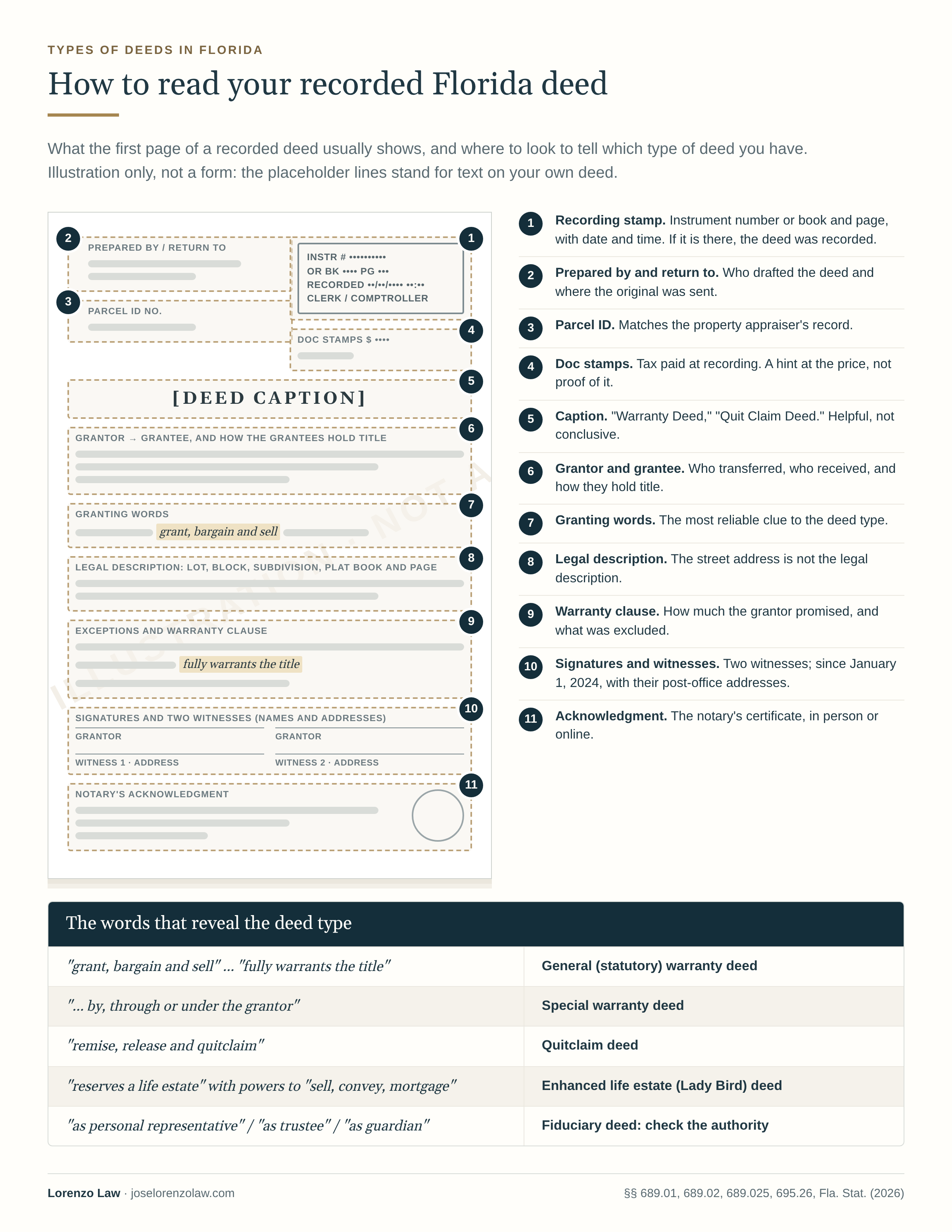
See the chart “How to read your recorded Florida deed” (open to enlarge; the details are also in the text).
Look for these parts on the deed you already have:
- Recording information, usually at the top of the first page: the clerk’s or recorder’s stamp, the date and time, and an instrument number or book and page. If it is there, the deed was recorded.
- “Prepared by” and “return to” lines identifying who drafted the deed and where the original was sent.
- Parcel identification number, which matches the property appraiser’s record.
- Documentary stamp tax notation, showing the tax paid at recording. It hints at the price, but the tax base is not always the sale price.
- The caption, such as “Warranty Deed” or “Quit Claim Deed.” Helpful, but not conclusive.
- Grantor and grantee: who transferred and who received, and how the grantees hold title (“husband and wife,” “as joint tenants with right of survivorship,” “as trustee of…”).
- The granting words, which tell you the deed type more reliably than the caption, followed by the habendum clause (“to have and to hold”) describing the estate conveyed.
- The legal description: lot, block and subdivision, or a metes-and-bounds description. The street address is not the legal description.
- Exceptions and the warranty clause, which show how much the grantor promised and what was excluded.
- Retained rights, such as a life estate or Lady Bird powers, if any.
- Signatures, two witnesses with their names and addresses, and the notary’s acknowledgment.
This is a guide to reading a deed that already exists, not a list of what to put in a new one. A deed drafted from a list like this can still fail for reasons the list cannot show (see the risks of preparing your own deed).
Where to find a copy of your deed
To look up a deed in Florida, search the Official Records of the county where the property is located by the owner’s name, the parcel number or the instrument number, and order a certified copy if you need one for a closing or a court. The county records table links the official search page for Florida’s largest counties. An online search that finds nothing is not proof that no deed was recorded; check name variations, dates and indexing with the recording office.
Signing and recording a Florida deed
Do Florida deeds require witnesses? Yes. An ordinary Florida deed must be signed by the grantor in the presence of two subscribing witnesses (§ 689.01). To be recorded, it must also be acknowledged, usually before a notary, or its execution proved by a subscribing witness (§ 695.03) and meet the formatting rules for recording, including the names and post-office addresses of the witnesses (§ 695.26). Then it is recorded in the Official Records of the county where the property is located.
These Florida deed signing requirements, recording requirements and notary requirements are the same for a warranty deed and a quitclaim deed; the Florida quitclaim deed witness requirements are the same two-witness rule.
What makes a Florida deed valid
The requirements for a valid deed are:
- a written instrument;
- a grantor with legal capacity;
- a grantee who can be identified;
- words of conveyance;
- a legal description of the land;
- the grantor’s signature before two subscribing witnesses;
- delivery to and acceptance by the grantee.
An acknowledgment (usually before a notary) or proof of execution by a subscribing witness, plus compliance with the recording rules, is needed to record the deed. Homestead may also require the spouse’s joinder.
Florida deed witness requirements, including the 2024 witness-address rule
Since January 1, 2024, a deed presented for recording must include each witness’s printed name and post-office address, in addition to the grantor’s and grantee’s names and addresses (§ 695.26). Older templates often lack the witness-address lines, and a deed missing them can be rejected for recording. The same section requires a blank space at the top for the recorder (3 by 3 inches on the first page and 1 by 3 inches on later pages) and has exceptions for certain instruments. Special execution provisions apply to corporations and some other signers.
Can the notary be one of the two witnesses?
Yes. Witnessing (§ 689.01) and acknowledgment before a notary (§ 695.03) are separate acts, and a notary may also serve as one of the two witnesses, but only by signing separately on a witness line. The acknowledgment by itself never counts as a witness signature, and a notary cannot notarize his or her own signature (§ 117.05). Witnesses should be adults who actually watch the grantor sign.
Can a family member witness a deed? The deed statute does not bar relatives, but an independent witness, rather than a family member who will receive the property, is better evidence if the deed is ever challenged. Notarizing a deed in Florida, including notarizing a quitclaim deed, means an acknowledgment, not a jurat (a sworn statement). The Florida deed notary block records whether the signer appeared in person or by online notarization and how identity was established (§ 117.05(4)).
Can a Florida deed be signed and notarized online?
Can a deed be signed electronically? Yes, if Florida’s remote online notarization requirements are met. Chapter 117 allows qualifying online notarization and remote witnessing through approved platforms, with identity checks, recordings and extra safeguards in some situations (§ 117.285). An informal video call is not enough. Confirm the signer’s location, identification, capacity, witnesses and the recording office’s requirements in advance.
Recording in the county Official Records
Where do you file a quitclaim deed in Florida, or any other deed? In the Official Records of the county where the land is located. The Clerk of the Circuit Court and Comptroller records deeds in most counties, but Broward uses a county division and Orange its County Comptroller (see the county table). Recording is available in person, by mail and electronically; confirm current instructions and fees.
Afterward, check the recorded copy’s legal description, names and recording reference, and update the property appraiser, insurer, lender and association as needed. Recording does not change the loan, the insurance or the exemption application.
Unrecorded deeds
A signed and delivered deed can be effective between the parties even if it is never recorded, but it does not protect the new owner against a later purchaser or creditor who had no notice of it (§ 695.01); recording protects the new owner against later buyers and lenders who pay value without notice, and against creditors; a later buyer who knew or should have known of the unrecorded deed does not take priority. Recording does not cure every defect or make a forged deed valid, and a deed found in a drawer after the grantor’s death raises delivery questions that need review before it is recorded.
A “pocket deed,” signed but deliberately kept unrecorded to be used later, invites exactly these problems: questions about delivery, a later buyer or creditor taking priority, and a deed that no longer matches the owner’s wishes. If a transfer is meant to happen at death, a Lady Bird deed or a trust does that properly.
Where Florida deeds are recorded: county records and fraud alerts
Every Florida county keeps its own Official Records, and the office that records deeds is not always the Clerk. Most counties also offer a free property fraud alert that emails the owner when a document is recorded in the owner’s name. For a deed search in Miami-Dade, Broward, Orange, Hillsborough, Palm Beach, Pinellas, Duval (Jacksonville), Osceola (Kissimmee), Polk or Lee, use the Official Records link in that county’s row of the table below. In counties not in the table, such as Marion, Volusia, Seminole or Collier, use the recording office’s Official Records search. A Florida deed lookup is free in every county, and Lorenzo Law prepares and records deeds for property in all 67.
| County | Office that records deeds | Official Records search | Property appraiser | Free fraud alert |
|---|---|---|---|---|
| Miami-Dade | Clerk of the Court and Comptroller | Official Records search | Miami-Dade Property Appraiser | Property Fraud Alert (Clerk) |
| Broward | Broward County Records, Taxes and Treasury Division (not the Clerk) | Official Records search | Broward County Property Appraiser | Owner Alert (Property Appraiser) |
| Palm Beach | Clerk of the Circuit Court & Comptroller | Official Records search | Palm Beach County Property Appraiser | Property Fraud Alert (Clerk) |
| Orange | Orange County Comptroller (not the Clerk) | Official Records search | Orange County Property Appraiser | Property Fraud Alert (Comptroller) |
| Hillsborough | Clerk of the Circuit Court & Comptroller | Official Records search | Hillsborough County Property Appraiser | Property Fraud Alert (Clerk) |
| Pinellas | Clerk of the Circuit Court and Comptroller | Official Records search | Pinellas County Property Appraiser | Fraud Alert Subscription Service (Clerk) |
| Duval | Clerk of the Circuit Court | Official Records search | Duval County Property Appraiser | Property Fraud Alert (Clerk) |
| Osceola | Clerk of the Circuit Court & County Comptroller | Official Records search | Osceola County Property Appraiser | Property Alert Service (Clerk) |
| Polk | Clerk of the Circuit Court & Comptroller | Official Records search | Polk County Property Appraiser | Property Fraud Alert (Clerk) |
| Lee | Clerk of the Circuit Court & Comptroller | Lee Clerk records services | Lee County Property Appraiser | Property Fraud Alert (Clerk) |
Office names and links were checked on the counties’ official websites in October 2026. Fees, hours and procedures change; confirm with the office before recording.
Deed fraud: how Florida owners can monitor their title
Deed theft in Florida usually means a forged or fraudulent deed recorded against a property, often a vacant or inherited one. Does Florida have deed fraud laws? Yes: knowingly filing a false document against real property is a crime under § 817.535, and forgery is a crime as well, but clearing the title still takes a civil action. Your county’s free fraud alert, Florida’s closest thing to a property deed alert system, is the simplest protection: it does not stop a fraudulent recording, but it tells you quickly so you can act. Register each owner and any trust or company that holds title. Paid monitoring services, such as one sold as “Deed Shield,” are private commercial products, not a county program.
If a deed was recorded without your consent, get a copy, keep any correspondence, report it to the recording office and law enforcement as appropriate, and get prompt legal review; a new “self-help” deed back to yourself is not the cure. For the court route, see how to set aside a deed in Florida and challenging transfers made before death.
The risks of preparing your own Florida deed
Can I do a quitclaim deed myself in Florida? Do I need a lawyer to transfer a deed? Florida law does not require one: an owner may prepare a deed for his or her own property, and printable forms are everywhere. Preparing a deed for someone else, however, is generally the practice of law, with narrow exceptions such as a title insurer or its agent preparing documents needed to issue a title policy. The real question is what a defective deed costs to fix later.
The problems Jose sees most often in self-prepared or online-form deeds are:
- The wrong deed for the goal. A quitclaim to a child meant to work like a Lady Bird deed, or a co-owner added as a tenant in common when survivorship was intended.
- A missing spouse’s signature on homestead. The deed can be challenged or fail (see a spouse’s signature).
- A bad legal description. The street address, or an old description with an error, instead of the recorded legal description.
- Missing witness addresses or recording space, which since 2024 can get the deed rejected.
- Unexpected documentary stamp tax on a “free” family transfer of a mortgaged house.
- Tax and benefits consequences: a lifetime gift that loses the stepped-up basis, a Medicaid penalty or a lost homestead exemption.
- Out-of-state forms that use another state’s deed names and omit Florida requirements.
- Unlicensed “deed services” and a non-lawyer notary offering to prepare the deed. A Florida notary who is not a lawyer cannot give legal advice or choose the deed.
Fixing a defective deed can take a corrective instrument signed by everyone involved, a title company’s curative work or a court action, which usually costs more than the flat fees below.
So you can legally transfer a deed without an attorney, or add a name without one. Whether you need a lawyer to add a name to a deed depends on what is at stake: homestead, a mortgage, a spouse, taxes or a plan for death. What type of lawyer deals with deeds? A Florida real estate lawyer for sales and title problems, and an estate-planning or probate lawyer when the deed is part of a plan for death or follows one.
Documentary stamp tax, recording fees and deed preparation cost
A Florida deed has three separate costs: documentary stamp tax (a state tax on the transfer, usually $0.70 per $100 of consideration), recording fees charged by the county, and the preparation fee. Lorenzo Law’s standard quitclaim deed is $575 and standard Lady Bird deed is $675, with signing, recording and the minimum documentary stamp included in both; documentary stamp tax above the minimum, such as on a sale price or a mortgage balance, is calculated separately.
How much is documentary stamp tax on a Florida deed?
The general rate is $0.70 per $100 or fraction of taxable consideration (§ 201.02). Miami-Dade is different: its rate is $0.60 per $100, plus a $0.45 per $100 surtax that does not apply to a deed transferring only a single-family residence (Fla. Admin. Code R. 12B-4.012; §§ 125.0167, 201.031). All parties to the deed are legally liable for the tax (§ 201.01). The Florida Department of Revenue’s documentary stamp tax page explains the rates and gives examples. The tax attaches when the deed is delivered and must be paid before the deed is recorded (§ 201.01). An unrecorded deed still owes the tax, which is then paid directly to the Department of Revenue, and unpaid tax draws penalties and interest (§ 201.17).
Example. A house sells for $300,000 outside Miami-Dade. The deed tax is $300,000 ÷ 100 × $0.70 = $2,100, assuming $300,000 is the correct tax base and no exemption applies. In Florida, the seller customarily pays the deed tax in a sale, but the contract can allocate it differently.
How to calculate doc stamps in Florida:
- Start with the consideration, including the balance of any mortgage on the property, whether or not the new owner assumes it (for a partial interest, the matching share).
- Round up to the next $100.
- Divide by 100.
- Multiply by $0.70, or by the Miami-Dade rate.
Florida doc stamps are required whenever a deed transfers an interest in real property for consideration, and there is no cap or maximum on the deed tax; a separate cap applies only to the tax on certain promissory notes. When a deed carries no tax or only the minimum, the deed or the recording cover sheet should show why, such as no consideration and no mortgage. Doc stamps in real estate transactions also apply to a new mortgage and note, taxed separately from the deed at 35 cents per $100 (§ 201.08); when the note is secured by a recorded mortgage, that tax is paid once, on the mortgage.
The Florida doc stamps statute is § 201.02, with the Miami-Dade rules in § 201.031. Pinellas, Hillsborough, Orange and every other county outside Miami-Dade use the $0.70 rate, so the four steps above show the calculation for a simple deed without a doc stamps calculator.
Doc stamps on a family transfer or a quitclaim
Do you pay taxes on a quitclaim deed in Florida? Possibly documentary stamp tax on any consideration and, for a gift, a federal gift-tax return, which may be required even when no gift tax is owed. Taxable consideration includes the unpaid balance of a mortgage on the property, even if no money changes hands and the person receiving the property does not assume the loan. That makes the Florida documentary stamp tax on a quitclaim deed gift to a child a common surprise: a parent who deeds a mortgaged house to a child can owe deed tax on the mortgage balance, or the share of it that matches the interest transferred. A true gift of property with no mortgage and no stated consideration generally owes no deed tax; a deed that recites nominal consideration, such as “$10 and other good and valuable consideration,” owes the minimum tax.
From Jose’s practice. A family deeded a house that still had a mortgage on it, without knowing that documentary stamp tax was due on the mortgage balance. That tax should be identified and calculated before a deed on mortgaged property is signed, not discovered afterward.
There is no blanket exemption for every family or estate-planning transfer. Section 201.02 contains specific rules for transfers of homestead between spouses and for transfers between spouses under a divorce, and transfers into trusts and to companies have their own rules. Do not infer the tax from the deed’s caption.
What are the recording fees for a Florida deed?
County recording charges under § 28.24 commonly total about $10 for the first page and $8.50 for each additional page, once the statutory surcharges are included, with extra charges for indexing more than four names. A two-page deed therefore usually costs about $18.50 to record, before any documentary stamp tax, so a deed like this one needs no recording fee calculator. Certified copies are extra. Confirm the current amount with the county recording office.
What Lorenzo Law charges for a deed
| Service | Fee | What it covers |
|---|---|---|
| Standard quitclaim deed | $575 | Review of the current deed, preparation, supervised signing (including remote online notarization when needed), recording and the minimum documentary stamp |
| Standard Lady Bird (enhanced life estate) deed | $675 | Review, preparation of the enhanced life estate deed, supervised signing, recording and the minimum documentary stamp |
| Deed into your revocable trust | $575 per Florida deed | Review of the current deed, preparation of the deed to the trustee, supervised signing, recording and the minimum documentary stamp |
| Other deeds and deed problems | Quoted in writing | Warranty deeds for sales, fiduciary deeds, trust problems beyond a standard funding deed, corrections and disputes, scoped after the free consultation |
There is no published average cost of a warranty deed in Florida. In a sale, the closing agent or the seller’s attorney usually prepares it as part of the closing charges. For a warranty deed outside a sale, Lorenzo Law quotes the fee in writing after the free consultation.
These are distinct services, not a blanket price for every deed on this page. Each standard fee includes the minimum documentary stamp charge; any documentary stamp tax above the minimum is a state tax determined from the transaction’s facts and is not part of the fee. A title search, title insurance, probate, curative work and litigation are separate. See Florida deed preparation and the Lady Bird deed attorney page for the current scope.
Mortgage, due-on-sale, gift tax, basis and Medicaid
A deed changes who owns the property. It does not change who owes the mortgage, and it can have tax and benefits consequences that the deed itself never mentions. Treat ownership, borrower liability, tax and Medicaid as separate questions, and answer each before signing.
Does changing the deed remove me from the mortgage?
No. Transferring ownership does not release anyone from the promissory note. A refinance, a payoff or a release the lender agrees to in writing can address the debt. A lender-approved assumption is not a release unless the lender’s documents say so. A divorce agreement between spouses does not, by itself, change the lender’s rights. See adding or removing a name on a Florida deed.
Adding someone, or a spouse, to the deed but not the mortgage is common and lawful: the new owner gets an ownership share, not the debt. Changing the deed on a house with a mortgage still requires reading the loan documents for the lender’s transfer clauses, as explained next.
Does transferring the deed trigger the due-on-sale clause?
Most residential mortgages let the lender call the loan if the property is transferred. Federal law limits that right for certain transfers of a home with fewer than five units, including a transfer to a spouse or children, a transfer on death to a relative, a transfer under a divorce, and a transfer into an inter vivos trust in which the borrower remains a beneficiary and that does not transfer rights of occupancy (12 U.S.C. § 1701j-3). Each exception has conditions, and a federal regulation adds that the person receiving the property occupy or plan to occupy the home for several of them (12 C.F.R. § 191.5). A qualifying exception does not cancel the debt. Provide the loan documents before signing.
The due-on-sale clause applies to a quitclaim deed just as it does to a warranty deed. The type of deed does not matter; the type of transfer does.
Gift tax and the step-up in basis
A deed to a child for little or nothing is a gift. A federal gift-tax return (IRS Form 709) may be required even when no tax is owed; see the IRS gift-tax FAQs. Gifted property generally keeps the donor’s tax basis for figuring gain, while property received at death generally takes a basis equal to its value at death (IRS Publication 551). That is why giving a house to children during life can cost them more income tax when they sell than inheriting it would. A Lady Bird deed is often chosen partly for this reason; see Lady Bird deed tax consequences. The result depends on value, expenses and retained interests, so get individual tax advice.
For the IRS, a quitclaim deed is not special: a transfer for less than full value is a gift whatever the deed is called, and the gift-tax return requirement and basis rules apply the same way.
Deeds and Medicaid
For anyone who receives or may need long-term-care Medicaid, a property transfer can raise eligibility and transfer-penalty issues. Florida examines transfers during a 60-month look-back period, with exceptions; see Florida DCF’s asset-transfer policy. Property-tax homestead status does not settle Medicaid treatment, so review the deed before signing.
Correcting a Florida deed and responding to a disputed deed
The remedy depends on the error and on who is affected. A corrective deed signed by the original parties fixes many mistakes. Florida also has a limited curative notice procedure for certain legal-description errors (§ 689.041), and some defects need a court. A deed recorded without the owner’s consent is not something to “correct”; it needs prompt legal review.
Revoking, changing or voiding a deed
Can a deed be revoked, changed or voided? A delivered deed cannot be revoked by the person who signed it. The exceptions are rights the deed itself reserves, such as the power to revoke in a Lady Bird deed. A deed can be changed or modified only by a new deed or a recorded correction signed by the people the law requires. A deed does not expire. A deed can be contested. A forged deed, or a married owner’s homestead deed signed without the spouse when the spouse’s joinder is required, is void and passes nothing, though a court action may still be needed to clear the record. A court can set a deed aside for fraud, undue influence, duress, lack of capacity or failure of delivery. A deed missing a required witness does not pass title, but Florida law generally cures that defect five years after recording (§ 95.231); the passage of time does not cure a forged deed or a void homestead deed. A warranty deed can be contested on the same grounds as any other deed; the warranty protects the buyer against title claims, not against a challenge to the deed itself.
Corrective deeds and the § 689.041 curative notice
When to use a corrective deed: when a recorded deed has a mistake that everyone involved agrees on. The correction deed meaning is simple: a new deed between the same parties that fixes an error in the original, such as a misspelled name or a wrong lot number, and refers to the deed being corrected. A deed missing a witness is usually re-signed with proper witnesses; once such a deed has been recorded for five years, § 95.231 generally cures the missing witness unless there is fraud, adverse possession or pending litigation. Section 689.041 offers an alternative for qualifying legal-description errors, with strict limits: its definition of an erroneous deed excludes quitclaim deeds, it limits the kinds and number of errors, it requires specified ownership-history conditions and it excludes property described only by metes and bounds. Once recorded, the curative notice corrects the deed back to its original recording date. Its remedies are expressly nonexclusive, and a curative notice is not a general-purpose fix; material errors may need a court action to reform the deed.
Florida title practice also uses a scrivener’s affidavit, sometimes called a title correction affidavit or affidavit of correction, for minor typographical errors. It is a practice document, not the statutory curative notice; it explains the error without re-signing the deed, and the title insurer decides whether to accept it. A “confirmatory deed” confirms an earlier conveyance, often to cure a technical defect. Title examiners follow The Florida Bar’s Uniform Title Standards, and the Marketable Record Title Act (chapter 712) can extinguish some old claims once a chain of title is 30 years old.
Other defects may need more instruments, the cooperation of others or a court action, such as reformation or quiet title. Do not assume an old recording is necessarily valid, or that a fresh deed is always the only solution.
When a deed is disputed
Deeds are challenged for forgery, lack of capacity, undue influence, fraud or a missing signature. A forged deed is generally void and passes nothing, even to a later buyer; a deed obtained by fraud in the inducement is generally voidable and must be set aside by a court. The deadlines and proof depend on the facts and on whether the owner has died. See how to set aside a deed in Florida, challenging transfers before death and, when co-owners cannot agree, a Florida partition action.
Can you forcibly remove someone from your property in Florida? Not by self-help. A tenant is removed by eviction. Other occupants are removed through the process that fits their status: an ejectment action (chapter 66), an unlawful-detainer action (chapter 82) or, for certain unauthorized or transient occupants who are not tenants or immediate family, a law-enforcement removal procedure (§§ 82.035, 82.036). Self-help against a tenant is barred by § 83.67. A co-owner generally cannot be excluded at all, so the remedy between co-owners is an agreement or a partition action. Changing the locks, removing belongings or shutting off utilities can expose the owner to liability.
Contesting a deed transfer or a quitclaim deed. A quitclaim deed can be invalid for the same reasons as any deed:
- a forged signature;
- missing witnesses (curable, and generally cured five years after recording);
- no delivery;
- a grantor without capacity;
- undue influence, duress or fraud;
- a missing spouse’s joinder on homestead.
A fraudulent deed transfer, including a quitclaim signed during a divorce because of fraud or duress, is challenged in a court action to cancel the deed or quiet title. Recording a notice of the lawsuit (lis pendens) can protect the property while the case is pending. Deadlines apply and can depend on when the fraud was discovered, so get advice promptly. See Florida deed contests.
Documents to gather before a deed consultation
You do not need every document to call. Gather what you have; the consultation is the place to arrange a secure way to share sensitive papers.
- The current recorded deed and any earlier deeds or corrections.
- The county, the parcel number and the property appraiser’s exemption record.
- Full legal names, marital status and the ownership you want afterward.
- Mortgage and home-equity details, and any lender letters about a transfer.
- Trust documents, powers of attorney, probate papers, court orders or divorce papers.
- Death certificates and survivorship or beneficiary documents if an owner has died.
- The timing, any payment, rights you want to keep and any family disagreement.
- Any sale contract, title policy, known lien or benefits concern.
Do not post sensitive identification or financial information in a public form or comment.
Florida deed FAQs
What are the three main types of deeds in Florida?
By warranty, the three are the general warranty deed (including Florida’s statutory warranty deed), the special warranty deed and the quitclaim deed. Other deeds, such as life estate, Lady Bird, personal representative’s and trustee’s deeds, are named for their purpose or signer and can carry different warranty language.
Are there four or five types of deeds in Florida?
It depends on how you sort them. Lists of four often add a “fee simple deed”; lists of five often add the life estate or Lady Bird deed. Florida law does not fix a number. What matters is what your deed says, who signed it and what it was meant to do.
What type of deed is most commonly used in Florida?
In ordinary home sales, the warranty deed, usually in Florida’s statutory short form. Quitclaim deeds are common in family and divorce transfers, and Lady Bird deeds are common in estate planning for a home.
What is the strongest type of deed, and which gives the least protection?
The general warranty deed offers the greatest protection, because the seller warrants the title against all lawful claims. The quitclaim deed gives the least, because it makes no promise at all. A special warranty deed sits in between.
What is the difference between a statutory warranty deed and a special warranty deed?
A statutory warranty deed (§ 689.02) carries the full general-warranty covenants, protecting against claims from anyone. A special warranty deed protects only against claims arising by, through or under the seller, not defects from earlier owners.
Which is better, a quitclaim deed or a warranty deed?
For a buyer, a warranty deed. A quitclaim fits transfers between people who already know the state of the title, such as spouses or family members, and releases of a claimed interest. Neither removes anyone from a mortgage.
Is a deed the same as a title, and does a Florida house have both?
No. Title is ownership; the deed is the document that transfers it. A Florida house has recorded deeds but no state-issued certificate of title like a car. Your ownership is shown by the deed recorded in the county Official Records.
Is Florida a deed of trust state or a mortgage state?
A mortgage state. Florida treats a mortgage as a lien, and the owner keeps title (§ 697.02). Florida treats a deed of trust, or any deed given to secure a debt, as a mortgage (§ 697.01), so Florida home loans use mortgages.
How do I know what type of deed I have?
Read the granting words and the warranty clause on your recorded deed. “Grant, bargain and sell” with a full warranty signals a warranty deed, “by, through or under” signals a special warranty deed, and “remise, release and quitclaim” signals a quitclaim. See how to read your deed.
Is a Florida transfer on death deed the same as a Lady Bird deed?
Florida has no statutory transfer on death deed for real estate. The Lady Bird (enhanced life estate) deed does the same job: the owner keeps control during life and the house passes to named beneficiaries at death without probate for that property.
Is a Lady Bird trust the same as a Lady Bird deed?
There is no such thing as a “Lady Bird trust.” A Lady Bird deed is a deed, not a trust. A revocable living trust is a separate document that can hold the house only if the house is deeded to the trustee.
What is a PR deed, and why is it needed?
A personal representative’s deed is signed by the person the probate court appointed for an estate. It is needed because, after an owner dies with a house only in that owner’s name, no one else can sign for the property until the court gives someone authority, unless the house is protected homestead, which generally passes outside the administration to the heirs, who can sign themselves; a title company usually wants an order determining homestead before a sale.
Can a personal representative transfer property to himself in Florida?
Only in limited circumstances. A sale to the personal representative is a conflict-of-interest transaction that any interested person who did not consent after fair disclosure can set aside, unless the will or the decedent’s contract expressly authorized it or the court approved it (§ 733.610). A representative who is a beneficiary can receive the house by distribution in his or her share.
What type of deed do I need to keep my homestead exemption in Florida?
No specific deed type; what matters is that a qualifying owner keeps the required ownership interest and lives in the home as a permanent residence. A Lady Bird deed or a deed to the trustee of your own revocable trust generally keeps the exemption; a deed to someone who does not live there generally does not.
Does adding my child to my deed reset Save Our Homes?
Not automatically. Section 193.155 has an exception for a deed in which the owner who holds the exemption keeps an interest and adds another person, as long as the original owner remains entitled to the exemption. If the added person applies for a homestead exemption on the property, the statute treats that application as a change of ownership.
Does my spouse have to sign the deed if the house is only in my name?
If the house is your homestead and you are married, generally yes. The Florida Constitution and § 689.111 require a spouse’s joinder to convey or mortgage homestead, even when the spouse is not on the title.
Does a Florida deed need two witnesses and a notary?
Yes, in practice. Two witnesses are required for the deed to be valid (§ 689.01), and the notary’s acknowledgment is the usual way to make it recordable (§ 695.03), though Florida also allows recording when a subscribing witness proves the execution. A witnessed but unnotarized deed is still valid between the parties; it just cannot be recorded until it is acknowledged or proved. Since January 1, 2024, the witnesses’ names and post-office addresses must appear on the deed (§ 695.26).
Do you pay doc stamps on a quitclaim deed to a family member?
Sometimes. If the property has a mortgage, the unpaid balance can count as taxable consideration even when no money changes hands. A true gift with no mortgage and no stated consideration generally owes no deed tax, while a recital of nominal consideration owes the minimum. Specific rules apply to transfers between spouses.
Who pays the documentary stamp tax on a Florida deed?
In a typical Florida sale, the seller customarily pays the deed tax, but the contract can say otherwise. In a gift or family transfer, the parties arrange it, usually at recording.
Does a quitclaim deed avoid probate?
Not by being a quitclaim. What matters is the ownership the deed creates. A present transfer to a child, a survivorship arrangement, a Lady Bird deed and a deed to a funded trust each work differently at death.
Can someone remove you from a deed without your knowledge in Florida?
No one can remove someone from a deed without their knowledge or signature just by signing a new deed, and a co-owner cannot convey your interest alone. Your interest can end without your signature only through a court judgment, such as divorce, partition, foreclosure or quiet title, or in limited cases by operation of law, such as adverse possession. A forged deed is generally void but can still be recorded and cloud your title, so sign up for your county’s free fraud alert and get legal review quickly if a deed you did not sign appears.
What is the 7-year property law in Florida?
People usually mean adverse possession: a person whose possession of someone else’s land is actual, open, notorious, exclusive, continuous and hostile for seven years can claim title in limited cases, under a recorded written instrument that appears to give title (§ 95.16) or, without one, only by also filing a return with the property appraiser and paying all the taxes (§ 95.18). The claimant must prove it by clear and convincing evidence, and permitted use never counts. It is rare, but a vacant inherited house should not be left unmanaged. The Marketable Record Title Act, a different rule, works on a 30-year chain of title.
What happens if a deed is never recorded in Florida?
It can still be effective between the parties, but it does not protect the new owner against a later purchaser or creditor who had no notice of it (§ 695.01). Record deeds promptly.
Can I use a deed form from another state for Florida property?
Not safely. Out-of-state forms use other states’ deed names and often omit Florida’s witness, address and homestead requirements. Florida land should be conveyed with a Florida deed.
Does the recording office confirm that I chose the right deed?
No. Accepting a deed for recording does not mean it achieves your goal, conveys good title or satisfies your lender. Recording, legal suitability and title insurance are separate functions.
Can I prepare my own deed in Florida?
You may prepare a deed for your own property, but the common errors (wrong deed type, missing spouse’s signature, bad legal description, missing witness addresses, unexpected doc stamps) are expensive to fix. See the risks of preparing your own deed.
How much does it cost to have a deed prepared in Florida?
With Lorenzo Law, a standard quitclaim deed is $575 and a standard Lady Bird deed is $675, including signing, recording and the minimum documentary stamp, and a deed into your revocable trust is $575 per Florida deed. Documentary stamp tax above the minimum is separate. Other deed work is quoted in writing after the free initial consultation.
Which deed should I use to transfer property to a family member?
Which deed is best depends on the goal; there is no single best family-transfer deed. Decide first whether the family member should own an interest now or receive the property at death, and whether you should keep control. A quitclaim or warranty deed fits a present transfer; a Lady Bird deed or a trust fits a transfer at death.
Talk to a Florida deed attorney
Lorenzo Law offers a free initial consultation to discuss the ownership change you have in mind. Start with the recorded deed and a description of who should own the property afterward. If probate, a title defect or an ownership dispute needs attention first, that is separate work and is identified before any deed is prepared.
Lorenzo Law is a one-attorney firm: Jose M. Lorenzo, Jr. reviews and prepares every deed himself, from the first call to recording. The scope and fee are confirmed in writing before work begins. Jose then drafts the deed, supervises the signing and records it, and keeps you informed at each step. Consultations are available in English and Spanish, by phone or video. Jose explains every deed in Spanish as well, including what a warranty deed is (¿qué es un warranty deed?) and how a Lady Bird deed works.
Request a free initial consultationCall (305) 224-6811
If you need a deed lawyer or property deed attorney near you, in Miami, Fort Lauderdale, Orlando or anywhere else in Florida, Jose handles the matter himself, by phone, video or in person. The principal office is in Kissimmee, with meetings in Coral Gables and Fort Lauderdale by appointment. Lorenzo Law handles deed matters throughout Florida. See also the Florida deeds and property guide and Florida estate planning.
This page provides general information about Florida law as of October 2026. It is not legal advice for your situation, and reading it or sending an inquiry does not create an attorney-client relationship. The right deed and its consequences depend on the property, the documents and the people involved.
About the author
- Jose M. Lorenzo, Jr. is the firm’s only attorney. He was admitted to The Florida Bar on October 4, 2013 (Florida Bar No. 107002). See his Florida Bar profile.
- His practice focuses on deeds and property transfers, probate, estate planning, guardianship, homestead law and probate litigation.
- He consults in English and Spanish. Principal office in Kissimmee; Coral Gables and Fort Lauderdale by appointment.
Sources and authorities cited
Statutes cited are the 2026 Florida Statutes. The text of the law controls over any summary on this page.
Statutes, cases and official sources 55 entries
Discuss your Florida deed with Jose
Tell me briefly what the property is and what you want to happen to it, and I will respond within 24 to 48 hours.

