Florida Homestead Property in Probate
Florida homestead property in probate raises three different questions: who owns the home after death, whether it is protected from the deceased owner’s creditors, and what happens to its property-tax benefits. Property that qualifies as protected homestead generally passes outside the assets administered by the personal representative. That does not eliminate the need to establish the owners and their interests. A probate homestead order may be needed to document title for a sale or refinance, depending on the ownership history and the transaction’s requirements.
Florida homestead law uses one word for several different rules, and mixing them up can lead families to the wrong conclusion. This guide separates them, then walks through who inherits homestead property in Florida, what a surviving spouse can choose, how the deceased owner’s creditors are treated, how a petition to determine homestead works, and how to get the property out of a deceased owner’s name.
A note on the word “homestead.” This page is about Florida homestead property law statewide. If you are looking for a probate lawyer in the City of Homestead, Miami-Dade County, see our page on probate representation in Homestead, FL.
Ask about a Florida homestead — free initial consultationCall (305) 224-6811
Surviving spouses · Children and heirs · Selling an inherited home · Property taxes after a death · English and Spanish · Statewide
Families usually reach this page after a death, when a will seems to say one thing about the house and a lawyer or title company says another, when a surviving spouse and the children are not sure who owns what, or when a closing stalls because the public records still show a deceased owner. The rules below answer those questions in order: what the property is, who owns it now, who it is protected from, and what has to be filed to prove it.
| Three different questions | Property-tax benefits, protection from the deceased owner’s creditors, and who receives the home at death are governed by different rules. A tax exemption does not conclusively decide probate homestead status. |
|---|---|
| Probate status | Qualifying protected homestead is generally outside the assets the personal representative administers. Property passing by valid survivorship title follows its own nonprobate route. |
| Who receives it | Start with the recorded deed, then any will or trust, then the family at death. A surviving spouse or minor child restricts what a will or trust can do with the home. |
| Surviving spouse | Where section 732.401 gives the spouse a life estate, the spouse may elect a one-half interest instead, generally within six months after death and during the spouse’s lifetime, with a narrow statutory extension. |
| Creditors | Qualifying protected homestead passing to the spouse or qualifying heirs is generally protected from the deceased owner’s unsecured creditors. Valid mortgages, property taxes and other enforceable liens remain. |
| Court order | A petition to determine homestead under Florida Probate Rule 5.405 is permitted, not mandatory. A title examiner may require the order before a sale or refinance. |
| Property taxes | The deceased owner’s exemption and Save Our Homes benefit do not automatically become the heirs’ benefits. Statutory exceptions apply to certain spouse, dependent and joint-owner transfers. |
| Your attorney | Jose M. Lorenzo, Jr., a solo Florida attorney: the same lawyer from the first call through the court’s order. Statewide, in English and Spanish, with a free initial consultation. |
What to Do With a Florida Homestead After the Owner Dies, Step by Step
What should the family do first? Protect the house, find out how title was held, and identify who survived. Those three facts decide which of the steps below apply. The order can change with the facts, and each step links to the section that explains it.
- Secure and insure the house. Contact the insurer about the death and any vacancy, and keep the property maintained. A personal representative’s authority over protected homestead is limited to protective possession in the circumstances the statute describes. See who controls the house.
- Get the recorded deed. How title was held at death is the starting point: sole name, tenancy by the entireties, joint tenancy with right of survivorship, a trust or an enhanced life estate deed. See how title was held.
- Identify the family at death. Was there a surviving spouse? Any minor child of the owner? Which descendants survived, and did any child die first leaving children? Florida intestacy law and § 732.401 both turn on those answers. See who inherits.
- Read the will or trust against the homestead rules. A devise of the home that a surviving spouse or minor child makes impermissible does not control the initial descent. If there is no will, Florida estate law decides who the heirs are. Whoever has the original will must deposit it with the clerk within 10 days after learning of the death, the “10-day rule,” whether or not anyone opens probate. See devise restrictions.
- Note the surviving spouse’s election period. If the spouse has a statutory life estate, the one-half election generally must be made within six months after death and during the spouse’s lifetime. See the election deadline.
- Contact the property appraiser. Review the exemption and whether a change of ownership will affect the assessment for the following January 1. See property taxes after a death.
- Contact the mortgage servicer. A mortgage remains a lien on the home after death. Ask what the servicer requires and keep payments current while ownership is sorted out. See the mortgage.
- Decide what the family wants to do. Keep the home, live in it, rent it or sell it. The plan determines what has to be proved and how quickly.
- Petition to determine homestead, if title must be documented. An interested person files a verified petition under Rule 5.405 in the probate proceeding and serves formal notice. See the petition and where to file.
- Record the order and work with the title examiner. Obtain the actual title requirements early, before choosing a closing date. See clearing title and selling.
The steps are a planning sequence, not a statutory checklist, and some of them run at the same time. For the first weeks after any death in Florida, see what to do when someone dies in Florida.
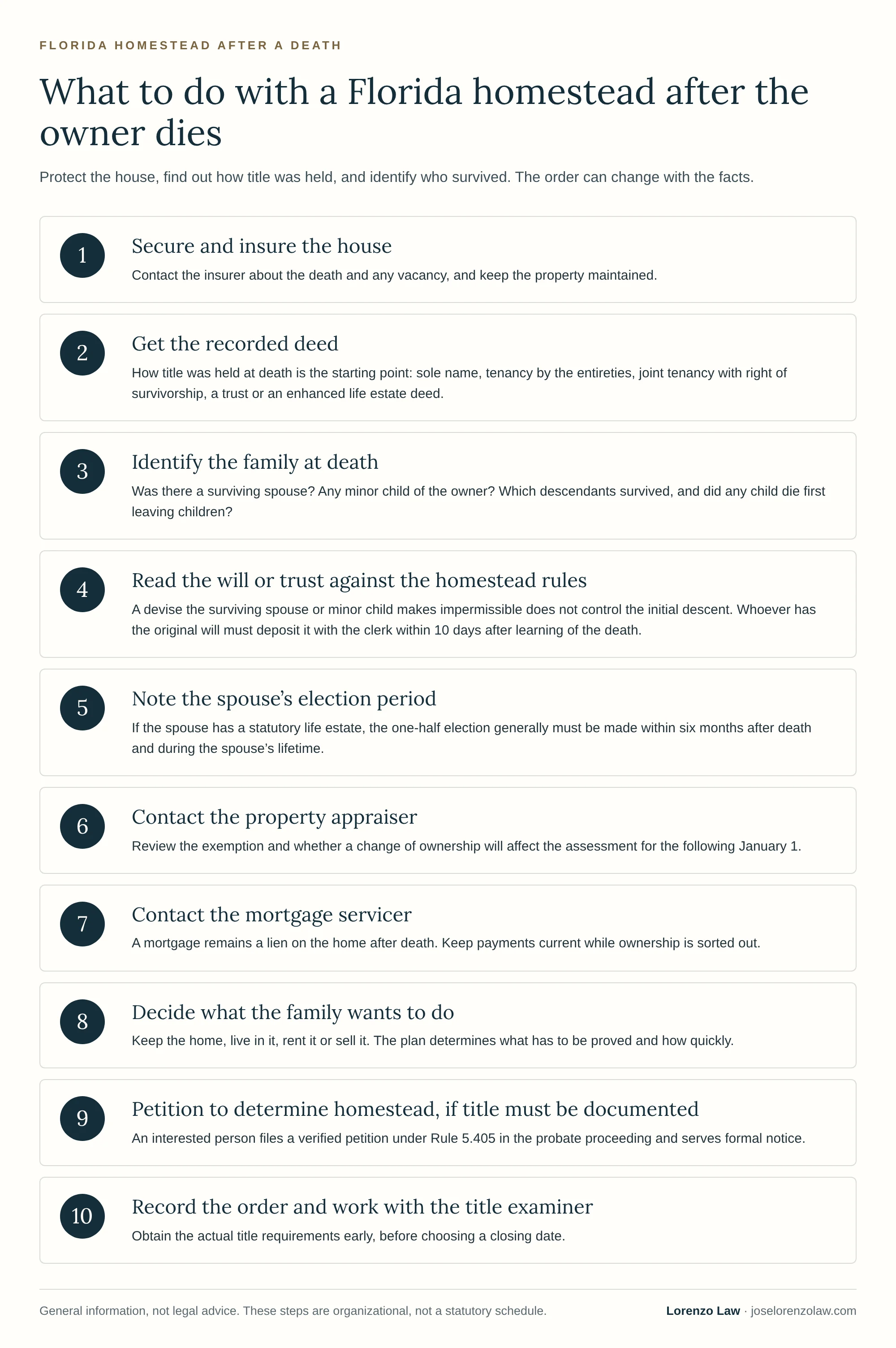
View the “What to do with a Florida homestead after the owner dies” chart (zoom in to read; the details are also in the text above).
What Is Homestead Property in Florida? Protected Homestead Explained
In Florida probate, protected homestead is a deceased owner’s residence that qualifies under Article X, Section 4 of the Florida Constitution and the Probate Code’s definition. Florida uses “homestead” in several different ways. A property-tax exemption reduces taxable value; constitutional creditor protection limits forced sale for qualifying debts; and devise and descent rules help determine who receives an owner’s interest at death. The facts and documents relevant to each question overlap, but a tax exemption does not conclusively decide probate homestead status.
| Question | Facts and documents to check | Legal effect and limit |
|---|---|---|
| Property-tax exemption and assessment cap | Title or qualifying beneficial ownership, permanent residence, January 1 eligibility, application history and the kind of transfer | The exemption reduces taxable value; Save Our Homes separately limits qualifying assessment increases. The property appraiser administers these benefits. A probate order does not automatically establish the new owner’s tax eligibility. |
| Protection from the deceased owner’s creditors | Residence and ownership at death, qualifying acreage and use, the recipient’s status and the particular debt or lien | Article X, section 4 protects qualifying homestead from general creditor claims and extends protection to the surviving spouse or qualifying heirs. Valid mortgages, taxes and other applicable exceptions require separate treatment. |
| Ownership after death | Recorded deed, will or trust, spouse, children and other descendants, waivers, disclaimers and any election | Valid survivorship title, a permitted devise or statutory descent can determine the recipients and their interests. The tax bill does not identify all the people who must participate in a later conveyance. |
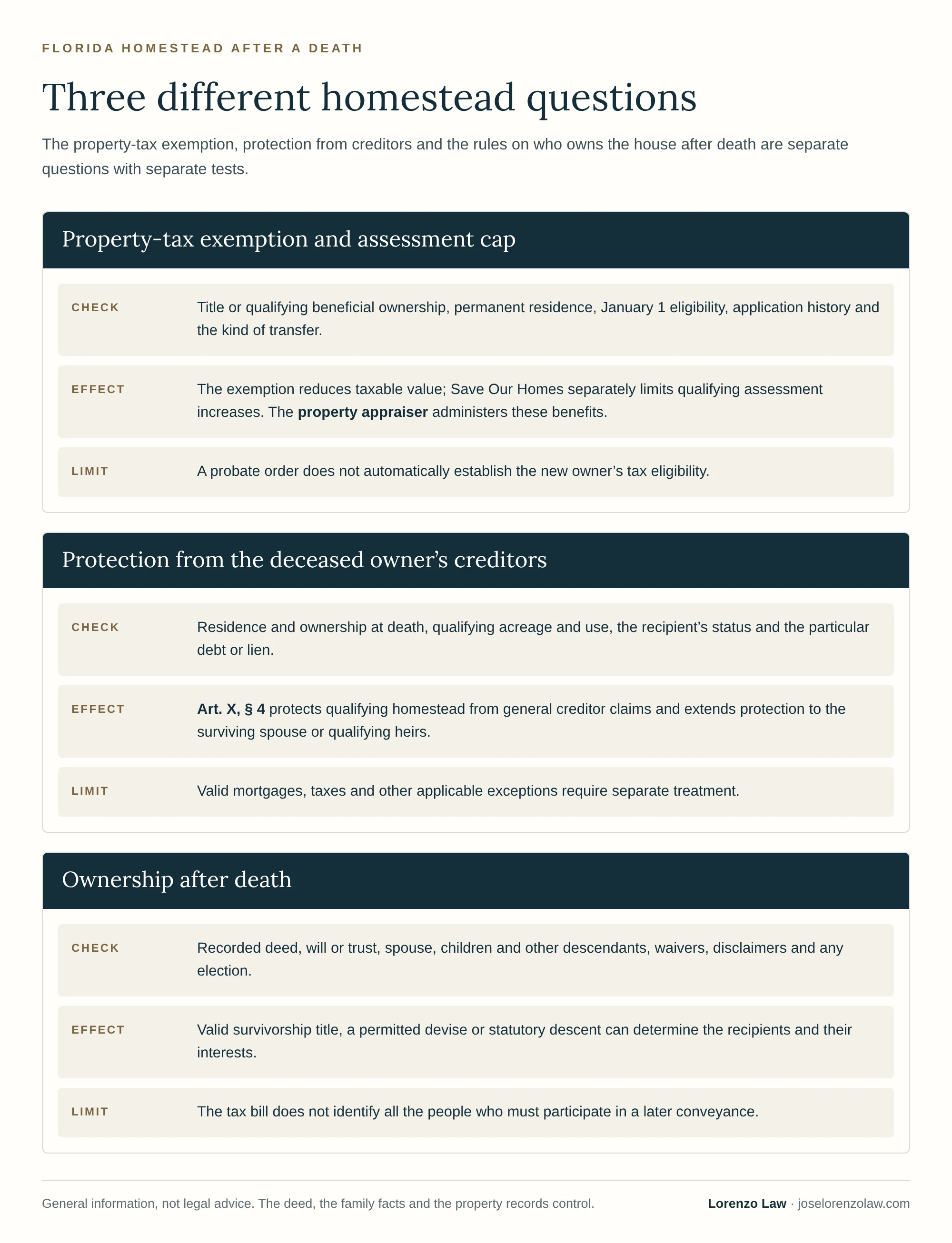
View the “Three different homestead questions” chart (zoom in to read; the details are also in the text above).
Homestead Tax Exemption vs. Homestead Probate Protection
Neither one depends on the other. The two have distinct requirements and can produce different answers for the same property. The tax exemption is an application filed with the county property appraiser. The constitutional protection at death arises from ownership, residence and intent, not from paperwork. A parent who never once filed for the tax exemption can still own protected homestead at death, and a parent who did file can still own property that is not protected homestead, because of how title was held.
What Makes Property Homestead Exempt From Forced Sale in Florida?
Property is homestead exempt from forced sale in Florida when it is the residence of the owner or the owner’s family and meets Art. X, § 4(a). The purpose of the Florida homestead protection is to keep the family home from being lost to the owner’s general creditors. During the owner’s life, this is the protection people mean by Florida homestead asset protection or lawsuit protection; at death, § 4(b) carries it to the surviving spouse or heirs.
- Owned by a natural person. A corporation, LLC or partnership cannot hold homestead.
- Within the size limits. Up to 160 acres of contiguous land outside a municipality; up to one-half acre inside a municipality, where the exemption is further limited to the residence of the owner or the owner’s family. Acreage beyond the ceiling is not covered. The constitution also provides that the exemption is not reduced, without the owner’s consent, because the property is later included in a municipality.
- No general dollar ceiling. Florida’s constitutional exemption has acreage and use limits rather than a general dollar ceiling; other applicable law, including bankruptcy law, can affect protection.
- Equitable title can be enough. Beneficial ownership can count, which is why Fla. Prob. R. 5.405 reaches property titled in the trustee of a § 733.707(3) trust where the deceased settlor was treated as owner under § 732.4015. That does not mean every trust qualifies merely because an individual benefits from it; the trust’s terms and the settlor’s interest must be reviewed.
The protection is not absolute. The constitutional text excepts taxes and assessments, obligations contracted for the purchase, improvement or repair of the property, and obligations for labor performed on the realty.
What Does Homestead Mean in Florida Real Estate?
What does homestead property mean in Florida? In a real estate file, “homestead” can mean any of the three questions above, which is why buyers, sellers and agents get different answers from the property appraiser, the title company and the probate court; the homestead meaning in law depends on which of those questions is being asked. Real estate documents use the word too: a deed or mortgage may state whether the property is the signer’s homestead, because a married owner’s conveyance of homestead ordinarily requires the constitutionally required spousal joinder. A statement in a deed is evidence to review, not the final answer to whether the property was protected homestead at death.
The Probate Code Definition, and the Title Trap
Fla. Stat. § 731.201(33) supplies the probate homestead legal definition, “protected homestead,” and it carves out a category that can surprise families. Property owned as tenancy by the entireties or as joint tenancy with rights of survivorship is not protected homestead under the Probate Code, even though it may still be exempt from creditors. That exclusion does not make the property a probate asset: valid survivorship title follows its own nonprobate route.
So if you and your spouse owned the house as husband and wife, as tenants by the entirety, the probate homestead rules usually never come into play. Title passes to you by survivorship when your spouse dies. There is nothing to devise. The same logic applies to a joint tenancy with right of survivorship between any two owners. See survivorship ownership in Florida.
Nursing-Home Stays, Renting and Florida Homestead Status
A nursing-home stay or a rental does not automatically end homestead status. Abandonment turns on intent to return. A temporary or involuntary absence, including placement in a nursing home or other healthcare facility, does not by itself destroy homestead status where the owner, or the owner’s family, has not formed a permanent intent to leave. The same analysis applies to an owner who moved in with an adult child or rented the house out. Renting cuts against homestead intent, but it is one fact among many, and the answer is fact-specific.
These are constitutional homestead questions. Renting the home also raises separate property-tax rules under section 196.061. Do not assume the tax result and the probate result are the same. Residence, intent, actual use and the reason for an absence need to be reviewed together.
Condos, Co-ops, Mobile Homes, Duplexes, Second Homes and Out-of-State Owners
A condominium unit that is the owner’s residence can qualify if the ownership, residence, acreage and use requirements are met. A mobile or manufactured home can qualify on the same conditions; check ownership of the land and the home’s separate title status, because tax classification alone does not settle the transfer procedure. A cooperative apartment is different: it is held through corporate shares and a proprietary lease, not a deed, and under In re Wartels’ Estate, 357 So. 2d 708 (Fla. 1978), it is not an “interest in realty” and cannot pass as protected homestead under the descent and devise rules, even though it may qualify for the homestead tax exemption. Later decisions have treated a co-op’s protection from forced sale as a separate question, so Wartels governs descent and devise, not every creditor issue. For a duplex within a municipality, the protection can be limited to the severable portion used as the owner’s or family’s residence. Location, use and the ability to divide the property require review; the property-tax exemption presents a separate question. Examples of non-homestead property include a vacation or second home, which does not qualify as the owner’s residence, and a rental the owner did not live in; an owner has only one homestead at a time.
A decedent who was not a Florida resident generally has no Florida homestead; that person’s Florida real estate is generally handled through ancillary probate in Florida or another available procedure. That is why Fla. Prob. R. 5.405 requires the petition to state the county of domicile at death and, if the property was not the decedent’s domicile, whether it was within a municipality and the domicile of a family member. The owner does not have to have personally occupied the home in every qualifying case; the residence of the owner’s family can matter.
Does Homestead Property Go Through Probate in Florida?
Protected homestead is generally outside the assets the personal representative administers to pay the deceased owner’s ordinary debts and estate expenses. A court can still determine its status and identify the owners under Probate Rule 5.405. Property passing under valid survivorship title follows a different nonprobate route; exclusion from the Probate Code’s definition of protected homestead does not make it a probate asset.
The Florida homestead property probate rules start with two statutes. Fla. Stat. § 733.607(1) provides that the personal representative takes possession of the decedent’s property except the protected homestead. Fla. Stat. § 733.608(1) provides that all property except the protected homestead is an asset in the personal representative’s hands for devises, family allowance, elective share, taxes, claims and expenses. Title to protected homestead passes at death by operation of law to the persons entitled; when a court order is sought, it documents that result rather than transferring the property.
The case law is consistent. Clifton v. Clifton, 553 So. 2d 192 (Fla. 5th DCA 1989), holds that homestead passes outside probate, that the personal representative has neither jurisdiction nor title, and that no order of distribution and no personal representative’s deed are required to pass title. Lanford v. Phemister, 338 So. 3d 1049 (Fla. 5th DCA 2022), confirms the same for homestead devised to an heir. In re Estate of Mahaney, 903 So. 2d 234 (Fla. 2d DCA 2005), states the narrow exception: homestead enters the probate estate under the personal representative’s control when devised to someone other than an heir. That rule assumes a decedent survived by neither a spouse nor a minor child, which is the situation in which homestead is freely devisable in the first place, and “heir” is a defined term in § 731.201.
Homestead Property Exempt From Probate in Florida: The Limits
In the sense that matters to creditors and the personal representative, homestead is generally exempt from probate; in the sense that matters to a buyer, not necessarily. Title vests at death; marketable title is a different problem. So do you have to probate a house in Florida that was protected homestead? Not for the usual purposes of estate administration, but a court proceeding may still be needed to document who owns it. Homestead is not the only property that stays outside the personal representative’s administration; see other assets exempt from probate and non-probate assets in Florida.
A homestead determination is a common way to document status and ownership. Rule 5.405 permits an interested person to petition; it does not declare an order mandatory for every transfer. The title examiner or insurer may require an order and additional evidence based on the deed, family facts, liens and transaction. Obtain the actual requirements early. The order does not guarantee marketable or insurable title.
Homestead vs. Non-Homestead Property in a Florida Estate
The difference shows up as soon as someone dies. Protected homestead passes at death to the persons entitled, outside the personal representative’s administration, and is generally beyond the deceased owner’s unsecured creditors. Non-homestead real estate owned in the decedent’s name, such as a rental, a vacation home or land beyond the acreage limits, is an ordinary estate asset: the personal representative administers it, it can be used for claims and expenses, and the personal representative may be able to sell it, depending on the will and any required court authority. A home that passes by survivorship is a third category, outside both probate and the Probate Code’s homestead rules.
Heirs, the Home and the Decedent’s Debts
Inheriting property from a deceased person’s estate ordinarily means taking what is left after claims and expenses; protected homestead is different, because § 733.608(1) keeps it out of the assets used to pay them. Qualifying protected homestead passing to the surviving spouse or qualifying heirs is generally protected from the deceased owner’s unsecured creditors. That does not eliminate valid mortgages, property taxes, applicable assessment or construction liens, or other legally enforceable exceptions. A recipient’s own creditors present a separate question. Art. X, § 4(b) provides that the exemptions “shall inure to the surviving spouse or heirs of the owner,” which is why the protection follows the property. The details, including what still rides with the home, are in the creditor section.
Homestead on the Inventory and Its Effect on Attorney’s Fees
Protected homestead goes on the inventory, but without a value. Fla. Prob. R. 5.340(a) directs that protected homestead be shown on the inventory without a valuation. Read with § 733.608(1), that produces a consequence worth understanding before you agree to a fee: protected homestead is not a probate asset and carries no inventory value, so it falls outside the “compensable value of the estate” driving the presumptive fee schedule in § 733.6171(3). Homestead work may support additional compensation under the statute as an extraordinary service under § 733.6171(4)(i), subject to the engagement and applicable review. Statutory presumptions are not a mandatory fee agreement, and homestead work is not automatically free.
The classification matters in the other direction too. A residence that is an ordinary probate asset generally enters the applicable probate inventory and fee calculation. Property passing to a surviving owner by valid tenancy by the entireties or joint tenancy with right of survivorship generally passes outside probate instead, and its exclusion from the Probate Code’s definition of protected homestead does not, by itself, make its value part of the probate fee base. Resolve the classification early rather than at a fee hearing.
Homestead and Summary Administration
Under the current section 735.201, summary administration may be available when the Florida estate subject to administration, less property exempt from creditors’ claims, is $150,000 or less, or when the person has been dead for more than two years. In a testate estate, the will must not direct administration under chapter 733. Chapter 2026-57 raised the amount effective July 1, 2026. Earlier deaths in the former $75,000-to-$150,000 range require review of which law applies; the effective date does not by itself resolve every transition question.
A home that qualifies as protected homestead is excluded from the value calculation. For example, an estate with a qualifying protected home and a $60,000 individually owned bank account may meet the value test even if the home is much more valuable. This hypothetical assumes no other countable assets; it does not decide the needed notices, creditor handling or title work. A homestead determination may still be sought in the same court file. See our Florida summary administration guide for the full eligibility and transition discussion.
Ownership of the Home During Probate: Heirs and the Personal Representative
The people entitled to the homestead own it from the moment of death. Section 733.608(2) authorizes limited protective possession when property reasonably appears to be protected homestead and is not occupied by a person who appears to have an interest. Qualifying expenditures or obligations under subsection (3) can support a lien; this is not blanket authority to charge heirs for every estate expense. Recording, notice, adjudication and enforcement requirements apply.
That protective possession is authorized, not required. There is no duty to rent the property, and it does not authorize evicting an heir who is living there. For the personal representative’s role generally, see becoming a personal representative in Florida.
Devise Restrictions: Who You Can Leave Your Florida Home To
If a minor child of the owner survives, Florida homestead cannot be devised by will or trust. If a spouse survives and no minor child does, the homestead may be devised only to the spouse, and only as a full fee interest, unless the spouse has validly waived the relevant rights. A prohibited devise does not control the initial descent; section 732.401 supplies the result instead.
Florida tells you who you may leave your house to. Art. X, § 4(c), Fla. Const. provides that “the homestead shall not be subject to devise if the owner is survived by spouse or minor child, except the homestead may be devised to the owner’s spouse if there be no minor child.” Fla. Stat. § 732.4015(1) restates the rule.
Can I Leave My Homestead to Anyone in Florida?
Only if you are survived by neither a spouse nor a minor child. The Florida homestead devise restrictions come down to three situations:
| Who survives the owner | What the owner may do with the homestead by will or trust |
|---|---|
| A minor child of the owner (with or without a spouse) | The homestead cannot be devised to anyone, including the spouse or the minor child. A spouse’s waiver does not remove a surviving minor child’s protection. |
| A spouse and no minor child | It may be devised to the spouse, and only to the spouse, and only in fee simple absolute, unless the spouse has validly waived the relevant rights. Adult descendants do not alone prohibit that devise. |
| Neither a spouse nor a minor child | The owner may devise it to anyone, including adult children, grandchildren, stepchildren, a friend or a charity. The recipient’s identity still matters for creditor protection. |
In re McCartney’s Estate, 299 So. 2d 5 (Fla. 1974), confirms the middle row: with a spouse and only adult children, homestead may be devised to the spouse absolutely in fee. McKean v. Warburton, 919 So. 2d 341 (Fla. 2005), illustrates the bottom row, and adds the rule that matters for drafting: homestead not specifically devised passes under the residuary clause, which is “a sufficiently precise indicator of testamentary intent,” and it loses its protected character only where the will directs a sale and makes the proceeds part of the general estate. The homestead passed to residuary beneficiaries under the will.
What happens to a house when the owner dies in Florida follows from the same three facts: how title was held, whether a valid will or trust controls, and who survived. When a parent dies in Florida and leaves no spouse and no minor child, a valid will controls what happens to the house; without one, the children generally inherit it. A house left in a deceased parent’s name in Florida stays that way on the public record until someone documents who owns it now; see clearing title. Florida inheritance laws for a house that was not the owner’s homestead follow the ordinary probate route instead.
Minor Children: Who Counts
If a minor child of the owner survives, the will’s or trust’s homestead provision fails. You cannot leave the home to the surviving spouse, and you cannot leave it in trust for the minor child.
The frequent mistake is reading “minor child” as “children.” Adult children do not trigger the restriction. A child who turned eighteen a month before the parent died is not a minor child; a child three days short of eighteen at death is. That is why Fla. Prob. R. 5.405 requires the petition to identify minor children by name and year of birth.
“Minor child” means a child of the deceased owner under the applicable parent-child rules, not every minor descendant. An adopted child counts; a stepchild does not. Whether a minor grandchild whose parent died first can trigger the restriction has not been decided by a Florida appellate court. Adoption and parentage must be checked under § 732.108 and the related definitions.
The Less-Than-100% Trap
Where a spouse survives and there is no minor child, a permitted devise to the spouse must be the entire fee. Anything less fails. This is a common improper devise of homestead.
Here is a will that fails, assuming no effective waiver and no competing ownership interest: “I devise my residence to my wife for the term of her life, and upon her death to my two adult sons in equal shares.” A sensible second-marriage plan, and invalid. In re Finch’s Estate, 401 So. 2d 1308 (Fla. 1981), held that a life estate to the surviving spouse with a remainder to adult children is a devise of less than a fee and is invalid. Iandoli v. Iandoli, 504 So. 2d 426 (Fla. 4th DCA 1987), applied the same rule. Half to the spouse and half to a child fails too.
An Invalid Devise Changes the Inheritance Route
The prohibited devise does not control the initial descent. Later lawful transfers, disclaimers or settlements must be evaluated separately; they do not retroactively make the original devise valid. Under Ballard v. Pritchard, 332 So. 3d 570 (Fla. 2d DCA 2021), an invalid devise causes the homestead to descend under § 732.401(1) as though there had been no will.
Applied to the failed will above, the spouse takes a life estate and the two sons a vested remainder per stirpes. That resembles what the will said but is not the same, because the spouse now holds the § 732.401(2) right to elect an undivided one-half interest as tenant in common instead.
Trusts and the Homestead Restrictions Florida Imposes
A Florida will cannot override the restriction, and neither can a revocable trust. Section 732.4015(2)(b) defines “devise” to include a disposition by trust of what would otherwise be the grantor’s homestead, so moving the house into a revocable trust and directing its distribution there is still a devise.
Section 732.4017 draws the line: a completed lifetime transfer of an interest, including into a trust, is not a devise if the transferor retains no power to revoke or revest that interest. The test is specific to the interest transferred. A revocable trust does not qualify. In Aronson v. Aronson, 81 So. 3d 515 (Fla. 3d DCA 2012), homestead held in a revocable trust passed by operation of law as a life estate and vested remainder, and the successor trustees had no power to sell. Section 736.1109(1) confirms that where a trust devise violates Art. X, § 4(c), title passes under § 732.401 at the moment of death.
Leaving a House to a Child or Someone Outside the Family in Florida
If you leave no spouse and no minor child, you can, and that includes leaving your Florida home to a friend. Once neither a spouse nor a minor child survives, you may leave the homestead to someone outside the family, whether the taker is a grandchild, a stepchild, a neighbor or a charity. Whether that recipient also takes the home free of your creditors is a separate question, covered in the creditor section.
The harder version: can I leave my homestead to someone other than my spouse? A valid lifetime waiver and a post-death disclaimer are different legal acts. Section 732.4015(3) addresses a spouse’s disclaimer of an interest validly devised to that spouse; chapter 739 then governs that interest. A disclaimer is not a general cure for an otherwise prohibited devise. Review the actual interest and instrument before relying on either route. A valid waiver can remove the spouse-based devise restriction to the extent of the waiver, but does not remove a surviving minor child’s protection. Waivers are covered in the waiver section.
Planning Around the Devise Restriction
Because the restriction applies at death, the planning questions are for the owner’s lifetime. The issues to raise with an estate planning lawyer usually include whether a permitted full-fee devise to the spouse fits the family; whether a valid waiver under § 732.702 or a deed waiver under § 732.7025 exists or is appropriate, remembering that it cannot remove a minor child’s protection; whether other assets, such as life insurance or accounts with beneficiary designations, can balance what children and a spouse each receive; and how any lifetime transfer would be analyzed under § 732.4017. None of these is a universal fix, and each has consequences for taxes, creditors and control. See Florida estate planning, living trusts in Florida and lady bird deeds in Florida.
Who Inherits Homestead Property in Florida?
Start with the deed, then the will or trust, and then the family circumstances at death. Section 732.401 supplies the descent rules when the homestead was not validly devised, subject to applicable waivers and other rights. Its spouse-and-descendants life-estate rule does not apply to property owned by tenancy by the entireties or joint tenancy with right of survivorship.
| Situation at death | Starting point for ownership | What can change the answer |
|---|---|---|
| Valid tenancy by the entireties or joint tenancy with right of survivorship | The surviving owner ordinarily takes through the deed’s survivorship arrangement | Deed validity, severance, ownership history and applicable liens; do not apply the section 732.401 election merely because a spouse survives |
| Spouse and descendants; no valid devise; no effective waiver changing the result | Spouse takes a life estate in the decedent’s homestead interest; descendants take the remainder per stirpes | A valid election substitutes an undivided one-half interest for that life estate; review the recording and statutory requirements |
| Spouse, no minor child; permitted full-fee devise to spouse | Spouse receives the devised interest outright | Deed, validity of devise and scope of any waiver; adult descendants do not alone prohibit that devise |
| Spouse, no descendants; statutory descent applies | Spouse generally receives the decedent’s interest outright | Waiver, disclaimer and the actual ownership interest; there is no section 732.401(1) life estate to exchange merely because a spouse survives |
| No spouse, minor child of decedent survives | Devise restriction applies; descendants inherit under the applicable descent rules | Parentage, adoption and family branches; minor ownership also affects a later sale |
| No spouse and no minor child | A valid devise can control; without one, intestate succession controls | Identity of the recipient matters for creditor protection; do not assume a friend or charity receives protected homestead on the same terms as an heir |
Sources: § 732.401, § 732.4015, § 732.102 and § 732.103, Florida Statutes; Art. X, § 4(c), Fla. Const. The table describes the decedent’s interest, which is not always the entire property.
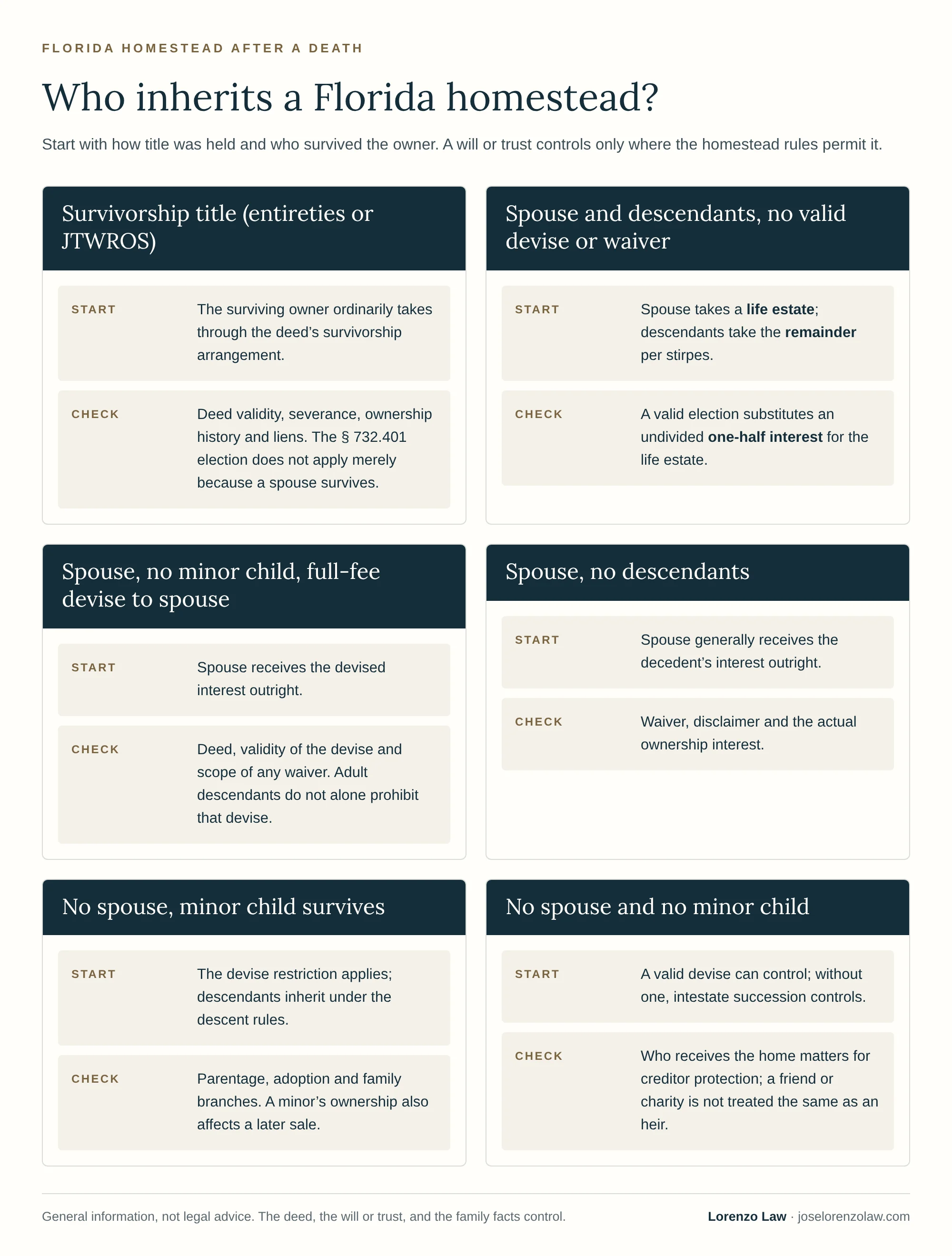
View the “Who inherits a Florida homestead?” chart (zoom in to read; the details are also in the text above).
The spouse-with-no-descendants row surprises people, and the reasoning matters. The life estate in § 732.401(1) is conditioned on the decedent being survived by a spouse and one or more descendants. With no descendants that condition is never satisfied, there is no class to hold a remainder, and, where statutory descent applies, the ordinary intestate rules generally give the spouse the decedent’s interest outright.
Who Inherits Homestead if There Is No Will?
Under Florida intestacy law, homestead intestate succession and the descent rules for an improperly devised homestead produce the same result, which makes the common question of who inherits a homestead if there is no will in Florida easier to answer than most estate questions, once the deed, any waiver and the family facts are confirmed. There is no residuary clause to interpret and no discretion to exercise; when there is no will, Florida inheritance law turns on the family tree rather than anyone’s stated wishes. The heirs are identified by the rules summarized in the table, and they take by operation of law. Where no spouse and no descendants survive, the property passes to the decedent’s other heirs under § 732.103, the Florida intestacy statute that ranks them: parents first, then siblings and their descendants, and outward from there.
In Bayview Loan Servicing, LLC v. Giblin, 9 So. 3d 1276 (Fla. 4th DCA 2009), the Fourth District affirmed that a home the decedent owned but did not live in was still protected homestead, because his wife and daughter occupied it, and that it descended to her as a life estate with a vested remainder in the descendants in being at his death. The lender had sued to foreclose a mortgage the personal representative signed during probate; the court held only that the property was homestead and title passed accordingly, leaving the lender free to pursue any remedy not inconsistent with that determination. A timely statutory election by the spouse can change the descendants’ ownership form. Inheritance of Florida homestead is not something the estate performs; it is a title change that has already happened by the time anyone calls a lawyer. The Florida Supreme Court upheld the scheme against a restraint-on-alienation challenge in King v. Ellison, 648 So. 2d 666 (Fla. 1994). The Court held there is no conflict between the statute and Art. X, § 4(c): the constitution restrains the right to devise but says nothing about how homestead descends when it is improperly devised, and § 732.401(1) fills that gap. Justice Kogan, concurring, put it as “merely the legislative statement of how homestead property will descend if not devised as permitted by article X, section 4(c),” and added that the section governs plain intestacy too.
For intestacy outside the homestead rules, see probate in Florida without a will; in Spanish, qué pasa si no hay testamento en Florida.
Per Stirpes, and What Happens if a Child Died First
Per stirpes means each branch of the family takes one share. Three living children take one-third each. If one predeceased the parent leaving two children of her own, those grandchildren split her one-third and take one-sixth apiece. The remainder is one undivided interest shared among the remaindermen, not a set of parcels, so “divided equally” describes ownership percentages, not the house itself.
Three Family Examples (Hypothetical)
1. A second marriage. In this second marriage house problem, a Florida homeowner dies owning the house in her name alone, survived by her husband and two adult children from her first marriage. Her will leaves the house to the children. Assume no waiver, no minor child and no survivorship deed. Because a spouse survived, the devise to the children is not permitted, and the home descends under § 732.401(1): the husband takes a life estate and the two children a vested remainder per stirpes. The husband may elect a one-half interest as tenant in common instead, within six months after the death and during his lifetime.
2. A minor child. An unmarried owner dies survived by a 15-year-old and a 25-year-old. The will leaves the house to the owner’s sister. Because a minor child survived, the devise is not permitted, and the home descends as intestate property to the two children. The 15-year-old’s interest means a later sale needs appropriate court-authorized authority for the minor’s share.
3. No spouse, no minor child. A widower with two adult children leaves the house by will to one of them. With neither a spouse nor a minor child surviving, the devise is permitted and the child named in the will receives the home, subject to valid mortgages, taxes and other enforceable liens.
These examples illustrate stated facts only. They are not client results or title opinions, and a different deed, waiver or family fact changes the answer.
Stepchildren’s Homestead Rights in Florida
An unadopted stepchild does not inherit as the decedent’s child merely because of the step-relationship. A valid devise or an independently held property interest can produce a different result. An adopted child is a lineal descendant and takes as a biological child does. A child born outside marriage is a descendant of the mother, and of the father where paternity was established or acknowledged under the applicable rules.
Out-of-State Heirs, Non-Citizen Heirs and Unmarried Partners
Florida succession laws apply to the Florida home wherever the heirs live. Inheriting homestead property in Florida does not require the heir to live in Florida, live in the United States or hold citizenship. A remainder vests in an heir in Ohio or in Colombia on the same terms it vests in an heir across the street. Citizenship does not change descent. It is relevant to the property tax homestead exemption, which turns on the new owner’s own permanent residence and does not pass down with title. For families handling a Florida estate from elsewhere, see out-of-state executors in Florida and herencia en Florida para extranjeros.
An unmarried partner does not receive a spouse’s intestate share merely because of the relationship; a valid devise, deed or other independent property right still matters.
What Happens to the Homestead When a Spouse Dies in Florida? Life Estate or One-Half Interest
When section 732.401(1) gives a surviving spouse a life estate because the owner left descendants and did not validly devise the homestead, the spouse may elect an undivided one-half interest in the decedent’s homestead interest as a tenant in common instead. The election generally must be made within six months after death and during the spouse’s lifetime by filing the statutory notice for recording in the county or counties where the property lies. The statute provides a narrow extension procedure for a timely petition by an attorney in fact or guardian. Once made, the election is irrevocable.
Who inherits the house when a spouse dies in Florida? Florida surviving spouse homestead rights start with title. A spouse who owned the home with the decedent as tenants by the entireties, or as joint tenants with right of survivorship, ordinarily takes it by survivorship, and the life-estate and election rules do not apply (§ 732.401(5)). The rest of this section concerns the spouse described in § 732.401: the owner died leaving a spouse and descendants, and did not validly devise the homestead. Two practical questions follow: whether the surviving spouse can stay in the house, and whether the spouse can sell it. Both turn on the same choice. For the spouse’s other rights, including exempt property, the family allowance and the elective share, see surviving spouse rights in Florida.
The Default: The Life Estate a Surviving Spouse Receives Automatically
What does a life estate mean in Florida? It is the right to live in, use and receive income from the property for the rest of a person’s life, while the remainder belongs to someone else. Under § 732.401(1), a spouse who survives alongside descendants takes a life estate, with a vested remainder to the descendants in being at the decedent’s death, per stirpes. You will sometimes see this called the spouse’s elective life estate, which is a misnomer worth correcting, because the life estate is what the spouse receives without electing anything. Nothing has to be filed for it to exist.
In Florida, each life estate remainderman owns a vested future interest, while the spouse holds the present right to the home. It is a present life interest, subject to enforceable liens and the obligations associated with that interest. For a spouse without cash, those obligations can be hard to carry.
A Surviving Spouse Not on the Deed to the Florida Homestead
Title and homestead rights are separate questions. If the home was protected homestead titled in the deceased spouse’s name alone, the surviving spouse’s rights at death come from the constitution and § 732.401, not from being named on the deed: a life estate with the right to elect where descendants survive, or the decedent’s interest where none do and statutory descent applies, unless a permitted devise or a valid waiver changes the result. During the marriage, a conveyance or mortgage of homestead ordinarily required the non-owner spouse’s joinder. Whether a particular deed signed without the spouse affected the home is a question for review of that deed. Spousal status is measured at death. In Merli v. Merli, 332 So. 3d 1020 (Fla. 4th DCA 2022), no final judgment of dissolution had been entered when the husband died, so the wife remained the surviving spouse, and a partial marital settlement agreement did not waive her spousal rights under § 732.702. A dissolution that became final before the death is a different question, and so is a settlement agreement that does contain a valid § 732.702 waiver; both require review of the actual judgment or agreement.
Who Pays Property Taxes, Insurance and Repairs on a Homestead Life Estate in Florida?
Section 732.401(3) sends pre-election allocation to chapter 738, now the Florida Uniform Fiduciary Income and Principal Act, where § 738.508 allocates expenses between a life tenant and remaindermen. Aronson v. Aronson, 81 So. 3d 515 (Fla. 3d DCA 2012), separately holds the life tenant responsible for ordinary carrying costs, including taxes, insurance, homeowners’ association fees and general repairs. Ordinary recurring expenses and principal expenditures must be classified under the applicable provisions; unusual assessments, major repairs, agreements and the actual loan terms need review. In general terms, the allocation looks like this:
| Expense | Life estate (no election) | After an election is filed for recording |
|---|---|---|
| Property taxes | Generally the life tenant, as an ordinary recurring expense | Shared by the cotenants in proportion to their shares |
| Homeowner’s insurance | Generally the life tenant | Shared proportionately |
| Regular HOA or condominium assessments | Generally the life tenant | Shared proportionately |
| Special assessments | Depends on purpose: for an extraordinary repair, the remaindermen; for an improvement expected to outlast the life estate, split by a statutory formula; otherwise the life tenant | Shared proportionately |
| Ordinary maintenance and repairs | Generally the life tenant | Shared proportionately |
| Mortgage interest | Generally the life tenant | Shared proportionately |
| Mortgage principal | Generally the remaindermen | Shared proportionately |
| Major repairs and permanent improvements | Extraordinary repairs: the remaindermen. Value-adding improvements: split by statutory formula, or the life tenant if not expected to outlast the life estate | Shared proportionately |
Under § 732.401(3), the proportionate sharing begins on the date the notice of election is filed for recording. The table is a general orientation, not a calculation for a particular home; agreements among the family and the loan documents can change who actually pays.
Can a life tenant sell property in Florida? A life tenant may convey the life estate, but not the fee. In Florida, a life tenant and a remainderman do not have the same cotenancy relationship, so the usual partition remedy between co-owners does not work the same way. A sale of the whole property requires every remainderman, or a person legally authorized to convey that interest, to join; a minor’s or incapacitated person’s interest can require a guardianship or other court-authorized procedure first. A surviving spouse holding only a life estate cannot sell the whole house alone.
The Election: One-Half of the Decedent’s Homestead Interest Instead
People often call this the 50% homestead election in Florida. Section 732.401(2) lets the spouse elect, in lieu of the life estate, an undivided one-half interest in the decedent’s homestead interest, with the other half vesting in the descendants per stirpes. Practitioners describe the choice as a decision between the life estate and the one-half interest.
| Feature | Life estate (default, § 732.401(1)) | Undivided one-half as tenant in common (elected, § 732.401(2)) |
|---|---|---|
| What the spouse owns | A right to possess for life; no fee title | Fee ownership of an undivided one-half of the decedent’s interest |
| Ongoing costs | Allocated under chapter 738 (see the table above) | Shared in proportion to the shares from the date the election is filed for recording |
| Selling, or forcing a sale | A sale of the whole requires the remaindermen or their authorized representatives; a life tenant and remainderman are not ordinary cotenants | The cotenants can agree; a cotenant may seek partition under chapter 64 when available, with the procedure and result depending on the facts |
| Passing it on at death | Nothing; the interest ends at the spouse’s death | The one-half interest passes under the spouse’s own estate plan or intestacy |
Six Months and the Narrow Statutory Extension
Section 732.401(2)(b) requires the election within six months after the decedent’s death and during the surviving spouse’s lifetime, and says the time may not be extended except as provided in paragraph (c). A spouse who dies before electing keeps only the life estate, and it ends at death. In Samad v. Pla, 267 So. 3d 476 (Fla. 2d DCA 2019), a surviving spouse moved for an extension roughly seven and a half months after the death; the Second District reversed, holding that Fla. Prob. R. 5.042(b) “is inapposite” because it reaches only acts required by the rules or by court order, not acts required by statute.
The one exception is in § 732.401(2)(c). An attorney in fact or a guardian of the property may make the election only with the approval of a court having jurisdiction of the real property, after the court determines that the election is in the spouse’s best interests during the spouse’s probable lifetime. The petition for approval must be filed within six months after the death and during the spouse’s lifetime. If it is timely filed, the time for making the election is extended for at least 30 days after rendition of the order allowing the election. Get advice promptly; this guide does not calculate an individual deadline. For the other time limits in a Florida estate, see Florida probate deadlines.
Two mechanics matter as much as the date:
- The election is made by recording, not by filing in the probate case. Section 732.401(2)(e) requires a notice of election, in the statutory sworn form and containing the legal description, to be filed for recording in the official records of the county or counties where the homestead property is located. Placing a copy in the probate file is not the statutory recording step.
- It is irrevocable. Section 732.401(2)(d). There is no cooling-off period.
Once the election is filed for recording, § 732.401(3) switches expense sharing to a proportionate split between the cotenants, effective on that date.
How to Actually Choose
Compare the cost of remaining in the home, the mortgage and other liens, the spouse’s needs and life expectancy, the descendants’ interests and any plan to sell or borrow. A life estate and a one-half tenancy in common allocate possession, expenses, transfer rights and future inheritance differently. A one-half interest is not a guarantee of an easy sale or loan; co-owner disputes and partition costs can matter. Obtain advice before choosing an irrevocable election.
Fee Simple Where There Are No Descendants, and the Elective Share Overlay
None of this applies where the decedent left a spouse but no descendants. Section 732.401(1) is conditioned on surviving descendants, so with none, and where statutory descent applies, the spouse generally takes the decedent’s interest outright and there is nothing to elect.
Homestead also interacts with the Florida elective share statute. Protected homestead is included in the elective estate under § 732.2035. Section 732.2055(1)(a) values a § 732.401(1) life estate and an elected § 732.401(2) one-half interest the same way: at one-half of the statutory fair-market-value measure of the protected homestead at death, not by an actuarial calculation. Under § 732.2055(1)(b), that fair market value is calculated after deducting mortgages, liens and security interests to which the homestead is subject and for which the decedent is liable, but only to the extent the amount is not otherwise deducted as a claim paid or payable from the elective estate. The value then counts toward the spouse’s elective share under § 732.2065. The calculation belongs on our Florida elective share page.
Can the decedent’s children or stepchildren force the spouse out of the house? A remainderman has no right of possession while the life tenant lives. After an election, the spouse and the descendants are cotenants, and disagreements over possession, contribution or sale are resolved by agreement, an accounting or partition rather than by one side locking the other out. See homestead disputes.
Is Florida Homestead Protected From Creditors After Death?
Qualifying protected homestead passing to the surviving spouse or qualifying heirs is generally protected from the deceased owner’s unsecured creditors. That does not eliminate valid mortgages, property taxes, applicable assessment or construction liens, or other legally enforceable exceptions. A recipient’s own creditors present a separate question.
Death does not end the homestead exemption; it carries it to the recipients. Art. X, § 4(a), Fla. Const. exempts homestead from forced sale, and § 4(b) provides that “these exemptions shall inure to the surviving spouse or heirs of the owner.”
Florida Homestead Protection After Death: How It Works
The protection does not depend on the size of the debts, and a probate court does not weigh the equities. There is no general dollar cap; the limits are acreage and use: 160 contiguous acres outside a municipality, one-half acre inside one, and inside a municipality only the owner’s or the family’s residence. Whether a particular recipient is a qualifying heir, and whether the property qualified at death, are the questions that decide most disputes.
The Exceptions to Florida Homestead Creditor Protection
The constitution writes its own exceptions, and other law can create separate issues. In general terms:
| Ordinary unsecured claims generally excluded from protected homestead | Still applies to the home |
|---|---|
| Unsecured credit cards | Valid, enforceable mortgages, HELOCs and other qualifying liens |
| Medical, hospital and nursing bills | Property taxes and applicable assessments |
| Personal injury and other unsecured money judgments | Obligations for the purchase, improvement or repair of the property, including qualifying construction liens |
| General estate creditors who filed claims | Obligations for labor performed on the realty |
| Funeral expenses and costs of administration | Federal tax liens, which arise under federal law and need separate review |
| Medicaid estate recovery against creditor-exempt property (see below) | Homeowners’ association and condominium assessment liens, which by statute relate back to the recorded declaration (§§ 720.3085, 718.116) |
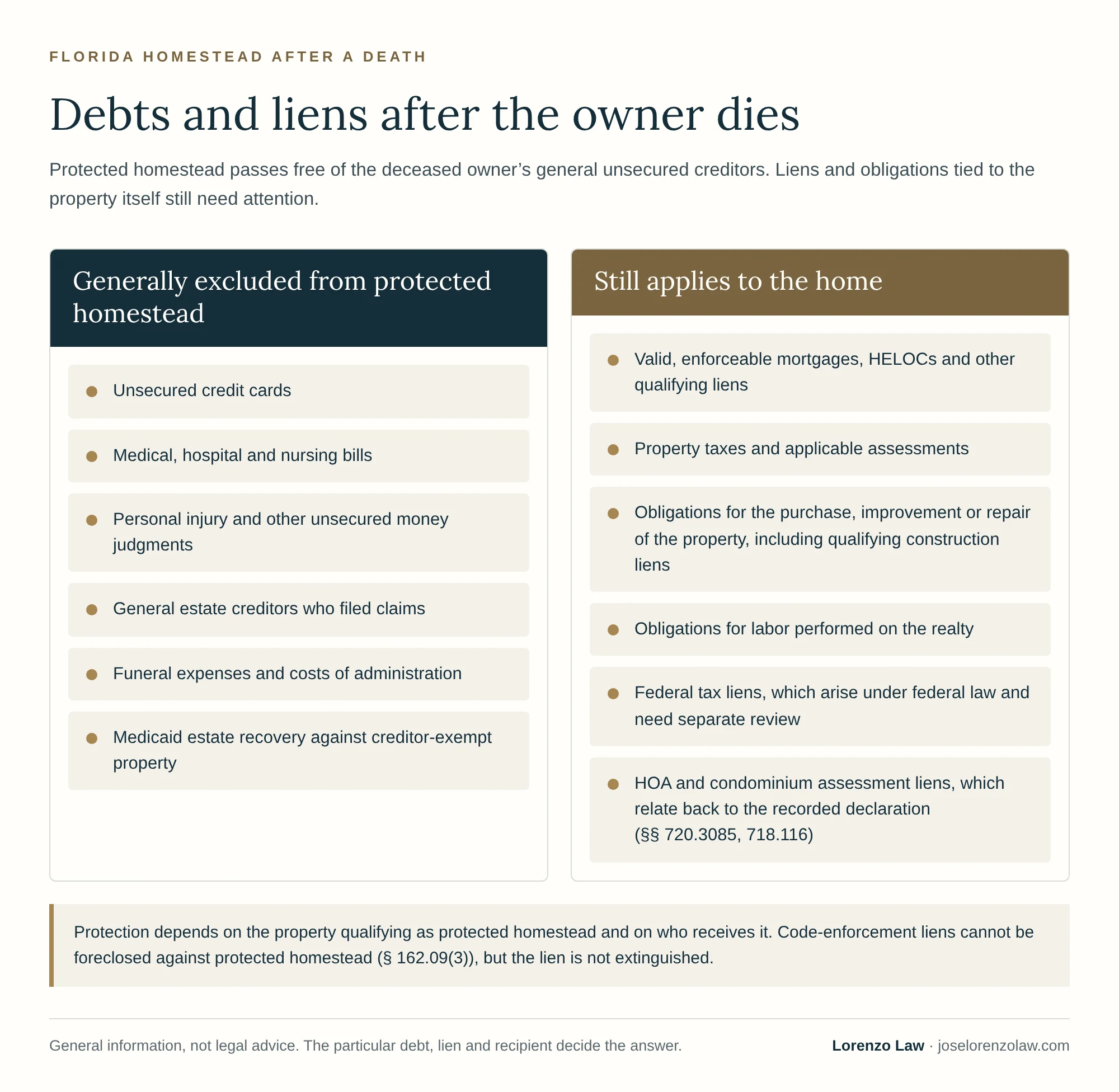
View the “Debts and liens after the owner dies” chart (zoom in to read; the details are also in the text above).
Protected homestead is not charged with funeral bills, attorney’s fees or costs of administration in the ordinary course. Section 733.608(1) makes every asset except protected homestead available for claims and expenses, and § 736.1109(2) provides that a general power of sale, or boilerplate directing payment of “debts, expenses and claims,” does not by itself pull homestead into that pool. Code-enforcement liens are not among the three constitutional exceptions and cannot be foreclosed against protected homestead (§ 162.09(3) says so expressly); recording the order does not cloud homestead title, but the lien is not extinguished and becomes enforceable if the property loses homestead status, so identify them early. Miskin v. City of Fort Lauderdale, 661 So. 2d 415 (Fla. 4th DCA 1995). IRS debt after death is different, even with no estate opened: a federal tax lien arises under federal law, and Florida homestead protection does not by itself resolve it, so have any federal tax lien reviewed before a sale.
Can Creditors Force the Sale of Homestead in Florida?
Not for an ordinary unsecured debt of the deceased owner, which is the short answer when families ask whether creditors can take an inherited house in Florida. The question arises when a judgment creditor has recorded a certified copy of a judgment, creating what people call a Florida judgment lien on homestead property. Recording does not give that creditor a right to force the sale of protected homestead, but the judgment sits in the chain of title, which is why it has to be addressed before a title company will insure a sale.
Homestead Protection Passing to Heirs After Death
Homestead protection passes to qualifying heirs. The homestead “descends directly to the spouse or heirs free and clear of creditor’s claims,” regardless of dependency, Public Health Trust of Dade County v. Lopez, 531 So. 2d 946, 951 (Fla. 1988) (footnote omitted). A child who inherits a remainder generally takes it free of the parent’s credit card debt. Two limits deserve honesty. Section 4(b) shields the property from the decedent’s creditors; whether it also shields it from an heir’s own creditors is a separate question that turns on that heir’s own circumstances, including whether the heir owns and occupies it as the heir’s own homestead.
Separate a homeowner’s lifetime sale from a sale after protected homestead has vested in qualifying heirs. The conditions for protecting lifetime-sale proceeds against that seller’s creditors are not a universal reinvestment requirement for heirs seeking protection from the deceased owner’s creditors. A specific sale direction in a will or trust and the actual recipient can change the result. The proceeds section explains the distinction. For how creditors are handled in the rest of the estate, see Florida probate creditor claims and whether heirs inherit debt in Florida.
The Mortgage the Heirs Inherit Along With the Homestead
A mortgage on inherited property in Florida survives as a lien on the property. Protection never applied to a lien the owner voluntarily granted, so a mortgage on the homestead stays enforceable after death, and the lender can foreclose if the payments stop. Distinguish the lien on the home from personal liability on the loan: heirs who did not sign the note are not ordinarily personally liable for it, but someone has to keep the loan current to keep the house. Federal law, 12 U.S.C. § 1701j-3(d), limits enforcement of due-on-sale clauses for specified transfers of covered residential property, including a transfer to a relative resulting from the borrower’s death. The protection depends on the transfer and the loan; check the documents and contact the servicer rather than assuming every inheritance prevents acceleration.
In Florida, a reverse mortgage may become due after the borrower’s death, subject to its terms and applicable protections, including any eligible surviving-spouse provisions. Contact the servicer promptly.
Can Medicaid Take Your House in Florida? What § 409.9101 Actually Says
Protected homestead is usually safe from Medicaid estate recovery, but say it carefully. Section 409.9101(3) creates a debt for medical assistance paid after age 55. Subsection (6) restricts enforcement while the decedent is survived by a spouse, a child under 21, or a blind or permanently and totally disabled child. Subsection (7) bars enforcement against property exempt from creditors’ claims under Florida law, which is what generally protects homestead. So the protection comes from the property’s exempt character, not from a blanket immunity. If the home lost that character, the analysis changes. This is not a statement about Medicaid eligibility, transfer penalties, other property or every medical debt. People also ask about a Medicaid estate recovery time limit in Florida; for protected homestead, the exempt character of the property is what generally matters, not a filing deadline, while claims against other estate property follow the probate claims process and need their own review. Planning aimed at avoiding Medicaid estate recovery in Florida involves eligibility and transfer rules that this page does not cover.
The Personal Representative’s Lien Under § 733.608
Florida Statute 733.608(2) authorizes limited protective possession when property reasonably appears to be protected homestead and is not occupied by a person who appears to have an interest. Qualifying expenditures or obligations under subsection (3) can support a lien; this is not blanket authority to charge heirs for every estate expense. Recording, notice, adjudication and enforcement requirements apply.
- Priority comes from recording. Under § 733.608(4), the lien takes priority as of the date and time a notice of lien is recorded in the official records, not when the money is spent.
- No personal liability for the preservation debt. The interest holders are not personally liable for it; the lien runs against the property, subject to the statute’s provisions on enforcement and offsets.
- It ends. Under § 733.608(5), it terminates on the earliest of the events the statute lists, including a recorded satisfaction, the personal representative’s discharge, one year from recording unless a proceeding to determine the debt or enforce the lien has been filed, or a court order releasing it.
- Sale proceeds. Section 733.608(12) provides a court-supervised mechanism for transferring the lien to proceeds or holding funds in escrow when the property is sold.
A personal representative’s advance does not automatically become an enforceable lien without the statutory conditions. A representative who records and then does nothing can lose the lien.
Petition to Determine Homestead in Florida (Probate Rule 5.405)
A petition to determine homestead status of real property asks the Florida probate court to determine whether the decedent’s property, or part of it, was protected homestead and, if so, to identify the persons entitled and define their interests. Florida Probate Rule 5.405 permits an interested person to petition; it does not declare an order mandatory for every transfer. A title examiner or insurer may require the order and additional evidence before a sale or refinance.
The order determining homestead status turns a conclusion that already exists into a document a title examiner can read. Florida provides one procedure for determining homestead status in probate, and it is the petition under Rule 5.405, published in the current Florida Probate Rules (see The Florida Bar’s rules index).
Read this before you file. The proceeding is permissive. Fla. Prob. R. 5.405(a) says an interested person may petition, and the Fifth District put it plainly while deciding a partition dispute: “proceedings to determine whether a property is homestead are permissive, not required.” Mullins v. Mullins, 274 So. 3d 513 (Fla. 5th DCA 2019). Title passed at death under Art. X, § 4 and § 732.401(1); the court transfers nothing. In practice, the reason families file is usually the transaction: a homestead determination is a common way to document status and ownership, and the title examiner or insurer may require one based on the deed, family facts, liens and transaction. Obtain the actual requirements early. The order does not guarantee marketable or insurable title.
In re Estate of Hamel, 821 So. 2d 1276 (Fla. 2d DCA 2002), describes the proceeding as declaratory, with the function of changing record title or releasing the personal representative. If the house stays in the family, unencumbered and undisputed, an order may be optional. If it is to be sold, mortgaged or fought over, discuss it early.
What Is an Order Determining Homestead?
An order determining homestead in Florida is the court’s order deciding whether the described property, or part of it, was protected homestead and, if so, naming the persons entitled and defining their interests. It is a final, appealable order. A title examiner may require it and additional evidence; it is not a universal title guarantee or a substitute for resolving every lien.
Filing a Petition to Determine Homestead Status
Any interested person may file: the surviving spouse, an heir or devisee, the personal representative or a remainderman. The rule also reaches property titled in the trustee of a § 733.707(3) trust where the deceased settlor was treated as owner under § 732.4015, so a revocable trust is not beyond its reach. In practice, the petitioner is usually whoever needs title documented.
The Ten Things the Verified Petition Must State
Rule 5.405 requires a verified petition stating:
- The petitioner’s interest in the determination of protected homestead status for the real property.
- The decedent’s date of death.
- The county of the decedent’s domicile at the time of death.
- Whether the decedent died testate or intestate.
- Whether a spouse survived and, if so, the spouse’s name, whether the spouse waived homestead rights and, if so, the method of waiver.
- The names of surviving descendants, and whether the decedent had any minor children as of the date of death, identifying them by name and year of birth.
- A legal description of the property owned by the decedent on which protected homestead is claimed.
- Whether the property was the decedent’s domicile, and if not, whether it was within a municipality and the domicile of a family member.
- How the real property was titled at the time of the decedent’s death.
- Any other facts in support of the petition.
Items 5, 6 and 9 are the ones older forms miss. “The spouse waived” is not enough; plead how, by a § 732.702 marital agreement or a § 732.7025 deed waiver. Item 9 catches the title trap, since entireties and joint-tenancy property is not protected homestead under § 731.201(33) at all. Use the current Probate Rule 5.405. Its text was last amended effective October 1, 2025, adding the testate-or-intestate allegation and the spouse’s method of waiver; the 2026 revision changed only the committee notes. If you are working from a homestead petition form you downloaded, confirm that it carries those allegations.
Formal Notice, and Why It Is Not an Emailed Copy
In Florida probate, interested persons are served by formal notice under Fla. Prob. R. 5.405(c) and Rule 5.040. Use the required formal notice procedure and address any legally effective waiver or consent; do not substitute an ordinary emailed copy. A homestead determination is only as reliable as the service behind it, which is one reason a title examiner looks at who was served.
What the Order Must Contain
The order must describe the property, determine whether all or any part of it was protected homestead, and if so name the persons entitled and define their actual interests—for example, a spouse’s life estate and descendants’ remainders when those are the interests established. “The property is homestead” is not enough.
Testate Versus Intestate Homestead Petitions
The testate petition and the intestate petition differ in what the court has to decide. The intestate petition applies the descent rules to the survivors. The testate petition adds a step, because the court must first decide whether the devise was valid under Art. X, § 4(c) and § 732.4015. If not, the property descends under § 732.401(1) as if there were no will. Ballard v. Pritchard, 332 So. 3d 570 (Fla. 2d DCA 2021). It must also address whether the devisee is an heir: homestead devised to an heir passes outside the estate, Lanford v. Phemister, 338 So. 3d 1049 (Fla. 5th DCA 2022), while homestead devised to a non-heir falls under the personal representative’s control, In re Estate of Mahaney, 903 So. 2d 234 (Fla. 2d DCA 2005).
Homestead Determinations in Summary Administration
A homestead determination can be requested in a summary administration, with the required homestead allegations and notice. Current section 735.201 uses a $150,000-or-less value test after the statutory exclusions, or a separate more-than-two-years route, together with the will condition. Qualifying protected homestead is excluded from that calculation. Earlier deaths and the appropriate procedure still need review; the amount alone does not answer every eligibility question.
The court’s reach has a limit. Under Ford v. Ford, 581 So. 2d 203 (Fla. 5th DCA 1991), it has no authority over property the decedent did not own at death, and the court added that “the Probate Rules are not a substitute for declaratory judgment actions or quiet title suits.” Property held in the decedent’s own revocable trust is treated differently, because § 732.4015(2)(a) treats the grantor as the owner and Rule 5.405 reaches trust property on those terms. Ford involved an unchallenged lifetime conveyance where the petition itself denied any ownership at death.
Homestead Orders and Selling the House in Florida
A Rule 5.405 homestead determination is not required before every sale; the proceeding is permissive. Separate court approval can still be required, for example to convey a minor’s interest. Title already vested in the persons entitled, and Clifton says no personal representative’s deed is required. Whether the buyer’s title insurer needs an order is a transaction question. Without one, the examiner may ask for every potential heir to join the deed, plus affidavits, death records and other evidence; with one, the order names the owners and their interests. Ask the title company for its written requirements before choosing a closing date.
Timing of a Homestead Determination in Florida
Timing depends on complete title and family information, notice, the court’s calendar and any dispute or need for additional representation. Rule 5.405 sets no fixed completion time. An upcoming closing does not ensure an expedited order; discuss the actual requirements before choosing a closing date.
Deadlines, Appeals and Finality
Rule 5.405 does not state a general filing deadline for the homestead petition itself. Other deadlines, existing orders, notice, elections, claims and title issues may affect what relief remains available. Do not assume waiting is harmless.
- The order is final and appealable under Fla. R. App. P. 9.170(b)(13). See Anderson v. Estate of Quintero, 374 So. 3d 67, 71 n.5 (Fla. 3d DCA 2022), noting in a footnote that the rule “expressly provides for appellate review of orders that determine the homestead status of real property.”
- Rehearing and rendition. Under Probate Rule 5.020(d), a motion for rehearing must be served no later than 15 days after the order or judgment is filed with the clerk, as shown on its face. Appeal timing ordinarily runs from rendition under the applicable appellate rules, and only an authorized, timely motion affects rendition. The 30-day appeal period under Rules 9.110 and 9.020 does not run from the signature date or the date of death. In Dorsey v. Hearns, 433 So. 3d 481 (Fla. 6th DCA 2026), a motion to set aside filed 38 days after the homestead and summary administration orders did not toll rendition because it fell outside the 15-day probate rehearing window, and the appeal was dismissed for lack of jurisdiction.
- Relief from an existing order is limited and depends on the grounds, procedure and time elapsed. Probate Rule 5.025 determines when a matter is adversary and the civil rules apply. Where Florida Rule of Civil Procedure 1.540(b) applies, a motion based on mistake, newly discovered evidence or fraud must be made within a reasonable time and no more than one year after the order; other grounds are not automatically available at any time. In Steele v. Brown, 197 So. 3d 106 (Fla. 1st DCA 2016), the trial court vacated a homestead order entered years earlier on a waiver and consent; the First District reversed, holding that the earlier order was a final, appealable order that could not be vacated without a valid basis under Rule 1.540. Get the file reviewed promptly rather than relying on a general rule.
Why Petitions Get Denied
Pleading problems that can lead to denial include an unverified petition; no allegation of how the property was titled at death; “the spouse waived” with no method; minor children not named with birth years; a legal description that does not match the deed; formal notice not served on an heir; acreage over the constitutional limit; or a request that the court authorize a sale, which this rule does not do.
The Notice of Taking Possession of Protected Homestead
Separately, § 733.608(2) lets a personal representative take possession of property that reasonably appears to be protected homestead when it is not occupied by a person who appears to have an interest, and Florida Probate Rule 5.404 governs the notice of taking possession of protected homestead. It authorizes possession for one purpose: preserving, insuring and protecting the property pending a determination of homestead status.
What it does not do matters more. The personal representative is authorized but not required to act, has no duty to rent the property, cannot evict an occupying heir and has no power to sell. Harrell v. Snyder, 913 So. 2d 749 (Fla. 5th DCA 2005), rejected a sale even where the will authorized disposing of “all or any part of the assets of the estate.”
Where to File a Petition to Determine Homestead: Florida Counties and Circuits
The petition is ordinarily filed within the decedent’s probate file, most often a summary administration; a full formal administration is not required, because homestead rights vest at death and the proceeding confirms them. It reaches only homestead real property the decedent owned at death. Venue for the probate proceeding is governed by § 733.101, generally the county where the decedent was domiciled. The surviving spouse’s election, by contrast, is recorded in the official records of the county or counties where the property is located. Each clerk and division sets its own checklists and submission practices, and some publish homestead-specific materials.
The firm guides are Lorenzo Law’s own explanations of local practice, not official court publications. Clerk and division materials change; confirm them directly before filing, and check the date on any checklist or worksheet. Lorenzo Law handles homestead petitions statewide.
Homestead Petition Forms: Why a Downloaded Packet Is Risky
People often search for a petition to determine homestead Florida form or a sample order. Some circuits publish their own, and they differ: testate and intestate versions, local worksheets and different submission rules. A packet from one county may not match another county’s requirements, and an older one may predate the testate-or-intestate and waiver-method allegations added in 2025.
The bigger risk is what a form cannot do. A form does not decide whether the house was protected homestead, whether title was held in a way that takes it outside the rule, whether a will’s devise was permitted, who must receive formal notice, or how the order must define each person’s interest so a title examiner can act on it. A petition is verified, so the person who signs it is swearing to those facts. Use the official resources for your county, and get advice before signing.
What to Gather Before Filing
- The recorded vesting deed with the exact legal description
- The death certificate, and the will, codicils and any trust
- The property appraiser’s record showing exemption history
- Names and addresses of the spouse and every descendant, birth years for any child under 18, and information on any child who died first
- Any prenuptial or postnuptial agreement, or a deed with waiver language
- Any recorded spouse’s election or existing probate orders
- A title search showing mortgages, judgments, HOA and code liens
- A survey or plat if the acreage limits are in play
- Evidence of residence when status is uncertain, such as where the owner lived, voted and received mail
- The title commitment or contract, if a sale or refinance is underway
- The probate case number, or a plan to open the estate
- Your own role: spouse, heir, beneficiary, fiduciary or co-owner
This is preparation, not a requirement to have a complete file before you call, and not something to upload through a public contact form.
Selling an Inherited House in Florida: Clearing Title on Homestead
A homestead sale requires establishing the actual owners, the nature of their interests and the authority of the people signing. A personal representative’s ordinary power over estate assets does not itself authorize sale of protected homestead. The transaction may require a homestead determination, appropriate owner or authorized representative signatures, lien resolution and additional court proceedings for a minor or incapacitated owner.
Title vests at death, but the records still show a deceased owner, and that is what stalls a closing. Clifton v. Clifton, 553 So. 2d 192 (Fla. 5th DCA 1989), holds that homestead passes outside probate and that no order of distribution and no personal representative’s deed are required to pass title. What remains is proving to a stranger who now owns it. Clearing title to homestead property means documenting three facts for the buyer and the lender: the death, that the property was protected homestead, and a complete named list of the people who took it, with their interests.
Families who want to sell an inherited house in Florida should first sort out which kind of property it is. Selling homestead property in Florida, including while a probate case is open, is done by the people who inherited it once their ownership is documented. Selling inherited property in Florida that was not the owner’s homestead follows a different path: in a Florida probate sale of real property, the personal representative may be able to sell under a power of sale in the will or with court authority under § 733.613, and the proceeds belong to the estate. See selling a house during probate.
Can a Personal Representative Sell Florida Homestead Property?
The office of personal representative alone does not confer authority to convey protected homestead. Separate ownership or legally granted authority must be established. Section 733.607(1) excludes protected homestead from the property the personal representative takes possession of, and § 733.608(1) excludes it from the assets in the personal representative’s hands. Section 733.608(2) allows limited possession of unoccupied homestead, but only to preserve, insure and protect it. In Harrell v. Snyder, 913 So. 2d 749 (Fla. 5th DCA 2005), that possession carried no power to sell even though the will authorized the personal representative to dispose of “all or any part of the assets of the estate.” The clause did not reach the home because the home was never an estate asset.
What the Title Company May Require
Title examiners do not insure assumptions, and title insurance on inherited property in Florida turns on what the record shows. Requirements vary with the deed, the family and the transaction, but a probate closing involving homestead commonly involves:
| What the examiner may ask for | Why |
|---|---|
| An order determining protected homestead under Fla. Prob. R. 5.405 | It identifies by name the persons entitled and defines each interest |
| Proof of formal notice on all interested persons | The order is only as reliable as the service behind it |
| A recorded § 732.401(2) election, or proof that no spousal interest remains outstanding | A life estate or elected one-half interest must be accounted for |
| Identification of any minor or incapacitated owner’s interest and the legal authority needed to convey it | A parent cannot convey a child’s vested real-property interest merely by signing as the parent |
| A deed executed by the owners or persons legally authorized to convey their interests | Only they hold title |
| Resolution of recorded mortgages, judgments, association and code claims, including payoff, release or evidence establishing that a claimed lien does not attach | The title examiner must address the actual encumbrances and apparent title defects; a homestead order does not resolve every issue |
The insurer must also resolve the transaction’s other requirements and exceptions. Ask for the title commitment early. Marketable title does not come from the vesting itself; it comes from a record showing who the vesting benefited.
How to Get Homestead Out of a Deceased Owner’s Name in Florida
A Florida homestead transfer at death happens by operation of law; what the family needs is a public record that shows it. That is the real answer to how to remove a deceased person from a deed in Florida: a new deed alone does not do it, because the record has to show who owns the property now. The usual routes are:
- An order determining homestead status of real property in Florida. Any interested person may petition under Fla. Prob. R. 5.405, serving interested persons by formal notice. The proceeding is permissive under Rule 5.405(a), Mullins v. Mullins, 274 So. 3d 513 (Fla. 5th DCA 2019), and its practical purpose is to change record title or release the personal representative, In re Estate of Hamel, 821 So. 2d 1276 (Fla. 2d DCA 2002).
- Summary administration. If the estate qualifies, this procedure can be used alongside the appropriate homestead determination. The current amount is $150,000 or less after the statutory exclusions, with a separate route for deaths more than two years ago and a condition concerning the will’s direction of administration. The summary administration guide explains the July 1, 2026 amendment and the review needed for earlier deaths. Neither the value test nor a summary order automatically resolves a disputed homestead or every title requirement.
- Affidavits of heirship. Some title insurers will accept them in some transactions; others will not, particularly where a spouse survived or descent runs through a predeceased child. Ask before relying on one.
A quitclaim deed transfers the signer’s existing interest; it does not independently establish heirship or cure missing interests. A valid family conveyance can be useful once the owners are known, but a set of quitclaims among relatives cannot prove who the heirs are if the family’s belief about heirship is wrong. See what a quitclaim deed transfers and removing a deceased owner’s name from a deed.
Who Signs the Deed to the Buyer
The owners or persons legally authorized to convey their interests. A surviving spouse holding a life estate signs, and so does every remainderman, because neither interest alone conveys the whole fee. A married heir’s own spouse may need to join if the property is that heir’s homestead, and the § 732.7025(2) devise waiver does not waive the joinder requirement for a sale, mortgage or gift. In the ordinary case of adult owners, the court is not asked to approve the sale itself; the order is obtained to document ownership for the title company. A minor, guardianship or partition case is different.
A minor’s remainder can require a guardianship or other appropriate court-authorized procedure before the interest can be conveyed. Identify the required authority before committing to a closing date, and expect the court to supervise the minor’s share of the proceeds.
Carrying Costs, Insurance and a Closing Already on the Calendar
The people who inherited the house generally carry it: the mortgage payments needed to avoid foreclosure, taxes, association dues and insurance. Distinguish obligations secured by the home from personal liability on a loan. A personal representative who advances qualifying funds to preserve or insure the property may obtain a lien under § 733.608, with priority from the date a notice of lien is recorded under subsection (4), and the interest holders have no personal liability for that preservation debt. Vacancy is the quiet risk: check the insurance policy and the loan terms. A reverse mortgage may become due after the borrower’s death, subject to its terms and applicable protections, including any eligible surviving-spouse provisions; contact the servicer promptly.
If a contract is signed and the order is not in hand, the buyer may agree to extend, the parties may close with proceeds escrowed pending the order where the title insurer agrees, or another arrangement may be possible. A deed from fewer than all of the owners conveys only the signers’ interests, which is rarely what a buyer’s contract calls for.
Are the Sale Proceeds Protected?
Proceeds are not automatically exempt, because cash is not real property, and the answer depends on whose creditors are asking, when the sale happened and what any will or trust said. For an owner selling during life, the rule comes from Orange Brevard Plumbing & Heating Co. v. La Croix, 137 So. 2d 201 (Fla. 1962): the seller must hold an abiding good-faith intent, formed before and existing at the closing, to reinvest in another homestead within a reasonable time; the money must be kept separate and not commingled; and only the portion actually intended for reinvestment is exempt. There is no fixed deadline. In JBK Associates, Inc. v. Sill Bros., Inc., 191 So. 3d 879 (Fla. 2016), placing the proceeds in a separately titled, non-speculative investment account kept apart from other funds, and actually used to buy a new homestead within a reasonable time, did not destroy the exemption. Heirs selling an inherited homestead are in a different position.
| What happened | Whose creditors | Are the proceeds protected? |
|---|---|---|
| The owner sold during life | The selling owner’s creditors | Only on the La Croix conditions above |
| A will or trust specifically directed that freely devisable homestead be sold and the proceeds put into the general estate | The deceased owner’s creditors | A specific direction to sell freely devisable homestead and put proceeds into the general estate can change creditor treatment; construe the actual instrument. Estate of Margarette Price v. West Florida Hospital, 513 So. 2d 767 (Fla. 1st DCA 1987). A general power of sale or a direction to pay debts is not automatically such a direction. |
| The homestead vested in qualifying heirs at death, and they sold it afterwards | The deceased owner’s creditors | Generally yes, as to the deceased owner’s creditors, without a reinvestment requirement. The heirs’ own creditors are a separate question. |
The last row reflects In re Estate of Tudhope, 595 So. 2d 312 (Fla. 2d DCA 1992). Minor children inherited a mortgaged condominium, could not carry it, and sold it through the personal representative. The deceased owner’s creditors claimed the escrowed proceeds. The Second District reversed, explaining that the homestead estate “was not converted to dollars before it passed to and vested in” the children, and “it is that significant fact which condemns the application of Price and LaCroix to the instant case.”
Lanford v. Phemister, 338 So. 3d 1049 (Fla. 5th DCA 2022), refused to reimburse a personal representative’s fees out of homestead proceeds that passed outside the estate, while treating permitted testamentary-trust expenses differently; it does not support an assurance that every charge against homestead proceeds is forbidden. The practical lesson for planning: have counsel review the proposed disposition and any sale or debt-payment direction before signing the estate plan. The sale process itself, from listing to closing, is covered in our guide to selling a house during probate in Florida.
For Real Estate Agents and Title Professionals
When a listing is an inherited house in Florida that belonged to a deceased owner, ask early how title was held at death, who survived the owner, whether a spouse’s election was recorded, whether any owner is a minor, and whether a homestead determination is already in the court file. Those answers decide who must sign and how long the file may take. The title examiner’s written requirements control the closing; an agent’s or a family’s understanding of who inherited does not. Agents and title professionals with a file in progress are welcome to have the family call to discuss it.
Homestead in Trusts, Lady Bird Deeds and Joint Ownership
A revocable trust does not escape the homestead devise restriction: under § 736.1109, a trust devise that violates the constitution sends title through § 732.401 at death. A properly structured enhanced life estate deed can transfer an interest outside probate, but it should not be assumed to resolve a surviving spouse’s or minor child’s homestead rights or to replace title review. Valid survivorship title follows its own route.
Planning instruments do not repeal the constitution. Art. X, § 4(c), Fla. Const. restricts devise whenever a spouse or minor child survives, unless a valid waiver changes the spouse-based restriction, and a trust, a deed or survivorship title changes the mechanics of transfer. What they do change is whether probate is needed, which is why they come up when people ask how to avoid probate on a house in Florida, and whether the Probate Code’s “protected homestead” rules apply.
How Title Was Held at Death, and What Happens to the Home
| How title was held | How the home generally passes | Homestead devise rules | What to review |
|---|---|---|---|
| Sole name of the deceased owner | By permitted devise or by descent under § 732.401 | Apply if a spouse or minor child survives | Will, family at death, waivers; a homestead determination may be needed for title |
| Tenancy by the entireties (spouses) | To the surviving spouse by survivorship | Not protected homestead under § 731.201(33); § 732.401 does not apply (§ 732.401(5)) | Deed validity, that the marriage continued until death, death records |
| Joint tenancy with right of survivorship | To the surviving joint owner by survivorship | Not protected homestead under § 731.201(33); § 732.401 does not apply | Deed language, severance, who the co-owner is and how the joint title was created |
| Tenants in common | The decedent’s share passes by devise or descent; the co-owner keeps theirs | Can apply to the decedent’s interest | Each owner’s share; the life-estate rule applies to the decedent’s interest, not the whole |
| Revocable trust | Under the trust, if the trust disposition is permitted | Apply: a trust disposition is a devise under § 732.4015(2)(b), and § 736.1109 governs a violating one | Trust terms, family at death, waivers |
| Enhanced life estate (lady bird) deed | To the remainder beneficiaries outside probate, if the deed is effective | Unsettled whether the retained powers bring it within the devise restriction; review the deed, retained powers, family and any waiver | The deed itself, spousal joinder, who the beneficiaries are |
| Irrevocable trust or completed lifetime transfer | Under the instrument | Not a devise if the transferor retained no power to revoke or revest the interest transferred (§ 732.4017) | What was transferred and retained; tax-exemption consequences |
| LLC, corporation or partnership | Through the entity interest, not as real property | An entity cannot hold homestead | Entity documents and the decedent’s ownership interest |
This table is a starting map, not a title opinion. The deed, the instrument and the family facts can change the result, and several of these rows have their own detailed guides linked below.
Trusts and Homestead Restrictions in Florida
A homestead held in a revocable trust is governed by the same rule as a homestead left by will. Section 732.4015(2)(b) defines “devise” to include a disposition by trust of what would be the grantor’s homestead, so funding the house into a revocable trust and leaving it to the children is a devise that fails if a spouse or minor child survives, unless a valid waiver changes the spouse-based restriction. Section 732.4017 marks the boundary: a lifetime transfer of an interest, including into a trust, is not a devise if the transferor retains no power to revoke or revest that interest. A revocable trust retains exactly that power. You can transfer a Florida homestead to a revocable trust, and doing so generally does not cost creditor protection; the settlor generally continues to qualify for the property-tax exemption while living there as a permanent residence. It does not avoid the devise restriction.
Section 736.1109, effective 1 July 2021 and applicable as stated in its subsection (5), supplies the consequence. Where a trust devise violates Art. X, § 4(c), title passes under § 732.401 at the moment of death, outside the trust, by operation of law. Subsection (2) closes another gap: a general power of sale, or a general direction to pay debts, expenses and claims, does not subject protected homestead to creditors or administration expenses. Subsection (4) reaches revocable pour-over trusts under § 733.707(3) and testamentary trusts.
Aronson v. Aronson, 81 So. 3d 515 (Fla. 3d DCA 2012), is the illustration: the life estate and vested remainder arose by operation of law at death, and the successor trustees had no power to sell what the trust no longer held. In Stone v. Stone, 157 So. 3d 295 (Fla. 4th DCA 2014), a failed qualified personal residence trust left the interest reverting and subject to the devise restrictions, the devise surviving only because the spouse had waived. Creditor protection is the friendlier half of the answer: putting the home in a revocable trust generally does not cost you that protection, since the exemption follows the property and § 736.1109(2) refuses to expose it to trust-level debts and expenses. In Schiro v. Elliott, 435 So. 3d 1156 (Fla. 2d DCA 2026), a residence titled in a revocable trust was the settlor’s protected homestead, and the creditor exemption passed to her three adult children at death; the court grounded that result in Art. X, § 4, not in § 736.1109(2). Rely on Stone for the reversion point rather than for its waiver reasoning: the deed there was an ordinary granting clause with no mention of homestead, and the same district later remarked in Thayer that “one may question whether the language in Stone was sufficiently specific to waive homestead.” See living trusts in Florida.
Lady Bird Deeds and the Homestead Problem
A lady bird deed addresses only part of the problem. An enhanced life estate deed, sometimes called a lady bird deed, reserves a life estate plus retained powers to sell, mortgage, lease or revoke without the remainder beneficiaries’ consent, with the remainder passing at death. A properly structured enhanced life estate deed can transfer an interest outside probate, but it should not be assumed to resolve a surviving spouse’s or minor child’s homestead rights or to replace title review.
A lady bird deed should not be assumed to resolve a surviving spouse’s or minor child’s homestead rights. Whether the retained powers bring a particular deed within the devise restriction is unsettled. Section 732.4017 turns on whether the transferor kept a power to revoke or revest the interest transferred, and no Florida appellate court has decided whether a lady bird grantor’s retained power to sell, mortgage or convey is such a power; Stone, the only appellate decision construing the statute, involved a qualified personal residence trust. If the remainder designation is treated as a devise and a spouse or minor child survives, naming someone other than the spouse can fail, subject to any valid waiver, and title then passes under § 732.401 instead. Review the actual deed, retained powers, family circumstances and any waiver before relying on the transfer. A married owner’s conveyance of homestead ordinarily requires the constitutionally required spousal joinder; recording alone does not establish the conveyance’s validity, and the § 732.7025(2) devise waiver does not waive joinder. Our lady bird deed guide covers the instrument, and what the family does after a lady bird deed owner dies covers the transfer.
Survivorship Title, and Adding Children to the Deed
Property held by spouses in tenancy by the entireties, or by any owners in joint tenancy with rights of survivorship, is not “protected homestead” under § 731.201(33), even where it stays creditor-exempt, and § 732.401(5) confirms the life-estate and election rules do not apply to it. A surviving spouse who owned the home with the decedent as tenants by the entireties usually wants to know whether probate is needed; generally it is not, because the survivor already owns the whole. A joint tenancy with right of survivorship between owners who are not married passes by survivorship too, but lacks the entireties’ creditor characteristics. A deed that describes tenants in common with right of survivorship in Florida needs careful reading, because tenants in common ordinarily have no survivorship and the outcome turns on the deed’s exact words.
Adding an adult child can create a present ownership interest and consequences for control, creditors, taxes and later transfer. Review the actual deed and objective first. Whether adding a co-owner affects the Save Our Homes assessment depends on the transfer and on the exceptions in § 193.155(3)(a), including circumstances where an owner retains an interest or a qualifying joint owner continues to qualify.
Finally, Florida has no transfer-on-death deed for real property. Other states allow a revocable beneficiary deed; Florida does not, which is one reason the enhanced life estate deed carries the weight it does here.
Property Taxes, the Homestead Exemption and Save Our Homes After a Death
A deceased owner’s tax exemption and Save Our Homes benefit do not automatically become the heirs’ benefits. Eligibility for the exemption and the effect of a transfer on assessed value must be checked separately. A change of ownership generally triggers reassessment at just value the following January 1, but statutory exceptions can apply, including qualifying spouse, dependent and joint-owner transfers.
Florida’s homestead tax exemption and Florida’s constitutional homestead protection are two different bodies of law. One does not conclusively determine the other; the underlying residence and ownership facts can affect both. A house can be protected homestead in probate with no tax exemption on it, and a house can carry the tax exemption and still fall outside “protected homestead” in probate, for example because it was held in tenancy by the entireties or joint tenancy with rights of survivorship, which § 731.201(33) places outside that definition.
| Feature | Tax exemption (Art. VII, § 6) | Save Our Homes assessment cap | Protected homestead (Art. X, § 4) |
|---|---|---|---|
| Decided by | County property appraiser | County property appraiser | The court, when judicial determination is sought |
| What it does | Reduces taxable value | Limits annual increases in assessed value | Limits forced sale, restricts devise, and passes the home outside the personal representative’s administration |
| Turns on | Ownership and permanent residence on January 1, and an application | Homestead assessment and any change of ownership | Ownership and residence at death, plus who survives |
The 2026 Exemption Figures
For 2026, the base exemption is up to $25,000; the inflation-adjusted additional exemption is up to $26,411 on qualifying assessed value above $50,000 and does not apply to school-district levies. The combined maximum is $51,411 for qualifying non-school levies. See the Department of Revenue’s 2026 adjustment table. That does not mean every tax bill is reduced by $51,411; the result depends on the assessed value and the levies.
What Happens to the Homestead Exemption When the Property Owner Dies?
What happens to the homestead exemption when someone dies depends on who owns and lives in the home next, and property taxes keep accruing in the meantime. The exemption belongs to the person who qualified for it, not to the building. Entitlement is measured as of January 1 each year: the death does not retroactively undo the exemption properly established for the tax year in progress, but entitlement has to be established again for the years that follow. The Florida Department of Revenue’s guidance on this question, “What happens to the homestead exemption when the property owner dies?”, says the property will not receive the exemption in the year following the owner’s death, but that the exemption continues in a surviving spouse’s name if the owner was married, and in a surviving joint tenant’s name where that co-owner previously applied and lives there as a permanent residence. Unpaid property taxes on a deceased person’s home are not cut off by homestead protection; they remain a lien on the property, so keep the tax bill current while ownership is sorted out.
| What people ask | What the law does |
|---|---|
| Homestead exemption after death of the owner | Entitlement is not inherited with the title. The next January 1 is what matters, measured against whoever then owns and permanently resides in the property and has applied. |
| Homestead exemption removed after death | The appraiser removes the exemption once entitlement ceases. Contact the appraiser after the death to confirm eligibility and filing requirements; § 196.011(10)(a) provides notification and re-filing duties where annual applications have been waived. |
Inheriting a Homestead Exemption in Florida: Personal Eligibility
On inherited property in Florida, the homestead exemption does not transfer to heirs as such. The constitutional creditor protection in Art. X, § 4(b) inures to the surviving spouse or heirs; the tax exemption does not. An heir who takes title has to qualify personally under § 196.031, and an heir who lives out of state, or keeps the home as a rental or second residence, will not qualify on that property.
Save Our Homes and the Reset to Just Value
Florida’s Save Our Homes cap, sometimes called the Save Our Homes Act, is implemented in section 193.155(1), which limits the annual increase in assessed value on homestead property to the lower of 3% or the change in the consumer price index, and over twenty or thirty years the gap between assessed and market value can become large. Section 193.155(3) then provides that on a change of ownership the property is reassessed at just value as of the following January 1, subject to statutory exceptions.
Relevant exceptions include qualifying transfers between spouses (including to a surviving spouse), passage by operation of law to a spouse or minor child under section 732.401, transfer at death to a permanent resident who was legally or naturally dependent on the owner, and certain surviving joint owners who were previously entitled to and receiving the exemption and continue to qualify. The statute also addresses retained-owner and specified title changes. The exact transfer and exemption history matter; “a relative inherited” is not enough.
This reassessment after death in Florida is why property taxes on an inherited house in Florida can rise sharply the year after a parent dies. There is no general exception merely because an adult child inherits and moves in. That child may qualify for a new exemption going forward, on a new base set at just value. An adult child is not automatically excluded from the dependent or qualifying joint-owner exceptions, though; the facts decide. A higher tax bill alone does not establish either an error or a correct assessment. Ask the property appraiser to review the specific transfer and any applicable exception.
How to Notify the Property Appraiser of a Death in Florida, and What Happens if Nobody Does
Contact the property appraiser promptly after the death to confirm eligibility and filing requirements. Where annual applications have been waived, § 196.011(10)(a) requires an exempt owner to notify the appraiser of changes affecting exempt status and requires re-filing for the transfers or changes specified in the statute. If an exemption is left in place for an owner who was not entitled to it, § 196.161(1)(b) authorizes a lien for the exempted taxes for up to 10 prior years, a 50% penalty for each year and 15% interest per year, after notice and 30 days to pay. Where the improper exemption resulted from a clerical mistake or omission by the property appraiser, no penalty or interest is assessed; if the owner voluntarily disclosed the problem before the appraiser’s notice, no back taxes are due, and otherwise back taxes reach only the five years before the notice. Exemption recapture under § 196.161 is different from a correction of the assessment limitation under § 193.155(9)–(10). If you have received a notice, have it reviewed promptly rather than calculating a deadline from this summary.
Florida Homestead Exemption Portability and Save Our Homes Portability After a Death
A surviving spouse who keeps owning and permanently residing in the home can keep the existing Save Our Homes benefit, under the spouse exception above. Portability becomes the question later, when that spouse sells and buys elsewhere in Florida: it can let some accumulated benefit move to the next homestead, within statutory limits and on a timely application. A surviving spouse may qualify for portability under the applicable rules. An adult heir does not simply inherit a parent’s portability benefit, but may qualify based on the heir’s own prior homestead and circumstances. Chapter 2026-239 amended the portability provision in § 193.155(8), first applying to the 2027 tax roll, so check the applicable roll before relying on any time window.
Inheritance Tax, Basis and Capital Gains on Homestead Property After a Death
Florida imposes no inheritance tax and no state estate tax, so the inherited property tax Florida heirs actually face is the local property tax, not a tax on inheriting. For federal income tax purposes, inherited property often receives a basis adjustment to its value at the date of death, which matters if the heirs sell, but the adjustment is not automatic in every case: the way title was held, a life estate and remainder, and earlier transfers can change the result. That is why capital gains tax on a deceased parent’s home is often smaller than families expect: capital gains on a house sale after death are generally measured from the date-of-death value, not from what the parent paid, and capital gains on inherited property in Florida follow the same federal rules. Whether any exclusion for the sale of a principal residence after death applies, for example to a surviving spouse, is a question for the tax adviser. Get tax advice before a sale. See the taxes heirs still pay in Florida. None of this changes the homestead analysis above.
Waiving Florida Homestead Rights
A valid waiver can change a surviving spouse’s homestead rights, but the effect depends on its scope, execution and applicable law. A spouse’s waiver does not remove a surviving minor child’s separate devise protection. A deed waiver under section 732.7025 is narrower than a broad marital agreement and does not eliminate creditor protection or required spousal joinder in a conveyance.
A valid waiver of homestead rights can make the surviving spouse the legal equivalent of having predeceased the decedent for purposes of the devise restriction, so the homestead can be left as the will directs. That is the holding of City Nat’l Bank of Fla. v. Tescher, 578 So. 2d 701 (Fla. 1991): a waiver is “the legal equivalent of predeceasing the decedent, for purposes of article X, section 4(c).” Read those last words carefully. A deed waiver under § 732.7025 reaches only the devise restriction; a broad marital agreement under § 732.702 can reach other spousal rights as well. Neither surrenders the creditor protection, and neither helps if a minor child survives, because that child is protected in the child’s own right. Within those limits, a valid waiver is an important planning tool.
Can a Spouse Waive Homestead Rights in Florida?
Yes. Under Hartwell v. Blasingame, 584 So. 2d 6 (Fla. 1991), an adult child cannot step forward and invoke the devise restriction independently, because Art. X, § 4(c) protects two classes, surviving spouses and minor children. Once the spouse validly waived, nobody was left inside the protected class unless a minor child survived. A minor child is protected in the child’s own right and cannot be written out by a spouse’s waiver. A prenuptial agreement is a common place for a Florida homestead waiver; a postnuptial agreement or a deed can also contain one.
Waiver of Homestead Rights Florida Courts Enforce: The Formalities
Under § 732.702(1), a waiver of homestead rights may be made, wholly or partly, before or after marriage, by a written contract, agreement or waiver signed by the waiving party in the presence of two subscribing witnesses. The witness requirement applies to contracts, agreements or waivers signed by Florida residents; an agreement executed by a nonresident is valid in Florida if it was valid where executed. Do not reject an out-of-state agreement merely because it lacks Florida witnesses, and do not assume a Florida resident’s homemade agreement without witnesses works. No consideration is required. Unless the waiver provides otherwise, a waiver of “all rights,” or equivalent language, waives homestead along with the elective share, intestate share, pretermitted share, exempt property, family allowance and preference in appointment as personal representative.
The Disclosure Rule
Section 732.702(2) does not impose its disclosure requirement before marriage; after marriage it requires fair disclosure. A premarital agreement’s enforceability may also involve section 61.079 and other applicable law, including voluntariness and the statutory unconscionability and disclosure analysis. The absence of a disclosure requirement in one provision does not settle every challenge.
Waiver by Deed
Section 732.7025 allows a waiver of the devise restriction in a deed. The statutory safe-harbor sentence is: “By executing or joining this deed, I intend to waive homestead rights that would otherwise prevent my spouse from devising the homestead property described in this deed to someone other than me.” That sentence is what most people are after when they ask whether a spouse can waive homestead in a deed.
Its scope is narrow. Section 732.7025(2) makes clear the deed waives only the devise restriction. It does not waive creditor protection during life or after death, and it does not waive the requirement that both spouses join in a mortgage, sale or gift of homestead.
Deed Language Decides These Cases
Two recent decisions frame the question. In Thayer v. Hawthorn, 363 So. 3d 170 (Fla. 4th DCA 2023), a deed reciting only that the property was “granted, bargained and sold,” with no release language and no conveyance of hereditaments, was not a waiver, because a waiver of a constitutional right must be language that can be “clearly understood as waiving the right.” Note the vintage: Thayer construed a 2002 deed and held the § 732.7025 safe harbor inapplicable to it. Section 732.7025 took effect July 1, 2018; review the deed’s date and language when considering that statutory safe harbor. In Weaver v. Hatfield, 424 So. 3d 545 (Fla. 1st DCA 2025), a release of “all his interest, of whatever kind including any marital or homestead interest,” together with “[a]ll the tenements, hereditaments and appurtenances,” was a valid § 732.702(1) waiver. Between them sits Mendia v. Galvez, 418 So. 3d 838 (Fla. 3d DCA 2025), where a postnuptial agreement plus a quitclaim deed lacking clear waiver language did not waive, because the evidence did not establish intent to waive.
Generic conveyance boilerplate may not be a waiver. Clear language, and the word “homestead,” matter.
Timing, and What a Spouse Should Understand Before Signing
A waiver must precede death. In Feldman v. Schocket, 366 So. 3d 1104 (Fla. 3d DCA 2022), a waiver signed three weeks after the death failed “for a myriad of reasons”: no fair disclosure under § 732.702(2), a statute that contemplates contracting with a living present or prospective spouse and “contains no provision for effectuating waiver after death,” and an interest that had already vested. A post-death disclaimer, conveyance or settlement agreement among the personal representative and the heirs is a different instrument and can still be effective on its own terms.
Before signing, a spouse should understand what is being surrendered: potentially the right to a life estate or an elected one-half interest under § 732.401, the right to occupy the home after the other spouse’s death, and under a broad “all rights” waiver the elective share and family allowance as well. Signing does not by itself create a right to stay in the house or an obligation on the other spouse to leave anything by will.
Homestead Disputes and Litigation
Homestead disputes tend to fall into five patterns: blended-family possession disagreements, waste and carrying-cost claims against a life tenant, partition between co-owners, contested determinations, and disputes over a personal representative’s possession or lien. Many turn on facts that were set long before anyone filed anything.
Much homestead litigation is not about whether the house is homestead. It is about who lives there, who pays for it and who has to sell. For disputes over the estate generally, see Florida probate litigation.
Blended Families: Disputes Between a Surviving Spouse and the Children
Hypothetical: a second spouse holds a life estate under § 732.401(1); the decedent’s children from a first marriage, who are the surviving spouse’s stepchildren, hold the vested remainder as the decedent’s descendants. Neither side can sell the whole alone. The spouse wants to stay, the children want the value, and both sides carry costs. These cases turn on the § 732.401(2) election, on whether a waiver exists, and on whether the parties will buy each other out.
Waste and Carrying Costs
Remaindermen can sue a life tenant who lets the property deteriorate. The claim is waste, and it often arrives as unpaid taxes, a lapsed windstorm or flood policy, or a roof left unrepaired long enough to damage the interior. Before an election is filed for recording, expenses are allocated between life tenant and remaindermen under chapter 738; after an election, the parties hold as tenants in common and share proportionately.
Partition Among Co-Owners
A cotenant may seek partition when available; the result and procedure depend on the interests, defenses and applicable law. Heirs property in Florida is addressed by the Uniform Partition of Heirs Property Act, §§ 64.201–64.214, which can give cotenants a buyout right under § 64.207 before any sale. A life tenant and remainderman do not have the same cotenancy relationship, which is one practical reason a surviving spouse may consider the one-half election under § 732.401(2). Chapter 64 governs a partition action where siblings hold an inherited homestead in undivided shares after an intestate death. A familiar pattern: three heirs on the title, one living in the house, none able to agree on price. See Florida partition actions and disagreements among inherited-home co-owners.
The Heir Living in the House Rent-Free
A co-owner in possession is generally not charged rent merely for occupying jointly owned property; the others usually have to show ouster, meaning they were excluded. What co-owners can do is seek contribution toward taxes, insurance and necessary repairs, seek an accounting for rents the occupant collects from third parties, and file for partition, where those credits are resolved. The personal representative usually cannot help: § 733.607(1) excludes protected homestead from what the personal representative takes possession of, and the § 733.608(2) preservation power applies only where the property is not occupied by someone who appears to have an interest.
Contesting a Homestead Determination
Any interested person may petition under Fla. Prob. R. 5.405, and standing is where these disputes often begin: a stepchild, a creditor and a surviving spouse do not all have the same stake. If you want to challenge a homestead status the court would otherwise take at face value, the verified petition is the vehicle, served by formal notice. The proceeding is permissive, not mandatory, Mullins v. Mullins, 274 So. 3d 513 (Fla. 5th DCA 2019).
Contesting a homestead determination the court has already entered is a different exercise. The order is final and appealable, Fla. R. App. P. 9.170(b)(13); Anderson v. Estate of Quintero, 374 So. 3d 67 (Fla. 3d DCA 2022), and appeal timing runs from rendition, Dorsey v. Hearns, 433 So. 3d 481 (Fla. 6th DCA 2026). Relief from an existing order is limited and depends on the grounds, procedure and time elapsed; see Steele v. Brown, 197 So. 3d 106 (Fla. 1st DCA 2016), and the appeals discussion above.
Invalid Devises and Personal Representative Overreach
A devise of less than a fee to the surviving spouse is invalid, In re Finch’s Estate, 401 So. 2d 1308 (Fla. 1981), and an invalid devise sends the homestead down the § 732.401(1) path instead, Ballard v. Pritchard, 332 So. 3d 570 (Fla. 2d DCA 2021). Personal representatives also overstep. The § 733.608(2) power is limited to preserving, insuring and protecting, and Harrell v. Snyder, 913 So. 2d 749 (Fla. 5th DCA 2005), held it gives no power to sell, even where the will authorized disposing of “all or any part of the assets of the estate.” The § 733.608 lien is likewise constrained: it takes priority only on recording a notice of lien under subsection (4), interest holders have no personal liability for the preservation debt, and it terminates one year from recording unless a proceeding to determine the debt or enforce the lien is filed.
Deeds Signed Late in Life, and Pressured Heirs
Another recurring case is a deed signed in the last months of life, often to one child, sometimes unrecorded until after the funeral. The claims are undue influence, lack of capacity, forgery and, where a spouse’s signature appears, a waiver that does not meet § 732.702(1). Heirs also get pressured into signing away an interest before anyone has told them what it is worth. See contesting a deed in Florida.
Evidence decides these cases: medical records around the signing date, the drafting attorney’s file, notary records where they exist, who drove the decedent to the appointment, and bank and utility records showing residence and intent. Resolution may involve mediation, a buyout, agreed occupancy or a court proceeding. A homestead property attorney adds value mainly by pricing the parties’ real positions before the litigation consumes the equity.
Cost, Timeline and Whether You Need a Lawyer
Counsel can help classify the property, identify the correct parties and procedure, and address the title examiner’s actual requirements. Disputed residence, waivers, minor interests and an imminent closing can make a simple-looking inheritance more complicated. Florida Probate Rule 5.030 requires guardians and personal representatives to be represented, subject to its exceptions; it does not make a lawyer legally mandatory for every interested person who files a homestead petition.
The Rule 5.405 petition is verified, has to plead a specific list of facts including how the property was titled at death and the name and birth year of every minor child, and has to be served on interested persons by formal notice. A personal representative in a formal administration generally must appear through counsel under Rule 5.030, subject to its exceptions. A sole heir is not automatically the sole interested person, and a recommendation to hire counsel is not itself a legal requirement to do so.
How Much Does It Cost to Get an Order Determining Homestead?
There is no standard price. The cost depends on the facts below and the clerk’s filing fees, and Jose quotes the fee for a specific matter in writing before work begins. Facts drive it, not the value of the house: whether a spouse survived and whether a valid waiver exists; whether a minor child survived, which may require a guardianship or other court-authorized procedure before any sale; whether a § 732.401(2) election was recorded; how many descendants there are and whether descent runs through a predeceased child; and whether anyone contests. An uncontested determination among heirs who all agree is usually a modest matter. A contested one is litigation. For how fees are set generally, see Florida probate costs; for the shorter path, see the Florida summary administration guide.
The Fee Base: Why the House May Not Count
State this one carefully, because it is often gotten wrong. The exclusion is mechanical rather than announced. Three provisions chain together. Protected homestead is not an asset in the personal representative’s hands under § 733.608(1). Fla. Prob. R. 5.340(a) therefore directs that it be listed and designated on the inventory without a fair-market value, as reflected in Gaines v. DeWitt, 41 So. 3d 951 (Fla. 2d DCA 2010). And § 733.6171(3) defines the compensable value that drives the presumptive fee schedule as the inventory value of the probate estate assets. An asset carrying no inventory value cannot contribute to that base.
Appellate decisions assume the result without squarely holding it. Estate of Shefner v. Shefner-Holden, 2 So. 3d 1076 (Fla. 3d DCA 2009), describes fees calculated after exclusion of the homestead property. In re Estate of Bryan, 576 So. 2d 344 (Fla. 4th DCA 1991), held that fees computed on an estate value including property later determined not to be an estate asset were unreasonable. Lanford v. Phemister, 338 So. 3d 1049 (Fla. 5th DCA 2022), refused to reimburse a personal representative’s fees out of homestead proceeds that passed outside the estate, while treating permitted testamentary-trust expenses differently; it does not support an assurance that every charge against homestead proceeds is forbidden. Faulkner v. Woodruff, 159 So. 3d 319 (Fla. 2d DCA 2015), is often cited here but answers a different question: it holds the probate court keeps jurisdiction to review the reasonableness of fees paid from homestead proceeds, not that homestead counts in the base.
The same definition governs personal representative commissions. Section 733.617(1)–(2) uses the identical “inventory value of the probate estate assets” formula, and § 733.617(3)(e) lists dealing with protected homestead as an extraordinary service that may warrant additional compensation. Attorney fees run parallel: § 733.6171(4)(i) treats legal advice regarding homestead status, proceedings involving that status and services related to protected homestead as an extraordinary service, which may support additional compensation under the statute, subject to the engagement and applicable review. Statutory presumptions are not a mandatory fee agreement.
A residence that is an ordinary probate asset generally enters the applicable probate inventory and fee calculation. Property passing to a surviving owner by valid tenancy by the entireties or joint tenancy with right of survivorship generally passes outside probate instead. Its exclusion from the Probate Code’s definition of protected homestead does not, by itself, make its value part of the probate fee base. Review the deed and the actual transfer route before calculating fees. No Florida decision squarely holds that protected homestead is excluded from the § 733.6171(3) fee base as a matter of law; this is the reading the statutes and rule support, and it is how the fee question should be presented.
Timeline
Timing depends on complete title and family information, notice, the court’s calendar and any dispute or need for additional representation. Rule 5.405 sets no fixed completion time. For the wider Florida probate timeline, see Florida probate deadlines. An upcoming closing does not ensure an expedited order; discuss the actual requirements before choosing a closing date. Two dates are less flexible than the rest: the § 732.401(2) election period, subject only to the narrow statutory extension, and the time to appeal an order determining homestead, which runs from rendition.
Florida Homestead Property Lawyer: What Jose Handles, and How
Lorenzo Law is a solo practice. Jose M. Lorenzo, Jr. handles Florida homestead matters himself, from the first call through the court’s order, statewide and remotely, in English and Spanish. The initial consultation is free.
If you found this page searching for a probate attorney near me, a probate lawyer near me, an inheritance lawyer near me or a real estate probate attorney near me, location matters less than it seems for a homestead matter. The petition is filed in the county where the decedent was domiciled, consultations can be held by phone, and Jose handles matters statewide. Principal office: Kissimmee, Florida; meetings in Coral Gables and Fort Lauderdale by appointment.
Families looking for a Florida homestead lawyer, a probate real estate attorney or an inherited property lawyer usually need one of a short list of things done. A typical homestead engagement can include:
- Reviewing the deed, will, trust and family facts to classify the property and identify every person with an interest.
- Preparing and filing the verified petition to determine homestead, serving formal notice and following the case to the order.
- Requesting the homestead determination within a summary or formal administration where the estate needs one.
- Advising a surviving spouse on the life estate, the one-half election and its time limits.
- Coordinating with the title company or closing agent on its written requirements for a sale or refinance.
- Addressing a minor’s interest, including the court-authorized steps needed before that interest can be conveyed.
- Handling disputes: partition, waste, possession, contested determinations and late-life deed challenges.
Jose quotes the fee for the specific matter in writing before the engagement begins, and work outside that scope is agreed separately before it starts. For probate services generally, see Florida probate representation.
When to Handle It Yourself and When to Retain a Lawyer
Not every homestead matter needs counsel. Use this as a starting point, not a rule.
| Situation | What to check | Why legal help may matter |
|---|---|---|
| You believe you are the only heir, there are no creditors and nothing is being sold | Whether anyone else holds an interest (a spouse, a minor child, a predeceased child’s children) and how title was held | Rule 5.030’s representation requirement applies to personal representatives and guardians, subject to its exceptions; a sole heir is not automatically the sole interested person |
| A closing is scheduled and the title company wants a homestead order | The title commitment’s written requirements, the deed and the family facts | The petition is verified, pleads ten specific allegations and must be served by formal notice; the order must define each interest |
| A spouse survived and the election period is running | Date of death, title, descendants, any waiver and any existing recording | The election is irrevocable, must be recorded, and the period can be extended only in the narrow way the statute provides |
| The will or trust left the home to someone other than the spouse | Whether a spouse or minor child survived and whether a valid waiver exists | A prohibited devise does not control the initial descent; the statute does |
| Heirs disagree about selling, or someone lives in the house rent-free | Each person’s interest, who pays what, and any ouster | Partition, contribution and possession claims have their own procedures and defenses |
| There are creditors, liens or other beneficiaries | Which debts are secured by the home, which are unsecured, and who the recipients are | Protection depends on the recipient and the debt; liens still have to be resolved |
| The property appraiser has sent a back-tax notice | The notice, the exemption history and whether a clerical-error rule applies | § 196.161 allows back taxes for up to 10 years, a 50% penalty and 15% interest, with different rules for an appraiser’s clerical error |
If you are unsure which row you are in, that is itself a reason to ask. Two calls should not wait: a closing that will not fund, and a spouse’s election period that is already running.
What Changed in Florida Homestead and Probate Law in 2026
The core homestead rules did not change in 2026: the constitution’s devise restriction, the descent rules in section 732.401 and the surviving spouse’s six-month election to take a one-half interest instead of a life estate are the same. What changed are figures and procedures around them, listed below as of October 2026.
- Summary administration threshold. Chapter 2026-57 raised the § 735.201 amount to $150,000 effective July 1, 2026. Protected homestead is excluded from that calculation. Earlier deaths in the former $75,000-to-$150,000 range require review of which law applies.
- Probate rules. Rule 5.405 was last amended in substance effective October 1, 2025, when the petition gained the testate-or-intestate and spouse-waiver-method allegations; the 2026 revision changed only its committee notes. For a homestead petition, use the current published rule, not an older form.
- Exemption amounts. For 2026 the inflation-adjusted additional homestead exemption component is up to $26,411, for a combined maximum of $51,411 on qualifying non-school levies.
- Portability. Chapter 2026-239 amended § 193.155(8), first applying to the 2027 tax roll.
Older guides, forms and agency handouts can still show earlier figures. Check the date and source before relying on any number.
Myth vs. Reality: What Families Get Wrong About Florida Homestead
Homestead questions turn on the property, the family, the transfer documents and the particular protection being claimed. These common misconceptions show why tax benefits, creditor protection and inheritance should be checked separately.
Myth: “Homestead avoids probate, so there is nothing to file.”
Reality: Protected homestead generally passes outside the personal representative’s administration, but the public record still shows a deceased owner. An order may be needed to satisfy the actual title requirements of a sale or refinance; there is no universal insurer rule, so ask for the written requirements early.
Myth: “The tax exemption and homestead protection are the same thing.”
Reality: They are separate constitutional provisions with distinct requirements. The tax exemption comes from Art. VII, § 6 and is applied for with the county property appraiser. The creditor and devise protections come from Art. X, § 4 and arise from ownership, residence and intent. A parent who never filed for the exemption can still own protected homestead at death.
Myth: “The will decides who gets the house.”
Reality: A valid devise does. Only a devise that the surviving spouse or minor child makes impermissible fails, and then the home descends under § 732.401. A valid waiver, survivorship title or a permitted full-fee devise to the spouse can change the result.
Myth: “My children are adults, so I can leave the house to anyone.”
Reality: The devise is unrestricted only where there is no surviving spouse and no minor child. With a spouse and adult descendants, the homestead can be devised to the spouse in full fee, or the spouse’s valid waiver can change the restriction; otherwise the statutory descent rules apply.
Myth: “The surviving spouse inherits the whole house.”
Reality: It depends on the deed first, then on any devise, the descent rules and any waiver. Survivorship title can give the spouse the whole; § 732.401 can give a life estate with the right to elect a one-half interest; a permitted devise or the absence of descendants can produce outright ownership of the decedent’s interest.
Myth: “We can decide later whether to take half the house.”
Reality: The election generally must be made within six months after death and during the spouse’s lifetime, with a narrow statutory extension for a timely petition by an attorney in fact or guardian. It is irrevocable once made.
Myth: “A life estate means the house is mine and I can sell it.”
Reality: A life tenant may transfer the life estate itself. Conveying the whole fee requires appropriate authority for the remainder too. The life tenant also generally carries ordinary recurring expenses under chapter 738, which is why an unaffordable life estate is a real concern.
Myth: “Homestead is protected, so no creditor can touch it.”
Reality: The protection is from the deceased owner’s ordinary unsecured creditors, for qualifying recipients. Valid mortgages, property taxes and assessments, and liens for the purchase, improvement or repair of the property survive. A recipient’s own creditors and sale proceeds raise separate questions.
Myth: “We can sign quitclaim deeds among the heirs and skip probate.”
Reality: A valid quitclaim can convey an existing interest, but it does not establish who all the heirs are or eliminate missing interests. If the family’s belief about heirship is wrong, the defect stays in the chain of title.
Myth: “The personal representative owns and controls the house.”
Reality: Protected homestead is not an asset in the personal representative’s hands under § 733.608(1), and the office alone does not confer authority to convey it. The statute separately allows limited protective possession of an unoccupied home. Ordinary probate real estate is different.
Myth: “We can sell first and sort out probate afterwards.”
Reality: The buyer’s title insurer decides what it needs to insure the sale, and an order may be among its requirements. Starting early avoids a closing that cannot fund.
Myth: “My parent’s exemption and Save Our Homes cap come with the house.”
Reality: The new owner’s personal eligibility matters. A change of ownership generally resets the assessment to just value on the following January 1, but qualifying statutory exceptions exist for certain spouse, minor-child, dependent and surviving joint-owner transfers.
Myth: “Putting the home in a trust or a lady bird deed solves it.”
Reality: It depends on the actual instrument, any waiver and whether a minor child survives. A revocable trust disposition is a devise, and § 736.1109 sends a violating one through § 732.401 at death. An enhanced life estate deed can avoid probate, but whether its retained powers bring it within the homestead devise restriction is unsettled, so it should not be assumed to resolve a spouse’s or minor child’s rights.
Myth: “The nursing home or Medicaid will take the house.”
Reality: Constitutional homestead status, tax-exemption rental rules and Medicaid estate recovery are separate. Section 409.9101 restricts recovery against property exempt from creditors’ claims and while certain survivors are living; that is not a statement about every asset or every situation.
Myth: “Renting it out or moving into care destroyed the homestead.”
Reality: Abandonment turns on intent to return. A temporary absence, including residence in a healthcare facility, does not automatically end homestead status, and the separate tax rules for renting under § 196.061 can produce a different answer. It is fact-specific.
Florida Homestead Probate Glossary
These short definitions match how the terms are used on this page. Several words, including “homestead” itself, mean different things in different parts of Florida law.
- Protected homestead
- A deceased owner’s residence on which the constitutional protection passes to the surviving spouse or heirs under Article X, Section 4(b), as defined in § 731.201(33). Property held as tenants by the entireties or as joint tenants with right of survivorship is not protected homestead under that definition.
- Homestead exemption
- The property-tax exemption under Article VII, Section 6 and § 196.031. It reduces taxable value for an owner who qualifies and applies. It is a separate question from probate homestead status.
- Save Our Homes
- The limit in § 193.155 on annual increases in the assessed value of homestead property. A change of ownership generally resets the assessment to just value on the following January 1, subject to statutory exceptions.
- Devise
- A gift of property by will. Under § 732.4015(2)(b), a disposition of the grantor’s homestead by a revocable trust is also treated as a devise.
- Descent
- How property passes by statute when it is not validly devised, under Florida intestate succession law. For homestead, § 732.401 supplies the result when a devise is not permitted.
- Life estate
- The right to own and use property for the rest of a person’s life. Under § 732.401(1), a surviving spouse takes a life estate in the homestead when descendants survive and no valid devise or effective waiver changes the result.
- Remainder and remainderman
- The ownership interest that takes effect when a life estate ends, and the person who holds it. Under § 732.401(1) the remainder vests in the decedent’s descendants in being at death, per stirpes.
- Election (one-half interest)
- The surviving spouse’s option under § 732.401(2) to take an undivided one-half interest as a tenant in common instead of the life estate, made by filing the statutory notice for recording within the statutory period.
- Tenants in common
- Co-owners who each hold a separate, inheritable share. When one dies, that owner’s share passes by will or descent rather than to the other owners.
- Joint tenancy with right of survivorship
- Co-ownership in which a deceased owner’s interest passes to the surviving joint owner by operation of law, if the title was validly created and not severed.
- Tenancy by the entireties
- A form of ownership available only to spouses. When one spouse dies, the survivor ordinarily owns the property by survivorship.
- Enhanced life estate deed (Lady Bird deed)
- A deed in which the owner keeps a life estate and broad powers over the property and names remainder beneficiaries who take at death outside probate if the deed is effective. Whether its retained powers bring it within the homestead devise restriction is unsettled, so it should not be assumed to resolve a surviving spouse’s or minor child’s rights.
- Petition to determine homestead
- A verified petition under Florida Probate Rule 5.405 asking the court to decide whether property was protected homestead and who received it.
- Order determining homestead
- The court’s order on that petition. It decides homestead status and identifies the persons entitled and their interests. It is a final, appealable order, but it does not guarantee insurable title.
- Personal representative
- The person appointed by the probate court to administer the estate, often called the executor. Protected homestead is not an asset the personal representative administers under § 733.608(1).
- Formal notice
- The method of service required by Probate Rules 5.040 and 5.405(c) for the petition to determine homestead. An ordinary emailed copy is not a substitute.
- Summary administration
- A shortened probate procedure under chapter 735. Protected homestead is excluded from the § 735.201 value calculation as property exempt from creditors’ claims; the threshold is $150,000 for qualifying estates under chapter 2026-57.
- Elective share
- A surviving spouse’s statutory right to a share of the elective estate, a different right from the homestead life estate or one-half election, although Florida’s elective share and homestead laws interact because protected homestead is included in the elective estate. See Florida elective share.
- Waiver of homestead rights
- A spouse’s written waiver under § 732.702 or the deed-based waiver under § 732.7025. A valid waiver can change who receives the homestead at death.
- Partition
- A court action under chapter 64 to divide co-owned property or order its sale when co-owners cannot agree. The Uniform Partition of Heirs Property Act, §§ 64.201–64.214, can add a cotenant buyout before any sale.
- Per stirpes
- Division by family branch. If a child of the decedent has died, that child’s descendants share the deceased child’s portion.
Request a Consultation About a Florida Homestead
Request a free initial consultation with Lorenzo Law about a Florida homestead or probate issue. Have the date of death, county, deed, will or trust, and a family overview available. We can discuss the issue and whether representation is appropriate; any engagement will identify the agreed work and fees. Call (305) 224-6811 or request a consultation. Consultations are available in English and Spanish. Please use the public form for a brief overview rather than sensitive documents or account details.
Call (305) 224-6811 or Request a consultation
Principal office: Kissimmee, Florida; meetings in Coral Gables and Fort Lauderdale by appointment. For estates that need a full administration, see Florida probate representation.
This page provides general information about Florida law as of October 2026. It is not legal advice for any particular situation, and reading it or contacting the firm does not create an attorney-client relationship.
Florida Homestead Probate FAQ
Short answers to common questions about Florida homestead property in probate. Each answer is written to stand alone, and each one is limited by the qualifications in the sections above. More specific questions are answered in the Florida homestead probate FAQ.
Does homestead property have to go through probate in Florida?
Qualifying protected homestead generally passes outside the assets administered by the personal representative. A Rule 5.405 proceeding may still be needed to document status and ownership for the proposed transaction. Valid survivorship title follows a different route. Check the deed and the title examiner’s requirements.
What happens to a homestead house during probate in Florida?
If the home is protected homestead, it is not an estate asset that the personal representative administers or sells to pay the deceased owner’s general debts. Ownership passes at death to the persons entitled under a permitted devise or § 732.401. The personal representative may take limited protective possession of an unoccupied home under § 733.608(2), and a Rule 5.405 order may be needed to document status and ownership for a later sale or refinance. A home passing by valid survivorship title follows a separate nonprobate route. Non-homestead real estate that is an asset of the decedent’s probate estate is administered under the ordinary estate rules.
Who owns the house during probate, the heirs or the personal representative?
The persons entitled to protected homestead own it from the moment of death. The personal representative’s ordinary authority does not include conveying it, and protective possession under § 733.608(2) does not authorize evicting an heir who lives there. A lien for qualifying expenditures under that statute is a separate exception with its own requirements.
Is a petition to determine homestead always required?
No. The Rule 5.405 proceeding is permissive, not mandatory. Whether an order is needed in practice depends on the title examiner’s requirements for a sale, refinance or other transaction, and on whether homestead status or ownership is disputed.
Can I leave my Florida house to whoever I want in my will?
A surviving minor child of the owner restricts devise of homestead. When a spouse survives and no minor child survives, a permitted full-fee devise to the spouse is possible; a valid waiver may affect the spouse-based restriction. With neither a spouse nor minor child, a valid devise can control, but the recipient’s identity still matters for creditor protection.
My dad’s will left me the house. Why might that provision not control?
The deed, homestead status and family circumstances must be checked. A devise that violates the applicable spouse or minor-child restrictions does not control the initial descent; section 732.401 supplies the result. A valid waiver can affect a spouse-based restriction. Later lawful transfers or settlements are separate from validating the original devise.
What happens to homestead when a spouse dies in Florida?
Start with title. Valid survivorship ownership ordinarily passes to the surviving owner. If section 732.401 applies, and the decedent left a spouse and descendants without a valid devise or an effective waiver changing the result, the spouse takes a life estate and the descendants the remainder; a qualifying election can change those interests. Without descendants, the statutory descent result is generally outright ownership of the decedent’s interest by the spouse.
Does a surviving spouse have homestead rights in Florida if not on the deed?
Potentially, yes. If the home was protected homestead titled in the deceased spouse’s name alone, the surviving spouse’s rights at death come from the constitution and § 732.401, not from being named on the deed. Depending on whether descendants survive, any permitted devise and any valid waiver, the spouse may take a life estate with the right to elect a one-half interest, or the decedent’s interest. The deed, the will and any marital agreement should be reviewed.
Does the surviving spouse get the whole house or just part of it?
There is no universal answer. Survivorship title, a permitted devise, statutory descent and waivers can produce different interests. The life-estate/one-half-election rule applies to the spouse described in section 732.401, not to every spouse who survives a homeowner.
How do I elect a one-half interest instead of a life estate?
If eligible under section 732.401(2), the spouse makes the election by filing the statutory notice for recording in the official records of the county or counties where the property is located. It concerns one-half of the decedent’s homestead interest. Merely placing a copy in the probate case is not the statutory recording step. An attorney in fact or guardian needs the required court approval.
What is the deadline for that election?
Generally, within six months after death and during the surviving spouse’s lifetime. Section 732.401(2)(c) provides a narrow extension when an attorney in fact or guardian timely petitions for approval within that period and during the spouse’s lifetime. The election is irrevocable once made. Obtain prompt advice; do not wait for probate to begin or assume a court can excuse delay.
Who pays property taxes, insurance and repairs when a spouse has a life estate?
Before any election, § 732.401(3) applies chapter 738 to allocate expenses between the life tenant and the remaindermen. In general terms, ordinary recurring expenses such as property taxes, insurance and routine maintenance fall on the life tenant, while principal expenditures are classified under separate provisions. After a one-half election, the spouse and the descendants are tenants in common and generally share costs in proportion to their interests. Unusual assessments, major repairs, the actual loan terms and family agreements need individual review.
Can creditors take homestead in Florida probate?
Qualifying protected homestead passing to the spouse or qualifying heirs is generally protected from the deceased owner’s unsecured creditors. Valid mortgages, property taxes, applicable assessments and other enforceable liens or exceptions remain separate issues. An heir’s own creditors and sale proceeds also require their own analysis.
What is an order determining homestead?
It determines whether the described property, or part of it, was protected homestead and, if so, identifies the persons entitled and their interests. The proceeding is permitted by Rule 5.405. A title examiner may require the order and additional evidence; it is not a universal title guarantee or a substitute for resolving every lien.
Can homestead be sold during probate?
It can, when ownership, signing authority and the transaction’s requirements are satisfied. A personal representative’s ordinary estate authority does not itself authorize sale of protected homestead. Owners or legally authorized representatives must convey the appropriate interests; minor or incapacitated ownership may require additional court proceedings.
Do all heirs have to agree to sell?
A voluntary conveyance of the whole property requires authority to convey every ownership interest. If cotenants cannot agree, partition may be available, with procedures and possible buyout rights depending on the facts. A life tenant and remainderman are not ordinary cotenants; do not assume either can force a sale on the same basis.
Can you inherit a homestead exemption in Florida?
Not as such. The property-tax exemption belongs to an owner who personally qualifies. An heir who takes title must apply and qualify under § 196.031 based on the heir’s own permanent residence as of January 1. The Save Our Homes assessment limit generally resets after a change of ownership, subject to statutory exceptions for certain spouse, minor-child, dependent and surviving-joint-owner transfers.
Why did property taxes rise after a parent’s death?
A change of ownership can reset assessed value to just value for the following January 1, and the new owner must establish tax-exemption eligibility. There are statutory exceptions, including qualifying spouse, dependent and surviving-joint-owner situations. An adult child does not preserve the parent’s cap merely by inheriting and moving in. Ask the property appraiser to review the specific transfer and any applicable exception.
Do joint ownership or tenancy by the entireties avoid the homestead rules?
Generally, yes, when the survivorship title is valid. Under § 731.201(33), property held as tenants by the entireties or as joint tenants with right of survivorship is not protected homestead, and § 732.401(5) excludes it from the homestead descent rule, so it passes to the surviving owner. The deed language, how the joint title was created, any severance, and whether a required spouse joined a deed adding someone else all need review.
Does a Lady Bird deed avoid probate on Florida homestead?
A properly structured enhanced life estate deed can transfer an interest outside probate. It should not be assumed to resolve a surviving spouse’s or minor child’s homestead rights: whether the retained powers bring a particular deed within the devise restriction is unsettled, and required joinder, the actual deed and title still need review. See the dedicated Lady Bird deed guide for the instrument’s requirements and limits.
What changed in Florida homestead probate law in 2026?
The core homestead devise and descent rules did not change. Chapter 2026-57 raised the summary administration threshold in § 735.201 to $150,000 effective July 1, 2026, and protected homestead remains excluded from that calculation. Rule 5.405, the homestead petition rule, was last amended in substance in October 2025; use the current published version. The 2026 tax exemption figures and a portability amendment first applying to the 2027 tax roll affect property-tax planning, not who inherits.
About the Author
Jose M. Lorenzo, Jr. is the founder of Lorenzo Law and a Florida probate lawyer whose practice is concentrated in estate administration, probate and trust litigation, wrongful death claims brought by a personal representative, and guardianship. Before entering full-time practice he clerked for the Honorable Maria M. Korvick in the Probate Division of the Eleventh Judicial Circuit Court in Miami-Dade County, and spent nearly a decade as a paralegal at two Miami-area firms. He was admitted to The Florida Bar in 2013 (No. 107002) and is a graduate of Florida International University College of Law.
Authorities Cited on This Page
The probate laws in Florida cited here are the 2026 Florida Statutes and the October 1, 2026 compilation of the Florida Probate Rules. Cases are discussed for the points stated in the text; each turned on its own facts.