
Selling a House in Probate in Florida: Who Can Sign and When a Court Order Is Needed
Selling a House in Probate in Florida: Who Can Sign and When a Court Order Is Needed
Selling a house in probate in Florida is possible while the case is still open, but the first step is to identify who owns the interest being sold and who has authority to sign the deed.
Request a free initial consultation. Only the initial consultation is free; representation fees and costs are agreed separately in writing.
Request a free initial consultationCall (305) 224-6811
Consultations by phone or video in English or Spanish, for a house in any Florida county; meetings by appointment in Coral Gables or Fort Lauderdale. Lorenzo Law’s principal office is in Kissimmee.
Go straight to: Who can sign · Homestead · Court approval · Closing documents · By county · Where the money goes
Selling a house during probate follows one of a few routes. A personal representative appointed by the court sells estate real property under a power of sale in the will or under a court order. The people who inherited protected homestead convey their own interests. A surviving owner, a trustee or another successor may sell outside probate altogether. This guide answers the who-signs question first, then covers the court approval, the documents a title company asks for, timing, costs, taxes, where the money goes and what changes from county to county. With Lorenzo Law, summary administration costs from $3,975 and uncontested formal administration from $7,975, as flat fees. The summary administration fee includes the court filing fee and one certified copy of the order, with additional certified copies charged at the Clerk’s rate; the formal administration fee includes the court filing fee, publication of the notice to creditors and the certified copies the matter needs. Jose does not publish the optional notice to creditors in summary administration, so his fee there includes no publication cost. For either procedure, homestead determinations, more complex estates and contested matters are quoted separately, and other expenses may apply, such as recording fees or the decedent’s debts, and in formal administration a personal representative’s bond if the court requires one and the personal representative’s compensation; any increase is discussed before work begins. Full fee terms: summary and formal administration fees.
By role: if you were named personal representative (executor), start with who has authority to sell; if you inherited the house, with selling as the heir; if the house was your parent’s home, with protected homestead; if a sibling will not sell, with when co-owners disagree; if you live out of state, with selling from out of state; if you are buying, with buying a probate house.
Statewide · Personal representatives, heirs and buyers · Who signs the deed · Court orders · Homestead · Title requirements · By county · Published flat fees
All guide sections 25 sections
Selling a house in probate in Florida at a glance
Short answer. Yes, a Florida house can be sold while probate is open, and often is. Before anyone lists it, find out three things: whether it was the decedent’s home (protected homestead follows a different route), whether the will gives the personal representative a power of sale, and how title was held at death. Those answers decide who signs, whether a court order is needed and where the money goes after closing.
| Can it be sold during probate? | Yes. An authorized sale can close before the estate is finished; the case does not have to end first. When you can sell |
|---|---|
| Estate asset with a power of sale | The appointed personal representative may sell under the will’s power, subject to its terms, any restrictions and fiduciary duties (§ 733.613(2)). Authority to sell |
| Estate asset without a usable power | The personal representative may sell, but title does not pass until the court authorizes or confirms the sale (§ 733.613(1)). Court approval |
| Protected homestead | Not an ordinary estate asset. The people entitled to it convey their own interests; a court order determining homestead usually identifies them for the title company. Homestead |
| Outside probate | A surviving joint owner or spouse, a successor trustee, a remainder beneficiary under a valid enhanced life estate (Lady Bird) deed, or an entity’s authorized signer may sell without an estate sale. Title routes |
| Co-owners who disagree | No co-owner can sell another owner’s interest alone. A buyout or partition is a separate route. When co-owners disagree |
| Creditor period | It usually holds back the distribution of the money, not the buyer’s closing, when the sale is made with the right authority. What the claims period delays |
| Where the case is filed | Generally in the county where the person who died was domiciled, which is not always the county where the house is. By county |
| Lorenzo Law’s flat fees | Flat fees for summary and uncontested formal administration; ancillary quoted per matter. Costs |
Probate is a legal procedure that happens to include a real estate transaction, not the other way around. A mistake about homestead, creditor notice or the source of authority can cloud the title, stop the closing or expose the personal representative to a claim. Most sale problems are avoidable when the route is settled before a listing agreement or contract is signed. Lorenzo Law handles the probate side of the sale; the closing itself and the title insurance policy come from the title agent or closing attorney chosen for the transaction.
Start here: three questions that decide who signs
Before you interview a real estate agent, answer three questions, in this order: was the house the decedent’s home, does the will contain a power of sale, and how was title actually held at death? No single answer settles the route on its own. A “yes” to the power-of-sale question does not override a homestead answer or a deed that already passed title to someone else.
Was the Florida house the decedent’s home?
If the house was the decedent’s home, investigate protected-homestead status before treating it as an estate asset. Residence is the starting fact, not a complete legal answer: ownership, the constitutional limits, who is entitled to inherit, whether a spouse or minor child survived, and the will can all change the result. A property-tax homestead exemption on the tax bill is evidence of residence, not proof of probate homestead. The detailed rules are in the guide to Florida homestead and probate.
The distinction matters because sections 733.607(1) and 733.608(1), Florida Statutes, exclude protected homestead from the property the personal representative takes into possession and administers as estate assets. That one exception changes who signs the deed. See protected homestead.
Does the will give the personal representative a power of sale?
If the will gives the personal representative a specific power to sell or mortgage real property, or a general power to sell any asset of the estate, section 733.613(2) lets the personal representative sell real property of the estate without authorization or confirmation of court. That power applies to real property that is subject to administration. The personal representative must first be appointed, and the actual wording of the power, any court restrictions and any conflict of interest still have to be reviewed. A general power of sale does not convert protected homestead into an estate asset.
If the will is silent, the decedent died without a will, or the power is so limited that it cannot conveniently be used, section 733.613(1) applies: the personal representative may sell, but no title passes until the court authorizes or confirms the sale. Read the will before the house is listed. If there is no will, the inheritance rules in probate without a will decide who the heirs are.
How was title to the Florida house held at death?
Pull the most recent recorded deed. The way title was held at death may mean the house never needs an estate sale. If the deed is in the decedent’s sole name, determine the succession route and homestead status and the court documentation needed to show who has authority to sell. If it was held some other way, the title routes outside an estate sale may apply, each subject to the validity of the instrument, the actual vesting, the governing document’s terms and any spouse, minor or title issue that remains.
Title routes outside an estate sale
How to transfer property after death in Florida starts with the deed. Joint tenancy with right of survivorship in Florida, tenancy by the entirety, a trust, an enhanced life estate (Lady Bird) deed and an entity can each move title to a successor who sells, without a personal representative’s sale.
| How title was held | Who may sign | What to check before selling | Read next |
|---|---|---|---|
| Decedent’s sole name | Depends on the route: the personal representative for an estate asset, the people entitled to protected homestead, or the distributees named in a summary administration order | Homestead status, the will, appointment and letters, any court order needed | Authority to sell |
| Joint tenancy with right of survivorship | The surviving joint owner or owners | That the deed created survivorship; the death certificate recorded for the title chain | Right of survivorship |
| Tenancy by the entirety (married couple) | The surviving spouse | That the couple was married when they took title and still married at death | Surviving spouse rights |
| Revocable trust | The successor trustee, under the trust’s terms | That the house was deeded to the trustee; the trustee’s powers; homestead and spouse issues, which a trust label alone does not remove | Non-probate assets |
| Lady Bird (enhanced life estate) deed | The remainder beneficiaries named in the deed | That the deed is valid and recorded, who survived, and any spouse or minor-child homestead issue | Lady Bird deed after death |
| A deed labeled “transfer-on-death” | Needs legal review; Florida has no transfer-on-death deed statute for real estate | Whether it operates as an enhanced life estate deed or another valid conveyance | Florida transfer on death deed |
| An LLC or corporation | The entity’s authorized signer | Who controls the entity after the death; the membership interest or shares may or may not need probate | Which probate |
This table identifies issues to resolve; it does not determine title, replace a court order or promise that a title company will insure the sale.
Who may sign for this Florida house: five steps
Gather the deed, the will and any court orders first, then answer the three questions above. Being an heir, being named executor in a will, paying the expenses or agreeing on a price does not by itself give anyone authority to convey everyone’s interests.
- Does the deed show a valid route outside ordinary estate administration? A surviving owner, a trustee, a remainder beneficiary under a valid enhanced life estate (Lady Bird) deed, or an entity’s authorized signer may be the seller. Verify the instrument, the succession and every interest. If the route is disputed or unclear, resolve it before anyone commits to a sale.
- Could the house be protected homestead? Review residence, ownership, family circumstances and the will. If protected homestead passed to heirs or devisees, identify each person’s actual interest. The personal representative’s ordinary estate sale power does not substitute for those ownership interests. If the status is uncertain, get it reviewed rather than assuming the house is an estate asset.
- Is the house an estate asset administered by a personal representative? Confirm the appointment, the letters, the will and any restrictions. A usable power in the will may permit a sale under section 733.613(2); intestacy, no power or an inconveniently limited power brings in the court authorization or confirmation required by section 733.613(1). Conflicts of interest, contracts the decedent signed before death and special orders need separate review.
- Was the house assigned by a summary administration order? Read the order and the persons and interests it assigns. Summary administration appoints no personal representative; the recipients sell as owners, subject to title, lien and other conditions.
- Do the actual owners disagree? Keep a co-owner dispute separate from a beneficiary’s objection to an authorized estate sale. Co-owned interests can be resolved by a voluntary sale, a negotiated buyout or a partition (for undivided interests still in an open estate, partition can be sought in the probate case under section 733.814), not by collecting beneficiary consents.
Who may sign, by route
| Route | Potential signer | Documents and facts that change the answer | Next step |
|---|---|---|---|
| Estate asset, usable power of sale in the will | The appointed personal representative, in that capacity | The will’s exact power, appointment and letters, restrictions, conflicts, the title company’s requirements | Review the power and the contract and closing conditions |
| Estate asset, no usable power | The appointed personal representative, with court authorization or confirmation | Intestacy or a limited power, the petition, notice or consents, the proposed terms, the order | Obtain the order before title passes |
| Protected homestead | The people entitled to the ownership interests, or their authorized representatives | The deed, residence and family facts, a valid devise, a spouse’s life estate or election, minors, a homestead determination | Identify every interest and who may convey it; do not rely on the personal representative’s office alone |
| Summary administration | The recipients named in the order | The exact property and interests assigned, creditor provisions, liens, homestead issues | Review the order and the owners’ conveyance requirements |
| Survivorship, trust, Lady Bird deed or entity | The successor owner, or the authorized trustee or entity signer | The recorded instrument, valid succession, the governing document’s powers, spouse, minor and title issues | Confirm the route; a house does not need probate merely because it was inherited |
| Co-owners who disagree | No owner can convey another owner’s interest by signing alone | The form of ownership, agreements, occupancy, the interests, expenses paid, any pending probate | A separate dispute review, a buyout or a partition |
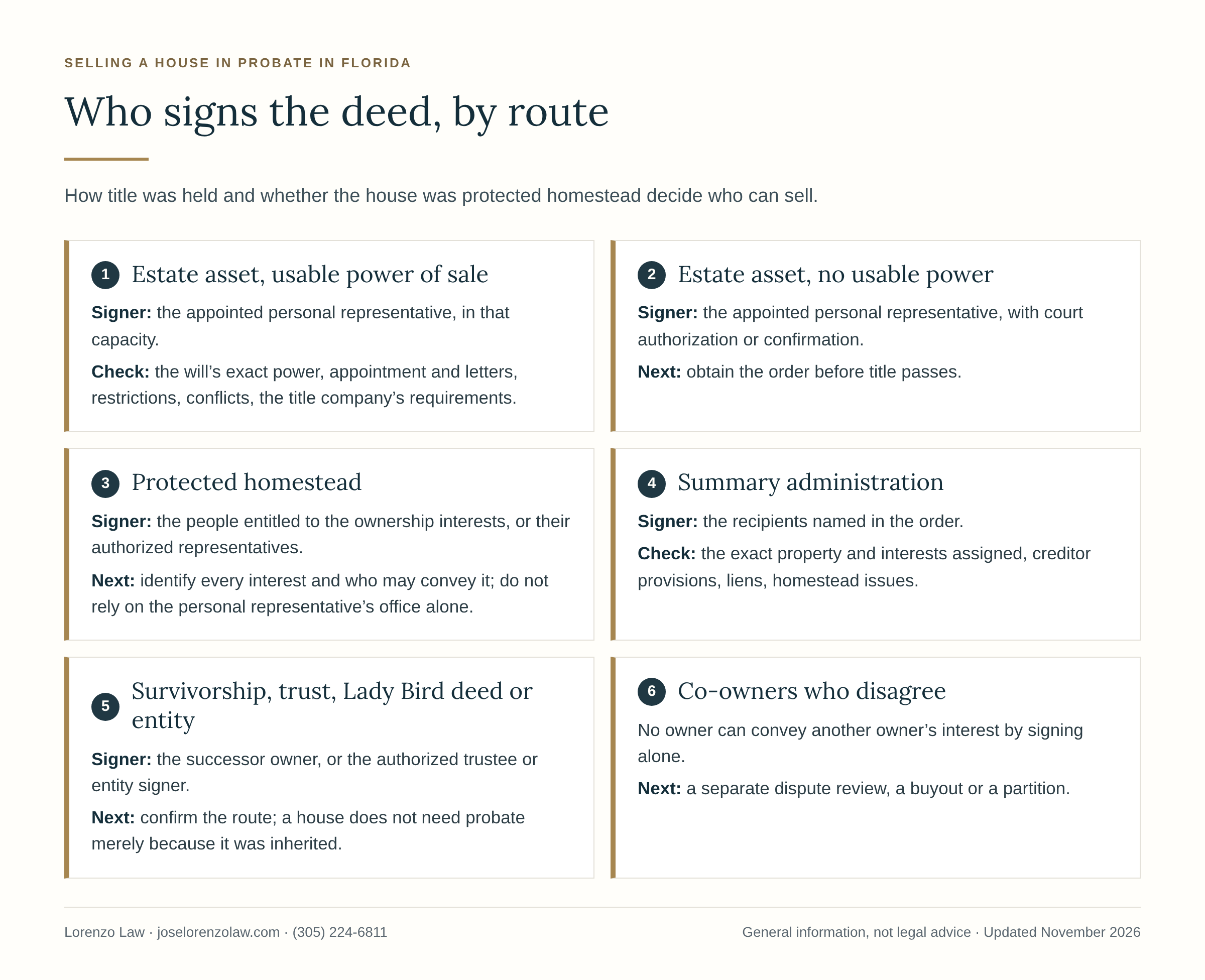
See the chart “Who signs the deed, by route” (opens the full-size image)
Who owns a house during probate in Florida?
A house “in probate” is a house whose owner died and whose transfer depends on a probate proceeding. What happens to a house in probate depends on whether it is protected homestead. For property passing under a will or by intestacy, the right to inherit generally vests at death, but property that is not protected homestead remains subject to estate administration. The heirs or devisees hold an interest that can be used to pay the estate’s debts, while the personal representative holds possession and the power to administer, not title. Protected homestead is outside ordinary administration and belongs to the people entitled to it.
Ownership versus control
When a Florida owner dies, title does not wait in limbo for a judge. Section 732.514 provides that the death of the testator is the event that vests the right to devises unless the will makes vesting depend on another event, and section 732.101(2) treats intestate property the same way. What the personal representative holds is possession, control and the power to administer: section 733.607(1) gives the personal representative the right to take possession of the decedent’s property, except protected homestead, and section 733.608(1) makes that property assets in the hands of the personal representative for paying claims, taxes, the family allowance, the elective share and the costs of administration.
The two ideas fit together like this: an heir’s or devisee’s ownership of a non-homestead house is real but subordinate. It can be reduced or divested to pay estate obligations, and that is what a title underwriter worries about when an heir offers to sell during an open administration. Protected homestead does not carry that subordination to estate creditors, which is the whole difference. Identify the actual recipients and their interests rather than assuming that every child owns an equal share; the will, a surviving spouse’s interest, a minor and the homestead rules can each change the shares.
Can the heirs sell the house before the estate closes?
Sometimes, and the answer splits the same way. Heirs or devisees may be the proper sellers of protected homestead, with evidence establishing their title and any spouse, minor or other ownership interests; the order determining homestead under Florida Probate Rule 5.405 is the usual proof. For property that is not protected homestead, a beneficiary’s deed alone during an open administration usually is not enough: the personal representative’s administrative authority and the title company’s requirements have to be resolved first.
The passage of two years after death is not a substitute for proving ownership or curing a title defect. Section 733.710 bars most claims against the decedent two years after death, but it has exceptions, and it does not clear every lien, tax issue or administration obligation. Legal vesting and proof that satisfies a particular closing are two different things.
Who has authority to sell: power of sale, court orders and section 733.612
For real property that is an estate asset, the authority to sell belongs to the personal representative appointed by the court, and it comes from one of two sources: a power of sale in the will (section 733.613(2)) or a court order authorizing or confirming the sale (section 733.613(1)). Protected homestead, survivorship property, trust property and summary administration distributions follow their own routes, described above.
In Florida the officeholder is the personal representative. Other states call the role executor or administrator, and many families search for “executor,” so this guide uses that word where people do; personal representative is the term the court, the clerk and the title company will use. Being named in a will does not by itself give present authority: the authority begins when the court appoints the personal representative and letters of administration issue. The steps to appointment are in the Florida probate process guide.
When the will grants a power of sale: section 733.613(2)
Section 733.613(2) provides that when a decedent’s will confers a specific power to sell or mortgage real property, or a general power to sell any asset of the estate, the personal representative may sell, mortgage or lease any real property of the estate or any interest in it, without authorization or confirmation of court, for cash or credit, and the sale need not be justified by a showing of necessity. No petition, no hearing and no showing that the estate needed the money are required for that sale.
The power is still exercised by a fiduciary. The personal representative must follow the will’s terms, any limits in the order of appointment and the standards of care in section 733.602, and should document the value and the marketing of the house.
The buyer’s protection: section 733.613(3)
Section 733.613(3) addresses a sale made under a specific power to sell or mortgage real property, or under a court order authorizing or confirming the sale: the purchaser takes title free of claims of the estate’s creditors and the entitlement of the estate’s beneficiaries, except that existing mortgages or other liens against the real property are not affected. Where the will grants only a general power to sell “any asset,” ask the closing agent and counsel early whether that power and the available documents satisfy the transaction’s title requirements. An additional court order, if one is sought, has its own notice and scheduling requirements.
When there is no usable power of sale, or no will: section 733.613(1)
Section 733.613(1) applies when the personal representative has no power of sale, when the decedent died intestate, or when the power given by the will is so limited by the will or by law that it cannot conveniently be exercised. The personal representative may sell real property at public or private sale, but no title passes until the court authorizes or confirms the sale, and no bona fide purchaser is required to examine the proceedings before the order of sale.
Authorization versus confirmation
The statute says no title passes until the court authorizes or confirms the sale. For a duly appointed personal representative with authority over the property, it contemplates either path: authorization before the contract is signed, or confirmation of a sale already negotiated. A proposed transaction may be negotiated subject to the necessary court approval, but the signer’s authority, whether the contract can be enforced, its contingencies and any existing orders should be reviewed before anyone commits. Where subsection (1) applies, title cannot pass until the court authorizes or confirms the sale.
That is why the closing itself cannot happen on the personal representative’s signature alone in those estates. Section 733.611 protects people who deal in good faith with a personal representative, except as provided in section 733.613(1), and that carve-out is why a title company will want the order in hand.
What section 733.612 covers
Section 733.612 is sometimes cited for the idea that a personal representative can sell any estate property. Subject to the statute’s opening qualifications, it lists acts a personal representative may take without a court order. As to real property, section 733.612(2) authorizes performing or compromising the decedent’s own contracts, including an enforceable contract the decedent signed before death to convey real property. The general disposal power, section 733.612(5), covers acquiring or disposing of an asset excluding real property in this or another state. That exclusion is why furniture, vehicles and other personal property can be sold long before the house, and why section 733.613 governs real estate sales separately.
Section 733.612(19) authorizes the personal representative to employ appraisers, accountants, attorneys and other professionals to assist in administering the estate, which is the basis for hiring an appraiser to value the house.
Selling to the personal representative or a relative
A sale involving the personal representative or a related interest raises conflict-of-interest issues. Section 733.610 makes a covered transaction voidable by an interested person who has not consented after fair disclosure, subject to its exceptions for transactions expressly authorized by the will or approved by the court after notice to interested persons. That is not a rule that every such sale always needs both unanimous consent and a court order, but it does call for a separate review of the conflict, notice, authority and fairness of the price before anyone proceeds. A sale to a sibling who is not the personal representative, or a buyout among heirs who own the house, is analyzed under the route that applies to that house. Price matters on every estate sale: a personal representative selling an estate asset below market value, to a family member or anyone else, must be able to show the decision met the prudent-trustee standard in section 733.602(1), and a current valuation and marketing record is how that is shown. Beneficiaries who believe a sale price is too low can object before an order is entered or raise it with the court.
Protected homestead: identify the owners who must convey
A personal representative’s general authority over estate assets does not authorize an ordinary sale of protected homestead as an estate asset. The people entitled to the homestead generally convey their own interests. The personal representative is not shut out entirely: section 733.608 permits limited protective possession and a preservation lien under stated conditions, and an interested person may ask the court to determine homestead status. If the personal representative is also one of the owners, that person signs in an individual capacity, which is separate from the office.
Florida courts have explained why a power of sale does not reach protected homestead. In Harrell v. Snyder, 913 So. 2d 749 (Fla. 5th DCA 2005), a personal representative whose will authorized disposing of the estate’s assets still could not sell the homestead, because protected homestead is not property of the probate estate. Clifton v. Clifton, 553 So. 2d 192 (Fla. 5th DCA 1989), explains that homestead passes outside the probate estate. In McKean v. Warburton, 919 So. 2d 341 (Fla. 2005), where the decedent left no spouse or minor child, homestead passed to the residuary devisees on the facts of that case; a will that specifically directs the homestead to be sold and the proceeds distributed is treated differently, but that direction cannot be used to get around the spouse and minor-child restrictions in article X, section 4(c) of the Florida Constitution. Under Snyder v. Davis, 699 So. 2d 999 (Fla. 1997), the protection from forced sale inures to devisees who are within the class of heirs.
None of this means that every homestead, or every dollar from its sale, is protected from every creditor. The constitutional exceptions (taxes and assessments, obligations for the purchase or improvement of the property, and labor or materials furnished for it) still apply, and the personal representative’s preservation lien is discussed below.
The order determining homestead
If the people entitled to the homestead already own it, why file anything? Because the buyer’s title underwriter cannot tell from the public records that the decedent lived there or who is entitled to the property. Under Florida Probate Rule 5.405, an interested person may petition the court to determine homestead status; the order identifies the property, the persons entitled to it and each person’s interest. The order does not make the personal representative the seller. Title companies commonly ask for it before insuring a sale of a decedent’s former home, and individual underwriters may have their own evidence requirements on top of the rule.
The petition must be verified and must state the petitioner’s interest; the date of death; the county of domicile; whether the decedent died with or without a will; whether a spouse survived and, if so, the spouse’s name and whether and how the spouse waived homestead rights; the names of surviving descendants and whether any minor child survived, giving each minor’s name and year of birth; the legal description; whether the property was the decedent’s domicile or, if not, whether it was in a municipality and was the domicile of a member of the decedent’s family; how title was held at death; and any other supporting facts. Interested persons must be served by formal notice.
Homestead and a sale order: sequence
Where homestead status is unresolved, counsel must determine the proper proceeding, the parties and how any proceeds will be handled. A local checklist cannot create authority to sell protected homestead that the law withholds. The Eleventh Judicial Circuit’s probate checklists (Miami-Dade) address how a pending homestead question and a sale petition interact; practice varies by circuit and by division, so ask what your division expects before filing either petition.
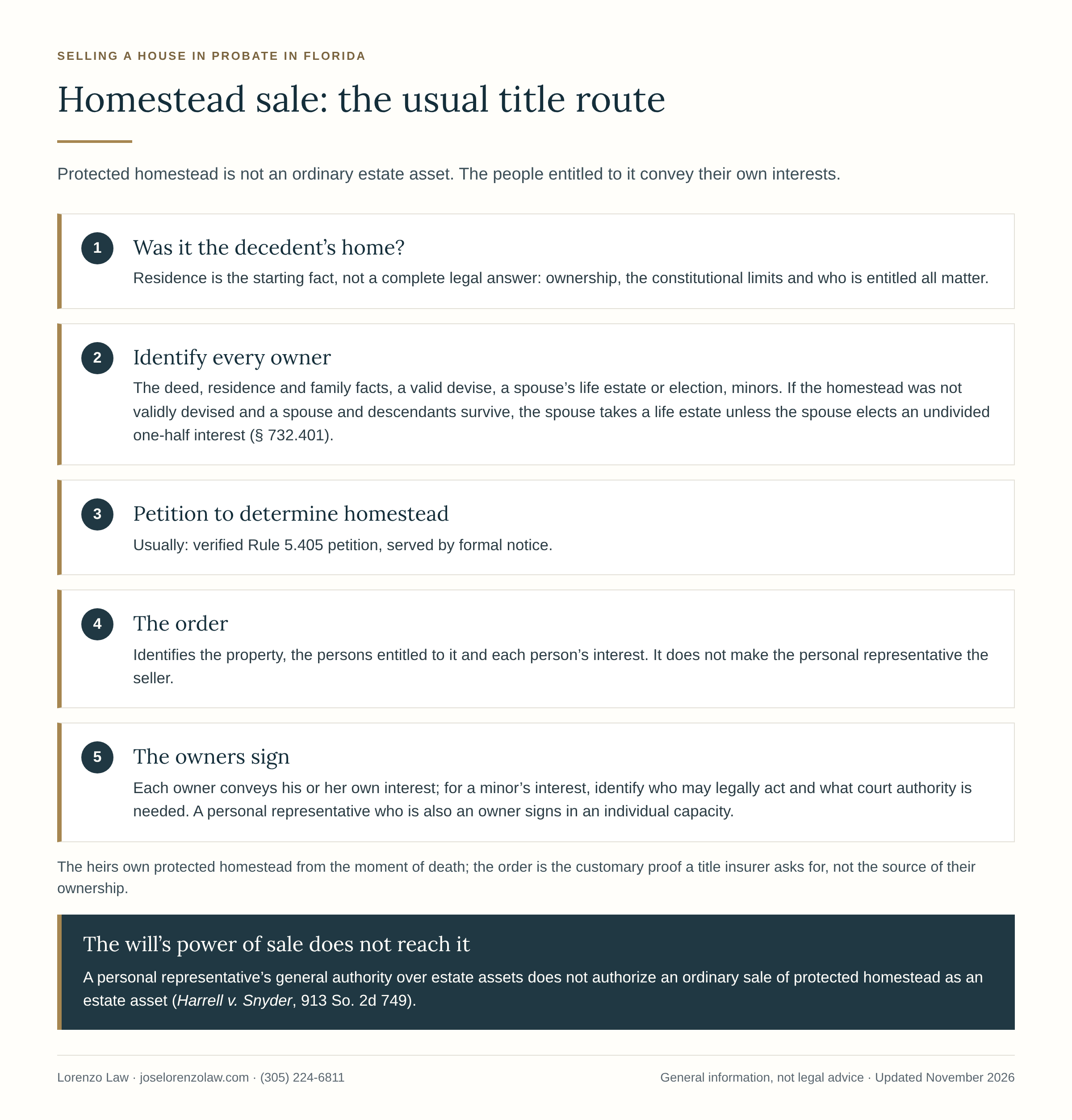
See the chart “Homestead sale: the usual title route” (opens the full-size image)
The devise restriction
Under article X, section 4(c) of the Florida Constitution and section 732.4015, homestead cannot be devised if the owner is survived by a spouse or a minor child, except that it may be devised to the spouse if there is no minor child. A devise that violates the restriction fails, and the homestead passes as if there were no will. If the owner left a spouse and one or more descendants, the spouse takes a life estate and the descendants take the remainder, unless the spouse elects instead to take a one-half interest as a tenant in common. Otherwise the homestead passes to the heirs under the intestacy rules. A trust holding the homestead does not by its label avoid these restrictions.
The surviving spouse’s election
When section 732.401 gives a surviving spouse a life estate, the statute permits the spouse to elect instead to take an undivided one-half interest in the decedent’s homestead interest as a tenant in common. The ordinary deadline is six months after the decedent’s death and during the spouse’s lifetime. Section 732.401(2) also contains a route for an attorney-in-fact or a guardian to make the election with court approval, and a limited extension when the approval petition is filed in time. Recording and other requirements apply. Get prompt advice rather than assuming the ordinary deadline has no exception, because the election changes who has to sign the deed. More in surviving spouse rights in Florida.
The personal representative’s preservation lien
Section 733.608(2) through (4) permits, but does not require, the personal representative to take possession of an unoccupied apparent homestead for the limited purpose of preserving, insuring and protecting it for the heirs or devisees, and gives the personal representative a lien for the expenses. Under section 733.608(4), the lien attaches and takes priority as of the date and time a notice of the lien is recorded in the county’s official records. If that step is taken, a notice of taking possession under Florida Probate Rule 5.404 shows the limited purpose. A buyer’s title search should look for both instruments.
Selling an inherited house in Florida when you are the heir
If you inherited a house in Florida and want to sell it, first find out which route applies to you; how to sell an inherited house depends on it, whether you are selling your deceased parent’s house or selling inherited property in Florida from another relative. You may already own the house (protected homestead, survivorship or a Lady Bird deed), you may receive it through a summary administration order, or the personal representative may be selling it as an estate asset. Your signature, your timing and your share of the money depend on that route.
You may already own it. If the house was your parent’s protected homestead and you are among the people entitled to it, the property passed to you at death; you and the other owners sign, usually after a homestead determination. If it was a rental, a vacation condo or vacant land, you hold an interest subject to the estate’s administration, and the personal representative or the court route controls the sale.
You may not need an estate sale at all. Before assuming you do, check how title was held. A revocable trust, a valid Lady Bird deed, joint tenancy with right of survivorship and tenancy by the entirety can all move title without an estate sale. Summary administration is a probate proceeding; it appoints no personal representative, and the court’s order assigns the property to the people entitled to it, who then sell as owners. See Florida summary administration.
Two values matter, and they are different. The date-of-death value is used for the inventory and generally sets the tax basis; the current market value is what a buyer will pay now. Either can be higher. A date-of-death appraisal supports the basis and the inventory; a current valuation or broker’s opinion supports the asking price.
The calendar costs money. Every month the house sits, someone is paying property taxes, insurance, association dues and any mortgage, and the responsibility depends on the route. See carrying costs.
When co-owners disagree
First establish that you are co-owners of interests that can be addressed through the relevant remedy. A voluntary sale of the whole property generally needs every owner’s participation, or a lawful representative or court authority. If agreement fails, a negotiated buyout or a partition may be considered. Florida heirs property procedures apply only when the statutory definition and procedural conditions are met, and section 733.814 permits a qualifying partition for purposes of distribution before an estate is closed. A beneficiary’s objection to an authorized estate sale is a different problem from co-owners who cannot agree.
Do not change the locks, remove an occupant’s belongings or spend money on the assumption that being a beneficiary settles possession and reimbursement. Whether an occupying co-owner owes rent, and how expenses are credited, are separate questions. The detailed remedies are in when one sibling won’t sell the inherited house and the Florida partition action guide.
Cash offers and selling as-is
Investors buy inherited Florida houses as-is and can close quickly, and for a hoarded, storm-damaged or badly dated property that can be a reasonable choice. It is not free: a cash buyer prices in the risk and the repairs, and the offer reflects that. Before accepting one, compare it with a current valuation, confirm that the person signing has authority to sell, and remember that “as-is” allocates repair costs; it does not change who must sign or what must be disclosed. A cash buyer’s speed does not shorten a court order, a homestead determination or a title requirement.
Which kind of probate you are in
Florida has formal administration, summary administration, ancillary administration for people who lived in another state or country, and disposition without administration for very small estates. The kind of probate decides whether there is a personal representative, which document the title company reads for authority and who signs the deed for property on that route. Florida has no “informal probate”; that is a term from other states’ law.
The three proceedings that sell houses
| Question | Formal administration | Summary administration | Ancillary administration |
|---|---|---|---|
| When it applies | The general route when a personal representative is needed | Estate subject to administration in Florida, less exempt property, not over $150,000, or the person has been dead more than two years; a will must not direct formal administration | The person was domiciled outside Florida and left Florida property that needs administration |
| Personal representative? | Yes; letters of administration issue | No; the court’s order assigns the property | Yes; an ancillary personal representative is appointed |
| Who signs for an estate-asset house | The personal representative, under a power of sale or a court order | The recipients named in the order, as owners | The ancillary personal representative, on the same conditions |
| Buyer’s statutory protection | § 733.613(3), for a sale under a specific power or a court order | § 735.206(4)(c), for bona fide purchasers from the recipients | § 733.613(3), on the same conditions |
| What must be resolved | Appointment, the source of sale authority, homestead, notices, claims | Eligibility, known creditors, the exact property in the order, homestead | The foreign proceedings, who may serve, and the same items as formal administration |
The “who signs” row applies to property on that route; it does not apply to protected homestead, which follows the homestead rules in every kind of proceeding.
Formal administration
The court appoints a personal representative and issues letters of administration, the first document a title company asks for because it shows who holds the office. Formal administration fits when the house needs active management, marketing and negotiation by a fiduciary. Florida letters of administration are also what lets an executor selling a house show the buyer’s title insurer that the authority is current. The steps and timing are in the Florida probate process and the Florida probate timeline guides.
Summary administration and the $150,000 limit
Summary administration is available when the value of the entire estate subject to administration in Florida, less the value of property exempt from creditors’ claims, does not exceed $150,000, or when the person has been dead for more than two years, and the will, if there is one, does not direct formal administration. The limit was $75,000 before July 1, 2026 (chapter 2026-57, Laws of Florida), and many websites and AI answers still give the old figure. The 2026 law has no transition rule for deaths before July 1, 2026. Florida law measures eligibility at the time the petition is filed, which supports applying the $150,000 limit to petitions filed on or after that date, but confirm the applicable limit before filing.
Summary administration is a probate proceeding, but it appoints no personal representative. Before the order is entered, section 735.206(2) requires the petitioner to make a diligent search and reasonable inquiry for known or reasonably ascertainable creditors and to serve or provide for them as the statute directs. The court then enters an order assigning the property to the people entitled to it, and those recipients sign the deed to a buyer. Under section 735.206(4)(c), after the order is entered, bona fide purchasers for value from the recipients take the property free of the claims of the decedent’s creditors and the rights of the surviving spouse and other beneficiaries. The order does not remove an existing mortgage or other lien on the house.
Section 735.2063 separately permits, but does not require, publication of a notice to creditors after the order is entered; it bars creditors who are not known or reasonably ascertainable if they do not file within three months of first publication. It protects the recipients more than the buyer’s title. Two practical points: the legal description in the order must match the deed exactly, and if the house was homestead, a petition to determine homestead is often filed alongside the summary administration petition. More in Florida summary administration.
The owner lived in another state: ancillary administration and the alternatives
Florida real property requires a Florida-law title analysis even when probate is open in another state. Letters issued by another state’s court do not by themselves authorize a conveyance of Florida land. Ancillary administration under section 734.102 may be needed, but it is not the only route: check first for nonprobate title (survivorship, a trust or a Lady Bird deed), summary administration where the estate qualifies, the limited procedure in section 734.1025 and, in qualifying cases, admission of the foreign will under section 734.104.
Section 734.102 sets the order of preference for the ancillary personal representative, beginning with a personal representative the will names for the Florida property, then the foreign personal representative if qualified to act in Florida, and continuing through the statute’s list. The petition attaches authenticated copies of the foreign proceedings. Section 733.304 limits who may serve: a nonresident qualifies only as an adopted child or adoptive parent, a person related by lineal consanguinity, a spouse, brother, sister, uncle, aunt, nephew or niece, or a lineal relative of any of them, or the spouse of a person otherwise qualified. A nonresident friend or business partner cannot serve.
Section 734.1025 is narrower than many summaries suggest. It applies to a nonresident decedent who died testate, whose gross Florida property subject to administration did not exceed $50,000 at death; the foreign personal representative may file authenticated copies of the foreign proceedings, before two years have passed after death, if the will was executed as Florida law requires. If a creditor files a claim, a personal representative must be appointed. Section 734.104 has its own conditions, including timing and the absence of Florida administration, and is not an automatic shortcut. More for families outside Florida: serving as an out-of-state executor in Florida and Florida ancillary probate.
Before, during or after probate: when can you sell?
Can you sell a house while in probate? Yes: an authorized sale can close while the estate is still open; probate does not have to finish first. Can you sell a house before probate? Only the person who already owns it, or who holds authority outside probate, can. Before a case is opened, only a person who already owns the house or holds authority outside probate can sell it. Time passing does not create authority by itself, and closing the estate is not a universal guarantee of marketable title.
Selling before, during and after probate
| Stage | What is possible |
|---|---|
| Before a case is opened | Determine whether the house is an estate asset, protected homestead or a nonprobate transfer. The proper owner may have rights before an estate is opened, but the closing documents still have to establish them. Separately, section 732.901 requires the custodian of a will to deposit it with the clerk within 10 days after receiving information that the testator died, sometimes called the 10-day rule; depositing the will does not by itself give anyone authority to sell. |
| Case filed, personal representative not yet appointed | Being named in a will does not itself give present authority. Gather documents, arrange lawful protection of the property, and have any proposed commitment reviewed before signing anything as personal representative. |
| During administration | An authorized estate sale may close before the case ends. Follow the power-of-sale or court-order route, and keep homestead and owner sales separate. |
| After distribution or discharge | Confirm who received which interest and any remaining title conditions. Closing the estate is not a universal guarantee of marketable title. |
| More than two years after death, nothing filed | Summary administration may be available under the statutory conditions. An old death can still leave missing heirs, later deaths, liens, ownership disputes or transfers that were never completed. |
Can you list the house or sign a contract before letters or a court order?
You can prepare before letters issue: interview agents, order a valuation, gather the deed and secure the property. Listing and signing a contract are commitments made by whoever has authority to sell. For an estate asset, that is the personal representative after appointment; a contract signed in that capacity before appointment, or before a required order, should be reviewed for authority, enforceability and contingencies. A contract that depends on a court order should say so and should allow for the time the order takes. For protected homestead or a nonprobate route, the owners or the successor sign, once their authority can be shown to the title company.
How long does a personal representative have to sell the house?
Florida law does not set a fixed number of days for a personal representative to sell a house. The personal representative must administer the estate promptly and with the care of a prudent trustee, and the court can set deadlines or act on a beneficiary’s petition when administration stalls. A beneficiary who believes a sale is being delayed without reason can ask for information, an accounting or court direction; see how long probate takes in Florida for the deadlines that do exist.
When the executor is taking too long or the sale is stuck. Section 733.603 directs a personal representative to proceed expeditiously with settling and distributing the estate. A beneficiary whose house sale is held up can ask the personal representative in writing for the reason and the plan, request an accounting, and, if that fails, petition the court for instructions or an order directing action. Failing to comply with a court order, failing to account for the sale of property, and wasting or maladministration of the estate are among the grounds for removal listed in section 733.504, which is a separate and more serious step. Many sales that seem stuck are waiting on something else: a homestead determination, a sale order, an occupant, a missing heir or a title defect. Identify which before deciding what to file. A beneficiary who simply opposes a sale can object, but cannot stop an authorized estate sale indefinitely; the court decides.
Does the house have to be sold in probate?
No. Probate does not require a sale. A house can be distributed to the beneficiaries in kind, kept by an heir who buys out the others, or sold when the will directs it, when money is needed to pay claims, expenses or taxes, or when the beneficiaries prefer cash. A specific gift of the house in the will generally goes to the person named, subject to the estate’s obligations. Protected homestead passes to the people entitled to it, who decide together whether to keep or sell.
When the estate cannot pay its debts. If the estate’s other assets are not enough to pay valid claims and expenses, a house that is an estate asset can be sold to pay them, in the order of priority in section 733.707, and the gifts in the will abate under section 733.805 to make up the shortfall. Protected homestead is generally not available to the decedent’s ordinary creditors, so they cannot force its sale to pay their claims; the constitution’s own exceptions, such as taxes and a mortgage on the house, still apply.
Getting court approval: the petition, notice and consents
When the personal representative’s authority comes from the court rather than the will, Florida Probate Rule 5.370 governs the petition and the order. The petition is verified and states the reasons for the sale, a description of the property and the price and terms. Interested persons receive notice unless they have validly waived it or consented; a waiver or consent covers only the persons and matters it addresses.
What Rule 5.370 requires
Under Rule 5.370 the personal representative files a verified petition setting out the reasons for the sale, a description of the real property and the price and terms. The order must describe the property; an order authorizing a private sale must specify the price and terms, and an order authorizing a public sale must specify the type of notice to be given. These are not formalities: in In re Estate of Corbin, 637 So. 2d 51 (Fla. 1st DCA 1994), a sale order was reversed where the motion did not specify the property, the price and the terms and the court made no determination that the sale was necessary or in the best interest of the estate. A defective petition produces a defective order, and a defective order is a title problem.
Notice and the 20-day period
Rule 5.370 does not itself set a universal notice period; notice is analyzed under Rules 5.040 and 5.041, any applicable statute, the court’s orders and local requirements together. When formal notice is used, a person served must serve written defenses within 20 days after service of the notice, exclusive of the day of service, under Rule 5.040(a)(1), with the time-computation rules applied. That period is not a promised order date and it is not the creditor deadline.
How valid waivers and consents can help
Valid waivers or consents can remove notice issues for the persons and matters they cover. Identify every interested person, and any representation or conflict issue, first; a list of beneficiaries alone may not include everyone affected. Consent does not supply missing ownership, override protected-homestead restrictions or guarantee an order without a hearing. Florida Probate Rule 5.180 governs waivers and consents: they must be in writing, signed by the person executing them, state the person’s interest and any fiduciary capacity, state expressly what is waived or consented to, and be filed. Check local requirements, such as notarization, before signatures are collected across several states.
When the family agrees, consents can turn a contested calendar problem into a paperwork problem. When one person will not sign, the matter proceeds on notice and, where needed, a hearing.
Selling a probate house by region: where the case is filed and what changes locally
Under section 733.101, a Florida resident’s estate is ordinarily administered in the county where the decedent was domiciled; for a decedent domiciled outside Florida, the county where property is located can determine venue. The house’s own county still matters for recording, the property appraiser, tax and code liens and the closing. The law is the same statewide; the calendar, checklists and local practice differ.
Probate venue and the county where a partition suit is filed are different questions. If the person lived in one county and the house is in another, the probate case is filed where the person was domiciled, and the deed and court orders are recorded where the house is.
Where Florida probate house sales are filed
| Region | Counties (communities often searched) | Judicial circuit | Local notes |
|---|---|---|---|
| Central Florida: The Villages corridor | Lake (Clermont, Leesburg, Eustis, Tavares, Mount Dora, Groveland, Minneola, Umatilla, Howey-in-the-Hills, Yalaha, Okahumpka, Astatula, Lady Lake, Fruitland Park), Sumter, Marion (Ocala) | Fifth (with Citrus and Hernando) | The Villages spans Lake, Sumter and Marion; the probate case goes to the county of domicile. Many owners kept a domicile in another state |
| Central Florida: Volusia | Volusia (DeLand, Deltona, DeBary, Orange City, DeLeon Springs, Daytona Beach) | Seventh (with Flagler, Putnam, St. Johns) | Ask the division whether an unopposed sale petition is ruled on the papers |
| Central Florida: Seminole, Orange, Osceola | Seminole (Sanford, Lake Mary); Orange (Orlando, Ocoee, Apopka, Winter Garden); Osceola (Kissimmee) | Eighteenth (Seminole, with Brevard); Ninth (Orange, Osceola) | Orange County: Orange County probate court |
| South Florida | Miami-Dade (Kendall, Doral, Cutler Bay); Broward (Coral Springs, Coconut Creek, Plantation, Weston, Margate); Palm Beach (Jupiter, Wellington, Lake Worth); Monroe | Eleventh (Miami-Dade); Seventeenth (Broward); Fifteenth (Palm Beach); Sixteenth (Monroe) | Miami-Dade publishes probate checklists, including one for sale of real property |
| Northeast Florida | Duval (Jacksonville), Clay, Nassau | Fourth | Duval County probate court; Jacksonville probate |
| Tampa Bay and Southwest | Hillsborough (Tampa); Pinellas and Pasco; Sarasota and Manatee; Lee and Collier | Thirteenth; Sixth; Twelfth; Twentieth | Seasonal owners: check domicile before choosing the county. Hillsborough probate court; Pinellas probate court; Sarasota probate |
| Panhandle and North Central | Escambia (Pensacola), Okaloosa, Walton; Leon (Tallahassee); Bay; Alachua | First; Second; Fourteenth; Eighth | Rural parcels: confirm the legal description and acreage |
Circuit assignments are from the Florida courts’ circuit directory; confirm the current division, filing requirements and checklists with the clerk of the circuit court in the county of domicile.
Central Florida: Lake, Sumter, Marion, Volusia, Seminole and Orange
Many Central Florida houses were bought by owners who moved to Florida from another state, which produces two problems at once: the owner may never have changed his or her legal domicile, so ancillary administration or another out-of-state route may apply, and the heirs often live in other states and must agree on a house none of them lives near. The Villages spans Lake, Sumter and Marion counties, so the county of domicile, not the address of the house, decides where the case is filed. In Lake, Volusia or another county with larger parcels, check that the legal description matches the prior deed and whether the land exceeds the homestead limit: 160 contiguous acres outside a city or town, or one-half acre inside one. Land that was annexed into a city after the owner acquired it keeps the larger limit unless the owner consented to a reduction. Land beyond the limit is not protected homestead and is handled like other estate property. In a planned community, ask the title agent for any community development district assessments and resale requirements early. Related guides: The Villages probate, Central Florida probate, Orlando probate, inherited-house disputes in Orlando, Kissimmee probate.
South Florida: Miami-Dade, Broward and Palm Beach
South Florida houses are often condominiums or homes in associations, so association documents, estoppel certificates and assessments are usually on the critical path; see inherited condos. For a unit in Brickell, see who can sell an inherited Brickell condo. For a Coconut Creek house, or a condominium in one of its 55-and-older communities, see the Coconut Creek probate lawyer guide. For a Cooper City family home, including one in a homeowners’ association or one a parent kept after a second marriage, see the Cooper City probate lawyer guide. For a Dania Beach house, including a condominium with association approval or a home still in a parent’s name, see the Dania Beach probate lawyer guide. The Eleventh Judicial Circuit (Miami-Dade) publishes probate checklists, including CC-09, Sale of Real Property (Estates), revised November 2024. It applies where the property is an estate asset, no homestead order has been entered and the proceeding is not a summary administration, and it asks for items such as the contract, valuation evidence, qualifying waivers or proof of notice, appointment and letters, the inventory, proof of service of the notice of administration and a restricted depository for the proceeds, with an appraisal where the value exceeds $600,000. That is Miami-Dade checklist practice, not a statewide requirement; check the court’s checklist index for revisions. Related: Miami-Dade probate court, Broward probate court, Palm Beach probate court, and for condominium towers who can sign to sell an Aventura unit and Bal Harbour probate.
What can differ from circuit to circuit
- Whether a sale petition is heard or ruled on the papers. Some divisions sign an unopposed order on submission; others set sale petitions for hearing.
- Whether waivers and consents must be notarized. Rule 5.180 does not require it; some circuits ask for it.
- What valuation the judge expects. An appraisal, a broker’s opinion, or either, depending on value and local practice.
- Whether proceeds go to a restricted depository. Some orders direct deposit into a restricted account under section 69.031.
- How a homestead petition and a sale petition are sequenced. Ask before filing either.
- Filing fees and e-filing conventions. A statutory base plus local charges; cover sheets and proposed-order formats differ.
None of this changes the law; all of it changes the calendar. Lorenzo Law’s principal office is in Kissimmee, with meetings by appointment in Coral Gables and Fort Lauderdale; matters elsewhere in Florida are handled by phone, video, mail and electronic filing. Ask what can be handled remotely and which signatures, hearings or other steps need particular arrangements.
What the title company needs before it insures the buyer
A probate house sale closes when the buyer’s title insurer is satisfied that the right person signed for the right interest. The insurer issues a written commitment listing its requirements; no statute sets one universal checklist. Ask the closing agent for the actual commitment early, because the requirements depend on the route: an estate sale, an owners’ sale of protected homestead, a summary administration distribution or a nonprobate transfer.
Documents the closing agent may need, by route
| Route | Documents commonly requested |
|---|---|
| Every route | Certified death certificate; the current recorded deed and legal description; any will; the probate case number, if a case exists; payoff letters for any mortgage; association estoppel certificate where applicable; a seller’s affidavit from whoever signs |
| Estate sale by the personal representative | Certified letters of administration; the order admitting the will and appointing the personal representative; an order authorizing or confirming the sale where § 733.613(1) applies; the personal representative’s deed; evidence of the notice to creditors and the diligent search; the estate’s taxpayer identification number where the estate is the seller |
| Protected homestead sold by the owners | An order determining homestead status; a deed signed by every owner, with spousal joinder where needed; proof of any spouse’s election or life estate; authority for any minor or incapacitated owner; often an affidavit of heirs |
| Summary administration | The order of summary administration with a legal description that matches the deed; a deed signed by the recipients named in the order |
| Nonprobate transfer | The recorded survivorship deed or Lady Bird deed; trustee or entity authority documents; the death certificate and any affidavit the insurer requires |
If you already have an order that a bank or title company won’t act on, or a petition that came back, my page on the order of summary administration explains what is going on and how I help.
Not every transaction uses a personal representative’s deed, an estate taxpayer identification number or a closing agent’s Form 1099-S in the estate’s name; the route decides who signs and reports. This list identifies documents to ask about; it does not determine title or guarantee that a policy will issue.
Creditor claims and the buyer’s title
Many families assume the house cannot close until the creditor period ends. That is usually not the rule for a properly authorized sale. Under section 733.613(3), a purchaser under a specific power of sale or a court order authorizing or confirming the sale takes title free of the claims of estate creditors and the entitlements of estate beneficiaries, except that existing mortgages and other liens on the property are not affected. Section 735.206(4)(c) does similar work for a bona fide purchaser for value from summary administration recipients. Protected homestead follows its own rules: it is generally not available to estate creditors, so the buyer’s concern there is whether every owner signed.
What waits is often the money. Net proceeds of an estate sale go into the estate account, or a restricted depository where the court orders one, and are administered through the claims period and the estate’s obligations. The deadlines that matter:
- Section 733.702. A claim is generally barred unless filed by the later of three months after first publication of the notice to creditors or 30 days after service of the notice on a creditor who had to be served.
- Section 733.2121. The personal representative publishes the notice and makes a diligent search for reasonably ascertainable creditors, who must be served. Under Jones v. Golden, 176 So. 3d 242 (Fla. 2015), a reasonably ascertainable creditor who was never served may file within two years of death.
- Section 733.710. Two years after death, neither the decedent’s estate, the personal representative nor the beneficiaries is liable for a claim against the decedent, whether or not letters were issued, with the statute’s own exceptions for timely filed claims not yet paid or otherwise disposed of and for the lien of a duly recorded mortgage or security interest. The Florida Supreme Court described section 733.710 as an absolute two-year bar in Tsuji v. Fleet, 366 So. 3d 1020 (Fla. 2023), and held in May v. Illinois National Insurance Co., 771 So. 2d 1143 (Fla. 2000), that it is a jurisdictional statute of nonclaim that cannot be waived or extended.
The personal representative’s deed
A personal representative’s deed, often called a personal representative deed in Florida, is a fiduciary deed. The personal representative signs in a representative capacity and does not give the general warranties of a statutory warranty deed under section 689.02. Whether the deed carries a limited warranty against the grantor’s own acts or no warranty at all is a matter of negotiation and local practice, not a fixed rule.
The deed should let an underwriter understand the authority without guessing: the decedent’s name and date of death; the fiduciary capacity in the grantor line and the signature block (“Jane Doe, as Personal Representative of the Estate of John Doe, Deceased”); the court, county and case number; the letters and their date; any order authorizing or confirming the sale by date and recording reference; and the legal description, grantee’s name and address and form of ownership.
Execution follows the ordinary Florida deed rules. Section 689.01 requires two subscribing witnesses, and acknowledgment before a notary is needed for recording. Section 695.26 requires printed names under the signatures of the grantor, witnesses and notary, post-office addresses for the grantor and witnesses, a preparer block and the grantee’s address. Witnesses may appear by audio-video communication technology where Florida’s remote online notarization requirements are met. On protected homestead, the owners sign their own deed as individuals; the personal representative’s deed is not the instrument for their interests.
The DR-312 and DR-313 affidavits
If a closing agent asks for a Florida Affidavit of No Florida Estate Tax Due (DR-312) or a DR-313, point to Florida Department of Revenue Tax Information Publication No. 23C03-01 and Florida Administrative Code Rule 12C-3.0015. Effective July 1, 2023, personal representatives are no longer required to file those affidavits and no estate tax lien arises for estates of decedents dying after December 31, 2004. The change applies to probate proceedings commenced on or after July 1, 2023, and to proceedings pending on that date without an order of final discharge. The affidavits are still requested because some title checklists predate the change.
The municipal lien search
A title search reads the county’s official records. A municipal lien search reads the local government’s own records for utilities, code enforcement, building permits, solid waste, stormwater and special assessments. It can turn up unpaid water and sewer balances, code violations accruing daily fines, open or expired permits and special assessments that a title search does not show. It is customary rather than statutory, and no search guarantees that every unrecorded obligation is found. It matters more in probate because a vacant house is the fact pattern that collects lot-mowing liens, board-up charges and unpermitted-repair citations while an estate is open.
What commonly stalls a probate closing
- The wrong authority, or none. A personal representative signs without an order the file required, or signs a deed for protected homestead.
- Homestead not addressed before the contract. The signers change after the buyer is already under contract.
- Missing or unknown heirs. Often invisible in the public records.
- Legal description errors. The order, the letters, the deed and the prior vesting deed must all match.
- An unresolved spouse’s interest. Including an estranged spouse, a life estate or an election not yet made.
- Defective notice or unresolved objections. To beneficiaries, interested persons or creditors.
- Liens. Association, code enforcement, judgment, tax and Medicaid recovery claims against estate assets.
- Contract defects. No court-approval contingency where an order was required, or a signer who lacked authority on the contract date.
How to sell a house in probate in Florida, step by step
How to sell a house after someone dies in Florida: classify the property and the signer first, then choose the proceeding, resolve homestead and family interests, protect and value the house, and only then market it, sign a contract, obtain any order and close. Doing the steps in that order prevents the most common failure: a buyer under contract before anyone knows who can sign.
- Classify the property and the signer. Read the deed and the will. Decide whether the house is an estate asset, protected homestead or a nonprobate transfer, and who signs on that route, before choosing a proceeding. If an estate is needed, obtain appointment and letters in formal administration, or the order in summary administration.
- Resolve homestead and family interests. Do this before signing a listing agreement. If the house was the decedent’s residence, plan a petition to determine homestead status and identify every owner, including a surviving spouse’s life estate or election and any minor’s interest.
- Arrange lawful protection of the property. Confirm insurance and tell the carrier the owner has died; ask about vacancy coverage. Keep utilities on and the lawn cut, because code fines accrue. Changing locks or taking possession is not automatic: if a co-owner or relative lives there, get advice about possession rights first.
- Establish value. A probate appraisal fixes the date-of-death figure. Section 733.604(1)(a) requires the inventory to state estimated fair market value at the date of death. A date-of-death appraisal serves the inventory and the tax basis; a current market valuation supports the sale price. Section 733.612(19) lets a personal representative employ an appraiser, and section 733.602(1) holds the personal representative to a trustee’s standard of care. Documented value supports a fiduciary’s decision; it does not guarantee protection from a later claim.
- Choose the transaction professionals. A probate realtor, meaning a probate real estate agent who has handled estate listings, and a closing agent or probate real estate attorney for the buyer’s side, who have handled probate sales understand court-approval contingencies and why a closing date cannot be promised as in an ordinary sale. Lorenzo Law handles the probate side; it does not act as broker or title agent.
- Market only through the person with authority. The personal representative for an estate asset; the owners together for protected homestead or an inherited interest. A probate listing should disclose that the sale depends on probate so buyers understand the timeline.
- Sign a reviewed contract, then give notice or collect consents. Where section 733.613(1) applies, a contract may be made before the order, conditioned on the court authorizing or confirming the sale. Collect written waivers and consents under Rule 5.180 from interested persons who will sign. For anyone who will not, serve the petition as Rules 5.040 and 5.041, any statute and the court’s own requirements direct; counsel often uses formal notice, which starts a 20-day period to respond.
- Obtain any necessary order. File the verified petition under Rule 5.370 with the reasons, the legal description and the price and terms. Confirm the order describes the property and, for a private sale, specifies the price and terms.
- Close with the correct deed and handle the proceeds by route. The personal representative signs in a fiduciary capacity for an estate asset; the owners sign individually for protected homestead or summary administration property. Estate-sale proceeds go to the estate account or a restricted depository; the owners’ proceeds from protected homestead are theirs, subject to liens and any order.
Occupancy, keys and carrying costs while the house is for sale
Someone has to keep the house insured, secure and paid for while the sale is pending, but who that is depends on the route. A personal representative manages an estate asset and may take possession under section 733.607. Protected homestead belongs to the owners, so the personal representative’s powers over it are limited, and an owner who lives there is not automatically a trespasser.
Who can live in the house during probate?
There is no fixed number of days that someone may live in a house during probate; the answer depends on who owns it. For an estate asset, the personal representative is entitled to take possession under section 733.607 and decides whether anyone may stay, on what terms and for how long; a beneficiary does not have a right to move in just because he or she will inherit. When protected homestead passes to two or more people as co-owners, each owner has a right to use and occupy the house, and the personal representative does not control it. One owner living there is treated as possession on behalf of all of them, so it does not by itself create a debt for rent. That changes if the occupant shuts the others out, for example by changing the locks or refusing them access after they ask. The owners generally share the taxes, insurance and mortgage payments in proportion to their shares. When the house is sold or partitioned, the value of one owner’s extra use can be offset against that owner’s claim for reimbursement of those costs. A surviving spouse who holds a life estate has the right to live there for life.
Can the house be sold while a relative is living in it? Possibly, but the occupant’s status decides the route. If the occupant is a co-owner, such as a sibling who inherited a share of protected homestead, no one else can sell that share without the sibling’s signature or a court remedy; see co-owners who disagree. If the house is an estate asset and the occupant has no ownership or lease right, the personal representative may seek possession through the court. If the occupant is a tenant, the lease and Florida landlord-tenant law govern. Whether an occupying co-owner owes rent or must account for expenses is a separate question that turns on the facts. Do not change the locks or remove belongings until the occupant’s status is clear.
Clearing out the house: furniture and belongings
The contents are separate from the house. Furniture, household goods, vehicles and personal effects pass under the will, a separate writing the will refers to, or intestacy, and a surviving spouse or children may be entitled to exempt property, including household furniture and appliances up to the value section 732.402 allows. For estate property, the personal representative has authority over the contents once appointed; before that, no one should sell, give away or discard them, even with the family’s agreement. An estate sale or clean-out is usually done after appointment, after specific gifts and exempt property are set aside, and after the contents are photographed or listed for the inventory. For protected homestead, the house passes to the heirs, but the contents generally remain estate property. See specific bequests of tangible property.
Who pays the taxes, insurance, dues and mortgage
For an estate asset, the personal representative generally pays carrying costs from estate funds as expenses of administration. For protected homestead, the owners are generally responsible for their property; when the personal representative spends estate funds to preserve it, section 733.608(3) can give the personal representative a lien on the homestead to secure reimbursement. When an heir advances money, keep receipts and record whether reimbursement was agreed. Do not assume every expense is an estate obligation.
| Expense | What to check |
|---|---|
| Mortgage or reverse mortgage | The current statement or due-and-payable notice and its deadline |
| Property taxes | Whether the homestead exemption and the Save Our Homes cap continue, which depends on who now owns the house and whether they qualify; and whether any prior year’s taxes are unpaid. Unpaid property taxes become tax certificates and can lead to a tax-deed sale if they stay unpaid, and they are paid off from the proceeds at closing |
| Insurance | The carrier’s written response on coverage for a deceased owner and a vacant house, and who is the named insured |
| Association dues and assessments | The association’s ledger, which can be liened and foreclosed if unpaid |
| Utilities, maintenance and security | Who has authority to contract for them and who is paying |
Property taxes can rise after a death because the homestead exemption and the Save Our Homes assessment limit attach to a qualifying owner, not to the house, but the result depends on who receives the house, whether that person qualifies and the statutory exceptions; it is not automatic in every case. Add up the real carrying costs before deciding to wait for a better market.
How a probate sale differs from a regular Florida home sale
How does a probate sale work in Florida? A probate sale, sometimes called a probate real estate sale or probate property sale, uses the same purchase contract and the same closing process as any Florida home sale. Five things differ: who signs, where the authority comes from, how the closing date is set, what the seller can disclose and where the money goes.
Regular sale and probate sale compared
| Item | Regular sale | Probate sale |
|---|---|---|
| Who signs | The owner on the deed | The personal representative in a fiduciary capacity for an estate asset; the owners for protected homestead or assigned property |
| Source of authority | Ownership | A power of sale in the will, a court order, an order of summary administration or inherited ownership; the closing agent checks it before insuring |
| Closing date | Set by the parties | Set partly by the court’s calendar where an order is required |
| Disclosure | The seller usually knows the house | A fiduciary who never lived there discloses the material facts he or she actually knows, including what the estate’s records have revealed; a death on the property is not a material fact under § 689.25 |
| Where the money goes | To the seller at closing | To the estate account for an estate asset; to the owners for protected homestead, subject to liens and orders |
| Contract | Standard Florida form | The same form with a probate addendum and, where an order is required, a court-approval contingency |
What is not different: a Florida probate house does not have to be sold at auction, a personal representative is not required to accept a low offer, and Florida has no general courtroom overbid procedure of the kind described in national articles about California probate sales.
Buying a house from a Florida probate estate
A buyer of a Florida probate house should confirm three things before signing: who is signing and in what capacity, whether a court order is needed before title can pass, and whether the contract allows for the time that order takes. The buyer’s title insurer will ask the same questions.
Ask the seller’s side for the letters of administration or the order that gives the seller authority, the will’s power of sale if the sale relies on one, and any order determining homestead status. If the house was the decedent’s residence, expect the owners rather than the personal representative to sign. If an order authorizing or confirming the sale is required, the contract should carry a contingency for it and a realistic closing date. A buyer who takes under a specific power of sale or a court order is protected by section 733.613(3) against estate creditors’ claims and beneficiaries’ entitlements, but not against existing mortgages and liens, which are paid off or addressed at closing. Inspections, surveys and association documents matter as in any sale; a probate seller often knows little about the condition of the house.
A buyer who wants a lawyer for the purchase itself should hire a real estate closing attorney or rely on a title agent; Lorenzo Law handles the probate side of the transaction, not the buyer’s closing.
Special situations: out-of-state families, old deaths, mortgages, Medicaid and minors
Most probate house sales are complicated by one fact outside the ordinary steps: the family lives in another state, the death was years ago, there is a mortgage or reverse mortgage, the decedent received Medicaid, or a minor holds an interest. Each changes who must act, what must be resolved first or how quickly.
You live out of state and do not want to travel to Florida
Common, and usually manageable. If the decedent was domiciled in Florida, the Florida estate is opened in the county of domicile; if the decedent lived elsewhere, the Florida property may need ancillary administration or one of the alternatives described in ancillary administration. Documents can generally be signed remotely, and Florida permits remote online notarization. Check section 733.304 first: a nonresident who is not a spouse or a relative within the listed classes cannot serve as personal representative in Florida, and someone else will have to be appointed. Ask early which signatures, originals and certified copies the court and the closing agent require, because mailing originals between states is the most common source of delay.
The owner died years ago and nothing was ever filed
This is often more manageable than families expect. Section 733.710 generally bars claims against the decedent two years after death, with the statute’s exceptions, including recorded mortgages and security interests, and section 735.201 makes summary administration available when the person has been dead more than two years, regardless of the estate’s value, if the other conditions are met. An old death can still leave problems that time does not cure: heirs who have since died, missing heirs, unpaid taxes and liens, and transfers that were never completed. A house that has sat for years often has unpaid property taxes and outstanding tax certificates; check the tax collector’s records early, because a tax-deed application can be filed on a certificate that stays unpaid long enough. A house that has sat for a decade is frequently a summary administration and a homestead determination, but the title history has to be traced first.
There is a mortgage on the house, or it is paid off
Who pays the mortgage during probate? For an estate asset, the personal representative from estate funds; for protected homestead, the owners. The mortgage does not stop when the borrower dies. Payments keep coming due, and the lender’s rights under the mortgage are unaffected by the probate. A sale pays the mortgage off from the proceeds at closing. If the family wants to keep the house, the Garn–St Germain Depository Institutions Act, 12 U.S.C. § 1701j-3(d), bars a lender from exercising a due-on-sale clause on residential property of fewer than five dwelling units for certain transfers, including a transfer by devise, descent or operation of law on the death of a joint tenant or tenant by the entirety and a transfer to a relative resulting from the borrower’s death. In plain terms, the death and the transfer to family do not by themselves let the lender call the loan, but missed payments remain a default.
When the house is worth less than the mortgage, a sale at market value will not pay the loan off. Neither the estate nor the heirs can sell free of the mortgage without the lender’s agreement: the choices are usually a short sale the lender approves, a deed in lieu of foreclosure, or letting the lender foreclose. Heirs take the house subject to the mortgage. Whether or not it files a claim in the probate case, the lender keeps its lien and can foreclose on the house. To collect any shortfall from the estate’s other assets, the lender must file a timely claim in the probate case; if it does not, it is limited to the house itself. If the lender forecloses while probate is open, the heirs or devisees who hold title are necessary parties, and the personal representative is usually named for property in the estate (protected homestead passes outside the estate, so substituting the heirs is enough); respond to the summons and tell the probate court, because a foreclosure can move faster than an estate sale. How a mortgage fits with the deceased owner’s other debts, and who is and is not responsible for it, is covered in mortgages and other debts after a death in Florida.
When you inherit a house that is paid off, there is no lender to pay at closing and no due-on-sale question, which makes it easier to keep or to distribute in kind; property taxes, insurance and any association dues continue, and the question of who can sign is exactly the same.
The house has a reverse mortgage
A reverse mortgage after death becomes due under the loan’s terms, and reverse mortgage heirs have decisions to make quickly. Contact the reverse-mortgage servicer promptly and obtain the written due-and-payable notice, payoff options and deadlines. Co-borrower and eligible non-borrowing-spouse protections can change when the loan becomes due. For a federally insured reverse mortgage (a HECM), HUD’s rule gives the estate or heirs 30 days after the due-and-payable notice to pay the loan in full or to sell the home for at least the amount HUD sets, which cannot exceed 95 percent of the appraised value; an inheritance counts as a sale for this purpose. Consumer Financial Protection Bureau guidance says heirs who want to keep the home generally must repay the full loan balance or 95 percent of the appraised value, whichever is less. Confirm the figure and the options with the servicer in writing. Other reverse mortgages follow the terms of the loan documents. Sale options and extensions depend on the loan program’s requirements and the servicer’s process. Do not assume an extension has been granted until it is confirmed in writing.
The decedent received Medicaid
Florida’s Agency for Health Care Administration may recover Medicaid paid on behalf of a recipient from the recipient’s estate under section 409.9101, as a claim under section 733.707(1)(c). Eligibility while alive and recovery after death are different questions. Under the statute, payment of benefits to a person under 55 does not create a debt, and the debt may not be enforced if the decedent is survived by a spouse, a child under 21 or a blind or permanently disabled child. Section 409.9101(7) provides that the debt is not enforceable against property determined to be exempt from creditors’ claims under the constitution or laws of Florida, which is why the homestead determination matters so much here. When the decedent was 55 or older, Florida law requires the personal representative to serve the notice to creditors and a copy of the death certificate on the agency within 3 months after first publication. If the decedent received Medicaid, get advice before anyone signs a contract.
A minor or an incapacitated person owns an interest
If a minor owns an interest, identify who may legally act for that interest and what court authority is needed. A parent’s signature alone should not be assumed sufficient. Guardianship or another authorized representation route may be required, and the facts and governing law decide the procedure. The same is true for an adult owner who cannot manage his or her own affairs. Remember also that under article X, section 4(c) of the Florida Constitution, homestead cannot be devised when the owner is survived by a spouse or a minor child, except as the constitution allows, which can change who owns the house in the first place. The Florida guardianship guide explains the court process.
Selling a house after the death of a spouse
If spouses owned the house as tenants by the entirety, the surviving spouse owns it outright at death and can sell alone once the death is documented for the title company; no probate is needed for the house. If the house was the deceased spouse’s homestead in that spouse’s name alone and there are descendants, the surviving spouse generally holds a life estate, or a one-half interest as a tenant in common if the spouse made the election under section 732.401(2), and the descendants hold the rest, so they sign together. A house that was not homestead and was in the deceased spouse’s name alone is an estate asset sold through the personal representative. See surviving spouse rights in Florida.
A beneficiary or owner lives outside the United States
A buyer may have to withhold federal tax under the Foreign Investment in Real Property Tax Act when the seller is a foreign person, which changes the closing figures and the timeline. Who the seller is decides the analysis: a domestic estate selling through a personal representative is not automatically a foreign seller because a beneficiary lives abroad, while heirs who own protected homestead and sign as sellers are each assessed on their own status. Plan for this early with a tax professional; see taxes on the sale.
Selling an inherited Florida condo in probate
An inherited condominium is sold through the same authority routes as a house, but the seller also takes on Florida’s condominium resale disclosure duties under section 718.503, which apply to non-developer sellers, including a personal representative or the heirs. Order the association documents and the estoppel certificate as soon as a sale is likely; they are the most common reason an inherited-condo contract falls apart.
What the seller must deliver
Section 718.503(2) entitles a buyer, at the seller’s expense, to current copies of the declaration, articles of incorporation, bylaws and rules, an annual financial statement and annual budget, the question-and-answer sheet, the inspector-prepared summary of any milestone inspection report under section 553.899, the association’s most recent structural integrity reserve study or a statement that none has been completed, and any turnover inspection report under section 718.301(4)(p) and (q) for a turnover inspection performed on or after July 1, 2023, together with the governance form the statute describes. Contracts entered into after December 31, 2024, must also contain the statements the statute prescribes about the status of those inspections and studies.
The statute gives the buyer rights tied to when the documents are received. A contract that does not conform is voidable by the buyer before closing, and the statute provides that this right cannot be waived. A buyer who receives the required documents fewer than seven days before signing, or after signing, generally may cancel within seven days after the later of execution or receipt, excluding Saturdays, Sundays and legal holidays; a buyer who received them more than seven days before signing may acknowledge that in the contract. The triggers, written requests and receipt dates matter, so the closing agent should track them; there is no single “seven days from signing” rule for every case.
Milestone inspections apply to condominium and cooperative buildings three habitable stories or more, and associations controlled by unit owners have had structural integrity reserve study deadlines under section 718.112(2)(g), with a combined-schedule option for some buildings. Reserve-funding rules were changed by CS/CS/HB 913 (2025); confirm the current status for the specific building with the association rather than relying on a general summary. The market consequence has not changed: assessments in many older coastal buildings have risen, and buyers price that in.
Association approval and right of first refusal
Some condominium and homeowners’ association documents give the association a right to approve a buyer or tenant, or a right of first refusal to buy the unit on the same terms. Read the declaration and any amendments before signing a contract; where an approval or first-refusal right applies, the contract should allow time for the association to act and the closing date should account for it. These rights come from the association’s recorded documents, so they vary from building to building.
The estoppel certificate
Every condominium and many homeowners’ association closings need an estoppel certificate showing what the unit owes. Under section 718.116(8), the association must deliver it within 10 business days after a written or electronic request; if it is not timely delivered, no fee may be charged for it.
The statutory fee caps are adjusted for inflation. The Department of Business and Professional Regulation’s current published maximums are $299 for a standard certificate, an additional $119 for expedited delivery and an additional $179 where the account is delinquent; the department says its next update is due by July 1, 2027. Ask for a written quote, and keep the certificate fee separate from the assessments owed. In an estate where dues have gone unpaid for months, the estoppel amount is often the number that changes the deal.
What a probate seller must disclose, and what it need not
A Florida home seller must disclose facts the seller actually knows that materially affect the value of the property and are not readily observable or known to the buyer. A personal representative or heir who never lived in the house is held to what he or she actually knows, which includes what he or she has learned from the estate’s papers. A death on the property is not a material fact that must be disclosed.
A fiduciary who never occupied the house usually has little first-hand knowledge, and liability turns on what the seller actually knows. But a roof report, an insurance claim, a contractor’s estimate or a letter from the association that the seller has seen is known, and knowledge can be proved by circumstantial evidence. Read the decedent’s papers before completing a disclosure form, and disclose what they show. Selling as-is does not switch the duty off: an as-is contract allocates the cost of repairs; it does not permit concealment of a known defect.
A death in the house
Families ask this often, particularly when the decedent died at home. Section 689.25(1)(b) provides that the fact that a property was, or was suspected to have been, the site of a homicide, suicide or death is not a material fact that must be disclosed in a real estate transaction, and section 689.25(2) provides that no cause of action arises against an owner or a licensee for failing to disclose it. You are not required to disclose that your parent died in the house.
How long a probate house sale takes, and what it costs
Is it hard to sell a house in probate? Usually not, once the right person can sign. How long a house sits in probate before it can be sold, and how long to sell a house in probate, depend on its slowest dependency: appointment of the personal representative or the summary administration order, any homestead determination, any sale order, and the buyer’s financing and title work. Court calendars, a disagreement among the owners or an out-of-state route stretch it. The 20-day formal-notice period and the creditor claim period are rule and statutory periods with their own triggers, not court turnaround estimates.
Milestones a sale depends on
| Milestone | What it depends on |
|---|---|
| Authority to sign | Letters in formal or ancillary administration; the order in summary administration; for protected homestead, identification of every owner and usually an order determining homestead |
| Sale order, if required | A verified Rule 5.370 petition; valid waivers and consents, or service on interested persons as the rules and the court require (if formal notice is used, the 20-day response period); the court’s calendar and any hearing |
| Creditor claim period | The later of three months after first publication or 30 days after service on a creditor who had to be served (§ 733.702); this generally governs distribution of estate proceeds, not the buyer’s title |
| Contract to closing | The buyer’s financing, inspections, title commitment, association documents and estoppel, and any order contingency |
| Distribution of proceeds | For an estate asset, claims, taxes, expenses and the court’s requirements; for protected homestead, the owners’ own agreement, subject to liens and orders |
Selling the house is not the same as finishing the estate. A sale can close well before the estate is ready for final accounting and discharge. For overall estate timing see the Florida probate timeline.
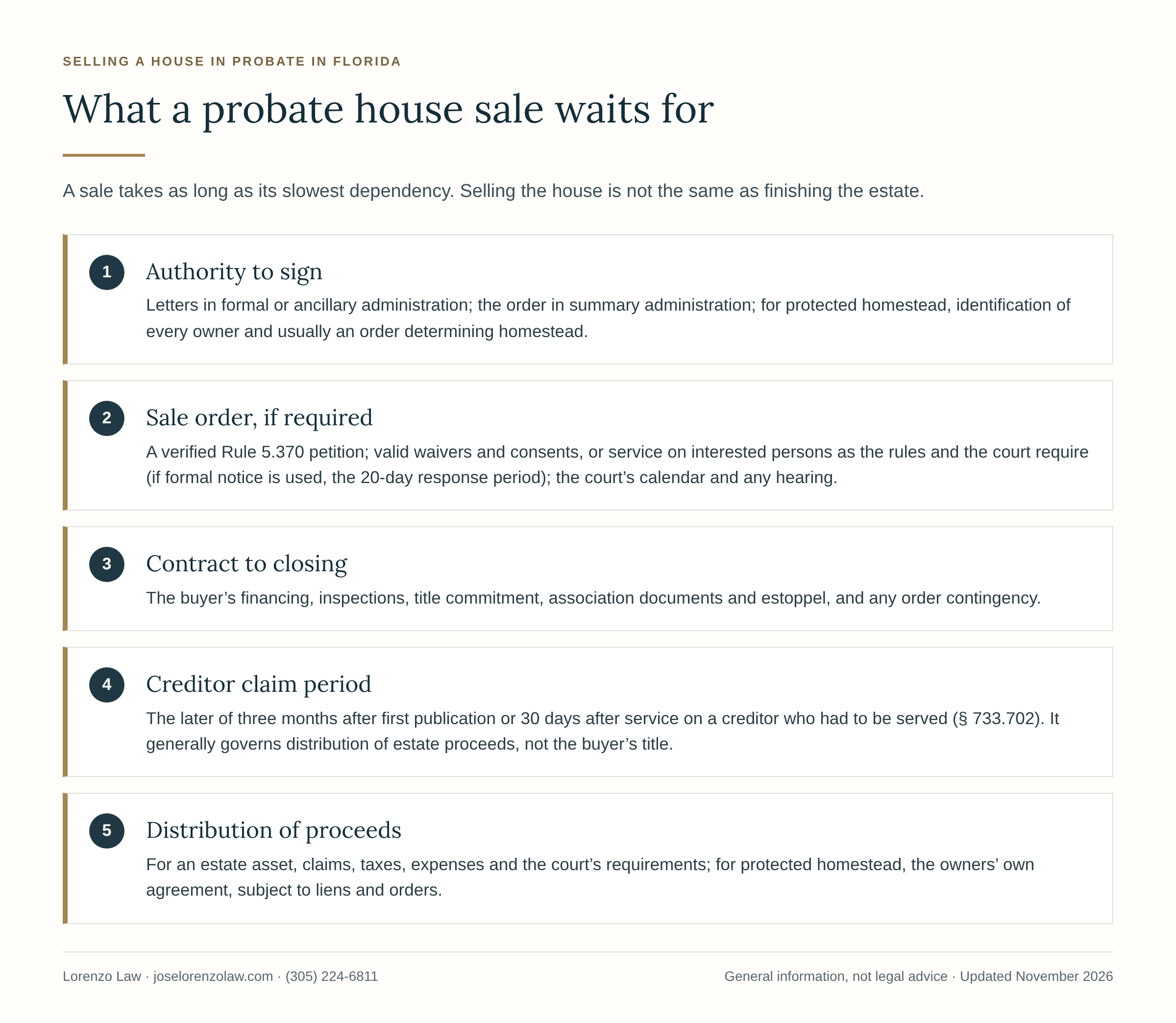
See the chart “What a probate house sale waits for” (opens the full-size image)
What a probate house sale costs
| Cost | How it is set |
|---|---|
| Lorenzo Law’s probate fee | Summary administration from $3,975, with the court filing fee and one certified copy of the order included (additional copies at the Clerk’s rate), and uncontested formal administration from $7,975, with the court filing fee, publication of the notice to creditors and the certified copies the matter needs included. For either procedure, homestead determinations, more complex estates and contested matters are quoted separately, and other expenses may apply, such as recording fees or the decedent’s debts, and in formal administration a personal representative’s bond if the court requires one and the personal representative’s compensation; any increase is discussed before work begins. Full fee terms: summary and formal administration fees. Ancillary administration is quoted per matter. These published fees are honored at least until February 15, 2027. |
| Clerk filing fees | Depend on the proceeding and the county clerk’s fee schedule |
| Publication of the notice to creditors | The newspaper’s rate in the county |
| Appraisal or broker’s opinion of value | A written quote from the appraiser or broker |
| Municipal lien search and title charges | The title agent’s written quote and the purchase contract |
| Association estoppel certificate | The association’s quote, within the DBPR caps described under the estoppel certificate |
| Personal representative’s compensation | Section 733.617(2) presumes reasonable, in formal administration, a commission of 3 percent of the first $1 million of the compensable estate, 2.5 percent to $5 million, 2 percent to $10 million and 1.5 percent above; a personal representative may renounce all or part of it |
| Real estate commission | Negotiated in the listing agreement |
| Documentary stamp tax on the deed | $0.70 per $100 of consideration; $0.60 per $100 in Miami-Dade County, plus a surtax on transfers other than single-family residences |
About attorney’s fees in formal administration: section 733.6171 sets out a schedule of fees presumed reasonable for ordinary services, but it is not a mandatory fee. An attorney who intends to rely on the schedule must disclose in writing to the personal representative that there is no mandatory statutory attorney’s fee, that the fee is not required to be based on the size of the estate, that the fee is negotiable, that the personal representative may choose any attorney, and that the personal representative is entitled to a summary of the services at the end of the representation, and must obtain the personal representative’s signed acknowledgment; without those disclosures, the fee requires court approval or the written consent of all interested persons. Lorenzo Law’s flat fees are agreed separately in writing. More in the cost of probate in Florida, which explains how much probate costs in Florida beyond the sale.
After the closing: where the money goes
Where the money goes depends on who sold which interest. Net proceeds from an estate asset sold by the personal representative are administered through the estate, subject to valid obligations, required reserves and any restricted-depository order. A sale by the owners of protected homestead is not automatically an estate sale; their proceeds should not be swept into the estate’s creditor-payment order merely because a probate case exists. Summary administration recipients and other nonprobate owners require their own analysis. Existing liens, disputes, court orders and taxes may affect disbursement on any route.
Priority for claims payable from estate assets
| Class | What it covers |
|---|---|
| 1 | Costs, expenses of administration, compensation of personal representatives and their attorneys’ fees, and attorneys’ fees awarded under section 733.106(3) |
| 2 | Reasonable funeral, interment and grave marker expenses, not to exceed $6,000 in the aggregate |
| 3 | Debts and taxes with preference under federal law, claims under sections 409.9101 and 414.28, and certain state claims for unpaid court costs, fees or fines |
| 4 | Reasonable and necessary medical and hospital expenses of the last 60 days of the last illness |
| 5 | Family allowance |
| 6 | Arrearage from court-ordered child support |
| 7 | Debts acquired after death by the continuation of the decedent’s business, limited to the assets of that business |
| 8 | All other claims, including judgments entered against the decedent during life, and any funeral or medical expenses above the Class 2 and Class 4 limits |
Where assets are insufficient, claims within a class are paid ratably. Protected homestead is generally not available for these claims; its exemption comes from article X, section 4 of the Florida Constitution, with the constitution’s own exceptions for taxes and assessments, purchase-money obligations and obligations for labor or materials furnished on the property, and the personal representative’s preservation lien under section 733.608(3) is charged against it.
Closing, an interim distribution, the final accounting, final distribution and discharge are separate events. Beneficiaries do not always wait for final discharge to receive anything, and not all proceeds must be held untouched, but distributions should follow the claims analysis and any court order. When administration is complete, the personal representative files a final accounting and a petition for discharge under Florida Probate Rule 5.400, and section 733.901 governs the discharge. More on claims: Florida probate creditors.
Taxes on selling an inherited house in Florida
Florida does not currently collect an estate tax or an inheritance tax. What may be owed on the sale is federal income tax on gain, and because the basis of inherited property generally resets to fair market value at the date of death, the taxable gain on a prompt sale is often small. Capital gains on inherited property are the usual concern, and taxes on selling an inherited house are often smaller than families expect because of the stepped-up basis. Identify the actual seller and taxpayer, the estate or the owners, before choosing forms, and have a tax professional confirm the reporting.
The date-of-death basis
The basis of inherited property is generally its fair market value at the date of death, not what the decedent paid, and it can move down as well as up; alternate valuation and other exceptions exist. As a hypothetical: a house bought in 1978 for $40,000 and worth $500,000 at death that sells for $515,000 shows a $15,000 difference before selling expenses and other basis adjustments, not $475,000. A date-of-death appraisal is what substantiates that basis, which is a good reason to obtain one even when the court does not require it. This is not a promise that no tax will be due.
Details that change the result
- Holding period. Under Internal Revenue Code section 1223(9), qualifying inherited property is treated as held for more than one year, so gain is generally long-term even on a quick sale.
- A loss. A sale below the date-of-death value after selling expenses may produce a deductible capital loss, but deductibility depends on how the property was used, including any personal use by the seller.
- Selling expenses. Commission, documentary stamp tax and closing costs generally reduce the amount realized.
- The primary-residence exclusion. The $250,000 and $500,000 exclusion generally does not apply to an inherited house the seller did not own and use as a principal residence for two of the last five years.
- Net investment income tax. The 3.8 percent tax can apply to individuals above $200,000 of modified adjusted gross income (single or head of household) or $250,000 (married filing jointly); estates and trusts have their own, much lower threshold.
- Reporting. The closing agent may issue a Form 1099-S to the seller of record, and an estate may need to file a Form 1041 if it had gross income of $600 or more for the tax year.
- Foreign sellers. FIRPTA withholding, with Forms 8288 and 8288-A and possibly a withholding certificate on Form 8288-B, applies when the transferor is a foreign person; see beneficiaries outside the United States.
- Federal estate tax. It affects few estates; the basic exclusion amount for decedents dying in 2026 is $15,000,000.
Documentary stamp tax on probate deeds
Florida charges documentary stamp tax on deeds at $0.70 per $100 of consideration; Miami-Dade County’s rate is $0.60 per $100, plus a $0.45 per $100 surtax on transfers of property other than single-family residences. A personal representative’s deed to a devisee in accordance with the will is generally not taxable under Florida Administrative Code Rule 12B-4.014, but tax applies to consideration given where a devisee takes more than his or her share, and a mortgage the property passes subject to can count as consideration under section 201.02. Check each distribution deed on its own facts. More on Florida taxes at death: is there an inheritance tax in Florida?
Myths about Florida probate house sales
Most of what goes wrong in a Florida probate sale starts with one of a handful of beliefs repeated online and by well-meaning relatives. Each one below is followed by what Florida law actually provides.
- Myth: you have to wait until probate closes to sell. No. An authorized sale can close during administration, and where section 733.613(1) applies a contract may be signed before the order, conditioned on the court authorizing or confirming the sale.
- Myth: the summary administration limit is $75,000. It was, before July 1, 2026. Chapter 2026-57 raised it to $150,000; confirm which limit applies to a death before that date.
- Myth: the will gives the personal representative a power of sale, so the personal representative can sell the homestead. Protected homestead is not property of the probate estate, and Harrell v. Snyder, 913 So. 2d 749 (Fla. 5th DCA 2005), illustrates that a power of sale in the will does not reach it. The owners sign.
- Myth: every heir must agree before anything can be sold. Not for an estate asset sold under a valid power of sale in the will, which needs no court order, or under a court order, which requires notice to interested persons. For protected homestead or an inherited co-owned interest, the owners do sign.
- Myth: having a will avoids probate. A will directs who receives the property; it does not transfer title. A house in the decedent’s sole name generally goes through probate whether or not there is a will.
- Myth: you must disclose that someone died in the house. Section 689.25(1)(b) says it is not a material fact that must be disclosed.
- Myth: the house cannot close until the creditor period ends. For a properly authorized estate sale, section 733.613(3) or section 735.206(4)(c) protects the buyer’s title; it is the proceeds that are administered through the claims period.
- Myth: the closing needs a DR-312. Not for probate proceedings commenced on or after July 1, 2023, or pending on that date without a final discharge; see Florida Department of Revenue Tax Information Publication No. 23C03-01.
- Myth: a Florida probate sale goes to auction, or anyone can outbid the buyer in court. Florida has no general courtroom overbid procedure, and a personal representative may sell by private sale under a power of sale or a court order.
Frequently asked questions about selling a house in probate in Florida
Can you sell a house during probate in Florida?
Yes. A Florida house can be sold while the probate case is still open, and an authorized sale does not have to wait until the estate closes. Who signs depends on the property: the personal representative signs for an estate asset, under a power of sale in the will or a court order, while the people entitled to protected homestead sign for themselves, and the recipients named in a summary administration order sign as owners. Identify the route before listing the house.
Who signs the deed in a Florida probate sale?
It depends on what is being sold. For a non-homestead house that is an estate asset, the personal representative signs a personal representative’s deed in a fiduciary capacity. For protected homestead, the people entitled to the property sign individually, usually after an order determining homestead, and the personal representative’s office does not authorize the conveyance. In summary administration, the recipients named in the order sign. For a house held in survivorship, a trust or a Lady Bird deed, the successor owner or trustee signs without an estate sale.
Does a probate house sale need court approval in Florida?
Not always. If the will gives the personal representative a power to sell real property and nothing restricts it, section 733.613(2) generally allows the personal representative to sell without a court order. If there is no usable power of sale, or no will, section 733.613(1) requires an order authorizing or confirming the sale before title passes, and Florida Probate Rule 5.370 governs the petition. Some title insurers ask for an order even with a general power. A sale of protected homestead by its owners is not an estate sale and does not use a Rule 5.370 order.
Can I sell my deceased parent’s house before or without probate?
Sometimes. An executor cannot sell a house without probate if it was in the decedent’s sole name, because being named in a will gives no present authority. If the house passed outside probate, through a revocable trust, a valid Lady Bird deed, joint ownership with right of survivorship or tenancy by the entirety, selling a house in a trust after death is done by the successor trustee, and the successor can sell once the closing agent accepts the documents showing the transfer. If the house was in your parent’s sole name, being named executor in the will gives no present authority, and a sale needs proof that a buyer’s title insurer will accept. Who owns it, and what proves it, depends on the house. Protected homestead belongs to the heirs from the moment of death, and an order determining homestead is the usual way to prove who they are. A house that is not homestead is subject to administration, so the sale normally needs a personal representative’s appointment or a summary administration order. When the death was years ago, summary administration is often the route, but the title history still has to be traced. More on what passes outside probate: Florida non-probate assets and the Florida Lady Bird deed.
What is the difference between summary and formal administration for a house sale?
Formal administration appoints a personal representative, who receives letters of administration and signs for an estate asset under a power of sale or a court order. Summary administration appoints no personal representative; when the estate subject to administration in Florida, less exempt property, does not exceed $150,000, or the person has been dead more than two years, and a will does not direct formal administration, the court enters an order assigning the property, and the recipients sign the deed as owners. The limit was $75,000 before July 1, 2026; confirm the applicable limit before filing.
How long does it take to sell a house in probate in Florida?
There is no single number. The sale can close once the signer has authority, any homestead determination and sale order are entered, and the buyer’s financing and title work are done. An uncontested case with a power of sale moves faster than one that needs a sale order and a hearing, a homestead determination or an ancillary proceeding, and a disagreement among the owners can add months. After the estate is closed and the property distributed, the owners can sell as soon as their title is documented; there is no statutory waiting period. Selling the house is separate from finishing the estate.
Can a personal representative sell homestead property in Florida?
Not as an estate asset when the property is protected homestead. Protected homestead passes outside the probate estate to the people entitled to it, and a power of sale in the will does not reach it; Harrell v. Snyder, 913 So. 2d 749 (Fla. 5th DCA 2005), illustrates the point. The owners sign the deed themselves. A personal representative who is also one of the heirs signs only for his or her own share, as an owner. Homestead that is not protected, for example where it was validly devised to someone outside the protected class, can be treated differently. See Florida homestead probate.
What is an order determining homestead status, and why does the title company want one?
It is a probate court order, entered under Florida Probate Rule 5.405, declaring that the property was the decedent’s protected homestead and identifying the people to whom it passed. Homestead depends on residence and family facts that the deed does not record, so a buyer’s title insurer has no way to know from the public records who owns the house. The order supplies that, and it is usually the document that lets the heirs sell protected homestead.
My sibling refuses to sell the inherited house. What can I do?
First find out whether you and your sibling are co-owners or beneficiaries of an estate asset. If the house is an estate asset, the personal representative may be able to sell it under a power of sale or a court order even without every beneficiary’s agreement, after notice. If you and your sibling already own it, for example as heirs of protected homestead, one heir cannot force the sale of property owned with others just by signing, and no one can sell your sibling’s share without his or her signature, and the options are a negotiated buyout, a voluntary sale or a partition action, where Florida’s heirs-property procedures may apply if the statutory definition is met. Whether an occupying sibling owes rent or must share expenses is a separate question. See when one sibling won’t sell the inherited house.
Can an executor or personal representative sell the house without all the heirs agreeing?
Do all heirs have to agree to sell property in Florida? For an estate asset, often no. A personal representative whose authority comes from the will can sell without unanimous agreement and without a court order under section 733.613(2). When the will gives no usable power, the court must authorize or confirm the sale under section 733.613(1), and interested persons receive notice of that petition and can object. Beneficiaries who agree can sign written waivers and consents under Rule 5.180, which can shorten the court process. Even without a court proceeding, a beneficiary who believes a sale breached the personal representative’s duties can raise it with the court. Approval is a different matter for protected homestead or an inherited co-owned interest: there the heirs are the owners, and each must sign for his or her share.
How long does a surviving spouse have to elect a one-half interest in the homestead?
When the decedent was survived by a spouse and descendants and the homestead was not devised as Florida law permits, the spouse receives a life estate unless the spouse elects, under section 732.401(2), to take an undivided one-half interest as a tenant in common instead. The election must be made within six months after the decedent’s death, during the spouse’s lifetime, and made by recording a notice of election in the county where the property is located; an attorney-in-fact or guardian may elect with court approval, and a timely petition for approval extends the deadline. The choice changes who must sign a later sale. See surviving spouse rights in Florida.
Can the personal representative or one of the heirs buy the house from the estate?
Possibly, but a sale involving the personal representative or a related interest raises conflict-of-interest issues. Section 733.610 makes covered transactions voidable by an interested person who has not consented after fair disclosure, subject to its exceptions for express authority in the will and court approval. That is not a rule that every such sale needs both unanimous consent and a court order, but it should be reviewed separately for conflict, notice, authority and fairness before anyone signs. An heir who buys out the other owners of protected homestead is buying their shares, not buying from the estate.
I inherited a house in Florida and live in another state. What do I do first?
Find out how the house was titled and where the owner was domiciled. If the owner lived in Florida, the estate is opened in the Florida county where he or she lived; if the owner lived in another state, the Florida house may need ancillary administration or one of the Florida alternatives, because letters from another state do not by themselves authorize a conveyance of Florida land. Check whether the house passed outside probate, whether it was homestead and whether you can serve as personal representative under section 733.304. Most of the work, including signatures, can be done remotely. See out-of-state families and serving as an out-of-state executor.
Do I pay taxes on the sale of an inherited house in Florida?
Florida does not currently collect an estate tax or an inheritance tax. Federal income tax may apply to gain on the sale, measured from the basis, which is generally the fair market value at the date of death. A sale soon after death often produces little gain, and gain on qualifying inherited property is generally long-term. Selling expenses reduce the amount realized, the home-sale exclusion usually does not apply to an inherited house the seller did not live in, and the net investment income tax may apply above its thresholds. Confirm the result with a tax professional.
What happens if the house sells for more than its probate value?
The probate value is the date-of-death value reported in the inventory, which is generally also the tax basis. The difference, after selling expenses and other basis adjustments, is generally a capital gain to whoever is the seller, the estate or the owners, and is generally treated as long-term for qualifying inherited property. If the house sells for less than its date-of-death value after expenses, the sale may produce a loss, but whether it is deductible depends on how the property was used. A date-of-death appraisal is what establishes the starting figure.
I received a Form 1099-S for an inherited house. What do I do with it?
A Form 1099-S reports the gross proceeds of a real estate sale to the seller of record, as the closing agent identified it. It does not mean tax is owed; the sale is reported, and the gain or loss is figured using the date-of-death basis and selling expenses. If the form was issued to the wrong person, for example to an heir when the estate sold the house, raise it with the closing agent and a tax professional promptly.
What happens to the mortgage when the owner dies?
The mortgage stays on the house, and payments continue to come due; the lender’s rights are not suspended by the probate. A sale pays it off at closing. If the family wants to keep the house, the federal Garn–St Germain Act generally prevents a lender from calling the loan merely because the house passed to a relative or a surviving joint owner on the borrower’s death, but missed payments remain a default. A paid-off house has no lender to deal with, but the authority question is the same.
What if the house has a reverse mortgage?
Contact the servicer promptly and get the written due-and-payable notice, payoff options and deadlines. For a federally insured reverse mortgage (a HECM), HUD’s rule gives the estate or heirs 30 days after the due-and-payable notice to pay the loan in full or to sell the home for at least the amount HUD sets, which cannot exceed 95 percent of the appraised value; an inheritance counts as a sale for this purpose. Consumer Financial Protection Bureau guidance says heirs who want to keep the home generally must repay the full loan balance or 95 percent of the appraised value, whichever is less. Confirm the figure and the options with the servicer in writing. Other reverse mortgages follow the terms of the loan documents. Extensions depend on the program and the servicer; do not assume one has been granted until it is confirmed in writing.
Will Medicaid take the house?
Not automatically. Florida may recover Medicaid paid for a recipient 55 or older from the recipient’s estate under section 409.9101, but the debt may not be enforced if the decedent is survived by a spouse, a child under 21 or a blind or permanently disabled child, and the debt is not enforceable against property determined to be exempt from creditors’ claims, such as protected homestead. That is why the homestead determination matters. If the decedent received Medicaid, get advice before anyone signs a contract.
Who pays the property taxes, insurance and association dues during probate?
It depends on the route. For an estate asset, the personal representative generally pays them from estate funds as expenses of administration. For protected homestead, the owners are generally responsible, and if the personal representative spends estate money to preserve the house, section 733.608(3) can give the personal representative a lien for reimbursement. Anyone who advances money should keep receipts and record whether reimbursement was agreed. Property taxes may rise after a death if the homestead exemption and assessment limit no longer apply to the new owners.
Do I have to disclose that someone died in the house?
No. Section 689.25(1)(b) provides that the fact that a property was the site of a death, homicide or suicide is not a material fact that must be disclosed in a Florida real estate transaction. You must still disclose defects you actually know about that materially affect value and are not readily observable, including what you have learned from the decedent’s papers.
Can I sell the house before the creditor claim period ends?
In most authorized estate sales, yes. Section 733.613(3) gives a purchaser under a specific power of sale or a court order title free of estate creditors’ claims and beneficiaries’ entitlements, other than existing mortgages and liens, and section 735.206(4)(c) does similar work for a buyer from summary administration recipients. What waits for the claims period is usually the distribution of the estate’s proceeds, not the closing.
My parent died years ago and no probate was ever opened. Can the house still be sold?
Usually, yes. When the person has been dead more than two years, summary administration may be available regardless of the estate’s value, and section 733.710 generally bars claims against the decedent two years after death, with the statute’s exceptions, including recorded mortgages. The proceeding still has to establish who owns the house now, which can be harder when heirs have since died, cannot be found or never completed a transfer, and a homestead determination is often needed as well.
What happens to the house if there is no will?
Without a will, Florida’s intestacy statutes decide who inherits, and the house goes one of two ways. If it was protected homestead, it descends like other intestate property, except that when a spouse and descendants survive, the spouse takes a life estate (or may elect a one-half interest) and the descendants take the remainder under section 732.401; those owners sign. If it was not homestead, it is an estate asset, and because there is no will there is no power of sale, so the personal representative needs a court order under section 733.613(1) to sell it.
What documents will the title company ask for?
It depends on the route, and the insurer’s written commitment is the real list. Commonly: a certified death certificate, the current deed and legal description, any will, and payoff and association information; for an estate sale, certified letters of administration, the appointment order, any sale order and the personal representative’s deed; for protected homestead, an order determining homestead and a deed signed by every owner; for summary administration, the order with a matching legal description. See documents by route.
How much does it cost to sell a house in probate in Florida?
The costs fall into probate costs and sale costs. Probate costs include the attorney’s fee, clerk filing fees, publication of the notice to creditors and certified copies; Lorenzo Law’s flat fees, and what each includes, are explained under “What a probate house sale costs,” with ancillary administration quoted per matter. Sale costs include the real estate commission, title charges, documentary stamp tax at $0.70 per $100 ($0.60 in Miami-Dade, plus a $0.45 surtax on transfers other than single-family residences), any association estoppel fee and a valuation. A personal representative may also take the compensation section 733.617 presumes reasonable, or waive it.
Do I need a lawyer to sell a house in Florida probate?
If a personal representative must be appointed, yes: Florida Probate Rule 5.030 requires a personal representative to be represented by a Florida Bar member unless the personal representative is the only interested person or is a Florida lawyer. The rule does not by its terms apply to other petitions, such as a petition for summary administration or to determine homestead, but those proceedings and the title work that follows usually call for counsel in practice. Heirs selling property that already passed to them outside probate may not need probate counsel, though the title company will still want the documents that prove the transfer. See do I need a Florida probate attorney?
What extra rules apply to selling an inherited condominium?
Section 718.503 requires a non-developer seller, including a personal representative or heirs, to deliver the association’s governing and financial documents and, for contracts entered after December 31, 2024, the milestone inspection summary where one applies, the most recent structural integrity reserve study or a statement that none exists, and any turnover inspection report, at the seller’s expense. A nonconforming contract is voidable by the buyer before closing, and a seven-day cancellation right applies in the cases the statute describes. Order the estoppel certificate early; section 718.116(8) requires delivery within 10 business days of the request.
How is a probate sale different from a regular home sale in Florida?
The contract and closing are the same; five things differ. The signer is a personal representative in a fiduciary capacity, or the heirs; the authority comes from a power of sale, a court order or inherited ownership rather than simple ownership; the closing date can depend on the court’s calendar; the seller often knows little about the house and discloses what the records show; and estate-sale proceeds go to the estate account rather than directly to the family. Florida probate houses are not required to be sold at auction.
Does it matter which Florida county the house is in?
Yes, in two ways. The probate case is ordinarily filed in the county where the decedent was domiciled, which may not be where the house is, while the deed and orders are recorded, and liens are searched, in the county where the house is. Local practice also differs by circuit: whether an unopposed sale petition is ruled on the papers, whether consents must be notarized, what valuation the judge expects and whether proceeds go to a restricted depository. The law is the same statewide; the calendar and checklists are not. See probate house sales by region.
Talk to a Florida probate lawyer about selling the house
Not sure who can sign? Contact Lorenzo Law about the probate or ownership question before you list the house or sign a contract. Jose M. Lorenzo, Jr. handles each matter himself: the attorney you speak with at the first call is the attorney who handles any matter the firm accepts.
Have these available: the date of death, where the person lived, the county where the house is, the deed, any will, the case number if a case is open, and any contract, lender or association deadline. If co-owners disagree, mention the disagreement so the dispute can be considered separately from the administration. Ask how to send documents securely rather than putting confidential records into a general inquiry. Representation is subject to a conflicts review, acceptance and a written engagement; an inquiry does not create an attorney-client relationship, and the initial consultation does not guarantee a result, a court date or a closing date. Lorenzo Law handles the probate side of the sale; the closing and the title policy are handled by the title agent or closing attorney the parties choose. More about the practice: Florida probate lawyer.
Request a free initial consultation. Only the initial consultation is free; representation fees and costs are agreed separately in writing.
Sources and authorities
Statutes cited are the 2026 Florida Statutes; the rules are the Florida Probate Rules compilation of October 15, 2026.

