
Florida Quit Claim Deed: Requirements, Cost & How to File
A quit claim deed in Florida transfers whatever interest the grantor owns in a piece of Florida real property — no more and no less — without any warranty that the title is good, clear or free of liens. Florida’s statutes spell it as one word, a quitclaim deed, and it is often called a quick claim deed; the names mean the same instrument. It is useful for an agreed change of ownership between people who already trust each other. It does not clear liens, it does not release anyone from a mortgage loan, and it does not settle a dispute about who owns the property.
Talk to me about your deed — free consultationCall (305) 224-6811
Standard quitclaim deed: $575 · Free consultation · English and Spanish · Statewide, with remote signing where permitted
Before choosing a deed, identify who owns the property now, who should own it afterward, and whether the change should happen now or at death. The current recorded deed, any mortgage, marital status, homestead status and any trust or court documents can change the answer. This guide explains Florida’s execution and recording requirements, the government charges and documentary stamp tax, homestead and mortgage consequences, and the common transfer situations. If you would rather have the deed prepared for you, I prepare and record a standard Florida quitclaim deed for a published $575 flat fee, with the scope and tax exclusions explained below; a title defect, a deceased owner or a contested transfer calls for different work.
| What it does | Conveys the grantor’s present interest, whatever it is, with no title warranties |
|---|---|
| Who signs | The grantor (each conveying owner), before two subscribing witnesses; a notary takes the acknowledgment for recording. Other people may need to sign in some transfers — see below |
| Where it is recorded | In the official records of the county where the land is located |
| Recording charge | $10.00 for the first page and $8.50 for each additional page, plus $1.00 for each indexed name over four (§ 28.24) |
| Documentary stamp tax | Based on taxable consideration, which can include a mortgage balance: $0.70 per $100 outside Miami-Dade; $0.60 per $100 in Miami-Dade, plus a $0.45 surtax where it applies |
| What it does not do | Remove anyone from a mortgage, clear liens, or resolve a disagreement between owners |
| My fee | $575 flat for a standard Florida quitclaim deed, covering the homestead and stamp-tax analysis, drafting, the signing (including remote online notarization and remote witnessing where permitted), the county recording charge and the nominal stamp; documentary stamp tax on consideration is separate |
| Your attorney | Jose M. Lorenzo, Jr., a solo Florida attorney — the same lawyer from the first call to the recorded deed |
In plain terms: Jose M. Lorenzo, Jr. (Florida Bar No. 107002) is a solo Florida attorney who prepares and records quitclaim deeds statewide for a published $575 flat fee that includes the signing (with remote online notarization where permitted), the county recording charge and the nominal stamp; documentary stamp tax on consideration is separate, and the first consultation is free.
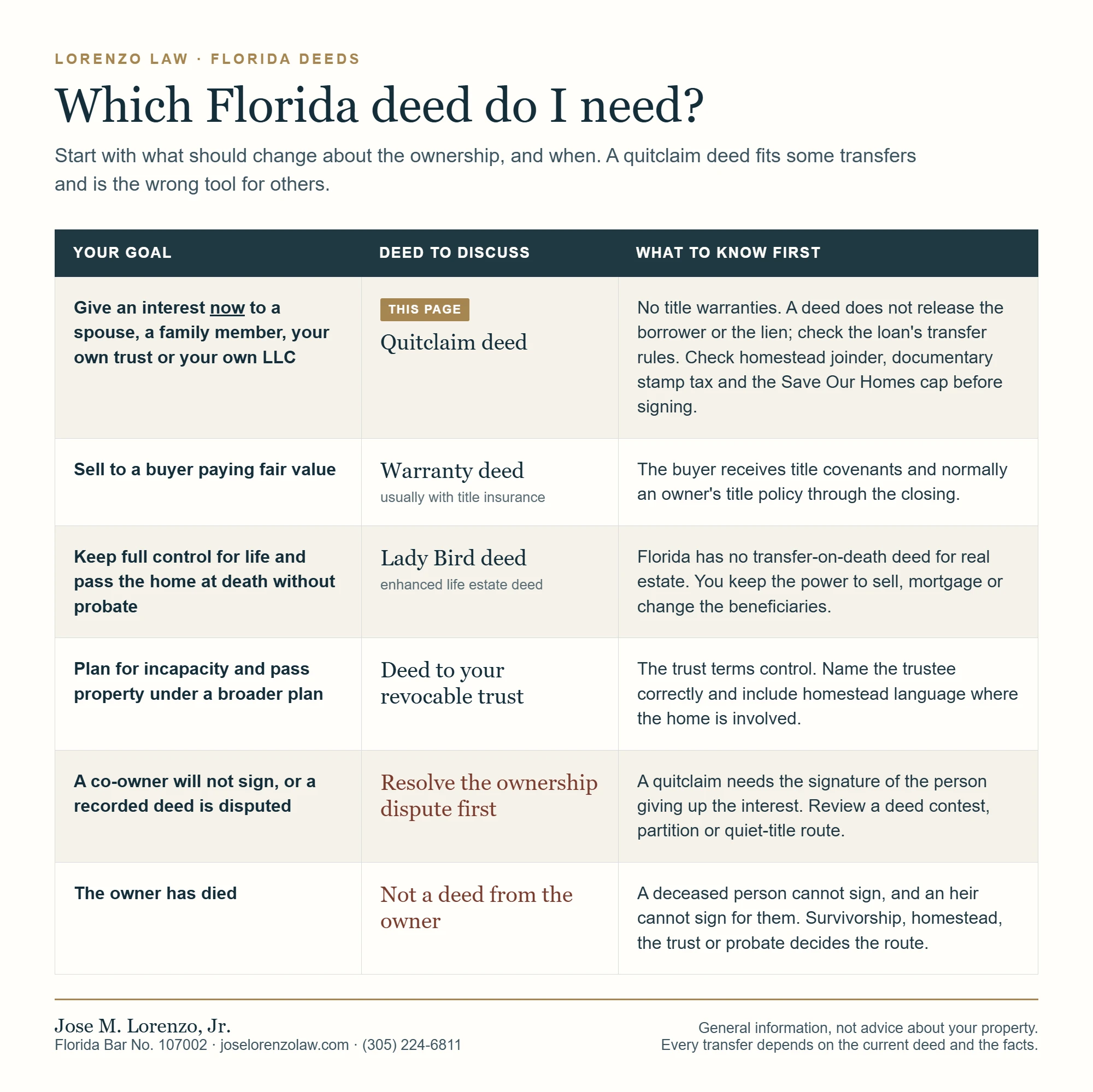
Key Takeaways
- A Florida quitclaim deed conveys the grantor’s interest without title warranties. The recipient should understand what interest is being conveyed and what claims may affect it.
- An ordinary conveyance by an individual requires a written deed signed in the presence of two subscribing witnesses under § 689.01. Recording ordinarily uses a notarial acknowledgment, with other methods permitted by § 695.03.
- Florida has prescribed a statutory quitclaim deed form under § 689.025 since July 1, 2023. Since January 1, 2024, the ordinary recording checklist in § 695.26 includes each witness’s printed name and post office address.
- A deed changes ownership. It does not change who owes the mortgage loan, remove liens or guarantee that a lender will approve the transfer.
- Documentary stamp tax depends on the consideration, the interest transferred and any exemption. A family gift or a nominal dollar amount on a form does not settle the calculation.
- Homestead, spousal rights, survivorship, property-tax assessment and future care needs deserve review before anyone signs.
- Florida has no transfer-on-death deed for real property; the enhanced life estate (Lady Bird) deed is the Florida tool for passing a home at death while keeping control.
- Routine drafting is different from resolving an ownership dispute, clearing a deceased owner’s title or repairing a defective chain of title.
What Is a Quit Claim Deed in Florida?
A quit claim deed in Florida is a written deed in which one person, the grantor, releases to another person, the grantee, whatever right, title and interest the grantor has in a described parcel of Florida real property. It makes no promise that the grantor owns anything, that the title is clear or that there are no liens. The grantor signs it before two witnesses and, for recording, ordinarily acknowledges it before a notary; it is then recorded in the county where the land is located.
The operative words in the statutory form at § 689.025 are “remise, release, and quitclaim.” That phrasing matters. A quitclaim deed does not say the grantor owns the property. It says that whatever the grantor owns, if anything, now belongs to the grantee. If the grantor owns the whole property, the grantee receives the whole property. If the grantor owns a one-third undivided interest, the grantee receives one-third. If the grantor owns nothing, the deed conveys nothing — the form cannot supply an ownership interest the grantor does not have.
What a Florida quit claim deed does not do
- It supplies no title warranties. A recipient does not receive the warranty protections associated with a warranty deed. That does not eliminate a separate claim based on fraud, a contract or other applicable law.
- It does not clear existing liens or competing claims. The property can remain subject to enforceable mortgages, judgment liens, tax liens, association assessment liens and code-enforcement liens. Their effect depends on the lien, the ownership, priority and any applicable protections; a search of the public index alone is not a complete title examination.
- It does not remove anyone from a mortgage. The deed governs title. The promissory note governs the debt. They are separate documents.
- It may not carry title the grantor acquires later. A warranty deed is generally understood to pass title the grantor acquires after the conveyance; a quitclaim conveys only what the grantor holds when it is delivered. Ask before relying on a quitclaim from someone whose interest is still being acquired.
- It does not settle the rest of your estate. An outright transfer of your entire interest ordinarily gives up that interest now. A retained share, a life estate, survivorship wording or a reserved power changes the analysis, and transferring one property does not plan for anything else you own.
What is the purpose of a quit claim deed in Florida?
The purpose of a quit claim deed is to move whatever interest one person holds to someone else when the parties are not bargaining over the quality of the title. Nobody is paying a market price that needs protecting, so nobody needs the grantor’s promises about the title.
Why would someone do a quit claim deed in Florida? The common reasons are adding a spouse to the title, carrying out a divorce settlement, giving a family member a share of a property, moving property into the owner’s own trust or LLC, releasing a co-owner’s interest to the other owner, and clearing up a possible claim by having the claimant sign it away. The When to Use section below lists the situations where it is the wrong tool.
Who benefits the most from a quitclaim deed? Mostly the grantor: the grantor gives no title warranties, so the grantee has no claim on the deed itself if the title turns out to be defective. That does not eliminate liability that may arise from fraud, an agreement or another legal duty. The grantee receives exactly what the grantor had. That is a fair trade between spouses or family members who already know the property’s history, and a poor one for a buyer paying fair value to a stranger.
“Quick claim deed” or “quit claim deed”? Is quitclaim one word or two?
Is quitclaim deed one word or two? Both spellings mean the same instrument; Florida’s statutes use the one-word form, quitclaim. “Quick claim deed” is a common mishearing of the name, and there is no separate Florida instrument called a quick claim or a quick deed. Nor is there a “quiet claim” deed: a quiet title action is a lawsuit, not a deed. The title printed on a downloaded form does not tell you whether its language fits your transfer.
Grantor and grantee: who signs a quit claim deed in Florida?
| Party | Role | Signs the deed? |
|---|---|---|
| Grantor | The owner giving up an interest | Yes — each conveying owner signs before two subscribing witnesses |
| Grantee | The person receiving the interest | Ordinarily not required to sign merely as the recipient. A grantee who is also conveying an interest, or agreeing to an obligation in the deed, may need to sign |
| Joining spouse | A married owner’s spouse where homestead requires joinder | Yes, where joinder is required — even if the spouse is not on title |
| Authorized representative | A trustee, personal representative, entity officer or agent | Signs in the representative capacity, with proof of authority |
| Two subscribing witnesses | Watch the grantor sign | Yes — with printed names and post office addresses |
| Notary public | Takes the acknowledgment for recording | Completes and signs the acknowledgment |
The ordinary grantor signs before two subscribing witnesses, and the acknowledgment is completed for recording. More than one owner, spousal joinder, a representative or a separate agreement can require additional signatures. Do not use a fixed signature count to decide whether a deed is complete.
Which Situation Are You In?
Start with the change of ownership you want. Find the row closest to yours. These are starting points, not findings about your title.
| Ownership now → intended result | What to review first | Mortgage, tax and homestead questions | Usual next step |
|---|---|---|---|
| One owner wants to add a spouse now | Current deed; marriage and homestead facts; how the spouses will hold title | Does the spousal homestead exemption from documentary stamp tax apply? Who stays liable on the note? | Ask whether the standard $575 deed fits |
| Spouses divorcing; one keeps the home | The final judgment or marital settlement agreement; the current deed | Dissolution-related exemption from stamp tax; the departing spouse stays on the loan until a refinance, release or payoff | Coordinate the deed with the refinance — see Quit Claim Deeds and Divorce |
| A parent wants a child to become a co-owner now | Exact share, survivorship, the child’s own creditors; capacity and agreement | Gift reporting, carryover basis, Save Our Homes, stamp tax on any mortgage share | Compare an immediate transfer with the real goal before drafting |
| A parent wants a child to receive the home only at death | The existing estate plan, homestead and family facts | Consequences depend on the retained powers and circumstances | Consider a Lady Bird deed or estate planning instead |
| Unmarried partners want to own together | How they want the property to pass if one dies | No spousal exemptions apply; survivorship must be stated expressly | Decide between tenancy in common and survivorship before drafting |
| Co-owners agree one will release an interest to the other | Both deeds if title changed recently; any settlement | A deed alone does not release a departing borrower | Coordinate the deed with lender requirements or a refinance |
| A co-owner will not sign, or a signature is disputed | Recorded instruments, dates, communications, court papers | Recording another deed does not extinguish the disputed rights | A deed contest or partition consultation |
| The recorded owner has died | Deed wording, death certificate, trust and estate papers | Who has authority, and what interest passed | Determine the probate, homestead, survivorship or trust route first — see After the Owner Has Died |
| An owner is funding a revocable trust | Trust document, trustee’s exact name, authority | Lender and homestead consequences; a deed to your own revocable trust is generally exempt from stamp tax while you are its only beneficiary | Confirm the instrument and scope before signing |
| An owner is moving property into an LLC | Operating agreement, the exact entity name, the property’s use | Homestead and lender consequences; possible stamp tax | Separate review; not routine for a home |
| Selling to an outside buyer | The contract and title commitment | Stamp tax on the price; the buyer will want title insurance | Buyers usually require a warranty deed at a closing |
| A name change after marriage or divorce | Current deed; marriage certificate or judgment | Usually no change of ownership | Ask before recording a new deed — see Do I need a new deed after a name change? |
An attorney’s review of the current recorded deed for drafting is not a title examination, a title-insurance commitment or a guarantee that no other claim exists.
When to Use (and Not Use) a Quit Claim Deed in Florida
A quitclaim deed is commonly used to:
- add a spouse to the title of a home the other spouse already owns;
- transfer a spouse’s interest under a divorce judgment or marital settlement agreement;
- give a share of property to a family member as a present gift;
- move property into the owner’s own revocable trust, or into the owner’s own LLC where that is appropriate;
- release a co-owner’s interest to the remaining owner by agreement;
- clear a cloud on title by having someone with a possible claim release it;
- correct the vesting between the same owners.
A quitclaim deed is usually the wrong tool when:
- you are buying property from someone you do not know. You receive no warranty and no recourse on the deed if title turns out to be defective. Should you buy a house with a quitclaim deed? From a stranger, usually not without a title examination and title insurance;
- the goal is to pass a home at death. A Lady Bird deed or a revocable trust can do that without giving the property away now;
- the goal is to qualify for long-term care benefits. A transfer for less than fair value can affect long-term-care Medicaid eligibility (see Medicaid);
- you want to get off a mortgage. The deed cannot do that;
- someone with a competing claim will not sign. A quitclaim works only with the cooperation of the person giving up the interest;
- the owner has died. A deceased person cannot sign, and an heir cannot sign for them.
For the detailed comparison with the Lady Bird deed, see Lady Bird deed vs. quitclaim deed in Florida.
Rental property, vacant land or a home you just bought
The same deed rules apply to every kind of Florida real property, but each of these raises its own questions before a quitclaim is signed:
- Rental property. There is no homestead exemption to lose, but the leases, the tenants’ security deposits, the landlord insurance and any association approval have to follow the new owner. The federal due-on-sale protections described below are written around residential property and, for several transfers, occupancy, so a transfer of a rental to a relative may not be protected. If the goal is liability protection, that is an LLC question, discussed below.
- Vacant land. Land is commonly described by metes and bounds or by a government-survey description rather than a lot and block, so the legal description deserves extra care. Vacant land is also a common deed-fraud target because no one lives there to notice a forged transfer (see Deed Fraud).
- A home you just bought. Ask before quitclaiming a home soon after closing. The lender’s due-on-sale rights apply from day one, the homestead exemption application may not have been filed yet, and whether your owner’s title insurance policy continues to protect the new owner depends on the policy’s terms and who receives the deed. The 2021 ALTA Owner’s Policy form, for example, lists successor insureds that include a trustee or beneficiary of a trust you created for estate planning, an affiliated entity and a spouse who receives title in a divorce. A lifetime gift to a child does not, by itself, qualify the child as a successor insured. The earlier 2006 form is narrower, and endorsements vary. Check your actual policy with the title insurer before transferring.
Advantages and disadvantages of a quit claim deed
| Advantages | Disadvantages |
|---|---|
| Simple, short instrument in a statutory form | No warranty of title and no recourse on the deed if title fails |
| A short standard instrument with a predictable preparation cost; some transfers carry only the minimum stamp tax | A mortgage balance can make documentary stamp tax due even on a gift |
| Well suited to transfers between spouses and to the owner’s own trust | Gives the property away permanently; you need the new owner’s signature to sell or refinance |
| Can release a cloud on title when the claimant cooperates | Can reset the Save Our Homes assessment cap and pass a low tax basis to the recipient |
| Takes effect on delivery; no court involvement | Does not remove anyone from the mortgage or clear liens |
Why is a quit claim deed bad, then? It is not bad, and it is not safe either; those are the wrong questions. Its downsides are real but specific: no title warranties from the grantor, and consequences for the mortgage, taxes and homestead that the form does not mention. The disadvantages are not reasons to avoid the deed. They are the questions to answer before signing it.
Types of quitclaim deeds you may hear about
- Standard quitclaim deed. The § 689.025 statutory form, used for a voluntary transfer of the grantor’s present interest.
- Spouse-to-spouse deeds. Some states use the term “interspousal transfer deed.” In Florida, a transfer between spouses is ordinarily made by a regular deed; the questions are homestead joinder, the stamp-tax exemption and how the spouses will hold title.
- Divorce quitclaim deed. A deed that carries out a dissolution judgment or settlement.
- Deed into or out of a trust. A deed to the trustee of the owner’s revocable trust, or from a trustee to a beneficiary; trustee authority governs the second.
- Deed to or from an LLC. A transfer to a business entity, signed by an authorized representative when the entity is the grantor.
- Corrective quit claim deed. A Florida deed that corrects an error in an earlier recorded deed, such as a misdescribed lot. A deed that only fixes a scrivener’s error and conveys no new interest is not itself taxed, though a nominal consideration recital usually brings the minimum stamp; a “corrective” deed that adds a new owner can be fully taxable.
- Quit claim deed reserving a life estate. An owner keeps the right to live in the property for life and gives the remainder now; the Lady Bird deed is the enhanced version that keeps the power to sell. Lady Bird provisions concern retained powers and future interests, while “quitclaim” describes the absence of title warranties, so an enhanced life estate deed can be written in quitclaim form or with warranties; a Lady Bird quit claim deed is simply one written without them.
- Heir’s quitclaim deed. An heir releasing whatever interest the heir has. It cannot convey a deceased owner’s interest in the heir’s place.
- Timeshare quitclaim deed. Used only for a deeded timeshare estate (see Timeshares).
- A deed to yourself. An owner who signs a deed as grantor and is also named as a grantee, to change how title is held (see Why would someone do a quitclaim deed to themselves?).
Florida Quit Claim Deed Requirements
Florida’s statutes address several different tasks: the conveyance itself, the deed’s form, execution, acknowledgment, recording and priority. Keeping them apart answers many “is my deed valid?” questions.
| Statute | What it governs |
|---|---|
| § 689.01 | The conveyance. An interest in Florida real property is conveyed by a written instrument signed by the grantor in the presence of two subscribing witnesses. It also permits witnessing by audio-video technology and cross-references separate execution rules for corporations. |
| § 689.025 | The form. The statutory quitclaim deed form, a legibly printed legal description, and a space for the parcel identification number. |
| § 695.03 | Acknowledgment for recording. How an instrument is acknowledged, proved or authenticated so it may be recorded. |
| § 695.26 | Recording formalities. Printed names and post office addresses, the preparer’s name and address, the grantee’s address and the space for the recording stamp. |
| § 695.01 | Priority. What an unrecorded conveyance means for creditors and later purchasers for value without notice. |
| § 28.222 | The recorder. The clerk of the circuit court is the county recorder, unless the county has assigned that role elsewhere. |
| § 28.24 | Recording charges. The service charges for recording. |
How many witnesses does a Florida quit claim deed need?
Two. Section 689.01 requires a conveyance of an interest in Florida real property to be “signed in the presence of two subscribing witnesses” by the person conveying it. Leases are exempt from this witness requirement. For an ordinary deed by an individual, two subscribing witnesses remain required; permitted audio-video witnessing must meet the applicable legal requirements. A corporation may instead convey under the separate execution rules of §§ 692.01 and 692.02.
The statute does not say a witness must be disinterested or must not be related to the parties. As a matter of practice, I use two witnesses who take nothing under the deed and have no stake in the transaction, because an interested witness gives a future challenger something to argue about, and deed challenges can be brought years later, when memories have faded and the grantor cannot explain. That is my practice, not a statutory command.
Can a family member or the notary be one of the witnesses?
No Florida statute prohibits a relative from serving as a subscribing witness to a deed. The notary may also serve as one of the two witnesses, but only by actually signing in a witness space; the notary’s acknowledgment alone does not count as a witness signature, and a notary can never notarize his or her own signature. The person receiving the property should not sign as a witness. I use two independent witnesses so none of these questions arises.
Who can notarize a quitclaim deed in Florida?
A Florida notary public with an active commission can take the acknowledgment for an in-person signing, and a registered online notary can take it for a remote online notarization. Notaries are easy to find — banks, shipping stores, title companies and law offices commonly have one — but the notary’s job is limited to identifying the signer and completing the acknowledgment. The notary does not check whether the deed is correct, whether the spouse needed to join or whether stamp tax is due.
Florida’s notary law limits who a notary may notarize for. A notary may not notarize the signature of the notary’s own spouse, son, daughter, mother or father, and may not notarize a signature on a document when the notary has a financial interest in the transaction or is a party to it, with narrow exceptions for an employee notarizing for an employer and an attorney notarizing for a client. Choose a notary with no family or financial connection to the transfer.
Florida’s statutory quitclaim form under § 689.025
Before 2023, Florida prescribed a statutory form for warranty deeds but not for quitclaim deeds. Chapter 2023-238 created § 689.025, effective July 1, 2023. A Florida quitclaim deed must be in substantially the statutory form, include a legibly printed, typed or stamped legal description, and include a space for the parcel identification number (in Miami-Dade, the property appraiser calls it the folio number), which is entered before recording if available.
Section 689.025 contains a saving clause: leaving out the parcel-number space or the number itself does not affect the validity of the conveyance or the recordability of the deed. The statute also makes clear that the parcel identification number is not part of the legal description and cannot replace it.
The legal description — and why a street address is not one
A deed that describes the property only as “123 Palm Avenue, Miami, FL 33133” has a mailing address, not a legal description. A Florida legal description is a platted description (lot, block, subdivision, plat book and page), a metes-and-bounds description, a condominium unit description referring to the recorded declaration, or a government-survey description by section, township and range.
The prior recorded deed is the starting point, not proof that its description is correct. Compare the full legal description and any referenced exhibits against the current deed and the relevant recorded documents. Flag an apparent error for review rather than silently changing it or copying it into another instrument; an error is fixed deliberately, usually with a corrective instrument.
Acknowledgment, recording and priority
Execution and recording are different questions. Section 689.01 governs the ordinary conveyance formalities. Section 695.03 requires acknowledgment, proof or authentication in a permitted form before an instrument concerning real property can be recorded; a notarial acknowledgment is the usual route for a routine deed.
A deed’s effectiveness between the parties also depends on the grantor’s authority, delivery and acceptance. Recording gives public notice and matters for priority. Under § 695.01, an unrecorded conveyance may be ineffective against creditors or later purchasers for value without notice. Section 695.01(2), a long-standing provision rather than a recent change, provides that grantees by quitclaim are deemed bona fide purchasers without notice within the meaning of the recording acts, so a buyer is not disqualified from that protection just because the deed is a quitclaim. The quitclaim form alone does not make the buyer a protected purchaser, though: the buyer must still have paid value and taken the property without actual, recorded or inquiry notice of a competing claim (Morris v. Osteen, 948 So. 2d 821 (Fla. 5th DCA 2007)). A quitclaim deed does not by itself settle who owns the property; the consideration, notice and recording history all have to be reviewed.
If a signed deed lacks a proper acknowledgment or another recording requirement, have it reviewed promptly. Do not assume it is automatically void, and do not assume it is safe to leave unrecorded. The permitted correction depends on the actual defect and the circumstances.
Does a quit claim deed need to be notarized in Florida?
To be recorded in the ordinary way, yes. Section 695.03 requires an acknowledgment or another permitted proof before the clerk will record it, and a notarial acknowledgment is the normal route. An unnotarized deed should be treated as a problem to fix, not a finished transfer.
Witness names and addresses for recording
Section 695.26 has long required the printed name and post office address of each person who signs an instrument. Chapter 2023-238 extended that requirement to witnesses, effective January 1, 2024. Under § 695.26(1)(c), the name of each witness must be legibly printed, typed or stamped immediately beneath the witness’s signature, and the post office address of each witness must appear on the instrument.
Section 695.26 contains exceptions, and it gives the clerk limited discretion over where names and addresses appear. For a deed subject to the ordinary Florida checklist, provide the complete signer, witness, preparer and grantee information before execution. Confirm the receiving recording office’s instructions for the actual instrument rather than treating an exception as a reason to use an incomplete form.
Many deed forms circulating online were written before these 2023 and 2024 changes. A form that has no witness-address lines, or that is not in the statutory quitclaim form, is worth a second look before anyone signs it.
Remote online notarization and remote witnessing
Florida permits remote online notarization, and § 689.01 allows the two-witness requirement to be satisfied by witnesses present through audio-video communication technology as defined in chapter 117. Remote notarization and remote witnessing have separate legal requirements, including the screening and physical-presence rules in § 117.285. A generic video call does not satisfy them. I offer remote signing where it is permitted, and I confirm the appropriate signing process for the people, the instrument and the circumstances before the appointment.
What the Clerk and a Title Examiner Will Check
A deed can be legally effective between the parties and still be rejected at the recording counter, or questioned years later when the property is sold. These are the items the recording office and a later title examiner look for. This is the ordinary checklist, subject to the particular instrument and the statutory exceptions; it is not a template, and a deed should be prepared for the specific transfer.
| What is checked | Why it matters | Authority |
|---|---|---|
| Blank space for the clerk’s recording information | Room for the recording stamp | § 695.26(1)(e) |
| Preparer’s name and post office address | Identifies who prepared the instrument | § 695.26(1)(b) |
| Parcel identification number space | Required space; the number never replaces the legal description | § 689.025 |
| The grantor correctly identified | Reconcile any name variation with the recorded deed and supporting documents | § 689.025; § 695.26(1)(a) |
| The grantee’s full name and post office address | Indexing and notices | § 689.025; § 695.26(1)(f) |
| Consideration recital | Relevant to documentary stamp tax; the recital does not decide the tax by itself | § 689.025; ch. 201 |
| Complete legal description | Identifies the land with certainty | § 689.025 |
| How the grantees will hold title | Decides what happens when an owner dies | § 689.15 |
| Grantor’s signature, printed name and address, signed before both witnesses | Execution | § 689.01; § 695.26(1)(a) |
| Two witness signatures, printed names and post office addresses | Execution and the 2024 recording rule | § 689.01; § 695.26(1)(c) |
| Proper acknowledgment with the notary’s required information, signature and seal | Recordability | § 695.03; § 695.26(1)(d); ch. 117 |
| Spousal joinder where homestead requires it | Whether the transfer of a homestead is effective | Art. X, § 4(c) |
| Documentary stamp tax paid on the correct consideration | Tax, penalties and a later title question | ch. 201 |
How the Grantees Hold Title: Survivorship and Tenancy in Common
Under § 689.15, the right of survivorship does not exist by default in Florida. A conveyance to two or more people creates a tenancy in common unless the instrument expressly provides for survivorship. The exception is an estate by the entireties between spouses.
So a joint tenancy quit claim deed — a quitclaim deed with right of survivorship — has to say so in its own words. That rule decides what happens when one owner dies. Two siblings who take a deed simply “to Maria and Ana” are tenants in common. If Maria dies, her half does not pass to Ana automatically; it passes under the rules that govern Maria’s estate.
| Ownership arrangement to discuss | What happens at death |
|---|---|
| Tenancy in common (the default for two or more grantees) | No automatic survivorship; the deceased owner’s interest passes under the applicable estate, homestead and other governing rules |
| Joint tenancy with right of survivorship (must be stated expressly) | Passes to the surviving joint tenant |
| Tenancy by the entireties (spouses only) | Passes to the surviving spouse; also protects the property from the separate creditors of one spouse |
| Life estate with a remainder | The remainder owner’s interest becomes possessory when the life tenant dies; a sale of the full ownership ordinarily requires the remainder owners as well, and the deed’s reserved powers matter |
| Enhanced life estate (Lady Bird) | The owner keeps the power to sell, mortgage and convey during life; the property passes to the remainder beneficiaries at death without probate |
Section 689.15 also provides that when spouses who own as tenants by the entireties divorce, they become tenants in common, which is one reason a quitclaim deed so often accompanies a marital settlement. The wording that creates any of these arrangements belongs in a deed drafted for the specific transfer, not in an isolated clause copied into a form.
Unmarried partners: how should you take title?
Unmarried partners cannot hold title as tenants by the entireties, and none of the spousal exemptions or homestead rules written for married couples apply to them. If partners want the survivor to own the whole property, the deed has to state survivorship expressly; otherwise each partner’s share passes under that partner’s estate. Because each joint tenant can usually convey his or her own share, survivorship planning between partners is often coordinated with wills, a trust or a Lady Bird deed. The estate planning for unmarried couples guide covers the wider plan.
Do I need a quit claim deed to change my name on the title?
Usually not to change ownership in Florida, because the same person owns the property before and after a name change. A deed is sometimes recorded after a marriage or divorce to show the owner’s current name, or to add a spouse at the same time. Whether a new deed is advisable, and how it should recite the former name, depends on the transfer; ask before recording one.
Why would someone do a quitclaim deed to themselves?
A quit claim deed to yourself sounds pointless, but it is a common way to change how title is held without changing who owns it. The owner signs as grantor and is also named as a grantee. Typical reasons:
- Adding someone while staying on title — an owner deeds the property to himself or herself together with a spouse or another person. Florida law specifically allows a spouse who owns property to convey it to both spouses to create a tenancy by the entireties under § 689.11.
- Keeping the Save Our Homes cap — the § 193.155 exception for an owner named as both grantor and grantee, described below.
- Funding your own revocable trust — the owner deeds the property to himself or herself as trustee.
- Reserving a life estate — the owner keeps a life estate and conveys the remainder.
- Correcting the record — fixing a legal description, a name or the way co-owners hold title.
Because the deed can change survivorship, the assessment and the stamp-tax calculation, a deed to yourself deserves the same review as a transfer to someone else.
How to File a Quit Claim Deed in Florida: Step by Step
Filing a quit claim deed in Florida takes eight steps. The first three decide whether the deed does what you intend; the later steps are mechanical but still need care.
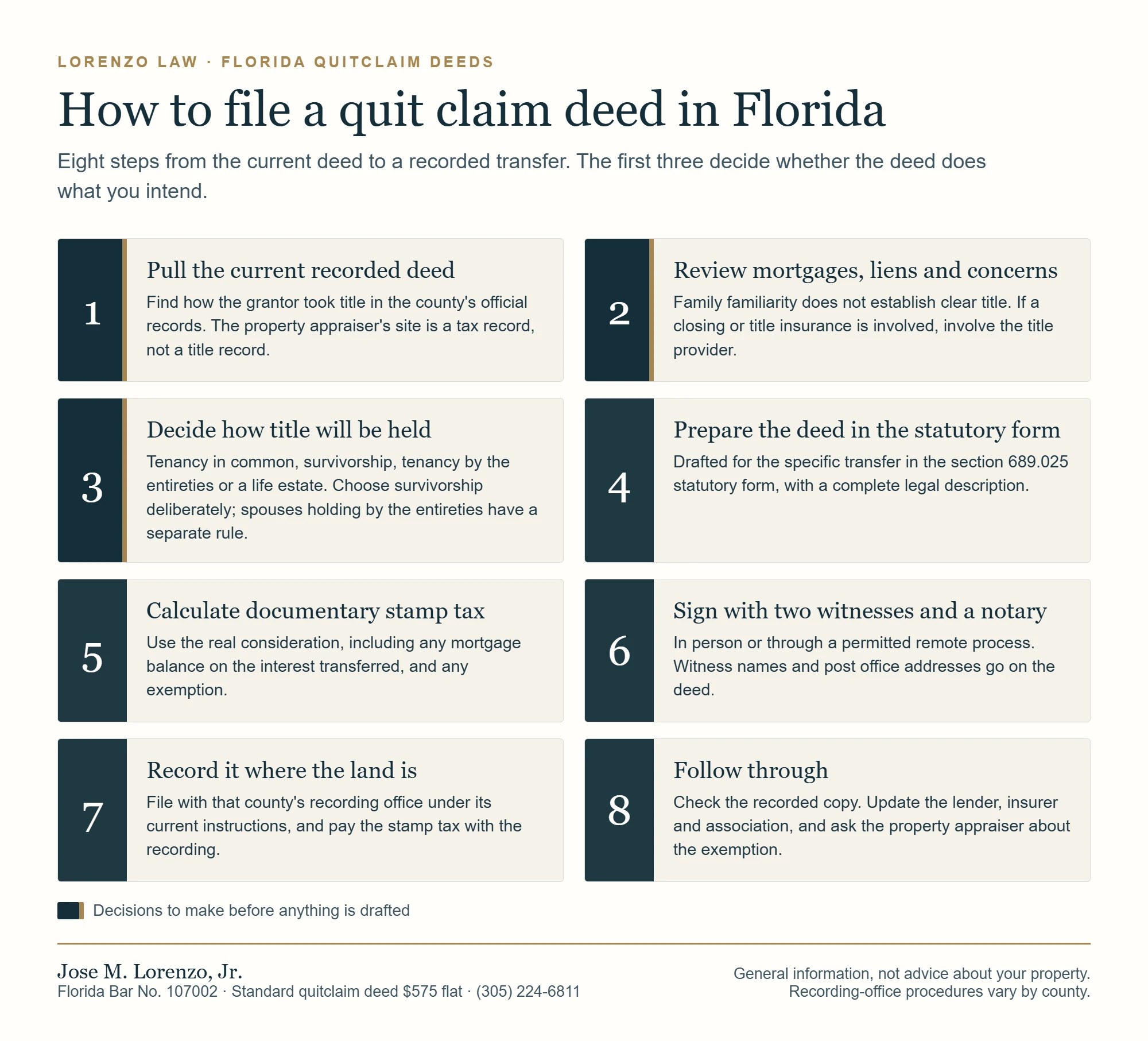
View the eight-step filing chart
Step 1: Pull the current recorded deed
Find the deed by which the grantor took title in the county’s official records. The county recorder — the clerk of the circuit court in most counties, the Comptroller in Orange County, and the Records, Taxes and Treasury Division in Broward — keeps the official records. The property appraiser’s website is a tax record, not a complete title record.
Step 2: Review known mortgages, liens and ownership concerns
Check what you already know about the property. If title assurance or a closing is involved, discuss an appropriate title examination and title insurance with the relevant provider. Familiarity between family members does not establish clear title. My standard deed engagement is not a title examination.
Step 3: Decide how the new owners will hold title
Choose tenancy in common, survivorship, tenancy by the entireties or a life-estate arrangement deliberately (see the table above). Make this decision on purpose, before drafting.
Step 4: Prepare the deed in the § 689.025 statutory form
The deed should be prepared for the specific transfer and meet the form and recording requirements discussed above.
Step 5: Calculate the documentary stamp tax before signing
Use the actual transaction, the interest transferred, any mortgage and any exemption — see Documentary Stamp Tax.
Step 6: Sign with the confirmed process
This is how to execute a quit claim deed in Florida: the grantor signs before two subscribing witnesses, and the acknowledgment is taken, in person or through a permitted remote process. Everyone’s printed information is completed as the recording statute requires.
Step 7: Record the deed in the county where the land is located
Record it in the county where the property is located — not where you live and not where the grantee lives. Use the correct county recording office and its current payment and submission instructions, and pay the documentary stamp tax with the recording.
Step 8: Follow through after recording
Obtain the recorded copy and confirm the indexing and the legal description. Coordinate the lender, the homeowner’s insurance and any association. Ask the property appraiser about exemption and assessment requirements and deadlines. Recording does not complete those tasks automatically.
Filing by mail, in person or electronically
Florida recording offices generally accept deeds in person, by mail and through approved electronic-recording services, but the details differ by county: return envelopes, cover sheets, payment methods and what may be e-recorded. A member of the public usually records by mail or at the counter; electronic recording is normally done through a submitter account or an approved vendor. Check the county’s official recording page (linked in the table below) before sending anything time-sensitive.
Can you file a quit claim deed online in Florida? Many counties accept electronic recording, but usually through a submitter account or an approved e-recording vendor rather than a public upload page. If you are mailing the deed, send it to the recording office’s mailing address shown on its official page, with the payment in the form the office accepts and a return address for the original, and keep a copy of everything you send.
How long does a quit claim deed take in Florida?
No statewide completion time applies. The process has four stages, and different people control each one:
| Stage | Who controls it | What affects timing |
|---|---|---|
| Document review and drafting | The attorney or preparer | Whether the current deed, legal description and ownership facts are complete |
| Signing | The parties, witnesses and notary | Scheduling, remote-signing requirements, travel |
| Acceptance and indexing | The county recording office | Submission method, county workload, any rejection |
| Return and follow-through | The recording office and the parties | Mail return, lender and insurance updates, the property appraiser |
Tell the attorney about a sale, refinance, court deadline or travel date at the first contact, and confirm the expected schedule for your matter.
When does a quit claim deed take effect?
Between the grantor and the grantee, a deed generally takes effect when it is delivered to and accepted by the grantee, not when it is recorded. Recording protects the grantee’s position against later purchasers and creditors under § 695.01. There is no reason to delay recording: an unrecorded deed is exposed if the grantor later dies, remarries, is sued or files bankruptcy.
Where to File a Quit Claim Deed in Florida: County Recording Guide
Record the deed in the county where the land is located. The statewide rules are the same everywhere: the recording charges in § 28.24 and the documentary stamp rate of $0.70 per $100, except in Miami-Dade, which uses $0.60 per $100 plus a $0.45 surtax where the surtax applies. What varies is each office’s submission procedure, so use the county’s own official instructions.
| County | Recording office | Official recording information | Property fraud alert |
|---|---|---|---|
| Miami-Dade | Clerk of the Court and Comptroller | Official Records | Property fraud alert |
| Broward | Broward County Records, Taxes and Treasury Division | Records, Taxes and Treasury Division | Recording notification |
| Palm Beach | Clerk of the Circuit Court & Comptroller | Homeownership and recording | Property fraud alert |
| Hillsborough | Clerk of the Circuit Court & Comptroller | Property records and recording | Property fraud alert |
| Orange | Orange County Comptroller, Official Records | Official Records | Property fraud |
| Pinellas | Clerk of the Circuit Court and Comptroller | Recording services | Offered — see the recording page |
| Duval | Clerk of the Circuit Court | Recording | Property fraud alert |
| Lee | Clerk of the Circuit Court & Comptroller | Record a document | Property fraud |
| Polk | Clerk of the Circuit Court and Comptroller | Official Records | Property fraud alert |
| Brevard | Clerk of Court & Comptroller | Official Records | Recording notification |
| Volusia | Clerk of the Circuit Court | Official Records | Property fraud alert |
| Pasco | Clerk & Comptroller | County Recorder | Property fraud alerts |
| Seminole | Clerk of the Circuit Court & Comptroller | Official Records | Property fraud alert |
| Sarasota | Clerk of the Circuit Court and County Comptroller | Recording services | Property fraud alerts |
| Manatee | Clerk of the Circuit Court and Comptroller | Recording | Property alerts |
| Collier | Clerk of the Circuit Court & Comptroller | Recording information | Risk alert notifications |
| Marion | Clerk of Court and Comptroller | Official Records recording | Property alert service |
| Osceola | Clerk of the Circuit Court & County Comptroller | Recording | Property alert |
| St. Lucie | Clerk of the Circuit Court & Comptroller | Recording department | Property fraud alert |
| Alachua | Clerk of the Court | Recording | Recording notification service |
Submission procedures, e-recording options and payment rules change. Confirm the current instructions with the recording office before mailing anything time-sensitive.
Quick answers for the largest counties. A quit claim deed in Miami-Dade is recorded with the Miami-Dade Clerk of the Court and Comptroller and carries the Miami-Dade stamp rate. A quit claim deed in Broward County, Florida, is recorded with the county’s Records, Taxes and Treasury Division, not the clerk. In Orange County, Florida (Orlando), where you file a quit claim deed is the Orange County Comptroller’s Official Records office. A quit claim deed in Palm Beach County, Florida, goes to the Palm Beach Clerk of the Circuit Court & Comptroller, and a quit claim deed in Lee County, Florida — Fort Myers, Cape Coral and the rest of the county — goes to the Lee County Clerk of the Circuit Court & Comptroller. In each county the statewide rules on execution, recording charges and stamp tax are the same.
If the real goal is passing the property at death, the county Lady Bird deed guides explain the instrument that does that without giving the property away now: Miami-Dade, Broward, Palm Beach County, Tampa and Hillsborough, Orlando, Pinellas County, Jacksonville, Fort Myers, Naples, Kissimmee and Sarasota.
What a Florida Quit Claim Deed Costs
A Florida quitclaim deed carries three kinds of cost: the county’s recording charge, the documentary stamp tax and the preparation fee. Only the third is set by the person preparing the deed.
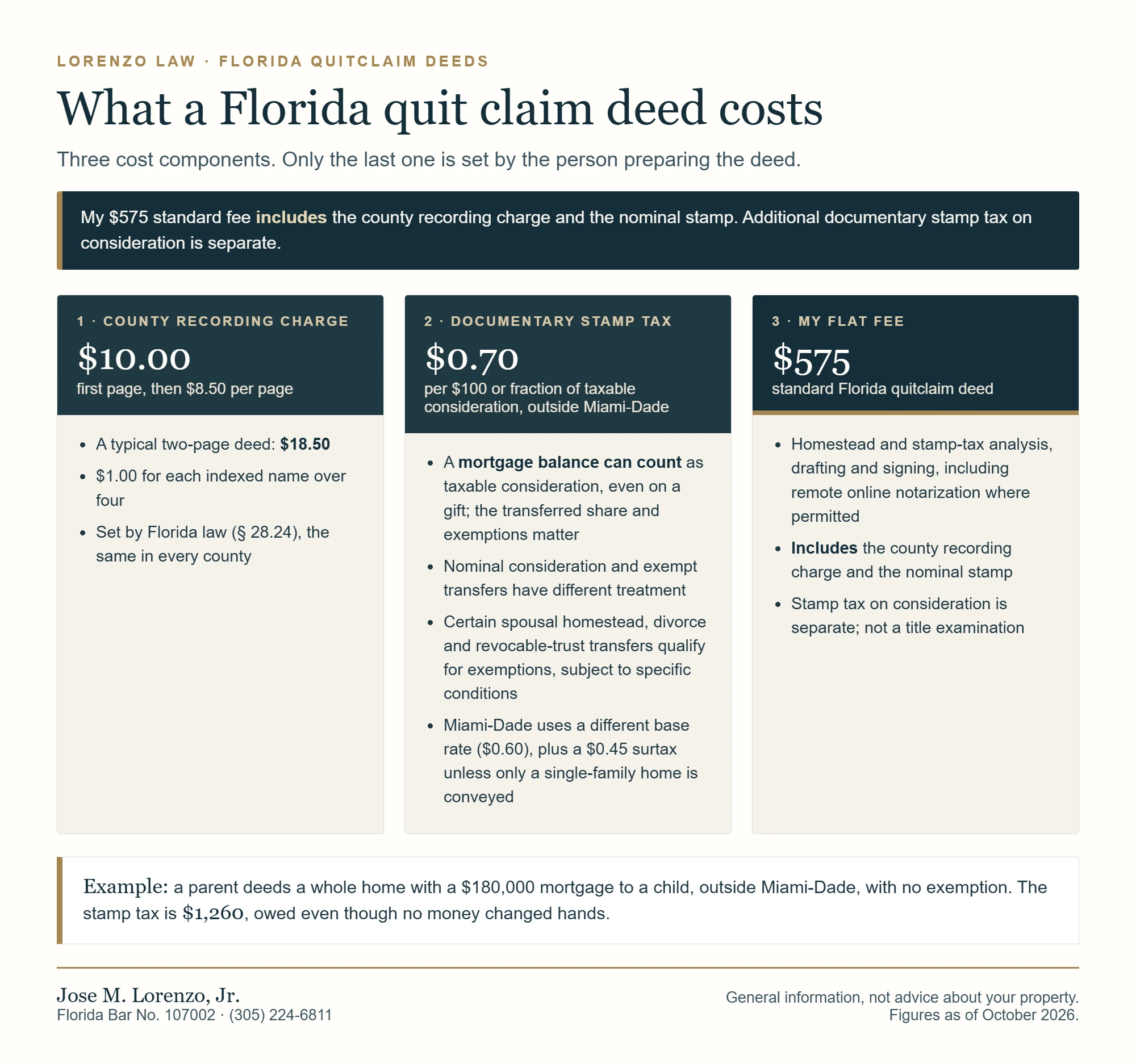
How much does a quit claim deed cost in Florida?
The government charges for a simple two-page deed are often small: $18.50 to record it, plus documentary stamp tax that may be only the minimum when the deed recites only nominal consideration and there is no mortgage. When the property carries a mortgage, or the transfer is a sale, the stamp tax is usually the largest number. My fee to prepare and record a standard quitclaim deed is a flat $575, which includes the recording charge and the nominal stamp; documentary stamp tax on consideration is separate.
How much does it cost to file a quitclaim deed in Florida? The filing itself — the county’s part — is the recording charge: $10.00 for the first page and $8.50 for each additional page, so $18.50 for a typical two-page deed, plus the documentary stamp tax that is paid at the same time. The breakdown is below.
How much does a lawyer charge for a quit claim deed in Florida?
My published attorney fee for a quit claim deed is $575 for a standard Florida quitclaim deed: one property, straightforward parties and a clean chain of title. Eligibility and the engagement are confirmed in writing after I review the current recorded deed.
The fee includes:
- review of the current recorded deed for the proposed transfer;
- the homestead and spousal-joinder analysis;
- the documentary stamp tax analysis;
- preparing the deed;
- the signing, including remote online notarization and remote witnessing where permitted;
- the county recording charge and the nominal documentary stamp covered by the standard service.
Documentary stamp tax on consideration — for example, on a mortgage balance — is separate and is owed by the parties.
The $575 service is not a title examination, a title-insurance policy or an undertaking to cure a title defect. A dispute among owners, a deceased owner whose property needs probate, a defective prior deed or another nonstandard circumstance calls for a separate scope and fee discussion. The separate $575-per-deed service for moving a Florida home into a revocable trust, and the $675 standard Lady Bird deed, have their own scopes; a matching price does not mean the services are interchangeable. See Florida deed preparation for the published deed services.
Quit claim deed lawyer, title company or online form?
Who can prepare a quit claim deed in Florida? The owner, for his or her own property; an attorney; and a title insurer or its agent, but only as part of a transaction in which it is issuing title insurance. Those providers do different work:
| Provider | What you usually get | Questions to ask |
|---|---|---|
| An attorney | Advice on whether a quitclaim is the right deed, the homestead and tax analysis, drafting, signing and recording | Is the fee flat? Does it include recording and remote signing? Who reviews the current deed? |
| A title company or closing agent | A deed prepared as part of a sale or refinance closing, usually with title insurance for the buyer or lender | Is the deed part of an insured closing? Who is advising the person giving up title? |
| An online form service | A completed form, sometimes with notary and recording services sold separately | Is the form in the 2023 statutory format with 2024 witness-address lines? Who checks homestead, the mortgage and the tax? |
Florida law does not require an attorney to prepare a deed, and a property owner may prepare one for his or her own property. Non-lawyers who prepare deeds for others must stay within the limits on the unlicensed practice of law. The useful comparison is not the price of the form; it is what happens if the deed is the wrong deed. See Can I prepare my own quit claim deed?
Base recording charges and additional costs
Florida’s recording charge of $10.00 for the first page and $8.50 for each additional page is the sum of three charges in § 28.24:
| Component | Authority | First page | Each additional page |
|---|---|---|---|
| Base recording, indexing and filing | § 28.24(13)(a), (b) | $5.00 | $4.00 |
| Public Records Modernization Trust Fund | § 28.24(13)(d) | $1.00 | $0.50 |
| Additional service charge | § 28.24(13)(e) | $4.00 | $4.00 |
| Total | $10.00 | $8.50 |
The ordinary recording charge for a two-page deed is $18.50 before any additional indexing, documentary stamps or other applicable charges. Section 28.24 also provides a $1.00 charge for each indexed name above four. Do not count signatures as a substitute for the recorder’s indexing rules; confirm the calculation for aliases, extra parties and your submission method with the recording office. Copy, postage, payment-processing and electronic-submission costs can differ from county to county.
Illustrative government charges, before professional and other costs
| Transfer (assumptions stated) | Documentary stamp tax | Recording (two pages) |
|---|---|---|
| Parent to child, whole property, no mortgage, nominal consideration recited | Minimum stamp on the nominal consideration | $18.50 |
| Parent to child, whole property, $180,000 mortgage, no other consideration or exemption, outside Miami-Dade | $1,260 | $18.50 |
| Same mortgage, but a one-half interest is transferred, outside Miami-Dade | $630 | $18.50 |
| Spouse to spouse, homestead, the only consideration is the mortgage | May qualify for the § 201.02(7)(b) exemption | $18.50 |
| Arm’s-length sale for $400,000, Broward, no exemption | $2,800 | $18.50 |
| Arm’s-length sale for $400,000, duplex, Miami-Dade, surtax applies | $4,200 | $18.50 |
These figures assume two pages and no excess indexing or other charge. For a standard deed I prepare, the recording charge and the nominal stamp are already inside the $575 fee; only documentary stamp tax on consideration is added. A government subtotal is not a quote for the $575 service, and the actual transaction must be checked before using any figure.
Ask me whether a standard deed fits your property — free consultation · Call (305) 224-6811
Documentary Stamp Tax on a Florida Quit Claim Deed
Documentary stamp tax is calculated from taxable consideration, not simply the market value of the home or the amount typed into a form. Outside Miami-Dade, the rate is $0.70 for each $100 or fraction of taxable consideration. Miami-Dade uses $0.60, plus a $0.45 surtax where applicable; the surtax does not apply to a document transferring only a single-family dwelling.
Consideration can include money, the discharge of a debt, and a mortgage or other encumbrance, whether or not the recipient assumes the debt. The transferred interest matters. If a parent transfers an entire property subject to a $180,000 mortgage, with no other consideration or exemption, the illustrative tax outside Miami-Dade is $1,260. If the taxable transaction instead transfers a one-half interest measured against that same debt, the corresponding illustration is $630. The actual transaction must be checked before using either figure.
There is no general exemption merely because the parties are related or the purpose is estate planning. A family transfer is a non-arm’s-length transfer, but that label does not make it exempt. The specific exemptions that matter most for quitclaims are:
- Spouse to spouse, homestead: a transfer of homestead between spouses when the only consideration is the mortgage or other lien on it (§ 201.02(7)(b)). Any other consideration makes the whole amount, mortgage included, taxable.
- Divorce: a transfer of the marital home between spouses or former spouses under a dissolution of marriage action, exempt regardless of the mortgage when made at or after the final judgment (§ 201.02(7)(a)). A deed signed before the divorce is final is taxed, with a refund available if the dissolution follows within one year.
- Your own revocable trust: a deed to the trustee of your own revocable trust, while you are its only beneficiary, is exempt even if the property is mortgaged. Tax can apply to the share of the mortgage attributable to other beneficiaries.
The facts and the rule’s conditions control.
Do not treat $0.70 as a universal minimum owed on every deed in every county. A nominal-consideration transfer, a genuinely exempt transfer and a transfer involving debt are different calculations. Confirm any required recital, exemption support and payment before recording. Late or insufficient payment can result in penalties and interest under § 201.17; use current Department of Revenue guidance rather than assuming a fixed rate.
Who pays the documentary stamp tax on a quit claim deed?
The tax is paid when the deed is recorded, and the parties decide between themselves who bears it. Florida law makes the tax a liability of the parties to the transfer, so an unpaid amount can come back to either of them and can become a title problem later. I calculate it and tell you the amount before anyone signs.
Sources: Florida Department of Revenue, documentary stamp tax; § 201.02; § 201.031 and § 125.0167 (Miami-Dade surtax); Fla. Admin. Code R. 12B-4.012–12B-4.014 (renumbered January 25, 2026). How the same tax question plays out on the other common family deed: Lady Bird deed tax consequences in Florida.
Quit Claim Deeds and Florida Homestead Property
“Homestead” means three different things in Florida, and confusing them causes mistakes.
| Homestead rule | Source | What a quitclaim deed changes |
|---|---|---|
| Protection from forced sale | Art. X, § 4(a)–(b) | Constitutional creditor protection depends on qualifying ownership, use and constitutional limits; do not assume the recipient automatically acquires the transferor’s protection |
| Restriction on transfer | Art. X, § 4(c) | A married owner’s spouse must join a lifetime transfer of homestead; the devise restriction limits who may receive it at death |
| Tax exemption and Save Our Homes cap | Art. VII, §§ 4(d), 6; §§ 196.031, 193.155 | The exemption does not transfer with the deed, and a change of ownership can reset the assessment cap |
Does my spouse have to sign a quit claim deed of our homestead?
If you are married and the property is your homestead, yes: Florida’s Constitution requires a married owner’s spouse to join a sale, gift or mortgage of homestead to someone else, even where the spouse is not named on the title, contributed nothing and the home was acquired before the marriage. Florida appellate courts treat a deed of homestead made without the required joinder of the owner’s spouse as void (Clemons v. Thornton, 993 So. 2d 1054, 1056 (Fla. 1st DCA 2008)); the Third District has called such a deed void ab initio (Mendia v. Galvez, 418 So. 3d 838, 841–42 (Fla. 3d DCA 2025)). Because the recording of a void deed creates no legal title and protects no one claiming under it, a later buyer’s good faith does not save it (McCoy v. Love, 382 So. 2d 647, 648 (Fla. 1979)); recording it or a later event does not fix it. A mortgage signed without the spouse is treated differently: it is not void, but it does not work as a lien until the spouse joins or the property stops being homestead.
The main exception is a spouse who has already signed a valid written waiver of homestead rights, such as a prenuptial or postnuptial agreement with specific homestead language, signed before two witnesses. Florida courts have treated that spouse as having predeceased for this purpose, although the Florida Supreme Court has not squarely decided it for lifetime deeds. A general quitclaim, or an agreement that does not specifically mention homestead, is not enough. Tell me who is conveying, who is receiving and who lives in the property before deciding which signatures are needed.
Transfers between spouses and other special statutory circumstances need their own analysis.
The § 732.7025 waiver is narrower than people assume
Section 732.7025 lets a spouse waive, through language in a deed, the homestead rights that would otherwise prevent the other spouse from devising the homestead to someone else. Read what it covers: it reaches the devise restriction only. It is not a waiver of creditor protection, and it is not a waiver of the requirement that the spouse join a lifetime transfer. The spouse still has to join the deed.
Do minor children block the transfer?
Minor children do not create the same joinder requirement as a spouse for a genuine lifetime conveyance by an owner. Restrictions on devising homestead at death are a different issue: under Art. X, § 4(c) and § 732.4015, homestead generally cannot be devised when the owner is survived by a spouse or minor child, except that it may be devised to the spouse when there is no minor child. A child’s own ownership interest, retained rights, or a disposition that functions at death can raise different issues. Do not use a lifetime-deed rule as a shortcut around homestead succession law.
Does a spouse keep rights after signing a quit claim deed?
Generally the signing spouse gives up his or her ownership interest. But if the property is the couple’s homestead and they remain married, the constitutional homestead rules and the joinder requirement can still affect a later transfer. Homestead rights are not the same thing as title, and a deed alone does not always dispose of them.
How a Quit Claim Deed Can Reset Your Save Our Homes Cap
A deed can change the property’s assessment, but the deed’s label does not decide whether the Save Our Homes cap resets. Section 193.155 generally limits annual assessment increases on qualifying homestead to the lower of 3% or the specified change in the Consumer Price Index. A qualifying change of ownership ordinarily results in assessment at just value the following January 1, subject to statutory exceptions.
One important exception concerns an owner who remains entitled to the homestead exemption and is named as both grantor and grantee while another individual is added as a grantee. Under § 193.155(3)(a)1.c., that arrangement can avoid a change-of-ownership reset; an additional grantee’s application for a homestead exemption changes the analysis. Transfers between spouses and certain death-related transfers have separate exceptions.
Compare two situations. A parent transfers the entire home to an adult child and no longer keeps the qualifying ownership. A parent keeps qualifying ownership and exemption entitlement while adding the child in a deed that satisfies the statutory exception. Both use a quitclaim deed; they should not be treated as the same automatic reset.
For illustration only: a full assessment increase from $260,000 to $525,000 is a $265,000 difference. At an assumed effective rate of 2%, that difference represents about $5,300 before exemptions and other adjustments. It is not a prediction of your bill. The county property appraiser evaluates the actual deed, ownership and exemption facts, and tax rates and values change.
Quit Claim Deeds and Your Mortgage
Does signing a quit claim deed remove you from the mortgage?
No. A deed transfers title. A promissory note creates the debt, and the mortgage is the lien that secures it. Signing a quitclaim deed gives away your ownership while your obligation on the note stays where it was. If the remaining owner stops paying, the lender can look to the borrowers on the note.
A borrower needs an effective release or satisfaction of the obligation; refinancing, an approved assumption with a written release, or a payoff are the common routes. A deed or an agreement between the owners does not bind the lender. A quitclaim deed without refinancing leaves the loan exactly where it was.
Can you quit claim a house with a mortgage in Florida?
Yes. The mortgage stays on the property, the borrower stays on the note, and documentary stamp tax is generally due on the mortgage balance attributable to the interest transferred unless an exemption applies.
What if my name is on the deed but not the mortgage?
Being on the deed does not by itself make you personally liable on someone else’s promissory note. Review the note, any assumption, guaranty and other signed documents before deciding who owes the debt. A valid mortgage lien can still affect your ownership, and a foreclosure can put your interest at risk. A successor owner may also have rights in dealing with the loan servicer; do not assume the servicer can never communicate with someone who was not the original borrower.
Will a quit claim deed trigger the due-on-sale clause?
A typical mortgage lets the lender demand full payment if the property is transferred. Federal law, 12 U.S.C. § 1701j-3(d), bars a lender from exercising that option for specified transfers of residential property with fewer than five dwelling units, including:
- a transfer on the death of a joint tenant or tenant by the entirety;
- a transfer to a relative resulting from the borrower’s death;
- a transfer in which the borrower’s spouse or children become owners;
- a transfer resulting from a dissolution decree, legal separation agreement or incidental property settlement, in which the spouse becomes an owner;
- a transfer into an inter vivos trust in which the borrower is and remains a beneficiary and which does not relate to a transfer of rights of occupancy.
The implementing federal regulation adds an occupancy condition that the statute itself does not state: the death, spouse-or-children and divorce protections apply when the person receiving the property occupies or will occupy it, and the trust protection requires the borrower to remain an occupant. Whether that narrowing is valid has not been settled by the courts, so the loan, the property and the exact transfer need to be checked. This is not a blanket exemption for every transfer between relatives, and a transfer to an LLC or to an unrelated person is not on the list. Protection from acceleration does not release the borrower or make the recipient a borrower. Source: 12 U.S.C. § 1701j-3.
VA loans, home equity loans and reverse mortgages
These loans have their own program rules and loan documents, so read them and call the servicer before any transfer:
- A VA loan stays with the veteran who borrowed it. Quitclaiming the home to someone else does not release the veteran or free up the veteran’s loan entitlement. Release generally requires notifying the lender in writing before the transfer and an approved assumption by a qualified buyer, or a payoff; a transfer without notice lets the lender demand full payment.
- A home equity loan or line of credit is a second lien that stays on the property like any other mortgage. Whether a transfer of title is a default depends on the loan agreement; federal lending rules let a lender end a credit line when the borrower’s action adversely affects its security, and the federal successor-in-interest protections that apply to ordinary mortgages do not cover home equity lines.
- A reverse mortgage (HECM) becomes due when a borrower dies and the home is not the principal residence of a surviving borrower, subject to deferral protection for an eligible non-borrowing spouse, which must be confirmed with the servicer. It also becomes due when a borrower conveys all of his or her title and no other borrower keeps any title; keeping even a life estate counts as keeping title, so a transfer to a child that leaves no borrower with any title makes the loan due. With HUD approval, the loan can also become due if the home stops being a borrower’s principal residence for reasons other than death and is not the principal residence of another borrower; if a borrower fails to occupy the home for more than 12 consecutive months because of physical or mental illness and it is not the principal residence of another borrower; or if property charges are not paid or other mortgage obligations are not performed. Reverse mortgages are excluded from the federal due-on-sale protections described above. Talk to the servicer before signing anything.
Can you sell a house with a quit claim deed in Florida?
Yes. An owner who received title by quitclaim can sell it like any other owner. The buyer’s title insurer will examine the chain of title, and a quitclaim in the chain is a reason for questions, not a bar to a sale. Start the title work early if a sale is planned.
Can you get a mortgage or refinance after a quit claim deed?
Often, yes, and a refinance is frequently the point of the exercise. Lenders and title insurers apply their own underwriting rules to a recent transfer, so the timing of the deed and the loan application should be planned together rather than assumed. No lending approval is promised by any deed.
Quit Claim Deeds and Divorce in Florida
A quitclaim deed is the usual way one spouse transfers an interest in the marital home to the other under a divorce. Four points decide whether it works:
- The deed and the loan are separate. The spouse who signs the deed stays on the mortgage note until the other spouse refinances, the lender approves an assumption with a written release, or the loan is paid. Any settlement that calls for a quitclaim should tie the deed to the refinance or set a deadline with a specific remedy, rather than having the deed signed at mediation and the refinance left for later.
- Divorce changes how spouses hold title. Under § 689.15, spouses who owned as tenants by the entireties become tenants in common when the marriage is dissolved, so the survivorship protection ends with the divorce.
- Documentary stamp tax. A transfer of the marital home between spouses or former spouses under a dissolution action is exempt regardless of the mortgage when it is made at or after the final judgment. A deed signed before the divorce is final is taxed, with a refund available if the dissolution follows within one year.
- Due-on-sale. Federal law protects a transfer resulting from a dissolution decree or settlement in which the spouse becomes an owner from acceleration under the due-on-sale clause, subject to the conditions described above.
Does a divorce decree override a quit claim deed?
A final judgment can order a party to convey, and a Florida court can transfer title by the judgment itself. Once a deed is executed and recorded, though, it controls record title, and undoing it means going back to the court. Do not sign the deed without addressing the refinance obligation.
Does a Quit Claim Deed Give You Ownership?
It gives you exactly what the grantor had when the deed was delivered — no more, no less, and with no promise that it was anything. If the grantor held clear title, you now hold clear title, and a quitclaim moves it as effectively as a warranty deed would. If the grantor’s title was clouded, you now own the cloud.
Is a quit claim deed legally binding in Florida?
Yes, when it is properly executed by a grantor with authority, delivered and accepted. It binds the grantor and the grantee from delivery; recording affects notice to others and priority, not whether the transfer happened between the parties.
Does a quit claim deed hold up in court? A deed that was properly signed, witnessed, acknowledged and delivered by an owner with capacity and authority generally does. A quitclaim is not weaker in court because it is a quitclaim; it is narrower, because it transfers only what the grantor had. Challenges succeed on the grounds listed below — forgery, fraud, lack of capacity, undue influence, lack of delivery or a missing spousal joinder — not on the deed’s label.
How long is a quit claim deed good for in Florida?
A properly executed and delivered quitclaim deed does not expire, lapse or need renewal. How long does a quitclaim deed give you ownership? Indefinitely — you own the interest until you convey it, it passes at your death, or it is taken by a foreclosure or a court order.
The question usually being asked is a different one: how long until ownership is secure against a challenge? Section 95.231 addresses specified defects after five years of recording and also contains a twenty-year provision. Its five-year text reaches execution defects such as missing witnesses or a defect, failure or absence of acknowledgment, subject to the statute’s conditions. In 2026 a Florida appeals court held that a quitclaim deed missing its two witnesses had been cured under the five-year provision without any court order (Hi-Land Props., LLC v. Gantt, 429 So. 3d 1014, 1018–19 (Fla. 4th DCA 2026)). It does not cure a homestead deed made without the required joinder of the owner’s spouse. These provisions are not a promise that every deed becomes unchallengeable after a set period; the instrument, the alleged defect, fraud issues, possession and litigation history require legal analysis. A pending sale or ownership dispute should be reviewed now rather than left to an assumed future cure.
What happens after a quit claim deed is filed and recorded?
- The recording office assigns an instrument number or an Official Records Book and Page (often written “OR Book ___, Page ___”), indexes the deed under the grantor’s and grantee’s names, and returns it as the submission instructions provide.
- The deed gives constructive notice under § 695.01.
- The county property appraiser reviews the transfer and evaluates whether it is a change of ownership for assessment purposes.
- Nothing happens automatically to the mortgage, the insurance policy, the association’s records or the homestead exemption. Those are follow-through tasks (Step 8 above).
Does a quit claim deed override a will?
A quitclaim deed does not “supersede” a will so much as remove the property from it. A will controls property the person owns at death. Property the owner validly conveyed during life, by a deed delivered to the grantee, is generally no longer the owner’s to leave by will. The questions in a dispute are usually whether the deed was delivered and whether it was valid when signed, not which document is “stronger.”
Does a quit claim deed remove a lien?
No. Existing liens and encumbrances remain with the property after a quitclaim. The deed changes who owns the property; it does not pay or release anyone’s debt.
Can a quit claim deed be reversed, revoked or nullified?
Not by the grantor alone. Can a judge overturn a quit claim deed? Yes, in a lawsuit that proves a recognized ground for setting it aside; the grantor’s change of mind is not one. Can you nullify a quit claim deed without going to court? Only if the grantee agrees to deed the property back. A voluntary transfer back, a corrective instrument and a court challenge are different routes:
- A voluntary transfer back. The grantee signs a new deed returning the property. The grantee has no obligation to do so, and the new deed may carry its own stamp-tax and assessment consequences.
- A corrective instrument. Used to fix a genuine error in the deed, not to undo a transfer the parties intended.
- A court challenge. A deed may be set aside where it was defective from the start, on grounds such as forgery, fraud, undue influence, duress, lack of capacity or lack of delivery. A homestead deed missing a required spouse’s joinder is treated as void, though clearing the record can still take court action. These claims are fact-intensive and time-sensitive; see contesting a Florida deed and challenging a transfer made before death.
A quitclaim cannot decide the rights of an owner who did not consent to it. When the dispute is between co-owners, a partition action may be the route. A quiet-title action is a possible separate remedy after legal review, not a guaranteed result.
What makes a quit claim deed invalid in Florida?
- It is not in writing, or not signed by the grantor.
- It lacks the two subscribing witnesses (subject to § 95.231 as described above).
- It has no legal description, or one so indefinite the land cannot be identified.
- It was never delivered. Delivery depends on the grantor’s intent and the facts; physical possession and recording are evidence, not universal substitutes for that inquiry.
- A grantee or representative is misidentified, or lacks the capacity or authority the transaction requires.
- It conveys homestead without the required joinder of the owner’s spouse.
- The grantor lacked capacity, or the signature was obtained by fraud, undue influence or duress.
- It was signed by an agent whose power of attorney had already ended, including at the principal’s death.
- It was forged.
Failing to record, failing to pay the stamp tax and missing a witness address create real problems — loss of priority, penalties, a rejected filing — but they are different questions from whether a delivered deed was valid between the parties.
Adding or Removing Someone From a Florida Deed
Many people looking into a quitclaim deed want to add or remove a name. The mechanics are simple; the consequences are not. The full guide is adding or removing a name on a Florida deed; the short version follows.
How much does it cost to add someone to a deed in Florida? For a standard deed I prepare, the flat fee is $575, including the recording charge and the nominal stamp. Documentary stamp tax on any mortgage share being transferred is separate, and the tax, assessment and benefits consequences below are often the larger cost.
Adding a spouse to the deed
Often the cleanest family transfer, but still worth checking. Whether the homestead stamp-tax exemption applies, how the spouses will hold title, the Save Our Homes treatment and the due-on-sale protection each depend on the facts described in the sections above. A conveyance to spouses ordinarily creates a tenancy by the entireties.
Adding a child to the deed
Parents ask, “Can I quit claim deed my house to my son?” Children ask, “Can my mom quit claim her house to me?” Yes: an owner can deed a home, or a share of it, to an adult child, and that is how to transfer property title to a family member in Florida during life. It is simple to sign, and often not the best way to reach the goal. Adding an adult child as a co-owner:
- costs you control of the whole property — you need the child’s signature to sell or mortgage the whole property;
- exposes the child’s share to the child’s own judgment creditors (a gift from a parent is generally the child’s separate, nonmarital property, so the child’s divorce is a smaller risk than people assume);
- may make documentary stamp tax due on the share of any mortgage;
- may affect the assessment, depending on the § 193.155 exceptions;
- may require gift reporting;
- generally carries over your basis in the gifted share for a completed lifetime gift, subject to the applicable rules;
- can affect eligibility for specified long-term-care Medicaid programs.
When the real goal is getting the house to the child at death without probate, a Florida Lady Bird deed or a revocable trust is usually the instrument to discuss first.
Removing a name from a Florida deed
Can you just take someone off a deed? No. For an ordinary voluntary transfer, the departing owner signs a deed conveying that interest. A court-ordered transfer or a deceased owner’s title requires a different process.
The common reasons to remove a name from a deed are a divorce or a breakup, one co-owner buying out the other, a refinance in which the lender wants only the borrowers on title, a family member who was added years ago and now wants out, and correcting an earlier transfer. The reason shapes the tax and mortgage questions.
What if a co-owner refuses to sign a quit claim deed?
The quitclaim cannot be completed without the owner whose interest is being conveyed. The routes then are a negotiated buyout, a partition action under chapter 64, an order in a dissolution case, or a suit to set aside a deed that was defective when made. Each turns on the facts; a quick consultation sorts out which applies.
Can you forcibly remove someone from your property in Florida?
Not by yourself. Changing the locks, removing belongings or cutting off utilities is not a lawful way to remove an occupant, and a quitclaim deed does not remove anyone from the property either; it changes who owns it, not who is living there. Who the person is decides the route:
- A co-owner generally has the same right to possess the whole property as you do, so a co-owner cannot be evicted like a tenant, and filing a partition case does not by itself put the co-owner out. The usual remedy between co-owners who cannot agree is a partition action. If one co-owner has shut the other out, an ejectment action may also be available.
- A tenant, including a relative paying rent, is removed through an eviction under Florida’s landlord-tenant law.
- A non-owner who is not a tenant — a former partner, a guest who will not leave, a relative living there without paying rent — is removed through an unlawful-detainer action under chapter 82. For some unauthorized occupants of a home, a 2024 law adds an expedited sheriff process, but it does not apply to immediate family members or former tenants. If the occupant claims an ownership or equitable interest, the route is an ejectment action in circuit court.
Quit Claim Deeds After the Owner Has Died
A deceased person cannot sign a new deed, and an agent’s authority under a power of attorney ends at the principal’s death (§ 709.2109). An heir cannot sign as though he or she were the deceased owner. The deed and the applicable succession rules determine whether ownership passes through survivorship, homestead, a trust, probate or another route. An heir’s own interest and a fiduciary’s authority are separate questions.
Removing a deceased person from a Florida deed
How do I remove a deceased person from my deed in Florida? Usually not with a new deed. Can you use a quit claim deed after someone dies? Only for the interest of a living owner who can sign; the deceased owner’s interest is cleared through the route that matches how title was held:
| How title was held | What usually clears the decedent’s name |
|---|---|
| Tenancy by the entireties (spouses) | Title passes to the surviving spouse; the deed terms and appropriate death documentation are recorded and reviewed |
| Joint tenancy with express survivorship | Same — confirm the survivorship wording, then record the appropriate death documentation |
| Tenancy in common | The decedent’s share passes under the estate and homestead rules; review is needed rather than a universal form |
| Sole owner, homestead, survived by a spouse or minor child, or left without a will | Title passes at death by law, outside the probate estate; a court determination is commonly needed to clear title |
| Sole owner, homestead, no spouse or minor child, left by will to adult children | Freely devisable, but it does not become an estate asset: the home passes to the heirs outside probate at death, free of the decedent’s creditors and estate expenses, and the personal representative does not administer it. A court order is commonly needed to confirm homestead status for title. Different rules apply if the will specifically directs a sale or leaves the home to someone who is not an heir |
| Sole owner, not homestead | Probate — formal or summary administration depending on the facts |
| Enhanced life estate (Lady Bird) deed | Confirm the deed terms; the remainder beneficiaries record the appropriate death documentation |
| Revocable trust | The successor trustee acts under the trust; trustee authority is reviewed, and an immediate new deed is not always needed |
My wife or husband died — do I have to take their name off the deed in Florida?
“My wife died — do I have to take her name off the deed in Florida?” is one of the most common versions of this question. Not by signing a new deed. If you owned the home as spouses, the title generally passed to you as the surviving spouse at the moment of death, and the usual step is to record the appropriate death documentation so the public record reflects it. How the deed was titled controls, so check the wording first. If the home was in your spouse’s name alone, the homestead and estate rules decide who owns it now, and that usually needs a court determination rather than a deed. See Florida homestead property in probate and surviving spouse rights in Florida.
How long do you have to transfer property after someone dies in Florida?
How long do you have to transfer property after death in Florida? There is no single deadline for clearing a deceased owner’s name from title, but waiting has costs: a sale or refinance cannot close on unclear title, creditor and tax issues continue, and later deaths make the chain harder to clear. The route depends on how title was held — survivorship, homestead, a trust or probate.
What about a deed signed before death?
The governing question for a deed signed before death is delivery, not recording; most questions about recording a quit claim deed after death come down to whether the deed was delivered while the grantor was alive. A deed handed to the grantee during the grantor’s life can be effective even if it is recorded afterward; a deed that stayed under the grantor’s control raises a delivery question. Delivery depends on the grantor’s intent and the facts; possession of the deed is evidence, not a universal answer.
An heir who signs a quitclaim before a personal representative is appointed conveys at most that heir’s own interest, while clouding the title for everyone downstream. What usually works is a personal representative’s deed, an order of summary administration or an order determining homestead status — see Florida probate, summary administration and selling a house during probate. For a Lady Bird deed, see what the family does after the owner of a Lady Bird deed dies.
Quit Claim Deed Tax Implications in Florida
Do you pay taxes on a quitclaim deed in Florida? Possibly, and there are four different taxes to think about, each with its own rules:
| Tax | When it comes up | Who usually bears it |
|---|---|---|
| Documentary stamp tax | On the consideration, including a mortgage balance, when the deed is recorded | The parties decide; both are liable (details) |
| Property tax reassessment | When the transfer is a change of ownership under § 193.155 | The owner of record, the following year (details) |
| Federal gift tax reporting | When the transfer is a gift above the annual exclusion | The donor files; a return can be required even when no tax is due |
| Federal income tax on a later sale | When the recipient sells property received with a carryover basis | The recipient |
Florida has no state income tax on individuals and no state gift tax, so the state-level cost of a quitclaim is ordinarily the stamp tax. Who pays taxes on a quit claim deed depends on which of these applies; the sections below explain how a quit claim deed works with each.
Carryover basis vs. stepped-up basis
A completed lifetime gift of appreciated property generally carries the donor’s adjusted basis into the recipient’s gain calculation. Inherited property generally receives a basis tied to its value at death or another applicable valuation date, and that adjustment can be upward or downward. Exceptions, loss-basis rules, retained interests, debt and estate inclusion can change the result; the deed’s label alone does not determine the tax treatment. (IRS Publication 551.)
A hypothetical basis illustration. Assume a parent bought a home for $80,000 and it is worth $500,000. Assume a completed gift of the entire property, no retained interests, no debt or basis adjustments, a $500,000 valuation at death where applicable, and a sale at that value with no transaction costs.
| Lifetime gift by quitclaim deed | Inheritance at death | Lady Bird deed (assuming the retained powers keep the home in the owner’s estate) | |
|---|---|---|---|
| Recipient’s basis | $80,000 | $500,000 | $500,000 |
| Simplified gain on a $500,000 sale | $420,000 | $0 | $0 |
| Federal tax at an assumed 15% rate, before other taxes, exclusions and adjustments | about $63,000 | $0 | $0 |
The illustration shows why the choice of instrument matters; it is not a tax result for your family. The Lady Bird deed tax consequences article goes further.
Does a quit claim deed avoid capital gains tax?
No. A gift does not eliminate gain; it generally passes the donor’s basis to the recipient. A principal-residence sale exclusion depends on the seller’s ownership, use and other eligibility requirements, and giving a home away does not transfer the donor’s exclusion to a child who has never lived there. Review the facts before choosing a transfer date or structure. (IRS Publication 523.)
Is a quit claim deed a gift? Do I have to file a gift tax return?
A transfer for less than adequate consideration can be a gift. A federal gift-tax return may be required even when no gift tax is payable. Exclusions, deductions, the nature of the interest and the year’s reporting rules matter, so coordinate the transfer with your tax adviser. (IRS gift-tax FAQs.)
Quit Claim Deed vs. Warranty Deed in Florida
Quit claim vs. warranty deed comes down to one thing: quitclaim and warranty describe the title assurances a deed gives, not how fast or cheap it is. A general warranty deed contains title covenants whose scope depends on the instrument and the law; a quitclaim deed contains none. Both transfer whatever the grantor owns when delivered.
| Quitclaim deed | General warranty deed | |
|---|---|---|
| Title covenants | None | Covenants of title whose scope depends on the deed and the law |
| What the grantee receives | The grantor’s present interest, whatever it is | The grantor’s interest, backed by the covenants |
| Recourse against the grantor if title fails | None on the deed itself | A claim on the covenants |
| Title the grantor acquires later | Generally not carried by the quitclaim | Generally carried to the grantee |
| Documentary stamp tax | Based on consideration, the same rules | Based on consideration, the same rules |
| Typical use | Transfers between spouses, family members, an owner’s own trust or entity; releasing a claim | Sales between unrelated parties, usually with title insurance |
Which is better, a quitclaim deed or a warranty deed? For a buyer paying fair value to a stranger, a warranty deed (with title insurance) is the norm. For a transfer between people who already share the property’s history, or into the owner’s own trust, a quitclaim is common because there is no price being protected. A special warranty deed sits between them: the grantor warrants only against claims arising by, through or under the grantor. No Florida statute defines it; it comes from practice and case law.
What is better than a quitclaim deed? It depends on the goal: a warranty deed for a sale, a Lady Bird deed to pass a home at death while keeping control, a deed to a revocable trust for a broader plan, and a court action when someone will not sign.
Is a quitclaim deed the same as a grant deed?
No. “Grant deed” is a term used in California and some other states for a deed with limited implied promises about the title. Florida’s statutes provide forms for warranty deeds and quitclaim deeds and do not use a grant-deed category. Labels from other states — a grant deed, or the “quitclaim deed with covenants” used in Massachusetts — do not carry over; in Florida, read what the deed actually promises.
Quit claim deed vs. other Florida deeds
Life-estate and Lady Bird provisions describe retained and future interests. A trust is an ownership and planning arrangement that may receive property through a deed. These categories can overlap; they are not six interchangeable forms with automatic tax results.
| Quitclaim (outright transfer) | General warranty | Special warranty | Life estate deed | Lady Bird deed | Deed to revocable trust | |
|---|---|---|---|---|---|---|
| Title warranties | None | Covenants whose scope depends on the deed | Limited to the grantor’s period of ownership | Depends on the drafting | Depends on the drafting | Depends on the drafting |
| Interest conveyed or retained | Grantor’s present interest, conveyed now | Same, with covenants | Same, with limited covenants | Owner keeps a life estate; remainder conveyed now | Owner keeps a life estate with the power to sell, mortgage and convey; remainder takes effect at death | Ownership moves to the trustee |
| Control under the document | Given up for the interest conveyed | Given up | Given up | Sale of full ownership ordinarily needs the remainder owners | Kept for life | Kept as trustee, under the trust terms |
| Death-transfer mechanism | None for the interest given away | None | None | Remainder owners take at death | Remainder beneficiaries take at death without probate | Successor trustee acts under the trust |
| Questions to resolve | Mortgage, stamp tax, homestead, assessment, basis, benefits | Price, title insurance | Price, title insurance | Basis, assessment, the remainder owners’ creditors and consent | Homestead, assessment, retained powers, lender | Trust terms, trustee name, homestead trust language, lender |
Does Florida have a transfer on death deed?
No. Florida has no transfer-on-death deed (TOD deed), transfer-after-death deed or beneficiary deed for real property, which surprises people moving from states that have one. For a home, the Florida instrument that does a similar job is the enhanced life estate (Lady Bird) deed, which passes the property at death while the owner keeps control during life.
Quit claim deed vs. quiet title action
Both are used to clean up title, but they work differently. A quitclaim deed is a voluntary conveyance; it works only if the person with the competing claim agrees to sign. A quiet title action is a lawsuit under chapter 65 asking a court to decide ownership. Whether that remedy is available, and whether it will succeed, depends on the claim and requires legal review.
Quit claim deed vs. living trust
They work together rather than as alternatives. A revocable living trust holds property; a deed is how real property gets into it. Funding a Florida trust with a home means signing and recording a deed from the owner to the trustee, and some practitioners prefer a warranty or special warranty deed for that step. See living trusts in Florida.
Will a Title Company Insure a Quit Claim Deed?
A quitclaim deed supplies no title warranties, but its presence in the chain does not by itself decide whether a title insurer will issue coverage. The insurer evaluates the title, the proposed transaction and its own underwriting requirements. A policy may contain exceptions or require additional work. If a sale or refinance is planned, ask the closing or title provider early. My standard deed fee is not a title search, a title commitment or a promise of insurance.
Transferring Florida Property to an LLC or a Trust
A deed into a trust requires review of the trust, the trustee’s authority, the beneficial interests, the mortgage, homestead and tax facts. You put property into a trust with a deed, and a quitclaim deed can be that deed. Name the trustee correctly — the trustee, in that capacity, of the named trust and its date — rather than the trust alone. Documentary stamp tax rules are specific here: a deed to your own revocable trust is exempt while you are its only beneficiary, even if the property is mortgaged, but tax can apply to the mortgage share attributable to other beneficiaries.
A deed into an LLC raises different questions. Homestead protections, the homestead tax exemption and the lender’s due-on-sale rights all need review, because an LLC transfer is not on the federal due-on-sale protection list. Do not treat an LLC transfer as routine asset protection, especially for a home. A transfer to a conduit entity can carry its own documentary stamp tax consequences under § 201.02(1)(b), depending on the transaction. For a title-holding arrangement, see the Florida land trust guide.
Can I quit claim a property to my LLC?
Yes, an owner can deed property to his or her own LLC, and a quitclaim is a common form for it. The LLC must already exist, and the deed must name it exactly as it appears in the state’s records. The harder questions come before the deed.
What are the tax consequences of transferring property to an LLC in Florida?
- Documentary stamp tax. A transfer to an entity is not exempt just because you own the entity. Tax can be due on a mortgage balance, and the conduit-entity rule in § 201.02(1)(b) can apply.
- Property tax. An LLC cannot claim your homestead exemption, so a home deeded to an LLC ordinarily loses the exemption and the Save Our Homes cap. For non-homestead property, a transfer can be a change of ownership or control that resets the non-homestead assessment limit.
- Federal income tax. The treatment depends on how the LLC is taxed. A transfer to a single-member LLC that is disregarded for tax purposes is treated differently from a transfer to a multi-member LLC. Coordinate with your CPA before signing.
Is it smart to put your property in an LLC?
For a rental or investment property, it is often worth discussing, because an LLC can separate the property’s liabilities from your other assets. For your own home, usually not: the homestead exemption, the homestead creditor protection, the due-on-sale protection and possibly your owner’s title insurance can all be lost or put at risk, and an LLC adds its own annual filing and upkeep. The answer depends on the property, the loan, the insurance and what you are trying to protect against.
Medicaid and Quit Claim Deeds
A transfer for less than fair value can affect eligibility for specified long-term-care Medicaid programs. Federal Medicaid law, applied in Florida by DCF, looks back 60 months for transfers for less than fair value, with program distinctions and allowable-transfer exceptions. The look-back is not the penalty: the penalty period depends on the value given away. How the home is treated as an asset and the effect of giving it away are separate questions.
Do not sign a quitclaim deed to qualify for care benefits without reviewing the owner’s situation, the recipient, any compensation, retained rights and the relevant program. A Lady Bird deed raises different questions because of its retained powers, but the label alone is not an eligibility determination or a promise against estate recovery. I do not provide Medicaid or elder law planning; if qualifying for benefits is part of the goal, that planning should be done with an elder law attorney before any deed is signed. Sources: 42 U.S.C. § 1396p(c)(1)(B); Fla. Admin. Code R. 65A-1.712(3).
Deed Fraud: Can Someone Steal Your House With a Quit Claim Deed?
One form of deed fraud is recording a forged deed — sometimes a quitclaim, because it is short and makes no promises — that appears to transfer a property out of the true owner’s name. The forger may then try to sell the property or borrow against it. Vacant land, rental property, homes of owners who live elsewhere and property of owners who have died can be targets.
A forged deed does not transfer the true owner’s title, and recording it gives no protection to anyone claiming under it; a deed obtained by fraud in the inducement, by contrast, is voidable rather than void (McCoy v. Love, 382 So. 2d 647, 648–49 (Fla. 1979)). But a forged deed on the public record still clouds the title until it is cleared, and clearing it can take a court proceeding. The practical goal is to find out quickly.
How common is home title theft in Florida?
No public statewide figure measures it reliably, so be wary of anyone quoting a precise number to sell you a product. How common is title deed fraud? Common enough that Florida’s recording offices across the state now offer free fraud-alert services and publish warnings about it. Paid title-monitoring services also exist; the county alert is free and comes from the office that records the deed.
How to prevent quit claim deed fraud
- Sign up for your county’s property fraud alert. Florida recording offices commonly offer a free notification service that alerts you when a document is recorded under your name; each of the 20 counties in the guide offers one. The links for the counties above are in the county recording guide.
- Check the official records for your property from time to time, especially for land or a home you do not occupy.
- Watch for signs of a transfer you did not make: a property tax bill, homestead notice or utility account that changes unexpectedly.
If you find a deed you did not sign
- Get a copy of the recorded instrument from the county’s official records.
- Report it to law enforcement and notify the recording office.
- Notify your mortgage lender and your title insurer, if you have an owner’s policy.
- Talk to a lawyer about clearing the title. Since 2023, Florida has provided an expedited quiet title action for a fraudulent attempted conveyance, which restores the owner to the title the owner had before. See contesting a Florida deed.
Why Deeds Get Rejected at the Recording Counter
These are the defects that commonly cause a rejection or a later title problem. For each, have the defect and the permissible correction reviewed, and coordinate any needed signing and resubmission with the recording office.
| Defect | Authority |
|---|---|
| Witness printed names or post office addresses missing | § 695.26(1)(c) |
| Signers’ names not printed beneath their signatures | § 695.26(1)(a) |
| Preparer’s name and address missing | § 695.26(1)(b) |
| Grantee’s mailing address missing | § 695.26(1)(f) |
| No blank space for the recording information | § 695.26(1)(e) |
| Fewer than two subscribing witnesses | § 689.01; see § 95.231 above |
| Defective or missing acknowledgment | § 695.03 |
| Legal description missing, or only a street address | § 689.025 |
| Insufficient documentary stamp tax | §§ 201.02, 201.17 |
| Homestead conveyed without required spousal joinder | Art. X, § 4(c) |
Can I Prepare My Own Quit Claim Deed in Florida?
Can I do a quit claim deed myself? Yes. Florida law does not require an attorney to prepare or record a deed for your own property. The honest question is not whether you may, but whether your transfer is one where a mistake is cheap or expensive. A deed is two pages; its consequences run for decades. A form, or a clerk’s acceptance of it for recording, does not answer the title, authority, tax or suitability questions.
Get advice before signing when any of these are true:
- the property has a mortgage — stamp tax on the balance and the due-on-sale clause;
- the property is homestead and the owner is married — the spouse’s joinder;
- the transfer is from parent to child — basis, gift reporting, Save Our Homes, benefits;
- someone has died or lacks capacity, or a power of attorney is being used;
- the transfer is part of a divorce;
- the property is going to an LLC;
- you are trying to fix a prior deed;
- the property is a condominium or in an association with transfer approval rules or a right of first refusal;
- you are receiving property from someone whose title history you do not know.
Free Florida quit claim deed forms: what they miss
Can I get a free quit claim deed form in Florida? Free forms are easy to find, but a fill-in-the-blanks document does not evaluate your transfer. The risk is not the paper; it is everything the form does not ask:
- The format may be out of date. Many forms predate the 2023 statutory quitclaim form and the 2024 witness-address requirement.
- The legal description is often wrong. A street address or a property-appraiser abbreviation is not a legal description.
- The vesting may do the opposite of what you intend. Two names with no survivorship language create a tenancy in common.
- Homestead is invisible on a form. A form does not know you are married or that the home is homestead.
- The tax is not on the form. A “$10 and love and affection” recital does not stop documentary stamp tax from being due on a mortgage balance.
- No one checks whether a quitclaim is the right deed at all. For many families, the goal is better met by a Lady Bird deed or a trust.
I do not offer a downloadable deed form. If you want the deed prepared and recorded for you, the $575 flat fee covers the analysis that a form leaves out.
Common myths about Florida quit claim deeds
| Myth | Reality |
|---|---|
| “A quit claim deed removes me from the mortgage.” | It does not. Title and debt are separate; the borrower needs a release, refinance, approved assumption or payoff. |
| “Family transfers are exempt from documentary stamps.” | Not as a category. A mortgage balance can make tax due; specific spousal and dissolution exemptions have conditions. |
| “The doc stamp rate on a deed is $0.35 per $100.” | That is the rate on promissory notes. The deed rate is $0.70 per $100 outside Miami-Dade. |
| “A deed always needs exactly four signatures.” | There is no fixed count. The grantor signs before two witnesses and a notary takes the acknowledgment; joining spouses, co-owners and representatives can add signatures. |
| “Any quit claim deed form off the internet works in Florida.” | Many forms predate the 2023 statutory form and the 2024 witness-address rule, and no form checks homestead, tax or vesting. |
| “Title insurance isn’t available if there’s a quitclaim in the chain.” | A quitclaim in the chain does not by itself decide coverage; the insurer underwrites the title and the transaction. |
| “You don’t need to record if everyone knows about the transfer.” | An unrecorded deed can lose to later purchasers or creditors without notice under § 695.01. |
| “A quit claim deed avoids probate.” | An outright lifetime transfer removes the conveyed interest from your probate estate by giving it away now; retained interests, survivorship wording and trust ownership need their own analysis. A Lady Bird deed or a revocable trust can avoid probate without giving up control. |
| “Adding my child to the deed protects the house from a nursing home.” | A transfer for less than fair value can affect long-term-care Medicaid eligibility; the effect depends on the program and the facts. |
| “I can just take my ex off the deed.” | Not by yourself. Your ex must sign a deed conveying that interest, or a court must order the transfer. |
| “Any ownership change automatically resets the Save Our Homes cap.” | Not always. Section 193.155 has exceptions, including transfers between spouses and the continuing-owner exception. |
| “Florida has a transfer on death deed.” | Not for real property. For a home, a Lady Bird deed functions like one. |
What to Have Ready Before Discussing a Deed
- The current recorded deed, including all legal-description exhibits, and the prior deed if a recent transfer is part of the concern.
- The property’s county, address and parcel number — the parcel number does not replace the legal description.
- Full names of the current and proposed owners, their relationship, marital status and the proposed ownership shares.
- Whether anyone has died, lacks capacity, is using a power of attorney, or acts as a trustee, personal representative or entity representative, with the relevant documents.
- Mortgage and loan information, known liens, any consideration being paid and any upcoming sale or refinance.
- Homestead and exemption information, who lives at the property, and whether the goal is an immediate transfer or a transfer at death.
- Any settlement, pending court matter, disagreement, suspected forgery or pressure to sign.
Do not send sensitive records through a general inquiry form; ask how to provide them for the agreed review.
Talk to a Florida Deed Attorney Before You Sign
I’m Jose M. Lorenzo, Jr. I help clients evaluate proposed Florida deed transfers and decide whether the matter fits standard drafting or needs a separate review. As a solo attorney, I handle your matter myself from the first call to the recorded deed. The first consultation is free. Tell me what the property is, who owns it now and what you want to change.
For an eligible standard quitclaim engagement, the published fee is $575, with the scope and the separate stamp tax described above. Ownership disputes, probate and title defects require a different scope discussion. Consultations are available in English and Spanish, by phone, by video or in person by appointment. Lorenzo Law’s principal office is in Kissimmee, Florida; meetings in Coral Gables and Fort Lauderdale are by appointment. Phone answering is available 24 hours, and I aim to follow up within one to two business days.
Request a free consultation or call (305) 224-6811. More deed and property guides are in the Florida deeds and property guide.
Florida Quit Claim Deed FAQs
Are quit claim deeds legal in Florida?
Yes. Florida recognizes quitclaim deeds and has prescribed a statutory quitclaim form since July 1, 2023 under § 689.025.
Does the grantee (transferee) have to sign a quit claim deed?
Ordinarily not merely as the person receiving the property. A grantee who is also conveying an interest, or who is agreeing to an obligation in the deed, may need to sign.
Do I need a lawyer for a quit claim deed in Florida?
Florida law does not require one. A lawyer is worth involving when the property is mortgaged or homestead, the owner is married, someone has died, the transfer is part of a divorce, or the property is going into an LLC. My flat fee for a standard quitclaim deed is $575. If long-term care benefits are part of the goal, that planning belongs with an elder law attorney before any deed is signed.
Can a title company do a quit claim deed?
Title companies — title insurers and their agents — may prepare a deed only as part of a transaction in which they are issuing title insurance; preparing a deed for you outside an insured closing would be the unlicensed practice of law. If you are giving up title outside a closing, ask who is advising you about homestead, tax and the mortgage before you sign.
Where do I file a quit claim deed in Florida?
In the official records of the county where the property is located — with the clerk of the circuit court in most counties, the Comptroller in Orange County and the Records, Taxes and Treasury Division in Broward. Offices accept deeds in person and by mail, and many offer electronic recording through approved submitters; see the county recording guide.
Is a quit claim deed public record?
Once recorded, yes. Recorded deeds are part of the county’s official records, which must remain open for public inspection and copying and can generally be searched online.
Do I have to refinance after a quit claim deed?
Not to make the deed effective. A refinance, an approved assumption with a release or a payoff is needed if the goal is to take someone off the loan, which the deed itself cannot do.
Does a quit claim deed avoid probate in Florida?
An outright lifetime transfer removes the conveyed interest from your probate estate, so that interest bypasses probate. Retained interests, survivorship wording and trust ownership each need their own analysis. If you want to avoid probate while keeping control, a Lady Bird deed or a funded revocable trust is the instrument to discuss.
How do I add someone to a deed in Florida?
By signing a new deed from the current owner to the current owner and the new person, with the ownership arrangement chosen deliberately. Adding a spouse and adding an adult child carry very different consequences; see Adding a child to the deed and the full guide to adding or removing a name on a Florida deed.
How do I remove someone from a deed in Florida?
You cannot simply take another owner off the deed. For an ordinary voluntary transfer, that owner signs a deed conveying his or her interest. Otherwise a court must order the transfer — through a partition action, a dissolution case or a suit to set aside a defective deed. A deceased owner’s title requires a different process.
What are the tax implications of adding someone to a deed in Florida?
Possible documentary stamp tax on the share of any mortgage, possible assessment consequences under § 193.155, possible federal gift reporting, and a carryover basis rather than a basis adjustment at death on the transferred share. Each depends on the facts.
How do I add a right of survivorship to a Florida deed?
By signing a new deed that expressly provides for survivorship. Under § 689.15, Florida does not presume survivorship between co-owners other than spouses, so it must be stated in a deed drafted for the transfer.
What is the difference between a quit claim deed and a Lady Bird deed in Florida?
A quitclaim deed transfers the grantor’s interest now. A Lady Bird deed transfers the property at death while the owner keeps the power to sell, mortgage or change the beneficiaries during life. For passing a home to children, the Lady Bird deed is usually the instrument to discuss first. See Lady Bird deed vs. quitclaim deed.
What is the difference between a quit claim deed and a warranty deed?
A warranty deed contains title covenants that give the grantee a claim against the grantor if covered title defects appear. A quitclaim deed contains none. Warranty deeds are the norm in sales; quitclaim deeds are common between people who already share the property’s history.
Quit claim deed or quiet title action — which do I need?
A quitclaim deed works only if the person with the competing claim agrees to sign. A quiet title action asks a court to decide ownership; whether it fits your situation requires legal review.
Can a quit claim deed be contested in Florida?
Yes, on grounds such as forgery, fraud, undue influence, duress, lack of capacity or lack of delivery; a homestead deed missing a required spouse’s joinder is treated as void. These claims are fact-intensive and time-sensitive; see contesting a Florida deed.
What are the loopholes or repercussions of a quit claim deed in Florida?
A quitclaim deed has no hidden loopholes; the risks are consequences people do not see coming: no warranty of title, liens that stay with the property, stamp tax on mortgaged transfers, a homestead deed that fails because a spouse did not join, a possible Save Our Homes reset, a carryover tax basis, possible long-term-care benefits consequences, and how easily the form can be misused in deed fraud.
How do I get a copy of my deed or look up a quit claim deed in Florida?
Search the official records of the county where the property is located, online or in person, by owner name or document details. Deeds are public records; certified copies are available from the recording office for a fee. The official links for each county are in the county recording guide.
Discuss your Florida deed with Jose
Tell me briefly what the property is and what you want to happen to it, and I will respond within 24 to 48 hours.

