Surviving Spouse Rights in Florida
What a widow or widower is entitled to: homestead, elections and the deadlines that start them
Surviving spouse rights in Florida can include several different rights after a death: property passing under a will or by intestacy, homestead rights, exempt property, a family allowance, an elective share, and—in qualifying circumstances—a pretermitted spouse share or rights in property traceable to a community property jurisdiction. Florida’s surviving-spouse rules apply equally to a widow or widower. Joint ownership and beneficiary designations can also transfer assets outside probate.
These rights do not produce one automatic total. The deceased spouse’s domicile, family relationships, asset ownership, will and trust, marital agreements, notices and timely filings can change the result. Property already passing to the survivor may count toward satisfaction of an elective share. A homestead election changes the form of a qualifying spouse’s interest; it is a different action from electing the statutory share of an elective estate.
This guide explains how to identify the possible right, the documents that matter and the event that may start a deadline. If you have received court papers or are considering signing a waiver, have them reviewed promptly. Do not wait for a complete asset list before seeking advice.
Ask about your rights as a surviving spouse — free initial consultationCall (305) 224-6811
Widows and widowers · Second marriages and stepchildren · Homestead · Elective share · Waivers · English and Spanish · Statewide
Most people reach this page shortly after a husband or wife has died, when a will, a trust, a deed or a relative says one thing and the family is not sure what Florida law actually gives the survivor. What is the spousal inheritance law in Florida? The short answer below is followed by a table of each possible right, the documents to gather and the event that may start its clock.
In short: a Florida widow or widower does not receive one fixed package. Start with the deed: survivorship title usually passes outside probate. When § 732.401 applies (no valid devise and no effective waiver), a surviving spouse and descendants take a life estate and vested remainder; the spouse may instead elect a one-half interest within six months. With no descendants, the spouse takes the homestead outright. Exempt property, such as qualifying household items up to $20,000 and up to two qualifying vehicles, must be claimed by petition. A family allowance of up to $18,000 in total may be available during administration for qualifying family members. Whatever the will says, the surviving spouse of a Florida domiciliary may be able to elect 30 percent of the statutory elective estate, with credit for property already passing to the spouse. A spouse who married the testator after the will was executed is entitled to a share equal to an intestate share (a pretermitted share), unless one of § 732.301’s three exceptions applies.
| Who the rules cover | Florida’s surviving-spouse rules apply equally to a widow or widower. Status is measured at death; see who qualifies as a surviving spouse. |
|---|---|
| The home | Start with the recorded deed, including what happens if a spouse’s name is not on the deed. Survivorship title, a permitted devise and the statutory descent rules for protected homestead lead to different results. |
| Personal property and support | Exempt property under § 732.402 and a family allowance under § 732.403 are separate statutory protections with their own requirements. |
| No will | The spouse receives all or one-half of the intestate estate, depending on which of four descendant patterns in § 732.102 applies. |
| Will leaves the spouse out | Leaving a spouse out of a will does not by itself resolve that spouse’s rights. The elective share and the pretermitted-spouse rule have their own eligibility, waiver and filing rules. |
| Deadlines | Some run from death; others depend on service of the notice of administration, a waiver or a particular proceeding. See key deadlines and the events that start them. |
| Attorney and consultation | Jose M. Lorenzo, Jr. is a solo Florida attorney. Lorenzo Law represents clients statewide and offers a free initial consultation. Consultations are available in English and Spanish. |
What Rights Does a Surviving Spouse Have in Florida?
A surviving spouse in Florida may have several separate rights: an inheritance under the will or by intestacy, homestead rights, exempt property, a family allowance, an elective share and, where the facts fit, a pretermitted spouse share or rights in property traceable to a community property jurisdiction. Each has its own requirements, documents and timing. The table below shows how to identify each one.
These are often called a widow’s rights, Florida widow inheritance law, spousal rights in Florida, or a surviving spouse’s inheritance rights. Florida’s statutes are written in terms of the surviving spouse, so a widower has the same claims. They are not the same thing as the division of marital property in a divorce, and they are not dower. Most of them are found in chapter 732 of the Florida Probate Code.
| Right or issue | What may apply and action to discuss | Documents to gather | Trigger or timing qualification |
|---|---|---|---|
| Will or intestate inheritance | Identify the probate property and governing instrument. The four § 732.102 family patterns determine the intestate spouse share; they do not allocate every asset. §§ 732.101–732.102 | Will and codicils, family relationships, adoption records where relevant, probate inventory, waivers | No single inheritance deadline resolves all related rights. Notices, objections and administration steps have separate timing. |
| Pretermitted spouse | A spouse who married the testator after the will was executed is entitled to a share equal to an intestate share, unless one of § 732.301’s three exceptions applies. Obtain a document-based determination. § 732.301 | Marriage date, every will/codicil, marital agreement and amendments | Compare instruments and marriage; preserve rights promptly in the actual proceeding. Do not substitute the elective-share deadline. |
| Homestead ownership | Check title, protected status, family, permitted devise and waiver before determining descent or seeking a homestead order. § 732.401, § 732.4015 | Recorded deed/legal description, will/trust, residence evidence, spouse/descendant information, waiver | Survivorship title is a separate route. The one-half election applies only to the qualifying statutory life estate. |
| Homestead one-half election | Eligible spouse may replace the statutory life estate with one-half of the decedent’s interest as a tenant in common; record the statutory notice in the property county or counties. § 732.401(2) | Deed/legal description, death evidence, election, any representative’s authority and approval order | Generally within six months after death and during spouse’s lifetime. Narrow timely representative-approval petition exception under (2)(c); irrevocable once made. |
| Exempt property | Seek determination of qualifying items by verified petition. Domicile, specific devises and perfected security interests matter. § 732.402; Rule 5.406 | Item list/values, titles, personal-use evidence, liens, will, notice/service records | Later of four months after service of notice of administration or 40 days after termination of proceedings specified in § 732.402(6). Failure to petition timely waives the right. |
| Family allowance | Request reasonable support during administration for qualifying recipients; total statutory cap is $18,000. § 732.403; Rule 5.407 | Household needs, support/dependency facts, estate information, will, marital waiver | No fixed filing period stated in § 732.403; raise during administration promptly. Not an automatic maximum award; unpaid entitlement ends on that recipient’s death. |
| Elective share | Eligible survivor of Florida domiciliary may elect 30 percent of the statutory elective estate. Apply exclusions, valuation and satisfaction rules before identifying a shortfall. § 732.201, § 732.2135; Rule 5.360 | Probate/nonprobate inventory, beneficiary forms, trust, relevant transfers, agreements, notices and prior orders | Ordinarily earlier of six months after service on spouse/specified representative or two years after death. Extension petition provisions and tolling can change the election time; see detail below. |
| Community-property discovery demand | Determine whether assets fall within the Act; written demand triggers PR/curator discovery duty. Entireties and homestead exclusions require review. § 732.217, § 732.2211(2) | Domicile/acquisition history, source-of-funds and tracing records, deeds/accounts, agreements, notice/service records | Spouse/beneficiary demand within six months after service of notice of administration. This duty-triggering demand is distinct from the action below. |
| Community-property declaratory action | A demand or dispute under the Act requires declaratory relief governed by civil procedure. § 732.2211(1), (3) | Tracing/title evidence, written demand, estate records, pleadings | Complaint within two years after death or statutory rights are forfeited. A discovery demand is not the complaint and does not itself satisfy that requirement. |
| Survivorship and beneficiary assets | Establish valid ownership/designation and institutional claim requirements; assess any separate elective-estate issue. § 732.2035 | Account contracts, signature cards, plan/insurance documents, beneficiary and consent forms, death evidence | Institution, plan and claim rules differ. Nonprobate transfer does not automatically remove an asset from elective-estate analysis. |
| Appointment preference | Intestate spouse preference is subject to eligibility, waiver and appointment; testate preferences differ. § 733.301 | Will, marital waiver, petition, qualification information, court orders | Preference does not authorize action before appointment. Respond to the actual notices and proceedings. |
| Waiver or agreement | Identify precisely which rights were waived and whether the instrument is effective. § 732.702 | Full signed agreement, witness/notary pages, residence/date evidence, amendments, disclosure records | Signing date, residence and circumstances affect analysis. Do not assume a waiver challenge stops an election or petition deadline. |
The rows are not additive. For example, exempt-property exclusions and elective-share satisfaction credits serve different functions. Ownership already belonging to the survivor, an intestate distribution and a possible elective-share shortfall are not interchangeable amounts. The table is educational, not an exhaustive procedural calendar or a deadline calculator.
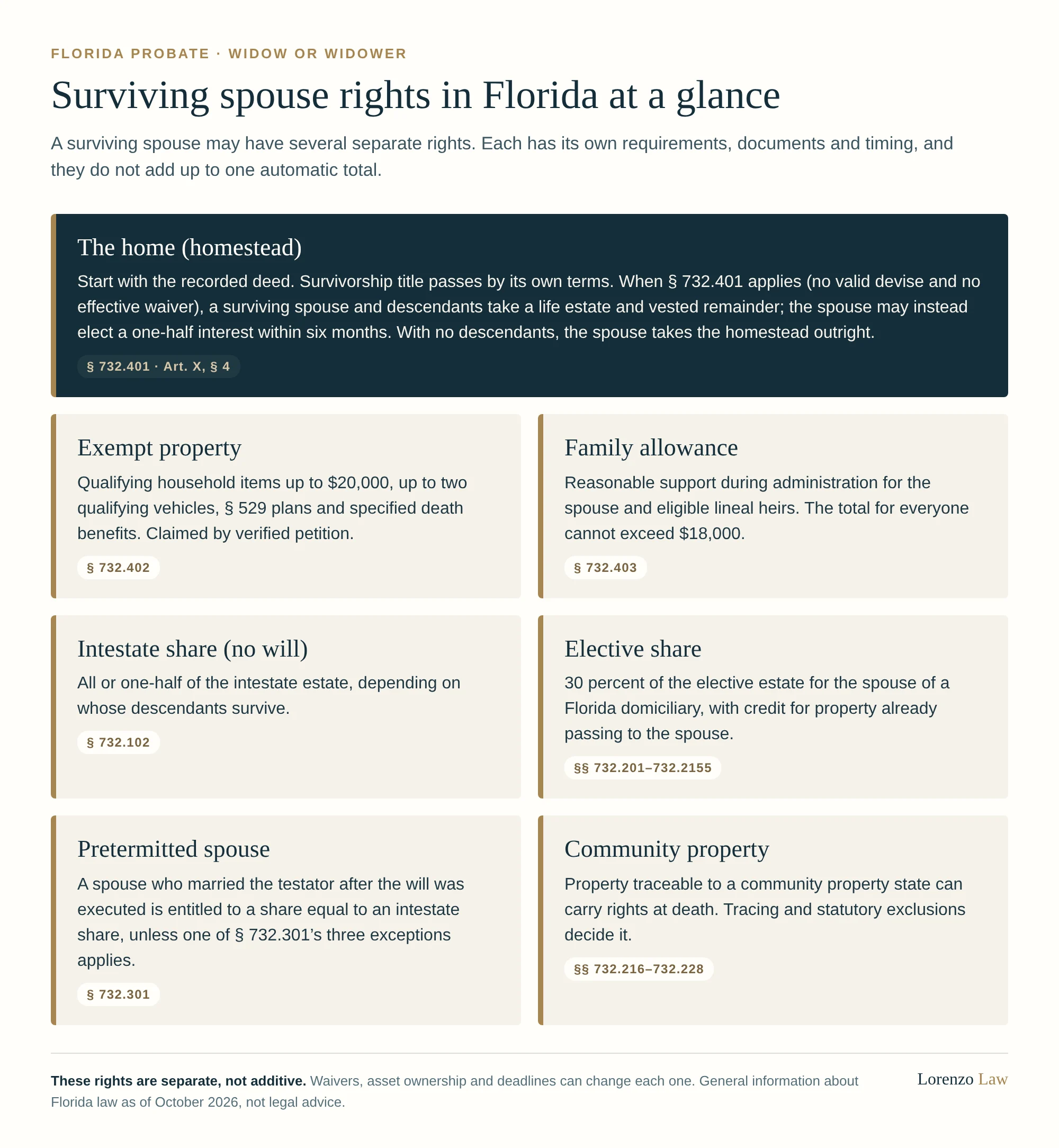
View the “Surviving spouse rights in Florida at a glance” (zoom in to read; the details are also in the text above).
When a Husband Dies, What Is the Wife Entitled To in Florida?
The answer depends on the property and family circumstances. Florida’s surviving-spouse rules apply equally to a widow or widower. A spouse may receive property under a will, an intestate share, property passing by survivorship or beneficiary designation, and separate statutory protections when their requirements are met. No universal minimum package guarantees every spouse a house, two cars or an $18,000 payment.
Start by separating the home, accounts, other probate assets and contractual benefits. Then review any will, trust, marital waiver and notices. The sections below explain homestead, exempt property, family allowance, intestacy, elective share and pretermitted-spouse rights separately.
Is a wife entitled to her husband’s estate in Florida, and what rights does a widow have in her husband’s property? The same framework answers both questions, including the rights of a second wife in her husband’s property, and it applies in the same way when a wife dies and her husband survives. In practice, a widow or widower usually works through the questions in this order:
- The house. How title was held and whether it was protected homestead. See the house.
- Household items and vehicles. Whether they qualify as exempt property. See exempt property.
- Support during administration. Whether a family allowance should be requested. See the family allowance.
- What the will or intestacy provides, and whether an elective share or pretermitted share should be considered. If there is no will, Florida inheritance law gives the spouse an intestate share. See no will and the elective share.
- Assets outside the estate: survivorship accounts, beneficiary designations, life insurance, retirement plans and agency benefits. See accounts and benefits.
Does a Spouse Automatically Inherit Everything in Florida?
No. Under § 732.102, the spouse receives the entire intestate estate if the decedent left no descendants, or if all the decedent’s surviving descendants are also the survivor’s descendants and the survivor has no other descendants. The spouse receives one-half in the other descendant patterns specified in that statute. This describes the intestate estate, not every asset the decedent owned. A valid will, homestead rules, joint title, beneficiary designations and enforceable waivers require separate review. A spouse can also receive all property under valid instruments; “only if there is no will” is not a universal rule.
Does the wife get everything when her husband dies in Florida, or the husband when his wife dies, and does a surviving spouse automatically inherit everything in Florida? Only to the extent the intestacy statute, valid instruments or the statutory protections give it to the survivor. Some assets can pass outside probate under a valid survivorship title or beneficiary designation, such as property held as tenants by the entireties, a joint account with right of survivorship or a payable-on-death designation. Those assets pass by their own terms rather than by inheritance, and they still need to be documented.
Can You Disinherit Your Spouse in Florida?
Leaving a spouse out of a will does not by itself resolve that spouse’s rights. Florida law provides protections that may apply despite the will, including an elective share for the survivor of a Florida domiciliary. But waivers, statutory exclusions, asset ownership and missed deadlines can affect what the spouse actually receives. Review the instruments and preserve any required election or petition rather than assuming either total disinheritance or a guaranteed recovery.
The same answer applies to the related questions people ask: can you exclude a spouse from your will, can I leave my estranged spouse out of my will, and does a will override a spouse in Florida? The will alone does not decide all statutory rights. Separation or a pending divorce does not by itself establish that the marriage ended before death; see separated or divorcing spouses. A valid marital agreement, such as a prenup limiting surviving spouse rights, is reviewed separately under § 732.702; see waivers.
Does Marriage Override a Will in Florida?
Marriage does not automatically cancel an earlier will. A spouse who married the testator after the will was executed is entitled to a share equal to an intestate share, unless one of § 732.301’s three exceptions applies. Review the will, every codicil, marriage date and marital agreement. A permitted homestead devise can be effective, and elective-share rights have their own eligibility, waiver and filing rules.
So marriage does not revoke a previous will in Florida; the question under Florida inheritance law is what the later spouse may be entitled to despite it. This is the pretermitted spouse rule, explained in what is a pretermitted spouse. A revocable trust signed before the marriage needs its own review; see surviving spouse rights when everything is in a revocable trust.
Does Florida Have Dower Rights?
No. Fla. Stat. § 732.111 provides: “Dower and curtesy are abolished.” They were eliminated by the 1974 Florida Probate Code.
Dower was a widow’s common-law life interest in a fraction of her husband’s real property; curtesy was the husband’s equivalent. Florida’s spouse inheritance law replaced both with a statutory scheme: the intestate share, protected homestead, exempt property, the family allowance and the elective share. If an older deed, title commitment or out-of-state document refers to dower, it is referring to law Florida no longer has. The elective share is sometimes described as dower’s closest modern counterpart, but it is a different right with its own eligibility, calculation and filing rules.
Is Florida a Community Property State? What Happens at Death
Florida generally uses separate-property rules, but §§ 732.216–732.228 can preserve specified rights in property acquired as community property in another jurisdiction or traceable to it. Prior residence alone does not establish that an asset qualifies. The acquisition history, governing law, tracing, title, agreements and statutory exclusions matter.
People also ask whether Florida is a “common law property” or “marital property” state, or whether it is a community property state for inheritance. Those labels come from divorce and general property discussions. For inheritance, what matters is Florida’s surviving spouse inheritance laws on this page and, for property traceable to a community property jurisdiction, the Act explained in the community property section.
Is a Surviving Spouse Considered an Heir in Florida?
Yes, in the Probate Code’s sense, because Florida inheritance laws without a will are what make someone an heir. Section 731.201 (subsection (20)) defines heirs as the persons, including the surviving spouse, who are entitled under the statutes of intestate succession to the property of a decedent. Being an heir describes the intestate route. A spouse who receives property under a will is a devisee or beneficiary under that will, and a spouse’s homestead, exempt-property, allowance and elective-share rights come from their own statutes rather than from heir status alone.
The House: Florida Surviving Spouse Homestead Rights, the Life Estate and the Six-Month Election
Inheriting homestead property in Florida as a surviving spouse, and what happens to the house when a husband or wife dies, depend first on the recorded deed, then on whether the home was the decedent’s protected homestead, the family at death, any permitted devise and any valid waiver. Survivorship title, statutory descent under § 732.401 and a permitted devise lead to different results, and only the statutory life estate carries the six-month option to elect a one-half interest.
What Happens to the House When a Spouse Dies in Florida?
Start with the recorded deed. Property validly held as tenants by the entireties or as joint tenants with right of survivorship ordinarily passes under that title; § 732.401(5) excludes it from the statutory homestead descent rule. For a decedent’s homestead interest subject to the devise restrictions, the family at death, a permitted devise and any effective waiver matter.
When § 732.401 applies without a valid devise or an effective waiver changing the result, a surviving spouse and descendants generally receive a life estate and vested remainder interests, respectively. If there are no descendants, the spouse generally receives the decedent’s interest outright under the statutory descent rules. A permitted full-fee devise to the spouse can control when no minor child survives. A surviving minor child restricts devise even when the spouse would prefer the will’s result.
The rules for inheritance, protection from the deceased owner’s creditors and property-tax benefits are different. See the Florida homestead probate guide for the detailed title, creditor and court-order analysis.
So when people ask “if my husband dies, what happens to the house?”, “who inherits the house when a spouse dies?” or “does the surviving spouse inherit the home?”, the deed comes first. Article X, section 4(c) of the Florida Constitution and § 732.4015 restrict devise of homestead when the owner is survived by a spouse or minor child, except that the homestead may be devised to the owner’s spouse if there is no minor child. When families talk about surviving spouse rights in probating a home in Florida, they usually mean documenting ownership: qualifying protected homestead generally passes outside the assets administered by the personal representative, but a court order may be needed to show who owns it. An interested person may petition to determine homestead status under Florida Probate Rule 5.405; see the petition to determine homestead.
Two further points that surprise people:
- Area, not a general dollar limit. The constitutional protection is limited by area, one-half acre inside a municipality and 160 contiguous acres outside one, rather than by a general dollar ceiling.
- Creditors. Qualifying protected homestead passing to the surviving spouse or heirs is generally protected from the deceased owner’s creditors. The constitutional exceptions are taxes and assessments, obligations contracted for the purchase, improvement or repair of the property, and obligations for labor performed on the realty. The protection does not remove every lien, and it is not protection against the survivor’s own debts.
A revocable trust does not avoid the devise restriction. Section 732.4015(2) treats the grantor of a trust described in § 733.707(3) as the owner and treats a trust disposition of what would have been the grantor’s homestead as a devise, and § 736.1109 provides that title passes under § 732.401 at death when a trust devise violates the constitutional restriction. In Aronson v. Aronson, 81 So. 3d 515 (Fla. 3d DCA 2012), homestead held in a revocable trust passed by operation of law as a life estate and vested remainder.
What If the House Is Only in My Spouse’s Name? (Married but Not on the Deed)
What are my rights if my name is not on the deed but we are married? Being absent from the deed does not necessarily eliminate a surviving spouse’s homestead rights. If the decedent owned a homestead interest, review the deed, family circumstances, any permitted devise and any valid waiver to determine what passes at death. The constitutional joinder requirement for a married owner’s lifetime conveyance or mortgage is a separate issue from inheritance. The instrument and transaction must be reviewed before declaring a deed defective.
A properly structured Lady Bird deed can transfer an interest outside probate, but it should not be assumed to resolve spouse or minor-child homestead rights. Whether the retained powers bring a particular deed within the devise restriction remains an issue for careful review. See the Lady Bird deed guide and the homestead guide. Federal tax basis also requires separate analysis; inherited property does not always receive a basis increase or produce little tax on sale.
If the property was not protected homestead, its title and transfer documents still matter. A rental or second home is not necessarily a probate asset: a trust or valid survivorship deed may govern it.
Should You Take the Life Estate or the One-Half Interest?
A spouse who receives the life estate described in § 732.401(1) may elect an undivided one-half interest in the decedent’s homestead interest as a tenant in common. The descendants receive the other half per stirpes. This option is not available merely because a married homeowner died.
The life estate is what the spouse receives without electing anything; nothing has to be filed for it to exist. The election is the choice to replace it. The comparison below lists the factors to discuss before making that choice.
Life Estate Versus One-Half Interest, Compared
| Factor to discuss | Life estate | Elected one-half interest |
|---|---|---|
| Occupancy | Life interest ordinarily continues for the survivor’s life, subject to applicable obligations | Shared ownership; possession and use may be disputed |
| Expenses | Allocated between life tenant and remaindermen under chapter 738 | Allocated in proportion to interests from filing the election for recording |
| Sale | A voluntary sale of the entire ownership ordinarily requires the necessary holders or authorized representatives | A cotenant may seek partition; sale is not guaranteed or immediate |
| At the survivor’s death | Life estate ends | Survivor’s share can pass under the survivor’s own plan or applicable law |
| Decision | Review carrying costs, liquidity, occupancy, relationships and title | Review the same factors and the risk that another cotenant seeks partition |
Neither choice is best for every spouse. A sale of an individual interest is different from selling the entire property. Loan terms, liens, guardianship issues and any applicable heirs-property procedures may also matter. Missing the election does not mean that a life estate can never later be conveyed, released or addressed by a lawful agreement; it means the statutory election option may be lost.
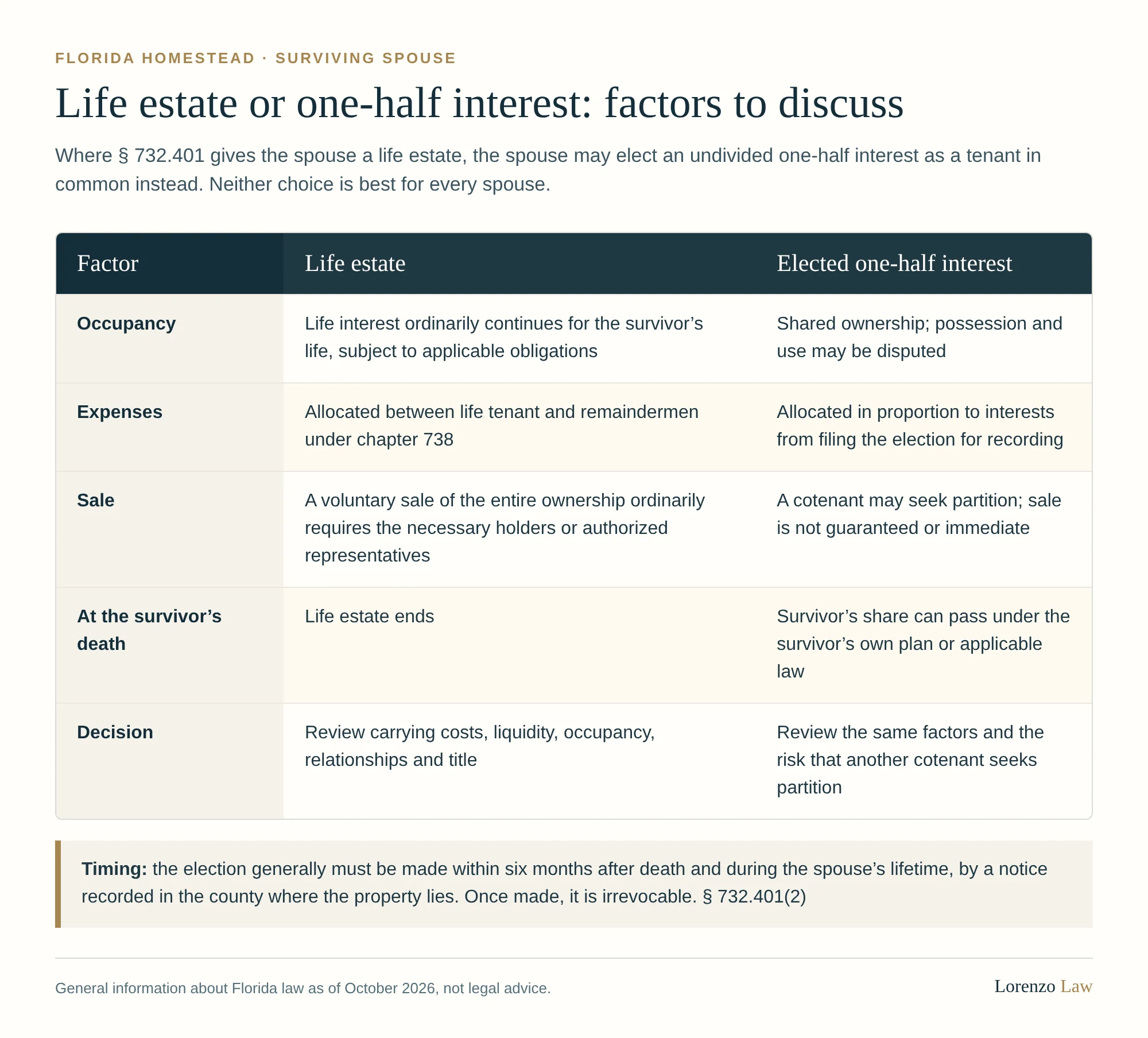
View the “Life estate or one-half interest” comparison (zoom in to read; the details are also in the text above).
For who generally pays taxes, insurance, association dues and repairs under each option, see the homestead life estate expense table.
When and Where Must the Homestead Election Be Recorded?
The election generally must be made within six months after death and during the surviving spouse’s lifetime. The statutory notice, including the legal description, must be filed for recording in the official records of the county or counties where the property lies. A filing only in the probate case is not that recording step. Once made, the election is irrevocable.
Who Can Make the Homestead Election?
The surviving spouse makes the election during the spouse’s lifetime. An attorney in fact or a guardian of the property may make the election only with the approval of a court having jurisdiction of the real property, after the court determines that the election is in the spouse’s best interests during the spouse’s probable lifetime.
There is no general good-cause extension. Section 732.401(2)(c) provides a narrow extension when an attorney in fact or guardian of the property timely petitions for court approval within the six-month period and during the spouse’s lifetime. If timely filed, the election period extends for at least 30 days after rendition of the order allowing it. Do not assume that opening probate, negotiations or an ordinary extension request preserves this option.
Can the Homestead Election Be Revoked?
No. Section 732.401 makes the homestead election irrevocable once made. The elective-share election is different: under § 732.2135(3) it may be withdrawn within the period and by the persons the statute specifies. See changing your mind after electing.
Can a Surviving Spouse Stay in the Home or Be Forced to Sell?
A spouse holding the statutory life estate has a present right to the home for life, subject to enforceable liens and the obligations that come with that interest. Florida homestead law does not remove a mortgage on the spouse’s home: a valid mortgage remains a lien after death, so someone must keep the payments current. Life tenant and remainderman interests are not ordinary cotenancy interests, so the usual partition remedy between co-owners does not work the same way. Liens, enforcement and other proceedings remain separate questions.
The one-half election changes that. After a valid election, the spouse and the descendants hold as tenants in common, and a cotenant may seek partition; sale is not guaranteed or immediate, and the result depends on the interests, defenses and applicable law. Whether occupancy or control of an individual share matters more is one of the factors in the comparison above. See Florida partition actions.
What if There Is a Minor Child?
If a minor child of the owner survives, the homestead cannot be devised at all, not even to the surviving spouse. Article X, section 4(c) permits a devise to the spouse only where there is no minor child, and a spouse’s waiver does not remove a surviving minor child’s protection. Adult children do not trigger this restriction.
The spouse’s interest still has to be worked out from the deed. Where the home was the decedent’s protected homestead and § 732.401 supplies the result, the spouse and descendants generally take the life estate and remainder described above, with the spouse’s election option. Survivorship title, a different ownership interest or other facts can change that, so the title review comes first. A minor’s ownership interest also affects any later sale, which may require a guardianship or other court-authorized procedure.
How Do I Remove My Late Spouse’s Name From the Deed?
To remove a deceased spouse from the deed in Florida, start with how title was held. For a home owned as tenants by the entireties or joint tenants with right of survivorship, the survivor’s ownership is ordinarily documented by recording a certified copy of the death certificate in the official records of the county where the property lies, sometimes with additional documents a title company requests. A home that was protected homestead in the deceased spouse’s name alone may need an order determining homestead or another probate procedure before the public record shows the new owners. A new deed alone does not establish who inherited. See removing a deceased owner’s name from a deed and how to get homestead out of a deceased owner’s name.
Property Taxes After a Spouse’s Death: The Widow’s Exemption, Homestead Exemption and Save Our Homes
Probate homestead rights do not automatically establish continued property-tax benefits. Florida provides a $5,000 exemption for a qualifying widow or widower who is a bona fide Florida resident under § 196.202. Continued homestead exemption, Save Our Homes treatment and portability depend on the owner’s eligibility, the transfer and the applicable tax-roll rules. Ask the county property appraiser to review the transfer and filing requirements.
Section 193.155 contains exceptions to reassessment after a change of ownership, including qualifying transfers to a surviving spouse and passage by operation of law to a surviving spouse or minor child under § 732.401, and under § 196.041(2) a life tenant is treated as having the equitable title needed for the homestead exemption. Whether a particular transfer keeps the assessment limitation depends on the facts and filings. See property taxes after a death and estate planning for widows in Florida.
Some deadlines run from death; others depend on service, waiver or a particular proceeding. Ask for a review of the documents and dates before assuming which period applies.
Call (305) 224-6811 or Request a consultation
Statewide Florida representation, in English and Spanish.
Exempt Property and the Family Allowance
Exempt property under Florida Statute § 732.402 protects qualifying household items, up to two qualifying vehicles, qualified tuition programs and specified death benefits from estate claims, and it must be claimed by a timely verified petition. The family allowance under § 732.403 is a separate, reasonable monetary allowance during administration, capped at $18,000 in total for all qualifying recipients.
What Is Exempt Property, and Who Is Entitled to It in Florida?
If the decedent was domiciled in Florida at death, § 732.402 provides exempt-property rights to the surviving spouse or, if there is no surviving spouse, the decedent’s children. The property must satisfy the statutory categories and exclusions. It is protected against estate claims except perfected security interests in that property; a vehicle loan or other qualifying lien does not disappear.
| Category | Statutory qualification |
|---|---|
| Household furniture, furnishings and appliances | Located in the decedent’s usual abode; combined net date-of-death value up to $20,000 |
| Two motor vehicles | Each has gross vehicle weight no greater than 15,000 pounds; titled in the decedent’s name and regularly used by the decedent or immediate family as personal motor vehicles |
| Qualified tuition programs | Programs authorized by IRC § 529, including the Florida programs listed in § 732.402(2)(c) |
| Specified death benefits | Benefits paid under § 112.1915 |
Property specifically or demonstratively devised by the will is generally excluded. The statute permits a qualifying devisee who would otherwise be entitled to that property as exempt property to seek its exemption from claims, subject to the petition requirements and perfected security interests. Property determined exempt is excluded before the residuary, intestate, pretermitted or elective shares are determined. It is not a cash entitlement to buy replacement items when the estate lacks qualifying property.
Property outside these categories is not exempt property under § 732.402, although other rules, such as a will, survivorship title or the protected homestead rules, may still determine where it goes. Because exempt property is excluded from creditors’ claims, it is also left out of the value calculation for summary administration under § 735.201.
How Do I Petition to Determine Exempt Property?
Rule 5.406 requires a verified petition describing the property and basis for exemption and identifying the persons entitled. The petition to determine exempt property is filed in the probate proceeding with the clerk of the circuit court, and the court’s order determining exempt property identifies what qualifies and who is entitled to it. A downloaded form cannot decide whether an item qualifies, how a lien affects it or who must be served, so review the facts before signing a verified petition.
How Long Do You Have to Claim Exempt Property?
Under § 732.402(6), the petition must be filed by the later of four months after the date of service of the notice of administration or 40 days after the termination of any proceeding involving the construction, admission to probate or validity of the will, or involving any other matter affecting any part of the exempt property. Failure to petition timely waives the right. The service date must be established under the applicable rules; see the notice of administration.
What Is the Florida Family Allowance?
For a decedent domiciled in Florida, § 732.403 provides a reasonable monetary allowance during administration for the surviving spouse and eligible lineal heirs whom the decedent supported or was obligated to support. The total cannot exceed $18,000; it is not $18,000 for each person or an automatic award of the maximum. Lineal heirs here include lineal ascendants and descendants. Payment may be in a lump sum or installments, with allocation according to the statute and the court’s order.
The allowance generally is not charged against another benefit or share unless the will provides otherwise. Death of a person entitled ends the unpaid portion of that person’s allowance. Section 732.403 states no fixed filing period, but this is support during administration: raise it promptly rather than treating “no fixed period” as unlimited time. See the Florida family allowance guide for the petition, supporting information and administration issues. Florida Probate Rule 5.407 governs the petition for family allowance.
My Husband Died and the Car Is in His Name. What Now?
First determine the title, any lien and whether the car qualifies as exempt property. A spouse’s exemption petition and the motor-vehicle title transfer are separate steps. A probate order or another available transfer procedure may supply the required authority, depending on the facts. See the vehicle-transfer guide. Do not assume every sole-name title requires formal administration or that creditor protection cancels a secured loan.
If the vehicle was titled in both spouses’ names, the Florida Department of Highway Safety and Motor Vehicles (FLHSMV, often called the Florida DMV) publishes form HSMV 82152, the Application for Surviving Spouse Transfer of Florida Certificate of Title for a Motor Vehicle. People sometimes search for a “surviving spouse affidavit” for this step. The form lists supporting documents such as the death certificate and, unless the surviving spouse is named on it, a marriage certificate. Check the current form and the county tax collector’s requirements before relying on a downloaded copy. A car titled only in the deceased spouse’s name needs a different route, which the vehicle-transfer guide explains.
What Does a Surviving Spouse Inherit in Florida Without a Will?
When a husband or wife dies without a will in Florida, the surviving spouse receives either the entire intestate estate or one-half of it under § 732.102, depending on which of four descendant patterns applies, subject to applicable waiver and disqualification rules. The intestate share describes probate property passing by intestacy, not every asset the decedent owned.
Florida inheritance law without a will works differently from inheriting property in Florida under a will. When a spouse dies without a will, which lawyers call dying intestate, the probate estate passes under Florida’s intestacy law rather than under a document. So the answer to “what happens if my husband dies without a will in Florida?” depends on whose descendants survive. Under Florida inheritance laws, if the decedent is survived by descendants, the spouse’s share drops from all to one-half whenever either spouse has descendants who are not of their marriage (for example, children from a previous marriage); with no surviving descendants, the spouse takes all. “Descendants” includes children, grandchildren and more remote descendants, and it accounts for legally recognized family relationships such as adoption.
| Family situation | Spouse’s intestate share |
|---|---|
| No surviving descendant of the decedent | The entire intestate estate |
| All of the decedent’s surviving descendants are also descendants of the surviving spouse, and the surviving spouse has no other descendant | The entire intestate estate |
| One or more of the decedent’s surviving descendants are not descendants of the surviving spouse | One-half of the intestate estate |
| All of the decedent’s surviving descendants are also the surviving spouse’s, but the surviving spouse has one or more descendants who are not the decedent’s | One-half of the intestate estate |
The table is subject to applicable waiver and disqualification rules. The intestate estate is defined by § 732.101, and § 732.103 governs any part not passing to the spouse. This is Florida’s intestate succession statute, the part of Florida state inheritance laws that applies when there is no will, and it applies to probate property passing by intestacy, not to assets that pass under a valid survivorship title or beneficiary designation. Homestead, exempt property and the family allowance have their own rules, explained above. For the probate process when there is no will, see what to do when someone dies in Florida.
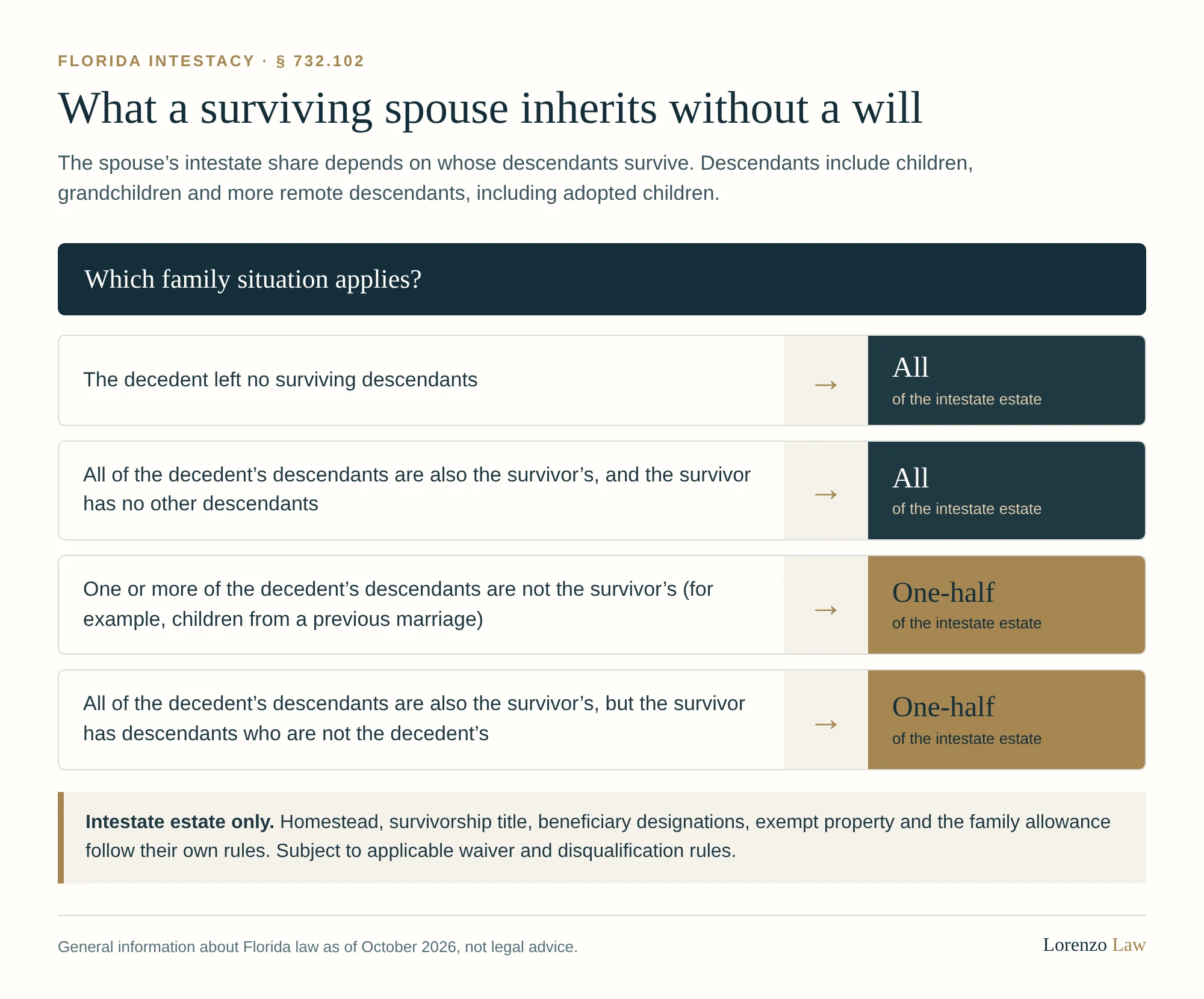
View the “What a surviving spouse inherits without a will” chart (zoom in to read; the details are also in the text above).
What Is the Order of Inheritance in Florida?
On a Florida intestacy chart, the surviving spouse’s share comes first, under § 732.102. Any part of the intestate estate not passing to the spouse, or the entire intestate estate if there is no surviving spouse, passes under § 732.103: first to the decedent’s descendants; if none, to the decedent’s parents; if none, to the decedent’s brothers and sisters and the descendants of deceased brothers and sisters; and then to more remote relatives in the order the statute lists. Under these sibling inheritance laws, the decedent’s brothers and sisters inherit by intestacy only when no surviving spouse, no descendant and no parent survives the decedent. If no relative in the statutory order survives, § 732.103(5) sends the estate to the kindred of the decedent’s last deceased spouse. Because that class is determined as if the deceased spouse had died intestate, it can in rare cases include the deceased spouse’s own children, the decedent’s stepchildren, who inherit as the deceased spouse’s kindred, not as the decedent’s children. Otherwise, step children inheritance law in Florida is mostly a matter of wills, trusts and beneficiary designations.
Who Has More Rights, the Spouse or the Children, in Florida?
Florida intestate succession law is only one of the rules involved. Neither the spouse nor the children have one universal priority across all assets. Intestacy, homestead, exempt property, family allowance and beneficiary designations use different rules. A minor child restricts homestead devise; that is not the same as owning every asset ahead of the spouse. A spouse has first statutory appointment preference in an intestate estate, subject to qualification and court appointment. A stepchild does not become a descendant of a stepparent merely through the marriage; adoption or another legally recognized relationship may change the analysis.
So surviving spouse vs. children inheritance in Florida is not one ranking; each asset is analyzed under the rule that governs it. Children do not inherit before the spouse as a general rule, and the spouse does not always take ahead of the children.
The Elective Share and the Pretermitted Share
The surviving spouse of a person domiciled in Florida at death may elect 30 percent of the statutory elective estate, subject to waiver and the governing requirements. That estate can include probate and specified nonprobate interests. The election is not simply a demand for 30 percent more than everything already received: inclusion, exclusions, valuation and satisfaction credits must be worked through under §§ 732.2035–732.2095.
Is a spouse entitled to inheritance money in Florida even when the will leaves nothing? Florida is an elective share state. The spousal right of election is created by Florida Statute § 732.201, the spousal elective share statute, and § 732.2065 sets the surviving spouse’s share at 30% of the elective estate.
Section 732.2035 defines the elective estate, and it reaches beyond the probate estate. Its categories include the probate estate, protected homestead, payable-on-death, transfer-on-death and survivorship accounts, joint tenancy and tenancy by the entireties interests, property over which the decedent held a revocable power, property in which the decedent retained a right to income or use, the net cash surrender value of life insurance on the decedent’s life, amounts payable by reason of surviving the decedent under a pension, retirement or deferred compensation plan or similar arrangement, certain transfers within one year of death, and property transferred in satisfaction of the elective share. Each is included as and to the extent the statute provides, and valuation runs through § 732.2055; not every nonprobate asset is included at its full value.
Benefits under the federal Railroad Retirement Act and the Social Security system are excluded from the elective estate, and § 732.2045 lists further exclusions. Life insurance enters the elective estate at its net cash surrender value, which is a different question from whether insurance proceeds passing to the spouse are counted toward satisfying the share. The sources from which the elective share is paid are set out in § 732.2075. An estate that looks small on the probate side can still have a larger elective estate. For calculations, credits and contribution, see the Florida elective share page.
How Long Do I Have to File for the Elective Share?
Unless an extension applies, the election must be filed by the earlier of six months after service of the notice of administration on the surviving spouse or the specified representative, or two years after death. Section 732.2135(2) provides a qualified period to petition for an extension, including its provision for certain proceedings affecting the amount payable; the extension petition cannot be filed more than two years after death. For good cause the court may allow additional time, and the election must then be filed within the time allowed. Subsection (4) provides tolling for an extension or approval petition. The two-year petition limit is not an absolute prohibition on an election filed later under a proper extension or tolling.
The election is filed with the court in the probate proceeding. Florida Probate Rule 5.360 governs its filing and service: the current rule requires prompt formal-notice service of the spouse’s election on the personal representative, and elections by authorized representatives require approval. Detailed contribution proceedings belong on the elective-share page.
What Is a Pretermitted Spouse in Florida? (The Will Was Signed Before the Marriage)
A pretermitted spouse, sometimes called an omitted spouse, is a person who married the testator after the testator’s will was made. You may qualify as a pretermitted spouse. Under Florida Statute § 732.301, such a spouse is entitled to a share equal in value to the share the spouse would have received if the testator had died intestate, unless one of three exceptions applies:
- provision was made for, or waived by, the spouse by prenuptial or postnuptial agreement;
- the spouse is provided for in the will; or
- the will discloses an intention not to make provision for the spouse.
Whether a will discloses that intention depends on its actual language. A will that says nothing about a future spouse is reviewed differently from one that expressly says the testator intends to make no provision for any person the testator may later marry.
Check the date of every testamentary instrument, not only the will, and obtain a document-based determination rather than a conclusion from dates alone. Separately, § 732.805 can bar a spouse whose marriage was procured by fraud, duress or undue influence.
Florida has a parallel rule for children born or adopted after a will was made, the pretermitted child statute in § 732.302. The pretermitted spouse rule often comes up with second wife inheritance rights, because the will may be older than the second marriage. Omitted-spouse and omitted-child questions are sometimes described together as omitted heir cases, but they are separate statutes with separate requirements.
How the Pretermitted and Elective Share Analyses Differ
A pretermitted-spouse share is measured by the intestate-share rules and the estate available for that entitlement. The elective share uses the statutory elective estate, which can reach specified nonprobate interests. Those different measurements mean the documents and asset inventory matter more than a comparison of headline percentages. Do not add the two figures or assume the spouse must forfeit one right simply to preserve the other. Section 732.201 provides that making the election does not reduce what the spouse would receive without it; amounts otherwise passing to the spouse may satisfy the elective share.
In practice, a spouse who qualifies for both may be eligible for either the pretermitted share or the elective share and should take whichever is more advantageous. Under § 732.2075, amounts already passing to the spouse are credited against the elective share rather than paid twice.
Surviving Spouse Rights When Everything Is in a Revocable Trust
A revocable trust does not by itself defeat a surviving spouse’s homestead or elective-share rights. Section 732.2035 includes property over which the decedent held a revocable power in the elective estate, and §§ 732.4015(2) and 736.1109 address homestead held in or disposed of by a trust.
A common structure in a second marriage is a revocable living trust funded during life and naming the children of an earlier marriage, with the surviving spouse told there is “nothing in the estate.” Does a second wife have rights to property held in that trust? The elective estate is a different measurement from the probate estate, so that statement does not answer the elective-share question. Florida trust spousal rights questions start with the trust instrument, its amendments, the funding records and any marital agreement.
Florida also permits the elective share to be satisfied in trust. An elective share trust under § 732.2025(2) must give the surviving spouse the income or use of the property for life, the right to require that unproductive property be made productive, and no distributions to anyone else during the spouse’s lifetime. Section 732.2095 then values that interest for satisfaction purposes:
- 100 percent where the trust includes both a qualifying invasion power (a power held by the spouse or the trustee to invade principal for the spouse’s health, support and maintenance) and a qualifying power of appointment held by the spouse;
- 80 percent where the trust includes the qualifying invasion power but not the qualifying power of appointment;
- 50 percent in all other cases, including a qualifying appointment power without a qualifying invasion power.
These are statutory valuation credits, not a discount on the promised benefit or proof the trustee is offering an unlawful shortfall. A surviving spouse facing a funded trust should have the instrument reviewed and the credit worked out on the elective share page’s method; if a dispute with the trustee develops, that is a trust litigation question.
Can You Change Your Mind After Electing?
Under § 732.2135(3), an election may be withdrawn within eight months after death and before the court’s order of contribution by the spouse or the authorized representatives specified there. The homestead election is different: § 732.401 makes it irrevocable once made.
Can an Elective Share Be Waived?
Yes. The elective share is among the spousal rights that can be waived wholly or partly by an effective written agreement under § 732.702, before or after marriage. Whether a particular agreement is effective depends on its scope, execution and the other questions explained in prenuptial and postnuptial waivers.
Moved to Florida From a Community Property State? Your Rights at Death
Property traceable to a community property jurisdiction can carry specified rights at death in Florida under the Florida Uniform Disposition of Community Property Rights at Death Act, §§ 732.216–732.228. Prior residence alone does not establish that an asset qualifies; acquisition history, tracing, title, agreements and statutory exclusions decide it.
Section 732.217 excludes personal property held as tenants by the entirety and excludes Florida real property held as tenants by the entireties or qualifying as homestead under the Act’s definition. For covered property, § 732.219 generally treats the survivor’s one-half as the survivor’s property outside the decedent’s probate estate and the decedent’s half as part of the probate estate. Section 732.2045(1)(f) excludes the decedent’s half of property to which the Act applies from the elective estate. Do not treat a Florida homestead bought with out-of-state earnings as an automatic example of this Act.
Did You Move to Florida From a Community Property State?
The question arises for couples who acquired property while either spouse was domiciled in a community property jurisdiction and later became Florida domiciliaries. The states most commonly listed as community property states are Arizona, California, Idaho, Louisiana, Nevada, New Mexico, Texas, Washington and Wisconsin. Other legal systems can also use community property rules. Having lived in one of those places is the starting point for the analysis, not the answer. See establishing a Florida domicile.
Two rebuttable presumptions in § 732.218 help sort property:
- Property acquired during the marriage while domiciled in a community property jurisdiction is presumed to be property to which the Act applies.
- Property acquired while domiciled in a noncommunity property jurisdiction and titled in a form creating rights of survivorship is presumed not to be.
Presumptions can be rebutted, so tracing records matter: where the money came from, when and where it was earned, how the account or deed was titled and whether any agreement changed the character of the property. An account that moved from another state to a Florida institution, or Florida real estate bought with funds earned elsewhere, may require tracing before anyone can say whether the Act applies. Section 732.222 protects purchasers and lenders who deal with the person holding apparent title, which is one reason to raise the issue early.
The Six-Month Discovery Demand and the Two-Year Lawsuit Deadline
Section 732.2211 addresses two different steps. A surviving spouse or beneficiary’s written demand within six months after service of the notice of administration triggers the personal representative’s or curator’s duty to discover whether the property is subject to the Act. Separately, a demand or dispute arising under the Act must be determined in a declaratory-relief action governed by civil procedure, with the complaint filed within two years after death.
Failure to file that action timely results in the statutory forfeiture and liability protections. Do not equate failure to make the six-month discovery demand with the separate forfeiture rule, or assume that making the demand files or preserves the lawsuit. The statute expressly distinguishes this action from an ordinary probate creditor claim. Other persons, including creditors, have different demand provisions; this spouse-focused guide does not calculate their dates.
Under § 733.212(2)(g), the notice of administration must state that the personal representative or curator has no duty to discover whether property held by the decedent or the surviving spouse is property to which the Act applies or may apply, unless a written demand is made by the surviving spouse or a beneficiary under § 732.2211. Section 732.219(2) also allows the survivor’s rights to be waived after death in the statutory form. Section 732.2211 was added by chapter 2024-238, Laws of Florida, effective June 13, 2024, which also amended § 732.217. For deaths or proceedings that predate those changes, obtain an applicability analysis rather than assuming the current text applies.
Accounts, Beneficiaries, Debts and Non-Probate Assets
Accounts, retirement plans, life insurance and agency benefits pass according to their ownership type, contracts and governing law, not simply because of the marriage. A valid survivorship or beneficiary transfer can avoid probate administration of that asset while still requiring separate elective-estate analysis.
Does a Surviving Spouse Have to Go Through Probate in Florida?
Not always. Whether administration is needed depends on what the deceased spouse owned in his or her sole name with no surviving joint owner, beneficiary designation or trust to pass it. Property held by valid survivorship title or tenancy by the entireties, accounts with a valid beneficiary or payable-on-death designation, and assets already titled in a funded trust usually pass without probate administration, although records are still needed. Sole-name probate assets may require summary administration, formal administration or another statutory procedure, and some spousal rights, such as exempt property and the family allowance, are claimed within a probate proceeding. See non-probate assets in Florida and assets exempt from probate.
Does a Joint Account Go to the Surviving Spouse Automatically?
Review the account agreement, signature card, beneficiaries and ownership type. Florida statutory presumptions can matter; absence of the words “right of survivorship” does not by itself settle the result. A valid survivorship or beneficiary transfer can avoid probate administration of that asset while still requiring separate elective-estate analysis.
Does a wife have access to her husband’s bank account after his death? Ask the institution what records it requires. Depending on the account and available procedure, authority may come from survivorship or beneficiary documentation, a summary-administration order, letters in formal administration or another applicable statutory route. Marriage alone does not authorize access to a deceased spouse’s sole account. See the bank-account and survivorship guides.
The same approach answers what happens to jointly owned property when one owner dies, and whether a spouse automatically inherits property in Florida that was jointly owned: the deed, title or contract decides whether the survivor takes by survivorship, and a valid survivorship transfer is documented rather than probated.
Do You Have to Remove a Deceased Spouse From a Bank Account?
It depends on how the account was owned. For a valid survivorship or entireties account, the institution generally asks for a death certificate and its own forms before it retitles the account in the survivor’s name. For an account in the decedent’s sole name, the institution will ask for the authority described above. See closing a bank account after death for the records institutions commonly request.
Am I Responsible for My Spouse’s Debts After Death in Florida?
Generally, not merely because you were married. A deceased spouse’s debts are ordinarily paid from estate assets during administration, subject to the creditor-claim process and the protections for exempt property and protected homestead. A survivor can still be responsible for a debt the survivor signed, co-signed or guaranteed, for joint credit, and for a loan secured by property the survivor keeps, such as a mortgage or car loan. Florida no longer has a “doctrine of necessaries” making one spouse liable for the other’s medical or other necessary expenses: the Florida Supreme Court abrogated it in Connor v. Southwest Florida Regional Medical Center, Inc., 668 So. 2d 175 (Fla. 1995). A surviving spouse who signed a hospital admission agreement, financial-responsibility form or guaranty in his or her own capacity can still be liable under that agreement; a spouse who signed only as the patient’s agent or representative generally is not. Ask for a review before paying a collection demand from your own funds. See do you inherit debt in Florida, what happens to your debt when you die and Florida probate creditor claims.
Does a Surviving Spouse Need a Power of Attorney After a Death?
No, and an existing one stops working. Under § 709.2109, a power of attorney terminates when the principal dies, so a power of attorney the deceased spouse signed does not authorize the survivor to sign, withdraw funds or transfer property after the death. Authority after death comes from survivorship or beneficiary documentation, letters of administration, a summary administration order or another applicable procedure. See does a power of attorney end at death in Florida.
Is a Wife Entitled to Her Husband’s Inheritance in Florida?
Is a wife entitled to her husband’s inheritance if he dies? Property the husband inherited and still owned in his sole name at death is generally part of what he owned at death. It passes under his will or by intestacy, subject to the surviving spouse’s statutory rights, in the same way as his other property. Whether the inheritance would have been treated as separate property in a divorce does not decide that question. Property held for him in a trust, or that passes to someone else under its own terms, depends on that instrument. The same analysis applies when a wife dies holding property she inherited, so spousal rights to inherited property follow the ordinary rules on this page.
What Happens to My Late Spouse’s IRA, 401(k) or Life Insurance?
Employer retirement plans, IRAs, annuities and life insurance have different governing documents and legal rules. Many qualified employer plans provide spousal survivor protections and consent requirements; an IRA does not generally use the same spousal-consent regime. Obtain the plan documents, beneficiary forms, consent records and any relevant court order. Federal law may control payment and affect state-law claims; do not assume every plan is governed by the same rule or that a state elective-share claim can redirect any plan benefit.
That is why 401(k) beneficiary rules for a surviving spouse, and disputing a life insurance beneficiary designation, start with the documents rather than the will. Separately, § 732.2035 includes amounts payable by reason of surviving the decedent under any public or private pension, retirement or deferred compensation plan or similar arrangement, and the decedent’s beneficial interest in the net cash surrender value of life insurance on the decedent’s life, in the elective estate, excluding Railroad Retirement and Social Security benefits. See beneficiary designations and retirement plans and beneficiary designations in Florida estate planning.
Social Security, VA and Other Benefits Outside the Estate
Social Security and veterans’ survivor benefits have their own eligibility and application rules. Contact the relevant agency promptly to ask about available benefits, application timing and any retroactive entitlement. These claims are separate from Florida probate elections. The Social Security Administration’s survivor-benefits guidance explains the starting points.
Does a widow get 100% of her husband’s Social Security? According to the Social Security Administration’s survivor benefit amounts page, a surviving spouse can receive up to 100 percent of the deceased spouse’s benefit at full retirement age for survivor benefits (between ages 66 and 67), and a reduced percentage, starting at 71.5 percent, if benefits begin earlier. Ask the agency for an estimate based on your own record. Some unclaimed assets may be held by the state, so a search is worthwhile; see unclaimed property in Florida. For the survivor’s own planning after these benefits are sorted out, see estate planning for widows in Florida.
Does the Surviving Spouse Get a Step-Up in Basis or Owe Inheritance Tax?
Does a surviving spouse pay inheritance tax? Florida imposes no inheritance tax and no state estate tax. For federal income tax purposes, inherited property often receives a basis adjustment to its value at the date of death, which matters if the property is later sold, but the adjustment is not automatic in every case: how title was held between the spouses, the type of asset and earlier transfers can change the result. For property a married couple owned as joint tenants or tenants by the entirety, IRS Publication 551 explains that generally only the deceased spouse’s share receives the date-of-death value, while the survivor keeps the original basis in his or her own share. Get tax advice before a sale. See the taxes heirs still pay in Florida.
Who Qualifies as a Surviving Spouse in Florida?
Surviving-spouse status is measured at death. Separation or a pending divorce does not by itself establish that the marriage ended before death, while a final judgment of dissolution entered before death generally means the former spouse is not a surviving spouse. A valid marriage formed elsewhere, a waiver and Florida’s slayer statute can each change the analysis.
Common-Law Marriage and Surviving Spouse Status
Florida generally does not recognize a common-law marriage newly created here after January 1, 1968. Whether a marriage validly formed elsewhere establishes surviving-spouse status requires review of that jurisdiction’s law and the evidence. Cohabitation alone does not establish a Florida marriage. See § 741.211.
Separated, Estranged, or in the Middle of a Divorce
Separation or a pending divorce does not by itself establish that the marriage ended before death. Review any final judgment, marital settlement, waiver and other order. Continuing spouse status is not a guarantee of every statutory benefit: asset requirements, waivers, disqualification and timely action still matter. Divorce can affect will, trust and beneficiary provisions under different laws and exceptions.
In Merli v. Merli, 332 So. 3d 1020 (Fla. 4th DCA 2022), no final judgment of dissolution had been entered when the husband died, so the wife remained the surviving spouse, and a partial marital settlement agreement did not waive her spousal rights under § 732.702. A settlement agreement that does contain a valid § 732.702 waiver is a different question and requires review of the actual agreement. Separated spouse inheritance in Florida therefore turns on the documents, not on how long the couple lived apart.
What rights does a former spouse, such as an ex wife or ex husband, have after death in Florida, and does the first wife get everything when the husband dies after remarrying? A former spouse whose marriage ended by a final judgment of dissolution before the death is not a surviving spouse for these statutory rights. Any remaining claim depends on the judgment, a settlement agreement, or an instrument or designation that still names the former spouse. Sections 732.507(2) and 736.1105 address the effect of divorce on wills and revocable trusts, and § 732.703 addresses certain beneficiary designations, each subject to its exceptions.
Can Someone Who Caused the Death Inherit? The Slayer Statute
Under § 732.802, a surviving person who unlawfully and intentionally kills or participates in procuring the death of the decedent is not entitled to the benefits the statute describes, and property affected by the statute generally passes as if the killer had predeceased the decedent. Not every allegation disqualifies a spouse; the unlawful-and-intentional standard has to be established.
- Survivorship title. The statute severs the decedent’s interest in a joint tenancy, including a tenancy by the entirety, so the decedent’s share passes as the decedent’s property and the killer takes no rights by survivorship.
- Contracts. It reaches the killer’s rights as a named beneficiary of a bond, life insurance policy or other contractual arrangement.
- Other acquisitions. Subsection (4) reaches any other acquisition of property or an interest by the killer, including a life estate in homestead property.
- Proof. A final judgment of conviction of murder is conclusive; without a conviction, the court may determine the question by the greater weight of the evidence.
Prenuptial and Postnuptial Waivers of Spousal Rights
The Florida statute on waiver of spousal rights is § 732.702. An effective written agreement signed before or after marriage can waive many of the rights on this page, wholly or partly, but whether a prenuptial agreement is valid and enforceable in Florida depends on its scope, execution, disclosure and the signer’s residence. A spouse’s waiver does not erase a minor child’s independent homestead protection.
Can a Prenuptial Agreement Waive All of These Rights?
Many spousal rights can be waived wholly or partly by an effective written agreement under § 732.702. The scope of the language, applicable execution rules, residence when signed and enforceability must be reviewed. “All rights” language can have broad consequences unless the agreement provides otherwise; it does not make every signed document enforceable or erase a minor child’s independent homestead restriction.
Florida’s marriage inheritance laws let spouses change these rights by agreement. The rights the statute allows a spouse to waive include the elective share, intestate share, pretermitted share, homestead, exempt property, family allowance, rights under the community property act and preference in appointment as personal representative of an intestate estate. The agreement may be called a prenuptial agreement, a prenup, an antenuptial or postnuptial agreement, or simply a marital agreement; at the death of a spouse the statute looks at when it was signed and what it says. Unless the waiver provides otherwise, a waiver of “all rights,” or a complete property settlement entered into after or in anticipation of separation or dissolution, is treated as a waiver of those rights. Florida’s premarital agreement statute, § 61.079, does not change the formalities § 732.702 requires, so a waiver of these rights in a prenup must still meet § 732.702.
The Disclosure Rule for Agreements Signed Before and After Marriage
Section 732.702(2) requires each spouse to disclose that spouse’s estate fairly to the other for an agreement executed after marriage. It does not require disclosure for an agreement executed before marriage. That statutory distinction does not eliminate questions about execution, coercion, fraud, contractual scope or the law applicable to the dispute. Do not assume divorce-law standards automatically resolve a probate waiver challenge.
Witnesses, Residence and the Agreement’s Date
Section 732.702 contains a two-subscribing-witness requirement with a Florida-resident applicability provision and a separate rule for a nonresident agreement valid where executed. This requirement was already in the 2023 statute; it was not newly created by the 2024 amendment. Chapter 2024-238 added community-property-act rights to the waiver provisions. An agreement signed before June 2024 should not be treated as exempt from witness requirements merely because of that date.
Bring the complete agreement, signatures, witness and notary pages, amendments, disclosure schedules and evidence of residence when signed. A notarial acknowledgment and subscribing witnesses perform different roles. Counsel must assess the actual instrument and applicable law.
Is a Homestead Waiver in a Deed the Same Thing?
No. A § 732.7025 deed waiver addresses specified homestead devise rights and is not a universal waiver of all spousal rights, creditor protection or lifetime joinder. Its detailed analysis is in the homestead guide’s section on waiving Florida homestead rights.
This page does not provide a waiver of spousal rights form or an elective share waiver form. A downloaded form cannot decide what the signer is giving up, whether the execution requirements are met or how the agreement interacts with the rest of the estate plan.
Can a Surviving Spouse Be the Personal Representative?
A surviving spouse has first statutory preference in an intestate estate under § 733.301, subject to eligibility, any effective waiver and court appointment. In a testate estate, the statute first looks to the person nominated by the will or the power it grants, then its other preference categories. A nomination or marriage does not itself issue letters or authorize someone to act as personal representative.
The personal representative owes fiduciary duties in administering the estate. Appointment does not turn estate property into the representative’s personal property or authorize sale of protected homestead merely by virtue of office. The personal representative’s lawyer represents that fiduciary in the engagement; a surviving spouse should not assume the lawyer separately represents the spouse’s individual interests.
Florida calls this role the personal representative; many other states call it the executor. The order of preference under § 733.301 is:
- Intestate estate: the surviving spouse; then the person selected by a majority in interest of the heirs; then the heir nearest in degree.
- Testate estate: the personal representative, or his or her successor, nominated by the will or under a power conferred by it; then the person selected by a majority in interest of the persons entitled to the estate; then a devisee under the will.
The preference in appointment for an intestate estate is one of the rights that can be waived under § 732.702. See how to become personal representative in Florida. Who can represent a surviving spouse in probate? A Florida lawyer the spouse retains for the spouse’s own interests, separate from the personal representative’s lawyer.
Key Deadlines and the Events That Start Them
Florida surviving-spouse deadlines do not all start on the same day. The homestead election period runs from death; the exempt-property, elective-share and community-property demand periods generally run from service of the notice of administration; and the community-property lawsuit and the outside limits on the elective share run from death. Extensions, tolling and waivers can change the calculation. There is no single statute of limitations on inheritance in Florida; each right has its own period and trigger.
| Right | Event that starts the period | General timing | Qualification |
|---|---|---|---|
| Homestead one-half election, § 732.401(2) | Death | Generally within six months after death and during the spouse’s lifetime; notice filed for recording in the property county or counties | Narrow timely representative-approval petition exception under (2)(c); irrevocable once made |
| Exempt property, § 732.402(6) | Service of the notice of administration, or termination of a specified proceeding | Later of four months after service or 40 days after termination of the proceedings specified in § 732.402(6) | Failure to petition timely waives the right |
| Elective share, § 732.2135 | Service of the notice of administration on the spouse or specified representative, and death | Earlier of six months after service or two years after death | Extension petition provisions and tolling can change the election time |
| Withdrawing an elective-share election, § 732.2135(3) | Death | Within eight months after death and before the order of contribution | Does not make the homestead election revocable |
| Community-property discovery demand, § 732.2211 | Service of the notice of administration | Written demand within six months after service | Triggers the personal representative’s or curator’s discovery duty; it is not the lawsuit |
| Community-property declaratory action, § 732.2211 | Death | Complaint within two years after death | Failure to file timely results in statutory forfeiture and liability protections |
| Family allowance, § 732.403 | Administration | No fixed filing period stated in § 732.403 | Support during administration; raise it promptly |
| Pretermitted spouse share, § 732.301 | The actual proceeding | No dedicated statutory or rule deadline; assert it during administration, before distribution and closing | Do not substitute the elective-share deadline |
Elective-share extension: § 732.2135(2) permits an extension petition within the ordinary election period or 40 days after termination of a proceeding affecting the amount under § 732.2075(1), whichever is later, but no more than two years after death. If granted for good cause, the election must be made within the allowed time. Subsection (4) provides tolling for extension or approval petitions. The petition cutoff is not a blanket statement that no properly extended election can ever occur after two years.
Elective-share withdrawal: under § 732.2135(3), withdrawal must occur within eight months after death and before the order of contribution. Authorized actors include those specified by the statute. This does not make the homestead election revocable.
Notice objections: under current § 733.212(3), an interested person served with notice of administration generally must object to will validity, venue or jurisdiction within three months after service. The statute sharply limits extension and includes an outside bar tied to final discharge or one year after service unless sooner barred. Other procedures can affect the route; a will contest is not the same as an elective-share election. See contesting a will in Florida.
Service and waiver: preserve actual proof of service and any filed waiver. Section 733.212(8) treats service as occurring when a waiver of notice-of-administration service is filed. Do not calculate from a letter’s date alone. A private consultation request is not a court filing, an election, a recorded notice or an extension petition.
This table is educational, not a deadline calculator. For other time limits and the general Florida probate timeline, see Florida probate deadlines.
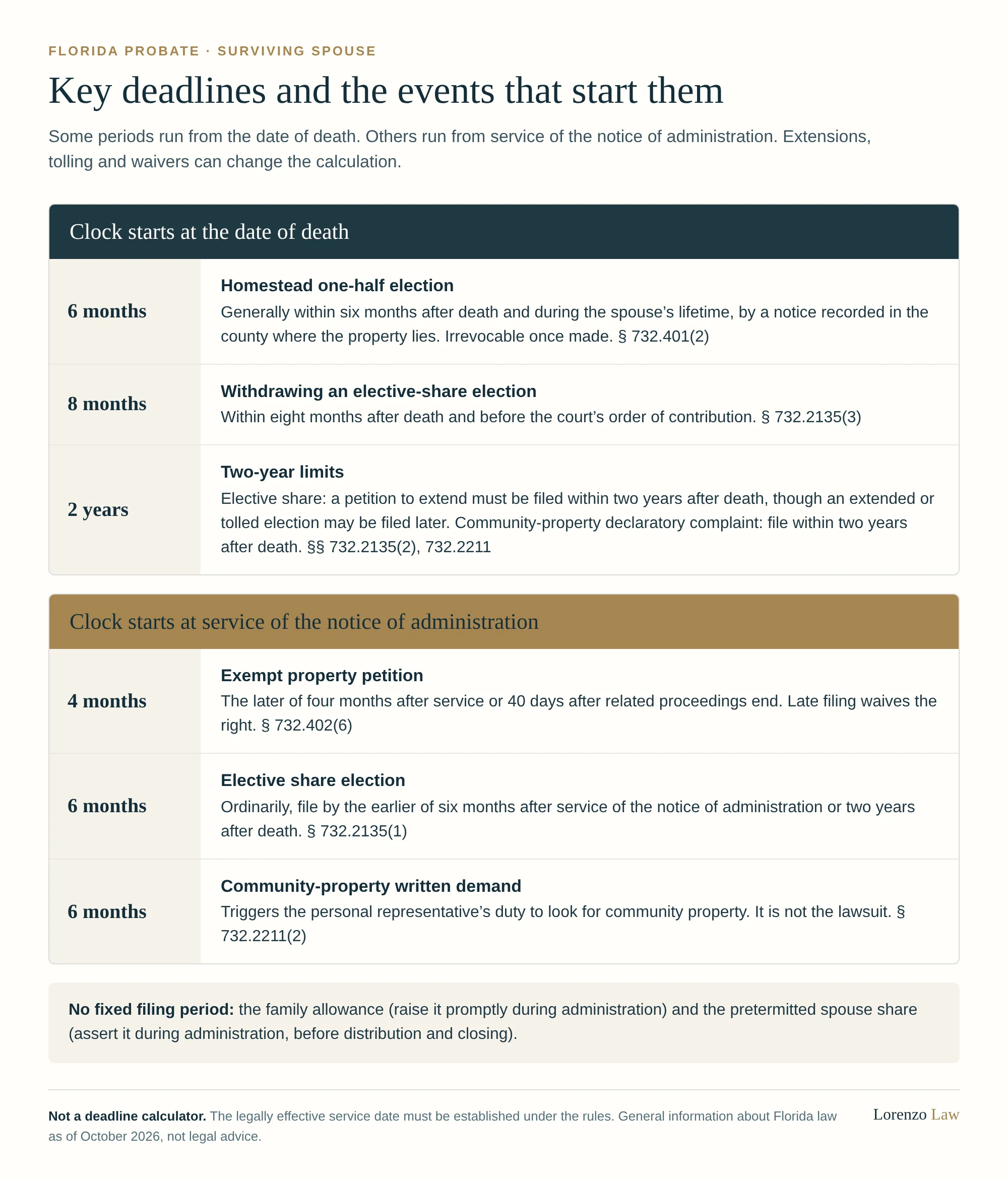
View the “Key deadlines and the events that start them” timeline (zoom in to read; the details are also in the text above).
What Being Served With a Notice of Administration Means
A notice of administration tells interested persons that a probate estate has been opened and that time periods may now be running. Save the notice, envelope, delivery records, any waiver and the court filing record. The legally effective service date must be established under the applicable rules; it is not always simply the date printed on a certificate. Under § 733.212(8), when service of the notice of administration is waived, service is deemed to occur when the waiver is filed. A notice of administration is different from a notice to creditors, a notice of election or an order with an appeal deadline.
The current § 733.212 objection language covers validity of the will, venue and jurisdiction. Court papers in the probate case are filed with the clerk of the circuit court, usually through the Florida Courts E-Filing Portal, while a homestead election is recorded in the county’s official records. Have any notice you receive reviewed promptly.
Second Marriages and Blended Families: Rights of a Second Wife or Husband
What rights does a second wife have? A second wife or second husband has the same statutory rights as any surviving spouse, subject to the same instruments, waivers and deadlines. In a blended family, the home, probate accounts and a revocable trust are usually analyzed separately, and the stepchildren’s and the spouse’s interests come from different rules. Step parent inheritance in Florida usually runs through a will, trust or beneficiary designation rather than intestacy.
Second-marriage and blended family inheritance questions in Florida often involve a remarriage later in life, adult children from an earlier relationship, a will or trust signed before the wedding and a house in the husband’s name when he dies, or in the wife’s name when she dies. Those facts raise the issues on this page; they do not decide the outcome.
Hypothetical: A Florida domiciliary dies survived by a spouse and adult descendants from an earlier relationship. Assume the decedent owned a qualifying homestead interest alone, there is no effective spousal waiver, and no permitted devise controls. Under § 732.401 the spouse generally receives a life estate with the statutory election option; the descendants receive remainder interests. A separate sole-name probate account passing by intestacy is analyzed under § 732.102. A revocable trust calls for its own beneficiary and elective-estate review. These are separate analyses, not amounts to add together without valuation and satisfaction rules.
Adult children sometimes ask the reverse question, for example when a father leaves everything to a second wife, or when a father died and a stepmother is still living in the house. Florida does not give adult children a general forced share of a parent’s estate. Their questions usually concern the homestead rules, the validity of the will or trust and any marital agreement.
Do Stepchildren Inherit in Florida?
Do stepchildren have inheritance rights in Florida? Not as descendants merely because of the marriage. A stepchild does not become a descendant of a stepparent merely through the marriage; adoption or another legally recognized relationship may change the analysis. A stepchild can still receive property under a valid will, trust, deed or beneficiary designation. Because § 732.102 counts the decedent’s descendants and the surviving spouse’s own descendants separately, children from a previous marriage can change the spouse’s intestate share even though a stepchild does not inherit from a stepparent as a descendant.
Can I Contest My Spouse’s Will or Trust?
Where the will or trust itself looks suspect, the separate questions are contesting a will in Florida, undue influence, challenging transfers made before death and filing a caveat to receive notice before a will is admitted. A trust dispute is a trust litigation matter. These are distinct routes from the statutory elections and petitions described above, and they have their own deadlines. Not every omitted-spouse situation requires an inheritance lawsuit; many spousal rights are claimed by petition or election in the probate case. If you need an inheritance dispute lawyer in Florida, see Florida probate litigation.
Documents and Early Steps After a Spouse’s Death
This checklist covers what to do when a spouse dies in Florida, which starts with two things: gathering the documents that decide which rights apply, and identifying which periods may already be running. You do not need a complete file before requesting help.
Use this as a checklist for the first conversation with a lawyer:
- Date of death, the decedent’s domicile and the Florida county involved; the requester’s role and contact details.
- Marriage records and relevant final divorce judgments, complete marital agreements and amendments.
- All wills/codicils, relevant trusts/amendments and beneficiary provisions.
- Deeds/legal descriptions, mortgage/lien information and evidence of home use; any title commitment if a sale is pending.
- A family outline identifying the decedent’s and survivor’s descendants, any minor children, and relevant adoptions or support relationships.
- Court case number, notices, envelopes, delivery/service proof, filed waivers, petitions, elections and orders.
- Account agreements, signature cards, beneficiary forms, retirement-plan/insurance records and spousal-consent documents.
- Item list for household property and vehicles, values, title and personal-use records; household support needs for any allowance request.
- Earlier domicile, acquisition and tracing records if community-property rights may apply.
You do not need a complete file before requesting help. Ask how to transmit records securely; do not place private financial records or identifying numbers in a public inquiry form.
Early steps that often matter:
- Order certified death certificates. Institutions often want their own certified copy.
- Get advice promptly about the home. The homestead election generally must be made within six months after death, and it runs from death rather than from any notice.
- Have waivers and settlement papers reviewed before signing. Waivers of accounting, consents and family settlement agreements can be enforceable. Prompt review is better than either signing quickly or refusing everything.
- Find the deed, the will, every codicil and any trust. The deed matters most if your husband died and the house was in his name. Note the dates and compare them with the marriage date. If no will turns up, Florida law on a death without a will applies to the probate property.
- List where you lived during the marriage. Mention any community property jurisdiction at the first meeting.
- Inventory the accounts and how each is titled, and ask each retirement plan and insurer for the beneficiary of record and any spousal-consent records.
- Contact the Social Security Administration and, if applicable, the VA about survivor benefits.
- Contact the county property appraiser about the exemptions and the transfer.
- Keep every notice and envelope. The notice of administration can start several periods; see the notice of administration.
For the general notifications after any death, see what to do when someone dies in Florida.
Common Misunderstandings About Spousal Rights in Florida
Each of these corrections is explained in more detail above.
- “The will leaves me nothing, so I get nothing.”
- The will alone does not decide all statutory rights. Homestead, exempt property, the family allowance, the elective share and the pretermitted-spouse rule have their own requirements, and waivers and deadlines can affect each one.
- “Everything is in a trust, so there is no estate.”
- The elective estate is a different measurement from the probate estate, and § 732.2035 includes property over which the decedent held a revocable power.
- “We were separated, so I have no claim.”
- Separation or a pending divorce does not by itself establish that the marriage ended before death. Review any final judgment, marital settlement, waiver and other order.
- “Florida has dower, like my mother had.”
- Dower and curtesy were abolished by § 732.111. The modern statutory rights are different rights with their own rules.
- “My name isn’t on the deed, so the house isn’t mine.”
- Being absent from the deed does not necessarily eliminate a surviving spouse’s homestead rights. When a spouse dies with the house in their name alone, the deed, family circumstances, any permitted devise and any valid waiver determine what passes at death.
- “Florida isn’t a community property state, so that doesn’t apply to us.”
- Florida generally uses separate-property rules, but property traceable to a community property jurisdiction can carry rights at death. Tracing and the statutory exclusions decide whether the Act applies.
- “The lawyer for the estate is looking out for me.”
- The personal representative’s lawyer represents that fiduciary in the engagement; a surviving spouse should not assume the lawyer separately represents the spouse’s individual interests.
- “I have plenty of time.”
- Some deadlines run from death; others depend on service, waiver or a particular proceeding. The homestead election generally must be made within six months after death.
Hiring a Florida Lawyer for Surviving Spouse Rights
Lorenzo Law is the solo practice of Jose M. Lorenzo, Jr. The firm represents surviving spouses statewide. The initial consultation is free, and consultations are available in English and Spanish.
Whether you are looking for a widow lawyer or a lawyer for a widower, a surviving spouse is usually represented by a lawyer the spouse engages separately from the lawyer for the personal representative. A probate attorney can review the deed, will, trust, marital agreements and notices together, advise a surviving spouse on property rights, including rights without being on the deed, and explain which rights and periods may apply. The work can include:
- Advising on the homestead life estate and the one-half election, and recording an election.
- Evaluating and filing an elective-share election, and the response to an elective share trust.
- Petitions to determine exempt property and requests for a family allowance.
- Pretermitted (omitted) spouse claims when the will predates the marriage.
- Reviewing a prenuptial agreement after a death, a postnuptial agreement or another waiver of spousal rights.
- Community-property discovery demands and declaratory-relief actions.
- Disputes with a personal representative, trustee or stepchildren, and will or trust contests.
Any representation and scope are established through an engagement agreement. For probate representation generally, see Florida probate lawyer, Florida inheritance lawyer, Florida probate litigation and Florida estate litigation.
Who Is the Best Lawyer for Surviving Spouse Rights in Florida?
No lawyer can honestly claim to be the best for every surviving spouse, and the useful question is who fits the matter. Lorenzo Law’s services for surviving spouses include disinherited-spouse claims, and the firm assists spouses with omitted heir cases, but the same questions apply to any lawyer you consider. What legal help is best for surviving spouses in estate disputes? Whether you are in an estate dispute, are a disinherited spouse weighing an elective share, or have an omitted-spouse claim, ask:
- Does the lawyer regularly handle Florida probate and estate disputes, not only estate planning?
- Will the lawyer you speak with be the one who handles the matter?
- Will the lawyer represent you, rather than the personal representative or another family member?
- Can the lawyer explain which periods may already be running, based on your actual documents and notices?
- Can you work with the lawyer in your language and from where you live?
Surviving Spouse Matters Across Florida
A Florida probate case is generally opened in the county where the decedent was domiciled under § 733.101, while a homestead election is recorded in the county or counties where the property lies. Lorenzo Law handles surviving-spouse matters statewide, so a spousal rights attorney does not need to be in your county, and consultations can be held by phone or video. These local guides explain how the probate court works in each area:
- Miami-Dade probate court
- Broward County probate court
- Palm Beach County probate court
- Orange County probate court
- Hillsborough County probate court
- Pinellas County probate court
- Duval County probate court
- Lee and Collier probate court
- Sarasota and Manatee probate court
Local probate pages: Miami, South Miami, Fort Lauderdale, Palm Beach County, Orlando, Kissimmee, Celebration, Tampa, St. Petersburg, Jacksonville, Sarasota and The Villages.
The firm guides are Lorenzo Law’s own explanations of local practice, not official court publications. Confirm clerk and division requirements directly before filing.
Glossary of Florida Surviving Spouse Terms
These short definitions match how the terms are used on this page.
- Surviving spouse
- The person married to the decedent at death. Separation or a pending divorce does not by itself end that status; a valid waiver, disqualification or a final judgment of dissolution before death can affect the rights that follow.
- Heir
- A person, including the surviving spouse, entitled under the statutes of intestate succession to a decedent’s property (§ 731.201).
- Devisee or beneficiary
- A person who receives property under a will (devisee) or a trust or designation (beneficiary).
- Intestate
- Dying without a valid will, or the property not disposed of by one. Under Florida law, intestate succession sets the spouse’s share in § 732.102.
- Elective estate and elective share
- The elective estate is the statutory measure in § 732.2035, which can include specified nonprobate interests. The elective share is 30 percent of it, subject to exclusions, valuation and satisfaction credits.
- Pretermitted (omitted) spouse
- A spouse who married the testator after the will was executed is entitled to a share equal to an intestate share, unless one of § 732.301’s three exceptions applies.
- Protected homestead
- A deceased owner’s qualifying residence under Article X, section 4 of the Florida Constitution, as defined in § 731.201. Survivorship and entireties property is outside that definition. Under Florida homestead law, inheritance of this property follows the devise restrictions and § 732.401.
- Life estate and remainderman
- A life estate is the right to the property for a person’s life; the remainderman holds the interest that takes effect when it ends. Under § 732.401(1), the spouse may take a life estate and the descendants the remainder.
- Tenant in common
- A co-owner holding an undivided, inheritable share. The homestead election makes the spouse a tenant in common with the descendants.
- Tenancy by the entireties
- Ownership available only to spouses; the survivor ordinarily takes the whole by survivorship.
- Exempt property
- Qualifying household items, vehicles, tuition programs and specified death benefits protected from estate claims under § 732.402, claimed by petition.
- Family allowance
- A reasonable allowance during administration for the spouse and lineal heirs the decedent was supporting or was obligated to support, capped at $18,000 in total (§ 732.403).
- Personal representative
- The person appointed by the probate court to administer the estate, often called the executor elsewhere.
- Curator
- A person the court may appoint to take charge of a decedent’s estate until letters are issued, or in other circumstances the statutes allow (§§ 731.201, 733.501).
- Notice of administration
- The notice served on interested persons after an estate is opened. Its service can start several of the periods on this page.
- Formal notice
- A method of service under the Florida Probate Rules required for certain papers, including service of an elective-share election on the personal representative. An ordinary emailed copy is not a substitute.
- Waiver of spousal rights
- A written agreement under § 732.702, signed before or after marriage, giving up some or all of a spouse’s statutory rights.
- Community property (in Florida)
- Property acquired as community property in another jurisdiction, or traceable to it, to which §§ 732.216–732.228 may apply at death.
Discuss Your Florida Surviving-Spouse Rights
Lorenzo Law represents surviving spouses in Florida probate and estate litigation. A free initial consultation can help identify the issues to review, including the home, will or trust, account ownership, marital agreements and notices received. Any representation and scope are established through an engagement agreement.
Call (305) 224-6811 or request a consultation. Consultations are available in English and Spanish. In your initial message, provide a brief overview, the date of death, the relevant Florida county and whether you have received court papers. Ask how to send records; do not include sensitive documents or account numbers in a public form.
Call (305) 224-6811 or Request a consultation
After the immediate estate questions are addressed, a surviving spouse may also need to review his or her own will, fiduciaries and beneficiary designations. See estate planning for widows in Florida.
Lorenzo Law represents clients statewide. Principal office: Kissimmee, Florida; meetings in Coral Gables and Fort Lauderdale by appointment.
This page provides general information about Florida law as of October 2026. It is not legal advice for any particular situation, and reading it or contacting the firm does not create an attorney-client relationship.
About the Author
Jose M. Lorenzo, Jr. is the founder of Lorenzo Law and a Florida probate lawyer whose practice is concentrated in estate administration, probate and trust litigation, wrongful death claims brought by a personal representative, and guardianship. Before entering full-time practice he clerked for the Honorable Maria M. Korvick in the Probate Division of the Eleventh Judicial Circuit Court in Miami-Dade County, and spent nearly a decade as a paralegal at two Miami-area firms. He was admitted to The Florida Bar in 2013 (No. 107002) and is a graduate of Florida International University College of Law.
Authorities Cited on This Page
The statutes cited here are the 2026 Florida Statutes, and the rules are the October 1, 2026 compilation of the Florida Probate Rules. Cases are discussed for the points stated in the text; each turned on its own facts.