
Living Will in Florida: Requirements, Cost, and How to Make One

A Florida living will is a written advance directive in which a competent adult states, ahead of time, whether life-prolonging medical procedures should be provided, withheld or withdrawn if the adult later cannot decide and has a terminal condition, an end-stage condition or a persistent vegetative state.
A living will in Florida is signed in front of two witnesses, at least one of whom is neither the signer’s spouse nor a blood relative, and Florida law does not require a notary. This guide covers the Florida living will form, the signing rules, when the document applies, how it differs from a health care surrogate, a “medical power of attorney” and a DNR form, and what it costs.
Request a free initial consultation. Only the initial consultation is free; representation fees and costs are agreed separately in writing. Consultations are available statewide in English and Spanish, by phone or video.
Request a free initial consultationCall (305) 224-6811
Go straight to: The form · Signing rules · When it applies · Living will vs surrogate and DNR · Cost
By situation: someone making a living will should start with the step-by-step checklist; a family member facing a decision now, with when it applies and disagreements; someone who moved to Florida, with documents from another state.
All guide sections 24 sections
Florida living will at a glance
Short answer. A Florida living will records your instructions about life-prolonging procedures for a time when you cannot speak for yourself. It does not take effect just because you are sick or unconscious, it does not give anyone control of your property, and it is not the yellow DNR form paramedics use. The official suggested form is in section 765.303 of the Florida Statutes and is free to read and use; whether a completed form says what you mean is a separate question.
| What it is | A written advance directive with your instructions about providing, withholding or withdrawing life-prolonging procedures in the situations the law describes (§ 765.302). What is a living will |
|---|---|
| Who can sign | A competent adult. Another person cannot make a living will for someone who can no longer decide. Signing rules |
| Witnesses | Two subscribing witnesses; at least one must be neither your spouse nor a blood relative. Both may be unrelated. Who can witness |
| Notary | Not required by § 765.302. A notary does not replace the witnesses. Notarization |
| Official form | The suggested form in § 765.303. It is optional, and it can name a surrogate to carry out the declaration. The Florida living will form |
| When it applies | Only after the required findings: no reasonable medical probability of recovering capacity, one of the three statutory conditions, and your stated conditions satisfied, with two physicians’ findings in the record. When it takes effect |
| What it does not do | It does not transfer property, avoid probate, appoint a general decision-maker for every medical decision, or serve as Florida’s emergency DNR order. Comparison |
| Where to keep it | No court filing. Notify your primary physician, ask that a copy go into your medical record, and give copies to your surrogate and family. Storage and copies |
| Cost | The form is free. Jose M. Lorenzo, Jr.’s fee to prepare a Florida living will is $675 per person, with all associated costs included. Cost |
Key takeaways
- A living will can ask for treatment to be provided as well as withheld or withdrawn.
- Two witnesses are required; a notary is not. Using two unrelated witnesses is not a defect.
- Signing the document and applying it to a treatment decision are separate steps, and the second requires specific medical findings.
- Artificially provided nutrition and hydration fall within the legal definition of life-prolonging procedures, but your actual instructions still control what you have asked for. Comfort care and pain relief are outside that definition.
- A living will, a health care surrogate designation and a Florida Do Not Resuscitate Order (DNRO) do different jobs. Most people who plan carefully sign more than one of them.
- No living will does not mean no decision-maker: a designated surrogate, and otherwise a statutory proxy, may decide under Florida law.
What is a living will in Florida?
A living will is a witnessed document (or a witnessed oral statement) in which a person gives instructions about life-prolonging procedures. In Florida it is part of the Health Care Advance Directives law in Chapter 765, and its signing rules are in Part III.
Florida’s definition in § 765.101 includes a witnessed written document executed under § 765.302 and a witnessed oral statement expressing instructions about life-prolonging procedures. This guide concentrates on the written living will, because a signed document can be copied, shared and placed in the medical record; an oral statement can raise separate questions of proof and interpretation.
A living will speaks for you only in defined circumstances. Florida’s statutory form, and most living wills, are written around three medical conditions:
| Condition | What the statutory definition addresses |
|---|---|
| Terminal condition | A condition caused by injury, disease or illness from which there is no reasonable medical probability of recovery and which, without treatment, can be expected to cause death. |
| End-stage condition | An irreversible condition caused by injury, disease or illness that has resulted in progressively severe and permanent deterioration, and for which, to a reasonable degree of medical probability, treatment would be ineffective. |
| Persistent vegetative state | A permanent and irreversible condition of unconsciousness with an absence of voluntary action or cognitive behavior and an inability to communicate or interact purposefully with the environment. |
Summaries of § 765.101. A diagnosis, or a family member’s impression, does not by itself establish that a condition exists; the medical findings described in when a living will takes effect are required.
While you can make your own health care decisions, you make them, whatever your living will says (§ 765.204(1)). A living will is for the time when you cannot.
Other names for a living will
You may see the same document under other labels: living will declaration (the statutory form is a declaration), advance medical directive, health care directive, medical directive or “living directive.” The broader term is advance directive, sometimes written “advanced directive.” A label does not tell you everything a document does. What is a living will called in Florida? The statute calls it a living will, and the suggested statutory form is a declaration directing that the maker’s dying not be artificially prolonged. The difference between a living will and an advance directive is one of scope. In Florida, “advance directive” is the umbrella term: it covers a living will, a health care surrogate designation and an anatomical gift. The guide to advance directives versus living wills explains the broader category.
The purpose of a living will, and what goes in one
The main purpose of a living will is to let you, rather than your family or a statute, decide in advance how life-prolonging procedures are handled if you cannot speak for yourself. It is a type of advance directive, and nothing else does exactly that job. People sometimes ask what is better than a living will: nothing replaces it, but the more complete plan pairs it with a surrogate designation rather than replacing it. Florida’s definition recognizes two kinds: a written living will and a witnessed oral statement.
No one is required to have a living will in Florida, and a provider cannot require one as a condition of care (§ 765.110). Whether you should have one depends on whether you want your own instructions, rather than someone else’s judgment, to guide end-of-life decisions. When should you make a living will? Any competent adult can sign one at any time; common reasons to do it now are turning 18, marriage, a new diagnosis, a planned surgery, a move to Florida, or a change in who you would trust to decide.
The following outline shows what goes in a living will: what it consists of and what it should specify.
- Your name and the date.
- The conditions it covers: a terminal condition, an end-stage condition, a persistent vegetative state.
- Your instructions about life-prolonging procedures, including artificial nutrition and hydration if you want them addressed separately.
- Your wishes about comfort care and pain relief.
- If you choose, a surrogate to carry out the declaration.
- Any additional instructions, such as religious wishes or a time-limited trial of treatment.
- Your signature and the signatures of two qualifying witnesses.
That outline follows the statutory form; a lawyer’s living will questionnaire usually walks through the same items.
What a living will is not
- Not a last will. It does not leave property to anyone or name a personal representative (the executor). Searches for a “living will and testament” usually mean a last will and testament, which is a different document.
- Not a living trust. It does not hold or manage assets.
- Not a power of attorney. It does not let an agent handle money or sign contracts.
- Not a DNR order. Florida paramedics follow the Department of Health DNRO form, not a living will.
- Not a blanket refusal of care. It applies only in the circumstances it describes, and comfort care continues.
Living will vs health care surrogate, medical power of attorney, proxy and DNR
A living will states your instructions. A health care surrogate designation names the person who decides. A statutory proxy decides only when there is no available designated decision-maker. A DNRO is a medical order for emergency responders. A durable power of attorney, a last will and a living trust deal mainly with property.
| Document or role | What it does | Who decides | When it matters |
|---|---|---|---|
| Living will | Records your instructions about life-prolonging procedures. The statutory form can also name a surrogate to carry out the declaration. | You, in advance; a surrogate or proxy, and the physicians, apply your instructions. | When you cannot decide, after the required findings about your condition (§ 765.304, § 765.306). |
| Health care surrogate designation | Appoints a person, and usually an alternate, to make health care decisions and receive health information within the authority you give (§ 765.202). | Your surrogate. | Ordinarily when you are found unable to make your own decisions; the document can make some authority immediately exercisable (§ 765.202(6)). |
| “Medical power of attorney” | A common national term. In Florida the document that appoints a medical decision-maker is the health care surrogate designation. | The person you appoint. | Same as the surrogate designation. See the Florida term. |
| Health care proxy | Not a form you sign in Florida: a statutory role filled from a priority list when you have no advance directive or available surrogate (§ 765.401). | The proxy chosen under the statute. | When you cannot decide and no designated decision-maker is available to act. |
| Florida DNRO (DNR form) | A Department of Health medical order directing that resuscitation not be attempted in cardiac or respiratory arrest, signed by a physician or other authorized clinician together with you or your authorized decision-maker. | You (or an authorized decision-maker) and a physician or other authorized clinician who signs it. | During an arrest, including when paramedics respond. See the DNR form. |
| Durable power of attorney | Appoints an agent for financial and legal matters, within the powers granted. Health care authority in it is treated under § 709.2109. | Your agent. | During life, including incapacity; it ends at death. |
| Last will | Leaves property and names a personal representative. | Your personal representative, under court supervision in probate. | After death. |
| Revocable living trust | Holds property for you and then for your beneficiaries, managed by a trustee. | You as trustee, then your successor trustee. | During life and after death, for the property in the trust. |
General comparison only. The authority in any document depends on its exact wording and Chapter 765.
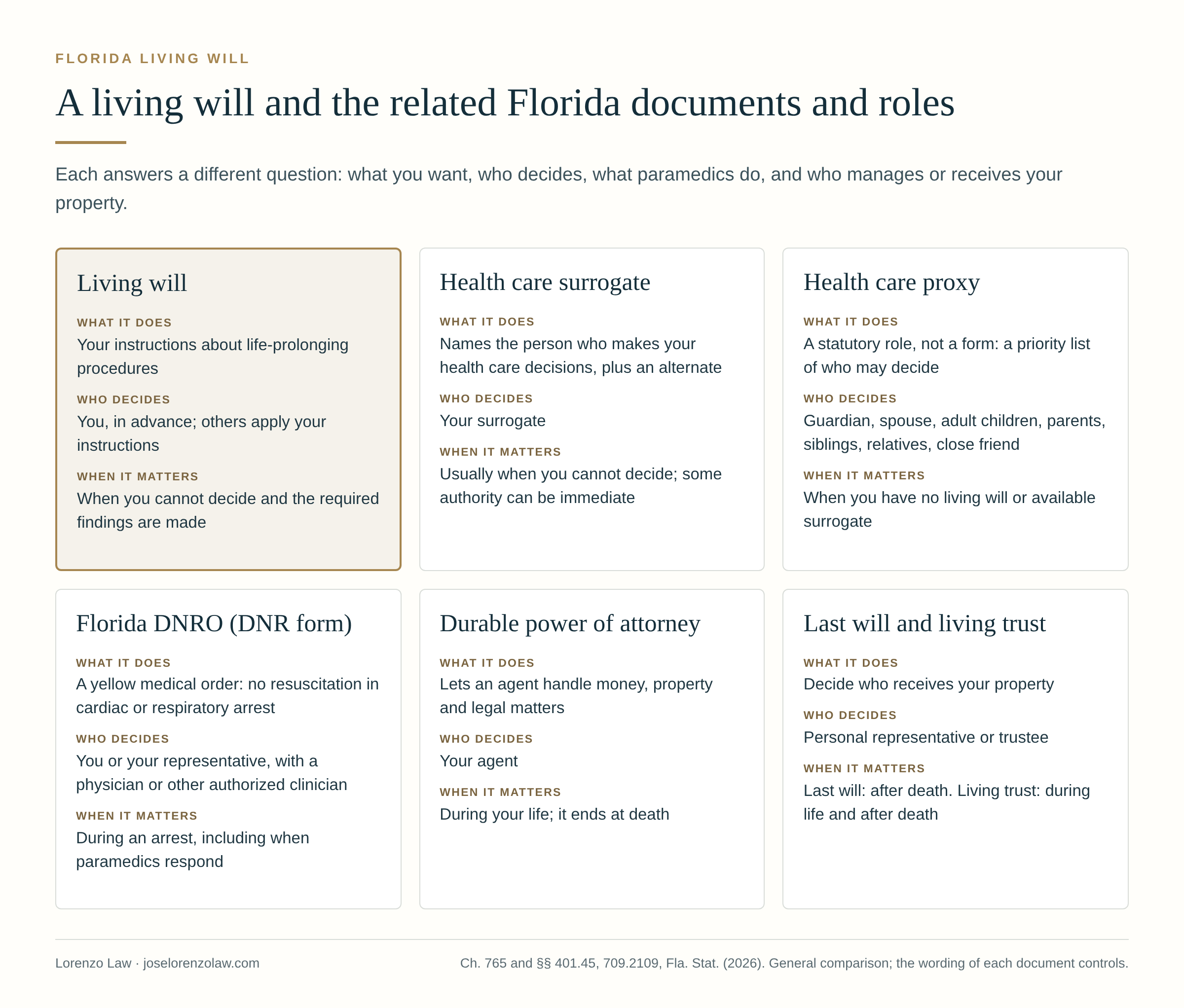
Living will vs health care surrogate: instructions and decision-making
The difference is between what and who. A living will tells your physicians and family what you want in specific end-of-life situations. A designation of health care surrogate tells them who may make health care decisions for you, including the many decisions that have nothing to do with life support, such as consenting to surgery, choosing a facility or talking with your doctors while you are temporarily unable to.
The suggested living will form lets you name someone to carry out the declaration, but that limited role is not the same as a full designation with an alternate and stated authority. A living will can also be valid without naming anyone. For example, a person temporarily unable to consent may need a surrogate even though the conditions for withdrawing life-prolonging procedures under a living will have not been met. These are hypothetical distinctions, not recommendations about any patient’s care.
The Florida health care surrogate guide covers choosing a surrogate and an alternate, the surrogate’s authority, witnesses and when that authority begins. Coordinate the two documents so the names, instructions and limits match.
Is a “medical power of attorney” the same thing in Florida?
Not in name. “Medical power of attorney,” “health care power of attorney” and “health care proxy form” are terms used in other states and on national form sites. Florida’s document for appointing a medical decision-maker is the designation of health care surrogate under Part II of Chapter 765. Florida’s health care proxy is a different thing: a person who may decide under § 765.401 when you have not designated a surrogate, or your surrogate is unavailable. A financial power of attorney can also contain health care provisions. If both documents grant health care authority and your advance directive designates a health care surrogate, § 709.2109(3)(b) provides that the directive controls over the power of attorney unless the power of attorney was executed later and expressly states otherwise. Where a living will designates no surrogate, § 709.2109(3)(b)’s control rule does not apply by its terms; the agent’s authority is still bounded by your own instructions and the living will’s statutory force (§ 765.302(3)), so the agent cannot override them. Rely on the document and the governing law rather than the label. If you are looking for a free, printable “medical power of attorney form” or a “health care proxy form” PDF for Florida, the form you want is the designation of health care surrogate, which FloridaHealthFinder publishes as a free download.
The Florida power of attorney guide explains the financial document.
Florida living will requirements: how to sign it correctly
For a written living will under § 765.302: (1) the person making it is a competent adult; (2) the person signs in the presence of two subscribing witnesses; (3) at least one witness is neither the person’s spouse nor a blood relative; and (4) if the person is physically unable to sign, one of the witnesses signs the person’s name in the person’s presence and at the person’s direction.
Those are the Florida living will requirements for signing. Three practical points follow from them. First, physical inability to sign is not the same as inability to decide: a family member cannot create someone else’s living will because that person can no longer consent. Second, the witnesses must actually take part in the signing; names added later are not a substitute. Third, the rules for a last will or a financial power of attorney are different, so a document package must follow each document’s own requirements.
Who can witness a living will in Florida?
The relationship rule applies to one witness, not both: at least one of the two subscribing witnesses must be neither your spouse nor a blood relative. A spouse and an unrelated friend satisfy that rule; a spouse and a brother or sister do not. Two unrelated adults, such as neighbors or coworkers, also satisfy it. Use competent adult witnesses as a practical matter. If a proposed witness’s legal relationship to you is unclear, use a clearly unrelated witness instead of relying on a general statement about step-relatives or in-laws.
A person designated as a health care surrogate may not act as a witness to the document that designates them (§ 765.202(2)). That bar is written for a Part II surrogate designation; the living will statute (§ 765.302) imposes no such witness bar, so as a precaution a person named on the living will’s surrogate line should not also serve as one of its witnesses. Read the whole document, not just its title, before choosing witnesses. Whether a nurse, a treating physician or a notary may serve is answered in the questions below.
Does a Florida living will need to be notarized?
No. Section 765.302 requires two witnesses but does not require notarization, and Florida’s suggested form provides witness lines rather than a notary certificate (§ 765.303). Some people sign their living will at the same appointment as a notarized power of attorney, but a notary’s seal does not replace either required witness, and notarizing a Florida document does not guarantee how another state will treat it.
Can I sign a Florida living will online?
Florida has a supervised remote process that expressly covers health care advance directives: an online notary supervises a signing over audio-video communication under § 117.285. It is not the same as typing a name into a PDF, emailing signatures or signing during an ordinary video call. The law addresses identity verification, how remote witnesses observe the signing, and a remote witness’s confirmation of residence and physical location in the United States or a U.S. territory.
Extra protections apply to health care directives when fewer than two witnesses are physically present with the signer. The remote online notarization (RON) service provider asks preliminary screening questions, and an affirmative answer to any of them requires physically present witnesses; the online notary asks separate questions during the ceremony. Remote witnessing is not available for a signer who is a vulnerable adult as the statute defines that term. The additional safeguards in § 117.285(5) apply only when fewer than two witnesses are physically present with the signer; having at least two witnesses physically present removes those additional safeguards (§ 117.285(5)(k)), but not the other requirements for the supervised electronic process. Preparing a living will online and executing it are different things, and the remote route does not change the requirement of capacity.
Signing for someone who cannot physically sign
If you can decide but cannot hold a pen, because of a stroke, arthritis or an injury, you may direct one of the two witnesses to sign your name for you, in your presence (§ 765.302(1)). Plan that arrangement before the signing day so the witnesses know their roles.
The Florida living will form (2026): official sources and their limits
The official Florida living will form is the suggested form printed in § 765.303 of the 2026 Florida Statutes. You do not have to buy a template to read it, and Florida does not require that exact form. Free and printable versions are also published by state agencies; check any copy against the current statute before relying on it.
Where to find the Florida living will form
- Florida Statutes, § 765.303 (Online Sunshine and the Florida Senate site): the current text of the suggested form. This is the version to compare every other copy against. Read § 765.303
- Agency for Health Care Administration, FloridaHealthFinder: a consumer guide to advance directives with downloadable living will, surrogate, anatomical gift and wallet-card forms. FloridaHealthFinder advance directives
- Office of the Attorney General: a printable living will PDF. Compare its wording with the current statute before using it: the current § 765.303 form uses “primary physician,” and a form that still says “attending physician” uses superseded wording.
- The Florida Bar: a consumer page that points to the AHCA forms and states that it does not vouch for their currency. Florida Bar consumer page
- Hospital, hospice and national form sites: many Florida hospitals offer advance directive forms at admission or online; national sites are often based on older text or other states’ law. Free is not the same as current.
What the statutory form says
There is no separate 2022, 2025 or 2026 edition of the Florida living will form: the suggested form in § 765.303 was last amended in 2015 (chapter 2015-153, Laws of Florida), so a “2026” form is the same statutory text, and older printed copies should be compared with it. The suggested form is written as a declaration directing that life not be artificially prolonged in the circumstances it describes. It has separate lines for the three conditions, a statement about the physicians’ findings, a statement preserving comfort care and pain relief, a place to name one surrogate to carry out the declaration (with no line for an alternate), a space for additional instructions, and two witness lines. It is not a neutral menu of every possible treatment choice. If you want treatment provided in situations the form addresses, or want something treated differently, the additional-instructions space or a differently worded document is where that belongs.
Sample, blank and printable living will forms
A sample living will or an example can show how the document is organized. A blank or simple living will form may come as a fillable PDF or a Microsoft Word template, or in a living will packet or kit. Before using an easy living will form, ask whether it says what Florida law requires and what you want. The FloridaHealthFinder living will is a free PDF you can download and print, and the statutory text in § 765.303 can be copied into a document of your own. A basic living will built on that text can be valid. A generic national template, a form printed from another state’s website, or an older free download may use different conditions, terms or witness rules. For a do-it-yourself (DIY) living will, written yourself from a sample or from the free paperwork, check both the completed instructions and the signing arrangements. A sample is a guide to structure, not a substitute for deciding what you want.
Before you fill out a free or printable form
- Read the entire declaration, including what it says about treatment and recovery.
- Ask your clinician about unfamiliar treatment terms and how they relate to your health, without assuming a diagnosis activates the form.
- Decide whether you want artificial nutrition and hydration, comfort care, religious concerns or a trial of treatment addressed in your own words.
- Decide whether the form’s limited surrogate line is enough or whether a separate health care surrogate designation with an alternate is needed.
- Check for conflicts with an existing surrogate designation, health care powers in a power of attorney, or an older living will.
- Arrange the correct witnesses, and any help with physically signing, before the signing day.
Do not paste generic pregnancy, dementia or treatment language into the additional-instructions space without considering its legal effect and medical meaning. A completed form should say accurately what you want, not steer you toward a particular decision.
How to make a Florida living will: a step-by-step checklist
Whether you write it yourself or have a lawyer draft it, creating a living will in Florida follows the same order: gather your existing documents, decide what you want and whom you trust, choose the form or have one drafted, sign before two qualifying witnesses, then notify your doctor and share copies. Getting a living will done involves both preparation and signing. Use the checklist below whether you are setting up a living will for the first time or replacing an old one.
Before signing
- Gather any existing living wills, surrogate designations, powers of attorney with health care provisions, and DNR or other medical orders, including documents signed in another state.
- Write down the questions you want answered about treatment, capacity, artificial nutrition and hydration, and any religious or personal preferences. Take medical questions to your clinician and drafting questions to a lawyer; a living will questionnaire covers the same ground.
- Talk with the person you want as surrogate and with an alternate. Confirm that each is willing and reachable, and that each knows your wishes.
- Compare names, authority and instructions across your documents, and resolve inconsistencies before signing another version.
- Arrange two witnesses who meet the rules and decide how you will sign: in person, with help signing, or by the supervised remote process.
After signing
- Notify your primary physician and ask that the living will or a copy be placed in your medical record (§ 765.302(2)).
- Give your surrogate and alternate the current documents. For a surrogate designation, § 765.202 requires an exact copy to be provided to the surrogate.
- Sign a HIPAA authorization if you want family members to be able to speak with your doctors, and consider uploading the living will to your patient portal.
- Keep a paper copy where it can be found, a legible scan on your phone, and the FloridaHealthFinder wallet card or a note in your wallet saying where the document is.
- Bring copies to a hospital admission or a change in care setting, and ask whether the record has the current version (§ 765.110).
- Review the documents after a change in your wishes, a serious diagnosis, a marriage, divorce or death in the family, a move, or when a surrogate becomes unavailable. Communicate any change and replace old copies (§ 765.104).
When does a Florida living will take effect?
A properly executed living will is valid when signed, but its instructions are applied to a treatment decision only when you cannot decide and the required findings have been made: no reasonable medical probability that you will recover capacity, one of the three statutory conditions, and any limitations you wrote satisfied. Your primary physician and at least one consulting physician must each examine you and record signed findings before life-prolonging procedures are withheld or withdrawn.
Before acting on a living will under Part III, § 765.304(2) requires a determination that there is no reasonable medical probability of recovering capacity so that you could exercise the right yourself, that you have a terminal condition, an end-stage condition or a persistent vegetative state, and that your expressed limitations and conditions have been carefully considered and satisfied. Under § 765.306, the primary physician and at least one other consulting physician separately examine the patient, and each examination’s findings must be documented and signed in the medical record before life-prolonging procedures are withheld or withdrawn.
That is a different process from the one that starts a health care surrogate’s authority. Under § 765.204(2), the primary or attending physician evaluates capacity, with another physician’s evaluation when the first has a question about incapacity, and a designation can make authority immediately exercisable (§ 765.202(6)). None of these provisions displaces the decisions of a patient who can still decide.
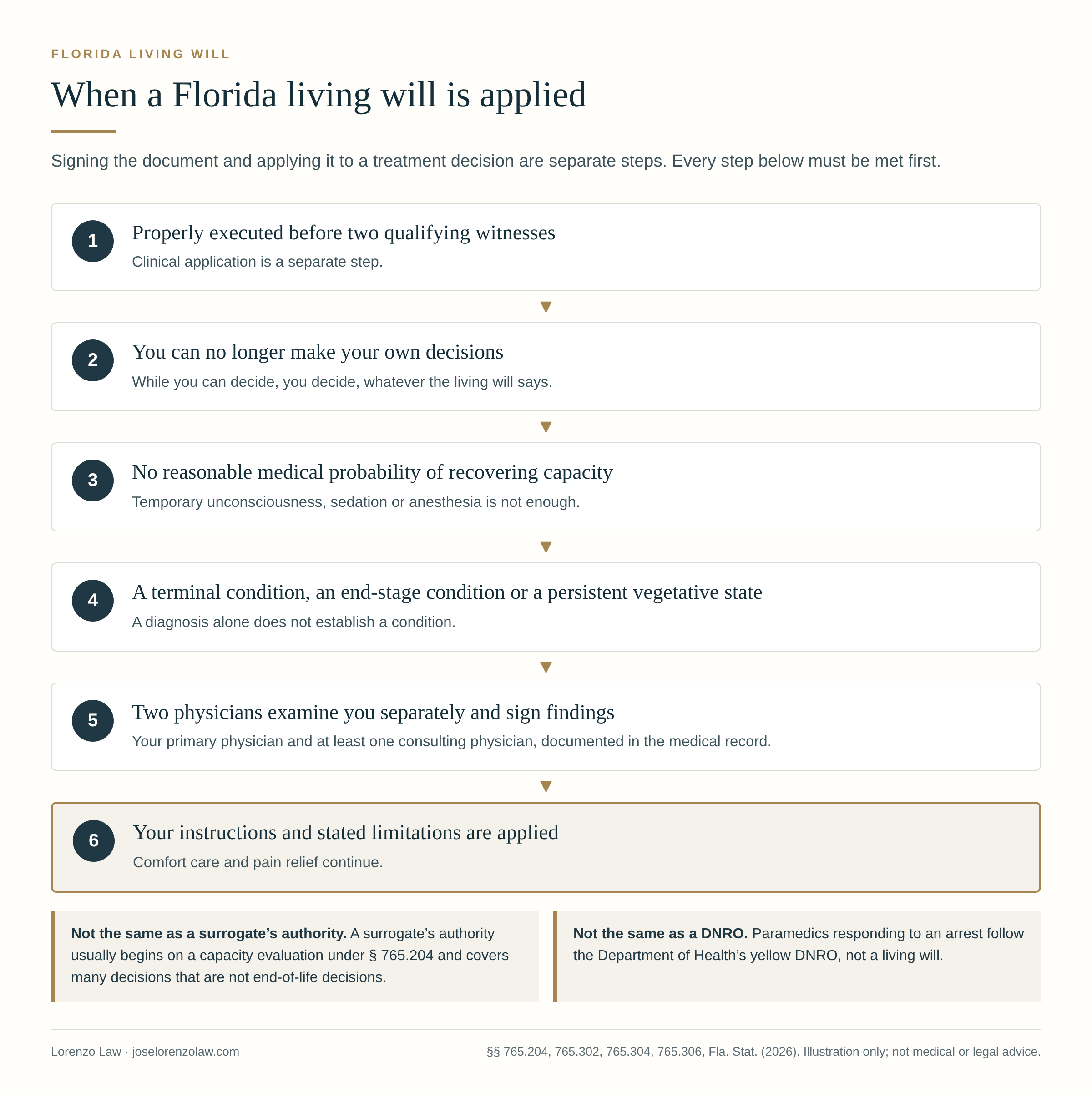
Does it apply during temporary unconsciousness or anesthesia?
No, not by that fact alone. Being unconscious after an accident, sedated in intensive care or under anesthesia for surgery does not establish any of the three conditions or the findings that recovery of capacity is not reasonably probable. A surrogate may still be needed for treatment decisions in that period, which is one reason a separate surrogate designation matters. Ask the treating clinicians about the medical findings rather than treating the word “incapacitated” as a complete answer.
Living wills, dementia and Alzheimer’s disease
A diagnosis of dementia or Alzheimer’s disease does not automatically establish a terminal condition, an end-stage condition or a persistent vegetative state, and it does not by itself mean a person lacks capacity to sign a document or make a current treatment decision. Progressive illness is where living wills are most often tested: years can pass between the diagnosis and the end-stage decisions a living will addresses, and many decisions along the way are not end-of-life decisions at all. Planning for dementia usually needs both clearly expressed treatment preferences and a surrogate designation with an alternate. If a diagnosis is recent and you want to sign or update documents, do it while your capacity is clear, and consider asking your physician to note it.
What does a Florida living will actually cover?
A Florida living will covers life-prolonging procedures: medical interventions that use mechanical or other artificial means to sustain, restore or supplant a spontaneous vital function, including artificially provided food and water. Medication and procedures needed for comfort care or pain relief are excluded from that definition (§ 765.101(12)).
Treatments people commonly address
Living wills and the conversations around them often mention cardiopulmonary resuscitation (CPR), mechanical ventilation (a breathing machine), dialysis, feeding tubes and IV fluids, and, in some documents, antibiotics or blood transfusions. Whether a particular treatment is a life-prolonging procedure in a particular situation is a medical and legal question; listing it in your own words tells your physicians how you think about it. Hospice and palliative care are approaches to care, not procedures a living will turns on or off.
Artificial nutrition and hydration
Because artificially provided sustenance and hydration are within the definition of life-prolonging procedures, broad instructions about life-prolonging procedures can include them. That does not mean every living will automatically orders a feeding tube or IV fluids withdrawn: the actual instructions, stated exceptions, medical circumstances and statutory requirements are read together. If you want nutrition and hydration treated differently from other procedures, say so clearly, after discussing the wording with your clinician and lawyer. This page does not recommend choosing or declining any treatment.
Comfort care and pain relief
Declining specified life-prolonging procedures is not declining comfort care. Florida excludes the medication and procedures necessary for comfort care or pain relief from the definition above, and the statutory form expressly provides for them. The legal distinction is not a guarantee about a specific medication, hospice eligibility or an individual outcome; discuss the care plan with the care team.
Personal, religious and cultural instructions
You may add instructions that reflect your values, your faith or your family’s traditions, such as a wish to have clergy consulted, a time-limited trial of treatment, or a request that a decision follow the teaching of your religion. Some faith communities publish model directives and templates, for example Catholic and Jewish (halachic) forms; using one is a personal choice, and the completed document still has to meet Florida’s signing rules. Florida law treats lawful withholding or withdrawal under Chapter 765 as distinct from suicide or mercy killing (§ 765.309), but that legal rule does not decide anyone’s religious or moral beliefs.
Documents that work with a living will
A living will is one part of a health care plan. The documents most often signed with it are a designation of health care surrogate, a HIPAA authorization, an anatomical gift (organ donor) declaration and, where appropriate, a Florida DNRO signed with a physician. A durable power of attorney and a last will cover the financial and property side.
Designation of health care surrogate and an alternate
The surrogate designation is the document that answers “who decides.” Like a living will, it is signed before two adult witnesses and does not need to be notarized (§ 765.202). It can name an alternate, give the surrogate access to your health information, and make some authority immediately exercisable (§ 765.202). Florida also has a separate form for designating a surrogate for a minor child (§ 765.2035). See the health care surrogate guide.
HIPAA authorization
A HIPAA authorization lets the providers you name share your medical information with the people you name. It does not make anyone a decision-maker. Many people sign one so that a spouse, partner or adult child can talk with doctors even before a surrogate’s authority begins.
Anatomical gifts and organ donation
An anatomical gift is a separate advance directive. You can register as a donor through Florida’s donor registry, operated as Donate Life Florida and designated by statute as the ‘Joshua Abbott Organ and Tissue Registry’ (§ 765.5155), through the driver license office, or by a signed document such as the uniform donor form on FloridaHealthFinder. If you have both a living will and a donation decision, ask your clinician whether the two sets of instructions fit together, and say in writing how you want them read.
Florida DNRO and the power of attorney
A Florida DNRO is the order emergency responders follow; it is completed and signed with your physician or another authorized clinician. A durable power of attorney handles bank accounts, property and contracts during incapacity. Neither replaces a living will.
Living will vs last will, living trust and power of attorney
A last will and a living trust decide who receives your property; a power of attorney lets an agent manage it during your life. A living will decides none of that: it addresses medical treatment while you are alive.
Living will vs last will. A last will and testament takes effect at death, names a personal representative and leaves property through probate. A living will addresses health care during life, has different signing rules and has no role after death. The Florida wills guide covers the last will.
Living will vs living trust. A revocable living trust holds and manages property during life and can continue after death; it is a property-planning tool and contains no health care instructions. The living trust guide explains it.
Living will vs power of attorney. A durable power of attorney appoints an agent for financial and legal matters within the powers granted, and it ends at death (does a power of attorney end at death). It should not be treated as a health care surrogate designation. If both documents grant health care authority and your advance directive designates a health care surrogate, § 709.2109(3)(b) provides that the directive controls over the power of attorney unless the power of attorney was executed later and expressly states otherwise. Where a living will designates no surrogate, § 709.2109(3)(b)’s control rule does not apply by its terms; the agent’s authority is still bounded by your own instructions and the living will’s statutory force (§ 765.302(3)), so the agent cannot override them.
Florida DNR form (DNRO): how it differs from a living will
The Florida DNR form is the Department of Health’s Do Not Resuscitate Order, form DH 1896. It is a medical order, signed by you or your authorized decision-maker and by a physician or other authorized clinician, that tells emergency medical technicians and paramedics not to attempt resuscitation in cardiac or respiratory arrest. A living will does not do that job.
The Department of Health publishes the DNRO and its instructions on its Do Not Resuscitate Order page, with versions in English, Spanish and Haitian Creole. The Department’s guidance explains that the form must have a full-page yellow background or be printed on any shade of yellow paper, that accurate yellow copies are as valid as the original, that a reduced-size version can be carried with photo identification, and that the order is signed by the patient or the patient’s representative and by a Florida-licensed physician, osteopathic physician, advanced practice registered nurse registered for autonomous practice, or physician assistant. The underlying law is § 401.45 and Florida Administrative Code Rule 64J-2.018.
The Department’s guidance says the DNRO does not have to be notarized or witnessed; it is signed by the patient or the patient’s representative at the same time the health care provider signs it. You cannot get a valid Florida DNRO without a physician or other authorized clinician signing it.
To obtain a DNR form in Florida, download and print the DNRO PDF from the Department’s page on yellow paper, then complete it with your physician or other authorized clinician; the printable form itself is free.
Keep the distinction clear. A DNRO addresses resuscitation only; a living will addresses a range of life-prolonging procedures in defined conditions; a surrogate designation names a decision-maker. A living will does not include a DNR order, and a DNRO does not replace a living will or a surrogate designation. Many people with a serious illness have all three, and keep the yellow DNRO where responders will see it, such as on the refrigerator or by the bed.
If you have a DNR, POLST or similar order from another state, ask your Florida providers what orders are needed for care and emergency response here. Do not assume those documents are interchangeable with the Florida DNRO. Florida recognizes no POLST or MOLST program, so an out-of-state POLST has no direct Florida equivalent, and Florida EMS honor only the Department of Health’s DNRO form or its wallet-size DNRO Device.
What happens if you do not have a living will in Florida?
Decisions do not stop. If you have designated a health care surrogate, the surrogate may decide, including about life-prolonging procedures unless the designation limits that authority (§ 765.305). If you have no living will or designated surrogate — or your surrogate is unavailable — Florida’s proxy statute names who may decide, in order of priority (§ 765.401).
When people ask whether next of kin can make medical decisions in Florida, this list is the answer. Under § 765.401(1), the order is: a court-appointed guardian (or guardian advocate) authorized to consent to medical treatment; the spouse; an adult child, or a majority of the adult children reasonably available for consultation; a parent; an adult sibling, or a majority of the adult siblings reasonably available; an adult relative who has shown special care and concern, kept regular contact and knows the patient’s activities, health and religious or moral beliefs; a close friend; and finally a licensed clinical social worker or graduate of a court-approved guardianship program selected by the provider’s bioethics committee. A person in a later class decides only if no one in an earlier class is reasonably available, willing or competent to act. The proxy list governs treatment decisions, while anatomical-gift decisions follow § 765.512(3).
A proxy must decide as the proxy reasonably believes you would have decided; only if there is no indication of what you would have chosen may the proxy consider your best interest in deciding to withhold or withdraw treatment (§ 765.401(2)). A decision to withhold or withdraw life-prolonging procedures carries further requirements, including clear and convincing evidence in the situations described in § 765.401(3). When the decision rests on what you would have chosen, that evidence comes from what you said and did; if there is no indication of your wishes, the proxy must instead meet the statutory best-interest standard and its evidentiary requirements (§ 765.401(2)–(3)).
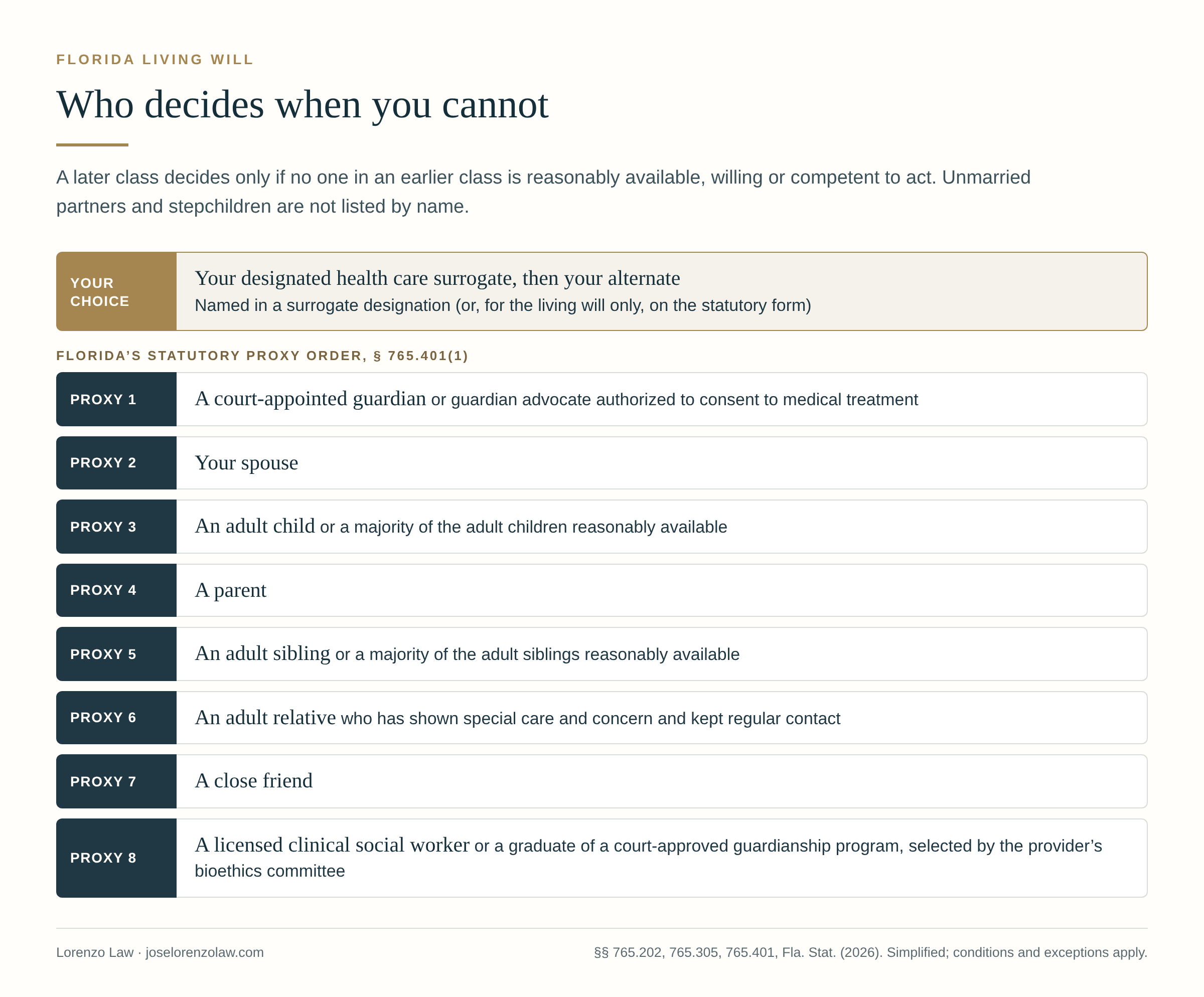
Unmarried partners, stepfamilies and close friends
The proxy list follows legal relationships. An unmarried partner of many years is not in the spouse class, and a stepchild is not an ‘adult child,’ so the person you would choose may rank behind relatives you have not seen in years. A devoted stepchild might qualify as an ‘adult relative’ under § 765.401(1)(f), but because the statute does not define ‘relative,’ that is uncertain; otherwise such a person is reached only as a ‘close friend.’ A surrogate designation lets you choose instead of the statute. The guides on estate planning for unmarried couples and estate planning for parents cover the rest of the plan.
When a guardianship may become necessary
Health care decisions can usually be made through a surrogate or proxy without going to court. When there is no one available to act, family members disagree about who should decide, or broader authority over the person or property is needed, a court proceeding may follow. The Florida adult guardianship guide explains that process; a surrogate designation, a living will and a durable power of attorney signed in advance are the documents that most often make it unnecessary.
When family, doctors or agents disagree with a living will
A relative’s disagreement does not overturn or replace your written instructions. Merely holding a power of attorney does not give an agent unrestricted authority to disregard your wishes. If the documents conflict, the authority each one grants, their dates, and their express terms govern — including the exception in § 709.2109(3)(b). A doctor or facility that will not comply has to take reasonable steps to transfer you to one that will, and specified people can ask a court for expedited review when there is a genuine question about the document or the decision.
While you can decide, you decide. After that, Chapter 765 puts the patient’s own expressed wishes first. Questions about whether the document was validly signed, revoked or meant what a family member says it meant, whether the medical conditions exist, or whether a surrogate or proxy is acting properly can be raised under § 765.105, which lets specified interested persons seek expedited judicial review on its listed grounds. The evidentiary presumption from a properly executed living will (§ 765.302(3)) is strong, but it is rebuttable.
If a doctor or hospital will not follow it
A provider or facility that refuses to comply with a directive, or with a surrogate’s or proxy’s treatment decision, must make reasonable efforts to transfer the patient to a provider or facility that will comply. Section 765.1105 also addresses moral or ethical objections, including the nonemergency and admission-notice conditions, and the requirement within seven days to transfer at the provider’s or facility’s expense or carry out the patient’s wishes if transfer has not occurred, unless § 765.105 applies.
When the primary physician is acting on a living will without a designated surrogate and the decision is disputed, § 765.304(1) bars withholding or withdrawal pending review under § 765.105; if review is not sought within seven days after the physician’s decision, the physician may proceed according to the instructions. Providers cannot require you to sign an advance directive, or to re-sign yours on their own form, as a condition of care (§ 765.110).
Court review
A conversation with the care team, an ethics consultation or a second medical opinion may help clarify a disagreement. If the disagreement remains unresolved, the court route is fact-specific and time-sensitive, and advice should be sought promptly. This guide does not predict how any dispute will be decided.
Where should you keep a living will?
Keep the signed original where family can find it, give copies to your primary physician, surrogate and alternate, and carry a note or wallet card saying where it is. A Florida living will is not filed with a court or recorded with the county.
Section 765.302(2) makes the principal responsible for notifying the primary physician; once notified, the physician or facility must promptly make the living will or a copy part of the medical record. If you are incapacitated on admission, another person may give the notification. Practical steps that help:
- Upload a copy to your hospital system’s patient portal and ask your doctor’s office to scan it into your chart.
- Give an exact copy to your surrogate and alternate, and tell close family where the original is.
- Keep a scan on your phone and a copy in a travel folder; bring copies to any admission.
- Use the FloridaHealthFinder wallet card, or a card of your own, naming your surrogate and where the documents are.
- Do not make a safe deposit box or a locked safe the only place the document exists.
Florida does not maintain an official state advance-directive registry; your directive travels with you as part of your medical record. Private registry services exist, but registration is not part of Florida’s signing requirements, and a registry entry does not replace giving copies to the people and providers who will need them.
How do you change or revoke a Florida living will?
While competent, you can amend or revoke a living will at any time: by a signed, dated writing; by destroying or canceling it yourself (or having someone do it in your presence at your direction); by telling someone orally; or by signing a later directive that is materially different. The change takes effect when it is communicated to your surrogate, provider or facility.
Those methods are in § 765.104(1). Under subsection (3), an amendment or revocation is effective when communicated to the surrogate, health care provider or health care facility, and a person without actual knowledge of it is protected from liability for not acting on it. Tell the relevant people promptly, replace old copies, and ask that the medical record reflect the change; deleting a file without telling anyone can leave others relying on an outdated copy. Revoking recognition of a statutory proxy under subsection (4) has its own requirements, including a third person for an oral communication.
Does divorce change my documents?
Unless the directive or the order of dissolution or annulment says otherwise, dissolution or annulment of marriage revokes the former spouse’s designation as surrogate (§ 765.104(2)). It does not automatically erase your treatment instructions or every alternate appointment. Review the living will and the surrogate designation together after a divorce, and sign new documents if your choices have changed.
Living wills and pregnancy in Florida
Florida restricts what a surrogate or proxy may consent to for a pregnant patient. Withholding or withdrawing life-prolonging procedures from a pregnant patient before viability requires that the patient expressly delegated that authority to the surrogate in writing, or that a court approve it under the specified procedure (§ 765.113(2)).
This is a rule about a decision-maker’s authority, not a rule that pregnancy automatically voids every living will, and not something a generic sentence in the additional-instructions space reliably resolves. If this issue matters to your planning, discuss the specific authority and wording with counsel and the medical questions with your provider.
Moving to Florida, snowbirds, and living wills from another state or Puerto Rico
Florida treats an advance directive signed in another state as validly executed if it was executed in compliance with that state’s law or Florida’s law (§ 765.112). After a move, the practical question is less whether the old document is valid than whether Florida doctors and your family will read it the way you intend.
Is an out-of-state living will valid in Florida?
It can be. The compliance condition in § 765.112 matters: an out-of-state title or a familiar form name does not by itself establish proper execution. Documents from other states also use different terms (“health care proxy,” “medical power of attorney,” “advance health care directive”) and may combine appointment and instructions in ways Florida’s forms do not. Bring the complete document for review after moving, especially if it conflicts with anything you signed later. Recognition of a directive does not make an out-of-state resuscitation order equivalent to a Florida DNRO.
Part-time Florida residents
If you spend winters in Florida and the rest of the year elsewhere, you may be treated in either state. Florida’s rule covers documents from other states; whether a Florida-signed living will is honored in your other state depends on that state’s law. Many part-time residents keep one consistent set of documents that satisfies both states’ signing rules, and make sure both sets of doctors have the current version.
Documents from Puerto Rico
If you signed an advance directive in Puerto Rico before moving to Florida, keep it, but do not assume it answers every Florida question. Jose M. Lorenzo, Jr. does not practice Puerto Rico law and does not advise on whether a document was valid there. Section 765.112 recognizes a directive executed in another state, but neither that section nor Florida’s general definitions (§ 1.01) defines state to include Puerto Rico or other U.S. territories, so whether a Puerto Rico directive qualifies is unsettled; a directive that also meets Florida’s own execution requirements is recognized regardless, because § 765.112 covers directives executed in compliance with the law of this state. The practical question is whether a Florida living will and surrogate designation should be signed now so that Florida providers have documents in the form they use every day.
Why a properly executed living will matters
Why is a living will important? It helps ensure your end-of-life wishes are followed when you cannot speak, and its importance in estate planning comes down to evidence. A living will signed under § 765.302 creates a rebuttable presumption of clear and convincing evidence of your wishes. That is the evidentiary standard Florida applies to decisions to forgo treatment, so a properly executed document carries real weight; it is not, however, immune from challenge.
The presumption appears in § 765.302(3). It does not eliminate the medical findings required before a living will is applied, and it does not guarantee that disagreement will never occur. The absence of a written living will does not mean care must continue indefinitely, and it does not give the nearest relative unlimited authority; the available surrogate, the proxy rules, the evidence of your wishes and the statutory requirements are considered together.
Florida court decisions behind the law: Browning and Schiavo
Florida’s statute grew alongside court decisions. In In re Guardianship of Browning, 568 So. 2d 4, 9–10, 15–16 (Fla. 1990), the Florida Supreme Court recognized a constitutional right to refuse life-prolonging treatment that a surrogate may exercise, applying a clear and convincing evidence standard and treating a written declaration as evidence of the patient’s wishes. Theresa (Terri) Schiavo had no written living will or surrogate designation, and the litigation over her care, including In re Guardianship of Schiavo, 780 So. 2d 176, 179–80 (Fla. 2d DCA 2001), and Bush v. Schiavo, 885 So. 2d 321, 328 (Fla. 2004), became the best-known Florida example of a dispute over end-of-life wishes with no written document. These summaries are general; they do not predict how any dispute will be decided.
Withdrawing life support is not suicide or euthanasia under Florida law
Florida distinguishes lawful withholding or withdrawal of life-prolonging procedures under Chapter 765 from suicide, and does not authorize mercy killing or euthanasia (§ 765.309). Many people ask this as a religious question first; the legal answer does not decide anyone’s beliefs.
How much does a living will cost in Florida?
Florida law sets no price for a living will, and the official form in § 765.303 is free to read and use. Jose M. Lorenzo, Jr.’s fee to prepare a Florida living will is $675 per person, and that fee includes all associated costs. The work is confirmed in a written fee agreement before it begins.
If you are looking for the cheapest way to do a living will, the official suggested form is free to read and use: you complete it yourself and sign it before two qualifying witnesses, though printing or signing arrangements may still involve some cost. What a lawyer costs for a living will depends on the firm and on what is included, and there is no official average cost of a living will in Florida. If you want a living will and a trust, or a living will with a last will, the cost of each document is set out in the written fee agreement. What people pay for a living will in Florida depends on what they are buying. A free or printable form costs nothing but provides no advice about whether the wording matches your wishes or your other documents. An online form service sells a template. An attorney-prepared living will includes legal advice, drafting to your instructions, and coordination with your surrogate designation and any existing documents.
When you compare options, ask what is included: the advice, drafting and revisions; whether related documents such as a health care surrogate designation or a power of attorney are part of the work; and how the signing will be arranged, in person or remotely. For broader planning, the Florida estate planning attorney page and the online estate planning guide describe the other documents. For Palm Beach County, see estate planning in Palm Beach County.
Do you need a lawyer for a living will in Florida?
No. Florida does not require a lawyer to prepare a living will. Legal advice is useful when your wishes are specific, your documents conflict, your family situation is complicated, or you want someone other than the statutory proxy to decide.
Situations to discuss with a Florida living will attorney include: documents from another state or Puerto Rico; an existing power of attorney or surrogate designation that may conflict; an unmarried partner, a blended family or estranged relatives; a progressive illness where capacity and timing matter; pregnancy-related authority; a person who needs help physically signing; or a wish to sign remotely. A clinician explains treatment; an attorney addresses authority, wording and execution.
Lorenzo Law is a solo practice: Jose M. Lorenzo, Jr. personally takes every first call, and the attorney you speak with at the first call is the attorney who handles any matter the firm accepts. Documents are prepared in English and explained in English or Spanish.
What are the limitations and risks of a living will?
The pros and cons of a living will are easy to state. The advantage is that your own instructions, with strong evidentiary weight, guide decisions you can no longer make. The main disadvantage, or downside, is that it cannot anticipate every situation. It applies only in defined conditions, it does not name a full decision-maker for everything else, and it works only if the people treating you know it exists and can read it.
Ambiguous terms, inconsistent documents, an unavailable decision-maker or a missing copy can make it harder to apply your wishes. Practical errors to check for: a spouse and a blood relative as the only witnesses; a named surrogate witnessing the surrogate-designation document (a statutory bar under § 765.202(2)) — and, as a precaution, witnessing a living will on which they are named; instructions about artificial nutrition and hydration copied without understanding them; contradictory versions; and failing to notify the physician or share the document. Using two unrelated witnesses is not a defect.
A signing problem is assessed under the health care directive law, not the rules for a last will. Do not assume that every defect has the same consequence, that litigation is inevitable, or that a document will certainly be disregarded. If a problem is found while you still have capacity, ask how to correct it and distribute the corrected version.
More questions about Florida living wills
Can I write my own living will in Florida?
Yes. You can write your own living will or complete the suggested form in § 765.303; Florida does not require an attorney or that exact form. A homemade living will still needs a competent adult signer, two qualifying witnesses and instructions that say clearly what you want. Get help if the wording is unclear to you or if you have other documents it could conflict with.
How do I fill out a living will without a lawyer?
Read the complete suggested form; initial the conditions it lists that you want it to cover; write any additional instructions, such as about artificial nutrition and hydration or religious wishes; decide whether to name a surrogate on the form or in a separate designation; sign before two witnesses, at least one neither your spouse nor a blood relative; then notify your primary physician and share copies. Ask a clinician about medical terms instead of guessing at unfamiliar treatment choices just to fill a blank.
Can I make a living will online?
Free online living will services let you write or create a living will online, and Florida allows a supervised remote signing for health care advance directives through an online notary under § 117.285, with screening questions and limits that do not apply to an in-person signing. Filling out a website template and printing it is preparation, not execution: the document still has to be signed before two qualifying witnesses, in person or through the statutory remote process.
Is Five Wishes valid in Florida?
A nonstatutory form such as Five Wishes is not automatically invalid, because Florida does not require its suggested form. Whether a completed Five Wishes document works as intended depends on its content, how it was signed and witnessed, any surrogate it names, and whether it is consistent with your other documents. Have the version you actually signed reviewed; a product name is not a validity determination.
Can I notarize my own living will?
No. Florida does not require notarization of a living will (§ 765.302(1)), and a notary cannot notarize their own signature. A notarial act does not replace the two required witnesses.
Can a nurse, my doctor or a notary be a witness to my living will?
Section 765.302 states only the relationship rule: two subscribing witnesses, at least one neither your spouse nor a blood relative. It does not separately bar a nurse, a treating physician or a notary from witnessing a living will. A person designated as surrogate may not witness the Part II surrogate-designation document (§ 765.202(2)). The living will statute (§ 765.302) imposes no such bar, so for the living will’s surrogate line the precaution is simply to use someone else as a witness. Many hospitals and facilities also have their own policies limiting staff witnessing. When a choice of witness could be questioned later, use a clearly independent adult.
How long does a living will last?
A living will is good for as long as you leave it in place: until you revoke it. Chapter 765 does not set an expiration date or a renewal requirement for a living will, so a properly signed Florida living will stays in effect unless your own document says otherwise. Review it when your wishes, health or family change, and communicate any amendment or revocation under § 765.104 rather than relying on the age of the paperwork.
Does a living will expire if I move?
Not because of the move. Florida treats a directive signed in another state as validly executed if it complied with that state’s law or Florida’s (§ 765.112). Whether another state honors a Florida living will depends on that state’s law. Review your documents after any move.
Can a living will be revoked orally?
Yes. A competent person can express an intent to amend or revoke orally under § 765.104(1)(c). The revocation is effective when it is communicated to the surrogate, health care provider or facility. Different rules apply to revoking recognition of a statutory proxy under subsection (4).
Can life insurance be canceled because I signed a living will?
Florida law protects against that. Section 765.108 addresses the effect of making an advance directive, and of treatment decisions made under Chapter 765, on life insurance: it covers policy issuance, existing terms and impairment or invalidation, and it bars requiring an advance directive as a condition of health care coverage or services. It does not resolve every unrelated coverage dispute.
Can my family override my living will?
Not by disagreeing with it. A relative’s preference does not replace your written instructions. Genuine questions about validity, revocation, meaning, the medical conditions or a decision-maker’s conduct can be taken to court under § 765.105. Your own decisions control while you can make them.
Can a power of attorney or a health care surrogate override a living will?
A surrogate is expected to carry out your instructions, not substitute different ones, and must decide as the surrogate believes you would have decided (§ 765.205). An agent under a financial power of attorney has only the authority the document and § 709.2109 give, and health care authority in a power of attorney is coordinated with a surrogate designation under § 709.2109(3)(b). People often ask whether a living will “trumps” a power of attorney. Merely holding a power of attorney does not give an agent unrestricted authority to disregard your wishes. If the documents conflict, the authority each one grants, their dates, and their express terms govern — including the exception in § 709.2109(3)(b). If your documents point in different directions, have them reviewed and made consistent.
Does a living will avoid probate, or go through probate?
Neither. A living will does not transfer property or decide who inherits, so it plays no part in probate. It addresses health care during life. Wills, trusts, ownership and beneficiary designations address what happens to property.
Is a living will public record, and does it need to be filed with a court?
No and no. Section 765.302 does not require a court filing or county recording, so a Florida living will is a private document — kept in your medical record, not any public file — though it can become part of a public court file if it is later litigated. Notify your primary physician, ask that a copy be placed in your medical record, and give copies to the people involved in your care. A treatment dispute can lead to a court proceeding even though signing a living will does not.
What standard applies to a proxy’s treatment decision?
A proxy decides as the proxy reasonably believes you would have decided. If there is no indication of what you would have chosen, the proxy may consider your best interest in deciding that treatments be withheld or withdrawn (§ 765.401(2)). Withholding or withdrawing life-prolonging procedures carries the clear and convincing evidence requirement and related procedures in § 765.401(3). It is not unrestricted authority to choose the proxy’s preferred outcome.
Can I make a mental health advance directive in Florida?
Florida does not recognize a stand-alone instrument called a mental health advance directive; mental health treatment decisions are folded into Chapter 765 (see § 765.101(6) and § 765.202(5)). Section 765.202(5) permits a separate surrogate designation for the stated court-incompetency and guardian-advocate situation and addresses the presumed choice when a general designation does not say otherwise. Specific treatments and admissions can involve additional restrictions. Review the actual authority you need with counsel.
Is a living will the same as a health care surrogate designation?
No. A living will gives treatment instructions; a surrogate designation appoints the person who makes health care decisions. The suggested living will form can name someone to carry out its declaration, but that does not provide the scope of a full designation with an alternate. Most people benefit from coordinating both. See the comparison table.
Can a living will be contested?
Yes. Disputes can concern how it was signed, the signer’s capacity, a revocation, what the words mean, the medical findings, or decisions made under it. Section 765.105 provides expedited court review on its listed grounds, and the evidentiary presumption in § 765.302(3) is rebuttable. Clear wording, proper witnesses and shared copies make a contest less likely, but no document rules one out.
Is a living will legally binding in Florida?
Yes, when properly executed. A Florida living will is a legal document, not a wish list: § 765.302(3) gives it a rebuttable presumption of clear and convincing evidence of your wishes, and a provider that will not follow it must make reasonable efforts to transfer your care (§ 765.1105). It binds only within its own terms and after the required medical findings, and it can still be challenged on the grounds in § 765.105.
Does a living will include a DNR order?
No. A living will can say you do not want CPR in the conditions it describes, but Florida paramedics and EMTs follow the Department of Health’s DNRO (DH 1896), a separate medical order signed with your physician or other authorized clinician. If you want a do-not-resuscitate order for emergencies, ask your physician about the DNRO in addition to your living will. See the Florida DNR form.
Is dementia a terminal condition under a Florida living will?
Not automatically. Whether a person with dementia has a terminal condition, an end-stage condition or a persistent vegetative state is a medical determination made under the definitions in § 765.101 and the two-physician findings in § 765.306. Advanced dementia may satisfy a statutory definition at some point, but whether any stage does is a medical determination; an early or moderate diagnosis generally will not. See dementia and Alzheimer’s disease.
Does a Florida living will work in every county and hospital in Florida?
Yes. Chapter 765 is state law, so a properly executed Florida living will is the same document in Miami-Dade, Broward, Orange, Osceola, Hillsborough or any other Florida county, and in any hospital, nursing home or hospice in the state. Facilities may ask for a copy for their records but cannot require you to re-sign on their own form as a condition of care (§ 765.110).
Talk to a Florida estate planning attorney about your living will
Jose M. Lorenzo, Jr. is Lorenzo Law’s sole attorney (Florida Bar No. 107002). Clients work directly with Jose: the attorney you speak with at the first call is the attorney who handles any matter the firm accepts.
If you want a Florida living will prepared, a health care surrogate designation coordinated with it, or existing documents from Florida, another state or Puerto Rico reviewed, request an initial consultation and bring the documents you already have. The fee to prepare a Florida living will is $675 per person, including all associated costs.
Consultations are available statewide in English and Spanish, by phone or video. The principal office is in Kissimmee; meetings in Coral Gables and Fort Lauderdale are by appointment. Representation requires a conflict review, acceptance and a written engagement agreement.
Request a free initial consultation. Only the initial consultation is free; representation fees and costs are agreed separately in writing.
Request a free initial consultationCall (305) 224-6811
Related guides: Florida health care surrogate, advance directive vs living will, Florida power of attorney, Florida estate planning guide and Florida estate planning attorney.
This guide provides general information about Florida law, not legal advice or individualized medical guidance. Reading it or requesting a consultation does not create an attorney-client relationship. Discuss treatment questions with your health care provider.
Sources and authorities cited
Statutes cited are the 2026 Florida Statutes. The text of the law controls over any summary on this page. Agency pages were reviewed in October 2026.

