
Florida Right of Survivorship: Joint Bank Accounts and Real Estate
Florida right of survivorship rules decide whether a deceased co-owner’s interest passes to the surviving owner or owners instead of through probate, and the answer depends on the asset. A deed to Florida real estate generally creates no survivorship unless the deed expressly provides for it under § 689.15, with an important exception for a tenancy by the entirety between spouses. A joint bank account works the other way: a deposit account in two or more names is presumed to carry survivorship under § 655.79 unless the account documents expressly provide otherwise.
Talk to me about a survivorship question — free initial consultationCall (305) 224-6811
Planning a deed or account change · Handling an owner’s death · Disputing a transfer · Free initial consultation · English and Spanish · Statewide
Two names on an asset do not answer every question. The recorded deed or the complete account agreement, any later changes, the owners’ relationship and the circumstances of the transaction all matter. An authorized signer or a payable-on-death beneficiary is not necessarily a co-owner, and a valid survivorship transfer that avoids probate does not resolve every creditor, spousal-rights, tax or ownership dispute.
Start with your situation. If you are planning a future transfer, review the ownership arrangement before anyone signs. If an owner has died, establish who is entitled to the asset and what documentation the bank, title company or court will need. If you suspect an improper change or withdrawal, preserve the records and get advice about the disputed transaction before more money moves.
| Real estate, unmarried co-owners | Tenancy in common unless the deed expressly provides for survivorship (§ 689.15) |
|---|---|
| Real estate, spouses | Tenancy by the entirety is the important exception to the express-language rule; it carries survivorship and its own transfer and creditor rules |
| Joint bank deposit account | Survivorship presumed unless the contract, agreement or signature card expressly provides otherwise (§ 655.79(1)); the presumption can be challenged on the statutory grounds |
| Account in both spouses’ names | Treated as a tenancy by the entirety unless otherwise specified in writing (§ 655.79(1)) |
| Convenience account | The agent helps with banking but does not take the money by survivorship (§ 655.80) |
| Joint account with a POD beneficiary | Under a valid arrangement governed by § 655.82, the surviving party takes first; a qualifying POD beneficiary takes after the last party dies |
| Does a will override it? | A will ordinarily does not redirect an asset that validly passes by survivorship |
| Can it be challenged? | Yes — an account on the § 655.79(2) grounds; a deed on the grounds that apply to deeds |
| Your attorney | Jose M. Lorenzo, Jr., a solo Florida attorney — the same lawyer from the first call through the end of the matter |
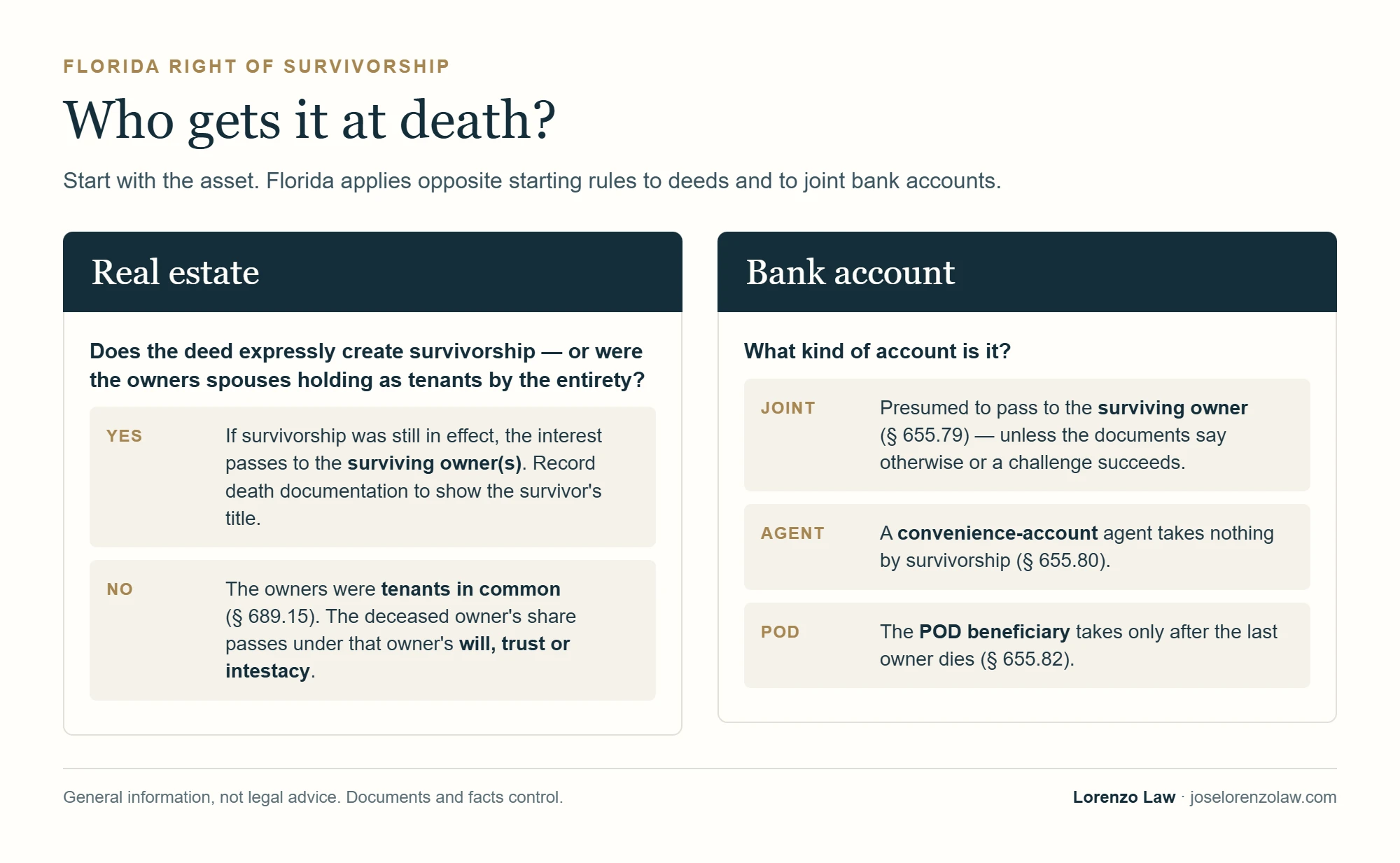
View the “Who gets it at death?” chart
In plain terms: Jose M. Lorenzo, Jr. (Florida Bar No. 107002) is a solo Florida attorney who handles survivorship questions statewide — planning deeds and accounts, clearing title and claiming accounts after a death, and challenging or defending disputed survivorship transfers in probate and civil court — in English and Spanish, with a free initial consultation.
Key Takeaways
- Florida deed and deposit-account rules differ. Use the correct document and statute for the asset: § 689.15 for real estate, § 655.79 for joint deposit accounts.
- Outside the entireties exception, a Florida deed to two or more people creates a tenancy in common unless it expressly provides for survivorship.
- A joint deposit account is presumed to carry survivorship, and that presumption can be challenged on the statutory grounds in § 655.79(2) — fraud, undue influence, or clear and convincing proof of a contrary intent. A deed dispute requires its own analysis.
- A convenience-account agent helps with transactions but does not receive ownership by survivorship merely because of that role.
- A POD beneficiary ordinarily receives a deposit account after the last surviving party dies, not while another party survives.
- A valid survivorship transfer can avoid probate for that asset, but it is not immunity from valid claims, and documentation is still needed after a death.
- Probate estate, elective estate and federal gross estate are different concepts. An account can pass outside probate and still count toward a surviving spouse’s elective share.
- Florida has no transfer-on-death deed for real estate; an enhanced life estate (Lady Bird) deed or a revocable trust is the usual alternative to discuss, and neither answers every question.
What Is the Florida Right of Survivorship?
A right of survivorship is an ownership feature that can pass a deceased co-owner’s interest to the surviving co-owner or co-owners without transferring that interest through probate. With two owners, the survivor may become the sole owner; with more than two, there may still be several surviving owners. When the last survivor dies, the asset belongs to that person’s estate or passes under whatever arrangement that person made.
This is different from naming someone in a will or giving that person authority to pay bills. A valid survivorship arrangement ordinarily controls the asset despite different instructions in a will. The questions are whether that arrangement was validly created, whether it remained in effect, and whether a successful challenge or another applicable rule changes the result.
For example, two unmarried siblings can appear together on a deed and on a bank account yet have different rights at death. The deed, the bank contract and the applicable law must each be reviewed. Do not use the rule for one asset to decide the other.
Is right of survivorship automatic in Florida?
In Florida, it depends on the asset. For a joint bank deposit account, survivorship is presumed under § 655.79 unless the account documents expressly say otherwise, and that presumption can be rebutted on the statutory grounds. For real estate held by two or more people who are not spouses holding as tenants by the entirety, survivorship exists only if the deed expressly provides for it; otherwise the owners are tenants in common.
What does JTWROS mean?
In Florida, JTWROS means joint tenants with right of survivorship: co-owners whose interests pass to the surviving owner or owners when one of them dies, outside probate. You will see it on deeds, bank signature cards, brokerage registrations and some out-of-state vehicle titles. Whether survivorship actually exists still depends on the asset and the governing document.
You may also see it written as “JT TEN WROS,” “joint with right of survivorship” or “joint tenants with full rights of survivorship.”
The old common-law vocabulary for joint tenancy — the “four unities” of time, title, interest and possession — still explains how Florida courts analyze real-estate joint tenancies and their severance. It is historical and real-estate context; it is not the test for a deposit account under § 655.79, a point the Third District made in Larkins v. Mendez, discussed below.
Deeds and Joint Accounts Follow Different Rules: § 689.15 and § 655.79
Fla. Stat. § 689.15 — real estate and general personal property. The statute abolishes the common-law presumption of survivorship between joint tenants:
“The doctrine of the right of survivorship in cases of real estate and personal property held by joint tenants shall not prevail in this state; that is to say, except in cases of estates by entirety, a devise, transfer or conveyance heretofore or hereafter made to two or more shall create a tenancy in common, unless the instrument creating the estate shall expressly provide for the right of survivorship; and in cases of estates by entirety, the tenants, upon dissolution of marriage, shall become tenants in common.”
Outside the entireties exception, § 689.15 makes tenancy in common the default unless the instrument expressly provides for survivorship.
Fla. Stat. § 655.79(1) — deposit accounts. For deposit accounts the Legislature took the opposite starting point:
“Unless otherwise expressly provided in a contract, agreement, or signature card executed in connection with the opening or maintenance of an account, including a certificate of deposit, a deposit account in the names of two or more persons shall be presumed to have been intended by such persons to provide that, upon the death of any one of them, all rights, title, interest, and claim in, to, and in respect of such deposit account … vest in the surviving person or persons.”
For a deposit account covered by § 655.79, the statutory survivorship presumption applies unless the relevant contract, agreement or signature card expressly provides otherwise. That account presumption can be rebutted as the statute provides. A deed and a bank account signed on the same afternoon by the same two people, with the same silence about survivorship, can therefore produce opposite results.
| Asset or arrangement | Documents and facts to review | Decision at death | Who acts and practical next step |
|---|---|---|---|
| Florida real estate held by unmarried co-owners | Recorded vesting deed, later deeds, judgments and complete title history | Express survivorship versus tenancy in common; check for a completed change before death | Surviving owner and the appropriate estate or title representative obtain a title review before a sale or new deed |
| Real estate held by spouses | Deed, marital status when acquired, later conveyances, divorce documents and judgments | Whether a valid tenancy by the entirety existed at death; do not infer it from current marriage alone | Surviving spouse obtains advice about title evidence and any required corrective or court process |
| Joint bank deposit account, including a jointly titled CD | Signature card, deposit agreement, amendments, ownership codes and account history | § 655.79 survivorship presumption, contrary written terms, or a supported challenge | Survivor requests the institution’s deceased-owner requirements; the estate representative or other proper claimant obtains advice if ownership is disputed |
| Deposit account in both spouses’ names | Full account agreement and later writings, marital facts and relevant orders | § 655.79 entireties rule unless otherwise specified in writing; account-specific rules apply | Spouse and counsel review the agreement before assuming creditor protection or unilateral authority |
| Convenience account under § 655.80 | Principal and agent designation and the account contract; the statutory category excludes CDs | Agent status does not create survivorship ownership | The principal acts during life; after death the person authorized under the applicable estate process presents the required documents |
| Deposit account with a POD designation | Party names, beneficiary form, account terms, amendments and survival of parties and beneficiaries | Surviving party first; surviving beneficiary after the last party’s death, subject to § 655.82 | Surviving party or qualifying beneficiary follows the institution’s proof-of-death process; review any disputed designation |
| Securities registered TOD, or retirement benefits | Registration, beneficiary form, plan or custodial terms and applicable law | A beneficiary arrangement — not the real-estate deed rule or a universal bank-account rule | Contact the custodian or plan administrator and obtain asset-specific advice |
Keep planning, administration and disputes separate. For prospective deed changes, start with the Florida quitclaim deed guide and my estate-planning services. After a death, Florida probate guidance can help identify the necessary process. Suspected manipulation of an account or deed belongs in a review of the transaction and the available estate-litigation or deed-challenge issues.
Co-Owner, Signer, Agent or Beneficiary? Ownership Is Not the Same as Access
Joint ownership, an agency arrangement and a beneficiary designation do different jobs. A co-owner has a present ownership interest. A convenience-account agent acts for the principal, who retains the account rights. An agent under a power of attorney acts for the principal under that document. A POD beneficiary has no right to the sums on deposit while any party remains alive.
Tenancy in common does not carry survivorship. Joint tenancy with survivorship and tenancy by the entirety can carry it, but their creation, withdrawal, transfer and creditor rules are not interchangeable. The table below compares the arrangements people most often confuse; the sections that follow explain the qualifications.
| Arrangement | Owns the money or property now? | Can act during life? | At the owner’s death | Main authority |
|---|---|---|---|---|
| Joint owner with survivorship (account) | A present party to the account; ownership between the parties can still be disputed | Withdrawal authority under the account agreement | Presumed to take the account, subject to contrary written terms or a successful challenge | § 655.79 |
| Spouse on a joint account or entireties deed | Yes, as a tenant by the entirety where that form exists | Depends on the account agreement or deed; transfers of entireties property raise separate questions | Where a valid tenancy by the entirety exists, the surviving spouse continues to own the whole | §§ 655.79, 689.15, 689.11 |
| Convenience-account agent | No — the principal’s account | Deposits and withdrawals for the principal | Takes nothing by survivorship; payment follows the statutory routes | § 655.80 |
| Agent under a power of attorney | No | Within the powers granted; some acts, including changing survivorship or beneficiary rights, require specific authority | The agent’s authority ends | §§ 709.2109, 709.2202 |
| Authorized signer (bank label) | Depends on the account contract; the label alone does not establish ownership | Under the bank’s terms | Review the full agreement; a signer label does not by itself create survivorship | Account contract; §§ 655.79–655.80 as applicable |
| POD beneficiary | No right to the sums on deposit while any party is alive | No | Takes after the last party dies, if the beneficiary survives and qualifies | § 655.82 |
Is right of survivorship the same as naming a beneficiary?
No. In Florida, a joint owner with survivorship is a present owner of real estate, or a present party to an account, with rights under the deed or account agreement. A beneficiary — a POD or TOD beneficiary, or a remainder beneficiary under a Lady Bird deed — has no present right to use, sell or control the asset. The two arrangements do different jobs.
On a bank account, a POD beneficiary is next in line and has no right to the sums on deposit while any party is alive. If the goal is to pass money at death without giving anyone present account rights, a POD designation does that and a joint owner does not. If the goal is help with bill-paying, a POD designation does not provide it, and a joint owner is not the only option — see planning below.
Which Situation Are You In?
Most survivorship questions start with a relationship and an asset. Find the row closest to yours. These are starting points for a review, not findings about your documents.
| Situation | What usually controls | What to check first | Where to go next |
|---|---|---|---|
| A parent added one child to a bank account, and the parent has died | The § 655.79 presumption and the account documents | Signature card, deposit agreement, change forms, who funded the account and why the child was added | Challenges; convenience accounts |
| A spouse has died and the home was in both names | Whether a tenancy by the entirety or express survivorship existed at death | The vesting deed, marriage facts at acquisition, any later deeds | When an owner dies |
| A spouse has died and the bank account was in both names | The § 655.79 rule for spouses’ accounts and the written account terms | The full account agreement and any writing that specified otherwise | Spouses’ accounts; after a death |
| Siblings or partners own a house together and one has died | The deed: express survivorship or tenancy in common | The exact vesting words in the recorded deed | Real estate; no survivorship |
| Both owners have died | The last survivor’s estate plan, or the simultaneous-death rules if the order of death is unclear | Dates and order of death, each owner’s will or trust | Both owners die |
| A second spouse says an account that went to the children counts toward the elective share | § 732.2035 and the elective-share rules | Account type, withdrawal terms, any waiver, election deadlines | Elective share |
| Money was moved out of an account before or after death | Ownership, authority to withdraw and the remedies available | Statements, dates, recipients, any power of attorney | Protecting a disputed account; remedies |
| You want help with banking now, or to leave money to someone later | Which arrangement you choose before signing | What the bank offers; your will or trust | Planning |
Right of Survivorship in Florida Real Estate
Real estate requires its own deed and title analysis. For co-owners outside the entireties exception, § 689.15 generally requires the creating instrument to expressly provide for survivorship. If it does not, tenancy in common is the statutory default. A deceased tenant in common’s share does not pass to the other owner simply because they owned together. Identify who is legally entitled to that share under the estate plan, succession law and any applicable homestead rules.
How joint tenancy with right of survivorship works in Florida
Joint tenancy with right of survivorship in Florida is co-ownership in which, when one joint tenant dies, that owner’s interest passes to the surviving joint tenant or tenants instead of through the deceased owner’s estate. For anyone other than spouses holding as tenants by the entirety, the deed must expressly provide for survivorship; two names alone, or the words “as joint tenants” with no survivorship wording, create a tenancy in common.
During life, each joint tenant holds an undivided interest in the whole property. The arrangement does not give one owner the right to sell the entire property alone, and it does not protect one owner’s interest from that owner’s own creditors the way an entireties tenancy can protect spouses. At a death, the surviving owner’s title is evidenced in the public records rather than transferred by a new deed from the person who died — see what happens when one owner dies.
What is a survivorship deed in Florida?
In Florida, a “survivorship deed” is an informal name for a deed that expressly conveys property to two or more people with right of survivorship, or conveys it to spouses as tenants by the entirety. It is not a separate statutory form. The vesting words decide survivorship; the type of deed — warranty or quitclaim — decides the title promises.
Calling a document a survivorship deed or a quitclaim deed does not by itself decide which ownership form it created.
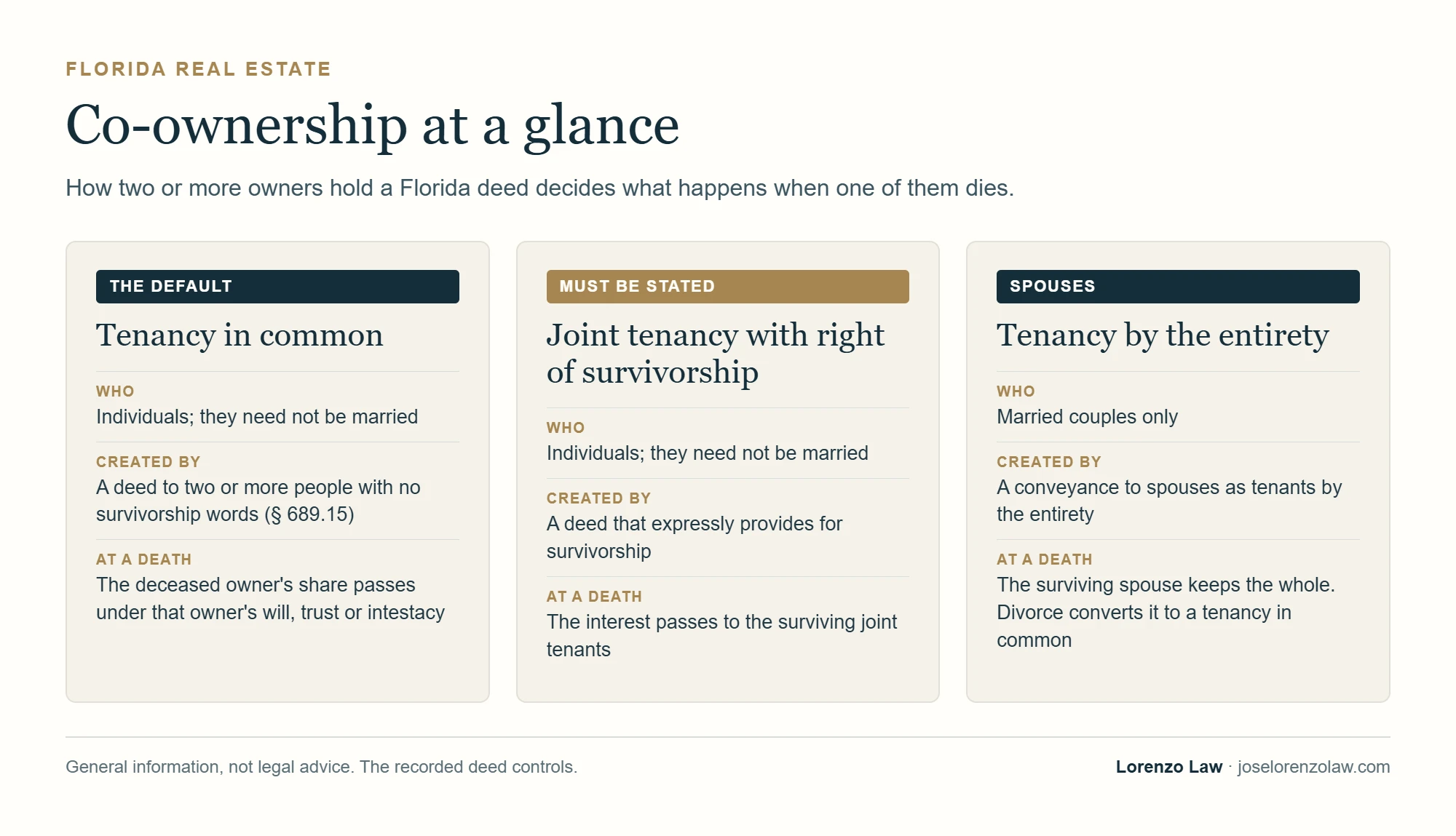
View the Florida co-ownership chart
Joint tenancy vs. tenancy by the entirety vs. tenancy in common in Florida
| Question | Tenancy in common | Joint tenancy with right of survivorship | Tenancy by the entirety |
|---|---|---|---|
| Who can hold it | Individuals need not be married; entity or trust ownership needs separate review | Individuals need not be married; entity or trust ownership needs separate review | Spouses only |
| How it is created | The default for a conveyance to two or more people (§ 689.15) | The deed must expressly provide for survivorship (§ 689.15) | A conveyance to spouses; or, under § 689.11(1), a spouse’s conveyance to both spouses or to the other spouse by a deed stating that purpose. The deed and marital facts must be reviewed |
| Shares | Each owner’s undivided share, which can be unequal | Undivided interests held together | The spouses together hold the whole |
| Can one owner transfer alone? | An owner can generally convey his or her own share | A completed conveyance of one owner’s interest can sever survivorship as to that interest; with three or more owners, the effect on the others is not settled (see below) | One spouse alone cannot sever it; see the entireties discussion below |
| Creditors of one owner | A valid judgment lien can attach to that owner’s share and remain after death, subject to homestead and other exemptions (§ 55.10) | A creditor of one joint tenant may attach that joint tenant’s portion (Beal Bank, 780 So. 2d at 53), but a lien not enforced during life ends if that joint tenant dies first | Generally protected under Florida law from a creditor of only one spouse; joint debts, federal tax claims and other exceptions require review. A creditor holding a debt owed by both spouses can reach it (Beal Bank, 780 So. 2d at 53) |
| Divorce | No change in form | No automatic change in form | Becomes a tenancy in common on dissolution of marriage (§ 689.15) |
| At an owner’s death | The deceased owner’s share passes under that owner’s will, trust or intestacy, subject to homestead rules | The deceased owner’s interest passes to the surviving joint tenants | The surviving spouse continues to own the whole |
| Typical action after a death | Probate, a homestead determination or another court process for the deceased owner’s share | Record appropriate death documentation so the record title reflects the survivor | Record appropriate death documentation; a title insurer may ask for proof of the marriage |
Is joint tenancy only for married couples?
No. In Florida, individuals do not have to be married to hold real estate as joint tenants with right of survivorship — siblings, a parent and an adult child, unmarried partners or friends — if the deed expressly provides for survivorship. Tenancy by the entirety is the form limited to spouses, and it carries transfer and creditor rules that an ordinary joint tenancy does not.
Unmarried partners who want the survivor to own the whole home therefore need express survivorship language, and they do not receive the spousal homestead and tax rules written for married couples. The estate planning for unmarried couples guide covers the wider plan.
What are the four requirements for joint tenancy?
Traditionally, a joint tenancy requires four unities: time (the owners take their interests at the same time), title (by the same deed), interest (equal, undivided shares) and possession (each may possess the whole). Tenancy by the entirety adds a fifth unity, marriage, and survivorship is its sixth characteristic (Beal Bank, 780 So. 2d at 52). In Florida, the practical requirement for non-spouses is express survivorship language under § 689.15.
When a deed expressly provides for survivorship, Florida courts do not require proof of the four unities (Simon v. Koplin, 159 So. 3d 281 (Fla. 2d DCA 2015)). Courts still use the unities when deciding whether a joint tenancy was severed: an act that destroys one of them can end survivorship, as the severance discussion explains. Two things have changed the older picture. A spouse who owns property alone no longer needs a “strawman” deed — a deed to a third party who deeds the property back — to create a tenancy by the entirety: § 689.11 allows a conveyance directly to both spouses, and an owner adding someone else ordinarily deeds to himself or herself and the new co-owner together, without a strawman (Ratinska, 447 So. 2d at 243); and for deposit accounts the statute, not the unities, controls, as Larkins and Loumpos (discussed below) confirm.
Who cannot take title as joint tenants with right of survivorship?
In Florida, joint tenancy with right of survivorship is ordinarily used by individuals. The survivorship statute, § 689.15, does not limit joint tenancy to individuals, but no Florida appellate court has decided whether a corporation, LLC or trustee can hold with a person as joint tenants with survivorship, or what happens if the entity dissolves. Have that arrangement reviewed before relying on it. Tenancy by the entirety requires spouses married when they take title.
Some practical limits come up more often than the legal ones:
- Minors. A minor can be named on a deed, but a later sale or mortgage of the minor’s interest generally requires a court-appointed guardian of the property and court approval (§ 744.441), which can stall a family that wanted a simple transfer.
- Trusts. A trust holds real estate through its trustee. Pairing a trustee and an individual as joint tenants is unusual and should be done only with a clear drafting reason; no Florida court has decided how survivorship would work between a trustee, who holds title in a representative capacity, and an individual.
- An owner who lacks capacity. A person without the required capacity cannot validly sign a deed creating survivorship; an agent under a power of attorney can do so only with the specific authority § 709.2202 requires.
- Non-citizen co-owners. A person who is not a U.S. citizen can generally own Florida real estate and take by survivorship, but the federal estate-tax rules for a non-citizen spouse differ and should be reviewed before titling.
Is tenancy by the entirety automatic in Florida, and what statute governs it?
Usually, for spouses who take title together while married. In Florida, a conveyance to two people who are married to each other generally creates a tenancy by the entirety unless the deed says otherwise, and § 655.79(1) treats spouses’ joint deposit accounts as entireties unless otherwise specified in writing. No single statute defines the estate; it rests on case law plus § 689.11, § 689.15 and § 655.79.
How a tenancy by the entirety is created and ended, in short:
- At purchase. A deed to the spouses — naming them as spouses, or stating that they take “as tenants by the entirety” — is the usual way. Stating it expressly reduces later questions.
- Later, from one spouse. A spouse who owns property alone can convey it to both spouses as tenants by the entirety under § 689.11, without a third-party deed. Homestead, mortgage and tax questions still apply.
- A couple who bought before marrying. Tenancy by the entirety requires that the couple be married when they take title (Ebanks v. Ebanks, 198 So. 3d 712, 714 (Fla. 2d DCA 2016)), so a deed to an unmarried couple does not create one, and marrying later does not convert it. To hold as tenants by the entirety, the couple must sign a new deed while married (Beal Bank, 780 So. 2d at 52–53).
- Ending it. The spouses can convey together; a divorce converts it to a tenancy in common under § 689.15; and at a spouse’s death the survivor owns the whole. One spouse alone cannot sever it.
Pros and cons of joint tenancy with right of survivorship
| Possible advantages | Possible disadvantages and questions |
|---|---|
| The deceased owner’s interest can pass to the survivors without probate for that asset | Each co-owner holds a present interest; the original owner gives up exclusive control |
| The survivor’s title is usually evidenced by recording documentation rather than by a court proceeding | A co-owner’s own creditors may be able to reach that co-owner’s interest |
| Simple to create in a deed drafted for the purpose | A sale or mortgage of the whole property ordinarily needs every owner |
| Can suit people who genuinely want to own together now | A will does not redirect the property, so it can contradict an estate plan that divides everything equally |
| Works the same way for any co-owners, married or not | A completed conveyance by one owner can sever survivorship as to that interest |
| — | Florida homestead classifications, gift, basis, documentary stamp and property-tax questions need review before a parent adds a child |
| — | When the last survivor dies, the property passes through that person’s estate unless another arrangement applies |
The disadvantages are not reasons to avoid joint ownership. They are the questions to answer before signing. For a parent whose real goal is passing a home at death while keeping control, a Lady Bird deed or a revocable trust is an alternative to discuss.
What are the disadvantages of tenancy by the entirety?
In Florida, the main drawbacks involve control, creditor limits and what happens at divorce or the second death. Neither spouse can sell, mortgage or sever entireties property alone; the creditor protection does not apply against debts both spouses owe or against federal tax liens; a divorce converts it to a tenancy in common; and when the surviving spouse dies, the property still needs a plan — or probate.
- Both signatures to sell or mortgage. If one spouse loses capacity, a sale or refinance may require an agent with sufficient authority under a power of attorney, or a guardianship.
- Joint debts and federal claims. Protection runs only against a creditor of one spouse. A joint creditor of both can reach the property, and a federal tax lien against one spouse can attach to that spouse’s interest — see bankruptcy and federal tax liens.
- Protection ends with the marriage. At a divorce the property becomes a tenancy in common; at the first death the survivor owns it alone, and the survivor’s own creditors are then the relevant question.
- The second death. Entireties ownership avoids probate at the first death only. The surviving spouse should plan for the property by will, trust, Lady Bird deed or another arrangement.
- Second marriages. The survivor takes the whole property, which can leave the first spouse’s children with nothing from that asset unless the plan addresses it.
How to add a right of survivorship to a Florida deed
Survivorship is added by a new deed, properly executed and delivered, with recording addressed separately to protect the public title record, that expressly provides for survivorship among the grantees. Spouses can create a tenancy by the entirety, including by a conveyance from one spouse to both spouses under § 689.11. An owner who wants to add another person while staying on title ordinarily conveys to himself or herself and the new co-owner together; one deed is enough, and no intermediate “strawman” deed is needed (Ratinska v. Estate of Denesuk, 447 So. 2d 241, 243 (Fla. 2d DCA 1983)).
Before signing, review the actual current deed, the mortgage, homestead and marital facts, the documentary stamp tax on any mortgage share, the property-tax assessment and the estate plan. The wording belongs in a deed drafted for the specific transfer, not in a clause copied from a form. The guide to adding or removing a name on a Florida deed covers the mechanics, and Florida deed preparation describes the deed services I offer.
A quitclaim deed is a form of conveyance; survivorship describes how the owners hold the interest. Calling a document a quitclaim deed does not determine whether it creates survivorship. See the Florida quitclaim deed guide for the transfer, signing, recording and tax questions to review before using one, and types of deeds in Florida for the other instruments.
| Vesting | Ownership feature to identify | What happens at death |
|---|---|---|
| Tenancy in common | The default for two or more grantees when the deed does not expressly provide for survivorship | The deceased owner’s share passes under the estate, succession and homestead rules |
| Joint tenancy with right of survivorship | Express survivorship among the grantees in the deed itself | Passes to the surviving joint tenants |
| Tenancy by the entirety | A conveyance to spouses holding as tenants by the entirety | The surviving spouse continues to own the whole |
| Traditional life estate | Life tenant has a lifetime interest; remainder rights and powers depend on the deed | The remainder interest becomes possessory at the life tenant’s death |
| Enhanced life estate (Lady Bird) | Retained powers and remainder provisions must be examined in the actual deed | Passes to the remainder beneficiaries under the deed’s terms |
See the Florida Lady Bird deed guide and the Lady Bird deed vs. quitclaim deed comparison for the drafting and recording differences.
Can a warranty deed or quitclaim deed create a right of survivorship?
Yes. In Florida, either deed can create survivorship if its vesting clause expressly says so — for example, a conveyance to two grantees “as joint tenants with right of survivorship.” A warranty deed adds the grantor’s promises about title; a quitclaim deed conveys whatever interest the grantor has, with no promises. The deed type neither creates nor removes survivorship.
The survivorship words themselves matter. Under § 689.15, a conveyance to two or more people creates a tenancy in common “unless the instrument creating the estate shall expressly provide for the right of survivorship.” A deed to two unmarried people “as joint tenants,” with no words of survivorship, therefore creates a tenancy in common. No reported Florida appellate decision has ruled on that exact wording, but Florida courts hold that grantees whose deed does not expressly provide for survivorship are tenants in common (Simon v. Koplin, 159 So. 3d 281, 282–83 (Fla. 2d DCA 2015); Reinhardt v. Diedricks, 439 So. 2d 936, 937 (Fla. 3d DCA 1983)).
Families adding a relative to a home often use a quitclaim deed because no one is selling. That works for the conveyance, but it gives the new co-owner no title assurances and does not fix an existing title problem — and the mortgage, documentary stamp tax, homestead assessment, gift-tax and creditor questions under how to add a right of survivorship still apply. A warranty deed is more common in a sale. In either, the grantee clause should name each grantee and state the survivorship feature in plain words. Florida deeds need two subscribing witnesses (§ 689.01), and § 695.26 sets requirements for recording, including the printed name and post-office address of each person who signed, the printed name and post-office address of each witness (required since January 1, 2024), the name and post-office address of the person who prepared the deed, the name and post-office address of each grantee, and the notary’s printed name.
How do I remove a right of survivorship from a Florida deed?
In Florida, joint tenants who agree can sign a new deed conveying the property to themselves as tenants in common. One joint tenant can also act alone by recording a completed conveyance of his or her own interest — even to himself or herself — which can sever survivorship as to that share; with three or more owners, the effect on the others is not settled. Spouses holding by the entirety can end it only together or by divorce.
Before recording, consider the side effects. Each owner’s share will then pass under that owner’s will, trust or intestacy, which can mean probate; a new deed can raise documentary stamp tax if a mortgage is involved; and homestead and assessment questions apply. If the property is a married owner’s homestead, that owner’s spouse may need to join in the deed. The cases on what counts as a completed severance are discussed in the next section.
Can a right of survivorship be transferred?
Not as such. In Florida, a joint tenant can transfer his or her own interest, but the person who receives it takes as a tenant in common, because the transfer severs survivorship. With three or more joint tenants, Florida cases have treated all the owners as tenants in common afterward; whether the others keep survivorship among themselves is not settled. A spouse cannot transfer an entireties interest alone.
The closest Florida case is Crockett v. Crockett, 708 So. 2d 329 (Fla. 1st DCA 1998). A husband, his wife and two of his daughters held land as joint tenants with right of survivorship. When the divorce court allocated the wife’s interest to the husband, the First District treated the joint tenancy as ended, leaving the husband and the daughters as tenants in common. Whether the remaining joint tenants keep survivorship among themselves has not been decided by a Florida appellate court.
What does it cost to record survivorship paperwork in Florida?
In Florida, the clerk’s recording fee is $10 for the first page and $8.50 for each additional page of a standard-size document. Recording a death certificate after a survivorship death usually costs only that fee. A new deed can add documentary stamp tax when there is consideration, including a mortgage balance — 70 cents per $100 or fraction of taxable consideration in every county except Miami-Dade.
Miami-Dade County’s rate is 60 cents per $100 or fraction of taxable consideration (Fla. Admin. Code r. 12B-4.012(1)(b)), plus its 45-cent surtax per $100 or fraction on deeds other than those conveying only a single-family residence (§ 201.031 and § 125.0167; Florida Department of Revenue, documentary stamp tax). Clerks publish their own fee schedules — for example, the Pinellas County Clerk’s fee schedule — and title insurance, closing-agent and attorney’s fees are separate. Fees change, so confirm the current schedule with the clerk in the county where the property is located.
Can one joint tenant sell or sever a Florida joint tenancy without the other?
In Florida, one joint tenant generally can convey his or her own interest without the other owners, and a completed conveyance — even a recorded deed to oneself — can sever survivorship as to that interest, leaving a tenancy in common; with three or more owners, whether the others keep survivorship among themselves is not settled. One joint tenant cannot sell the whole property alone, and a spouse cannot sever a tenancy by the entirety alone.
This question separates a joint tenancy from a tenancy by the entirety. For a joint tenancy, the Florida Supreme Court has stated the rule this way: “a joint tenancy may be terminated by any act which destroys one or more of its unities, provided the act of the joint tenant who severs his interest is such as to preclude him from claiming by survivorship any interest in the subject matter of the joint tenancy.” Kozacik v. Kozacik, 157 Fla. 597, 26 So. 2d 659, 661 (1946).
A conveyance to oneself. Older cases spoke of a conveyance “to a stranger,” and practitioners once used a straw-party transfer for that reason. In Countrywide Funding Corp. v. Palmer, 589 So. 2d 994, 996 (Fla. 2d DCA 1991), the Second District held that “a joint tenancy with right of survivorship can be … terminated and a tenancy in common created by a conveyance by one joint tenant of his interest to himself.” The Fourth District followed it in Weisblat v. Feldman, 358 So. 3d 1238 (Fla. 4th DCA 2023), where a joint tenant’s recorded quitclaim deed to himself, stating its purpose was to terminate the joint tenancy, was held effective. The court stated that Kozacik and Wittock v. Ramponi, 446 So. 2d 271 (Fla. 4th DCA 1984), “do not hold that rights of survivorship can only be terminated by conveyance to a stranger” (emphasis in original).
A conveyance to someone else. In Foucart v. Paul, 516 So. 2d 1035 (Fla. 5th DCA 1987), a joint tenant deeded her one-half interest to her daughter for “$10.00 and love and affection.” The Fifth District held the deed was not void for lack of consideration and that the daughter and the surviving co-owner held as tenants in common.
A pending lawsuit. Filing a partition case does not, by itself, necessarily sever survivorship. The effect of a conveyance, judgment or other act must be evaluated from the document, its completion and the governing law. In Mercurio v. Headrick, 983 So. 2d 773, 774 (Fla. 1st DCA 2008), the pending partition action had not severed the joint tenancy before the plaintiff died, even though the other owner had admitted in her answer that they held as joint tenants and that partition benefited both. The court cited “the established and undisputed rule in Florida that only a complete, final conveyance or disposition of jointly held property severs a joint tenancy with right of survivorship,” relying on Kozacik, Crockett v. Crockett, 708 So. 2d 329, 331 (Fla. 1st DCA 1998), and Harelik v. Teshoney, 337 So. 2d 828 (Fla. 1st DCA 1976). That case should not be restated as a rule that litigation can never protect a co-owner or that every partition proceeding has the same outcome.
Tenancy by the entirety. The entireties form is different: one spouse alone cannot sever it. See entireties accounts below and the cases discussed there.
The deed’s words control. Unlike a deposit account, where the § 655.79(2) grounds allow evidence of the parties’ actual intent, the Fifth District held in Foucart, 516 So. 2d at 1037, that “the clear and unambiguous terms of a deed cannot be varied by a prior or contemporaneous verbal agreement.” On the real-estate side, the document carries special weight.
Before signing a deed intended to change survivorship, obtain advice about ownership, homestead, marital rights and the effect on each owner. For an ordinary disagreement over use or sale, see Florida partition actions and when one sibling won’t sell the inherited house. If the deed itself is alleged to be forged or improperly obtained, see Florida deed challenges.
Can a joint tenancy be severed after one owner dies?
Generally, no. In Florida, survivorship takes effect at the moment of death, so a severance must be completed during life, and a will cannot defeat the survivor’s right. After the death, an heir or the personal representative has no interest left to sever. The question is whether a complete severance — or a ground to set the deed aside — existed before the death. The slayer and abuse-forfeiture statutes are the main exceptions.
The First District has said that a joint tenancy “can be severed only during the lives of the joint tenants” and that “[a] joint tenant cannot by will defeat his cotenant’s right of survivorship of the whole” (In re Barret’s Estate, 137 So. 2d 587, 588 (Fla. 1st DCA 1962)). That case involved jointly owned stock, but the rule it states is general. A narrow exception has been recognized where both owners signed an agreement and a joint will disposing of the jointly owned property in a way inconsistent with the joint tenancy (In re Waks’ Estate, 386 So. 2d 307, 310 (Fla. 4th DCA 1980)); the property there was securities and bank accounts, not real estate. Mercurio, above, shows the timing problem: a partition case filed during life had not severed the joint tenancy when the plaintiff died. For entireties property, the Third District has said a will purporting to devise the property to someone else has no effect (Ramos v. Estate of Ramos, 329 So. 3d 172 (Fla. 3d DCA 2021)).
Who pays the expenses, and can a co-owner force a sale?
In Florida, co-owners generally share carrying costs such as the mortgage, taxes and insurance, and a co-owner who paid more than his or her share may seek credit for it when the property is divided. Any joint tenant or tenant in common can ask a court to partition the property under chapter 64 (§ 64.031). Property held by spouses as tenants by the entirety cannot be partitioned while the marriage lasts.
Partition can divide the land itself — “in kind” — when that can be done fairly, but most homes cannot be split, so the court usually orders a sale and divides the proceeds. In that accounting, a co-owner who paid more than a fair share of the mortgage, taxes, insurance or preservation and improvement costs can generally seek credit when the property is divided or sold. An owner who lived in the property is not ordinarily charged rent for that use unless the other owners were shut out (an “ouster”), but if the occupying owner seeks credit for payments, the reasonable rental value of that owner’s use can be offset against the claim (Barrow v. Barrow, 527 So. 2d 1373 (Fla. 1988)). Property held as tenants by the entirety is not subject to partition while the marriage lasts (Blew v. Blew, 358 So. 3d 1232, 1233–35 (Fla. 4th DCA 2023)); after a divorce, the former spouses hold as tenants in common (§ 689.15). If the co-owners inherited the property from a relative, Florida’s Uniform Partition of Heirs Property Act can add a buyout right before any forced sale (§§ 64.201–64.214). See Florida partition actions.
Survivorship and the different meanings of Florida homestead
Florida uses “homestead” in different legal settings. Section 731.201(33) excludes property held as tenants by the entirety or joint tenants with survivorship from the Probate Code’s definition of protected homestead. That definition does not by itself decide the property’s tax exemption, Save Our Homes assessment treatment, or every constitutional creditor and transfer issue under Article X, section 4 of the Florida Constitution.
Before adding an owner to a residence, review the actual deed, marriage and family circumstances, mortgages, the intended transfer and the specific protection at issue. A survivorship feature is not a substitute for that analysis. The Florida quitclaim deed guide explains why a title change can require separate deed, tax and mortgage review, and Florida homestead property in probate covers homestead after a death.
What Happens to Jointly Owned Property When One Owner Dies in Florida?
In Florida, it depends on how the deed titled the property. If the owners held as joint tenants with right of survivorship or as tenants by the entirety, the deceased owner’s interest passes to the survivor without probate, and the survivor’s title is documented in the county records. If they held as tenants in common, the deceased owner’s share passes under that owner’s will, trust or intestacy and homestead rules, which may require probate or another court or title process.
| How the deed titled the property | What happens | Usual action |
|---|---|---|
| Tenancy by the entirety (spouses) | The surviving spouse continues to own the whole | Record appropriate death documentation; a title insurer may ask for proof the marriage continued |
| Joint tenancy with express survivorship | The deceased owner’s interest passes to the surviving joint tenants | Confirm the survivorship wording, then record appropriate death documentation |
| Tenancy in common (no survivorship words) | The deceased owner’s share passes under that owner’s will, trust or intestacy, subject to homestead rules | Probate, summary administration, a homestead determination, a trust or another title process for that share |
| Enhanced life estate (Lady Bird) deed | Passes to the remainder beneficiaries under the deed | Review the deed; record the appropriate death documentation |
| Revocable trust | The successor trustee acts under the trust | Review trustee authority; a new deed is not always needed immediately |
If valid survivorship ownership remained in effect, the deceased owner’s interest passes under that arrangement. Documentation is still needed to establish the death and the surviving owner’s title for later transactions. Recording and title-insurance requirements should be checked for the property and transaction; do not assume a new deed from the deceased owner is needed or permissible.
How to remove a deceased joint tenant from a Florida deed
A surviving owner does not “remove” a name with a new deed from the person who died, and an heir cannot sign for the deceased owner. The usual work is to show, in the public records, that the death occurred and that the survivor holds title. The steps that commonly apply:
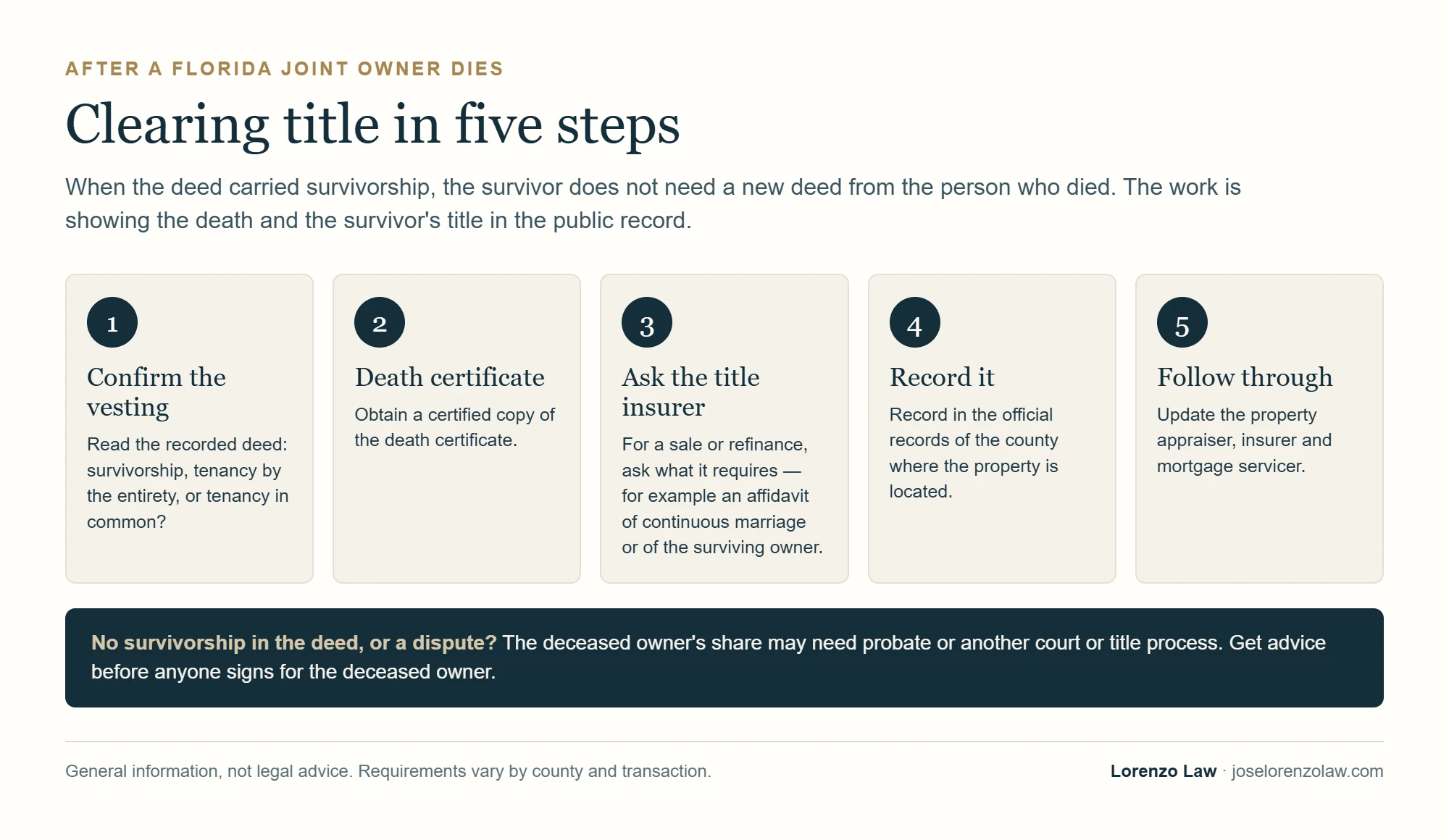
- Confirm the vesting. Pull the recorded deed by which the owners took title and any later deeds. Confirm whether it expressly created survivorship, created a tenancy by the entirety, or created a tenancy in common. Check for a completed severance or other change before the death.
- Obtain a certified death certificate. Florida death certificates are issued through the Florida Bureau of Vital Statistics and local health department offices. Ask which version the recording office or title insurer needs, and avoid disclosing more personal information than the transaction requires.
- Ask what the title insurer or closing agent will require. If a sale or refinance is planned, the title insurer lists its requirements in the title commitment. Requests may include an affidavit of continuous marriage or identity and information about possible liens. Florida Department of Revenue Form DR-312 was historically used to show that no Florida estate tax was due. Under § 198.32(3), for a death after December 31, 2004, the affidavit is not required and the estate is not subject to that section’s lien if the specified federal tax credits are unavailable. Chapter 2023-207 added subsection (3); its section 3 applies the act to probate proceedings commenced on or after July 1, 2023, and proceedings pending on that date for which no final-discharge order had been entered. Section 198.32(2) still permits a qualifying affidavit, and an insurer may request one. For this tax chapter, § 198.01(2) defines personal representative to include, when no executor, administrator or curator is appointed, qualified and acting, a person in actual or constructive possession of property included in the decedent’s gross estate. A surviving co-owner may fall within that definition; signing authority and the affidavit’s statements need review. Because section 3 of chapter 2023-207 limits the act to probate proceedings, no Florida court has decided whether § 198.32(3)(b) removes the lien for property that passed entirely outside probate, with no proceeding ever opened. Separately, for a decedent who was a Florida resident at death, the lien is discharged 10 years after the date of death unless the Department of Revenue files and records a notice of lien, and in no event continues beyond 20 years from death (§ 198.33). For property passing outside probate, ask counsel and the title insurer which requirements apply and what documentation will satisfy them. See the Department of Revenue’s estate-tax guidance.
- Record the documentation in the right county. Record in the official records of the county where the property is located — not where the survivor lives. The clerk assigns each recorded document an Official Records book and page or an instrument number; keep that reference with the deed. The recording offices and their official links are listed in the county recording guide.
- Follow through. Ask the property appraiser about exemption and assessment requirements — a surviving joint tenant who already received the homestead exemption on the property can generally keep the Save Our Homes cap (§ 193.155(3)(a)5.), and a surviving spouse relies instead on the separate exception for a transfer to a surviving spouse (§ 193.155(3)(a)2.) — update the homeowner’s insurance, and contact the mortgage servicer. If the deed had no survivorship, the owner lived outside Florida, or anyone disputes the title, get advice before anyone signs for the deceased owner.
Recording does not transfer title; the survivor’s title vests at the death, and the recording makes the public record show it. Recording a death certificate, often with an affidavit of continuous marriage, is long-standing practice rather than a statutory requirement, and title insurers may ask for more. The exact documents depend on the deed, the county and the transaction. A recorded death certificate does not cure a deed that never created survivorship, and it does not resolve an ownership dispute.
My spouse died — do I have to take their name off the deed in Florida?
Not with a new deed. In Florida, if you and your spouse held the home as tenants by the entirety or with express survivorship, title generally passed to you at the death. The usual step is to record the appropriate death documentation — typically a certified death certificate, sometimes with an affidavit the title insurer requests — so the public record shows you as owner.
How the deed was titled controls, so check the wording first. If the home was in your spouse’s name alone, the homestead and estate rules decide who owns it now, and that may require a court determination. See Florida homestead property in probate and surviving spouse rights in Florida.
What happens if a spouse’s name is not on the deed in Florida?
The surviving spouse may still have rights in the home. In Florida, a home titled in one spouse’s name can still be protected homestead. At that spouse’s death, if descendants survive, the surviving spouse generally receives a life estate or may elect a one-half interest as a tenant in common under § 732.401, and the owner could not freely leave the home to someone else by will. Non-homestead property passes under the will or intestacy.
The one-half election must be made within six months after the death. During life, the Florida Constitution requires the owner’s spouse to join in a deed or mortgage of the homestead even when the spouse is not on title (Article X, section 4(c)). For property that is not homestead — a rental or a second home, for example — a spouse who is not on the deed has no survivorship right. That property, and generally the protected homestead too, can count toward the elective estate used to compute a surviving spouse’s elective share (§ 732.2035), unless a valid waiver applies. A prenuptial or postnuptial agreement can change these rights. See homestead property in probate.
Selling, refinancing or keeping the mortgage after a co-owner dies
A surviving owner who holds title by survivorship can generally sell or refinance once the death and the survivor’s title are documented to the title insurer’s and lender’s satisfaction. A mortgage on the whole property — one every owner signed, or one already on the property when they took title — does not disappear at a death: the lien stays on the property, and the lender can foreclose if payments stop. Personal liability is separate: a survivor who did not sign the note is not personally liable on it (First National Bank in St. Petersburg v. Cooper, 266 So. 2d 191, 193 (Fla. 2d DCA 1972)). In WVMF Funding v. Palmero, 320 So. 3d 689, 691–92 (Fla. 2021), a reverse-mortgage case, the Florida Supreme Court held that a wife who signed the mortgage but not the note was not a borrower on the note; the lender’s remedy against her was the property. A mortgage that only one joint tenant signed is different: it is a lien on that owner’s interest alone and ends if that owner dies first (D. A. D., Inc. v. Moring, 218 So. 2d 451, 452 (Fla. 4th DCA 1969)). For a home loan on residential property with fewer than five dwelling units, federal law bars the lender from calling the loan due because of a transfer on the death of a joint tenant or tenant by the entirety (12 U.S.C. § 1701j-3(d)(3)); reverse mortgages are treated differently. A surviving owner the servicer confirms as a successor in interest is treated as a borrower under federal servicing rules (12 C.F.R. § 1024.30(d)), though those rules do not cover home-equity lines of credit. Call the servicer, and start the title work early if a sale is planned. When the deed had no survivorship, a sale of the whole property ordinarily waits until someone has authority to sign for the deceased owner’s share — see selling a house during probate.
What happens if both joint owners die?
In Florida, survivorship works one death at a time. The first owner’s interest passes to the survivor; when the survivor dies, the property passes under the survivor’s own will, trust, Lady Bird deed or intestacy — usually through probate if nothing else applies. If the order of the deaths cannot be established, the simultaneous-death statute addresses how the property is divided.
If there is insufficient evidence that the owners died other than simultaneously, Florida’s simultaneous death statute, § 732.601(3), divides joint-tenancy or entireties property one-half as if each had survived — or proportionally among more than two joint tenants — unless the governing instrument shows a contrary intention. Bring the dates and circumstances of both deaths and each owner’s will or trust to the first consultation.
Can someone who killed a co-owner inherit by survivorship?
Not if the killing was unlawful and intentional. In Florida, the slayer statute, § 732.802, provides that a joint owner who unlawfully and intentionally kills another joint owner does not take the decedent’s interest by survivorship. The killing severs the decedent’s interest, which passes as the decedent’s own property. The rule reaches joint tenancies with right of survivorship and tenancies by the entirety in real and personal property, joint and multiple-party accounts, and other co-ownership with survivorship.
A final judgment of conviction of murder is conclusive. Without a conviction, the court can decide by the greater weight of the evidence whether the killing was unlawful and intentional (§ 732.802(5)). A related statute enacted in 2021, § 732.8031, applies a similar forfeiture to a joint owner convicted of abuse, neglect, exploitation or aggravated manslaughter of an elderly person or disabled adult for conduct against the deceased joint owner: the conviction severs the decedent’s share, which passes as the decedent’s own property. It covers joint tenancies, tenancies by the entirety and joint accounts (§ 732.8031(2)). A conviction creates a rebuttable presumption; without one, the court can decide by the greater weight of the evidence whether that conduct caused or contributed to the death. A buyer who paid value without notice before the rights were decided is protected (§ 732.8031(5)). There is one exception: the forfeiture does not apply if, after a conviction for abuse, neglect or exploitation (not aggravated manslaughter), the victim, while capacitated, signs a written instrument, sworn to and witnessed by two people competent to witness a will, expressly allowing the convicted person to keep those rights, proven by clear and convincing evidence (§ 732.8031(7)).
When the deed had no survivorship language
Without survivorship, identify the deceased owner’s interest and the people entitled to it. If probate is needed, the court issues letters of administration to a personal representative, who can then deal with the deceased owner’s share. Probate, a homestead determination, an existing trust or another appropriate title process may be relevant — see Florida probate and summary administration. A nonresident owner’s Florida property may require ancillary or other Florida proceedings, but nonresidence alone does not establish the required process; see ancillary probate in Florida. Obtain a title and estate review before anyone signs for the deceased owner. If the surviving owner and the heirs cannot agree on keeping or selling the property, partition may become the route.
How do I remove a deceased life tenant from a Florida deed?
In Florida, the remainder owners named in a life estate deed generally own the property outright when the life tenant dies; no new deed from the life tenant is needed or possible. The usual step is to record a certified death certificate in the county where the property is located, then meet any further requirements the title insurer sets for a sale or refinance.
This describes a traditional life estate. For an enhanced life estate (Lady Bird) deed, the after-death steps are covered in Lady Bird deed after death. If the life tenant conveyed the property during life under retained powers, or the deed is unclear, have the title reviewed before anyone signs.
Does Florida Have a Transfer-on-Death Deed?
No. Florida has no transfer-on-death (TOD) deed, beneficiary deed or transfer-after-death deed for real property. For a home, the enhanced life estate (Lady Bird) deed functions like one: the property passes to the remainder beneficiaries at death while the owner keeps control during life. A revocable trust is the other common alternative.
Bank POD and securities TOD rules do not authorize a real-estate beneficiary designation. Florida real-estate planning requires its own legally effective deed or trust arrangement. The available tools, in short:
- Bank deposit accounts — POD designations under § 655.82.
- Securities and brokerage accounts — beneficiary (TOD) registration under Florida’s Uniform Transfer-on-Death Security Registration Act, including § 711.507 and § 711.508.
- Real estate — a Lady Bird deed, a revocable trust, or co-ownership with survivorship, each with its own consequences. My statewide planning work covers the choice; none of these is a universal answer to every tax, benefits, creditor or family question.
For what the family does after the owner of a Lady Bird deed dies, see Lady Bird deed after death.
Do Joint Bank Accounts Have Right of Survivorship in Florida?
Presumptively, yes. In Florida, under § 655.79(1), a deposit account in two or more names — including a certificate of deposit — is presumed to pass to the surviving owner or owners at a death unless a contract, agreement or signature card expressly provides otherwise. Section 655.79(2) provides that the presumption “may be overcome only by proof of fraud or undue influence or clear and convincing proof of a contrary intent.”
Several consequences follow.
You do not need the words “right of survivorship”
The presumption arises from the deposit account being in two or more names, not from a particular phrase. In In re Estate of Herring, 670 So. 2d 145 (Fla. 1st DCA 1996), a grandfather had a certificate of deposit retitled to read “Herbert H. Herring or Robert J. Herring.” No words indicating survivorship appeared on the certificate, and the grandfather’s will purported to leave his certificates of deposit to someone else. The First District held the grandson, as survivor, was presumed to own the CD, that the presumption had not been rebutted, and that the CD was not an asset of the estate. Section 655.79(1) expressly includes a certificate of deposit in the presumption.
That is the opposite of the deed rule, where express survivorship language is generally needed outside the entireties exception.
The presumption rests on the account contract, not on proof of a gift
Section 655.79(2) makes the presumption operate “notwithstanding the absence of proof of any donative intent or delivery, possession, dominion, control, or acceptance.” The Florida Supreme Court held in In re Estate of Combee, 601 So. 2d 1165 (Fla. 1992), that the joint-account statute eliminated the requirement of showing a gift inter vivos, and that the presumption in that case had not been rebutted by clear and convincing evidence. (Combee construed § 658.56, Florida Statutes (1987), a predecessor of § 655.79.)
The statute does not require separate proof of an ordinary lifetime gift. A challenge must address the actual account documents, the applicable statutory grounds and the evidence supporting them.
Joint deposit accounts held by spouses
Section 655.79(1) closes with a rule for married couples: “Any deposit or account made in the name of two persons who are husband and wife shall be considered a tenancy by the entirety unless otherwise specified in writing.” Entireties is a form of joint ownership with its own transfer and creditor rules — see entireties accounts below.
Does a joint bank account automatically go to the surviving spouse?
Ordinarily, yes. In Florida, a deposit account in both spouses’ names is treated as a tenancy by the entirety unless a writing expressly disclaims entireties ownership, so the surviving spouse continues to own it at the first death. The account can still matter to an elective-share calculation, and an account in one spouse’s name alone follows different rules.
Confirm the full account agreement and any later writing. A third co-owner requires a separate ownership analysis. A POD beneficiary has no right to the balance while either party is alive and does not take ahead of the surviving spouse merely because the beneficiary is named. For the elective share, one-half of an entireties account’s value counts in the elective estate (§ 732.2035(3)); because that half passes to the surviving spouse, it is applied first toward the spouse’s own share (§ 732.2075(1)), and the spouse’s own half is not counted.
Joint accounts without right of survivorship
Some accounts are opened in a form that expressly excludes survivorship — for example, an account the documents describe as held by tenants in common. In that case the deceased owner’s interest belongs to that owner’s estate, and a POD designation on a multiple-party account without right of survivorship is ineffective under § 655.82(4). Ask for the account documents before assuming which form the account takes. The Consumer Financial Protection Bureau’s joint-account explainer describes the same two forms, with and without survivorship, in general terms.
Survivorship account vs. joint account: what is the difference?
In Florida, a “survivorship account” is a joint account that carries right of survivorship. Because § 655.79 presumes survivorship for a deposit account in two or more names, a joint deposit account is presumed to be a survivorship account unless the documents say otherwise. A joint account titled as tenants in common is not, and neither is a convenience account.
What are the requirements for a right of survivorship bank account in Florida?
In Florida, the account must be a deposit account — checking, savings, a money market deposit account (not a brokerage money market fund) or a certificate of deposit — held in the names of two or more persons, and the account documents must not expressly exclude survivorship. No special words are required. The parties normally sign the bank’s signature card or ownership form, and the presumption can still be rebutted under § 655.79(2).
Banks set their own procedures for opening an account or adding a party: identification, signatures and their own account-type codes. Those are bank practices, not additional legal requirements, but the forms they produce become the evidence of what the parties agreed to. An account opened by one person and later retitled should have a dated change form; ask for a copy and keep it. Before adding anyone, compare the alternatives in joint account or POD account.
Does it matter which bank holds the account — Wells Fargo, Bank of America, Chase or a credit union?
Generally, no. In Florida, the joint-account and POD statutes (§§ 655.79 and 655.82) apply to accounts at Florida branches of national banks and federal credit unions as well as state-chartered institutions, and no federal regulation specifically preempts them. For survivorship, the main exception is a written agreement by all parties choosing another state’s law (§ 655.55(1)). The deposit agreement and signature card that were in effect still control the details.
Two rules sit behind that answer. First, for these statutes an “institution” means “any state or national bank, state or federal association, or state or federal credit union” (§ 655.769(4)), and Florida courts have applied the survivorship statutes to bank, savings-association and credit-union accounts alike (In re Estate of Clement, 568 So. 2d 1297 (Fla. 2d DCA 1990)). For national banks, the federal regulation on deposit-taking preserves state contract and property laws unless they prevent or significantly interfere with the bank’s federally authorized powers (12 C.F.R. § 7.4007(c)). That regulation does not apply to federal credit unions, and the NCUA has no regulation preempting state survivorship or POD rules; its share-insurance rules list forms of joint ownership for insurance purposes only (12 C.F.R. § 745.8(a)). Second, Florida law governs “all aspects, including without limitation the validity and effect,” of a deposit account at a branch in Florida, wherever the parties live (§ 655.55(1); Sanchez v. Sanchez De Davila, 547 So. 2d 943 (Fla. 3d DCA 1989)), with two exceptions. Certain Uniform Commercial Code rules, such as those for check processing and funds transfers, follow their own choice-of-law provisions (§ 655.55(1)(a), referring to § 671.105(2)); they do not ordinarily affect survivorship. And the statute does not apply to the extent that all parties to the account agreement “have agreed in writing that the law of another jurisdiction will govern it” (§ 655.55(1)(b)). No Florida appellate court has decided whether a bank’s standard clause choosing another state’s law can displace Florida’s survivorship rules, so if the deposit agreement names another state, have it reviewed.
Some practical differences remain. Credit unions call their deposit accounts “share” accounts and have their own membership rules, and each institution has its own deceased-customer process and forms. An account opened at a branch outside Florida is a separate question, because § 655.55 covers accounts at Florida branches.
How to Verify Whether Your Joint Account Has Right of Survivorship
The account display may not include the full governing terms. The controlling terms are usually in the signature card, the deposit agreement and any later account-change forms — documents the bank keeps and the customer often does not.
What the labels on a signature card suggest
| What the card or account says | What the designation suggests — subject to the full agreement and applicable law |
|---|---|
| Joint With Right of Survivorship · JTWROS · Joint Tenants WROS · JT TEN WROS | Survivorship among the parties; § 655.79 |
| Multiple-Party Account With Right of Survivorship | Survivorship; the statutory phrasing used in § 655.82(1) |
| Joint — Tenants in Common · Joint Without Survivorship | No survivorship; the decedent’s share is estate property, and a POD designation on it is ineffective under § 655.82(4) |
| Joint — Husband and Wife · Tenancy by the Entireties | Distinct married-owner form; see the entireties and creditor qualifications below |
| Convenience Account · Agent · Authorized Signer · Attorney-in-Fact | These descriptions call for an authority review. A statutory convenience-account agent is not an owner under § 655.80. A power of attorney or signing authorization is a separate arrangement; the label alone does not establish ownership or make every signer arrangement a § 655.80 account |
| Payable on Death · POD · In Trust For · ITF · Totten trust | A beneficiary designation that takes effect after the death of the last surviving party; § 655.82 |
| Nothing beyond two names | Survivorship is presumed under § 655.79(1) unless the documents expressly provide otherwise |
What to ask the bank for, in writing
Ask in writing for the signature card or deposit agreement in effect when the account was opened; every later signature card or account-change form; the account type code and its meaning in the bank’s own documentation; the date each owner or beneficiary was added; and the date-of-death balance. If the account moved through a bank merger, ask for the predecessor institution’s records as well.
Request records through the institution’s authorized process. A relative’s interest in a dispute does not itself entitle that person to every banking record. A lawyer can assess whether estate authority, consent, a subpoena or another procedure is needed. Do not use another person’s login or credentials to obtain records.
The bank’s label is evidence, not the final word. In Larkins v. Mendez, discussed in the convenience-account section, a card that said “multiple-party account with right of survivorship” was found, after trial, to reflect a convenience arrangement and to be an estate asset.
Joint Account With Right of Survivorship and a POD Beneficiary: Who Gets the Money?
The surviving joint owner, at the first death. In Florida, assuming a valid deposit-account arrangement governed by § 655.82 and no successful challenge, the surviving party receives the funds when one party dies. The POD beneficiary receives funds only after the last party dies, and only if the beneficiary qualifies under the governing arrangement and law.
Consider an example. A mother adds her son to her checking account as a joint owner and separately names her daughter as the payable-on-death beneficiary. Then the mother dies. Section 655.82(3) answers the sequence:
“(a) On the death of one of two or more parties, sums on deposit in the account belong to the surviving party or parties. (b) On the death of the sole party or the last survivor of two or more parties, sums on deposit belong to the surviving beneficiary or beneficiaries.”
Section 655.82(2) adds that a beneficiary in an account having a pay-on-death designation “has no right to sums on deposit during the lifetime of any party.”
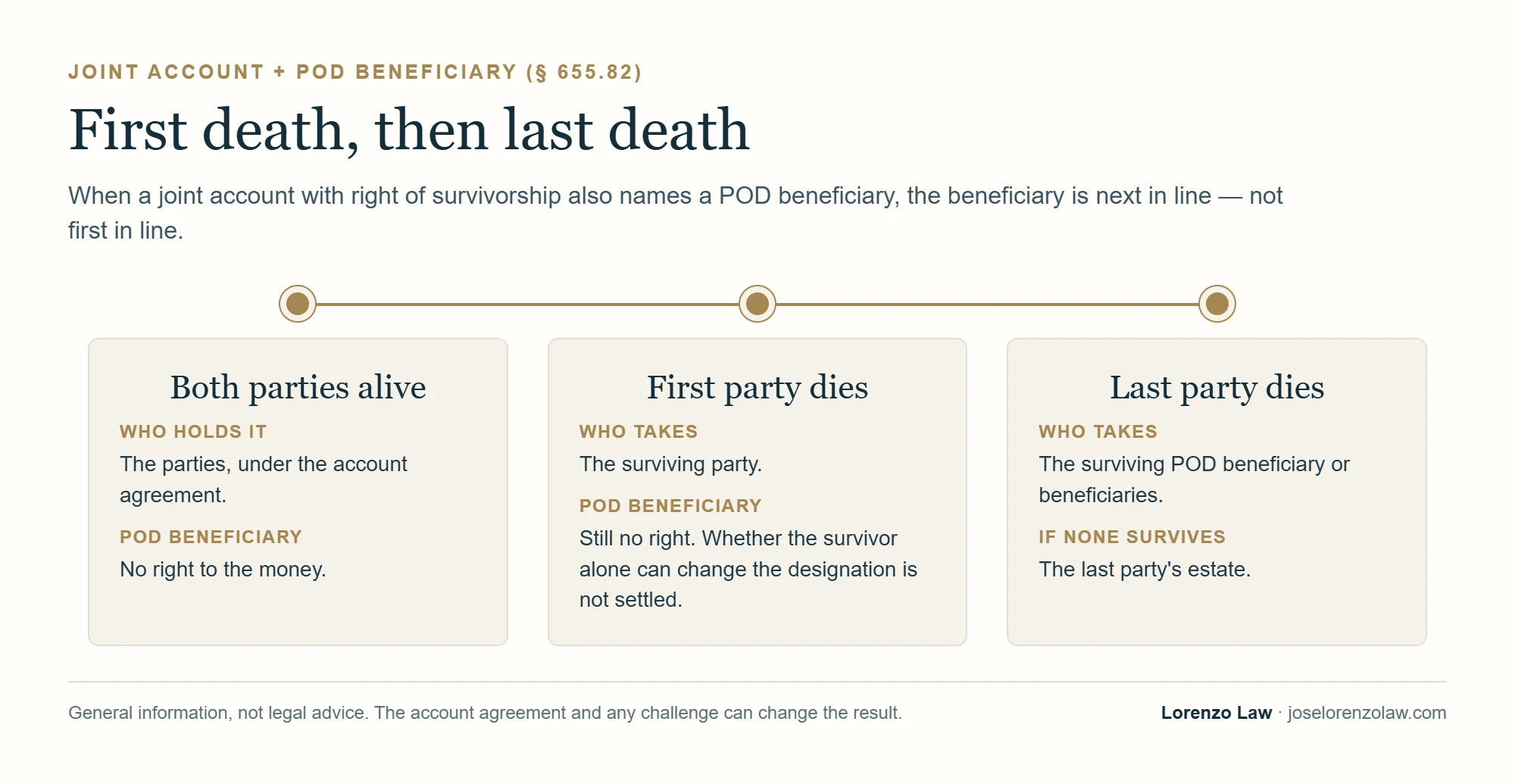
View the first-death and last-death chart
| What happens | Who receives the funds | Authority |
|---|---|---|
| One of two joint parties dies; a POD beneficiary is named | The surviving party; the POD beneficiary receives nothing yet | § 655.82(3)(a) |
| The last surviving party then dies | The surviving POD beneficiary or beneficiaries | § 655.82(3)(b) |
| Two or more POD beneficiaries survive | Equal and undivided shares, with no survivorship among them unless a depository agreement written between December 31, 1994, and July 1, 2001, provides otherwise | § 655.82(3)(b) |
| No POD beneficiary survives the last party | The estate of the last surviving party | § 655.82(3)(b) |
| The account is a multiple-party account without right of survivorship, with a POD designation | The POD designation is ineffective | § 655.82(4) |
| The surviving party wants to change the POD designation | Not decided in Florida. The survivor owns the funds in any event, and an account owner may generally change a beneficiary without the beneficiary’s consent; review the contract | § 655.82(3)(a); Vargas v. Vargas; account contract |
Does a POD beneficiary override right of survivorship in Florida?
No. In Florida, a POD beneficiary waits behind the account’s parties. Under § 655.82(3), when one of two or more parties dies, the money belongs to the surviving party or parties. The POD designation takes effect only after the last party dies, and only for a beneficiary who survives that party.
Can the surviving joint owner change or remove the POD beneficiary?
No Florida court has decided it. In Florida, a POD beneficiary has no right to the money while any party is alive (§ 655.82(2)), and courts have held that an account owner may change a beneficiary without the beneficiary’s consent. Whether a surviving party alone may change a designation all the parties made is open. Either way, the survivor owns the money and can withdraw it, so the designation guarantees the beneficiary nothing.
The cases are “in trust for” (Totten-trust) decisions. In Vargas v. Vargas, 659 So. 2d 1164, 1165–66 (Fla. 3d DCA 1995), the Third District held that “any decisive act or declaration of disaffirmance during the lifetime of the owner will suffice” to revoke, and that the bank’s own change procedures, which exist to protect the bank, do not limit the owner’s power to revoke. A deposit agreement can set how a change is made; whether it can require every surviving party to agree has not been decided.
What if the POD beneficiary dies before the last account owner?
In Florida, the money goes to the POD beneficiaries who survive the last party, in equal and undivided shares under § 655.82(3)(b). If none survives, the account belongs to the last surviving party’s estate, which can make it a probate asset. Florida’s anti-lapse statute (§ 732.603) applies only to wills, so a predeceased beneficiary’s children do not step into that share.
Section 655.82 does not provide for unequal shares among POD beneficiaries or for a contingent (backup) beneficiary on a deposit account. Some institutions offer a backup-beneficiary option by contract; no Florida court has decided whether it is enforceable. If unequal shares or a backup matter to you, raise that when your plan is reviewed.
Can a joint account with right of survivorship have a beneficiary?
Yes. In Florida, a multiple-party account with right of survivorship can also carry a pay-on-death designation under § 655.82. The surviving joint owner takes first; the POD beneficiary takes only after the last joint owner dies. The beneficiary has no right to the money in the meantime.
Brokerage accounts can be registered in a similar way under Florida’s transfer-on-death security registration law. What a particular institution offers, and how its forms describe it, varies — get the complete agreement.
Can you be a joint owner and a POD beneficiary at the same time?
Yes, but the second role adds little. In Florida, § 655.82 treats a party, who has a present right to the money, and a beneficiary, who is paid only after all parties die, as different roles. A person named as both already owns the account as a party and, by outliving the other parties, takes it as the survivor, so the POD designation is redundant rather than void. No Florida court has decided the point.
Payable-on-Death (POD) Accounts in Florida
A payable-on-death account — also described as a POD account, an in-trust-for (ITF) account or a Totten trust — is a deposit account with a named beneficiary who takes after the death of the last party. Florida governs these designations in § 655.82.
A POD designation may fit a goal of transferring money at death without giving the beneficiary present account rights. It does not provide lifetime bill-paying authority. The account owner’s circumstances, intended beneficiaries and wider estate plan determine whether this is an appropriate choice.
What is an ITF (in trust for) account in Florida?
In Florida, an ITF or “in trust for” account — sometimes called a Totten trust — is a deposit account that names someone to receive the money at the owner’s death, for example “Mary Smith ITF John Smith.” It works as a pay-on-death designation under § 655.82: the beneficiary has no rights while the owner lives and claims the balance after the last owner dies.
The trust label is historical. Since July 1, 2001, § 655.825 has provided that § 655.82 “shall apply to and govern deposits in trust,” for deposits to accounts created after December 31, 1994, and Florida’s Trust Code does not apply to “trusts created by the form of the account or by the deposit agreement at a financial institution” (§ 736.0102(2)). The owner therefore owes the beneficiary no trustee’s duties and can spend the money or change the designation; in Beane v. SunTrust Banks, Inc., 47 So. 3d 922, 924 (Fla. 4th DCA 2010), the Fourth District held that a prospective Totten-trust beneficiary “cannot object to the depositor’s withdrawal from the Totten trust.” An “in trust for” account opened before 1995 may need a separate look. For deposit insurance, the FDIC treats ITF and POD accounts as trust accounts, discussed below.
Is it better to have a joint account or a POD account?
It depends on the goal. In Florida, a POD designation passes the account at death while giving the beneficiary no rights during life, which usually fits a plan to leave money to someone. A joint owner gets present withdrawal rights, and the account is exposed to that person’s creditors and choices. For bill-paying help, a convenience account or power of attorney is often the better tool.
| Question | Joint account with survivorship | POD designation |
|---|---|---|
| Rights during the owner’s life | The other party may have withdrawal authority under the account agreement | The beneficiary has no right to the sums on deposit while any party is alive |
| Helps with bill-paying | Can, but it also creates a co-party | No |
| At the owner’s death | Presumed to pass to the surviving party | Passes to the surviving beneficiary after the last party dies |
| Exposure to the other person’s situation during life | A co-party’s own creditors or conduct can create disputes over the account | The beneficiary has no present right to the funds |
| Changing your mind | Removing a co-party can require that party’s cooperation or the bank’s process | A revocable designation can generally be changed under the account terms |
| Main risks | Conflicts with an equal-share will; disputes among family members after death | Must be kept current; a beneficiary who dies first, or an account form without survivorship, changes the result |
Some disadvantages of a payable-on-death account are maintenance problems: a designation that was never updated after a death, a divorce or a new grandchild, or one that conflicts with the rest of the plan. A designation can also be challenged on an applicable legal ground, as Keul (below) illustrates. Review designations with the will or trust, not separately.
Three limits worth knowing
- A POD designation on an account without survivorship is ineffective. Section 655.82(4): “A pay-on-death designation in a multiple-party account without right of survivorship is ineffective.”
- Payment requests made before death are addressed separately. Under § 655.82(5), the beneficiary’s ownership is subject to requests for payment made by a party before death; the statute addresses whether such a request was paid and the beneficiary’s responsibility to the payee. Do not assume that every outstanding check was or will be paid by the bank.
- A POD designation may be challenged on an applicable legal ground. The procedure and proof must be assessed for that designation. In Keul v. Hodges Blvd. Presbyterian Church, 180 So. 3d 1074 (Fla. 1st DCA 2015), the First District rejected the argument that a POD designation cannot, as a matter of law, be invalidated for undue influence, and affirmed the invalidation of a POD designation on credit-union accounts obtained by a person who was the decedent’s neighbor, friend, paid caregiver, attorney-in-fact and health care surrogate.
- The joint-account presumption and its contrary-intent challenge do not apply to a POD designation. In Brown v. Brown, 149 So. 3d 108 (Fla. 1st DCA 2014), the First District held that § 655.79 applies only to accounts in the names of two or more persons, not to POD accounts, which § 655.82 governs, and reversed an order that had used the § 655.79 contrary-intent rule to send three POD certificates of deposit into the estate.
What Is a Convenience Account in Florida (§ 655.80)?
In Florida, a convenience account is a deposit account in one person’s name — the principal — in which one or more other people are designated as agents who can make deposits and withdrawals. Under § 655.80, the account belongs to the principal only, and the agent does not take the balance by survivorship. The statutory category excludes certificates of deposit.
Consider a parent who wanted help paying bills: “Mom put my brother on the account so he could pay her bills when she couldn’t get to the bank.” Florida has a statute for that arrangement. Section 655.80(1) defines a convenience account as a deposit account, other than a certificate of deposit, “in the name of one individual (principal), in which one or more other individuals have been designated as agents with the right to make deposits to and to withdraw funds from or draw checks on such account.” Section 655.80(2) provides that all rights, interests and claims in the account “shall be those of the principal only.”
The agent does not take the balance by survivorship. Section 655.80 identifies the persons and documents through which payment may be made, including estate-administration and qualifying simplified-estate procedures. The appropriate route depends on the facts; an agent’s authority under this statute should not be confused with authority under an ordinary power of attorney.
| Question | Convenience account (§ 655.80) | Joint deposit account (§ 655.79) |
|---|---|---|
| Who owns the funds | The principal only | The parties, subject to the account terms and any dispute between them |
| The helper’s role | Agent who can deposit and withdraw for the principal | A party to the account |
| At the principal’s or owner’s death | No survivorship to the agent; payment follows the statutory routes | Presumed to pass to the surviving party |
| Certificates of deposit | Excluded from the statutory category | Expressly included in the presumption |
| How a dispute usually arises | Whether the account was opened in this form, and what the agent did with the money | Whether the presumption is rebutted on the § 655.79(2) grounds |
Convenience account, or a joint account whose presumption is rebutted?
In Florida, those are two different claims. If the account was opened as a § 655.80 convenience account, the agent never had survivorship rights. If it was opened as a joint account, the question is whether the § 655.79 presumption can be rebutted — usually by clear and convincing proof that the owner intended only a convenience arrangement.
Section 655.80 governs an account established as a convenience account under that section. It does not, by its own force, convert an ordinary joint account into a convenience account after the fact. If the account was opened in joint form with a survivorship signature card, the argument is that the § 655.79(1) presumption should be rebutted under § 655.79(2) because the parties’ actual intent was an agency or convenience arrangement — with § 655.80 describing what the parties meant to create.
Florida courts have admitted evidence of that intent. In Caputo v. Nouskhajian, 871 So. 2d 266, 269 (Fla. 5th DCA 2004), the Fifth District held admissible parol evidence that the decedent intended joint bank accounts to pass through her estate.
What a convenience-account claim looked like in Larkins v. Mendez
Larkins v. Mendez, 363 So. 3d 140 (Fla. 3d DCA 2023), is a Miami-Dade probate case decided after a trial. The decedent had opened an account with his wife in 1997. In 2006, after her death, he added one son and updated the signature card by checking “multiple-party account with right of survivorship.” A convenience-account box on the same card was left unchecked. He died intestate in 2016, survived by three sons, and the son on the account withdrew essentially all of the money and argued it had passed to him by survivorship.
After a four-day bench trial, the probate court found the account was a convenience account and an estate asset. The court considered testimony, contemporaneous notes and account records, including:
- a brother’s testimony that the father had said the account would be split three ways and that the son was added to help pay bills and manage finances;
- the son’s admission that the funds came from his father and that he had not withdrawn money for personal use during his father’s lifetime;
- a neighbor’s testimony, and contemporaneous notes, recording the decedent’s statement that the son’s name was put on the account for convenience; and
- account records showing large withdrawals after the father died.
The Third District affirmed the account-ownership order but reversed the separate contempt order on procedural grounds. It held that the trial court’s inquiry “was not limited to the holder’s express intent as manifested by the signature card,” that clear and convincing evidence supported the finding, and that applying a common-law unities-of-title analysis to the account was error, though harmless. The case illustrates the contrary-intent route: evidence that the owner intended a convenience arrangement overcame a survivorship signature card.
An older Third District decision points the same way. In Constance v. Constance, 366 So. 2d 804 (Fla. 3d DCA 1979), decided under the law then in force, the court affirmed a judgment returning to a father $38,569.67 that his daughter had withdrawn from their three joint accounts during his lifetime, even though the signature cards said the accounts were joint with right of survivorship. The court recognized “a strong presumption of joint ownership” but held that, “as between the depositor and the joint signer,” an equitable ownership can still be asserted.
Evidence that may be relevant to a convenience-intent claim
The following are potential evidence to evaluate, not a checklist that proves the claim. Source of funds, illness, an equal-share will or a family relationship alone does not automatically establish contrary intent or undue influence.
- Source of funds: who deposited the money, and whether the added person ever contributed.
- Timing: when the person was added — for example, after a diagnosis, a fall or a hospitalization.
- Use: whether account activity was the owner’s own household spending.
- The rest of the estate plan: whether a will or trust divided everything equally, alongside an account that would give one person everything.
- Contemporaneous statements: what the owner told the banker, an accountant, the estate-planning attorney or family members, and any notes made at the time.
- Who drove the process: whether the added person selected the account type, filled in the card or spoke for the owner at the branch.
None of these factors alone settles the question. In Davis v. Foulkrod, 642 So. 2d 1129, 1133–34 (Fla. 4th DCA 1994), review denied, 652 So. 2d 816 (Fla. 1995), the Fourth District reversed a judgment for the estate on both grounds the trial court had found. The decedent’s lack of donative intent, his family’s expectations and his omission of the joint holder from his will were not clear and convincing evidence of a contrary intent, and the undue-influence finding failed because, in the court’s words, “[h]e alone initiated the process of transferring his assets into joint accounts.”
Attorney communications and files require a separate privilege analysis. Section 90.502 includes exceptions, including certain issues between parties claiming through the same deceased client. That does not make every estate-planning file or every communication discoverable. Counsel should assess relevance, privilege, work product and the proper request procedure.
Tenancy by the Entireties Bank Accounts in Florida
When the two names on a Florida account belong to spouses, the account is considered a tenancy by the entirety unless otherwise specified in writing (§ 655.79(1)). At the first death the surviving spouse continues to own the account, and while both spouses are alive, Florida law protects qualifying entireties property from a creditor of only one spouse. In Beal Bank, SSB v. Almand & Associates, 780 So. 2d 45, 53 (Fla. 2001), the Florida Supreme Court stated that “only the creditors of both the husband and wife, jointly, may attach the tenancy by the entireties property.”
Why the account rule differs from the older common-law test
As historical context — not an additional current bank-account checklist — Beal Bank described the common-law characteristics of a tenancy by the entireties: unity of possession, unity of interest, unity of title, unity of time, survivorship, and unity of marriage. For deposit accounts, the statute now does the work.
Two decisions explain what writing defeats the presumption. They involved the same creditor but different couples, banks and courts, and they do not conflict. In Storey Mountain, LLC v. George, 357 So. 3d 709, 714–16 (Fla. 4th DCA 2023), the Fourth District held that because the 2008 amendment uses the word “writing,” the disclaimer no longer has to be on the signature card itself: a bank agreement incorporated into the signature card, stating that a spouses’ account is “NOT owned as tenants by the entireties,” was effective, and the account could be garnished. In In re Del Amo, 158 F.4th 1335, 1346–47 (11th Cir. 2025), a separate bankruptcy appeal, the Eleventh Circuit agreed that the amendment changed where a disclaimer may appear but held that it did not change what the disclaimer must say: the writing must expressly reject entireties ownership. Fine print on the signature card saying that joint accounts “are owned as joint tenants with right of survivorship” did not do that — in the court’s words, “[i]t is not enough to say the account is something else.” A married couple that does not want entireties ownership should say so expressly in writing.
In Loumpos v. Bank One, 423 So. 3d 856 (Fla. 2025), the Florida Supreme Court held that the statutory presumption for joint spousal bank accounts is not defeated by the absence of the common-law unities of time and title. The account had begun in one spouse’s name and was later designated as entireties property. The court did not address what a disclaimer must say. This account-specific holding does not establish that every retitling is valid, that every creditor claim is barred, or that the same creation rule governs real estate. Loumpos explains the state-law entireties creditor principle while resolving the narrower statutory account question.
Under § 689.15, tenants by the entirety become tenants in common upon dissolution of marriage. A divorce therefore changes the survivorship analysis for entireties real estate; account records, beneficiary provisions and court orders still need separate attention.
Can one spouse withdraw or transfer entireties funds?
The bank may honor one spouse’s withdrawal, but that does not settle ownership. In Florida, neither spouse can sever entireties property without the other’s consent, and courts have allowed the other spouse to recover entireties funds transferred without consent. Whether a particular withdrawal was proper depends on the account terms, any agency authority and how the money was used.
The bank’s contractual authority to pay one spouse and that spouse’s right to change beneficial ownership are separate issues. Review withdrawal provisions, consent, any agency authority, the use of the money and applicable law. A unilateral transaction may create a dispute even where the institution was authorized to honor it. Do not assume that one signature either authorizes every transfer or makes every withdrawal impossible.
If funds have been moved, counsel must evaluate the ownership arrangement, authority, recipient and potential remedies. Relief is not automatic simply because the funds once stood in both spouses’ names.
Two Florida decisions illustrate how courts have treated entireties funds differently from ordinary joint funds. In Sitomer v. Orlan, 660 So. 2d 1111, 1112–14 (Fla. 4th DCA 1995), the Fourth District explained that in a tenancy by the entirety “neither spouse may sever or forfeit any part of the estate without the assent of the other,” while for an ordinary joint account “[a] joint owner’s withdrawal of funds from a joint bank account terminates the joint tenancy nature of the [funds] and severs the right of survivorship as to the funds withdrawn” (internal quotation marks omitted), and it described the continuation of an interest after an unauthorized withdrawal as “a feature unique to tenancies by the entireties.” In Wallace v. Torres-Rodriguez, 341 So. 3d 374 (Fla. 3d DCA 2022), the Third District approved a constructive trust to recover entireties assets that one spouse had transferred during the marriage without the other spouse’s consent. These are case illustrations; the remedy in a particular matter depends on its facts.
Can a joint bank account be garnished in Florida?
It can be, but only the debtor’s share. In Florida, a creditor of one owner of an ordinary joint account can reach that owner’s portion, not the other owner’s. Once the other owner claims the money, the creditor must prove it belongs to the debtor. An entireties account is generally protected from a creditor of only one spouse — but not from a joint creditor of both, and federal tax liens follow federal law.
The answer depends on the form of ownership, whom the creditor’s judgment is against and the account’s terms. Do not move or retitle money to defeat a creditor based on the account label alone; see the creditor discussion below.
For a co-owner who does not owe the debt, Florida courts measure the protected share by what that owner contributed, plus a proportionate share of any interest (Antuna v. Dawson, 459 So. 2d 1114 (Fla. 4th DCA 1984)). The co-owner must act: Chapter 77 provides a sworn claim to the funds (§ 77.16) and a motion to dissolve the writ, which § 77.07(2) requires within 20 days after the creditor’s notice is served; a late motion is stricken and the case proceeds in default as to that person. Once the claim is made, “the garnishor must prove that the garnished funds belong exclusively to the debtor” (Stanbro v. McCormick 105, LLC, 213 So. 3d 925, 927 (Fla. 4th DCA 2017)).
Social Security and certain other federal benefits have added protection. Federal law bars garnishment of Social Security benefits (42 U.S.C. § 407). When a bank receives a garnishment order, federal rules require it to review the account within two business days after it has the order and enough information to tell whether the debtor is an account holder, and to leave the account holder full access to the “protected amount”: the lesser of the benefits directly deposited during the prior two months or the balance (31 C.F.R. §§ 212.3, 212.5, 212.6). The rule covers Social Security, VA, Railroad Retirement and federal civil-service retirement benefits, and the bank must do the review even if the account has a co-owner or the benefits are mixed with other money (§ 212.5(d)). It does not apply to an order from the United States or a state child-support agency that includes a Notice of Right to Garnish Federal Benefits (§ 212.4). Beyond that automatic protection, a debtor who claims that garnished funds are exempt Social Security benefits is entitled to an evidentiary hearing on the claim (Bennett v. Society of Lloyd’s, 51 So. 3d 568, 568–69 (Fla. 3d DCA 2010)). A head of family’s exempt wages also stay exempt for six months after deposit if they can be traced (§ 222.11(3)). Whether the automatic protection applies when the judgment debtor is the co-owner who does not receive the benefits has not been decided; the regulation’s text points toward protection, but the benefit recipient should claim the exemption promptly.
What happens to joint property if one owner files bankruptcy or owes the IRS?
In Florida, a co-owner’s bankruptcy or federal tax debt can reach that owner’s interest in ordinary joint property. Entireties property is generally exempt in one spouse’s individual bankruptcy, except as to creditors both spouses owe. The IRS is different: a federal tax lien against one spouse can attach to that spouse’s interest in entireties property.
- Bankruptcy. The debtor’s interest in jointly held property becomes part of the bankruptcy estate. Federal law lets a debtor exempt an interest held as a tenant by the entirety to the extent it is exempt from process under applicable nonbankruptcy law (11 U.S.C. § 522(b)(3)(B)), which in Florida generally means protection from a creditor of only the debtor spouse — not from joint creditors. When both spouses owe a creditor, the trustee can generally reach the entireties property only up to those joint debts, and Florida bankruptcy courts have generally paid the proceeds only to the joint creditors. A trustee can sometimes sell co-owned property, including the other owners’ interests, but only if the court finds, among other things, that the benefit to the estate outweighs the harm to them, and entireties property only when joint creditors exist; a co-owner may buy at the sale price, or otherwise receives his or her share of the net proceeds (11 U.S.C. § 363(h)–(j)). A transfer into entireties ownership before a filing can be challenged as a fraudulent transfer. If a bankruptcy filing is pending or planned, talk to bankruptcy counsel before retitling anything.
- Federal tax liens and levies. In United States v. Craft, 535 U.S. 274, 288 (2002), a case involving Michigan entireties property, the U.S. Supreme Court held that one spouse’s interest in entireties property is property to which a federal tax lien against that spouse attaches, because a state-law exemption does not bind the federal tax collector. The Eleventh Circuit, whose decisions bind the federal courts in Florida, has held that the IRS could levy on Florida entireties property despite Florida’s rule that such property is exempt from one spouse’s individual debts (United States v. Ryals, 480 F.3d 1101, 1105 (11th Cir. 2007)). In United States v. National Bank of Commerce, 472 U.S. 713, 724 (1985), the Court held that the IRS could levy on a joint bank account for the tax debt of one depositor who had an unrestricted right to withdraw the funds. That levy is provisional: a co-owner who says the money is his or hers can ask the IRS to return it (IRC § 6343(b)) or sue for wrongful levy (IRC § 7426), generally within two years after the levy.
- After a death. A judgment lien against one joint tenant attaches to that owner’s interest during life, but if that owner dies first and the creditor has not enforced it, the lien ends and the survivor takes the whole free of it (Hurlbert v. Shackleton, 560 So. 2d 1276, 1279 (Fla. 1st DCA 1990)). A lien on a tenant in common’s share stays on that share after the death. Federal tax claims and challenges to the transfer itself need separate review.
Withdrawal Rights vs. Ownership While Both Owners Are Alive
A joint party and a POD beneficiary have different rights during life. A POD beneficiary has no right to the deposit balance while any party is alive. A joint party may have withdrawal authority under the account agreement, but the bank’s authority to honor a withdrawal does not decide every dispute about who beneficially owns the money or whether the withdrawing person owes duties to someone else. Section 655.78 and § 655.82(7) address the institution’s authority and protection when it pays; they are not a ruling on who is entitled to keep the money as between the parties.
Who legally owns the money in a joint account?
In Florida, the account agreement controls whom the bank may pay, but it does not always settle who owns the money as between the parties. During life, ownership can turn on who deposited the funds, why a person was added and what the parties intended. At a death, the § 655.79 survivorship presumption applies unless it is rebutted.
That is why lifetime withdrawals by one party — especially a person added to help an older parent — can become disputes. The remedies section discusses cases in which courts allowed claims to proceed over withdrawals that exceeded the withdrawing party’s authority.
Can a power of attorney change a joint account or a POD beneficiary?
Only with specific authority. In Florida, § 709.2202 lets an agent create or change rights of survivorship or a beneficiary designation only if the principal signed or initialed next to that specific power in the document; general banking authority is not enough, although ordinary deposits and withdrawals do not count as a change. The agent’s acts remain subject to fiduciary duties, and all authority under the power of attorney ends at the principal’s death.
The specific-authority rule is in § 709.2202. Authority under a power of attorney ends at the principal’s death (§ 709.2109). Do not infer that a particular agent transaction was valid or invalid without reviewing the document and the facts. See does a power of attorney end at death and the Florida power of attorney guide.
Can a Right of Survivorship Be Challenged in Florida?
Yes. A joint bank account with right of survivorship can be challenged in Florida. Section 655.79(2) provides that the presumption “may be overcome only by proof of fraud or undue influence or clear and convincing proof of a contrary intent.” A survivorship deed can be challenged on the grounds that apply to deeds — such as forgery, fraud, undue influence, lack of capacity or lack of delivery. The proper claimant, the evidence and the procedure have to be identified for the particular asset.
Is the right of survivorship ever immune from challenge?
No. In Florida, a survivorship arrangement can be challenged, but the grounds depend on the asset. For a joint deposit account, the § 655.79(2) grounds govern. For a deed, the questions are whether it was validly made and delivered, whether it actually created survivorship, and whether the joint tenancy was severed before the death.
The two are different lawsuits with different evidence. Other states’ rules on the right of survivorship differ. Florida law decides a Florida deed, and it generally decides survivorship for an account at a Florida branch unless all parties agreed in writing to another state’s law (§ 655.55(1)(b)), so check the account agreement for a governing-law clause.
The statutory grounds for a joint account
Section 655.79(2) identifies fraud, undue influence and clear and convincing proof of contrary intent as grounds for overcoming the account presumption. A contrary-intent claim requires that elevated proof; Larkins illustrates an application of that rule, as does In re Estate of Combee, 601 So. 2d 1165 (Fla. 1992). Counsel must separately identify the elements, applicable presumptions and burdens for the particular claim. A rule developed for a will contest or another transaction should not be applied to a deposit account without examining the relevant authority.
The cases on undue influence over accounts are worth knowing. In Cripe v. Atlantic First National Bank of Daytona Beach, 422 So. 2d 820, 823 (Fla. 1982) — a joint bank account case decided under a predecessor statute — the Florida Supreme Court stated that “[t]he trier of fact determines the question of undue influence, the standard of proof required of the moving party being the preponderance (greater weight) of the evidence.” The Legislature later changed how the undue-influence presumption shifts the burden (§ 733.107(2)); Hack v. Janes, 878 So. 2d 440 (Fla. 5th DCA 2004), recognized that change and still applied the preponderance standard. As written, § 655.79(2) requires “clear and convincing” proof only for contrary intent. No Florida court has decided the standard of proof for the fraud ground, so that burden remains an open question.
Issues to investigate in a joint-account challenge
| Issue to investigate | Records and questions | Legal review needed |
|---|---|---|
| Fraud | What was represented or concealed when the account was opened or changed, and by whom | Elements and proof of fraud under § 655.79(2) and general law |
| Undue influence | The relationship, who procured the change, the owner’s condition and independence, who benefited | Whether a presumption arises and its effect (§ 733.107(2)); the Carpenter factors as applied to accounts |
| Contrary intent | Statements, notes, the estate plan, source and use of funds, why the person was added | Clear and convincing proof under § 655.79(2) |
| Disputed signing or capacity | Signature cards, branch records, medical records for the period, witnesses | Whether the change was validly executed by an owner with capacity |
| Use of fiduciary authority | Any power of attorney, guardianship or trustee role; who made the change | The agent’s authority under the document and §§ 709.2202, 709.2114 and fiduciary duties |
An agency or convenience arrangement is not a fourth statutory exception. It is usually presented through the contrary-intent ground — or, where the account was actually opened as a statutory convenience account, through § 655.80 itself. Claims about exploitation of an elderly person or disabled adult are discussed with the remedies below.
What undue influence requires
Florida’s framework comes from In re Estate of Carpenter, 253 So. 2d 697 (Fla. 1971): a presumption of undue influence arises where a substantial beneficiary who occupies a confidential relationship with the decedent was active in procuring the transaction. Carpenter listed non-exclusive factors for active procurement at 253 So. 2d at 702 — including the beneficiary’s presence at execution, the beneficiary’s presence when the decedent expressed a desire to make the instrument, recommending the attorney, knowing the contents in advance, giving instructions to the drafter, securing witnesses, and keeping the instrument afterward — and said a contestant need not prove all of them. On the confidential-relationship element, Carpenter relied on the broad description in Quinn v. Phipps, 93 Fla. 805, 113 So. 419 (1927), which reaches informal relations of trust and reliance as well as technical fiduciary ones.
Carpenter treated the presumption as shifting only a burden of coming forward. In 2002 the Legislature added § 733.107(2), which provides that in any transaction or event to which the presumption of undue influence applies, the presumption is “a presumption shifting the burden of proof under ss. 90.301-90.304.” The Third District applied that rule in Hannibal v. Navarro, 317 So. 3d 1179, 1182 (Fla. 3d DCA 2021), citing Hack v. Janes, 878 So. 2d 440, 443 (Fla. 5th DCA 2004).
A family or caregiving relationship is part of the factual inquiry; it does not by itself prove undue influence. Section 733.107(2) addresses the effect of an applicable undue-influence presumption. Whether that presumption applies, and how the cases govern the specific account transaction, requires separate analysis.
Account-specific decisions show how fact-dependent this is. In Cripe, the Florida Supreme Court analyzed two transactions separately. Two joint accounts (about $12,700 and $10,900) that came from an earlier arrangement to manage the decedent’s apartment business and personal care stayed with the Cripes, because no confidential relationship existed when that arrangement began. A $32,000 certificate of deposit funded with condemnation proceeds went to the estate: by then a confidential relationship had developed, Mr. Cripe had asked the decedent to deposit the money in a joint account, and the presumption of undue influence was not rebutted. In Davis, discussed above, the survivor had suggested two institutions, one of which the decedent rejected, and drove him to his appointments; the Fourth District held that “[m]erely driving the decedent to and from his bankers, without more, is insufficient evidence of procuring these joint accounts.”
Can siblings fight a joint bank account left to one child?
In Florida, siblings may have grounds to investigate a disputed account, but unequal treatment is not enough by itself. The proper claimant must establish a legal basis and the required evidence. A will dividing an estate equally does not automatically invalidate a joint account left to one child.
The claim must rest on a legal ground — for example, that the titling resulted from fraud or undue influence, or did not reflect what the parent actually intended — and it must be brought by the person or estate entitled to bring it. Florida law permits a parent to leave one child more than another. The undue-influence analysis overlaps with undue influence in Florida generally, and a transfer made before death can raise related questions covered in challenging a transfer the decedent made before death. A will contest is a separate challenge.
Can a survivorship deed be contested in Florida?
Yes. In Florida, a deed that created survivorship can be challenged on grounds such as forgery, fraud, undue influence, lack of capacity, lack of delivery or a missing spousal joinder for homestead. The parties may also dispute whether the joint tenancy was severed before the death. The § 655.79(2) account grounds do not govern deeds.
See contesting a Florida deed. These claims are fact-intensive and time-sensitive.
What to gather before a survivorship dispute
- Complete deed and title history, or signature cards, deposit agreements and all available change forms.
- Dates of account creation, each ownership or beneficiary change, marriage or divorce, disputed withdrawals and death.
- The date-of-death balance and transaction records before and after the questioned change.
- Any will, trust, power of attorney and court orders relevant to authority or intent.
- Communications and witness names concerning who requested, explained, signed and benefited from the transaction.
- Any existing probate or civil case number and notices already received.
Preserve original records and a factual chronology. Ask counsel how to obtain records you are not authorized to access and how to handle medical or privileged material. For the first inquiry, provide a brief description; do not send account numbers, Social Security numbers or confidential documents through a public contact form.
For representation concerning a disputed account in an estate matter, see Florida probate litigation.
Remedies: Constructive Trust, Conversion and Civil Theft
Winning the ownership question is often only part of the problem, because the money may already have been withdrawn. Possible remedies may include an ownership determination, recovery of identifiable property, damages or equitable relief such as a constructive trust. Each has its own requirements, defenses and proof. A favorable ownership ruling does not automatically establish another claim or make funds recoverable from every recipient.
Constructive trust
A constructive trust is an equitable remedy. Florida courts have described it as “a remedial device with dual objectives: to restore property to the rightful owner and to prevent unjust enrichment.” Provence v. Palm Beach Taverns, Inc., 676 So. 2d 1022, 1025 (Fla. 4th DCA 1996), citing Abreu v. Amaro, 534 So. 2d 771 (Fla. 3d DCA 1988). In Provence, the court listed the elements — a promise, express or implied; transfer of the property and reliance on it; a confidential relationship; and unjust enrichment — and stated that they must be proved by clear and convincing evidence. Because it is equitable, the remedy is subject to equitable defenses such as laches; in Wadlington v. Edwards, 92 So. 2d 629 (Fla. 1957), the Florida Supreme Court held a widow’s constructive-trust claim to land titled in her late husband’s name barred by laches, measured by the twenty-year statute for recorded deeds, after she waited more than twenty years to sue. Whether those elements and defenses fit a particular survivorship dispute is a question for the specific case.
Conversion
Where a person takes funds beyond his or her actual authority, a conversion claim may be available. In Columbia Bank v. Turbeville, 143 So. 3d 964 (Fla. 1st DCA 2014), a granddaughter who had been added as a joint holder to help her grandmother manage the accounts withdrew $671,696.57 after learning that the grandmother was trying to move the funds into accounts in her own name; the First District reversed the dismissal of claims for conversion and breach of fiduciary duty, which the bank brought under an assignment of the grandmother’s claims. That decision was at the pleading stage — the claims could proceed, not that they were proved — and the account holder was still alive, so it is not a post-death survivorship holding.
In Joseph v. Chanin, 940 So. 2d 483, 485 (Fla. 4th DCA 2006), the Fourth District held that “where a joint tenant in a bank account wrongfully transfers funds to a third party, the other joint tenant may maintain a cause of action for conversion against the third party who (1) holds the identifiable funds and (2) refuses a demand to restore the funds to the other joint tenant.” A man had taken more than his share of a pooled joint checking account and used it to fund a separate savings account naming his daughter as beneficiary. After his death the daughter withdrew the $48,720.52 and refused the other joint owner’s demand, and the court affirmed a jury verdict for conversion.
An important limit
These claims are fact-specific. In Sitomer v. Orlan, discussed in the entireties section, the Fourth District reversed a jury instruction that had allowed recovery of transferred funds from third parties for ordinary joint tenancies with right of survivorship. In the decisions above where a claim went forward, there was something more than an ordinary withdrawal by an ordinary joint owner — an entireties account in Wallace, access granted for the owner’s benefit in Turbeville, and, in Joseph, money taken beyond the joint owner’s share, moved into a separate account and held by a recipient who refused a demand.
Obtain advice before sending a demand or choosing a cause of action. The identity of the owner, authority to withdraw, traceability of funds, recipient’s position and applicable law can change both the available claim and the steps required before filing.
Civil theft and exploitation of an elderly person
Section 772.11 provides a civil remedy for qualifying theft or exploitation proved by clear and convincing evidence. It provides threefold actual damages, with a $200 minimum, plus attorney’s fees, but the claimant must first make a written demand; a person who complies within 30 days after receipt receives a written release from further civil liability for that act. The defendant is entitled to fees on a finding that the claimant raised a claim “without substantial fact or legal support.” A disputed withdrawal is not automatically civil theft, and a statutory exploitation claim requires its own analysis.
True ownership can be central to a theft theory, including whether the money was property of another at the relevant time. Florida decisions have addressed co-owners of joint accounts: in Rosen v. Marlin, 486 So. 2d 623, 625 (Fla. 3d DCA 1986), the Third District stated that “a co-owner of a joint bank account cannot be guilty of the theft of funds taken from the account since the co-owner is in lawful possession of the joint property,” citing Hinkle v. State, 355 So. 2d 465 (Fla. 3d DCA 1978), cert. dismissed, 359 So. 2d 1220 (Fla. 1978); see also Escobar v. State, 181 So. 2d 193, 195 (Fla. 3d DCA 1965). In Escudero v. Hasbun, 689 So. 2d 1144 (Fla. 3d DCA 1997), the Third District allowed a claim to proceed where a spouse alleged she had become the sole owner of a certificate of deposit by a later agreement. The cited co-ownership decisions must be assessed in context, alongside any applicable exploitation statute. This is not a rule requiring a separate completed ownership trial before every possible claim, nor a guarantee that co-owner status defeats every form of liability.
Who Can Bring the Claim, and How Soon?
Who has authority to bring the claim?
In Florida, it depends on whose right is at stake. A claim that money belongs to the estate is usually brought by the personal representative; a surviving owner’s or beneficiary’s own claim is brought by that person. The court can appoint an administrator ad litem when the estate needs one.
First identify whose legal right is being asserted. A claim belonging to an estate is different from a surviving owner’s personal claim or a beneficiary’s own right. Being an heir or an “interested person” under § 731.201 does not by itself establish authority to sue on every claim. Counsel should review the documents, the requested relief and any existing estate proceeding.
Whether an heir can skip probate and sue a surviving joint owner directly, to recover money claimed for the estate, has not been decided by a Florida appellate court. In All Children’s Hospital, Inc. v. Owens, 754 So. 2d 802 (Fla. 2d DCA 2000), where an estate was already open, the Second District would not let residual beneficiaries bring their own constructive-trust suits over assets the personal representative could recover. The same court later distinguished that case where the probate remedy was inadequate (Neumann v. Wordock, 873 So. 2d 502, 504–05 (Fla. 2d DCA 2004)). The safer course is usually to open administration so the personal representative brings the claim. A surviving owner or POD beneficiary asserting his or her own ownership is in a different position: in Royal v. Royal, 372 So. 3d 782, 784–85 (Fla. 6th DCA 2023), a granddaughter who was the named POD beneficiary could sue in circuit court over funds she had been induced to route through the estate, because her claims arose from her own ownership of the accounts.
If estate representation is needed and there is no personal representative, or the personal representative is or may be adverse to the estate in the matter, the court may appoint an administrator ad litem for that particular proceeding under Florida Probate Rule 5.120. A curator, who takes charge of estate property until letters are issued, may be appropriate in the circumstances covered by § 733.501 and Rule 5.122. Neither appointment should be presented as an automatic consequence of an accusation. See Florida probate for how an estate is opened and who may serve.
How soon should the issue be reviewed?
Promptly. In Florida, there is no single deadline: the time limit depends on the claim, when it accrued and any notice already served, and probate claim bars and elective-share deadlines are separate rules. Money that is still in an account is also easier to protect than money that has already been spent or moved.
Some claims concern a transaction during life; others concern later conduct. A death does not necessarily restart an existing claim’s clock.
Sections 95.11 and 95.031 address limitations and accrual — § 95.11(3), for example, lists four-year periods for categories that include an action for taking, detaining or injuring personal property and an action founded on fraud, and § 95.031 addresses when a fraud claim accrues — but an article cannot calculate the deadline for an individual account dispute. Bring the ownership-change dates, withdrawal dates, date of death, discovery history and all court notices to a lawyer. Do not wait for the estate to close or for the bank to finish an internal review before asking about deadlines.
As a historical illustration of accrual, in Gottesman v. Gottesman, 221 So. 2d 212 (Fla. 3d DCA 1969), an executor sued over bank-account transfers made about a month before the decedent’s death; the court held the claim had accrued during the decedent’s lifetime because the facts were known to him, and that it was time-barred under the limitations period then in force. The periods have changed since; the case is cited for the accrual point, not for a current deadline.
How a Florida Joint Account Dispute Proceeds
Every case is different, but these disputes tend to move through the same stages.
Step 1: Preserve the records
Request, through an authorized process, the signature card in effect at opening, every later account-change form, statements covering the relevant years and the date-of-death balance, plus predecessor-bank records after a merger. Retention policies vary and branch-level records can be lost. Medical records covering the period of the change may be relevant, but they do not automatically prove incapacity or susceptibility. Privileged and medical material must be requested and handled properly.
Step 2: Identify the proper claimant and proceeding
Determine whose claim it is — the estate’s, a surviving owner’s or a beneficiary’s — and whether estate representation exists. If the personal representative has an adverse interest, the court may appoint an administrator ad litem under Rule 5.120; a curator may be appropriate in circumstances covered by Rule 5.122. Not every account dispute requires opening probate — a surviving owner or beneficiary asserting his or her own right may not need one — but a claim that money belongs to the estate is ordinarily the personal representative’s to bring, and naming a particular defendant does not by itself resolve who has authority to sue.
Step 3: Assess whether interim protection is available
If disputed funds may be moved, tell counsel at once. Under § 655.83, notice to the bank alone does not obligate it to recognize an adverse claimant; see protecting a disputed account.
Step 4: Select and pursue the appropriate proceeding
Florida Probate Rule 5.025 identifies particular adversary proceedings — including a proceeding to determine beneficiaries — and allows other proceedings to be declared adversary or treated as such by court order. A survivorship dispute is not automatically a petition to determine beneficiaries merely because someone claims an inheritance; a challenge to a joint-account designation is not one of the listed categories, and in Larkins the claim was brought in the probate case as a petition for declaratory relief and a constructive trust. Pleading, service, division assignment and procedure depend on the claim and requested relief. Discovery commonly includes the bank’s records, testimony from branch personnel, the account activity and, where appropriate after a privilege analysis, the drafting attorney’s file.
Step 5: Resolution
A matter may resolve by agreement, mediation or a court decision. Any settlement must address who has authority to bind the affected parties and whether court approval or other implementation steps are needed.
Where these matters are filed
The proper court and county depend on the proceeding, the decedent’s domicile, property and parties, and applicable venue rules. An independent civil claim may require a different analysis from estate administration. I handle Florida matters statewide; a consultation can help identify the appropriate next step. No hearing date, emergency relief or remote appearance is promised.
Does a Will Override a Joint Bank Account in Florida?
Ordinarily, no. In Florida, a will governs the probate estate, and an account that validly passes by survivorship passes outside it under the account contract. A will dividing everything equally among children therefore does not, by itself, change a bank contract that passes an account to a surviving party. That does not prevent a supported challenge to the account arrangement.
The will can still be considered as part of legally admissible evidence in a supported challenge. Situations in which the will’s plan may end up affecting the money include:
- The account never carried survivorship — for example, an account held as tenants in common, or a statutory convenience account — so the deceased owner’s interest may be payable through the estate process.
- A challenge succeeds on a § 655.79(2) ground — fraud, undue influence or clear and convincing proof of a contrary intent — and the court orders a remedy that restores the funds to the person or estate entitled to them.
- No POD beneficiary survives the last party, so the funds belong to the last party’s estate.
A will ordinarily does not override a payable-on-death or “in trust for” designation either, even a will that names the account. Section 655.82 provides no mechanism for a will to revoke a POD designation, and since 2001 it has also governed “in trust for” accounts created after December 31, 1994 (§ 655.825). Older Totten-trust cases recognized that a will clearly revoking the trust could do so (Serpa v. North Ridge Bank, 547 So. 2d 199 (Fla. 4th DCA 1989)); no Florida appellate court has held that rule survives the 2001 change, so a will that names such an account still deserves a careful review. A revocable trust also requires coordination with title and beneficiary arrangements. Merely signing a trust or pour-over will does not retitle a separately held account. Before death, changes must be made through an authorized and effective process. After death, the question is the legal effect of the arrangement that existed and any available challenge — not a new instruction signed for the deceased person.
If your concern is about the will itself, see contesting a Florida will. If it concerns trust terms, trustee conduct or ownership involving a trust, see Florida trust litigation. These are related but distinct from challenging a joint-account designation. The same logic applies to a deed with survivorship: real estate that passes to a surviving joint tenant is not controlled by the deceased owner’s will.
Are Joint Bank Accounts Frozen When Someone Dies in Florida?
Not automatically. In Florida, a joint account with right of survivorship ordinarily belongs to the surviving owner at the death, although the bank may restrict it while it collects a death certificate and reviews the account agreement. An account in the deceased person’s name alone is typically frozen until a personal representative, a POD beneficiary or a person holding a court order claims it.
An owner’s death does not produce one uniform bank procedure. The institution may require proof of death and authority, review the agreement or restrict transactions while resolving documentation or legal issues. Do not assume that access will continue unchanged or that a dispute is the only reason for a hold.
Section 674.405 concerns a bank’s authority to process items after death. Under § 674.405(2), even after it knows of the death, a bank “may for 10 days after the date of death pay or certify checks drawn on or before that date unless ordered to stop payment by a person claiming an interest in the account.” It is not an ownership rule or a guarantee that a survivor can withdraw every dollar. The protection relieves the bank of liability; it does not decide who is entitled to the money, and the Third District has held that the estate’s representative can still recover a post-death check payment from the person who received it (Black v. Hart, 301 So. 2d 787 (Fla. 3d DCA 1974)). Ask the bank for its specific requirements and obtain advice if ownership or access is disputed.
| How the account was titled | What happens | Usual action |
|---|---|---|
| Joint with right of survivorship | Presumed to belong to the surviving owner or owners, unless rebutted | Death certificate and the bank’s forms; the bank retitles or closes the account |
| Both spouses’ names (entireties) | The surviving spouse continues to own the account | Death certificate and the bank’s forms |
| Joint without survivorship (tenants in common) | The deceased owner’s share belongs to the estate | Estate authority for that share — letters of administration or another court process |
| Joint owner plus a POD beneficiary | The surviving owner takes first; the beneficiary waits for the last owner’s death | Surviving owner presents a death certificate; review the POD designation |
| One owner with a POD or ITF beneficiary | The surviving beneficiary takes the balance | Beneficiary presents a death certificate and identification |
| Convenience account (§ 655.80) | The principal’s funds; the agent takes nothing by survivorship | Payment through the statutory routes, usually estate authority |
| One owner, no beneficiary | Part of the probate estate | Personal representative, summary administration or another statutory procedure |
Can I take money out of my parent’s bank account after they die?
Only if you own the account or have legal authority. In Florida, a power of attorney ends at death, and a convenience-account agent does not inherit the balance. A joint owner with survivorship presumptively owns the money; a signer, agent or heir who withdraws it can face personal liability. Wait for the bank’s process or estate authority.
If you were a joint owner but a sibling or the estate disputes the account, or you were added only to help with bills, get advice before moving or spending the money. Using a deceased parent’s debit card or writing checks after the death is a common mistake, even with good intentions such as paying the funeral home. Separately, a Florida bank may pay up to $2,000 from a deceased person’s sole-name accounts that have no POD or survivor designation to a surviving spouse or other listed family member, without a court order, but not earlier than six months after the death (§ 735.303). Ask the bank how it handles funeral and other urgent bills, keep receipts for anything you pay yourself, and ask about reimbursement from the estate. Funeral costs and other expenses usually have to be presented within the estate’s claim deadlines, and repayment depends on what the estate holds. In Larkins, discussed above, a son who withdrew an account’s balance after his father died was found to have taken an estate asset. If money has already been withdrawn, say so early in a consultation; it is easier to correct than to defend later.
What happens to a bank account when someone dies without a will in Florida?
In Florida, it depends on how the account was titled, not on the missing will. A joint account with survivorship or a POD account passes to the surviving owner or beneficiary. An account in the deceased person’s name alone becomes part of the estate and passes to the heirs under the intestacy statutes, usually through summary or formal administration.
The intestate heirs are set by § 732.102 and § 732.103: the surviving spouse (who in some families shares with the decedent’s descendants), then descendants, parents, siblings and more distant relatives in the statutory order. Which court process applies depends on the estate — summary administration is available when the probate assets, not counting protected homestead and other exempt property, do not exceed $150,000, or when the decedent has been dead more than two years (§ 735.201(2), as amended effective July 1, 2026); whether the $150,000 figure applies to a death before July 1, 2026 has not been decided by a court; the amended statute has no date-of-death limit, which supports applying it to petitions filed after that date, but the point is open. Section 735.301 covers only personal property, where the estate has no real property and the non-exempt personal property is no more than preferred funeral expenses plus reasonable and necessary medical and hospital expenses of the last 60 days of the final illness. See closing a bank account when someone dies in Florida.
What can cause a hold on a survivorship account — and what doesn’t by itself
| Situation | What it may mean for access |
|---|---|
| The bank learns of the death and opens a deceased-customer file | Temporary restrictions while it collects proof of death and reviews the agreement |
| The account documents are unclear, or the account had no survivorship | The bank may require estate authority or a court order before releasing the deceased owner’s interest |
| Someone asserts an adverse claim | A notice alone does not obligate the bank to recognize the claimant under § 655.83, but the bank may still apply its own procedures |
| A court order, levy or garnishment names the account | The bank follows the legal process directed to it |
| The bank exercises a contractual right of setoff for a debt owed to it | Review the account agreement and § 655.79’s provision for proper institutional charges and setoffs |
| Federal benefit payments arrive after the death | Payments may need to be returned; do not assume every post-death deposit belongs to the survivor |
| The death alone, with clear survivorship documents and no dispute | Often resolved administratively once the bank’s requirements are met — but the timing and process are the bank’s |
Protecting a disputed account from further transfers
Tell counsel promptly if you believe disputed funds may be moved. Section 655.83 states that notice of an adverse claim alone does not obligate an institution to recognize that claimant. It specifies court process directed to the institution, with the account holder made a party and served, or an acceptable indemnity bond as routes requiring recognition under that section. Once the institution receives a qualifying bond, it must hold the account until the claimant and the account holder agree or court process is served. Separately, for 10 days after a death, a person claiming an interest in the account can order the bank to stop paying checks the deceased owner wrote on or before the date of death (§ 674.405(2)).
That does not mean a written notice is useless or that these are the only circumstances in which a bank may restrict an account. A notice can document the concern, but it should not be relied on as a guaranteed freeze. A lawyer must assess the legal basis, evidence, service and any bond requirements for the relief sought. No injunction, hearing date or preservation order is automatic.
Removing a deceased owner from a Florida bank account
- Obtain the complete account agreement and confirm the arrangement in effect at death.
- Ask the institution which proof of death, identification and authority it requires. Request only the death-certificate information needed for the transaction.
- Obtain the date-of-death balance and preserve statements and account-change records.
- Ask whether the institution will retitle the existing account, establish a new account or use another process, and how automatic payments and deposits will be affected.
- Use only access methods the institution authorizes for you. Do not assume the deceased person’s checks, credentials, card or power of attorney remain usable.
- Ask the paying agency and bank how to handle benefit deposits and other payments that may need correction or return. Do not assume every deposit after death belongs to the survivor.
If no effective survivorship or beneficiary arrangement applies, the institution may need proof of estate authority or a qualifying court order or other statutory procedure. The proper route depends on the account and estate facts. If ownership is disputed, get legal advice before treating retitling or withdrawal as a routine administrative step. For accounts in the decedent’s name alone, see closing a bank account when someone dies in Florida; en español, cuenta bancaria de un fallecido en Florida.
Survivorship on Cars, CDs, Brokerage Accounts and Retirement Accounts
Vehicle titles: “or” versus “and”
Section 319.22 distinguishes a motor-vehicle title issued to co-owners in the alternative, using “or,” from one issued in the conjunctive, using “and.” Title wording affects transfer authority and survivorship, but the available deceased-owner transfer procedure also depends on statutory requirements and the facts. See selling or transferring a deceased person’s car in Florida.
A Florida title does not need the letters “JTWROS” or the words “right of survivorship”: § 319.22 works from the “or” and “and” wording. As a general guide, when co-owners’ names are joined by “or,” either owner can transfer the title and the surviving co-owner can take the deceased owner’s interest; when they are joined by “and,” § 319.22 requires the signature of each co-owner or the deceased co-owner’s personal representative to transfer the title, so a deceased co-owner’s interest may require estate authority or another statutory deceased-owner route. Once a Florida title is issued, its “or” or “and” wording governs. A “JTWROS” notation on another state’s title does not carry over by itself, so if survivorship is intended, ask for the Florida title to be issued with “or.” If a co-owner dies before the vehicle is retitled here, the application must include the out-of-state title or other evidence of ownership (§ 319.23(3)), but no Florida court has decided whether Florida must honor the out-of-state survivorship designation.
Certificates of deposit, including payable-on-death CDs
Section 655.79(1) expressly includes a certificate of deposit in the joint-account presumption. A CD is not a statutory convenience account: § 655.80 excludes certificates of deposit from that category.
A CD can also carry a payable-on-death designation, and the § 655.82 sequence applies: on a joint CD, the surviving party takes first; on a CD in one name with a POD beneficiary, the beneficiary claims it after the owner’s death with a death certificate and identification. Many banks waive the early-withdrawal penalty when an owner dies, but that is a term of the CD agreement to confirm, not a rule of law.
Brokerage and investment accounts
Sections 711.507 and 711.508 address beneficiary registration of securities, ownership during the owners’ lifetimes and transfer at death. A brokerage account can be registered as joint tenants with right of survivorship and can carry a TOD beneficiary. Do not apply the deposit-account presumption to every brokerage account; read the registration and custodial agreement.
Retirement accounts
Review the plan or custodial terms, beneficiary designation and applicable law, including any spousal rights. Deposit-account or deed rules do not decide all retirement-benefit questions.
Are joint accounts FDIC insured to $500,000?
Not per account. For a Florida depositor, as for any other, FDIC insurance covers each co-owner up to $250,000 for that owner’s combined share of all joint accounts at the same bank, so two owners’ joint accounts at one bank are insured up to $500,000 in total. Payable-on-death accounts are a separate category insured by beneficiary, and credit-union accounts are insured by the NCUA under similar rules. Deposit insurance does not decide who owns the money.
Each co-owner’s interests in qualifying joint accounts at the same FDIC-insured institution are combined for that ownership category, with coverage up to $250,000 per co-owner. The FDIC describes a six-month grace period after an owner’s death, subject to its conditions; coverage should be reviewed with the institution. See the FDIC’s joint-account guide. This is deposit insurance, not a determination of beneficial ownership or survivorship.
Payable-on-death and in-trust-for accounts are insured differently, as “trust accounts.” Since April 1, 2024, an owner’s trust deposits at one bank are insured up to $250,000 for each eligible beneficiary, to a maximum of $1,250,000 per owner when five or more beneficiaries are named. See the FDIC’s trust-account fact sheet. If an account is near those limits, have the bank confirm the coverage in writing.
Does a joint safe-deposit box pass by survivorship?
Not necessarily. In Florida, unless the lease says otherwise, a surviving co-lessee may open the box and remove its contents (§ 655.937), but co-leasing gives access, not ownership. Who owns the jewelry, cash or papers depends on who owned them, and items that belonged to the person who died remain part of that person’s estate.
If the box was leased in two or more names, § 655.937 gives access to “[e]ither or any of such lessees, regardless of whether or not the other lessee or lessees or any of them are living or competent,” unless the lease provides otherwise, and that access is not subject to the rules for personal representatives in § 655.935 or § 733.6065. After a co-lessee’s death, the survivor may make a written inventory in the presence of one other person — another person with access, a bank employee or a Florida lawyer — and each signs it under penalty of perjury. Access is not ownership: co-leasing a box does not by itself make the contents jointly owned (Bechtel v. Bechtel’s Estate, 330 So. 2d 217, 219 (Fla. 2d DCA 1976)). Actual use can change the result; in Winterton v. Kaufmann, 504 So. 2d 439, 442–43 (Fla. 3d DCA 1987), a wife who had her own key and often opened the box alone was found to own the contents with her husband as tenants by the entirety.
For others, Florida’s banking statutes allow a limited search of a box leased or co-leased by a person who has died (§ 655.935). On proof of death, the bank must let a person named in a court order — or, if none has been served, the spouse, a parent, an adult descendant or a person named as personal representative in a copy of a purported will — examine the box in a bank officer’s presence. Only a purported will (which goes to the probate court in the county where the bank is located), a burial-plot deed or burial instructions, and a life-insurance policy (which goes to the named beneficiary) may be removed. Once a personal representative has letters, the bank must allow access, and since July 1, 2026 it must also let the representative or the representative’s attorney pay the charges and end the lease (§§ 655.933, 655.936, as amended by ch. 2026-57); the initial opening and inventory follow § 733.6065. Removing contents that belonged to the deceased person is a different matter from having a key. Inventory the box with a witness, and keep the deceased owner’s property separate until ownership is settled.
Does Florida Have Community Property With Right of Survivorship?
Florida is not a community property state, and Florida does not have the “community property with right of survivorship” titling used in some community property states. Florida’s rules concerning community property brought from another jurisdiction and its Community Property Trust Act are separate from ordinary joint survivorship ownership.
Community property you brought with you from another state
Under § 732.219, qualifying property is allocated between the surviving spouse and the decedent as the statute provides, subject to the applicable facts and any effective waiver. Do not decide the property’s character from the couple’s former address alone; tracing and documents matter. Couples who spent working years in a community property state and retired to Florida should have this reviewed before the first death.
Florida community property trusts
For a Florida community property trust, § 736.1507 distinguishes the spouses’ shares at death. It does not automatically award the decedent’s share to the survivor. That does not mean trust-held assets necessarily require probate: disposition and administration also depend on the trust agreement and applicable law. Have the trust and property history reviewed rather than treating “community property” as another name for survivorship.
Taxes: Basis, Gift and Estate Questions Before Adding an Owner
Ownership planning can raise federal gift and estate-tax questions and affect income-tax basis. A Florida deed change can also involve documentary stamp tax, homestead exemption or assessment issues. Probate avoidance is not a tax conclusion. Have the proposed transaction reviewed before transferring an interest; this article does not calculate a tax bill or determine benefits eligibility.
- Basis. Property received as a lifetime gift and property received at death are treated differently for basis purposes, and with jointly owned property the portion treated as the decedent’s at death matters — which can differ for spouses and for other co-owners. See IRS Topic 703, basis of assets.
- Gift reporting. Adding a co-owner without adequate consideration can be a gift for federal purposes, and a return can be required even when no tax is due. See the IRS gift-tax FAQs.
- Federal estate tax. Avoiding probate does not automatically exclude an asset from the federal gross estate; jointly owned property is addressed in the Form 706 instructions. Florida has no separate state estate or inheritance tax — see does Florida have an inheritance tax.
- Florida deed taxes and assessment. Documentary stamp tax can be due on a deed, including on a mortgage share, and a change in ownership can affect the homestead exemption and Save Our Homes assessment. The quitclaim deed guide covers those questions in detail; see also the Florida Department of Revenue’s documentary stamp tax page.
- Benefits eligibility. A transfer can affect eligibility for certain public benefits. I do not provide Medicaid or elder-law planning; if benefits are part of the goal, that planning should be done with an elder law attorney before any transfer.
Does jointly owned property get a step-up in basis?
Fully, partly or not at all, depending on who owned the property and who paid for it. Under federal tax law, the portion of joint property included in the deceased owner’s estate generally receives a new basis equal to its value at death. For spouses, that is usually one-half. For other joint owners, it can be all, part or none of the property, depending on who paid for it.
That new basis can be lower as well as higher than the original cost. The illustration below shows the direction of the federal rules (IRC § 1014 for basis at death and IRC § 2040 for joint interests). It ignores depreciation, improvements, selling costs, the home-sale exclusion and any estate tax; it is not a tax calculation for your property.
| Arrangement | Included in the deceased owner’s estate | Basis afterward |
|---|---|---|
| The mother keeps title alone (or uses a Lady Bird deed), and her son inherits | All of it | $500,000 for the whole house |
| The mother deeds the house to herself and her son as joint tenants with right of survivorship; she paid for all of it | All of it, including the half she deeded to him, unless the son proves he contributed his own money (IRC § 2040(a)) | Generally $500,000 for the whole house (IRC § 1014(b)(9)) — and the deed was also a gift of half when it was made (Treas. Reg. § 25.2511-1(h)(5)) |
| The mother gives her son the whole house by deed during her life, keeping no interest | None | $100,000, carried over from the mother; a $500,000 sale would show roughly $400,000 of gain |
| A married couple owned the house as tenants by the entirety; the husband dies | One-half (IRC § 2040(b)) | $300,000 for the widow: $50,000 for her own half plus $250,000 for the half included in his estate |
| Two siblings bought it as tenants in common, each paying half; one dies | The deceased sibling’s half | $250,000 for the deceased sibling’s half, for whoever inherits it; the survivor’s own half keeps its $50,000 basis |
Two notes. The spousal one-half rule assumes the surviving spouse is a U.S. citizen; for a non-citizen spouse it does not apply (IRC § 2056(d)(1)(B)); the contribution rule of IRC § 2040(a) applies instead, and the estate-tax marital deduction is generally available only through a qualified domestic trust (QDOT). Courts generally value a fractional share, as in the last row, at a discount from a proportionate share of the whole, which also lowers the new basis. And spouses who hold assets in a Florida community property trust may be treated differently from the table above — see community property.
Tenants in common vs. joint tenancy: what are the tax implications?
In Florida, the tax differences come from federal rules. A tenant in common’s share is included in that owner’s estate and gets a basis step-up only on that share. For non-spouse joint tenants, the whole value is included unless the survivor proves his or her own contribution; for spouses, one-half is generally included regardless of who paid, if the surviving spouse is a U.S. citizen. Florida imposes no estate or inheritance tax.
Two Florida tax issues can arise with a new deed, whichever form is chosen. Documentary stamp tax under § 201.02 is due on consideration, and a mortgage on the property counts as consideration even if the new owner does not assume it. When a deed adds a co-owner to mortgaged property, the tax is generally measured by the share of the mortgage that matches the interest conveyed — for example, half of the balance for a one-half interest. A deed of homestead between spouses, including from one spouse to both, is exempt when the only consideration is the mortgage (§ 201.02(7)(b)). And the homestead exemption (§ 196.031) and the Save Our Homes assessment cap (§ 193.155) can be affected. A change of ownership generally resets the assessment to just value as of the following January 1. The statute lists exceptions, among them transfers between spouses, including to a surviving spouse; a deed in which the owner stays on title and adds another person, unless the added person applies for the homestead exemption; and the death of a joint tenant with right of survivorship, if the surviving owner already received the homestead exemption on the property and continues to qualify. If you add a co-owner who does not live there, how the exemption itself is figured also depends on the form: a resident joint tenant with survivorship keeps the full exemption, while a resident tenant in common is generally limited to his or her share. The Florida Department of Revenue’s Save Our Homes guide summarizes the rule; ask the property appraiser before recording.
When is adding someone to an account or deed a taxable gift?
For a joint bank account, the federal gift generally happens when the added person withdraws money for his or her own benefit, not when the account is opened. Adding someone other than a spouse to a deed as a joint tenant is generally a gift of that person’s share when the deed is delivered. A gift above the annual exclusion requires a gift-tax return even when no tax is due.
The Treasury regulations describe both rules. For a joint bank account that one person funded and can take back without the other’s consent, “there is a gift to B when B draws upon the account for his own benefit” (Treas. Reg. § 25.2511-1(h)(4)). For property one person paid for and titled to himself or herself and another as joint owners with survivorship that either can sever, “there is a gift to B in the amount of half the value of the property” (Treas. Reg. § 25.2511-1(h)(5)). If the deed gives the new owner a different share, the gift is generally measured by the value of the interest actually conveyed.
The annual exclusion is $19,000 per recipient for 2026; a larger gift is reported on Form 709 and counts against the donor’s lifetime exemption ($15,000,000 for 2026), so filing the return does not by itself mean tax is owed. Gifts to a spouse who is a U.S. citizen generally qualify for the unlimited marital deduction; for a spouse who is not a citizen, the annual exclusion is instead $194,000 for 2026. See the IRS gift-tax FAQs.
Do you pay taxes on a joint account or POD account after a death?
Generally not income tax on the balance itself. Money received by survivorship or as a POD beneficiary is generally not taxable income under federal law, although interest earned before the death but not yet paid can be, and Florida has no personal income tax or inheritance tax. Interest the account earns after the death is taxable to the new owner, and a very large estate may owe federal estate tax that the account counts toward.
For the years before the death, the bank usually reported all of a joint account’s interest on a Form 1099-INT under one owner’s taxpayer number. IRS Publication 550 explains that each owner’s share of the interest is determined by local law, and that an owner who receives a 1099-INT for interest belonging to someone else can report the difference as a nominee distribution — that is, interest received on another person’s behalf. See IRS Publication 550 and, on inherited property generally, IRS Publication 525.
Planning Survivorship: Choosing — or Undoing — an Arrangement
These are the decisions worth making deliberately, before anyone signs a bank form or a deed. To undo survivorship on real estate, see severance; to change an account, use the institution’s authorized process with every signature the account terms require.
If you want someone to help with your banking
Consider whether a convenience account or appropriate power of attorney can provide the needed authority without making the helper a co-owner. Confirm what the institution offers and how the arrangement works. A power of attorney ends at the principal’s death; the statutory convenience-account arrangement has its own rules. Neither choice should be assumed to determine the ultimate beneficiary without reviewing the full account and estate plan. The Consumer Financial Protection Bureau’s guides for managing someone else’s money explain an agent’s and a trustee’s duties in plain language.
If you want someone to receive money at your death
A POD designation may be suitable if you want a beneficiary to receive a deposit account at death without present account rights. Check the beneficiary form, the surviving-party sequence, what happens if a beneficiary dies first (§ 655.82 provides equal shares among surviving beneficiaries but does not expressly address a contingent designation) and consistency with the estate plan. Changing a designation through an agent raises separate authority and fiduciary-duty questions.
If you genuinely want a co-owner
Review the present ownership and control you are creating, as well as the intended result at death. For an account, obtain and retain the complete agreement. For real estate, have the vesting and retained powers reviewed in the actual deed before signing or recording.
Make the titling match the estate plan
Compare your will and trust with each deed, account title and beneficiary designation. A document saying that children should share equally does not automatically override a valid survivorship arrangement on a particular asset. My Florida estate-planning services address that broader coordination, and a living trust is one way to hold assets under one plan.
Review after a major change
Marriage, divorce, an owner’s or beneficiary’s death, a move, a change in capacity or a financial-institution change can justify a new review. Section 689.15 addresses conversion of entireties ownership on dissolution of marriage; account records, beneficiary provisions, court orders and other applicable law still need attention. Do not assume unchanged bank paperwork means legal rights are unchanged.
Six Florida Survivorship Hypotheticals
These are hypothetical illustrations written to show how the rules interact. They are not client matters, case results or predictions, and small differences in the documents or facts can change the outcome.
1. The parent who added one child to the account
A widowed mother adds her eldest daughter to her checking account after a fall, so the daughter can pay the bills. Every dollar in the account is the mother’s, and her will divides everything equally among four children. She dies with $180,000 in the account.
The deposit-account presumption is the starting point. The available records may support an investigation into contrary intent or another ground, but the source of funds, illness or equal-share will does not by itself establish that the survivor loses. The proper claimant and required proof must be identified.
2. The sibling deed without survivorship
Two brothers take title to a rental property by a deed that reads “to Luis Ortiz and Rafael Ortiz.” Both assume that if one dies, the other gets the property. One dies.
Assuming no other controlling instrument or applicable exception, tenancy in common is the default. The surviving brother does not take the deceased brother’s share by survivorship. Who receives that share depends on the will, family facts and applicable succession rules.
3. The second marriage and the elective share
A man who remarried late in life titles a $500,000 brokerage account jointly with his son from his first marriage and keeps a modest probate estate. He dies survived by his second wife.
The account may be relevant to the surviving spouse’s elective-share rights. Inclusion and value require the statutory withdrawal-without-accountability analysis and any applicable exclusions or waiver. Do not assume the $500,000 balance is automatically the decedent’s includible interest or the recipient’s liability.
4. The joint owner plus a POD beneficiary
A father adds his son as a joint owner with right of survivorship and names his daughter as the POD beneficiary, intending them to split the account. He dies.
With a valid arrangement governed by § 655.82, the surviving party receives the account before the POD beneficiary. That designation alone does not require the survivor to share the first distribution with the POD beneficiary. The son, as the surviving party, owns the account and can withdraw the money, so the daughter’s designation does not guarantee she will receive anything. Whether he alone may also change the designation has not been decided by a Florida court.
5. The couple who moved from California
A married couple spent thirty years in California, accumulated a securities portfolio and retired to Florida. The husband dies with a will leaving everything to his children from a prior marriage.
If the property remains within the applicable community-property rules, the surviving spouse’s and decedent’s shares must be analyzed under those rules. Trace the assets and review agreements and waivers; the former state of residence alone is not the analysis.
6. The homestead deed to a son
A homeowner adds her adult son to the deed of her homestead “as joint tenants with right of survivorship” to keep the house out of probate.
A lifetime deed adding the son can create present ownership consequences as well as a survivorship feature. The Probate Code’s protected-homestead definition, constitutional rules, taxes, mortgage and any benefit-eligibility issue require separate review. A Lady Bird deed or trust may be an alternative, but neither is a universal guarantee against every consequence.
When to Hire a Florida Probate Litigation or Estate Attorney for a Survivorship Issue
In Florida, an undisputed survivorship deed or account can often be cleared with a death certificate and the bank’s or title insurer’s forms. Hire a lawyer when the deed had no survivorship, a sale or refinance is pending, money has already been moved, a family member objects, or you need to challenge or defend the transfer.
What I handle on survivorship matters
- Planning. Deeds creating or ending survivorship, account and beneficiary designations, and coordinating them with a will or trust — see deed preparation and estate planning.
- After a death. Clearing title, claiming accounts, and probate or summary administration for anything survivorship did not cover — see Florida probate.
- Disputes. Investigating withdrawals, challenging or defending survivorship accounts and deeds, constructive trust and conversion claims, and partition — see estate litigation and probate litigation.
Comparing Florida probate litigation attorneys
Ask whether the lawyer handles both the probate court and the civil side of these disputes, who will actually do the work, and how fees are set. You can confirm any Florida lawyer’s status in The Florida Bar’s member directory. I am a solo attorney, so the lawyer you speak with first is the lawyer who handles your matter. Representation, fees and costs are set out in a written engagement agreement.
Where Florida Survivorship Matters Are Handled
Survivorship questions arise in every Florida county. Where a dispute is filed depends on the proceeding, the decedent’s domicile, the property and the parties; title documents are recorded in the official records of the county where the real estate is located. I handle these matters statewide, by phone and with meetings by appointment. Lorenzo Law’s principal office is in Kissimmee.
County probate court guides: Miami-Dade · Palm Beach · Orange · Duval · Pinellas · Lee and Collier · Sarasota and Manatee
Probate litigation by area: Miami · Fort Lauderdale · Boca Raton · West Palm Beach · Orlando · Tampa · Pinellas County
Recording a death certificate or deed: the official recording offices for Florida’s largest counties are listed in the county recording guide.
Florida Survivorship Law: What Is Current as of October 2026
- Statutes. This guide cites the 2026 Florida Statutes, including §§ 655.79, 655.80, 655.82, 655.83, 689.15 and 732.2035.
- Spouses’ bank accounts. The Florida Supreme Court’s December 11, 2025 decision in Loumpos v. Bank One addressed the statutory presumption for joint spousal accounts, as described above.
- 2026 legislation. Chapter 2026-57, effective July 1, 2026, requires a bank to give a personal representative who presents letters access to the decedent’s safe-deposit box and to let the representative pay the charges and end the lease (§§ 655.933, 655.936), updated a cross-reference in the statute on boxes leased in two or more names (§ 655.937(1)(b)) without changing a co-lessee’s access or who owns the contents, and raised the small-estate figures, including the summary-administration ceiling to $150,000 (§ 735.201) and the bank payment to family members to $2,000 (§ 735.303). The account statutes cited here (§§ 655.78, 655.79, 655.80, 655.82 and 655.83) were not amended in 2026.
- Probate procedure. References to Florida Probate Rules 5.025, 5.120 and 5.122 are to the rules as compiled by The Florida Bar effective October 1, 2026.
Statutes and rules change. If you are reading this after a later legislative session, check the current text or ask before relying on it.
Florida Survivorship Terms, Explained
| Term | What it means in Florida |
|---|---|
| Right of survivorship | An ownership feature that can pass a deceased co-owner’s interest to the surviving co-owner or co-owners outside probate |
| JTWROS | Joint tenants with right of survivorship; the applicable creation and transfer rules depend on the asset |
| Survivorship deed | An informal name for a deed whose vesting expressly creates survivorship, or that creates a tenancy by the entirety; not a separate statutory form |
| Tenancy in common | Co-ownership without survivorship; each owner’s interest must be addressed separately at death |
| Tenancy by the entirety | A married-owner form of ownership with survivorship and distinct transfer and creditor rules |
| Convenience account | A deposit account within § 655.80 in which the principal owns the funds and another person acts as agent; the statutory category excludes CDs |
| Authorized signer | A bank label for a person permitted to transact; the label alone does not establish ownership or survivorship |
| Multiple-party account | The statutory term in § 655.82 for an account with more than one party |
| POD beneficiary | A person designated to receive a deposit account after the death of all parties under the applicable arrangement; no right to the sums while a party lives |
| TOD | Transfer on death; a beneficiary registration for securities under chapter 711. Florida has no TOD deed for real estate |
| Four unities | Time, title, interest and possession — common-law vocabulary used in analyzing real-estate joint tenancies and severance; not the test for a deposit account under § 655.79 |
| Severance | A legally effective change ending survivorship ownership; its effect depends on the act, asset and governing law |
| Affidavit of continuous marriage | A sworn statement, commonly requested by title insurers, that spouses holding as tenants by the entirety remained married until the death |
| ITF account | An “in trust for” deposit account naming a beneficiary at death; it works as a pay-on-death designation under § 655.82, not a trust with a trustee’s duties |
| Step-up in basis | The federal rule giving property included in a decedent’s estate a new income-tax basis equal to its value at death |
| Title commitment | The title insurer’s statement of what it requires before it will insure a sale or mortgage, including any death and survivorship documents |
| Letters of administration | The court order appointing a personal representative and giving that person authority to act for the estate |
| Official Records | The county clerk’s public land records, where deeds and death certificates are recorded and indexed by book and page or instrument number |
| Partition | A court action under chapter 64 to divide co-owned property or order its sale and divide the proceeds; not available for entireties property while the marriage lasts |
| Rebuttable presumption | A starting assumption the law makes, which the other side may overcome with sufficient proof |
| Clear and convincing evidence | A standard of proof higher than the greater weight of the evidence and lower than beyond a reasonable doubt |
| Constructive trust | An equitable remedy imposing a trust on property to restore it to the rightful owner and prevent unjust enrichment |
| Elective estate | The pool of property, defined in § 732.2035, against which a surviving spouse’s elective share is computed |
| Protected homestead | A Probate Code term defined in § 731.201(33); distinguish it from other constitutional and tax uses of “homestead” |
| Administrator ad litem | A representative the court may appoint for a particular proceeding when the estate needs representation under Rule 5.120 |
Discuss Your Florida Survivorship Question With Me
Whether you are planning a deed or account change, handling an owner’s death, or disputing a transfer, the first step is to identify the asset, the governing documents and your role. I’m Jose M. Lorenzo, Jr., and as a solo attorney I handle your matter myself. Lorenzo Law offers a free initial consultation about Florida planning, probate, deed and litigation matters. Representation, fees and costs are addressed separately in an engagement agreement.
Request a consultationCall (305) 224-6811
Consultations are available in English and Spanish, by phone and by appointment. If a deadline or threatened transfer is involved, mention it when contacting the firm; do not assume an inquiry stops a deadline or that emergency representation has been accepted. More guides are collected on the practice areas page.
This article provides general information, not advice about a particular asset or dispute. Contacting the firm or reading this page does not itself create an attorney-client relationship.
Frequently Asked Questions About the Florida Right of Survivorship
What does right of survivorship mean in Florida?
It can pass a deceased co-owner’s interest to the surviving owner or owners outside probate. Deposit accounts and real estate follow different rules, and tenancy by the entirety is an important married-owner distinction.
Is Florida a right of survivorship state?
Florida recognizes survivorship, but it does not presume it for real estate. A deed to two or more people creates a tenancy in common unless it expressly provides for survivorship, except for a tenancy by the entirety between spouses. Joint bank deposit accounts are the reverse: survivorship is presumed under § 655.79 unless the account documents expressly provide otherwise, subject to a challenge on the statutory grounds.
What does JTWROS mean on a bank account?
Joint tenants with right of survivorship. Review the full account agreement and later changes; § 655.79 provides a survivorship presumption for covered joint deposit accounts, subject to its qualifications.
Do all joint bank accounts have right of survivorship?
No. The written terms may provide otherwise, and an agent or authorized signer may not be an owner at all. Covered joint deposit accounts carry a rebuttable statutory presumption.
How do I add right of survivorship to my bank account?
Through the bank’s own account forms — a new signature card or account-change form that names the parties and the ownership type. Before adding anyone, decide whether you want a co-owner, a convenience-account agent, an agent under a power of attorney or a POD beneficiary; each does a different job, and the choice should match your estate plan.
Does a joint bank account go through probate?
A valid survivorship arrangement ordinarily passes the account outside probate. Without it, or after a successful challenge, estate procedures may be needed. The documents and facts decide the route.
Does a will override a joint bank account?
A will ordinarily does not redirect a valid survivorship transfer. That differs from presenting evidence in a legally supported challenge to the account arrangement.
Does right of survivorship override a trust?
An asset that validly passes by survivorship ordinarily goes to the surviving owner rather than into a revocable trust, unless the asset was titled in the trust. Signing a trust or pour-over will does not retitle a separately held account or deed, so titling and beneficiary designations need to be coordinated with the trust during life.
Can a right of survivorship bank account be challenged?
Yes. Section 655.79(2) identifies fraud, undue influence and clear and convincing proof of contrary intent. The applicable elements, claimant and procedure require review.
Can the right of survivorship be challenged?
Yes. In Florida, a joint account’s survivorship presumption can be challenged for fraud, undue influence or clear and convincing proof of a contrary intent under § 655.79(2), and a survivorship deed can be challenged for forgery, fraud, undue influence, lack of capacity, lack of delivery or a missing spousal joinder for homestead, among other grounds. The claimant, evidence and procedure depend on the asset.
Can siblings fight an account left to one child?
A sibling may have grounds to investigate, but unfairness alone does not establish a claim or standing. Account documents, authority, intent and the particular transaction matter. A will contest is a separate challenge.
How do I know if my joint account has right of survivorship?
To verify it, request the complete signature card, agreement and change forms through an authorized process. A statement or online label may not show all the controlling terms.
How do I know if my deed has right of survivorship?
Read the vesting words in the recorded deed — the part that names the grantees and how they hold. Express survivorship language, or a conveyance to spouses holding as tenants by the entirety, points to survivorship; two names with nothing more — or “as joint tenants” without words of survivorship — ordinarily means tenants in common under § 689.15. Get the recorded copy from the county’s official records rather than relying on a tax-bill listing.
Joint survivor or POD beneficiary — who receives the funds?
For a valid arrangement governed by § 655.82, the surviving party receives the account first. The POD beneficiary receives funds after the last party dies, subject to the applicable terms and law.
Can a surviving party change the POD beneficiary?
No Florida court has decided whether a surviving party alone may change a designation all the parties made. The beneficiary has no right to the balance while a party remains alive, and the survivor owns the money and can withdraw it. Review the account terms.
Are joint accounts frozen at death?
There is no single procedure for every account. The bank may require documents or restrict transactions during its review. Statutory authority to pay certain checks does not guarantee unrestricted survivor access.
How can a disputed account be protected?
Seek prompt advice about available relief. An adverse-claim notice alone does not require recognition under § 655.83; the statute addresses qualifying court process or an acceptable bond. A notice is not a guaranteed freeze, and court relief is not automatic.
Can creditors reach an account after death?
Passing outside probate does not settle every creditor issue. Ownership, setoffs, transfer law, the creditor and the applicable protection require separate review.
Can a surviving spouse reach an account passing to someone else?
Specified accounts may enter the elective-estate calculation under § 732.2035. Inclusion, value, exclusions, waiver and contribution must be evaluated; the full account balance is not an automatic answer in every case.
Is a joint account part of an estate?
Distinguish the probate estate from the elective estate and federal gross estate. An asset may pass outside probate yet remain relevant to another calculation.
Is right of survivorship considered an inheritance?
Not in the probate sense: a valid survivorship transfer passes under the deed or account arrangement rather than through the estate or a will. It can still be counted for other purposes, such as the elective estate or a federal estate-tax analysis.
What is a convenience account?
Under § 655.80, the principal retains ownership and the agent assists with transactions. It does not give the agent survivorship ownership. Payment after death follows the applicable statutory process.
Can I withdraw after the other party dies?
Confirm your rights and the bank’s requirements first. Withdrawal authority is not the same as freedom from every ownership claim or duty. Obtain advice before moving disputed funds.
What happens to a joint account if both owners die?
Under a valid arrangement governed by § 655.82, when the first party dies the survivor takes the account; when the last party dies, the account goes to a surviving POD beneficiary if there is one, or otherwise to the last party’s estate. If the order of death cannot be established, Florida’s simultaneous-death statute addresses how the account is divided.
What is the difference between joint tenants and tenants in common in Florida?
Joint tenants with right of survivorship hold so that a deceased owner’s interest passes to the survivors. Tenants in common each hold a share that passes under that owner’s estate at death, with no survivorship. In Florida, tenancy in common is the default for real estate unless the deed expressly provides for survivorship, outside the entireties exception for spouses.
Should a married couple own as tenants by the entirety or joint tenants?
Both forms carry survivorship, but a tenancy by the entirety is available only to spouses and has its own transfer and creditor rules, including Florida’s protection of qualifying entireties property from a creditor of only one spouse. The right choice depends on the property, the family and the estate plan; have the deed reviewed before signing.
Can a joint tenancy have three or more owners?
Yes. A deed can name three or more joint tenants with survivorship. When one dies, that owner’s interest passes to the remaining joint tenants, who continue to hold together — unless the joint tenancy is severed — until the last survivor owns the whole. If one owner conveys his or her interest during life, Florida cases have treated all the owners as tenants in common afterward; whether the others keep survivorship among themselves is not settled.
What are the disadvantages of joint tenancy with right of survivorship?
The main ones are loss of exclusive control, exposure to each co-owner’s creditors, the need for every owner’s participation to sell or mortgage the whole property, possible gift and basis consequences, and a result that can contradict a will. Survivorship avoids probate only until the last owner dies; the last survivor still needs a plan for the property.
Does a divorce end the right of survivorship?
For real estate held as tenants by the entirety, § 689.15 provides that the spouses become tenants in common upon dissolution of marriage. Bank accounts, beneficiary designations and other titles do not necessarily change on their own, so review each one after a divorce.
What is an affidavit of continuous marriage?
A sworn statement, commonly requested by a title insurer, that spouses who held real estate as tenants by the entirety remained married until one of them died. It helps the surviving spouse show title for a later sale or refinance. Whether it is needed depends on the title insurer and the transaction.
Does a surviving joint tenant need probate to sell the house?
Usually not for a property that passed by valid survivorship: the survivor’s title is documented in the public records, and the title insurer sets what it needs to insure the sale. If the deed had no survivorship, or anyone disputes the title, a court process may be needed for the deceased owner’s share.
Does Florida have community property with survivorship?
Community-property rights and Florida community property trusts require their own analysis. Their statutory division of spouses’ shares is not automatic survivorship of the entire asset; trust terms and property history also matter.
Does Florida have a TOD deed?
No. Florida has no transfer-on-death deed for real estate, and a bank POD or securities TOD designation cannot substitute for a legally effective Florida deed or trust plan. For a home, a Lady Bird deed functions like a transfer-on-death deed, and a revocable trust is the other common choice; neither answers every question.
Does joint tenancy affect Florida homestead?
It can. Under § 731.201(33), property held as joint tenants with survivorship or as tenants by the entirety is not “protected homestead” for probate purposes, so it passes to the survivor rather than under the homestead descent rules. The tax exemption, Save Our Homes assessment and creditor protection are separate questions with their own rules.
Can one joint tenant sever survivorship?
Certain effective acts can end a joint tenancy’s survivorship feature, but their sufficiency and timing require review. Filing a partition case alone does not necessarily sever it. Entireties ownership has different rules.
Does survivorship apply to a Florida car title?
Section 319.22 distinguishes titles using “or” from those using “and.” Transfer authority and any deceased-owner process also depend on the statute and the facts; do not assume title wording alone decides whether formal probate is required.
Are there tax consequences to adding an owner?
There can be federal and Florida tax issues. Gift reporting, basis, documentary stamp tax and property-tax treatment depend on the transaction. Benefits eligibility is a separate issue. Review the proposed transfer before signing.
Does survivorship avoid estate tax?
Avoiding probate does not automatically exclude an asset from the federal gross estate. Ownership, contributions, marital facts and tax rules must be reviewed.
How long do I have to challenge an account?
There is no single deadline for every claim. Bring transaction dates, discovery history, death information and notices for prompt review. Do not assume death restarts a period or that a general limitations chart controls your case.
Do I need a lawyer to clear title or claim a joint account after a death?
Not always. A clear survivorship account or deed is often handled administratively once the bank’s or title insurer’s requirements are met. Get advice when the documents are unclear, the deed had no survivorship, a sale or refinance is pending, someone disputes the transfer, or money has already been moved.
Talk to a Florida probate attorney
Tell us briefly what you are dealing with and we will respond within 24 to 48 hours.

