
Port St. Lucie Lady Bird Deed Attorney for Tradition, St. Lucie West and All Port St. Lucie Homes
A Port St. Lucie lady bird deed lets your home — real estate you own in your own name — pass to the people you name at your death without probate, while you keep control of it and can still sell it or change your mind. Whether the home is in Tradition, St. Lucie West or anywhere else in Port St. Lucie, the deed is recorded with the St. Lucie County Clerk of the Circuit Court and Comptroller, whose Recording Department is in Fort Pierce. Community names are used only to describe where homes are located. I am not affiliated with or endorsed by any community, developer or association.
I don’t have an office in Port St. Lucie. I serve Port St. Lucie property owners remotely, by phone or video, with online signing, and I record the deed for you. My principal office is in Kissimmee, and meetings in Coral Gables and Fort Lauderdale are by appointment. No trip to Fort Pierce is needed: you sign remotely, or in person with a notary and two witnesses near you, and I record the deed with the St. Lucie County Clerk.
$675 flat fee for one property and one deed. It does not include documentary stamp tax above the minimum; I identify that cost during the free initial consultation, before you hire me. If your home is in a condominium, cooperative or homeowners’ association, the association may charge its own fee, for example for approval or an estoppel certificate; that fee is not included, and I will tell you before you hire me if I expect one. If the property is mortgaged, additional documentary stamp tax may apply; how the tax applies in that situation is unsettled in Florida, and I will explain that risk and any likely cost before you hire me.
Request a free initial consultation. Only the initial consultation is free; representation fees and costs are agreed separately in writing.
Request a free initial consultation·Call (305) 224-6811
Go straight toIf you own the home now: Cost · Recording · The Clerk’s form · HomesteadBy property type: Property table · Tradition and St. Lucie West · 55+ neighborhoods · Manufactured homes · Condos and owners elsewhereAfter a death: Your beneficiaries’ steps
Last updated: November 2026.
All sections 21 sections
At a glance
- What it does: you keep the home and full control for the rest of your life; at your death it goes to the people you named, without probate.
- What it costs: $675 flat for one property and one deed, including recording fees and the minimum documentary stamp. Documentary stamp tax above the minimum is not included, and a mortgage can raise it. If the property is mortgaged, additional documentary stamp tax may apply; how the tax applies in that situation is unsettled in Florida, and I will explain that risk and any likely cost before you hire me.
- Where it’s recorded: with the Clerk’s Recording Department at the main office in Fort Pierce, by delivery, mail or electronic recording. Recording is not among the services the Clerk lists for its Port St. Lucie branch on Country Club Drive. I record yours.
- Port St. Lucie or not: one Clerk and one Property Appraiser serve all of St. Lucie County, and the Property Appraiser’s parcel record, not your mailing address, shows which county a home is in.
- Does it fit your property? Mortgages, HOAs and CDDs, 55+ communities, manufactured homes, condominiums and rentals each have their own section; the property table shows which one applies to you.
What Is a Lady Bird Deed, and Is It Legal in Florida?
A Lady Bird deed, formally an enhanced life estate deed, lets you keep control of your Florida home during your life and name who receives it at your death. When you die, the property passes to the people you named without going through probate.
One document, several names
Lady bird deed, ladybird deed and enhanced life estate deed are three names for one instrument. The deed gives you a life estate — the right to use the home for the rest of your life — plus reserved powers to sell, mortgage or change the beneficiaries without their consent. Your beneficiaries receive the property only if you haven’t sold or otherwise disposed of it before you die.
No Florida statute creates the Lady Bird deed; it rests on Florida case law allowing an owner to keep a life estate with the power to sell, and Florida title standards accept properly drafted enhanced life estate deeds.
A Lady Bird deed covers only the property it describes. It doesn’t replace a will for everything else you own, doesn’t by itself eliminate taxes, and doesn’t override Florida’s homestead restrictions. The statewide picture is in my Florida Lady Bird deed guide; this page is about homes in Port St. Lucie.
Port St. Lucie at a glance
| Measure (as the Census Bureau labels it) | Port St. Lucie | Vintage |
|---|---|---|
| Population estimates, July 1, 2025 | 268,062 | V2025 |
| Persons 65 years and over, percent | 21.8% of persons | Not stated by QuickFacts |
| Owner-occupied housing unit rate | 84.0% of occupied housing units | 2020–2024 |
| Median value of owner-occupied housing units | $369,200 | 2020–2024 |
| Hispanic or Latino, percent | 24.0% of persons | Not stated by QuickFacts |
Source: U.S. Census Bureau QuickFacts, Port St. Lucie city, Florida (read 15 November 2026).
What Does a Lady Bird Deed Cost in Port St. Lucie?
$675 flat fee for one property and one deed. It does not include documentary stamp tax above the minimum; I identify that cost during the free initial consultation, before you hire me. If your home is in a condominium, cooperative or homeowners’ association, the association may charge its own fee, for example for approval or an estoppel certificate; that fee is not included, and I will tell you before you hire me if I expect one. The first look at your current deed is part of the free initial consultation.
What the $675 fee includes and excludes
| Item | Standard Lady Bird deed | Quoted separately, before you hire me |
|---|---|---|
| Fee | $675 flat | Depends on the issue |
| Covers | One property and one deed | — |
| Included | Speaking with me directly, deed review, homestead and spousal-signature analysis, documentary stamp analysis, drafting, signing with witnesses (including online notarization), recording fees, and the minimum documentary stamp charge | — |
| Not included | Documentary stamp tax above the minimum, identified during the free initial consultation, before you hire me | Title searches, disputes, after-death matters, more than one property or deed, and wills or trusts |
| St. Lucie County recording fees | $10.00 for the first page, $8.50 for each additional page, $1.00 for each name beyond four | — |
If the property is mortgaged, additional documentary stamp tax may apply; how the tax applies in that situation is unsettled in Florida, and I will explain that risk and any likely cost before you hire me. My advertised fee stays in effect for at least 90 days after this page is published.
The same flat fee applies in every Florida county; my Florida Lady Bird deed attorney page lists it with my other county pages.
Is documentary stamp tax due on a Port St. Lucie Lady Bird deed?
With no mortgage and no exchange of value, a Lady Bird deed generally carries at most the minimum documentary stamp tax. If the property is mortgaged, the general rule taxes a transfer on the mortgage balance, but whether that rule applies to a Lady Bird deed is unsettled in Florida. That is why I don’t publish a figure for mortgaged property; I ask you about your loan and explain the possible cost before you hire me.
Comparing prices: what’s inside the number
Lady Bird deed prices quoted online vary widely, and quotes do not always cover the same work. These questions make any two quotes comparable:
- Does an attorney read your recorded deed and check the homestead and spouse issues before drafting?
- Are the notary and both witnesses included?
- Are recording fees and documentary stamp tax (the minimum when the home has no mortgage) included?
- Who records the deed, and who sends you the recorded copy?
Request a free initial consultation. Only the initial consultation is free; representation fees and costs are agreed separately in writing.
Where Is a Port St. Lucie Lady Bird Deed Recorded?
The St. Lucie County Clerk of the Circuit Court and Comptroller records deeds for Port St. Lucie homes through its Recording Department at the main office in Fort Pierce; the Clerk says documents may be delivered there or mailed, and deeds can also be recorded electronically through a third-party vendor. Recording is not among the services the Clerk lists for its St. Lucie West branch, the South County Annex on Country Club Drive.
Recording puts the deed on the public record. Delivery, not recording, creates the transfer, and a deed you delivered during life stays valid even if recorded after your death. But recording in the county where the property sits protects you against later buyers and creditors, and title companies rely on it, so I record every new deed promptly.
St. Lucie County recording at a glance
| Item | St. Lucie County | Source |
|---|---|---|
| Recording Department | 201 S. Indian River Drive, 4th Floor, Fort Pierce; Monday through Friday, 8 a.m. to 5 p.m., excluding holidays | Recording |
| St. Lucie West branch (South County Annex), 250 N.W. Country Club Drive, Port St. Lucie | Listed services: court case filings, payments and copies (county civil, small claims and traffic); traffic payments; marriage licenses and ceremonies; passports; traffic and small-claims court proceedings. Recording is not listed | Locations & Hours |
| By mail | Clerk and Comptroller, St. Lucie County, Recording Department, P.O. Box 700, Fort Pierce, FL 34954, with a self-addressed, stamped envelope for the return | Recording |
| Electronic recording | Through a third-party vendor; the Clerk says it “cannot recommend or endorse vendors.” Its EZ-Record service accepts only notices of commencement, notices of termination and declarations of domicile from the public, not deeds | E-Recording |
| How long it takes | The Clerk says documents “are recorded upon receipt,” then indexed, verified and scanned, and that “the turn-around time is normally seven to ten days” for the mailed return | Official Records FAQs |
| Recording fees | $10.00 for the first page, $8.50 for each additional page, $1.00 for each name beyond four | Fees & Costs |
| Property Fraud Alert | A free Clerk service that “sends email and text notifications within 24 hours to registered users” when a document matching their monitoring criteria is recorded | Property Fraud Alert |
Checked on the St. Lucie County Clerk’s website on November 15, 2026. Offices change procedures; confirm before you rely on any detail.
Can I record my deed at the Clerk’s Port St. Lucie office?
The Clerk lists recording among the services at its main office in Fort Pierce, not among those at the St. Lucie West branch, and its Recording page says documents may be delivered to the main office or mailed; vendors handle electronic recording. A deed I prepare is recorded by me, so you don’t need either office.
Do I have to go to Fort Pierce?
No. I handle recording with the St. Lucie County Clerk, so you do not need to visit Fort Pierce to submit the deed. Signing by video, including from another state, is covered under “Can I sign the deed if I’m out of state or out of the country?” in the questions below, and my page on Lady Bird deeds for out-of-state owners covers owners who live elsewhere.
St. Lucie County deed requirements: what the Clerk checks
Before recording, the Clerk checks that the owner signed before two witnesses, with each signer’s and witness’s name and mailing address printed beneath, and that a notary’s acknowledgment bears the notary’s seal. On paper that is an inked rubber-stamp seal; for online notarization it is an electronic seal. The deed must also show the name and address of the person who prepared it and leave a blank space at the top of the first page for the Clerk. Florida requires two witnesses and a notary for a deed; the law doesn’t require the witnesses to be “disinterested,” but witnesses who receive nothing under the deed avoid questions later.
Port St. Lucie, Fort Pierce or Martin County: Which Page and Which Clerk?
A Lady Bird deed is recorded in the county where the land sits, which is the county whose Property Appraiser lists the parcel; near the St. Lucie–Martin county line, a mailing address doesn’t decide it.
Every deed for land in St. Lucie County is recorded by the same Clerk, whether or not the home is inside Port St. Lucie. This page is written for owners of homes in Port St. Lucie; Fort Pierce, the St. Lucie County portion of Hutchinson Island and the rest of the county are on my St. Lucie County Lady Bird deed page.
Where the lines run
In places, Port St. Lucie’s city boundary is also the St. Lucie–Martin county line, and land on the Martin side is recorded by the Martin County Clerk, not in Fort Pierce. My St. Lucie County page covers the St. Lucie County portion of Hutchinson Island. A “Port St. Lucie” mailing address doesn’t prove a home is inside the city limits, and a ZIP code settles neither the city nor the county.
The two-minute parcel check
- Look up the address or your name in the St. Lucie County Property Appraiser’s property search. If the home is near the Martin County line, look it up in Martin County’s search too.
- Whichever Property Appraiser lists the parcel tells you the county that records the deed and handles the homestead exemption.
- If neither search gives a clear match, hold off on signing: line up the address, legal description and parcel ID from your current deed first.
I confirm the county from the parcel record before anything is drafted. If you own land in both counties, see “Can one Lady Bird deed cover property in two counties?” below.
How Do I Find My Current Deed for a Port St. Lucie Home?
Before a new deed is drafted, you need the deed that put the property in your name — the “vesting deed.” It shows exactly how you hold title today and gives the legal description the new deed must repeat, once that description is checked and any error is corrected. I check it before I draft, because the new deed has to match it.
St. Lucie County deed search: the Clerk’s Official Records
The Clerk’s Recording page lists its online searches as Official Records “1980 – present,” deed books “1905 – 1953” and “1953 – 1960,” and Official Records from 1960 to 1979 as “Coming Soon”; older records go through the Clerk’s Research Department. If your deed is from the 1960s or 1970s, it may not be searchable online yet, and I can request it. Anyone looking for a “registry of deeds” or “recorder of deeds” in St. Lucie County will find those records with the Clerk. Port St. Lucie is a city, not a county, so its deeds are in St. Lucie County’s Official Records.
Your parcel record at the Property Appraiser
The St. Lucie County Property Appraiser’s parcel search shows the owners as the tax roll lists them, the parcel ID and the exemptions on the parcel. It is not the deed, but it is the quickest way to confirm the parcel number and whether the homestead exemption is in place.
A wrong legal description can leave doubt about which property was transferred and force a correction. The street address is not enough; the deed must carry the legal description from your vesting deed. If you can’t find your deed, send me your name and the property address, and I will look for it as part of the free initial consultation. That first look finds the deed and shows how title is held; the full review of the deed, homestead and spouse issues is part of the paid deed service, and a title search is quoted separately.
Can I Use the St. Lucie County Clerk’s Lady Bird Deed Form?
You may complete the Clerk’s sample form yourself. A nonlawyer who helps you may only type in the information you provide in writing and may not advise you or draft the deed for you.
The Clerk lists a “Deed Enhanced life Estate (Lady Bird Deed)” among the recording forms on its Self-Help Forms page. Its Recording page adds: “The Clerk’s office cannot provide legal advice or any assistance with the completion of forms.” The St. Lucie County Property Appraiser’s FAQ on recording a new deed says: “We recommend that you never attempt to change your deed without the help of a legal professional.” Neither office recommends or endorses any lawyer, including me.
What to check before you use any form
None of these is a defect in the Clerk’s form; they are the questions any Lady Bird deed has to get right for your home.
- The reserved powers. A form that doesn’t expressly reserve the powers to sell, mortgage and change beneficiaries may not work as a Lady Bird deed.
- Your spouse. If the home is homestead and you are married, a deed your spouse doesn’t sign, without a valid waiver, is void as to that gift.
- A minor child. If a minor child survives you, Florida law has not settled whether the deed controls who receives your homestead (see “What if I have a minor child?” below).
- The legal description. A wrong legal description can leave doubt about which property was transferred and force a correction.
- Alternates. What happens if a beneficiary dies before you; see what happens if a Lady Bird deed beneficiary dies before the owner.
Before using any form, read what to know before using a Florida Lady Bird deed form. I don’t publish a fill-in deed.
How I Prepare a Port St. Lucie Lady Bird Deed
I work from the recorded deed and the parcel record, not from what anyone remembers about the property. For a Port St. Lucie home, that means your deed in the Clerk’s Official Records and the St. Lucie County Property Appraiser’s record for your parcel.
When an adult child calls me about a parent’s home, the parent is my client. I speak with the parent directly, the parent’s instructions control, and I discuss the matter with family members only as the parent wishes. My page on Lady Bird deeds for a parent explains who does what.
What I’ll ask you for
After the first conversation, I’ll tell you how to send these; please don’t attach documents to the contact form.
- Your current recorded deed, with its instrument number if you have it
- The parcel ID from the Property Appraiser
- Whether you are married, whether you have a minor child, and whether the home is your homestead
- Any mortgage, and the name of any homeowners’ association or community development district
- For a condominium, the condominium’s name; for a 55+ neighborhood, the community’s name
- For a manufactured home: whether its title has been retired, and whether you own the lot, lease it or hold a co-op share or membership
- Who you want to name, including any alternates, and whether any of them is a minor
- Whether the home is rented, and any power of attorney if an agent will sign
Once you hire me, I prepare the deed, you sign with two witnesses and a notary, and I record it with the St. Lucie County Clerk and send you a copy of the recorded deed. Drafting usually takes 24 to 48 hours from the time I have spoken with you, been hired and had you confirm your instructions, to the deed being ready to sign. Sending me your deed doesn’t by itself make me your lawyer; I confirm the scope and fee before you hire me.
If someone else prepared your current deed, I review deeds prepared by other lawyers and online services. If I see a larger issue, such as missing reserved powers or a missing spousal signature on homestead, I explain it before you hire me, including how the scope and fee may differ from my standard fee. To change a Lady Bird deed you already have, see how to change or revoke a Lady Bird deed.
Homestead, Your Spouse and the St. Lucie County Property Appraiser
If you live in the Port St. Lucie home you are deeding, it is probably your homestead. Homestead is the home Florida law protects, with special rules for your spouse and minor children and a property tax exemption. Those rules decide who must sign the deed and whether it can do what you want.
Will the St. Lucie County Property Appraiser remove my homestead exemption?
A Lady Bird deed in which you keep your life estate and keep living in the home as your primary residence does not end the homestead exemption or reset the Save Our Homes cap, and it is not a change of ownership that requires you to reapply for the exemption or notify the property appraiser; the exemption renews automatically while you keep living there. The deeds I prepare list you as both grantor and grantee, which is the form Florida’s Save Our Homes statute says is not a change of ownership, as long as you remain entitled to the exemption and none of the people named after you applies for a homestead exemption on the home.
The duty to reapply or notify the property appraiser arises only if the property is sold or otherwise disposed of, if you stop using it as your primary residence, or if your circumstances change in a way that affects your right to the exemption.
The St. Lucie County Property Appraiser cautions that adding names to a deed can affect the Save Our Homes cap. Under Florida law, a deed that lists you as both grantor and grantee, keeps the whole home for you for your lifetime, and names others to receive it after you does not reset the cap, as long as you remain entitled to the exemption and none of those people applies for a homestead exemption on the home. With a Lady Bird deed you keep your life estate and full control, and the people you name have no right to live in or use the home until your death.
The Clerk’s Recording page carries the same reminder: “Recording a new deed may impact your property tax exemptions.” After I record your deed, you can check that the exemption still shows on your parcel record.
Does my spouse have to sign?
If you are married and the home is your homestead, yes, unless your spouse has validly waived that right. A married owner can’t convey homestead to someone else without the spouse joining, unless the spouse has validly waived that right, for example in a prenuptial or postnuptial agreement. Without that signature or waiver, a deed naming someone else as beneficiary is void as to that gift; your life estate stands, and you keep the remainder. A waiver your spouse signed inside an earlier deed covers only that deed and only the right to be left the home.
What if I have a minor child?
If you have a minor child, using a Lady Bird deed on your homestead is risky and may not work. If a minor child survives you, Florida’s homestead-devise restriction likely prevents leaving the home this way to anyone — your spouse included — and a court could treat the remainder as void, so the homestead would pass under § 732.401 instead.
No statute resolves this for a Lady Bird deed, and no Florida appellate court has decided it, so the outcome is probable but not settled. Your life estate and retained powers survive, and the test is applied at your death, not when you sign; a deed to your spouse is permitted only where no minor child survives. If you have a minor child, tell me when you first contact me.
What must my beneficiaries file with the Property Appraiser after I die?
Apply to the St. Lucie County Property Appraiser by March 1 for your own homestead exemption if you live in the home as your permanent residence. The Property Appraiser accepts applications online through its “File Online” exemptions page and at its two offices: the Saint Lucie West Office at 250 NW Country Club Drive, in the same building as the Clerk’s St. Lucie West branch, and the Fort Pierce Office at 2300 Virginia Avenue, where appointments can be scheduled.
Asked whether someone can inherit the Save Our Homes cap with a family home, the Property Appraiser’s FAQ answers “Probably not.” After your death, the home is reassessed at market value as of the next January 1 unless it passes to your surviving spouse, or to someone who was living in the home as a permanent resident and was legally or naturally dependent on you, such as a minor child who lived there. That person must apply for the exemption in their own name.
What if I signed a deed but never recorded it?
A Lady Bird deed should be recorded while you are alive; a signed deed left in a drawer can raise questions about whether it ever took effect and can cause property tax problems for your beneficiaries. When I prepare your deed, I record it for you.
Tradition, St. Lucie West and Port St. Lucie’s Newer Neighborhoods
Much of Port St. Lucie’s newer housing is in Tradition and St. Lucie West. Three questions often come up with these homes: the mortgage, children still living at home, and a homeowners’ association or community development district.
Can I do a Lady Bird deed on a home that still has a mortgage?
Yes. You can put a Lady Bird deed on mortgaged property; the mortgage stays, the beneficiaries take subject to it, and the lender doesn’t sign. Federal law generally bars a lender from calling the loan when your spouse or children become owners, or when the home passes to a relative at your death, but federal rules for some lenders require the new owner to live in the home, other beneficiaries aren’t covered, and how these rules apply to a Lady Bird deed is unsettled, so I ask you about your mortgage before preparing the deed. The documentary stamp question for a mortgaged home is answered in the cost section above.
Does a Lady Bird deed still work with young children at home?
It can. For a homestead, the key question is whether any child could still be under 18 when you die, because Florida law has not settled how a Lady Bird deed works on a homestead in that case. That is the question most likely to change the plan, so read “What if I have a minor child?” in the homestead section before deciding anything.
Does a Tradition HOA or a CDD change anything?
A community development district assessment or homeowners’ association assessment stays with the home; a Lady Bird deed doesn’t change it, and your beneficiaries take the home subject to any unpaid assessments or liens. Whether a particular HOA’s approval or notice requirement applies to a transfer at death depends on that community’s recorded documents. That is why the intake list asks for your association’s or district’s name.
55+ Neighborhoods in Port St. Lucie
Some Port St. Lucie neighborhoods are age-restricted. Two questions decide most cases: how the home is titled, and what the community’s documents allow.
What if my child is under 55 and the home is in a 55+ community?
Three separate questions apply: who owns the home, who may live in it, and whether the community must approve a transfer.
Ownership. A beneficiary under 55 can generally receive title through a Lady Bird deed, but the community’s recorded governing documents may restrict that beneficiary’s right to live in the home and, in some communities, may require association or park approval or a sale.
Occupancy. The federal and Florida housing-for-older-persons rules are written around who occupies the homes, not who owns them, so the age limit operates on living there.
Approval and sale. Many 55+ communities require association or park approval of a transfer. If your home is in one, the community’s recorded governing documents may restrict what your beneficiary can do — including occupancy and resale — to the extent those documents were validly adopted and recorded.
Does the community have to approve the transfer?
Whether a particular community’s approval or notice requirement applies to a transfer at death depends on that community’s recorded documents. In a 55+ community, the age rules in the community’s documents control who may live in the home. A beneficiary under 55 may be able to own it but not live there, depending on those documents.
Manufactured Homes and Leased or Owned Lots
Some manufactured homes in Port St. Lucie sit on a lot the owner holds by deed, others on a leased lot or in a resident-owned community; the answers below cover each situation.
Can I use a Lady Bird deed for a mobile or manufactured home?
It depends on whether the home is still titled like a vehicle. Three situations come up.
- Title retired, on land you own. When a manufactured home is permanently affixed to land you own and its certificate of title has been retired, the home becomes real property. It is conveyed by deed and passes with the land under a Lady Bird deed.
- On land you own, title never retired. A home that still carries a certificate of title stays under Florida’s vehicle-title law, so a Lady Bird deed of the land does not, by itself, pass the home. The title can be retired first, and then the deed carries the home with the land.
- On a rented lot in a mobile home park. The home is personal property, title retirement generally isn’t available, and a Lady Bird deed can’t reach it.
The free initial consultation covers how a Lady Bird deed would work for your home and what I need from you; the full review is part of the paid deed service.
What if I rent my lot from the community?
Then a Lady Bird deed can’t reach the home; it is the third situation above. A mobile home that still has a vehicle title does not pass by a Lady Bird deed; at death it passes through Florida’s title-transfer process, which may require probate documents or, in some cases, an heir’s affidavit, unless the home is titled to two owners joined by “or.”
What if my home is in a resident-owned or co-op community?
If you own your home in a resident-owned co-op through shares, a membership, or a proprietary lease instead of a deeded lot, a Lady Bird deed can’t pass that interest — it transfers under the co-op’s own rules (often with board approval) and at death passes through your estate unless it’s titled to pass outside it, such as jointly with right of survivorship, under a beneficiary designation the co-op allows, or through a revocable trust.
If you own a deeded lot in a resident-owned community, a Lady Bird deed can pass the lot, and it carries the manufactured home with it only if the home’s title has already been retired to real property — otherwise the home is still titled like a vehicle and needs its own step. Your park’s papers show which you have: a deed to a numbered lot, or a share certificate, membership or proprietary lease.
Does a manufactured home qualify for the homestead exemption?
Florida grants the homestead exemption on a mobile home only if you own both the home and the land it is permanently attached to; whether a Lady Bird deed passes the home is a separate question that turns on whether the home’s title has been retired.
Condos and Owners Who Live Elsewhere Part of the Year
This section is for condominium owners and for people who own a Port St. Lucie home but spend part or all of the year somewhere else. Start with the county check above.
Can I use a Lady Bird deed on a condominium unit?
A Lady Bird deed can cover a condominium unit you own. Whether the association must approve the deed, when you sign it or at your death, or has a right of first refusal depends on the condominium’s declaration. Under Florida’s condominium law, the people who take title to the unit become responsible, along with the previous owner (here, your estate), for any assessments still unpaid when they take title, though they may be able to recover what they pay from your estate.
What if I rent the property out, or it isn’t my homestead?
A Lady Bird deed works for a second home or rental property the same way it works for a residence; because the property isn’t your homestead, Florida’s homestead restrictions on leaving it to someone other than your spouse don’t apply, although your spouse may have other rights.
Your spouse doesn’t have to sign a Lady Bird deed on a non-homestead property you hold in your own name, but a surviving spouse may still reach it through the elective share, because the deed leaves you free to sell, mortgage, or change beneficiaries until death. A Lady Bird deed reaches only what you can transfer on your own, so property you hold with your spouse as tenants by the entirety can’t be passed this way by you alone and goes to your spouse, and property you own jointly with someone else involves only your share. For deeds that both spouses or other co-owners sign together, see “What if the property is owned with my spouse or someone else?” below.
Florida law counts that property when it figures the elective share, and part of the share can be collected from the people who receive the property under the deed. A valid prenuptial or postnuptial agreement can waive the elective share, so a spouse who has signed one may have no claim to reach the property.
If the rental is titled in an LLC, a Lady Bird deed is not the tool. Land titled in an LLC belongs to the LLC, not to you personally, so you can’t sign a Lady Bird deed for it in your own name.
If the property is your homestead and you rent it out, a different rule applies. Renting out your whole home can jeopardize the homestead exemption, but renting after January 1 will not cost you that year’s exemption unless you rent the home for more than 30 days a year in two years running.
Owners who are away for months at a time can sign up for the Clerk’s free Property Fraud Alert, described in the recording table above.
Which Port St. Lucie Property, Which Path
Whether a Lady Bird deed reaches a property depends on how you hold it, not on the neighborhood.
Property types at a glance
| Property | Does the Lady Bird deed reach it? | Where this page covers it |
|---|---|---|
| Site-built home on land you own | Yes | Homestead section (spouse and minor child) |
| Home with a mortgage | Yes | Mortgage question; cost section (documentary stamp tax) |
| Home in an HOA or CDD | Yes | “Does a Tradition HOA or a CDD change anything?” |
| Home in a 55+ community | Yes, as to title | 55+ section (occupancy and approval) |
| Condominium unit | Yes; check the declaration | Condominium question (declaration) |
| Manufactured home, title retired, on land you own | Yes, with the land | Manufactured homes |
| Manufactured home on land you own, title not retired | Not by the deed alone | Manufactured homes |
| Manufactured home on a leased lot | No | “What if I rent my lot from the community?” |
| Co-op share, membership or proprietary lease | No | Resident-owned or co-op question |
| Rental or second home in your own name | Yes | Rental question (not homestead; elective share) |
| Land owned by your LLC | No | Rental question (LLC) |
Request a free initial consultation. Only the initial consultation is free; representation fees and costs are agreed separately in writing.
After a Death in Port St. Lucie: Step by Step
When the owner dies, the home passes to the beneficiaries without probate. The steps afterward depend on the deed, on whether the home was homestead, and on what a title company asks for before a sale or loan; my guide to what to do with a Lady Bird deed after death covers them statewide.
My free initial consultation is for owners considering a new Lady Bird deed. After a death, a review of the recorded Lady Bird deed with a 30-minute consultation is $475. Probate or a new or corrective deed is quoted separately before it begins, and title work is not included. The $475 fee also stays in effect for at least 90 days after this page is published.
Which death certificate does the St. Lucie County Clerk record?
To show the death in the public record, your beneficiaries record with the St. Lucie County Clerk a certified copy of the death certificate issued without the confidential cause-of-death information; a certificate issued by another state can be recorded as issued. They can mail it to the Clerk’s Recording Department or have a vendor record it electronically, so nobody has to travel to Fort Pierce. What a title company may ask for is covered below, and the Property Appraiser filing is in the homestead section.
Can a Lady Bird deed be contested?
Like any deed, a Lady Bird deed can be challenged on grounds such as the owner’s lack of capacity, undue influence, fraud, forgery or duress. See can a Lady Bird deed be contested in Florida.
Does the home pass free of creditors?
While you live, a beneficiary’s creditors can’t reach the home through the beneficiary’s interest, because the beneficiary doesn’t yet have a present interest.
At your death, if the home is homestead, it passes to your beneficiaries outside probate, and homestead protection from your general (unsecured) creditors carries over when the beneficiary is your spouse or a family member who could inherit by law (your “heirs”). If the beneficiary is not in that group — for example, a friend or a distant relative who wouldn’t inherit by law — that protection from your creditors generally doesn’t carry over.
If the home isn’t homestead, it passes outside probate, but whether general creditors can reach it is unsettled in Florida, and a transfer made to defraud creditors can be set aside. A Lady Bird deed doesn’t remove an existing mortgage or lien: the home passes subject to it.
What a title company may ask for
A title company may ask for additional affidavits before a sale or new mortgage. That is title-company practice, not a requirement for the home to pass. Title companies and their underwriters decide what they will insure, and for a later sale or refinance they may ask for proof of identity and marital status, or payoff of a judgment against a named beneficiary. If a beneficiary named in the deed died before the owner, see what happens if a Lady Bird deed beneficiary dies before the owner. I don’t provide closings or title insurance.
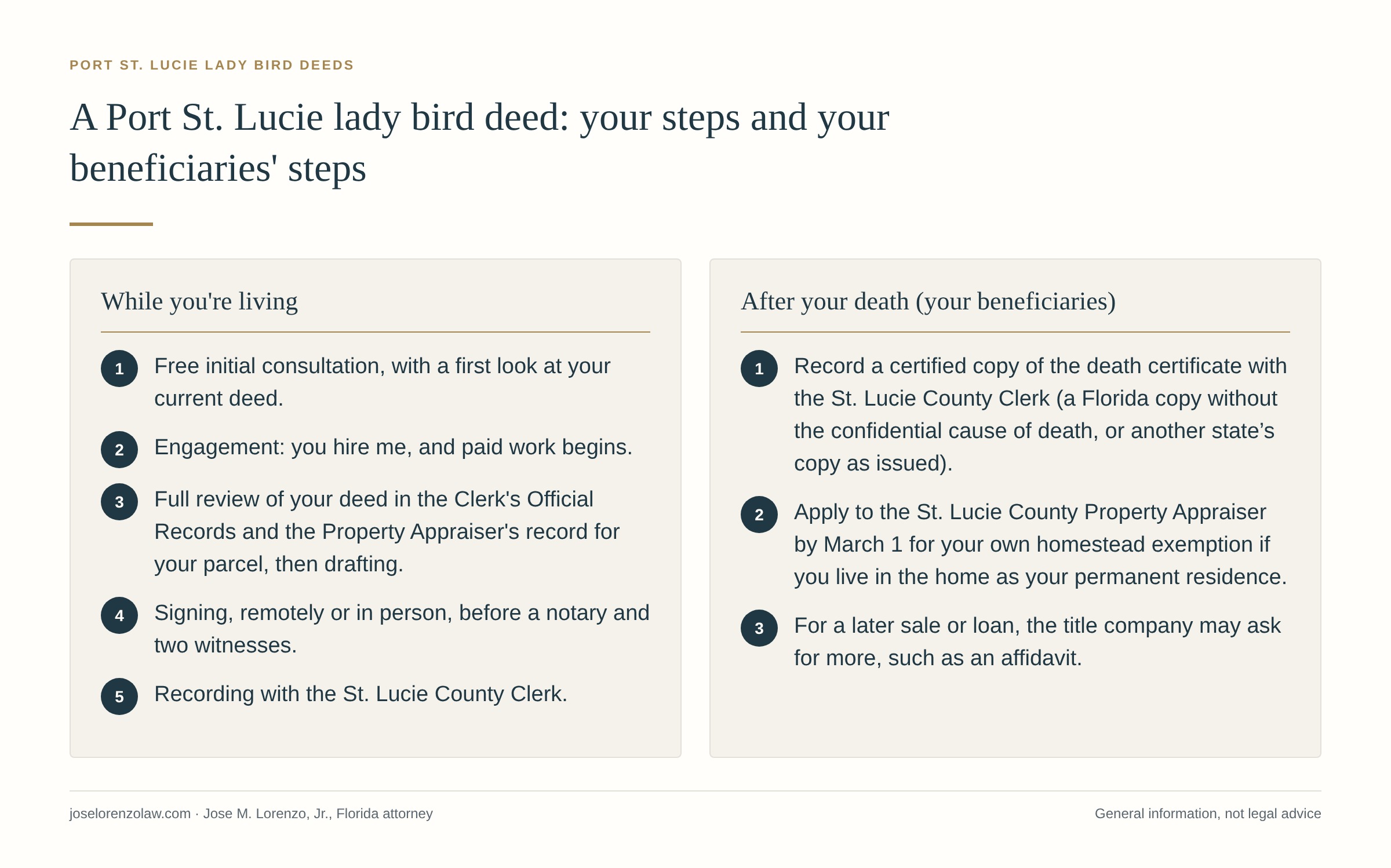
A Port St. Lucie lady bird deed: your steps and your beneficiaries’ steps
While you’re living:
- Free initial consultation, with a first look at your current deed.
- Engagement: you hire me, and paid work begins.
- Full review of your deed in the Clerk’s Official Records and the Property Appraiser’s record for your parcel, then drafting.
- Signing, remotely or in person, before a notary and two witnesses.
- Recording with the St. Lucie County Clerk.
After your death (your beneficiaries):
- Record a certified copy of the death certificate with the St. Lucie County Clerk (a Florida copy without the confidential cause of death, or another state’s copy as issued).
- Apply to the St. Lucie County Property Appraiser by March 1 for your own homestead exemption if you live in the home as your permanent residence.
- For a later sale or loan, the title company may ask for more, such as an affidavit.
Some owners also leave property that has to go through probate. If the owner lived in St. Lucie County, that probate case is filed in the circuit court for St. Lucie County, part of Florida’s Nineteenth Judicial Circuit. If the owner lived in a different Florida county, the main probate is filed in that county. If the owner lived outside Florida, a separate ancillary probate may be needed for other Florida property that did not pass under the Lady Bird deed, and it can be filed in St. Lucie County if the owner left property here. The home itself still passes to the beneficiaries outside probate. My Port St. Lucie probate page covers that process.
Hypotheticals: Five Port St. Lucie Situations
These are illustrative hypotheticals, not actual clients or cases, and are not a prediction or guarantee of any result. Every situation is different.
Hypothetical: a Tradition couple with a mortgage and a 10-year-old
A married couple in Tradition still has fifteen years left on their mortgage, and their son is 10. They want the house to go to him and to his adult half-sister. The mortgage is the smaller issue. The question that can change everything is the minor child: see “What if I have a minor child?” and then the mortgage question.
Hypothetical: a widower whose manufactured home sits on a leased lot
A widower owns a manufactured home in a 55+ community and pays monthly rent for the lot under it. He wants the home to go to his niece. Because the lot is leased, the deed has nothing to attach to: see “What if I rent my lot from the community?”
Hypothetical: a St. Lucie West condo owner who spends summers in Ohio
A retired teacher owns a condominium unit in St. Lucie West and lives in Ohio from May to October. She wants to sign without flying down and to know if anyone records something against her unit while she is away. Three answers apply: the condominium question, signing from out of state in the questions below, and the Property Fraud Alert in the recording table.
Hypothetical: a 55+ homeowner whose only daughter is 52
A widow in a 55+ neighborhood wants to leave her house to her only child, a daughter who is 52 and lives nearby. Owning and living there are different questions, covered under “What if my child is under 55 and the home is in a 55+ community?”
Hypothetical: a daughter in New Jersey calling about her mother’s home
A daughter in New Jersey calls about her widowed mother’s house in Port St. Lucie and asks to set up the deed. Her mother wants the house split among three children. Who the client is comes first, under “How I Prepare”; then what three co-owners mean, under “Several beneficiaries” in Before You Sign, and what happens if one of them dies first.
Before You Sign: Changes, Taxes and Beneficiaries
These points apply to Lady Bird deeds anywhere in Florida, so each gets a short line here, with a link where another page covers it in full.
- Your will. For property under a recorded Lady Bird deed, the deed takes precedence over a will: a will can’t override a Lady Bird deed.
- Selling, refinancing or changing your mind later. See how to change or revoke a Lady Bird deed.
- Divorce. A divorce doesn’t automatically remove a former spouse named as beneficiary; changing that takes a new deed.
- Several beneficiaries. Several beneficiaries take as tenants in common unless the deed gives them a right of survivorship. See Florida partition actions.
- A beneficiary who dies before you. See what happens if a Lady Bird deed beneficiary dies before the owner.
- Taxes. Your beneficiaries receive a new cost basis equal to the home’s value at your death. This assumes you keep your life estate in the home until death. Florida has no inheritance tax, and the federal estate tax applies only to estates worth more than the federal exemption. See tax effects of a Lady Bird deed.
- A quitclaim deed or a living trust instead. A quitclaim deed to someone else ordinarily passes your present interest and keeps no lifetime control for you. See Lady Bird deed vs. quitclaim deed and Lady Bird deed vs. living trust.
- Signing. You must understand the nature and effect of the deed when you sign. For a Lady Bird deed to be valid and recordable, you sign it before two witnesses and a notary; your beneficiaries don’t sign or accept it.
- An agent under a power of attorney. General real-estate authority isn’t enough. See can a power of attorney sign a Lady Bird deed.
Medicaid
Keeping your powers generally means no completed transfer. Giving them up without fair value can be treated as a transfer within the five-year look-back. Florida’s estate recovery statute works through a claim against the probate estate, and Lady Bird deed property passes outside probate. This is general information about the deed’s legal effect, not a promise about your Medicaid eligibility or about Medicaid recovery in your case; Medicaid rules are complex and change, so check them with a Medicaid attorney or the agency. I don’t offer Medicaid planning, real estate closings or title insurance.
Downsides, and when a Lady Bird deed is the wrong tool
- Several properties, incapacity planning or a minor beneficiary. A living trust can fit better when you have several properties or other assets you want to keep out of probate, when you want someone to manage your assets if you lose capacity, or when a beneficiary is a minor.
- Tax expectations. No deed eliminates every tax: a Lady Bird deed doesn’t avoid the federal estate tax when the estate owes it, or income tax if the beneficiaries later sell the home for more than their basis.
What if the property is owned with my spouse or someone else?
If you and your spouse own the home together as a married couple (tenants by the entireties), the survivor owns the whole home when the first spouse dies; both of you can sign a single Lady Bird deed that reserves your lifetime use, so the home passes to the beneficiaries only after the second death. Both spouses must sign that deed; one alone can’t transfer or mortgage property they own together as a married couple.
If the co-owners aren’t married to each other, each can sign a Lady Bird deed for his or her own share only. If that share was held with a right of survivorship, transferring it breaks that right and turns the ownership into a tenancy in common, and what happens at death depends on whether the right of survivorship still exists.
Comparing Port St. Lucie Lady Bird Deed and Estate Planning Attorneys
Questions to ask any lawyer
If you are comparing lawyers for a Lady Bird deed in Port St. Lucie, these questions work with any of them:
- Who drafts the deed, and who reviews the homestead and spouse issues?
- Is recording with the St. Lucie County Clerk included in the fee?
- Who supplies the notary and the two witnesses, and can you sign remotely?
- Is the minimum documentary stamp included, and how is any tax above it identified?
- What happens if the legal description in your current deed is wrong?
- Who will you actually talk to?
I am personally involved in every matter, and my staff assists with the process.
The rest of your plan
A Lady Bird deed covers one property. The rest of an estate plan usually includes a will, a durable power of attorney, a health care surrogate designation and a living will. My flat fees for those documents are on my Florida estate planning page.
Frequently Asked Questions
Do you have an office in Port St. Lucie?
No. I don’t have an office in Port St. Lucie. I serve Port St. Lucie property owners remotely, by phone or video, with online signing, and I record the deed for you. My principal office is in Kissimmee, and meetings in Coral Gables and Fort Lauderdale are by appointment.
Can I sign the deed if I’m out of state or out of the country?
Yes. You can sign by video, without traveling to Florida, before a Florida notary authorized for online notarization and two witnesses; you can even be outside the United States. The notary must be physically in Florida. Any witness who appears remotely must confirm that he or she is both a resident of and physically located in the United States or a U.S. territory. If you are abroad, the law of the country you are in may have its own rules about signing legal documents there; ask before you sign.
Do I need a lawyer to prepare a Lady Bird deed in Port St. Lucie?
You are free to prepare and sign your own deed, and no law requires you to use a lawyer to do so. In Florida, a nonlawyer such as a document preparer or notary may act only as a scrivener — typing onto a deed form the exact information you provide in writing — but may not choose the type of deed for you, draft its terms, or advise you on the reserved powers or on how homestead and spousal rights affect your deed; doing those things for another person is the practice of law. The Clerk’s form is covered in its own section above.
Can one Lady Bird deed cover property in two counties?
One deed can cover more than one parcel, but it must be recorded in each county where any of the land lies. My $675 fee is for one property and one deed, and it doesn’t include documentary stamp tax above the minimum; more than one property or deed is quoted separately, before you hire me. If the property is mortgaged, additional documentary stamp tax may apply; how the tax applies in that situation is unsettled in Florida, and I will explain that risk and any likely cost before you hire me. The full fee terms are under What Does a Lady Bird Deed Cost in Port St. Lucie?.
Does Florida have a transfer-on-death deed?
No. Florida does not have a transfer-on-death (beneficiary) deed statute for real property; Floridians instead use the common-law enhanced life estate, or “Lady Bird,” deed to pass real estate outside probate.
Can Medicaid take my house if I have a Lady Bird deed?
Florida’s estate recovery statute works through a claim against the probate estate, and Lady Bird deed property passes outside probate. This describes the deed’s legal effect only, not your Medicaid eligibility or what recovery may apply in your case. The full answer, with its limits, is under “Medicaid” above.
Talk to Me About Your Port St. Lucie Home
Use the contact form to send your name and the address of the Port St. Lucie home; please don’t attach documents there. If you have a copy of your current deed, I’ll tell you how to send it. I’ll then tell you whether a Lady Bird deed fits your home, what it would involve and what it costs, all before you hire me. I can’t promise a particular result, but I can tell you plainly what your deed allows and what it requires.
Request a free initial consultation. Only the initial consultation is free; representation fees and costs are agreed separately in writing.
Request a free initial consultation·Call (305) 224-6811
If someone has died and you need the recorded deed reviewed, the $475 review described above applies; the free initial consultation is for owners considering a new deed.
My principal office is in Kissimmee, and meetings in Coral Gables and Fort Lauderdale are by appointment. I handle matters throughout Florida by phone or video. Consultations are available in English and Spanish. In Spanish, see my Lady Bird deed guide (in Spanish).
This page provides general information about Florida law, not advice about a particular deed or situation. Reading it or requesting a consultation does not create an attorney-client relationship.
Sources
Florida Constitution and statutes (2026 Florida Statutes, linked to the Florida Senate): Art. X, § 4, Fla. Const.; §§ 7.59, 28.222, 64.011, 64.031, 117.05, 117.021, 117.209, 117.265, 117.285, 190.021, 193.155, 196.011, 196.031, 196.041, 196.061, 201.02, 319.20, 319.22, 319.261, 319.28, 320.015, 382.008, 382.025, 409.9101, 454.23, 605.0110, 605.0501, 668.50, 689.01, 689.07, 689.15, 695.01, 695.03, 695.26, 695.27, 709.2202, 718.104, 718.116, 719.103, 720.303, 720.305, 720.3085, 732.401, 732.4015, 732.4017, 732.702, 732.7025, 733.101, 734.102, 736.1109, 760.29.
Federal (listed without links): 42 U.S.C. § 3607(b); 24 C.F.R. § 100.305; 12 U.S.C. § 1701j-3; Internal Revenue Code §§ 1014, 1015, 2036, 2038, and 2511; Treas. Reg. § 25.2511-2.
Official county and state sources: St. Lucie County Clerk of the Circuit Court and Comptroller (Recording Department; Locations & Hours; E-Recording; Property Fraud Alert; Fees & Costs; Self-Help Forms; Official Records search); St. Lucie County Property Appraiser (FAQ “Recording a New Deed”; File Online – Exemptions; parcel search); Nineteenth Judicial Circuit. Population figures: U.S. Census Bureau QuickFacts (text citation only).