
What Happens to a Bank Account When Someone Dies in Florida?

What happens to a bank account when someone dies in Florida depends on the account agreement, any beneficiary designation and the authority of the person seeking the funds. A surviving joint owner or a qualifying payable-on-death beneficiary may claim directly from the institution. An account in the deceased person’s sole name without a surviving beneficiary generally requires an estate procedure, although a narrow small-account payment may be available without court proceedings.
Talk to me about a bank account after a death — free initial consultationCall (305) 224-6811
Surviving owners and beneficiaries · Family members · Personal representatives · Disputed accounts · Free initial consultation · English and Spanish · Statewide
Leer esta guía en español: cuenta bancaria de un fallecido en Florida
A will can identify beneficiaries and nominate a personal representative, but it does not by itself authorize a bank to release estate funds. A power of attorney ends at the principal’s death. Other arrangements, including statutory convenience accounts, have their own rules; a person’s ability to sign does not establish ownership.
Start by identifying the account and your role. Then ask the bank’s estate-services team for the documents it needs for that particular route. This guide explains account access, closing an account step by step, simplified procedures, documents, unresolved payments and when a dispute needs legal review. If you first need the broader picture, see what to do when someone dies in Florida.
| Joint account with survivorship | Passes to the surviving owner or owners under the account terms, subject to any valid challenge (§ 655.79) |
|---|---|
| Account in both spouses’ names | Goes to the surviving spouse where the tenancy-by-the-entireties arrangement remains valid (§ 655.79(1)) |
| Payable-on-death (POD) account | A surviving party takes first; a qualifying POD beneficiary takes after the sole or last party dies (§ 655.82) |
| Sole name, no beneficiary | Generally needs an estate procedure; a narrow payment of up to $2,000 to a qualifying family member may be available after six months (§ 735.303) |
| Convenience account or signer | A signer is not an owner merely because of signing authority (§ 655.80) |
| Power of attorney | Ends at the principal’s death |
| A will | Can nominate a personal representative, but does not by itself authorize the bank to release estate funds |
| Bank “freeze” | A restriction while the bank confirms the death and who is entitled; it does not decide who owns the money |
| Your attorney | Jose M. Lorenzo, Jr., a solo Florida attorney — the same lawyer from the first call through the end of the matter |
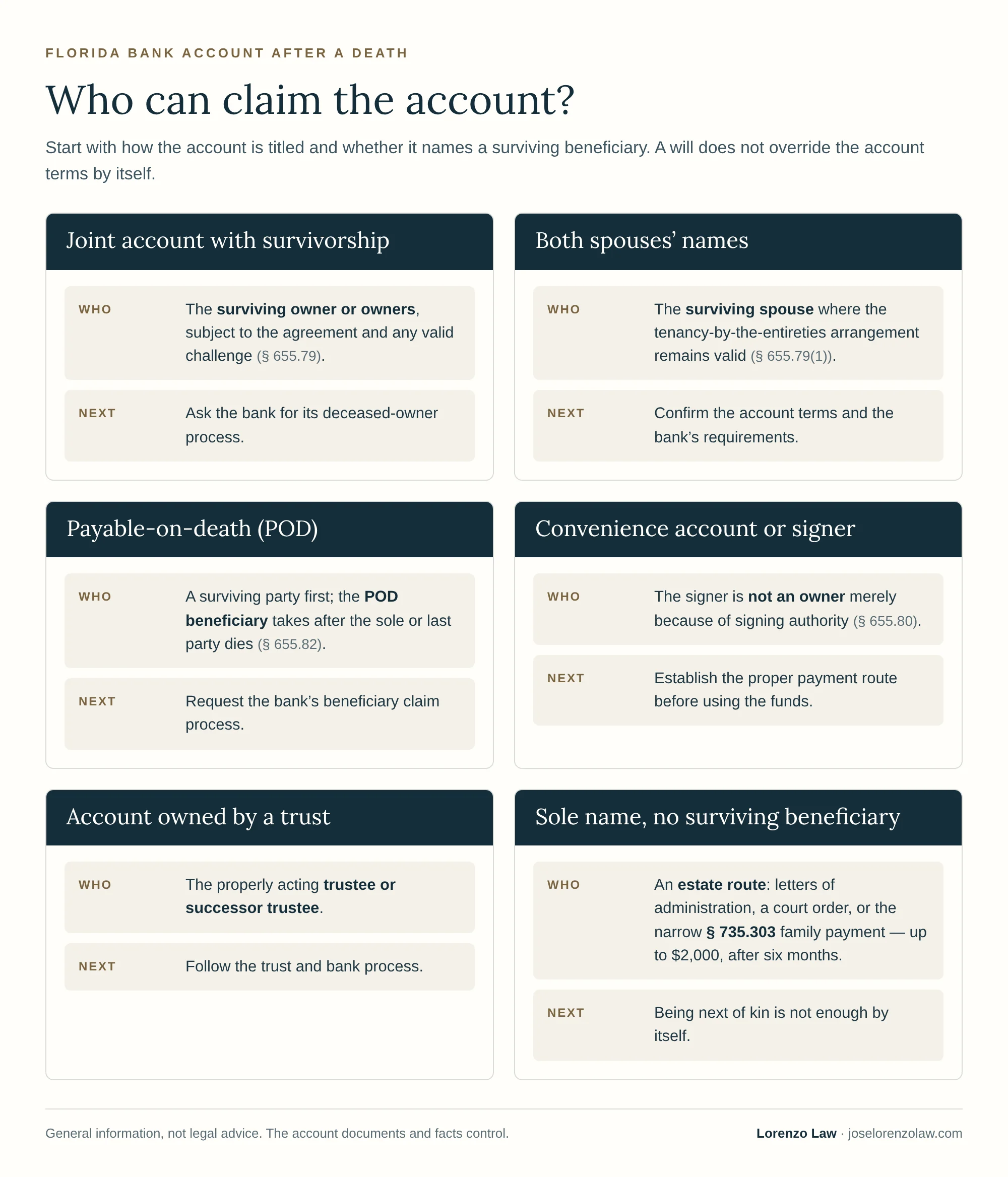
View the “Who can claim the account?” chart (zoom in to read; the details are also in the text above).
In plain terms: Jose M. Lorenzo, Jr. (Florida Bar No. 107002) is a solo Florida attorney who handles bank accounts and estates after a death statewide — survivor and beneficiary claims, small-estate and summary routes, estate administration, and disputed withdrawals or designations — in English and Spanish, with a free initial consultation.
Key Takeaways
- How the account is titled, and whether it names a surviving beneficiary, decides the route to the money. A will does not override that by itself.
- A surviving joint owner or a qualifying payable-on-death (POD) beneficiary usually claims directly from the bank, without probate for that account.
- An account in the deceased person’s sole name with no surviving beneficiary generally needs an estate procedure. A narrow bank payment of up to $2,000 may be available to a qualifying family member after six months.
- A power of attorney ends at death, and signing authority on an account does not make someone an owner. Holding the card or knowing the password is not authority.
- A bank may restrict, or “freeze,” activity on an account, most often a sole-name account, while it confirms the death and who is entitled to the money. The restriction does not decide who owns it.
How the Account Is Titled Decides Who Can Claim It
A statement may help locate the account, but the full account agreement, signature card, beneficiary form and later changes are the better evidence of ownership. Ask what records the institution can provide to you in your role.
| Account arrangement | Who may seek payment or control | Evidence to identify the route | Practical next step |
|---|---|---|---|
| Sole owner with no effective surviving beneficiary | Court-authorized estate representative or recipient; a qualifying family member may have the narrow § 735.303 route | Full ownership and beneficiary records, date of death, estate assets and family information | Review the estate procedures below; being next of kin is not enough by itself |
| Joint deposit account with survivorship | Surviving owner or owners, subject to the agreement and any valid challenge | Signature card, agreement and changes; proof of death and survivor identity | Ask for the deceased-owner process; bank access and final ownership are separate questions |
| Account in both spouses’ names | Surviving spouse where the entireties arrangement remains valid | Written account terms and marital facts | Confirm the arrangement and institution’s requirements; obtain advice about disputed transfers or creditor claims |
| Sole or joint account with POD designation | Surviving party first; qualifying surviving beneficiary after the sole or last party dies | Beneficiary form and amendments, all party names and relevant proof of death | Request the beneficiary claim process; a POD beneficiary does not take while another party survives |
| Joint account expressly without survivorship (sometimes described as tenants in common) | The deceased owner’s interest follows the applicable estate route | Agreement specifying no survivorship and evidence of the parties’ interests | Do not assume all two-name accounts transfer in full to the survivor |
| Statutory convenience account or other signer arrangement | The signer is not an owner merely because of signing authority | Principal/agent designation and full contract; identify which statute applies | Notify the institution and establish the proper payment route before using the funds |
| Account actually owned by a trust | Properly acting trustee or successor trustee | Account title, trust documents or appropriate certification, succession and death evidence | Follow the trust and bank process; a trust that never owned the account does not automatically control it |
Florida’s joint-account presumption and married-account rule are in § 655.79; convenience accounts are addressed in § 655.80, and POD accounts in § 655.82. For the deeper ownership and challenge analysis, see Florida right of survivorship for joint accounts and deeds. For other assets that pass outside an estate, see what assets are exempt from probate in Florida.
What Documents May a Bank Request to Close an Account After Someone Dies?
The bank’s document checklist depends on your route. Use the table below to prepare, then ask the institution which documents it needs for your request.
| Your route | Evidence of legal role | Documents or information the bank may request |
|---|---|---|
| Joint survivor | Account records establishing survivorship | Death certificate, identification, deceased-owner forms and instructions for retitling |
| POD beneficiary | Effective beneficiary record and survival of the sole or last party | Death certificate evidence, identification and beneficiary claim forms |
| Trustee | Trust ownership and authority of the acting trustee | Trust certification or relevant trust records, death evidence and identity documents |
| § 735.303 claimant | All statutory eligibility conditions | Certified death certificate and complete sworn affidavit; any supporting relationship information requested |
| Recipient under a court order | Order or sealed authorization identifying the property and recipient | Certified order/authorization, identity and the institution’s processing instructions |
| Personal representative | Appointment and letters of administration | Certified letters, identity, estate account paperwork and EIN where needed |
These are preparation categories, not a universal checklist. Bank of America Estate Services and the Wells Fargo Estate Care Center publish their own processes, including role review and document submission. Their instructions illustrate institution-specific requirements rather than Florida law for every bank. A trustee’s certification of trust is addressed in § 736.1017.
How many death certificates do you need?
There is no single right number. The number and format of death certificates depend on the institutions and procedures involved. Do not assume every institution needs a retained paper copy; some accept a certified copy and return it, and some accept a secure upload. List the banks, insurers, benefit payers and any court procedure first, then ask each one what it requires before ordering.
Ask the institution how many certified death certificates it needs, whether it accepts a secure upload, and whether originals will be returned. Ask which Florida death-certificate version is appropriate, and avoid sharing cause-of-death information unnecessarily.
Questions to ask the bank’s estate-services team
- What ownership and beneficiary arrangement appears in your records?
- What may you disclose to me in my present role, and what additional authority is needed for statements or historical records?
- Which exact document or certification is missing, and why?
- Is there a review involving pending checks, benefits, a lien, setoff or a competing claim?
- Will payment be made to a beneficiary, named court-order recipient, trustee or estate account?
- How can I submit documents securely and track the request?
Use the bank’s verified contact channel. Do not send full account numbers, Social Security numbers or financial records through a public comment or initial website inquiry.
How to Close a Deceased Person’s Bank Account in Florida, Step by Step
The process for closing a deceased person’s financial accounts is really two separate questions: who is entitled to the money, and what the bank needs before it will act. The steps below are organizational, not statutory deadlines, and the bank’s own estate process controls the paperwork.
- Find out how each account is held. Locate the statements, checkbooks, tax records and any trust or will you lawfully have. Match each account to a row in the ownership table above, and write down the date of death and the county and state where the person lived.
- Identify your role. You may be a surviving joint owner, a POD beneficiary, a successor trustee, a qualifying family member under § 735.303, a person named in a court order, or a court-appointed personal representative. Being a relative or a will beneficiary is not, by itself, one of these roles.
- Notify the bank through its official deceased-customer channel. Ask for the estate-services or bereavement team, keep a reference number, and ask for the document checklist for your specific role. Many banks let you start by phone, by mail or online, so ask whether you must be present at a branch to close the accounts after a death.
- Provide the documents your route requires. A survivor or beneficiary usually needs proof of death, identification and the bank’s claim forms. A sole-name account without a beneficiary needs the § 735.303 affidavit, a court order or letters of administration.
- Deal with pending activity. Review automatic payments, deposits and outstanding checks with the bank before closing anything, and keep essential insurance, mortgage and property services in place.
- Get written confirmation. Ask the bank to confirm in writing whether the account was retitled, paid to a beneficiary, paid to an estate account or closed.
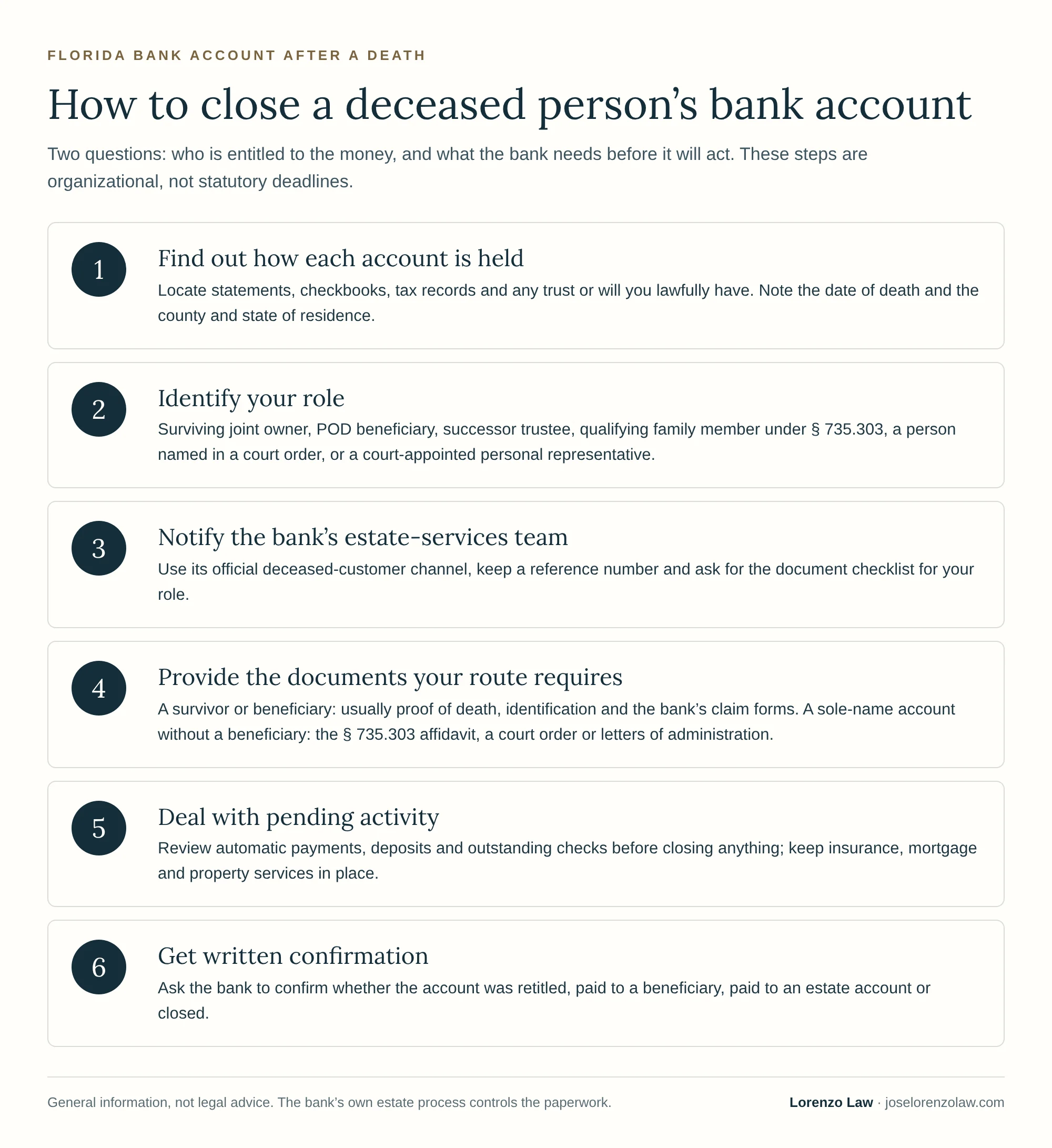
View the “How to close a deceased person’s bank account” chart (zoom in to read; the details are also in the text above).
Who can close a deceased person’s bank account?
Only someone with authority that fits the account. That is a surviving joint owner, a qualifying POD beneficiary, a properly acting trustee of an account the trust owned, a family member who meets every condition of § 735.303, a person named in a court order, or a personal representative holding letters of administration. A power of attorney agent, an authorized signer and a convenience signer cannot close the account as owners, and next-of-kin status alone does not supply authority.
A widow or widower asking how to close a deceased husband’s or wife’s bank account starts with the same question: was the surviving spouse on the account as a joint owner or named as the POD beneficiary? If so, the bank’s deceased-owner or beneficiary process applies. If not, the spouse needs one of the estate routes described below.
Closing a deceased parent’s bank account
When a mother or father dies, adult children are often the ones dealing with the bank, and the first question is whether a child’s name is actually on the account as an owner or a beneficiary. If it is, the child follows the survivor or beneficiary process. If the parent held the account alone with no surviving beneficiary, the child needs an estate route: a qualifying adult child may have the narrow § 735.303 payment if every condition is met, or someone must obtain a court order or be appointed personal representative. A child added only to help pay bills should read the convenience-account section below before using the funds. Starting the process online or by phone does not change the authority question.
Closing an account when there is no will
The absence of a will changes who inherits and who has priority to be appointed; it does not change how a joint or POD account passes, and it does not authorize next of kin to withdraw funds. For a sole-name account, an estate without a will may use formal administration with a court-appointed personal representative, an eligible court procedure without a personal representative, or the narrow bank-payment route. See the probate process in Florida without a will for the court steps.
Is there a letter format for closing a bank account after someone dies?
Usually what the bank needs is not a letter you write but its own estate forms and proof of your authority. A home-made letter cannot supply authority you do not have, and a letter that describes you as an “executor” or claims an ownership interest you do not hold can create problems later. Ask the bank for its deceased-customer forms and submit them with the documents for your role. If the bank asks for a written request, keep it short and factual, and get advice first if ownership is unclear or disputed.
How long can you keep a deceased person’s bank account open?
There is no single closure deadline for every account. The institution generally holds the balance, often with activity restricted, until someone presents the authority to claim it. If nothing happens for long enough, the balance may be treated as dormant and reported to Florida’s unclaimed-property program, where the proper claimant must still establish entitlement. Leaving an account unresolved does not make the money the bank’s, but it does leave automatic payments, deposits and fees unmanaged, so it is better to start the bank’s process promptly.
Certificates of deposit, credit unions and other account types
A certificate of deposit follows the same ownership rules as other deposits, but ask how the institution treats redemption before maturity after an owner’s death; the answer depends on the account terms. Credit-union share accounts follow the credit union’s membership and account terms, with deposit insurance for federally insured credit unions provided through the NCUA rather than the FDIC. Business accounts depend on the business form. A sole proprietor’s business bank account is usually held in the owner’s own name, so the death of a sole proprietor generally leaves that account to be handled like the owner’s other accounts, while an account owned by an LLC or corporation belongs to the company and follows the company’s own authority. Closing a guardianship bank account, or another account opened under a court order, may need instructions from that court. Treat each as its own route rather than assuming it follows the deceased person’s personal checking account.
Where large banks route estate requests
Most large institutions handle a death through a central estate or bereavement unit rather than the local branch. The links below go to the institution’s own published process. They describe that institution’s practice, not Florida law, and requirements change; confirm the current process directly with the institution.
| Institution | Published estate process |
|---|---|
| Bank of America | Estate Services |
| Wells Fargo | Estate Care Center |
| Chase | Estate Services FAQs |
| Capital One | Estate servicing for bank accounts |
| Other banks and credit unions | Ask for the estate, bereavement or deceased-customer team and request its written checklist |
Routes to the Money That Do Not Require a Full Administration
A sole-name account does not always require formal administration. The route depends on the whole estate and the statute’s conditions, not just the balance at one bank. The July 1, 2026 amendments changed several limits; a dollar figure alone does not establish eligibility.
| Route | Conditions and limits | Authority the institution receives |
|---|---|---|
| Family payment without court proceedings | Narrow $2,000 qualified-account route, no earlier than six months after death; see the full conditions immediately below | Certified death certificate and the statutory sworn affidavit; the institution may pay |
| Disposition without administration | Only qualifying personal property: specified exempt property plus nonexempt personal property no greater than preferred funeral expenses and reasonable and necessary medical and hospital expenses of the last 60 days of the last illness | Court authorization under seal under § 735.301 |
| Disposition of a small intestate estate | No will; death more than one year ago; no Florida administration pending; qualifying personal property only. Nonexempt personal property cannot exceed $20,000 plus preferred funeral and qualifying last-illness expenses | Court authorization after the affidavit, creditor inquiry, provision for creditors and required notices under § 735.304 |
| Summary administration | Florida estate subject to administration, less creditor-exempt property, no more than $150,000, OR death more than two years ago; any will must not direct administration under chapter 733 | Order identifying the property and persons entitled to it; no letters of administration |
| Formal administration | Used when summary administration is unavailable or an appointed personal representative is needed; real estate alone does not require this route | Court appointment and letters of administration, followed by estate administration |
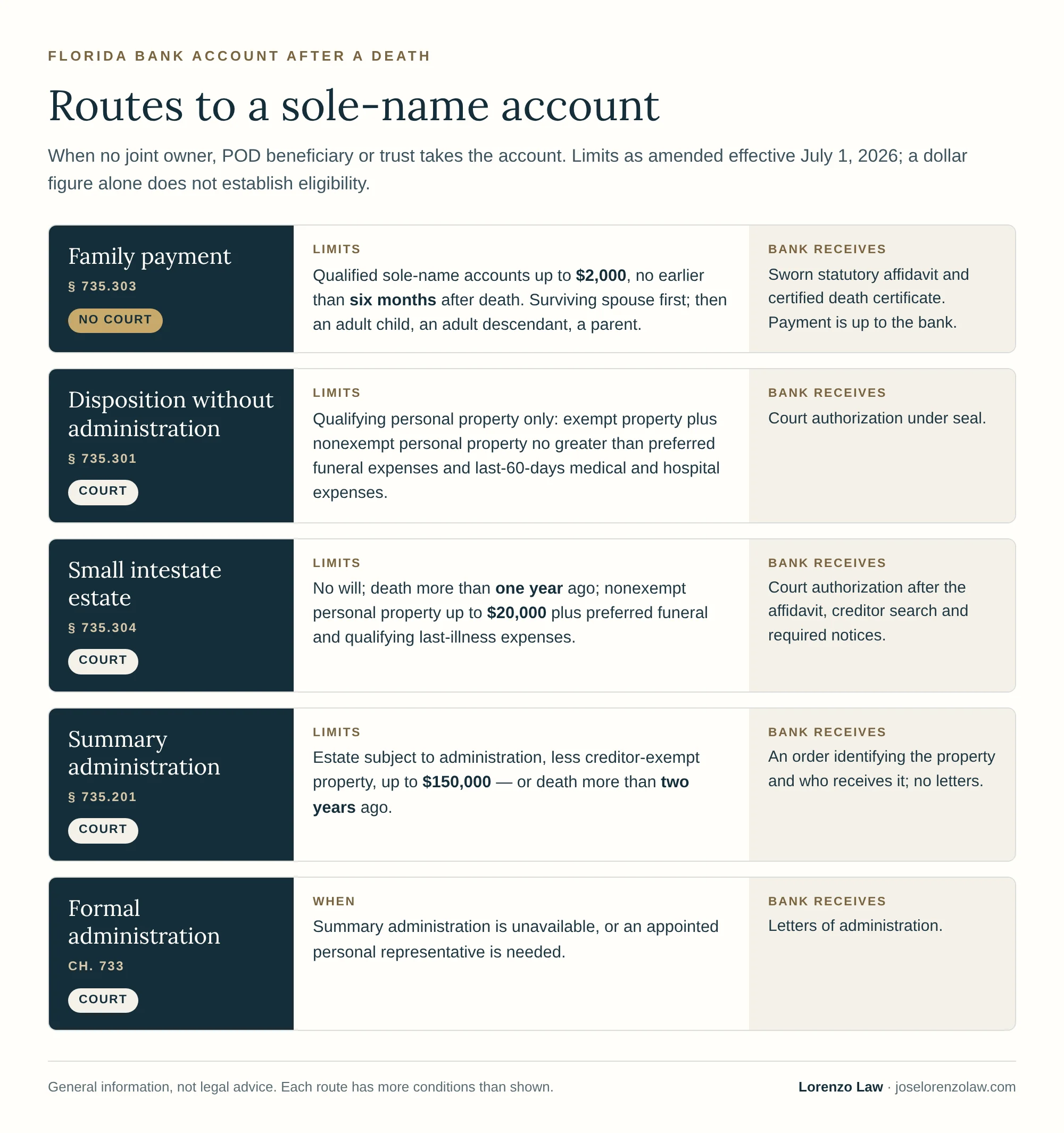
View the “Routes to a sole-name account” chart (zoom in to read; the details are also in the text above).
The narrow $2,000 bank payment
Section 735.303 allows, but does not require, a Florida institution to pay qualified accounts after six months. These are sole-name deposits or CDs without POD or another survivor designation. The institution’s combined qualified accounts must not exceed $2,000; the affidavit also requires the total across all institutions known to the signer to be no more than $2,000.
Eligible family members are the surviving spouse; if none, an adult child; if neither, an adult descendant; and only if none of those survives, a parent. No personal representative may have been appointed and no probate or summary administration commenced. The signer must have no knowledge of a will or other document or agreement distributing the estate. A certified death certificate and sworn affidavit containing the statutory statements are required, including the last residence and date of death, the institution’s discharge, liability acknowledgment and false-statement warning. Recipients can be personally liable to creditors and others entitled to funds exceeding their proper share. Do not sign unless the statements are true.
As for cost, nothing is filed with a court, so there is no court filing fee for this affidavit; the cost is usually limited to having the affidavit sworn before a notary and obtaining a certified death certificate, and the institution may have its own requirements. The statute itself prescribes the affidavit form, titled “Affidavit Under Section 735.303, Florida Statutes, to Obtain Bank Property of Deceased Account Holder.” A form that is signed with an inaccurate statement about the family, the will, other accounts or the waiting period does not protect the person who signs it, and section 735.303 itself provides that knowingly making a false statement in the sworn affidavit to receive a decedent’s funds is theft, punishable as provided in § 812.014. Ask the institution whether it will accept the affidavit at all, since payment is discretionary.
Court procedures for small estates
Section 735.301 has an expense-based formula rather than a single flat account limit. Preferred funeral expenses are the funeral costs that receive Class 2 priority under § 733.707(1)(b), capped at $6,000; whether that cap also limits the § 735.301 threshold has not been decided by any Florida court. Keep invoices and proof of payment, and ask the correct clerk for the application requirements. Eligibility and reimbursement are not guaranteed.
Section 735.304 is a separate court route. It requires a diligent creditor search and reasonable inquiry before filing, payment provision or creditor consent, required signatures or joinders, and formal notice to nonjoining heirs and known or reasonably ascertainable creditors. Notice to AHCA is required if the decedent was over 55 at death. Court authorization and recipient-liability rules apply; it is not an affidavit that any heir can take straight to the bank.
The Florida Probate Rules supply the procedure for the two court routes above: Rule 5.420 for disposition without administration under § 735.301, and Rule 5.425 for small intestate estates under § 735.304.
Summary administration also requires court action and attention to creditors. Its order differs from the authority of an appointed personal representative. These court procedures can be simpler than formal administration, but neither time nor cost is guaranteed. Direct survivor, beneficiary and properly funded trust procedures are different from these estate proceedings. For the full procedure, see summary administration in Florida under the $150,000 test and when Florida probate is not necessary.
A federal income tax refund is a separate issue
Section 735.302 addresses a federal income-tax overpayment of no more than $5,000. It allows a verified application by the surviving spouse or, if none, a child designated in an application purporting to be executed by all children over 14. The application must address debts or creditor exemption and state that no administration, including summary administration, has begun or is planned to the applicant’s knowledge. Follow the IRS refund requirements as well, including IRS Form 1310 (Statement of Person Claiming Refund Due a Deceased Taxpayer) where the IRS requires it. This provision does not unlock an ordinary bank balance.
Does Florida Have a Small Estate Affidavit?
Not in the sense many people expect. Some states let an heir sign a small-estate affidavit and take it straight to the bank. Florida does not have a general, self-executing affidavit of that kind. The closest Florida comes is the narrow § 735.303 bank payment described above: sole-name deposit accounts or CDs only, with no POD or other survivor designation, $2,000 in total, a qualifying family member, no will known to the signer, no administration opened, and no earlier than six months after death, with payment left to the institution’s discretion.
Whether an estate can be settled without probate in Florida depends on what the deceased person owned and how each asset was titled; a small-estate shortcut is only one part of that picture. The procedure that Florida practitioners often call the “small estate affidavit,” § 735.304, is a court proceeding. It is limited to estates without a will, requires that more than a year has passed since the death, and ends with court authorization rather than a document the family signs and presents on its own. Disposition without administration under § 735.301 and summary administration under § 735.201 are court procedures as well.
Do you need an attorney to file a small estate affidavit in Florida? Not necessarily. For the § 735.303 bank affidavit there is nothing to file with a court; the signed affidavit goes to the institution. The court routes are different. Florida Probate Rule 5.030’s attorney requirement is directed at personal representatives, and summary administration, disposition without administration and the § 735.304 procedure do not appoint one, so that rule does not by itself require one. Those petitions still have their own statutory conditions, notices and creditor steps, and a mistake can expose the people who receive the money to later claims.
Online forms sold for a “Florida small estate affidavit” do not change that. Before using any form, identify which statute it is built for and confirm that every condition of that statute is actually met.
Changed on July 1, 2026
Chapter 2026-57, Laws of Florida, raised four dollar figures, effective July 1, 2026:
- Summary administration, § 735.201: $75,000 to $150,000 (or any value if death was more than two years ago).
- Bank payment to a family member, § 735.303: $1,000 to $2,000.
- Small intestate estates, § 735.304: $10,000 to $20,000 (the base figure for nonexempt personal property; preferred funeral and qualifying last-illness expenses are added to it).
- Federal income tax refund, § 735.302: $2,500 to $5,000.
Section 14 of the act states only that the act takes effect July 1, 2026; it has no transition rule for deaths before that date. The better reading is that the new figures apply to a petition, application or affidavit filed or presented on or after July 1, 2026, even if the death was earlier, because each of these routes tests eligibility at that point. For summary administration, § 735.2055 says expressly that the estate must qualify at the time of filing. No Florida court has decided the question yet, so it is not settled; have it reviewed for the specific estate.
Material that still shows $75,000, $10,000 or $1,000 predates the change. Some local court materials have not caught up either: a Broward County administrative order still refers to the old $75,000 summary administration figure.
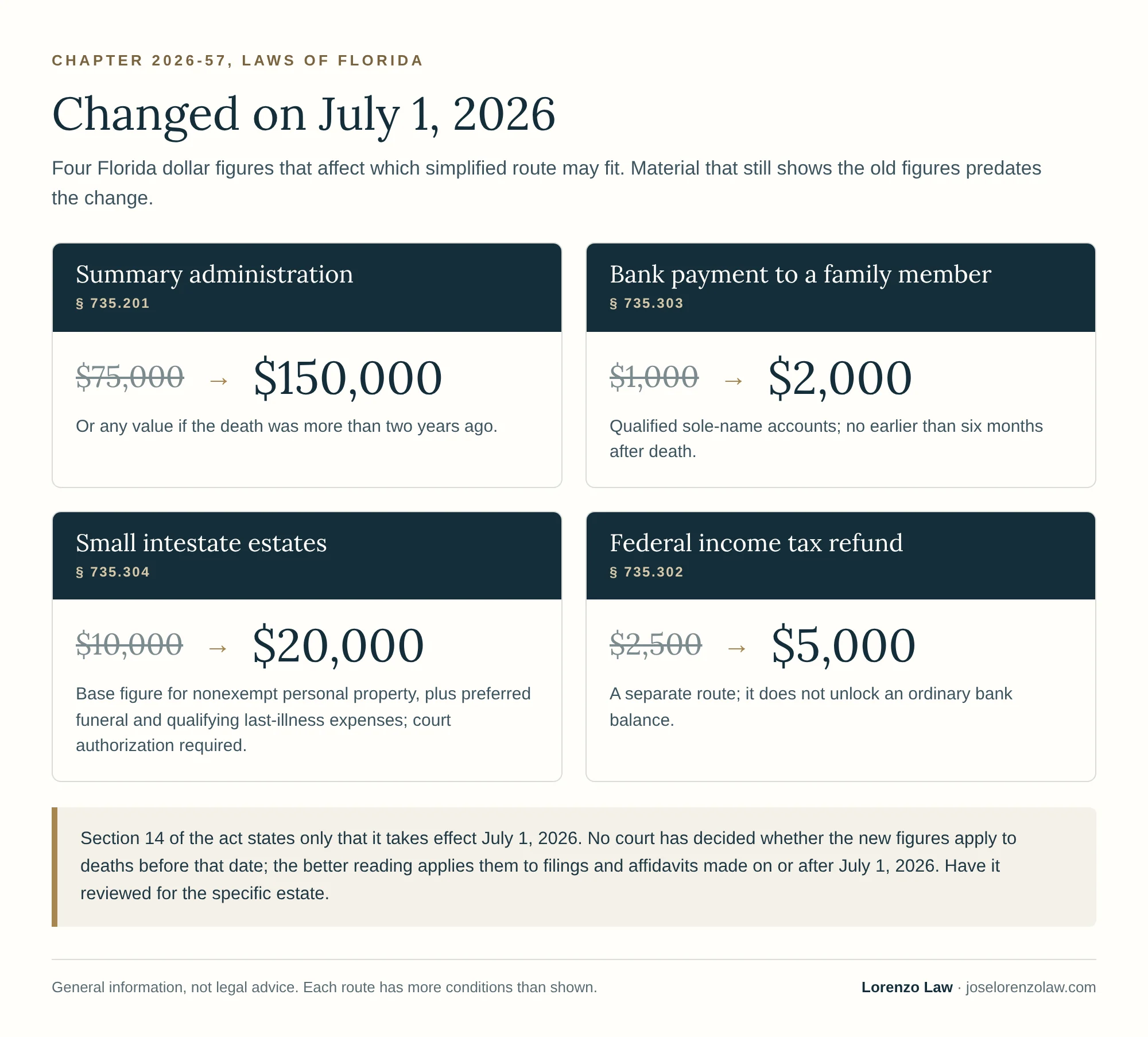
View the “Changed on July 1, 2026” chart (zoom in to read; the details are also in the text above).
Can a bank release funds without probate in Florida?
Yes, in several situations. A valid survivor, POD or funded-trust route may let the institution pay without administering that account in probate. Section 735.303 permits, but does not require, a narrow payment of up to $2,000 to a qualifying family member after six months. Disposition without administration and summary administration avoid formal administration, but both require court authorization before the bank pays.
Does a Bank Account Transfer Automatically When Someone Dies?
Death can change ownership immediately under a valid survivorship or POD arrangement, but it does not automatically complete the bank’s transfer or closure process. The institution still needs to identify the proper recipient and review the required evidence. Sole-name estate funds follow the applicable court or narrow statutory payment route. A beneficiary named only in a will does not gain account access merely by presenting the will.
What happens to a bank account when someone dies without a beneficiary?
If the account was in the deceased person’s sole name and no surviving joint owner or POD beneficiary is named, the balance is generally an estate asset. Someone then needs an estate route to reach it: the narrow § 735.303 payment where every condition is met, a court order under one of the small-estate procedures, or letters of administration. Whether there is a will decides who ultimately inherits that money: the will’s beneficiaries if there is one, and Florida’s intestacy statutes if there is not. Neither one by itself authorizes anyone to withdraw it.
What Happens to a Bank Account When Someone Dies Without a Will in Florida?
Dying without a will is called dying intestate, and it changes who inherits, but it does not change how the account itself passes. Titling still decides first. A joint account with survivorship, a payable-on-death account and a trust account pass the same way whether or not there is a will, because none of them pass under a will in the first place.
What the absence of a will changes is the destination of the sole-name account that falls into the estate. Instead of the beneficiaries the decedent chose, Florida’s intestacy statutes decide.
Under section 732.102, the surviving spouse’s share turns on whose descendants are involved:
- No descendants at all: the spouse takes the entire intestate estate.
- All of the decedent’s descendants are also descendants of the surviving spouse, and the surviving spouse has no other descendant: the spouse takes the entire intestate estate.
- The decedent has a descendant who is not a descendant of the surviving spouse: the spouse takes one-half.
- All of the decedent’s descendants are also the surviving spouse’s descendants, but the surviving spouse has other descendants: the spouse takes one-half.
Where there is no surviving spouse, section 732.103 sends the estate down a fixed order: to the decedent’s descendants; then to the parents equally, or to the survivor of them; then to brothers and sisters and the descendants of deceased brothers and sisters; then outward to grandparents and their descendants, divided between the paternal and maternal lines, and beyond. These examples are not a complete heir determination. Family status and special statutory rules can change the result, so the actual heirs should be confirmed for the specific family.
An estate without a will may use formal administration with a court-appointed personal representative, an eligible court procedure without a personal representative, or the narrow bank-payment route. The absence of a will changes inheritance and appointment questions; it does not itself authorize next of kin to withdraw funds. For more on how Florida handles an estate with no will, see probate in Florida without a will.
Florida law identifies heirs before escheat can apply. A bank does not acquire the money just because no one has yet claimed it. Unclaimed-property reporting and an estate with no lawful heirs are different issues. §§ 732.103, 732.107.
Unmarried partners have no automatic right to the account
Florida’s intestacy order lists a surviving spouse and relatives. It does not include an unmarried partner, however long the relationship. A partner generally receives a deceased person’s account only through a route that names the partner, such as joint ownership with survivorship, a POD designation, a trust or a will, and even a will still has to go through the estate process to reach a sole-name account. Couples who are not married and want each other to have access should review their accounts and estate plans while both are living.
Do Banks Freeze Accounts When Someone Dies in Florida?
A bank may restrict activity once it learns of a death, most often on an account in the deceased person’s sole name. An institution may restrict transactions while it confirms a death, account ownership, payment authority or competing claims. The account agreement, applicable law, court orders and the facts all matter. A restriction does not by itself decide who owns the money, and different accounts at the same institution may need different treatment. Joint checking and savings accounts with a surviving owner are generally handled through the bank’s deceased-owner process, which may involve a review before the survivor’s access is updated, rather than being frozen in the same way as a sole-name account.
Section 674.405 addresses the bank’s authority to process items after a customer’s death. It preserves that authority until the bank knows of the death and has a reasonable opportunity to act; it also permits payment or certification of checks drawn on or before death for ten days after death unless an interested person orders payment stopped. This is not permission for relatives to write new checks or use the deceased person’s card.
How long does a bank freeze an account after death?
There is no fixed period. A restriction generally lasts until the institution has what it needs for the particular route: proof of death and the survivor’s or beneficiary’s claim, the § 735.303 affidavit after the six-month waiting period, a court order, or letters of administration. If ownership is disputed, the bank may hold the funds while the dispute is pending, although notifying the bank alone does not guarantee that, as explained below. Ask the bank what is still outstanding rather than waiting for the restriction to lift on its own.
When and how should you notify the bank?
Notify the institution through its official deceased-customer process and keep a record of the notice. Ask what will happen to each account, pending payments, cards and online access. Gather the account details and your own role first so the call is productive, but do not delay notification in order to keep using the deceased person’s credentials. A survivor should use the institution’s process for their own lawful access.
Do not assume someone else has already told the bank. Banks usually learn of a death when a family member, a funeral home, a personal representative or a benefit payer tells them; reporting a death to one agency or company does not reliably notify every institution where the person had an account. Notify each institution yourself and keep each reference number. The process is generally the same whether the branch is in Miami, New Port Richey or Spring Hill: local branch staff usually route a death notification to the bank’s central estate or deceased-customer team, so ask for that team rather than relying on a conversation at the counter.
Why do some websites say not to tell the bank? The usual suggestion is that staying quiet keeps the money accessible. That is a mistake. A power of attorney ended at death, signing authority is not ownership, and using the deceased person’s card, online banking or checks afterward without authority that fits the account can lead to demands for repayment, civil claims and, depending on the facts, criminal exposure. Notifying the bank does not change who is entitled to the money; it starts the process of paying it to the right person.
What happens if you don’t notify the bank of a death? The account may keep receiving deposits that may later have to be returned, automatic payments may keep drawing on it, and anyone who keeps using it without authority takes on the risks described in this guide. Delay also postpones getting the money to the person who is actually entitled to it.
Getting a restricted account released
Ask the bank, in writing, exactly which document or review is outstanding for each account, and supply the documents for your role from the table above. If the bank is waiting for a court order or letters, the release depends on that court step. If the bank refuses after receiving sufficient authority, see the section on what to do when the bank will not release the funds.
Debit cards, credit cards and online banking after death
Once a bank is notified, it commonly cancels the deceased person’s debit cards and ends their online access to sole-name accounts. Recurring charges set up on those cards may then fail, so list them early and move essential bills to an authorized payer. A surviving joint owner should ask the bank to issue cards and online access in the survivor’s own name rather than continuing to use the deceased person’s card or login. Credit cards in the deceased person’s name are a separate matter: the card issuer’s balance is generally a claim against the estate, discussed in the creditors section below.
If ownership is disputed
If ownership is disputed, notifying the bank alone may not protect the funds. Section 655.83 provides specified court-process and acceptable indemnity-bond routes for an adverse claim. Counsel should evaluate the appropriate remedy promptly; a complaint does not guarantee a freeze.
Joint Bank Accounts and the Right of Survivorship
When two names are on a bank account and one person dies, the starting point is section 655.79(1). A deposit account in two or more names is presumed, unless the contract, agreement or signature card expressly says otherwise, to vest in the survivors on the death of any party.
Subsection (2) limits how that presumption may be overcome: by proof of fraud or undue influence, or by clear and convincing proof of a contrary intent. The statute makes survivorship effective despite the listed absences of lifetime-gift formalities and despite its testamentary character; validity and a supported statutory challenge still require review.
A joint bank account with survivorship is generally not part of the probate estate, so in that sense it avoids probate, although it can still matter for a surviving spouse’s elective share, federal estate-tax questions and any valid challenge to the survivorship arrangement.
Three points from the case law matter in practice:
- Magic words are not required. In In re Estate of Herring, 670 So. 2d 145 (Fla. 1st DCA 1996), the survivorship presumption attached to a certificate of deposit titled in two names even though the account documents contained no express “right of survivorship” language.
- Donative intent is the wrong question. In Davis v. Foulkrod, 642 So. 2d 1129 (Fla. 4th DCA 1994), it was error to decide the issue on donative intent, because the absence of an intent to make a lifetime gift does not prove a contrary intent as to what happens at death. The court also held that “[m]erely driving the decedent to and from his bankers, without more, is insufficient evidence of procuring these joint accounts.” The Fourth District reversed both the finding of a contrary intent and the finding of undue influence.
- The bar for contrary intent is high. In In re Estate of Combee, 601 So. 2d 1165 (Fla. 1992), construing section 658.56, the predecessor of the current statute, the Florida Supreme Court held that evidence the decedent did not intend a present inter vivos gift does not rebut the presumption.
Two separate questions run through every joint-account dispute. One is whether the bank may honor a withdrawal or pay the survivor under the account terms. The other is whether the person who received the money is entitled to keep it. A bank’s payment does not conclusively answer the second question.
Can a joint account holder withdraw money after the other owner dies?
A surviving joint owner of an account with survivorship generally follows the bank’s deceased-owner process and continues as owner. The bank may still review the death, the account terms and any pending items first, and a survivor whose right is challenged should not treat the funds as settled. If the account was in substance a convenience account, or the survivorship presumption is successfully challenged, money already withdrawn may have to be returned. When ownership is uncertain, keep the funds intact until the question is reviewed.
Does a will override a joint or payable-on-death account?
Generally, no. A valid joint account with survivorship and a valid POD designation pass under the account terms and the deposit statutes, not under the will, so a will that leaves “all my bank accounts” to someone else does not by itself redirect them. A joint account with survivorship generally cannot be willed away from the surviving joint owner. The account arrangement can still be challenged on the grounds the law allows, a surviving spouse may have separate rights discussed below, and an account in the deceased person’s sole name with no beneficiary does pass through the estate under the will.
Is adding a child to your bank account a good way to avoid probate?
Adding a child to a bank account so the child receives it at death can move that account outside the estate, but it is a blunt tool. A joint owner may have present rights under the account terms, the survivor may take the whole balance even if the parent intended siblings to share, and the arrangement can lead to later disputes about whether it was truly a joint account or only a convenience arrangement. A POD designation or a trust may keep the account out of the estate with fewer side effects, and a convenience account can give a helper signing authority without ownership, although a convenience account does not keep the money out of the estate. These choices are best made with estate planning advice about beneficiary designations rather than at a branch counter.
Accounts Held by Husband and Wife: Tenancy by the Entireties
Section 655.79(1) contains a second sentence that changes the answer for married couples: “Any deposit or account made in the name of two persons who are husband and wife shall be considered a tenancy by the entirety unless otherwise specified in writing.”
An account validly held as a tenancy by the entirety can receive protection against a creditor of only one spouse. The written terms, marital status, nature of the debt and challenged transaction matter; this is not immunity from every claim. The statutory account rule, and the account-specific holding in Loumpos discussed below, should not be generalized to every asset.
Before the 2008 amendment that added that sentence, the governing authority was Beal Bank, SSB v. Almand & Associates, 780 So. 2d 45 (Fla. 2001), which established that where the required unities are present and the signature card does not expressly disclaim entireties treatment, a presumption of tenancy by the entireties arises and the burden shifts to the creditor. Two things have moved since 2001. The 2008 amendment to section 655.79(1) (ch. 2008-75) put the husband-and-wife presumption in the statute. And in Loumpos v. Bank One, 423 So. 3d 856 (Fla. 2025), the Florida Supreme Court held that section 655.79 authorizes a joint spousal account to be held as a tenancy by the entireties even if the account was originally established by one spouse; there, the husband opened the account alone and the couple executed new signature cards designating entireties ownership months later. The Court held Beal Bank’s common-law unities analysis inapplicable to that scenario, quashing the Second District’s contrary decision at 392 So. 3d 841 (Fla. 2d DCA 2024).
See also Gibson v. Wells Fargo Bank, N.A., 255 So. 3d 944 (Fla. 2d DCA 2018), applying the entireties presumption of Beal Bank and section 655.79(1) to hold that a joint federal tax refund deposited into a spousal account was held as a tenancy by the entireties and was not subject to garnishment by a creditor of one spouse.
Can a surviving spouse access the deceased spouse’s bank account?
It depends on how the account was held. If the spouse’s name was on the account as a joint owner, or the account was held as a tenancy by the entirety, the surviving spouse uses the bank’s deceased-owner process for that account. If the account was in the deceased spouse’s sole name with no beneficiary, being the spouse does not by itself give access; the surviving spouse needs an estate route, although a surviving spouse is first in line for the § 735.303 family payment and has priority for appointment as personal representative when there is no will. A spouse who was left off an account entirely may also have rights described in the surviving-spouse section below.
A widowed spouse who finds themselves shut out of a joint account, with cards canceled or online access blocked after the bank learns of the death, should ask for the deceased-owner process for that account and for new cards and access in the survivor’s own name. A restriction on the deceased spouse’s credentials is not, by itself, a decision about who owns the money.
If your husband died and you are not a joint owner or POD beneficiary of his bank account, being his wife does not by itself give you access to an account in his sole name; you will need one of the estate routes described above.
It is generally not legally necessary to remove a deceased spouse’s name from a joint account right away, but updating the account through the bank’s deceased-owner process keeps direct deposits working in the survivor’s name.
Convenience Accounts and Authorized Signers
A statutory convenience account is in one principal’s name with one or more designated agents; the category excludes certificates of deposit. The funds belong to the principal, and the agent does not inherit them by survivorship. Section 655.80 has its own agency and payment rules, including language that the agency is not affected by death except as otherwise provided in that section. Do not confuse it with a power of attorney or treat it as permission to take the balance personally.
The statute is direct about ownership: “All rights, interests, and claims in, to, and in respect of, such deposits and convenience account and the additions thereto shall be those of the principal only.” It also lists who the institution pays the balance to, including the guardian of the principal’s property, a person designated in an order entered under section 735.206, a person designated under section 735.301, or the personal representative of the deceased principal’s estate, on the notice and proof the section describes.
The full account records matter. A statutory convenience account under § 655.80 is in one principal’s name with another person designated only as an agent. An account titled jointly with survivorship can also be treated as a convenience account in substance, but only if clear and convincing proof shows a contrary intent under § 655.79(2), as in Larkins v. Mendez; the survivorship presumption can also be set aside for fraud or undue influence. A late-added name, help with bills or the source of deposits can be evidence, but none decides the question alone.
How to tell which kind of account you actually have
The two arrangements can look similar on a statement. Start with the account’s actual form: the signature card, the account agreement and any later changes, and whether the bank’s own form is labeled a convenience or agency account. Then look at the surrounding facts. Evidence sometimes raised in disputes includes when and why the second name was added, whether the second person used the account for their own purposes, the contributions each person made to the joint account, and what the account holder said at the time. None of those facts decides the question on its own.
Larkins v. Mendez, 363 So. 3d 140 (Fla. 3d DCA 2023), is a fact-specific illustration of rebutting the § 655.79 presumption. The account was titled a multiple-party account with right of survivorship on a signature card that the decedent and his son had signed. The Third District held that the presumption created by the signature card is rebuttable by clear and convincing proof of a contrary intent, so the probate court was not confined to the four corners of the card; on the evidence, the account was in substance a convenience account and an estate asset. The court affirmed the ownership ruling and separately reversed a contempt order. Larkins does not mean bank paperwork never matters.
Review the account’s actual form first, then the evidence and legal basis for any challenge. A payment allowed by the bank does not conclusively resolve beneficial ownership.
Payable-on-Death Accounts (POD), and Their Disadvantages
A payable-on-death designation can let a qualifying surviving beneficiary claim a deposit account without administering that account as a probate asset. A checking account, a savings account or a certificate of deposit (CD) can carry a POD designation. Here is how a payable-on-death account works in practice: the owner keeps control of the account during life, the beneficiary has no rights while any party is alive, and at the last owner’s death the surviving beneficiary claims the balance through the bank. The claimant must follow the institution’s process and establish entitlement; a death certificate and identification are commonly requested, but they are not a universal guarantee of immediate release.
Section 655.82(3) sets out the order of operations, and it contains a trap. On the death of one of two or more parties, the sums on deposit belong to the surviving party or parties. The POD beneficiary takes only on the death of the sole party or the last survivor, so a surviving joint owner outranks a named POD beneficiary. Subsection (4) adds that a pay-on-death designation in a multiple-party account without right of survivorship is ineffective. If more than one beneficiary survives, they generally take in equal undivided shares under the statute. If no named beneficiary survives, the money belongs to the estate of the last surviving party, which puts it back into the estate process.
This is the distinction the First District drew in Brown v. Brown, 149 So. 3d 108 (Fla. 1st DCA 2014): the section 655.79 rebuttable survivorship presumption applies to joint deposit accounts, and it was error to apply it to POD accounts, which are governed instead by section 655.82.
Claiming a POD account after the owner dies
A valid POD account generally does not go through probate, but the beneficiary still goes through the bank. Ask for the beneficiary claim process, provide the proof of death and identification the bank requests, and confirm that no other party to the account is still living. If the beneficiary is a minor, has died, or is no longer the person the owner would have chosen, ask for advice before signing claim forms.
Totten trust and ITF accounts
Older account paperwork sometimes says “in trust for” (ITF) or calls the account a Totten trust. ITF on a bank account means the owner holds the account “in trust for” a named person, who is meant to receive it at the owner’s death. Securities registered transfer-on-death, governed in Florida by the Florida Uniform Transfer-on-Death Security Registration Act, §§ 711.50–711.512, and retirement accounts have their own governing rules and custodian requirements. A deposit account described as a Totten trust or ITF may fit § 655.82, but those labels do not make it interchangeable with a funded living trust or every brokerage arrangement. Ask the bank how its records classify the account, and treat the label as a starting point rather than the answer.
The disadvantages of a payable on death account
Is it a good idea to put a beneficiary on a bank account? It can keep that account out of probate and give the beneficiary a direct claim, which is why it is popular, but it is not the right tool for every account or every family. When people weigh a bank account beneficiary vs. a will, the key difference is that the designation usually controls that account regardless of what the will says, so the two need to be coordinated rather than treated as alternatives.
To add a payable-on-death beneficiary to a bank account, the owner usually signs the bank’s own beneficiary designation form. An outright payment to an individual may not provide the timing, management or benefits planning that a properly designed trust can offer. Review minor beneficiaries, disability benefits, divorce, deceased beneficiaries and coordination with the estate plan. Divorce can affect a designation under § 732.703 and its exceptions; do not assume an old form always controls. A POD account that holds most of the money can also leave the rest of the estate short of funds for expenses and debts, and a designation that is never updated is a problem nobody notices until it is too late. For future planning, see Florida estate planning.
Can a POD designation be challenged?
Yes. A beneficiary designation is not immune from attack simply because it sits outside the will. In Keul v. Hodges Boulevard Presbyterian Church, 180 So. 3d 1074 (Fla. 1st DCA 2015), the First District confirmed that POD designations may be challenged on grounds including undue influence, fraud, duress and overreaching.
Proving such a claim is a different matter, and the proof depends on the particular claim. In Estate of Kester v. Rocco, 117 So. 3d 1196 (Fla. 1st DCA 2013), the court reversed a finding of undue influence where there was insufficient evidence of active procurement: the beneficiary was not shown to have been present when the designations were changed, gave no instructions to bank staff, and the decedent retained her faculties. A close parent-child relationship and an unsigned, undated memorandum stating a contrary intention were not enough on those facts. Disputed designations are handled through Florida probate litigation.
A Power of Attorney Ends When the Principal Dies
This is a common misunderstanding families bring to a bank, and it is usually discovered at the counter. Section 709.2109(1)(a) lists the events that terminate a power of attorney, and the first is simply that the principal dies. For the full treatment, see does a power of attorney end at death in Florida.
Can a power of attorney close a bank account after death?
No. Once the principal has died, the agent’s authority under the power of attorney is gone, so the agent cannot use it to withdraw, transfer or close the account. Authority over a sole-name account after death comes from the estate process, such as letters of administration, an order of summary administration, another court order, or the narrow § 735.303 payment. If the former agent is also named as personal representative in the will, that role begins only on court appointment. There is no grace period after death, not even a few days, during which an agent may keep withdrawing money under a power of attorney, however long the agent served; the protection in § 709.2109(4) covers only an agent who acts without knowledge of the death and in good faith.
Durable does not mean it survives death
A durable power of attorney under section 709.2104 is one that survives the principal’s incapacity. That is the effect of durability. People reasonably read the word as meaning lasting or permanent, but incapacity and death are different events, and durability answers only incapacity.
Why the bank asks whether the principal is still living
Section 709.2119 allows a financial institution presented with a power of attorney to require an affidavit from the agent stating, among other things, that the principal is alive. Using a power of attorney after a death is therefore a serious step rather than a technicality: the agent may be asked to state something in writing.
The protections in this area are separate. Section 709.2109(4) protects an agent who acts after termination only where the agent acted both without knowledge of the death and in good faith. Section 709.2119 addresses an institution that accepts a power of attorney in good faith without knowledge that it has terminated. Neither protects an agent who knows the principal has died and keeps moving money. Bank and agent conduct require separate analysis.
What happens to an agent who keeps using it
Once the principal dies, the power of attorney has ended, so money a former agent takes from the account after learning of the death is generally treated as taking estate property. Section 733.309 makes any person who takes, converts or intermeddles with a decedent’s property liable to the personal representative or curator for the value of the property and for damages to the estate, and conversion and unjust-enrichment claims may also be available. Section 709.2117, the Power of Attorney Act’s remedy provision, makes an agent who violates the Act liable to the principal or the principal’s successors in interest to restore the lost value and reimburse fees and costs paid from the principal’s funds in defending the agent’s actions. That provision reaches misconduct while the principal was alive; no Florida court has held that it applies to withdrawals made purely after the death. Neither statute is an automatic award of every claimant’s litigation fees.
Can an authorized signer use the account after death?
A signer label alone does not establish ownership or a right to inherit. A power of attorney ends at death, while a statutory convenience account has separate rules. Review the agreement and obtain confirmation of your lawful role before further transactions; knowing the password or holding the deceased person’s card supplies no independent authority.
Several roles feel similar and are not. The table separates ownership from authority and from the payment process.
| Role | Ownership at death | How payment or control happens |
|---|---|---|
| Joint owner with survivorship | Takes by survivorship under the account terms, subject to a valid challenge | Bank’s deceased-owner process |
| POD beneficiary | Takes on the death of the sole or last party, if surviving | Bank’s beneficiary claim process |
| Trustee of an account the trust owned | Holds for the trust, not personally | Bank’s trust process with appropriate certification |
| Convenience agent (§ 655.80) | None; the funds were the principal’s | Paid to the persons § 655.80 lists, not to the agent personally |
| Authorized signer | None by reason of signing authority | No independent route; confirm role with the bank |
| Agent under a power of attorney | None | None; the power ends at death |
| Court-authorized recipient or personal representative | Receives as directed by the order or for the estate | Certified order or letters of administration |
| Qualifying family member under § 735.303 | Receives a discretionary payment, subject to liability for others’ shares | Certified death certificate and statutory affidavit after six months |
Is It Illegal to Withdraw Money From a Deceased Person’s Account in Florida?
It can be, and this is the question people usually ask after they have already done it. Withdrawing or transferring money from a dead person’s account without authority that fits the account means taking money that may belong to someone else, with the civil and criminal risks described below.
Can families withdraw money from a deceased person’s bank account?
Only through authority that fits their role and the account. A surviving joint owner, a qualifying POD beneficiary, a trustee, a personal representative or a court-authorized recipient each follows a different procedure, and a qualifying family member may have the narrow § 735.303 payment. Being a relative, the next of kin or the person who paid the bills does not by itself permit a withdrawal, and the deceased person’s card or password is not independent authority.
What is the punishment for taking money from a deceased person’s account?
Unauthorized use can lead to demands for repayment, an accounting or civil claims. The available claim, defenses, damages and fees depend on the actor’s role, authority, conduct and evidence. Conversion, constructive-trust, civil-theft and other theories are not automatic remedies. Criminal consequences depend on the elements of the offense and the facts; good intentions or repayment do not by themselves decide liability. Taking property of another with the required intent can be theft under section 812.014, and presenting a power of attorney while knowing the principal has died raises a separate problem because the institution may require the agent’s written statement that the principal is alive. Theft under § 812.014 is graded largely by the value taken, so the possible penalty ranges from a misdemeanor to a felony depending on the amount and the facts.
Can I use my parent’s debit card to pay for the funeral?
Do not use the deceased person’s card or login to pay a funeral merely because the bill is legitimate. The authority behind the card ended at death. Ask about an authorized estate-payment or reimbursement route. If you pay personally, preserve invoices and proof of payment; reimbursement depends on the estate, priority rules and applicable procedure. Disposition without administration under § 735.301 is built around funeral and last-illness expenses. Funeral costs receive Class 2 priority only up to $6,000 under § 733.707(1)(b); whether that cap also limits the § 735.301 calculation has not been decided by any Florida court.
If you have already used the account
Stop, and do not spend anything further. If funds have already moved, preserve complete records and seek advice about authority, disclosure, accounting and any corrective payment. Note what each withdrawal actually paid for; a funeral invoice or a utility bill in the decedent’s name is a different fact from a cash withdrawal. Do not alter records or move disputed funds to conceal them, and get advice before signing anything the bank puts in front of you.
How to Get Letters of Administration in Florida
Letters of administration establish the court-appointed personal representative’s authority in formal administration. They are not required for every account transfer, and summary administration produces an order instead. For the court process as a whole, see the Florida probate process.
Where it is filed. For a Florida domiciliary, a petition for administration generally goes to the probate division of the circuit court for the county where the decedent was domiciled at death, not where the bank is. Venue is discussed further below.
What gets filed. Whoever has custody of the original will must deposit it with the clerk within ten days after receiving information that the testator has died, under section 732.901. The petition for administration is then filed with the supporting documents the court requires, including the proposed personal representative’s oath and designation of a resident agent, and notice is given as the rules require.
Who gets appointed. Being named in a will is a nomination, not an appointment. If there is a will, the person it nominates is appointed if qualified. If there is not, section 733.301 sets the order of preference: the surviving spouse, then the person selected by a majority in interest of the heirs, then the heir nearest in degree.
The attorney requirement. Florida Probate Rule 5.030 generally requires a personal representative to have a Florida attorney unless the representative remains the sole interested person; a personal representative admitted to practice law in Florida may represent themselves. Being the only beneficiary does not automatically establish the exception. Summary administration does not appoint a personal representative, so this requirement does not apply in the same way.
What issues, and when. The court signs an order appointing the personal representative and the clerk issues letters under seal. Ask the institution whether it requires recently certified letters and what it considers acceptable. Court appointment timing depends on complete filings, qualification, notice, any bond requirements and the court’s handling of the matter. Appointment, bank processing and final estate distribution are different stages. For timing across the whole estate, see how long probate takes in Florida.
Can an executor withdraw money from a deceased person’s bank account?
In Florida the court-appointed fiduciary is called a personal representative, and the authority comes from appointment, not from being named in the will. Once appointed, the personal representative can collect sole-name estate accounts with certified letters and should move the funds into an estate account, then pay expenses and claims in the order the law requires. Before appointment, the person named in the will has no authority to withdraw from the deceased person’s account, and a personal representative generally does not control accounts that validly passed directly to a survivor or beneficiary, although the estate may recover the funds if the arrangement is successfully challenged. A true convenience account under section 655.80 belongs to the principal and is paid to the personal representative, and even an account titled jointly with survivorship can be shown to be a convenience account by clear and convincing proof of a contrary intent, or set aside for fraud or undue influence, under section 655.79(2), as in Larkins v. Mendez, 363 So. 3d 140 (Fla. 3d DCA 2023).
What to Do When the Bank Will Not Release the Funds
When a bank won’t release funds to an executor (in Florida, the court-appointed personal representative), the cause is usually a mismatch between the document presented and what the institution needs, or a competing claim. Ask the institution to identify the reason for its refusal and refer the request to its estate-services or legal-review team. Keep the reference number, submitted documents and written response. Confirm that you supplied an entered order rather than a petition and that the names, account and recipient match.
A request for additional paperwork should be evaluated, not assumed valid or invalid. Institution requirements do not replace Florida legal authority. If a bank refuses letters of administration or a sufficient order after they are properly presented, or there is a competing ownership claim, counsel can review escalation, an appropriate regulatory complaint or court relief. The correct procedure depends on the dispute and jurisdiction.
The 2026 legislation also created section 733.6125, which addresses proceedings to enforce a personal representative’s authority under the Probate Code. In such a proceeding, the court is directed to award a prevailing personal representative taxable costs, including attorney fees, and may direct payment by a person whose action or inaction made the proceeding necessary. Because the statute took effect July 1, 2026, no reported decision has yet applied it to a financial institution; whether it applies to a particular institution’s refusal requires review of the facts and the authority presented.
If assets need protection before a personal representative qualifies, counsel may consider a curator under § 733.501. Appointment and powers depend on the court; it is not a guaranteed emergency-payment shortcut. For a disputed account, preserve records and ask promptly about protective relief under the applicable procedure.
Opening, Using and Closing the Estate Bank Account
Getting funds out of the deceased person’s sole-name account is the middle of an estate administration, not the end. In Florida, the estate checking account is where those funds are usually held while the estate is administered. A personal representative handling estate funds should keep them separate from personal money and use the proper estate account and tax identification. A valid survivor, POD, trustee or court-ordered direct payment does not automatically have to pass through a formal estate account. Obtain tax advice about the proper recipient and taxpayer rather than treating every released balance as estate income.
How to open an estate bank account
Banks generally open an estate account in the name of the estate, with the personal representative as the authorized fiduciary. Expect to provide certified letters of administration, the personal representative’s identification, and an employer identification number (EIN) for the estate, which is obtained from the IRS. Ask the bank which of its account types it uses for estates and whether it requires its own fiduciary forms.
Using the estate account
Run estate receipts and payments through the estate account, keep every statement, and record what each payment was for. Section 733.707 sets the order of priority for paying expenses and claims. Administration fees, debts, exemptions, creditor procedures, reserves and recipient liability require review before money is distributed, and a premature distribution can create problems for the person who made it.
Closing the estate account
Closing an estate checking account is one of the last steps in administration. The estate account generally stays open until the estate’s expenses, claims and taxes have been addressed and the remaining funds are distributed as the will or intestacy law and the court process require. There is no single rule for how long money has to stay in an estate account; the creditor process, tax filings, any reserve for final expenses and the court’s handling of the final accounting and discharge all affect timing. Before closing it, confirm that outstanding checks have cleared and that interest earned after death has been accounted for, and keep the final statements with the estate records.
Safe Deposit Boxes After Death
A locked box creates its own emergency, usually because the family believes the will is inside it.
A limited search for a will or specified documents differs from taking the box’s contents. Under § 655.935, satisfactory death proof permits a supervised search by the person named in a court order or, when no order has been served, specified family members or a person named personal representative in a copy of a purported will. Only the documents specified by the statute are delivered, to the recipients it identifies.
Section 655.936, amended by chapter 2026-57, addresses a court-appointed personal representative’s access to the box and delivery of its contents on certified letters. The 2026 amendments to sections 655.933 and 655.936 also provide for the personal representative, or the personal representative’s attorney, to pay the accumulated charges and terminate the lease, so an unused box does not keep billing the estate. The initial opening of the box must comply with section 733.6065, which governs the inventory procedure following a lessee’s death.
Under § 655.936(2), delivery to an out-of-state personal representative is discretionary after three months from issuance of their letters, if the lessor has received no written notice of a Florida appointment. The required affidavit addresses non-Florida domicile and no unpaid Florida creditors; certified letters and an itemized receipt are also involved. The period runs from letters, not death.
What Happens to Social Security and Automatic Payments After Death?
Deposits and withdrawals do not stop on their own when a person dies, and this catches families off guard.
Social Security. Families often call the return of post-death benefit payments a Social Security “clawback” after death. Social Security retirement and disability benefits under Title II are not due for the month of death or later months. SSI follows a different month-of-death rule. A deposit date alone does not establish the month covered or final entitlement. A Social Security reclamation concerns the benefit payments themselves rather than freezing the whole account, although the bank may restrict the account for its own reasons once it learns of the death. Notify SSA and the institution, identify the benefit and payment period, and do not spend a disputed deposit while return or underpayment procedures are being resolved. SSA reclamation guidance.
Veterans Affairs and pensions. VA benefits and pensions have program-specific rules, including possible survivor benefits. Notify the payer and ask which payments must be returned; do not assume every post-death payment follows the Social Security rule.
Automatic debits. List automatic debits and contact providers through an authorized person to stop or redirect payments as appropriate. Do not indiscriminately cancel essential insurance, mortgage or property services.
Outstanding checks. Checks written before death require separate review under § 674.405 and, where applicable, § 655.82(5); a continuing bank-processing power is not authority to write new checks.
The practical rule: reconcile each account as of the date of death, list everything that came in or went out afterward, and treat the post-death items as a separate problem to resolve rather than as part of a balance someone is entitled to distribute.
Checks and deposits that arrive after death
Refunds, final paychecks, dividends and other payments often arrive made out to the person who died. A check payable to the deceased person is not a check payable to the family. Money can sometimes still be deposited into an account that is restricted after a death, but whether the bank accepts, holds or returns a deposit depends on the account, the payer and the bank’s process. Do not sign the deceased person’s name to endorse a check, and do not deposit it into your own or a joint account unless you are actually entitled to that payment. A check made out to the deceased person that was still uncashed at death generally becomes an estate asset, and a family member who deposits it keeps the money only by proving a gift by clear and satisfactory evidence (Sharps v. Sharps, 214 So. 2d 492, 495 (Fla. 3d DCA 1968)). Signing the deceased person’s name with intent to defraud can also be forgery under § 831.01, a third-degree felony. Depending on what the payment is and how it was owed, it may belong to the estate, to a beneficiary or to a surviving owner. When a personal representative has been appointed, estate receipts are generally deposited to the estate account; some payers will instead reissue the payment to the proper recipient once they receive proof of death and authority. Federal benefit payments for periods after death follow the return rules described above.
A check written by someone who has since died is a different situation. If you received a check from someone who died, the bank may still pay it for a limited time under § 674.405, described above, unless an interested person stops payment. Whether you may keep the money can depend on what the check was for; a gift check that was not paid before the death can raise a separate question.
How Do You Find a Deceased Person’s Bank Accounts?
Families routinely discover that they do not know where a parent banked. Start with records you lawfully possess or can obtain.
- The paper trail. Recent mail, checkbooks and statements, the most recent federal tax return (interest income can reveal institutions), and the decedent’s own records.
- The institutions themselves. What a bank can disclose depends on your role, applicable confidentiality rules and the documentation or legal process supplied. Reporting a death does not automatically entitle a relative to balances or transaction history. A personal representative, once appointed, is in a stronger position to make inquiries.
- Florida unclaimed property. Dormant balances may be reported to Florida’s unclaimed-property program, which the Florida Department of Financial Services runs as Florida Treasure Hunt at FLTreasureHunt.gov. Search through the official program and follow its deceased-owner claim requirements. A search result does not establish the claimant’s entitlement. This is distinct from an estate passing to the state because there are no lawful heirs. See claiming Florida unclaimed property for a deceased owner.
- The safe deposit box, under the limited search described above.
Creditors, Debts and the Account
Two questions come up constantly, and they have different answers.
“Am I responsible for my parent’s debts?” Generally, debts are paid from the estate, not by family members personally. A relative’s own contractual liability is different: a co-signer or joint obligor on a debt can be liable in their own right, and a person who receives estate property they were not entitled to can face claims. See what happens to your debt when you die in Florida.
“Am I legally responsible for paying my husband’s debts if he dies in Florida?” The same starting point applies to a surviving spouse: a debt in the deceased spouse’s sole name is generally a claim against his estate, not a personal debt of the widow. Florida no longer applies the old “doctrine of necessaries,” so a widow is not liable for her husband’s medical or hospital bills merely because they were married (Connor v. Southwest Florida Regional Medical Center, Inc., 668 So. 2d 175 (Fla. 1995)). The answer changes for a debt she also signed, co-signed or guaranteed, including a joint credit account or an admission agreement signed in her own name. Review the actual account and loan documents before paying a creditor from personal funds.
“Can creditors reach the POD or joint account?” Passing outside probate does not answer every creditor or family-rights question. Review any lien or setoff, the ownership arrangement, pre-death payment requests, alleged improper transfers and the specific legal basis for a claim. An insufficient probate estate does not, by itself, make every joint or POD balance available to ordinary estate creditors.
What happens to credit card debt? A card balance in the deceased person’s name is generally a claim against the estate and is paid, if at all, in the § 733.707 order. A joint account holder on the card is a different matter, because that person may be contractually liable in their own right; an authorized user generally is not, though card agreements vary. A mortgage does not disappear at death, but it is secured by the property and does not become an heir’s personal obligation simply because the heir inherits.
If the Surviving Spouse Was Cut Out
A surviving spouse may have rights that are not resolved by a POD form. Florida’s elective estate can include specified nonprobate interests, subject to statutory calculations, exclusions and valid waivers. Family allowance and exempt property are separate issues. Obtain advice promptly about eligibility and applicable deadlines; do not assume every account contributes its full balance or every spouse has the same remedy.
Under section 732.201, the surviving spouse of a person who died domiciled in Florida has the right to an elective share, and section 732.2065 sets the amount at 30 percent of the elective estate, calculated as the statutes provide. Whether a particular account is included, and how much of it, depends on those calculations and any waiver. See the Florida elective share for the deadlines and procedure.
When a Joint Owner or Agent Drains the Account
The fact pattern is familiar: one sibling held the card, or the power of attorney, or was added to the account, and by the time anyone looks the balance is gone. Siblings fighting over a parent’s joint account usually disagree about two things: whether the account was truly joint or only for convenience, and whether money taken before or after the death was authorized.
The available remedies depend on the role that person held and on the evidence. If they acted as an agent under a power of attorney and misused the money while the parent was alive, section 709.2117 can require restoration of the lost value and reimbursement of fees and costs paid from the parent’s funds in defending the agent’s actions. Money taken after the death is generally pursued by the personal representative under section 733.309, which makes a person who takes or converts a decedent’s property liable for its value and for damages to the estate. If they took money that was not theirs, civil claims may be available depending on the facts; conversion, constructive-trust, civil-theft and other theories are not automatic remedies. If the account was in substance a convenience account under section 655.80, the funds belonged to the principal, and the estate’s claim turns on that showing.
Two practical notes. Move promptly, because money that has been spent is harder to recover than money still in an account. And preserve the records you have. Counsel will assess who has standing to seek the records, the available authority or discovery process, the transaction history and the evidence supporting or defending the claim.
Routine administration and a contested ownership claim may require different representation. See Florida probate administration for estate procedures and Florida probate litigation for a disputed estate account. A trust-specific dispute may require trust litigation.
Out-of-State Decedent With a Florida Bank Account
An out-of-state death does not automatically require a second probate proceeding just because the institution has a Florida branch. Identify the account arrangement, the estate proceeding and the authority the institution will accept. Direct survivor or beneficiary procedures may apply.
For estate personal property, § 734.101(4) authorizes payment or delivery to a foreign personal representative after 90 days from appointment when no written demand has been received from a Florida personal representative or curator, except for safe-deposit-box contents, which follow the separate rules in § 655.936. It does not compel every bank payment. Ancillary administration under § 734.102 or another eligible procedure may still be needed; have the actual facts reviewed before opening a second estate. See ancillary probate in Florida.
FDIC Coverage After the Owner Dies
The FDIC generally calculates a deceased owner’s deposit insurance as though the owner were alive for six months after death, unless an authorized person restructures the accounts earlier. Afterward, actual ownership and the applicable insurance category control. This is not extra coverage for every balance or a deadline for receiving an inheritance. Ask the bank or FDIC to review coverage before retitling or distributing large deposits. Credit-union coverage requires its own NCUA review. FDIC guidance.
Tax on an Inherited Bank Account
An inherited cash balance generally is not federal income to the recipient merely because it was inherited. Interest is different. Who reports it depends on the account ownership, when it was received or available, the deceased person’s accounting method and whether it is income in respect of a decedent. Interest earned before death but received afterward does not automatically belong on the final individual return. Post-death interest can belong to the estate or another proper recipient, depending on the account. IRS Publication 559.
Florida does not impose an estate tax for deaths on or after January 1, 2005. Federal estate-tax and reporting questions are separate from whether the account avoids probate; a POD designation does not itself remove property from the federal gross estate. Retirement accounts have separate income-tax and distribution rules. Ask a tax professional to reconcile the death-date balance, later interest, Forms 1099 and the correct returns. Florida Department of Revenue.
Is money from a payable-on-death account taxable?
The balance a POD beneficiary receives is generally not income to the beneficiary merely because it was inherited, but interest is treated separately, as described above, and the account can still matter for federal estate-tax purposes. Keep the bank’s death-date balance and any Form 1099 the institution issues, and confirm the reporting with a tax professional.
Costs and Timeframes
Timing has three different parts that are easy to confuse: any statutory waiting period, the bank’s processing, and completion of the estate as a whole.
| Route | What controls timing |
|---|---|
| Survivor or POD claim | No universal release period. Complete proof, account terms, institution review, pending payments and any dispute |
| § 735.303 | A statutory minimum of six months after death, plus institution processing; payment remains discretionary |
| Disposition or summary administration | Eligibility, complete filings, required notice, creditors, court review and later bank processing |
| Formal administration | Appointment and letters may occur before final distribution; creditors, taxes, asset issues and disputes affect completion |
| Contested account | Evidence, parties, protective proceedings, discovery, settlement or trial |
Ask for an estimate tied to the actual route and whether it concerns access, an initial payment or final closure. No estimate guarantees a court or institution’s timing.
An initial consultation with Lorenzo Law is free. Representation fees and costs are set separately in a written agreement. For the firm’s current administration scope and fee information, see Florida probate lawyer. The appropriate payer and any reimbursement from an estate depend on the representation and governing rules; do not assume every beneficiary’s dispute fees will be paid by the estate.
Where These Matters Are Filed
For a Florida domiciliary estate, venue generally follows the decedent’s domicile under § 733.101. Nonresident estates have separate venue rules. A disputed account’s parties and requested relief can affect the proper proceeding. The bank’s location does not, by itself, decide where an estate is opened.
Probate matters are heard in the probate division of the circuit court. The table below shows the judicial circuit for some of Florida’s most populous counties, as examples; each clerk of court publishes its own probate filing information.
| County of domicile | Judicial circuit |
|---|---|
| Miami-Dade | Eleventh |
| Broward | Seventeenth |
| Palm Beach | Fifteenth |
| Orange and Osceola | Ninth |
| Hillsborough | Thirteenth |
| Pinellas and Pasco (including Clearwater, St. Petersburg and New Port Richey) | Sixth |
| Duval | Fourth |
| Lee and Collier | Twentieth |
| Polk | Tenth |
| Brevard and Seminole | Eighteenth |
| Volusia | Seventh |
| Sarasota and Manatee | Twelfth |
| Hernando (including Brooksville and Spring Hill), Lake, Marion and Sumter | Fifth |
| St. Lucie and Martin | Nineteenth |
Whether you search for a “small estate affidavit” in Broward County or any other county, the same statewide procedures apply; the local clerk’s probate division can explain its filing requirements for the court routes.
Lorenzo Law handles Florida probate matters throughout the state. The principal office is in Kissimmee, Florida; meetings in Coral Gables and Fort Lauderdale are by appointment. Consultations are available in English and Spanish, by phone or by appointment.
Worked Examples
These are hypothetical illustrations, not advice or reported results.
- $1,800 sole-name account and a death four months ago. Section 735.303 is not yet available because six months have not elapsed. Even later, all family, account, will and administration conditions must be met, including the aggregate across known institutions. A $1,800 balance is above the old $1,000 figure and within the new $2,000 figure. If the death occurred before July 1, 2026, whether the new figure applies is not yet settled; the better reading is that it does if the affidavit is presented on or after that date (see “Changed on July 1, 2026” above). Waiting is not the only option; another eligible procedure may fit.
- $16,000 sole-name savings account, no will, no preferred funeral or last-illness expenses to add, death fourteen months ago. Section 735.304 may fit if the entire estate contains only qualifying personal property, no Florida administration is pending, and the creditor, notice and application requirements are met. With no expenses to add, $16,000 is above the old $10,000 figure and within the new $20,000 figure. Because this death occurred before July 1, 2026, whether the new figure applies is not yet settled; the better reading is that it does if the affidavit is filed on or after that date (see “Changed on July 1, 2026” above). The account balance alone does not establish eligibility.
- $9,000 nonexempt bank balance and an $11,000 funeral bill, with no other qualifying expenses. The funeral invoice alone does not establish § 735.301 eligibility: the preferred funeral amount is capped at $6,000. Review any qualifying last-illness expenses and other estate facts before choosing a route.
- $120,000 in sole-name accounts and a will. Summary administration may fit if this is the relevant Florida estate value after creditor-exempt property is excluded, the will does not direct chapter 733 administration and other requirements are met. It is not guaranteed to be faster or cheaper, and an earlier death raises the July 1, 2026 question described above.
- $400,000 and a house. Determine which assets actually require administration, exemptions, date of death, the will and need for a personal representative. Formal administration may be needed, but a death more than two years ago or nonprobate/exempt assets can change the analysis. A house alone does not require formal administration.
Common Myths, Corrected
“The power of attorney still works, so I can withdraw funds for the funeral.” No. The power terminates at the principal’s death under section 709.2109(1)(a). Ask about an authorized estate-payment or reimbursement route instead; disposition without administration under section 735.301 is built around funeral and last-illness expenses.
“Having a will means we do not have to go through probate.” No. A will tells the court who should be in charge and who takes what. Survivorship, valid beneficiary designations and funded trusts are the usual ways an account passes outside the estate.
“The bank will release funds to the next of kin or the surviving spouse.” Not on that basis alone. Being the spouse, the only child or the person who paid the bills does not, by itself, give authority over a sole-name account. Authority comes from a route that fits the account, such as survivorship or a beneficiary designation, ownership by a trust, the narrow § 735.303 payment, a court order, or letters of administration.
“Summary administration avoids court.” No. Summary administration and disposition without administration are court procedures with a petition and an order. They can be simpler than formal administration, but they are not the same as a direct survivor or beneficiary claim.
“Once the bank freezes the account, the bank decides who gets the money.” No. A restriction is the bank’s process while it verifies the death and the claimant’s authority. Ownership is decided by the account terms, the law and, if necessary, a court.
“We can split the money as soon as we get access.” Not safely. Administration expenses, debts, exemptions, creditor procedures and reserves have to be addressed first, and a recipient can be liable for funds beyond their proper share.
“If there is no will, the State of Florida takes the money.” No. Florida law identifies heirs before escheat can apply. A bank does not acquire the money just because no one has yet claimed it, and unclaimed-property reporting is a different issue from an estate with no lawful heirs.
“We need to order ten death certificates.” Not necessarily. The number and format of death certificates depend on the institutions and procedures involved; check before ordering.
“Direct deposits stop automatically when someone dies.” No. Payers need to be notified, and federal benefits paid for periods after death may have to be returned.
Quick Checklist
- Locate lawfully available statements, account documents, the will and any trust; record the date of death and domicile.
- Notify institutions and benefit payers through official channels; preserve confirmation and reference numbers.
- Identify each account’s ownership, beneficiary record and your role. Request its specific document checklist.
- Review pending deposits, checks and automatic payments with the authorized person. Preserve essential property coverage and services.
- Select the correct direct-claim, trust or estate route. Obtain any necessary court authority and then follow the institution’s process.
- Preserve a complete accounting of receipts, payments, transfers and correspondence. Seek review promptly if authority, ownership or a withdrawal is disputed.
These are organizational steps, not statutory deadlines. A will custodian’s separate § 732.901 deposit obligation and any notice or court deadline still require attention. An inquiry to a lawyer does not extend a deadline. For the dates that do apply in a Florida estate, see Florida probate rules and deadlines.
Discuss Your Florida Bank Account Question With Me
Whether you are claiming an account as a survivor or beneficiary, handling a sole-name account as a family member or personal representative, or facing a disputed withdrawal, the first step is to identify the account, its documents and your role. I’m Jose M. Lorenzo, Jr., and as a solo attorney I handle your matter myself. Lorenzo Law offers a free initial consultation about Florida probate, estate and account matters. Representation, fees and costs are addressed separately in an engagement agreement.
Request a free initial consultationCall (305) 224-6811
For your initial consultation about a bank account after a death, tell Lorenzo Law the date of death, the person’s county and state of residence, the account type, your role, whether a court case is open and what the bank has requested. Mention any disputed withdrawal, notice or deadline. Keep the initial message brief and wait for secure document instructions before sending sensitive records.
Consultations are available in English and Spanish, by phone and by appointment. Learn more about Jose’s practice.
Disclaimer: This guide provides general information about Florida law and does not constitute legal advice, nor does reading it create an attorney-client relationship. Statutory thresholds and procedures change; the figures above reflect Florida law as amended by chapter 2026-57, effective July 1, 2026. Every estate is different. Consult a Florida probate attorney about your specific situation.
Frequently Asked Questions About a Bank Account When Someone Dies in Florida
How long does it take to close a bank account after death?
Timing depends on ownership, complete documents, the bank’s review and any court process or dispute. Distinguish account access from final estate distribution. The § 735.303 route cannot be used before six months after death; other routes do not share that universal waiting period, though some have their own conditions, such as the more-than-one-year requirement in § 735.304.
Can you withdraw money from a deceased person’s account?
Only through authority applicable to your role and the account. Survivors, qualifying beneficiaries, trustees, personal representatives and court-authorized recipients follow different procedures. A narrow statutory family payment may also apply. The deceased person’s card or password is not independent authority.
Do banks freeze accounts after death in Florida?
An institution may restrict activity while it reviews the death, ownership and authority. Contract terms, law, pending items and disputes affect the response. A restriction does not decide final ownership; ask the bank what documents or review remain outstanding.
Can you close a bank account without probate in Florida?
A valid survivor, POD or funded-trust route may avoid administering that account in probate. Section 735.303 offers a narrow discretionary family payment with all the conditions explained above. Summary administration and disposition without administration require court authorization.
How do I close a bank account after death in Florida?
Establish how the account is held, your legal role and the bank’s document requirements. Complete the appropriate beneficiary, survivor, trustee or estate procedure, reconcile pending activity and obtain written confirmation of transfer or closure.
My name is not on the account. Can I still close it?
Possibly, if you establish authority through the applicable estate or statutory process. Being a relative or will beneficiary alone is insufficient. Ask which role and documents the bank requires; do not overlook an eligible court-order or § 735.303 route.
Do I need probate to get money from a bank account in Florida?
It depends on ownership and the available procedure. Survivorship, a valid POD arrangement or trust ownership may allow a direct claim. A sole-name account without an effective surviving beneficiary usually needs an estate procedure, with the narrow § 735.303 exception.
What if the bank will not release the funds?
Obtain the specific reason, confirm the entered documents and escalate to the estate-services team. Persistent refusal or disputed ownership may require legal review of the correct complaint or court procedure. A curator or protective order is not automatic.
My father added my name to his account so I could pay his bills. Is the money mine now?
Not necessarily. Determine whether you were a co-owner, statutory convenience agent or another signer. A joint-account survivorship presumption can be challenged on the statutory grounds, but helping with bills alone does not automatically resolve ownership. Review the full records before spending disputed funds.
Can a payable-on-death designation be challenged?
Yes, potentially on grounds such as undue influence, fraud, duress or overreaching. The proper claimant, proof and defenses depend on the particular claim. Disagreement with the designation alone does not invalidate it.
What happens to Social Security payments deposited after death?
Identify the benefit and the month covered, and contact SSA and the bank. Title II benefits are not due for the month of death or later; SSI differs. A deposit arriving after death may require return or an underpayment claim. Do not spend it based only on the deposit date.
The decedent lived in another state but banked in Florida. What now?
Ask what authority the institution will accept and review the existing estate proceeding. A direct transfer, foreign-representative payment under § 734.101 or an eligible Florida proceeding may fit. A Florida branch alone does not establish that ancillary administration is required.
Who can open a safe deposit box after death?
A supervised search for specified documents under § 655.935 is distinct from a personal representative removing contents under § 655.936 and the applicable inventory rules. An out-of-state representative’s delivery route has separate timing, affidavit and other conditions.
How do I remove a deceased person’s name from a joint bank account?
Ask the institution for its deceased-owner procedure and establish survivorship under the actual agreement. It may update, retitle or replace the account after reviewing documents. With more than two owners, more than one survivor may remain; a signer is not necessarily an owner.
How long does a bank account stay open after someone dies?
There is no single closure period for every account. Ask the institution about its process, restrictions and dormant-account treatment. Unclaimed balances may eventually enter the state’s unclaimed-property system, where the proper claimant must establish entitlement.
What happens if you don’t close a deceased person’s bank account?
The money does not become the bank’s. The account may stay restricted, automatic payments and fees may continue or fail, and after long inactivity the balance may be reported to Florida’s unclaimed-property program. Starting the bank’s process promptly avoids those problems.
Talk to a Florida probate attorney
Tell us briefly what you are dealing with and we will respond within 24 to 48 hours.

