
Unclaimed Property in Florida When the Owner Has Died: How Heirs Claim It
Unclaimed property in Florida does not disappear when the owner dies. The state holds it for the people legally entitled to it, and an heir, beneficiary or personal representative can claim a deceased relative’s unclaimed money through Florida’s official program, Claim Your Cash Florida (formerly Florida Treasure Hunt). Finding an account in a deceased person’s name is the starting point. Before Florida releases it, the claimant must connect the record to the deceased owner and establish who is legally entitled to receive it. A matching name, a family relationship or a will alone does not complete that proof.
Some beneficiaries can claim without a probate court order under Florida’s $20,000 estate affidavit procedure. All property held by the Department of Financial Services for that owner must total $20,000 or less, no probate proceeding may be pending, and all beneficiaries must sign an affidavit confirming their agreement on the division of the estate and that funeral expenses, last-illness expenses and other lawful claims have been paid. A will, if there is one, and the required supporting evidence must accompany the claim (section 717.1243). Above $20,000, or when an estate is open or was closed years ago, the answer usually depends on the probate records that exist, not on the dollar amount alone.
Searching and filing directly with the state are free. This guide explains who can claim a deceased person’s unclaimed property in Florida, which route fits each situation, what documents the state requires, how to spot unclaimed-property scams, and where else to look for an unclaimed inheritance or other lost inheritance money. Lorenzo Law is a private law firm, not the state program. Consultations are available in English and Spanish. Only the initial consultation is free; fees and costs for representation are agreed separately in writing.
Request a free initial consultationCall (305) 224-6811
Heirs · Beneficiaries · Personal representatives · $20,000 estate affidavit · Open and closed estates · Scams and finders · English and Spanish · Statewide
| Cost | Searching and filing a claim directly with the state are free. You do not have to hire a recovery company. |
|---|---|
| Who can claim | The person legally entitled to the property or authorized to act for the estate, not simply the relative who found the record. |
| $20,000 estate affidavit | Available only when every condition is met, including a total held for the owner of $20,000 or less, no pending probate, all beneficiaries signing and agreeing, lawful claims paid, and the will (if any) and required proof included. |
| Over $20,000 | Not an automatic new probate case. Existing probate records may establish entitlement; court proceedings may be needed when they do not. |
| Deadlines | The Department says there is no deadline to claim ordinary abandoned property it holds, but a pending claim has response deadlines, and other programs have their own rules. |
| Scams | The state says it never texts about abandoned property. Verify any letter or call by searching the official site yourself. |
Official Florida Links and Contacts: Claim Your Cash Florida (Formerly Florida Treasure Hunt)
Florida’s official unclaimed property program is Claim Your Cash Florida, run by the Florida Department of Financial Services, Division of Unclaimed Property. On September 15, 2026, the Chief Financial Officer announced the new name and website; it was formerly called Florida Treasure Hunt, at FLTreasureHunt.gov.
Use only the official addresses below. Searching and starting a claim are free on the official site, and it is the official route for a Florida claim, which is completed by mailing the signed form and documents as the instructions direct. Bookmark them rather than following links in letters, texts or advertisements.
| What you need | Official source |
|---|---|
| Program website | ClaimYourCashFL.gov |
| Search for property in a deceased person’s name | Official property search |
| Check a claim you already filed | Claim status (enter your claim number) |
| Official answers to common questions | Department FAQ |
| Contact the Division | Contact page; claimant email FloridaUnclaimedProperty@MyFloridaCFO.com |
| Where to mail a claim | The address printed on your generated claim form. The contact page lists Claimant Services at Post Office Box 8599, Tallahassee, FL 32314-8599. |
| Complain about a recovery company or representative | Official complaint form |
The Department reports that it holds more than $3 billion in abandoned property, that about one in five Floridians has abandoned property, and that it returned more than $800 million to owners in the last fiscal year (Department announcement, September 15, 2026). Older articles, letters and search results still use the Florida Treasure Hunt name and the FLTreasureHunt.gov address. Start from ClaimYourCashFL.gov, and confirm that any page asking for information is on that official site.
People also search for this program as “Florida treasury unclaimed property,” under the comptroller, or through the Florida Department of Revenue. Florida’s unclaimed property program is run by the Department of Financial Services, the agency headed by the Chief Financial Officer; the Department of Revenue does not run it. Whatever name a search or letter uses, the claim goes through ClaimYourCashFL.gov.
Is “abandoned property” the same as “unclaimed property”?
Yes, for practical purposes. You will see both terms. Florida’s statute, Chapter 717, now uses “abandoned property,” and the state program uses both. Neither term means that an unrelated person may take the asset, and the change in vocabulary does not change who is entitled to claim it. The state acts as custodian; the property still belongs to the owner or the people entitled to it (section 717.139).
Who Can Claim Unclaimed Property of a Deceased Person in Florida?
The person legally entitled to it, or the person with legal authority to act for the estate or the owner. Being related to the deceased owner, being listed as next of kin, finding the account first or paying for the funeral does not by itself give someone the right to claim it.
The test is the same whether the deceased owner was your mother or father, a grandmother or grandfather, or your husband or wife: the question is who is legally entitled under the account, the will or the applicable succession rules, not how close the relationship was. Claiming unclaimed property as an heir therefore starts with proof of entitlement, not just proof of the relationship.
Depending on the property and the estate’s status, the claimant is usually one of the following:
- The personal representative of an open estate, who claims for the estate using court records showing current authority to act.
- The beneficiaries together, through the $20,000 estate affidavit, when every condition of that procedure is met and no probate is pending.
- The beneficiaries identified in closed-estate records, when existing probate records establish who is entitled and in what shares.
- A surviving joint owner or a named beneficiary, who may claim as the person entitled to the property on proof of the account’s terms, such as survivorship or payable-on-death terms.
- A trustee or business representative, when the reported owner was a trust or a business rather than the individual.
When initiating a claim for a deceased owner, identify the owner as deceased. Follow the resulting instructions for the actual claimant and capacity: an individual beneficiary, personal representative, trustee or other authorized claimant. Do not enter information as though the deceased owner were living.
Before treating every record as an estate asset, review the account’s actual ownership. Property can pass outside probate, and a record in a spouse’s, trust’s or business’s name may involve a different owner and claimant. See probate and non-probate assets in Florida and survivorship accounts and deeds.
Which Route Fits Your Situation?
Claiming money from a deceased relative starts with two facts: the total the state holds for the deceased owner, and the status of the estate (never opened, open, or closed). Those two facts, together with how the account itself is owned, usually decide which documents are needed.
The routes at a glance
| Your situation | What to establish | Practical next step |
|---|---|---|
| You found a possible match | That the account belongs to the deceased person, rather than someone with the same name | Compare reported addresses and the reporting company with family records. |
| DFS holds $20,000 or less for the owner and no probate is pending | All affidavit conditions, all beneficiaries, their agreement and signatures, and the required proof | Review the estate affidavit route before signing. |
| A probate estate is open | The personal representative’s current authority to act for the estate | Use the open-estate documentation route; the amount alone does not permit the affidavit shortcut. |
| An estate was probated and closed | Who the probate records identify as beneficiaries and each person’s share | Review the existing court records first. Reopening is not automatic. |
| No usable probate records exist and the affidavit conditions cannot be met | Whether court proceedings are needed to establish entitlement or authority | Assess disposition without administration, summary administration or formal administration as applicable. |
| The account has a surviving joint owner, named beneficiary, trust or business owner | The account’s actual ownership and the claimant’s capacity | Obtain the ownership documents and the appropriate DFS instructions before treating it as an estate asset. |
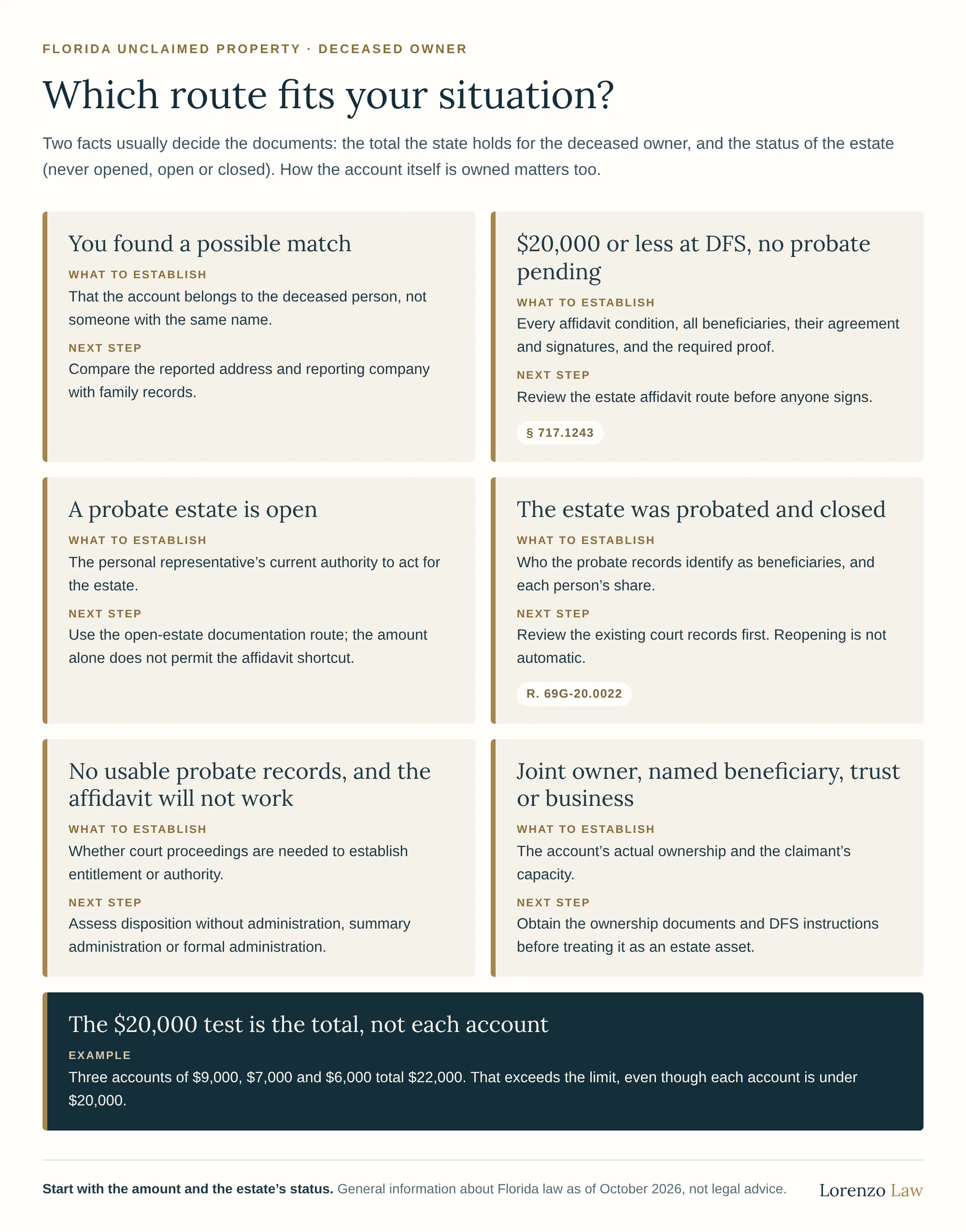
View the “Which route fits your situation?” chart (zoom in to read; the details are also in the text above).
The $20,000 test concerns the aggregate property DFS holds for one deceased owner, not each account, each beneficiary’s share, or the value of the entire probate estate. Three accounts of $9,000, $7,000 and $6,000 total $22,000 and exceed that limit.
Does unclaimed property go through probate in Florida?
Not always. When the total the state holds for the owner is $20,000 or less, no probate is pending and every other condition is met, the beneficiaries can claim with the estate affidavit instead of a probate court order. When those conditions cannot be met, the claim generally depends on probate records: an open estate’s personal representative, an order or file from an estate that was already administered, or a court proceeding that establishes entitlement or authority. Unclaimed property in a deceased person’s name can therefore be claimed without a new probate case in some situations, and only through probate records in others.
What if the unclaimed property is over $20,000?
Then the estate affidavit is not available, but that does not automatically mean a new probate case. First determine whether probate records already exist:
- If an estate is open, the personal representative claims with clerk-certified records of current authority.
- If an estate was administered and closed, existing probate records may establish who is entitled and in what shares. Additional or subsequent administration may be necessary when they do not, or when authority or distribution questions remain.
- If there was never a probate case, court proceedings may be needed to establish entitlement or authority. Which one depends on the estate, not on the unclaimed amount alone; see court routes.
Before starting a proceeding, compare the likely recovery with record costs, court costs, legal fees, creditor issues and the beneficiaries’ shares.
Hypothetical example 1: A son finds two accounts in his late mother’s name: an uncashed refund check of $1,900 and a dormant savings account of $4,600. Nothing else is held for her, no probate case was ever opened, she left no will, and her three children are her only heirs. If all three children agree on the division, confirm the funeral, last-illness and other lawful claims have been paid, and sign the estate affidavit, the affidavit route may fit. If one sibling refuses to sign or cannot be found, it does not, and the family needs advice about another route.
Hypothetical example 2: A daughter finds $31,000 in her late father’s name. His estate was probated and closed years ago, and the order of discharge is in the court file. Because the total is over $20,000, the affidavit is unavailable. The first step is usually not a new case: it is obtaining certified copies of the probate order identifying the beneficiaries and their shares, or the combination of probate-file documents the rule describes, and asking DFS whether they establish entitlement to this property. The rule explains how to prove who the beneficiaries are and their shares; it does not say whether DFS will pay on an order that never mentioned the newly found account. If DFS requires more, or authority or distribution questions remain, a supplemental order or further administration may be needed.
How to Search for a Deceased Relative’s Unclaimed Money in Florida
Search the official Claim Your Cash Florida database by the deceased person’s name, using every name the person used, then compare each result’s reported address and reporting company with family records before starting a claim.
Use the official property search. Searching is free, and the same database answers the questions families ask most: “does my deceased parent have unclaimed money in Florida?”, “how do you find out if someone left you money?” and “how do I find unclaimed money from deceased relatives?” An unclaimed inheritance is rarely a dramatic windfall. More often it is a bank account nobody closed, an uncashed final paycheck, a utility or rent deposit, an insurance refund, a dividend check or the contents of a safe deposit box.
The Department’s examples of abandoned property include uncashed checks, dormant bank accounts, insurance proceeds, stocks and other securities, refunds, utility deposits and safe deposit box contents. Businesses that hold this property, such as banks, insurers, employers and utilities, report it to the state after the applicable dormancy period.
Name, address and business variations to search
Search the deceased person’s name and relevant variations, and compare the results against former addresses, employers, banks and insurers:
- First and last name only first, then narrow with a middle name, initial or city if the name is common.
- Every name the person used: maiden and married names, middle initials, hyphenated forms, nicknames and spellings used in older records.
- Every Florida address the person had, because property is reported under the last address the holder had on file.
- A business, trust or spouse’s name, searched separately. Those records may involve a different owner and claimant.
A similar name is not enough. Compare the reported address and the company that reported the property with the deceased person’s records before you start a claim.
Can you search Florida unclaimed property by Social Security number?
The official search is by name, not by Social Security number. Sites advertising a “free unclaimed money search by Social Security number” are not the state. Do not enter a Social Security number, account number or death certificate on an unverified site. The state’s own claim forms request Social Security numbers to determine entitlement and prevent fraud, and say the numbers are kept confidential; provide them only on official forms, sent as the instructions direct.
Creating a claim is not the same as filing it
Save the property or account reference and the assigned claim number. They serve different purposes. A claim number identifies the claim you created; it does not establish entitlement or confirm that DFS has received a completed claim. The Department’s public instructions direct claimants to complete and sign the generated form, gather the required supporting records and mail the package to the address on the form. DFS says the claim does not appear as filed until it receives the signed form and required documents (DFS frequently asked questions).
Why nothing appears yet: dormancy and the two-year rule after a death
Unclaimed property after death often appears in the database only later, so a search with no result does not prove that the person had no assets. An account may still be with its original institution, may be reported under another name, or may not yet have been processed into the state’s database. Search again periodically and ask the institution about a known account.
Florida’s general abandonment provision uses a five-year dormancy period unless another rule applies. If a holder learns or receives confirmation of the owner’s death, section 717.102(3) provides a two-year period after death unless an authorized representative affirmatively demonstrates interest before it expires; that provision does not extend an otherwise applicable dormancy period. Property-specific rules and reporting and processing steps matter: there is no promise that every asset will appear exactly two years after death (section 717.102).
For money still at a bank, see what happens to a bank account when someone dies. The institution’s release requirements and the DFS claim process are separate.
The $20,000 Estate Affidavit (Form DFS-UP-1243)
Section 717.1243 lets beneficiaries claim a deceased owner’s property without a probate court order when all the abandoned property DFS holds for that owner totals $20,000 or less, no probate proceeding is pending, and every other condition is met. The limit increased from $10,000 to $20,000 in 2024.
The DFS-published version of Rule 69G-20.0022(3) also states $20,000 and identifies Form DFS-UP-1243, Estate Affidavit, effective August 2025. Older instructions and copies showing $10,000 should not be used to describe the current threshold (DFS administrative rules).
Every condition you must meet
Before using this route, confirm every condition:
- All abandoned property DFS holds for the deceased owner totals $20,000 or less.
- No probate proceeding is pending.
- All beneficiaries have been identified and agree on the division of the estate.
- All beneficiaries sign the required affidavit.
- The affidavit can truthfully state that funeral expenses, expenses of the last illness and other lawful claims have been paid.
- A copy of the will accompanies the claim if the owner left one.
- The claim includes the certified death certificate, claimant identification, evidence connecting the claimant to the deceased owner, and any additional evidence DFS reasonably needs.
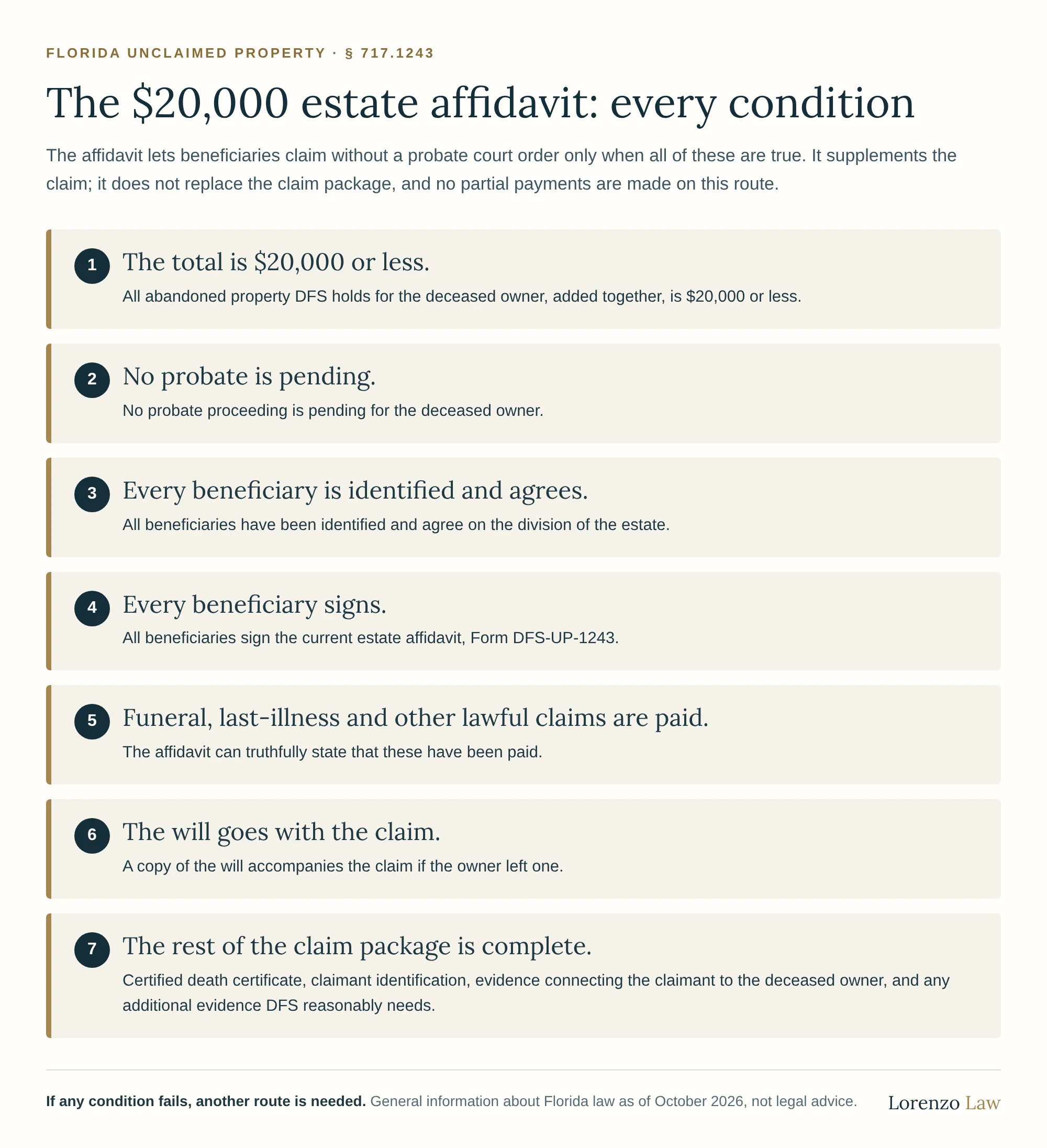
View the “$20,000 estate affidavit conditions” chart (zoom in to read; the details are also in the text above).
The affidavit supplements the claim; it is not a substitute for the complete claim package. The rule provides that no partial payments are made under this affidavit route.
What the current estate affidavit asks
The version of Form DFS-UP-1243 filed with the rule (marked effective 08/25) is titled for estates with a total value of unclaimed property of $20,000 or less. It asks for the deceased owner’s name, the account numbers and amounts, and the date of death. It then has the signers state, among other things, that funeral expenses, last-illness expenses and other lawful claims have been paid, that they are unaware of any dispute about the estate or the will, and that they understand they can be personally liable for lawful claims up to the value they receive. The signers choose whether the owner left no will or left a will (with an unaltered copy attached), and, if there was no will, identify the class of heirs. Heirship for this purpose is determined under the intestacy law of the state where the decedent resided at death; Florida’s intestacy statutes (sections 732.102 and 732.103) govern only when the decedent resided in Florida. A second page lists each heir or beneficiary’s name, mailing address, relationship, age, share and signature, together with a Social Security number, and the affidavit is verified under penalties of perjury.
The current form uses a declaration under penalties of perjury rather than a notary’s jurat. Florida law allows a document that must be verified to be signed that way (section 92.525), so a notary is not needed when the form carries that declaration. A knowingly false declaration is perjury, so read the form completely before signing it, and follow the claim instructions DFS generates for your claim on how to sign and submit it.
Where to get the current form, and why an old copy is risky
Obtain the current affidavit through the claim instructions or DFS. The rule identifies official form reference Ref-18383. Lorenzo Law does not provide a copy, a template or a filled-in sample. Search results for “DFS-UP-1243” often lead to old copies hosted on private websites and form-filling services, some carrying earlier dates or other form numbers. An undated or superseded copy can carry the wrong threshold or the wrong statements, and every signer is swearing to what the form says. If the official reference is unavailable, ask DFS for the current form rather than downloading an undated copy from a private website.
Does Florida have a small estate affidavit?
Not as a single, court-free way to transfer a deceased person’s estate. The DFS estate affidavit described here is a specific procedure for property the Department of Financial Services holds for a deceased owner, and it applies only to that property. It does not transfer a bank account the bank still holds, a vehicle, a house or other assets outside the state program. There is also no single Florida small estate limit. The DFS affidavit uses $20,000 of property held by the Department. Florida’s court affidavit for small intestate estates (section 735.304) is available only when the person died without a will more than one year earlier, no Florida administration is pending, and the estate consists only of exempt personal property plus nonexempt personal property of no more than $20,000 (plus preferred funeral expenses and reasonable and necessary medical and hospital expenses of the last 60 days of the last illness). If the requirements are met, the court may authorize distribution by a letter or other writing under seal. Summary administration uses a $150,000 ceiling, and disposition without administration has its own narrow test; both require a court order. Outside the courts, a bank may pay up to $2,000 from a deceased person’s qualifying accounts to a family member in limited circumstances (section 735.303), and vehicles have their own title-transfer rules (section 319.28). See court routes below and when probate is not necessary in Florida.
Who counts as a beneficiary, and can a grandchild sign?
“Beneficiary” has a legal meaning. In a testate estate it generally means a devisee under the will; in an intestate estate it means an heir at law, excluding a person whose interest has already been satisfied. The will, applicable succession law and estate history determine the list (section 731.201).
Do not assume the oldest child, the person who paid the funeral bill or the relative who found the record can sign for everyone. A surviving spouse and descendants may share an intestate estate; the sequence is not always “spouse first, children only if there is no spouse.” More remote relatives and descendants of deceased relatives can require a documented family chain. See sections 732.102 and 732.103.
A grandchild can be a beneficiary, for example when the grandchild’s parent, the deceased owner’s child, died first, or when the will names the grandchild. Whether a particular grandchild must sign, and for what share, depends on the will or the succession rules and on who else survived. The current form reflects this: with no will, the signers identify the class of heirs, such as descendants, parents, or brothers and sisters and their descendants, and state that everyone ahead of them under the intestacy laws of the state where the owner lived at death has died.
What if an heir won’t sign, can’t be found, is a minor or has died?
If someone refuses to sign, cannot be located, has died, is a minor or lacks capacity, obtain advice about the required authority and procedure. When a claimant is under guardianship, the rule requires the court-appointed guardian to file, with a clerk-certified order showing that authority dated within one year. Do not omit that person or assume another relative may sign for them. A minor or incapacitated beneficiary raises a representation question that should be reviewed, rather than treated as an automatic answer in either direction. If the family cannot agree on the division, the affidavit’s agreement condition is not met.
Personal liability after receiving the money
Under section 717.1243(2), a recipient remains personally liable for lawful estate claims to the extent of the value received, excluding property exempt from creditors under Florida law. A rightful heir or devisee who did not receive a share can bring appropriate proceedings against recipients; subsection (3) provides for taxable costs, including attorney’s fees. Leaving an entitled relative off the affidavit is not a shortcut.
This is different from inheriting every debt merely because you are related to the person who died. See whether you inherit debt in Florida for the distinction between personal obligations, estate debts and liability connected to distributions.
Open Estates, Closed Estates and Court Routes
When the affidavit route is unavailable, the claim usually rests on probate records. Which records depends on whether an estate is open, was closed, or never existed.
If probate is open
DFS’s rule requires court records certified by the clerk within one year of filing the claim that show the personal representative’s right to act for the estate. Letters of administration are a common example. The representative’s authority, claimant identification and proof of the deceased owner’s connection to the property answer different questions; one does not replace the others. See becoming a personal representative in Florida.
Section 717.12405 also requires an estate, or someone acting for it, to locate the heir or legatee entitled to the property before claiming it. Receiving property before meeting that requirement can create personal liability and an obligation to return it (section 717.12405).
Found money after the estate closed?
Start with the existing file. Rule 69G-20.0022(3)(a)2 recognizes a certified probate order identifying beneficiaries and their proportional entitlement. If such an order is unavailable, DFS may determine that information from an appropriate combination of probate-file documents, for example the will and order admitting it, petition for administration, or petition for discharge with exhibits. That combination must also include the order of discharge and docket sheet. A will standing alone is insufficient. The rule does not address property that the order never mentioned, so confirm with DFS whether it will pay on the existing records before assuming a new proceeding is or is not needed.
The affidavit can be an alternative when the aggregate is $20,000 or less and all its conditions are met, including no pending probate. If the amount is greater, do not assume reopening follows automatically: first determine whether the existing records establish entitlement.
Additional or subsequent administration, which people often search for as a petition to reopen the estate, may be necessary when they do not, or when authority or distribution questions remain. See closing an estate in Florida.
Disposition without administration, summary administration and formal administration
The DFS affidavit and Florida’s court procedures have different eligibility tests.
| Procedure | Key distinction |
|---|---|
| DFS estate affidavit | No court order. Limited to property DFS holds for the owner, totaling $20,000 or less, with no pending probate and every affidavit condition met (section 717.1243). |
| Disposition without administration | Section 735.301 covers a decedent leaving only specified exempt personal property and nonexempt personal property worth no more than preferred funeral expenses plus reasonable and necessary medical and hospital expenses of the last 60 days of the last illness. It is not a general $20,000 release rule. The court evaluates eligibility and may authorize payment or transfer. |
| Affidavit for small intestate estates | Section 735.304 allows distribution without administration where the decedent died intestate more than one year earlier, no Florida administration is pending, and the estate consists only of exempt personal property plus nonexempt personal property not exceeding $20,000 (plus preferred funeral expenses and reasonable and necessary medical and hospital expenses of the last 60 days of the last illness). A qualifying heir applies by verified affidavit, subject to the signature, creditor and formal-notice requirements of the statute and Florida Probate Rule 5.425. An heir receiving a full intestate share under the proposed distribution need not join the affidavit. If satisfied the requirements are met, the court may, in its discretion, authorize distribution by letter or other writing under seal. |
| Summary administration | Under section 735.201, the estate subject to administration in Florida, less creditor-exempt property, must not exceed $150,000, or the decedent must have been dead more than two years. In a testate estate, the will must not direct administration under Chapter 733. Other procedural, creditor and distribution requirements still apply. |
| Formal administration | A personal representative receives court authority to administer the estate. The need for that authority, the estate’s circumstances and unresolved issues matter; the DFS account balance alone does not decide every case. |
Read the summary administration guide and the Florida probate process guide for the court procedures.
Is opening probate worth it?
Before starting a proceeding, compare the likely recovery with record costs, court costs, legal fees, creditor issues and the beneficiaries’ shares; see the cost of probate in Florida. Opening an estate does not by itself revive every old debt. Florida’s creditor statutes include a generally applicable two-year bar with exceptions and preserved lien rights; notice and filing rules also matter (section 733.710; see Florida probate creditor claims). Obtain advice before distributing funds or paying a disputed claim.
What happens if no heirs claim the money?
Property reported under Chapter 717 remains the owner’s property, and the state holds it as custodian; there is no general deadline for an owner or entitled heir to claim it. Special statutes govern certain probate deposits, including money paid to the Chief Financial Officer. Florida probate law has separate provisions for an estate with no heirs, which can escheat to the state (escheatment), and for distributions a personal representative could not deliver, which are deposited and handled under their own procedure and time limits (section 732.107; section 733.816). Escheated estate proceeds go to the Chief Financial Officer for the State School Fund and can be reclaimed within 10 years after that payment. Undelivered distributions are deposited with the clerk and, after six months, with the Chief Financial Officer; they can be reclaimed within 10 years from the date of deposit with the Chief Financial Officer, after which they escheat. If you are an heir who was not located during an estate, ask where the undelivered share went before assuming it is in the state database. Unclaimed estate funds of this kind may still be with the clerk or may have been sent on to the state, so check both. For an undelivered distribution, confirm the required procedure with the court and DFS, including whether a court order under section 733.816 is needed.
Documents Florida Requires for a Deceased Owner’s Claim
The answer to “what documents do I need for unclaimed property?” depends on what each record proves. Every deceased-owner claim must prove several different things: who you are, that the reported owner is the person who died, the death itself, your relationship or interest, your authority to act, and, for the affidavit route, that its conditions are met. One document rarely proves more than one of them.
| What DFS needs to establish | Records to gather | What the records do not establish by themselves |
|---|---|---|
| The claimant’s identity | Required photo identification or a permitted identity alternative | Identification alone does not prove inheritance rights. |
| The reported owner’s identity and connection to the account | Address history, account statements, employer or insurer records, and name-change records as applicable | A similar name is not enough. |
| The owner’s death | Death certificate certified by the issuing governmental agency | Death does not identify the person entitled to receive the property. |
| The claimant’s relationship or beneficial interest | Relevant birth, marriage and intervening death records; will and probate records where applicable | Being related or named in a will does not automatically supply estate authority. |
| Authority to act for an estate, trust or other owner | Applicable court records, letters, trust or business authority documents | A claim filed in the wrong capacity is not cured merely by supplying more identification. |
| Eligibility for the estate affidavit | Current affidavit, all required signatures, agreement, paid-claims conditions and will if any | Being below $20,000 satisfies only the value condition. |
Documents by route
| Estate affidavit ($20,000 or less, no probate pending) | Open estate | Closed estate |
|---|---|---|
| Signed claim form; certified death certificate; identification for each claimant; current DFS-UP-1243 signed by all beneficiaries; copy of the will if any; records linking the owner to the account and each beneficiary to the owner | Signed claim form by the personal representative; certified death certificate; identification; court records certified by the clerk within one year of filing showing current authority, such as letters of administration; records linking the owner to the account | Signed claim form; certified death certificate; identification; a certified probate order identifying beneficiaries and their shares, or the combination of probate-file documents the rule describes, including the order of discharge and docket sheet; records linking the owner to the account |
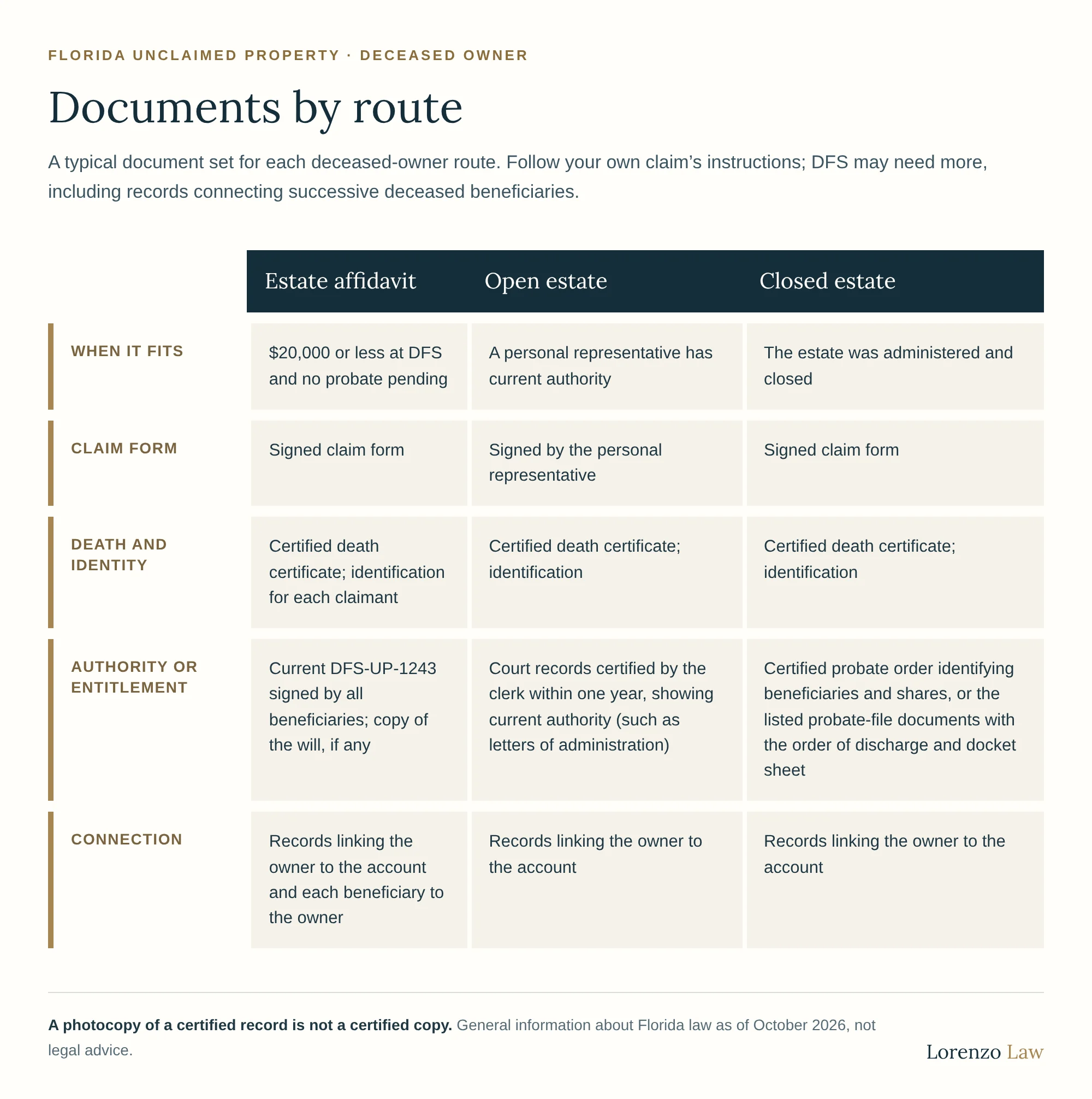
View the “Documents by route” chart (zoom in to read; the details are also in the text above).
Follow the claim-specific instructions. DFS may need additional proof, including records connecting successive deceased beneficiaries. Rule 69G-20.0022(2) recognizes identity alternatives, including Form DFS-A4-2007 in the circumstances it describes; use the permitted procedure rather than assuming an ordinary notarized letter will suffice.
Forms you may see named
Searchers often look up a form number from a letter or an old article. Use the claim instructions DFS generates for your claim to select the correct form; the list below explains what each number refers to, not which one your claim needs. Lorenzo Law does not provide copies or templates of these forms.
| Form | What it is |
|---|---|
| DFS-UP-1243 | Estate Affidavit, the supplement for the $20,000-or-less route described above, effective 08/25. |
| DFS-UP-107 | A claim form for a claim filed by someone other than the apparent owner, listed in Rule 69G-20.0021. |
| DFS-UP-106 | A claim form for a claim filed by the apparent owner, generally a living owner claiming his or her own property. |
| DFS-UP-108 | A claim form used by a claimant’s representative. |
| DFS-A4-2007 | An identity alternative recognized by Rule 69G-20.0022(2) in the circumstances it describes. |
| DFS-UP-309 | The Department’s recovery agreement form for claimant representatives, identified in the Department’s FAQ. |
| DFS-UP-112 | A holder’s safe deposit cost-reimbursement form, not a claim form for heirs. |
Proving the family chain
The claimant must show the chain from the name on the account to the claimant: the birth, marriage and intervening death records that connect each generation, plus the will and probate records where they apply. A grandchild claiming through a parent who has died, for example, usually needs the parent’s death certificate and the records linking grandchild, parent and grandparent. Gather certified copies where the instructions call for them; a photocopy of a certified record is not the same as a certified copy (section 717.1261; Rule 69G-20.0022).
Certified court documents and the 180-day provision
Section 717.1262 requires a certified copy of the court document relied on to establish entitlement. It also requires certified copies of the pleadings used to obtain an entitlement document that were filed within the specified 180-day period before the claim form was signed.
Do not treat this as a blanket rule that every older probate order expires after 180 days. The date a pleading was filed, the court document relied on, the date the claim was signed and separate certification requirements must be considered together. Obtain the required certified records and ask DFS or counsel about the particular file before refiling court papers simply because an order is old (section 717.1262).
Out-of-state and foreign heirs
Residence elsewhere does not by itself disqualify a rightful claimant. The claimant still must prove entitlement and comply with the applicable document requirements. A foreign probate file, foreign-language documents or another deceased beneficiary can require additional review, and the decision period can be extended when the claimant is outside the United States or supporting documents are not in English and are not translated. If a Florida administration is needed and a personal representative lives outside Florida, see serving as an out-of-state personal representative.
Filing the Claim and What Happens Next
Complete and sign the generated claim form, attach every required document and mail the package to the address on the form. Keep copies and proof of delivery, then track the claim with its claim number.
Creating an online claim is not the same as filing a complete claim. Follow your claim’s current instructions; do not assume an apparent-owner electronic option or a representative’s submission procedure applies to a deceased-owner claim. Keep a copy of the package and evidence of delivery.
How long does Florida unclaimed property take to process?
Section 717.124 generally requires a determination within 90 days after receipt of the claim or the response to a request for additional information, whichever is later. It extends that period by 60 days for good cause or specified circumstances, including bankruptcy, an address or claimant outside the United States, or untranslated non-English supporting documents. This is not a promise of payment within 90 days or a guarantee about the time needed for probate. The Department says claims are processed in the order received and that how long it takes for unclaimed property to process varies with each claim’s complexity, claim volume and the completeness of the paperwork. When probate records are needed first, the court process adds its own time.
Answer every request within 60 days
Failure to respond within 60 days after DFS provides notice of apparent errors or omissions results in withdrawal under the statute. Read every request, record its deadline and respond with the requested information. Do not assume that the absence of a general deadline to claim property means a pending claim has no deadlines (section 717.124).
How do I check my claim status, and what if I move?
Use the claim number to check claim status on the official website. The claim does not appear as filed until DFS receives the signed form and required documents. If you move while a claim is pending, the Department’s FAQ tells claimants to notify the Division in writing and include a copy of current government-issued identification.
Incomplete, Disputed or Denied Claims
A complete package must still establish entitlement, and a denial carries specific review rights and deadlines. Read every notice the day it arrives.
Missing signatures, identity records, certified documents, account connections or estate authority may require correction. DFS decides claims to property in its custody; a probate order supports the claim but does not eliminate the agency’s review. Sections 717.1242, 717.1244 and 717.126 govern these distinctions and the claimant’s burden of proof. Having the same name as the reported owner is not, by itself, enough.
What if two relatives claim the same account?
If another person claims the same property, disclose and address the dispute. Section 717.1241 contains priority rules for defined conflicting claims where claimants appear equally entitled, including claims through representatives. Filing first does not create inheritance rights or authorize exclusion of other beneficiaries.
What happens if a claim is denied?
A determination must include notice of rights under sections 120.569 and 120.57. Read the notice promptly and obtain advice about the stated hearing deadline, available administrative remedies and any later judicial review. The remedy for a denial is a timely request for an administrative hearing. Chapter 717 does not clearly provide for filing a new claim on new evidence after a denial becomes final, so do not let the hearing deadline pass on the assumption that you can simply refile (Chapter 717).
What You Receive: Cash, Interest, Securities, Crypto and Safe Deposit Contents
A cash claim generally pays the amount the state received. Property other than cash, such as securities, virtual currency or safe deposit box contents, may have been sold, and different rules apply to it.
Does Florida pay interest on unclaimed money?
Generally not on cash. Unclaimed money held as cash generally does not earn interest while the state holds it, and a cash claim generally pays the amount DFS received. Section 717.121 addresses dividends, interest and other increments only for property other than money, realized or accruing at or before its liquidation or conversion. That rule matters for securities; it is not a guaranteed interest rate on every claim.
Stocks, virtual currency and safe deposit box contents
Unclaimed stocks and other property may have been sold before the claim is resolved. Securities, virtual currency (including unclaimed crypto) and safe deposit contents have their own holding, sale and delivery rules. A safe deposit claim may involve remaining contents or sale proceeds, with authorized deductions; items the Department finds to have insubstantial commercial value may have been destroyed or disposed of (section 717.128). Do not assume the state can return the original stock position, digital asset or sentimental object. Ask DFS what it holds and what delivery instructions apply (sections 717.1065, 717.116, 717.119, 717.121, 717.122, 717.124 and 717.128).
Form DFS-UP-112 is a holder’s safe deposit cost-reimbursement form under Rule 69G-20.0021(7), not the form an heir uses to claim sold box contents. Obtain the form for your actual claimant type.
Is recovered unclaimed money taxable?
Tax treatment depends on the asset and what the payment represents. Do not assume every recovery is taxable or tax-free merely because it came through an unclaimed-property program. Retain the payment records and any tax forms and ask a tax adviser about the particular recovery.
Is There a Deadline to Claim a Deceased Relative’s Unclaimed Property?
Not for ordinary abandoned property held by the Florida program, according to the Department: its FAQ says there is no deadline to claim, and its website says the state never becomes the owner. That is true for property reported under Chapter 717; money that passes through the probate escheat statutes is different and can belong to the state after 10 years. Pending claims, court cases and other programs do have deadlines.
The Department’s FAQ says there is no deadline to claim property and no statute of limitations on abandoned property claims. That does not extend to every situation: a pending claim must answer requests within 60 days, a denial notice states its own hearing deadline, and money held by a court clerk, a federal agency or another state may have entirely different rules. Florida’s general statement that there is no deadline for its ordinary abandoned-property claims should not be extended to every court deposit, surplus claim, federal benefit or escheated estate. If someone tells you that you must act immediately or lose the money, treat it as a warning sign; see scams.
Unclaimed Property Letters, Finders and Scams
Searching for and filing a claim directly with the state are free. Verify any letter, call or text by going to ClaimYourCashFL.gov on your own and searching the name, rather than using a link, phone number or form supplied by the person who contacted you.
Is a letter about unclaimed property a scam?
Not necessarily, but verify it before you respond. The Department says it does outreach to owners, so a genuine letter is possible, and registered claimant representatives may also contact owners and heirs lawfully. Scams copy both. Use these checks:
- Texts: the Department says it will never text you about abandoned property. Treat a text claiming to be from the state as a red flag.
- Fees to search or release money: searching and filing directly with the state are free. A demand for a “processing,” “release” or “search” fee is a warning sign.
- Urgency: the Department says there is no deadline to claim abandoned property it holds. “Act now or lose it” pressure is a warning sign.
- Personal information: do not give a Social Security number, bank account, card number or a copy of a death certificate to anyone you have not verified.
- Company-branded letters: a letter that names a bank, insurer or retailer and asks you to call a number or sign an “unclaimed property affidavit” should be verified with the company through a number you find yourself, and by searching the official Florida database.
Report a problem with a recovery company or representative through the Department’s official complaint form. The Federal Trade Commission’s guidance on unexpected unclaimed-funds calls explains common tactics, and fraud can be reported at ReportFraud.ftc.gov.
Five warning signs at a glance
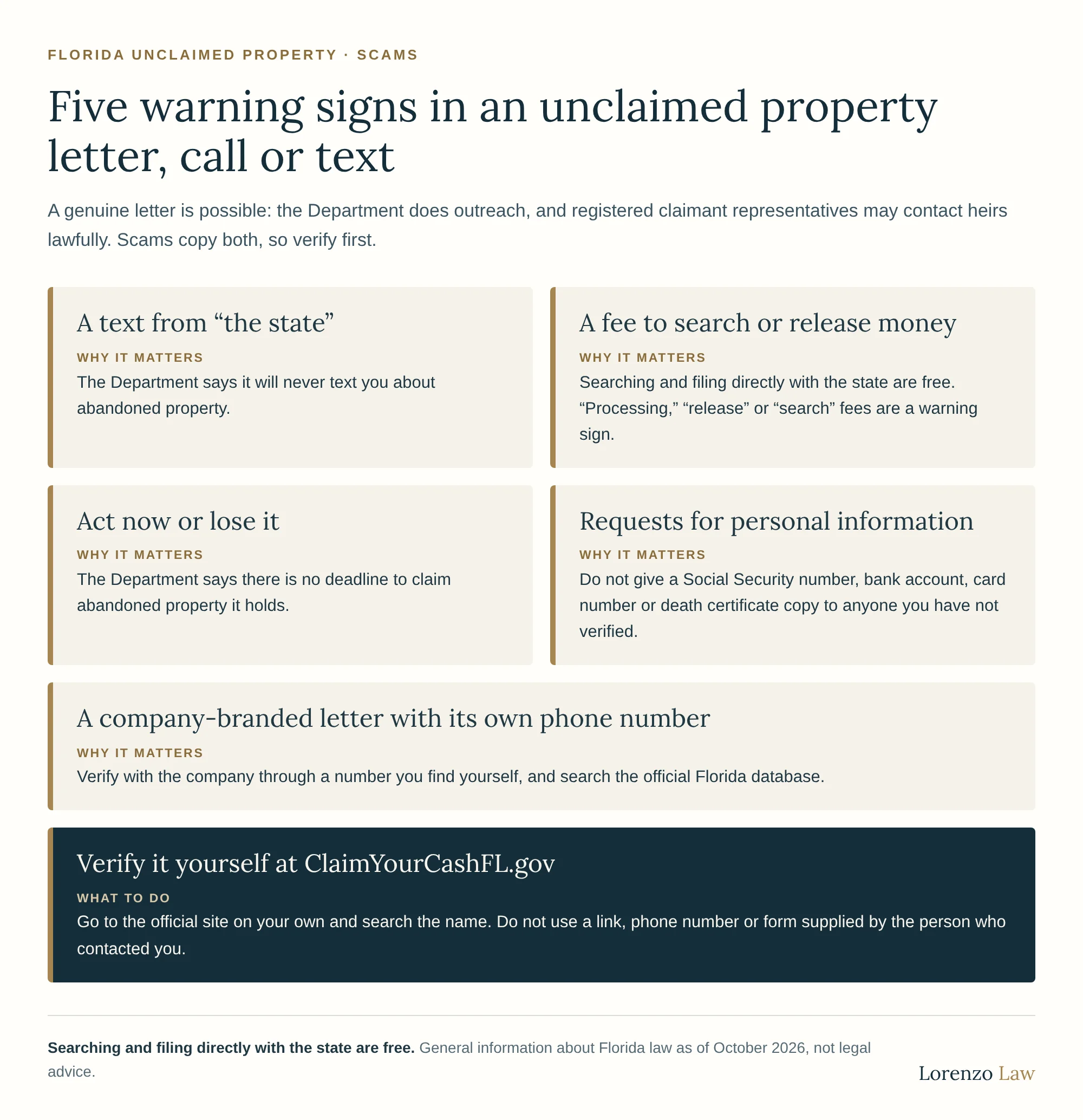
View the “Five warning signs” chart (zoom in to read; the details are also in the text above).
How much can a finder charge in Florida?
You do not have to hire a recovery company or pay an unclaimed money finder’s fee to search or file directly with Florida. Certified records, translations, court proceedings or separately retained legal help may still cost money.
For an unclaimed property recovery agreement with a claimant’s representative, governed by section 717.135, total fees and costs are capped at 30% of the claimed amount; the statute also regulates purchasing representatives’ net gain. It requires the prescribed agreement and provides that authorized fees and costs become payable only after approval. The Department’s FAQ identifies its recovery agreement form as DFS-UP-309. Other purchase arrangements have their own statutory requirements. Review the actual agreement and verify the representative’s status with DFS rather than assuming every person who contacts you is a state employee or a lawyer acting as your legal counsel (sections 717.135, 717.1356 and 717.1400).
What is an heir finder, and should I sign an heir-finder contract?
Heir finders, sometimes called heir hunters or forensic genealogists, locate relatives who may be entitled to an estate or to property in a deceased person’s name and offer to recover it for a percentage. For property the Florida program holds, Chapter 717 regulates who may act as a claimant representative and what agreements may be used, so ask whether the company is registered with DFS and whether its agreement is the Department’s form; charging a fee to help with a DFS claim is a violation unless the person is a registered claimant representative (section 717.1322). Chapter 717’s fee limits do not reach assets outside the state program; for those, the contract’s own terms and the law that governs it control. Before signing any heir-finder contract, read the whole document, including the percentage, what work is included and whether it can be cancelled, and check whether you could recover the same asset yourself for free. You may also see websites selling an heir hunters list of unclaimed estates; those are private lists, not state records, and Florida’s official database is free to search yourself.
Can you claim someone else’s unclaimed money?
No. Only the owner, a person legally entitled to the property, or a person authorized to act for the owner or the estate may claim it, and the claimant carries the burden of proving that entitlement (section 717.126). Finding someone else’s name in the database does not give you a right to the money. If you receive property you are not entitled to, you must return it with interest, regardless of intent. Knowingly filing, conspiring to file or assisting in filing a claim you are not entitled to is a crime, graded by the amount involved. A fine of up to three times the property’s value may be imposed only where the Department prevails in an enforcement action and the person acted knowingly or with reckless disregard or deliberate ignorance of the truth (section 717.1341). A good-faith question about whether you are entitled is not itself criminal. If the owner is a relative who has died, follow the deceased-owner routes on this page.
When paid legal help makes sense, and when it does not
A Florida attorney, CPA or licensed private investigator who acts as a claimant’s representative before DFS must register with the Department. What matters is whether the engagement is contingent on discovering or locating the property, not how the fee is labeled: an attorney retained to perform the legal work on terms not contingent on locating the property falls outside the claimant-representative definition and its registration requirement (section 717.101; section 717.1400). Ask what work is included, who will file the state claim, which fees and costs apply, and whether court work is covered. No fee percentage or recovery arrangement described here is an offer of Lorenzo Law’s terms.
Self-service may be appropriate when ownership and beneficiaries are clear, all required documents and signatures are available, and the applicable route is understood. Legal advice may help when probate authority is missing, an estate was closed, beneficiaries disagree or cannot act, ownership is unclear, or DFS has issued a disputed determination.
How to Find a Deceased Person’s Assets: Where Else to Look
To find a deceased person’s assets for free, search Florida’s database and then the official sources below; each official search listed here is free to use, and you do not need to pay a service to run them. The Florida database is one part of an asset search. Life insurance, retirement plans, savings bonds, federal refunds, failed-bank deposits, court-held money and other states each have their own official source and their own rules.
Keep these leads tied to the deceased person’s records and the correct owner or beneficiary.
| Possible asset | Appropriate starting point |
|---|---|
| Life insurance or annuity benefits | The insurer and the NAIC Life Insurance Policy Locator, a free tool to find a life insurance policy for a deceased person; beneficiary designations matter. Veterans’ policies: VA unclaimed insurance funds. |
| Old retirement plans and pensions, including an unclaimed 401(k) | The employer or plan administrator; the U.S. Department of Labor’s Retirement Savings Lost and Found and abandoned plan search; and PBGC unclaimed pensions where applicable. |
| Savings bonds and federal tax refunds | TreasuryDirect’s Treasury Hunt for unclaimed savings bonds; the IRS (Where’s My Refund) for federal tax refunds. |
| Failed bank or credit-union deposits | FDIC or NCUA, according to the institution. |
| FHA mortgage insurance refunds | HUD’s official refund search. |
| Bankruptcy funds | The bankruptcy court holding the funds; the federal courts’ unclaimed funds information and unclaimed funds locator. |
| Money from SEC enforcement actions | The SEC’s information for harmed investors. |
| Tax-deed or foreclosure surplus, court-registry money, undelivered estate or guardianship funds | The relevant clerk, case file and governing statute; ask whether the funds remain with the clerk or have been transferred. See money held by the county clerk. |
| Property connected to another state | That state’s official program, located through NAUPA (unclaimed.org) or MissingMoney.com; use Florida’s own database for Florida records. |
| Money still at a bank | The bank itself. To find lost bank accounts of a deceased person, check statements, mail and tax forms for interest income, then ask each bank; see bank accounts after a death. |
These programs may have distinct entitlement rules and deadlines. The source of the funds and their present custodian matter. Do not assume a negative search on an interstate website is a complete search of Florida’s records. For a broader list of federal sources, see USA.gov’s unclaimed money page.
Money held by the county clerk
Some money connected to a deceased person never reaches the state program, or reaches it only later. A county clerk of court can hold surplus from a tax-deed or foreclosure sale, money deposited into the court registry in a lawsuit, uncashed clerk checks, and estate or guardianship money that could not be delivered. Each clerk handles these funds under its own procedures and the governing statutes, and the rules and timing for claiming them differ from the state program’s. If you are searching for an unclaimed surplus funds list in Florida, start with the clerk of the county where the sale took place: some clerks publish searchable lists; others direct older funds to the state. Unclaimed tax-deed surplus is processed under the state’s unclaimed property law after its claim period, foreclosure surplus left unclaimed for a year is sent to the state program, and undeliverable guardianship money is deposited with the Chief Financial Officer and can be reclaimed within five years (sections 197.582, 45.032 and 744.534). Examples of official clerk pages:
- Duval County: Duval Clerk unclaimed funds
- Hillsborough County: Hillsborough Clerk unclaimed funds
- Pinellas County unclaimed funds: Pinellas Clerk unclaimed monies
- Broward County: the Broward Clerk’s finance page directs older unpaid funds to the state’s unclaimed property program first.
In Miami-Dade, Palm Beach, Orange and other counties, start with the clerk’s official website or finance department and the court case file. When an estate case is involved, the county’s probate court can also matter; see Lorenzo Law’s guides to the Miami-Dade, Broward, Palm Beach, Orange, Hillsborough, Pinellas and Duval probate courts.
For Personal Representatives: Should You Search Before Closing the Estate?
Yes, as a matter of good practice. Searching the state database early in the administration, and again before the estate is closed, helps the personal representative identify assets that belong to the estate and avoid the need to revisit a closed estate later.
A practical approach:
- Search the official Florida database under every name the decedent used, and the databases of every state where the decedent lived or did business, soon after appointment.
- Review the decedent’s mail, statements and tax forms for accounts, refunds and dividends that may later be reported to the state.
- Search again before the final accounting and discharge, because property may be reported to the state after the death; see the two-year rule after a death.
- Keep a record of each search, its date and the result.
- Remember that an estate claiming property must locate the heir or legatee entitled to it before claiming (section 717.12405).
Property discovered after the estate closes is addressed under the closed-estate rules above. For the administration steps around closing, see closing an estate in Florida and Florida probate deadlines.
What Is Different About Claiming Unclaimed Property in Florida
National articles about finding unclaimed money from deceased relatives cannot address the Florida rules that decide most deceased-owner claims:
- The program and its name: Claim Your Cash Florida, formerly Florida Treasure Hunt, run by the Department of Financial Services, Division of Unclaimed Property.
- The $20,000 estate affidavit for property the Department holds, with all of its conditions (§ 717.1243 and Rule 69G-20.0022(3)).
- Separate documentation routes for open estates, closed estates and court proceedings (Rule 69G-20.0022(3)).
- Certified court documents and the 180-day pleading provision (§ 717.1262).
- The two-year presumption measured from the owner’s death when the holder learns or receives confirmation of the death, unless an authorized representative affirmatively demonstrates interest before the two-year period expires; this rule does not extend the otherwise applicable dormancy period (§ 717.102(3)).
- The duty of an estate to locate the entitled heir or legatee before claiming (§ 717.12405).
- Determination periods and the 60-day response rule (§ 717.124), and administrative hearing rights for a denial.
- The 30% cap for claimant-representative recovery agreements (§ 717.135).
- Florida’s court procedures for small and larger estates, with their own tests (§§ 735.201 and 735.301).
Claimant Preparation Checklist
- Identify the reported owner, account references, approximate total and reporting institutions.
- Note the owner’s date of death and domicile; identify any probate case, county or other jurisdiction and whether it is open or closed.
- Establish who is claiming and in what capacity.
- Gather the will, relevant court records and the family or ownership documents needed to establish entitlement.
- Determine whether DFS holds other property for the same owner before relying on the $20,000 limit.
- Confirm all beneficiaries and whether there are missing, deceased, minor or incapacitated beneficiaries or disagreements.
- Review unpaid expenses and lawful claims before making affidavit statements or distributing money.
- Obtain the required certified death and court records, complete the current forms and preserve copies.
- Calendar DFS requests and any hearing or court deadlines; check receipt and status using the official route.
Keep identification numbers, death certificates and financial records out of ordinary website contact messages. An initial inquiry can briefly describe the issue without attaching those records.
Unclaimed Property for a Deceased Owner in Florida: Frequently Asked Questions
Short answers to common questions. Each answer is limited by the qualifications in the sections above.
Can I claim my deceased parent’s unclaimed money in Florida without probate?
Sometimes, whether the account was your mother’s or your father’s. If everything the state holds for your parent totals $20,000 or less, no probate is pending, all beneficiaries agree and sign the estate affidavit, lawful claims have been paid, and the will (if any) and required proof accompany the claim, the beneficiaries can claim without a probate court order. Unless the account passed to a joint owner or named beneficiary, the claim otherwise generally depends on probate records, such as an open estate’s letters or a closed estate’s order.
Can one child claim all of a parent’s unclaimed money?
Only if that child establishes entitlement to all of it or the necessary authority to act. Finding the account or being a child does not establish sole entitlement. The estate affidavit requires all beneficiaries’ signatures and agreement, along with its other conditions.
Can a grandchild claim a grandparent’s unclaimed property?
Yes, when the grandchild is a beneficiary: for example, because the grandchild’s parent, the grandparent’s child, died before the grandparent, or because the grandmother’s or grandfather’s will names the grandchild. Under Florida’s intestacy rules, a grandchild whose parent is still living generally does not inherit from a grandparent who left no will. A grandchild claiming through a deceased parent usually needs that parent’s death certificate and the records linking each generation; see who counts as a beneficiary.
Can a surviving spouse claim a deceased spouse’s unclaimed property?
A surviving spouse (a widow or widower) can claim a deceased husband’s or wife’s unclaimed property to the extent the spouse is entitled. If the account was joint or named the spouse as beneficiary, its terms may make the spouse the owner. Otherwise the spouse’s share depends on the will or on the applicable succession rules (Florida’s, if the owner lived in Florida, under which a spouse and descendants may share), and every other beneficiary must join an estate affidavit. To claim unclaimed money for a deceased spouse, use the route that fits the estate and include the marriage certificate as proof of the relationship.
Does a will avoid the need for probate documents?
A will alone does not establish a complete DFS claim. A qualifying estate-affidavit claim includes the will if there is one. Other claims may require records admitting the will, identifying shares or establishing the representative’s authority.
Must I reopen an estate when I find another account?
Not automatically. Review the closed-estate records and the DFS requirements first. A qualifying affidavit may be available, or existing probate records may establish entitlement. Additional administration depends on what remains unresolved.
Can I claim Florida unclaimed property if I live in another state?
Yes, if you are entitled to it. Residence elsewhere does not by itself disqualify a rightful claimant, who must still prove entitlement and comply with the document requirements. Foreign records or a foreign probate file can require additional review.
Is Claim Your Cash Florida (formerly Florida Treasure Hunt) legit?
Yes. ClaimYourCashFL.gov is the official program of the Florida Department of Financial Services, and searching and filing there are free. Claim Your Cash Florida is the new name of the state’s official program, announced on September 15, 2026; it was formerly Florida Treasure Hunt, at FLTreasureHunt.gov. Start from ClaimYourCashFL.gov. A private letter or message is a separate matter: verify the sender and proposed agreement independently before providing records or paying for assistance.
Does Florida unclaimed property show up on MissingMoney.com?
MissingMoney.com, a free missing money search endorsed by the National Association of Unclaimed Property Administrators, searches records of participating state programs and is useful when a relative lived in more than one state. File a Florida claim through the official Florida program, and search ClaimYourCashFL.gov directly rather than relying on a multi-state result.
Do I need a lawyer to claim unclaimed property for a deceased person?
Not always. Many families file straightforward affidavit claims themselves. Legal advice may help when probate authority is missing, an estate was closed, beneficiaries disagree or cannot act, ownership is unclear, the total exceeds $20,000, or DFS has issued a disputed determination.
What if another relative already claimed the money?
Ask DFS about the claim’s status and disclose your interest. Filing first does not create inheritance rights or authorize exclusion of other beneficiaries. A rightful heir or devisee who did not receive a share of property paid under the estate affidavit can bring appropriate proceedings against the recipients. Obtain advice before deadlines run.
How do I find out if a deceased parent left money I don’t know about?
Search the official Florida database for unclaimed funds for a deceased parent under every name your parent used, then the official programs of other states where your parent lived, and the federal and private sources for life insurance, retirement plans, savings bonds and refunds listed in where else to look. Check your parent’s mail and tax forms for accounts.
Is unclaimed property a debt or a bill?
No. Unclaimed property is money or property that a business, bank, insurer, government agency or other holder owed to or held for the owner and reported to the state, not money the owner owes. Finding a deceased relative’s name in the database does not mean anyone owes anything, and the official program does not charge to search or file a claim. A letter or call that asks for a payment to release unclaimed property is a warning sign; see scams.
Can unclaimed property be garnished or taken by creditors?
Do not assume property is protected from creditors simply because DFS holds it. Section 717.1245 addresses garnishment petitions and costs and attorney fees when DFS successfully opposes them. Whether a creditor can reach particular property requires separate analysis. For the estate affidavit, the beneficiaries must state that funeral expenses, last-illness expenses and other lawful claims have been paid, and each person who receives property under it is personally liable for lawful claims against the estate only up to the value of the property received, not counting property exempt from creditors under Florida law (section 717.1243). If a creditor, judgment or lien is involved, get advice before filing.
Is unclaimed property the same as an abandoned house or the “7-year” property rule?
No. Florida’s unclaimed property program handles abandoned personal property, such as accounts, checks, refunds and securities reported to the state by the businesses, agencies and others holding them. Questions about an abandoned house, land, or acquiring real estate through long possession are governed by different laws and are not claimed through Claim Your Cash Florida.
Talk to a Florida Probate Lawyer About a Deceased Owner’s Unclaimed Property
People looking for a Florida unclaimed property attorney or an unclaimed funds attorney usually have a claim that is stuck on a probate question: no one has authority to act, the estate was closed, the total is over $20,000, or the heirs disagree. Those are questions for a probate lawyer rather than a recovery company.
If you need help determining whether estate proceedings or legal representation are appropriate, describe the owner’s date of death, approximate value, whether probate is open or closed, and the issue preventing the claim. Florida probate attorney Jose M. Lorenzo, Jr. handles each matter himself, statewide and in English or Spanish. For a straightforward state claim, begin with the official DFS instructions above.
Call (305) 224-6811 or request a free initial consultation. Only the initial consultation is free; representation, scope, fees and costs require a separate written agreement. Sending a request does not establish an attorney-client relationship or confirm an appointment.
Call (305) 224-6811 or Request a consultation
If you are looking for an attorney for Florida unclaimed funds with probate issues near you, Lorenzo Law’s principal office is in Kissimmee, with meetings by appointment in Coral Gables and Fort Lauderdale, and the firm handles probate matters statewide. For estates that need administration or disputes, see Florida probate lawyer services and Florida probate litigation.
This article provides general information about Florida law. It is not legal advice and does not create an attorney-client relationship. The appropriate procedure depends on the property, estate records and people entitled to receive it. It reflects Florida law and the state program’s published information as of October 2026.
About the Author
Jose M. Lorenzo, Jr. was admitted to The Florida Bar on October 4, 2013, Bar number 107002. His pre-admission paralegal experience is described separately in his biography. Lorenzo Law’s principal office is in Kissimmee, with meetings by appointment in Coral Gables and Fort Lauderdale.
Authorities Cited on This Page
The statutes cited here are the 2026 Florida Statutes. Statutory, rule and form text controls over any summary on this page.
Florida statutes23
Rules and forms6
Official program and agency resources6
Talk to a Florida probate attorney
Tell us briefly what you are dealing with and we will respond within 24 to 48 hours.

