
Florida Probate Process: Steps, Timeline and What to Prepare
Florida Probate Process: Steps, Timeline and What to Prepare
The Florida probate process is the court procedure that transfers a deceased person’s probate assets, and which version of it applies depends on three facts: how each asset was owned, whether there is a will, and who is asking for authority.
Go straight to: Step by step · Which route · Timeline · Documents · Where it’s filed · Cost
Probate in Florida runs in phases: deposit the original will, open the case in the right county, obtain the court’s authority, give notices, inventory the property, deal with claims and expenses, then distribute and close. In a formal administration the court appoints a personal representative and issues letters of administration; in a summary administration the court instead enters an order that distributes the property. This guide walks through each step, the routes, the deadlines, the documents to gather, where a case is filed and what it costs. With Lorenzo Law, summary administration costs from $3,975 and uncontested formal administration from $7,975, as flat fees. The summary administration fee includes the court filing fee and one certified copy of the order, with additional certified copies charged at the Clerk’s rate; the formal administration fee includes the court filing fee, publication of the notice to creditors and the certified copies the matter needs. Jose does not publish the optional notice to creditors in summary administration, so his fee there includes no publication cost. For either procedure, homestead determinations, more complex estates and contested matters are quoted separately, and other expenses may apply, such as recording fees or the decedent’s debts, and in formal administration a personal representative’s bond if the court requires one and the personal representative’s compensation; any increase is discussed before work begins. Full fee terms: summary and formal administration fees.
Request a free initial consultation. Only the initial consultation is free; representation fees and costs are agreed separately in writing.
Request a free initial consultationCall (305) 224-6811
Consultations by phone or video in English or Spanish, for estates in any Florida county; meetings by appointment in Coral Gables or Fort Lauderdale. Lorenzo Law’s principal office is in Kissimmee.
By role: if you were named executor or personal representative, start with how to start probate; if you inherit, with who does what; if the estate is small, with summary administration; if the person lived in another state, with out-of-state estates; if a case is already open, with the next-step checker.
Statewide · Formal and summary administration · Step by step · Deadlines · Published flat fees · English and Spanish
All guide sections 24 sections
The Florida probate process at a glance
Short answer. A Florida probate follows the same broad order in most estates: the will is deposited, a petition is filed in the county where the person was domiciled, the court gives someone authority, notices go out, the property is listed and protected, valid claims and expenses are handled, and what remains is distributed before the case closes. A formal administration goes through every phase; a summary administration skips the appointment and letters; some assets never enter probate at all.
| Before anything is filed | Find the original will, gather the records, protect the property and check how each asset was titled; some assets pass outside probate. How to start |
|---|---|
| The original will | The custodian must deposit it with the clerk of the court having venue within 10 days after receiving information that the person has died; depositing it does not open probate. The 10-day rule |
| Which route | Formal administration, summary administration (Florida assets subject to administration, less exempt property, of $150,000 or less, or a death more than two years ago, and no will directing formal administration), or a small-estate procedure. Routes |
| Authority | In a formal administration the court appoints a personal representative and issues letters of administration; in a summary administration the court enters an order and appoints no one. Letters |
| Notices and claims | A creditor has the later of three months after the first publication of the notice to creditors or 30 days after being served with a copy to file a claim. Claims not filed within two years after death are barred, but a recorded mortgage or other lien is not affected. Notices |
| Inventory | The inventory is due within 60 days after letters are issued, under Rule 5.340. Inventory |
| Closing | Final accounting or waivers and the petition for discharge with a plan of distribution, then distribution under the plan; the court’s discharge ends the personal representative’s role. Closing |
| How long | Many uncontested formal administrations take roughly six months to a year; Lorenzo Law aims to finish a summary administration within one to two months from retention, a goal, not a guarantee. Timeline |
| Lorenzo Law’s flat fees | Flat fees for summary and uncontested formal administration; ancillary administration quoted per matter. Cost |
How does probate work in Florida?
What is probate in Florida? Probate in Florida is the court process that gives someone legal authority over a deceased person’s probate assets, makes sure valid debts and expenses are dealt with, and transfers what is left to the people entitled to it under the will or, without a will, under Florida’s intestacy statutes. Florida law also calls it estate administration; lawyers often say probate administration, and families describe it as the way to settle an estate. What happens during probate is the same in every county: someone obtains authority, finds the assets, deals with the debts and transfers the rest. The court supervises; the clerk of the circuit court keeps the file; the personal representative, or in a summary administration the petitioner, does the work.
In short, probate exists for assets that cannot transfer any other way. A will does not move title by itself; it tells the court who receives the probate assets. An account with a surviving beneficiary, property held with a co-owner who has survivorship rights, and property already titled in a funded trust usually pass outside probate, so a family can have a will and still need very little court work, or no will and still need a full administration.
Florida has three kinds of court procedure for a decedent’s probate assets: formal administration, summary administration, and the narrow small-estate procedures called disposition without administration. When the person lived in another state or country, a Florida proceeding for the Florida property is called ancillary administration. The steps below follow a formal administration, the full version, and then show what changes in the shorter routes.
The 30-second check
- Is anything in the person’s sole name, without a surviving beneficiary or a co-owner with survivorship rights? If not, the estate may need no probate at all. Assets outside probate
- Is the estate small or was the death more than two years ago? Summary administration may be available. Summary administration
- Will someone need to act for the estate for months: sell a house, deal with creditors, collect assets? That points to formal administration. Step by step
- Did the person live outside Florida? The Florida property may need an ancillary or other Florida proceeding. Out-of-state estates
- Has a case already been opened? Use the next-step checker to see which phase comes next.
Which Florida probate route applies?
Florida has three types of probate for assets in the decedent’s name: formal administration, summary administration and disposition without administration, plus ancillary administration for someone who lived elsewhere. The Florida probate requirements for each route are set out in the Florida Probate Code (chapters 731 to 735 of the Florida Statutes) and the Florida Probate Rules. The route depends on how the assets were titled, their value after exempt property, the date of death, whether a will directs formal administration, and whether someone needs ongoing authority to act for the estate.
Is probate required in Florida if there is a will?
A will does not avoid probate by itself; it tells the court who receives the probate assets. The original will must be deposited with the clerk, but it is admitted to probate only if someone petitions; probate is needed when the decedent owned probate assets that have to be transferred. Do all wills go through probate in Florida? Only if there are probate assets: accounts with a surviving beneficiary, and property held with a co-owner who has survivorship rights, pass outside the will.
So does a will have to be probated in Florida? It must be deposited with the clerk in every case, but it does not go to probate automatically: it is probated when someone petitions because there are probate assets. The probate process in Florida with a will follows the same steps as without one; the will names the personal representative and the beneficiaries.
Does every estate in Florida have to go through probate?
No. Assets in a joint bank account or held under a deed that expressly provides for survivorship, assets with a valid beneficiary, payable-on-death or transfer-on-death designation, and assets titled in a funded revocable trust generally pass outside probate, unless no named beneficiary or co-owner survives; trust assets can still be reached for estate debts if the probate estate is not enough. If every asset passed outside probate and there are no claims to resolve, there may be no probate at all.
What triggers probate in Florida, then, is an asset in the decedent’s name that has no other way to transfer: a house or condominium titled only to the decedent, a bank or brokerage account with no surviving beneficiary, a vehicle, a business interest, a share held as a tenant in common, or money owed to the decedent. Whether a single small asset justifies a court case depends on the shortcuts described below.
What is the summary administration limit in Florida in 2026?
Florida’s probate threshold for summary administration is $150,000: the Florida assets subject to administration, less property exempt from creditors, must be worth no more than $150,000, unless the death was more than two years ago, and any will must not direct formal administration. Chapter 2026-57 raised the limit from $75,000, effective July 1, 2026. Older guidance may still cite the former $75,000 limit, which applied before July 1, 2026.
Neither the amended statute nor the amended court rule says which limit applies when the death occurred before that date, so confirm the applicable limit before filing.
The two-year alternative, sometimes called the “2 year probate rule”: when the death occurred more than two years before the petition, summary administration may be used whatever the value, as long as the other conditions are met. The same two years also bar most creditor claims that were never filed.
Florida probate changes in 2026
Several 2026 changes affect the steps on this page. Chapter 2026-57, effective July 1, 2026, raised the summary administration limit from $75,000 to $150,000 and raised the limit for the intestate small-estate affidavit from $10,000 to $20,000 of nonexempt personal property, and the Florida Supreme Court conformed the probate rules to those figures on July 16, 2026. The Legislature also amended other sections this page relies on, including the fees of the personal representative’s lawyer (section 733.6171) and the bank-account affidavit (section 735.303); the figures and conditions on this page are stated as amended.
Does owning a house mean formal administration?
Not by itself. A house titled only to the decedent needs a court procedure to transfer, but the procedure can be summary administration if the estate qualifies, and a home that was the decedent’s protected homestead is treated separately from the property the personal representative administers. Formal administration becomes the better fit when the house must be sold during the case, a mortgage or other debts need managing, the family disagrees, or the estate is over the summary limit within the first two years. See Florida homestead probate and selling a house during probate.
Florida probate routes compared
| Route | When it fits | What the court issues | Lawyer |
|---|---|---|---|
| No probate | Every asset passed by beneficiary designation, survivorship, POD or TOD, or a funded trust, and no claims need resolving | Nothing; each institution asks for its own proof, usually a death certificate | Not required |
| Disposition without administration | Only exempt personal property and non-exempt personal property worth no more than preferred funeral expenses and the reasonable and necessary medical and hospital expenses of the last 60 days of the last illness (section 735.301); no real estate | A letter or order releasing the property | Not required |
| Summary administration | Florida assets subject to administration, less exempt property, of $150,000 or less, or a death more than two years ago; no will directing formal administration | An order of summary administration distributing the property; no personal representative is appointed | Not required |
| Formal administration | The estate does not qualify for a shorter route, a will directs it, or someone needs ongoing authority: to sell, collect, litigate or manage creditors | Letters of administration to the personal representative; later an order of discharge | Required for the personal representative, with two exceptions (Rule 5.030) |
| Ancillary administration | The decedent lived in another state or country and left Florida property in his or her name (section 734.102); shorter options can apply | Ancillary letters, or a summary order if the estate qualifies | Same rules as above |
Neither small-estate procedure requires a lawyer. Rule 5.030 lets a personal representative who remains the sole interested person, or who is a Florida attorney, act without separate counsel.
Chart: which Florida probate route
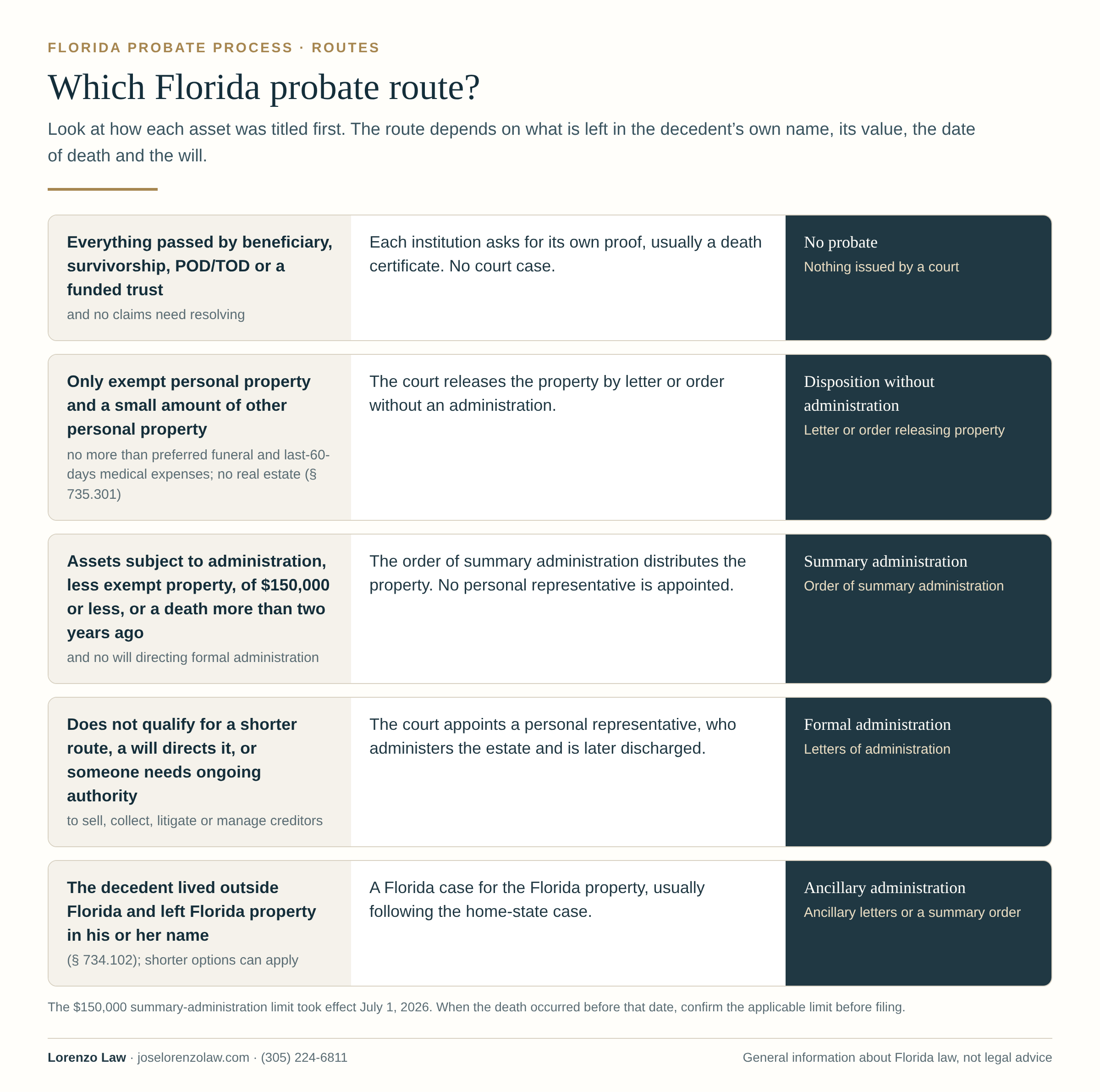
See the chart “Which Florida probate route?” (opens the full-size image)
Example: one fact changes the route
A widower dies in Lee County with a will leaving everything to his two daughters. He owned a condominium in his own name and a bank account with no beneficiary, worth together about $140,000 after exempt property, and had no debts beyond the final bills. Summary administration may fit, because the value is under the limit and the will does not direct formal administration. If the same will had said the estate must be administered under chapter 733, or the account had held another $40,000 and he had died last year, formal administration would be the route. If he had died three years ago, summary administration could again be available whatever the value. The facts that decide the route are the will, the value after exempt property and the date of death, checked against the documents, not estimated.
Hypothetical example, not a client result or an eligibility determination.
Florida probate process step by step
Here are the probate process steps in Florida, the stages of probate in a formal administration: (1) gather the documents and protect the property; (2) deposit the original will; (3) choose the county and file the petition; (4) the court appoints the personal representative and issues letters of administration; (5) serve the notice of administration and publish the notice to creditors; (6) file the inventory; (7) review claims and pay expenses in the order the law sets; (8) deal with the house, accounts and other property. Steps 9 and 10 are to file the final accounting and petition for discharge with a plan of distribution, and then distribute under the plan and obtain the order of discharge, with each step depending on an earlier one.
The phases overlap in practice. The creditor period runs while the inventory is prepared; a house can be listed while claims are reviewed. What does not change is the dependency: nobody signs for the estate before authority exists, nothing is distributed until it is clear the property is not needed for claims, expenses, taxes, the family allowance, exempt property or an elective share, and the case does not close until the distributions are documented. When a probate seems stuck, the useful question is which earlier step is still open.
Formal administration, phase by phase
| Step | Who acts | Key document | Must be finished before moving on |
|---|---|---|---|
| 1. Gather and protect | Family; the person named in the will | Death certificate, will, account and title records | Know what was owned, how it was titled and who the heirs or beneficiaries are |
| 2. Deposit the will | Whoever holds the original | Original will and codicils | The original is with the clerk of the county with venue |
| 3. Open the case | Petitioner; in a formal administration, through a Florida lawyer unless the personal representative is the sole interested person or a Florida lawyer | Petition for administration, oath, designation of resident agent | Correct county, qualified personal representative, bond question resolved |
| 4. Authority | The court | Order admitting the will; letters of administration | Letters issued; estate account opened under the estate’s tax identification number |
| 5. Notices | Personal representative | Notice of administration (served); notice to creditors (published and served) | Creditor period running; known creditors served |
| 6. Inventory | Personal representative | Inventory with date-of-death values | Filed within 60 days after letters or an extension; homestead identified separately |
| 7. Claims, expenses, taxes | Personal representative | Claims, objections, receipts, tax returns | Claim periods expired; valid claims paid or provided for in the statutory order |
| 8. Property decisions | Personal representative; the court when its approval is needed | Deeds, sale contracts, homestead order | Each asset sold, kept for distribution or released |
| 9. Accounting and petition | Personal representative | Final accounting or waivers; petition for discharge with a plan of distribution | Accounting (or waivers) and petition with plan of distribution filed and served; objection period passed or objections resolved |
| 10. Distribution and closing | Personal representative; the court | Deeds, receipts, evidence of distribution, order of discharge | Property distributed under the plan; evidence of distribution filed; discharge entered |
Chart: the Florida probate process in ten steps
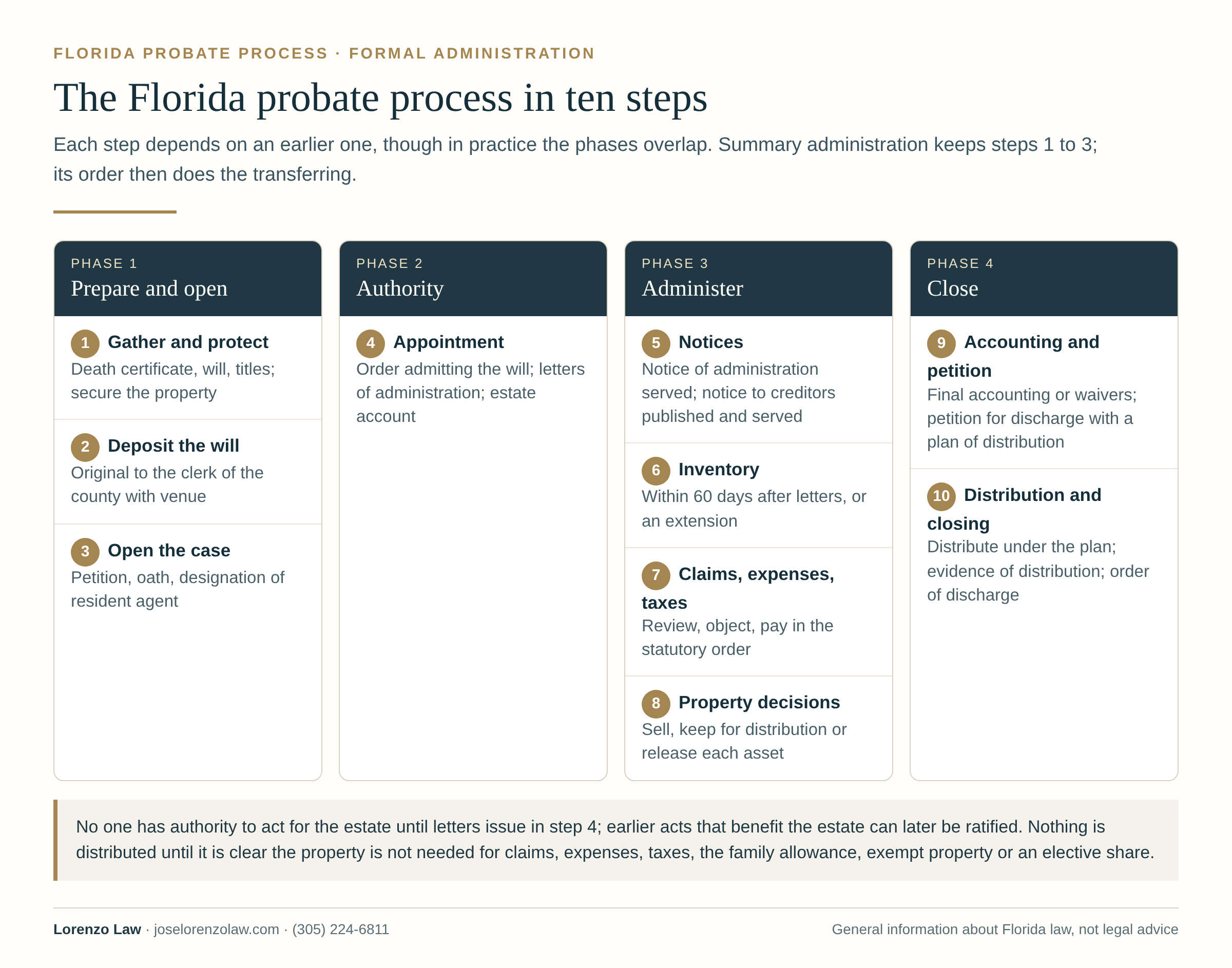
See the chart “The Florida probate process in ten steps” (opens the full-size image)
How do you start probate in Florida?
To start or file probate in Florida, with or without a will: deposit the original will with the clerk, confirm the county where the person was domiciled, decide which route fits, and file the petition with the clerk of the circuit court in that county, through the Florida Courts E-Filing Portal. In a formal administration the person who will serve as personal representative signs an oath and a designation of resident agent, and a Florida lawyer files for that person unless an exception in Rule 5.030 applies.
Where to file probate in Florida is decided by venue, explained in where a Florida probate case is filed. How to probate a will in Florida is the same opening sequence, with the original will deposited first and filed with the petition; opening an estate without a will uses the same petition, naming the heirs instead of the beneficiaries.
Step 1: Gather the documents and protect the property
What to do when someone dies in Florida, before any court filing: order certified copies of the death certificate, find the original will and any codicils, secure the home and vehicles, keep the insurance in force, collect the mail, and list every asset and debt you know about, with how each was titled. Do not sell, give away or distribute the decedent’s property, and do not use a power of attorney: a power of attorney ends at the principal’s death. Until someone has authority, the family’s job is to preserve, not to administer.
Some institutions will speak with the family before probate. On proof of death, a bank must let the spouse, a parent, an adult descendant or the person named as personal representative in a copy of the will search the decedent’s safe-deposit box in the presence of a bank officer, and any will found is delivered to the probate court. A funeral home usually reports the death to Social Security. Neither gives anyone authority over the estate.
Step 2: Find the original will and deposit it with the clerk
The person who has the original will must deposit it with the clerk of the court in the county with venue. The clerk keeps it on file. A copy is not a substitute: the court generally needs the original, and a lost original raises a separate proof question (section 733.207). An electronic will is deposited by its qualified custodian (section 732.524).
What is the 10-day rule for probate in Florida?
The deadline for depositing the original will is that the custodian of a will must deposit it with the clerk of the court having venue of the estate within 10 days after receiving information that the testator is dead (section 732.901). Depositing the will does not open probate and does not require a lawyer. See Florida probate rules and deadlines.
The 10 days run from learning of the death, not from the death itself, and they apply to the will deposit only. Florida sets no 10-day deadline to open probate. There is also no fixed deadline to file the petition, but waiting has consequences: nobody has authority over the assets, bills and taxes keep running, and after two years most creditor claims are barred whether or not an estate was opened.
Step 3: Choose the county and file the petition
A Florida estate is opened in the county where the decedent was domiciled; if the decedent was not domiciled in Florida, in any county where the decedent’s property is located; and if there is no Florida property, in the county where a debtor of the decedent lives (section 733.101).
In a formal administration, the petition for administration identifies the decedent, the domicile, the will, the beneficiaries or heirs, the person seeking appointment and the approximate nature and value of the assets. It is filed with the oath of the personal representative, the designation of a resident agent and acceptance, and the original will if it has not already been deposited. The death certificate may be filed later: in a formal administration it can be filed after the case is opened, and in a summary administration it must be filed before the order. The clerk charges a filing fee that varies by the type of case and county.
Who can file for probate in Florida?
Any interested person may petition for administration (section 733.202); in practice the petitioner is usually the person nominated in the will or the person entitled to preference to serve as personal representative.
When there is no will, the court appoints a personal representative using the statute’s order of preference: the surviving spouse, then a person selected by a majority in interest of the heirs, then the heir nearest in degree (section 733.301).
The qualifications to serve are a separate question from who can file. A personal representative must be at least 18 and mentally and physically able to serve, and a person convicted of a felony, or of abuse, neglect or exploitation of an elderly person or disabled adult, cannot serve (section 733.303). A beneficiary or family member can serve, and often does. A Florida resident can serve; a nonresident can serve only if related to the decedent in one of the ways the statute lists. See how to become a personal representative in Florida.
Appointment and letters of administration — step 4
Once the court is satisfied with the petition, it enters an order admitting the will (if there is one) and appointing the personal representative, and the clerk issues letters of administration. The letters are the document banks, title companies and agencies ask for: they show who has authority to act for the estate. Before letters, being named in a will gives no authority over the assets. That is how a personal representative is appointed in Florida: by court order, followed by letters.
What are letters of administration in Florida?
Letters of administration are the court’s written authority for the personal representative to act for the estate. Florida issues “letters of administration” whether or not there is a will; the terms “letters testamentary” and “executor” come from other states, though people often use them for the same thing. With letters, the personal representative can collect assets, open an estate bank account, deal with creditors and, where the will or the law allows, sell property. A court may require a bond first, unless the will waives it or the court decides one is not needed.
The personal representative’s powers relate back to the date of death, so a reasonable step taken earlier to preserve the estate can later be ratified; that is not permission to act as if appointed before letters issue. Banks and title companies rely on the letters themselves and will not accept a will or a family agreement instead.
How long are letters of administration good for in Florida?
Letters stay in effect until the court discharges or removes the personal representative or revokes the letters; they do not expire on a fixed date. In practice, banks and title companies often ask for a certified copy issued recently, so the estate orders new certified copies from the clerk as needed.
The court can appoint co-personal representatives to serve together. When a personal representative dies, resigns or is removed, the court appoints a successor or a curator to serve until one is appointed, and the court or any interested person can start removal proceedings for the reasons the statute lists, such as wasting or mismanaging the estate or failing to comply with a court order.
Hearings and how the court decides
Many uncontested petitions are decided on the papers, without a hearing; a hearing is set when someone objects, the will’s validity or the right to serve is disputed, or a judge wants to hear from the petitioner. Each circuit has its own practices. When a hearing is needed, a personal representative in a formal administration appears through counsel. See what Florida probate court is and does.
Notices, creditor claims, expenses and taxes — steps 5 and 7
After letters issue, the personal representative serves a notice of administration on the people with an interest in the estate and publishes a notice to creditors, which is also served on creditors the personal representative knows of or can reasonably find. The notice to creditors starts the claim period. Claims are then reviewed: valid ones are paid in the order Florida law sets, and others are objected to.
The two notices do different jobs. The notice of administration tells the surviving spouse, the beneficiaries and certain others that the estate is open and starts their deadline to object to the will, the venue or the court’s jurisdiction. The notice to creditors is published once a week for two consecutive weeks in a newspaper in the county and served on known or reasonably ascertainable creditors; it starts the creditors’ deadline. If the decedent was 55 or older, a copy of the notice to creditors and the death certificate also goes to the Agency for Health Care Administration, which may have a Medicaid claim.
A person served with a notice of administration has three months after service to object to the will’s validity, venue or the court’s jurisdiction, and in any event no later than the earlier of the personal representative’s discharge or one year after service (section 733.212).
How long do creditors have to file a claim in Florida probate?
A creditor has the later of three months after the first publication of the notice to creditors or 30 days after being served with a copy of it to file a claim, and claims not filed within two years after death are barred in any event (sections 733.702 and 733.710). These deadlines do not wipe out a recorded mortgage, a security interest or another lien on the decedent’s property; the lender can still enforce it against that property (sections 733.702(4) and 733.710(3)).
Three months, not 90 days: some summaries describe the creditor period as “90 days,” which is not how the statute counts it. The personal representative has a deadline of its own to object to a claim, and a creditor whose claim is objected to must then file an action within the time the statute allows or the claim is barred. The details, including the priority classes, are in Florida probate creditors.
Step 7: Paying claims, expenses and taxes
A personal representative facing many claims, or an estate that may not have enough to pay them, should not pay bills in the order they arrive: Florida sets a statutory order of priority for paying expenses and claims (section 733.707).
Administration expenses, funeral expenses up to $6,000, debts with preference under federal law and certain state claims, and medical expenses of the last 60 days of the last illness come ahead of ordinary bills. Before paying anyone, the personal representative also has to account for what the family may be entitled to first: exempt property, the family allowance and protected homestead, which is generally not available to pay ordinary creditors. Heirs do not inherit the decedent’s debts personally; the estate pays what it can, in order. See do you inherit debt in Florida.
Taxes are handled alongside the claims. The decedent’s final income tax returns are due as usual, and the estate may need its own fiduciary income tax return if it earns income during the administration. Florida’s estate tax equals the federal credit for state death taxes, less death taxes paid to other states, and for deaths after 2004, when that credit is not allowable, the estate is not subject to a Florida estate tax lien or affidavit; the Florida Constitution bars any estate or inheritance tax beyond that credit. A federal estate tax return is required only for very large estates. Lorenzo Law coordinates with the family’s tax professional and does not prepare tax returns.
Inventory and estate property — steps 6 and 8
Within 60 days after letters issue, the personal representative files an inventory of the probate assets with their date-of-death values and serves it on the people entitled to it. Property that appears to be protected homestead is identified separately rather than valued as an estate asset. During the administration the personal representative collects, protects and manages the estate property, and decides with the beneficiaries and, where needed, the court, what is sold and what is distributed in kind.
When is the probate inventory due in Florida?
The inventory is due within 60 days after letters are issued, under Rule 5.340.
The court can extend it for cause shown. The inventory goes to the surviving spouse, each heir in an intestate estate, each residuary beneficiary and any other interested person who asks; it is not a public list for anyone who wants it. A personal representative who later finds an asset files a supplemental or amended inventory. People also ask about appraisals: an appraisal is not required for every asset, but real estate, a business or valuable collections usually need a professional value.
Can a house be sold while in probate in Florida?
Yes, in many estates. In a formal administration the personal representative can sell real estate without court approval when the will gives a power of sale; when it does not, no title passes until the court authorizes or confirms the sale. Protected homestead is different: it usually passes to the heirs or devisees outside the administration, and selling it during probate generally means the people who own it sign, or the court determines its status first. In a summary administration, non-homestead real estate passes by the court’s order to the persons named in it, who then sell it themselves. See selling a house during probate.
How long it takes for a house to go through probate in Florida depends on the route and whether a sale is needed: the house cannot be sold before someone has authority, and closing still needs the title company’s approval. Lorenzo Law does not provide real estate closings or title insurance; a sale of estate property uses a closing agent.
Until the house is sold or distributed, the mortgage, property taxes, insurance and association dues keep coming due. Only the appointed personal representative can pay them from estate funds; a relative who pays them in the meantime is not personally liable for the decedent’s debt and may ask to be reimbursed from the estate.
Do bank accounts go through probate in Florida?
Only some. An account with a payable-on-death beneficiary who survived, or a joint account with right of survivorship, passes outside probate to the beneficiary or co-owner. An account in the decedent’s sole name with no surviving beneficiary is a probate asset: the bank releases it to the personal representative named in letters, or under a summary administration order.
A Florida bank may pay up to $2,000 in the decedent’s sole-name accounts without a payable-on-death designation to the family member the statute puts first, by affidavit no earlier than six months after death, if no administration has been opened and no will is known (section 735.303). For bank accounts, see a deceased person’s bank account in Florida.
Other property the personal representative manages
Vehicles can sometimes be retitled by affidavit (section 319.28); a business interest follows its operating or shareholder agreement; brokerage accounts and stocks need letters or a summary order unless they had a transfer-on-death beneficiary; unclaimed money held by the State of Florida is claimed through the estate. A personal representative keeps estate money in an estate account, never in a personal account, and records every receipt and payment for the final accounting.
Distribution and closing the estate — steps 9 and 10
After the creditor period has run and the valid claims, expenses and taxes are paid or provided for, the personal representative files a final accounting (unless the beneficiaries waive it) and a petition for discharge with a plan of distribution, then distributes the remaining property under the plan, which follows the will or, without a will, the intestacy statutes, and collects receipts (deeds and account transfers are how the estate transfers property to each beneficiary). The court’s order of discharge closes the administration and ends the personal representative’s role.
When do beneficiaries get paid in Florida probate?
There is no fixed payment date. Distribution usually waits until the creditor period has ended and the claims are resolved, because a personal representative who distributes too early can be personally liable for a valid claim the estate can no longer pay. Partial distributions are sometimes made earlier when the estate clearly has enough to cover every claim and expense. If a distribution seems overdue, ask the personal representative what step is still open: an unresolved claim, a property sale, a tax question or a dispute.
A parent can receive a minor’s inheritance without a court appointment only if the total is $15,000 or less (section 744.301); above that, a guardianship of the property is usually needed, unless the will leaves the share in a trust or to a custodian under the Florida Uniform Transfers to Minors Act (chapter 710).
How is a Florida probate estate closed?
Under the Florida Probate Rules, the personal representative files a final accounting and a petition for discharge within 12 months after letters are issued, or later if a federal estate tax return is required, and the court can extend the time. Beneficiaries who agree can waive the accounting and service of the petition. The petition shows how the property will be or has been distributed; once the distributions are complete and documented, the court enters an order of discharge.
A beneficiary or other interested person may object to the personal representative’s final accounting or petition for discharge within 30 days after being served with the later of the two, and the objections are treated as abandoned if a hearing on them is not noticed within 90 days after filing (Rule 5.401).
The 12-month filing deadline is not a promise that every estate closes within a year. Sales, disputes and tax questions can extend the time, and the court can allow more. For the closing steps in detail see closing an estate in Florida.
How does summary administration change the steps?
Florida does not require a lawyer for summary administration, and no personal representative is appointed in it; the court enters an order distributing the assets. The petition must still meet the statute’s conditions, and the court can return a petition that does not.
Summary administration keeps steps 1 to 3 and replaces the rest. No personal representative is appointed. Instead the petition lists each asset and who should receive it, and the order does the transferring: the bank, the brokerage firm or the county property records rely on the order itself.
The petition may be filed by any beneficiary or by the person nominated as personal representative in the will offered for probate; it must be signed and verified by the surviving spouse, if any, and the beneficiaries, except that a beneficiary who will receive a full distributive share need not join, but must be served with formal notice of the petition (section 735.203). Before the order is entered, the petitioner must make a diligent search and reasonable inquiry for known or reasonably ascertainable creditors, serve them with the petition, and make provision for paying them to the extent assets are available (section 735.206).
Creditors are not ignored in a summary administration. The petitioner may also publish a notice to creditors, which shortens the time a creditor has to make a claim; without it, the people who receive property can remain answerable to a creditor, up to the value they received, until the creditor’s time runs out. That is why the creditor search is part of the work, not a formality.
Florida summary administration is usually the shortest court route, but it is not automatic: a petition can be returned because a signature or a creditor is missing, the asset description does not match what the bank needs, or the value turns out to be over the limit. A house can pass in a summary administration, but protected homestead is determined separately from the property that is administered. For eligibility, forms and costs in detail see summary administration in Florida.
Formal vs summary administration at a glance
| Question | Formal administration | Summary administration |
|---|---|---|
| Who can use it | An estate of any size that does not qualify for a shorter route, or whenever a will directs it | Assets subject to administration, less exempt property, of $150,000 or less, or a death more than two years ago; no will directing formal administration |
| Who acts for the estate | A personal representative appointed by the court | No one is appointed; the petitioner signs, and beneficiaries who do not join receive formal notice |
| What the court issues | Letters of administration, later an order of discharge | An order of summary administration that distributes the property |
| Creditors | Notice to creditors published and served; claims reviewed and paid in order | Diligent search for creditors and provision for paying them before the order; publishing a notice is optional |
| Inventory and accounting | Inventory within 60 days after letters; final accounting unless waived | No inventory and no final accounting |
| Lawyer | Required for the personal representative, with two exceptions (Rule 5.030) | Not required |
| Typical length | Many uncontested cases roughly six months to a year | Usually shorter |
| Lorenzo Law flat fee | Flat fee, if uncontested; filing fee, publication and certified copies included (other expenses may apply) | Flat fee; filing fee and one certified copy of the order included; additional copies at the Clerk’s rate; no publication cost (Lorenzo Law does not publish the optional notice to creditors); other expenses may apply |
Small-estate routes: disposition without administration and the $2,000 bank rule
Florida’s small-estate shortcuts are narrow and asset-specific: the bank-account and vehicle affidavits need no court case, while disposition without administration and the intestate small-estate affidavit need a court letter or order. Disposition without administration and the other small-estate procedures do not require a lawyer; each has narrow conditions.
Disposition without administration under section 735.301 is for estates made up only of exempt personal property, personal property exempt from creditors under the Florida Constitution, and non-exempt personal property worth no more than the preferred funeral expenses and the reasonable and necessary medical and hospital expenses of the last 60 days of the last illness. It does not transfer real estate. Section 735.304 is a separate procedure for an intestate estate of personal property only, when the decedent has been dead more than one year and no administration is pending: non-exempt personal property may not exceed $20,000 plus preferred funeral and last-60-days medical expenses, an heir files a verified affidavit after a diligent creditor search, and the affidavit is served on non-joining heirs, known creditors and, if the decedent was over 55, the Agency for Health Care Administration.
Florida small-estate procedures compared
| Procedure | What it covers | Main conditions |
|---|---|---|
| Disposition without administration (section 735.301) | Personal property only | Only exempt property plus non-exempt personal property no greater than preferred funeral and last-60-days medical expenses |
| Intestate small estate affidavit (section 735.304) | Personal property only, no will | More than one year after death; no administration pending; up to $20,000 plus preferred funeral and last-60-days medical expenses; diligent creditor search; service on heirs, creditors and AHCA where required |
| Bank payment by affidavit (section 735.303) | Sole-name accounts without a POD beneficiary | Up to $2,000 in total, to the family member the statute puts first, no earlier than six months after death, with no administration opened and no will known |
| Vehicle title by affidavit (section 319.28) | A motor vehicle | The conditions the statute and the tax collector apply; ask the county tax collector |
Is there a small estate affidavit in Florida?
Not in the general sense other states use. Florida’s closest equivalent is the section 735.304 affidavit for intestate personal property, plus the bank and vehicle shortcuts above. None of them transfers a house. A Florida small estate affidavit found online is usually another state’s form or a form that does not fit the estate; the risks of free probate forms are that they do not tell you whether an asset needs probate at all, which county has venue, whether the will directs formal administration, how homestead affects a sale or which creditors must be paid. Lorenzo Law does not provide forms or templates.
Who does what in Florida probate?
The court supervises, the clerk keeps the file, and the personal representative (in a summary administration, the petitioner) does the work: collecting assets, giving notices, paying valid claims and distributing. Beneficiaries and heirs receive notices and documents and can object. Creditors file claims. Each person’s rights and deadlines depend on that role, so start by naming yours.
Roles in a Florida probate
| Role | What that person does | What not to assume |
|---|---|---|
| Person named in the will as personal representative | Deposits the will, gathers records, seeks appointment, then administers the estate with letters | That being named gives authority to withdraw money, sell or distribute before letters |
| Petitioner in a summary administration | Lists the assets, searches for creditors, gathers signatures, files the petition | That a summary order produces letters of administration |
| Beneficiary or heir | Receives the notice of administration, the inventory if entitled, the accounting; can object | That the personal representative’s lawyer represents you |
| Surviving spouse | May have homestead, exempt-property, family-allowance and elective-share rights with their own deadlines | That the will alone decides what the spouse receives |
| Out-of-state relative | Can serve only if related as section 733.304 lists; handles the case by phone, video and mail | That where you live, or where the person died, decides the county |
| Creditor | Files a claim within the statutory period | That the family must pay the decedent’s debts personally |
| Clerk and court | Clerk accepts filings and keeps the record; the judge rules on petitions and disputes | That clerk’s staff can give legal advice or choose a route for you |
Does Florida use “executor” or “personal representative”?
Executor and personal representative are the same role; Florida law uses the term personal representative. The personal representative is a fiduciary who must observe the standards of care that apply to trustees, settle and distribute the estate as efficiently as is consistent with the best interests of the estate, and is liable to interested persons for damage or loss caused by breaching those duties (sections 733.602 and 733.609).
Other states also say “administrator” for the person who handles an estate without a will; in Florida that person is a personal representative too, appointed by the same letters.
Do I need a lawyer for probate in Florida?
Florida Probate Rule 5.030(a) provides that every guardian and every personal representative, unless the personal representative remains the sole interested person, must be represented by an attorney admitted to practice in Florida. A guardian or personal representative who is an attorney admitted to practice in Florida may represent himself or herself as guardian or personal representative. Florida does not require a lawyer for summary administration, and no personal representative is appointed in it.
A beneficiary is never required to hire a lawyer. For the role-by-role answer, including the “sole interested person” exception and when a beneficiary needs independent advice, see do I need a probate attorney in Florida.
Can an out-of-state relative be the personal representative?
A person who is not domiciled in Florida can serve only if related to the decedent in one of the ways section 733.304 lists: a legally adopted child or adoptive parent; a relative by lineal consanguinity (children, grandchildren, parents, grandparents); a spouse, brother, sister, uncle, aunt, nephew or niece, or someone related by lineal consanguinity to any of them; or the spouse of a person who is otherwise qualified. A friend or a non-relative living elsewhere cannot. Where the decedent died does not decide the question.
An out-of-state personal representative also designates a resident agent in Florida and may be asked for a bond. The case itself can be handled by phone, video and mail; see serving as an out-of-state executor in Florida.
Does the estate’s lawyer represent the beneficiaries?
No. In a formal administration, the probate lawyer’s client is the personal representative, not the beneficiaries individually, even though the lawyer’s fee is paid from the estate (In re Estate of Gory, 570 So. 2d 1381 (Fla. 4th DCA 1990)). The lawyer still owes the beneficiaries certain fiduciary duties, but they are not the lawyer’s clients. Sending notices to beneficiaries, answering their questions or sharing documents does not make them clients.
How long does probate take in Florida?
When does probate start, and when is probate over in Florida? It starts when the petition is filed and, in a formal administration, ends with the order of discharge. Many uncontested formal administrations take roughly six months to a year; summary administrations are usually shorter. Lorenzo Law aims to finish a summary administration within one to two months from retention; that is a goal, not a guarantee. The legal clocks set a floor (the creditor period alone runs at least three months from first publication), and court schedules, sales, missing records and disputes add time.
The Florida probate timeline is easier to understand when the legal deadlines are separated from the estimates. The deadlines below come from the statutes and rules; the durations around them depend on the estate, the county and the people involved. No court promises a date for letters or an order, and this page does not either. The detailed timing guide is how long probate takes in Florida; every rule deadline is listed in Florida probate rules and deadlines.
Florida probate deadlines and typical durations
| Event | Legal deadline or period | What usually decides the timing |
|---|---|---|
| Will deposit | Within 10 days after the custodian receives information of the death (section 732.901) | Finding the original |
| Filing the petition | No fixed deadline; most creditor claims are barred two years after death (section 733.710) | Gathering the will, records and family information; choosing the route |
| Letters or a summary order | No deadline for the court | A complete petition, the county’s workload, any bond, any objection |
| Objections to the will, venue or jurisdiction | Three months after service of the notice of administration (section 733.212) | When the notice is served on each person |
| Creditor claims | Later of three months after first publication or 30 days after service (section 733.702); two-year outer limit | How quickly the notice is published and served |
| Inventory | Within 60 days after letters (Rule 5.340), extendable | Statements, appraisals, hard-to-value assets |
| Spouse’s elective share | The earlier of 6 months after service of the notice of administration or 2 years after death (section 732.2135) | Whether the spouse elects; see the elective share guide |
| Final accounting and petition for discharge | Within 12 months after letters, or later if a federal estate tax return is required; extendable | Sales, claims, taxes, disputes |
| Objections to the accounting or discharge | Within 30 days after service of the later of the two (Rules 5.400 and 5.401) | Whether beneficiaries waive or object |
Chart: legal deadlines and estimates in a Florida probate
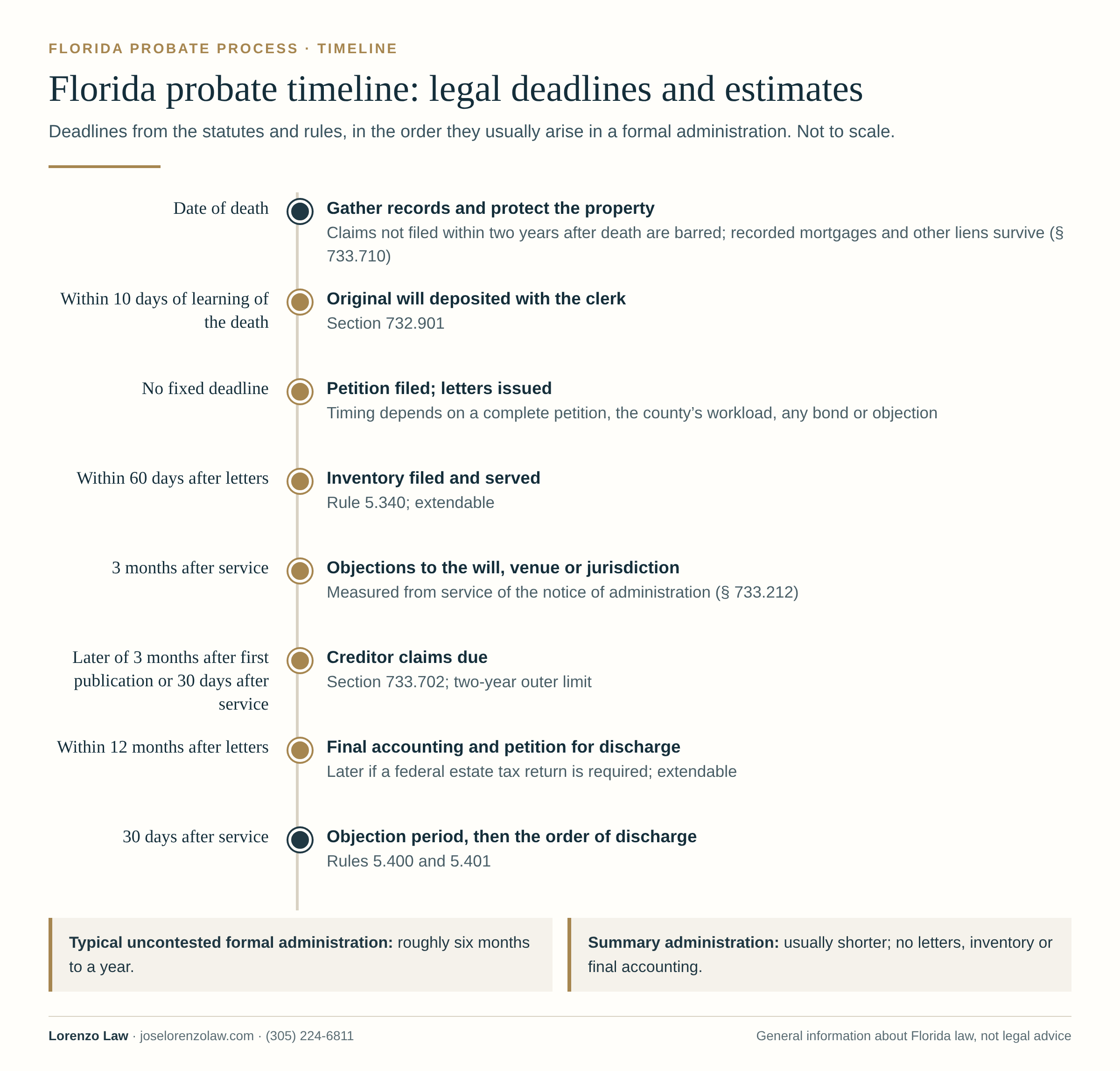
See the chart “Florida probate timeline: legal deadlines and estimates” (opens the full-size image)
Why does Florida probate take so long?
Usually because a step depends on something outside the personal representative’s control: the creditor period, a creditor whose claim is disputed, a house that has to be sold, an heir who cannot be found or will not sign, a missing original will, a tax question, a court calendar, or a family disagreement. Probate delays in Florida are rarely caused by the paperwork alone. When a case seems stuck, the next-step checker below helps identify which step is still open.
How can I check the status of a probate case in Florida?
Most Florida clerks of court offer an online case search where the docket shows the progress of the case: what has been filed and when, including the letters, the inventory and orders; some documents are confidential and not shown online. A beneficiary can also ask the personal representative, or the personal representative’s lawyer, for a status update in writing. Florida probate court files are generally public records, but inventories, death certificates with the cause of death and some other documents are confidential or restricted.
Next-step checker: find your place in the Florida probate process
Answer a few questions about what has already happened to see which phase the estate is in and what usually comes next. It uses general rules only; it does not decide your case.
The tool works in your browser. It makes your selected role and result phase available to site analytics. The event does not include your other selections, dates or amounts. This is general information, not legal advice, and does not create an attorney-client relationship.
What documents do you need to start probate in Florida?
Start with a certified death certificate, the original will and any codicils, the deeds and account statements showing how each asset was titled, the beneficiary designations, the names and addresses of the spouse, children and other heirs or beneficiaries, and any bills, creditor letters and court papers. You do not need a complete file to begin; missing records are part of what the process finds.
The documents needed for probate come in two groups: what the court needs to open the case, and what the personal representative needs to administer it. The court needs the original will, the information in the petition and, at the right time, a death certificate. The personal representative needs everything that shows what the decedent owned and owed.
Florida probate checklist of documents
| Document | Why it matters | Where to look |
|---|---|---|
| Certified death certificate; date of death; last address | Venue, deadlines and the court’s record | Funeral home; Florida vital statistics |
| Original will, codicils and any trust | Who receives, who is nominated, whether formal administration is directed | Papers at home, the drafting lawyer, a safe-deposit box, the clerk |
| Deeds and property records | Title, homestead, mortgages and liens | County official records; property appraiser |
| Bank, brokerage and retirement statements; beneficiary designations | Probate or non-probate; values for the route and inventory | Mail, online accounts, the institutions |
| Vehicle titles; business documents | Transfer method; who can sign for a business | Glove box, files, the company’s records |
| Family information: spouse, children (including any who died), other heirs, addresses | Who must receive notice or sign; who inherits without a will | Family records |
| Bills, creditor letters, final medical and funeral receipts | Claims, priority of payment, small-estate procedures | Mail; the person who paid the funeral |
| Tax returns for recent years | Final returns; hidden accounts and income | The decedent’s files; the tax preparer |
| Any court papers, case number, letters, accounting or release | Existing authority and running deadlines | The envelope they came in; the clerk’s online docket |
For a first conversation, describe the assets by type. Do not send Social Security numbers, full account numbers or originals by email; ask how to provide records securely. If a notice has a deadline, say so at the start: a consultation request does not extend it. See also building a thorough list of assets.
Where is a Florida probate case filed?
A Florida estate is opened in the county where the decedent was domiciled; if the decedent was not domiciled in Florida, in any county where the decedent’s property is located; and if there is no Florida property, in the county where a debtor of the decedent lives (section 733.101). One Florida lawyer can handle an estate in any of the 67 counties.
Domicile means the person’s permanent home, not where the person happened to die, where the family lives or where a lawyer’s office is. A Florida resident who died in a hospital in another county is still probated in the home county, and that one case also covers property elsewhere in Florida. A case filed in the wrong county can be transferred to the right one.
Each county’s clerk of the circuit court keeps the probate files, and each judicial circuit sets its own procedures for hearings and self-represented filers. Lorenzo Law handles estates statewide by phone or video, with the principal office in Kissimmee and meetings by appointment in Coral Gables and Fort Lauderdale. Jose M. Lorenzo, Jr. handles each matter himself, so the attorney you speak with at the first call is the attorney who handles any matter the firm accepts.
Florida probate courts by county
| County where the person was domiciled | Main cities | Judicial circuit | County guide |
|---|---|---|---|
| Miami-Dade | Miami, Hialeah, Coral Gables, Homestead | Eleventh | Miami-Dade probate court · Miami probate attorney |
| Broward | Fort Lauderdale, Hollywood, Pembroke Pines, Coral Springs | Seventeenth | Broward County probate court |
| Palm Beach | West Palm Beach, Boca Raton, Boynton Beach, Jupiter | Fifteenth | Palm Beach County probate court |
| St. Lucie, Martin, Indian River, Okeechobee | Port St. Lucie, Fort Pierce, Stuart, Vero Beach | Nineteenth | Port St. Lucie probate attorney |
| Orange, Osceola | Orlando, Winter Park, Kissimmee, Celebration | Ninth | Orange County probate court · Kissimmee probate lawyer |
| Hillsborough | Tampa, Brandon, Plant City | Thirteenth | Hillsborough County probate court |
| Pinellas, Pasco | St. Petersburg, Clearwater, New Port Richey | Sixth | Pinellas County probate court |
| Duval, Clay, Nassau | Jacksonville, Orange Park, Fernandina Beach | Fourth | Duval County probate court |
| Sarasota, Manatee, DeSoto | Sarasota, Venice, Bradenton, Arcadia | Twelfth | Sarasota and Manatee probate court |
| Lee, Collier, Charlotte, Hendry, Glades | Fort Myers, Cape Coral, Naples, Punta Gorda | Twentieth | Lee and Collier probate court |
| Seminole, Brevard | Sanford, Altamonte Springs, Melbourne, Titusville | Eighteenth | Florida probate service areas |
| Volusia, Flagler, Putnam, St. Johns | Daytona Beach, DeLand, Palm Coast, St. Augustine | Seventh | Florida probate service areas |
| Lake, Sumter, Marion, Citrus, Hernando | The Villages, Ocala, Leesburg, Brooksville | Fifth | Florida probate service areas |
| Polk, Highlands, Hardee | Lakeland, Winter Haven, Sebring | Tenth | Florida probate service areas |
Every county, including the Panhandle and North Central Florida: Florida probate service areas. Lorenzo Law has no office in most of these counties; estates there are handled by phone, video, mail and electronic filing.
Comparing probate attorneys in your county? Statewide representation by a Florida probate lawyer works the same way for an estate in Miami-Dade, Orange or a smaller county.
What changes in Florida probate if there is no will?
The steps are the same; three things change. Florida’s intestate succession statutes decide who inherits, the court appoints the personal representative by the statute’s order of preference instead of the will’s nomination, and more people are usually interested in the estate, so more notices and signatures are involved. Without a will, an estate can still qualify for summary administration or pass outside probate.
Common follow-ups: who inherits when there is no will (the spouse and descendants, then parents, then siblings, in the statute’s order), whether a stepchild inherits (not by intestacy unless adopted), and whether a house titled only to the decedent can be sold before probate (generally not, unless it passed outside probate or a court order gives authority).
Before anyone assumes there is no will, search for one: the decedent’s papers, the lawyer who prepared other documents, a safe-deposit box and the clerk’s will deposit records. Who receives what without a will, including the surviving spouse’s share and how it changes with children from another relationship, is explained in probate in Florida without a will.
What if the person who died lived outside Florida?
When the decedent lived in another state, Florida property in the decedent’s name usually needs an ancillary administration in Florida (section 734.102). If the decedent left a will and the Florida property is worth $50,000 or less, the out-of-state personal representative may use a shorter procedure within two years after death (section 734.1025), and summary administration is also available for a nonresident’s Florida estate that qualifies (section 735.201).
Florida property of a nonresident usually means a condominium, a house, land or a Florida bank account in the decedent’s own name. The Florida case is opened in a county where the property is, and it usually follows the home-state case: the personal representative there, or a qualified relative, applies in Florida with authenticated copies of the will and the home-state letters. A home-state appointment does not by itself give authority over Florida real estate. Gather the deed or statements for the Florida property, the will and any orders from the home state before calling. See ancillary probate in Florida.
The reverse also happens: a Florida resident who owned property in another state may need a proceeding there for that property. A Florida lawyer handles the Florida case and coordinates with a lawyer in the other state. Lorenzo Law does not practice in Puerto Rico or outside Florida.
What if someone contests the will or the personal representative?
A dispute pauses the part of the probate it touches and can stretch the timeline by months. A will contest, an objection to the personal representative, a challenge to an accounting, or an elective share or homestead claim each has its own deadline, and some deadlines start when papers are served. Anyone with a stake in the dispute needs his or her own advice; the personal representative’s lawyer represents the personal representative.
A caveat lets an interested person receive formal notice before the court admits a will or appoints a personal representative, but it does not stop the estate by itself; a creditor may file a caveat only after the death and does not get that pre-appointment notice.
Warning signs worth acting on early: a will that changed shortly before death, a caregiver or relative who controlled the decedent’s finances, transfers or new joint accounts in the last months of life, a personal representative who stops sharing information, or an heir who was left out. If you have been served, keep the papers and the envelope, and note the date and the way you received them. Read next: Florida will contest, Florida probate caveat and Florida probate litigation.
How much does probate cost in Florida?
With Lorenzo Law, summary administration costs from $3,975 and uncontested formal administration from $7,975, as flat fees. The summary administration fee includes the court filing fee and one certified copy of the order, with additional certified copies charged at the Clerk’s rate; the formal administration fee includes the court filing fee, publication of the notice to creditors and the certified copies the matter needs. Jose does not publish the optional notice to creditors in summary administration, so his fee there includes no publication cost. For either procedure, homestead determinations, more complex estates and contested matters are quoted separately, and other expenses may apply, such as recording fees or the decedent’s debts, and in formal administration a personal representative’s bond if the court requires one and the personal representative’s compensation; any increase is discussed before work begins. Full fee terms: summary and formal administration fees. The quote can be higher depending on the estate, and the scope and price are agreed in writing before work begins. Ancillary administration is quoted per matter.
Florida probate costs fall into four groups: court costs (the clerk’s filing fee and certified copies), publication of the notice to creditors, professional fees (the lawyer and, where needed, appraisers or accountants), and the personal representative’s compensation. Which of them an estate pays depends on the route, the assets and whether anyone disagrees. Disputes, sales and tax work are separate from an administration fee.
Lorenzo Law probate fees
| Service | Fee | What is included or separate |
|---|---|---|
| Summary administration | From $3,975 flat | Filing fee and one certified copy of the order included; additional copies at the Clerk’s rate; no publication cost (Lorenzo Law does not publish the optional notice to creditors). |
| Uncontested formal administration | From $7,975 flat | Filing fee, creditor-notice publication and certified copies included |
| Ancillary administration | Quoted per matter | Depends on the home-state documents and the Florida assets |
| Review or advice (self-filers, beneficiaries) | Hourly, agreed in writing | Scope limited to what you ask Lorenzo Law to review or advise on |
| Disputes and litigation | Agreed separately | Separate scope and fee terms |
For either procedure, homestead determinations, more complex estates and contested matters are quoted separately, and other expenses may apply, such as recording fees or the decedent’s debts, and in formal administration a personal representative’s bond if the court requires one and the personal representative’s compensation; any increase is discussed before work begins. Full fee terms: summary and formal administration fees.
The published fees are honored at least through February 15, 2027. The flat fee is paid near the close of the matter; any advance is discussed at the start, and if the estate has no cash, for example when the house was the only asset, the client pays the flat fee.
Who pays for probate in Florida?
The personal representative’s lawyer is paid from the estate as an expense of administration, before beneficiaries receive their shares. A beneficiary who hires his or her own lawyer ordinarily pays that lawyer. Section 733.6171 sets a schedule that the law presumes reasonable in formal administration, but it is not a required fee, the base is the estate’s compensable value (the inventory value plus income earned during administration), not every asset the decedent owned, and a lawyer who charges by the schedule must first make written disclosures to the personal representative.
The executor is paid separately from the lawyer. The personal representative’s compensation follows the will or the statutory schedule, the personal representative may waive all or part of it, and on request of an interested person the court can raise or lower it (section 733.617). Family members who serve often waive it.
How much does it cost to open probate in Florida?
The clerk’s filing fee to open the case depends on the county and the type of administration, and certified copies and publication add to it. With Lorenzo Law’s flat fees, those costs are already included in the quoted price. For the clerk’s charges and every other cost in detail, including the statutory fee schedules, see how much probate costs in Florida.
Common mistakes that stall a Florida probate
Most probate delays and personal liability come from a short list of mistakes: acting before authority exists, paying bills in the wrong order, distributing before the claim period ends, treating every asset as a probate asset, missing a notice, mixing estate money with personal money, and assuming the estate’s lawyer represents everyone.
- Acting before letters. Withdrawing money, selling a car or giving away belongings before appointment can create liability and confusion later. Preserve; don’t administer.
- Paying whoever calls first. Florida sets an order of priority; an estate that cannot pay everyone must follow it.
- Distributing too early. A personal representative who pays the beneficiaries before claims are resolved can be personally liable for a valid claim the estate can no longer pay.
- Putting non-probate assets into the estate, or the reverse. Check every title and beneficiary designation; an account with a surviving beneficiary does not belong in the petition, and a sole-name account cannot be skipped.
- Missing a notice or a person. An heir or creditor who was not served can reopen questions the family thought were closed.
- Mixing funds. Estate money belongs in an estate account, never in a personal account.
- Ignoring the homestead. A Florida home may pass outside the will and outside the administration, and the spouse may have rights the will cannot change.
- Relying on free forms or another state’s form. The form does not choose the route, the county or the creditors.
Executor checklist: first steps after appointment
The first things a newly appointed personal representative usually does:
- Order several certified copies of the letters.
- Obtain a tax identification number for the estate and open an estate account.
- Notify the banks, the property insurer and the post office.
- Publish and serve the notices.
- Secure and value the assets for the inventory.
- Keep a ledger of every dollar in and out from the first day; everything in it becomes the final accounting.
Can probate be avoided in Florida?
For assets you own now, often yes, by beneficiary designations, joint ownership with right of survivorship, an enhanced life estate (“Lady Bird”) deed or a funded revocable trust, although a deed on a homestead can raise separate spousal-rights questions.
Planning works only while the owner is alive and able to sign. After a death, the family cannot add a beneficiary or retitle an asset for the decedent, so the estate goes through whichever route its assets require. A will alone does not avoid probate, and a trust avoids it only for assets actually titled in the trust. If you are planning for your own family, see Florida estate planning and Florida non-probate assets; assets that are exempt from creditors are a different concept, explained in assets exempt from probate.
More questions about the Florida probate process
Can I do probate myself in Florida?
Yes, in a summary administration, a disposition without administration, the other small-estate procedures, and a formal administration in which you remain the sole interested person or are yourself a Florida lawyer. Otherwise, a formal administration needs a Florida lawyer for the personal representative. Clerk’s office staff can explain filing requirements and fees, but cannot give legal advice, choose a route for you or check whether your petition is legally correct.
Are probate records public in Florida?
Mostly. A Florida probate court file is generally a public record that anyone can look up through the clerk, and the will becomes public once it is deposited after the death. Some documents are confidential or restricted, including the inventory, which is available to the interested persons rather than the public, and the cause-of-death version of a death certificate.
What happens if no one opens probate in Florida?
The assets that needed probate stay in the decedent’s name. Nobody can sell the house, close the sole-name accounts or sign for the estate, and costs keep running: property taxes, insurance, association dues and mortgage interest. Creditors are not simply wiped out; most claims are barred two years after death, but a lien such as a mortgage stays on the property. Years later, an heir who wants to sell or refinance usually has to open the probate anyway, sometimes for more than one generation.
Do I have to travel to Florida for probate?
Usually not. A Florida probate can generally be handled by phone, video, mail and electronic filing, and many estates never need an in-person hearing. Ask about signing and original-document requirements for the particular matter; the original will must be deposited with the clerk. Lorenzo Law works with clients statewide and in other states, in English or Spanish.
Discuss the next step for the estate
Tell Lorenzo Law your role (named personal representative, beneficiary, heir or petitioner), the date of death, the county where the person lived, the kinds of assets and how they were titled, and whether there is a deadline or a dispute. Jose M. Lorenzo, Jr. handles each matter himself. He was admitted to The Florida Bar in 2013, after about a decade as a probate and litigation paralegal, and served as a judicial intern with the Hon. Maria M. Korvick in the Probate Division of the Eleventh Judicial Circuit. The initial consultation identifies the route and the information needed to quote a fee; it does not guarantee that a matter will be accepted, a result or a date from the court. Lorenzo Law aims to follow up within one to two business days.
What to bring to the first call: the death certificate or the date of death, the will or a copy if there is one, a list of the assets with how each was titled, and any court papers, notices or creditor letters already received. Nothing needs to be gathered in full before calling.
Request a free initial consultation. Only the initial consultation is free; representation fees and costs are agreed separately in writing.
Request a free initial consultationCall (305) 224-6811
For the statewide probate service, see the Florida probate lawyer page. Related guides: Florida probate guide, when probate is not necessary, what probate assets are, the Florida elective share, probate questions people are embarrassed to ask.
General information about Florida law; it does not replace a review of your documents and circumstances. Reading this page does not create an attorney-client relationship.
Sources and authorities
Statutes cited are the 2026 Florida Statutes, mainly the Florida Probate Code; the rules are the Florida Probate Rules compilation of October 15, 2026.
