
Broward County Probate Lawyer
A Broward County probate attorney helps a family settle the estate of someone who was domiciled in Broward County, or who was domiciled outside Florida and owned Florida property here: whether probate is needed at all, where the estate is filed, which route fits, who may act for the estate and what has to be paid and done before anything is distributed.
This guide covers estate administration across Broward’s 31 cities and its unincorporated areas, from Deerfield Beach and Parkland to Hollywood, Miramar and Weston. It is written for personal representatives, children and other heirs looking for an estate administration attorney, including those who live outside Florida, and it explains venue, the Seventeenth Judicial Circuit’s probate division, summary, formal and ancillary administration, homes and condominiums, seasonal residents, what to gather, timing and published flat fees.
Request a free initial consultation. Only the initial consultation is free; representation fees and costs are agreed separately in writing.
Request a free initial consultationCall (305) 224-6811
Consultations by phone or video in English or Spanish; meetings by appointment in Fort Lauderdale or Coral Gables. Lorenzo Law’s principal office is in Kissimmee.
Go straight to: What help you need · Does it need probate? · Where it is filed · Which route · Broward cities · Fees · What to gather · More questions
By role: if you were named personal representative, start with who serves and whom the lawyer represents; if you live outside Florida, with handling a Broward estate from another state; if the person who died lived part of the year elsewhere, with seasonal and out-of-state owners; if there is a home or condominium, with homestead; if the family disagrees, with disputes.
All of Broward County · Seventeenth Judicial Circuit · Summary, formal and ancillary administration · Published flat fees · English and Spanish
All guide sections(32)
Broward County probate at a glance
| Does it need probate? | It depends on how each asset was owned. Property in the person’s sole name with no beneficiary usually needs a probate case; survivorship property, accounts with a living beneficiary and property already in a funded trust usually do not. Does every estate need probate? |
|---|---|
| Where it is filed | For a person domiciled in Broward, Broward County, in the probate division of the Seventeenth Judicial Circuit in Fort Lauderdale. The heirs’ addresses do not decide the county. Where the estate is filed |
| Which route | Summary administration is available if the Florida assets subject to administration, less property exempt from creditors, are worth no more than $150,000, or the person died more than two years ago, and any will does not direct formal administration. Otherwise formal administration, or ancillary administration when the person was domiciled outside Florida. Which route fits |
| Who can act | In formal administration, the personal representative the court appoints, once letters of administration issue; in summary administration, no one is appointed and the court’s order says who receives each asset. Personal representative |
| Homes and condos | A Florida resident’s home may be protected homestead, which follows its own rules on who inherits and who signs. Condominium association approval is a separate step from legal authority. Homestead · Selling or renting |
| Timing | Summary administration: Jose aims to finish within one to two months from retention, a goal, not a guarantee. Many uncontested formal administrations take roughly six months to a year. Timing |
| Fees | Flat fees: summary administration from $3,975; uncontested formal administration from $7,975; ancillary administration quoted per matter. Fees |
| Who handles it | Jose M. Lorenzo, Jr. handles each matter himself, by phone and video statewide, in English or Spanish, with meetings in Fort Lauderdale by appointment. Who handles your case |
What does a Broward County probate attorney do?
A Broward County probate attorney identifies whether the estate needs a court case, which county and route apply, and who may act; then prepares and files the papers, guides the personal representative through notices, creditor claims, the inventory and the sale or transfer of property, and closes the estate. In a disagreement, the same attorney can assess the dispute under a separate engagement.
Most Broward families come to probate with a specific problem rather than a legal category: a bank that will not release an account, a condominium that cannot be sold, a will that names someone who lives in another state, or a relative who wants an accounting. The first conversation sorts the problem into the work it actually needs. That may be estate administration in Broward, a Florida case for a person domiciled outside Florida, no probate case at all, or a dispute that needs its own assessment.
Within an accepted administration, the work usually includes reviewing the will, the deeds and the account titles; preparing the petition and the papers the court and the Clerk require; obtaining the order or the letters of administration the bank, the title company or the association asks for; publishing and serving the notice to creditors when the route requires it; reviewing claims; preparing the inventory and the accountings; obtaining the homestead determination or the court authority a sale needs; and distributing the assets and closing the estate. You do not need to choose a probate procedure before you hire a probate lawyer in Broward County; sorting that out is part of the first conversation.
The personal representative remains the person who signs and carries the duties of the role; the lawyer prepares, files and advises. As a probate attorney in Broward County, Florida, Lorenzo Law handles estate administration for estates that belong in Broward and for Florida property of people domiciled outside Florida. More on the role: do I need a probate attorney in Florida.
What kind of help does your Broward estate need?
Your role and the documents decide the next step. A bank’s request, a will that names you, a home that must be sold, an owner who lived out of state, a disagreement and planning for someone still living are different inquiries, and only some of them are estate administration.
Serving families throughout Broward does not mean every caller’s estate belongs in Broward court, and a probate engagement for a personal representative does not make the lawyer the representative of every heir. The guide below matches common situations to the work involved and to the fact or document that can change the route.
Case-fit and scope guide
| Your situation | Work to discuss | Fact or document that can change the route |
|---|---|---|
| A bank or another institution will not release an asset after a death | Probate administration and the order or appointment the institution needs | How the account is titled, any beneficiary designation and the institution’s written request |
| You are named personal representative, or there is no will | The right procedure and who may seek appointment | The will, family relationships, the asset list and any case already open |
| A home or condominium must be transferred or sold | Estate authority, any homestead issue and the administration steps | The deed, the mortgage, the association’s documents and any sale deadline; closing and title services are separate |
| The person who died lived outside Florida and owned Broward property | Whether ancillary administration or another Florida procedure fits | How the Florida property is titled and any proceeding in the home state or country |
| You disagree with a will, an accounting or a distribution | A separate probate-dispute assessment | The case number, papers served on you, orders and any response or hearing date |
| You are a creditor or a beneficiary with your own questions | A separate paid engagement for your own interest, after a conflicts check | Who already represents the personal representative and the claim or accounting at issue |
| You are planning for your own property, or need help for someone who is living | A separate planning or guardianship inquiry, not estate administration | Current ownership, capacity and the actual goal |
Before accepting any matter, Lorenzo Law identifies the client and checks for conflicts. Representing a personal representative does not automatically include representing every beneficiary, and a will dispute or a concern about a personal representative’s conduct needs its own assessment of conflicts, scope and representation.
Does every Broward estate have to go through probate?
No. Whether an asset needs probate depends on how it was owned. Property in the person’s sole name with no beneficiary usually needs a probate case; property owned with a right of survivorship, owned by spouses as tenants by the entirety, titled in a funded living trust, covered by a recorded Lady Bird deed or paid to a living beneficiary usually passes without one.
So, can probate be avoided in Florida? For assets that were titled or designated this way before the death, often yes; for assets left in the person’s sole name, usually not. Start with the documents, not with who has been paying the bills. A recorded deed shows how real property was titled; a bank or brokerage statement and the institution’s records show whether an account has a payable-on-death or transfer-on-death beneficiary; a beneficiary designation controls a life insurance policy or a retirement account. A relative who paid the condominium dues or the property tax does not become the owner, and a will does not by itself keep anything out of probate: it takes effect through the probate case.
A trust avoids probate only for property actually titled in the trust, so signing a trust does not prove the house or the condominium was deeded to it. A revocable trust can still answer for the estate’s expenses and debts when the probate assets are not enough (section 733.707(3)). When the property is titled in a revocable trust, the successor trustee administers it without a probate case for that property, and Lorenzo Law also handles trust administration for successor trustees. When property was owned by a company, such as a limited liability company, the property stays with the company; what passes through the estate is the owner’s interest in the company.
How the property was titled
| Title | What usually happens | What to check |
|---|---|---|
| The owner’s name alone, no beneficiary | Probate: summary, formal or ancillary administration | The will, homestead status and the value of the Florida assets |
| Joint owners with a right of survivorship | Passes to the surviving owner when the title carries the right of survivorship | The exact wording of the deed or account; the death certificate to record or present |
| Spouses as tenants by the entirety | Passes to the surviving spouse | That the owners were married when they took title |
| Tenants in common | The deceased owner’s share goes through that owner’s estate | Each owner’s share and the co-owners’ plans |
| A living (revocable) trust | The successor trustee administers it under the trust | The recorded deed or account title in the trust’s name and the trust document |
| A Lady Bird deed (enhanced life estate) | Passes to the named remainder beneficiaries under the deed’s terms | The recorded deed, any later deed or sale, and the title company’s requirements |
| An account with a payable-on-death or transfer-on-death beneficiary | Paid to the beneficiary who survived the owner | Whether the beneficiary is living and the institution’s claim form |
Even when the main asset passes outside probate, another asset may still need a case, such as an account in the owner’s sole name with no beneficiary or a car titled only to the owner. More on bank accounts: a deceased person’s bank account in Florida. More on each kind of title: Florida non-probate assets and when probate is not necessary in Florida.
Where is a Broward County estate filed?
If the person who died was domiciled in Broward County, the estate generally belongs in Broward, in the probate division of the Seventeenth Judicial Circuit, and that one case also covers property the person owned in other Florida counties. It is not decided by where the heirs live, where the lawyer’s office is or which hospital the person died in.
Florida’s venue statute starts with the county where the person was domiciled. When the person who died was not domiciled in Florida, the estate may be opened in a county where the person owned property; if there was neither a Florida domicile nor Florida property, the statute points to the county where a debtor of the person lives (section 733.101). A beneficiary’s residence is not part of that test. A Broward condominium can therefore bring a nonresident’s Florida case to Broward, but a son who lives in Broward does not bring his mother’s estate here if she was domiciled in another Florida county. A case filed in the wrong county is not automatically void: the court may transfer it, and actions taken before the transfer stand (section 733.101(3)). An interested person who is served with a notice of administration generally has three months after service to object to venue (section 733.212(3)).
Every Broward city, from Deerfield Beach in the north to Hallandale Beach and Miramar in the south and Southwest Ranches in the west, is in the same county and the same circuit. Broward has no separate probate court for each city, and a Broward mailing address is not a substitute for checking where the person was domiciled and where each property is.
Two hypothetical examples
The child lives in Broward, the parent did not. An adult child lives in Plantation; her father was domiciled in Orange County, Florida, and died there. His estate is ordinarily opened in Orange County, not in Broward, because the daughter’s address does not move the estate (section 733.101). If her father had also owned a Pompano Beach condominium, that same Orange County case would administer it.
The owner lived in New York. A widow domiciled in New York owned a Hollywood condominium in her own name. The main estate belongs in New York; a Florida case for the condominium can be opened in Broward, where the unit is (sections 733.101(1)(b) and 734.102 and Florida Probate Rule 5.470). These examples assume the stated facts; they are not client results or title opinions.
Part-year residents and domicile
For a part-year resident, the first question is domicile. Broward has many seasonal residents, including owners from other states and from Canada. Spending winters in a Broward condominium does not by itself make someone a Florida domiciliary, and keeping a home in another state does not by itself rule it out: domicile is decided from all the facts, such as where the person usually lived, where the family, documents and daily life were, and what intention the person showed, not from a single document. A Florida declaration of domicile is one of those facts, not the deciding one. The answer decides whether the main estate is opened in Broward or elsewhere. More on this: establishing a Florida domicile.
Which court handles probate in Broward County?
Broward County probate cases are handled by the Seventeenth (17th) Judicial Circuit of Florida, whose probate and guardianship division sits at the Broward County Judicial Complex, the Broward County Courthouse in downtown Fort Lauderdale. The Broward County Clerk of Courts keeps the probate records and receives filings and deposited wills.
Attorneys file probate papers electronically through the Florida Courts E-Filing Portal. Filing a petition is not the same as getting an order: under the circuit’s administrative orders, proposed orders and requests for hearings go through the circuit’s Court Management System (CMS) and other court procedures, and some uncontested matters can be considered without a hearing. That does not mean every case, or every appearance, will be handled without a hearing or remotely. Each case is assigned to one of the circuit’s probate divisions, and the assigned division’s current instructions and the notices in the case control. Which city the person lived in does not decide the judge.
The circuit also publishes probate Smart Forms and certified checklists that certain filings must follow, and those requirements can change. The Clerk’s website offers a case search for probate court records. Clerk staff can explain the Clerk’s services but cannot give legal advice, such as which kind of administration fits or whether a will is valid. For courthouse location, filing-fee and counter details, see the Broward County probate court guide. For current official resources, use the Broward Clerk’s probate and guardianship division and the circuit’s probate administrative orders.
Which Broward cities does this page cover?
All of them. Broward County has 31 cities, towns and villages plus unincorporated areas, and an estate for a person domiciled in any of them is filed in Broward County. Lorenzo Law has local probate pages for 19 of those cities; for the others, this page is the guide.
The city mainly matters for practical reasons rather than legal ones: the type of property, whether there is a condominium or a homeowners’ association, and how far the family is from the property. The probate rules are the same countywide. The table lists every municipality by part of the county; the local pages add city-specific detail. The city links show local information; they do not mean there is an office in each city or decide where a case is filed. Lorenzo Law meets clients in Fort Lauderdale by appointment and works with families across the county by phone and video.
Broward municipalities and local guides
| City | Part of the county | Local guide |
|---|---|---|
| Coconut Creek | North | Coconut Creek probate lawyer |
| Coral Springs | North | Covered on this page |
| Deerfield Beach | North | Covered on this page |
| Hillsboro Beach | North (coastal) | Covered on this page |
| Lauderdale-by-the-Sea | North (coastal) | Covered on this page |
| Lighthouse Point | North (coastal) | Lighthouse Point probate lawyer |
| Margate | North | Margate probate lawyer |
| North Lauderdale | North | North Lauderdale probate lawyer |
| Parkland | North | Covered on this page |
| Pompano Beach | North (coastal) | Pompano Beach probate lawyer |
| Sea Ranch Lakes | North (coastal) | Covered on this page |
| Tamarac | North | Tamarac probate lawyer |
| Fort Lauderdale | Central (county seat) | Fort Lauderdale probate lawyer |
| Lauderdale Lakes | Central | Covered on this page |
| Lauderhill | Central | Lauderhill probate lawyer |
| Lazy Lake | Central | Covered on this page |
| Oakland Park | Central | Oakland Park probate lawyer |
| Plantation | Central | Plantation probate lawyer |
| Sunrise | Central | Sunrise probate lawyer |
| Wilton Manors | Central | Wilton Manors probate lawyer |
| Dania Beach | South (coastal) | Dania Beach probate lawyer |
| Hallandale Beach | South (coastal) | Covered on this page |
| Hollywood | South (coastal) | Covered on this page |
| Miramar | South | Covered on this page |
| Pembroke Park | South | Pembroke Park probate lawyer |
| Pembroke Pines | South | Pembroke Pines probate lawyer |
| West Park | South | Covered on this page |
| Cooper City | Southwest | Cooper City probate lawyer |
| Davie | Southwest | Davie probate lawyer |
| Southwest Ranches | Southwest | Southwest Ranches probate lawyer |
| Weston | Southwest | Weston probate lawyer |
| Unincorporated Broward | Pockets of land across the county outside any city | Covered on this page |
For the wider region, see the South Florida probate attorney page, the neighboring Miami-Dade County probate lawyer and Palm Beach County probate lawyer pages, or the Florida probate service areas for all 67 counties.
Which probate route fits a Broward estate?
The three Florida probate routes are summary administration, formal administration and ancillary administration. Summary administration fits when the assets subject to administration in Florida, less property exempt from creditors, are worth no more than $150,000, or the person died more than two years ago, and any will does not direct formal administration. Formal administration appoints a personal representative with letters of administration. Ancillary administration is the Florida case for a person who was domiciled in another state or country.
That $150,000 figure is the Florida threshold for summary administration (section 735.201); the older $75,000 figure still repeated on some websites, including some official summaries, is out of date. The $150,000 test is not the size of the whole estate. It counts only what must pass through the Florida court: a home held with right of survivorship, an account with a payable-on-death beneficiary or property deeded into a funded trust usually does not count. Property exempt from creditors is subtracted (section 735.201), and protected homestead that passes to the heirs is generally not part of the estate subject to administration, so a Broward home that qualifies does not by itself push an estate over the limit. In a summary administration there is no personal representative; the court orders distribution to the people entitled. Before the petition is filed, the petitioner must make a diligent search for creditors, and the order does not end the claims of creditors who are owed and not paid; those who receive property can remain liable for two years after death (section 735.206). Debts do not by themselves rule out summary administration, and being eligible for it does not make it the right choice for every estate. More on the shorter route: Florida summary administration attorney and summary administration in Florida.
Formal administration is used when summary administration is not available or not appropriate, and it is not limited to estates above a dollar figure: for example, when someone has to sell property and the will gives no usable power, collect assets, deal with creditors through the claims process or bring or defend a lawsuit, or when the will requires it. The court appoints a personal representative and issues letters of administration, which banks, associations and buyers rely on as proof of authority. A summary-administration order and letters of administration serve different purposes, so an institution’s written request should be reviewed before the route is chosen. When a minor child is a beneficiary, the amount matters: a parent acting as natural guardian can generally receive up to $15,000 for the child without a guardianship (section 744.301(2)), while a larger share usually needs a guardianship of property or another arrangement the law allows.
Very small estates can sometimes be handled without a full case. Disposition without administration covers only personal property on narrow facts, such as when the only assets are exempt property and personal property worth no more than the funeral expenses and certain final-illness medical expenses (section 735.301). Neither that procedure nor an affidavit of heirs can transfer a Broward house or condominium. Florida has no general small-estate affidavit that does.
Summary, formal and ancillary administration compared
| Point | Summary administration | Formal administration | Ancillary administration |
|---|---|---|---|
| When it fits | Florida assets subject to administration, less exempt property, worth no more than $150,000, or death more than two years ago; the will, if any, does not direct formal administration | Summary is not available or not appropriate, or a personal representative’s authority is needed to act for the estate | The person was domiciled outside Florida and left Florida property needing administration; a nonresident’s Florida estate that qualifies may use summary administration instead |
| Personal representative | None; the court orders who receives the property | Appointed, with letters of administration | Appointed in Florida; a representative the will names for the Florida property, or otherwise the domiciliary representative, has priority if qualified |
| Creditors | Diligent search before filing; distributees may remain liable for two years after death | Notice to creditors published, and served on known or reasonably ascertainable creditors; claims period | In formal ancillary administration, notice to creditors in Florida, as in a formal case |
| Typical records | Death certificate, original will if any, asset values, family information | Same, plus records for each asset, any real property and any debts | Authenticated copies of the will and of the other state’s probate papers, the Florida deed |
| Flat fee (see fees) | From $3,975 | From $7,975, if uncontested | Quoted per matter |
Chart: where a Broward estate is filed and which route fits
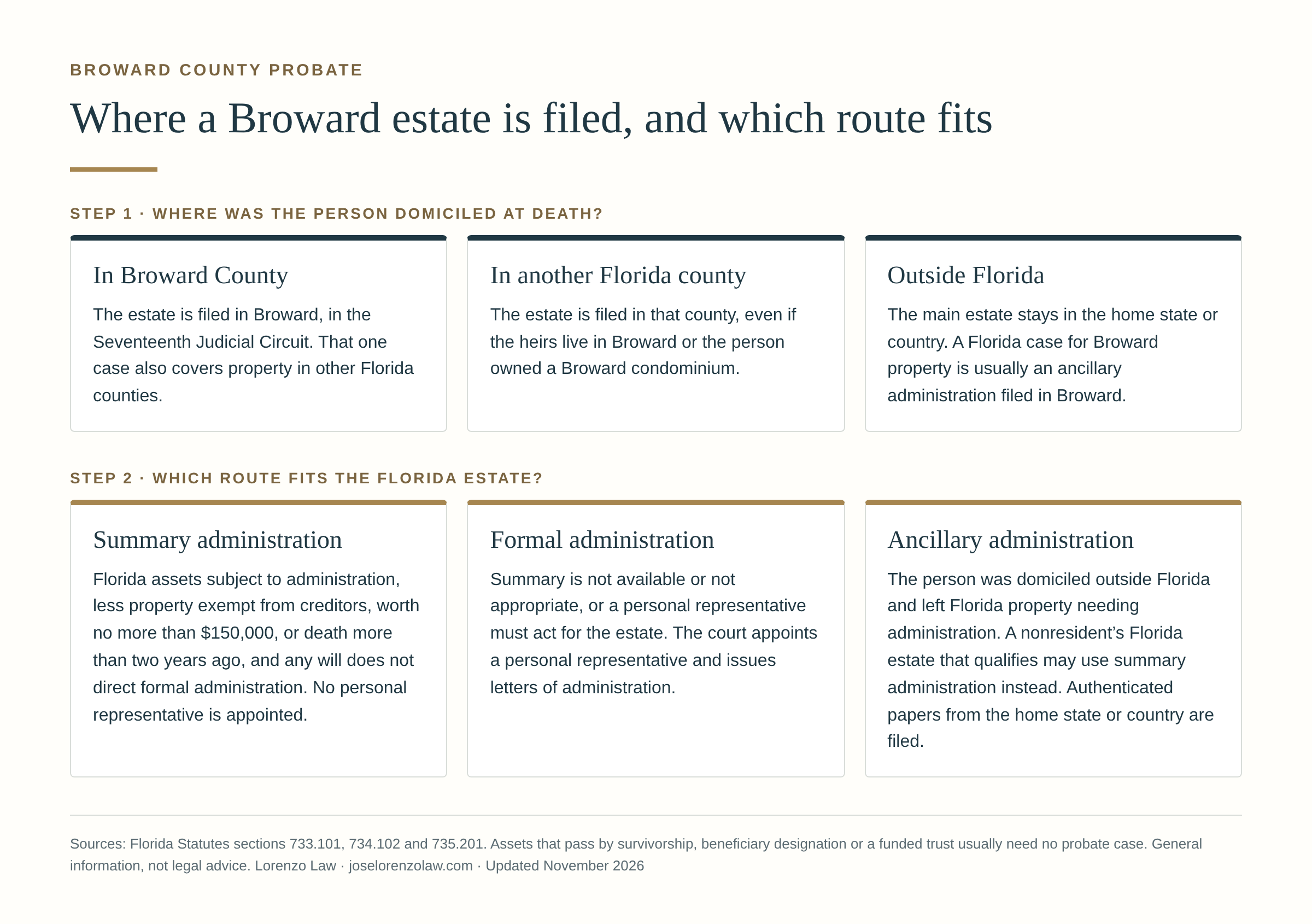
See the chart: where a Broward estate is filed and which route fits
More on the court steps: the Florida probate process. If there is no will, Florida’s intestacy rules decide who inherits the probate assets, subject to the homestead rules; they do not redirect assets that pass by beneficiary designation, survivorship or trust (probate without a will in Florida).
Who serves as personal representative, and whom does the lawyer represent?
The personal representative is the person the court appoints to run the estate, often called the executor; the will usually nominates one, and if there is no will the statute sets the order of preference. The personal representative’s lawyer represents the personal representative in that role, not each heir or beneficiary individually.
Florida’s probate rules generally require a personal representative to be represented by a Florida lawyer, with limited exceptions, such as when the personal representative is the sole interested person, or is a Florida lawyer (Florida Probate Rule 5.030). Being nominated in the will does not give authority to act until the court appoints the person and letters of administration issue. A personal representative owes duties to the estate and to the interested persons, keeps estate money separate, files an inventory and accounts for what was received and paid. More on the role: how to become a personal representative in Florida and who can serve as executor.
The lawyer prepares the court papers, but the personal representative signs the documents the rules require, such as the oath (Florida Probate Rule 5.320), and the inventory, accountings, petitions to sell and the petition for discharge (Florida Probate Rule 5.330). Attorney continuity does not replace the personal representative’s own responsibilities; it means the same lawyer who heard the facts at the first call is the one who prepares and files what the personal representative signs. Beneficiaries and heirs receive the notices the law requires and can ask questions, but if they want advice about their own rights, an accounting or a proposed release, they can hire their own lawyer; Lorenzo Law accepts those beneficiary engagements as separate paid matters when there is no conflict.
Personal representatives who live outside Florida
Being named in the will is not the same as being appointed. Florida allows a person who is not domiciled in Florida to serve as personal representative only if he or she is an adopted child or adoptive parent of the person who died, a lineal relative such as a child, grandchild or parent, a spouse, brother, sister, uncle, aunt, nephew or niece, or a lineal relative of one of them, or the spouse of anyone in those categories (section 733.304). A nominated friend who lives in another state may not qualify, even if the will names him. Before letters issue, a personal representative, unless a corporate fiduciary with a Florida office or a Florida lawyer who lives and has an office in Florida, must designate a resident agent, and a bond is required unless the will or the court waives it, subject to the court’s power to require one (section 733.402 and Florida Probate Rules 5.110 and 5.235). More on serving from another state: serving as an out-of-state executor in Florida.
The Broward probate process, step by step
An uncontested formal administration in Broward usually moves through the same stages: the will, if any, is deposited, the petition is filed, the court appoints the personal representative and letters issue, notices go out, creditor claims are handled, assets are collected, sold or distributed, and the estate is closed with a discharge. A summary administration is shorter: one petition, then an order that says who receives each asset.
Formal administration
- Deposit the original will, if there is one. Whoever has the original will must deposit it with the clerk of the court where the estate will be handled, the Broward Clerk for a Broward domicile, within 10 days after learning of the death (section 732.901).
- File the petition for administration electronically, with the papers the circuit requires, and the proposed personal representative’s oath and designation of resident agent; a bond is required unless the will or the court waives it.
- The court admits the will and appoints the personal representative; letters of administration issue and give the authority banks, associations and buyers ask for.
- Serve the notice of administration on the interested persons, and publish and serve the notice to creditors, which starts the claims period (sections 733.212, 733.2121 and 733.702).
- Collect and value the assets and file the inventory; open an estate account and pay expenses from it.
- Review creditor claims, pay valid claims in the order the law sets and object to claims that are not valid.
- Determine homestead and sell or transfer property as the will, the court or the heirs’ agreement allows.
- Account to the beneficiaries, distribute and ask the court for discharge, which ends the personal representative’s role.
Summary administration
- Make a diligent search for creditors and gather the asset values and family information.
- File the petition for summary administration, joined by the beneficiaries or served on them as the rules require.
- The court enters an order of summary administration naming who receives each asset; no personal representative is appointed.
- Present or record the order with the bank, the Broward County official records or the title company to transfer each asset.
The order of these steps can change: a homestead determination, a sale, a creditor dispute or an objection can add a petition or a hearing. More on each stage: the Florida probate process.
Is the Broward home protected homestead?
It may be. A house or a condominium can be protected homestead if the person who died was a Florida resident and the property was the permanent residence of that person or his or her family. Protected homestead is generally exempt from most creditor claims and, if the owner was survived by a spouse or a minor child, cannot be left by will except as Florida’s Constitution allows; it then passes under the homestead statutes rather than as the will directs (article X, section 4, Florida Constitution; sections 732.401 and 732.4015).
When there is a surviving spouse and descendants, the spouse generally receives a life estate in the homestead with the remainder to the descendants, or may elect within six months after death to take an undivided one-half interest as a tenant in common (section 732.401). When the owner was survived by no spouse and no minor child, the home can generally be left by will to anyone, and if it passes to an heir it keeps its creditor protection. The family usually asks the court for an order determining homestead, which a title company relies on when the property is later sold. Protected homestead is generally not an asset the personal representative administers for creditors (section 733.607), although the representative may need to take possession to protect it (section 733.608(2)).
A Broward property that was not the permanent residence of the owner or the owner’s family, such as a rental unit or a seasonal condominium owned by someone domiciled in another state, is generally not protected homestead. A surviving spouse may also have an elective share of 30 percent of the elective estate, which must generally be claimed by the earlier of six months after service of the notice of administration or two years after death, unless the spouse waived it in a valid agreement (sections 732.201, 732.2065, 732.2135 and 732.702). Two other family protections apply when the person who died was domiciled in Florida: exempt property, such as household furnishings in the usual home up to a net value of $20,000 and up to two motor vehicles held in the decedent’s name and regularly used by the decedent or the family, which must generally be claimed within four months after service of the notice of administration (section 732.402), and a family allowance of up to $18,000 for the spouse and the dependent lineal heirs the decedent was supporting (section 732.403). More on these rights: Florida homestead in probate and surviving spouse rights in Florida.
The homestead property-tax exemption is a different question
The homestead exemption shown on the Broward County Property Appraiser’s records is a property-tax benefit, not a probate determination. The exemption and the Save Our Homes assessment limit generally end with a change of ownership at death, and the property is reassessed at just value as of the next January 1, except for certain transfers to a surviving spouse, a minor child or a dependent who lives there (sections 193.155 and 196.011). An heir who makes the property his or her own permanent residence must apply for a new exemption by March 1 of the year it should apply. Families should tell the Property Appraiser about the death rather than let an exemption continue that no longer applies. The property tax itself keeps coming due: taxes not paid by April 1 become delinquent, the Tax Collector can sell a tax certificate on the property, and if the certificate is not redeemed the holder may apply for a tax deed after two years from April 1 of the year the certificate was issued (sections 197.333, 197.432 and 197.502). Within the estate, the point is to keep the tax bill paid; Lorenzo Law does not handle tax-deed proceedings.
Who can sell or rent an inherited Broward house or condominium?
Being an heir does not by itself give that power. While the property is part of the estate, only a person with authority can sell, rent or hand it over. In formal administration, the personal representative sells under a power of sale in the will or with the court’s authorization; in summary administration, the people who received the property by the court’s order act as its owners. A relative who has the keys, pays the dues or is named in the will does not yet have authority to sign a sale. That is the first question when a family wants to sell an inherited house or an inherited condo in Broward during probate.
In formal administration, the personal representative can sell without a court order if the will gives a power of sale; otherwise, the sale needs the court’s authorization or confirmation (section 733.613). A personal representative may lease estate real property, which does not include protected homestead, without a court order, for a term within or extending beyond the period of administration, but must act reasonably for the benefit of the interested persons and is bound by any limits in the will or a court order (section 733.612(7)). A lease still has to follow the association’s rules on minimum terms, the number of leases a year and approval, and any local short-term rental rules. Once the heirs are co-owners, each may sell an undivided share, but none can sell the whole property without the others. If the property was protected homestead, different rules apply: it usually passes directly to the heirs, the court is usually asked to determine its status, and the personal representative does not sell it as an ordinary estate asset.
When one heir wants to keep the property and the others want its value, there are three usual paths: the other heirs agree to sell their shares to that heir for an agreed price; in a formal administration, the personal representative may distribute the property to that heir and balance the shares with other estate assets, because Florida allows non-pro-rata distribution subject to the representative’s duty of impartiality (section 733.810); or, if no agreement is possible, a co-owner asks the court for partition, which can end in a division or, if the property cannot be divided without prejudice, a court-ordered sale (chapter 64, including section 64.071). More on this: Florida partition actions and selling a house in probate in Florida.
Condominiums and 55-and-older communities
Much of Broward’s housing is in condominium and homeowners’ associations, including large age-restricted communities. The declaration and the association’s other documents decide whether the association must approve a buyer, a tenant or an occupant, or has a right of first refusal; in some buildings they do, in others they do not, and a transfer to heirs through probate may be treated differently from a sale. In a 55-and-older community, the documents may also limit who can live in the unit, which can affect whether an heir can move in or rent it. Ask management in writing for the current documents and the time the association takes to decide before signing a contract or promising a closing date. Association approval and the signer’s legal authority are two separate requirements; meeting one does not satisfy the other.
The association’s estoppel certificate states, as of a date, what the association says is owed on the unit; it does not appoint anyone, decide who inherits or give anyone authority to sign. A unit with no living owner of record keeps accruing dues, assessments and interest, and the association’s lien rights are governed by the Condominium Act (section 718.116). Tell the association about the death and the estate early, and keep the unit insured.
Milestone inspections, reserves and special assessments
Building safety rules affect what an inherited Broward condominium costs to keep. After the 2021 Surfside collapse, Florida law requires residential condominium buildings three or more habitable stories tall to undergo milestone inspections and structural integrity reserve studies on statutory schedules, and local building officials may impose their own recertification requirements. Repairs and reserves can become special assessments that the estate or the new owner must pay.
Under the statutes, a covered building generally needs a milestone inspection by December 31 of the year it turns 30, or 25 if the local enforcement agency decides that local conditions such as proximity to salt water require it, and every 10 years after that (section 553.899), and a structural integrity reserve study at least every 10 years (section 718.112(2)(g)). Local recertification programs may set their own schedules; check the notice the building received rather than assuming a date.
Inheriting a unit in an older Broward building, on the beach or inland, can therefore mean inheriting an assessment that the board approved before the death, during the estate, or soon after distribution. The building’s age, structure, reports and notices matter; this guide does not assume that every building faces the same bill or the same deadline. Ask management for the milestone inspection reports, the reserve study, the current budget and any notice of a proposed or adopted assessment, and keep proposed and adopted assessments separate when the family compares keeping the unit with selling it.
Engineering review and disputes with the association over repairs are not part of an estate administration; if they arise, they are a separate matter. Within the estate, the questions are practical: who pays an assessment that comes due while the case is open, whether the estate can afford to keep the unit, and whether a sale before distribution makes more sense. A beneficiary who does not want an inherited unit can, in some circumstances, disclaim the inheritance; a disclaimer has strict form requirements, is barred once the beneficiary accepts the property, and has tax effects, so it should be reviewed before anyone accepts the unit or its rents (chapter 739).
How the transfer shows up in the public record
Title changes in the public record only when the right document is recorded in the Broward County official records: in formal administration, the personal representative’s deed to a buyer or to the beneficiaries; in summary administration, a certified copy of the order; for a protected homestead, the court’s order determining homestead status (Florida Probate Rule 5.405); and for a survivorship or trust title, the documents the title company requires, usually including a death certificate. Lorenzo Law’s probate work establishes the authority to sell within the agreed engagement. The firm does not provide real estate closings or title insurance; coordination with the closing agent, the title company or an appraiser is available under a separately agreed scope.
What if the owner lived in another state or spent winters in Broward?
If the person who died was domiciled in another state or country and owned Florida property in his or her own name, a Florida case is usually needed for that property. It is generally an ancillary administration opened in the county where the property is, so a Broward condominium brings the Florida case to Broward. The main estate stays in the state of domicile. An heir who lives outside Florida does not, by itself, make a case ancillary.
An ancillary administration recognizes the out-of-state estate in Florida and gives a Florida personal representative authority over the Florida property (section 734.102). The court generally gives preference to a representative the will names for the Florida property and, otherwise, to the representative already appointed in the state of domicile, if qualified to serve in Florida (section 734.102). Filing ordinarily needs authenticated copies of the will and of the other state’s probate papers; an ordinary photocopy is not enough. Owning property in two Florida counties does not make a Florida resident’s estate ancillary: the estate of a Florida domiciliary is a single Florida case in the county of domicile. An appointment in another state does not by itself give authority over a Broward property.
Two shorter routes exist for nonresidents. Summary administration is available to the estate of a nonresident if the Florida estate meets the summary conditions described above (section 735.201). Short-form ancillary administration may be available when a nonresident died with a will, the Florida property subject to administration had a gross value of no more than $50,000, and the foreign personal representative files within two years after death (section 734.1025). Whether a property falls under either route depends on its value and on how it was titled; a condominium owned with a surviving joint tenant may not need any Florida case. The cost of an ancillary case depends on those facts, which is why Lorenzo Law quotes it per matter. More on this: Florida ancillary probate.
Seasonal residents raise the domicile question described above: a person who spent winters in Broward may have been domiciled here or in the other state, and the answer decides whether Broward holds the main estate or only an ancillary case. Bring information about any proceeding already opened elsewhere. Living outside Florida as a beneficiary is a different issue from the person who died having lived outside Florida.
International estates: owners and heirs in another country
When the person who died was domiciled in another country, such as a Canadian who wintered in Broward, the Florida property is handled the same way as for an owner from another state: usually an ancillary administration in Broward, filed with authenticated copies of the will and of any foreign court or notarial papers. Documents issued abroad generally need an apostille or consular authentication, and documents in another language need a translation; Lorenzo Law explains documents in Spanish but does not translate them word for word, so a certified translator is hired when one is needed. Heirs who live abroad can usually sign where they live, before a U.S. consular officer or a local notary. Lorenzo Law handles the Florida case and its documents; another country’s inheritance law and taxes are for a lawyer and tax adviser in that country. When an estate sells Florida real property and the seller is a foreign person, the buyer may have to withhold federal tax under the FIRPTA rules; that is a tax question for the family’s tax professional.
Can a family handle a Broward estate from another state?
Usually, for most of the work, and often without traveling to Florida. Florida probate is handled in writing and filed electronically, Jose works with families by phone and video, and many signatures can be given remotely. What cannot always be done remotely is delivering an original, such as the original will or certain authenticated documents, and attending a hearing the court sets in person. Phone and video consultations with the lawyer are not the same as permission to appear remotely in court.
A personal representative who lives in another state can usually handle a Broward estate without moving to Florida: papers are signed where he or she lives. Florida lets the petition and joinders be signed under penalty of perjury, so a notary is usually not needed; when a notarized document is needed, it can be signed online with a Florida online notary, or abroad before a U.S. consular officer or a local notary (Florida Probate Rule 5.020; sections 92.525, 117.215 and 92.50(3)). Lorenzo Law offers signing by online notarization when the document allows it, and if a document needs another form, that is explained in advance. The lawyer files the papers, and some uncontested matters are decided without a hearing.
If a hearing is needed, the assigned judge’s instructions decide whether it is held in person or remotely, so no one should assume every hearing will be remote. Travel may still be needed for a hearing set in person, or to clear out and secure the property. An original will, certain authenticated documents or a document to be recorded may have to travel on paper by courier; that is a shipment, not necessarily a trip. A scanned will or an e-mailed signature is not a substitute where the law requires an original.
In practice, out-of-state families usually work this way: a first call or video meeting to identify the client and the route; documents sent in the way Jose arranges after intake, not through the public contact form; signatures given where the family lives; and updates by phone, video, e-mail or WhatsApp. Lorenzo Law aims to follow up within one to two business days. Families who prefer to meet in person can meet Jose by appointment at 12 SE 7th Street, Suite 701, Fort Lauderdale, FL 33301, a by-appointment meeting location (that office’s direct line is (954) 371-0402).
Where do you file a will in Broward County, and what is the 10-day rule?
Whoever has the original will of a person who died must deposit it with the clerk of the court in the county with venue within 10 days after learning of the death (section 732.901). The 10 days run from learning of the death, not necessarily from the death itself, and depositing the will does not open an estate or give anyone authority to act.
For a Broward domiciliary, that is the Broward County Clerk of Courts. Check the Clerk’s current instructions for depositing an original will before mailing or delivering it, and keep a copy of what was delivered and when. An electronic will is deposited by its qualified custodian under its own rules. If the original may be in the deceased person’s safe-deposit box, the bank must, on proof of death, let the spouse, a parent, an adult descendant or the person named as personal representative in a copy of the will open the box in the presence of a bank officer, and it delivers any will found to the probate court (section 655.935). If the original cannot be found, a copy is not automatically enough: a lost or destroyed will must be established in court, generally by two disinterested witnesses, or one if a correct copy is available (section 733.207).
A will made in another state is not automatically invalid in Florida. A will signed by someone who was not a Florida resident is generally valid in Florida if it was valid where it was signed, but a handwritten will that was not witnessed as Florida requires, or an oral will, is not recognized here (section 732.502(2)). Bring the original, every codicil and any earlier will you find, even one you believe was revoked.
What should the family do in the first weeks after a death in Broward?
Secure the home and its contents, find the original will and the deed, order certified death certificates, tell any association and the insurer in writing, and keep paying or documenting the property’s bills. Do not sell, give away or move assets until someone has legal authority.
- Control keys, gate or access devices and any association authorization list; note who has access.
- Look for the original will, codicils and any trust; if someone has the original, it must be deposited with the Clerk within 10 days after that person learns of the death.
- Get the recorded deed, the latest association statements, the mortgage statement and the insurance policy.
- Tell the association manager and the insurer about the death in writing, and ask the insurer what the policy requires if the home stays vacant.
- Keep receipts for anything a relative pays; reimbursement is not automatic.
- Do not use a power of attorney after the death: the agent’s authority ended when the principal died (section 709.2109).
- Do not sign a listing agreement or a sale contract until the right person has authority to sign it.
- Write down any court notice, creditor letter or association collection notice you receive, and the date it arrived.
- Check Florida’s unclaimed property records (unclaimed funds held by the state) for the person’s name; a claim for a deceased relative’s unclaimed property is filed with the state, generally by the estate’s personal representative, although heirs can sometimes claim small amounts without a probate case, and Lorenzo Law handles those claims only within a probate representation.
If something cannot wait for an appointment
Sometimes property needs protection before anyone has been appointed: a vacant home with a lapsing insurance policy, a tenant whose lease is ending, or a sale contract the owner signed before death. Florida allows the court to appoint a curator to take charge of the estate’s property when that is necessary, until a personal representative is appointed (section 733.501). Whether a curator, a prompt petition for administration or a simpler step fits depends on the facts, so raise the urgency at the first call.
How long does probate take in Broward County?
In summary administration, Jose aims to finish within one to two months from retention, and starts as soon as he is retained; that is a goal, not a guarantee. Many uncontested formal administrations take roughly six months to a year. Missing documents, unclear title, creditor claims, taxes, a sale or a dispute can make any estate take longer.
Creditor deadlines are not a promise of when an inheritance will be distributed. In a formal administration, the ordinary claims deadline is generally the later of three months after the first publication of the notice to creditors or, for a creditor who must be served, thirty days after service of the notice, subject to the statute’s qualifications and exceptions (section 733.702). That is why most formal estates cannot close in a few weeks. Claims not filed within two years after death are generally barred, whether or not an estate was opened (section 733.710). Florida’s court rules set 12 months from the issuance of letters to discharge as a presumptive time standard for uncontested estates that do not file a federal estate-tax return, but that is a time standard for completing cases, not a promise of distribution by that date (Fla. R. Gen. Prac. & Jud. Admin. 2.250(a)).
What usually decides a Broward probate timeline
- Whether the original will is available and the family agrees on who should serve.
- How quickly the personal representative signs and returns the court papers and the bank and association forms, especially from another state.
- Whether the home is protected homestead and needs a court determination before it can be sold.
- Whether association approval, a buyer’s financing, a special assessment or a title issue affects a sale.
- Whether creditors file claims that have to be objected to, or the family disagrees.
- For a nonresident owner, how quickly the other state’s court issues authenticated papers.
- The court’s review of the filings, and any hearing the assigned division sets.
No one can promise when a beneficiary will receive money. More detail: how long probate takes in Florida.
How much does a Broward County probate attorney cost?
Lorenzo Law charges flat fees for probate administration. Summary administration starts at $3,975 and includes the filing fee and certified copies of the order; Lorenzo Law does not publish the optional notice to creditors in summary administration, so there is no publication cost. Uncontested formal administration starts at $7,975 and includes the filing fee, creditor-notice publication and certified copies. Ancillary administration is quoted per matter. These fees are honored at least until February 28, 2027.
For either procedure, homestead determinations, more complex estates and contested matters are quoted separately, and other expenses may apply, such as recording fees or the decedent’s debts, and in formal administration a personal representative’s bond if the court requires one and the personal representative’s compensation; any increase is discussed before work begins. Full fee terms: summary and formal administration fees. Broward County probate attorney costs vary widely from firm to firm, so compare what each quote includes. The Broward Clerk’s probate filing fee, which these flat fees include, is currently $401 for formal or ancillary administration and $346 for summary administration of an estate of $1,000 or more ($236 below $1,000); the Clerk’s full schedule is in the Broward County probate court guide.
Flat fees for Broward probate administration
| Route | Flat fee | Included | Outside this administration fee |
|---|---|---|---|
| Summary administration | From $3,975 | Filing fee, certified copies of the order (no notice publication) | Homestead determination, disputes, a real estate closing, title insurance, tax returns |
| Uncontested formal administration | From $7,975 | Filing fee, creditor-notice publication, certified copies | Homestead determination, contested matters, a real estate closing, title insurance, tax returns |
| Ancillary administration | Quoted per matter | Set out in the written quote | Work under another state’s or country’s law |
The figure that applies to a particular estate can rise with its facts, such as the number of assets, an out-of-state personal representative or a sale, and any change is discussed before the work begins. The written engagement names the client, the work, the fee and any cost not included. The flat fee is generally paid near the close of the matter; whether the client advances any cost is discussed in advance, and when the estate has no cash, for example when the home is the only asset, the client pays the flat fee. People who prefer to handle part of the work themselves can retain Jose by the hour for review or advice.
There is no single average cost for a probate attorney in Florida: fees depend on the route, the estate and how the lawyer bills, so compare written quotes. Florida law does not require a percentage fee for a probate lawyer. Section 733.6171 sets a schedule presumed reasonable for the personal representative’s lawyer, but there is no mandatory fee: the lawyer, the personal representative and those bearing the cost can agree to a different fee, such as a flat fee, and a lawyer who uses the schedule must make written disclosures. The personal representative’s own compensation is a separate question (section 733.617). Probate litigation is priced differently: on contingency or a hybrid basis where appropriate, or with a flat fee for a discrete task, depending on the facts. More on this: the cost of probate in Florida.
What happens to the debts of a person who died in Broward?
Debts are paid from the estate, in the order Florida law sets, before beneficiaries receive their shares. Heirs generally do not become personally liable for the decedent’s debts just because they inherit, but property that passes through the estate, and in some cases a revocable trust, can be used to pay valid claims.
In formal administration, the personal representative publishes a notice to creditors and serves it on creditors who are known or reasonably ascertainable; creditors then file claims in the probate case, and the personal representative reviews each claim and may object to one that is not valid. In summary administration there is no claims period like the one in a formal administration, although a notice to creditors may be published after the order; the petitioner makes a diligent search for creditors before filing, serves the petition on those creditors, and those who receive property can remain liable for valid unpaid claims (sections 735.206 and 735.2063). A recorded mortgage stays with the property, and the association’s rights against a condominium unit follow the Condominium Act. Protected homestead passing to heirs is generally not available to pay ordinary creditors. More on this: Florida probate creditor claims and do you inherit debt in Florida.
Reasonable funeral, burial and grave-marker expenses, up to $6,000 in total, come early in the order of payment, right after the costs and expenses of administering the estate, and a family member who paid the funeral home can file a timely claim in the probate case to be reimbursed from the estate (sections 733.702 and 733.707).
Lorenzo Law also represents creditors and claimants who need to file, enforce or settle a claim against a Florida estate, subject to a conflicts check; fees and costs for that work depend on the issue and are agreed in writing.
Taxes after a death in Broward
Florida does not currently collect an estate tax or an inheritance tax. Federal estate tax applies only to estates above the federal filing threshold, and the person who died may still owe a final income-tax return. Property tax on a Broward home keeps coming due during probate.
The personal representative is responsible for seeing that the decedent’s final tax returns are filed and that taxes owed are paid from the estate before distribution. Heirs who later sell inherited property should keep a record of its value at the date of death, because it matters for their own income tax. Lorenzo Law does not prepare tax returns or give tax opinions; it explains the Florida side of the estate and coordinates with the family’s accountant or tax professional. Property tax and the homestead exemption are explained under homestead. More on this: Florida inheritance tax.
What should you gather before calling a Broward probate attorney?
Before meeting a probate attorney, gather the records you have for the Broward estate: the death certificate, the will, the recorded deed, recent statements for the main accounts, any association statements and any court or creditor notice. A missing record is a reason to identify the gap at the first call, not a reason to wait.
A Broward probate checklist for families
- The person’s name, date of death, domicile at death and your relationship or role.
- Whether there is a will, where the original is, and whether a trust is involved.
- A general asset list: real estate, accounts, vehicles and other property, with approximate values and how each is titled.
- Information about a surviving spouse, children and other possible beneficiaries, and where each lives.
- Any existing case number, appointment papers, orders or proceeding outside Florida.
- Notices from a bank, creditor, association or court, including the date received and any stated deadline.
- A deed and any pending sale information if a home or condominium is involved.
- Whether there is a disagreement, and what you want the attorney to assess.
Records for a Broward estate
| Gather | Why it matters | Usually held by |
|---|---|---|
| Original will and codicils, and any trust, with the name of whoever holds them | Admission to probate, nominations, powers of sale and possible nonprobate ownership | The family, the drafting lawyer or the trustee |
| Certified death certificate and any existing appointment or order | Proof of death and whether authority already exists | The family; the court file |
| Recorded deed for the home and any other real property | Separates estate assets from property that passed outside probate | Broward County official records; the closing file |
| Recent account statements and beneficiary information | The asset list, approximate date-of-death values and the route | The banks and brokerage firms; the family |
| Association statements, mortgage, insurance, lease and sale papers | Carrying costs, the property’s obligations and any deadline | The association or manager, the lender, the insurer, the tenant, the broker |
| Creditor letters and court notices, with the date each was received | Deadlines and any possible dispute | Whoever received them |
You can start even if some records are missing. In the public contact form, give only a short description: your role, the date of death, the county or state of domicile, the types of assets and any deadline. Do not send account numbers, Social Security numbers, passwords or documents through the form; Jose explains how to send documents after the first conversation. Mention a hearing, a response deadline or a pending sale when you call, and do not assume a message changes a deadline or confirms representation. Florida’s ethics rules generally protect information a prospective client shares with a lawyer in a consultation, even if no engagement follows (Rule Regulating The Florida Bar 4-1.18).
What if the family disagrees about the will or the estate?
A disagreement about the will, the personal representative, an accounting, a claim or what to do with the home is a separate matter from an uncontested administration. Identify it at the first call and bring any papers you have been served, because some deadlines are short and a consultation does not stop them.
Common Broward disputes include heirs who cannot agree whether to keep, rent or sell a home or condominium; a relative living in the property who will not leave or pay; questions about a will signed late in life; a personal representative who does not account for money or rent; and creditor claims the estate disputes. Some are resolved inside the probate case, by objection, petition or mediation; a probate dispute can also end in a negotiated settlement or court-ordered mediation, the usual forms of probate dispute resolution, rather than a trial; others need a separate lawsuit. The client, the conflicts review, the legal issues and the fee differ from an uncontested administration, and the written engagement for a dispute is separate; an administration engagement is not a promise to handle every later dispute.
Timing matters. An interested person who is served with a copy of the notice of administration generally has three months after service to object to the validity of the will, the venue or the jurisdiction of the court (section 733.212(3)). An interested person who expects a dispute before a case is opened can file a caveat with the Broward County Clerk, which generally entitles the caveator to formal notice before a will is admitted to probate or a personal representative is appointed (section 731.110); more on this: Florida probate caveats. Other rights run on their own deadlines: an exempt-property claim, the spouse’s elective share, an objection to a claim or to an accounting, and a petition to remove a personal representative each follow their own rules. More on disputes: Fort Lauderdale probate litigation, Florida probate litigation, Florida will contests and trust litigation.
If the person is still living: guardianship and planning
Then it is not a probate administration. Help for a living person who can no longer manage his or her affairs is a guardianship or planning question, and planning for your own property is estate planning; each is a separate inquiry and a separate engagement.
If a parent or spouse can no longer make decisions and has no usable power of attorney or health care surrogate, a guardianship may be needed; guardianship is not simply the first stage of a later probate. More on this: Florida adult guardianship. If you are planning ahead for a Broward home, a deed such as a Lady Bird deed or a revocable trust can avoid probate for that home, subject to Florida’s homestead restrictions when there is a spouse or minor child; that planning is different from administering property after a death and cannot fix property already in a deceased person’s sole name. More on this: Broward County Lady Bird deeds and Florida estate planning.
What Lorenzo Law handles in a Broward estate, and what it does not
Lorenzo Law handles the Florida legal work of the estate: summary, formal and ancillary administration, homestead determinations, the authority to sell or transfer property, creditor claims, trust administration for successor trustees, beneficiary and creditor engagements, and probate disputes under a separate engagement. It does not handle real estate closings, title insurance, tax-return preparation, property management, tax-deed proceedings or another country’s or state’s inheritance law.
Within and outside a Broward probate engagement
| Topic | Within a probate engagement | Outside it, or a separate engagement |
|---|---|---|
| The home or condominium | Whether it is a probate asset, who has authority, the court order or letters, the personal representative’s deed | The closing itself, title insurance, listing and management of the property |
| The association | Reviewing the estoppel certificate and the documents that affect the estate | Association litigation or disputes with the board |
| Taxes | Explaining the Florida side and coordinating with the family’s tax professional | Preparing tax returns or giving tax opinions |
| Other professionals | Coordination under a separately agreed scope | Their fees, unless the engagement says otherwise |
| Disputes | A separate written engagement | An uncontested administration fee |
| A case another lawyer started | Taking over the representation when the facts and the position of the case allow, discussed with the client first | Responsibility for work done before the change |
The initial consultation is not a complete review of every asset or a title search. The written engagement says who the client is, what work is included, the fee and the costs, and which later proceedings would need their own agreement.
Who will handle your Broward estate?
Jose M. Lorenzo, Jr. handles each matter himself. Lorenzo Law is a solo practice: the attorney you speak with at the first call is the attorney who handles any matter the firm accepts, from the first review to discharge.
Jose is a Florida attorney (Florida Bar No. 107002), admitted in 2013. Before law school he worked for about a decade as a probate and litigation paralegal, and during law school he was a judicial intern in the Probate Division of the Eleventh Judicial Circuit. He takes first calls personally and works in English and Spanish; documents are prepared in English and explained in Spanish when a client prefers.
Lorenzo Law’s principal office is in Kissimmee; meetings in Fort Lauderdale and Coral Gables are by appointment, and consultations are available statewide by phone or video. Jose is a Spanish-speaking probate attorney, and consultations are available in Spanish. More about Jose: the firm.
Comparing probate attorneys in Broward County?
Before hiring a probate lawyer for a Broward estate, ask each lawyer the same questions: who exactly the lawyer would represent, which route fits and why, what the fee includes and excludes in writing, who will do the work, how a home or condominium will be handled, and how the family will sign from wherever it lives.
- Will you represent the personal representative, a beneficiary or the family as a whole, and what happens if family members disagree?
- Does this estate need summary, formal or ancillary administration, and does the home need probate at all?
- Is the fee a flat fee or a percentage, and what exactly is included: filing fee, publication, certified copies, a homestead determination?
- Who will I speak with, and who will prepare and file the papers?
- Who will sign a sale of the property, and does the sale need a court order or the association’s approval?
- How will documents be signed by family members who live in another state?
If you are trying to find a good probate attorney in Broward County, these questions and a check of each lawyer’s listing in the Florida Bar’s lawyer directory, including Jose’s, will tell you more than any ranking. More on choosing a lawyer: how to choose a Florida probate lawyer.
Common mistakes in Broward probate
Avoid these assumptions: relying on an outdated threshold, filing in the county where an heir lives, using a power of attorney after the death, promising a buyer a closing date before anyone has authority, and treating a free form as a complete plan.
- Relying on the $75,000 figure. The summary-administration threshold is $150,000, measured as described above; older pages and summaries that still say $75,000 are out of date.
- Filing where the heir lives. Venue follows the domicile of the person who died, not the beneficiary’s address.
- Using the power of attorney. The agent’s authority ends at death; acting under it afterward can create problems for the estate and the agent.
- Selling before authority exists. A listing or a contract signed by someone without authority can delay the sale or expose the signer.
- Distributing too early. Paying heirs before creditor claims and expenses are resolved can leave the personal representative responsible for the shortfall.
- Treating forms as the whole job. The circuit publishes forms and checklists for certain filings, but a form does not decide which route fits, whether a home is homestead or how to answer an objection, and a filing that does not follow the current requirements can be rejected.
- Asking the Clerk for legal advice. Clerk staff can explain the Clerk’s services but cannot advise on the right procedure for an estate.
A Broward estate, step by step: a hypothetical example
The facts below are hypothetical and simplified. They show how the questions on this page fit together; they are not a client result and do not predict any outcome.
A widow domiciled in Tamarac died with a will leaving everything to her two sons, one in Coral Springs and one in Ohio. Her condominium, worth more than $150,000, was in her name alone and was her home; she also had a bank account in her name with no beneficiary and an annuity with both sons named as beneficiaries.
- Venue. She was domiciled in Broward, so the estate is filed in Broward, whatever the sons’ addresses.
- What passes outside probate. The annuity is paid to the sons as beneficiaries; it is not part of the probate estate.
- Homestead. With no surviving spouse and no minor child, she could leave the condominium by will; as her home, it may be protected homestead, and the court is usually asked to determine that status before a sale.
- Route. Because the condominium may be exempt from creditors, its value may not count toward the $150,000 test; whether summary administration fits then depends on the bank account and any other probate assets, and on whether the family needs a personal representative to act.
- Authority and the association. Whoever signs a sale needs authority from the court’s order or letters, and the association’s documents decide whether it must approve a buyer.
- The son in Ohio. He can take part by phone and video and sign where he lives; as her son, he may serve as personal representative even though he lives outside Florida, if appointed.
Broward probate terms
- Decedent
- The person who died.
- Domicile
- The place a person treated as his or her permanent home; it decides where the main estate is opened.
- Personal representative
- The person the court appoints to administer the estate, often called the executor.
- Letters of administration
- The court document showing the personal representative’s authority; it is not a deed.
- Order of summary administration
- The court order in a summary case naming who receives each asset; no personal representative is appointed.
- Ancillary administration
- The Florida case for the Florida property of a person domiciled in another state or country.
- Protected homestead
- The Florida residence of the owner or the owner’s family that the Constitution and statutes protect from most creditors and, when there is a spouse or minor child, from being left by will except as the law allows; it is not the same as the property-tax homestead exemption.
- Estoppel certificate
- The association’s statement, as of a date, of what is owed on a unit; it does not decide ownership or authority.
- Notice of administration and notice to creditors
- Two different notices: the first goes to the interested persons and starts certain deadlines to object; the second is published and served on creditors and starts the claims period.
- Seventeenth Judicial Circuit
- The Florida trial court circuit for Broward County, also written 17th Judicial Circuit; the 17th Judicial Circuit probate and guardianship division hears Broward probate cases.
More questions from Broward families
Is the Florida probate threshold still $75,000?
No. The summary-administration threshold is $150,000: summary administration is available if the Florida assets subject to administration, less property exempt from creditors, are worth no more than $150,000, or the person died more than two years ago, and any will does not direct formal administration (section 735.201). Pages and summaries that still say $75,000 are out of date.
Can I file probate in Broward County without a lawyer?
Usually not as a personal representative. Florida’s probate rules generally require a personal representative to be represented by a Florida lawyer, with limited exceptions, such as when the personal representative is the sole interested person or is a Florida lawyer (Florida Probate Rule 5.030). Self-filers who fit an exception can retain Jose by the hour to review a petition or advise at one step.
Can the Clerk’s office tell me which probate to file?
No. Broward Clerk staff can explain the Clerk’s services, such as filing, records and deposited wills, but cannot give legal advice, such as which kind of administration fits an estate, whether a will is valid or how to answer an objection.
Are the Broward probate forms and checklists enough to open an estate?
Not by themselves. The Seventeenth Judicial Circuit publishes probate forms and certified checklists that certain filings must follow, and they can change. A form does not decide which route fits, whether a home is protected homestead or how to handle a creditor or an objection, and a filing that does not meet the current requirements can be rejected or delayed.
Does every Broward probate case need a court hearing?
No. Some uncontested matters can be considered without a hearing under the circuit’s procedures, but that is not a promise for every case. When a hearing is needed, the assigned division’s instructions decide how and when it is held, including whether it is in person or remote.
How do you file probate in Broward County?
Probate is opened by filing a petition in the probate division of the Seventeenth Judicial Circuit, electronically through the Florida Courts E-Filing Portal; if there is an original will, it must be deposited with the Broward Clerk first. The petition depends on the route: a petition for summary administration, or a petition for administration that asks the court to appoint a personal representative. The circuit’s forms and certified checklists apply to certain filings, and a personal representative generally needs a Florida lawyer to file.
Is protected homestead counted toward the $150,000 limit?
Generally not. Protected homestead that passes to the heirs is generally not part of the estate subject to administration, and summary administration also subtracts property exempt from creditors, so a Broward home that qualifies does not by itself push an estate over the $150,000 limit. Whether a home is protected homestead is decided by the court on a petition by an interested person, usually in the same case (Florida Probate Rule 5.405).
Can an affidavit of heirs transfer a Broward house?
No. An affidavit of heirs can help a title company identify the family members of a person who died, but it does not transfer title or give anyone authority to sell. A Broward house in the deceased owner’s sole name generally needs a probate order, letters of administration or another route the law recognizes, such as an order determining homestead.
Are Broward County probate records public?
Mostly. Probate court files are court records that can generally be searched through the Broward Clerk’s case search, but some filings, such as the estate inventory and accountings, are available only to the people the law allows (section 733.604). The original will becomes part of the court file once it is deposited. To find probate records in Broward County, search the decedent’s name in the Clerk’s online case search.
Do you have to pay a probate attorney up front?
Lorenzo Law’s probate flat fee is generally paid near the close of the matter. The written engagement sets the payment terms, including any costs the client must advance and how payment will work when the estate has no cash. Other lawyers may bill differently, so ask when a fee is due before signing any engagement.
Can a power of attorney be used after the death?
No. A durable power of attorney ends when the principal dies (section 709.2109). After the death, authority over the estate comes from the court: letters of administration for a personal representative, or the order in a summary administration. Property that passed outside probate is handled by the surviving owner, the beneficiary or the trustee.
What happens if there is no will?
Florida’s intestate succession statutes decide who inherits the probate assets, generally the surviving spouse and the descendants, or other relatives when there are none, subject to the homestead rules. The court appoints a personal representative following the statutory order of preference. Assets with a living beneficiary or a survivorship title are not redirected. More on this: probate without a will in Florida.
Do heirs have to pay the debts of the person who died?
Generally not from their own money just because they inherit. Valid debts are paid from the estate before distribution, in the order Florida law sets. Those who receive property in a summary administration can remain personally liable for a share of valid unpaid claims, up to the value of the nonexempt property they received, until two years after the death unless the claim is already being enforced (section 735.206).
What is the difference between a Broward probate attorney and an estate planning attorney?
A probate attorney helps after a death, administering the estate through the court. An estate planning attorney helps a living person prepare a will, a trust, powers of attorney or deeds. Lorenzo Law does both, as separate engagements; planning for your own property is a different inquiry from settling a relative’s estate. More on this: Florida estate planning.
Can I change probate lawyers if a Broward case is already open?
Usually, yes. A personal representative or other client can change lawyers during a probate case; whether Lorenzo Law can take over depends on the facts and the position of the case, and it is discussed with the client first. Bring the case number, the orders entered, the papers filed so far and every notice you have received, with the date each arrived, because some deadlines run from service and a consultation does not stop them.
Does Lorenzo Law have an office in Broward County?
Lorenzo Law meets clients in Fort Lauderdale by appointment, at 12 SE 7th Street, Suite 701. The principal office is in Kissimmee, and consultations are available statewide by phone or video, in English or Spanish. There is no walk-in office in the other Broward cities.
Is the consultation with Lorenzo Law free?
The initial consultation is free. Only the initial consultation is free; representation fees and costs are agreed separately in writing, and the published flat fees apply to the administration routes described on this page.
Are consultations available in Spanish?
Yes. Jose consults in English and Spanish. Court papers are prepared in English and explained in Spanish when a client prefers; Lorenzo Law does not translate documents word for word, so a client who needs a full translation or an interpreter arranges one.
Does a Broward condominium have to be sold to settle the estate?
No. A condominium can be kept and distributed to the heirs, sold by the person with authority, or, if the heirs cannot agree, divided or sold through partition. The will, homestead status, the estate’s debts and the heirs’ plans decide which path fits, and the association’s documents may affect occupancy and approval.
Talk to a probate attorney in Broward County
To discuss a Broward estate with a Broward County probate lawyer, call (305) 224-6811 or use the contact page. Mention your role, the date of death, the county where the person was domiciled, the types of assets involved, and any court notice, disagreement, pending sale or other deadline. Jose M. Lorenzo, Jr. takes first calls personally and handles each matter himself.
Consultations are by phone or video statewide, in English or Spanish. Lorenzo Law’s principal office is in Kissimmee; meetings in Fort Lauderdale and Coral Gables are by appointment. For probate elsewhere in Florida, see Florida probate lawyer.
Request a free initial consultation. Only the initial consultation is free; representation fees and costs are agreed separately in writing.
Request a free initial consultationCall (305) 224-6811
This page gives general information about Florida probate law and Broward County procedure as of the date shown at the top. It is not legal advice for any estate. Reading it or contacting Lorenzo Law does not create an attorney-client relationship; representation begins only with a signed written engagement.