

LORENZO LAW · FLORIDA TRUST LITIGATION
Florida Trust Litigation Attorney
A Florida trust litigation attorney represents people when a trust is being fought over instead of simply administered: a trustee who will not account, a trust amendment signed weeks before a death, trust money moving into someone else’s name, or a trustee accused of wrongdoing who needs a defense. Trust litigation covers disputes over whether a trust or amendment is valid, how a trustee is managing it, and what a court should order to protect the trust and its beneficiaries. Those disputes are governed by the Florida Trust Code, chapter 736 of the Florida Statutes, and they run on different notices and deadlines from a will contest.
Jose M. Lorenzo, Jr. represents beneficiaries and trustees in contested trust matters, trust contests and trustee disputes throughout Florida’s 67 counties, including for clients who live out of state or abroad. Lorenzo Law is a solo practice: clients work directly with Jose on the matters he handles, throughout the matter. Consultations are available in English and Spanish, by phone or by appointment.
Request a free initial consultationCall (305) 224-6811
Only the initial consultation is free. Fees and costs for representation are agreed separately in writing. Contingency arrangements are available in trust litigation matters, discussed with each client based on the claim; costs may still be owed even without a recovery.
Did a trustee send you something? Keep the complete document, every attachment, and the envelope, email or proof of delivery. Three trust documents can start short clocks, and they work differently:
- A copy of the trust with a notice after the settlor’s death (often called a trust notice) can shorten the time to contest a trust that was revocable at death to six months after the trustee sent it.
- An accounting or written report with a limitation notice can shorten a breach-of-trust claim about matters it adequately discloses to six months after you received the report or the limitation notice, whichever came later.
- A final report and plan of distribution with a 60-day objection notice (a procedure available since April 29, 2026) can discharge a departing trustee unless the trustee receives your written objection within 60 days after the report was sent.
Asking for a consultation does not file a claim, object for you or extend a deadline.
Key takeaways
- Different trust claims have different clocks, and none of the six-month clocks runs from the date of death: a contest of a trust that was revocable at death can be cut to six months after the trustee sent the trust and the required notice; a breach-of-trust claim about a matter an accounting or report adequately disclosed can be barred six months after you received the report or its limitation notice, whichever came later; and a departing trustee’s final report under the 2026 law calls for a written objection the trustee receives within 60 days after the report was sent.
- A trust or amendment can be contested for lack of capacity, undue influence, fraud, duress, mistake, improper execution or forgery. Unfairness alone is not a ground.
- A trustee can be ordered to account, repay losses, or be removed on a statutory ground.
- Attorney fees: in actions for breach of fiduciary duty or challenging a trustee’s exercise of its powers, the court shall award taxable costs, including attorney fees, as in chancery actions, apportioned between the parties on equitable grounds; do not assume reimbursement. No finding of bad faith is required.
- Jose M. Lorenzo, Jr. represents beneficiaries and trustees throughout Florida. Free initial consultation, in English and Spanish; contingency arrangements are discussed with each client.
What does a Florida trust litigation attorney do?
A trust litigation attorney handles the part of a trust that people disagree about and, when agreement fails, asks a judge to decide it. Most people looking for a lawyer for a trust dispute need one of these:
- challenging or defending a trust, an amendment or a restatement
- forcing a trustee to provide information or an accounting
- recovering money or property taken from a trust
- removing a trustee, or defending one against removal
- asking the court what a trust provision means, or instructing a trustee what to do
What does a trust litigation lawyer do day to day?
- reading every notice, accounting and pleading promptly, and identifying which clock each one starts
- choosing the right proceeding and naming the right parties in the right capacity
- rebuilding the financial history: statements, deeds, closing statements, distributions and fees
- gathering validity evidence: earlier versions of the trust, the drafting lawyer’s file where it can be reached, medical records and witnesses
- negotiating, mediating and, where needed, trying the case and enforcing the order that results
Trust administration vs. trust litigation: what’s the difference?
Trust administration is the trustee’s ordinary work of managing, accounting for and distributing trust property. Trust litigation is what happens when a beneficiary, trustee or other interested person asks a court to resolve a disagreement about it.
A Florida trust is not supervised by a court on an ongoing basis unless a court orders it. A trustee accounts to the qualified beneficiaries, not to a judge. The court becomes involved only when someone files a proceeding. §736.0201. That is the practical reason trust problems can go unnoticed for years, and why the notice and accounting rules below matter so much.
Trust litigator vs. trust lawyer: is there a difference?
Is a litigator the same as a lawyer? Every litigator is a lawyer. “Trust litigator” describes a lawyer who handles contested trust matters in court, not only drafting or routine administration. It is not a separate license or a Florida Bar certification.
A trust litigation lawyer may also be called a trust litigator, a trust dispute attorney, a fiduciary litigation attorney, a probate and trust litigation attorney, or an estate and trust litigation attorney, and some firms group all of it as estate, trust and fiduciary litigation. The label matters less than the work, and the litigator vs. lawyer question is really about experience in court. The practical question is whether the lawyer you hire handles demands, discovery, hearings and trial preparation in trust disputes.
Trust, probate or estate litigation: which one is yours?
It depends on where the disputed property sits and who controls it. People often call any of these a probate trust lawsuit, but the property decides which proceeding fits:
| If the dispute is about… | It is usually… | Where to read more |
|---|---|---|
| A trust, a trust amendment, a trustee’s accounting, a trustee’s conduct or a trust distribution | Trust litigation, under the Florida Trust Code, with its own notices and deadlines | This page |
| A will, the personal representative (executor), an estate accounting or who the heirs are | Probate litigation, inside the probate case | Florida probate litigation |
| Lifetime transfers, joint or payable-on-death accounts, beneficiary designations, or several asset types at once | Estate litigation, a broader set of claims | Florida estate litigation |
| A person who is still alive and may be incapacitated or exploited | Guardianship or protective proceedings | Guardianship litigation |
Many families have all of these at once: a pour-over will, a revocable trust, a deed and a bank account. In a combined estate/trust litigation matter, winning a will contest does not automatically reach trust assets, and a trust contest does not automatically reach a joint account. Estate litigators and trust litigators handle overlapping work, but each asset still needs the claim that fits it.
Start with your role and the result you need
A beneficiary may want information, payment, protection of property or a ruling that an amendment is invalid. A trustee may need to respond to allegations, defend an accounting, resolve conflicting demands or obtain the court’s instructions. Representing a trustee does not mean representing the beneficiaries, and the trustee’s lawyer does not represent them.
| Your situation | What needs to be examined | Useful starting documents |
|---|---|---|
| You are a current or future beneficiary | Your interest, whether you are a qualified beneficiary, and the particular right or remedy involved | The trust, amendments, notices, accountings, correspondence |
| An amendment reduced or eliminated your share | Which instrument controls, your interest under earlier versions, the ground for challenge and the notice history | Earlier and later versions, signing dates, notices, witness and drafting-lawyer names |
| You are a sibling of the trustee | Whether the trustee’s dual role as beneficiary created conflicts, and how distributions and expenses were handled | Accountings, bank records, deeds, communications |
| You are a trustee facing a demand or lawsuit | The trust’s powers and limits, the disputed transactions, what was disclosed, your defenses and the capacity in which you need counsel | The complaint or demand, the trust, your accounting records, notices sent, prior orders |
| You are a successor trustee or cotrustee | Your authority, the prior administration, and any disagreement affecting the trust | Acceptance or resignation documents, trust provisions, records received, written directions |
| You are a surviving spouse or a relative who is not named | Whether you have standing in this particular proceeding, and whether a separate estate or property claim applies | The trust, the will, family information, title documents, court papers |
Being related to the settlor (the person who created the trust) does not by itself give you every right to information or every right to sue. A “qualified beneficiary” is a defined category that can include certain future beneficiaries. §736.0103.
Tell Jose whose interests you want represented, who else is involved and whether you already have a lawyer. Conflicts and the scope of the engagement are addressed before representation begins.
Who can contest a trust or sue a trustee in Florida?
It depends on the claim.
- To contest a trust or amendment, a person generally needs an interest that the challenged document affected: for example, someone who would take more under an earlier version of the trust, or under the settlor’s estate, if the challenged document failed. A person with that kind of interest is an “interested person” who may reasonably be expected to be affected by the outcome. A contest of a revocable trust generally cannot be filed until the trust becomes irrevocable, typically at the settlor’s death.
- To sue a trustee for breach of trust, the claimant is generally a beneficiary whose interest the breach harmed; a cotrustee, a successor trustee or, in some cases, the settlor may also have claims.
- A qualified beneficiary has specific statutory rights to notices, a copy of the trust on request and accountings.
Can you contest a trust if you are not a beneficiary? Sometimes. A person left out of the current trust may have standing if an earlier version, or the estate plan that would apply without the challenged document, gave that person an interest. Being a child, spouse or sibling of the settlor does not by itself establish it. Can a stepchild contest a trust? Only in limited cases. A stepchild is not an heir under Florida law, so a stepchild has standing only as an interested person, for example as a beneficiary under an earlier trust or will that would control if the challenged document failed. In blended families, that often turns on the earlier versions of the plan. §731.201.
If you are the trustee
Trust litigation has two sides. A trustee who receives a demand letter, a request for an accounting, a removal petition or a surcharge claim needs a litigation plan, not only an administration checklist. Jose represents trustees as well as beneficiaries, subject to conflicts. The trustee-side issues (defense costs, instructions, releases and discharge) are covered in “Representing and defending trustees” below.
Trust disputes and the remedy that fits
Trust disputes, including revocable trust disputes in Florida that begin after the settlor’s death, are more than challenges to the document. A trust can be valid while its trustee acts improperly (an irrevocable trust dispute, for example, may be about administration rather than validity), and a disagreement about what a provision means may call for the court’s instructions without any accusation of misconduct.
| Concern | Main question | Possible route, depending on the evidence | What the route does not automatically do |
|---|---|---|---|
| A trust or amendment was signed under suspicious circumstances | Was the document validly created, amended or revoked? | A validity challenge on a recognized ground (§736.0406) | Reach assets that passed outside the trust |
| Accountings are missing or transactions are unexplained | What information is owed, and what happened? | A written request, then a proceeding to compel an accounting | Prove theft just because information is missing |
| Money was diverted, or property is about to be transferred | Is there a completed or threatened breach? | Protective orders, repayment, tracing and other relief under §736.1001 | Guarantee recovery or collection |
| A sale or loan involves the trustee or a relative | Was the transaction affected by a conflict of interest? | A claim that the transaction is voidable under §736.0802 | Undo a sale without regard to the buyer’s rights and the statutory exceptions |
| Distributions are late, refused or disputed | What does the trust require, and what discretion does it give? | Construction, instructions, or review of the trustee’s exercise of discretion | Override discretion the trust validly grants |
| The trustee cannot or should not continue | Are the statutory removal requirements met, and who takes over? | Removal under §736.0706, with a successor | Erase the former trustee’s liability |
| A departing trustee sent a final report with a 60-day notice | Is the report complete and the distribution plan correct? | A timely written objection (§736.10081) | Resolve separate claims about matters the report did not adequately disclose; those are outside the discharge |
| A trustee announced a plan to “decant” into a new trust | Does the trustee have the power, and do the new terms stay within the statute’s limits? | Review of the notice and the proposed instrument; a court proceeding if needed (§736.04117) | Treat the advance notice period as the only objection deadline |
| Cotrustees are deadlocked | Who can act, and how is the tie broken? | Instructions, removal for non-cooperation, or another court solution (§736.0703) | Let one cotrustee act alone where the trust requires both |
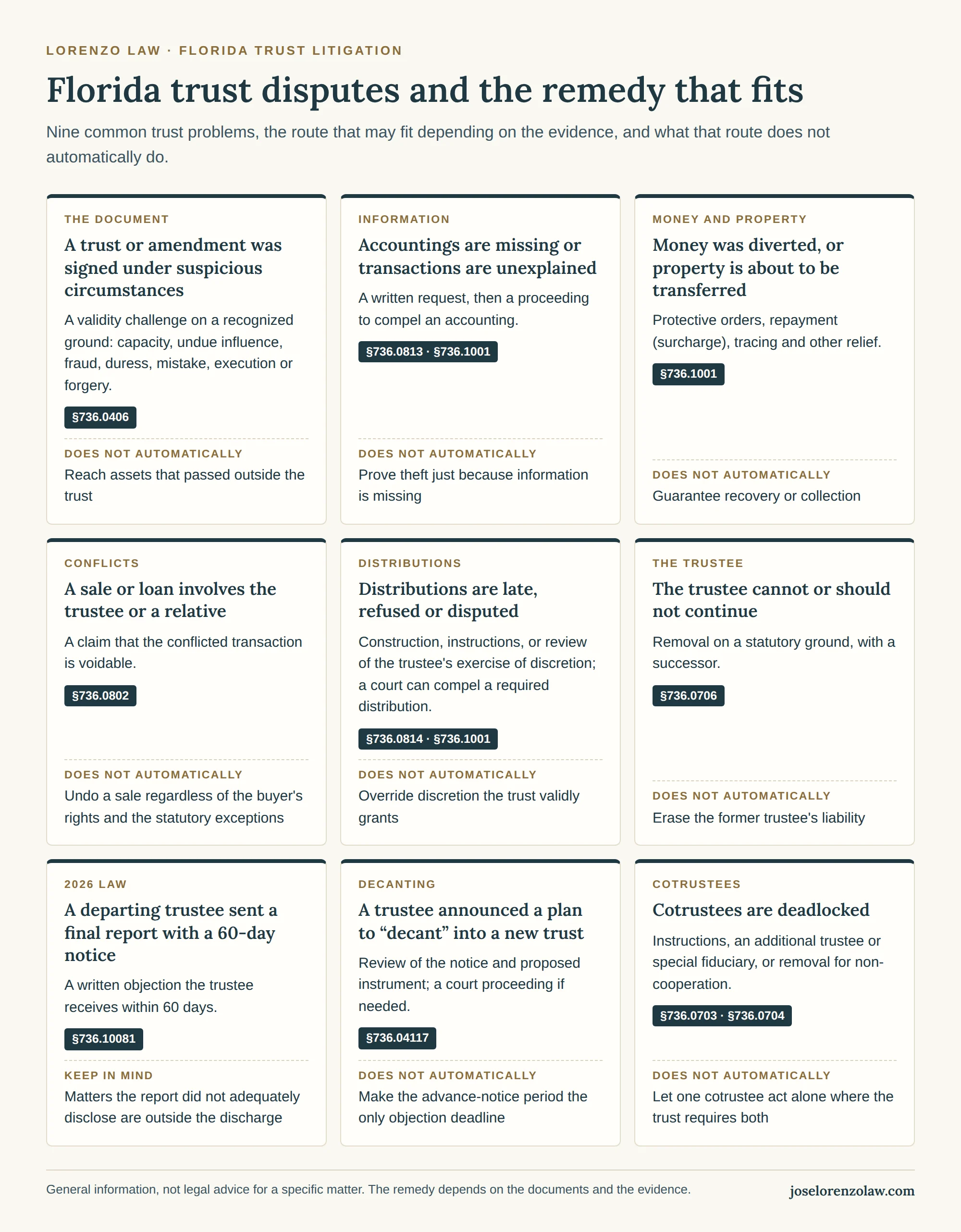
These routes overlap. An example of how they combine: an amendment favors one child, who then becomes trustee and moves trust money into a personal account. The amendment’s validity and the later transfer are separate claims with different evidence, and the notices that affect their deadlines may differ. Defeating one does not automatically resolve the other.
How long do you have to contest a trust or sue a trustee in Florida?
There is no single trust deadline. Two statutes do most of the work, and they are easy to confuse: a contest of a trust that was revocable at death generally must be filed within the chapter 95 period, or within six months after the trustee sent you the trust and the required notice, whichever comes first; a breach-of-trust claim about a matter adequately disclosed in an accounting or report can be barred six months after you received the report or the applicable limitation notice, whichever is later.
That is the practical answer to “what is the statute of limitations to contest a trust in Florida?”: the period depends on which document you received and when. The difference between sent and received is not a technicality. The first clock can run while a notice sits in a mailbox you do not check; the second runs from receipt. Neither six-month clock runs from the date of death.
| Document or situation | What it can do | Where it comes from |
|---|---|---|
| Trust copy plus notice after the settlor’s death (trust revocable at death) | A contest is barred unless filed within the earlier of the applicable chapter 95 period or six months after the trustee sent the trust instrument and a notice of the trust’s existence, the trustee’s name and address, and the time allowed to sue. | §736.0604 |
| Accounting or other written report (a “trust disclosure document”) with a limitation notice | A breach-of-trust claim about a matter the document adequately disclosed can be barred six months after receipt of the document or the applicable limitation notice, whichever is received later. The notice can be part of the report itself. | §736.1008(2) |
| Accounting or report without an applicable limitation notice | The longer chapter 95 period generally applies to the adequately disclosed matter, running from receipt. | §736.1008(1) |
| Matters never adequately disclosed | The chapter 95 period (generally four years for a breach-of-trust claim) runs from the beneficiary’s actual knowledge of the facts the claim is based on, if that knowledge is proved by clear and convincing evidence, or of the trustee’s repudiation of the trust or adverse possession of trust assets. Knowing only that you never received an accounting does not start the clock on a claim for the missing accounting. If the trustee issued a final accounting with written notice both that the trust records are available for examination and that claims about matters not adequately disclosed may be barred unless an action is commenced within the chapter 95 period, that period runs from your receipt of the accounting and notice. | §736.1008(1)(b), (3) |
| Outer limits | Regardless of disclosure, a claim against a trustee is barred at the later of 10 years after the trust terminates, the trustee resigns or the fiduciary relationship ends, or 20 years after the act or omission, if the beneficiary knew of the trust and of being a beneficiary throughout; and in every case 40 years after termination, resignation or the end of the relationship. Any applicable repose period is extended by 30 years if the beneficiary shows, by clear and convincing evidence, that the trustee actively concealed the facts. These outer limits apply to claims based on acts or omissions on or after July 1, 2008. | §736.1008(6) |
| Final report and plan of distribution with a 60-day notice (trust ends, or trustee resigns or is removed) | If the trustee does not receive a written objection within 60 days after sending the report, the trustee can be discharged, after completing the planned distributions, from liability for matters adequately disclosed in the report, with the effect of a court order. | §736.10081 (effective April 29, 2026) |
| Decanting notice | A trustee exercising the statutory decanting power generally must give specified people written notice at least 60 days before acting. That is an advance-notice period, not a universal objection deadline: the notice is not a trust disclosure document and does not limit a beneficiary’s right to object. | §736.04117 |
| Settlor still alive, trust still revocable | A contest of the trust or of a partial revocation generally cannot be filed until the trust becomes irrevocable by its terms or at death. | §736.0207 |
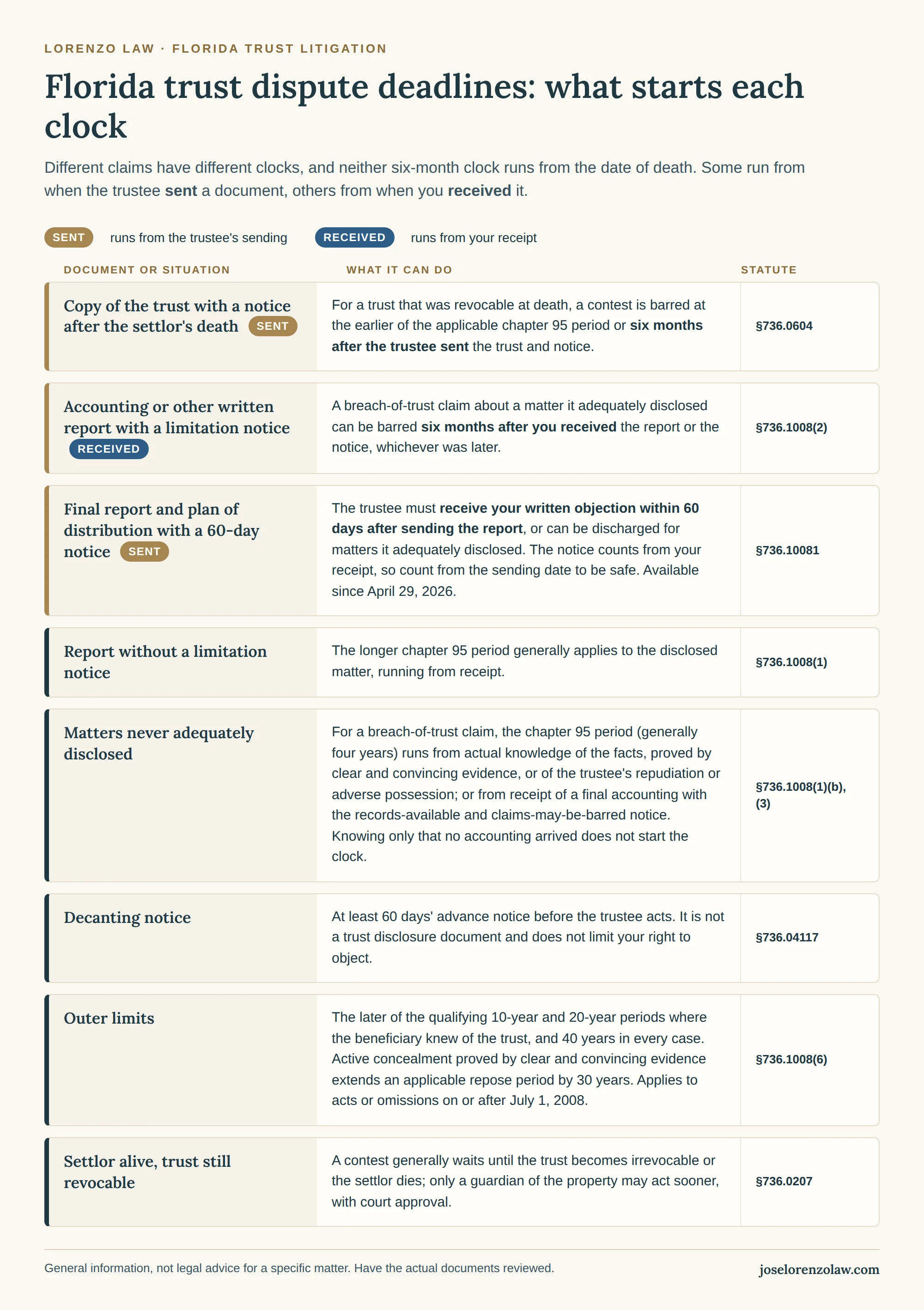
Other documents create their own issues: a summons, a court order, a proposed release or consent, or a notice that the trustee intends to pay defense costs from the trust. Do not calculate your deadline from this page. Have the actual documents and their delivery records reviewed promptly.
Does receiving a trust accounting start a six-month deadline?
Not necessarily. Receiving an accounting alone does not set everyone’s deadline. An accounting with notice is the case to watch. Under §736.1008(2), a beneficiary’s breach-of-trust claim about an adequately disclosed matter may be barred six months after receipt of the disclosure document or an applicable limitation notice, whichever is later, unless it is barred sooner. The limitation notice does not have to be a separate letter: if the accounting or report itself includes the required warning, that single document starts the six-month period on the day you receive it. If a report adequately discloses a matter but no limitation notice applies to it, the longer chapter 95 period generally applies instead. The six-month rule is not limited to final accountings; an annual accounting or another written report can qualify.
Asking questions, negotiating or waiting for an answer is not a substitute for timely commencing the required proceeding.
Received a trustee’s notice with a 60-day deadline?
Treat it as urgent. Since April 29, 2026, Florida has allowed a departing trustee to seek discharge without going to court, and the deadline to object is 60 days, much shorter than the six-month rule above.
- The procedure is available when a trust terminates, or a trustee resigns or is removed, at least six months after the trustee accepted the trust, and only if the trustee has substantially complied with the duty to inform and account.
- The trustee must send the report to all qualified beneficiaries, any cotrustee, the successor trustee if the trust is not terminating, and anyone else the trustee reasonably believes would be affected. It must include the trustee’s contact information, a plan of distribution, any required accounting, a statement that the trust terminated or the trustee resigned or was removed, and the statutory notice in at least 12-point type.
- An objection does not have to give reasons or follow a form, but it must be in writing and sent by a method the Trust Code’s notice statute allows, such as first-class mail, personal delivery or email; posting on an electronic account or website does not count. §736.0109. The trustee must receive it, so keep proof of delivery.
- The required notice counts the 60 days from your receipt of the report, but the trustee’s discharge is blocked by an objection the trustee receives within 60 days after the trustee sent it. The safe course is to make sure the trustee receives your written objection within 60 days after the report was sent, and to get advice promptly.
- The same report can also start the six-month period under §736.1008(2). Matters that were not adequately disclosed are not covered by the discharge.
How long after someone dies can a trust be contested?
Can you contest a trust after death? Yes. For a trust that was revocable, death is usually when a contest first becomes possible, but there is no single period measured from the date of death. For a trust that was revocable at death, the outer limit is the applicable chapter 95 period, and it can be cut to six months by a trustee who sends the trust and the required notice. A trustee is not required to send that notice, but sending it is how a trustee shortens the window. So the honest answer to “how long do you have to contest a trust in Florida?” depends on which notice, if any, the trustee sent. A trust that was already irrevocable during the settlor’s life is not governed by the six-month rule; the chapter 95 limitations periods apply. Claims about how a trust has been administered follow the other rules in the table.
Is there a 5-year or 7-year rule for trusts in Florida?
Not in the Trust Code. Florida has no “7-year rule” for wills, trusts or inheritance disputes, and the Trust Code sets no five-year deadline for contesting a trust; where it sets none, Florida’s general limitations statute (chapter 95) applies. People asking about a “five-year rule” are often thinking of the Medicaid look-back period for transfers, which is a benefits-eligibility rule, not a deadline to contest a trust. The periods that matter are the ones tied to the documents described above.
Contesting a trust in Florida: the grounds and the proof
Can you contest a trust in Florida? Yes, on recognized grounds and within the applicable time, but not because a distribution seems unfair. Contesting, challenging or disputing a trust in Florida all describe the same kind of case: a claim that the trust, or a change to it, is not valid. Many contested trusts are revocable living trusts, created during the settlor’s lifetime, so challenging a living trust usually happens after the settlor’s death. Can you contest an irrevocable trust? Yes, on the same validity grounds; the timing rules differ from those for a trust that was revocable at death. A trust, an amendment or a restatement procured by fraud, duress, mistake or undue influence is void to the extent it was so procured; a revocation procured the same way can also be challenged; and a trust requires a settlor with capacity and proper execution. §736.0406, §736.0402.
The grounds for contesting a trust in Florida, meaning the legal reasons to contest a trust rather than a sense that it is unfair:
| Ground | The question the court asks | Where it comes from |
|---|---|---|
| Lack of capacity | For a revocable trust or amendment, did the settlor have the capacity required to make a will at the time of signing? | §736.0601 |
| Improper execution | For a revocable trust signed by a settlor domiciled in Florida at the time of signing, were the trust’s testamentary aspects (the provisions that dispose of property at or after death) executed with the formalities required for a Florida will: signed at the end by the settlor, or by another person in the settlor’s presence and at the settlor’s direction, with that signing, or the settlor’s acknowledgment of the signature, before two attesting witnesses who sign in the settlor’s presence and each other’s? Amendments must comply too. | §736.0403(2)(b), §732.502 |
| Undue influence | Did someone’s influence overcome the settlor’s free will? | §736.0406; case law |
| Fraud, duress or mistake | Was the settlor deceived, coerced or mistaken about the document? | §736.0406 |
| Forgery | Did the settlor actually sign it? | §736.0406 |
| Revocation | Was the trust, or part of it, validly revoked or replaced? | §736.0602 |
Living trust fraud, such as a settlor misled about what an amendment said, falls under the fraud ground.
Two features of Florida law change strategy:
- Only the part that was improperly procured fails. A challenge does not have to be all-or-nothing. Attacking the one amendment that changed the shares can be the stronger case.
- The contestant carries the burden of establishing the grounds for invalidity. §736.0207(1).
How do you contest a trust in Florida?
By filing a civil complaint in circuit court, within the applicable time, alleging a recognized ground and the facts that support it. Trust proceedings are generally commenced by complaint and governed by the Florida Rules of Civil Procedure, subject to statutory exceptions. §736.0201. In practice, how to contest a trust in Florida comes down to five steps a trust contest attorney works through:
- Identify the controlling documents. The current trust, every amendment and restatement, and earlier versions, with dates.
- Identify the clock. Whether and when the trustee sent the trust and the §736.0604 notice.
- Build the ground. Medical records around the signing, the signing logistics, the drafting lawyer, witnesses and communications.
- File and serve the complaint on the trustee and the affected beneficiaries.
- Protect the property if a sale or distribution is imminent while the contest is pending. During a contest the trustee keeps administering the trust but may not make distributions that would contravene the rights of people affected by the outcome, and the court can grant interim relief such as an injunction or a special fiduciary. §736.08165, §736.1001(2).
Challenging a trust amendment, restatement or revocation
Challenging a trust in Florida often means challenging one late change to it: an amendment or restatement that changed who receives what, rather than the original trust. Relief can reach only the affected part, so a trust amendment challenge often turns on comparing versions: what changed, when, and who was involved in the change. A revocation procured by fraud, duress, mistake or undue influence can be challenged too. A settlor revokes or amends by substantially following the method the trust specifies; if it specifies none, by a later will or codicil that expressly refers to the trust or specifically devises trust property, or by another method showing the settlor’s intent by clear and convincing evidence. §736.0602(3).
Contesting a trust for lack of capacity, dementia or hospice care
Capacity is judged at the moment the document was signed. A dementia diagnosis, heavy medication or hospice care is evidence, not proof. For a revocable trust, the capacity required to create, amend, revoke or add property is the capacity required to make a will. A document signed during a lucid interval can be valid even if the settlor lacked capacity at other times. The records that matter most are contemporaneous: office notes, cognitive-screening scores, discharge summaries and medication changes close to the signing date.
Undue influence in a trust contest
Undue influence is proved through the relationship and the circumstances of the signing, not by an unequal result. In an undue influence trust contest, Florida courts can apply a presumption of undue influence when a substantial beneficiary who had a confidential relationship with the settlor was active in procuring the document, and the factors courts weigh in deciding “active procurement” come from In re Estate of Carpenter, 253 So. 2d 697 (Fla. 1971). Florida courts apply that presumption to trusts as well as wills. Those factors include:
- the beneficiary’s presence when the settlor expressed the wish to change the plan, or at the signing
- the beneficiary recommending the drafting lawyer, or giving the lawyer instructions
- the beneficiary knowing the contents before signing
- the beneficiary securing the witnesses or keeping the document afterward
Not every factor must be present, the list is not exhaustive, and a presumption is not established just because the favored person was a caregiver or a child. See undue influence claims.
What are the signs of undue influence? The signs families most often notice are about access and control: the favored person chose the lawyer or attended the signing, the settlor was isolated from other relatives, the new document departs sharply from earlier plans, or one person took over finances, medications and communication. Signs are a reason to investigate, not proof.
If the settlor is still alive
While a trust is revocable, the trustee’s duties are owed to the settlor alone, and a future beneficiary generally cannot contest it. §736.0603, §736.0207. In practice, you generally cannot contest a living trust until the settlor dies or the trust otherwise becomes irrevocable.
- Contesting a revocable trust, or a partial revocation, generally waits until the trust becomes irrevocable by its terms or at the settlor’s death. A contest of the revocation of the entire trust waits until death.
- While the trust is still revocable during the settlor’s lifetime, only the court-appointed guardian of an incapacitated settlor’s property may bring such a contest, and only with the guardianship court’s approval, after the court finds it appears to be in the ward’s best interests during the ward’s probable lifetime. §744.441.
- If money is being taken from a living person, other protective routes may apply now, including a civil injunction against exploitation of a vulnerable adult under §825.1035 and guardianship proceedings. See Florida guardianship litigation.
Preserve evidence now: earlier versions of the plan, messages, and notes of what you personally observed and when.
Does a no-contest clause stop you from challenging a Florida trust?
No. A no-contest clause in a trust, meaning a provision that penalizes an interested person for contesting the trust or starting other proceedings about it, is unenforceable in Florida for trusts created on or after October 1, 1993; a revocable trust is treated as created when the right of revocation ends. §736.1108. A clause that offers an alternative benefit is not necessarily a penalty clause. An unenforceable clause does not remove standing requirements, deadlines, costs or possible fee exposure.
How hard is it to contest a trust? What are the chances of success?
No one can responsibly quote the chances of successfully contesting a trust from a web page, and this page does not give odds. Florida’s lawyer-advertising rules prohibit statements a prospective client can reasonably interpret as a prediction or guaranty of results, and there is no reliable published success rate for Florida trust contests. What can be explained is how the law allocates the burden. In a trust contest the contestant starts with the burden of establishing the grounds for invalidity (§736.0207(1)), unlike a will contest, where the will’s proponent must first prove it was properly signed. But if the contestant proves the facts that raise the presumption of undue influence, the burden of proof shifts: the beneficiary who benefited must then prove, by a preponderance of the evidence, that there was no undue influence. Florida’s statute makes the presumption one that shifts the burden of proof in any transaction to which it applies (§733.107(2)). Grounds to contest a trust come from what happened at the signing, not from the result. Contests built on signing-day facts are stronger than contests built on a sense of unfairness.
Is a trust harder to contest than a will? The grounds overlap, but the procedure and timing differ: a will contest runs through the probate case and its notice of administration, while a trust contest is a civil action with the §736.0604 clock. Neither is “easier” in the abstract; the evidence and the documents decide.
Siblings contesting a trust
When siblings contest a parent’s trust, family trust disputes usually have two layers: whether a late amendment is valid, and how the sibling-trustee has handled money since the death. Those are separate claims with separate evidence and possibly different deadlines. Keep them separate from the start; winning one does not resolve the other.
What happens if a trust or amendment is declared invalid?
Generally, the invalid part is disregarded and the trust is administered as it stood without it. Before you challenge a trust, know what would take its place: If an amendment fails, the prior version may control; if an entire revocable trust fails, the property may pass under an earlier instrument or through the settlor’s estate, for example under a pour-over will or by intestacy. Only the part procured by fraud, duress, mistake or undue influence is void; the rest of the trust stands. The answer depends on the documents, which is why every version matters.
Trust beneficiary rights, information and accountings in Florida
What rights does a trust beneficiary have in Florida? A qualified beneficiary is generally entitled to be kept reasonably informed, to receive specified notices, to obtain a complete copy of the trust on reasonable request, to receive trust accountings, and to ask a court to enforce those duties. §736.0813.
Under the duty to inform and account, generally:
- Within 60 days after accepting the trusteeship, the trustee must notify the qualified beneficiaries of the acceptance, the trustee’s name and address, and that the fiduciary lawyer-client privilege applies to the trustee and the trustee’s lawyers.
- Within 60 days after learning that an irrevocable trust was created, or that a revocable trust became irrevocable, the trustee must notify them of the trust’s existence, the settlor’s identity, the right to request a copy of the trust, the right to accountings, and the fiduciary lawyer-client privilege.
- On reasonable request, the trustee must provide a complete copy of the trust instrument and relevant information about assets, liabilities and administration.
- For an irrevocable trust, the trustee must provide a trust accounting at least annually, on termination and on a change of trustee.
Qualifications matter: a qualified beneficiary may waive accountings in writing and later withdraw the waiver for future periods; special needs trust beneficiary rights to information are analyzed under the same provisions, but a special needs trust usually gives the trustee broad discretion over distributions, so once the trust is irrevocable a claim about distributions turns on whether the trustee abused that discretion; representation rules can apply; some older trusts and certain family trust companies follow different rules; and while a trust is revocable the duties run only to the settlor.
Revocable trust beneficiary rights vs. irrevocable trust beneficiary rights. Living trust beneficiary rights are limited while the settlor is alive, because the trustee’s duties run to the settlor. Once the trust becomes irrevocable, qualified beneficiaries have the information, copy and accounting rights described here.
What is a qualified beneficiary?
A qualified beneficiary is a living beneficiary who, on the date the status is determined, (a) is a distributee or permissible distributee of trust income or principal; (b) would be one if the interests of the current distributees ended on that date without the trust terminating; or (c) would be one if the trust terminated on that date under its terms. §736.0103(19). Remainder beneficiary rights depend on that definition: a remainder beneficiary who takes after a parent’s death may well fall inside it, and Florida courts have treated such remainder beneficiaries as qualified beneficiaries with standing to sue for breach of trust. Read it against your trust before assuming you have no rights.
Are beneficiaries entitled to a copy of the trust?
A qualified beneficiary is entitled to a complete copy of the trust instrument on reasonable request. A certification of trust is a document the trustee may give third parties, such as banks or title companies, instead of a full copy of the trust; it has no bearing on a qualified beneficiary’s separate right to request the complete trust instrument. §736.1017.
What happens if a trustee refuses to provide an accounting?
If a trustee refuses to give an accounting, put the request in writing, keep the response, and if the trustee still does not account, ask the court to compel a formal accounting of the trust. A court can order a trustee to account and to perform its duties. §736.1001. A proceeding to compel an accounting is narrow: it asks for what the statute already requires, and it is often the first step that makes tracing possible.
Silence is evidence to investigate. It does not by itself prove theft or require removal, but persistent failure to administer effectively is one of the removal grounds discussed below.
Are beneficiaries entitled to an accounting? Qualified beneficiaries of an irrevocable trust generally are, at least annually, unless they waived it in writing.
How long does a trustee have to provide an accounting? For an irrevocable trust, at least annually, and also on termination (a trust final accounting) and on a change of trustee, unless validly waived. The notices are due within 60 days after the trustee accepts, or after the trustee learns that an irrevocable trust was created or that a revocable trust became irrevocable.
What must a Florida trust accounting show?
A trust accounting should let a beneficiary understand what came in, what went out and what remains: receipts and disbursements of principal and income, assets and liabilities, and trustee compensation and other expenses, under the statutory standards. §736.08135. Fiduciary accounting for trusts and estates follows its own conventions, so an accounting that looks unfamiliar is not necessarily wrong; a one-line balance, though, does not answer what happened to the property, and most trust accounting disputes start with that gap.
Can beneficiaries see the trust’s bank statements? Bank statements alone are not a trust accounting; a proper accounting must meet the statutory standards. A qualified beneficiary can also request relevant information about the trust’s assets and administration, which can support a request for underlying records such as bank statements, and in a contested proceeding records can be obtained through discovery or subpoena.
Trustee not communicating with beneficiaries?
If the trustee stopped communicating, send a dated written request that identifies what you want: the trust instrument, the latest accounting, or specific information. Keep a copy and any proof of delivery. A written record of requests and non-responses is what a court looks at later; a string of unanswered phone calls is much harder to prove.
Suing a trustee for breach of trust in Florida
Can a beneficiary sue a trustee in Florida? Yes. A beneficiary whose interest is harmed by a breach of trust can ask the court for relief, and a trustee who commits a breach can be ordered to repay the trust personally. The court’s remedies for a breach that has occurred or may occur include:
- compelling the trustee to perform its duties or to account
- preventing a threatened breach
- ordering the trustee to pay money or restore property
- appointing a special fiduciary to take possession of and administer the trust property
- suspending or removing the trustee
- reducing or denying the trustee’s compensation
- voiding an act, imposing a lien or constructive trust, or tracing trust property wrongfully disposed of and recovering it or its proceeds, subject to protections for certain third parties
- any other appropriate relief
§736.1001. Not every remedy fits every case, and the remedy should match the problem that can be proved. Suing a trustee for breach of fiduciary duty is, under the Trust Code, a claim for breach of trust.
When can a beneficiary sue a trustee? When a breach of trust has harmed the beneficiary’s interest, or threatens to, and before the applicable time runs out. How to sue a trustee in Florida, in outline: get the trust and the accountings, identify the breach and the loss, check which clock applies, then file a complaint in circuit court naming the trustee in the right capacity.
For the duty itself, see breach of fiduciary duty in Florida.
What can a trustee be sued for?
A trustee can be sued for a breach of trust: a violation of a duty the trustee owes a beneficiary, under the trust’s terms or the Trust Code. Some remedies, such as an accounting or an order preventing a threatened breach, do not require a completed loss; a repayment claim is measured as described under “Surcharge” below. Florida trustee duties include loyalty, impartiality, prudent administration, and the duty to inform and account, among others. Trustee misconduct (sometimes called trustee malfeasance) that commonly leads to claims:
- trustee self-dealing: buying, selling, borrowing or leasing trust property for the trustee’s own benefit or a relative’s
- paying the trustee’s own expenses or unreasonable compensation from the trust
- favoring one beneficiary (often the trustee) over others without authority
- refusing or delaying distributions the trust requires, including required income distributions
- failing to inform, account or keep records
- commingling trust money with personal funds
- leaving property uninsured, unmaintained or imprudently invested
- careless administration that a prudent trustee would have avoided
- ignoring the trust’s terms or a court order
A payment from a trust account is not automatically improper. Authorized expenses, distributions and compensation must be separated from misuse, which is why the records come first.
Can you sue a trustee for negligence? Yes, in substance. A trustee must administer the trust as a prudent person would, exercising reasonable care, skill and caution, and a loss caused by failing to do so is a breach of trust even without dishonesty. §736.0804. The standard is a fiduciary one, not ordinary negligence, and a trustee with special skills must use them.
Can you sue a trust in Florida? Who do you name?
A trust is not a person, so a lawsuit about a trust is usually brought against the trustee, in the trustee’s fiduciary capacity, and, when the claim is for personal repayment, against the trustee individually, which requires serving the trustee as an individual. In other words, a fiduciary lawsuit names the fiduciary. How do you sue a trust, then, and can a family trust be sued? Through its trustee, in the same way. Other beneficiaries whose interests would be affected may also need to be joined. Naming the wrong party, or the right party in the wrong capacity, is a common and avoidable mistake. Is it hard to sue a trust? Filing is not the hard part; the work is in the records, the deadlines and proving a loss, which is why the accountings and statements come first.
Can you sue a trustee personally?
Can a trustee be held personally liable in Florida? Yes, for a breach of trust. A surcharge makes the trustee repay the loss personally. Section 736.1013 limits a trustee’s personal liability to third parties on contracts and torts; it is not a shield against a beneficiary’s breach-of-trust claim. §736.1013. Liability, defenses and any right to reimbursement from the trust depend on the facts.
Surcharge: how a trustee’s liability is measured
A trustee who commits a breach of trust is liable for the greater of the amount needed to restore the trust property and distributions to what they would have been without the breach, including lost income, capital gain or appreciation, or the profit the trustee made from the breach. §736.1002. In a surcharge action, causation, valuation, defenses and collectability still matter; the measure is not automatically today’s value of every asset that was sold.
Trustee stealing from a trust, or money already spent
Start with the transaction, not the accusation: the account, the date, the amount, the payee and why it looks wrong. Money moved into the trustee’s name, or a relative’s, is a common starting point. Money that left a trust can sometimes be followed into another account or into property bought with it, and a court can impose a lien or constructive trust on what it became. Recovery depends on the records, what remains and the rights of people who received the property, including protection for those who dealt with the trustee in good faith and for value (§736.1016); identifying a transfer does not guarantee getting it back.
- Civil theft, in the right case, under §772.11, requires a written pre-suit demand and clear and convincing evidence; it allows treble damages.
- Exploitation of an elderly person or disabled adult is a crime under §825.103, but that statute is criminal; the civil remedies come from other statutes.
- Can a trustee go to jail for stealing? Conduct involving trust property can also be a crime, but prosecution is decided by the State, and neither a criminal report nor a civil lawsuit guarantees repayment. A civil breach of trust is not automatically a crime. Do not assume one process must come first; get advice on both.
Keep the bank records, deeds and transaction details you lawfully have. Do not access someone else’s accounts without authority.
Can a trustee sell trust property without all the beneficiaries’ approval?
Often yes. A trustee may have the power to sell without a beneficiary vote; the trust, the Trust Code and any court orders control. §736.0816. Disagreeing with the price is different from a sale affected by a conflict of interest.
A sale or transaction for the trustee’s own account, or otherwise affected by a conflict between the trustee’s fiduciary and personal interests, is voidable by an affected beneficiary unless a statutory exception applies, such as authorization in the trust, court approval, the beneficiary’s consent, ratification or release, the running of the time to sue, a contract the trustee entered into before becoming or planning to become trustee, or the settlor’s written consent while the trust was revocable. A conflict is presumed for transactions with the trustee’s spouse, descendants, siblings, parents or their spouses, and with certain agents, attorneys and affiliated businesses. §736.0802. An independently marketed sale within the trustee’s authority presents different issues from a below-market sale to the trustee’s brother. If the trustee sold the house to a relative, or to anyone else, gather the deed, contract, appraisal, closing statement and communications.
Can a trustee borrow money from the trust? A loan from the trust to the trustee is a classic conflict-of-interest transaction and is voidable unless the trust or the court authorized it or an exception applies.
Trustee refuses to distribute, or trustee not following the trust
When a trustee won’t distribute, first read what the trust requires. A mandatory distribution (“pay my daughter one-half at my death”) is different from a discretionary one (“as the trustee deems advisable”).
- A delay can have a legitimate cause: expenses, taxes, a creditor period, a reserve, or a house that must be sold.
- A delay without a reason, silence, or a refusal to make a required distribution can be a breach, and a court can compel performance. Can a beneficiary sue a trustee to compel distribution? Yes, through a breach-of-trust action, where the trust requires the distribution and the trustee has no legitimate reason to withhold it; the court can compel the trustee to perform.
- Even broad discretion, including “sole” or “absolute” discretion, must be exercised in good faith and in accordance with the trust’s terms and purposes and the interests of the beneficiaries. A court will not second-guess a discretionary decision merely because it would have decided differently. §736.0814(1).
What happens when a trustee does not follow the trust? The court can compel compliance, order repayment of any loss, reduce compensation, and in serious cases remove the trustee. What to do if a trustee does not follow the trust: read the provision, send a dated written request that cites it, keep the response, and get advice before the next deadline.
A trustee who is also a beneficiary
A trustee can also be a beneficiary. That dual role is lawful and common, and it does not by itself establish wrongdoing. Examine how the trustee treated the other interests, exercised discretion, used property and recorded payments. The duty of impartiality requires regard for the beneficiaries’ respective interests; it does not always require identical distributions. §736.0803. One important limit: a trustee who is also a beneficiary generally may not make discretionary distributions to or for the trustee’s own benefit beyond an ascertainable standard of health, education, maintenance and support. §736.0814(2).
How much does a trustee get paid in Florida?
For trustee fees in Florida, the trust controls first. If it is silent, a trustee is entitled to compensation that is reasonable under the circumstances; Florida law sets no trustee compensation percentage, and there is no typical trustee compensation figure: reasonable trustee compensation depends on the work, the assets and the trust’s terms. A court can adjust compensation the trust specifies if the trustee’s duties are substantially different from those contemplated or the specified amount is unreasonably low or high. §736.0708. The same rule applies to successor trustee compensation, so successor trustee fees come from the trust’s fee provision or, if it is silent, a reasonable amount. A court can also reduce or deny compensation as a remedy for breach. How much can a trustee charge in Florida? Whatever the trust allows or, if it is silent, a reasonable amount; the Florida trustee compensation statute sets no fee schedule. To test whether a bill reflects reasonable trustee fees, get the fee provision, invoices, a description of the work and the asset values.
Can a trustee change the trust? Can a trustee remove a beneficiary?
Serving as trustee does not give an unrestricted power to amend the trust or remove a beneficiary. Changes come from the settlor’s power to amend or revoke a revocable trust (§736.0602); a power the trust itself grants to someone; nonjudicial modification by unanimous agreement of the trustee and all qualified beneficiaries after the settlor’s death, subject to that statute’s conditions (§736.0412); judicial modification when purposes have been fulfilled or circumstances have changed (§736.04113) or when modification is in the beneficiaries’ best interests (§736.04115); a nonjudicial settlement agreement, to the extent permitted (§736.0111); or decanting (§736.04117, amended in 2025), which cannot reduce a vested interest. §736.0602, §736.0412, §736.04113, §736.04115, §736.04117. The same limits answer how to remove a beneficiary from a trust: while the trust is revocable, the settlor can do it by amendment or revocation, following the method the trust specifies or, if it specifies none, another method the statute allows, including one that shows the settlor’s intent by clear and convincing evidence; after that, a change requires a power the trust grants or a permitted statutory or common-law route (for example, while the settlor is living, the settlor and all beneficiaries agreeing together), and each has its own conditions and may not permit the proposed change. Ask for the instrument and the legal basis for any claimed change.
Removing a trustee in Florida
Can a trustee be removed from a trust? Yes: by the court on a statutory ground, or by someone the trust itself gives a removal power.
How do you remove a trustee in Florida, and who can remove a trustee? The settlor, a cotrustee or a beneficiary may ask the court to remove a trustee, and the court may act on its own initiative. Removal requires a statutory ground. §736.0706. On what grounds can a trustee be removed? The grounds for removing a trustee are:
- a serious breach of trust
- lack of cooperation among cotrustees that substantially impairs administration
- unfitness, unwillingness or persistent failure to administer the trust effectively, where the court finds removal best serves the beneficiaries’ interests
- a substantial change of circumstances, or a request by all qualified beneficiaries, where removal best serves all beneficiaries, is not inconsistent with a material purpose of the trust, and a suitable cotrustee or successor is available
Court-ordered removal of a trustee for cause requires one of these grounds. Removal does not always require proving dishonesty. Typical reasons for removing a trustee include a serious breach such as self-dealing (the first ground), cotrustees who cannot cooperate (the second), a trustee who is mismanaging the trust or simply is not doing the job (the third), and a substantial change of circumstances or a request by all qualified beneficiaries (the fourth), which requires no misconduct at all. A failure to account or communicate is not itself a named ground, but it can be evidence of a breach or of a persistent failure to administer the trust; a trustee who has become incapacitated may be replaced under the trust’s own terms or removed as unfit, and the standard for removing a trustee is less demanding than the standard for a guardianship. A bank or trust company serving as trustee is subject to the same statute.
How can a beneficiary remove a trustee? Not on their own, unless the trust grants that power. A beneficiary can ask the court to remove the trustee (people call it a petition to remove a trustee; in Florida it is filed as a complaint under the civil rules), and the court decides; all qualified beneficiaries acting together can also request removal under the fourth ground.
Is it hard to remove a trustee from a trust? It can be. The court must find grounds to remove a trustee, and dislike, hostility or tension between the trustee and beneficiaries, a single unanswered message or an unequal but authorized distribution is not enough.
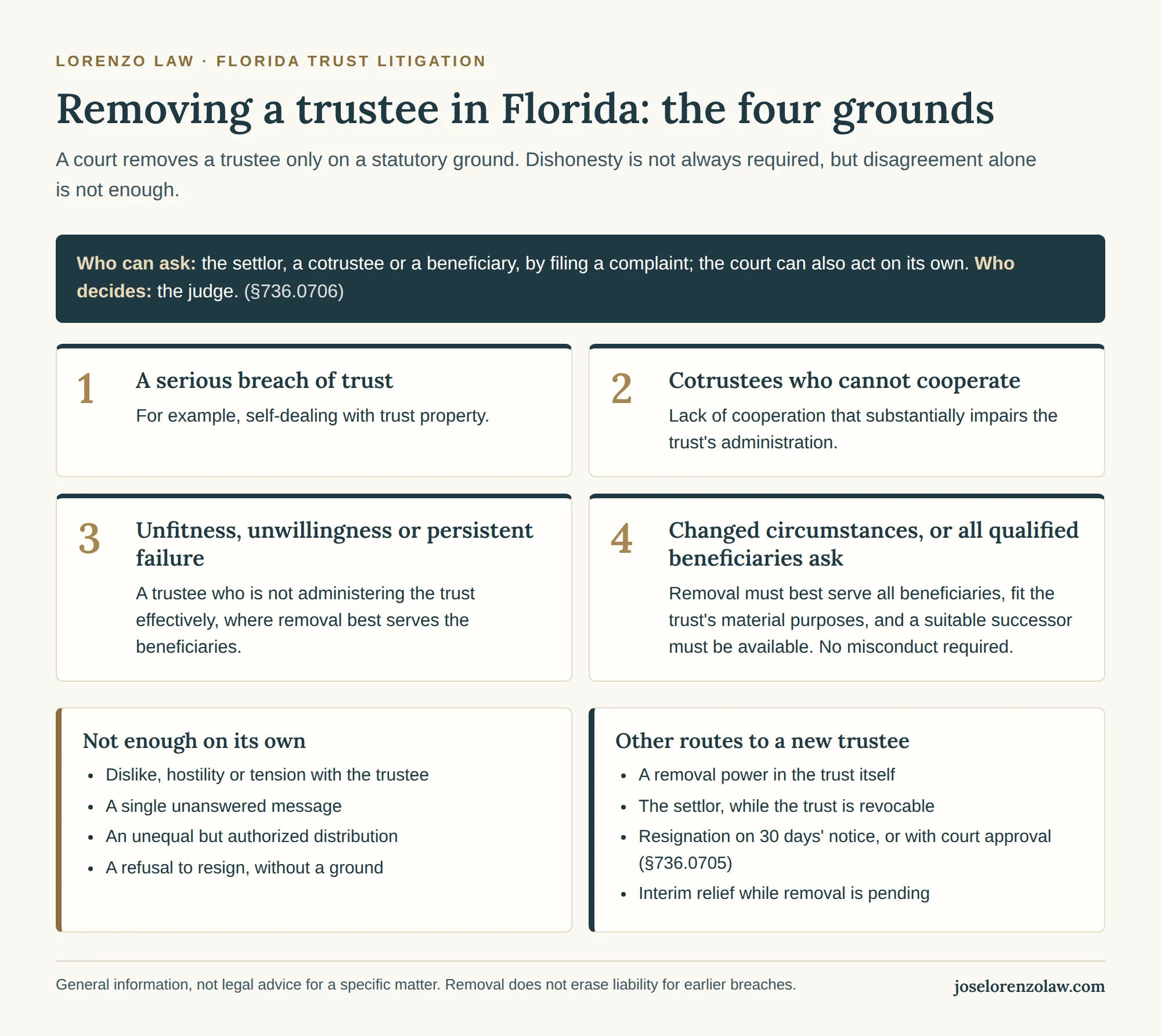
View the trustee-removal graphic
Check the trust first. Some trusts let a named person, such as a trust protector or a majority of beneficiaries, replace the trustee without court involvement.
Can a trustee be removed without consent? Yes, by court order on a statutory ground, or under a removal power in the trust.
Can a trustee be removed without their knowledge? Generally not by a court: the trustee is a party to the removal proceeding and is entitled to notice and an opportunity to be heard. Temporary protective relief can be sought quickly when property is at risk, and in a genuine emergency a court can enter a temporary injunction without notice, but only on a showing of immediate and irreparable harm and the other requirements for relief without notice.
Can a settlor remove a trustee? Usually, while the trust is revocable. The settlor (called the “grantor” in many trust documents; Florida’s statutes treat the terms as equivalent) can replace the trustee by amending the trust or using a removal power in it, so how to remove a trustee from a revocable trust rarely becomes a court question.
Can a trustee be removed from an irrevocable trust? Yes. Once the trust is irrevocable, often at the settlor’s death, removal runs through a removal power in the trust or a court proceeding under §736.0706. A “family trust” follows the same rules; how to remove a trustee from a family trust depends on whether it is still revocable.
What happens while removal is pending, and after? The court can order interim relief to protect the trust while a removal request is decided. After removal, the successor takes over, and the former trustee must deliver the trust property within a reasonable time, keeping a trustee’s duties and powers to protect it until then. §736.0707. The former trustee remains answerable for breaches committed while serving. Appointing a successor does not restart the limitations periods, which run from disclosures to beneficiaries and from the prior trustee’s departure.
How long does it take to remove a trustee? It depends on whether the trustee contests it. An agreed resignation can be quick; a contested removal proceeds like other litigation, and no timetable can be promised. How much does it cost to remove a trustee? The same factors drive the cost, especially how much of the financial history must be reconstructed.
Is there a removal of trustee form? Not a statewide one. A court removal is requested by a complaint, under the civil rules, drafted for the specific trust, facts and grounds.
Can a trustee remove themselves? A trustee can resign by giving at least 30 days’ notice to the qualified beneficiaries, the settlor if living, and any cotrustees, or with court approval, and resignation does not release liability for earlier conduct. §736.0705. If a trustee refuses to resign, a court proceeding on a statutory ground is the route; the refusal itself is not a ground, but the conduct around it may be.
For how to remove a trustee in Florida step by step, see Florida trustee removal.
Cotrustees, successor trustees, directed trusts and trust protectors
When cotrustees disagree
Cotrustees who cannot agree unanimously generally act by majority, subject to the trust’s terms, and a cotrustee must participate in performing the trustee’s functions unless an exception applies. §736.0703. Two trustees who disagree have no majority, so a deadlock may require the court’s instructions, the appointment of an additional trustee or special fiduciary (§736.0704(5)), or, where non-cooperation substantially impairs administration, removal. A cotrustee who does not join an action is not liable for it, and one who joins at the majority’s direction after notifying a cotrustee of the dissent at or before the time of the action is not liable either; but every cotrustee must use reasonable care to prevent a cotrustee’s breach and to compel its redress. Can a trustee sue another trustee? Yes: each cotrustee must exercise reasonable care to prevent a cotrustee from committing a breach of trust and to compel a cotrustee to redress one, which can mean going to court.
Can a co-trustee be removed? Yes, on the same statutory grounds as any trustee, including a lack of cooperation that substantially impairs administration. Can a successor trustee be removed? Yes, on the same grounds. Can a trust protector be removed? It depends on the trust instrument. A protector who holds a power of direction is a “trust director,” and the court’s trustee-removal statute applies to trust directors. §736.1416.
Successor trustee duties and claims
The role of a successor trustee is to take over when the prior trustee stops serving, by death, incapacity, resignation or removal, under the trust’s terms and the statute. §736.0704. Successor trustee responsibilities include the ordinary duties of any trustee, plus these:
- A successor has duties concerning a predecessor’s breaches that the successor knows of. §736.0812.
- A successor’s claim against a prior trustee is barred to the same extent the represented beneficiaries’ claim would be (a 2025 statute). §736.10085.
- A new trustee generally means new notices, but not a fresh start for any claim.
- A successor trustee is protected from personal liability for a predecessor’s conduct in specified circumstances: for example, when succeeding a settlor who served as trustee of a revocable trust, when released by a super majority of the eligible beneficiaries, or as to a beneficiary who made no written request for action against the prior trustee within six months after the successor accepted, but only if the successor’s written notice of acceptance warned that failing to make that request within six months would bar the right to proceed against the successor. §736.08125 (enacted in 2006, most recently amended effective June 20, 2025).
Can a trustee appoint a successor or a co-trustee? Not alone, unless the trust gives that power. A vacancy that must be filled is filled by the person the trust names or designates, then by unanimous agreement of the qualified beneficiaries, then by the court; a vacancy need not be filled while a cotrustee remains. The court can also appoint an additional trustee or special fiduciary whenever administration requires it. §736.0704.
Can a named trustee refuse to serve? Yes. A person named as trustee who does not accept the trusteeship within a reasonable time after learning of the designation is deemed to have declined it. §736.0701.
If you have just accepted a successor trusteeship over a trust with a troubled history, get the records, document what you received and when, and get advice before distributing.
Directed trusts, trust directors and trust protectors
Some Florida trusts split the trustee’s job: a trust director or trust protector holds certain powers, such as directing investments, approving distributions or replacing the trustee, and a “directed trustee” follows those directions. The Florida directed trustee statute, Part XIV of chapter 736, changes who is responsible for what, and it is also called the Florida Uniform Directed Trust Act. A directed trustee must take reasonable action to follow a trust director’s directions and is not liable for doing so, but may not comply where compliance would be willful misconduct; a trust director has the same fiduciary duty and liability as a trustee in a like position; and neither has a general duty to monitor the other. Part XIV of chapter 736. In these disputes, the first question is who held the power that was misused.
Representing and defending trustees
In trustee litigation, the first responses shape the record, so a trustee accused of a breach of trust needs a strategy early. Many trustees first call a trust and estate litigation attorney only after a lawsuit is filed, when calling earlier would have left more options. Jose represents individual trustees, including family members serving as trustee, in responding to demands, accounting disputes, removal petitions and surcharge claims, subject to conflicts.
What a trustee should know:
- Account, and document. A complete, standards-compliant accounting is both a duty and the trustee’s best evidence.
- Ask the court when a question is genuinely uncertain. A trustee can ask the court to construe the trust or instruct the trustee. §736.0201(4).
- Defense costs from the trust come with rules. A trustee sued by a beneficiary, before paying attorney fees or costs from trust assets for a breach-of-trust claim or defense made in a filed pleading, must serve written notice on each qualified beneficiary whose share may be affected, identifying the proceeding and the right to ask the court for an order. If the trustee pays without that notice, the court must order the payment returned with interest; after notice, a beneficiary can ask the court to prohibit further payment or compel return, which the court may grant on a reasonable basis to conclude there was a breach. §736.0802(10).
- The trustee’s lawyer represents the trustee. Communications between a trustee and the trustee’s lawyer are generally privileged under the fiduciary lawyer-client privilege, and the beneficiaries are not the client. §90.5021.
- Closing out. A departing trustee may be able to settle accounts through the 60-day nonjudicial discharge procedure, a court proceeding, or releases and consents, each with its own requirements; the 60-day procedure is in addition to, not a replacement for, the others.
Can a trustee sue a beneficiary? In some cases. A trustee’s rights against beneficiaries are narrower than people assume, but they include recovering a distribution made by mistake or property a beneficiary holds that belongs to the trust, and having the court resolve a beneficiary’s conflicting demands through instructions. Can a trustee sue on behalf of the trust? Yes. A trustee has power to prosecute or defend, including on appeal, an action or claim in any jurisdiction to protect trust property or the trustee in performing its duties, including claims against outsiders who took trust property, and a duty to take reasonable steps to enforce the trust’s claims. §736.0816(23), §736.0811.
A trustee who is also a beneficiary should explain both roles at the outset so conflicts can be evaluated.
Resolving a trust dispute without a trial
Many trust disputes are resolved by agreement, but the tools have limits.
- Nonjudicial settlement agreement. Interested persons can enter a binding agreement on matters involving a trust, such as construction of terms, approval of an accounting, a trustee’s resignation or compensation, and a trustee’s liability, but only to the extent the terms could properly be approved by a court and without producing a result the Trust Code does not allow. §736.0111.
- Mediation. Florida courts can refer contested matters to mediation, which is confidential subject to limited statutory exceptions. It is an option to evaluate, not a guaranteed outcome.
- Construction and instructions. When the problem is what a provision means, the court can construe it without any finding of misconduct.
- Reformation and modification. A court can reform a trust to correct a mistake, but only on clear and convincing evidence of the settlor’s intent and the mistake; modification has its own statutory grounds. §736.0415, §736.04113. Neither is a way to rewrite an unwanted inheritance.
- Decanting. An authorized trustee may be able to distribute trust principal into a second trust with different terms, within detailed statutory limits and after at least 60 days’ written notice, which those entitled to it may waive in writing. §736.04117. The notice goes to all qualified beneficiaries, all trustees of the first trust, anyone with power to remove or replace the trustee and, in some cases, the settlor, with copies of the proposed exercise, the first trust and the proposed second trust. If you receive a decanting notice, have the proposed trust, the recipients and the dates reviewed at once.
These options can themselves be disputed. They are not necessarily cheaper or faster, and not every one is available in every case.
Can a trust dispute be resolved without going to court? Often part of it can, through a written request, a corrected accounting, a negotiated resignation or a settlement agreement. When a deadline is running or property is at risk, a filed proceeding may be the only protection.
How a Florida trust lawsuit works
Contested trust matters generally move through the same stages as other civil litigation (pleadings, discovery, resolution attempts, and a hearing or trial) in circuit court. The order depends on the documents received, the urgency and whether property is at risk.
- Deadline triage. Identify every notice and report received, how and when it was delivered, and what has been signed.
- Records and demand. A written request for the trust, the accountings or specific information, or a proposal to resolve the issue, can narrow or end some disputes.
- Protective steps. If a sale, transfer or distribution is imminent, ask the court for interim relief rather than waiting for a routine request to be answered.
- Complaint and service. Trust proceedings are generally commenced by complaint under the Florida Rules of Civil Procedure, subject to statutory exceptions; the affected parties are served and respond. §736.0201.
- Discovery. Document requests, subpoenas for bank and medical records, and depositions of the trustee, the drafting lawyer, witnesses and caregivers.
- Experts, where the issues call for them.
- Mediation and settlement discussions.
- Hearing or trial, then enforcement. Carry out repayments, transfers, successor appointments or corrected distributions. No particular outcome or timetable can be promised.
Can you get the drafting attorney’s file or the trustee’s lawyer’s advice?
The drafting lawyer’s notes and testimony about the signing are often central in a validity contest, and they can usually be reached: when all parties claim through the same deceased settlor, the lawyer-client privilege does not protect the settlor’s communications with the drafting lawyer that are relevant to the dispute. §90.502(4)(b). By contrast, communications between a trustee and the trustee’s own lawyer are generally protected by the fiduciary lawyer-client privilege; a beneficiary is not that lawyer’s client. §90.5021. A records request does not guarantee access to every document; privilege, privacy and relevance rules apply.
Which experts are used in trust litigation?
It depends on the disputed facts: money, capacity or signatures.
- Forensic accountants, for reconstructing years of administration, tracing transfers and measuring a loss.
- Capacity experts, such as a geriatric psychiatrist or neuropsychologist, reviewing records for the settlor’s condition at or near the signing.
- Questioned-document examiners, for signatures and altered or substituted pages.
Jose’s undergraduate degree is in accounting and finance. That background helps when a case turns on reading a trust accounting or following transactions through statements. It is not a substitute for a forensic accountant when one is needed.
Is there a jury in a Florida trust case?
Generally no. Breach-of-trust surcharge claims and trust validity contests are equitable, and Florida courts decide them without a jury, even when money damages are sought. A different claim joined in the same case may be treated differently. Documents therefore carry great weight: a clean chronology of the statements, deeds and medical records often does more than a sympathetic witness.
How long does trust litigation take?
There is no standard timeline. It depends on the volume of records to reconstruct, the number of parties, expert work, the court’s calendar, emergency motions and whether the case settles. A consultation can identify the factors in your matter; it cannot guarantee a date.
Can a trust judgment be appealed? Final orders can generally be appealed to a Florida district court of appeal, on short deadlines (generally 30 days after the order is rendered), and an appeal adds time.
Where will the case be heard?
Florida circuit courts hear trust proceedings; which county is a separate venue question. Venue can lie, among other places, in a county where a beneficiary suing or being sued resides or has its principal place of business, or where the trust has its principal place of administration. §736.0203, §736.0204. A dispute over the construction of a testamentary trust can be filed in the probate proceeding for the estate, where the Florida Probate Rules govern. §736.0201(5).
What trust litigation costs, and who pays
How expensive is trust litigation?
It depends on whether the fight is about the document or about the trustee’s conduct, and on how much of the financial history must be rebuilt. Cost drivers:
- the number of years of accountings to reconstruct, and whether the trustee kept records
- Florida real estate, a closely held business or out-of-state accounts in the trust
- whether the trustee is also a beneficiary
- whether a power of attorney or guardianship ran alongside the trust
- the number of beneficiaries, whether they include out-of-state beneficiaries, and how many have their own trust and estate litigation lawyers
- whether experts are needed on capacity, handwriting or tracing
- whether the six-month or 60-day rules are in play for some transactions and not others
A contested case cannot responsibly be priced before the documents are reviewed.
How much does it cost to contest a trust? A contest aimed at one late amendment and decided on the signing-day evidence generally involves less work than a case that also requires rebuilding years of a trustee’s accountings. The same cost drivers apply.
Do trust litigation lawyers work on contingency?
Some do, in some cases. Florida does not prohibit contingency fees in probate or trust litigation. Lorenzo Law offers contingency arrangements in trust litigation matters, discussed with each client based on the claim; hybrid arrangements are also possible. The arrangement is agreed in writing.
| Arrangement | When it tends to fit | How it works |
|---|---|---|
| Hourly | Defending a trustee; disputes with no identifiable fund to recover | The rate depends on the complexity of the matter and is agreed in writing. |
| Contingency | Recovering money or property: surcharge, undue influence, asset recovery | The fee is a percentage of any recovery, set in the written agreement. You may still owe costs and expenses even if there is no recovery. |
| Hybrid | Strong facts with uncertain collectability | A reduced hourly fee plus a smaller contingent percentage. The hourly part is owed regardless of the result. |
A contingency or hybrid agreement must be in writing and signed by you and the lawyer, and you receive a copy; it states how the fee is determined and how costs are handled.
Costs are separate from fees. Filing and service fees, records, court reporters, transcripts, appraisals and expert fees are costs under every arrangement. Who advances them, and who bears them if there is no recovery, is set in the written agreement at the start.
Who pays attorney fees in trust litigation?
Will the trust or the other side pay your attorney fees? Sometimes, but do not assume it, and do not assume a fee award requires bad faith. In actions for breach of fiduciary duty, or challenging a trustee’s exercise or non-exercise of its powers, and in proceedings under §§736.0410–736.0417, the court shall award taxable costs as in chancery actions, including attorney fees and guardian ad litem fees, and in its discretion may direct payment from a party’s interest, if any, in the trust, or enter a judgment that may be satisfied from the party’s other property, or both. §736.1004. Online summaries that describe this as a “bad faith” statute are wrong; the companion statute lets the court assess a person’s share of the trust without finding bad faith, wrongdoing or frivolousness (§736.1005(2)(c)). “Shall award … as in chancery actions” brings in the chancery rule: the court apportions fees and costs between the parties on equitable grounds rather than automatically awarding everything to one side, and fees are available only for work on claims the statutes cover. The trust’s own terms can also matter: Florida’s Third District has held that although §§736.1004 and 736.1005 gave a trial court discretion to deny a former trustee’s fees, the trust’s indemnity clause required an award absent a finding of bad faith or reckless indifference. Do not assume an award or reimbursement.
Section 736.1004 does not apply to a pure validity contest, a claim that the trust or an amendment is invalid. In those cases, the options are narrower: the court may award costs, but not attorney fees, in any trust proceeding (§736.1006); attorney fees may be awarded as a sanction for frivolous claims (§57.105) or, from the trust, to an attorney whose services benefited the trust (§736.1005); and the trust’s own terms can matter. None of these means the other side will automatically pay your attorney fees. A beneficiary’s own lawyer is not automatically paid by the trust, and a possible award does not replace your obligations under your own fee agreement.
Is it worth suing a trustee or contesting a trust?
Is it worth it? Only a review of the evidence and the numbers can answer that. An estate and trust litigation lawyer should be able to walk you through the practical assessment, which covers the evidence, the amount at stake, what can actually be collected, the number of parties, the likely work, how fees may be allocated, and what the dispute will do to family relationships.
Mistakes that cost people their trust case
- Assuming every deadline runs from the date of death, or only from a document. Depending on the claim, a clock can run from when a notice was sent, when a report or limitation notice was received, or when you learned the facts.
- Filing away an accounting unread. A report with a limitation notice can start a six-month period on receipt.
- Missing a 60-day discharge notice. It is much shorter than the six-month rule.
- Treating a 60-day decanting notice as the only objection window, or ignoring it.
- Signing a receipt, release, consent or waiver without advice. An informed written consent, release or ratification can bar a later claim about the matter, unless the trustee induced it through improper conduct or you did not know your rights or the material facts. §736.1012.
- Assuming a no-contest clause (trust or amendment) applies. In Florida trusts, generally it does not.
- Assuming a will contest reaches the trust, or the reverse.
- Treating the trustee’s lawyer as your lawyer.
- Suing “the trust” instead of the trustee in the right capacity.
- Waiting for “all the records” before asking about a deadline.
- Accessing someone else’s accounts or taking property without authority to “preserve evidence.”
Preparing for your consultation
Bring what you have and can lawfully access. Missing records should be identified; they should not delay a call about a pending deadline.
- The trust and every amendment or restatement, including earlier versions and signature pages, and any claimed revocation.
- Every notice and report with its delivery record: envelopes, certified-mail receipts, emails and attachments, including any limitation notice, 60-day discharge notice, decanting notice or notice about using trust funds for defense costs.
- Accountings and financial records: statements, distribution records, deeds, appraisals, closing statements and trustee or professional invoices you lawfully hold.
- Court papers: complaint, summons, orders and any related probate or guardianship case.
- A short chronology that separates what you observed yourself from what others told you, with your requests for information and the responses. If a trustee refuses to provide an accounting in Florida, those written requests become the record.
- For a validity dispute, which is what a trust contest lawyer will ask about first: the drafting lawyer’s name, witnesses, caregivers, and what you know about the settlor’s condition and the signing.
- Any release, consent, waiver or settlement, signed or proposed.
- People and goals: names of trustees, beneficiaries and lawyers involved, for conflict checks, and whether you want records, a defense, payment, protection, removal or a ruling on the document.
Do not put full account numbers, Social Security numbers, medical records or other sensitive documents in the public contact form. Start with a short description and any stated deadline, and ask how to provide documents.
Trust litigation throughout Florida
Jose handles contested trust matters throughout Florida. Many people start with a search for trust litigation lawyers near me, but a trust dispute is filed where venue lies (commonly where the trust is administered or where a beneficiary party resides), not where the lawyer’s office is.
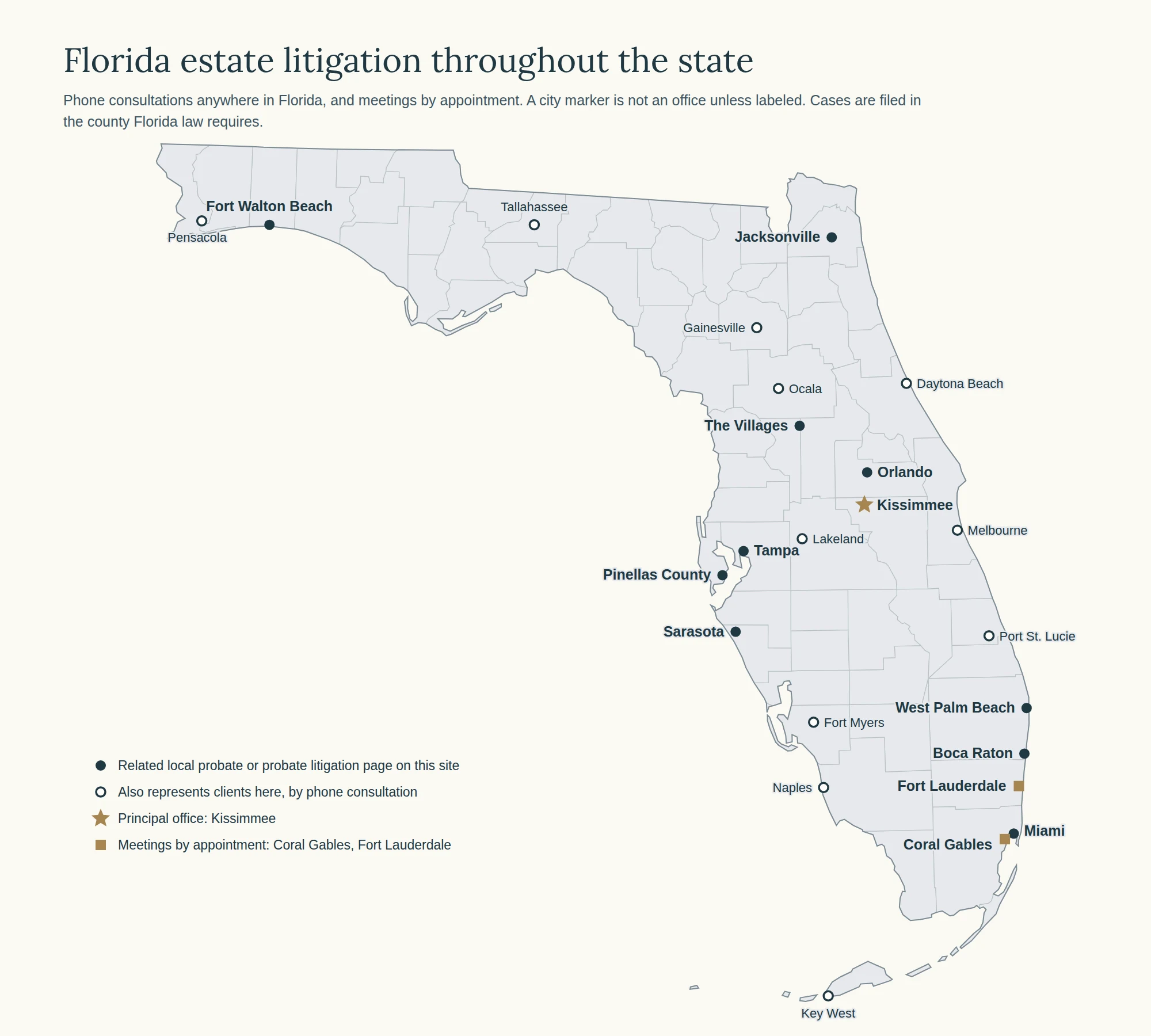
View the full-size Florida service-area map
| Region | Counties | Local pages |
|---|---|---|
| South Florida and the Keys | Miami-Dade (Miami, Miami Beach, Coral Gables, Aventura), Broward (Fort Lauderdale), Palm Beach County (Boca Raton, West Palm Beach), Monroe (Key Largo, Tavernier, Islamorada, Marathon, Key West) | Miami · Fort Lauderdale · Boca Raton · West Palm Beach |
| Central Florida | Orange (Orlando, Winter Garden, Lake Nona), Osceola (Kissimmee, Celebration), Seminole (Altamonte Springs), Lake, Sumter (The Villages), Polk, Volusia, Brevard | Orlando · Kissimmee probate |
| Tampa Bay and the Suncoast | Hillsborough (Tampa), Pinellas (St. Petersburg, Clearwater), Pasco, Manatee, Sarasota | Tampa · Pinellas County |
| Northeast Florida | Duval (Jacksonville), St. Johns, Clay, Nassau | Jacksonville |
| Southwest Florida, North Florida and the Panhandle | Lee (Fort Myers), Collier (Naples), Charlotte, Alachua, Marion, Leon, Escambia, Okaloosa (Fort Walton Beach), Walton (Miramar Beach) and others | Handled statewide |
The local pages describe representation in those areas (the Kissimmee page covers probate administration); they do not identify additional firm offices. This page covers trust disputes throughout Florida.
Can you handle a Florida trust dispute if you live out of state or abroad?
Yes. Many contested Florida trusts have beneficiaries, and sometimes trustees, who live elsewhere, including seasonal residents who kept homes in Florida. If you are searching for trust dispute lawyers near me from New York or Bogotá, start instead with where the Florida trust is administered.
- Consultations are available by phone, in English and Spanish.
- Where the trust is administered, where the trustee and beneficiaries live, and where the assets are located can all affect the analysis.
- Whether a hearing can be attended remotely depends on the court and the proceeding; travel may sometimes be required.
Looking for a trust litigation attorney near you?
Lorenzo Law’s principal office is in Kissimmee. Jose also meets clients by appointment in Coral Gables and Fort Lauderdale, and consultations are available by phone. Searches such as “trust litigation attorney near me” or “trust litigators near me” weigh distance among other factors, and distance says little about who knows which county your case belongs in or who reads the accountings. When comparing counsel, ask about trust-dispute experience, who will handle the matter, fees and costs, and which documents or notices need immediate attention. The court is set by the venue rules and the facts, not by where the lawyer’s office is, and whether you can appear remotely depends on the proceeding and the court.
Working with Jose M. Lorenzo, Jr.

Jose M. Lorenzo, Jr. was admitted to The Florida Bar on October 4, 2013 (Florida Bar No. 107002).
- Before admission, he worked for roughly a decade as a paralegal on probate and litigation matters. That work is separate from his years as an attorney.
- As a third-year law student, he served as a judicial intern in the Probate Division of Florida’s Eleventh Judicial Circuit with the Honorable Maria M. Korvick.
- Education: a B.A. in Accounting and Finance from Florida International University, and a law degree from FIU College of Law.
Two parts of that background matter for an attorney in trust litigation: the accounting training, for reading trust accountings, and the time in a probate division, for how contested fiduciary cases move.
Read Jose’s biography and his official Florida Bar profile.
How the practice works:
- Lorenzo Law is a solo practice, not a multi-lawyer trust litigation law firm. Clients work directly with Jose on the matters he handles.
- Phones are answered 24 hours a day, and the firm aims to follow up on inquiries within one to two business days.
- The initial consultation is free, by phone or by appointment, in English and Spanish. Fees and costs for representation are agreed separately in writing.
Comparing trust litigation attorneys?
If you have been searching for the best trust litigation attorney in Florida, no directory ranking or badge answers the questions that decide a case. Directories list this work under several headings (trust & estate litigation, contested trusts, fiduciary litigation, probate litigation), and the heading matters less than the answers. The same questions apply whether you are comparing estate and trust litigation lawyers at a large firm or a solo practice.
When comparing trust litigation attorneys, ask each lawyer:
- Who will actually handle my case?
- Which clock applies to the document I received, and does it run from sending or from receipt?
- How will the fee and the costs work if there is no recovery?
- Will you represent me as a beneficiary or as a trustee, and are there conflicts?
What you will not read here is a success rate or a promise about an outcome; that is a choice this firm makes. Florida’s advertising rules prohibit statements a prospective client can reasonably interpret as a prediction or guaranty of results. Past results do not predict yours.
More questions about Florida trust litigation
What is trust litigation?
Trust litigation is a court proceeding about a trust: its validity, its administration, its meaning, or the conduct of the trustee. In Florida, it is generally a civil action in circuit court under the Trust Code and the civil rules. A trust litigation lawyer in Florida handles those proceedings for beneficiaries or trustees.
What is the new trust law in Florida?
The most significant 2026 change for trust disputes is the nonjudicial settlement and discharge procedure, effective April 29, 2026, which lets a departing trustee send a final report with a 60-day objection notice. See “Received a trustee’s notice with a 60-day deadline?” above. Decanting (§736.04117) and the successor-trustee rules (§§736.08125, 736.10085) changed in 2025.
Is a trustee the same as an executor?
No. Florida calls an executor a personal representative. A personal representative administers a probate estate under court supervision; a trustee administers trust property, usually without continuing court supervision. One person may hold both roles, but the duties, property, procedures and claims must be kept separate. Does an executor have to show an accounting to beneficiaries in Florida? Generally yes, in the probate case, as the table below shows. People sometimes say “executor of a trust”; the Florida term is trustee, and removing one follows the trustee rules above. For a contested estate, see Florida probate litigation.
Executor vs. trustee in Florida, at a glance:
| Personal representative (executor) | Trustee | |
|---|---|---|
| Governed by | Florida Probate Code (chapters 731–735) | Florida Trust Code (chapter 736) |
| Appointed by | Generally the probate court | Generally the trust instrument, usually without court involvement |
| Court supervision | Generally throughout the probate case | Only when someone files a proceeding |
| Property handled | Probate estate assets | Assets titled in the trust |
| Accountings | Generally served on interested persons in the probate case | Provided to qualified beneficiaries |
Does a trustee own the trust property?
The trustee generally holds legal title in a fiduciary capacity; the beneficial interests belong to the beneficiaries under the trust’s terms. Title in the trustee’s name does not authorize personal use contrary to the trust.
Can a trustee be a beneficiary of the same trust?
Yes. A trustee can be a beneficiary, and it is common for an adult child to serve as trustee of a parent’s trust. The dual role increases the risk of conflicts, so the duties of loyalty and impartiality, and the conflict rules for self-dealing, apply with full force.
Can a trustee kick a beneficiary out of a trust?
No, not by virtue of being trustee. A trustee administers the trust as written; changing who benefits requires one of the routes described under “Can a trustee remove a beneficiary?” above. Can a beneficiary be removed from a trust at all? Only through the routes described under “Can a trustee remove a beneficiary?” above.
Can beneficiaries override a trustee?
Not directly. Beneficiaries can demand information, object, and ask a court to compel, restrain, surcharge or remove a trustee; all qualified beneficiaries together can also ask for removal under the statute’s conditions. A trust may give a beneficiary or trust protector specific powers, such as replacing the trustee. Can a trustee override a beneficiary? Within the discretion the trust validly grants, a trustee can decide over a beneficiary’s objection, but that discretion must be exercised in good faith and in line with the trust’s terms and purposes and the beneficiaries’ interests.
Who holds a trustee accountable?
The beneficiaries, through the rights described on this page, and the court, once a proceeding is filed. There is no automatic court review of a trustee’s accounting.
Does a trustee need a lawyer?
Not for every task, but a trustee facing a demand, an accusation, a removal petition or a surcharge claim should get advice before responding. A trustee looking for an attorney for a trust they administer should look for one who represents trustees, not only beneficiaries. A trustee’s early statements and accountings become the record.
What happens when a trustee dies?
The trust continues. A successor named in the trust, or one selected under the statute, takes over. The Trust Code does not directly require the deceased trustee’s personal representative to give beneficiaries an accounting, but the successor trustee must take reasonable steps to recover the trust property and redress known breaches, and can demand an accounting from the estate or obtain one by court order.
What is a spendthrift trust, and can it be challenged?
A spendthrift provision restricts a beneficiary’s ability to transfer an interest and generally keeps creditors from reaching trust property before it is distributed, subject to statutory exceptions. §736.0502, §736.0503. A spendthrift clause does not remove fiduciary duties or prevent a beneficiary from enforcing the trust.
Can you be the trustee of your own trust?
Yes, for a revocable living trust: settlors commonly serve as their own trustee, with a successor named to take over at death or incapacity. For an irrevocable trust, in some arrangements a settlor can serve as trustee, but the consequences depend on the trust, the powers retained and the purpose of the trust, such as creditor protection or tax treatment. While the trust is revocable, the trustee’s duties are owed to the settlor alone. For planning-stage questions, see Florida irrevocable trusts and selecting a trustee.
Is a Florida trust contested the same way as a will?
No. A trust contest in Florida, like a trustee dispute, has separate notice and limitation rules and proceeds as a civil action; will contests run through the probate case. A testamentary trust, one created inside a will, is generally challenged by contesting the will in the probate case; questions about administering, distributing or interpreting a testamentary trust can still be brought as trust proceedings. See Florida will contests.
Discuss your Florida trust dispute
Whether a trustee won’t give an accounting, a trust is being contested, or a claim has been made against you as trustee, a Florida trust litigation lawyer should see the documents early. Tell Lorenzo Law:
- your role: beneficiary, trustee, cotrustee, successor trustee or family member
- the trust’s name and date, if you know it, and the county where it is administered
- what happened and the result you need
- whether any notice, report, lawsuit or proposed transaction has a date attached
You do not need to know the exact legal remedy before asking for a consultation.
Request a free initial consultationCall (305) 224-6811
Consultations are available in English and Spanish, by phone or by appointment. Only the consultation is free; representation fees and costs are agreed separately in writing.
Contacting the firm does not create an attorney-client relationship, and it does not mean the firm has agreed to represent you. This page provides general information about Florida law, not legal advice for a particular matter; the trust documents, facts, applicable law and procedural history determine the available options.
Reviewed by Jose M. Lorenzo, Jr., Florida Bar No. 107002. Legal information current as of September 2026.
Sources
the Florida Trust Code (chapter 736, Florida Statutes, 2026), including §§736.0103, 736.0109, 736.0111, 736.0201–736.0207, 736.0402–736.0406, 736.0412–736.04117, 736.0502–736.0503, 736.0601–736.0604, 736.0701–736.0708, 736.0802–736.08165, 736.1001–736.1017, 736.10081, 736.10085, 736.1108 and Part XIV (§§736.1401–736.1420); §§57.105, 90.502, 90.5021, 731.201, 732.502, 733.107, 744.441, 772.11, 825.103 and 825.1035, Florida Statutes; Fla. R. App. P. 9.110; and In re Estate of Carpenter, 253 So. 2d 697 (Fla. 1971).