
Boca Raton Probate Litigation Attorney
Lorenzo Law handles contested wills, trusts, deeds and fiduciary matters for people who need a Boca Raton probate litigation attorney, serving Boca Raton and Palm Beach County. A dispute may concern a changed will, a trust amendment, a transfer of the family condo, or how a personal representative or trustee has handled property. The first questions are what is being challenged, how your rights are affected, and whether a notice or court order requires a response.
Request a free consultation. Only the initial consultation is free; representation fees and costs are agreed separately in writing. Consultations are available in English and Spanish, by phone or video.
Request a free initial consultationCall (305) 224-6811
Go straight to: Which dispute you have · Notices and deadlines · What to gather
Will contests · Trust disputes · Deed challenges · Fiduciary conduct · Palm Beach County venue · Boca nonresident property
All page sections 19 sections
Short answer. Probate litigation is a court dispute over a will, a trust, a deed, or the conduct of a personal representative or trustee. In Florida the response time depends on which document is challenged, which notice you received, and whether you are challenging or defending. There is no single deadline for every estate dispute, so identify the document and every notice before anything else.
| What this page covers | Contested wills (including capacity and dementia questions), trusts, deeds and lifetime transfers, and personal representative or trustee conduct, in Boca Raton and Palm Beach County matters, for people challenging a document and for people defending one. |
|---|---|
| First step | Identify what is being challenged and which notice, order or hearing date you received. Keep the envelope, the delivery record and every page. Checklist |
| Deadlines | There is no single period. Will, trust, accounting and formal-notice clocks differ and can start from service of a notice or a trustee’s notice, not from the date of death. Notices and deadlines |
| Who can bring or defend a claim | An interested person in the particular proceeding. A family label or receipt of a notice does not by itself settle standing. Your role |
| Where it is filed | Probate venue depends on domicile and property (§ 733.101), not on a Boca address or the lawyer’s office; trust proceedings have their own venue options under § 736.0204. Palm Beach County matters are in the Fifteenth Judicial Circuit, with assignment set by administrative order, not a city list. Venue |
| Fees | Only the initial consultation is free. Representation fees and costs are agreed separately in writing. Fees and timing |
| Office | Principal office in Kissimmee. Coral Gables and Fort Lauderdale by appointment. Consultations in English and Spanish, by phone or video. |
Jose M. Lorenzo, Jr. handles probate and trust litigation, including related inheritance disputes. You do not need to know the correct name for the claim before contacting the firm. Bring the disputed documents, the case number if one exists, and every notice you received. For an uncontested administration with no dispute, including when you are looking for a Boca Raton estate attorney rather than a litigator, see the Boca Raton probate attorney page.
What is probate litigation?
Probate litigation is the set of court disputes that arise in a probate or trust matter: contests over whether a will or trust is valid, claims about how a personal representative or trustee has acted, disputes over deeds and other lifetime transfers, and fights over who should serve as a fiduciary. In Florida these disputes arise under the Florida Probate Code (chapters 731 through 735 of the Florida Statutes), the Florida Trust Code (chapter 736), the Florida Probate Rules and case law. Uncontested probate asks the court to administer an estate. Probate litigation asks the court to decide a disagreement inside that administration or about the documents behind it.
Start with the disputed document or conduct
A contested estate can involve more than one dispute. The same family and the same Boca property can involve a will, a trust, a deed and a fiduciary at once, and each may need a different claim, different parties and a different procedure. Sort the problem by the document or conduct first.
Uncontested administration also involves legal duties and court oversight; it is not simply clerical paperwork.
| What you are facing | Documents that help identify the issue | Route to evaluate |
|---|---|---|
| A will or codicil changed who inherits | Every available will and codicil, signing information, notice of administration, and probate orders | A will validity challenge or defense; if a will is already admitted, whether a timely revocation proceeding remains available |
| A trust or amendment changed the beneficiaries or their shares | Complete trust, amendments and restatements, any revocation, trustee notices, and dates sent or received | A trust validity challenge or defense, with its own standing, timing, and venue analysis |
| A deed moved the Boca property before death | Recorded deed, earlier title documents, any power of attorney used, closing papers, and transfer dates | A separate deed challenge; contesting a will does not itself undo a lifetime conveyance |
| A late change followed a power of attorney, a new caregiver or an exploitation concern | The power of attorney, account and transfer records, dates of each change, and the person’s earlier plan | A lifetime-transfer and fiduciary review; a will, a trust amendment, an account change and a power-of-attorney transaction are different instruments |
| A parent with dementia or Alzheimer’s signed a new will, trust or deed | Medical and medication records near the signing, the drafting lawyer’s file, the witnesses, and any guardianship papers | A capacity review tied to the signing date; a diagnosis alone does not decide it |
| A caregiver, new spouse or new companion benefits from a late change | Messages, care and visitor records, the lawyer’s intake notes, and the earlier plan | An undue influence review; the relationship alone is not the proof |
| A personal representative or trustee is withholding information or mishandling assets | Appointment documents, accountings, requests and responses, transaction records, and court orders | An accounting or administration dispute; possible enforcement of duties, removal, or recovery for a proven breach |
| A trustee plans to sell the Boca condo or house | The trust, the proposed contract, the buyer’s identity, valuation information, and any notice | A trustee-conduct review and, if the facts support it, a request for protective relief |
| An original will cannot be found (a lost or missing will), or a later will has surfaced | Every copy, who last held the original, and where each document was signed | A lost will, missing will or competing-will review, which starts with custody history |
| The dispute is about where probate belongs | Petition, death certificate, residence history, property records, and other states’ proceedings | Probate venue and domicile analysis, distinct from assignment to a particular courthouse |
The table identifies questions for review, not an automatic remedy.
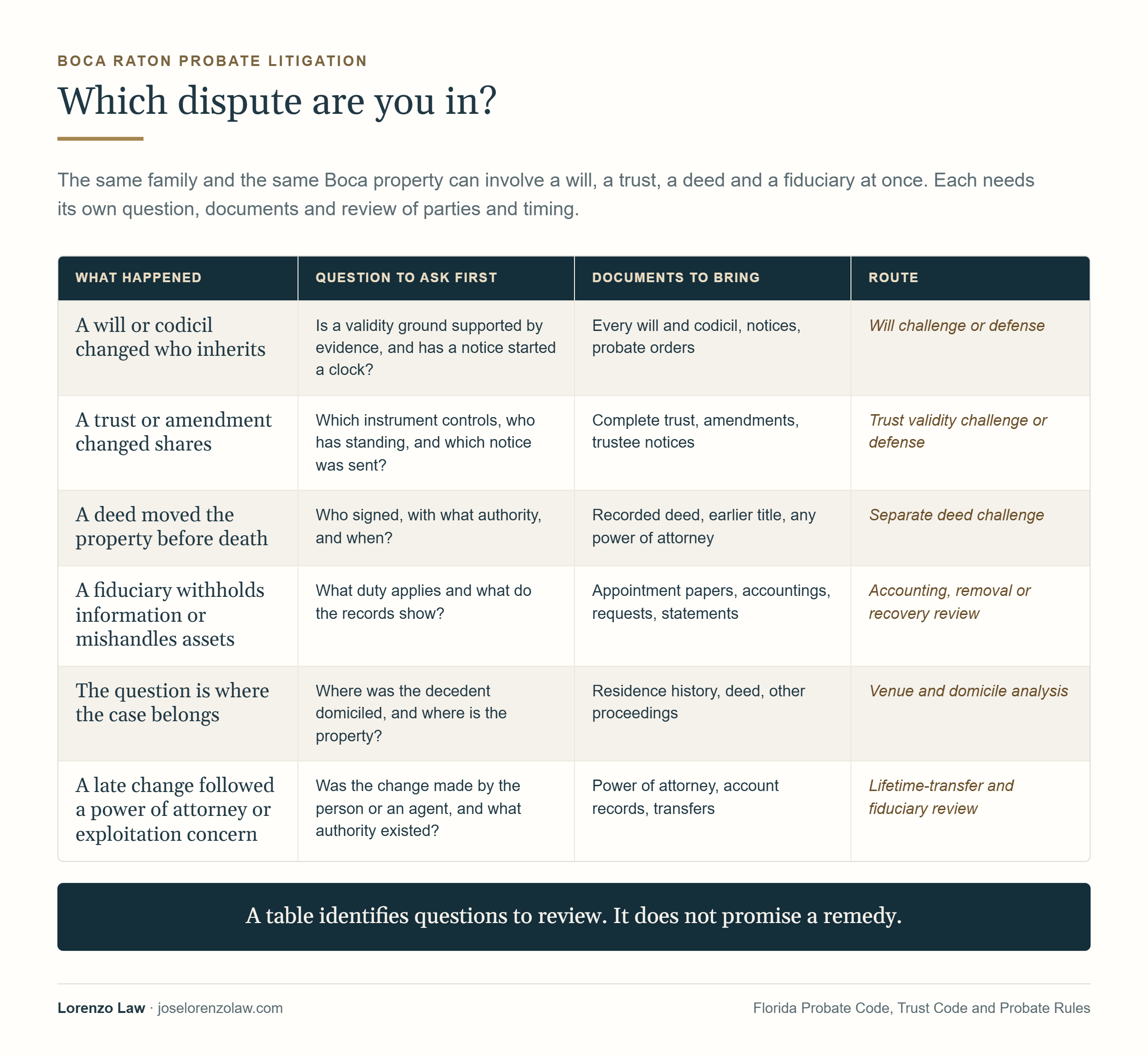
See the chart “Which dispute are you in?” (opens the full-size image; the details are also in the text).
Your concern may be contesting or challenging a will, including a Boca Raton will contest. You may want to dispute a trust or contest a trust, challenge a deed, remove a trustee, sue an executor, or ask a court to demand an accounting. Lawyers group the fiduciary-conduct disputes under the label fiduciary litigation. Lorenzo Law’s Florida will contest, trust litigation, and deed contest pages explain those services in more detail. A deed dispute requires its own engagement assessment; routine deed-preparation pricing does not cover litigation. For the broader service framework, see Florida probate litigation and Florida estate disputes.
Identify your role and the response required
An heir, a beneficiary under an earlier document, a surviving spouse, a personal representative and a trustee can have different interests in the same estate. Your role decides what you can ask a court to do, or what you may have to defend against.
Florida’s definition of an interested person depends on the particular proceeding and how its outcome may affect that person. A family relationship or receipt of notice does not by itself resolve standing. § 731.201.
| Your role | The question to ask first | What to bring |
|---|---|---|
| Heir, or family member who was disinherited or left out | Would an earlier document, or Florida’s intestacy rules, give me more than the document I am questioning? | Earlier and later wills or trusts, a family tree, notices received |
| Beneficiary under a changed document | How would invalidity change my share, and which instrument controls? | Earlier and later documents, amendments, dates, notices |
| Surviving spouse | Do I have rights independent of a will contest, such as an elective share (§§ 732.201–732.2155) or homestead rights (Fla. Const. art. X, § 4; § 732.401), with their own conditions and deadlines? | Marriage date, any agreements, property records, notices |
| Personal representative | What is my authority, what response is required, and do I also have a personal stake? | Appointment papers, letters, accountings, the petition or notice |
| Trustee, including a successor trustee | What does the trust authorize, what notices and accountings are owed, and is there a conflict? | The trust and amendments, trust records, notices sent, property documents |
| Beneficiary defending a document | Do my interests match the fiduciary’s, or do I need my own counsel? | The petition or notice, the document that gives me an interest |
For a beneficiary questioning a change, bring the earlier and later documents so the potential effect can be compared. For a fiduciary defending a transaction or appointment, bring the source of your authority, the decision record, and the notice or petition requiring a response. Identify whether you need advice in your individual capacity, your fiduciary capacity, or both. The engagement must identify whom the attorney represents; family members’ interests may conflict.
A surviving spouse may also need to evaluate rights independent of a will contest. Those rights have their own conditions and deadlines. The surviving spouse guide is a separate resource; no assumption that an election is cheaper or produces a larger recovery should substitute for reviewing the facts. A pretermitted spouse, meaning one who married the person after the will was signed (§ 732.301), or a pretermitted child, meaning one born or adopted after the will was signed and not provided for (§ 732.302), may also have statutory rights that are not a validity challenge. Each statute has exceptions. Those claims have their own conditions, so bring the marriage or birth dates and the date of the will.
If you are defending a will, trust or appointment
Many people reach this page because someone is challenging a document they rely on. Preserve the same records a challenger would need: the complete document and any signing affidavit, earlier plans, the witnesses’ and drafting lawyer’s details, service records and court papers. Identify evidence of independent instructions and capacity without coaching witnesses or reconstructing documents. A personal representative who is also a beneficiary should say so at the outset, because personal interests and fiduciary duties may need separate counsel. Defending a document does not allow withholding required information or distributing property in disregard of a pending proceeding.
Notices and deadlines need separate review
For a will, the usual question is whether you were served with a notice of administration, which generally starts a three-month period to object to the will’s validity. For a trust, the trustee’s notice and the type of trust drive a different clock. For an accounting dispute, the notice and disclosure received do. For a will objection, the clock usually runs from service of the notice of administration, not from the date of death, so do not assume the date of death controls. Some spousal rights, such as the elective share, have an outer limit measured from death (two years), so confirm which clock applies. Do not wait for a complete evidence file before asking for advice about a notice.
The date printed on an envelope, the date of death, and the date a document was legally served can be different. Preserve the envelope, delivery confirmation, email, attachments, and any signed waiver along with the document.
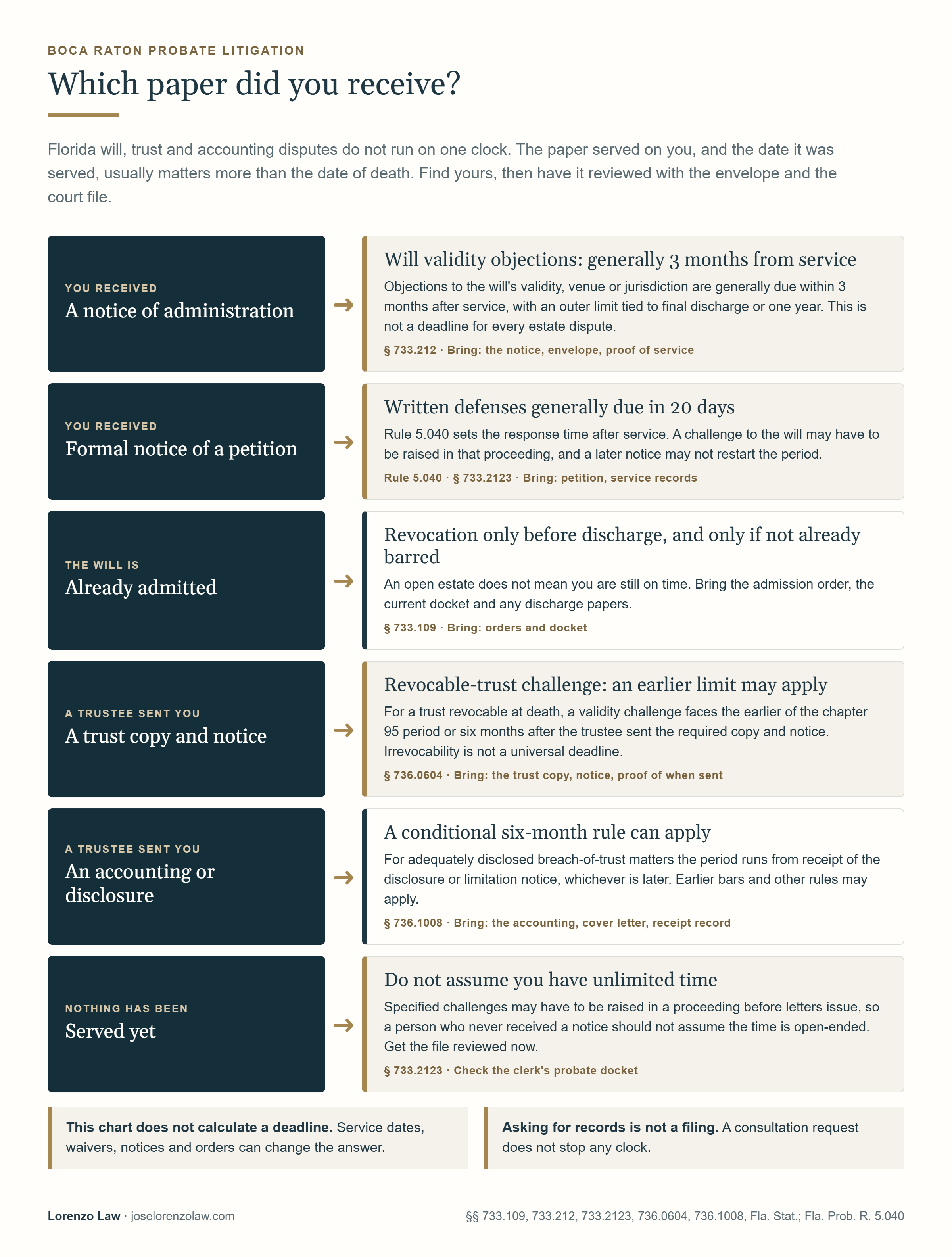
See the chart “Which paper did you receive?” (opens the full-size image; the details are also in the text).
| Document or event | Why it matters | What to bring |
|---|---|---|
| Notice of administration | Section 733.212 generally requires a served interested person to file specified objections to will validity, venue, or jurisdiction within three months after service. This is not a universal period for every estate dispute. | The complete notice, attachments, envelope or delivery record, and proof of service on the docket |
| Formal notice of a petition | Rule 5.040 generally requires written defenses to be served within 20 days after service, excluding the service day, and the original filed before or immediately after service. The pleading and procedural posture matter. | The petition, the formal notice, service records, any response |
| A will has already been admitted | Section 733.109 permits a revocation proceeding before final discharge only if the interested person is not already barred under sections 733.212 or 733.2123. | The admission order, the current docket and any discharge papers |
| A trustee sent a trust and contest notice | Under section 736.0604, validity challenges to a trust revocable at death face the earlier of the chapter 95 period or six months after the trustee sent the required trust copy and notice. | The trust copy, the notice, and proof of when and how it was sent |
| Trust accounting or other disclosure and limitation notice | Section 736.1008 has a conditional six-month rule for adequately disclosed breach-of-trust matters, measured from receipt of the disclosure or applicable limitation notice, whichever is later. Earlier bars and other limitation rules may apply. | The accounting, the cover letter, and a record of when it was received |
| A petition for discharge, final accounting, claim objection, or hearing order | Separate response requirements may apply. Do not use the will-contest period or trust-accounting period as a substitute. | The petition or order, its filing and service information |
§ 733.212 includes a narrow estoppel extension and an outer limit; it also treats the filing date of a waiver of service as the service date for referenced deadlines. § 733.2123 can require specified challenges in the proceeding before letters issue. A person who has not received a notice of administration should therefore not assume there is unlimited time.
Trust validity and trustee misconduct use different rules. § 736.0207 generally restricts when a revocable-trust validity action can begin, with a guardian exception and a separate rule for complete revocation. Irrevocability is not a universal deadline ending the right to challenge. Compare § 736.0604 with § 736.1008, and have the actual notices reviewed. Requesting records or a consultation does not itself preserve a filing deadline.
Can you contest a will after probate has started or closed?
A will can sometimes be contested after it is admitted to probate, but only within narrow limits. After admission, an interested person may petition to revoke probate before the personal representative’s final discharge, but only if the challenge is not already barred by the notice deadlines in sections 733.212 or 733.2123 (§ 733.109). An open estate does not mean you are still on time. Once the estate is closed and the representative discharged, the ordinary will contest route is generally over, although a person who was never served may have a route such as relief from an order entered without required notice, so have the record reviewed immediately.
If you think time has already run out
Late discovery of suspicious conduct does not, by itself, revive a contest. A separate lawsuit for tortious interference with an inheritance is not a routine workaround. In DeWitt v. Duce, 408 So. 2d 216 (Fla. 1981), the Florida Supreme Court barred a later interference claim where an adequate probate remedy had been available and the plaintiff had a fair opportunity to use it. Whether a different case presents an inadequate probate remedy needs its own analysis.
For the broader educational explanation, see contesting a will in Florida. Formal-notice procedure appears in the Florida Probate Rules, rule 5.040.
Grounds for contesting a will or trust, and the evidence each needs
An unequal inheritance does not establish that a document is invalid. A challenge must connect evidence to a recognized ground: lack of capacity, undue influence, fraud, duress, mistake in limited situations, improper execution, forgery, or revocation by a later document. Each ground needs evidence tied to the signing or the transaction.
Capacity and execution requirements, and claims involving fraud, duress, mistake, or undue influence, require different proof. Relevant statutes include sections 732.501, 732.502, 732.5165, and, for trusts, 736.0406.
| Ground | What the evidence must address | Useful records or witnesses | Not enough by itself |
|---|---|---|---|
| Lack of testamentary capacity | The person’s understanding when the document was signed | Medical and medication records near the signing, the drafting lawyer’s notes, the witnesses’ observations | Age, a diagnosis (including dementia or Alzheimer’s), or confusion at an unrelated time |
| Undue influence | Whether someone overcame the person’s free choice; procurement and the relationship | Appointment messages, drafts, instructions, restricted access, earlier estate plans | A large gift, caregiving or a close relationship |
| Fraud | Deception that produced the document or a provision | What was said, by whom, why it was false, and the change it caused | A relative’s general reputation for dishonesty |
| Duress | Threats or coercion that overcame free choice | Messages, reports made at the time, witnesses, evidence of dependence | Ordinary argument or persuasion |
| Improper execution | Compliance with the signing and witness requirements | The complete document, any self-proving affidavit, witness and notary information | A relative’s unfamiliarity with the document |
| Forgery or alteration | Whether the signatures and pages are genuine | The original, genuine signature samples, custody history, a document examiner | A signature that merely looks unusual |
| Mistake | Whether the issue is invalid procurement or terms that need reformation | Drafts, instructions, correspondence, evidence of actual intent | An outcome a beneficiary considers a mistake |
| Revocation or a competing document | Which document and which revoking act legally controls | Every will, trust and amendment, the originals, signing and custody history | An assumption that the older, preferred document comes back automatically |
What are valid reasons to contest a will?
The main reason to contest a will is a recognized legal ground: lack of capacity, undue influence, fraud, duress, mistake in limited situations, improper execution, forgery, or revocation by a later document. Surprise at the result, getting less than a sibling, or a belief that the document is unfair is not a ground, although it may be the reason to investigate. Some people who were left out have a separate statutory right, such as a surviving spouse’s elective share or homestead rights, or a pretermitted spouse or child share, that does not require overturning anything. For trusts the counterpart statute is § 736.0406.
Dementia, Alzheimer’s and testamentary capacity
Dementia and Alzheimer’s are among the most common reasons families question a will, but a diagnosis does not automatically invalidate a document. Florida requires a person making a will to be of sound mind (§ 732.501). The test is a general understanding, at the moment of signing, of the nature and extent of the property, the people who are the natural objects of the person’s bounty, and the practical effect of the will. It is generally regarded as a lower threshold than the capacity needed to manage complex finances.
Medical evidence needs a reasoned connection to the day of signing. A document signed during a lucid interval, a period when the person understood those things despite a broader illness, can be valid. In Reeves v. Gross, 403 So. 3d 362 (Fla. 3d DCA 2025), the court affirmed summary judgment on that record, holding that the mere possibility of incapacity does not overcome the presumption of capacity. It did not hold that every person with dementia has capacity.
The probate judge decides capacity on the whole record: the drafting lawyer, the attesting witnesses, medical records, people who saw the person around the signing date, and sometimes a retrospective opinion from a physician or geriatric psychiatrist. If there was a guardianship or incapacity proceeding, bring the actual orders and evaluations; they are important evidence, but their effect has to be measured against the signing date. A guardianship does not by itself take away the right to make a will, because a person found incapacitated keeps every right the court did not specifically remove. A trust, an amendment or a deed is a different instrument, so the capacity analysis for each needs its own review: a revocable trust or an amendment requires the same capacity as a will (§ 736.0601), while a deed is judged under its own standard. See contested guardianship for disputes about a living person’s capacity.
How do you prove undue influence?
Undue influence is pressure that overcomes the person’s free will so that the document reflects someone else’s wishes. Persuasion, affection or a request is not enough. Start with what the beneficiary did: whether that person was present when the plan was discussed or signed, recommended or chose the lawyer, knew the contents before signing, gave instructions on what to put in it, secured the witnesses, or kept the original afterward. § 733.107 allocates the burdens in a will contest and gives an applicable undue-influence presumption a burden-shifting effect. Whether the presumption applies needs legal analysis; it is not a substitute for gathering evidence. A diagnosis alone does not answer what the person understood when signing, and arranging transportation or receiving a larger share does not alone establish undue influence.
The relationship between the lawyer, the beneficiary and the person who signed matters. See also the undue influence lawyer page and the fuller will-contest guide on contesting a will in Florida.
Florida undue influence statute, elements and statute of limitations
For wills, the Florida undue influence statute is § 732.5165, which makes a will or a provision procured by undue influence void. The trust counterpart is § 736.0406. The presumption and burden rules come from case law and § 733.107.
For a will contest, the Florida undue influence elements that raise a presumption come from In re Estate of Carpenter, 253 So. 2d 697 (Fla. 1971): the person was a substantial beneficiary, had a confidential relationship with the person who made the will, and was active in procuring it. When the presumption applies, current § 733.107(2) makes it a presumption that shifts the burden of proof to the beneficiary, who must then show the will was not the product of undue influence. The presumption is rebuttable.
The Florida undue influence statute of limitations is not a separate period in a will contest. The notice deadlines in the deadline section govern. A trust, a deed, an account change or a power of attorney transaction has its own limitation analysis, so do not assume the will rule applies to it. A trust revocable at death follows § 736.0604; a deed or other lifetime transfer generally falls under the chapter 95 periods, which differ by claim (§ 95.11), and a fraud claim can carry a delayed-discovery rule (§ 95.031).
Caregiver, new spouse or new companion: when influence is alleged
A person may lawfully leave property to a caregiver, a new spouse or a new companion, so the relationship alone is not the proof. The questions are whether that person took part in arranging the document (contacting or choosing the lawyer, attending the meeting, giving instructions, keeping the original), whether that person controlled access, care, money or contact with family, and whether the change broke from a long-standing plan. Evidence tends to come from care logs, visitor records, caregiver agreements and payment records, messages, the lawyer’s intake notes, and changes to accounts or deeds in the same period.
A new spouse also has rights that do not depend on any contest, such as an elective share (§ 732.201), homestead rights (§ 732.401) and, for a spouse married after the will was signed, a pretermitted spouse share (§ 732.301), each subject to its own conditions and exceptions. For children of a first marriage, the first question is therefore what the will and the statutes already give the spouse, and what remains. See the surviving spouse guide.
Match the relief to the document
The requested relief should fit the document. A challenge may concern a particular provision or amendment rather than the entire estate plan. Invalidating one document does not automatically establish that the challenger receives the property; earlier documents, revocations, ownership, and other rights still need review. For a will executed outside Florida, record where it was signed and the maker’s residence at that time. Section 732.502 contains provisions for nonresident wills and military testamentary instruments. A difference from ordinary Florida signing formalities does not automatically invalidate every foreign will.
How do you dispute a trust or contest a trust in Florida?
Disputing a trust in Florida usually means one of two things. The first is a validity challenge: asking the court to hold that the trust or an amendment is void because it was procured by fraud, duress, mistake or undue influence (§ 736.0406), or because the person who signed it lacked capacity (for a revocable trust or an amendment, the same capacity required to make a will, § 736.0601). The second is an administration dispute about what a trustee has done, which is covered in the trustee section. To dispute a trust or contest a trust you need standing as an interested person, and the timing rules differ from a will contest; compare § 736.0207 and § 736.0604 and the deadline section. A trust contest and a will contest can involve the same family and the same property, but they are separate proceedings with different notices.
A revoked will, a lost will and competing wills
A revoked will is one the person cancelled, for example by a later will or codicil or by a physical act such as destroying it with the intent to revoke (§ 732.505, § 732.506), so the first question is which document the person last validly made and whether the revocation was effective. A revocation procured by fraud, duress, mistake or undue influence is also ineffective (§ 732.5165), which means a challenge can target the revoking document as well as the new will. An older will does not come back automatically because a newer one fails; the result depends on the documents and the revocation. Bring every version, the originals and the custody history. For a will that cannot be found, see the lost-will row in the routing table, and for the broader guide see contesting a will in Florida.
Pour-over wills and trusts
A pour-over will leaves some or all of the probate estate to the trustee of a trust (§ 732.513). A person who wants to challenge the plan may therefore face two documents: the will, which goes through probate, and the trust, which is challenged in a separate proceeding under the Florida Trust Code. Winning against one does not automatically undo the other, and failing to contest the will can, in some circumstances, also affect the right to challenge a trust or other writing the will incorporates; the notice of administration must warn of this (§ 733.212). Bring the will, the trust and every amendment together so that the notices and deadlines for each can be compared.
Evidence for a will or trust challenge, and how to get it lawfully
The most persuasive evidence usually comes from the time the document was signed or the transaction occurred: medical and medication records, the drafting lawyer’s file, the witnesses and notary, messages about appointments and gifts, and earlier plans that show a long-standing intention. Start by securing the notices and the documents themselves; much of the rest is obtained through the court once a case is filed.
Start with a chronology: when each document was prepared and signed, who participated, what changed, and what was happening in the person’s life. Identify the drafter, witnesses, notary, and people with firsthand knowledge. Keep communications about appointments, instructions, access to the person, and custody of the documents.
| Evidence | Why it matters | Usual source |
|---|---|---|
| Chronology of signing and changes | Shows who was involved and whether the change fit a long-standing plan | Your notes, dated messages, the documents themselves |
| Drafting lawyer, witnesses and notary | People with firsthand knowledge of the signing | The document, any signing affidavit, court filings |
| Medical and medication records near the date | Connects a condition, including dementia or Alzheimer’s, to the day of signing, not just a diagnosis | Providers and facilities, through lawful authority or the court |
| Messages, emails and appointment records | Show who arranged the meeting, gave instructions and kept the original | Phones, email accounts and devices you may lawfully use |
| Financial and property records | Show related transfers, account changes and deeds in the same period | Accountings, statements, recorded deeds, title records |
| Earlier estate plans | Show whether the change broke from the person’s prior intentions | Earlier documents and the drafting lawyer’s file |
| Notices, orders and service records | Show which proceeding is open and when time began to run | Mail, email and the court docket |
Identify relevant medical providers and the records already lawfully available to you; do not assume that a relative can obtain every medical record or the complete attorney file. Preserve originals and unaltered electronic messages. Do not use another person’s passwords, edit messages, or obtain records without authorization. Access to medical records after death depends on legal authority; being a relative is not automatic permission, and in a contested case records are usually obtained through a subpoena or court order. A request for a consultation does not itself obtain records, and the question of lawful access is separate from whether the firm accepts a representation or clears a conflict check.
Treat preservation as a litigation hold in practice: ask relatives, caregivers and the fiduciary in writing, through counsel where possible, not to delete messages, discard papers, or sell or alter property that bears on the dispute. Preservation requests do not by themselves stop a sale or a distribution; a court order, a statute, or a binding agreement may.
A diagnosis alone does not answer what the person understood when signing. Similarly, arranging transportation or receiving a larger share does not alone establish undue influence. If you expect a dispute, separate what you saw yourself from what you were told, and include evidence that cuts against your suspicion.
Trustee conduct, accountings and a proposed condo sale
A trust validity dispute asks whether the instrument should govern. An administration dispute asks whether the trustee has followed the governing duties. Those questions can overlap, but proving one does not automatically prove the other.
Beneficiary rights to information start with § 736.0813: qualified beneficiaries generally have information and accounting rights. The statute addresses notices, requested trust copies, and accountings, with qualifications for revocable trusts, waivers, and other circumstances. For certain existence notices, the trustee’s knowledge is part of the timing rule. Establish the trust’s status and your rights before treating silence as a proven statutory violation.
| Situation | First question | What to bring |
|---|---|---|
| Trustee will not provide a trust copy or accounting | What is the trust’s status, who qualifies as a beneficiary, and what was requested and when? | The trust, written requests, responses, any notices |
| Trustee plans to sell a Boca condo or house | What do the trust’s sale provisions say, and who is the buyer? | Proposed contract, buyer’s identity and relationship, valuation, notices, any consent or order |
| Trustee sells to a relative or to the trustee personally | Is there a personal conflict, and do the statute’s exceptions and protections apply? | The contract, the buyer’s identity, disclosures |
| Trustee is also a beneficiary | Does the dual role create a conflict that needs review? It is not a violation by itself. | The trust, distribution records, decision records |
| A beneficiary wants the property sold and the trustee refuses | Does the trust direct, permit or restrict a sale? A trust dispute differs from a co-owner dispute over inherited property. | The trust, the deed, ownership records |
| Statements show unexplained transfers | What do the records show, and what remedy does the proof support? | Statements, ledgers, bank records, the accounting |
If a Boca condo is about to be sold, gather the trust’s sale provisions, proposed contract, buyer’s identity and relationship to the trustee, valuation information, notices, and any consent or court order. A trustee may have authority to sell without every beneficiary’s approval. A transaction affected by a personal conflict can raise a different issue under § 736.0802, which also contains exceptions and protections. A related-party sale warrants review; the family relationship alone does not settle every element or defense. Whether a trustee may sell trust property to a beneficiary or to the trustee personally is the kind of self-dealing and conflict-of-interest question that review is meant to answer.
State what is imminent: a contract deadline, closing, distribution, or threatened destruction of records. Counsel can evaluate whether the facts support protective relief and what evidence is needed. Contacting the firm does not stop a sale, and an ordinary objection letter is not a court order.
When siblings disagree about keeping or selling a family home rather than about a document, see siblings who disagree about selling the family home. For removal and fiduciary-breach claims, see trustee removal and breach of fiduciary duty.
Trustee sale to the trustee, a relative or a beneficiary
Can a trustee sell property to himself? As a rule, a trustee must administer the trust solely in the interests of the beneficiaries, and a sale of trust property to the trustee personally is the classic conflict of interest under the duty of loyalty in § 736.0802. The statute generally allows an affected beneficiary to challenge a conflicted transaction, but it also contains exceptions, for example where the trust terms authorize the transaction, a court approved it, or the beneficiary consented or ratified.
Can a trustee sell property to a beneficiary? Not automatically improper, but price, appraisal, process, disclosure and who benefits all matter, and § 736.0802 presumes a conflict for a sale to the trustee’s spouse, close relatives, agents or attorney, or a company in which the trustee has a significant interest.
Should a trustee also be a beneficiary? Naming a beneficiary as trustee is common and lawful, yet a trustee who is also a beneficiary carries a built-in conflict that the trust and the records must manage. A trust cannot exist where the same person is the sole trustee and the sole beneficiary (§ 736.0402).
How long a trustee has to sell trust real estate
How long does a trustee have to sell a house? The statute does not set one deadline. The trust terms control, and within them the trustee must act prudently and impartially (§ 736.0804, § 736.0803), which means neither rushing a sale nor holding the property without reason while taxes, insurance and upkeep run. Whether a delay is a problem turns on the trust’s directions, the market, carrying costs, any beneficiary living in the property, and what the trustee has told the beneficiaries. If a trustee is stalling, put the request in writing and ask for information under § 736.0813 before assuming a breach.
Who owns trust property: the trustee or the beneficiary?
Does the trustee own the house? A trustee holds legal title to trust property as a fiduciary for the beneficiaries; the trustee does not own it in the ordinary sense and may not treat it as personal property. Does the beneficiary own the trust property? A beneficiary holds a beneficial interest defined by the trust terms, not title, so a beneficiary generally cannot sell, mortgage or force a sale of the house unless the trust gives that right. The recorded deed shows who holds title, usually the trustee of the named trust, and the trust instrument shows what each beneficiary may demand.
Removing a trustee from an irrevocable trust: who can ask, and when
Can you remove a trustee from an irrevocable trust? Yes, on proper grounds. Who can remove a trustee? The settlor, a cotrustee or a beneficiary may ask the court under § 736.0706, the court may act on its own, and the trust itself may give a named person a removal power. When to remove a trustee depends on the statutory grounds and findings: a serious breach of trust; lack of cooperation among cotrustees that substantially impairs administration; or unfitness, unwillingness or persistent failure to administer the trust effectively, where removal best serves the beneficiaries. A separate ground, a substantial change of circumstances or a request by all qualified beneficiaries, also requires findings that removal best serves the interests of all of the beneficiaries and is not inconsistent with a material purpose of the trust, and that a suitable cotrustee or successor trustee is available. A conflict, a smaller distribution or a family disagreement is not enough by itself. While a trust is revocable the settlor controls it, so the court route matters mostly once the trust is irrevocable. Decide what you want: removal, an accounting, a surcharge, or all three.
Personal representative disputes and potential remedies
A personal representative administers the estate under the will, applicable law, and court orders. That role does not confer personal discretion to disinherit someone, but a smaller or delayed distribution can reflect lawful expenses, claims, or administration needs rather than misconduct. Compare the authority, the accounting, and the transaction before choosing the claim.
The governing duties are in § 733.602. People often ask whether they can sue an executor. The claim depends on the duty, the breach and the loss, and removal and money recovery are different remedies. If you suspect an executor is stealing or mishandling estate funds, the first questions are what the authority, the accounting and the transaction records show, not what the family fears.
| Problem to investigate | Potential response to evaluate | Important distinction |
|---|---|---|
| Missing information or unexplained entries | Enforcing an information or accounting duty; examining particular transactions | Missing records are a reason to investigate, not proof of theft |
| Failure to obey an order, waste, or a disabling conflict | Removal of a personal representative under section 733.504 | Being both beneficiary and fiduciary is not by itself a sufficient removal analysis |
| Serious breach or ineffective trust administration | Trustee removal or protective relief under sections 736.0706 and 736.1001 | Court findings and the applicable statutory conditions matter |
| Loss caused by fiduciary misconduct | Monetary recovery (including a surcharge), restoration, or another remedy supported by the claim | Removal and compensation address different problems; neither guarantees collectible recovery |
§ 733.504 distinguishes initial disqualification from its other removal grounds. § 733.609 addresses personal-representative liability for loss caused by a breach. For trustees, § 736.0706 includes specific grounds and required findings; persistent ineffective administration is not an automatic removal order.
§ 736.1001 permits remedies including an accounting, restoration, suspension, a special fiduciary, and specified property remedies. Tracing assets or seeking a constructive trust requires an evidentiary and legal basis, and third-party protections may matter. An accounting order, a change of fiduciary, and recovery of a proven loss should each be evaluated against the client’s objective. A surcharge is a court order making a fiduciary personally responsible for the loss a breach caused. It is one way to recover a proven loss, separate from an accounting or removal, and whether it is available depends on the duty, the breach and the proof.
Breach of fiduciary duty by an executor or trustee: elements and time limits
What is breach of fiduciary duty of an executor? A personal representative is a fiduciary who must observe the standards of care applicable to trustees and settle and distribute the estate under the will and the Probate Code as expeditiously and efficiently as is consistent with the best interests of the estate (§ 733.602). A breach is a failure to meet those duties: self-dealing, taking or commingling funds, selling property without authority or at an unfair price, ignoring the will, failing to inventory or account, or concealing information. If your concern is executor stealing, identify the transactions or missing records that led to it. The breach of fiduciary duty elements are generally a duty, a breach of it, and damages caused by the breach, so a claim needs records showing all three.
The breach of fiduciary duty statute of limitations is not a single period. The time to sue depends on who the fiduciary is, what was disclosed, and the claim. For a trustee, § 736.1008 can bar a claim about a matter adequately disclosed in a trust disclosure document unless it is brought within six months after the beneficiary receives that document or a limitation notice that applies to it, whichever is received later, and other claims fall under the general limitation periods in chapter 95. Have the actual accounting and notices reviewed rather than counting from the date of the transaction.
Executor and trustee compensation, fee disputes and delay in distribution
Executor compensation and trustee compensation are allowed but must be reasonable. A personal representative is entitled to reasonable compensation (§ 733.617), a trustee to compensation that is reasonable under the circumstances (§ 736.0708), and the estate lawyer’s fees are addressed in § 733.6171. Attorney fee disputes arise when fees look high for the work done, when a fiduciary is paid from the estate to defend their own conduct, or when fees are charged against one beneficiary’s share. An interested person can object, so ask for the fee records and the accounting first.
Delay in distribution is not misconduct by itself, because debts, claims, taxes, a pending contest and property sales all take time. Unexplained delay with no inventory, no accounting and no explanation is different; it is a reason to demand information, ask for a status report or an accounting, and, in a serious case, consider removal.
Deeds, powers of attorney and late-life changes
Some of the most contested changes happen outside the will: a deed signed before death, a joint account added, a beneficiary form changed, or a power of attorney used. Each is a separate instrument with its own parties, remedy and timing, so a will challenge alone may not reach it.
A deed that moved the Boca property before death needs its own review: who signed it, with what authority, and when. People who want to challenge a deed usually have to identify the ground (for example lack of capacity, undue influence, forgery, or a defect in signing or delivery), the affected parties, and whether the property has since been sold to someone else. A quitclaim deed, which conveys whatever interest the signer holds without warranties, is challenged on the same grounds as any other deed. To challenge a deed, start with the recorded copy and the dates. A later buyer who paid value without notice of the problem can be protected (§ 695.01), and recording can cure some signing defects after five years in the absence of fraud (§ 95.231), so act promptly. See how to set aside a deed and whether a Lady Bird deed can be contested. Transfers made before death are discussed in challenging transfers made before death.
Florida’s power of attorney statute does not allow an agent to make or revoke the principal’s will or codicil (§ 709.2201). An agent may change certain property that passes outside the will, or create a trust, only if the power of attorney specifically grants that authority, and may amend or revoke a trust only if the trust instrument itself allows the settlor’s agent to do so (§ 709.2202). That is why a will that looks unchanged can still be emptied by changes made under a power of attorney before death. For general background, see Florida powers of attorney.
Concerns about elder financial exploitation or a living person’s incapacity are not a pre-death will contest: Florida bars an action contesting a will before the death of the person who made it (§ 732.518). They call for protective remedies instead, such as guardianship; see contested guardianship. A revocable trust likewise generally cannot be contested until it becomes irrevocable or the settlor dies, except by the guardian of an incapacitated settlor’s property (§ 736.0207).
Inherited property owned by several heirs: partition
A dispute over a house that several heirs now own together is often not a will contest. If the will or trust is valid and the property has passed to siblings as co-owners, one co-owner who wants out may ask the court for partition: a separate lawsuit in which the court divides the property or orders it sold and divides the proceeds. Partition addresses co-ownership, not whether a document was valid, and it depends on how title passed, whether the estate is still open, and the share each person holds. While the property is still in a trust or an open estate, the trustee or personal representative controls the timing, so the first question is who holds title today. Partition is governed by chapter 64 (§ 64.031), and a beneficiary can also ask the probate court to partition estate property before the estate closes (§ 733.814). See siblings who disagree about selling the family home.
Boca domicile and property owned by a nonresident
Owning a condo in Boca Raton does not by itself resolve where a decedent was domiciled. Domicile, title at death, and the instrument in dispute should be worked out in that order before anyone takes sides.
When a person divided time between Florida and another state or country, collect a consistent residence history rather than relying on one address. Useful records may include declarations, tax filings, voter and vehicle registrations, property records, travel records, and the person’s statements about home.
§ 733.101 places probate venue first in the Florida county of domicile. If there was no Florida domicile, it provides routes based on Florida property and, if there was also no Florida property, the residence of a debtor. A beneficiary’s Boca address or the location of the lawyer’s office does not replace that analysis. The Florida domicile guide explains the broader issue.
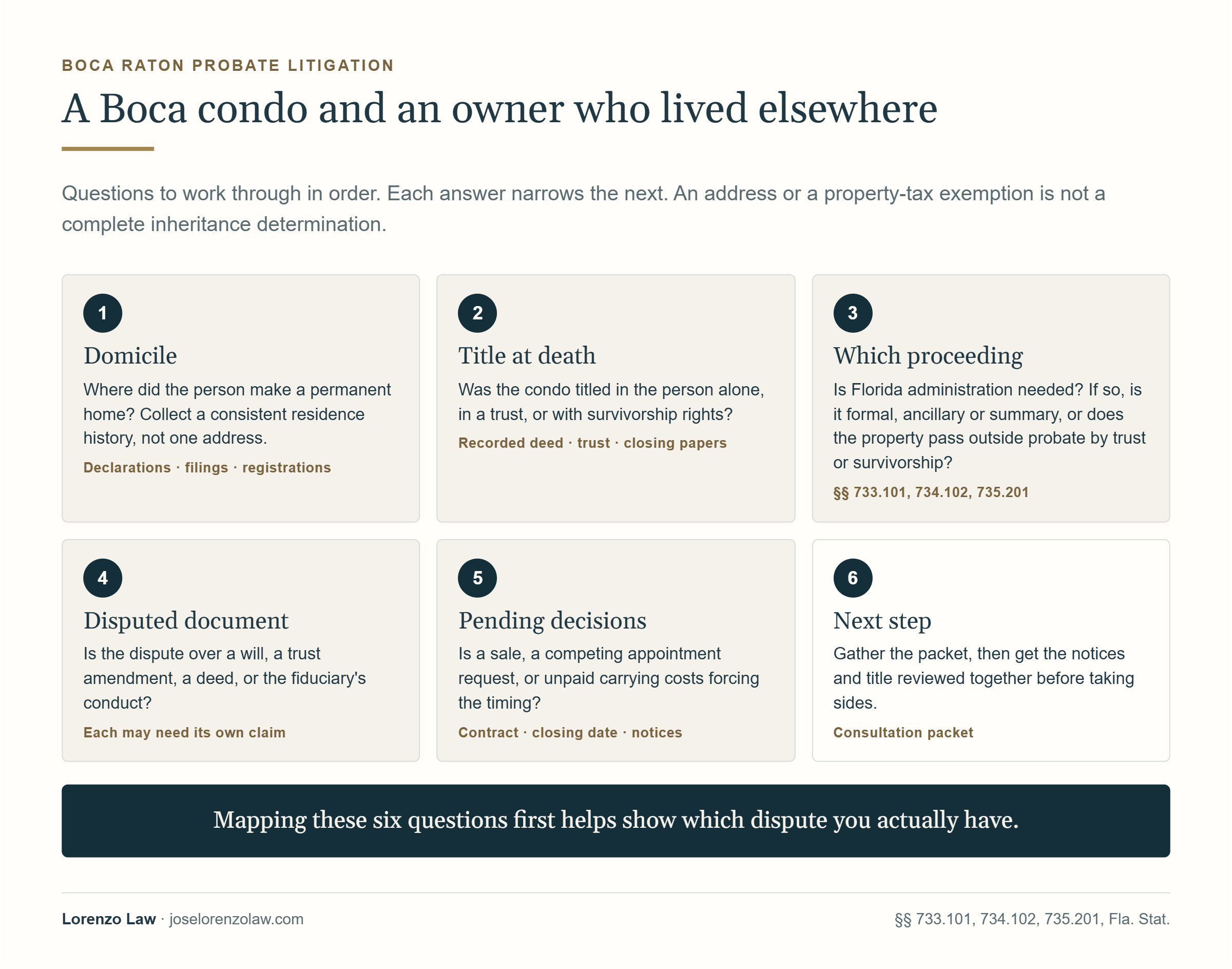
See the chart “A Boca condo and an owner who lived elsewhere” (opens the full-size image; the details are also in the text).
For a nonresident’s condo, begin with the deed and ownership at death. Property held in a trust or with effective survivorship rights presents a different starting point from property titled solely to the decedent. If Florida administration is required, § 734.102 provides an ancillary-administration framework. An out-of-state executor does not automatically obtain Florida letters. The statute addresses a specifically designated Florida representative, the qualified foreign representative, a qualified alternate or successor, and other appointment routes. See also ancillary probate in Florida and Lady Bird deeds for out-of-state owners.
Hypothetical example: A parent lived primarily in New York, owned a Boca condo, and signed both a late trust amendment and a deed. One child says the condo belongs to the estate; another says the deed transferred it before death. The deed history and trust funding must be examined before treating this solely as a will contest. A pending sale, competing appointment request, or disagreement over carrying expenses may require additional decisions. This example illustrates the review process, not a firm case or predicted result.
Gather the condominium association records, insurance, carrying-cost statements and any pending closing documents early, because a deadline in a sale or an unpaid obligation can force decisions before the legal question is resolved. If the dispute also involves homestead or spousal rights, those questions require their own analysis. Domicile, title, family circumstances, and the relevant instrument must be considered together; an address or property-tax exemption alone is not a complete inheritance determination.
Palm Beach venue and court assignment
When Palm Beach County is the proper venue, the Palm Beach County probate court is the probate division of the Fifteenth Judicial Circuit. Venue and courthouse assignment are different questions: the first decides which county, the second decides which division and judge hear the matter.
Trust venue has its own alternatives under § 736.0204. The fact that parties or property are in Boca does not mean every related claim belongs in one probate file.
The circuit’s Administrative Order 6.101 provides for assignment of the covered new probate, guardianship, and trust proceedings between Division IA and Division IZ, with related-case provisions. Do not select a hearing location from the nearest courthouse, including a South County branch, or from a city list. Confirm the assigned division, docket, current instructions, and hearing notice. The Division IZ instructions illustrate why hearing format and submission procedures must be checked for the particular matter. A remote consultation does not guarantee that every hearing or witness appearance can be remote.
Depositing an original will is a separate task. § 732.901 generally requires the custodian to deposit it with the clerk having venue within ten days after learning of the death. That is not the deadline to contest the will. Use the Palm Beach Clerk’s probate instructions to confirm original-document delivery and accompanying information. Keep proof of delivery; do not assume an uploaded scan satisfies the original-will requirement.
For uncontested administration in the county, see the Palm Beach County probate lawyer page. See also the firm’s West Palm Beach probate litigation page.
How a contested matter proceeds
The initial review identifies the client, opposing interests, documents, pending proceedings, and time-sensitive issues. If representation is accepted, the next steps depend on the claim: obtaining records, evaluating the evidence, preparing or responding to pleadings, and addressing any properly supported need for interim relief.
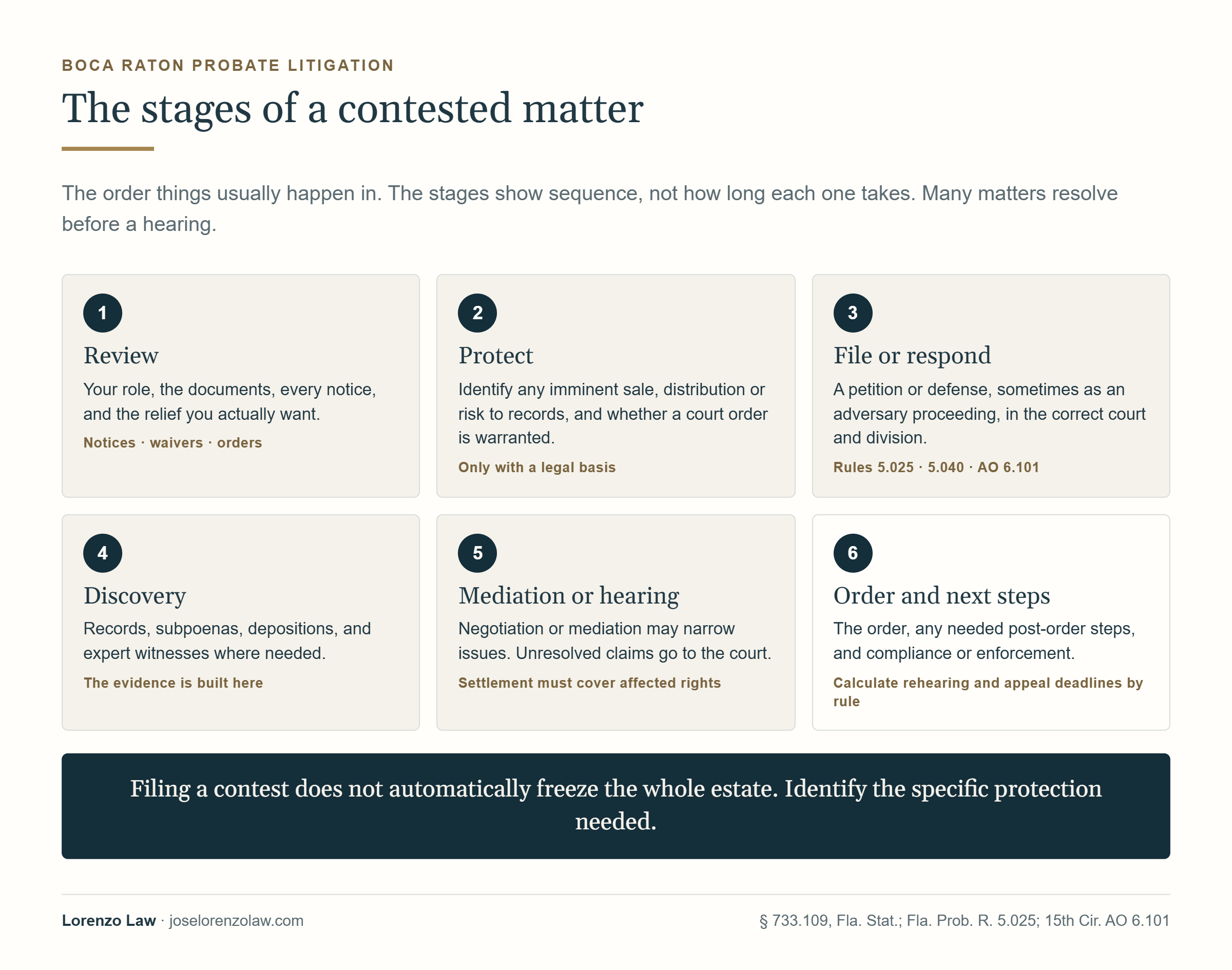
See the chart “The stages of a contested matter” (opens the full-size image; the details are also in the text).
Some probate matters proceed as adversary proceedings under Florida Probate Rule 5.025. Discovery, motions, and evidentiary hearings may follow. Related proceedings can share evidence without becoming the same lawsuit. Negotiation or mediation may narrow or resolve issues, but an agreement must address the affected rights and any required court action.
An unresolved claim may require a court decision. Filing a contest does not automatically freeze the entire estate: § 733.109 allows continued administration while restricting certain distributions during a revocation proceeding. The precise protection needed should be identified rather than assumed.
Protecting the estate while a dispute is pending: bond, curator and administrator ad litem
A contest does not freeze the estate by itself. If more protection is needed, counsel can evaluate whether the facts support a specific order, a bond, a curator to preserve estate property, or, where the personal representative has a conflict, an administrator ad litem to represent the estate on that issue. Each needs a legal basis and a court order, and a personal representative who is also the main beneficiary is not removed for that overlap alone.
How to contest a will in Florida?
Contesting a will is a court proceeding, not a form, and the steps depend on whether the will has been admitted and what notice you were served. In outline:
- Identify the will, the person who made it, and whether it has been admitted to probate.
- Confirm that you are an interested person in the proceeding.
- Find every notice you received and the date it was served; a served notice of administration generally starts the 3-month period to object (§ 733.212).
- Match a recognized ground, such as lack of capacity, undue influence, fraud, duress or improper execution, to evidence tied to the signing.
- File the correct paper in the probate court with venue: an objection before the will is admitted, a petition for revocation of probate after admission (Fla. Prob. R. 5.270), or written defenses within 20 days if formal notice was served on you. Will contests and revocation proceedings are adversary proceedings (Fla. Prob. R. 5.025).
- Expect discovery, mediation or settlement discussions, and a hearing before the probate judge if the case does not resolve.
Steps three and five are the hardest to fix after the fact, so have the notices reviewed first. A person who never received required notice usually is not bound by the deadline that notice would have started.
A Boca Raton will contest is usually filed in the Palm Beach County probate court when the decedent’s domicile or the property in the estate supports venue there, and the same steps apply: notices first, then standing, ground and evidence. If you are asking how to contest a will in Boca Raton, confirm venue and the assigned division before filing; the Palm Beach venue section above explains why the community name alone does not decide it.
Filing a caveat before probate opens
If you expect a dispute and no probate case has been filed, an interested person who is not a creditor can file a caveat with the clerk so that the court does not admit a will or appoint a personal representative without notice to them (§ 731.110). A caveat is not a will contest, does not freeze property and does not extend any response deadline; if formal notice follows, you must still act. See caveats in Florida probate.
Mediation and settlement
Many probate judges send contested cases to mediation, and many will contests settle there. A settlement can divide an estate differently from the document, if everyone affected agrees in writing and the court approves the settlement where approval is required, for example where a minor’s or an incapacitated person’s interest is involved.
Who decides, and how long it takes
A Florida will contest is decided by the probate judge, not a jury. A related civil claim is a separate lawsuit and is not the will contest. How long a matter takes depends on the issues, the experts, the court’s calendar, settlement and any appeal; a narrow case can end within months and a discovery-heavy one much later.
Appealing a will or trust ruling
An order that finally decides a will’s validity, such as an order revoking probate or denying revocation, can generally be appealed to the district court of appeal (Fla. R. App. P. 9.170). The notice of appeal is generally due within 30 days after the order is rendered, and that deadline is strict. An authorized and timely motion for rehearing, which in a probate case must be served within 15 days after the order is filed, postpones rendition and so the start of the 30 days. An appeal is not a new trial, so the evidence must be in the record first. Other probate and trust orders may be appealable on different terms, so have the order reviewed the day it is entered.
Is it worth contesting: settle, defend or litigate
A contested estate involves practical costs as well as legal questions. Compare your position now with each realistic outcome, then weigh the recoverable assets, the expense, the time, the fee-allocation risk and the evidence still needed. The gross value of the estate is not your recovery.
| Factor | Question to ask | Why it matters |
|---|---|---|
| The evidence | Is there proof tied to the signing or the transaction, or mostly suspicion? | Strong evidence supports a hearing; thin evidence supports a negotiated outcome |
| What you would receive | What would I receive if the document failed, under an earlier document or intestacy? | Winning can leave you with less than you hold now |
| Cost, time and collectibility | What will each stage cost, how long might it take, and could any recovery be collected? | A larger claim is not a larger net result |
| Relationships and fiduciary exposure | Do I need an ongoing relationship with the other side, and is a fiduciary exposed to personal liability? | Both sides’ exposure shapes what settlement terms are realistic |
| Procedural posture and deadlines | What notice or order is pending, and what is already barred? | A procedural bar can decide the case regardless of merit |
| Fee and no-contest clause risk | Could fees be charged against a share, and does the document contain a no-contest clause? | Florida does not enforce specified penalty provisions, but fee exposure remains a cost |
Fees and timing for contested matters
There is no single price for a contested estate or trust matter. The work depends on the documents, parties, disputed transactions, access to evidence, expert needs, and procedural stage. Only the initial consultation is free; representation fees and costs are agreed separately in writing.
A signing dispute and an accounting covering years of transactions can require very different resources. A domicile dispute or proceedings in another jurisdiction can add work. Court availability, discovery disputes, and settlement decisions affect timing; there is no reliable completion promise for every contested estate.
| Cost component | What to clarify |
|---|---|
| Attorney’s fees | The fee arrangement, the stages covered, and what happens if the scope changes |
| Court and service charges | Which filing is needed, what has already been paid, and the court’s current charges |
| Records and testimony | Record retrieval, subpoenas, depositions, transcripts and out-of-state witnesses |
| Experts | Whether a medical, accounting or document expert is needed, the scope, and when it will be authorized |
| Mediation, hearing and appeal | Which stages are included and which need a separate estimate or agreement |
| Fee awards | Whether a statute permits payment from an estate or trust, a charge against a share, or another award |
Contingency or hybrid arrangements may be considered for appropriate matters, subject to case review and a written agreement. Costs may remain payable without a recovery, and a hybrid arrangement includes a noncontingent fee component. No particular arrangement is guaranteed. Uncontested probate prices and deed-preparation prices are not litigation quotes.
Discuss the practical objective as well as the disputed amount: obtaining records, defending an appointment, protecting a transaction, changing a fiduciary, or recovering property. The likely expense and collectibility matter to that decision. Do not assume the estate, trust, or opposing party will pay your lawyer.
Request a free initial consultation. Only the initial consultation is free; representation fees and costs are agreed separately in writing.
Request a free initial consultationCall (305) 224-6811
Contesting a will without an attorney
Contesting a will without an attorney is allowed in many probate matters, because a person may represent himself or herself on his or her own claim. A contest involves formal pleadings, service, strict deadlines, discovery and evidence rules, and a generic objection form does not preserve every claim. A personal representative generally must be represented by a Florida lawyer, unless the personal representative is a lawyer or the sole interested person. Even if you intend to proceed alone, a one-time review of the notices and the deadline is worth the cost.
Boca Raton and Palm Beach County areas served
Lorenzo Law handles Florida probate and trust disputes statewide. The questions on this page apply to matters connected with Boca Raton, Delray Beach, Boynton Beach, Highland Beach, Wellington, West Palm Beach, Palm Beach Gardens, Jupiter and other Palm Beach County communities, and to owners and heirs who live elsewhere. Neighboring Broward County communities such as Deerfield Beach, Parkland and Coconut Creek raise a different venue question. Where a probate case is filed depends on domicile and property, not on the name of the community; trust proceedings have their own venue options. That includes a Boca Raton will contest, which turns on the same notices, standing, ground and evidence as a will contest anywhere in Florida.
For a Florida probate litigation attorney, a Florida probate litigation lawyer or a Florida estate litigation attorney, the questions to address are the same statewide: the document, the notice and the role you hold decide the analysis, and probate venue follows domicile and property, while trust proceedings have their own venue options under § 736.0204.
Consultations are available by phone or video throughout Florida. The principal office is in Kissimmee, and Jose M. Lorenzo, Jr. also meets clients by appointment in Coral Gables and Fort Lauderdale. See the firm profile for biography details.
Choosing a probate or trust litigation attorney
For a contested will, trust or fiduciary matter, look for a probate litigation attorney who handles contested matters in the county where the case is filed. Related descriptions include estate litigation attorney, trust litigation attorney and inheritance dispute lawyer. Ask about contested matters as well as estate planning.
What does a probate litigation attorney do? The lawyer reviews the notices and documents, identifies who has standing and which deadline appears to govern, files or responds to pleadings, requests records and subpoenas, takes depositions, works with experts where needed, negotiates or mediates, and tries the matter if it does not settle. A probate dispute lawyer or contested probate attorney should be able to explain, after reviewing the notices and the documents, which deadline appears to control and what evidence the matter will need.
If you are seeking a Boca Raton probate litigation lawyer, ask whether the lawyer handles contested wills, trusts and fiduciary claims in court. You may see that work described as the work of a probate litigation lawyer, an estate litigation lawyer or a trust litigation lawyer. A probate dispute attorney or an estate dispute lawyer should be able to explain the notices, the deadline and the evidence for your matter. Lorenzo Law handles that work for Boca Raton and Palm Beach County matters.
For a Boca Raton will contest attorney or a Boca Raton will contest lawyer, ask about experience with a disputed will. Other descriptions include a will contest attorney, a contested will attorney or a contest will lawyer. A trust dispute attorney handles challenges to or defenses of a trust; a fiduciary litigation lawyer addresses questions about how a personal representative or trustee has acted.
If you searched for probate litigators near me or probate litigation attorneys near me, note that the work is done in the court where the case is filed, not at a particular street address. Lorenzo Law’s principal office is in Kissimmee, with appointments in Coral Gables and Fort Lauderdale, and consultations are available by phone or video for Boca Raton and Palm Beach County matters.
Questions worth asking any lawyer you consult: how many contested matters of this kind has the lawyer handled, who will do the work, how fees and costs are structured, and whether the lawyer can appear in the county where the case is filed.
Jose M. Lorenzo, Jr. is the firm’s only attorney and handles contested matters himself, with consultations in English and Spanish. The firm accepts representation only after a conflict check and a written engagement. Whether you are challenging a document or defending one, see also the estate litigation attorney page and the inheritance dispute lawyer page.
Prepare for a consultation
Gather what you have now and identify what is missing:
- Your role and the names of the decedent, fiduciaries, beneficiaries, and other involved parties for a conflict check.
- The case number, filed petition, appointment orders, notices, waivers, and hearing dates, including delivery or service records.
- All available versions of the will, trust, amendments, deed, and any power of attorney involved in the disputed act.
- Accountings and transaction records, with the particular entries or missing assets you question marked separately.
- A dated timeline and names of witnesses with firsthand knowledge. Separate what you observed from what someone told you.
- For a Boca property or domicile dispute, the deed, ownership history, residence evidence, other proceedings, and any pending sale or expense deadline.
- Your objective and any immediate risk requiring attention.
Preserve originals and unaltered electronic messages. Do not use another person’s passwords or obtain records without authorization. In the initial contact form, provide a brief description and flag any notice or hearing date. If some documents are missing, list what you have and what you have requested. Ask how to provide documents securely before sending sensitive medical or financial records. A consultation request does not establish representation or suspend a deadline.
Common questions
What is the difference between probate and probate litigation?
Probate is the court-supervised process of administering an estate: proving the will, appointing a personal representative, giving notices, handling creditor claims and distributing property. Probate litigation is a dispute inside or alongside that process, such as a will contest, a challenge to a fiduciary, or a fight over who owns property. Many estates are administered with no dispute at all. A contested matter has its own parties, deadlines and evidence, and it can be filed in the probate case or arise from a trust or a deed.
Do I need probate litigation counsel, trust litigation counsel, or both?
Possibly both. A will and a trust may raise related questions, but they remain different instruments with their own claims, standing and timing. A coordinated review can identify shared evidence, separate claims, and the parties who must participate. It does not mean every dispute belongs in one case, or that one attorney can represent conflicting family interests.
How long do I have to contest a will in Florida?
Generally 3 months after you are served with a notice of administration, but earlier bars can apply, for example after formal notice before letters issue or a filed waiver, and an outer limit applies. The clock runs from service, not from the date of death. Trusts and accounting disputes use different rules. Have the actual notices reviewed promptly.
What is the 10-day rule for probate in Florida?
The ten-day period people usually mean is the duty of a will’s custodian to deposit the original will with the clerk after learning of the death. See § 732.901. It is a deposit duty. It is not the deadline to open probate and it is not the deadline to contest the will. The contest clock is separate and generally runs from service of the notice of administration, as explained above. Confirm the clerk’s current instructions for delivering an original will rather than assuming a scan is enough.
How do you contest a will in Florida?
You file in the probate court with venue, as an interested person, before the applicable deadline, and you prove a recognized ground such as lack of capacity, undue influence, fraud, duress or improper execution. The right paper depends on whether the will has been admitted and what notice you were served. See the steps in the process section, and have the notices and documents reviewed first.
Who can contest a will or trust in Florida?
An interested person: someone who may reasonably be expected to be affected by the outcome of the particular proceeding. That is often an heir who would take more if a document failed, or a beneficiary under an earlier document. A family label or receiving a notice does not by itself settle standing, and each instrument needs its own analysis.
Can I contest a will after probate has started or closed?
Sometimes. After a will is admitted, an interested person may petition to revoke probate before the personal representative’s final discharge, but only if the challenge is not already barred by earlier notice deadlines. An open estate does not mean you are still on time. Once the estate is closed and the representative discharged, the ordinary will contest route is generally over.
How do you prove undue influence or lack of capacity?
With evidence tied to the signing date or the transaction, not with suspicion or an unequal result. Capacity turns on the person’s understanding when the document was signed. Undue influence turns on whether someone overcame the person’s free choice, and in a will contest an applicable presumption can shift the burden. A diagnosis or a large gift is not enough by itself.
Does a no contest clause prevent a challenge?
Florida statutes make specified penalty provisions in wills and trusts unenforceable. See § 732.517 and, for trusts created on or after October 1, 1993, § 736.1108. That does not eliminate standing, deadline, proof, or fee issues. If another jurisdiction’s law may govern, the clause needs additional analysis.
Can a trust be sued in Florida?
A trust is generally not treated as a person that is sued by name. Claims are usually directed to the trustee in that role, and sometimes to beneficiaries or other people who received trust property, depending on the claim. Florida’s Trust Code addresses trust contests in § 736.0207 and remedies for breach of trust in § 736.1001. The right defendant, the court and the deadline depend on whether you are challenging validity, a trustee’s conduct, or an accounting.
What does a trust litigation lawyer do, and how expensive is trust litigation?
A trust litigation lawyer reviews the trust and every amendment, the trustee’s records and the notices received, then identifies the claim: validity, breach of trust, accounting, removal or interpretation. The lawyer checks standing and deadlines, gathers evidence lawfully, and files or defends in the proper court. Expense depends on the same factors as any contested matter: the documents, the parties, discovery, expert work and whether the matter settles. There is no fixed price. See fees and timing for contested matters. Only the initial consultation is free; representation fees and costs are agreed separately in writing.
Can a trustee or personal representative be removed?
Sometimes, but not automatically. A court can remove a personal representative on the grounds in § 733.504, and can remove a trustee on the statutory grounds and findings in § 736.0706. A conflict or a smaller distribution is not enough by itself. Records usually decide whether removal or another remedy is realistic.
Can a trustee sell a Boca Raton condo without every beneficiary’s approval?
A trustee may have authority to sell without every beneficiary’s approval. The trust’s terms, the buyer’s relationship to the trustee, valuation, notices and any conflict of interest matter, and a related-party sale needs review under § 736.0802. Contacting a lawyer does not stop a sale; protective relief needs a legal basis and a court order.
What if a trustee or executor will not provide an accounting?
Qualified beneficiaries generally have information and accounting rights under § 736.0813, with qualifications for revocable trusts, waivers and other circumstances. For an estate, the question is the personal representative’s duty to account. Missing records are a reason to investigate, not proof of theft.
How much does it cost to contest a will or litigate a trust, and who pays?
There is no single price. Cost depends on the documents, the parties, the discovery and expert work needed, and whether the matter settles. Only the initial consultation is free; representation fees and costs are agreed separately in writing. Whether an estate, a trust or another party can be made to pay fees depends on the statute and the facts, not on assumption. In trust litigation over a breach of fiduciary duty or a trustee’s powers, § 736.1004 governs costs and attorney’s fees, and the court may direct payment from a party’s interest in the trust.
How long does a will or trust contest take?
Timing varies with the issues and evidence. A narrow signing dispute and an accounting covering years of transactions can need very different resources. Court availability, discovery disputes, expert needs, settlement decisions and any proceedings in another state or country all affect timing.
How hard is it to contest a will in Florida?
It is difficult without timely action and evidence. An unequal share is not a ground, the clock can start from a served notice rather than the date of death, and once the will’s proponent shows formal execution the contestant generally has the burden of establishing the grounds under § 733.107. Strong evidence tied to the signing date makes the difference. See also whether a contest is worth the cost and risk.
How hard is it to win a contested will in Florida?
One case does not predict another. The outcome depends on whether the challenge is timely, whether you have standing, whether the facts fit a recognized ground, and whether the evidence ties to the signing date. A challenge based only on an unequal share usually fails. Some disputes resolve by agreement instead of a ruling, which is not the same as losing. A document review against the notice dates is the practical way to judge your position.
What happens if I contest a will and lose?
The will is carried out as written. Contesting does not by itself forfeit what the will leaves you, because Florida does not enforce no-contest clauses. See § 732.517 (for a trust, § 736.1108). A gift can still fail for another reason, and the cost is the risk: you generally pay your own lawyer, and the court may order part of the estate’s legal fees charged against your share, which reduces what you net. See § 733.106(4). A claim that is not supported by the facts or the law can also lead to sanctions: under Florida’s frivolous-claim statute, § 57.105, the court can order the person who filed it, and their lawyer, to pay the other side’s attorney’s fees. These risks are why the deadline, standing and evidence review comes before anything is filed.
Does dementia or Alzheimer’s automatically invalidate a will?
No. Capacity is measured at the moment of signing. A diagnosis and medical records can be strong evidence, but they must be connected to the signing date and weighed with the other evidence, including the possibility of a lucid interval. A trust, amendment or deed is a different instrument and needs its own capacity review.
Can you contest a will because a caregiver or new spouse inherited?
A will can lawfully leave property to a caregiver or a new spouse, so the relationship alone is not enough. A contest needs a recognized ground, such as undue influence, supported by evidence; in these cases the evidence often concerns whether the person took part in arranging the document, controlled access or care, or whether the change broke from a long-standing plan. A spouse also has rights that do not depend on any contest.
Can you contest a will without an attorney in Florida?
Often yes, because a person may represent himself or herself on his or her own claim in many probate matters. But a contest involves formal pleadings, strict deadlines and evidence rules, and a personal representative generally must be represented by a Florida lawyer unless the personal representative is a lawyer or the sole interested person. Get the notices and deadline reviewed promptly.
Can a trustee sell property to himself or to a beneficiary?
A sale to the trustee personally is generally a conflict of interest under the duty of loyalty in § 736.0802. An affected beneficiary can usually challenge it unless an exception applies, such as authorization in the trust, court approval, or the beneficiary’s consent. A sale to a beneficiary is not automatically improper, but price, process and disclosure matter.
How long does a trustee have to sell a house?
The statute sets no single deadline. The trust terms control, and the trustee must act prudently and impartially, neither rushing a sale nor delaying without reason. Carrying costs, the market, the trust’s directions and what beneficiaries were told all matter. If a trustee is stalling, ask in writing for information and have the trust reviewed.
Does the trustee own the house, and does the beneficiary own the trust property?
The trustee holds legal title as a fiduciary for the beneficiaries and does not own the property in the ordinary sense. A beneficiary holds a beneficial interest defined by the trust, not title, so a beneficiary generally cannot sell or force a sale unless the trust allows it. The recorded deed and the trust show who holds title and what each person may demand.
Can you remove a trustee from an irrevocable trust, and who can remove a trustee?
Yes, on proper grounds. The settlor, a cotrustee or a beneficiary may ask the court under § 736.0706, and the trust may give a named person a removal power. When to remove a trustee depends on the statutory grounds and findings, such as a serious breach, persistent failure to administer effectively, unfitness, or lack of cooperation among cotrustees. A conflict or disagreement alone is not enough.
What is breach of fiduciary duty of an executor, and how long do I have to sue?
It is a failure to meet the duties a personal representative owes the estate and its beneficiaries, such as self-dealing, taking or commingling funds, selling without authority, ignoring the will, or failing to inventory or account. The elements are generally a duty, a breach and resulting damages. There is no single time limit. For a trustee, § 736.1008 can bar a claim about a matter adequately disclosed in a trust disclosure document unless it is brought within six months after the beneficiary receives that document or a limitation notice that applies to it, whichever is received later, and other claims use general limitation periods.
Can executor or trustee fees be challenged, and is delay in distribution misconduct?
Fees can be challenged. A personal representative is entitled to reasonable compensation under § 733.617 and a trustee to reasonable compensation under § 736.0708, and an interested person may object. Delay alone is not misconduct, because debts, taxes, claims and a pending contest take time. Unexplained delay with no inventory or accounting is a reason to demand information.
What lawyer do I need to contest a will, and how do I find a good estate litigation lawyer?
Look for a Florida lawyer who regularly handles contested probate and trust matters, not only estate planning or uncontested probate. Confirm Florida Bar membership and discipline history, ask how many contested matters the lawyer personally handles, ask who will do the work, and get the fee terms in writing. Lorenzo Law is a solo practice, so the attorney you speak with at the first call is the attorney who handles the matter. Bring the documents, notices and dates to the first call so the deadline review can start right away.
Can I seek help if I live outside Florida?
Yes. Lorenzo Law handles Florida matters for clients who may live elsewhere, with consultations in English and Spanish. The location of the client does not determine probate venue, and hearing attendance depends on the assigned court’s requirements.
Does Lorenzo Law have a Boca Raton office?
No. Lorenzo Law serves Boca Raton matters. Its principal office is in Kissimmee, Florida, and Jose M. Lorenzo, Jr. also meets clients by appointment in Coral Gables and Fort Lauderdale. Consultations are available by phone or video.
What happens if a will or trust is found invalid?
Invalidating a document does not simply hand the property to the person who challenged it. Depending on what remains valid, an unaffected provision may stand, an earlier document may control, or Florida’s intestacy rules may apply. Trust assets, deeds and beneficiary designations usually pass by their own terms and may need their own challenge.
Can a deed or a power of attorney transaction be challenged separately from the will?
Often yes. A lifetime transfer, a deed or an account change is a different instrument from a will, with its own parties, remedy and timing. Contesting a will does not by itself undo a lifetime conveyance. Bring the recorded deed, any power of attorney used, and the transfer dates for review.
Discuss your Boca Raton inheritance dispute
Jose M. Lorenzo, Jr. is Lorenzo Law’s sole attorney, admitted to The Florida Bar in 2013, Bar number 107002. The firm’s practice includes estate planning, probate, and litigation. Your inquiry can begin with the document or conduct you are concerned about and the notice or deadline you have received.
Request a free initial consultation. Only the initial consultation is free; representation fees and costs are agreed separately in writing. Consultations are available in English and Spanish.
Request a free initial consultationCall (305) 224-6811
¿Prefiere español? Lea cómo impugnar un testamento en Florida.
This page provides general information about Florida law. Reading it or contacting the firm does not create an attorney-client relationship. Advice and representation depend on the particular facts and an accepted engagement.
Sources and authorities cited
Statutes cited are Florida Statutes. The text of the law controls over any summary on this page.