
Do You Inherit Debt in Florida?
Do you inherit debt in Florida? Usually not. Being a deceased person’s spouse, child, heir or beneficiary does not, by itself, make you personally responsible for that person’s debts in Florida. Valid debts may still be payable from the estate, and a mortgage or other enforceable lien may remain against inherited property. Your own loan agreement, guarantee, handling of estate assets or receipt of a distribution can also change the answer. A collection letter alone does not establish that you owe the balance.
People ask “can you inherit debt?”, “is debt inherited by a spouse or children?” and “can debt be inherited at all?” Family members, next of kin and heirs can answer that for their own situation with three questions: Who agreed to pay? What property secures the debt? What estate or collection procedure applies? Those questions distinguish an obligation you already have from a debt payable by the estate or a lien that affects something you inherit. This guide answers them for each relationship, from a surviving spouse or adult child to a co-signer, a power-of-attorney agent, a beneficiary and an executor, and for each common type of debt.
Lorenzo Law assists with Florida probate and estate disputes. Consultations are available in English and Spanish. Only the initial consultation is free; fees and costs for representation are agreed separately in writing.
Request a free initial consultationCall (305) 224-6811
Spouses · Children · Co-signers · Power of attorney · Beneficiaries and heirs · Executors · English and Spanish · Statewide
| Relationship alone | Being a spouse, child, sibling, heir or beneficiary does not by itself make you personally liable for a deceased person’s debts. |
|---|---|
| The estate | Valid debts are generally paid from assets legally available to the estate, in the order Florida law sets. If those assets run out, family members do not automatically have to supply the shortfall. |
| Liens and security | A mortgage, car loan or other valid lien can stay with property you inherit even if you never signed the loan. |
| What can change the answer | Your own signature as co-borrower, joint account holder or guarantor; a new agreement after the death; receipt of estate property through summary administration or an improper distribution; or a breach of duty as personal representative. |
| Collection letters | A collector’s letter or call does not establish that you owe the debt. Review the documents before paying or signing anything. |
When Can a Family Member Owe a Deceased Person’s Debt in Florida?
Only when something other than the family relationship creates exposure. In Florida, that usually means one of the eight situations below. Each is explained further down the page.
- You co-signed or are a joint borrower. Your own obligation on a co-signed loan or joint credit account can continue after the other borrower dies. Co-signers
- You signed a personal guarantee. A clear personal guarantee, for example on a loan or care agreement, can bind you. Signing as a “responsible party” or as an agent is not necessarily a guarantee. Nursing homes
- Property you inherit is subject to a lien. You may not owe the loan personally, but the lender can still enforce its lien against the property. If the inherited property is a condominium unit or an HOA parcel, taking ownership can do more than leave a lien in place: under sections 718.116(1)(a) and 720.3085(2), the new owner becomes personally and jointly liable with the former owner for unpaid assessments, including those that came due before the transfer, in addition to the association’s lien on the property itself. House or car with a loan
- You received property through summary administration. Recipients can be personally liable for a share of lawful estate claims, limited to the value of the non-exempt estate property they received. Beneficiaries
- You received an improper distribution. Property or money distributed improperly may have to be returned. Beneficiaries
- You breached a duty as personal representative. Appointment does not make the executor the debtor, but a breach of fiduciary duty that causes loss can create personal liability. Executors
- You signed something new after the death. A settlement, refinancing agreement or payment promise you sign personally can become your own obligation. Before you pay
- Spouse-specific situations. Joint debts both spouses owe, and the law of another state where the couple lived, need separate review. Spouses
If none of these applies, a debt owed only by the deceased person is generally a matter for the estate and the applicable creditor procedures, not for the family’s own money. That is also the practical answer to how to avoid inheriting debt: after a death, do not co-sign, guarantee or sign a new payment agreement in your own name, do not take estate property before creditor issues are resolved, and keep estate and personal funds separate.
Who Owes the Debt: You or the Estate?
A debt owed only by the deceased person is generally addressed through the estate and applicable creditor procedures. If you were already a co-borrower, jointly liable credit-card account holder or enforceable guarantor, the death does not automatically release your separate obligation.
An authorized user on a credit card is different from a joint borrower: authorized-user status alone generally does not make the deceased account holder’s balance your debt. See the CFPB guidance on a deceased spouse’s debts.
The same distinction answers whether a relative’s death can affect your credit. A survivor’s credit report and credit score generally reflect accounts the survivor shares or signed for, such as a joint card or a co-signed loan. Card issuers also usually report authorized-user status, which can show the account on your report without making you liable for the balance. A debt in the deceased person’s name alone is not your debt and should not be reported as yours; if it is, dispute it with the credit bureau.
Being named on a bank account, deed or emergency-contact form does not answer who promised to repay a loan. Review the credit agreement and the capacity in which each person signed. A signature as an agent or estate representative is not necessarily a personal guarantee, and even language described as a guarantee may be restricted by applicable law.
| Situation | Who may owe personally | Property and estate consequences | Documents to check |
|---|---|---|---|
| Parent’s credit card held only in the parent’s name | A child does not owe merely because of the relationship | A valid unsecured claim may be payable from available estate assets | Account agreement, statements, collection notice and probate filings |
| Credit card on which you were only an authorized user | That status alone generally does not create liability for the deceased holder’s balance | Confirm actual account status; do not treat access to the card as authority to keep using it after death | Application, issuer’s account records and transaction history |
| Joint credit account, co-signed loan or guarantee | Your own enforceable obligation may continue, subject to applicable defenses and release rules | The creditor may have rights against you independent of its estate claim | Complete signed contract, amendments and any release |
| Home inherited with a mortgage | Inheriting title alone is different from signing the note or assuming liability | The property may remain subject to foreclosure; qualifying successors have servicing protections | Deed, note, mortgage, payment history and servicer notices |
| Parent’s home with a reverse mortgage | Heirs who did not borrow are generally not personally liable on a federally insured reverse mortgage | The loan may become due, subject to surviving-borrower and eligible non-borrowing-spouse protections; heirs have options and deadlines | Loan documents, servicer due-and-payable letter, appraisal and payoff |
| Vehicle inherited with a loan | A co-borrower’s obligation may continue; inheritance alone does not establish it | The lien can affect transfer, sale or retention; loan assumption is not automatic | Title, lien information, loan contract and payoff statement |
| Parent’s medical or nursing-home bill | Relationship alone is insufficient; signing capacity and enforceability matter | A valid estate claim and a demand against a signer require separate analysis | Admission agreement, signature pages, bills and insurance decisions |
| Student loan with a surviving co-signer | Federal discharge rules and private-loan release protections may change liability | Identify the program, agreement date and any consolidation before paying | Promissory note, loan type, origination date and death-discharge instructions |
| Life insurance or a payable-on-death account paid to you | Receiving a beneficiary payment does not by itself make you liable for the deceased person’s debts | Protection depends on the asset; insurance payable to the estate is treated differently | Policy, beneficiary confirmation, account terms and claim paperwork |
| Estate property already distributed to you | Statutory recipient liability or a duty to return an improper distribution may apply | Exemptions, value received, orders and claim status matter | Distribution order, receipts, accounting, notices and creditor filings |
These are starting points, not determinations about a particular account. The sections below explain the important qualifications.
What happens if a co-signer or borrower dies?
If you co-signed or are a joint borrower, your own promise to pay generally survives the other borrower’s death unless the contract or a statute releases it. What that means depends on the loan:
- Mortgage. A surviving co-borrower on the note generally remains obligated, and the lien stays on the home. A co-owner who did not sign the note is in a different position; see inherited homes with a mortgage.
- Car loan. A co-signer generally remains responsible for the balance. Surrendering the vehicle does not necessarily eliminate liability for a remaining deficiency.
- Private student loan. Federal law requires release of a qualifying co-signer when the student borrower dies, for covered agreements entered into on or after November 20, 2018. Older or excluded agreements need individual review; see student loans.
- Joint credit card. A joint account holder who signed as a co-obligor generally remains liable for the balance. An authorized user generally does not.
- Business loan or line of credit. A spouse, partner or relative who personally guaranteed a business debt, including a loan to an LLC or corporation, can remain liable on that guarantee. Without a personal guarantee, the business’s debts belong to the business or, for a sole proprietor, to the estate, not to the family.
If the person who died was the co-signer rather than the main borrower, the borrower’s obligation continues, and the lender may also file a claim against the co-signer’s estate. Check the contract for any provision triggered by a co-signer’s death before assuming the loan is in default.
Is an authorized user responsible for credit card debt after death?
Generally no. An authorized user was allowed to charge on someone else’s account but did not sign the cardholder agreement as an obligor, so authorized-user status alone generally does not make the deceased cardholder’s balance the user’s debt. A joint account holder is different. An authorized user using a credit card after death has no continuing authority; see the next section. Both names can appear on the card either way, so check the original application and the issuer’s account records rather than the card itself.
Can I keep using a deceased person’s credit card?
Not if the account was the deceased person’s alone. If the deceased person was the sole account holder and you were only an authorized user, do not keep using the card. A surviving joint account holder is different: notify the issuer and confirm the surviving holder’s rights and the account’s status. Charging on a deceased person’s card after the death is not a way of handling the estate, even for funeral costs, groceries or the deceased person’s own utility bill, and charges made without authority can create civil and criminal exposure under Florida’s credit-card and identity-fraud laws. For an account held solely by the deceased person:
- stop all use, including autopay and recurring subscriptions charged to the card;
- notify the issuer, ask what proof of death it needs, and coordinate closing the account with the estate representative;
- ask the three credit bureaus to flag the credit file as deceased, which helps prevent identity theft;
- keep the statements, because they help the personal representative identify creditors; and
- before paying from your own money, determine whether you owe independently or are proposing a voluntary advance, and discuss documentation and possible reimbursement.
If a recurring charge posted after the death, tell the personal representative or the estate’s attorney rather than ignoring it.
Who Can Be Personally Liable, by Relationship
In Florida, the relationship is almost never the source of liability. What matters is what each person signed, received or did.
| Relationship or role | Liable by relationship alone? | What can change that |
|---|---|---|
| Surviving spouse or widow | No | Joint debts, co-signed loans, a personal guarantee, a joint tax return, or the law of another state where the couple lived. Spouses |
| Adult child | No | A co-signature, joint account or personal guarantee, such as a clear guarantee in a care agreement. Children |
| Sibling, parent or other next of kin | No | The same signature-based obligations, or receipt of estate property. Other relatives |
| Agent under a power of attorney | No | Signing in your own name rather than as agent, or using the principal’s funds after the authority ended. Power of attorney |
| Co-signer or joint account holder | Not relationship, but your own contract | Your own obligation generally continues, subject to defenses and release rules. Co-signers |
| Authorized user | Generally no | Continuing to use the card after the death, or being a joint holder rather than a user. Authorized users |
| Beneficiary or heir | No | Summary-administration recipient liability, an improper distribution, a lien on inherited property, or unpaid association assessments after taking title to a condominium unit or HOA parcel. Beneficiaries |
| Personal representative (executor) | No | A breach of fiduciary duty that causes loss, paying claims out of order, or federal priority rules in qualifying circumstances. Executors |
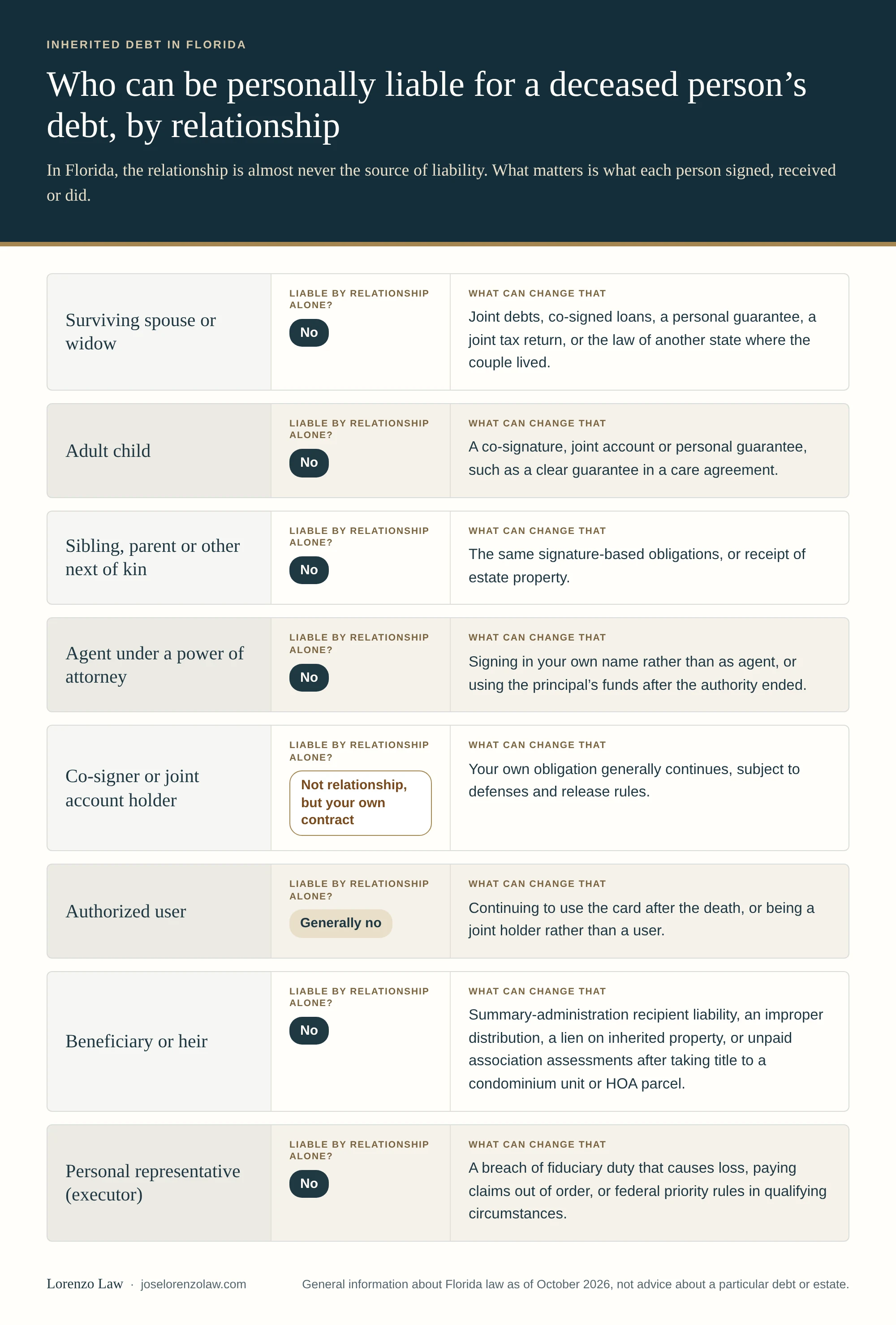
View the “Who can be personally liable, by relationship” chart (zoom in to read; the details are also in the table above).
Are Children Responsible for a Parent’s Debt in Florida?
Can you inherit debt from your parents? No, not merely because the parent died. An adult child does not become liable for a parent’s credit cards, medical bills or personal loans because of the relationship. A child can owe only through an independent obligation, such as a co-signed loan, a joint account or a personal guarantee, or by receiving estate property in a way that creates recipient liability.
So when people ask “do you inherit your parents’ debt?”, “are you responsible for your parents’ debt?”, “am I responsible for my parents’ debt when they die?”, “what happens to parents’ debt when they die?” or “if my mom passed away, will I inherit her debt?”, the starting answer is no: the debt stays with the parent’s estate. Shared obligations, agreements and other applicable law must still be examined separately. The FTC’s deceased-relative guidance also distinguishes family relationship from co-signing and estate-administration responsibilities.
A parent’s credit card debt after death
Deceased credit card debt held only in the parent’s name is the parent’s debt. A valid claim may be paid from the estate in the order Florida law sets, and the card issuer may receive partial payment or nothing if the estate runs out. A child who was an authorized user generally does not owe the balance; a child who was a joint account holder may. For how card debt is ranked against other estate debts, see who gets paid first in a Florida estate.
Who is responsible for medical bills after death?
The deceased person’s medical bills are generally claims against the estate; being the person’s child does not itself make you liable. Who is responsible for hospital bills after death follows the same rule, and the answer to “do you have to pay medical bills after someone dies?” is generally no, unless you signed for them or otherwise owe them independently. Am I responsible for my parents’ medical bills? Not because you are their child. Medical and hospital bills are claims against the estate. Reasonable and necessary medical and hospital expenses of the last 60 days of the final illness receive higher priority in the estate than ordinary unsecured debts, but that priority is about the order the estate pays; it does not make a child personally liable. A personal guarantee or other independent obligation can change the answer. Separate exposure can also arise from receiving estate property or mishandling estate assets, as explained in the beneficiaries and executor sections.
Families often ask how long to wait for medical bills after death before dealing with the estate. Providers may keep sending final bills for weeks, and some may arrive after a probate case is opened; a provider generally must present its claim within the estate’s creditor periods. Gather the bills as they arrive and give them to the personal representative for review. Before paying from your own money, determine whether you owe independently or are making a voluntary advance, and discuss documentation and possible reimbursement.
Can a nursing home make me pay my parent’s bill?
Obtain the complete admission agreement before answering. At a nursing facility covered by the federal admission protections, a third-party personal payment guarantee cannot be required as a condition of admission or continued stay. A representative with access to the resident’s funds may instead agree to use those funds to pay for care, without taking on personal liability. The label “responsible party” therefore does not settle the issue. See 42 C.F.R. § 483.15(a)(3), 42 U.S.C. § 1396r(c)(5)(A)(ii) and (B)(ii), and the CFPB’s nursing-home debt guidance.
Florida courts look at the actual language and the capacity in which each person signed. Signing only as a representative of the resident is different from signing a clear personal guarantee, and an ambiguous agreement may have to be resolved on its facts. A family member who genuinely guaranteed payment in clear terms can be held to that promise. Can a nursing home sue you for your parent’s bill? A facility can file suit, but it must prove an enforceable obligation you personally undertook; being the resident’s child is not one. If a facility is billing you personally, find what you signed before you pay anything. Unpaid nursing-home charges are otherwise a claim against the resident’s estate, filed and paid like other estate claims.
Hypothetical example: A daughter receives her mother’s hospital bill and collection letter. If the daughter did not undertake an enforceable payment obligation, being the daughter or contact person alone does not make the bill hers. If she signed paperwork, the complete agreement and her signing capacity need review before anyone concludes that she owes—or that every signature is harmless.
Can Florida Medicaid recover from a parent’s estate?
Florida’s Medicaid program can seek repayment from the estate of a recipient for benefits paid after the recipient turned 55, under section 409.9101. That is a claim against the parent’s estate, not a personal debt of the children. The statute does not allow recovery against property that is exempt from creditors’ claims under Florida law, such as protected homestead, and recovery is barred while a surviving spouse, a child under 21, or a child who is blind or permanently and totally disabled is living. Under the federal framework this operates as a deferral, so recovery can resume once those conditions end. Hardship waivers are available in limited circumstances. For the details, including when Medicaid can and cannot reach the house, see Medicaid estate recovery in Florida.
Does Florida Have Filial Responsibility Laws?
No. There are no filial responsibility laws in Florida. Florida has no filial responsibility statute making adult children liable for a parent’s debts or care costs. Many other states have some version of filial laws. Florida has not enacted one.
Filial responsibility laws, sometimes called filial support laws, are statutes in some states that can require adult children to contribute to an indigent parent’s care. They are why people search for Florida filial responsibility laws after reading national articles warning that children may owe for a parent’s nursing-home stay. Lists of filial responsibility laws by state vary by source and over time, and a Florida resident’s situation should not be judged by another state’s law.
So are children legally responsible for elderly parents in Florida? Not under a filial support statute. The absence of a filial statute is not the end of the analysis, though. A child can still be bound by an agreement the child signed personally, such as a clear guarantee in a care agreement, or can face recipient liability for estate property received. Those are obligations the child undertook or property the child received, not liability imposed because of the family relationship. If a collector or facility tells you that Florida law makes you responsible for your parent’s bill because you are the child, ask for the legal basis in writing.
Am I Responsible for My Deceased Spouse’s Debt in Florida?
If your spouse dies, are you responsible for their debt? Not merely because you were married. A surviving spouse, widow or widower should not assume every bill addressed to the deceased spouse must be paid from the survivor’s own money. Debts in the deceased spouse’s name alone are generally claims against the estate. A spouse can owe on debts the spouse shares or signed for, and on obligations created by other applicable law.
People also ask “do spouses inherit debt?”, “does a spouse inherit debt when the other spouse dies?” and “if my husband dies, am I responsible for his debt?” The same answer applies. Florida is not a community property state, so marriage alone does not make each spouse liable for the other’s separate debts. Shared obligations, agreements and other applicable law must be examined separately. Common examples of a debt a surviving spouse may still owe are a joint credit card, a co-signed loan, a mortgage note both spouses signed, and tax shown on a joint return.
Is a surviving spouse responsible for medical bills in Florida?
Is a spouse responsible for medical bills after death? Not because of the marriage alone. At common law, a husband could be held liable for his wife’s “necessaries,” such as medical care, under what is called the necessaries doctrine. In 1995 the Florida Supreme Court abolished that common-law doctrine of necessaries in Connor v. Southwest Florida Regional Medical Center, Inc., 668 So. 2d 175 (Fla. 1995), leaving any replacement to the Legislature, and Florida has not enacted a necessaries statute. A spouse who signed a hospital or facility agreement personally, or who is jointly liable on the account, is in a different position. Review the admission and financial paperwork for each signature and the capacity in which it was given.
Joint accounts and property held as tenants by the entireties
Spouses often hold bank accounts and real estate as tenants by the entireties. That ownership generally passes to the surviving spouse at death, and property held that way generally is not available to creditors of only the deceased spouse. A debt both spouses owe is different: a joint creditor of both spouses can have rights the deceased spouse’s individual creditors do not. A joint credit account is also different from a joint bank account. For how survivorship accounts and deeds pass, see survivorship rights in Florida and bank accounts after a death.
Couples who moved from a community property state
If another state is involved, tell the reviewing attorney where the couple lived, where the debt arose and what agreements governed it. National guidance discussing community-property or family-support rules is not a determination that those rules apply to a particular Florida family. Florida also has a separate statute for property that was acquired as community property while a couple lived in a community-property state, which can affect how that property passes at death (sections 732.216–732.228). For a surviving spouse’s broader rights, see surviving spouse rights in Florida.
Hypothetical example: A widow says, “My husband died and left me in debt.” His two credit cards were in his name alone, one card was joint, and they signed the mortgage together. The two individual cards are claims against his estate, not her personal debts. The joint card and the mortgage note are obligations she shares, and the mortgage lien stays on the home regardless. Sorting each debt into those categories, before paying any of them, is the first step.
Am I Responsible for a Parent’s Debt If I Have Power of Attorney?
Not because you held the power of attorney. An agent who signs or pays bills on a parent’s behalf, as agent, does not make the parent’s debts the agent’s own. The power of attorney also ends when the parent dies, so the agent’s authority over the parent’s money ends at death too.
Under Florida’s power of attorney act, an agent’s authority terminates when the principal dies (section 709.2109). So is a power of attorney responsible for medical bills after death, or for other debts? No: from that point, the deceased parent’s money and debts are handled through the estate, by a personal representative or an applicable statutory procedure, not under the power of attorney. See does a power of attorney end at death in Florida.
Two things can create exposure for a former agent:
- How you signed. Signing an admission agreement, loan or account application as “agent” or “attorney-in-fact” is different from signing your own name as a guarantor or co-borrower. The complete document and the signature block decide which you did.
- What you did with the money. Continuing to write checks, pay bills or move funds from the parent’s account after the death, without authority, can create problems even when the intent is helpful. Stop using the power of attorney at death, keep records of what you paid while it was in effect, and give the information to the personal representative.
A debt collector may contact a former agent for information about who is handling the estate, but the power of attorney alone does not give a collector a right to collect from the agent personally. For more on the document itself, see Florida power of attorney.
Do Siblings, Parents or Other Next of Kin Inherit Debt?
Do next of kin inherit debt, and is next of kin liable for debts? No. Next of kin do not inherit debt because of the relationship. The same rules apply to brothers, sisters, parents, grandchildren and other relatives as to a spouse or child: exposure comes from an independent obligation or from estate property received, not from family ties.
Are siblings responsible for a sibling’s debt?
Not because of the relationship. A brother or sister owes on a sibling’s debt only through a co-signature, a joint account, a personal guarantee, or receipt of estate property under the rules explained in the beneficiaries section. A sibling serving as personal representative has the fiduciary duties explained in the executor section, but appointment does not make the sibling the debtor.
Do parents inherit a child’s debt?
Parents do not inherit an adult child’s debts by relationship. If the child was a minor, review whether a parent personally signed for the account or the care involved; an obligation a parent signed is the parent’s own, not an inherited one. A federal Parent PLUS loan can be discharged when the student for whom the parent borrowed dies; see student loans.
Does Debt Die With You in Florida? What Happens to an Insolvent Estate
Not automatically. Death does not cancel every debt. If assets legally available for estate obligations are insufficient, the estate is insolvent, and some valid claims may receive only partial payment or go unpaid. Family members do not automatically have to supply the shortfall.
But “no money in the checking account” does not establish that there are no reachable assets, valid liens or independent obligors. An estate may own property that is not cash. Certain trust assets may also be available under applicable law. Conversely, property may be protected from particular claims. The person administering the estate must identify these categories before deciding what can be paid or distributed.
Section 733.707 establishes payment classes and proportional payment within an underfunded class. Ordinary unsecured credit-card claims generally fall in Class 8. Reasonable and necessary medical and hospital expenses of the last 60 days of the final illness can receive Class 4 treatment. Neither classification makes a child personally liable, and neither proves that a particular creditor will receive nothing.
Hypothetical example: A father dies with $30,000 in a bank account in his name alone and no other estate assets. Administration expenses, funeral expenses and a hospital bill for care in the last weeks of his final illness are paid first, in the order the statute sets. Two credit cards in his name alone come later. If the money runs out before the card issuers are reached, they may be paid in part or not at all. His daughter, who never signed for the cards, does not owe the unpaid balances; the shortfall is the creditors’ loss, not hers. A mortgage on his house would be different: the lien would still have to be addressed to keep the house. For the full payment order, see who gets paid first in a Florida estate.
This page addresses whether you owe personally. For the estate’s payment order, which debts are and are not forgiven at death, and different debt categories, see what happens to debt when someone dies in Florida. Tax obligations require separate attention; the IRS guide for survivors and estate representatives explains relevant filing and administration responsibilities.
What if no one opens probate?
Family members are not required to pay a deceased relative’s debts just because no probate case has been opened, and many unsecured claims are eventually barred by the two-year limit in section 733.710 whether or not an estate was opened. Waiting is not a plan, though: a creditor or other interested person can petition to open an estate (section 733.202), secured lenders keep their liens, and assets in the deceased person’s name generally cannot be sold or transferred without a proper procedure. See when probate is not necessary in Florida and what happens if no one opens probate.
Can I Keep an Inherited House or Car That Still Has a Loan?
Ownership, personal repayment liability and the lender’s security interest are separate questions. You might inherit property without becoming personally liable on the deceased borrower’s note, yet still risk losing the property if the secured obligation is not addressed.
Florida’s estate-claim limitation statute expressly preserves specified mortgage and security-interest enforcement rights. See section 733.710(3).
How do you settle debts on an inherited property in Florida?
Start by sorting the debts attached to the property from the debts that are not. A mortgage, car loan, property-tax bill or recorded lien is tied to the property, and someone has to address it to keep the property. An unsecured debt of the deceased person, such as a credit card, is a claim against the estate and is not a lien on the house merely because you inherited it. Then confirm whether the property is protected homestead, which affects which creditors can reach it, and who has authority to deal with the lender: a personal representative, the person who now holds title, or both. Do not sign a new loan, assumption or refinance until those questions are answered.
Inherited house with a mortgage: the Garn-St Germain Act and successors in interest
If you inherit a home with a mortgage, ask the servicer what documents are needed to establish your identity and ownership interest. Under the applicable federal mortgage-servicing rules, a confirmed successor in interest of a deceased borrower receives specified borrower protections even without assuming personal liability under state law. Confirmation is not itself an agreement to become personally liable. When you contact the servicer, ask specifically about successor-in-interest mortgage protections. See Regulation X, section 1024.30(d).
For covered residential loans secured by property with fewer than five dwelling units, the federal Garn-St Germain Act protects specified transfers from acceleration based on a due-on-sale clause, including a transfer to a relative resulting from the borrower’s death. That protection does not cancel the mortgage, excuse missed payments or promise approval of a modification. Reverse mortgages and other specialized arrangements require separate review. See 12 U.S.C. § 1701j-3(d).
Before agreeing to assume or refinance a loan, clarify the current balance, arrears, insurance, taxes, title and available options. A notice threatening foreclosure needs prompt review even if you believe you are not personally liable.
What happens to a reverse mortgage when you die?
A reverse mortgage after death works differently from an ordinary mortgage. A federally insured reverse mortgage (a HECM) generally becomes due and payable when the last surviving borrower dies and the home is no longer the principal residence of a surviving borrower, subject to protections for an eligible non-borrowing spouse. As for who is responsible for a reverse mortgage after death, heirs who did not borrow are generally not personally liable for the balance: the loan is enforced against the home, not against the heirs’ own assets. Heirs who want to keep the home can usually pay off the loan, and federal rules can let them satisfy it for less than the full balance when the balance exceeds the home’s appraised value; otherwise the home can be sold, or a reverse mortgage foreclosure after death can follow. The servicer’s first notice starts short deadlines, so respond promptly. See reverse mortgages after death.
A financed vehicle
Check the title and loan documents before transferring or selling the vehicle. Keeping it may require arrangements with the lender; paying off the loan, selling the vehicle or surrendering it have different consequences. Surrender does not necessarily eliminate an existing co-borrower’s liability for a remaining balance. A car lease works similarly: a spouse or relative who did not sign the lease is not liable on it merely by relationship, while a co-lessee may be, and the leasing company can recover its vehicle. For transfer requirements, see selling a deceased person’s car in Florida.
HOA dues, timeshares and ongoing charges
Family relationship alone does not make an heir responsible for association assessments. Taking ownership can change the answer: under Florida’s condominium and homeowners’ association statutes, a new owner, including one who takes title by inheritance, can be jointly and severally liable with the previous owner for unpaid assessments from before the transfer, as well as assessments due during the new ownership. Homestead status does not automatically prevent foreclosure of a valid association assessment lien, because a lien created when the owner takes title relates back to the earlier-recorded declaration and so predates the homestead. Whether that applies depends on whether the declaration was recorded before homestead attached and created a continuing, automatic assessment lien. Review sections 718.116(1)(a) and 720.3085(2), the governing documents, the lien rights, the account balance and any applicable exceptions before accepting or transferring the property. Timeshares require separate review of the ownership structure and governing documents (chapter 721).
Utilities, phone plans and subscriptions require an account-by-account review: a balance on an account in the deceased person’s name is generally a claim against the estate, service needed to protect a house during administration is generally paid by the estate, and an account in a survivor’s own name is the survivor’s own bill. Coordinate cancellation or transfer with the authorized estate representative, and keep necessary property services in place while responsibility for payment is resolved. If you may want to disclaim the property, get advice before accepting it or its benefits; see refusing an inheritance and the inherited timeshare guide.
Hypothetical example: A son inherits a house subject to his father’s mortgage but never signed the note. The mortgage can still affect the house. Whether the son has personal repayment liability, qualifies as a successor and can retain the property are separate questions; “I did not borrow the money” does not remove the lien.
What Happens to Student Loans When You Die?
Are student loans forgiven after death? What happens to student loans after you die depends first on whether they are federal or private. Federal student loans have death-discharge procedures. A Parent PLUS loan can also qualify when the student for whom the parent borrowed dies. Private loans need a separate review.
If you are asking “what happens to my student loans if I die?”, the same rules decide what your family faces: student loans after death follow the loan type and the agreement, not the family relationship. Notify the servicer and obtain the applicable proof-of-death requirements; do not assume only a certified original will be accepted for every program. See Federal Student Aid death-discharge guidance and MOHELA’s federal-loan proof requirements.
What happens to private student loans when you die depends on the lender and the agreement. Federal law requires release of a qualifying co-signer after notification of the student borrower’s death for covered private education loan agreements entered into on or after November 20, 2018. The statute’s definitions and exclusions matter, including its exclusion concerning loans used to consolidate pre-existing private education loans. Older or excluded agreements and lender-specific discharge provisions require individual review. See 15 U.S.C. § 1650(a), (g), and effective-date note.
The federal rule releases the co-signer only; it does not require the lender to release the deceased student’s estate. Keep the servicer’s written decision with the estate records.
Do I have to pay my spouse’s student loans if they die?
Not merely because you were married. A spouse who did not sign or co-sign the loan is not liable on it by reason of the marriage. A spouse who co-signed a private loan, or who joined in a consolidation that made both spouses liable, needs to review that specific agreement and whether any discharge or release rule applies. Spouses who hold a federal joint spousal consolidation loan can now apply to separate it into individual loans under the Joint Consolidation Loan Separation Act.
Am I Responsible for a Deceased Parent’s or Spouse’s Taxes?
Taxes owed only by the deceased person are generally obligations of the estate, not of the children. A surviving spouse who filed joint income tax returns with the deceased spouse can remain liable for tax on those joint returns, because liability on a joint return is joint and several (26 U.S.C. § 6013(d)(3)). Federal innocent-spouse relief (26 U.S.C. § 6015) can limit that liability in qualifying cases.
The personal representative is responsible for filing the deceased person’s final returns and addressing tax owed by the estate. Federal tax claims also carry special priority, which is one reason a personal representative should not distribute estate assets before tax obligations are understood; see the executor section. The IRS guide for survivors and estate representatives explains the filing responsibilities, and Florida estate and inheritance tax covers the questions heirs most often ask.
Can Creditors Go After Beneficiaries or Heirs in Florida?
Do heirs inherit debt? Generally not for the deceased person’s debts, but an inheritance is not always beyond later recovery. Being a beneficiary is not an unlimited guarantee of estate debts. Recipient liability, improper distributions and liens on inherited property are the main exceptions.
- Improper distributions: Under section 733.812, improperly distributed property or money may have to be returned, subject to the statute’s defenses and limits. Spending the distribution does not necessarily end the obligation.
- Summary administration: Section 735.206(4) provides for recipient liability for a proportional share of lawful estate claims, limited to the value of estate property actually received, excluding creditor-exempt property. Separate notice, enforcement and petitioner provisions also matter. See the Florida summary administration guide for that procedure.
- Personal representative misconduct: Appointment does not automatically make the representative the debtor. A breach of fiduciary duty that causes loss can create liability under section 733.609. Federal priority rules can create additional exposure in qualifying circumstances; do not distribute first and assume every debt can be addressed later.
So are heirs responsible for debt, and do beneficiaries inherit debt along with property? Only in situations like these, where a lien follows the inherited property, or where taking title to a condominium unit or HOA parcel makes you liable for its unpaid assessments. A new contract you enter after the death can create your own obligation as well. Before signing a settlement, refinancing agreement or payment guarantee, clarify whether you are agreeing personally or acting in an authorized representative capacity.
Can creditors take life insurance proceeds?
Generally not when you are the named beneficiary, and retirement money paid to you follows its own rules. The answer depends on the asset. Under section 222.13, life insurance payable to a named beneficiary inures to that beneficiary and is exempt from the insured’s creditors unless the policy or a valid assignment provides otherwise, so a beneficiary is not required to use the proceeds to pay the deceased person’s debts. Insurance payable to the insured’s estate is different: it becomes part of the estate and is available for estate obligations. Florida law separately protects specified retirement accounts, such as 401(k) plans and IRAs, including an inherited IRA, as well as annuities, but each protection has its own terms, including that a retirement account must be maintained in compliance with federal tax rules (sections 222.14 and 222.21). For how these assets pass, see Florida probate vs. non-probate assets.
Can creditors reach a joint bank account or POD account after death?
It depends on the account, the creditor and the applicable law; do not assume either that the money is protected or that it is reachable. A surviving joint owner or payable-on-death beneficiary may be entitled to the account under its terms, while a joint account that was really a convenience arrangement, or a transfer made to defeat creditors, can be challenged. Assets passing outside probate are not automatically immune from all claims. See can creditors go after non-probate assets in Florida.
Can an heir refuse an inheritance that comes with debt?
Sometimes. Can you refuse an inheritance? Disclaiming an inheritance is possible when the rules are followed: Florida’s disclaimer law, chapter 739, allows a person to refuse an interest in property, such as an underwater house, an inherited timeshare or an asset with carrying costs, if the disclaimer meets the statute’s writing, signing, delivery and timing requirements. Accepting the property or its benefits first, such as collecting rent or taking a distribution, can bar a later disclaimer. A disclaimer generally does not let you choose who receives the asset instead, and it does not erase the estate’s debts, which are still addressed from estate assets. Get advice before signing a claim form or taking possession if you may want to disclaim. See disclaiming property under Florida law.
Is the executor personally liable for the deceased person’s debts?
Not by default. In Florida the executor is called the personal representative, and appointment does not make the personal representative the debtor or require the personal representative to pay estate debts from personal funds. Personal liability can arise from how the job is done: a breach of fiduciary duty that causes loss (section 733.609), paying claims out of the order the statute requires, distributing assets too early, or, when the estate cannot pay everything, paying other debts ahead of a federal claim in qualifying circumstances. There is no single period for how long an executor can be liable; it depends on the type of claim, and the personal representative’s final discharge after administration is complete generally bars further actions against the personal representative (section 733.901). Following the claim procedures, paying in the required order and keeping records limits that exposure. For how a personal representative limits it, see executor liability for estate debts and becoming a personal representative in Florida.
What Property Is Protected From Creditors After a Florida Death?
Some property is protected from some claims, but no single rule protects everything. Florida homestead, statutory exempt property and certain assets passing outside probate each have their own requirements and limits.
Florida homestead protection can restrict general creditor claims when the constitutional requirements are met and the protection passes to a surviving spouse or heirs. Qualification, ownership, acreage, who receives the property and any permitted lien all matter. The constitutional limits include up to one-half acre within a municipality or 160 contiguous acres outside one; acreage alone does not establish protection. Valid mortgages, taxes and other constitutional exceptions are not erased. See article X, section 4 and the Florida homestead and probate guide.
Separate exempt-property rights under section 732.402 depend on Florida domicile, the eligible surviving spouse or children, the property and a timely petition. Covered property includes qualifying household furnishings and appliances up to $20,000 in net value, two qualifying personal vehicles each not exceeding 15,000 pounds gross weight, qualified tuition programs and specified statutory benefits. Will provisions can affect entitlement, and perfected security interests remain an exception. Do not assume an exemption is automatic or protects every beneficiary. See the exempt-property guide.
Assets passing outside probate are not automatically immune from all claims. For example, specified revocable-trust assets may be liable for estate obligations when the probate estate is insufficient, subject to exclusions and the statutory payment process. See sections 733.707(3) and 736.05053. An asset’s transfer route and its creditor protection need separate analysis.
Can Debt Collectors Go After the Family of Someone Who Died?
A collector’s right to discuss a debt does not establish your duty to pay it. Federal rules allow certain communications with a surviving spouse, an authorized estate representative and other specified people, and restrict disclosure to unrelated third parties and relatives outside the permitted categories.
Those federal rules come from the Fair Debt Collection Practices Act (FDCPA) and the CFPB’s Regulation F. Their coverage and exceptions matter. See Regulation F, section 1006.6.
How long can debt collectors go after the family of someone who died? If you do not owe the debt independently, you are not the debtor, however long the calls continue. The time limits that matter are the estate’s creditor periods and the two-year limit explained in the deadlines section.
Keep the letter, envelope, voicemail and dates. Ask who the creditor is, what account is involved and why payment is being requested from you. If you are authorized to handle the estate, identify that capacity accurately; do not claim to represent the estate merely because you are related to the deceased person.
Where federal validation protections apply, review the notice and its response date. A qualifying written dispute during the validation period generally requires the collector to stop collection of the disputed debt until verification is sent. That is different from filing or objecting to a probate claim. See Regulation F, sections 1006.34 and 1006.38.
A qualifying request to stop communications has a different purpose and limited exceptions. It does not cancel the debt or prevent every lawsuit. Florida also prohibits specified abusive or deceptive consumer-collection conduct, including knowingly asserting a legal right that does not exist, under the Florida Consumer Collection Practices Act. See section 559.72.
What to ask, and what not to do, when a collector calls
- Ask for the creditor’s name, the account, the amount, and why the collector believes you personally owe it.
- Tell the collector that the account holder has died and ask that it direct its claim to the estate’s personal representative. Saying so does not make you responsible for the debt.
- Ask whether a probate estate has been opened and who the personal representative is, and refer estate claims there.
- Write down the date, time, company, caller and what was said.
- Do not agree to pay from your own money, give bank or card information, or sign a payment promise until you know whether you owe the debt independently.
- Do not say you represent the estate unless you have been appointed or are otherwise authorized.
Do not ignore a summons, foreclosure notice or probate filing while waiting for a collector’s response. Bring it promptly to an attorney’s attention. For who a collector may contact and the remedies available, see debt collectors and your family.
How Long Do Creditors Have, and Should I Pay?
For many estate claims, a creditor must file within three months after the first publication of the notice to creditors or, for a creditor who must be served, within 30 days after service, whichever is later. A separate two-year limit also applies. Neither rule erases another person’s independent obligation.
For many estate claims, section 733.702 uses three months from first publication of the notice to creditors and, for creditors required to be served, 30 days from service, with the later applicable date controlling. Notice issues, statutory exceptions and permitted extensions require review. Three months should not be casually substituted with 90 days.
Publication alone does not start the section 733.702 period against a known or reasonably ascertainable creditor who was never served. The separate two-year bar still matters. See Jones v. Golden, 176 So. 3d 242 (Fla. 2015).
Section 733.710 supplies a separate two-year limitation with express exceptions, including specified lien rights and timely filed unresolved claims. Federal claims can require separate analysis. These are not universal deadlines that erase another person’s independent contractual obligation.
People often search for the “statute of limitations on debt after death.” In Florida, the closest answer is this two-year limit, which applies whether or not a probate case is ever opened. It works differently from an ordinary statute of limitations on a debt, and its exceptions mean some claims, such as a recorded mortgage, can still be enforced after two years.
If a creditor offers to settle, identify whether it is seeking payment from the estate or a person who independently owes the debt. The personal representative must consider validity, priority, available assets and the applicable compromise procedure. Section 733.708 restricts when estate claims may be compromised and addresses court authorization. No creditor is required to accept a reduced amount simply because a relative asks. Negotiating credit card debt after death, and negotiating medical bills after death, is generally the personal representative’s task when the estate owes them; a family member who negotiates without authority, or who agrees to pay personally, can create an obligation that did not exist before.
For filing, objections, service and payment procedure, use the separate Florida probate creditor claims guide and the Florida probate deadlines guide. A collection letter is not necessarily a filed probate claim, and replying to a collector is not necessarily a court response.
When a Florida administration is needed, it is generally filed in the circuit court for the county where the deceased person was domiciled (section 733.101). Lorenzo Law’s county guides explain local practice in Miami-Dade, Broward, Palm Beach, Orange, Hillsborough, Pinellas, Duval, Lee and Collier, and Sarasota and Manatee counties.
Common Misunderstandings About Inherited Debt
| Misunderstanding | What actually decides it |
|---|---|
| “I inherit my parents’ debt.” | Relationship alone does not create liability. A co-signature, guarantee, joint account or receipt of estate property can. |
| “A collector calling me means I owe.” | A collector may be allowed to contact certain people without any of them owing the debt. |
| “I was on the card, so I owe the balance.” | An authorized user generally does not; a joint account holder may. The application decides which you were. |
| “Signing as responsible party made me the guarantor.” | The complete agreement and your signing capacity decide it. A third-party guarantee of payment cannot be required as a condition of admission at a covered nursing facility. |
| “Every debt is wiped out if there is no money.” | Unpaid unsecured claims may go unpaid, but liens remain and other assets or obligors may exist. |
| “The house is always safe from creditors.” | Protected homestead depends on qualification and who receives it, and mortgages and taxes are not erased. |
| “I should pay right away to be safe.” | Paying a debt you do not owe, from your own money, is often unrecoverable. Confirm first. |
| “Creditors have 90 days.” | For many estate claims, Florida uses three months after first publication or, for creditors entitled to service, 30 days after service, whichever is later. Unserved known creditors, the separate two-year limit and statutory exceptions require review. |
What Is Different About Inherited Debt in Florida
National articles about inheriting debt cannot address several Florida rules that change the answer:
- No filial responsibility statute and no common-law doctrine of necessaries.
- Protected homestead under article X, section 4, with its qualifications and exceptions.
- Statutory exempt property for a surviving spouse or children (§ 732.402).
- Creditor claim periods of three months or 30 days after service (§ 733.702) and a separate two-year limit (§ 733.710).
- Summary-administration recipient liability, limited to the value of the non-exempt property received (§ 735.206(4)(e)).
- Return of improper distributions (§ 733.812).
- Revocable-trust liability when the probate estate is insufficient (§§ 733.707(3), 736.05053).
- The Florida Consumer Collection Practices Act (§ 559.72), alongside federal collection rules.
- Medicaid estate recovery limits for exempt property and certain survivors (§ 409.9101).
Documents to Gather Before Paying or Signing
- Death certificate, date of death and the deceased person’s county and state of residence.
- Complete loan, credit-card or admission agreements, including signatures, guarantees, amendments and account-status records.
- Any power of attorney you acted under, and records of payments made while it was in effect.
- Collection letters and validation notices, envelopes, call notes, lawsuits and hearing dates.
- Deeds, vehicle titles, mortgages, liens, payoff statements and insurance information, plus any reverse-mortgage or servicer notices.
- Will, trust, relevant beneficiary records, probate case number, appointment documents and any summary-administration order.
- Notices to creditors, service or publication records, filed claims, objections, accountings and distribution receipts.
- For student loans, the loan program, agreement date, consolidation history and servicer correspondence.
Gather what is available; you do not need a complete file to ask for help. Keep estate and personal payments distinguishable in the records. Do not send account numbers or sensitive documents through the public consultation form; ask for instructions first.
Discuss Your Role and the Documents With Lorenzo Law
Explain whether you are a surviving spouse, child, beneficiary, co-borrower, power-of-attorney agent or personal representative. Mention the date of death, Florida county, type of debt and any notice or hearing date. A consultation can help identify which documents and issues need closer review. Florida probate attorney Jose M. Lorenzo, Jr. handles each matter himself, statewide and in English or Spanish.
Call (305) 224-6811 or request a free initial consultation. Consultations are available in English and Spanish. Only the consultation is free; fees and costs for representation are set separately in a written agreement. Sending a request does not establish an attorney-client relationship or confirm an appointment.
Call (305) 224-6811 or Request a consultation
Lorenzo Law’s principal office is in Kissimmee, with meetings by appointment in Coral Gables and Fort Lauderdale. For estates that need administration or disputes, see Florida probate representation and Florida probate litigation.
This article provides general information about Florida law, not advice about a particular debt or estate. Documents, facts and applicable law determine the result. It reflects Florida law as of October 2026.
Inherited Debt in Florida: Frequently Asked Questions
Short answers to common questions. Each answer is limited by the qualifications in the sections above.
What happens if you die with debt and no assets in Florida?
Unsecured creditors may receive partial payment or nothing if the estate has no assets legally available to pay them, and family members do not automatically have to cover the shortfall. Liens on property, independent obligors such as co-signers, and assets outside the checking account still need to be identified.
Can a credit card company put a lien on an inherited Florida house?
General unsecured claims ordinarily cannot reach constitutionally protected homestead passing to a qualifying spouse or heirs. That does not mean every inherited house qualifies or that existing mortgages, tax liens and other exceptions disappear. Review the property, recipient and specific claimed lien before relying on the protection.
Are children responsible for a parent’s medical debt in Florida?
Not because of the relationship. A parent’s medical bills are generally claims against the parent’s estate. A child may owe under an enforceable personal guarantee or another independent obligation. Receiving estate property or mishandling estate assets can create separate exposure. Signing only as a representative is not necessarily a guarantee.
How long do creditors have to collect a debt after someone dies in Florida?
For many estate claims, three months after first publication of the notice to creditors or 30 days after service on a creditor who must be served, whichever is later, with a separate two-year limit under section 733.710. Exceptions, liens and unserved known creditors require review.
What debts are not forgiven at death?
Death does not automatically cancel debts; valid claims are paid from the estate in statutory order, and secured debts stay attached to their collateral. For which debts are discharged and how the estate pays the rest, see what happens to debt when someone dies in Florida.
Should I pay my parent’s bill from my own bank account?
First determine whether you owe independently, whether the estate should address the bill and whether payment is needed to protect property. Family relationship alone is not a reason you must pay. If you choose to advance funds, discuss documentation and possible reimbursement before assuming the estate will repay you.
Does the collector have to stop calling because I am not the borrower?
Not necessarily. Some communications are permitted with a spouse, estate representative or other qualifying person even without personal liability. Restrictions, dispute rights and requests to stop communications are different issues. Ask for the basis of the demand and preserve the notice.
Can I negotiate my deceased parent’s credit card debt?
Possibly, if you have the authority to act for the estate or are addressing your own obligation. Review the claim and applicable probate requirements first. Do not sign a personal payment promise simply to resolve an estate bill, and do not assume negotiation extends a court deadline.
About the Author
Jose M. Lorenzo, Jr. was admitted to The Florida Bar on October 4, 2013, Bar number 107002. His pre-admission paralegal experience is described separately in his biography. Lorenzo Law’s principal office is in Kissimmee, with meetings by appointment in Coral Gables and Fort Lauderdale.
Authorities Cited on This Page
The statutes cited here are the 2026 Florida Statutes. Statutory and regulatory text controls over any summary on this page.
