
Florida Probate Creditor Claims: Deadlines, Objections and Who Gets Paid First
Florida Probate Creditor Claims: Deadlines, Objections and Who Gets Paid First
Florida probate creditor claims follow a fixed sequence: the personal representative gives notice, creditors file written claims with the clerk, claims are paid or objected to, and valid obligations are paid in the order the Probate Code sets, from the assets that are legally available to pay them.
This guide explains that sequence for each person involved: the personal representative who manages the estate, a creditor who is owed money by someone who died, and a family member who wants to know what the debts mean for an inheritance. There is no single clock: first publication of the notice to creditors, service of a copy of that notice, the filing or service of an objection, and the date of death each start a different period. If you received a notice, a claim or an objection, keep it and the envelope or e-service record that shows when it arrived. Asking for a consultation does not extend any deadline.
Request a free initial consultation. Only the initial consultation is free; representation fees and costs are agreed separately in writing.
Request a free initial consultationCall (305) 224-6811
Consultations by phone or video in English or Spanish, for estates in any Florida county; meetings by appointment in Coral Gables or Fort Lauderdale. Lorenzo Law’s principal office is in Kissimmee.
Go straight to: Deadlines · Filing a claim · Objections · Who gets paid first · More questions
By role: if you are the personal representative or executor, start with notice to creditors and reviewing claims; if you are owed money, start with how to file a claim against a Florida estate; if you are a family member or beneficiary, start with what the family may owe.
Statewide · Notice to creditors · Statement of claim · Objections · Eight payment classes · English and Spanish
All guide sections 21 sections
Florida probate creditor claims at a glance
Short answer. A creditor of a person who died in Florida is paid from the estate only if the claim is presented the way the Probate Code requires, usually by filing a written statement of claim in the probate case before the deadline that applies to that creditor. The personal representative reviews each claim, pays the valid ones in the statutory order, and may object to the rest; an objection shifts the next step to the creditor. Family members are not liable for the decedent’s debts merely because they are related, but a separate contract, a guarantee or an improper distribution can change that.
| Who gives notice | The personal representative publishes a notice to creditors and serves a copy on creditors who are known or reasonably ascertainable. Notice to creditors |
|---|---|
| Filing deadline | Generally the later of three months after the first publication of the notice or, for a creditor who had to be served, 30 days after service of the copy. Which clock applies |
| Outside limit | Two years after the date of death, whether or not probate was opened, with exceptions for timely filed claims that are still unresolved and for certain recorded liens and security interests. The two-year limit |
| Where a claim is filed | With the clerk of the circuit court in the probate case, as a written statement of claim. A bill mailed to the family is not a claim. How to file a claim |
| Objection deadline | The later of four months after first publication or 30 days after the claim is timely filed or amended. Objection to claim |
| After an objection | Ordinarily the creditor has 30 days from service of the objection to bring an independent action, or a declaratory action if the claim is not yet due or is contingent; pending lawsuits and arbitration follow separate routes. After an objection |
| Who gets paid first | Eight statutory classes, starting with costs of administration and funeral expenses up to $6,000; ordinary unsecured debts such as credit cards are in the last class. Payment order |
| Lorenzo Law’s flat fees | Flat fees for summary and uncontested formal administration. Creditor matters and claim disputes are quoted after the issue is reviewed. Cost and scope |
Start with your role and the debt documents
The same debt raises different questions for different people. The personal representative manages the claims process for the estate but does not become personally liable on the decedent’s debts by taking the job. A creditor must protect its own claim by filing it on time. A family member’s question is usually whether the debt can reduce an inheritance and whether anything makes him or her personally responsible.
Three roles, three different questions
| Your role | Your main question | First thing to do | Read |
|---|---|---|---|
| Personal representative (executor) | Which claims are valid, which to pay, in what order, and when it is safe to distribute | Do not pay from personal funds or distribute until the claims picture is clear; calendar the publication date | Notice, Reviewing claims, Payment order |
| Creditor (lender, hospital, landlord, business, individual) | How and where to file, by when, and what happens if the estate objects | Find the probate case and the date the notice to creditors was first published or served on you | Filing a claim, After an objection |
| Family member or beneficiary | Do I owe this? Will it reduce what I inherit? Can a creditor take the house? | Do not pay or sign a promise to pay on the decedent’s account until you know whether you signed for the debt | What the family may owe, Assets outside probate |
Debt, debtor, security and documents
Before deciding whether a debt is the estate’s problem, a family member’s problem or a lien on a particular asset, sort it by who signed, whether it is secured and what records prove it.
| Debt or situation | Who may owe; what assets may answer | Security and claim route | Documents that change the answer |
|---|---|---|---|
| Credit card or loan in the decedent’s name alone | A potential obligation of the estate; being related is not enough to make a relative personally liable | Usually unsecured; the creditor must file a timely claim, and payment follows the statutory classes. | Account agreement, statements, date-of-death balance, payment history, the probate docket |
| Joint debt, co-signed note or personal guarantee | The surviving co-borrower or guarantor may owe the debt under his or her own contract, separately from any claim against the estate. | A creditor’s failure to file a timely probate claim bars the claim against the estate; it does not by itself release another person who signed. | The complete signed agreement, amendments, the capacity in which each person signed, any release |
| Authorized user on a credit card | The account holder; an authorized user is not the cardholder and owes the debt only if the card agreement or state law makes him or her liable | Treated as the decedent’s unsecured debt if the decedent was the account holder | Card agreement and the account application |
| Mortgage or vehicle loan | Separate the debt on the note from the property that secures it and from any assumption by an heir | A recorded mortgage or perfected security interest can usually be enforced against the collateral even if no probate claim is filed; a claim is needed to seek any shortfall from other estate assets. | Deed or title, recorded lien, note, payoff statement, valuation, servicer notices |
| Medical bills and funeral costs | The estate, if the decedent incurred them; whoever signed a funeral contract may owe it under that contract | Funeral expenses have priority up to $6,000 (Class 2); reasonable and necessary medical and hospital expenses of the last 60 days of the last illness have priority in Class 4; amounts beyond those limits fall into Class 8. | Itemized bills, dates of service, insurance decisions, receipts and who paid |
| Lawsuit, arbitration or disputed amount | Estate liability and amount may need a court or arbitrator to decide | A pending case does not excuse the creditor from presenting a claim in probate, and special 30-day routes apply after an objection. | Pleadings, case number, arbitration agreement, the probate claim, the objection and service records |
| Family member already received property | A person who received an improper distribution may have to return it or its value, and recipients in a summary administration can be liable to unpaid creditors up to the value they received. | Examine exemptions, the distribution order and whether the claim was timely | Court orders, the accounting, receipts, property values, exemption filings, creditor notices |
This table identifies the issues to review; it does not decide whether a particular debt is valid.
For spouses, children, joint accounts, student loans and debt collectors calling the family, see the detailed guide on whether you personally owe an inherited debt in Florida.
How Florida probate creditor claims work, step by step
Creditor claims are part of a formal probate administration in Florida. The process exists so that the estate’s debts are identified, valid claims are paid, and after the claims period the personal representative can distribute what remains without leaving unpaid creditors behind. The broader sequence of a Florida estate, from the petition to the discharge, is in the guide to the Florida probate process.
The five stages
- Identify creditors and give notice. The personal representative publishes the notice to creditors, makes a diligent search for creditors who are reasonably ascertainable, and serves a copy of the notice on them. Notice to creditors
- Creditors file claims. Each creditor files a written statement of claim with the clerk within the period that applies to it. Filing a claim
- The personal representative reviews each claim. Timeliness, the right debtor, the amount, any security and any prior payment. Reviewing claims
- Pay, object or resolve. Valid claims are paid; a disputed claim is met with a written objection, and the creditor must then take the next step or the claim is barred. Objections
- Pay in statutory order, then distribute. If the estate cannot pay every claim, payment follows the eight classes in section 733.707, and a class that cannot be paid in full is paid proportionately. Payment order
Chart: the creditor claim process by role
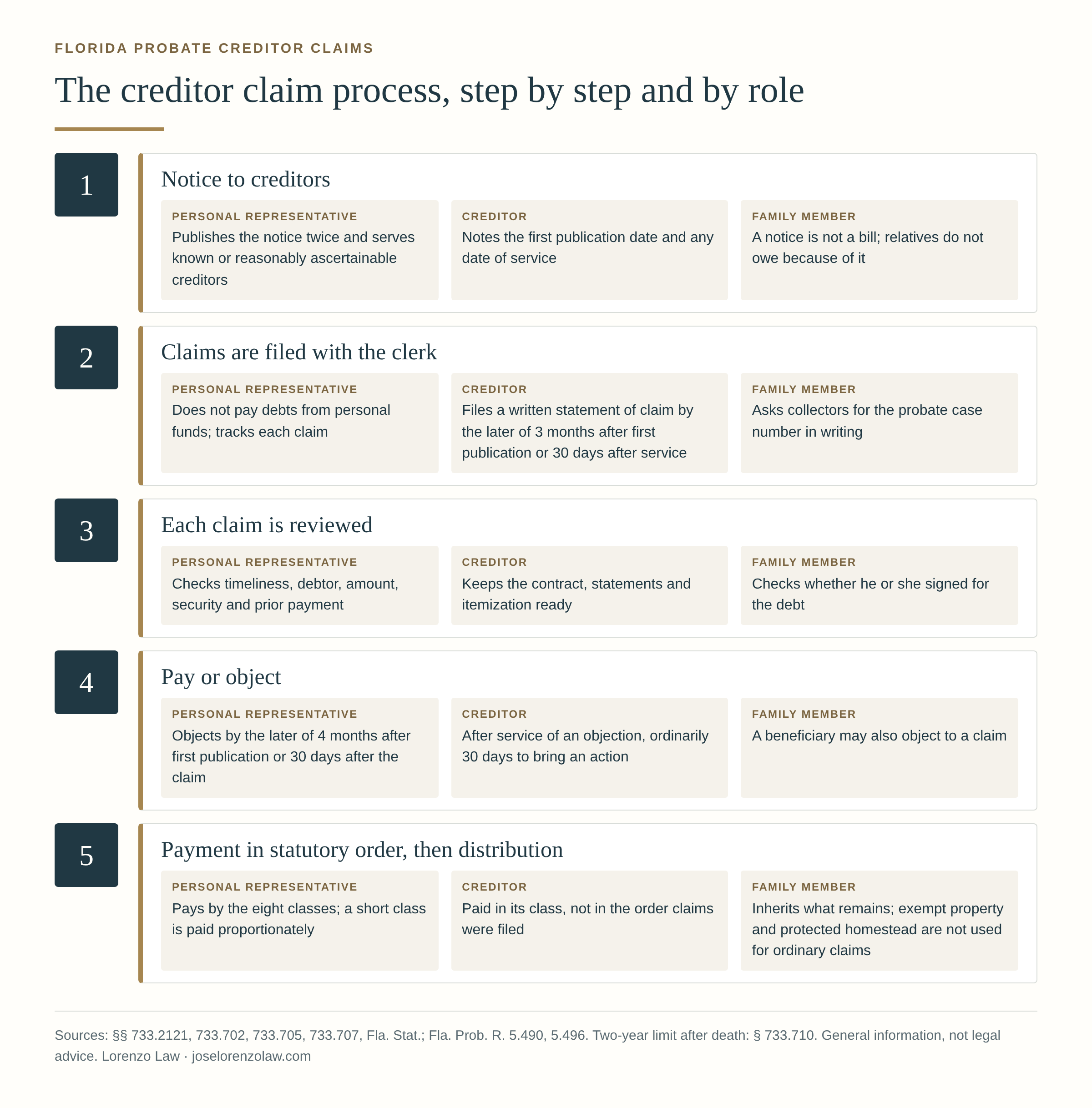
See the chart “The creditor claim process, step by step and by role” (opens the full-size image)
Summary administration handles creditors differently, because no personal representative is appointed; see creditors in summary administration.
Notice to creditors in Florida probate
A notice to creditors is the published and served notice that a Florida probate estate is pending and that claims against the estate must be filed with the court within the periods set by section 733.702 or be forever barred. It is both published in a newspaper and served directly on creditors whom the personal representative knows about or can reasonably find. Unless creditor claims are already barred by the two-year limit, the personal representative must promptly publish it (section 733.2121).
What is a notice to creditors in Florida probate?
The notice names the decedent, gives the case number, the court’s name and address, the names and addresses of the personal representative and the personal representative’s attorney, and the date of first publication, and warns that claims must be filed within the time periods set by section 733.702 or be forever barred; it also states that the personal representative has no duty to look for community property unless a creditor makes a written demand. The date of first publication matters most: several deadlines are counted from it.
Publication: newspaper and statewide website
The notice is published once a week for two consecutive weeks in a newspaper published in the county where the estate is administered or, if no newspaper is published there, in a newspaper of general circulation in that county. Legal notices published in Florida newspapers also appear on the statewide public-notice website, floridapublicnotices.com, which is a practical place for creditors to search. How long does the notice to creditors run? It is published for two consecutive weeks, and for most creditors the claims period it starts runs until three months after the first publication. Proof of publication must be filed within 45 days after the date of first publication (Florida Probate Rule 5.241).
Lorenzo Law’s flat fees for formal and summary administration include the cost of publishing the notice to creditors, so the newspaper invoice is not an extra charge to the family.
Diligent search and direct service on known creditors
The personal representative must promptly make a diligent search to determine the names and addresses of creditors who are reasonably ascertainable, including creditors whose claims are not yet due, contingent or unliquidated, and must promptly serve each of them with a copy of the notice. Impracticable and extended searches are not required. In practice the search covers the decedent’s mail and email, bank and card statements, tax returns, medical and insurance records, leases, loan documents, court records and the people who handled the decedent’s finances. No statute sets a number of days that automatically satisfies the duty; the search is judged by what was reasonable in that estate.
Service of a copy is not required on a creditor who has already filed a claim, whose claim has been paid in full, or whose claim is listed in a timely filed personal representative’s proof of claim. Giving notice is not an admission that the creditor’s claim is valid or that the claim is enforceable.
Agency for Health Care Administration (Medicaid estate recovery)
If the decedent was 55 or older at death, the personal representative must promptly serve the Agency for Health Care Administration with a copy of the notice to creditors and provide a copy of the death certificate within three months after the first publication, unless the agency has already filed a statement of claim in the estate. This allows the agency to present any claim to recover Medicaid benefits paid for the decedent. Claims under section 409.9101 (Medicaid estate recovery) are within Class 3 of the payment order. Lorenzo Law explains Medicaid recovery as information only; Medicaid planning is not a service the firm offers.
Florida Department of Revenue
The personal representative may serve the notice to creditors on the Department of Revenue only when the Department is determined to be a creditor of the decedent; it is not a mailing required in every estate. Some older agency handouts and websites still describe it as universal.
The verified statement of the diligent search
Within four months after first publication, the personal representative must file a verified statement that a diligent search has been made, listing each person then known who has or may have a claim and whether that person was served or otherwise had actual notice, except those who filed a timely claim or were included in the personal representative’s proof of claim (Florida Probate Rule 5.241). Creditors who filed timely claims or are listed in the personal representative’s proof of claim are handled under the rule’s own terms. That filing is the record a court will look at if a creditor later says it was never told.
Ancillary administration: when the decedent lived outside Florida
When a decedent who was domiciled in another state or country leaves Florida property that must be administered here, the Florida case is an ancillary administration, opened in a county where that property is located (sections 733.101 and 734.102). The ancillary personal representative publishes and serves a notice to creditors in the Florida case, and creditors with claims against the Florida property must file them in that case within the periods that apply there. A claim filed only in the home-state proceeding does not present a claim in the Florida ancillary case. See ancillary administration in Florida.
Is a notice to creditors mandatory in Florida?
In a formal administration, yes: the personal representative must publish the notice and serve reasonably ascertainable creditors unless creditor claims are already barred by the two-year limit in section 733.710. In a summary administration, publishing a notice to creditors is optional for the person who obtained the order, but before the order is entered the petitioner must still make a diligent search for reasonably ascertainable creditors, serve them with the petition, and make provision for paying them to the extent assets are available. See creditors in summary administration.
What is the difference between a notice of administration and a notice to creditors?
The notice of administration is served on the surviving spouse, the beneficiaries, persons who may be entitled to exempt property and certain trustees; it starts the three-month time to object to the validity of the will, venue or jurisdiction, and the time for claiming exempt property and electing the elective share. The notice to creditors is published and served on creditors and starts the claims period. They are different documents with different deadlines, and receiving one does not start the other’s clock.
Florida creditor claim deadlines: which clock applies
How long do creditors have to file a claim against an estate in Florida, or how much time do creditors have to collect after a death? For claims covered by section 733.702, the claim must be filed by the later of three months after the first publication of the notice to creditors or, for a creditor who was required to be served with a copy of the notice, 30 days after the date of service. Separately, section 733.710 bars claims against the estate two years after the date of death, with exceptions. The answer for a particular creditor depends on which event happened, and when; this window is often called the Florida probate creditor period or claims period.
Deadline and trigger table
| Who acts | What must be done | The clock starts at | Qualification |
|---|---|---|---|
| Personal representative | Publish the notice to creditors (once a week, two consecutive weeks) | Promptly after appointment; no fixed number of days | Not required if claims are already barred by the two-year limit |
| Personal representative | Diligent search and service on reasonably ascertainable creditors | Promptly | Includes unmatured, contingent and unliquidated claims; impracticable or extended searches not required |
| Personal representative | File proof of publication | Within 45 days after first publication (Rule 5.241) | Court rule, not the statute |
| Personal representative | Serve AHCA (decedent 55 or older) with the notice and the death certificate | Within three months after first publication | Not required if AHCA already filed a statement of claim |
| Creditor | File a written statement of claim with the clerk | The later of three months after first publication or, for a creditor required to be served, 30 days after service of the copy | Still subject to the two-year limit; part payment or other recognition of the debt does not replace a filed claim |
| Personal representative | File the verified statement of diligent search | Within four months after first publication (Rule 5.241) | Lists each person known who has or may have a claim and whether that person was served or had actual notice. |
| Personal representative or other interested person | File and serve a written objection to a claim | The later of four months after first publication or 30 days after the claim is timely filed or amended | The court may extend the time for good cause; an objection not properly served is abandoned |
| Creditor whose claim was objected to | Bring an independent action on the claim, or a declaratory action if the claim is not yet due or is contingent. | Ordinarily 30 days after service of the objection | Extension by written agreement with the personal representative before the period ends, or by the court for good cause; a lawsuit pending at death and claims subject to arbitration are counted from the filing of the objection. |
| Personal representative | Pay claims | Cannot be compelled to pay until five months after first publication; claims are to be paid within one year after first publication | The one-year period yields to litigation, claims not yet due or contingent, and court extensions |
| Everyone | Outside limit on claims against the estate | Two years after the date of death, whether or not letters of administration were issued | Under the statute, the limit does not apply to a timely filed claim that is still unresolved or to enforcing a duly recorded mortgage, security interest or possessory lien against the collateral. Separately, federal law prevents a state deadline from wiping out a claim of the United States, such as a federal tax debt. |
Months are counted as calendar months, not as 30-day blocks; three months is not the same as 90 days. Court rules generally move a deadline that falls on a weekend or legal holiday to the next business day, but the three-month claims period is counted from the date of first publication and should not be assumed to move, and a court can change a date only where the law allows.
Chart: the claims calendar
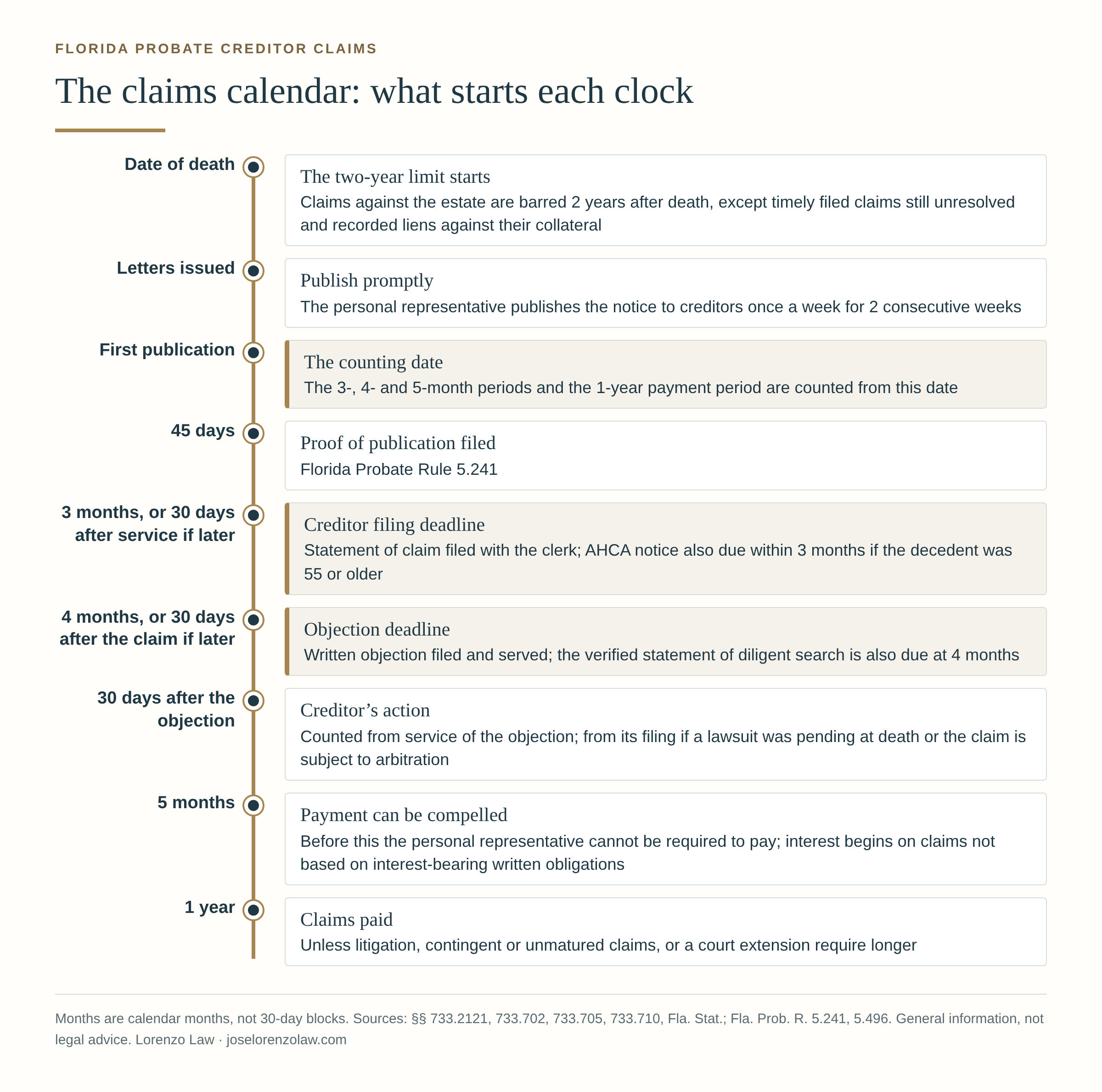
See the chart “The claims calendar: what starts each clock” (opens the full-size image)
Is the three-month creditor period the same as 90 days?
No. The statute counts the period in months from the date of first publication, so the last day is the corresponding date three months later, not the 90th day. If first publication was January 15, the three-month period runs to April 15, which is 90 days in some years and not in others. The same is true of the four-month objection period and the five-month payment protection.
What happens if a creditor never received the notice?
Publication alone does not start the three-month bar against a creditor whom the personal representative knew about or could reasonably have found and was required to serve; for that creditor, the filing period under section 733.702 does not begin to run until a copy of the notice is served (Jones v. Golden, 176 So. 3d 242 (Fla. 2015)). That creditor is still subject to the separate two-year limit in section 733.710. A creditor that was genuinely unknown and not reasonably ascertainable is bound by publication.
Can the court allow a late claim?
A claim filed after the section 733.702 period can be allowed only if the court extends the time on the grounds of fraud, estoppel or insufficient notice of the claims period, on a petition filed by the creditor. When the personal representative or another interested person serves the creditor with a notice to file a petition for an extension, the creditor has 30 days after that service to petition for one. No extension under section 733.702 can carry a claim past the two-year limit in section 733.710. A late claim is not saved by the estate’s silence: a claim filed outside the period is barred even if no one objects to it.
Can a creditor file a claim more than two years after the death?
Generally no. Two years after a person’s death, neither the estate, the personal representative nor the beneficiaries are liable for any claim or cause of action against the decedent, whether or not letters of administration were issued, except as section 733.710 provides. The two years run from the date of death, not from the opening of probate. Two exceptions matter most:
- A creditor who filed a claim under section 733.702 within the two years and whose claim has not been paid or otherwise resolved is not cut off by the two-year limit.
- The limit does not affect the lien of a duly recorded mortgage or security interest, the lien of a person in possession of personal property, or the right to foreclose and enforce those liens against the property.
The exception in section 733.702 for a proceeding limited to recovering casualty insurance proceeds does not carry over to the two-year limit in section 733.710 (Tsuji v. Fleet, 366 So. 3d 1020 (Fla. 2023)). The two-year limit is a statute of repose rather than an ordinary statute of limitations, which is why it can run even when no probate was ever opened.
Claims that are not yet due or are contingent
The filing deadlines also apply to claims that are not yet due, contingent or unliquidated; the creditor files within the same period and states the due date or the nature of the uncertainty. How those claims are paid or secured is explained under claims that are not due, uncertain or disputed.
A full calendar of other probate deadlines, from the 10-day deposit of the will to the inventory and accountings, is in Florida probate rules and deadlines.
If you are a creditor: how to file a claim against a Florida estate
How do I file a claim against an estate in Florida? A creditor files a written statement of claim with the clerk of the circuit court in the probate case, within the period that applies to that creditor. Sending an invoice, a demand letter or a collection notice to the family or to the personal representative is not the same as filing a claim, and a debt that is not filed, listed in the personal representative’s proof of claim, or settled with the interested persons’ approval is barred when the period ends.
What is a statement of claim in Florida probate?
A statement of claim is the creditor’s written, verified filing in the probate case that states the basis for the claim, the amount claimed, the creditor’s name and address, any security for the claim, and whether the claim is now due or involves an uncertainty (Florida Probate Rule 5.490 and section 733.703). If the claim is not yet due, the statement gives the date it will become due; if it is contingent or unliquidated, the statement describes the nature of the uncertainty. Most claims are presented by the creditor’s statement of claim, but a claim listed in the personal representative’s timely proof of claim is treated as filed, and a secured creditor can enforce its lien without filing. Many clerks publish a statement of claim form; using a form does not make the claim timely or valid, and the content still has to fit the debt.
Steps for a creditor
| Step | What to do | Why it matters |
|---|---|---|
| 1. Find the probate case | Search the clerk’s records in the county where the decedent lived, and the published notices, for the decedent’s name and the case number | A claim is filed in the probate proceeding for the estate, usually in the county where the decedent was domiciled. |
| 2. Fix your deadline | Note the date of first publication and the date a copy of the notice was served on you, if it was | Your deadline is the later of the two periods, and the two-year limit still applies |
| 3. Prepare the statement of claim | Basis, amount, your name and address, any security, the due date or the nature of any uncertainty; sign and verify it | Rule 5.490 lists the required contents; a claim defective in form can sometimes be amended, but a missing claim cannot be cured after the deadline. |
| 4. File with the clerk | File in the probate case, through the Florida Courts E-Filing Portal or as the clerk directs, and keep the filing confirmation | Filing with the clerk is what presents the claim; delivering it only to the personal representative or the estate’s lawyer is not enough. |
| 5. Service of the claim | Check the docket for the clerk’s service of the copy | Under Rule 5.490 the clerk serves a copy of the claim on the personal representative’s attorney or other designated recipient; failure to deliver or receive that copy does not affect the validity of the claim. |
| 6. Watch for an objection | Monitor the docket and your mail and email for an objection | If an objection is served, a new 30-day period to take action on the claim usually starts. |
Who sends the claim to the personal representative?
The clerk does. Under Florida Probate Rule 5.490, the creditor files the claim with the clerk and the clerk serves it on the personal representative’s attorney, or on a personal representative or attorney of record that all the personal representatives have designated. Some websites and AI answers tell creditors to serve the personal representative themselves; sending a courtesy copy is harmless, but it is not a substitute for filing. A copy that is never delivered, or never received, does not invalidate a claim that was timely filed.
Supporting documents
Florida Probate Rule 5.490 sets the contents of the statement of claim; it does not require the creditor to attach every contract, invoice or account statement to the claim. Those records still decide whether the claim survives an objection, so keep them organized and ready: the signed agreement, the account history, the itemization and any collateral documents. A creditor who attaches a summary should make sure it does not contradict the amount claimed.
Amending a claim
A creditor may amend a timely claim, and the court may allow amendment of a claim that adequately gave notice of its substance but was defective in form (section 733.704). An objection to a claim also counts as an objection to an amendment of that claim unless the objection is withdrawn.
Secured creditors
A secured creditor that wants to look to the collateral can generally enforce its recorded mortgage or perfected security interest against that property without filing a claim; a creditor that wants payment of any deficiency from other estate assets must file a timely claim and describe the security in it. For lenders, probate recovery usually turns on that choice. Mortgage servicers, vehicle lenders and other secured creditors should decide which they need before the period ends.
Can a creditor open probate in Florida?
Yes. Any interested person may petition for administration, and a creditor who may reasonably be expected to be affected by the proceeding can qualify, so a creditor can open the estate when no one else has. That is how a creditor gets a personal representative appointed and a claims process started. A creditor may file a caveat after the death, but unlike a caveat filed by an heir or beneficiary, a creditor’s caveat does not require the court to give the creditor formal notice before a personal representative is appointed. See Florida probate caveats. If no estate is opened, the two-year limit in section 733.710 still runs from the date of death.
How do creditors find out about probate?
From the published notice (in the county newspaper and on the statewide public-notice website), from a copy of the notice served on them by the personal representative, from the clerk’s online docket, or from returned mail and family members. A creditor who is reasonably ascertainable is entitled to be served; a creditor who is not must rely on publication.
What happens after a creditor files a claim?
The personal representative reviews the claim and either pays it, in its statutory class and when funds allow, or files and serves an objection within the objection period. If no objection is filed in time, the claim is not automatically paid; the personal representative still pays it according to the payment classes and the assets available, and the creditor can ask the court to compel payment after the five-month period. If you are a creditor and the estate objects, read the 30-day action immediately.
Common mistakes that cost creditors their claims
- Sending a bill instead of filing. Invoices, collection letters and calls to the family do not present a claim; a claim is presented by a statement of claim filed in the probate case or by being listed in the personal representative’s timely proof of claim.
- Filing late. A claim filed after the period that applies to the creditor is barred even if no one objects, unless the court grants an extension on the narrow statutory grounds.
- Waiting for the estate to open. The two-year limit runs from the date of death whether or not probate is opened; a creditor that waits can lose the claim.
- Filing in the wrong place or the wrong case. A claim filed in another county’s case, or under the wrong decedent, is not a claim filed in this estate’s probate proceeding and may not protect the creditor.
- Missing the 30 days after an objection. When an objection is served, the creditor must bring the action within the period that applies, or the claim is barred.
- Not being able to prove the debt. A debt buyer without the chain of assignment, or a lender without the signed agreement, can lose a claim that would otherwise be valid.
Creditors and claimants. For a lender, business or individual looking for a creditor claims lawyer in a Florida probate case, Lorenzo Law represents creditors and other claimants in filing, enforcing and resolving claims against Florida estates, subject to a conflicts check. Fees and costs depend on the issue and are discussed with the client and agreed in writing before work begins. Jose M. Lorenzo, Jr. does not represent a creditor and the estate in the same matter.
Reviewing a claim as the personal representative
The personal representative owes duties to every interested person: pay claims that are valid and timely, in the right order, and object to claims that are not. Paying a doubtful claim too early can leave too little for valid claims with higher priority; ignoring a valid claim can expose the estate, and sometimes the personal representative, to cost.
The claim review checklist
- Timeliness. Was the claim filed within the period that applies to this creditor, and within two years of death?
- The right debtor. Was the decedent the borrower or only an authorized user, a guarantor, or not on the account at all?
- The amount. Does the itemization match the records? Are fees, interest and charges allowed by the contract?
- Security. Is the creditor secured by property that will be sold or kept?
- Prior payment. Was the debt paid, settled, discharged in bankruptcy or covered by insurance?
- Limitations. Was the debt already time-barred under the ordinary statute of limitations when the decedent died?
- Priority. Which of the eight classes does it fall in?
Can a personal representative pay bills before the claim period ends?
A personal representative may pay a claim before the claims period ends, but cannot be compelled to pay any claim until five months after first publication; paying early carries the risk that the estate later proves unable to pay claims with higher priority. Costs that arise after death from preserving property the estate holds, such as insurance, utilities and association dues on a house in the estate, are not claims that must be filed, because a claim is a debt of the decedent; dues unpaid at death are claims, and protected homestead is not estate property. When in doubt, wait until the objection period has run and the priority picture is clear.
Can an executor pay bills before probate is opened? A person named as executor has no authority to act for the estate, including paying the decedent’s debts from the decedent’s accounts, until the court appoints him or her, although acts before appointment that benefit the estate can later be given effect. Family members who pay a funeral home or keep up insurance on the house before then should keep receipts; reasonable funeral, burial and grave marker expenses, up to $6,000 in total, have Class 2 priority whoever paid them.
Is a personal representative personally liable for the estate’s debts?
Not merely because of serving: the personal representative is not the borrower on the decedent’s accounts and is not personally liable on the decedent’s contracts by taking the role. A personal representative can be liable to interested persons for loss caused by a breach of fiduciary duty, for example by paying claims out of order or distributing to beneficiaries while valid claims remain unpaid (section 733.609). Federal law can also make a representative personally liable for paying other debts before a claim of the United States in an insolvent estate (31 U.S.C. § 3713). Section 733.2121 separately protects a personal representative who fails in good faith to give notice to a creditor. Do not pay estate debts from personal funds, and do not sign anything agreeing to pay the decedent’s debts personally.
The personal representative’s proof of claim
Instead of waiting for each creditor to file, the personal representative may file a proof of claim listing claims the personal representative has paid or intends to pay; a creditor listed in a timely proof of claim is treated as having filed a claim (section 733.703 and Florida Probate Rule 5.498). Interested persons may object to the items in the personal representative’s proof of claim under Florida Probate Rule 5.499.
When the personal representative is also a creditor
A personal representative who has an individual claim against the estate files it like any other creditor, and the claim must be served on the interested persons, who may object (Florida Probate Rule 5.490). Reimbursement of expenses the personal representative paid for the estate after death is different: those are costs of administration.
The personal representative’s duties as a whole, from appointment to discharge, are covered in how to become a personal representative in Florida and, for relatives outside Florida, serving as an out-of-state executor.
Objection to claim in Florida probate
How do I object to a creditor claim in Florida probate? The personal representative or any other interested person files a written objection in the probate case and serves it on the creditor within the later of four months after first publication or 30 days after the claim was timely filed or amended (section 733.705 and Florida Probate Rule 5.496). An objection that is filed but not properly served is treated as abandoned.
What the objection must contain and who must be served
- The objection is in writing, filed with the court, and contains a certificate of service.
- It must be served on the claimant and, when an interested person other than the personal representative objects, on the personal representative as well.
- It must include a statement that the claimant is limited to 30 days from the date of service of the objection to bring an action on the claim, as Rule 5.496 requires.
- The court may extend the time for filing or serving an objection for good cause.
Common grounds for an objection
Defending a claim against an estate starts here. Common grounds: the claim was filed late; the decedent did not owe it; the amount is wrong or includes unauthorized charges; the debt was paid, settled or discharged; the debt was already barred by the statute of limitations at death; the claim duplicates another claim; the creditor’s records do not show who signed. An objection is not required to defeat a claim that is barred by section 733.702 or section 733.710, but objecting makes the record clear.
Invalid, inflated and false claims
Some claims should not be paid at all: a balance that does not match the account history, a debt the decedent already paid, a duplicate filed by both the original lender and a debt buyer, charges the contract does not allow, or a claim by someone the decedent never owed. Paying a claim that is not owed reduces what is available for valid claims and for the beneficiaries, so the personal representative should ask for documents and object when the claim cannot be supported. A statement of claim is verified, and knowingly making a false verification is the crime of perjury by false written declaration, a third-degree felony.
Family members sometimes file claims for caring for the decedent before death. Under Florida law, services a family member provides to a relative living in the same household are generally presumed to be gratuitous, so a caregiver claim against the estate usually depends on proving an agreement that the services would be paid for. A written caregiver agreement signed before the services were provided makes that question much easier to answer.
Interested persons who object
A beneficiary or other interested person may object to a claim even if the personal representative does not. That matters when the personal representative is the creditor, is related to the creditor, or is reluctant to act. When the personal representative has a conflict, the court can appoint an administrator ad litem to act for the estate on that claim.
What if the creditor does nothing after an objection?
If the creditor does not, within the period that applies, bring an independent action (or, for a claim not yet due or contingent, a declaratory action), move to substitute in a pending suit, or take the required arbitration step, and no extension was obtained, the claim is barred. Abandoning an objection, by contrast, does not revive a claim that was already barred because it was filed late.
After an objection: the 30-day action, pending lawsuits and arbitration
How long does a creditor have to sue after an objection? Ordinarily 30 days from service of the objection to bring an independent action on the claim, or, for a claim not yet due or contingent, a declaratory action to establish it, unless the personal representative agreed in writing to extend that time before it expired or the court extends it for good cause (section 733.705(5)). This is the point where a routine claim becomes a lawsuit.
Three different routes
| Situation | What the creditor does | Time counted from |
|---|---|---|
| No case was pending at death (the usual case) | Brings an independent action on the claim or, if the claim is not yet due or is contingent, a declaratory action to establish it. | Service of the objection: 30 days |
| A lawsuit on the claim was pending against the decedent at death | Moves to substitute the personal representative as the party in the pending case, under the applicable rule | Filing of the objection: 30 days |
| The claim is subject to binding arbitration | Moves to compel arbitration or, if arbitration had already begun, gives the required notice or moves to substitute the proper party | Filing of the objection: 30 days |
The 30-day period is measured from service of the objection in the ordinary case but from the filing of the objection when a lawsuit was pending at death or the claim is subject to arbitration, so the two should not be confused. In the ordinary case the creditor must bring the independent action within the 30 days; for a lawsuit pending at death or a claim subject to arbitration, the substitution, motion to compel or notice the statute describes takes its place.
Who pays the legal fees in a creditor claim dispute?
Each side generally pays its own lawyer unless a contract or statute shifts fees; the estate’s own legal fees are costs of administration paid first, and a creditor’s contract may let it add collection fees to its claim, but not if it sues within five months after first publication before any objection. In the probate case, the court may award reasonable compensation from the estate to a lawyer who rendered services to the estate (section 733.106). Fee shifting is decided case by case, so neither side should assume the other will pay.
Will creditors negotiate or settle after a death?
Often. Negotiating medical bills or credit card debt after a death is common: a creditor that faces an objection, a small estate or a lower payment class may accept less than the full amount, and a personal representative may prefer a certain discount to the cost of litigation. Settlement talks do not extend any filing or action deadline unless the extension is made in writing as the statute requires. The court may authorize the personal representative to compromise a claim when it is in the best interest of the interested persons, but not until the time for objecting to claims has expired (section 733.708), and section 733.702 separately allows a claim to be settled and paid in full without filing when the interested persons approve. No creditor is required to accept a discount.
Evidence that decides disputed claims
Disputed creditor claims are usually decided on documents: the signed agreement, the chain of assignment if a debt buyer is the claimant, the account history, any personal guarantee and the dates of the last payment and the last charge. A judgment establishing a disputed claim does not move the claim into a higher payment class than it would otherwise have.
Is it hard to sue an estate? The lawsuit itself is an ordinary civil action against the personal representative; what makes it unforgiving is the timing, because it must be brought within the period after the objection, and the creditor must prove the debt like any other plaintiff.
When an objection has been served, a lawsuit is pending or the claim is large enough to affect the beneficiaries, see Florida probate litigation and the Florida estate disputes guide. Routine bills do not need litigation; the 30-day deadline after an objection does need a prompt decision.
Who gets paid first: Florida’s eight payment classes
Who gets paid first from an estate in Florida? When the estate cannot pay everything, the personal representative pays expenses and obligations in the order set by section 733.707: costs of administration first, then funeral expenses up to $6,000, then debts preferred by federal law and certain state claims, then last-illness medical expenses, the family allowance, child-support arrearages, debts of a continued business, and finally all other claims. Filing first does not move a creditor ahead; each class is paid in full before the next, and a class that cannot be paid in full is paid proportionately.
The eight classes
This is the Florida probate priority of claims, sometimes called the order of payment or the class of creditors.
| Class | What it includes | Limits and notes |
|---|---|---|
| 1 | Costs, expenses of administration and compensation of personal representatives and their attorneys, and attorney fees awarded under section 733.106(3) | Paid first because the estate cannot be administered without them |
| 2 | Reasonable funeral, interment and grave marker expenses, whether paid by a guardian, the personal representative or any other person | Priority limited to $6,000 in total; the excess falls into Class 8 |
| 3 | Debts and taxes with preference under federal law; claims under sections 409.9101 and 414.28; and claims of the state for unpaid court costs, fees or fines | Not every government bill; only the debts the statute names |
| 4 | Reasonable and necessary medical and hospital expenses of the last 60 days of the last illness, including compensation of persons attending the decedent | No dollar cap; expenses outside the last 60 days, or not part of the last illness, fall into Class 8 |
| 5 | Family allowance | Set by the court for the surviving spouse and the lineal heirs the decedent was supporting or obliged to support, up to $18,000 in total; see family protections |
| 6 | Arrearage from court-ordered child support | Ranks after the family allowance |
| 7 | Debts acquired after death by the continuation of the decedent’s business, in accordance with section 733.612(22), but only to the extent of the assets of that business | Applies only when the business was continued with authority |
| 8 | All other claims, including those founded on judgments or decrees rendered against the decedent during the decedent’s lifetime, and any excess over the sums allowed in Classes 2 and 4 | Credit cards, personal loans, most medical bills, utilities, unsecured business debts |
Chart: the payment order
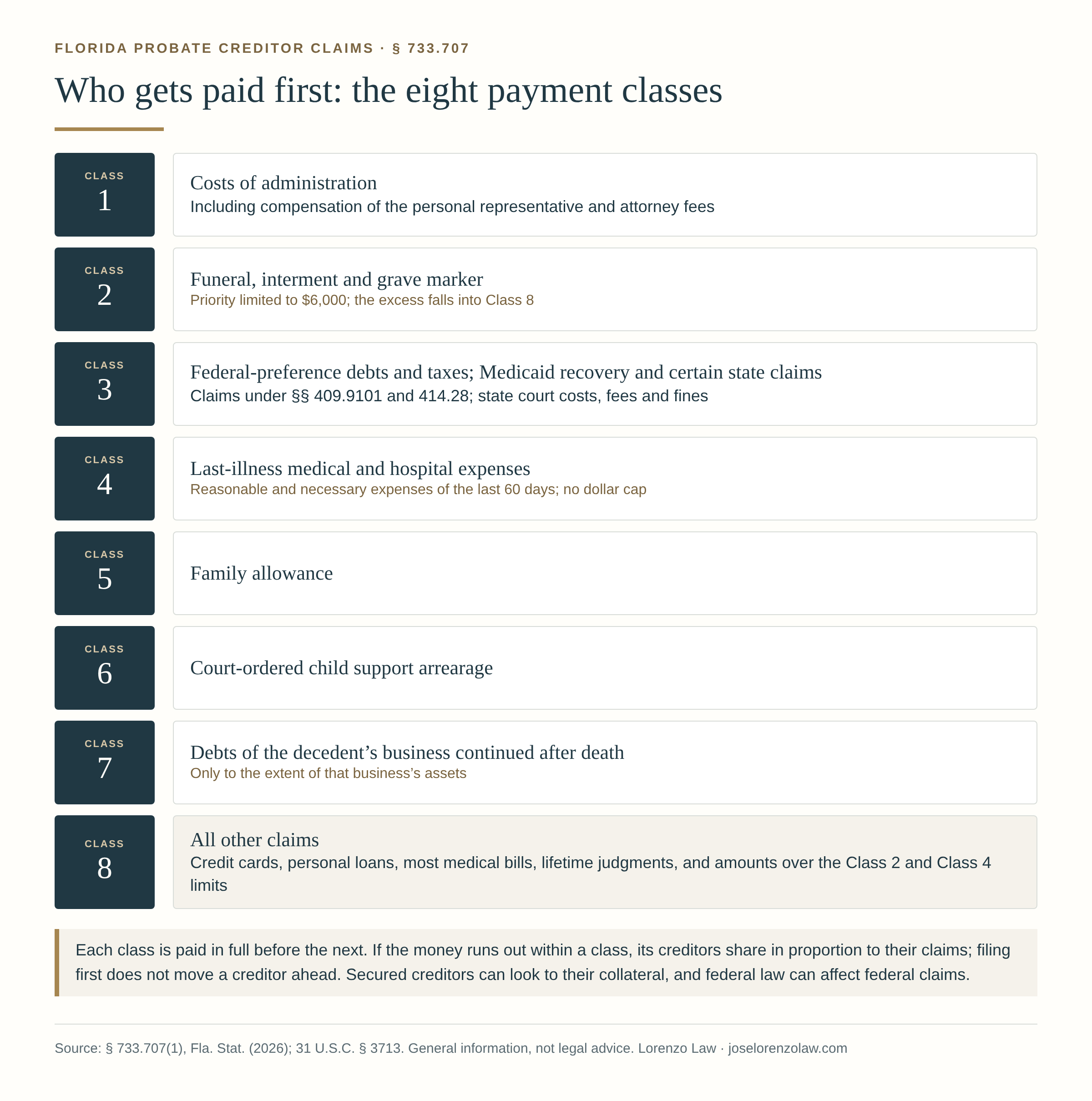
See the chart “Who gets paid first: the eight payment classes” (opens the full-size image)
Not first come, first paid
Within a class, creditors share ratably in proportion to their claims if the funds left for that class are not enough to pay all of them; the order in which claims were filed does not matter. That is why a personal representative should not pay Class 8 bills as they arrive while higher classes are still open.
Hypothetical example. After the higher classes and any secured or federal rights are satisfied, an estate has $6,000 left for two allowed Class 8 claims of $4,000 and $8,000, which total $12,000. Each creditor receives 50% of its claim: $2,000 and $4,000. The example assumes there are no other claims, reserves or disputes; it is an illustration of the arithmetic, not a prediction or a settlement offer.
What happens if the estate is insolvent?
The meaning of an insolvent estate is simple: it is an estate whose debts and expenses are greater than its assets. In an insolvent estate, the classes are paid in order until the money runs out, lower classes may receive part or nothing, and beneficiaries receive nothing from the probate estate. Unpaid debts do not pass to the heirs, but property that is exempt or protected homestead is not used to pay ordinary creditors, so a family can keep exempt property even when the probate estate is insolvent. Assets of the decedent’s revocable trust can be reached when the probate estate is insufficient (section 733.707(3)). An insolvent estate is still administered; it is not abandoned, and the personal representative should document every payment decision.
Are mortgages and car loans paid first?
Not as part of the eight classes. A secured creditor’s right to its collateral comes from its lien, which it can generally enforce against that property regardless of the classes; the classes decide how the estate’s other assets pay unsecured claims and any deficiency the secured creditor claims. In practice, the estate either keeps paying the secured loan to protect the property for a beneficiary, sells the property and pays the lien at closing, or lets the lender take the collateral.
An heir who receives a house that is subject to a mortgage takes it subject to the lien; heirs often keep paying the loan while they decide whether to keep or sell, and federal law generally prevents a lender from calling a residential loan due solely because the home passes to a relative on the borrower’s death (12 U.S.C. § 1701j-3(d)). For the family’s side of an inherited mortgage, see inherited debt in Florida.
Judgment creditors
A judgment entered against the decedent during life does not let the creditor collect by execution or levy against estate property after death without the probate court’s approval; under section 733.706 the judgment must be filed as a claim like any other, and an unsecured judgment is paid in Class 8. Section 733.706 does not prevent a creditor from enforcing a mortgage, security interest or lien on specific estate property. Whether a judgment lien recorded before death attaches to a particular property, and how it ranks, depends on the property and the facts; protected homestead raises separate questions.
Does the IRS have to file a probate claim?
Federal tax claims are governed by federal law, and under U.S. Supreme Court precedent Florida’s probate claim deadlines cannot wipe out a claim of the United States, even when it is filed late. Debts and taxes with preference under federal law are in Class 3, and under 31 U.S.C. § 3713 a representative who pays other debts before a federal claim, when the estate cannot pay all its debts, can become personally liable for the unpaid federal claim up to the amount of those payments. When federal income or estate tax may be owed, coordinate with the family’s tax professional before paying lower-class claims; Lorenzo Law provides information on federal tax only and does not prepare tax returns.
Does the personal representative get paid before creditors?
Yes. Under Florida’s payment order, compensation of the personal representative and attorney fees are costs of administration in Class 1, ahead of every class of creditor claims, though federal law can give a federal claim priority in an estate that cannot pay all its debts. For how those fees are set, see how much probate costs in Florida.
When claims are paid, and when distribution is safe
Claims are paid within one year after first publication unless litigation, unmatured or contingent claims, or a court extension requires longer. Distribution to beneficiaries usually waits until the objection periods have run, objections are resolved or reserved for, and the priority classes are satisfied. If the estate is selling a house, see selling the house before the creditor period ends.
Claims that are not due, uncertain or disputed
Not every claim is a fixed amount that is already due. Florida treats unmatured, contingent and unliquidated claims differently, but all of them must be presented within the same filing period.
Three different kinds of uncertain claim
- Unmatured (not yet due)
- A fixed debt that will become payable later, such as a loan with future installments. The personal representative may pay the principal amount of an unmatured claim, plus interest accrued to the date of payment, without discount or prepayment penalty, or the claim may be provided for by agreement or court order (section 733.705(7)).
- Contingent
- A claim that depends on an event that may never happen, such as the decedent’s guarantee of someone else’s loan that is not in default.
- Unliquidated
- A claim whose amount is not yet fixed, such as damages in a pending dispute.
What if the claim is contingent or not yet due?
The creditor files within the normal period, stating the due date or the nature of the uncertainty. Before distribution, the personal representative and the claimant may agree on how the claim will be handled, or the court may require the personal representative to set aside assets or provide security for it (section 733.705(7) and (8)). Absent agreement, a contingent claim on which no cause of action has accrued is barred at the earliest of a court finding that it is adequately secured or has no value, three months after a cause of action accrues if no action is then pending, five years after first publication, or a court order providing for its payment. This is not an invitation to wait: the claim must still be filed on time. No fixed percentage reserve applies in every estate.
Does interest accrue on debts after death?
A claim based on a written obligation that bears interest continues to bear interest at the rate in the obligation; other claims begin to bear interest five months after the first publication of the notice to creditors (section 733.705(9)).
Debts and assets outside the probate estate
Creditor claims are paid from the probate estate, but “outside probate” does not always mean “safe from creditors,” and “protected from creditors” does not always mean “outside probate.” Protected homestead and exempt property are shielded from most ordinary creditors; revocable trust assets can be reached if the probate estate is not enough; and assets that pass directly to a named beneficiary generally do not pass through probate.
Can creditors take a Florida homestead?
Usually not, if it is protected homestead. Under Article X, section 4 of the Florida Constitution, the homestead of a Florida resident that passes to a surviving spouse or heirs is protected from forced sale by most creditors, but not from taxes and assessments on it, obligations for its purchase, improvement or repair, or obligations for labor performed on it. Protected homestead is not used to pay the estate’s ordinary claims or administration expenses. Whether a particular house qualifies depends on the owner’s residence, the size and location of the land, the family left behind and how the will disposes of it; it is decided in the probate case. See Florida homestead in probate.
Exempt property and the family allowance
When the decedent was domiciled in Florida, the surviving spouse or, if there is no surviving spouse, the decedent’s children are entitled to exempt property, which is protected from creditors: household furniture, furnishings and appliances in the decedent’s usual residence up to a net value of $20,000 at death; up to two motor vehicles held in the decedent’s name, each with a gross vehicle weight of 15,000 pounds or less, regularly used by the decedent or family; qualified tuition program interests; and certain death benefits under section 112.1915 (section 732.402). Exempt property is subject to perfected security interests, and it must be claimed by petition within the time the statute allows.
Separately, the court may award a reasonable family allowance for the maintenance of the surviving spouse and the lineal heirs the decedent was supporting or obliged to support during administration, up to $18,000 under section 732.403, and the family allowance is paid in Class 5. More on spousal rights is in surviving spouse rights in Florida.
Can creditors reach a revocable trust after death?
Can creditors go after a trust after death in Florida? Yes, to the extent the probate estate is insufficient. Section 733.707(3) makes a decedent’s revocable trust liable for the expenses of administration and the obligations of the estate when the probate estate cannot pay them, and the trustee pays those amounts to the personal representative as the statute directs. A funded revocable trust, often called a living trust, avoids probate for the assets in it; it is not a shield against the settlor’s own creditors after death. After the settlor dies, the trustee of a trust that was revocable at death must file a notice of trust with the court of the county of the settlor’s domicile and the court having jurisdiction of the settlor’s estate (section 736.05055), and that filing is one way a personal representative and creditors learn that the trust exists.
What assets are protected from creditors after death in Florida?
Assets that pass directly to a surviving joint owner with survivorship rights, such as an account jointly held with right of survivorship, or to a named beneficiary of a life insurance policy, retirement account or payable-on-death account, generally do not become probate assets and are not used to pay probate claims, subject to exceptions that depend on the asset and the law that governs it. If the estate itself is named as beneficiary, the proceeds become part of the probate estate. See Florida non-probate assets.
Creditors in summary administration
In summary administration, no personal representative is appointed. Before the order is entered, the petitioner must make a diligent search and reasonable inquiry for known or reasonably ascertainable creditors, serve them with a copy of the petition, and make provision for payment to the extent assets are available (section 735.206). People who receive property in a summary administration are personally liable to creditors whose claims were not barred, for a pro rata share up to the value of the property they received, excluding exempt property. The person who obtained the order may publish a notice to creditors under section 735.2063; if proof of publication is filed, claims of creditors who are not known or reasonably ascertainable are barred unless filed within three months after first publication. See the Florida summary administration guide.
Family members: when someone other than the estate may owe
Who is responsible for a deceased person’s debt in Florida? First, the estate. Can creditors go after beneficiaries in Florida? Not for the decedent’s own debts merely because they are heirs, beneficiaries or relatives. Can creditors take inherited property in Florida? Not property that is protected homestead or exempt property; other probate property can be used to pay valid claims while it is in the estate, a lien follows the property it secures, and property distributed too early can be recovered. Family members can owe in three situations: they signed for the debt themselves, they received estate property improperly, or they received property in a summary administration while a creditor remained unpaid.
When a relative may be responsible
- Their own contract. A co-borrower, joint account holder with liability or guarantor owes under his or her own signature, separately from the estate. An authorized user on a credit card is not the cardholder and owes the debt only if the card agreement or state law makes him or her liable.
- Improper distributions. A beneficiary who received a distribution that was improper, for example while valid claims remained unpaid, may be liable to return the property or its value, subject to the defenses in section 733.812.
- Summary administration recipients. Those who received property under a summary administration order can be liable to unbarred creditors up to the value they received, excluding exempt property (section 735.206).
- Spousal rights are not creditor claims. A surviving spouse’s elective share, homestead rights, exempt property and family allowance are rights in the estate with their own procedures and deadlines, not creditor claims. See the Florida elective share.
- Personal representative’s breach. A relative serving as personal representative is liable for loss caused by a breach of fiduciary duty, not for the decedent’s debts as such (section 733.609).
When a creditor contacts the family
A debt collector may call the family. A short letter or written reply usually works better than a phone conversation: state that the account holder has died, give the probate case number if an estate has been opened (or say that none has been opened yet), ask the creditor to file any claim in the probate case, and ask it to direct further contact to the personal representative or the estate’s lawyer. Do not promise to pay the decedent’s account, do not give a card or bank account number, and do not pay from personal funds until you know whether you signed for the debt.
Who notifies creditors of a death? The formal notice is the personal representative’s notice to creditors, published and served in the probate case. Families often also send a death certificate to the decedent’s banks and card issuers and ask the credit reporting agencies to note the death on the decedent’s file, which helps stop new accounts being opened in the decedent’s name. For spouses, children, student loans and debt collection rules, see whether you personally owe an inherited debt.
Common debts after a death: where each one fits
The types of creditor claims an estate sees most often, and where each one usually lands:
| Debt | Usual route | Usual class |
|---|---|---|
| Credit card in the decedent’s name | Timely probate claim; an authorized user is not the cardholder and owes the debt only if the card agreement or state law makes him or her liable | Class 8 |
| Hospital and doctor bills | Timely claim; check insurance and Medicare decisions first | Class 4 for the last 60 days of the last illness; otherwise Class 8 |
| Funeral and burial | Paid by the estate or reimbursed to the person who paid | Class 2 up to $6,000; excess Class 8 |
| Medicaid benefits paid after age 55 | AHCA estate recovery claim after service of the notice | Class 3 |
| Federal income or estate tax | Federal law; coordinate with the tax preparer | Class 3 (preference under federal law) |
| Mortgage or car loan | Lien on the collateral; claim only for any deficiency | Outside the classes for the collateral; Class 8 for a deficiency |
| Condominium or homeowners’ association dues | Dues before death: claim; dues after death on property the estate holds: generally a cost of administration; association liens follow the association statutes | Depends on timing and the lien |
| Personal loan from a relative or friend | Timely claim with the note or other proof | Class 8 |
| Court-ordered child support arrears | Timely claim | Class 6 |
| Judgment entered against the decedent during life | Timely claim; a recorded judgment lien raises separate questions | Class 8 |
Federal student loans, small business loans and other federally backed debts can follow their own rules; check the loan program before paying.
What debts are forgiven at death in Florida? Ordinary debts are not forgiven because the borrower died; they become claims against the estate, and any part the estate cannot pay goes unpaid rather than passing to the heirs. Federal student loans are generally discharged on the borrower’s death; private loans and other debts follow their contracts and the probate rules. More on this is in inherited debt in Florida. For each common debt, including who owes it, what secures it and how the estate handles it, see debt after death in Florida.
When probate is closed, or was never opened
Can creditors make claims after probate is closed? Closing or reopening the estate does not revive a claim that was barred, because the two-year limit in section 733.710 cannot be waived or extended in the probate proceedings and a creditor who failed to file a timely claim cannot use reopening to get around that. A claim that was timely filed and never resolved, a lien that survives against the property, and a beneficiary’s liability for an improper distribution are analyzed separately.
If probate was never opened
If no one opens probate, the two-year limit in section 733.710 still runs from the date of death, after which neither the estate nor the beneficiaries are liable for the decedent’s claims, subject to the statute’s exceptions. A creditor that wants to be paid before then can open the estate itself, as explained in can a creditor open probate. Families who skip probate to avoid creditors usually find that title to the house, the car and the bank accounts is stuck instead.
Subsequent administration
Property discovered after the estate is closed can be administered in a subsequent administration, but that proceeding does not save a claim already barred by the time limits in sections 733.702 and 733.710. If you received a bill or a demand letter after the estate closed, check whether the creditor filed a claim during the administration and how it was resolved before responding.
Wrongful death recoveries and creditor claims
Are wrongful death proceeds subject to creditor claims? It depends on whose damages they are. Under Florida’s Wrongful Death Act, damages recovered for the survivors belong to the survivors, while damages recovered for the estate are estate assets, and the estate’s recovery is subject to the claims of creditors who have complied with the requirements for probate claims (section 768.21).
Medical and funeral expenses can be recovered by the survivors or by the estate depending on who paid them or is responsible for them, which affects whether that part of the recovery is available to creditors. A settlement should therefore allocate the recovery between survivors and the estate on a reasoned basis; describing the whole amount as exempt because it arises from a death is not accurate. Lorenzo Law handles the estate side of a wrongful death matter, including opening the estate and the personal representative’s appointment; the damages case is handled by a personal-injury lawyer by referral or as co-counsel. See Florida wrongful death estates.
Common myths about Florida probate claims
Myth 1: The personal representative must pay every bill right away
The personal representative cannot be compelled to pay a claim until five months after first publication, and paying early can leave too little for claims with higher priority. Paying in the right order matters more than paying fast.
Myth 2: Paying bills as they arrive is good enough
Bills that arrive first are often Class 8 debts. Paying them before the administration expenses, funeral expenses, Class 3 claims and last-illness expenses are known can make the personal representative answerable for the shortfall.
Myth 3: Small estates can ignore creditors
Summary administration still requires a diligent search for reasonably ascertainable creditors and provision for their payment, and recipients can be liable to unpaid creditors up to the value they received. A small estate is simpler, not creditor-free.
Myth 4: Heirs are personally responsible for the decedent’s debts
Heirs and beneficiaries are not liable for the decedent’s debts simply because they inherit; liability comes from their own signature on the debt, an improper distribution, or a summary administration in which a creditor was not paid.
Myth 5: Creditors can file whenever they want
Claims are barred if they are not filed within the period in section 733.702, and claims against the estate are barred two years after death under section 733.710, subject to the exceptions explained above.
Myth 6: All creditors are paid equally
Creditors are paid by class; within a class that cannot be paid in full, they share proportionately. A credit card company and a hospital can therefore receive very different percentages from the same estate.
Costs, scope and the documents to gather
For a personal representative, handling creditor claims is part of the estate administration. With Lorenzo Law, summary administration costs from $3,975 and uncontested formal administration from $7,975, as flat fees. The summary administration fee includes the court filing fee and one certified copy of the order, with additional certified copies charged at the Clerk’s rate; the formal administration fee includes the court filing fee, publication of the notice to creditors and the certified copies the matter needs. Jose does not publish the optional notice to creditors in summary administration, so his fee there includes no publication cost. For either procedure, homestead determinations, more complex estates and contested matters are quoted separately, and other expenses may apply, such as recording fees or the decedent’s debts, and in formal administration a personal representative’s bond if the court requires one and the personal representative’s compensation; any increase is discussed before work begins. Full fee terms: summary and formal administration fees. Ancillary administration is quoted per matter. These fees are honored at least through February 15, 2027.
What changes the cost
- A routine claims period. Publishing the notice, the creditor search, reviewing filed claims and paying them in order are part of the administration covered by the flat fee quote; the quote can rise with estate factors, discussed before work begins.
- An objection. Preparing and serving an objection to a particular claim is a discrete task; the fee depends on the claim and is quoted after review.
- An independent action or settlement. If a creditor sues after an objection, or a substantial claim has to be negotiated, the litigation is a separate engagement with its own written terms.
- Creditor and claimant matters. For a creditor filing, enforcing or settling a claim against a Florida estate, fees and costs depend on the issue and are discussed and agreed in writing before work begins.
- Limited help. Hourly review and advice engagements are available, for example a review of a claim or an objection before you file it, with the scope and rate agreed in writing.
- Third-party charges. Charges such as a court reporter in a contested hearing or an appraisal are identified in advance where they apply.
No one can promise that a claim will be defeated, discounted or paid in a set time. More on probate fees, including the statutory fee schedules and who pays them, is in how much probate costs in Florida; whether you need a lawyer at all is covered in do I need a probate attorney in Florida.
Preparation checklist
| Gather | Why it matters; who usually has it |
|---|---|
| Date of death, county, case number, letters of administration and the current docket | Fixes the court, the procedure and the recorded events; the personal representative, the estate’s lawyer or the clerk |
| The published notice to creditors, the first publication date and the proof of publication | Starts the three-, four- and five-month periods; the newspaper, the personal representative or the court file |
| Each copy of the notice served on a creditor, and the service record | Sets that creditor’s 30-day period; the creditor and the personal representative |
| The filed claim, any amendment, any objection, certificates of service and any written extension | Separates filing dates from service dates and shows the current status; the clerk and the parties |
| Signed debt documents, invoices, itemization, payment history and any release | Shows who owes, how much, the defenses and the risk of paying twice; the creditor and the estate’s records |
| Liens, titles, collateral values and insurance policies | Separates enforcement against property from estate liability; the lender, the owner and the insurer |
| Asset list, exempt-property filings, homestead determination, accountings and distributions | Shows what is available to pay claims, the priority, the reserves and any recipient exposure; the personal representative and beneficiaries |
| Pleadings and orders in any pending lawsuit or arbitration | Decides which post-objection route applies; litigation counsel |
Do not post account numbers, Social Security numbers or medical records in a web form or email when you first make contact. Describe your role and the earliest deadline you know of; secure delivery of documents is arranged after a conflicts check. Building a complete list of the decedent’s assets and debts is explained in the need for a thorough list of assets.
More questions about Florida probate creditor claims
How long do creditors have to file a claim against an estate in Florida?
Generally the later of three months after the first publication of the notice to creditors or, for a creditor that had to be served with a copy of the notice, 30 days after it was served. A known or reasonably ascertainable creditor that was never served is not barred by publication alone, but most creditors are subject to the two-year limit after death in section 733.710, except for timely filed claims that remain unresolved and recorded mortgages, security interests and certain liens.
How do I file a claim against an estate in Florida?
File a written, verified statement of claim with the clerk of the circuit court in the probate case, stating the basis, the amount, your name and address, any security, and the due date or the nature of any uncertainty. The clerk serves it on the personal representative’s attorney, unless the personal representatives have designated a different personal representative or attorney to receive claims. Keep the filing confirmation and watch the docket for an objection.
Is sending a bill to the family the same as filing a claim?
No. A bill, collection letter or phone call to the family or the personal representative does not present a claim; the claim must be filed in the probate case within the deadline unless the personal representative lists it in a timely proof of claim, and partial payment by the estate does not replace a filed claim.
What happens if I receive a Florida notice to creditors?
If you are a creditor, note the date it was served on you and the date of first publication it states, and calculate the later deadline. If you think you were sent it by mistake, for example because you are a relative and not a creditor, you do not need to file anything; the notice does not mean you owe money. If you are unsure whether the debt is yours or the estate’s, get advice before the deadline.
How does a personal representative start the creditor claims process?
After letters of administration are issued, the personal representative publishes the notice to creditors, makes a diligent search, serves reasonably ascertainable creditors and, if the decedent was 55 or older, serves the Agency for Health Care Administration. Calendar the first publication date: the objection and payment periods are counted from it.
How do I object to a creditor claim in Florida probate?
File a written objection in the probate case, with a certificate of service and the 30-day warning Rule 5.496 requires, and serve it on the claimant within the later of four months after first publication or 30 days after the claim was timely filed or amended. An interested person who objects also serves the personal representative.
How long does a creditor have to sue after an objection?
Ordinarily 30 days from service of the objection, unless the personal representative agrees in writing to extend it before it expires or the court extends it for good cause. If a lawsuit on the claim was pending at death, or the claim is subject to arbitration, the creditor’s step is taken within 30 days after the objection is filed.
Who gets paid first from an estate in Florida?
Under Florida’s statutory order, costs of administration, including the personal representative’s compensation and attorney fees, are paid first, then funeral expenses up to $6,000, then federal-preference debts and taxes and certain state claims, then last-illness medical expenses for the last 60 days, the family allowance, child-support arrears, debts of a continued business, and all other claims last. Secured creditors look first to their collateral.
Are family members responsible for a deceased person’s debt in Florida?
Not because of the relationship. A family member is responsible only if he or she signed for the debt, received property improperly while claims were unpaid, or received property in a summary administration while a creditor’s claim remained unpaid, up to the value received. See inherited debt in Florida.
Can creditors go after beneficiaries in Florida?
Only in limited cases: a beneficiary who received a distribution improperly can be required to return it or its value, and a person who received property under a summary administration order can be liable to an unbarred creditor up to the value received, excluding exempt property. A beneficiary who signed nothing, received nothing improperly, and took nothing under a summary administration order or a disposition without administration does not owe the decedent’s debts.
Does Medicaid file a claim against the estate in Florida?
It can. If the decedent was 55 or older, the personal representative must serve the Agency for Health Care Administration with the notice to creditors and the death certificate unless the agency has already filed a claim, and the agency may file a claim to recover Medicaid benefits paid; such claims are in Class 3. Protected homestead and exempt property rules still apply.
Can creditors make claims after probate is closed?
Not if the claim was barred: closing or reopening the estate does not revive a claim that was not filed in time. A timely filed claim that was never resolved, and a lien that survives against particular property, are treated differently, and a beneficiary may have to answer for an improper distribution.
Are wrongful death proceeds subject to creditor claims?
Damages recovered for the survivors are not estate assets; damages recovered for the estate are, and they are subject to the claims of creditors who complied with the probate claim requirements. The allocation between survivors and the estate matters.
Do I need a lawyer to file or fight a creditor claim?
A creditor may file its own statement of claim. A personal representative in a formal administration must be represented by a Florida lawyer unless the personal representative is the sole interested person or is a Florida lawyer, so objections in a formal administration are usually filed through counsel (Florida Probate Rule 5.030). Once an objection is served, the 30-day action period makes legal advice time-sensitive for both sides. See do I need a probate attorney in Florida.
Discuss the claim and your role with Jose M. Lorenzo, Jr.
Tell Lorenzo Law whether you are the personal representative, a creditor or a family member, and identify any notice, claim, objection, lawsuit or upcoming deadline. Have the date of death, the county, the case number and the relevant debt documents available. Jose M. Lorenzo, Jr. handles each matter himself. He was admitted to The Florida Bar in 2013, after about a decade as a probate and litigation paralegal, and served as a judicial intern with the Hon. Maria M. Korvick in the Probate Division of the Eleventh Judicial Circuit. Accepting a matter depends on the facts, a conflicts check and a written engagement agreement; a request for a consultation does not create an attorney-client relationship or extend a deadline. Lorenzo Law aims to follow up within one to two business days.
Request a free initial consultation. Only the initial consultation is free; representation fees and costs are agreed separately in writing.
Request a free initial consultationCall (305) 224-6811
For the statewide probate service, see the Florida probate lawyer page. Claims are filed in the county where the estate is administered; county guides: Miami-Dade, Broward, Palm Beach, Orange, Hillsborough, Pinellas and Duval. Related guides: Florida probate guide.
General information about Florida law; it does not replace a review of your documents and circumstances. Reading this page does not create an attorney-client relationship.
Florida probate creditor glossary
- Claim
- In probate, a liability of the decedent, whether arising in contract, tort or otherwise, and funeral expense; it does not include an expense of administration or estate, inheritance, succession or other death taxes (section 731.201).
- Creditor
- A person or business owed money by the decedent at death, or with a claim against the decedent.
- Notice to creditors
- The published and served notice that tells creditors to file claims; first publication starts the three-month period, and service starts a 30-day period for creditors who must be served.
- Reasonably ascertainable creditor
- A creditor the personal representative knows about or could find through a diligent, reasonable search; such a creditor is entitled to be served with a copy of the notice to creditors.
- Statement of claim
- The creditor’s written, verified filing in the probate case that presents the claim.
- Proof of claim (personal representative’s)
- A filing by the personal representative listing claims paid or to be paid; listed creditors are treated as having filed.
- Objection to claim
- A written filing by the personal representative or another interested person disputing a claim; once served, it starts the creditor’s 30-day period to bring an action, counted from filing if a suit was pending at death or the claim is subject to arbitration.
- Independent action
- A separate lawsuit, usually in the civil division, that the creditor brings to establish a claim after an objection.
- Statute of nonclaim; statute of repose
- Section 733.702 bars claims not filed within the claims period; section 733.710 is a statute of repose that bars claims against the estate two years after death, subject to its exceptions.
- Secured creditor
- A creditor with a lien on specific property, such as a mortgage or vehicle loan, which can look to that property.
- Unmatured, contingent and unliquidated claims
- A claim not yet due; a claim that depends on a future event; a claim whose amount is not yet fixed. Each must be filed on time.
- Insolvent estate
- An estate whose debts and expenses exceed its assets; claims are paid by class until the money runs out.
- Family allowance
- A court-ordered allowance during administration for the surviving spouse and the lineal heirs the decedent was supporting or obliged to support, up to $18,000, paid in Class 5.
- Exempt property
- Property the surviving spouse or, if none, the children of a Florida-domiciled decedent may claim free of creditors except perfected security interests, such as household items up to $20,000 and up to two vehicles within the statute’s limits.
- Protected homestead
- A Florida residence that passes to the surviving spouse or heirs and is protected from most creditors under the Florida Constitution.
- Administrator ad litem
- A person appointed by the court to represent the estate in a particular proceeding, such as a claim in which the personal representative has a conflict.
- Subsequent administration
- A proceeding to administer property found after an estate is closed; it does not save a claim already barred by the time limits in sections 733.702 and 733.710.
Sources and authorities
Statutes cited are the 2026 Florida Statutes; rules are the Florida Probate Rules compilation of October 15, 2026.

