
Florida Summary Administration Attorney: What I Do, What It Costs and How Long It Takes
As a Florida summary administration attorney, I help heirs, surviving spouses and people nominated as personal representative in a will settle smaller estates, and estates of people who died more than two years ago, through the court’s shorter probate procedure.
My flat fee for summary administration starts at $3,975, including the court filing fee and one certified copy of the order. Homestead determinations, complex estates and contested matters are quoted separately; full fee details below.
I aim to have the order signed within one to two months from the day you hire me; that is a goal, not a guarantee, because the court’s schedule and the family’s paperwork affect timing.
Request a free initial consultation. Only the initial consultation is free; representation fees and costs are agreed separately in writing.
Request a free initial consultation·Call (305) 224-6811
My principal office is in Kissimmee, and meetings in Coral Gables and Fort Lauderdale are by appointment. I handle summary administration statewide by phone or video, in English and Spanish.
Lorenzo Law · Jose M. Lorenzo, Jr., Florida Bar No. 107002 · handles summary administration for families across Florida, by phone or video.
Go straight toWhat I do · Fee · How long · Does it qualify? · Who signs · Out of state · The house · Creditors · Do I need a lawyer? · Where I handle it
All sections21 sections
At a glance
- Who I help: heirs, surviving spouses, people nominated as personal representative in a will, and families who live outside Florida.
- What it costs: a flat fee for an uncontested matter; what it includes, what is quoted separately and what can raise it are in the fee section.
- How long: my goal is the signed order within one to two months from the day you hire me; it is a goal, not a guarantee.
- Does it qualify? An estate may qualify on its value, or because the person died more than two years ago.
- From anywhere: most families sign from wherever they live; I work by phone or video.
- When it doesn’t fit: some estates need formal administration instead.
What I Do in a Florida Summary Administration, Start to Finish
I handle each summary administration myself, from the first call to the order; my staff assists with the process. The person or people who hire me are my clients, and I explain below what that means for the rest of the family. My fee is a flat fee, described in full in the fee section, and my timing goal is in the section after it.
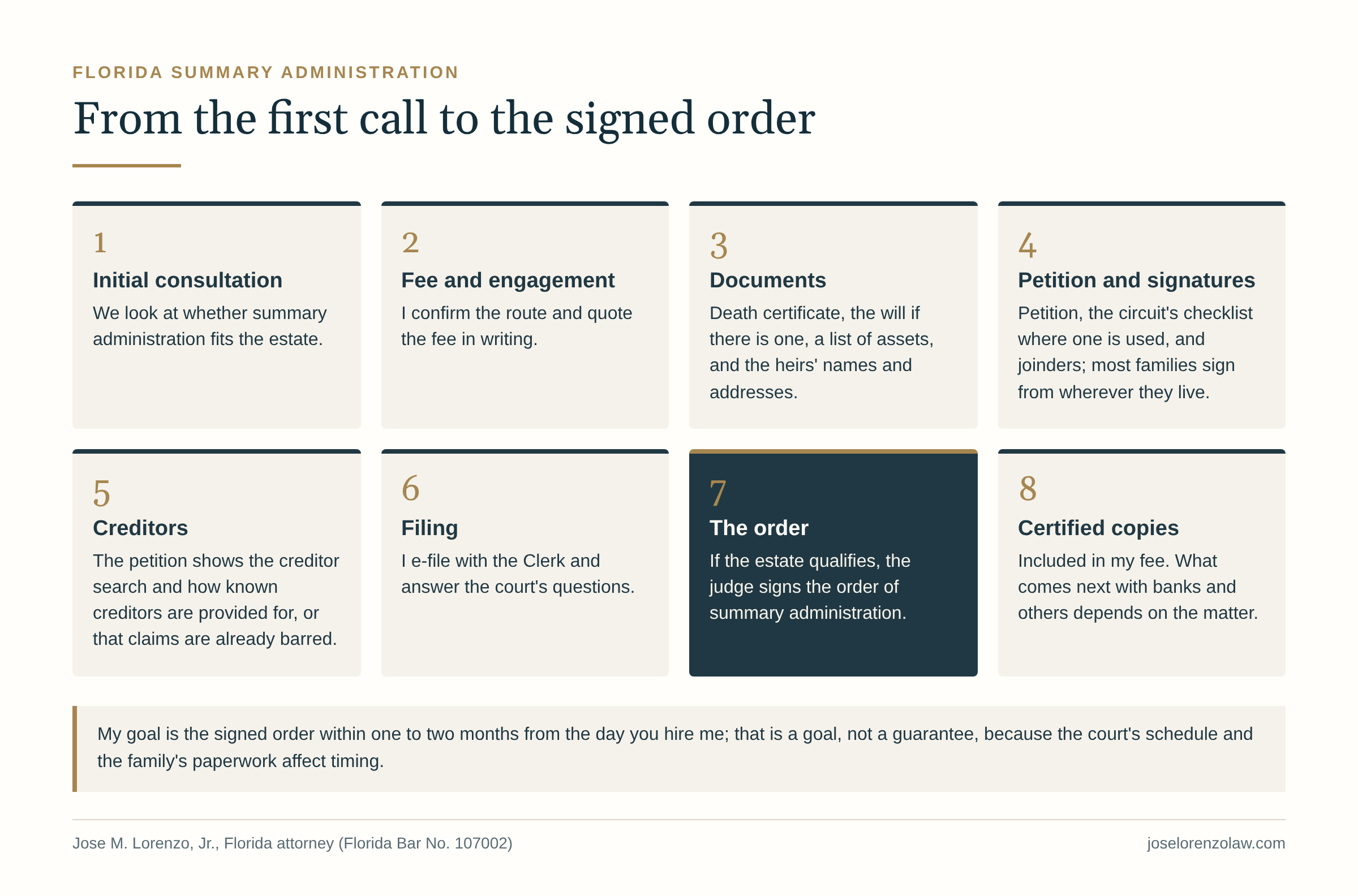
The steps, from first call to the order
| Step | What I do | What I need from you |
|---|---|---|
| 1. Initial consultation | Look at whether summary administration fits the estate. | A short description of the person, the assets and the family. |
| 2. Fee and engagement | Confirm the route and quote the fee in writing. | Your decision to hire me; the written fee agreement. |
| 3. Documents | Gather what the court needs. | The death certificate, the will if there is one, a list of assets, and the heirs’ names and addresses. |
| 4. Petition and signatures | Prepare the petition and the court’s checklist where the circuit uses one; arrange the signatures and joinders. | Signatures from everyone who must sign; most families sign from wherever they live. |
| 5. Creditors | The petition shows the creditor search and how known creditors are provided for, or that creditors’ claims are already barred. | Any bills, statements or letters from creditors you have. |
| 6. Filing | E-file with the Clerk and answer the court’s questions. | Quick answers if the court asks for something. |
| 7. The order | If the estate qualifies, the judge signs the order of summary administration. This is the milestone my fee and my timing goal are built around. | — |
| 8. Certified copies | Certified copies of the order are obtained; one is included in my fee, and additional certified copies are charged at the Clerk’s rate. What comes next with banks and others holding the property, and my part in it, depends on the matter and is discussed with you before work begins. | — |
What each step involves
The free initial consultation. We talk about who died, when and where, what the person owned and how each asset was titled, whether there is a will, who the heirs are, and whether anyone may disagree. From that, I can tell you whether summary administration looks like the right route or whether another route may fit better, and what I would charge. Only the initial consultation is free; representation fees and costs are agreed separately in writing.
The fee and the engagement. If you decide to hire me, I send a written fee agreement that sets out the flat fee, what it covers and what is quoted separately. Paid work begins once it is signed. Sending me documents before then doesn’t by itself make me your lawyer; I confirm the scope and fee before you hire me.
The documents. I tell you which documents I need and how to send them. Most families already have most of them; if something is missing, we work out together how to get it.
The petition and the signatures. I prepare the petition from those documents, along with the checklist the court uses where the circuit has one, and the joinders for family members who sign separately. Each person who signs receives the document with a short explanation of what it is. Family members who aren’t my clients can’t get legal advice from me, as the next sections explain.
The creditor search. I work through the creditor search with you: what bills, statements and letters have arrived, and what the person’s records show. When the person was 55 or older, that includes the Agency for Health Care Administration check described in the creditors section.
The filing. I e-file the petition through the Florida Courts E-Filing Portal and follow the case until the judge rules. If the court or the Clerk asks for a correction or more information, I handle it and tell you if anything is needed from you.
The order and the certified copies. When the judge signs the order, I let you know. One certified copy of the order is included in my fee; additional certified copies are charged at the Clerk’s rate.
The documents I prepare for the court
Depending on the estate, the papers I prepare usually include the petition for summary administration, joinders or consents for the family members who sign them, formal notice for any heir who is served instead of signing, formal notice of the petition to known creditors, the checklist or cover sheet the circuit uses, and a proposed order of summary administration. When a homestead determination is needed, I prepare that petition too; it is quoted separately as a flat fee before work begins.
What does a summary administration lawyer do?
As your summary administration attorney, I review whether the estate qualifies, prepare the petition, arrange the signatures, carry out the creditor search, e-file the case and answer the court’s questions until the judge signs the order. The petition shows the creditor search and how known creditors are provided for, or that creditors’ claims are already barred. The order of summary administration names who receives each asset, and banks and others holding the person’s property can rely on it. Summary administration is still a court proceeding, just a shorter one; no personal representative is appointed. What I do after the order depends on the matter, and I discuss it with you before work begins.
If you already have an order that a bank or title company won’t act on, or a petition that came back, my page on the order of summary administration explains what is going on and how I help.
Who I represent
I represent the person or people who hire me to file the petition. Other heirs who sign a joinder or consent are not my clients, and I can’t give them legal advice; they may wish to consult their own lawyer. If more than one person hires me, I explain the advantages and risks of joint representation before we begin.
How we stay in touch
I take every first call myself, and my phone is answered 24 hours a day. If you write through the contact form, you’ll hear back within 24 to 48 hours; please don’t attach documents there, and I’ll tell you how to send them. After that, we can talk by phone, Zoom or WhatsApp (I give the number on request), or meet in person by appointment. In Spanish, I explain the documents and each step; the documents themselves are in English, and a family that needs a full translation or an interpreter hires one.
What summary administration is usually used for
It is typically used for assets in the person’s sole name with no beneficiary designation, such as a bank or brokerage account, a car, or Florida real estate that is not protected homestead. Accounts with a named beneficiary, jointly owned accounts with survivorship rights and trust assets usually pass without it. How what counts toward the limit is decided is in my summary administration guide.
Some assets may not need a court case at all: a car can sometimes be retitled by affidavit without probate, and a Florida bank may pay up to $2,000 from a person’s sole-name accounts with no named beneficiary to a close family member, no earlier than six months after the death. See selling a car in Florida after a death and when probate is not necessary. I don’t handle those routes; I handle summary administration.
What I don’t handle
Summary administration is the only shortened probate route I offer; I don’t handle disposition without administration or the small-estate procedure, though this page explains both. I don’t offer Medicaid planning, real estate closings or title insurance, and I advise only on Florida law and Florida property, so property in another state needs a lawyer there. If the estate needs formal administration, guardianship for an heir or litigation, I handle those too, and each is quoted separately.
Who handles your summary administration
Florida Bar No. 107002; admitted October 4, 2013. I earned a B.A. in Accounting and Finance from Florida International University and my law degree from FIU College of Law. My background is on my bio page.
Do I have to go to court?
In many Florida courts, an uncontested summary administration is decided on the papers, without a hearing; practice varies by county, and the judge may set a hearing if there is an objection or a question about the petition.
Request a free initial consultation. Only the initial consultation is free; representation fees and costs are agreed separately in writing.
What Does a Summary Administration Lawyer Cost in Florida?
My flat fee for summary administration starts at $3,975. It includes my work on an uncontested matter, the court filing fee and one certified copy of the order; additional certified copies are charged at the Clerk’s rate. I don’t publish the optional notice to creditors in summary administration, so there is no publication cost. A homestead determination, when one is needed, is quoted separately as a flat fee before work begins. The quote can be higher for an estate that is more complex or difficult, for example many assets or assets that are hard to find or value, property in more than one county, creditor claims, or heirs who cannot be found or who disagree; I discuss any increase before work begins. The estate or the people who receive property may separately owe other expenses, such as recording fees for a deed or order, or the decedent’s debts. Contested work, for example an heir who objects, is quoted separately. I honor the fee shown on this page for at least 90 days after it last appears here.
My summary administration fee
| Item | My summary administration fee |
|---|---|
| Included | My work on an uncontested matter; the court filing fee; one certified copy of the order (additional copies at the Clerk’s rate) |
| Publication of the notice to creditors | I don’t publish the optional notice to creditors in summary administration, so there is no publication cost |
| Quoted separately | A homestead determination, as a flat fee before work begins; contested work |
| The quote can be higher | For a more complex or difficult estate; I discuss any increase before work begins |
| May be owed separately | Recording fees for a deed or order; the decedent’s debts |
| Fee honored | For at least 90 days after it last appears here |
What the written fee agreement covers
Before paid work begins, you sign a written fee agreement. It names who my client is, states the flat fee and what it includes, lists what is quoted separately, and explains how a change in the work is handled. Only the initial consultation is free; representation fees and costs are agreed separately in writing.
Is a homestead determination included?
A homestead determination, when one is needed, is quoted separately as a flat fee before work begins. When the house was the person’s protected homestead, title companies usually want a court order determining its homestead status before the heirs sell or refinance. I can request that order alongside the summary administration; it is quoted separately as a flat fee before work begins. The homestead section below explains when it comes up.
What can make the quote higher?
My summary administration fee is a flat fee, quoted in writing before work begins. The quote can be higher for an estate that is more complex or difficult, for example many assets or assets that are hard to find or value, property in more than one county, creditor claims, or heirs who cannot be found or who disagree; I discuss any increase before work begins. Contested work, for example an heir who objects, is quoted separately.
What else might the estate have to pay?
The estate or the people who receive property may separately owe other expenses, such as recording fees for a deed or order, or the decedent’s debts. I don’t publish the optional notice to creditors in summary administration, so there is no publication cost.
How much is the court filing fee for summary administration?
The Clerk of the Circuit Court charges a filing fee to open a summary administration: $235 for an estate valued at less than $1,000, and $345 for an estate valued at $1,000 or more, according to the Orange County Clerk’s August 2026 summary administration cover sheet. My flat fee includes the court filing fee, so you don’t pay it separately, and it includes one certified copy of the order; additional certified copies are charged at the Clerk’s rate. If you file without a lawyer, you pay the filing fee to the Clerk yourself when you file.
Who pays the attorney’s fee in a summary administration?
The person or people who hire me are responsible for my fee under our written fee agreement. In many cases the fee can be paid from the estate’s assets, if the petition and the court’s order provide for it; I explain the options before you sign.
How the flat fee works
You know the fee before work begins. I quote it in writing after the free initial consultation, based on what you’ve told me about the estate. Only the initial consultation is free; representation fees and costs are agreed separately in writing. If something turns up that changes the work, for example an asset nobody knew about, an heir who can’t be found or an objection, I tell you before doing more and quote it then. The fee is set by the work, not by a percentage of the estate.
Is your fee a percentage of the estate?
My fee is a flat fee, not a percentage of the estate. What it includes is set out above.
Request a free initial consultation. Only the initial consultation is free; representation fees and costs are agreed separately in writing.
How Long Does Summary Administration Take With Me?
I aim to have the order signed within one to two months from the day you hire me; that is a goal, not a guarantee, because the court’s schedule and the family’s paperwork affect timing. I start as soon as I’m hired. The time runs through the steps in the table above: gathering documents and signatures, the petition and the creditor information, the filing, and the court’s review until the judge signs the order.
What speeds it up or slows it down?
The things that change the timing are signatures and joinders from everyone who must sign, documents from another country, the court’s review of the petition and any checklist corrections it asks for, a homestead determination when one is needed, and an heir who can’t be found. The free initial consultation is where we look at which of these apply to your family. Only the initial consultation is free; representation fees and costs are agreed separately in writing.
How I keep the case moving
Most delays come from paperwork, so I start on the signatures and the creditor information at the same time as the petition, and I check the circuit’s checklist before filing. If a family member is slow to sign, I tell you, so you can decide how to handle it with them.
When can the family receive the money or the house?
My goal is the signed order: I aim to have the order signed within one to two months from the day you hire me; that is a goal, not a guarantee, because the court’s schedule and the family’s paperwork affect timing. The order of summary administration names who receives each asset, and banks and others holding the person’s property can rely on it. Summary administration is still a court proceeding, just a shorter one; no personal representative is appointed. My timing goal runs to the signed order. Each bank or other holder then releases or transfers the property under its own procedures; how long that takes is up to them, and my part in those steps depends on the matter and is discussed with you before work begins.
Does the Estate Qualify for Summary Administration in 2026?
Summary administration is available whether or not the person lived in Florida, when the value of the entire estate subject to administration in Florida, less property exempt from creditors’ claims, is $150,000 or less, or when the person has been dead for more than two years, whatever the value. If there is a will, it must not direct formal administration. My guide explains the $150,000 limit and what counts toward it.
What I check to confirm the estate qualifies
To confirm the route, I look at the date of death; each Florida asset, how it was titled and roughly what it is worth; which assets pass outside the estate, such as accounts with a named beneficiary; whether the house was protected homestead; whether there is a will and what it says about the kind of administration; and whether the person lived in Florida. Those answers decide whether the estate qualifies on its value, on the two-year ground, or not at all.
Does the $150,000 limit apply if the person died before July 1, 2026?
Whether the $150,000 limit applies when the person died before July 1, 2026 is not settled. The 2026 law took effect July 1, 2026, and as of November 18, 2026 I have found no Florida appellate decision on whether the limit depends on the date of death or the date the petition is filed. My guide covers deaths before July 1, 2026.
Can you help if the person died more than two years ago?
Yes. Summary administration is available when the person has been dead for more than two years, whatever the value. My guide explains the two-year route.
Does the house count toward the $150,000?
Protected homestead does not count toward the $150,000: it is not part of the estate subject to administration, and it is exempt from creditors’ claims. Other Florida real estate, such as a rental home or vacant land, does count. See Florida homestead probate.
What if the estate is a little over $150,000?
Then the value test isn’t met, unless the person died more than two years ago. But check what counts first: protected homestead does not count toward the $150,000, property exempt from creditors’ claims is subtracted, and assets with a named beneficiary or held jointly with survivorship rights usually pass without probate. If the estate is still over $150,000 and the death was within the last two years, summary administration isn’t available, and formal administration is usually needed. I can tell you which applies during a free initial consultation. Only the initial consultation is free; representation fees and costs are agreed separately in writing.
Can summary administration be used if there’s no will?
Yes. Summary administration can be used whether or not there is a will. If there is a will, it must not direct formal administration. Anyone who has the person’s original will must deposit it with the clerk of the court in the county where the estate will be handled within 10 days after learning of the death.
What changed on July 1, 2026
On July 1, 2026, chapter 2026-57, Laws of Florida, raised the summary administration limit in section 735.201 from $75,000 to $150,000. The Florida Supreme Court conformed Florida Probate Rule 5.530 to the new figure on July 16, 2026. Whether the new limit applies to deaths before that date is not settled.
Who Can File a Petition for Summary Administration, and Who Must Sign?
Any beneficiary, or a person nominated as personal representative in the will, may petition for summary administration. The surviving spouse and the beneficiaries must sign the petition, except that a beneficiary who receives a full share under the proposed distribution does not have to sign but must be served with formal notice. Known creditors must also be served. My guide explains who files.
What if one heir won’t sign or can’t be found?
If an heir who receives a full share under the proposed distribution won’t sign, that heir is served with formal notice instead. If an heir can’t be found, Florida’s service rules require a documented diligent search before other forms of notice can be used, and the court may appoint someone to protect the missing heir’s interest; this adds time and cost. An heir who would receive less than a full share must sign. If anyone objects, the matter becomes contested, and I quote contested work separately. See Florida probate litigation.
How joinders work in practice
A joinder is a short document in which a family member agrees to the petition. I prepare each joinder and send it with a plain explanation. Florida lets the petition and joinders be signed under penalty of perjury, so a notary is usually not needed. Signing a joinder doesn’t make that family member my client.
Can someone contest a summary administration?
Yes. A family member or another interested person can object to the petition, for example because they disagree with who should receive an asset, question the will, or think the estate doesn’t qualify. If anyone objects, the matter becomes contested, and I quote contested work separately. A contested matter may take longer, and some disputes may need formal administration or a separate court proceeding instead. See Florida probate litigation.
When an heir is a minor, has a guardian or has died
If an heir is a minor, the parents can generally receive the child’s inheritance only up to $15,000; above that, a court-appointed guardian of the property is usually needed. An adult heir who has a guardian acts through that guardian. I handle guardianship of minors and adults; see adult guardianship in Florida.
If an heir died after the person did, that heir’s share usually belongs to the heir’s own estate, which may need its own probate; I quote each estate separately.
I represent the person or people who hire me to file the petition. Who I represent explains what that means for the other heirs.
Families Out of State or Abroad
I handle summary administration statewide by phone or video, so no trip to Florida is needed to hire me. Most families sign from wherever they live. Summary administration moves only Florida property; property in another state goes through that state’s process. I advise only on Florida law and Florida property.
Can I sign from another state or another country?
Most families sign from wherever they live. Florida lets the petition and joinders be signed under penalty of perjury, so a notary is usually not needed; when a notarized document is needed, it can be signed online with a Florida online notary, or abroad before a U.S. consular officer or a local notary.
Do I need to come to Kissimmee, Coral Gables or Fort Lauderdale?
No. I handle summary administration statewide by phone or video. My principal office is in Kissimmee, and meetings in Coral Gables and Fort Lauderdale are by appointment if you want one.
What if the death certificate or other documents are from another country?
A death certificate or other record from another country may need certification, such as consular legalization or an apostille, and a translation, before a Florida court will accept it; what’s required depends on the document and how it is used. I can explain each document and step in Spanish; the documents themselves are in English, and a family that needs a full translation hires a translator.
Families abroad: what to expect
Families abroad usually need three things from me: a call time that works across time zones, a clear list of what each person must sign, and an early start on any document that needs certification or a translation. I raise those at the first call, because they set the pace of the case. We can talk by Zoom, WhatsApp or phone, whichever works best from where you are, and the documents can be sent and signed without a trip to Florida in most cases.
Request a free initial consultation. Only the initial consultation is free; representation fees and costs are agreed separately in writing.
What If the Person Lived Outside Florida but Owned Property Here?
If the person lived outside Florida but owned Florida property, a Florida proceeding is usually needed. Summary administration can be used when the estate qualifies. A shorter procedure in section 734.1025 is limited to cases with a will, Florida property worth $50,000 or less, and a filing by the personal representative from the other state within two years after the death.
If the person lived outside Florida and the estate qualifies for summary administration, the same fee and terms apply, after I review the facts. My flat fee for summary administration starts at $3,975. It includes my work on an uncontested matter, the court filing fee and one certified copy of the order; additional certified copies are charged at the Clerk’s rate. I don’t publish the optional notice to creditors in summary administration, so there is no publication cost. A homestead determination, when one is needed, is quoted separately as a flat fee before work begins. The quote can be higher for an estate that is more complex or difficult, for example many assets or assets that are hard to find or value, property in more than one county, creditor claims, or heirs who cannot be found or who disagree; I discuss any increase before work begins. The estate or the people who receive property may separately owe other expenses, such as recording fees for a deed or order, or the decedent’s debts. Contested work, for example an heir who objects, is quoted separately. I honor the fee shown on this page for at least 90 days after it last appears here. Ancillary formal administration is quoted per matter. See ancillary probate in Florida.
What I need when the person lived outside Florida
When the person lived in another state or country, I ask for the death certificate from where they died, the will and any probate opened there, and the records for the Florida property, such as the deed or the account statement. With those, I can tell you whether summary administration fits the Florida property and quote the fee.
Homestead, the Surviving Spouse and Summary Administration
When the house was the person’s protected homestead, title companies usually want a court order determining its homestead status before the heirs sell or refinance. I can request that order alongside the summary administration; it is quoted separately as a flat fee before work begins. Some courts will consider a homestead petition only within an open probate case. Protected homestead does not count toward the $150,000. See Florida homestead probate and surviving spouse rights in Florida.
Can we sell the house after summary administration?
Usually, yes, but if the house was the person’s protected homestead, the title company will usually want a court order on its homestead status first. I can request that order alongside the summary administration; it is quoted separately as a flat fee before work begins. See selling a house during probate.
Does the surviving spouse have to sign?
Yes. Florida law requires the surviving spouse, if there is one, to sign the petition. If an heir is a minor, the child’s court-appointed guardian signs for the child.
Creditors in a Summary Administration
Before the order, the petitioner must make a diligent search for creditors, serve known creditors with the petition, and provide for paying them to the extent the estate’s assets allow, unless all claims are already barred. People who receive property in a summary administration can be personally liable for their share of a valid claim that was not paid, up to the value of the non-exempt property each received, generally until two years after the death. A known creditor who was not notified can also recover attorney’s fees from those who signed the petition.
Florida law lets the people who receive property publish a notice to creditors after the order; if they do, claims of creditors who were unknown are generally cut off three months after first publication, instead of two years after the death. I don’t publish that notice in my summary administrations, so unless someone who receives property publishes it, the two-year period applies.
When the person was 55 or older, I check whether the Agency for Health Care Administration may have a Medicaid claim and give it notice when the creditor search calls for it.
What happens if a creditor appears after the order?
A creditor with a valid claim that wasn’t paid can pursue the people who received property, each for a share of the claim up to the value of what they received, generally within two years after the death.
Do the heirs have to pay the person’s debts?
Heirs are not responsible for the person’s debts beyond what they inherit. In a summary administration, though, each person who receives property can be personally liable for a share of unpaid valid claims, up to the value of what they received. See do you inherit debt in Florida.
After the Order: Banks, Real Property and Assets Found Later
After the judge signs the order, certified copies of it are obtained; one is included in my fee, and additional certified copies are charged at the Clerk’s rate. The order of summary administration names who receives each asset, and banks and others holding the person’s property can rely on it. My part in the steps that follow, such as sending copies to banks, depends on the type of matter, and I discuss it with you before work begins. If the house was protected homestead, the homestead section above explains the separate order a title company usually wants.
Using the order with banks and other holders
Each bank, brokerage or other holder has its own process for releasing property on the order. Some ask only for a certified copy; others also ask for their own forms or for identification from the person receiving the property. How long that takes is up to them, and my part in those steps depends on the matter and is discussed with you before work begins.
What if we find another asset after the order?
If another asset turns up after the order, an interested person can ask the court to reopen the case for further administration to cover it. I quote that work before it begins.
Money that turns up later may be held by Florida’s unclaimed-property program. See unclaimed property in Florida.
If summary administration turns out not to fit, for example because the assets are larger than expected or someone needs authority to collect assets or pursue a claim, formal administration may be needed instead.
Three Hypothetical Summary Administrations
These are hypothetical examples, not past cases or results. Every estate is different.
An heir out of state, a sibling’s joinder and remote signing.
Hypothetical: Ana lives in Texas. Her father lived in Orange County and died last year without a will, leaving a bank account and a car in his name, worth well under $150,000; Ana paid the funeral. Ana and her brother are his only heirs. Ana petitions for summary administration, listing the funeral bill and the results of the creditor search; her brother signs a joinder, and both sign remotely. After the judge signs the order, the bank releases the account on a certified copy.
A homestead house alongside a small account.
Hypothetical: Rosa’s husband died in Miami-Dade County. They had no children. The house was his protected homestead, and he left a $40,000 account. The house doesn’t count toward the $150,000. Rosa petitions for summary administration for the account and asks for an order determining the house’s homestead status.
A death more than two years ago.
Hypothetical: Mark’s father died in Broward County three years ago with an account worth $180,000 in his name and no will requiring formal administration. Because more than two years have passed, the estate can qualify for summary administration whatever its value, and most creditors’ claims are already barred.
When Is Summary Administration the Wrong Route?
Summary administration may not fit when the family needs someone with authority to collect assets or pursue a claim, when heirs disagree, or when the estate is over $150,000 and the death was within the last two years. Formal administration appoints a personal representative. Formal administration is compared with summary administration, with both fees, in the questions below. If the person lived outside Florida, see the nonresident section above; for disputes, see Florida probate litigation and Florida estate litigation.
Summary and formal administration side by side
| Item | Summary administration | Formal administration |
|---|---|---|
| Personal representative | None is appointed | One is appointed |
| How long, with me | My goal is the signed order within one to two months from the day you hire me; a goal, not a guarantee | Many uncontested formal administrations take roughly six months to a year |
| Notice to creditors | I don’t publish that notice in my summary administrations, so unless someone who receives property publishes it, the two-year period applies | Publication of the notice to creditors is included in my formal administration fee |
| My fee | Set out in the fee section | Set out in the comparison answer below |
Do you handle disposition without administration or the small-estate letter?
I don’t handle either; I handle summary administration. Disposition without administration under section 735.301 lets the court release a person’s personal property, without a full probate case, when the estate is only exempt property and property worth no more than the funeral and final medical expenses. The small-estate procedure in section 735.304 lets the heirs of a person who died without a will more than a year ago receive personal property worth up to $20,000, plus those expenses, through an affidavit and a court letter. See when probate is not necessary.
If you were looking for a small estate attorney, summary administration is the shortened probate procedure I handle.
Do I Need a Lawyer for Summary Administration in Florida?
Florida law does not require a lawyer for every summary administration. The probate rules require a personal representative to have a lawyer, unless the personal representative is the only person interested in the estate. Summary administration appoints no personal representative, so that requirement doesn’t apply, and a beneficiary who is an individual may file the petition without a lawyer. A company or other business beneficiary must act through a lawyer, and when someone signs for another person, such as a guardian, trustee or agent, additional rules apply. A lawyer helps most when there is real estate or a homestead, an heir who can’t be found or disagrees, creditor questions, or documents from another country. The 2026 change raised the limit but didn’t change who may file: a beneficiary may still file without a lawyer.
Free petition forms and online document services exist. What they leave to you is choosing the right procedure, valuing what counts toward the limit, getting the right signatures and formal notice, the creditor search, and answering the court’s checklist. I don’t publish fill-in forms. My guide explains filing without a lawyer and where petitions go wrong; see also do I need a probate attorney in Florida.
Questions to ask before filing on your own
Is there real estate or a homestead? Is any heir unwilling to sign, or hard to find? Are you unsure who all the creditors are? Are any of the documents from another country? A yes to any of these is where a lawyer helps most.
What the court checks before signing the order
Many Florida courts require a checklist to be filed with a summary administration petition, and local practice differs from county to county. Circuits that post a summary administration checklist include the Fifteenth Judicial Circuit (Palm Beach County), the Ninth (Orange and Osceola) and the Seventeenth (Broward). Checked on each circuit’s website on November 18, 2026.
What Should I Have Ready for the Initial Consultation?
- The date and place of death, and the death certificate if you have it. The court needs proof of the death, and the date matters for the two-year ground.
- The will, if there is one, and where the original is. Anyone who has the person’s original will must deposit it with the clerk of the court in the county where the estate will be handled within 10 days after learning of the death.
- A list of the assets, with approximate values and how each is titled. Titling decides what goes through summary administration and what passes without it.
- Whether there is a house, and who lives in it. The answer tells us whether a homestead determination may be needed.
- The names, relationships and addresses of the heirs. The surviving spouse signs; each other family member either signs or, if receiving a full share, may be served with formal notice instead.
- Any debts you know about, and any bills or letters from creditors. They are the starting point for the creditor search.
You don’t need all of these for the free initial consultation. Only the initial consultation is free; representation fees and costs are agreed separately in writing.
Request a free initial consultation. Only the initial consultation is free; representation fees and costs are agreed separately in writing.
How to Choose a Summary Administration Lawyer: Questions to Ask
Comparing summary administration law firms? These questions make quotes comparable:
- Is it a flat fee, and what does it include? Mine is a flat fee; what it includes and what is quoted separately are in the fee section.
- Is a homestead determination included? No; when one is needed, it is quoted separately as a flat fee before work begins.
- Who will handle my file? I handle each summary administration myself, from the first call to the order; my staff assists with the process.
- Can everything be done remotely? I handle summary administration statewide by phone or video, and most families sign from wherever they live.
- What would make the quote change? A more complex or difficult estate, or contested work; I discuss any increase before work begins.
- Who will you represent? I represent the person or people who hire me to file the petition.
You can also look up any Florida lawyer’s Bar status and discipline history on The Florida Bar’s website.
Where I Handle Summary Administration in Florida
My principal office is in Kissimmee, and meetings in Coral Gables and Fort Lauderdale are by appointment. I handle summary administration in every Florida county by phone or video. Local probate-court details are on my county guides, including Miami-Dade, Broward and Orange, and on my Florida probate service areas page.
A summary administration is filed in the Florida county where the person was domiciled; for someone who lived outside Florida, in a county where Florida property is located.
What differs from county to county
Three things vary locally. In many Florida courts, an uncontested summary administration is decided on the papers, without a hearing; practice varies by county, and the judge may set a hearing if there is an objection or a question about the petition. Many Florida courts require a checklist to be filed with a summary administration petition, and local practice differs from county to county. And some courts will consider a homestead petition only within an open probate case. My starting fee is the same in every Florida county.
Do you handle summary administration in Orlando and Seminole County?
Yes. I handle summary administration in Orlando and throughout Orange and Seminole counties, including Oviedo and Sanford, by phone or video. I don’t have an office in Orlando or Seminole County; my principal office is in Kissimmee. See my Orlando probate and Kissimmee probate pages and my Orange County probate court guide.
Do you handle summary administration in Miami-Dade and Broward?
Yes. Meetings in Coral Gables and Fort Lauderdale are by appointment, and the rest of the work is done by phone or video. My starting fee is the same in every Florida county. In Broward County, the circuit’s probate procedures still showed $75,000 when I last checked them on November 18, 2026; local forms can lag behind the statute, which now sets $150,000. See my Miami-Dade and Broward probate court guides.
Terms You’ll See in a Summary Administration
- Petition for summary administration: the document that asks the court for summary administration; it lists the assets, the people who receive them and the creditor information.
- Joinder (or consent): a short document in which a family member agrees to the petition.
- Formal notice: service of the petition by a method the probate rules allow. It goes to any heir who doesn’t sign (only an heir who receives a full share may be served instead of signing) and to the person’s known creditors.
- Diligent search for creditors: the petitioner’s search and reasonable inquiry for the person’s known creditors before the order; those creditors are served with the petition and provided for to the extent the estate’s assets allow.
- Order of summary administration: the court’s order naming who receives each asset; banks and others holding the person’s property can rely on it.
- Protected homestead: the person’s Florida home that qualifies as homestead under Florida law; it is not part of the estate the court administers and does not count toward the $150,000.
- Homestead determination: a court order determining the house’s homestead status, which title companies usually want before the heirs sell or refinance.
- Formal administration: the longer probate procedure, which appoints a personal representative.
- Personal representative: the person the court appoints in formal administration; summary administration appoints none.
- Ancillary administration: the usual Florida probate for someone who lived outside Florida but owned Florida property.
Frequently Asked Questions
What is summary administration in Florida?
Summary administration is available whether or not the person lived in Florida, when the value of the entire estate subject to administration in Florida, less property exempt from creditors’ claims, is $150,000 or less, or when the person has been dead for more than two years, whatever the value. If there is a will, it must not direct formal administration. Summary administration is still a court proceeding, just a shorter one; no personal representative is appointed. My summary administration guide explains how it works.
Summary administration or formal administration: which do I need?
Summary administration may not fit when the family needs someone with authority to collect assets or pursue a claim, when heirs disagree, or when the estate is over $150,000 and the death was within the last two years. Formal administration appoints a personal representative.
Summary administration: My flat fee for summary administration starts at $3,975. It includes my work on an uncontested matter, the court filing fee and one certified copy of the order; additional certified copies are charged at the Clerk’s rate. I don’t publish the optional notice to creditors in summary administration, so there is no publication cost. A homestead determination, when one is needed, is quoted separately as a flat fee before work begins. The quote can be higher for an estate that is more complex or difficult, for example many assets or assets that are hard to find or value, property in more than one county, creditor claims, or heirs who cannot be found or who disagree; I discuss any increase before work begins. The estate or the people who receive property may separately owe other expenses, such as recording fees for a deed or order, or the decedent’s debts. Contested work, for example an heir who objects, is quoted separately. I honor the fee shown on this page for at least 90 days after it last appears here.
Formal administration: My flat fee for uncontested formal administration starts at $7,975. It covers my legal work and includes the court filing fee, publication of the notice to creditors and certified copies. The estate may separately owe other expenses, such as a personal representative’s bond if the court requires one. Florida law also entitles the personal representative to compensation from the estate, unless the personal representative waives it; that compensation is separate from my fee and is not paid to me. The quote can be higher for an estate that is more complex or difficult, for example many assets or assets that are hard to find or value, property in more than one county, creditor claims, or heirs who cannot be found or who disagree; I discuss any increase before work begins. Contested work is quoted separately. I honor the fee shown on this page for at least 90 days after it last appears here. Many uncontested formal administrations take roughly six months to a year. See my Florida probate page.
Are consultations available in Spanish?
Yes. Consultations are available in English and Spanish. In Spanish, see probate in Florida (in Spanish).
Is there an office near me?
My principal office is in Kissimmee, and meetings in Coral Gables and Fort Lauderdale are by appointment. I handle summary administration statewide by phone or video, so you don’t need to be near an office.
Talk to Me About a Summary Administration
Use the contact form to send your name, the name of the person who died and the county where they lived; please don’t attach documents there, and I’ll tell you how to send them. I’ll then tell you whether summary administration may fit, what it would involve and what it would cost, all before you hire me. I take that first call myself, and my phone is answered 24 hours a day. If summary administration fits, I send a written quote and fee agreement; paid work begins only once you sign it. If it doesn’t fit, I tell you which route may, and what that route involves.
Request a free initial consultation. Only the initial consultation is free; representation fees and costs are agreed separately in writing.
Request a free initial consultation·Call (305) 224-6811
My principal office is in Kissimmee, and meetings in Coral Gables and Fort Lauderdale are by appointment. I handle summary administration throughout Florida by phone or video. Consultations are available in English and Spanish.
This page provides general information about Florida law, not advice about a particular estate or situation. Reading it or requesting a consultation does not create an attorney-client relationship.
Sources
Florida statutes and rules (linked to the Florida Senate’s current statutes and The Florida Bar’s current Florida Probate Rules; each link checked on build day to resolve to the 2026 text, O-11): §§ 92.50, 92.525, 117.265, 319.28, 409.9101, 731.201, 732.101, 732.901, 733.101, 733.2121, 733.402, 733.617, 734.102, 734.1025, 735.201, 735.203, 735.206, 735.2063, 735.301, 735.303, 735.304, 744.301; Fla. Prob. R. 5.020, 5.030, 5.040, 5.460, 5.530; chapter 2026-57, Laws of Fla. (cited without a link; O-11: the session-law link was not confirmed, and the Senate’s 2026 text of § 735.201 shows the change and cites s. 7, ch. 2026-57).
Official court sources (each with the date checked): summary administration checklists of the Ninth, Fifteenth and Seventeenth Judicial Circuits; Seventeenth Circuit (Broward) local probate procedures; Orange County Clerk summary administration cover sheet (August 2026); all checked November 18, 2026.