
Do I Need a Probate Attorney in Florida? When the Law Requires One and When It Doesn’t
Do I Need a Probate Attorney in Florida? When the Law Requires One and When It Doesn’t
Do I need a probate attorney in Florida? In a formal administration, generally yes: under Florida Probate Rule 5.030, the personal representative must be represented by a lawyer admitted in Florida, unless the personal representative remains the sole interested person or is a Florida attorney.
Whether you need a probate lawyer in Florida also depends on your role and the route. Summary administration and the small-estate procedures do not carry that requirement, a beneficiary is never required to hire one, and the personal representative’s lawyer does not represent each beneficiary individually. This guide answers the question role by role, for the personal representative, a beneficiary or heir, a family filing summary administration, an out-of-state relative and anyone facing a dispute. With Lorenzo Law, summary administration costs from $3,975 and uncontested formal administration from $7,975, as flat fees. The summary administration fee includes the court filing fee and one certified copy of the order, with additional certified copies charged at the Clerk’s rate; the formal administration fee includes the court filing fee, publication of the notice to creditors and the certified copies the matter needs. Jose does not publish the optional notice to creditors in summary administration, so his fee there includes no publication cost. For either procedure, homestead determinations, more complex estates and contested matters are quoted separately, and other expenses may apply, such as recording fees or the decedent’s debts, and in formal administration a personal representative’s bond if the court requires one and the personal representative’s compensation; any increase is discussed before work begins. Full fee terms: summary and formal administration fees.
Request a free initial consultation. Only the initial consultation is free; representation fees and costs are agreed separately in writing.
Request a free initial consultationCall (305) 224-6811
Consultations by phone or video in English or Spanish, for estates in any Florida county; meetings by appointment in Coral Gables or Fort Lauderdale. Lorenzo Law’s principal office is in Kissimmee.
Go straight to: What the law requires · Route finder · Probate without a lawyer · Cost · More questions
By role: if you were named executor or personal representative, start with the personal representative’s question; if you inherit, with beneficiaries and heirs; if the estate is small, with summary administration; if you live in another state, with out-of-state families; if someone is challenging the will or the executor, with disputes.
Statewide · Rule 5.030 · Personal representatives and beneficiaries · Summary administration · Published flat fees · English and Spanish
All guide sections 23 sections
When you need a probate lawyer in Florida: at a glance
Short answer. This overview compares the estate-administration routes discussed in this guide. Florida requires a lawyer for one person in one kind of case: the personal representative in a formal administration, with two exceptions. Everyone else decides whether legal help is worth it for their situation. A lawyer is most useful when there is real estate or homestead, unpaid debts, a spouse or minor with rights, a family member who disagrees, a deadline in court papers, or an heir who lives outside Florida.
| Personal representative, formal administration | Lawyer required (Rule 5.030), unless the personal representative remains the sole interested person or is a lawyer admitted in Florida. What the rule requires |
|---|---|
| Summary administration | No lawyer required; the petition still has to meet the statute’s conditions, and no personal representative is appointed. Summary administration |
| Very small estates | Disposition without administration and the other small-estate procedures do not require a lawyer; each has narrow conditions. Settling an estate without probate |
| Beneficiary or heir | Never required to hire a lawyer; the personal representative’s lawyer does not represent beneficiaries individually. Beneficiaries and heirs |
| Out-of-state family | Living elsewhere does not change the representation rule, but it raises a separate question: who may serve as personal representative. Out-of-state families |
| Dispute or court papers | Separate deadlines can run from service of court papers; get advice before the deadline, not after. Disputes |
| Lorenzo Law’s flat fees | Summary administration from $3,975: filing fee and one certified copy of the order included; additional copies at the Clerk’s rate; no publication cost (Lorenzo Law does not publish the optional notice to creditors). Uncontested formal administration from $7,975: filing fee, creditor-notice publication and certified copies included. Ancillary administration quoted per matter; hourly review and advice available. For either procedure, homestead determinations, more complex estates and contested matters are quoted separately, and other expenses may apply, such as recording fees or the decedent’s debts, and in formal administration a personal representative’s bond if the court requires one and the personal representative’s compensation; any increase is discussed before work begins. Full fee terms: summary and formal administration fees. Cost |
Do I need a probate attorney in Florida?
If you will serve as personal representative in a formal administration, Florida generally requires you to have a Florida-licensed lawyer. If the estate qualifies for summary administration or one of the small-estate procedures, you may file without a lawyer. If you are a beneficiary or heir, the question is not whether the law requires a lawyer but whether your interests need someone looking out for them alone.
People ask it as “do I need a probate lawyer in Florida,” “do I need a lawyer for probate in Florida” or “is a lawyer required for probate in Florida.” The honest answer has two parts. The first is legal: what Florida’s rule requires of a particular person in a particular proceeding. The second is practical: what can go wrong in this estate and who would be responsible for it.
The 30-second check
- Is anything in the decedent’s sole name, or held with a co-owner without survivorship rights, or payable to a beneficiary who did not survive? If not, the estate may need no probate at all. Settling an estate without probate
- Will someone be appointed personal representative? That happens in a formal administration, and the representation rule applies to that person. The rule
- Is the estate small or was the death more than two years ago? Summary administration may be available, without the representation rule. Summary administration
- Are you a beneficiary rather than the person in charge? Read beneficiaries and heirs.
- Has anyone been served with court papers or objected? Read disputes today.
The route finder below asks these questions in order and shows which part of this guide applies.
When does Florida law require a probate lawyer?
Florida Probate Rule 5.030(a) provides that every guardian and every personal representative, unless the personal representative remains the sole interested person, must be represented by an attorney admitted to practice in Florida. A guardian or personal representative who is an attorney admitted to practice in Florida may represent himself or herself as guardian or personal representative. The rule is about the personal representative, not about every relative or beneficiary.
The personal representative is the person the court appoints, in a formal administration, to collect the estate’s assets, deal with creditors and distribute what is left; many people still call that person the executor. The court’s letters of administration give the personal representative authority to act; being named in a will is not the same as being appointed. Because the personal representative acts for everyone with an interest in the estate, the rule requires that person to have a Florida lawyer. The size of a bank account or the presence of a house does not, by itself, trigger the rule. The proceeding does.
What does “sole interested person” mean in Florida probate?
An interested person is anyone who may reasonably be expected to be affected by the outcome of the particular proceeding involved, and the statute says the meaning can vary from time to time and must be determined by the particular purpose of the proceeding (section 731.201(23)). So the question is not who is named in the will. It is who could be affected by what the court is being asked to do now. Depending on the proceeding, that can include beneficiaries, heirs, a surviving spouse with statutory rights, and creditors whose claims are not resolved.
Is the only beneficiary always the sole interested person?
No, and this is the most common misunderstanding. AI answers and many websites describe the exception as “the sole beneficiary.” The rule’s words are that the personal representative must remain the sole interested person; a sole beneficiary is not the sole interested person while, for example, a creditor’s claim is unresolved, a spouse has rights to assert or someone else claims a share. Because the answer can change as the case moves, check it before relying on the exception, and again if a creditor or claimant appears.
Can a lawyer serve as personal representative without hiring another lawyer?
Yes, if the lawyer is admitted to practice in Florida: Rule 5.030(a) lets a personal representative who is a Florida attorney represent himself or herself. A relative licensed only in another state does not qualify for that provision; that person would need Florida counsel to serve in a formal administration unless the sole-interested-person exception applies. A lawyer may also be named as personal representative in a will, a question people ask as “can a lawyer be an executor.”
Can a family member represent the estate or the other heirs?
A personal representative who is not a Florida lawyer must have a Florida lawyer unless he or she remains the sole interested person, and a nonlawyer cannot represent the estate, the other beneficiaries or a relative in court. When siblings want one of them to “handle the paperwork for everyone,” that sibling can serve as personal representative, and the rule then requires a Florida lawyer for that role in a formal administration.
Consultations and limited help
A consultation does not make a lawyer the attorney of record. Rule 5.030 lets an attorney of record limit an appearance to particular proceedings or matters by filing a notice, but in a formal administration the personal representative still needs counsel of record for the proceedings the rule covers. Outside that requirement, limited help is common: Lorenzo Law can be hired by the hour to review documents or give advice, with the scope and rate agreed in writing.
Rule text: Florida Probate Rules, Rule 5.030; definition: section 731.201(23), Florida Statutes.
Do I need a probate lawyer if there is no will?
The rule is the same with or without a will: if a formal administration is opened, the personal representative needs a Florida lawyer unless an exception applies. Without a will, more people are usually interested, because the estate passes to heirs under Florida’s intestacy statutes, so the sole-interested-person exception is less likely to fit.
When there is no will, the court appoints a personal representative using the statute’s order of preference: the surviving spouse, then a person selected by a majority in interest of the heirs, then the heir nearest in degree (section 733.301). If the Florida estate subject to administration, less property exempt from creditors, is worth $150,000 or less, or the death was more than two years ago, summary administration may be available instead, and it does not require a lawyer. A probate without a will still ends with a court order or a personal representative’s deed or distribution, so title companies and banks will look for one of those documents.
Common follow-ups: who inherits when there is no will (the spouse and descendants, then parents, then siblings, in the statute’s order), whether a stepchild inherits (not by intestacy unless adopted), and whether a house titled only to the decedent can be sold before probate (generally not, unless it passed outside probate or a court order gives authority). The Florida probate guide covers who inherits in detail.
Find your situation: who needs a lawyer, role by role
Probate questions change with the person asking. Find your row, then read the section it points to.
Role-by-role guide
| Your situation | Lawyer required? | When advice matters most | Read |
|---|---|---|---|
| Named executor; formal administration needed | Yes, unless you remain the sole interested person or are a Florida attorney | Before filing; before paying creditors or distributing | Personal representative |
| Only beneficiary, wants to serve | Depends on whether you remain the sole interested person | Unresolved debts, a spouse, a competing claim | Sole interested person |
| Family filing summary administration | No | Real estate, homestead, creditors, a beneficiary who will not sign | Summary administration |
| Beneficiary or heir | No | A release to sign, an accounting, delay, a missing asset | Beneficiaries and heirs |
| Relative living outside Florida | Same rule as anyone else | Whether you qualify to serve; where to file | Out-of-state families |
| Will contest, objection, removal or caveat | Not for every participant, but deadlines are short | As soon as papers are served | Disputes |
| Creditor owed money by the decedent | Not to file a claim | Before the claim deadline | Debts and creditors |
| Assets with a surviving beneficiary, a joint owner with survivorship rights or a funded trust | Often no probate at all | When the institution asks for letters | Without probate |
Chart: do you need a probate lawyer, by role
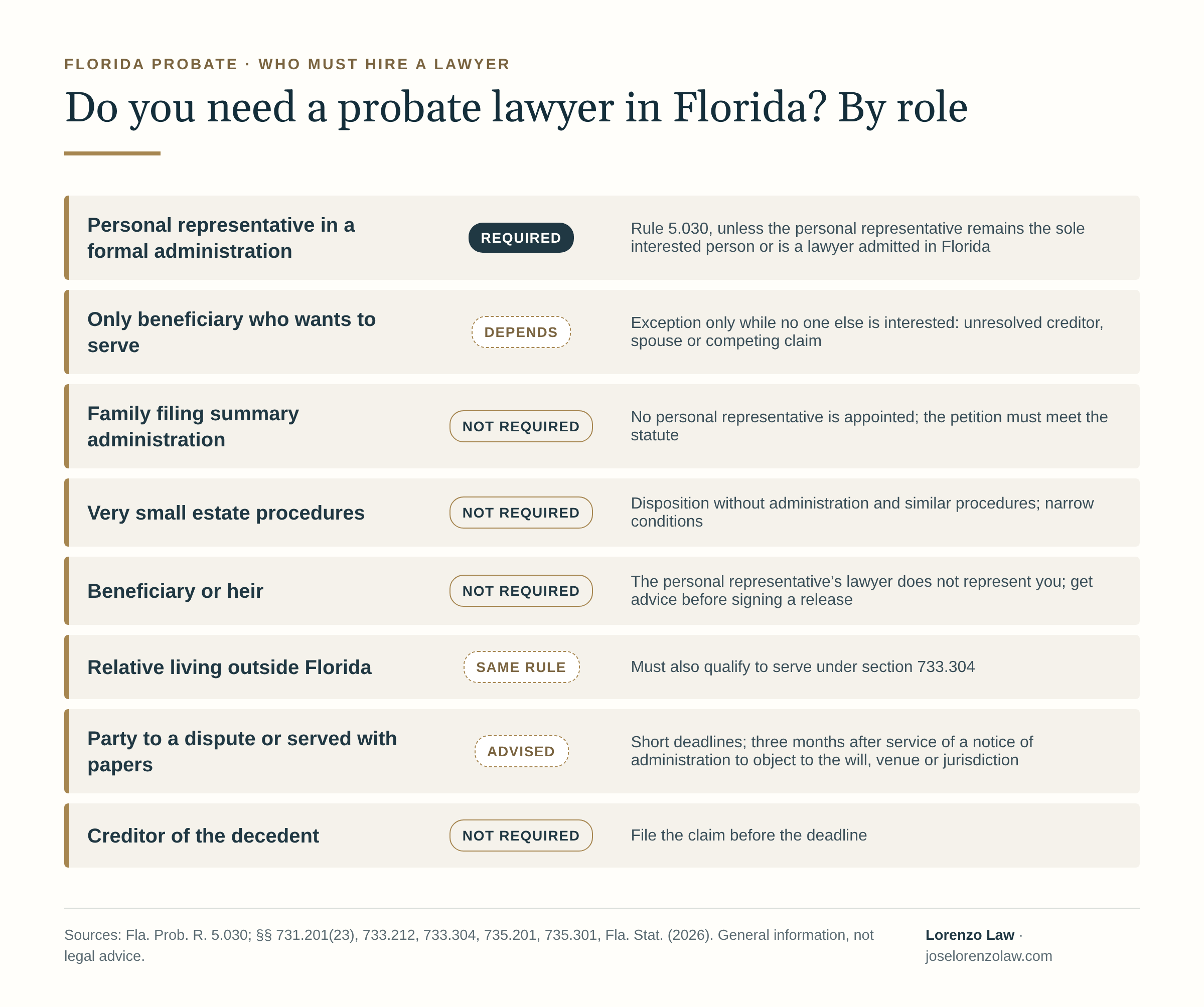
See the chart “Do you need a probate lawyer in Florida? By role” (opens the full-size image)
Does an executor or personal representative need a lawyer in Florida?
Does an executor need a lawyer, and do I need a lawyer to become executor of an estate? In a formal administration, yes, unless one of Rule 5.030’s two exceptions applies. The personal representative is the person the court holds responsible for the estate, and the lawyer’s client is that person in that role. Executor and personal representative are the same role; Florida law uses the term personal representative.
The personal representative is a fiduciary who must observe the standards of care that apply to trustees, settle and distribute the estate as efficiently as is consistent with the best interests of the estate, and is liable to interested persons for damage or loss caused by breaching those duties (sections 733.602 and 733.609). That is why the law insists on counsel, and why personal representative liability is the first thing to understand: decisions about which creditors to pay, what to sell, when to distribute and how to treat homestead carry personal consequences.
What the personal representative’s lawyer handles
Opening the estate (petition, oath, designation of a resident agent, bond questions), the notice of administration, the creditor search and the published notice to creditors, objections to claims, the inventory, homestead determinations, sales and court approvals, the accounting, distributions and the discharge. The inventory is due within 60 days after letters are issued, under Rule 5.340. The stage-by-stage table below shows the work in order.
Can I be the executor and a beneficiary?
Yes. A beneficiary may serve as personal representative if qualified, and many do. Serving and inheriting are separate roles: the personal representative owes duties to every interested person, including the other beneficiaries, and cannot favor his or her own share. When a will names two executors, both can serve as co-personal representatives; they may share one lawyer, and Rule 5.030’s representation requirement applies to them in a formal administration.
Does hiring a lawyer protect the personal representative from liability?
Not by itself. Having a lawyer does not transfer the personal representative’s fiduciary duties to the lawyer, and a personal representative remains responsible for his or her own decisions. What a lawyer does is reduce the decisions made without information: which claims are valid, what the priority of payment is, when distribution is safe, and what the court must approve.
Can a personal representative be removed or sued?
Yes. An interested person can petition to remove a personal representative on statutory grounds, such as failing to perform duties or mismanaging the estate, and a personal representative who breaches fiduciary duties can be surcharged for the loss (sections 733.504 and 733.609). To pursue a personal representative in Florida for a breach of duty, an interested person ordinarily files a petition in the probate proceeding to remove or surcharge the personal representative; this is an adversary proceeding requiring formal notice, and after the personal representative is discharged, later actions are generally barred. If you have been named and someone is already unhappy, get advice before acting. See Florida probate litigation.
Being named in a will is the start. The steps to be appointed are in how to become a personal representative in Florida; deadlines are in Florida probate rules and deadlines.
Do beneficiaries need their own probate lawyer?
Not usually, and never because the law requires it. A beneficiary or heir may receive notices, review the inventory and accounting, and receive a distribution without a lawyer. Separate advice matters when the beneficiary is asked to sign something, questions the accounting or the personal representative’s conduct, or believes an asset or a share is missing.
Does the estate’s probate lawyer represent the beneficiaries?
No. In a formal administration, the probate lawyer’s client is the personal representative, not the beneficiaries individually, even though the lawyer’s fee is paid from the estate (In re Estate of Gory, 570 So. 2d 1381 (Fla. 4th DCA 1990)). The lawyer still owes the beneficiaries certain fiduciary duties, but they are not the lawyer’s clients. Florida’s fiduciary lawyer-client privilege statute treats the personal representative as the client for privilege purposes (section 90.5021). Sending notices to beneficiaries, answering their questions or sharing documents does not make them clients. Ask plainly: “Do you represent me, or the personal representative?”
What rights does a beneficiary have in Florida probate?
Beneficiary rights in Florida probate are set by statute and the rules. Beneficiaries are entitled to be served with the notice of administration and, if they are residuary beneficiaries or heirs, with the inventory; they may ask the court to review the personal representative’s compensation, and may petition to remove a personal representative who fails to perform. A beneficiary or other interested person may object to the personal representative’s final accounting or petition for discharge within 30 days after being served with the later of the two, and the objections are treated as abandoned if a hearing on them is not noticed within 90 days after filing (Rule 5.401). Many beneficiaries never need more than that. The rights matter most when information stops coming.
When a beneficiary needs independent advice
- A release, waiver or receipt to sign. Understand what you give up before you sign, especially a release of the personal representative.
- An accounting that does not add up, or fees and compensation that look high.
- Delay without explanation, or a personal representative who stops answering.
- A missing asset, a transfer shortly before death, or a will you believe is not the last one.
- Court papers served on you, including a notice of administration, which starts deadlines for some objections.
People who search for a lawyer for inheritance or an inheritance attorney usually need exactly this kind of independent help. Lorenzo Law can act as a beneficiary attorney on the beneficiary’s own matter, as a paid engagement, for example a review of an accounting or a proposed release, separate from the personal representative’s lawyer. Independent advice does not have to mean a lawsuit; often it means a careful review and a letter.
Who pays a beneficiary’s lawyer?
Ordinarily the beneficiary pays his or her own lawyer. The court can award attorney fees from the estate to a lawyer whose services benefited the estate, and in some proceedings can assess fees against a party’s share, but that is decided case by case and is not a promise at the start (section 733.106). The personal representative’s lawyer, by contrast, is paid from the estate as an administration expense.
Can an executor shortchange a beneficiary in Florida?
A personal representative who favors one beneficiary, delays without reason, mixes estate money with personal money or sells property below value breaches fiduciary duties and can be removed and held liable for the loss. Beneficiaries who suspect this should ask for the inventory and accounting in writing first; the response usually shows whether there is a real problem. See the Florida estate disputes guide.
Do I need a lawyer for summary administration in Florida?
No. Florida does not require a lawyer for summary administration, and no personal representative is appointed in it; the court enters an order distributing the assets. The petition must still meet the statute’s conditions, and the court can return a petition that does not.
What qualifies for summary administration in 2026?
For summary administration, $150,000: the Florida assets subject to administration, less property exempt from creditors, must be worth no more than $150,000, unless the death was more than two years ago, and any will must not direct formal administration. Chapter 2026-57 raised the limit from $75,000, effective July 1, 2026.
A petition for summary administration may be filed at any stage of the administration if the estate would qualify at the time the petition is filed (section 735.2055). Several AI answers and older pages still give $75,000, the limit before July 1, 2026.
The petition may be filed by any beneficiary or by the person nominated as personal representative in the will offered for probate; it must be signed and verified by the surviving spouse, if any, and the beneficiaries, except that a beneficiary who will receive a full distributive share need not join, but must be served with formal notice of the petition (section 735.203). Before the order is entered, the petitioner must make a diligent search and reasonable inquiry for known or reasonably ascertainable creditors, serve them with the petition, and make provision for paying them to the extent assets are available (section 735.206).
When a lawyer still helps in a summary administration
Issues to check before filing include: the asset list includes property that does not belong in probate, the homestead is not handled correctly, a creditor is overlooked, a beneficiary does not sign and is not served, or the proposed order does not describe the assets the way a bank or title company needs. A house is the usual reason families call: real estate can pass in a summary administration, but the order must describe it correctly, and protected homestead is determined separately from the property that is administered. For the full route, costs and timeline see the Florida summary administration guide.
If you plan to file yourself, Lorenzo Law can be hired by the hour to review the petition and the proposed order before filing, with the scope and rate agreed in writing.
Can an estate be settled without probate in Florida?
Sometimes. Assets in a joint bank account or held under a deed that expressly provides for survivorship, assets with a valid beneficiary, payable-on-death or transfer-on-death designation, and assets titled in a funded revocable trust generally pass outside probate, unless no named beneficiary or co-owner survives; trust assets can still be reached for estate debts if the probate estate is not enough. If every asset passed outside probate and there are no claims to resolve, there may be no probate and no lawyer requirement at all; that is the usual answer to “do I need a lawyer to settle an estate” when everything had a beneficiary.
Is probate required in Florida with a will, and is probate necessary at all? A will does not avoid probate by itself; it tells the court who receives the probate assets. Can probate be avoided in Florida? For assets you own now, often yes, by beneficiary designations, joint ownership with right of survivorship, an enhanced life estate (“Lady Bird”) deed or a funded revocable trust, although a deed on a homestead can raise separate spousal-rights questions; see Florida estate planning. Exempt property, such as household furniture and up to two motor vehicles within the statute’s limits, is a separate concept: it is protected from creditors, but it is not the same as an asset that passes outside probate (section 732.402). See Florida non-probate assets and assets exempt from probate.
Disposition without administration
Disposition without administration under section 735.301 is for estates made up only of exempt personal property, personal property exempt from creditors under the Florida Constitution, and non-exempt personal property worth no more than the preferred funeral expenses and the reasonable and necessary medical and hospital expenses of the last 60 days of the last illness. It does not transfer real estate. Section 735.304 is a separate procedure for an intestate estate of personal property only, when the decedent has been dead more than one year and no administration is pending: non-exempt personal property may not exceed $20,000 plus preferred funeral and last-60-days medical expenses, an heir files a verified affidavit after a diligent creditor search, and the affidavit is served on non-joining heirs, known creditors and, if the decedent was over 55, the Agency for Health Care Administration. Neither procedure requires a lawyer.
Is there a small estate affidavit in Florida?
Florida’s no-court shortcuts are narrow and asset-specific. A Florida bank may pay up to $2,000 in the decedent’s sole-name accounts, without a payable-on-death designation, to a listed family member by affidavit no earlier than six months after death (section 735.303), and an heir may retitle a motor vehicle by affidavit in some cases (section 319.28). For bank accounts, see a deceased person’s bank account in Florida.
Chart: Florida probate routes and whether a lawyer is required
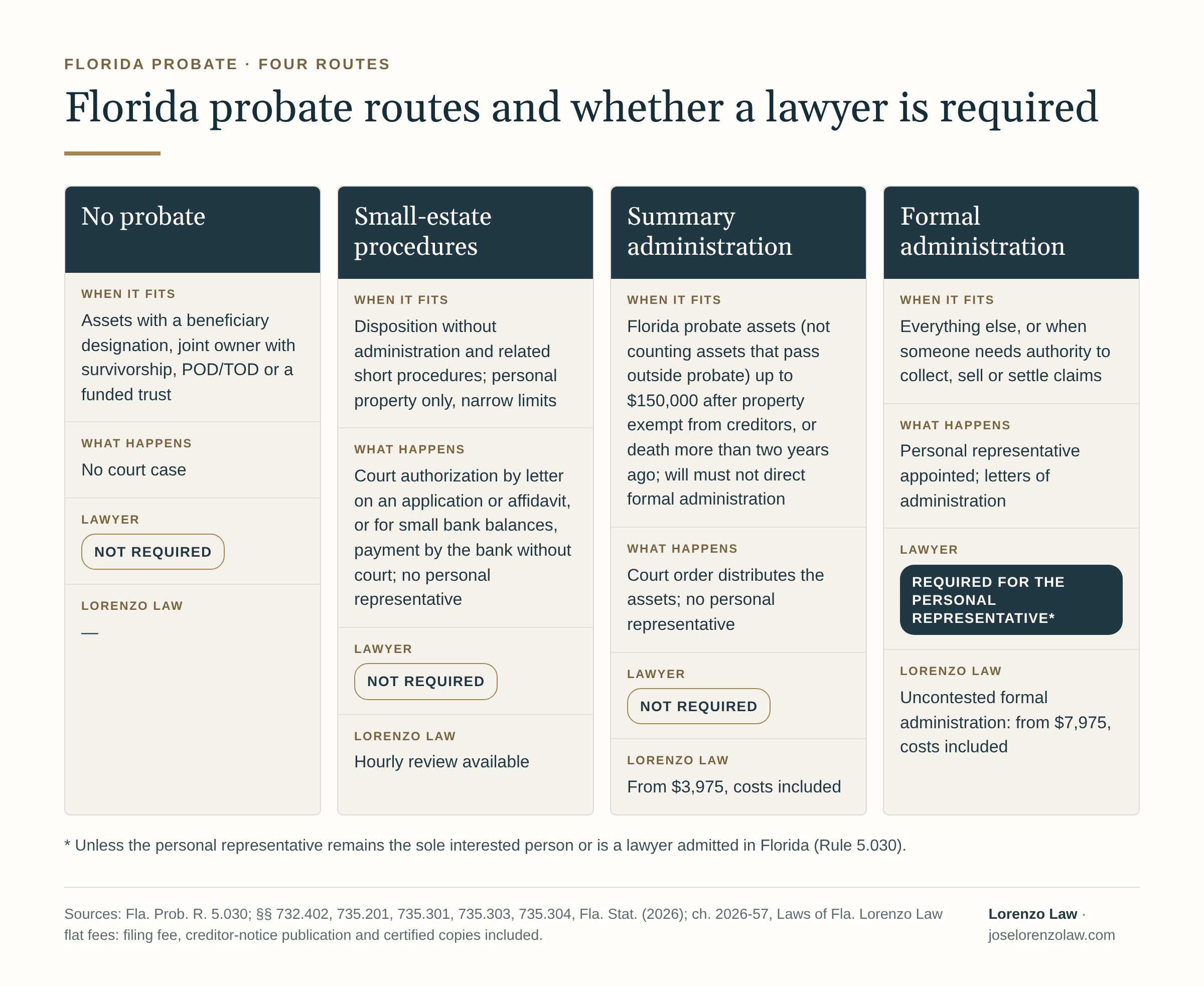
See the chart “Florida probate routes and whether a lawyer is required” (opens the full-size image)
Do I need a Florida lawyer if I live out of state?
Living outside Florida does not create a separate rule: an out-of-state personal representative in a formal administration needs a Florida lawyer for the same reason a resident does, and the same exceptions apply. A lawyer licensed only in your home state cannot appear in the Florida probate court for you. The separate question is whether you may serve at all.
Who can serve as personal representative if they live outside Florida?
A person who is not domiciled in Florida can serve only if related to the decedent in one of the ways section 733.304 lists: a legally adopted child or adoptive parent; a relative by lineal consanguinity (children, grandchildren, parents, grandparents); a spouse, brother, sister, uncle, aunt, nephew or niece, or someone related by lineal consanguinity to any of them; or the spouse of a person who is otherwise qualified. A first cousin by blood who lives in another state can qualify, because a first cousin is related by lineal consanguinity to the decedent’s aunt or uncle; relatives by marriage do not qualify through that route. A friend or a non-relative living elsewhere cannot. Where the decedent died does not decide the question.
Do I have to travel to Florida for probate?
Ask about travel, signing and original-document requirements for the particular matter. Lorenzo Law works with clients statewide by phone or video, in English or Spanish. The original will must be deposited with the clerk. See serving as an out-of-state executor in Florida.
When the decedent lived in another state but owned Florida property
When the decedent lived in another state, Florida property in the decedent’s name usually needs an ancillary administration in Florida (section 734.102). If the decedent left a will and the Florida property is worth $50,000 or less, the out-of-state personal representative may use a shorter procedure within two years after death (section 734.1025), and summary administration is also available for a nonresident’s Florida estate that qualifies (section 735.201). See ancillary probate in Florida.
Do I need a lawyer if the will or the estate is disputed?
A dispute is where legal help matters most, because the deadlines are short and some cannot be extended. A person served with a notice of administration has three months after service to object to the will’s validity, venue or the court’s jurisdiction, and in any event no later than the earlier of the personal representative’s discharge or one year after service (section 733.212).
Disputes come in several forms, and a lawyer for an inheritance dispute may be needed in any of them: a will contest, an objection to the personal representative, a petition to remove a personal representative, an objection to an accounting, a request that the court review compensation, a claim to homestead or to an elective share, and a fight among siblings over selling the family home. Anyone who wants legal advice in the dispute needs his or her own lawyer; the personal representative’s lawyer represents the personal representative, not the other side, and is not a neutral referee. A caveat lets an interested person receive formal notice before the court admits a will or appoints a personal representative, but it does not stop the estate by itself; a creditor may file a caveat only after the death and does not get that pre-appointment notice.
Read next: Florida will contest, Florida probate caveat, when siblings disagree about selling the family home and Florida probate litigation. If you have been served, keep the papers and the envelope, and note the date and the way you received them.
Debts and creditors
A creditor has the later of three months after the first publication of the notice to creditors or 30 days after being served with a copy of it to file a claim, and claims not filed within two years after death are barred in any event (sections 733.702 and 733.710). These deadlines do not wipe out a recorded mortgage, a security interest or another lien on the decedent’s property; the lender can still enforce it against that property (sections 733.702(4) and 733.710(3)). A creditor does not need a lawyer to file a claim. A personal representative facing many claims, or an estate that may not have enough to pay them, should not pay bills in the order they arrive: Florida sets a statutory order of priority for paying expenses and claims (section 733.707). See Florida probate creditors and do you inherit debt in Florida.
What does a probate attorney do in Florida?
What does “probate attorney” mean? In plain terms, a probate attorney is a Florida lawyer who guides an estate, or one person’s interest in it, through the probate court. For a personal representative, a probate lawyer opens the estate, keeps the deadlines, handles creditors and homestead, gets the court approvals the case needs, and closes the estate with an accounting and discharge. For a beneficiary or a party in a dispute, the lawyer reviews, objects, negotiates or litigates for that person alone.
What is a probate attorney used for? The work depends on the client and the engagement. People call the same lawyer an estate administration attorney, a Florida probate administration attorney, an estate lawyer, an estate settlement lawyer or an inheritance lawyer. Who does a probate attorney represent? Only the client: the personal representative, a beneficiary, a petitioner in a summary administration, or a party in a dispute.
Probate lawyer’s work, stage by stage
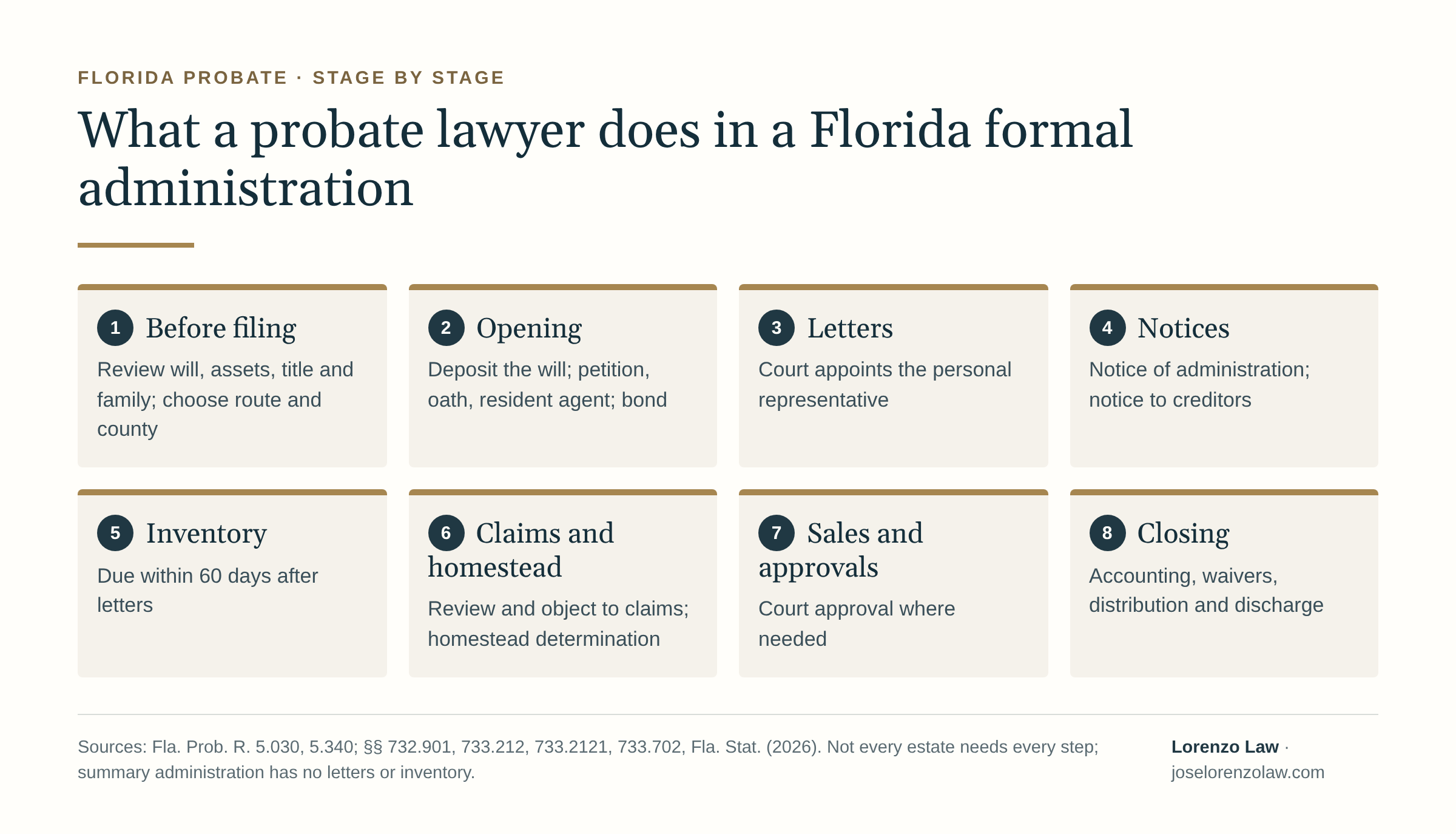
| Stage | What the lawyer does | Why it matters |
|---|---|---|
| Before filing | Reviews the will, assets, title and family; chooses the route and the county | The wrong route or venue wastes time and filing fees |
| Opening | Deposits the original will, files the petition, oath and resident-agent designation; addresses bond | Letters of administration give the personal representative authority |
| Notices | Serves the notice of administration; publishes and serves the notice to creditors | Starts the objection and claim periods |
| Assets and inventory | Collects assets, opens the estate account, files the inventory | The inventory is due within 60 days after letters |
| Claims and homestead | Reviews and objects to claims; obtains the homestead determination | Payment order and homestead status protect the family and the personal representative |
| Sales and approvals | Advises on sales, obtains court approval where needed | Buyers and title companies need authority they can rely on |
| Closing | Prepares the accounting, waivers and receipts; petitions for discharge | Discharge ends the personal representative’s role |
Not every estate needs every step; a summary administration has no appointment of a personal representative.
Chart: a probate lawyer’s work, stage by stage
Lorenzo Law does not provide real estate closings, title insurance or tax-return preparation; a sale of estate property involves a closing agent, and tax returns are coordinated with the family’s tax professional. For the full process see the Florida probate process and closing an estate in Florida.
Can I do probate without a lawyer in Florida?
Yes, in a summary administration, a disposition without administration, the other small-estate procedures, and a formal administration in which you remain the sole interested person. Otherwise, a formal administration needs a Florida lawyer for the personal representative. Filing without a lawyer is legal in those cases; whether it is wise depends on the estate.
Do I need a lawyer for probate if the estate is simple? Can you do probate without a lawyer then? Most people who look up how to file probate in Florida without an attorney, and then represent themselves in pro se probate filings, do it to save the fee. That can work for a small, cooperative estate with bank accounts and no real estate. It works less well when there is a house, a mortgage, a creditor, a beneficiary who will not sign, or a will with unusual terms.
Can I file probate without a lawyer if I am the personal representative? Only if you remain the sole interested person or are a Florida attorney; otherwise Rule 5.030 applies.
What clerks and self-help centers can and cannot do
Clerk’s office staff can explain filing requirements and fees, but cannot give legal advice, choose a route for you or check whether your petition is legally correct. Some circuits run a probate self-help center or program and require their own forms or checklists for self-represented filers; check the circuit where the estate is filed before preparing anything.
The risks of free probate forms
Florida probate forms published by courts, including summary administration forms, and free forms found online do not tell you whether an asset needs probate at all, which county has venue, whether the will directs formal administration, how homestead affects a sale or which creditors must be paid. Mistakes there can cost more time and money than the forms save. Lorenzo Law does not provide forms or templates.
With a lawyer or without: a comparison
| Question | Without a lawyer | With a lawyer |
|---|---|---|
| Allowed? | Summary, small-estate procedures, or formal if you remain the sole interested person | Any route |
| Who chooses the route and county | You | Your lawyer, with you |
| Who answers the court’s questions | You | Your lawyer |
| Creditors and homestead | Your responsibility | Handled with advice |
| Cost | Court fees and other applicable expenses; no attorney fee if no lawyer is hired. | Legal fees and applicable expenses under the written agreement. The published summary administration offer includes the filing fee and one certified copy of the order, with additional copies at the Clerk’s rate; the uncontested formal-administration offer includes the filing fee, creditor-notice publication and the certified copies the matter needs; hourly review has separate terms. |
A middle path exists: file yourself and hire a lawyer by the hour to review the petition and proposed order before filing, or to advise at a particular step. Lorenzo Law offers hourly review and advice engagements, with the scope and rate agreed in writing.
When is a probate lawyer worth it even if not required?
Should I get a probate attorney, and why would I need a lawyer for probate if the law does not require one? Usually because a mistake would be expensive or hard to undo: real estate or homestead, debts larger than the cash, a spouse or minor child, a beneficiary who will not cooperate, missing records, tax questions, or a release you are asked to sign.
- Real estate or homestead: who owns the house now, whether it is protected homestead, and whether it can be sold. A house does not automatically require formal administration, and probate representation does not include a closing. See Florida homestead probate and selling a house in probate.
- Debts and insolvent estates: paying claims in the wrong order can make a personal representative personally responsible.
- A spouse or a minor: A surviving spouse may have homestead, elective-share, exempt-property and family-allowance rights, and a parent may receive a minor’s inheritance as natural guardian, without court appointment or bond, only if the amounts received total $15,000 or less (section 744.301).
- A beneficiary who will not sign: summary administration can still proceed in some cases, but the petition must be built for it.
- Missing information: no will found, unknown accounts, heirs who cannot be located.
- Taxes: final income tax returns and, for very large estates, a federal estate tax return; Lorenzo Law coordinates with the family’s tax professional and does not prepare returns.
So why do I need a probate attorney if the law does not require one, or should I hire a probate attorney at all? Often the answer is no for a small, cooperative estate. Is it worth hiring a probate lawyer? That depends on what a mistake would cost and who would bear it.
Three examples
One beneficiary and a creditor. A daughter is the only beneficiary and wants to serve without a lawyer. A hospital has filed a claim. While the claim is unresolved she is not the only interested person, so the exception she was counting on may not apply until it is resolved.
A small estate and two cooperative children. Two adult children inherit a bank account and a car; the estate is well under $150,000. Summary administration may fit without a lawyer, although they still need to check the will, the creditors and how the car and account transfer.
A beneficiary asked to sign a release. A son receives a final accounting and a release from his sister’s lawyer. That lawyer represents his sister as personal representative. A one-time review of the accounting and the release, paid by the hour, can answer whether anything is missing before he signs.
Hypothetical examples, not client results or eligibility determinations.
Probate lawyer route finder
A quick way to answer “do you need a lawyer for probate in Florida” for your own situation. Answer seven short questions to see which Florida route probably fits and whether the representation rule applies to you. It uses general rules only; it does not decide your case.
The tool calculates your result in your browser. It makes your selected role and result category available to site analytics. The event does not include your other selections or monetary amounts. This is general information, not legal advice, and does not create an attorney-client relationship.
Where is a Florida probate case filed, and can one lawyer handle any county?
A Florida estate is opened in the county where the decedent was domiciled; if the decedent was not domiciled in Florida, in any county where the decedent’s property is located; and if there is no Florida property, in the county where a debtor of the decedent lives (section 733.101). One Florida lawyer can handle an estate in any of the 67 counties.
Each county’s clerk of the circuit court keeps the probate files, and each judicial circuit sets its own procedures for hearings and self-represented filers. Lorenzo Law handles estates statewide by phone or video, with the principal office in Kissimmee and meetings by appointment in Coral Gables and Fort Lauderdale. Jose M. Lorenzo, Jr. handles each matter himself, so the attorney you speak with at the first call is the attorney who handles any matter the firm accepts.
County guides: Miami-Dade · Broward · Palm Beach · Orange · Hillsborough · Duval · Pinellas · Sarasota and Manatee. Every county: Florida probate service areas.
Comparing probate attorneys in your county? Statewide representation by a Florida probate lawyer works the same way for an estate in Miami-Dade, Orange or a smaller county.
How much does a probate lawyer cost in Florida?
It depends on the fee structure and the route. With Lorenzo Law, summary administration costs from $3,975 and uncontested formal administration from $7,975, as flat fees. The summary administration fee includes the court filing fee and one certified copy of the order, with additional certified copies charged at the Clerk’s rate; the formal administration fee includes the court filing fee, publication of the notice to creditors and the certified copies the matter needs. Jose does not publish the optional notice to creditors in summary administration, so his fee there includes no publication cost. For either procedure, homestead determinations, more complex estates and contested matters are quoted separately, and other expenses may apply, such as recording fees or the decedent’s debts, and in formal administration a personal representative’s bond if the court requires one and the personal representative’s compensation; any increase is discussed before work begins. Full fee terms: summary and formal administration fees. The quote can be higher depending on the estate, and the scope and price are agreed in writing before work begins. Ancillary administration is quoted per matter.
What is the average cost for a probate attorney in Florida? There is no reliable average or typical figure, because what an attorney can charge for probate in Florida is agreed case by case. The statutory schedule presumes $3,000 for an estate of $100,000 and $15,000 for an estate of $500,000 in formal administration. How much does a simple probate cost? With Lorenzo Law, a summary administration is a flat fee that includes the court filing fee and one certified copy of the order, with additional copies at the Clerk’s rate (other expenses may apply).
The executor is paid separately from the lawyer. The personal representative’s compensation follows the will or the statutory schedule, the personal representative may waive all or part of it, and on request of an interested person the court can raise or lower it (section 733.617). Family members who serve often waive it. The full schedules are in how much probate costs in Florida.
Lorenzo Law fees and what they include
| Service | Fee | What is included or separate |
|---|---|---|
| Summary administration | From $3,975 flat | Filing fee and one certified copy of the order included; additional copies at the Clerk’s rate; no publication cost (Lorenzo Law does not publish the optional notice to creditors). |
| Uncontested formal administration | From $7,975 flat | Filing fee, creditor-notice publication and certified copies included |
| Ancillary administration | Quoted per matter | Depends on the home-state documents and the Florida assets |
| Review or advice (self-filers, beneficiaries) | Hourly, agreed in writing | Scope limited to what you ask Lorenzo Law to review or advise on |
| Disputes and litigation | Agreed separately | Separate scope and fee terms |
For either procedure, homestead determinations, more complex estates and contested matters are quoted separately, and other expenses may apply, such as recording fees or the decedent’s debts, and in formal administration a personal representative’s bond if the court requires one and the personal representative’s compensation; any increase is discussed before work begins. Full fee terms: summary and formal administration fees. The published fees are honored at least through February 14, 2027. The flat fee is paid near the close of the matter; any advance is discussed at the start, and if the estate has no cash, for example when the house was the only asset, the client pays the flat fee.
Who pays the probate lawyer?
The personal representative’s lawyer is paid from the estate as an expense of administration, before beneficiaries receive their shares. A beneficiary who hires his or her own lawyer ordinarily pays that lawyer. Section 733.6171 sets a schedule that the law presumes reasonable in formal administration, but it is not a required percentage, and the base is the estate’s compensable value, not every asset the decedent owned.
Are probate attorneys free?
No. Some firms, Lorenzo Law included, offer a free initial consultation; representation is paid. With Lorenzo Law, only the initial consultation is free, and representation fees and costs are agreed separately in writing. For every cost in a Florida probate, including the clerk’s charges and the personal representative’s compensation, see how much probate costs in Florida.
How to choose a probate attorney in Florida
Start with the client and the scope, then the price. Ask who the lawyer will represent, what the fee covers, what is added to it, who will do the work and how disputes would change the plan.
What questions should I ask a probate attorney?
- Who will be your client: me as personal representative, me as a beneficiary, or someone else?
- Which route do you expect (formal, summary, ancillary, none), and why?
- Is the fee flat, hourly or based on the statutory schedule, and is it in writing?
- Does the fee include the filing fee, publication and certified copies?
- What would raise the fee: a dispute, a sale, a new asset, a creditor?
- Who will do the work and answer my calls?
- What will you need from me, and by when?
- Do you handle tax returns, closings or title insurance, or will I need someone else?
More guidance: how to choose a Florida probate lawyer.
Hiring a lawyer partway through, or changing lawyers
Yes. A personal representative may change lawyers; the new lawyer appears in the estate, and the prior lawyer of record withdraws with the court’s approval after filing a motion and serving it on the client and other interested persons (Rule 5.030(c)). A self-represented petitioner whose summary petition was returned can also hire a lawyer at that point to correct and refile it.
What happens after you hire a probate lawyer
The plan depends on the route and the client. Three common paths:
Formal administration path
Review of the will, assets, family and venue; deposit of the original will; the petition, oath and designation of resident agent; letters of administration; the notice of administration and the notice to creditors; the inventory; claims, homestead and any sales; the accounting; distribution and discharge (the steps people mean when they ask whether they need a lawyer to close an estate). Many uncontested formal administrations take roughly six months to a year. Who can file probate in Florida? Any interested person may petition for administration (section 733.202); in practice the petitioner is usually the person nominated in the will or the person entitled to preference to serve as personal representative. Why does Florida probate take so long? The creditor period alone runs at least three months from the first publication of the notice to creditors, and sales, disputes, tax questions and missing records add time.
Summary administration path
Eligibility, the creditor search, the petition with the beneficiaries’ signatures or service, and the proposed order describing each asset. No personal representative is appointed. Lorenzo Law aims to finish a summary administration within one to two months from retention; that is a goal, not a guarantee.
Dispute or beneficiary path
First the served document and its deadline, then the client’s position and the evidence. A beneficiary’s engagement may be limited to one accounting or one release; a contested case is broader. See how long probate takes in Florida.
What to gather before you talk with a probate lawyer
You do not need a complete file to ask about an urgent deadline. Start with what you have. For a Miami-Dade example, see the documents to start probate in Miami-Dade or the documents for a Cutler Bay estate.
Preparation checklist
| Record | Why it matters | Where to look |
|---|---|---|
| Death certificate; date and county of death; last address | Route, venue and deadlines | Funeral home, vital records |
| The will and any codicils, and where the original is | Beneficiaries, the nominated personal representative, any direction for formal administration | Papers at home, the drafting lawyer, a safe-deposit box, the clerk |
| Your role and relationship to the decedent | Who the client is; whether an out-of-state relative may serve | Family information |
| Assets, how each was titled, approximate values, beneficiary designations | Probate versus non-probate; which route | Statements, deeds, policies, account records |
| Deeds, mortgages, how the home was used | Title, liens and homestead | County property records |
| Bills, creditor letters, final-expense receipts | Claims and the small-estate procedures | Mail, the person who paid the funeral |
| Names and addresses of beneficiaries and heirs | Notices, signatures and service | Family records |
| Any court papers, case number, accounting or release | Existing authority and deadlines | The envelope they came in; the clerk’s online docket |
Describe assets by type in a first message; do not send Social Security numbers, full account numbers or originals by email. See also building a thorough list of assets.
More questions about needing a probate lawyer in Florida
What is the 10-day rule for probate in Florida?
The deadline for depositing the original will is that the custodian of a will must deposit it with the clerk of the court having venue of the estate within 10 days after receiving information that the testator is dead (section 732.901). Depositing the will does not open probate and does not require a lawyer. See Florida probate rules and deadlines.
Do I need a lawyer to probate a will in Florida?
Do you need a lawyer to probate a will, and does a will have to be probated in Florida at all? The original will must be deposited with the clerk, but it is admitted to probate only if someone petitions; probate is needed when the decedent owned probate assets that have to be transferred. A will controls only probate assets. Accounts with a surviving beneficiary, and property held with a co-owner who has survivorship rights, pass outside it. What happens if you don’t probate a will in Florida? The original still has to be deposited with the clerk, and assets titled only in the decedent’s name cannot be transferred or sold until a court order or letters give someone authority; a will that is never admitted to probate does not pass title.
Having a will does not change the rule. If the will is probated in a formal administration, the personal representative needs a Florida lawyer unless an exception applies; if the estate qualifies for summary administration, no lawyer is required.
Do I need a lawyer to go to probate court?
This is often asked as “do I need an attorney for probate court.” When a hearing is needed, a personal representative in a formal administration appears through counsel; a self-represented petitioner in a summary administration appears for himself or herself.
Can I sell a house in probate without a lawyer?
Not in a formal administration: the personal representative who sells needs a Florida lawyer under the representation rule unless an exception applies. In a summary administration, non-homestead real estate passes by the court’s order to the persons named in it, who then sell it themselves; protected homestead passes outside administration and is determined separately. See selling a house in probate.
Will hiring a lawyer make probate faster?
A lawyer can prevent the delays caused by returned filings, missed notices and avoidable disputes, but cannot promise a date: court schedules, creditor periods, missing records and disagreements set much of the timeline.
What kind of lawyer do I need for probate?
A lawyer admitted in Florida who handles probate and estate administration. For a dispute, one who handles probate litigation. For planning your own estate, an estate planning lawyer; that is a different service with its own fees.
How do I know if I need a probate lawyer?
You need one if you will serve as personal representative in a formal administration and no exception applies. You should consider one if there is real estate, debt, a dispute, a minor, a spouse with rights, an heir abroad or court papers with a deadline. Otherwise you may be able to proceed on your own. Does Florida require an attorney for probate in any other case? No. When do you need a probate attorney even then? Before you sign, sell or distribute anything you are unsure about.
Is Florida probate difficult? The procedure is technical rather than difficult: deadlines, notices, creditor rules and homestead rules all have to be followed in order. Small, cooperative estates are manageable; estates with real estate, debts or disagreement are where most self-filers run into trouble.
Does Lorenzo Law offer consultations in Spanish?
Yes. For families looking for a Spanish-speaking probate lawyer, Jose M. Lorenzo, Jr. consults in English or Spanish by phone or video for estates in any Florida county. Court documents are in English; he explains them in Spanish.
Talk with a probate lawyer about your role
Tell Lorenzo Law your role (named personal representative, beneficiary, heir or petitioner), the date of death, the county where the decedent lived, the kinds of assets and how they were titled, and whether there is a deadline or a dispute. Jose M. Lorenzo, Jr. handles each matter himself. He was admitted to The Florida Bar in 2013, after about a decade as a probate and litigation paralegal, and served as a judicial intern with the Hon. Maria M. Korvick in the Probate Division of the Eleventh Judicial Circuit. The initial consultation identifies the route and the information needed to quote a fee; it does not guarantee that a matter will be accepted, a result or a date from the court. Lorenzo Law aims to follow up within one to two business days.
Request a free initial consultation. Only the initial consultation is free; representation fees and costs are agreed separately in writing.
Request a free initial consultationCall (305) 224-6811
For the statewide probate service, see the Florida probate lawyer page. Related guides: Florida probate guide, when probate is not necessary, probate questions people are embarrassed to ask.
General information about Florida law; it does not replace a review of your documents and circumstances. Reading this page does not create an attorney-client relationship.
Sources and authorities
Statutes cited are the 2026 Florida Statutes; the rule is the Florida Probate Rules compilation of October 15, 2026.

