Florida Elective Share: How the 30% Spousal Share Works
The Florida elective share lets the surviving spouse of a person who died domiciled in Florida take 30 percent of the elective estate, even when a will or trust leaves the spouse less. The spousal elective share reaches many assets outside probate, but what the spouse already receives counts toward it, and the election has a strict deadline. This guide explains who can elect, what counts, how the elective share in Florida is calculated, and what personal representatives, trustees and beneficiaries need to know.
Request a free initial consultation. Only the initial consultation is free; representation fees and costs are agreed separately in writing. Consultations are available statewide in English and Spanish, by phone or video.
Request a free initial consultationCall (305) 224-6811
Go straight to: The deadline · What counts · The calculation · Worksheet
By role: a surviving spouse should start with the deadline; a personal representative, with the filing steps and the review checklist; a trustee or beneficiary, with role guidance and who pays.
All guide sections 22 sections
Short answer. What is the Florida elective share? It lets the surviving spouse of a person who died domiciled in Florida elect 30 percent of the elective estate, a statutory base that reaches many trusts, accounts and other assets outside probate. Property the spouse already receives counts toward that 30 percent first. The election must generally be filed by the earlier of six months after service of the notice of administration or two years after death.
| Who can elect | The surviving spouse of a person who was domiciled in Florida at death, unless the right was validly waived. An agent under a power of attorney or a guardian of the property may elect only with court approval. Who can claim |
|---|---|
| How much | 30 percent of the elective estate (§ 732.2065). The Florida elective share amount is not 30 percent of everything, and it is not 30 percent added on top of what the spouse already receives. Calculation |
| What counts | Ten statutory categories, including the probate estate, protected homestead, payable-on-death, transfer-on-death and joint accounts, revocable trusts, certain retained-interest transfers, life insurance cash value, retirement benefits and certain transfers in the year before death, less statutory exclusions. What counts |
| What already counts toward the share | Property passing to the spouse is applied first: gifts under the will or trust, retirement benefits and life insurance paid to the spouse, and other qualifying interests, each at its statutory value. Credits |
| Deadline | The earlier of 6 months after service of the notice of administration on the spouse (or the spouse’s agent or guardian of the property) or 2 years after death (§ 732.2135). An extension needs a timely petition. Deadline |
| Withdrawal | Within 8 months after the death and before the court’s order of contribution. Withdrawal |
| Waiver | A written prenuptial or postnuptial agreement or waiver, signed before two subscribing witnesses if the signer is a Florida resident, or valid where signed if a nonresident; fair disclosure is required if signed after marriage (§ 732.702). Waivers |
| Who pays | Recipients of the elective estate contribute in statutory classes, starting with the probate estate and revocable trusts. Who pays |
| Fees and interest | Any amount unsatisfied two years after death bears statutory interest. The court may award fees and costs in disputed proceedings. Fees and interest |
| Where it is filed | In the Florida probate proceeding for the deceased spouse’s estate, in the circuit court of the county with probate venue. Counties and circuits |
| Consultation | Principal office in Kissimmee; Coral Gables and Fort Lauderdale by appointment; statewide by phone and video, in English and Spanish. Only the initial consultation is free. |
Jose M. Lorenzo, Jr. represents surviving spouses in Florida elective share matters and advises personal representatives, trustees and beneficiaries who must respond to an election. Because those people can have opposing interests in the same estate, the firm identifies whom it would represent and checks for conflicts before accepting a matter.
What is the elective share right in Florida?
An elective share is a surviving spouse’s statutory right to choose a fixed share of the deceased spouse’s property in place of relying only on what the will, trust or beneficiary forms provide. That answers the basic question: what is an elective share of an estate? The elective share right in Florida is 30 percent of the “elective estate” (sometimes called the elective share estate), a defined base built from probate property and many nonprobate interests. It is a choice, not an automatic payment: the spouse, or an agent or guardian with court approval, must file an election before the deadline. What does elective share mean in practice, then? A right the spouse may use, decline or lose by waiting too long. What is an elective share in Florida worth? That depends on the credits, as explained below.
Is Florida an elective share state, and does Florida have elective share rules of its own? Yes on both counts. The elective share Florida statute is part II of chapter 732 of the Florida Probate Code, sections 732.201 through 732.2155, titled “Elective Share of Surviving Spouse; Rights in Community Property.” The right goes by several names: the surviving spouse elective share, the spouse’s right of election, a statutory share of estate property, the spousal share of estate assets, an elective (forced) share, “electing against the will,” or simply the spousal elective share. Florida law protects the spouse, not adult children, unlike some forced share inheritance systems elsewhere. Law schools teach the elective share (trusts and estates courses call it the elective share doctrine), and estate planners speak of the Probate Code’s elective share provision; as a matter of elective share property law, certain property a married person gives away during life is still counted in the elective estate, unless the surviving spouse consented to the transfer in writing. Some states, following the Uniform Probate Code, compute an elective share of augmented estate assets; Florida’s closest equivalent to an augmented estate elective share is the elective estate, with its own rules, so another state’s chart does not apply here.
What is the elective share rule in Florida, in one line? The spouse files an election; the court then values the elective estate, takes 30 percent, credits what the spouse already receives, and orders any balance paid by the other recipients. That is the basic elective share meaning, and the elective share definition in section 732.201 is short; the rest of this page is Florida’s version. The Florida elective share percentage is fixed: the rate is 30 percent for every eligible spouse. Does Florida have dower rights? No. Dower and curtesy were abolished (§ 732.111), and the elective share is sometimes described as dower’s closest modern counterpart, although it is a different right.
Electing does not reduce what the spouse would receive without the election, and the spouse is not treated as having died first (§ 732.201). Instead, property the spouse already receives is credited toward the 30 percent, and only an unsatisfied balance is collected from others. That is why the same election can be worth a great deal in one estate and nothing in another.
Can you disinherit your spouse in Florida?
Generally, a spouse cannot be disinherited in Florida by will or trust alone, so the answer to “Can a spouse be disinherited in Florida?” depends on more than the will. A Florida will or trust can leave a spouse little or nothing, but if the deceased spouse was domiciled in Florida, the surviving spouse can usually elect 30 percent of the elective estate, which reaches many assets outside probate. The main exceptions are a valid written waiver, such as a prenuptial or postnuptial agreement, and property that the statutes exclude from the elective estate.
Questions about how to disinherit a spouse arise in different circumstances. “Can a spouse be disinherited?” includes questions from both partners: “Can a husband disinherit his wife?” and “Can a wife be disinherited?” Questions about the document itself include “Can you write your wife out of your will?” and “Can I leave my estranged wife out of my will?” The answer is the same for husbands and wives. A spouse can be left out of a will, but leaving a spouse out of the will does not by itself defeat the elective share, and disinheriting a spouse dependably in Florida usually requires the spouse’s own written waiver.
A common quiz answer says “a spouse can be legally disinherited but a child cannot.” In Florida it is largely the reverse. Can you disinherit a child in Florida? Generally yes: an adult child can be left out of a will, although the homestead rules limit how a home may be left when the owner is survived by a spouse or a minor child, and a child born or adopted after the will was signed may have a pretermitted share (§ 732.302). A spouse, by contrast, keeps the elective share unless it was waived.
The question has a longer answer because ownership, timing and paperwork matter. The elective estate is a list of statutory categories, not “everything the person owned,” and each category has its own rules. A transfer that was irrevocable before the marriage, a transfer for adequate consideration, a transfer the spouse consented to in writing, life insurance above its cash value, and the decedent’s half of community property are among the statutory exclusions (§ 732.2045). The spouse must also be eligible and must file on time. A spouse who misses the deadline, or who signed a valid waiver, may have no elective share at all.
Most attempts to disinherit a spouse without a waiver run into the categories the statute was written to reach: a funded revocable trust, accounts payable on death to the children, joint accounts with survivorship, retirement benefits payable to someone else, and gifts in the last year of life. Those assets often count, at statutory values, even though they never pass through probate. A spouse may also have rights that have nothing to do with the elective share, such as homestead, exempt property, a family allowance, or a pretermitted spouse share if the marriage came after the will.
For the broader questions, the surviving spouse rights in Florida guide explains Florida spouse inheritance laws as a whole: What is a surviving spouse entitled to in Florida? Does a surviving spouse automatically inherit everything in Florida? (Often not, when there is a will or the decedent had children from another relationship.) When a husband dies, what is the wife entitled to in Florida? It covers widow rights. Florida treats widowers the same way, so a husband’s rights after his wife’s death follow the same rules, along with the inheritance rights of a surviving spouse when there is no will.
Does the elective share override a will or trust?
Can a spouse override a will? In effect, yes, within limits. Does a will override a spouse? No: a will cannot cancel the elective share. Does marriage override a will in Florida? No again: a later marriage does not revoke an earlier will, although a spouse who married the decedent after the will was signed may have a pretermitted spouse share. The elective share does not invalidate the will or the trust: under the elective share, wills, trusts and beneficiary forms all remain in force. For the elective share, will and trust terms still matter, because they decide what the spouse already receives. The election creates a statutory claim to 30 percent of the elective estate, and if what the spouse receives under the documents falls short, the shortfall is collected from the people who received the elective estate, in a statutory order. A will or a trust referred to in the will can direct some of the details, such as which property is applied first, but it cannot simply cancel the spouse’s right (§ 732.2075).
Can you leave your spouse out of your will? You can, but the will does not end the matter. What is an elective share in a will? Strictly, it is not in the will at all: it is a statutory right that applies whatever the will says. Can a spouse be disinherited by a will alone, then? Not effectively, unless the spouse waived the right. Elective share vs will contest: a will contest asks the court to set a document aside for lack of capacity, undue influence, fraud, duress or improper execution. An election leaves the document in place and does not require proving anything about how it was made, although entitlement, the deadline, the waiver, the asset list and the values can all be disputed. Choosing between the elective share vs will challenges is a question of goals and evidence; if the concern is an invalid will, see contesting a will in Florida.
Who can claim a Florida elective share?
Who has the right to an elective share in Florida? The surviving spouse of a person who died domiciled in Florida (§ 732.201). The spouse must have been legally married to the decedent at death and must not have validly waived the right. The spouse can elect personally; an attorney in fact or a guardian of the property may elect only with court approval.
Florida elective share rights do not depend on how the marriage began or which marriage it was. The legal rights of a second spouse, and second wife legal rights in particular, are the same as a first spouse’s; a spouse who married the decedent after an existing will was signed may also have pretermitted spouse rights. When it comes to second wife property rights, what matters is title, homestead and the elective share, as the second-marriage section explains.
Florida domicile, part-year residents and spouses who lived elsewhere
The elective share statute in Florida applies only if the deceased spouse was domiciled in Florida at death; where the surviving spouse lives, or where property is located, does not decide it. Owning a Florida vacation home, having a Florida probate case, or having a spouse who lives here does not by itself establish a Florida domicile. For couples who divided time between Florida and another state, often called snowbirds, domicile is a question of fact proved with records: a homestead exemption, a declaration of domicile, voter and vehicle registration, tax filings, where the person spent time and what the person said about home. See the Florida domicile guide.
If the deceased spouse was domiciled in another state, the Florida elective share does not apply, and the surviving spouse’s rights generally depend on the law of that state, which this page does not address; Florida law does, however, govern the descent of any Florida real estate the decedent owned (§§ 731.106, 732.201). What are elective shares in other states? Elective shares exist in most states that do not use community property, but elective share laws differ by state. The elective share New York provides, the elective share Pennsylvania provides and the elective share Virginia provides each follow that state’s own statute and percentages, and the same is true of an elective share in NJ or an elective share in NC. An elective share by state comparison is only a starting point. The elective share in Maryland and the elective share in Massachusetts each follow that state’s statute. The same is true of the elective share in Nebraska, the elective share in South Carolina and the elective share in Tennessee. Community property states work differently: inheritance in community property states turns largely on each spouse’s half of community property. Does Texas have an elective share? Not in the Florida sense; Texas is a community property state. Does California have elective share rights? Also not in the Florida sense, because California is a community property state too. Does Georgia have an elective share, and does Georgia recognize elective share laws at all? No; Georgia is unusual among states without community property in relying on other protections instead, such as a year’s support for the family. Lists of elective share states change over time, so check the current statute of the state involved.
Religious and foreign inheritance rules do not displace Florida law either. For a person domiciled in Florida, the Florida elective share applies whether the family follows Islamic inheritance shares, Hindu custom, or French or German inheritance law, although a will or trust can follow those traditions if the spouse does not elect or validly waived the right. Property that was community property under the law of another jurisdiction when it was acquired can be handled under the community property rules described below, although whether a particular foreign community of property system qualifies needs individual review, and real estate located in another country can be governed by the law where it sits.
If the deceased spouse moved to Florida in retirement, the Florida rules apply even if the estate plan was signed elsewhere, so an older out-of-state trust or will should be reviewed against them. People who move here often ask, “Do I need a new trust after moving to Florida?” Not always, but the existing plan should be checked against Florida’s elective share and homestead laws.
Does a short marriage reduce the elective share?
No. Florida does not scale the elective share to the length of the marriage. In Florida, 30 percent surviving spouse protection applies whether the couple was married for three months or thirty years (§ 732.2065). The Uniform Probate Code takes a different approach: the elective share under UPC section 2-202 grows with the length of the marriage, following a schedule often shown as the UPC elective share chart. Florida did not adopt that UPC elective share statute, and its flat 30 percent is not an elective share UPC-style sliding scale. The timing of the marriage still matters in other ways: a transfer that became irrevocable before the marriage is generally excluded from the elective estate (§ 732.2045), and a prenuptial agreement signed before the wedding can waive the right.
What if you were separated or a divorce was pending?
What happens if a spouse dies during divorce? A final judgment of dissolution ends the marriage, and with it the elective share, because the claimant must be a surviving spouse. A divorce that was filed but not finalized before the death generally does not end the marriage, and a spouse who is separated but not divorced generally remains a surviving spouse, even after a long separation. Separated spouse inheritance questions therefore turn on paperwork: under § 732.702, unless it provides otherwise, a complete property settlement entered into after, or in anticipation of, separation, dissolution of marriage or divorce waives the elective share and the other listed spousal rights, if it was signed with the statute’s formalities (two subscribing witnesses for a Florida resident) and after fair disclosure of each spouse’s estate, which is required because it is signed during the marriage. A spouse found to have procured the marriage by fraud, duress or undue influence can also lose the elective share and other spousal rights (§ 732.805). Bring the divorce docket, any final judgment, and every settlement or marital agreement, signed or unsigned, so the actual status and terms can be reviewed.
People ask, “If separated, is spouse entitled to inheritance?” Usually yes, absent a signed settlement or waiver. Florida does not have a formal legal separation decree like some states, so legal separation and inheritance questions here are really about marital status and signed agreements; there are no special legal separation inheritance rights. The same is true of an inheritance after separation but before divorce, and of the rules on separated-but-not-divorced inheritance generally.
An ex-spouse is different. A former spouse has no elective share, so ex wife inheritance rights (and an ex-husband’s) generally end with the final judgment, and an ex spouse claim on estate property usually has to rest on the divorce judgment itself, such as an unpaid obligation under it. A divorce generally revokes will and revocable-trust provisions in favor of the former spouse (§ 732.507, § 736.1105) and many beneficiary designations made before the divorce (§ 732.703). A surviving divorced spouse can still take under a will signed after the divorce, a will stating a specific contrary intention, or a divorce judgment that expressly provides otherwise, and under a designation made after the divorce or covered by another exception, such as controlling federal law or a court order. There is no former spouse inheritance act claim in Florida like those available in some other countries.
Is Florida a community property state?
No. Florida is not a community property state; during life, each spouse generally owns the property titled in that spouse’s name, and the elective share is Florida’s main protection for a surviving spouse against disinheritance. Is Florida a community property state in death, at least? No again, but there are two exceptions, and community property and inheritance rules meet in them. The elective share vs community property comparison mostly matters for couples who once lived in a community property state. Property acquired while a couple lived in a community property state can keep its community character under Florida’s Uniform Disposition of Community Property Rights at Death Act (sections 732.216–732.228), and the decedent’s one-half of that property is excluded from the elective estate (§ 732.2045); if that half passes to the spouse, it counts toward satisfying the share (§ 732.2075). Florida also allows married couples to create a community property trust under the Florida Community Property Trust Act, which needs its own review. Community property inheritance at death is covered more broadly in the surviving spouse guide.
Can a guardian or agent under a power of attorney elect?
Only with court approval. The spouse can elect personally. An attorney in fact under a power of attorney or a guardian of the property may elect only with the approval of the court that has jurisdiction over the probate proceeding, and before approving, the court must determine that the election is in the spouse’s best interests during the spouse’s probable lifetime (§ 732.2125). A power of attorney by itself is not enough. The right to elect is personal: if the surviving spouse dies before electing, no one, including the spouse’s personal representative, can make the election (§ 732.2125). If the spouse dies after a timely election, the election survives; the spouse’s personal representative may withdraw it while withdrawal is still allowed, or may file the petition to determine the amount if the estate’s personal representative does not (Florida Probate Rule 5.360; § 732.2151(3)). A petition for approval to make the election tolls the election deadline (§ 732.2135), so an agent or guardian should file promptly rather than wait for the full picture. For the underlying documents, see Florida powers of attorney and the Florida guardianship guide.
What is the deadline to file the Florida elective share?
The Florida elective share deadline is the earlier of two dates: six months after a copy of the notice of administration is served on the surviving spouse (or the spouse’s attorney in fact or guardian of the property), or two years after the date of death (§ 732.2135). That is the time limit to exercise elective share in Florida: the election must be filed on or before that date. A timely petition can extend or toll that time, but no extension is automatic.
Both dates matter even after the notice is served. If service happens late, the two-year date can arrive before six months have run, leaving less than six months. If no notice of administration has been served, the spouse should not assume there is unlimited time, because the two-year date runs from death. A filed waiver of service of the notice of administration is treated as service on the date the waiver is filed for the deadlines that refer to service (§ 733.212). Keep the notice, the envelope and delivery records, any waiver you signed, and the court docket together, and have them reviewed before deciding anything else. Do not wait for a complete asset inventory before getting deadline advice.
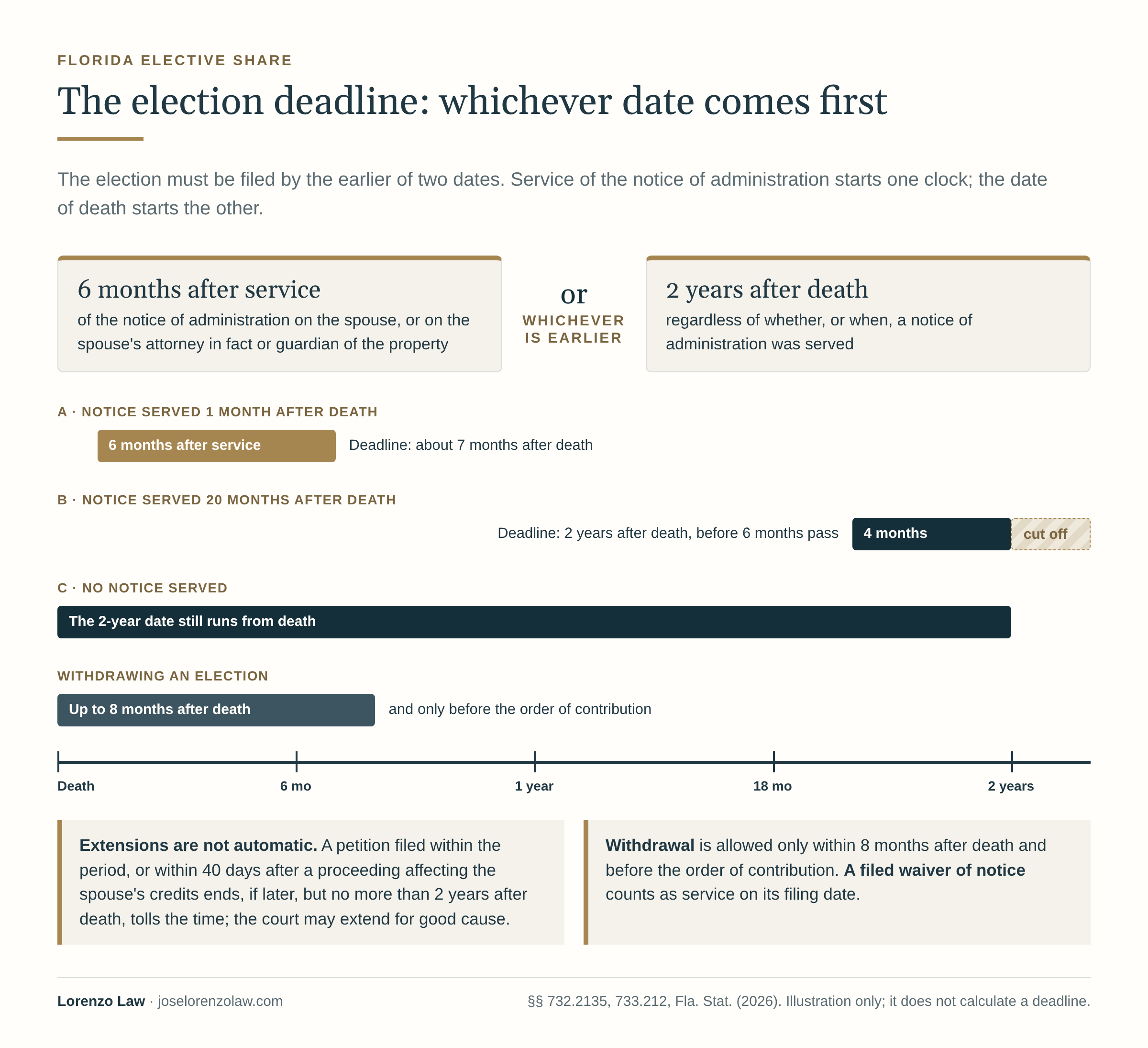
See the chart “The election deadline: whichever date comes first” (opens the full-size image; the details are also in the text).
| Time limit | What starts or ends it | What to keep |
|---|---|---|
| Ordinary election deadline | The earlier of 6 months after service of the notice of administration on the spouse, attorney in fact or guardian of the property, or 2 years after death | The notice, envelope, delivery record, any filed waiver, the docket |
| Petition for an extension | Within the ordinary period, or within 40 days after the end of a proceeding that affects what the spouse receives under § 732.2075(1), whichever is later, but no more than 2 years after death | The pending proceeding, its final order, and the date it ended |
| Tolling | A petition for an extension, or for approval of an agent’s or guardian’s election, tolls the time to elect | The filed petition and its filing date |
| Withdrawal of an election | Within 8 months after death and before the order of contribution | The election, the date of death, any order of contribution |
| Interest on an unpaid share | Any amount unsatisfied 2 years after death bears statutory interest; contributions bear interest from 90 days after the order of contribution | Payment records and court orders |
The table summarizes § 732.2135 and § 732.2145. It does not calculate a deadline for a particular estate.
Can the deadline be extended?
Sometimes, but only through a timely petition and a court finding of good cause. The spouse, an attorney in fact or a guardian of the property may petition for an extension within the ordinary election period, or within 40 days after the end of any proceeding that affects the amount the spouse is entitled to receive under section 732.2075(1), whichever is later, but no more than two years after death (§ 732.2135). If the court grants the extension, the election must be filed within the time the court allows. There is no automatic grace period after a missed deadline.
The petition itself matters. A petition for an extension, or for approval of an agent’s or guardian’s election, tolls the time for making the election. In Futch v. Haney, 328 So. 3d 1077 (Fla. 2d DCA 2021), the court held that timely extension petitions tolled the election period even though no order granting an extension had been entered. That holding does not rescue a petition filed too late, and it does not excuse ignoring the order the court eventually enters.
Can you withdraw an elective share election?
Yes, within a short window. The spouse, or the spouse’s attorney in fact, guardian of the property or personal representative, may withdraw an election at any time within eight months after the decedent’s death and before the court’s order of contribution (§ 732.2135). Both conditions must be met, and the eight months run from the date of death, not from the filing of the election. Because the window can close before the asset picture is complete, the decision to elect should be made with the best information available when the deadline arrives, not on the assumption that it can be undone later.
What assets count in the Florida elective estate?
The Florida elective estate includes the probate estate and specified nonprobate property: protected homestead, payable-on-death, transfer-on-death and joint accounts, joint and tenancy-by-the-entirety property, revocable trusts, certain transfers with retained interests, life insurance cash value, retirement and pension benefits, certain transfers in the year before death, and transfers in satisfaction of the elective share (§ 732.2035). Statutory exclusions and valuation rules then apply.
The probate estate and the elective estate serve different purposes. Assets that pass directly to a joint owner, a named beneficiary or a trustee can still enter the elective share calculation, and the label “trust,” “joint account” or “retirement account” does not tell you how much of it counts. For Florida purposes the probate estate is all property subject to administration in any state of the United States or the District of Columbia (§ 732.2025). If you are asking what is included to calculate your elective share, the answer is this list, not the probate inventory; knowing what is elective share property, and what is not, starts here. Use the table to identify records to review, not to add up gross account balances.
| Statutory category | What is included | What needs review |
|---|---|---|
| 1. Probate estate | Property subject to estate administration, wherever located in the United States | The inventory, ancillary proceedings in other states, claims and expenses |
| 2. Protected homestead | The decedent’s interest in protected homestead | Whether the home is protected homestead; special valuation and waiver rules apply |
| 3. POD, TOD, in-trust-for and survivorship accounts or securities | The decedent’s ownership interest: one-half for tenancy-by-the-entirety accounts; otherwise the portion the decedent could withdraw or use without accounting to anyone | Account titles, registration forms and contributions |
| 4. Other joint-survivorship or tenancy-by-the-entirety property | The decedent’s fractional interest: the value divided by the number of tenants | Deeds and titles; accounts and retirement plans fall under categories 3 and 8 instead |
| 5. Revocable transfers | The portion the decedent could revoke at death, alone or with another person | The trust or transfer document, funding records and amendments |
| 6. Transfers with retained interests | Property the decedent transferred but kept the right to income, use or principal from, or that could be distributed to the decedent in another person’s discretion | The governing instrument and four statutory exceptions |
| 7. Life insurance cash value | The decedent’s beneficial interest in the net cash surrender value immediately before death | Ownership, policy type and cash value; the death benefit above cash value is excluded |
| 8. Pension, retirement and deferred compensation benefits | Amounts payable to anyone because they survived the decedent | Plan documents and beneficiary forms; Social Security and Railroad Retirement are excluded |
| 9. Transfers in the year before death | Certain terminations of retained rights and certain gifts made in the one-year period before death | Dates, amounts, donees, and the medical, tuition and annual-exclusion exceptions |
| 10. Transfers in satisfaction of the elective share | A lifetime irrevocable transfer to an elective share trust | The trust instrument and its funding history |
Summarized from § 732.2035, § 732.2045 and § 732.2055. Exclusions, overlap rules and valuation dates change the amounts.
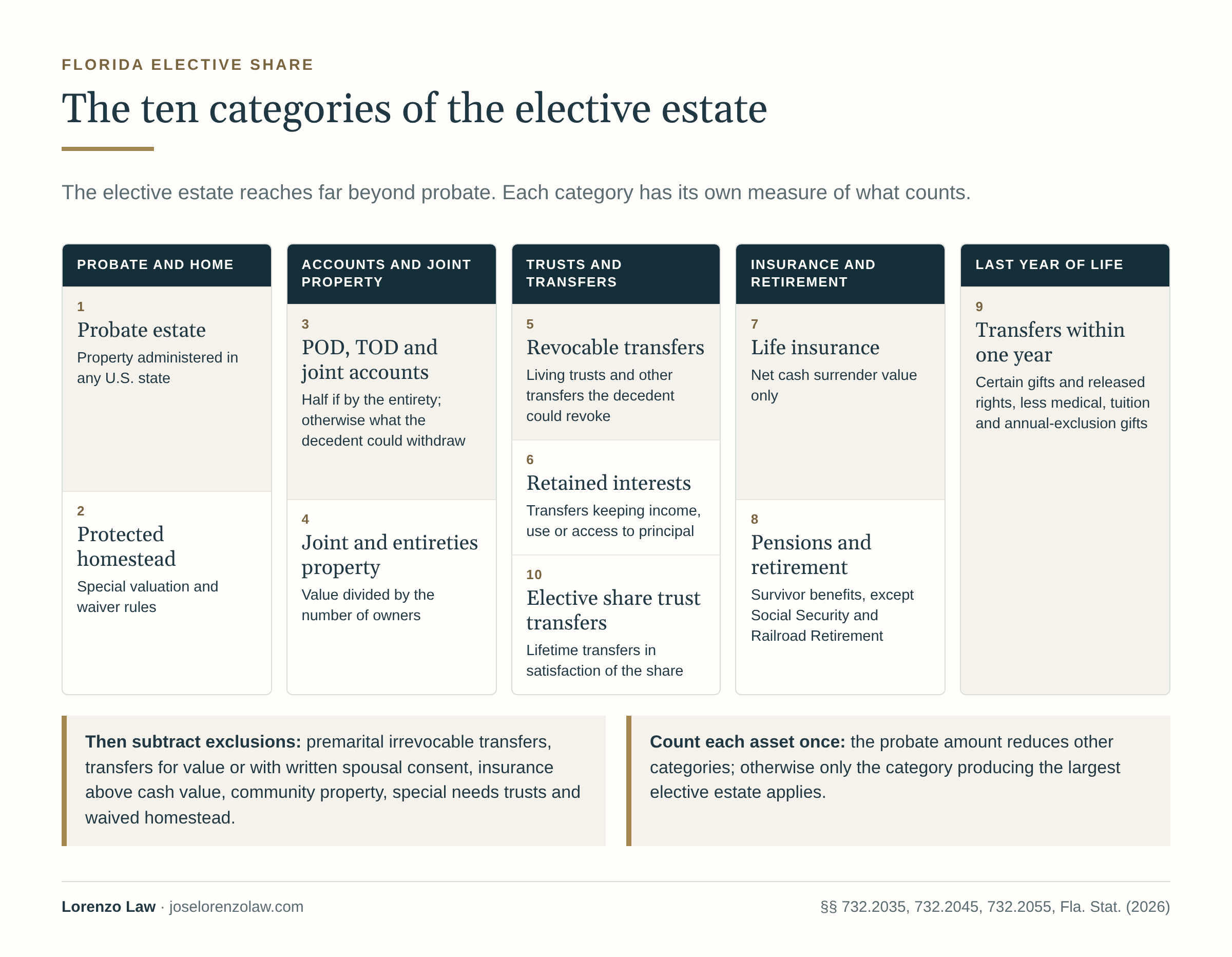
See the chart “The ten categories of the elective estate” (opens the full-size image; the details are also in the text).
Does the elective share reach a revocable living trust?
Yes. Under the Florida elective share, revocable trust property is included to the extent the decedent could revoke the trust at death. Property in a revocable living trust is included in the elective estate under category 5, alone or with another person’s participation, because the decedent kept the power to take it back (§ 732.2035). Putting assets into a living trust avoids probate; it does not remove them from the Florida elective share. A transfer that could be revoked only with the consent of everyone with a beneficial interest is not included under this category. The revocable trust is also first in line to contribute if the share is not satisfied (§ 732.2075).
“It’s a revocable trust, so it doesn’t count” is one of the most common assumptions about the elective share, and it is usually wrong. Florida trust spousal rights questions usually start here. Can a spouse disinherit their spouse with a revocable trust instead of a will? Not this way: revocable living trusts are counted precisely because the decedent could take the property back. Florida surviving spouse rights in a trust also include whatever the trust itself gives the spouse, which counts toward the share under the trust valuation rules.
Review the actual trust, every amendment, which assets were actually titled to the trustee, and whether any statutory exclusion or transition rule applies. One transition rule protects certain property held in trust continuously since October 1, 1999, transferred before the marriage and classified as nonmarital (§ 732.2155). For background on these trusts, see living trusts in Florida and the Florida trusts guide.
Irrevocable trusts and retained interests
For the Florida elective share, irrevocable trust property is not automatically outside the elective estate. If the decedent kept the right to the trust’s income, to use the property, or to principal, or if a trustee or another person (other than the spouse) could distribute principal to the decedent, the affected portion can be included under category 6. An irrevocable transfer can also be caught by category 9 if it was made, or a retained right was given up, within one year before death. On the other hand, a transfer that became irrevocable before the marriage, or one made for adequate consideration or with the spouse’s written consent, is generally excluded (§ 732.2045). The trust’s terms, the funding dates and the marriage date decide which rule applies.
Life insurance, IRAs, 401(k)s and annuities
Life insurance and retirement accounts are treated differently at two stages. For the elective estate, life insurance generally counts only at its net cash surrender value immediately before death; a term policy with no cash value adds nothing to the base, and the death benefit above cash value is excluded (§ 732.2035, § 732.2045). For satisfaction, proceeds paid to the spouse can count toward the share at their net amount (§ 732.2075, § 732.2095). Retirement and pension benefits payable to anyone because they survived the decedent are included at their transfer tax value, except Social Security and Railroad Retirement benefits, and benefits paid to the spouse are credited toward the share. Annuities enter the elective estate either as a commercial or private annuity or as a pension or retirement arrangement, depending on the type, and are valued under the same transfer-tax-value rule when they satisfy the share.
Employer plans governed by federal law, such as many 401(k) and pension plans, can carry their own spousal rights. Under many of these plans the spouse is the default beneficiary unless the spouse signed a spousal waiver of retirement benefits, and a spousal waiver of pension benefits or of a survivor annuity generally needs the spouse’s written consent, witnessed by a notary or a plan representative. People call these an ERISA spousal waiver, a 401k spousal waiver, or an annuity waiver and spousal consent. For a 401k, surviving spouse rights therefore start with the plan’s own records. Federal law can preempt part of the state calculation for a particular benefit, and Florida then requires a person who received a benefit without paying for it to return it, or be personally liable for its value, as the statute provides (§ 732.2085).
Bring the plan statements, the beneficiary designation forms and any spousal waiver form signed during the marriage, and ask the plan administrator for its records on any 401k. Deceased spouse benefits are paid under the plan’s own terms, which may differ from the will. Depending on the plan, the document may be a 401k spousal waiver form or a 401k spousal consent form, an ERISA spousal waiver form, a spousal waiver of pension benefits form, or a plan-specific document such as a TIAA spousal waiver form or a TSP spouse waiver form; most require a notarized spousal waiver or a plan representative’s signature. A spousal waiver for 401k benefits signed before the wedding, such as in a prenup, is generally not effective under federal law, so it usually has to be signed again after the marriage. See beneficiary designations for retirement plans.
Does the house count toward the elective share?
Often, but how it counts depends on whether the house is protected homestead and what the spouse receives. Under the Florida elective share, homestead property that is protected homestead enters the elective estate under category 2; a home held as tenants by the entirety or with right of survivorship is not protected homestead and instead counts under category 4 at the decedent’s fractional share. If the home is protected homestead and the surviving spouse takes it outright, it counts at full fair market value at death; if the spouse takes the statutory life estate, or elects the undivided one-half interest as a tenant in common, it counts at one-half of fair market value (§ 732.2055). Mortgages and liens the decedent was liable for reduce the value if they are not already deducted as claims. If the spouse validly waived homestead rights and received no interest in the home, the protected homestead is excluded (§ 732.2045).
A house that is not protected homestead, such as a second home or rental property, is not category 2; it counts through another category, for example the probate estate, a revocable trust or a joint deed. Elective share real estate questions also come from the other direction: “Is my wife entitled to half my house if it’s in my name in Florida?” “If your spouse dies, who gets the house?” “What happens if my husband dies and everything is in his name?” Title in one spouse’s name does not by itself defeat the elective share; whose name is on the deed can change which category the home falls in and how much of the value of the house counts, but not whether the spouse may elect. Widow rights in husband’s property, and a widower’s rights in his wife’s, do not depend on whose name is on the deed alone. If my husband dies, am I entitled to his inheritance from his own parents? Property he inherited and still owned at death is his property, so it can be part of the elective estate like anything else he owned.
Inheritance during marriage is treated very differently in a divorce, which this page does not cover. Is inheritance marital property in Florida? In a divorce, generally not: an inheritance received during marriage by one spouse is usually that spouse’s nonmarital property, unless it was mixed with marital funds or grew in value through marital funds or effort (§ 61.075). People ask it many ways: “If I inherit money, does my wife get half?” “If my husband inherits money, am I entitled to half?” “Can my spouse get part of my inheritance?” In a divorce, usually not, and keeping inheritance separate from spouse and joint accounts is the usual way of protecting inheritance from spouse claims. Is a spouse entitled to inheritance in Florida at death? That is a different question: an inheritance is not marital property for divorce purposes, but whatever the deceased spouse still owned at death, inherited or not, can count in the elective estate. For a divorce, speak with a family-law attorney.
What are the rights of a surviving spouse to a homestead in Florida? Under Florida statute 732.401, if the owner leaves a spouse and descendants and the home was not validly left another way, the spouse takes a life estate, or may elect within six months an undivided one-half interest as a tenant in common. Under Florida homestead law, surviving spouse rights in the home exist alongside the elective share, and Florida’s elective share and homestead laws meet in the valuation rules above. Who inherits Florida homestead property is therefore decided first by these rules, and for a child, inheriting homestead property in Florida usually means taking the remainder after the spouse’s life estate. Who inherits a house in Florida that was not homestead, such as a rental? Whoever the will, trust or deed names, or the heirs under intestacy. So what happens to your home if your spouse dies depends on how it was titled, whether it was protected homestead and what the documents say; if your husband dies without a will, what happens to the house follows the same homestead rules. The Florida homestead probate guide explains when a home is protected homestead, the life estate, and the separate one-half election, along with the other homestead surviving spouse protections, including surviving spouse homestead rights. Florida law ties many of them to the Florida Constitution.
Lady Bird deeds, POD and TOD accounts, and joint property
Non-probate transfers that skip probate by design usually still need to be reviewed for the elective estate. Payable-on-death and transfer-on-death accounts and securities, and accounts held jointly with right of survivorship, fall under category 3, counted at the decedent’s ownership interest. Real estate held as joint tenants with right of survivorship or as tenants by the entirety falls under category 4, at the decedent’s fractional share. A Lady Bird deed (an enhanced life estate deed) keeps the owner’s power to sell or revoke during life, so the statute’s language appears to reach the property as a revocable transfer under category 5, or as protected homestead under category 2 if it is the homestead, although no Florida court has ruled on this specific question. Category 2 and category 3 property is excluded from category 5, so the same asset is not counted twice.
Does a spouse automatically inherit property in Florida? Only property held with a right of survivorship, or payable or transferable to the spouse at death, passes automatically; everything else passes by will, trust or intestacy. A right of survivorship in Florida generally has to be stated expressly in the deed for joint owners, while spouses commonly hold real estate as tenants by the entirety, which carries survivorship by its nature. Rights of survivorship in Florida decide who receives the property, not whether it counts: when a couple holds property as joint tenants with right of survivorship, Florida still counts the decedent’s fractional share in the elective estate. See Florida non-probate assets and Florida right of survivorship.
Gifts and transfers before death, and the look-back
What is the look-back rule for the elective share? Florida’s elective share has a one-year look-back, not a seven-year rule. Certain property transferred during the one-year period before death is brought back into the elective estate, valued on the date of the transfer (§ 732.2035, § 732.2055). The statute excludes transfers for medical or educational expenses that qualify for the federal gift tax exclusion, and, after that, the first annual exclusion amount given to each person during the year. A required distribution from a trust and a termination that happens under a trust’s own terms are generally not caught unless the termination or distribution is tied to the decedent’s death and the court finds a principal purpose was avoiding the elective share.
Older transfers can still count if the decedent kept an interest or a power over the property, and a transfer outside the year is not automatically excluded. The “five-year look-back” people often mention is a Medicaid eligibility rule, a different system discussed below. If transfers look designed to defeat the share, see challenging transfers made before death.
Exclusions and overlapping categories
Deciding what is Florida elective share property also means knowing what is left out. Section 732.2045 excludes, among other things: irrevocable transfers made before the marriage (or before the statute’s effective date); transfers for adequate consideration in money or money’s worth; transfers made with the spouse’s written consent (consent to split-gift treatment for gift tax purposes does not count); life insurance proceeds above net cash surrender value; insurance maintained under a court order; the decedent’s one-half of community property; property in a qualifying special needs trust; property included in the federal gross estate solely because of a general power of appointment; and protected homestead that the spouse validly waived without receiving any interest in it (§ 732.2045).
The statute also prevents double counting. If property is in the probate estate and in another category, the other category is reduced by the probate amount; otherwise, when two categories apply, only the one producing the largest elective estate counts (§ 732.2045). Category 10 is an inclusion category for lifetime transfers to an elective share trust, not the overlap rule. For most property the value is fair market value at death, reduced by claims paid or payable from the elective estate and by mortgages and liens not already deducted (§ 732.2055); see Florida probate creditors for how claims arise.
How is the Florida elective share calculated?
The Florida elective share calculation has three stages: value the elective estate, take 30 percent of it, then subtract what already counts toward the share. Those three steps answer the question “How is elective share calculated in Florida?” Property passing to the spouse is credited first, at statutory values. Only an unsatisfied balance, if any, is collected from the other recipients of the elective estate.
Here is how to calculate elective share amounts step by step. For an elective share calculation, Florida applies a different group of sections at each stage:
- Identify and value the elective estate. Apply § 732.2035, § 732.2045 and § 732.2055 to the included interests, exclusions, overlaps, valuation dates and permitted deductions.
- Take 30 percent of that estate. § 732.2065 supplies the percentage.
- Apply the credits, then find any balance. Apply § 732.2075 and § 732.2095 to property passing to or for the spouse, then determine any unsatisfied balance and who contributes it.
The elective share formula is simple once the inputs are right: elective share = 30 percent × final elective estate, and balance = elective share − qualifying credits. Getting the inputs right is the work. Valuation is not one date for everything. For most property, § 732.2055 uses fair market value at death, reduced by claims and liens, but it separately addresses protected homestead, life insurance cash value, retirement benefits and transfers in the last year of life. Credits toward the share are valued under a different section with its own dates (§ 732.2095). Do not apply one valuation date to every category, and do not deduct the same mortgage twice.
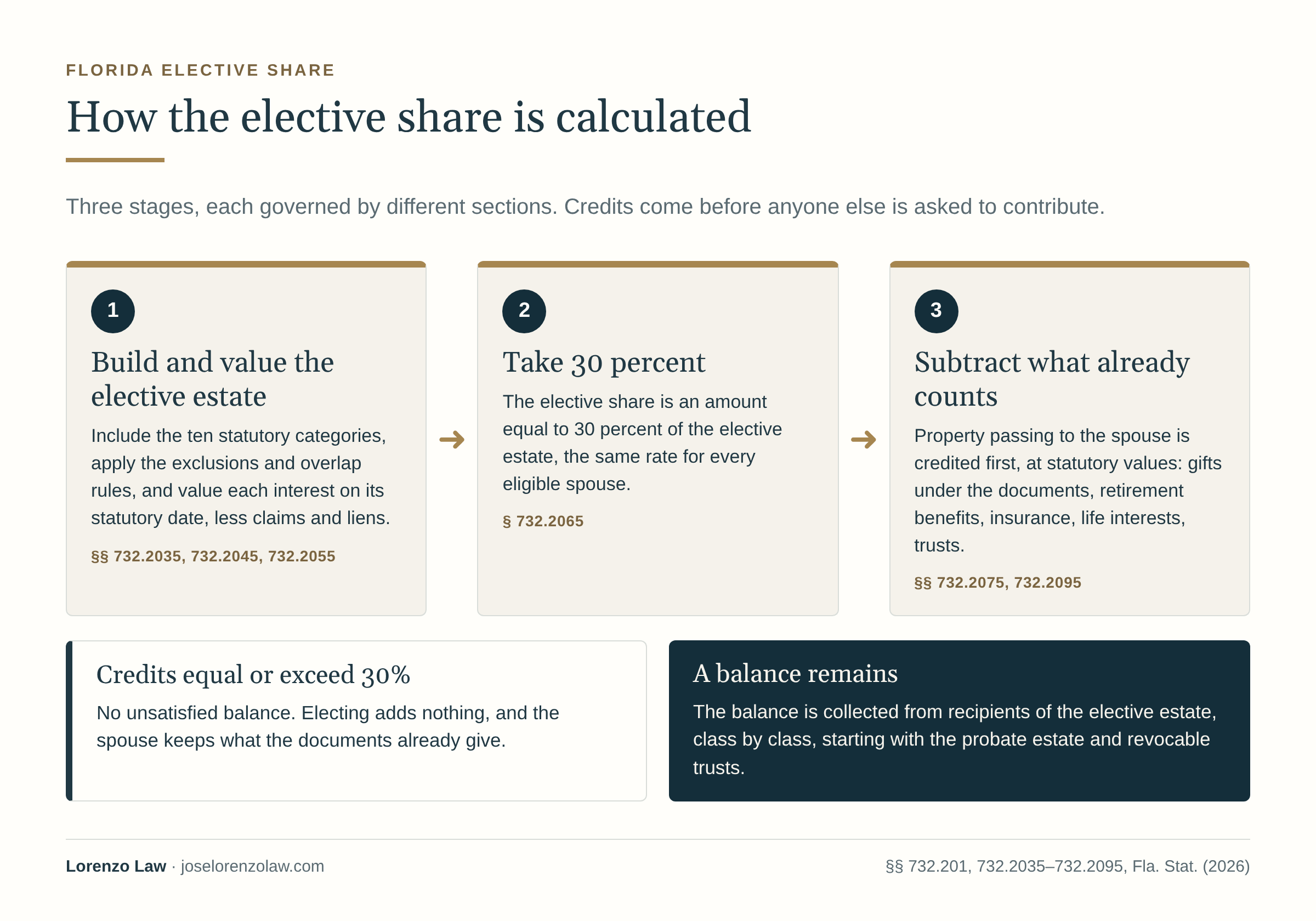
See the chart “How the elective share is calculated” (opens the full-size image; the details are also in the text).
Example 1: a balance remains
How much is elective share in Florida in dollars? It depends entirely on the inputs, so two examples follow, with the elective share explained step by step. This elective share example assumes a timely, valid election, no waiver, and a final, correctly valued elective estate of $1,000,000 after every exclusion, overlap adjustment and deduction. Assume the governing documents do not change the default satisfaction rules, and the spouse receives $180,000 of property that is properly credited toward the share. There are no other credits or adjustments.
| Step | Illustrative amount |
|---|---|
| Final elective estate | $1,000,000 |
| Elective share at 30 percent | $300,000 |
| Qualifying property credited toward the share | $180,000 |
| Remaining amount to satisfy from other recipients | $120,000 |
The spouse does not receive $300,000 plus the $180,000 already credited; the spouse’s total is $300,000 on these assumptions. The example identifies a balance. It does not predict which recipients pay, whether the money can be collected, or the fees, interest or outcome in a particular estate.
Example 2: what the spouse receives already exceeds 30 percent
Use the same $1,000,000 elective estate and the same $300,000 share. This time the spouse is the beneficiary of a retirement account and a life insurance policy and receives a specific gift under the will, together worth $350,000 as properly credited. Credits of $350,000 exceed the $300,000 share, so there is no unsatisfied balance and nothing for anyone else to contribute. Electing would not add anything. Because the election does not reduce what the spouse receives otherwise (§ 732.201), the spouse still keeps the $350,000.
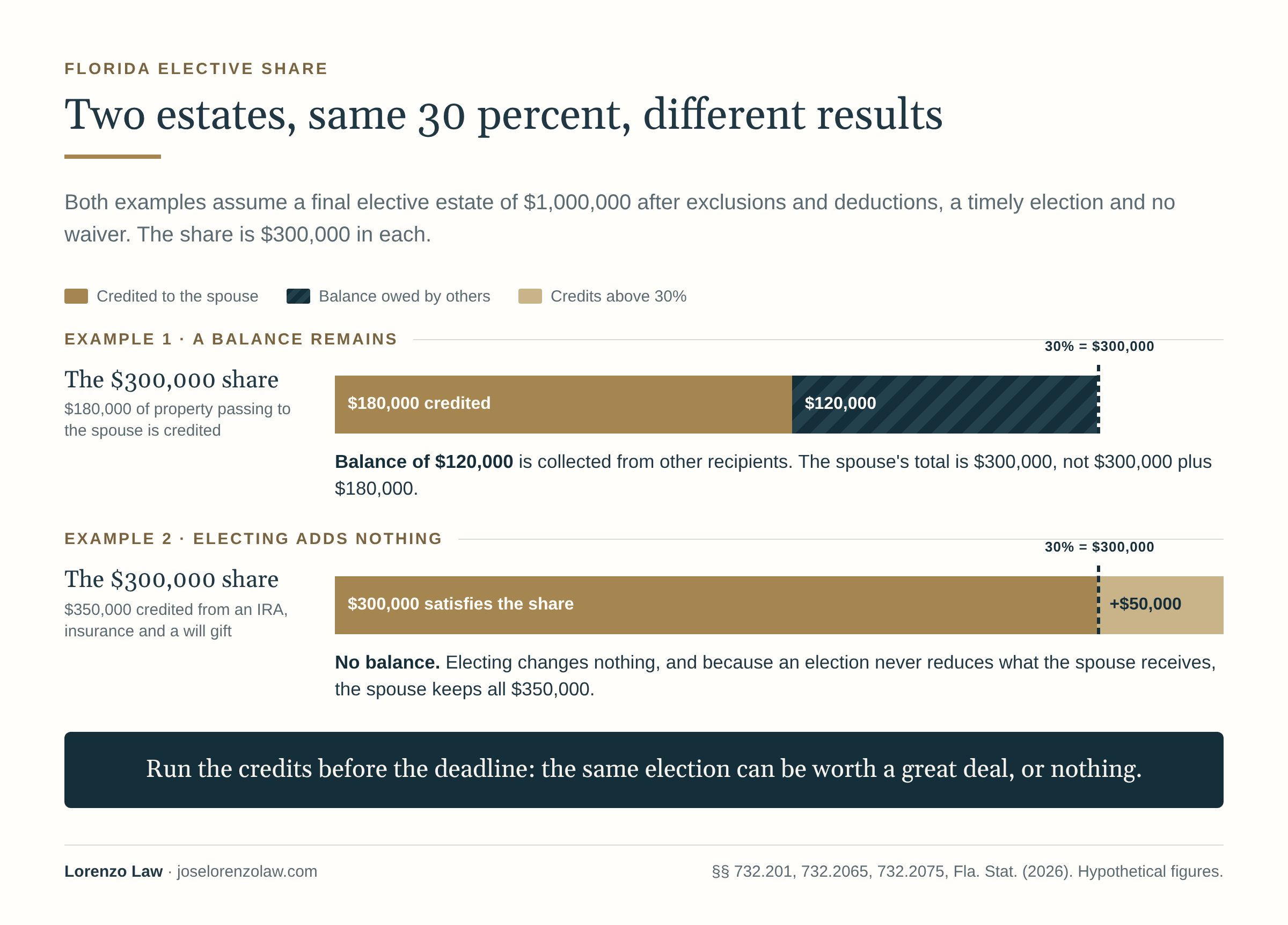
See the chart “Two estates, same 30 percent, different results” (opens the full-size image; the details are also in the text).
Deciding whether to elect: when it helps and when it adds nothing
What are elective share rights worth in a particular estate? Electing is not automatically the better financial move. It tends to help when the will or trust leaves the spouse a small part of a large elective estate; when most of the wealth sits in a revocable trust, payable-on-death accounts or beneficiary designations naming others; when substantial gifts were made in the last year of life; or when the spouse is left only an interest in a trust that is credited at 50 or 80 percent of its principal rather than 100 percent.
Electing tends to add little or nothing when the documents already give the spouse 30 percent or more of the elective estate at statutory values, because the elective share of estate assets is then already covered; when the spouse is the beneficiary of large retirement accounts or life insurance; when the major assets were already owned jointly with the spouse; or when the estate is modest and homestead, exempt property and the family allowance already deliver most of what there is. Electing can also have costs: a dispute over values or entitlement takes time and money, and a spouse who receives an outright share may lose eligibility for needs-based benefits. Run the numbers before the deadline, with the documents in hand, and keep in mind that the withdrawal window is short.
Florida elective share worksheet
The worksheet below does the last two steps of the arithmetic once you have a final elective estate figure and the credits that count toward it. Enter amounts after exclusions, overlaps, valuation dates and deductions have been applied. It shows the elective share amount and any balance. It does not decide what is included, what a trust interest is worth, or whether you are eligible, and it does not predict a payment.
Without the worksheet, the arithmetic is: final elective estate × 30% = the elective share; the elective share − qualifying credits = any remaining balance (never less than zero).
What already counts toward the elective share
Unless the decedent’s will, or a trust referred to in the will, provides otherwise, property passing to or for the surviving spouse is applied first to satisfy the elective share (§ 732.2075). That includes elective-estate property passing to the spouse, retirement benefits paid to the spouse, life insurance proceeds paid to the spouse on a policy the spouse did not own, the decedent’s half of community property paid to the spouse, property in a qualifying special needs trust for the spouse, and qualifying interests the spouse disclaimed.
Inclusion in the elective estate and credit toward satisfaction are separate questions. Life insurance shows why: only the cash value enters the elective estate, but the net proceeds paid to the spouse can count toward the share. Disclaimed property is another trap: an interest that would have satisfied the share still counts as a credit even if the spouse disclaims it, so disclaiming does not enlarge the balance owed by others (§ 732.2075).
Credits are valued under § 732.2095, which uses different dates for different property: the date of death for transfers in satisfaction, homestead and survivorship property, insurance and retirement benefits; the date of distribution for property the personal representative distributes; the transfer date for lifetime gifts to the spouse; and the funding date for property passing in trust. A current statement balance alone may not answer the credit question.
Homestead and other life interests
For satisfaction, a life interest in property that is not in trust, including the statutory homestead life estate, is credited at one-half of the property’s value on the applicable valuation date. The statutory one-half tenancy-in-common homestead election is also credited at one-half (§ 732.2095). Separately, § 732.2055 decides how protected homestead enters the elective estate itself. The two calculations should not be collapsed into one.
Whether a spouse receives a homestead life estate in the first place depends on the homestead and inheritance rules; the Florida homestead probate guide explains those conditions and the separate election, and the homestead probate FAQ answers the common follow-up questions.
Florida elective share trust requirements: the 100 / 80 / 50 rule
What is an elective share trust? It is a trust for the surviving spouse that is credited toward the share. A Florida elective share trust must meet three requirements (§ 732.2025): the spouse is entitled for life to the use of the property or to all of the income, paid at least annually; the spouse can require the trustee to make the property productive or convert it within a reasonable time; and, during the spouse’s life, no one other than the spouse can distribute income or principal to anyone other than the spouse. A qualifying trust is credited at 100, 80 or 50 percent of its principal.
An income interest alone does not make a trust an elective share trust; all three requirements must be met. When a plan relies on an elective share trust, Florida law looks at the trust’s actual terms, not its label: the statute defines an elective share trust by what the trust provides (§ 732.2025). For a trust, or a portion of a trust, that qualifies, the spouse’s interest is credited toward the share as a percentage of the trust principal on the applicable valuation date (§ 732.2095):
| Powers in the qualifying elective share trust | Percentage of principal credited |
|---|---|
| A qualifying invasion power and a qualifying power of appointment | 100 percent |
| A qualifying invasion power but no qualifying power of appointment | 80 percent |
| All other cases | 50 percent |
A qualifying invasion power is a power held by the spouse or the trustee to invade principal for the spouse’s health, support and maintenance; the power may, but need not, provide that the spouse’s other resources are taken into account when it is exercised. A qualifying power of appointment is a general power exercisable by the spouse alone and in all events in favor of the spouse or the spouse’s estate; a general power to appoint by will qualifies if the spouse can exercise it in favor of the spouse’s estate without anyone else’s consent (§ 732.2095). “All other cases” is broader than “neither power”: it covers every qualifying elective share trust that lacks the qualifying invasion power.
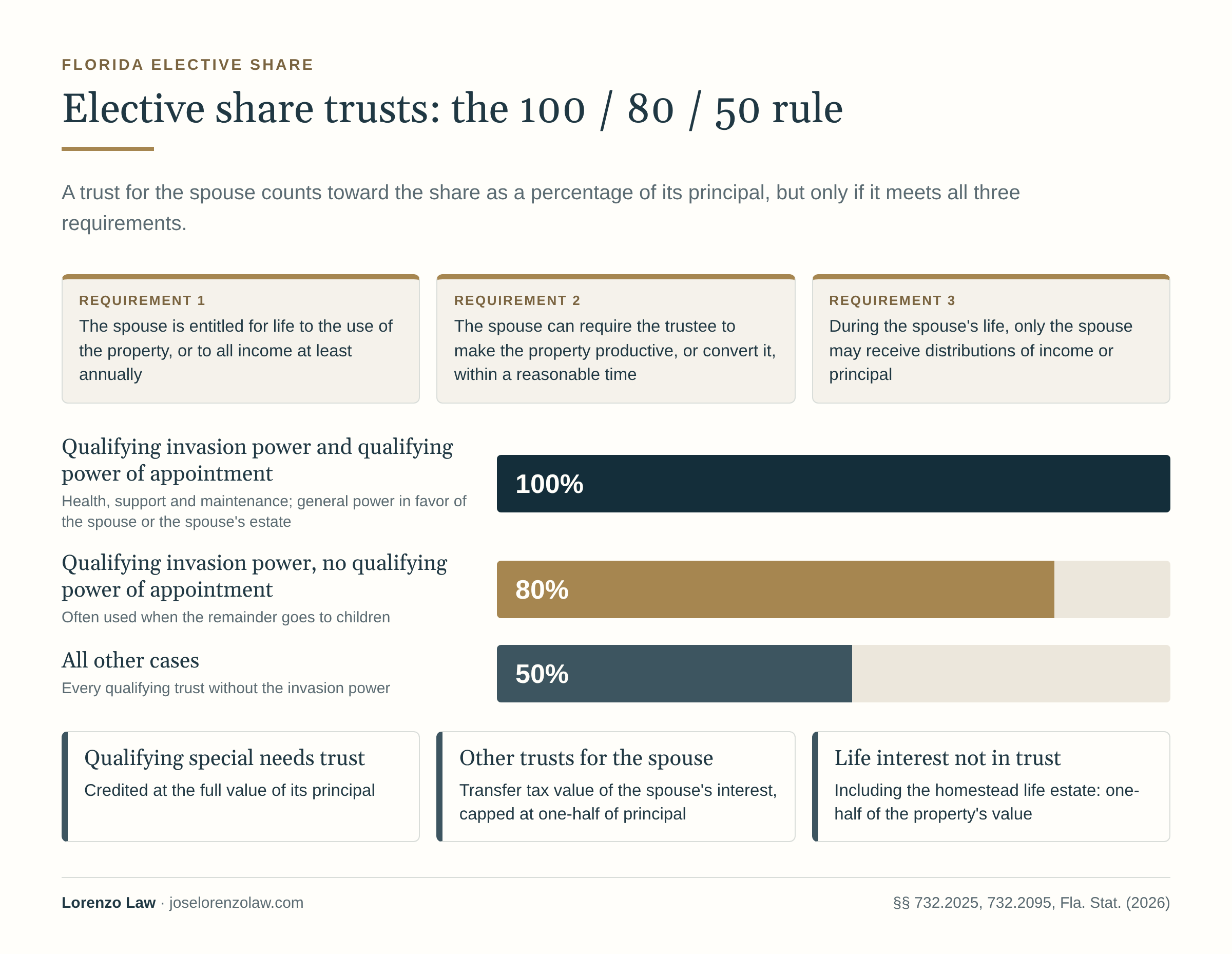
See the chart “Elective share trusts: the 100 / 80 / 50 rule” (opens the full-size image; the details are also in the text).
Special needs trusts and other trusts for the spouse
A qualifying special needs trust for an ill or disabled spouse is credited at the full value of its principal (§ 732.2095). It must be established for an ill or disabled spouse, with court approval (which is not required if the total held in all such trusts for the spouse is under $100,000), with discretionary distributions by trustees fewer than half of whom are ineligible family trustees, and with no one other than the spouse able to distribute to anyone other than the spouse during the spouse’s life (§ 732.2025). The Florida special needs trust page explains these trusts generally.
A trust for the spouse that is neither an elective share trust nor a qualifying special needs trust is credited at the transfer tax value of the spouse’s interest, capped at one-half of the trust principal (§ 732.2095). If the share is still unsatisfied after the contribution classes, the balance can be taken from such a trust under section 732.2075(3). These are valuation rules, not a promise that a trust of a given size will satisfy the share in every estate.
Planning with an elective share trust or a marital trust
For a married person who wants to provide for a spouse while preserving assets for children, an elective share trust is the statute’s own planning tool. Drafting it with a qualifying invasion power and a qualifying power of appointment produces a 100 percent credit; dropping the power of appointment, which is common when the remainder is meant for children of a prior marriage, produces an 80 percent credit, so the trust has to be larger to satisfy the same share. Many estate plans also use a marital trust designed to qualify for the federal estate tax marital deduction (often called a QTIP trust); whether it also meets the elective share trust requirements is a separate drafting question. See Florida estate planning and the Florida estate planning guide.
Who pays the elective share?
If credits do not satisfy the Florida elective share, the unsatisfied balance is collected from the recipients of the elective estate in three classes (§ 732.2075). Class 1 is the probate estate and revocable trusts. Class 2 is recipients of accounts, joint property and insurance cash value, and of retained-interest and retirement property the decedent could direct. Class 3 is everyone else who received elective-estate property. Each class pays in full before the next is reached.
| Order | Source | What it includes |
|---|---|---|
| First: credits | Property passing to or for the spouse | The interests listed in § 732.2075(1), unless the will or a trust referred to in the will provides otherwise |
| Class 1 | Probate estate and revocable trusts | Paid in cash or in kind; within the estate and trust, in the statutory abatement order unless the documents direct otherwise |
| Class 2 | Accounts, joint property, insurance and designated benefits | Recipients of category 3, 4 and 7 property, and of category 6 and 8 property to the extent the decedent could designate the recipient at death |
| Class 3 | All other recipients | Recipients of all other elective-estate property, such as transfers in the last year of life |
| Then | Other trusts for the spouse, then charitable lead interests | Trusts for the spouse that are not elective share or special needs trusts; then protected charitable lead interests, only as federal tax rules permit |
Protected charitable interests are excluded from classes 2 and 3. Summarized from § 732.2075 and § 732.2085.
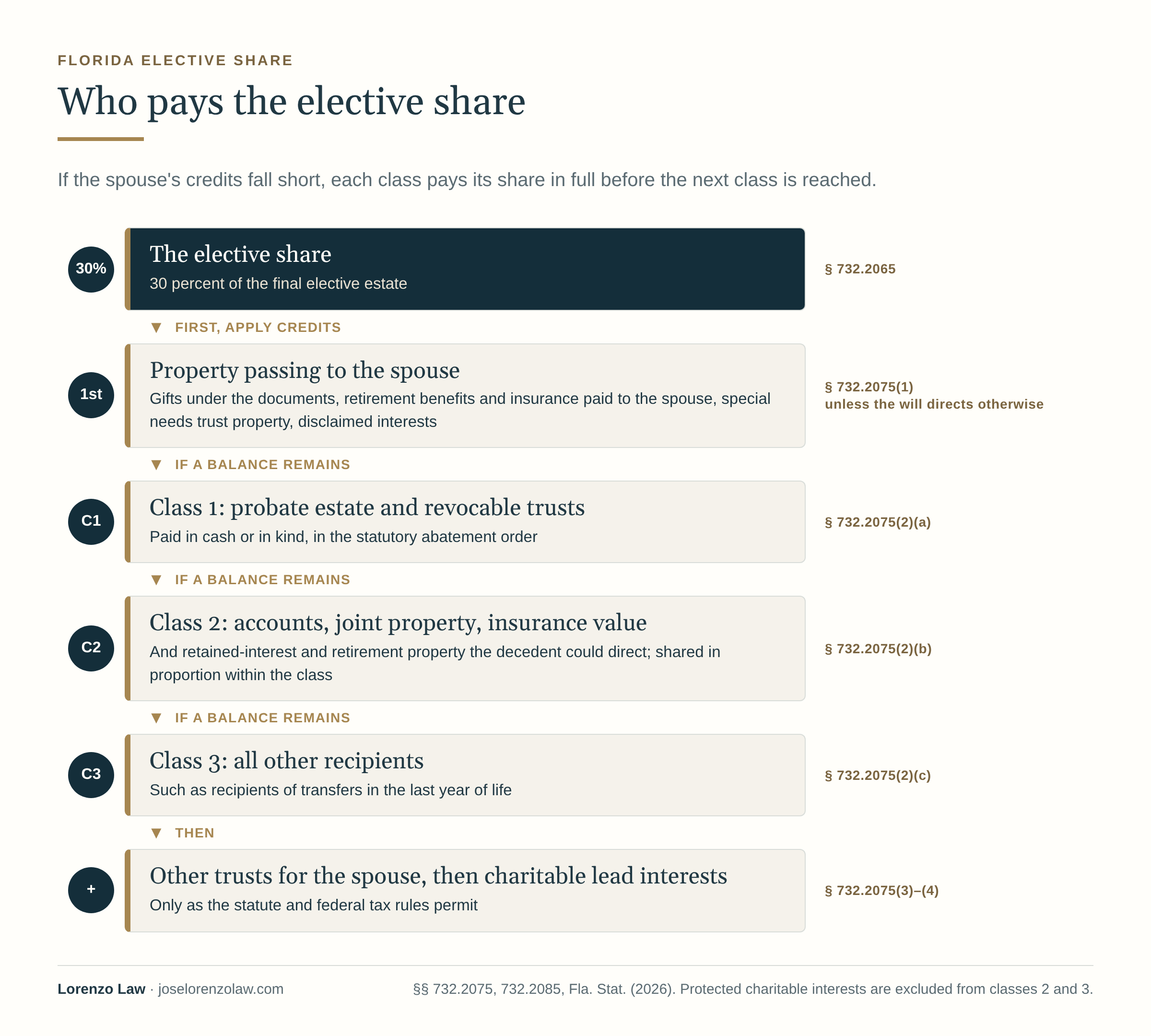
See the chart “Who pays the elective share” (opens the full-size image; the details are also in the text).
Within classes 2 and 3, each recipient is liable for a proportional part of the class’s liability, based on the value of what that recipient received (§ 732.2085). A will can direct which probate assets bear the contribution, and a will direction about trust property is effective only for revocable trusts; that is not the same as saying everything yields to the will. Recipients other than the probate estate and revocable trusts generally have choices about how to pay: a proportional part of everything received, or, for property received before the order of contribution, the property itself or, if it was sold before the election was filed, its sale value less reasonable costs of sale. A recipient who chooses to hand over the property or pay its sale value, but does not fully pay by two years after death, also owes statutory interest on the unpaid portion.
Direct recipients and beneficiaries
Only direct recipients of elective-estate property, and the beneficiaries of the probate estate or of a trust that is a direct recipient, are liable to contribute (§ 732.2085). A direct recipient is the probate estate and anyone who received elective-estate property from the decedent by transfer, survivorship or beneficiary designation; for property held in trust, the trustee is the direct recipient and the trust’s beneficiaries are not (§ 732.2025). A beneficiary who receives a distribution of principal after death can still be liable for a share measured by the distributing trust’s or estate’s remaining liability. Identify the recipient, the capacity in which the property was received, the property and the proposed amount, rather than assuming all family members owe equal shares.
How to file an elective share election in Florida, step by step
An election to take the Florida elective share is filed in the probate proceeding for the deceased spouse’s estate and served on the personal representative. Florida Probate Rule 5.360, the Florida Probate Rules’ elective share procedure, then separates the question of entitlement from the questions of amount and contribution, each with its own notices, objection periods and orders.
What is an elective share claim? Technically it is an election, not a creditor claim, so the elective share probate filing follows its own rule rather than the claims process. In a Florida probate, elective share filings move in this order:
- Confirm the deadline and authority. Identify the date of death, the date the notice of administration was served or any waiver was filed, and whether an agent or guardian needs court approval before electing.
- File and serve the election. The spouse files the election within the time required by law and promptly serves a copy on the personal representative in the manner provided for formal notice. An agent or guardian obtains court approval first. If no probate proceeding is open, one may need to be opened in the proper county so there is a proceeding in which to elect.
- Notice of election. Within 20 days following service of the election, the personal representative serves a notice of election, with a copy of the election, on the interested persons the rule identifies.
- Objections to entitlement. An interested person may serve an objection to the spouse’s entitlement, stating particular facts and grounds, within 20 days after service of the notice of election. If there is an objection, the court decides entitlement.
- Order of entitlement. The court determines whether the spouse is entitled to the elective share.
- Petition to determine the amount, with the elective estate inventory. After the entitlement order, the personal representative files a petition to determine the amount and serves it with an inventory of the elective estate within 60 days after the order is entered. If the personal representative has not filed it within 90 days from rendition of the order, the spouse, or the spouse’s agent, guardian or personal representative, may file it.
- Objections to the amount. An interested person may serve an objection to the amount or to the proposed distribution within 20 days after service of the petition.
- Order determining the amount and contribution. The court sets the elective share, identifies the assets to be distributed to the spouse and, where needed, the contribution required of each recipient.
These procedural periods are not substitutes for the election deadline, and the actual notice, service, orders and time-computation rules need review in each estate. If you obtain the petition form or an election form online, note that the document is often titled “Election to Take Elective Share.” Florida probate practice still turns on the rule’s requirements, and a form filed without reviewing the estate’s notices and the asset picture can preserve the deadline but rarely answers the real questions. For the broader process, see the Florida probate guide and Florida probate administration.
Collection, attorney’s fees and interest
The court determines the elective share and the contribution, and its order of contribution is prima facie correct in any court (§ 732.2145). The personal representative generally must collect contribution under that order, including by withholding a required contribution from a distribution under the personal representative’s control. The personal representative does not have to pursue property outside the estate’s control until after the order of contribution, may be relieved of the duty if collection is impracticable, and is not liable for failing to attempt an economically impracticable collection.
The surviving spouse also has an independent right to collect as the order of contribution provides. When the personal representative sues to collect from property outside its control, or the spouse sues to enforce the order, the judgment includes that party’s costs and reasonable attorney’s fees (§ 732.2145). Separately, in proceedings where entitlement, the amount, the included property, its value or the satisfaction of the share is disputed, the court may award costs and attorney’s fees and direct payment from the estate, from a party’s interest, or by judgment; if the personal representative fails to file the required petition to determine the amount, the spouse’s reasonable costs of preparing and filing it may be awarded from the estate (§ 732.2151). A fee award and actual collection are different outcomes.
Any part of the elective share not satisfied within two years after death bears interest at the statutory rate until paid, even if no order of contribution has been entered, and contributions bear statutory interest beginning 90 days after the order of contribution (§ 732.2145). That is the practical answer when an estate is not settled within two years: the delay does not cancel the share, but it starts interest on what remains unpaid. Apply the provisions to the actual amounts and payment history rather than assuming two rates accumulate on the same dollars.
If you are the personal representative, a trustee or a beneficiary
An elective share affects more than the spouse. The personal representative has service, inventory and collection duties; a trustee or other direct recipient may owe contribution; and a beneficiary may receive less. Each person’s interests can differ, so the estate’s lawyer does not represent every affected person, and each should get advice in the capacity in which they are involved.
Personal representative
Serve the notice of administration on the surviving spouse, track the election deadline, and when an election is served, serve the notice of election within the rule’s period. After entitlement is decided, prepare the petition to determine the amount and the elective estate inventory, which reaches nonprobate property the estate does not control, and serve them on time. Withhold required contributions from distributions under your control (§ 732.2145) and, consistent with your fiduciary duties, avoid distributions that would defeat a pending or anticipated election. A personal representative who is also a beneficiary or a trustee has competing roles and may need separate advice. If a beneficiary or the spouse believes the personal representative is not meeting these duties, see breach of fiduciary duty.
Trustee or other direct recipient
A trustee of a revocable trust is in class 1 and may have to contribute, in cash or in kind, ahead of other recipients. A trustee of another trust that received elective-estate property, a joint owner, a payable-on-death beneficiary or a retirement beneficiary may be in class 2 or class 3. Preserve records of what was received and when, consider the statutory options for paying, and do not distribute trust principal without accounting for a possible contribution. See trust litigation if the trust’s exposure is disputed.
Beneficiary who received a notice of election
Read the notice for the objection period: an objection to the spouse’s entitlement must be served within 20 days after service of the notice of election, and an objection to the amount within 20 days after service of the petition to determine the amount. Common questions are whether the spouse was eligible, whether a waiver exists, whether the election was timely, what was included, how it was valued, and whether the credits were applied. A beneficiary’s own exposure depends on what that beneficiary received and in which class, and a trust or estate beneficiary who received a principal distribution can be liable for a share of the contribution in proportion to what was distributed (§ 732.2085). Do not assume the personal representative’s lawyer is protecting your share.
Can the elective share be waived?
Can an elective share be waived? Yes. The Florida elective share can be waived, wholly or partly, before or after marriage, by a written contract, agreement or waiver signed by the waiving spouse; for Florida residents signing after the law’s effective date this must be done before two subscribing witnesses, while a nonresident’s agreement is valid here if valid where it was signed (§ 732.702). A waiver signed after the marriage also requires fair disclosure of each spouse’s estate; one signed before the marriage does not. No consideration is needed beyond signing the agreement.
A waiver of elective share Florida law will enforce must be in writing and properly signed. Florida statute 732.702, titled “Waiver of spousal rights,” allows a spouse to give up spousal elective share rights and several other spousal rights, together or one at a time. The controlling reference is Florida Statutes 732.702 (waiver of spousal rights: elective share, homestead, exempt property and more). There is no official waiver of spousal rights Florida form that fits every couple; what matters is that the document meets the statute. The witness requirement applies to agreements signed by Florida residents. An agreement signed by a nonresident is valid in Florida if it was valid where it was signed, whether or not the person was a Florida resident at death. Unless the document provides otherwise, a waiver of “all rights,” or equivalent language, in the property or estate of a present or prospective spouse waives the elective share, intestate share, pretermitted share, homestead, exempt property, family allowance, community property claims at death and preference to serve as personal representative of an intestate estate, and renounces benefits under any will signed before the waiver (§ 732.702). A document limited to homestead, by contrast, should not automatically be treated as an elective share waiver. That is why the practical answer to “Can you disinherit a spouse in Florida?” is usually a Florida waiver of elective share rights, signed by the spouse.
Review the residency, the date and place of signing, the witnesses, the governing-law clause, the schedules, and the whole document. Do not decide whether rights were waived from a document’s title or from a relative’s summary. An older waiver signed before the current elective share statutes took effect, if it otherwise complies with section 732.702, also waives all rights under sections 732.201 through 732.2145 (§ 732.2155).
Does a prenup still apply after a spouse dies?
Yes, a prenup can still apply after a spouse dies if it addresses rights at death. “Do prenups work if someone dies?” is a question about the rights the agreement covers. A prenup after death is enforced, if at all, as a waiver of the rights it covers. Does a prenup cover death? Only if its terms reach the rights each spouse would have at the other’s death; a prenup does not expire upon death, but one written only for divorce may say nothing about it. Can prenups expire? Generally only if the agreement says so, for example through a sunset clause, or if after the marriage both spouses amend, revoke or abandon it in a signed written agreement; in some cases a court may also find an agreement abandoned by the spouses’ conduct. Older documents call it an antenuptial agreement. Florida law treats the label as less important than the words: a prenup, a premarital agreement and a pre-nuptial agreement (Florida documents use all three) are read the same way. A prenuptial agreement usually governs divorce, but many also waive or limit the rights each spouse would have at the other’s death, including the Florida elective share. Whether it does depends on its words: an agreement that waives “all rights” in the other’s estate waives the elective share unless it provides otherwise, while one limited to divorce, or to particular property, may leave the elective share intact (§ 732.702).
Is a prenup still valid after death? Yes, to the extent it waives rights at death and was properly signed. What happens to a prenup when someone dies, or, put personally, what happens when your spouse dies and you have a prenup? Its waiver is applied in the probate case. If you have a prenup and your spouse dies, bring the prenup and death certificate together with the will, because their order matters. Does a prenuptial agreement override a will? An “all rights” waiver renounces gifts under a will signed before the waiver. Does a prenup override a will signed later? Not necessarily, which raises the reverse question: does a will override a prenup? A will signed after the agreement can still leave the spouse more than the agreement requires (§ 732.702). In a prenup, death of spouse provisions and divorce provisions are often separate, so read the whole prenup. Upon death, the waiver language is what counts.
Can a prenup be voided after death? It can be challenged in the probate case, where section 732.702, not the divorce statute, governs, so what voids a prenup in Florida at death depends on the defense raised. Can a prenup be contested at death? Yes, but only on a recognized ground, such as missing witnesses on a Florida resident’s waiver, a postnuptial agreement signed without fair disclosure, a signature obtained by coercion or duress or by fraud about what was being signed, or incapacity when signing. Failure to disclose assets cannot by itself invalidate a premarital waiver in probate (Stregack v. Moldofsky, 474 So. 2d 206 (Fla. 1985)). “Will my prenup hold up in court?” is therefore a question about the document, the signing and the defenses, not only its title. A valid prenuptial agreement in Florida that waives rights at death has to meet section 732.702.
So is a prenup valid after death in every case? Not automatically. At death, the waiver is reviewed under the Probate Code’s requirements: a writing, signed by the waiving spouse before two subscribing witnesses if a Florida resident signed it, and no disclosure requirement for an agreement signed before the marriage. There is no separate Florida prenup statute for death: in practice, the Florida prenup requirements that matter at death are these formalities, and the Florida prenuptial agreement requirements for divorce are a separate set. Florida prenup laws therefore come from two places, the Probate Code for rights at death and the Florida prenuptial agreement law in section 61.079 for divorce. Under Florida law, prenuptial agreement terms that waive rights at death are read under section 732.702. There is likewise no official Florida prenuptial agreement form and no standard prenuptial agreement Florida law requires couples to use. An online prenuptial agreement, Florida-made or not, must still meet section 732.702 to waive the elective share. One signed by a Florida resident needs two subscribing witnesses. One signed by a nonresident is valid in Florida if it was valid where it was signed. For a premarital agreement, Florida Statutes section 61.079 (the Uniform Premarital Agreement Act, the Florida premarital agreement statute) states that it applies only to proceedings under the Florida Family Law Rules of Procedure, and that Florida prenuptial agreement statute does not alter the formalities, rights or obligations of spousal agreements under the Probate Code (§ 61.079). Do not apply a divorce-court disclosure test to a probate waiver without analysis. Whether a particular agreement is enforceable still depends on its terms, its signing and the defenses raised.
Postnuptial agreements and fair disclosure
Can a prenup be signed after marriage? Not as a prenup: a prenup when already married is really a postnuptial agreement. For a postnuptial agreement, Florida law adds a disclosure condition when the agreement waives the elective share: it requires fair disclosure of each spouse’s estate to the other, and a prenuptial agreement does not (§ 732.702). The same document signed a week before the wedding or a week after it is therefore governed by different rules, and establishing which side of the wedding it falls on is often the first question.
| When it was signed | Fair disclosure of each spouse’s estate required? | Other requirements |
|---|---|---|
| Before the marriage (prenuptial) | No; the statute states that no disclosure is required | Written; signed by the waiving party before two subscribing witnesses if signed by a Florida resident |
| After the marriage (postnuptial) | Yes; each spouse must make fair disclosure of that spouse’s estate | Same writing and witness requirements |
Whether the document is a postnup or a prenup, Florida courts start with its words. Bring the agreement, its schedules and amendments, any financial disclosures exchanged, and the signing history. Couples planning a marriage or reviewing an existing agreement can see Florida estate planning; a marital agreement is often coordinated with the wills, trusts and beneficiary designations it is meant to support.
Waiving homestead rights
Can a spouse waive their homestead rights in Florida? Yes. A spouse may waive homestead rights under the same section, and a waiver of “all rights” includes homestead unless it says otherwise (§ 732.702); a waiver of homestead rights (Florida Statutes 732.702) is often part of a prenuptial agreement. For the elective share the effect is specific: if the spouse validly waived homestead rights and receives no interest in the protected homestead at death, the homestead is excluded from the elective estate; if the spouse waived but still receives an interest, that interest is valued as non-homestead property (§ 732.2045, § 732.2055). Homestead waivers and the constitutional limits on devising a homestead are explained in the Florida homestead probate guide.
Separation and property settlement agreements
A complete property settlement entered into after, or in anticipation of, separation, dissolution of marriage or divorce is a waiver of all the listed spousal rights, including the elective share, unless it provides to the contrary (§ 732.702). Like any waiver signed during the marriage, it must meet the statute’s witness formalities and follow fair disclosure of each spouse’s estate. This matters most when a spouse dies while a divorce is pending: the marriage may still exist, but a signed settlement may already have given up the right. A draft or an unsigned agreement is not the same as an executed one, so bring every version and the signing record.
Second marriages and blended families
Florida elective share disputes can involve second marriage inheritance and second wife rights when a surviving spouse and the deceased spouse’s adult children from an earlier marriage have competing interests. Without a valid waiver, a plan that leaves everything to the children through a trust, payable-on-death accounts and retirement beneficiary forms usually still leaves the spouse an elective share, and the children may have to contribute.
What rights does a second wife have? The same rights as a first wife. The rights of a second wife usually come down to the elective share, homestead and the documents. Second wife inheritance rights and the rights of a second husband raise the same issues. With the elective share, spouse and stepchildren can have competing interests. Stepchildren and spouse inheritance disputes follow a familiar pattern: a person remarries later in life; over the following years the house goes into a revocable trust for the children, a brokerage account is made transfer-on-death to the children, and the IRA beneficiary is changed; the will leaves the new spouse a modest gift. At death the probate estate looks almost empty. Under the elective estate rules, the trust, the transfer-on-death account and the IRA are each likely to be reviewed for inclusion, but each still needs its own analysis: whether the house is protected homestead, what the spouse already receives, whether anything was excluded, and when each change was made. The likely result is not that the planning was invalid, but that the recipients may owe contribution.
If you are the surviving spouse
If my husband dies, what am I entitled to in Florida? If he was domiciled in Florida, at minimum the right to the elective share if you file on time, along with any homestead, exempt property and family allowance rights, unless you validly waived them. Can my husband disinherit me? Generally not without your signed waiver; your spousal rights in Florida do not depend on the children’s agreement. Do not sign a waiver, a disclaimer, a receipt or a settlement until you know what you already receive and what the elective estate likely includes. Keep every notice. Write down what you know about accounts, beneficiary changes and transfers in the last year, even if you do not have statements. The children’s lawyer, or the personal representative’s lawyer, does not represent you. If your spouse dies without a will and had children from another relationship, your intestate share of the probate estate is generally one-half, plus your homestead rights, and if that totals less than the elective share, electing can make up the difference, because the intestate share is credited toward it.
Am I legally responsible for paying my husband’s debts if he dies in Florida? Generally not for debts in his name alone. Florida abolished the doctrine of necessaries (Connor v. Southwest Florida Regional Medical Center, 668 So. 2d 175 (Fla. 1995)), so marriage alone does not make you liable for his medical bills. You can still be responsible for debts you co-signed, guaranteed or owed jointly, including a hospital admission or financial-responsibility form you signed in your own capacity rather than only as his representative. His estate pays valid creditor claims before distributions; see Florida probate creditors.
If you are an adult child or other beneficiary
Can stepchildren inherit? Stepchildren inheritance rights in Florida generally come from the documents: a stepchild who was not adopted usually receives property from a stepparent through a will, trust or beneficiary designation rather than as an heir. Do stepchildren have inheritance rights of their own? Under the intestacy rules, stepchildren are not heirs of a stepparent unless they were adopted; the narrow exception applies only when no relative in the statutory order survives, and the estate then goes to the kindred of the decedent’s last deceased spouse, which can include that spouse’s children (§ 732.103); the step children inheritance law Florida applies leaves the rest to the documents. That is why inheritance issues with stepchildren usually come down to stepchildren and wills, trusts and beneficiary forms. An election does not mean anyone did something wrong, and it does not automatically take a fixed share of what you received. Check whether there is a waiver, whether the spouse was eligible and filed on time, what is in the elective estate, what the spouse already receives, and which class your property falls in. Preserve records of what you received and when, and do not spend or transfer property received from the estate or a trust without advice while an election is pending.
Planning that respects both families
Two planning questions come up again and again: “If I die, does my wife inherit everything?” and “Can I disinherit my spouse in Florida?” The answers are “not necessarily” and “generally not without a waiver,” so the statute’s tools matter. When it comes to inheritance and stepchildren, the gift has to be written into the plan: an inheritance to stepchildren does not happen by default. For people planning a second marriage, the statute offers several tools that can provide for a spouse and still protect children: a prenuptial or postnuptial waiver with proper formalities and, after marriage, fair disclosure; an elective share trust for the spouse with the remainder to the children; life insurance or retirement benefits naming the spouse, which are credited toward the share; and coordinated beneficiary designations. Each has trade-offs that depend on the family and the assets. A prenup and inheritance planning often go together. A prenup for inheritance purposes usually identifies the expected inheritance, with its income and growth, as separate property for divorce purposes and, to reach rights at death, waives the elective share or related rights, wholly or partly, in a writing that meets section 732.702; this kind of inheritance prenup has to match the will and trust. Many people also sign a prenup to protect inheritance they expect from their parents, or a prenup for future inheritance they want to pass to their own children; at death, those prenuptial agreement inheritance terms work through the waiver of the elective share and other spousal rights. When couples sign a prenuptial agreement, Florida estate planning usually pairs it with a will, a trust and updated beneficiary forms so the pieces match. See Florida estate planning, beneficiary designations in estate planning and probate administration; when the family is already in a dispute, see Florida probate litigation.
Elective share disputes: what gets contested
Elective share litigation usually turns on one of four questions: whether the spouse is entitled to elect, what belongs in the elective estate and what it is worth, how the share is satisfied, and who contributes and whether they pay. Objections are raised within the rule’s 20-day periods, and the court decides entitlement, then amount and contribution.
| Issue | Typical questions | Records that usually matter |
|---|---|---|
| Entitlement | Was the decedent domiciled in Florida? Was the claimant legally married to the decedent at death? Is there a valid waiver? Was the election timely, or extended or tolled? | Residence records, marriage and divorce records, the agreement and its signing, notices and service records |
| Inclusion | Does a trust, account, deed, policy or gift fall in a category? Does an exclusion apply? Is the same asset counted twice? | Trust instruments, account titles and forms, deeds, gift records and dates |
| Valuation | What is the fair market value on the correct date? Which claims and liens are deducted? What is a trust interest worth? | Appraisals, statements on the right dates, claims and mortgage records |
| Satisfaction | Which property passing to the spouse counts, and at what value? Does a trust qualify as an elective share trust? | The will, trust and beneficiary forms; trust terms on powers |
| Contribution and collection | Which class is each recipient in? Can the share be collected from property that was spent, sold or moved out of state? | Distribution records, sale records, the order of contribution |
Common elective share problems include missing records for accounts that passed outside probate, recipients who spent or moved what they received, and disagreement about whether a document is a waiver. Transfers that appear designed to defeat the share, including what families sometimes call fraudulent transfers, are usually addressed first through the elective estate rules themselves, such as the revocable-transfer, retained-interest and one-year categories. A transfer made without capacity or through undue influence or fraud raises different claims with different procedures; see challenging transfers made before death and the Florida estate disputes guide. Other family disputes are separate claims with their own deadlines, such as an inheritance theft claim, where the inheritance theft statute of limitations depends on the claim brought. Can siblings fight a joint bank account left to one child? Sometimes: the survivorship presumption can be overcome by proof of fraud, undue influence, or clear and convincing proof that the parent intended otherwise, for example a mere convenience account (§ 655.79), but that is a separate dispute from the elective share. Under the Florida spousal elective share law, a personal representative who will not pursue contribution, or a trustee who distributes despite an election, may raise fiduciary questions; see the estate litigation attorney page.
How elective share disputes are resolved
Many elective share disputes are resolved by agreement once the parties exchange the elective estate inventory, the values and the credit calculation, because the arithmetic narrows the disagreement. When they do not settle, the probate judge decides objections at a hearing, and the court’s orders on entitlement, amount and contribution control collection. The court can refer contested matters to mediation. If you need a Florida elective share attorney for a contested matter, on either side, see Florida probate litigation; Jose M. Lorenzo, Jr. personally handles the elective share matters the firm accepts.
Elective share vs other spousal rights
What rights does a surviving spouse have in Florida? Several separate ones, and the elective share is only one of the Florida surviving spouse rights. Homestead, exempt property and the family allowance are in addition to the elective share (§ 732.2105), but a homestead interest the spouse receives is credited toward the elective share, so these rights are not simply added together as cash amounts.
| Right or claim | What it is | How it relates to the elective share | Where it is explained |
|---|---|---|---|
| Elective share | 30 percent of the elective estate, by election (§ 732.2065) | This page | This page |
| Intestate share | The spouse’s share when there is no will: all of the intestate estate or one-half, depending on the descendants (§ 732.102) | Applies to property not disposed of by will; counts as property passing to the spouse | Surviving spouse rights |
| Pretermitted spouse share | A share for a spouse who married the decedent after the will was signed and is not provided for (a spouse left out of will planning because the marriage came later), subject to statutory exceptions | A separate claim; a waiver under § 732.702 can also waive it | Surviving spouse rights |
| Homestead | Florida surviving spouse homestead rights when the home was not validly left another way: a life estate for surviving spouse with the remainder to descendants, or an elected one-half interest as tenant in common; with no descendants, the spouse takes the home outright (§ 732.401) | In addition to the elective share, but what the spouse receives in the home is credited: a life estate or one-half interest at one-half of its value, and an outright interest at full value (§ 732.2095) | Florida homestead probate |
| Exempt property | Certain household items, vehicles and other listed property; the exempt property Florida statute 732.402 lists | In addition to the elective share | Exempt assets |
| Family allowance | A reasonable allowance for support during administration, up to $18,000 in total (§ 732.403) | In addition to the elective share | Florida family allowance |
| Will contest | A challenge to a will’s validity | A different claim with different proof and deadlines; neither route is automatically cheaper or more certain | Contesting a will |
Each right has its own conditions and deadlines, explained on the linked pages.
Three comparisons come up most: the elective share vs intestate share, explained below; the elective share vs omitted spouse share; and the elective share vs forced share: the elective share is sometimes called a forced share, although Florida has no forced heirship in the civil-law sense. Florida pretermitted spouse, elective share and intestate rules can overlap: a pretermitted spouse (Florida Statutes § 732.301) is a spouse who married the decedent after the will was signed. The elective share is not the same as the intestate share. The intestate share applies only to property not disposed of by a will and depends on whether the decedent left descendants who are not also the spouse’s descendants. The elective share applies even when a will exists, and reaches nonprobate property. A spouse who receives an intestate share still has that share credited toward the elective share. The surviving spouse guide explains all of these surviving spouse rights. Florida treats them as separate rights with separate conditions, and the guide is the place to start for spousal inheritance rights in Florida beyond the elective share.
If there is no will: what the spouse inherits
What happens when a spouse dies without a will in Florida? The probate estate passes under Florida intestacy law. Under the rules of intestate succession, Florida gives the surviving spouse the entire intestate estate if the decedent left no descendants, or if all of the decedent’s descendants are also the surviving spouse’s and the surviving spouse has no other descendants; otherwise the spouse’s intestate share is one-half (§ 732.102). The Florida intestacy statute for spouses is that section, and with no will, spouse rights in the home follow the homestead rules instead (§ 732.401).
Dying without a will in Florida does not mean the state takes the property. Florida intestacy rules, sometimes called Florida intestate succession law or the Florida laws of intestate succession, decide who inherits the probate estate, and probate in Florida without a will usually still requires a court proceeding to transfer it. If you die intestate, who inherits? The spouse and descendants first, as above; then parents, then brothers and sisters and their descendants, and then more distant relatives in the order section 732.103 sets. Florida inheritance law without a will is therefore mostly a list of who comes next, and Florida succession laws apply the same list in every county.
Unmarried partner inheritance rights, including common-law partner inheritance, are different. Florida does not recognize common-law marriages entered into in Florida after January 1, 1968, so a partner in such a relationship who was not a legal spouse has no intestate share and no elective share (a Florida common-law marriage formed before that date, or one validly formed in a state that permits it, is treated as a marriage). “If my partner dies without a will, do I inherit?” Usually not, unless the partner left property by will, trust, beneficiary designation or joint title, and the same is true when a common-law partner dies without a will, unless the couple had a valid common-law marriage formed in a state that allowed one. There is no Florida inheritance tax when one partner dies, but the federal marital deduction is not available to unmarried couples. See estate planning for unmarried couples.
What will the surviving spouse inherit in Florida, then, and does a spouse automatically inherit everything in Florida? Only in the first situation, and only as to property that passes by intestacy. Under intestacy, spouse entitlement is often one-half when there are children from an earlier marriage, and the question “Does wife get everything when husband dies in Florida?” usually has the same answer. What does a spouse inherit outside probate? Accounts, trusts and survivorship property pass by their own terms. If a spouse dies, who inherits depends first on those designations, then on any will, and only then on the intestacy laws. Florida treats husbands and wives the same: if a wife dies intestate, who inherits follows the same rules as for a husband. Who is first in line for inheritance? Without a will, the surviving spouse and the descendants, as described above.
How does inheritance work in Florida, then, and what is the inheritance law in Florida for a spouse? Beneficiary designations and survivorship come first, then the will or trust, then intestacy, with a spouse’s own protections (the elective share, homestead, exempt property and the family allowance) applied alongside them. That is the Florida surviving spouse law in outline, and Florida state inheritance laws apply it the same way across all 67 counties. For a spouse, inheriting property in Florida therefore starts with how each asset was titled.
Even without a will, the elective share can matter. When a spouse dies intestate but most assets pass outside probate to others, the intestate share of a small probate estate can be less than 30 percent of the elective estate, and the intestate share is credited toward the elective share. The surviving spouse rights guide explains the inheritance rights of spouses and surviving spouse inheritance generally. It also addresses widow inheritance questions and the inheritance rights of stepchildren.
Medicaid, taxes and the elective share
Electing can affect a spouse’s eligibility for needs-based benefits, and declining to elect can raise its own benefits question, so the decision should be made with any Medicaid planning in view. Florida has no estate or inheritance tax; spouse and children owe no Florida death tax, and for federal estate tax purposes, property passing outright to a U.S. citizen spouse generally qualifies for the marital deduction.
Medicaid and other needs-based benefits
When the surviving spouse receives, or may soon need, Medicaid long-term care, receiving a share outright can make the spouse ineligible until the assets are spent down, and choosing not to elect may be reviewed as giving up an available resource. The statute anticipates this: a qualifying special needs trust for an ill or disabled spouse can hold property that satisfies the elective share (§ 732.2025, § 732.2075), and when a guardian or agent seeks to elect, the court must find that electing is in the spouse’s best interests during the spouse’s probable lifetime (§ 732.2125). Coordinate the elective share decision with the benefits rules before the deadline. The estate planning for widows in Florida page covers a surviving spouse’s own planning.
Federal survivor benefits are separate again. Social Security benefits are excluded from the elective estate, as noted above, and Social Security for a surviving spouse is claimed from the Social Security Administration, not in the probate case. That is true for any surviving widow or widower, and Social Security for a widowed spouse is decided under federal rules, not Florida probate law. Questions about other Florida surviving spouse benefits, such as pensions or veterans’ benefits, usually start with the paying agency.
Estate and inheritance tax
Does a spouse have to pay inheritance tax in Florida? No. Florida does not impose a state estate tax or an inheritance tax, so there is no inheritance tax when one spouse dies, whether the property goes to a widow, a widower or the children; see inheritance tax in Florida. Florida inheritance tax laws do not impose an inheritance tax between spouses, and there is no inheritance tax for a widow, because there is no Florida inheritance tax. Surviving spouse property can still raise federal questions, and between husband and wife, inheritance tax is not the issue; federal estate tax is. There is no Florida inheritance tax between married couples and no separate inheritance tax rules for married couples. Questions about inheritance tax when a spouse dies, or inheritance tax and spouses generally, have the same answer. For Florida inheritance tax, stepchildren and children are treated alike: neither owes that tax.
On federal estate tax, surviving spouse transfers are treated generously. The basic exclusion amount for estates of people who die in 2026 is $15,000,000 (IRS), and property passing to a surviving spouse who is a U.S. citizen generally qualifies for the unlimited marital deduction, so the estate tax for spouse-to-spouse transfers is usually zero. The estate tax for non-citizen spouse transfers follows different rules, often involving a qualified domestic trust; see ancillary administration and non-citizen estate tax. A surviving spouse may also be able to use the deceased spousal unused exclusion (DSUE). Estate tax portability of that amount requires a timely federal estate tax return filed to elect it; an estate not otherwise required to file may have up to five years after death to make that election under IRS Rev. Proc. 2022-32.
For income tax, inherited property generally takes a basis equal to its fair market value at the date of death (IRS Publication 551), which matters for capital gains tax after the death of a spouse when the property is later sold; for property the spouses held as tenants by the entirety, or as joint tenants with survivorship when they were the only joint owners, generally only the half included in the decedent’s estate is adjusted. Elective share property received by the spouse is generally not taxable income to the spouse, but income earned on it after death and distributions from retirement accounts can be. If a fixed-dollar elective share is paid with appreciated assets, the estate or trust may owe tax on the gain; confirm with a tax adviser.
Property tax is a separate question for the county property appraiser, not the probate court. The Florida surviving spouse tax exemption, often called the Florida widow exemption (widowers qualify too), is a separate annual exemption (§ 196.202), and as for the Florida homestead exemption, surviving spouse ownership and residence generally decide whether the home keeps it. The Florida homestead probate FAQ covers the home itself.
Where a Florida elective share is filed
The election is filed in the Florida probate proceeding for the deceased spouse’s estate, in the circuit court for the county where probate venue lies, which is generally the county where the decedent was domiciled. Florida has 67 counties in 20 judicial circuits, and each county’s Clerk of the Circuit Court maintains the probate records.
Lorenzo Law handles Florida elective share matters statewide. The principal office is in Kissimmee (Osceola County, Ninth Judicial Circuit), and Jose M. Lorenzo, Jr. meets clients by appointment in Coral Gables and Fort Lauderdale. Consultations are available by phone and video throughout Florida, in English and Spanish. The table provides selected county and circuit references for readers reviewing a Florida estate. Use the clerk links for records relevant to an elective share matter.
Clerk links checked October 2026. Probate venue depends on domicile and property, not on the spouse’s address or the lawyer’s office.
The Villages spans Sumter, Lake and Marion counties, so a resident’s estate may be filed in any of the three depending on where the decedent lived. When a Villages resident is in a second marriage and moved to Florida in retirement, domicile, older out-of-state estate plans, stepchildren and inheritance planning are at the center of the elective share review. A common question is how a revocable living trust that lets the spouse stay in the home for life, and leaves the home to the children later, works with Florida homestead rules and the elective share. Without a valid waiver, where the home is protected homestead and the owner is survived by a spouse and descendants, Florida’s homestead rules generally void a trust term giving the spouse only a life interest with the remainder to the children: the spouse instead takes a life estate under section 732.401, or may elect a one-half tenant-in-common interest within six months of death, and that interest is credited toward the elective share at one-half of the home’s value. If the spouse validly waived homestead rights, in a marital agreement or in a deed under section 732.7025, the trust term can stand, and the spouse’s trust interest is valued as non-homestead property under the elective share trust rules; see elective share trusts and the homestead guide.
Florida elective share statutes at a glance
What is the elective share statute in Florida? The Florida elective share statute is not one section but a group: sections 732.201 through 732.2155 of the Florida Statutes, together with the waiver statute and the Florida Probate Rules. Florida statute 732.201 creates the right, section 732.2065 sets the 30 percent, and the remaining sections define the elective estate, the credits, the deadline and contribution; Florida statute 732.702 governs waivers. Together they are the Florida elective share law, sometimes called Florida’s spousal elective share statute or Florida’s spousal elective share law. The statute’s text controls over any summary.
Searches such as “Florida Statutes 732.201 elective share 30 percent,” “Florida elective share 30% statute 732.201,” “Florida elective share 30% elective estate statute 732.201” or “Florida Statutes 732.201 elective share 30 percent elective estate” all lead to the same two sections: the Florida elective share statute 732.201 creates the right, and 732.2065 sets the share at 30 percent of the elective estate. Under the Florida statute, elective share rights belong only to the surviving spouse of a Florida domiciliary. Under its elective share statute, Florida sets its own valuation and contribution rules. The Florida elective share rules cannot be replaced with another state’s elective share rules.
What are the changes in Florida’s probate system for 2026, as far as the elective share goes? In the 2026 Florida Statutes, most elective share sections were last amended in 2017 by chapter 2017-121; section 732.201 in 2016 (chapter 2016-189); section 732.2065, which sets the 30 percent, in 1999 (chapter 99-343); sections 732.2105 and 732.2155 in 2001 (chapter 2001-226); and section 732.2125 in 2010 (chapter 2010-132). Section 732.2151 was added in 2017 by chapter 2017-121. The waiver statute was last amended in 2024 (chapter 2024-238). None shows a 2025 or 2026 amendment, and the October 1, 2026 amendment to Florida Probate Rule 5.360 is stylistic. Questions such as “What is the new trust law in Florida?” deserve their own answer, because a change in trust law does not automatically change the elective share; confirm the law in effect on the date of death.
| Section | What it covers | On this page |
|---|---|---|
| § 732.201 | Right to the elective share for the surviving spouse of a Florida domiciliary; electing does not reduce other receipts | Who can claim |
| § 732.2025 | Definitions: direct recipient, elective share trust, probate estate, qualifying special needs trust | Trusts |
| § 732.2035 | The ten categories of property in the elective estate | What counts |
| § 732.2045 | Exclusions and overlapping categories | Exclusions |
| § 732.2055 | Valuation of the elective estate | Calculation |
| § 732.2065 | The amount: 30 percent of the elective estate | Calculation |
| § 732.2075 | Sources of satisfaction, contribution classes and abatement | Who pays |
| § 732.2085 | Liability of direct recipients and beneficiaries | Recipients |
| § 732.2095 | Valuation of property used to satisfy the share; the 100 / 80 / 50 trust rule | Trusts |
| § 732.2105 | The elective share is in addition to homestead, exempt property and allowances | Other rights |
| § 732.2125 | Who may elect; court approval for an agent or guardian | Agent or guardian |
| § 732.2135 | Time to elect, extensions, withdrawal and tolling | Deadline |
| § 732.2145 | Order of contribution, collection, interest and enforcement fees | Fees and interest |
| § 732.2151 | Fees and costs in disputed elective share proceedings | Fees and interest |
| § 732.2155 | Effective date and transition rules | Revocable trusts |
| § 732.702 | Waiver of spousal rights | Waivers |
| § 733.212 | Notice of administration; filed waiver treated as service | Deadline |
| Fla. Prob. R. 5.360 | Election procedure: service, notice of election, objections, entitlement, amount and contribution | Step by step |
An elective share review checklist
For the elective share, what to do when your spouse dies in Florida starts with two tasks: calendar the deadline and gather records. If you were looking for a “what to do when a spouse dies in Florida” checklist PDF, the table below is the elective share part of that list. Bring what you have. Missing records should be listed, not used as a reason to postpone deadline advice.
| Review area | Documents and facts to gather |
|---|---|
| Eligibility | Death certificate, marriage records, any divorce filings or judgments, domicile history, and any agent or guardian authority |
| Deadlines | Notice of administration, proof of service, envelopes and delivery records, filed waivers, extension or approval petitions, orders, and dates of related proceedings |
| Asset ownership | Probate inventory, deeds, account titles and beneficiary records, trust instruments and amendments, retirement plan documents, insurance ownership and cash value records |
| Valuation and exclusions | Statements on the relevant dates, appraisals, mortgage and lien records, claims, transfer dates, consideration paid, and any written spousal consents |
| Satisfaction | Property or payments already passing to the spouse, trust terms and powers, insurance and retirement benefits, disclaimers, and allocation provisions in the will or trust |
| Waiver | Complete prenuptial, postnuptial or settlement agreements, schedules, amendments, disclosures and signing history |
| Court action | Case number, letters of administration, the election and notice of election, objections, the petition to determine the amount and inventory, and any contribution or distribution orders |
What happens when a spouse dies in Florida also involves paperwork that has nothing to do with the election. Banks, title companies and the DMV have their own requirements, such as an affidavit of surviving spouse, Florida DMV surviving spouse form requirements for a vehicle, or a surviving spouse title transfer for real estate, and the surviving spouse will usually need certified death certificates for each. A surviving spouse in Florida often handles that paperwork and the elective share at the same time, but they run on separate tracks: in a Florida probate, surviving spouse rights such as the elective share are decided by the court, while banks and title companies act on their own paperwork. What is the 10 day rule for probate in Florida? Whoever has the original will must deposit it with the clerk within 10 days after learning of the death (§ 732.901). The Florida probate guide covers these first steps.
If you are the surviving spouse, identify the notices received and the property already received, as well as assets you believe are missing. If you are the personal representative, identify service obligations, the elective estate inventory, proposed contributions and distributions under your control. If you are an affected beneficiary or recipient, identify the notice requiring a response, the interest you received, and the amount sought.
Preserve records you lawfully possess. Ask the firm about a secure way to provide financial records; do not put account numbers or sensitive documents in a public contact-form message. A consultation request does not establish representation or extend a deadline.
Questions readers ask about the Florida elective share
What is the elective share in Florida?
The elective share in Florida is a surviving spouse’s statutory right to elect 30 percent of the elective estate of a spouse who died domiciled in Florida. What is the spousal elective share in Florida? The same right: the spousal elective share in Florida and the Florida surviving spouse elective share are names for the elective share Florida law creates. The elective estate includes the probate estate and many nonprobate assets, such as revocable trusts, payable-on-death accounts and retirement benefits. Property the spouse already receives counts toward the 30 percent, and the election must be filed on time.
How much is the Florida elective share, and is it 30 percent of everything?
What is the elective share rate in Florida? It is 30 percent of the elective estate, not 30 percent of everything. Under the Florida elective share, surviving spouse rights are measured against a defined base. The elective estate is a statutory base: it includes specified probate and nonprobate property at statutory values, after exclusions and deductions for claims and liens. Some property, such as life insurance above its cash value, is excluded. What the spouse already receives is credited first, so the additional amount can be far less than 30 percent, or nothing.
Does electing reduce what the will already gives me?
No. Florida law provides that the election does not reduce what the spouse would receive without it, and the spouse is not treated as having died first. What the spouse receives under the will, a trust or beneficiary designations is credited toward the 30 percent, and only any shortfall is collected from others. If those gifts already equal or exceed the share, electing adds nothing.
Does a common-law spouse get an elective share in Florida?
Generally not, if the relationship began in Florida, because Florida does not recognize common-law marriages entered into in Florida after January 1, 1968. Florida generally recognizes a common-law marriage validly formed in a state that permits it. The claimant must be the decedent’s legal spouse at death, so common law wife inheritance claims, and common law marriage inheritance rights generally, depend on where and when the marriage was formed, and an unmarried partner has no elective share; see estate planning for unmarried couples.
Do life insurance and retirement accounts count toward the elective estate?
Partly. Life insurance generally enters the elective estate only at its net cash surrender value immediately before death, so term insurance adds nothing to the base. Pension, retirement and deferred compensation benefits payable to survivors are included, except Social Security and Railroad Retirement. Insurance proceeds and retirement benefits paid to the spouse are credited toward the share. Federal plan rules can also apply.
What is the 7-year rule in Florida, and is there a look-back for gifts?
For the elective share, there is no seven-year rule. Florida’s elective share reaches certain transfers made in the one-year period before death, with exceptions for qualifying medical and tuition payments and the first annual exclusion amount per recipient. Older transfers can count if the decedent kept an interest or power over the property. The well-known five-year look-back is a Medicaid eligibility rule, not an elective share rule.
What if no probate has been opened or no notice of administration was served?
The election deadline is the earlier of six months after service of the notice of administration or two years after death, so the two-year date runs even if no notice is ever served. The spouse should not assume there is unlimited time. If no probate case exists, one may need to be opened in the proper county so there is a proceeding in which to elect; the surviving spouse, like any interested person, may petition for administration (§ 733.202). Get advice well before two years.
What happens if an estate is not settled within 2 years?
The elective share does not disappear because administration takes longer. Any part of the elective share not satisfied within two years after death bears interest at the statutory rate until paid, even if no order of contribution has been entered. Contributions ordered by the court bear statutory interest beginning 90 days after the order of contribution.
Can the surviving spouse recover attorney’s fees and interest?
Sometimes. If the spouse sues to enforce the order of contribution, the judgment includes the spouse’s costs and reasonable attorney’s fees. In a dispute over entitlement, the amount, the included property, values or satisfaction, the court may award fees and costs from the estate, from a party’s interest or by judgment. Unsatisfied amounts bear statutory interest after two years. An award is not the same as collection.
I am a beneficiary and received a notice of election. What should I do?
Note the date it was served, because an objection to the spouse’s entitlement must be served within 20 days after service of the notice of election. Then gather what you received from the estate, a trust or a beneficiary designation, and when. Ask whether there is a waiver, whether the election was timely, and which contribution class your property falls in. The personal representative’s lawyer does not represent you.
Does the elective share affect Medicaid eligibility?
It can. Receiving a share outright may make a spouse who needs long-term care ineligible until the assets are spent, and declining to elect can be reviewed as giving up an available resource. A qualifying special needs trust can hold property that satisfies the elective share for an ill or disabled spouse. Coordinate the decision with Medicaid planning before the election deadline.
Is the elective share taxed?
Florida has no estate or inheritance tax, so neither a spouse nor children owe any Florida death tax on what they inherit. (Other taxes, such as property tax on an inherited home, are a separate matter.) For federal estate tax, property passing outright to a surviving spouse who is a U.S. citizen generally qualifies for the marital deduction, and the 2026 basic exclusion amount is $15,000,000. Property received by the spouse is generally not income, but later income on it and retirement account distributions can be taxable. For estate tax, non-citizen spouse transfers need separate planning.
Is electing always better than taking under the will?
No. Electing helps when the spouse receives little of a large elective estate, especially one held in trusts, accounts and beneficiary designations for others. It adds nothing when what the spouse already receives, credited at statutory values, equals or exceeds 30 percent. It can also affect needs-based benefits and lead to disputes over values. Run the numbers before the deadline.
What does an elective share trust need to qualify?
Three things: the spouse is entitled for life to the use of the property or to all of the income, paid at least annually; the spouse can require the trustee to make the property productive or convert it within a reasonable time; and, during the spouse’s life, no one other than the spouse can distribute income or principal to anyone other than the spouse. A qualifying trust is credited at 100, 80 or 50 percent of principal, depending on its powers.
My spouse lived in another state. Does the Florida elective share apply?
Only if the deceased spouse was domiciled in Florida at death. Under elective share law, Florida looks only at the decedent’s domicile, so the elective share in New York or the elective share in Virginia follows that state’s statute, as does an elective share in PA. Owning Florida property or spending winters here does not by itself make Florida the domicile. If the deceased spouse was domiciled elsewhere, the spouse’s rights generally depend on that state’s law, though Florida law still governs the descent of any Florida real estate. If the couple moved to Florida, the Florida rules apply even to an estate plan signed in another state.
What happens if my husband dies without a will in Florida?
Under the intestacy rules, spouse and children share the probate estate as section 732.102 provides: if he left descendants, the spouse takes all of it when all of them are also the spouse’s and the spouse has no other descendants, and one-half otherwise; if he left no descendants, the spouse takes all of it. If my husband dies without a will, what happens depends first on what passes outside probate and then on his descendants; if a spouse dies without a will, what happens in Florida is the same for husbands and wives. If my spouse dies without a will and most assets passed outside probate, the elective share can still matter, because the intestate share is credited toward 30 percent of the elective estate. Husbands ask the same question, “If my wife dies without a will, do I inherit?”, and the rules are the same.
How is the elective share different from a pretermitted spouse share?
Can a spouse be left out of a will signed before the marriage? Not entirely. A pretermitted spouse share is for a spouse who married the decedent after the will was signed and is not provided for in it, subject to statutory exceptions such as a prenuptial agreement or provision in the will. It is a separate claim. The elective share does not depend on when the will was signed, and it reaches nonprobate property.
What if the personal representative will not collect the contribution?
The surviving spouse has an independent right to collect as the order of contribution provides, and a judgment in the spouse’s enforcement action includes costs and reasonable attorney’s fees. A personal representative may be relieved of the collection duty if collection is impracticable. If the personal representative does not file the petition to determine the amount, the spouse may file it and may be awarded the costs of doing so.
How long does the elective share process take?
It depends on the estate. The election itself must meet the deadline, and the rule sets 20-, 60- and 90-day periods for notices, objections and the petition to determine the amount. Contested entitlement, valuation disputes, nonprobate assets held by others and collection can add months or longer. Interest runs on amounts unsatisfied two years after death.
Do I need a lawyer to file an elective share election?
A spouse may file an election personally, but the decision usually turns on the deadline, a possible waiver, the elective estate and the credits, which are difficult to evaluate without the documents and the statutes. An agent or guardian needs court approval. A personal representative or beneficiary affected by an election also benefits from advice about service duties, objections and contribution exposure, and anyone weighing Florida elective share rights should know the deadline first.
Does a Lady Bird deed count toward the elective share?
Probably, although it is not settled. A Lady Bird (enhanced life estate) deed keeps the owner’s power to sell or revoke during life, so the statute’s language appears to reach the property as a revocable transfer, or as protected homestead if it is the homestead; no Florida court has ruled on this specific question. The deed avoids probate for the property, but it should not be relied on to remove the property from the elective estate.
Discuss a Florida elective share matter
An effective review starts with the marriage and domicile, any waiver, the notice and court history, the asset interests, and what the spouse already receives. From there the matter may involve an election, administration of the claim, or a dispute over entitlement, value or contribution. Jose M. Lorenzo, Jr. is Lorenzo Law’s sole attorney (Florida Bar No. 107002) and handles Florida estate planning, probate and probate litigation, with consultations in English and Spanish. If you are looking for a Florida elective share lawyer or a spousal elective share attorney for a spouse, a personal representative or a beneficiary, Lorenzo Law is a solo practice: the attorney you speak with at the first call is the attorney who handles any matter the firm accepts. If your husband died or your wife died and the will or trust left you little, the review is the same: Jose M. Lorenzo, Jr. provides legal services for disinherited spouses as well as for personal representatives, trustees and beneficiaries. Whether the question is about spouse inheritance rights, spousal rights to inheritance under a will or without one, or an elective share claim, the review starts with the same documents. The principal office is in Kissimmee; meetings in Coral Gables and Fort Lauderdale are by appointment, and consultations are available statewide by phone and video.
Request a free initial consultation. Only the initial consultation is free; representation fees and costs are agreed separately in writing. Representation requires a conflict review, acceptance and an engagement agreement.
Request a free initial consultationCall (305) 224-6811
¿Prefiere español? Jose M. Lorenzo, Jr. atiende consultas en español sobre la parte electiva del cónyuge sobreviviente en Florida, la herencia del cónyuge sobreviviente y si es posible desheredar al cónyuge. Lea también qué pasa si no hay testamento en Florida.
Explore estate planning for coordinating a future plan, probate administration for handling an estate after death, and probate litigation for a contested matter.
This page provides general information about Florida law, not advice about a particular estate. Reading it, using the worksheet or requesting a consultation does not create an attorney-client relationship.
Sources and authorities cited
Statutes cited are Florida Statutes. The text of the law controls over any summary on this page.